

Politics
Britney Spears Brands Restaurant Knife Incident Reports ‘Ridiculous’

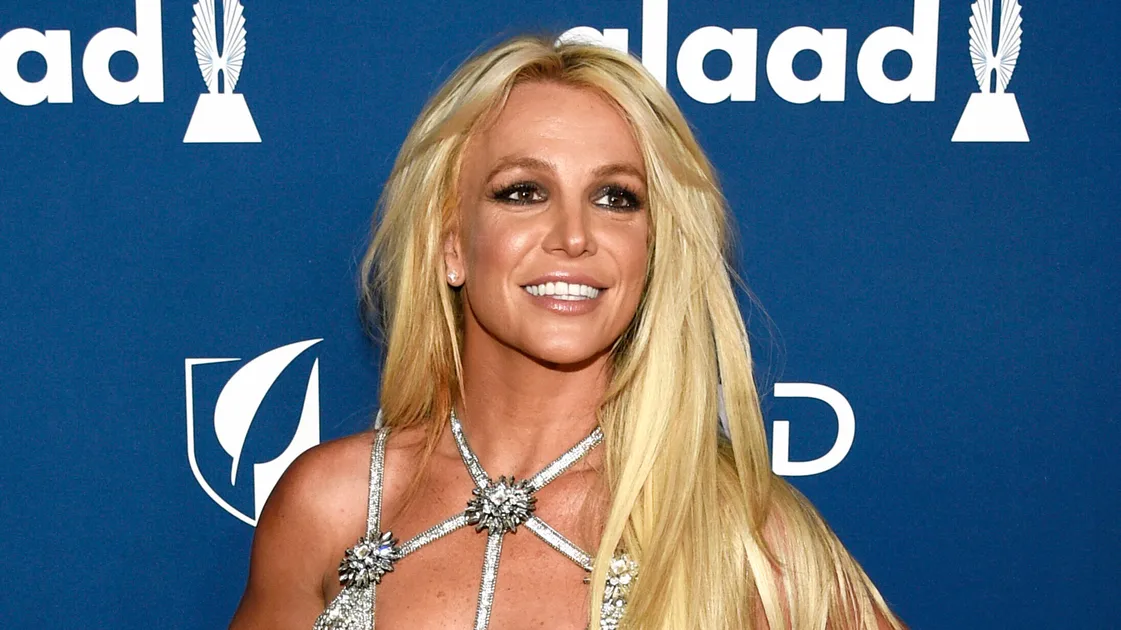
A spokesperson for Britney Spears is sticking up for the singer following accusations that she caused a scene at a Los Angeles-area restaurant on Wednesday night.
TMZ reported on Thursday that Britney had been seen dining out with two people, one of whom was a man she apparently kept saying “I love you” to while they fed each other.
Britney’s rep clarified that she was dining with her assistant and bodyguard at the Blue Dog Tavern in Sherman Oaks, and told a different story than the one reported by TMZ.
Eyewitnesses told the outlet they heard the Piece Of Me star raising her voice, screaming and barking. One described the vibe as chaotic and “kind of sad” though the Grammy winner reportedly “still looked cute”.
At one point, it was reported that staffers had to ask a person with Britney to put out a cigarette she had lit inside, but the most startling moment may have been when she allegedly walked through the restaurant holding a knife.
Entertainment journalist Jeff Sneider wrote on X that he had been dining at the Blue Dog Tavern at the same time as Britney, and called the incident both “wild” and “insane”, adding: “One diner feared for her life. This is not a joke.”
In a statement released to the media, a rep for Britney said the whole story has been unfairly exaggerated.
“Britney was enjoying a quiet dinner with her assistant and bodyguard,” her spokesperson said, while insisting any noise from the singer was because “she was simply telling the story about how her dog was barking at the neighbours”.
“At no point did she put anyone in danger with a knife. She was cutting her hamburger in half,” they added.
“This constant attack on everything that she does and this is exactly what happened 20 years ago when the media tried to depict Britney as a bad person. This is ridiculous and it needs to stop now.”
Britney’s rep notably did not address TMZ’s kissing allegations or the “I love you” comments in the statement.
The story about Britney’s supposedly erratic behaviour comes just over a week after she avoided jail for a DUI charge by pleading guilty to a lesser charge.
She had previously checked herself into a rehab facility following her arrest earlier this year.

Hello and welcome to Canary Catch Up. Each week, our resident telly addict Rachel Charlton-Dailey will bring us bang up to date with the shows she’s been obsessed with, what she’s hate-watching, and what she can’t wait to get stuck into.
Trigger warning: This article contains discussion of homophobic hate crimes and the murder of a gay man. Please take care when reading.
Pride 2026
I’ve been thinking a lot about pride and my local community this week. We, like many parts of the country, got a Reform council in May. For anyone who is disabled and isn’t straight, white and cis, that’s terrifying. What’s especially tough is knowing how many people in our city actively voted against our rights.
One of Sunderland Reform’s first acts in power was to declare that the Pride flag would never fly on government buildings. This will do absolutely nothing to improve the lives of the one in three children who live in poverty here, but the gammons ate it up. That’s why Pride this year feels even more poignant. When so many want us to be silent, we can’t be.
Tip Toe is a terrifying look at queer hate
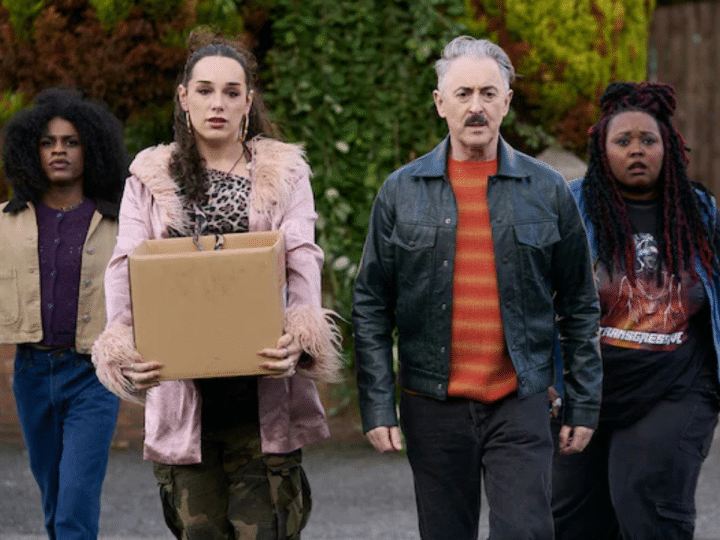
Russell T Davies‘ new Channel 4 mini-drama, Tip Toe, is an unflinching look at how not only rights for queer people are being stripped away but how attitudes are dangerously changing. If you thought this would be a gentle look at how we should just be less homophobic, the opening scene, which shows a gay man strung up on a lamp post, quickly puts that to bed.
The show tackles how social media, politicians and far-right mouthpieces have radicalised so many against queer and trans people. It’s a brutal look at how so many never really accepted us. The hatred has always been simmering away in the background and fuelled by the misinformation screaming at us online.
Overall, Leo (Alan Cumming) just wants to support and protect young gay people, but his neighbour Clive (David Morrissey) only sees that as him wanting to groom and abuse his son.
The results are extreme and violent, but just as sinister is how much the hatred creeps into people who are also supposed to be good.
Leo’s best friend, Stephanie (Elizabeth Berrington), is deeply gender critical. At several points, Stephanie blames girls getting abused on trans women, and even tells Leo that if he were more discreet in his life, he wouldn’t have this trouble.
As a bi woman living in a city that overwhelmingly voted for Reform, this show chilled me to my bones. I have a lot of privilege as a white bi woman to be able to say I’m going to loudly resist. However, I’m doing it for my trans, non-binary and gay male friends for whom it’s much less safe.
To say I enjoyed Tip Toe is almost definitely the wrong thing to say. Tip Toe is an excruciatingly hard watch, as it should be. But everyone, and I mean bloody everyone, needs to watch it. My worry is, though, that they won’t, because the people who hate gay people aren’t going to watch a show like this. Therefore, all it will serve to do is terrify queer people even more.
Rivals’ shocking mid-season finale
Rivals came to a jolting halt with its mid-season finale, which was also absolutely devastating. It’s been clear from the outset how dangerous Tony (David Tennant) and Maud’s (Victoria Smurfit) affair could be. But to see it break Tony’s wife, the long-suffering Monica (Claire Rushbrook), was particularly devastating.
The scene in Lizzie’s (Katherine Parkinson) kitchen between her and Monica, where Monica is clearly not mentally okay and discussing how her life could’ve been, was absolutely heartbreaking.
I cheered when she told Tony she would be taking him for all he’s worth, but then sobbed when it became clear that Rupert (Alex Hassel), one of her oldest friends, was having to break the news of her death to his enemy, Tony.
It must be said how gross it felt that the show killed off a fat queer woman just before she was able to reclaim her life. I can see why it was done, but killing yet another queer woman as a device to further a man’s story will never sit right. Monica deserved so much more. To see her story end like this is horrible.
I’m clinging onto the fan theory that she faked her own death, but I’m not very confident in that. I suspect Monica’s death will be used instead to justify how even more disgusting Tony is about to become.
Mandalorian and Grogu is a silly, lovely tale
On a much lighter note, I took myself to the cinema to see Star Wars: The Mandalorian and Grogu. I’m a big fan of the series anyway, but this movie was the perfect escape from the world. Just two hours of Pedro Pascal and his weird little alien baby being nuisances around the galaxy.
Mind you, be prepared to have very confused feelings for Jabba the Hutt’s son, who they gave a six-pack and is voiced by Jeremy Allen White.
Brain-free binge of the week
This section of the column is going to very quickly become a look into my brain and what I need when times are tough. A lot of the time, that’s political satire and/or Ben Willbond. Lucky for me, The Thick of It has both.
Considering my job, a political comedy-drama that skewers just how embarrassingly incompetent British politicians are might not seem like a break. Sometimes though, you just need a Scottish man inventively screaming swears at the worst MPs imaginable to make your day better.
Featured image via Channel 4

Having the occasional bad night’s sleep isn’t anything to worry about in and of itself, the NHS says.
But if the issue lasts a long time or starts to affect your day-to-day life, it could be worth speaking to a doctor, as this might be down to conditions like insomnia.
Still, those terms can be a little tough to navigate. How long is “a long time”? It feels like everyone complains about feeling tired – how can we tell “normal” fatigue from sleep-disorder-level exhaustion?
Here, doctor and Fellow at the Royal College of Anaesthetists, Dr Sunny Nayee, shared the “3-3-3 rule” he uses to tell bad sleep from a more lasting issue.
What is the “3-3-3 rule”?
“If you experience disrupted sleep at least three nights a week for at least three months, medical practitioners no longer regard it as lifestyle related but in the realm of insomnia,” Dr Nayee said.
He encourages those concerned to ask themselves three questions:
- Do you experience poor sleep for a minimum of three nights?
- Have you experienced poor sleep hygiene for at least three months?
- Does poor sleep impact at least three aspects of your day (fatigue, brain fog, changes in mood, lack of concentration).
After all, he stated, insomnia is usually measured by how you feel in the daytime, not what you struggle with at night.
“A common misconception is that people think insomnia is staring at the ceiling and not sleeping at all,” he wrote.
“However, it’s defined by the impact it has throughout the day. If you find that poor sleep hygiene is having an instrumental impact on your mood, concentration and ability to function, then it may be considered a clinical condition.”
What if I think I have insomnia?
Per the NHS, insomnia is not a life sentence: it is often linked to stress, booze, a poor sleeping setup, or rooms that are too hot or cold, and “usually gets better by changing your sleeping habits”.
The health service recommends going to bed at the same time every day, exercising regularly, ensuring your room is dark and quiet, using comfortable bedding, and unwinding for at least an hour before bed, ie by reading a book.
If changing your sleep habits doesn’t work, if your sleep issues have been going on for months, and/or if your insomnia is “affecting your daily life in a way that makes it hard for you to cope,” speak to your GP.
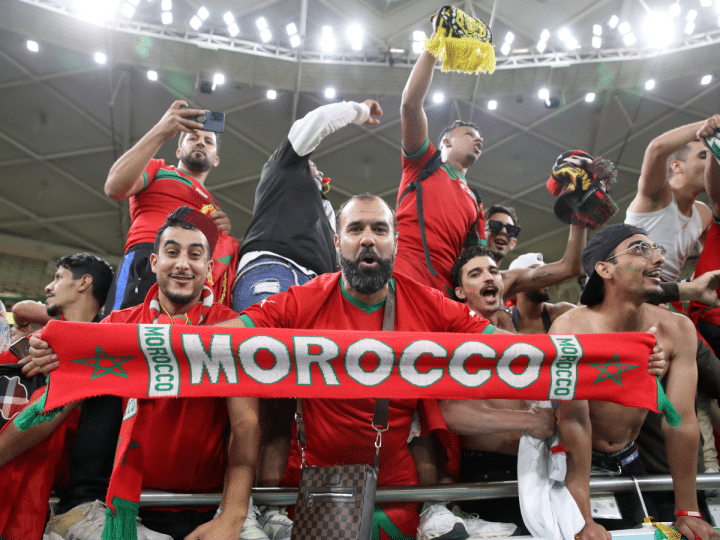
For dozens of Moroccan football fans, the 2026 World Cup was supposed to be another chapter in a long, loyal journey following the Atlas Lions across continents. Instead, it has turned into a financial and emotional blow, as at least 40 supporters were denied US visas despite months of preparation, thousands spent, and a spotless record of following their national team abroad.
The denials have been delivered without clear explanation. They have left fans stranded with match tickets, hotel bookings, and travel plans they can no longer use. For many, the losses run into the tens of thousands of dirhams.
World Cup: everyone saw this coming
The Sports Association of Moroccan National Team Fans, a long‑standing and well‑organized supporters’ group, saw 40 of its 42 applicants rejected. Members had applied from Casablanca, Marrakech, Fès, and Tétouan, expecting routine approvals given their travel history and the nature of their trip.
The group’s head, Azzedine Al Attaraoui, said:
No clear reasons were given for the visa refusals.
We just want to support our national team.
Hespress English reported that:
Al Attaraoui added that several supporters had already booked hotels costing between $400 and $1,000 per night, with some total expenses reaching up to 20,000 MAD covering tickets, visas, travel, and paperwork.
Many of these fans had followed Morocco to Russia in 2018, Qatar in 2022, and even the Paris Olympics but always returning home, always representing the country with pride.
Another group, same story
The Sbouaa (Lions) supporters’ group, who are known for orchestrating the noise, choreography, and atmosphere that have become synonymous with Moroccan fan culture, have faced a similar fate. Nearly 50 of their coordinators applied for visas. Only six were approved.
For a group tasked with organizing thousands of fans inside stadiums, six coordinators is nowhere near enough. They estimate they need at least 30 to recreate the energy seen in Qatar 2022 or the Africa Cup of Nations.
The rejections, they say, were largely issued under Section 214. This is a clause used when consular officers doubt an applicant’s intention to return home. The coordinators insist this makes no sense, they have stable lives in Morocco, long travel histories, and no intention of overstaying.
What stings most is the inconsistency. Moroccan authorities have previously helped facilitate visas for supporters traveling to Chile for the U20 national team. Those visas were issued quickly and efficiently. Fans expected similar cooperation for the World Cup, especially given Morocco’s rising global football profile.
Instead, they find themselves locked out of the tournament they helped energize in previous editions.
Dreams shattered
Behind the numbers are stories of sacrifice. Fans who saved for months. Families who planned entire trips around the World Cup. Supporters who have never missed a major tournament. Coordinators who volunteer their time to create the atmosphere that has made Moroccan fans famous worldwide.
Now, many of them are left with nothing but receipts and disappointment.
This is a real blow to Morocco’s footballing identity. Moroccan supporters have become one of the most celebrated fanbases in world football. Their passion in Qatar was widely praised, and their presence at AFCON tournaments is always felt.
The mass visa refusals threaten to mute that presence at the 2026 World Cup. A tournament where Morocco’s fan culture could have shone again on a global stage.
What can happen
For now, the fans are waiting. Waiting for answers, for intervention, for a solution that might salvage their World Cup dreams. They are calling on FIFA to acknowledge the issue and on Moroccan authorities to advocate on their behalf.
Whether anything changes remains uncertain, but the message from the supporters is clear, they want to be there for their team, as they always have been.
If the situation remains unresolved, the 2026 World Cup may unfold without one of its most vibrant and recognisable fanbases. For the fans, it’s a painful prospect, it’s a loss of energy and support. For the tournament itself, it’s a reminder that football’s global celebration can be derailed by corrupt politicians.
Featured Image courtesy of Francois Nel/Getty Images
By Faz Ali
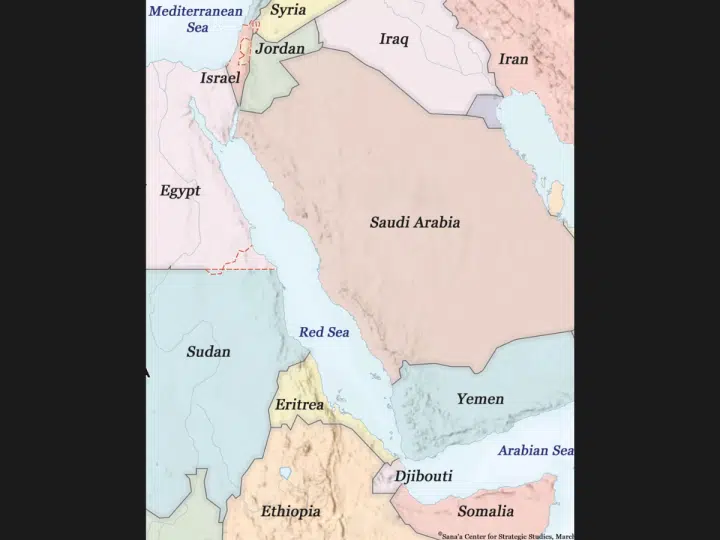
Yemen’s Ansar Allah de facto government has announced the Red Sea is closed to Israeli and Israel-linked shipping.
In a statement, Yemen military said the action is “in response to US-Zionist aggression” against the country plus Iran, Palestine, Lebanon and Iraq.
The announcement comes after Yemen joined Iran’s missile strikes on Israel in retaliation for the occupation’s bombing on the Dahiyeh area of Beirut.
Statement from Yemen
In response to US-Zionist aggression against the axis of jihad & resistance in Iran, Palestine, Lebanon, Iraq, Yemen – and rejecting the Zionist project for “Greater Israel” under the “New Middle East” – the Yemeni Armed Forces have launched a missile strike.
Target: Sensitive Israeli enemy positions in occupied Jaffa area.
Missiles achieved their objectives with precision, by the grace of Allah.
The Yemeni Armed Forces announce:
Complete naval blockade on the Israeli enemy in the Red Sea. From this moment, all enemy movements are legitimate military targets.
Escalation meets escalation – our military operations will continue to rise in line with events and in coordination with the axis of jihad & resistance.
We will not stand idle against the siege on our people & the free peoples of the axis (Palestine, Gaza, Iran, Lebanon, Iraq). Enemy attempts will fail, by Allah’s will. Our operations continue as long as aggression & siege continue against us and the axis.
Allah is sufficient for us, and He is the best disposer of affairs. Victory to Yemen and all the free of the Ummah.
Hard-hitting blockade
In February, Ansar Allah responded to the US and Israel’s unprovoked attacks on Iran by striking US bases in the Gulf.
The Arab country’s 2024 blockade of the Red Sea bankrupted Eilat, Israel’s third-largest port. The US and Israel, as usual, responded to Yemen’s solidarity with their victims by bombing and murdering civilians and journalists.
The resumption of Yemen’s actions, in conjunction with Iranian attacks, is likely to contribute to a repeat of 2025 scenes of panicked European ‘Israelis’ flooding air and sea ports in an attempt to leave the colony. But this is unlikely to be reported by Western state-corporate media.
Featured image via Sana’a Center for Strategic Studies
By Skwawkbox
Politics
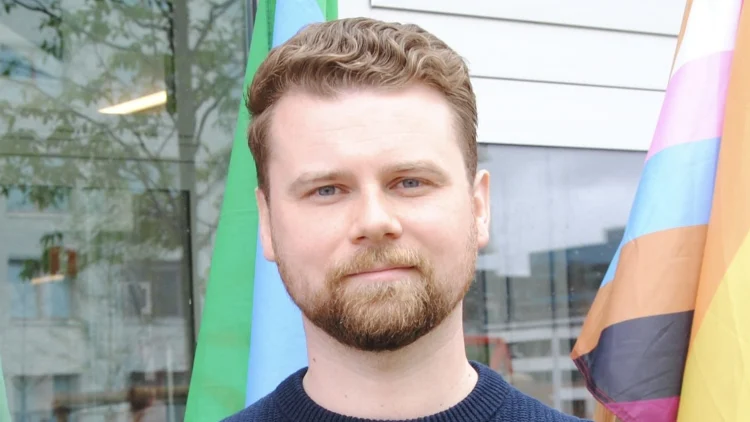
The House | Miles Thorpe: From Former Stationery Entrepreneur To Zack Polanski’s Morgan McSweeney

Miles Thorpe
5 min read
As Labour now knows to its cost, the Greens have sharpened their campaigning prowess considerably in recent years. Tom Scotson profiles Miles Thorpe – the man getting much of the credit for a series of wins
Bill Clinton had ‘ragin’ Cajun’ James Carville, Boris Johnson’s election Svengali was Lynton Crosby and Keir Starmer’s swift path to No 10 is widely credited to Morgan McSweeney. Zack Polanski has a 31-year-old former stationery entrepreneur.
Miles Thorpe, from south London, has knocked around Green Party circles for years but is now developing a reputation that might one day rival the other great campaigners. He is said to have masterminded the impressive victories of Carla Denyer in Bristol Central at the 2024 general election and the Gorton and Denton by-election in February, where Green candidate Hannah Spencer won by more than 4,000 votes.
“He is very focused, good at prioritising, great at recruiting and motivating volunteers and creating a fun team spirit,” says one Green Party source who knows Thorpe well.
Thorpe, who left school at 18, founded Skyline Office Supplies, a stationery business, after working in sales for a brief period. He then left the business world, having not found the work to be very meaningful, and off the back of that, moved to Brighton. The seaside city – where the Greens won their first parliamentary seat in 2015 – was where Thorpe set up Earners, a social enterprise focused on getting people from underrepresented backgrounds into good careers.
It was not until he became involved in the city’s oldest homeless charity that he became political and interested in progressive politics. YMCA Brighton, which works with 400 people each year who are homeless or at risk, opened Thorpe’s eyes to the level of deprivation in the UK as he saw first-hand what happens when the state does not meet people’s needs.
Thorpe door-knocked for Jeremy Corbyn’s Labour in the 2019 election but became a member of the Greens in 2021, after the pandemic and the election of Denyer and Adrian Ramsay as co-leaders. He had wrestled with the question of whether to stay in a larger party less aligned to his values, or switch to a smaller one that could move the two legacy parties by winning council and parliamentary seats against the odds.
He became heavily involved in political campaigning after identifying Bristol Central as a unique seat where the Greens had a chance of winning. For three years, he lived from Monday to Friday in Bristol, building the Greens’ presence organically and working on how they could unseat Thangam Debbonaire, then a shadow cabinet member.
During both elections, Bristol Central and Gorton and Denton, he would open the campaign office around 7am and leave party headquarters at 10pm. With no free time and eating on the move, allies say he had an uncanny ability to galvanise activists. Thorpe credits much of his success to his business background, which made him responsible for juggling data, finances and people’s egos.
He backed Polanski in the leadership race last year, giving an insight into his views in the process. “If we’re not just here to win seats but we’re here to change a country, then we can’t do that quietly,” he wrote on an internal Green Party site.
If we’re here to change a country, we can’t do that quietly
“I hear the concern – ‘We can’t spook the horses.’ The idea that, essentially, we can appeal to a wider range of voters by being ambiguous about our identity. But that has its limits. The limit being: it only works while you’re small enough for people not to notice.
“The truth is: there is space for us. As we are. A space that people are crying out for us to occupy. It’s time to step into that – and show that with the right message, the right messenger and the right policies, people will vote for us. Not in spite of who we are – but because of it.
“In my view, this election isn’t a choice between media cut-through and ground campaigning. It’s about understanding that in modern politics, you need both.”
He had the chance to implement that combination at the Gorton and Denton by-election. Green Party staffer Steve Jackson tells The House: “He operates on a high-trust model. If you are issuing a quote from the press side, he may look at it on the first couple of days, but after that, once he trusts you, he lets you crack on. He’s not a micromanager in any way.
“Miles was always on top of the detail, incredibly well-organised. I don’t think I ever saw him with a notepad, but he was constantly on his phone. If you rang him, he would always pick up, which is impressive considering during the campaign he must’ve been part of hundreds of group chats and receiving hundreds of queries each day.”
His key tip to activists during both elections was reminding them not to think too much about the result, which he believes can negatively affect people’s mindsets.
There is good news for Labour’s Andy Burnham, however: Thorpe is sitting out Makerfield. He has opted for a campervan holiday in Oslo, having travelled across Scandinavia to meet with Norwegian Greens and Swedish Greens.
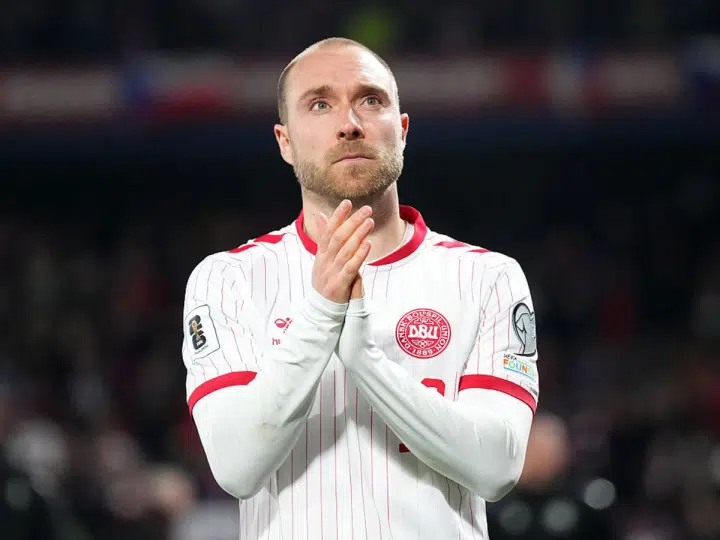
Christian Eriksen is expected to be discharged from hospital soon after he collapsed during the friendly match between Denmark and Ukraine five years after surviving a cardiac arrest.
The match, in which Denmark was leading 2-1, was halted after the veteran midfielder suddenly fell during the 65th minute, leaving players and fans in shock.
Medical teams rushed on to the pitch to provide emergency treatment before he was taken to hospital.
Denmark’s national team doctor, Morten Boesen, who is widely credited with saving Eriksen’s life when he collapsed in 2021, said the player is “doing well”.
He is with his family and in good spirits. The expectation is that he will be discharged soon and can return home.
Latest update from national team doctor Morten Boesen. pic.twitter.com/ZxiL6UjIWc
— Fodboldlandsholdene
(@dbulandshold) June 8, 2026
On Sunday, Boesen shared this statement about Eriksen’s condition:
— EuroFoot (@eurofootcom) June 7, 2026

Eriksen quickly regained consciousness
Eyewitnesses at the stadium in Odense, Denmark, Eriksen clutched his chest moments before collapsing on the field.
Players from both teams formed a circle around their teammate while he received treatment. The scene echoed the terrifying incident during the Euro match against Finland five years earlier when Eriksen suffered a cardiac arrest.
The Danish Football Association later announced, as reported by Reuters, that Eriksen quickly regained consciousness after the incident.
Meanwhile, organisers decided to cancel the match to ensure the safety of everyone involved given the extraordinary circumstances surrounding the event.
Cardiac device intervenes again
The implanted cardioverter-defibrillator (ICD) that Eriksen has had since 2021 functioned normally during this latest health crisis, it was reported. Doctors considered this to be an important factor in stabilising his condition.
The Danish team doctor also said:
Christian Eriksen is doing well and walked off the pitch by himself. As I see it, the pacemaker responded as it should. He was briefly unconscious, but regained consciousness very quickly, and we were quickly in contact with him.
He will now undergo further examinations at the hospital to determine what caused the incident.
While awaiting the final test results, the most important news for football fans remains that he left the pitch conscious and in stable condition. However, this emergency has reopened a wound for fans that had never fully healed since the summer of 2021.
The international sports community will continue to send “strength and love to Christian and the Eriksen family as we await further news”.
Featured image via Gabriel Kuchta/ Getty Images
By Alaa Shamali
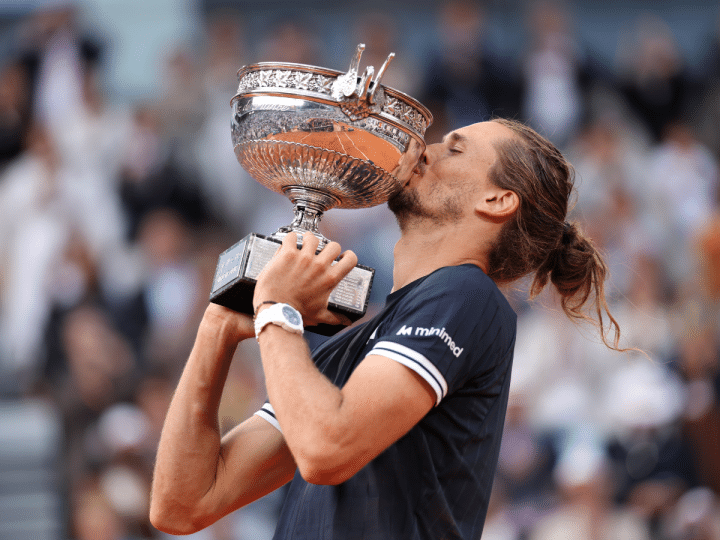
Alexander Zverev is no longer the nearly‑man of men’s tennis. After years of close calls, heartbreaks and three previous failed attempts on the sport’s biggest stages, the German has finally claimed his first Grand Slam title.
And he did it the hard way, outlasting Italy’s Flavio Cobolli in a dramatic five‑set French Open final.
On a sun‑soaked Philippe‑Chatrier, Zverev delivered the performance he has spent more than a decade chasing. The scoreline — 6‑1, 4‑6, 6‑4, 6‑7, 6‑1 — tells the story of a match that swung wildly, demanded nerve, and ultimately crowned a player who refused to let another opportunity slip away.
Alexander Zverev has a lightning start
Zverev opened like a man determined to end the narrative that had followed him for years. He tore through the first set 6‑1, dominating from the baseline and punishing Cobolli’s second serve. The Italian, playing in his first Grand Slam final, looked tight, tentative and overwhelmed by the moment.
The match flipped quickly. Cobolli settled, found his rhythm, and began to match Zverev’s weight of shot. A break midway through the second set gave him the foothold he needed, and he rode the surge of energy from the crowd to level the match at one set apiece. Suddenly, Zverev was no longer cruising. He was in a fight for the title.
Trading blows in a tight third set
The third set became a test of margins, it had long rallies, heavy hitting, and both players refusing to blink. Zverev edged ahead with a crucial break, leaning on his serve to keep Cobolli at bay. The German’s composure returned, and with it, the sense that he was beginning to reassert control. He took the set 6‑4, moving one away from the title.
Cobolli’s surge and a tense tie-break
The fourth set was chaos with momentum swings, missed chances, and a rising Italian who refused to go quietly. Cobolli, who had benefitted from extra rest after receiving a semifinal walkover earlier in the week, looked fresher as the set wore on. He broke Zverev twice, surged to a 5‑3 lead, and seemed poised to force a decider.
Zverev, battling visible discomfort in his lower body, clawed back to 5‑5. The tension was suffocating. Every point felt decisive. The set spilled into a tie-break, where Cobolli was fearless, aggressive, and riding the moment, he struck the decisive blows. He took it 7‑5, sending the final into a fifth set and igniting the Parisian crowd.
For Zverev, it was familiar territory, another Grand Slam final, another lead slipping away.
Career-defining set
Zverev came out for the fifth set with a clarity and conviction that had eluded him in previous finals. He broke Cobolli immediately, then again, racing to a 4‑0 lead. The Italian’s legs, so lively in the fourth, began to betray him. The German’s experience, power and poise took over.
At 5‑1, Zverev earned championship points. On the second, Cobolli pushed a return long, and Zverev collapsed onto his back, hands over his face, overwhelmed by the moment he had chased for so long.
This was not just a match. It was the culmination of a journey defined by near misses and painful memories.
Zverev had lost Grand Slam finals in 2020, 2024 and 2025, each in its own agonising fashion. He had suffered a devastating ankle injury on this very court in 2022, leaving in a wheelchair and unsure if he would ever return to the same level.
He had been labelled the best player never to win a major. Now, that label is gone.
His triumph also marks a historic moment for German tennis, the first men’s Grand Slam singles title for the country since Boris Becker won the Australian Open in 1996.
Though defeated, Cobolli leaves Paris transformed. The 10th seed had never been this deep in a Slam before, but his run aided by a semifinal walkover yet defined by fearless shot‑making, has announced him as a rising force in the sport.
He pushed Zverev deeper than many expected, matched him physically for long stretches, and showed a competitive edge that suggests this will not be his last appearance on a major stage.
His fourth‑set surge, in particular, electrified the crowd and turned the final into a genuine spectacle.
A tournament of opportunity
This French Open was wide open from the start. Carlos Alcaraz withdrew with injury. Jannik Sinner suffered an early exit. Novak Djokovic was eliminated before the second week. The draw cleared, and Zverev, who has long been burdened by expectation suddenly had a path to greatness.
He beat Benjamin Bonzi, Tomáš Macháč, Quentin Halys, Jesper De Jong and Jakub Menšík en route to the final, navigating the chaos of an upset‑filled tournament with a steadiness that had often deserted him in the past.
What does this mean for Alexander Zverev?
This title changes everything. It validates years of work, silences doubts, and resets the trajectory of his career. He now becomes part of a rare group of players who won their first major in their fourth final, joining names like Andre Agassi, Goran Ivanišević and Dominic Thiem.
With Wimbledon looming, Zverev enters the next phase of the season not as a contender searching for a breakthrough, but as a Grand Slam champion with the confidence to chase more.
A classic French Open final
This was a match that had everything: dominance, collapse, revival, tension, and ultimately, redemption.
Alexander Zverev’s maiden Grand Slam title wasn’t handed to him. He had to fight for it, suffer for it, and steady himself when the ghosts of past failures threatened to return. Cobolli pushed him to the edge, but the German found the resolve that had eluded him in previous finals.
In the end, he lifted the Coupe des Mousquetaires high above his head. A trophy 13 years in the making, earned on the court that had given him both his darkest and now his brightest moments.
Featured image via Clive Brunskill/ Getty Images
By Faz Ali
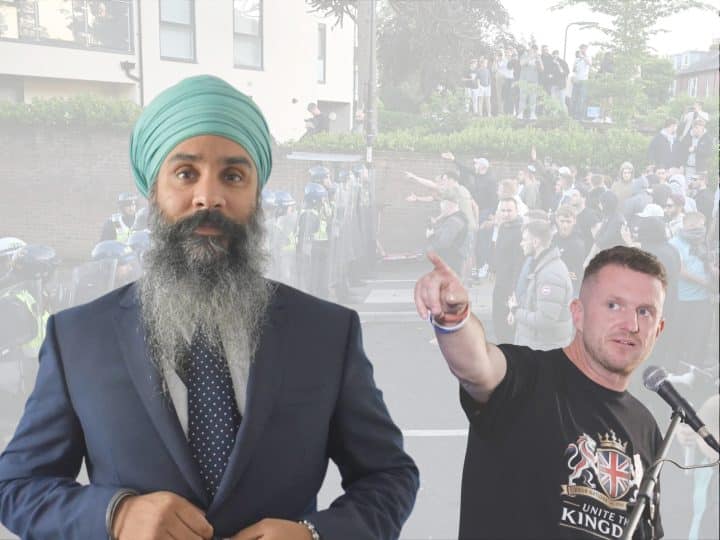
Tommy Robinson is a far-right agitator who’s led street movements like the English Defence League (EDL) and Unite the Kingdom (UtK). While Robinson’s propaganda has shifted over the years, the common throughlines have been Islamophobia and the fear of migrants.
As these prejudices aren’t unique to white Brits, there are some people from minority groups who have thrown in with Robinson and his ilk.
Now, one of the Sikh men who supported Robinson in the past is being warned to watch his back.
Short story:
Bobby Singh, who twerks for Tommy Robinson, is now being threatened by Tommy Robinson.
"If I personally see Bobby Singh, I'll personally punch his fucking head off." pic.twitter.com/CKsdzy0Npv
— Mukhtar (@I_amMukhtar) June 7, 2026
Robinson’s ex-mate Bobby Singh — who is he?
Bobby Singh is the co-founder of Love Your Postcode, a real estate and property management company. Recently, Singh attended the far-right Unite the Kingdom rally (as Mukhtar highlighted in the video above), where he voiced his support for Robinson. He’s also reshared anti-Muslim posts from Robinson like the following:
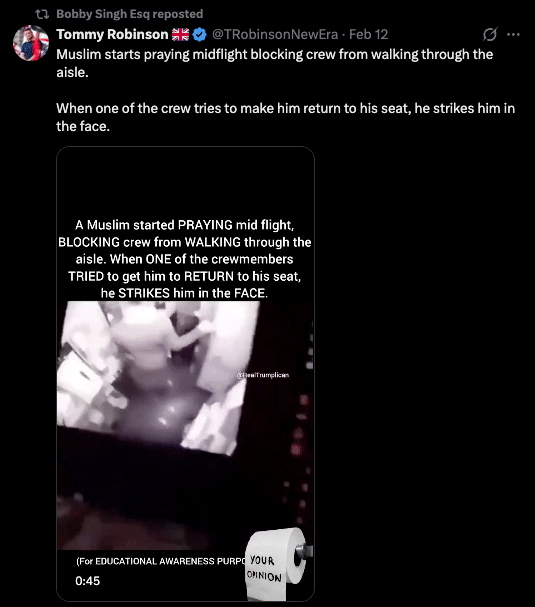
Because the above comes from Robinson — a known bullshitter and far-right propagandist — most people would ask themselves:
- Is this AI?
- Was it staged?
- Did it happen recently or years ago?
The other thing to remember is that sometimes Muslim people commit crimes. This is true of every group. But smear merchants like Robinson give the impression that Muslims are uniquely bad by only highlighting crimes committed by them.
Either Singh is willing to turn his brain off when he sees Islamophobic content or he lacks critical thinking skills.
The controversy surrounding Singh
Singh has now attracted controversy because of a TikTok panel in which he asked viewers to vote one “if you’re in support of the Singh” or two “if you’re in support of Henry”. From context, it’s clear that the men in question are the murderer Vickrum Digwa and his victim Henry Nowak (most baptised Sikh men have the surname ‘Singh’, but Digwa does not).
The video attracted greater controversy because at one point another man asks to change the vote, stating:
Can you put a 1 in the comments if I should piss on Henry’s grave, and a 2 if I should shit on his grave.
Singh has since claimed the backlash is a ‘character assassination’, and that while he was on the TikTok panel, he doesn’t agree with everything that was said.
Bobby Singh has RESPONDED to the live TikTok video circulating online.
In it, he shared a panel with someone who asked: “should I shit or piss on Henry Nowak’s grave?” The video also shows him agreeing that “Henry is wearing a turtleneck, so he means trouble,” and endorses… pic.twitter.com/V5Vo7xP5Ky
— Sydney Jones (@SydneyJones_) June 7, 2026
Regardless of whether Bobby Singh made the worst comments or not, it was clearly in poor taste to ask viewers to vote on which man they backed.
Digwa murdered Nowak with an illegal weapon, and then he fooled the police into thinking Nowak was the aggressor. Digwa’s actions, then, contributed towards a situation in which Nowak was handcuffed while bleeding out (with the other factor being police incompetence).
Dis-unite the Kingdom
Ironically, Love Your Postcode says the following about itself:
Our commitment to community cohesion and philanthropy is interwoven with a passion for business, inspiring others to lead with confidence and a sense of social responsibility.
We say, ironically, because co-founder Singh attended Robinson’s Unite the Kingdom rally, this now-yearly event isn’t committed to “community cohesion” at all. We say that because it promotes “remigration”.
Speakers at the first event included the Dutch Generation Remigration. The Canary wrote this about the group:
Well, they’re the leading proponents of ‘remigration’, which is the plan to mass deport migrants and their descendants from European countries.
We’re not quite sure how that will work in Britain given the continuous influxes of populations we’ve experienced since the Roman Empire, except we are sure, obviously – they’re talking about deporting Black and brown people.
Generation Remigration did not attend the 2026 UtK event. No doubt because key member, Eva Vlaardingerbroek, was banned from entering the UK earlier this year.
Robinson has kept the ethnic cleansing torch burning, anyway, and regularly posts about “remigration” himself. Take this from 12 May:
Invaders and their offspring, tormenting and brutally attacking our people in Europe and filming it “for fun” and to assert dominance.
Remigration and de-islamisation can’t come quick enough.
You’ll note Robinson calls for “remigration” and “de-Islamification”. He’s doing this to make it clear it won’t just be Muslims who go.
You’ll also notice he’s not saying something like ‘deport the non-indigenous Brits‘. This is because the in-group currently includes all white Europeans.
This won’t last, of course, and we only have to look back to 2016 to see when the far right was actively hostile towards continentals — most notably Polish people.
Clearly, to anyone smart enough to read between the lines, Bobby Singh isn’t in the in-group, so why was Robinson promoting him before this latest controversy? And why was Singh promoting Robinson?
Singh and Robinson: Bedfellows
To Robinson, there’s an obvious benefit to tolerating a guy like Bobby Singh. Specifically, he can point at him and say: “See, how can I be racist when I’m best mates with this guy?” The answer is obvious, and it’s that in this case, the two are friends because of racism, specifically racism against migrants, which seems to be Singh’s beef if his retweets are anything to go by.
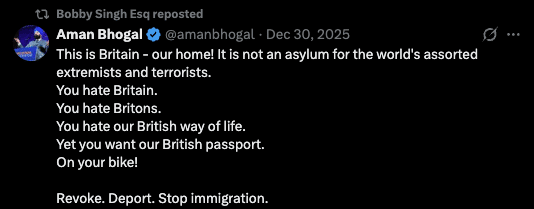
In modern Britain, establishment politicians like Nigel Farage warn ‘All migrants are bad‘ and their supporters hear ‘All Muslims are bad‘.
Inevitably, this becomes ‘All Black and Brown people are bad‘, because believe it or not, the white rioters shown below aren’t the best at identifying cultural signifiers; they just see a person’s skin colour and lose their minds.
Dozens of bricks being thrown pic.twitter.com/VwPXkfZlmR
— Taj Ali (@Taj_Ali1) June 2, 2026
Unless you’re a white British man, a guy like Robinson will always always turn on you at some point. But for some, their desire to punch downwards overrides their instincts for self-preservation.
To be fair, what Singh said was obviously grim, but Singh isn’t the only Sikh man facing backlash from the far-right.
Sikhs at a London remembrance march describe their fears and report a rise in abuse following Henry Nowak’s murder.
— Sky News (@SkyNews) June 7, 2026
 https://t.co/Zl3K65O6Kq pic.twitter.com/WB5y5UwmnD
Nigel Farage has retweeted JD Vance's tweet, calling British Sikhs "mass invasion of migrants."
Like I said the other day. Look how quickly they turned on the Sikh community. pic.twitter.com/1eGb1WYbnb
— Mukhtar (@I_amMukhtar) June 6, 2026
In-fighting
Known white supremacists like James Goddard are repeating the following:
Deport the Sikhs
It should be noted Robinson is still defending Sikhs despite a significant proportion of his far-right followers turning on them.
About 535,000 Sikhs live in the UK (around 0.8% of the population).
The Sikhs aint taking over our towns or cities, or even the UK for that matter you fucking moron.
They integrate and add value, they love, respect and do fight for our country. Sikhs are not… https://t.co/bv5Qa4IUwp
— Tommy Robinson
 (@TRobinsonNewEra) June 4, 2026
You're a disingenuous shithouse.
Fuck you and your framing. Nobody said we should "give up our homeland to Sikhs", own it dickhead.
— Tommy Robinson
(@TRobinsonNewEra) June 4, 2026
Lest we forget, Robinson literally calls for “remigration”. Clearly he doesn’t actually respect Sikhs; he’s just using them as cover for his Islamophobia.
What this shows, anyway, is that it’s impossible to maintain tactical positions on the reactionary far right. There will always be those who are willing to go further, and they will always find themselves arguing from a stronger position because the logical end point of this ideology is a patriarchy of indigenous whites.
An odd one
One final thing to note about Bobby Singh is that he’s not completely deluded about the white supremacist movement he’s attached himself to. In a video which appears to have been filmed at Unite the Kingdom, Singh said:
And by the way, just for the record, just for the record, lads. If they do go back and you ask me to go back, I wouldn’t have a fucking issue…There is no greater honour than going back to a country where it’s your real people of your colour. So what I’m saying is, mate, I’m patriotic, but if you ever want to say to me, ‘Bobby, your time’, I’m more than happy.
It’s not good that Singh — or anyone — feels this way. Every British citizen who isn’t 100 years old grew up in a multicultural country. The problems we’ve faced since then don’t arise from that fact; they arise from rich people stealing all of Britain’s wealth while blaming minority groups as cover.
Speaking as a white Briton, believe me, skin colour is no indicator of individuals being “your real people”. The people I have the least in common with in this country are the white identitarians who line up behind Tommy Robinson. If such people ever take power, I’ll be doing everything I can to move to a country that doesn’t treat skin colour as the defining characteristic.
Although Bobby Singh may not have an issue, you have to assume foreign countries would object to us banishing millions of European-born citizens into their territories. This might surprise people who think the British Empire never ended, but we actually don’t have the right to dump people wherever we like. This is especially true when it comes to nuclear powers like India and Pakistan.
The few
It’s important to re-emphasise that guys like Bobby Singh are a minority of a minority. Most Sikhs don’t support a movement which will inevitably come for them. At the same time, most would never willingly volunteer to be deported to a country they weren’t born in.
Singh being ex-communicated from the British far right was predictable. The same thing will happen to every other person who isn’t a member of the core inner group because this movement is only heading in one direction.
Featured image via Mario Tama/ Finnbarr Webster/ Getty Images
By Willem Moore
The World Cup is supposed to be the moment the world comes together. Instead, with less than a week to go, the United States is facing mounting accusations that it is shutting the world out.
The International Sports Press Association (AIPS) has formally written to FIFA, warning that “many” Iranian and African journalists have been denied visas needed to cover the 2026 tournament on U.S. soil.
The letter sent June 5 and published on the AIPS website, was addressed to Bryan Swanson, FIFA’s director of media relations, and Jochen Steinhoff, FIFA’s head of media operations & services. And its message was blunt.
AIPS president Gianni Merlo wrote:
We find ourselves facing a long-standing and unacceptable problem for us journalists: the denial of entry visas to regularly accredited colleagues.
He went further, saying the issue is widespread and worsening:
There are many cases: Iranian colleagues, African colleagues, some of whom have been given single entries, so if their team goes to play in Canada or Mexico and they follow it, they can no longer return to the States. The cases are countless and, I repeat, unacceptable.
For a tournament marketed as the most inclusive in history, the optics are disastrous.
World Cup chaos
Merlo’s letter cuts at the heart of the contradiction: the U.S. is hosting a global event while enforcing some of the strictest immigration policies in modern American history.
Politicians always say that sport unites and builds bridges between young people in countries in conflict, but in this case, we are going in the opposite direction.
He warned that blocking journalists undermines the very image FIFA claims to champion:
We believe it is important to allow colleagues to attend the event and work, because their presence will be crucial to the image of sport and what it represents, especially in a country like the United States of America, where freedom of the press is a must.
The practical consequences are already being felt. Some journalists have lost money on flights they can no longer use. Others face the prospect of being locked out of the U.S. mid‑tournament if they follow their teams to Canada or Mexico.
Merlo explained:
We’re already significantly behind schedule, and many colleagues have already lost the opportunity to use plane tickets booked on time, and they’ll also face significant additional expenses.
FIFA responds by passing responsibility back to governments
FIFA confirmed it had received the AIPS letter. A spokesperson said only that:
the ability to enter host countries are ultimately consular and immigration matters.
In other words: FIFA are trying to dodge any blame for this.
But that stance is becoming increasingly difficult to defend. Multi‑entry visas are essential for journalists covering teams that move between the three host nations. Ivory Coast, for example, will play in Philadelphia, then Toronto, then back to Philadelphia. Senegal finish their group in Toronto and may need to return to the U.S. for the knockouts. Tunisia start in Mexico before heading to Kansas City.
If journalists can’t follow them, fair coverage simply collapses.
The timing of the dispute is awkward. AIPS and FIFA have long maintained a close working relationship. In April, dozens of AIPS representatives visited FIFA’s headquarters in Switzerland. AIPS even awarded FIFA the Best Press Facilities Award for 2025, praising its media operations during the Club World Cup in the U.S.
At that event, Swanson told delegates:
We appreciate and respect the important work of the media. We understand journalists have a job to do in covering FIFA’s activities and we do what we can to support you… All we ever ask is to be reported on with fairness and balance.
Those words now ring hollow for the reporters who cannot even enter the host nation.
The Trump factor
The visa crisis cannot be separated from the political climate. Since returning to the White House last year, President Donald Trump has reinstated and expanded travel restrictions affecting several World Cup nations.
The U.S. has active travel bans on nationals from Iran, Haiti, Senegal, and the Ivory Coast. That is four countries that have qualified for the tournament. Additional visa bond measures apply to Algeria, Cape Verde and Tunisia.
Athletes, support staff and immediate family members are exempt. Fans and journalists are not.
This is the core of the crisis: the World Cup is being hosted by a country that is simultaneously restricting entry to the very people who make the event global.
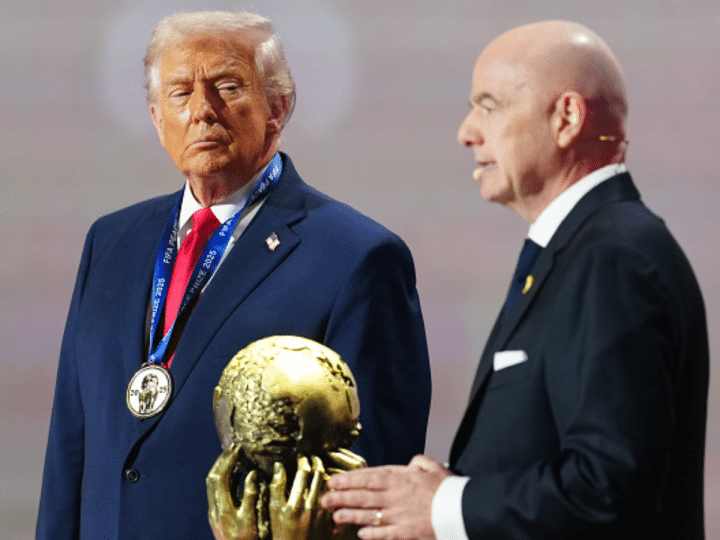
The situation also places FIFA president Gianni Infantino under renewed scrutiny. In December, he controversially awarded Trump a FIFA Peace Prize. And only this week, after meeting Trump, Infantino posted on Instagram:
America is ready to welcome the world for the FIFA World Cup 2026, I thanked (Trump) and his Administration for their continued support of this truly global event.
But Infantino’s past statements now haunt him. In 2017, during the U.S. bid to host the tournament, he said:
Any team, including the supporters and officials of that team, who qualify for a World Cup need to have access to the country, otherwise there is no World Cup.
Trump himself wrote to Infantino in 2018 promising that:
all eligible athletes, officials and fans, would be able to enter the United States without discrimination.
Those assurances now look a lot like lies.
A U.S. State Department spokesperson said
The United States is well prepared to welcome legitimate travelers from around the globe for the largest and greatest FIFA World Cup in history.
But the statement also made clear that security takes precedence:
The Administration will not waver in upholding U.S. law and the highest standards of national security and public safety… We adjudicate each visa application on a case-by-case basis after rigorous review and thorough vetting.
That leaves journalists, especially those from countries under travel restrictions in limbo. Clearly, the US’ definition of “legitimate” differs from the rest of the world.
A total disaster before it begins
The World Cup is meant to be a celebration. Instead, the conversation is dominated by who can’t get in.
The AIPS letter is more than a complaint, it is a warning. If journalists cannot enter the United States, the world cannot see the World Cup. Coverage will be uneven, distorted, or absent entirely for nations already underrepresented in global media.
The symbolism is stark, a tournament branded as “uniting the world” is being undermined by the host nation’s own policies.
FIFA can insist immigration is not its responsibility. The U.S. can insist security comes first. So unless the two sides find a solution, the 2026 World Cup risks becoming the most politically fraught, least accessible tournament in modern history.
A global event cannot function if the world cannot attend.
Featured Image via Jia Haocheng – Pool/Getty Images
By Faz Ali

We hope you love the products we recommend! All of them were independently selected by our editors. Just so you know, HuffPost UK may collect a share of sales or other compensation from the links on this page if you decide to shop from them. Oh, and FYI — prices are accurate and items in stock as of time of publication.
As a shopping writer, I test endless products each month. But, naturally, I don’t love everything.
Some of them, I’m holding my breath to get through, and the others stick around for, well, forever.
Whether you’re looking for a pay day treat or simply nosey about what I’ve been up to this month (I see you), here are 17 things I tried this month that will stay by my side for the forseeable.

Morgan Wallen Hurls Security Guard’s Phone Across Stage

Splurge Monday’s Workwear Report: Papercut Flower Cotton Knit Sweater

Kuami Eugene, Rotimi – Cryptocurrency (Official Video)



-

 Fashion3 days ago
Weekend Open Thread: Evereve – Corporette.com
-

 Business7 days ago
Jade Biosciences, Inc. (JBIO) Discusses Positive Interim Results From JADE101 Phase I Healthy Volunteer Study and Development Plans Transcript
-
 Crypto World3 days ago
Jensen Huang Approves Samsung, SK Hynix, and Micron for NVIDIA (NVDA) HBM4 Memory Supply
-
 Sports6 days ago
French Open 2026 results: Alexander Zverev beats Rafael Jodar and will play Jakub Mensik in semi-finals
-

 Tech6 days ago
CryZENx Releases Fresh Playable Content Deep Inside Jabu-Jabu for His Ocarina of Time Remake
-
 Business5 days ago
Trump Taps Housing Chief Bill Pulte as Acting Intelligence Director After Gabbard Exit
-
 Business1 day ago
The Pain Points Taking a Fragile Tech Rally Down a Notch
-
 NewsBeat6 days ago
Republicans balk at Trump’s attempt to appoint a MAGA enforcer to lead National Intelligence
-
Crypto World3 days ago
LBank Surpasses 25 Million Users Worldwide as AFA Partnership Continues to Drive Global Growth
-

 Tech3 days ago
RCS Messages Between iPhone and Android Get End-to-End Encryption With iOS 26.5
-

 Tech3 days ago
Microsoft launches MXC, an OS-level sandbox for AI agents, with OpenAI and Nvidia already on board
-
 Crypto World6 days ago
Seagate (STX) Stock Surges to Record High on AI Boom and Legal Settlement
-

 Tech3 days ago
Meta steals a tactic from Tesla and builds data centers in tents
-

 Crypto World23 hours ago
Trump’s AI Ownership Plan Could Benefit Anthropic at OpenAI’s Expense
-

 Business3 days ago
(VIDEO) Justin Bieber Delivers Surprise Happy Birthday Serenade to Diners at Los Angeles Mexican Restaurant
-
 Crypto World5 days ago
EU AI Data Center Project Faces Delays as Funding Gaps Grow
-

 Entertainment5 days ago
Did The Mandalorian And Grogu Already Ruin The Next Star Wars Movie?
-

 Business5 days ago
Aehr Test Systems Stock Soars 17% Amid Surging AI Demand and Conference Spotlight
-
 Crypto World3 days ago
Merlin (MRLN) Stock Soars 32% on Major USSOCOM Autonomy Milestone
-
 Business6 days ago
Claude AI Down Today Reason: Why Anthropic’s AI is not working today? What’s the latest quota update
You must be logged in to post a comment Login