

Politics
The Best Frying Pans Of 2026, From Ceramic To Stainless Steel And Non-Stick

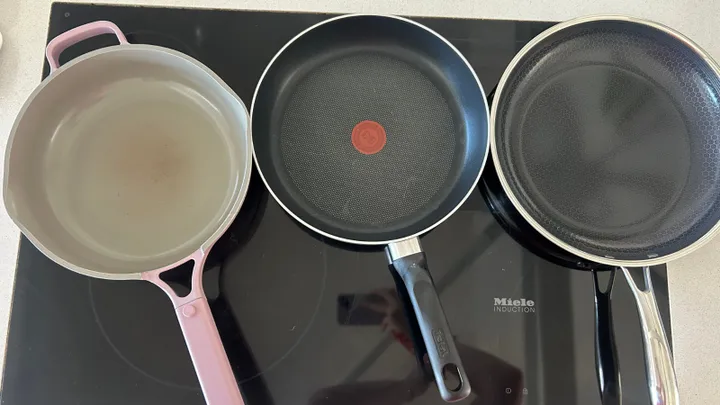
We hope you love the products we recommend! All of them were independently selected by our editors. Just so you know, HuffPost UK may collect a share of sales or other compensation from the links on this page if you decide to shop from them. Oh, and FYI — prices are accurate and items in stock as of time of publication.
Is there anything worse than a pan whose non-stick fails you after a few short years? Or buying a brand new pan and realising it’s not compatible with your hob?
As someone who’s experienced both, let me tell you: it’s not a situation you want to find yourself in.
As a kitchen essential, a great frying pan can make the difference between food that you want to feast on with your eyes as much as your mouth, and an undercooked, soggy mess.
Too many times have I spent upwards of £100 on a new frying pan only for it to get scratched by the whisper of a utensil.
And I’m sick of it! If you’re anything like me, you’ll want a pan that is not only efficient to cook with, but enhances the flavour of your food, and is easy to wipe clean or chuck in the dishwasher.
Whether you’re looking to upgrade your culinary prowess, or simply want a new pan to add to your collection, I’ve found the best frying pans available on the market right now.
What to consider when buying a frying pan
- Hob: Not all pans are compatible with induction hobs, so you’ll need to check before buying
- Material: Different materials cook, well, differently. Stainless steel pans heat up more evenly than ceramic or non-stick, and can reach higher temperatures, making them more suitable for searing. But, similar to cast iron pans, require treating to make sure they’re non-stick.
Ceramic pans are non-stick, which makes them great for cooking eggs. - Size: You might want to buy a mixture of sizes for every purpose.
- Dishwasher-friendly: Some pans can be cleaned in the dishwasher, but most must be cleaned by hand. Make sure you check this before you buy a pan if you have a preference, and also before you chuck it in the machine.
Difference between non-stick, ceramic, stainless steel, and cast iron pans
Traditional non-stick
- Very easy to use, releases food
- Versatile
- Often cheaper than ceramic, stainless steel or cast iron pans
- Some brands use toxic chemicals in the coating, which when damaged can seep into your food. Research each brand before buying to avoid
- Scratched with metal utensils.
Ceramic
- Easy to clean
- Fewer chemicals than traditional non-stick
- Can use on high heats, heats up quickly
- Versatile
- Eco-friendly
- Hand wash only
- Might not be as durable as stainless steel pans.
Stainless steel
- Don’t contain chemicals like traditional non-stick
- Heats up quickly and evenly
- Durable, they often last for life
- Can be non-stick (but require treating)
- Lighter than cast iron
- Dishwasher-safe
- Takes work to figure out how much heat and fat is needed to make it non-stick.
Cast iron
- Retains heat well
- Non-stick when seasoned
- Heavy
- Needs to be seasoned to prevent rust and make it non-stick
How I chose the best frying pans

As someone who cooks every day, I’m always thinking about how well my frying pan is performing. I tested several of the frying pans on this list, thinking about what they were best for cooking, how much maintenance they required, how non-stick they were compared with what they claimed to be, their size, whether they were dishwasher friendly and whether they were induction hub friendly.
Those I didn’t test myself, I crowdsourced from friends, family, and colleagues. I also read through thousands of reviews to see which were the best rated against the above criteria.
The best frying pans to buy in 2026

Best ceramic coated stainless steel pan
For the best of both worlds, Hexclad pans blend stainless steel with ceramic coating for pans that can be used on a high heat and don’t require treating. Designed in collab with Gordon Ramsay himself, this frying pan can just as easily sear as it can be wiped down. As if by magic, its handle won’t heat up, while the body can withstand up to 480 degrees in the oven. Even better, it can be popped in the dishwasher when you’re done, and you won’t even need to treat it!
Type: Stainless steel pan with ceramic coating
Size: 30cm
Induction friendly: Yes
Dishwasher friendly: Yes

Best for every day use
If you’re anything like me, you’ll be suspicious of anything that comes across your Instagram feed. And I’ll admit, this all singing, all dancing pan does sound too good to be true, but after two years of using it I can confirm it’s my go-to for everyday cooking. Thanks to the ceramic coating, it’s supremely non-stick. After a couple of years there’s a slight decrease in it’s non-stickiness, but nothing that means I can’t cook eggs. As well as coming in a range of gorgeous colours, it has a ton of practical accessories like a lid, a spatula that slots onto that little nub on the handle, and a steaming basket for everything from pasta to making a set custard.
Type: Aluminium pan with non-stick ceramic coating
Size: 26.7cm
Induction friendly: Yes
Dishwasher friendly: No

Best budget non-stick
My grandma swears by Tefal for cooking on the hob, and every time I’ve ever wanted a pan she’s bought me this one. It comes in at just £10, and is as non-stick as they come. While it scratches more easily than my Our Place one, the fact it’s such a budget option means I’ll always come back to it when I need a replacement.
Type: Teflon non-stick
Size: 24.8cm
Induction friendly: Yes
Dishwasher friendly: No

Best enamel-coated cast iron
If you’ve ever held a Le Creuset pot, you’ll have an idea of how study this pan is. Designed for sautéing, the cast iron base doesn’t require much heat to get things going, and it’ll sear everything from a hunk of protein to delicate greens perfectly. Although it has an enamel coating, it still needs to be seasoned, but eventually it will build up a non-stick resistance. That wooden handle will also make your life much easier by not burning your hands while you toss away.
Type: Enamel-coated cast iron
Size: 28cm
Induction friendly: Yes
Dishwasher friendly: No

With over 1,000 five-star reviews, it’s clear why this pan is such a fan favourite. It’s forged, which means the base is intended to be extremely scratch-resistant, and will last longer than other pans. You’ll even get a 25-year guarantee to prove it. It can go in oven up to 260 degrees, making it ideal for broiling or grilling, but is also induction hob and dishwasher-friendly. Check all our boxes, why don’t you?
Type: Non-stick
Size: 22cm
Induction friendly: Yes
Dishwasher friendly: Yes

Best titanium pan
By some miracle, Our Place has found a way to make a titanium pan non-stick without toxic chemicals. Its NoCo nonstick interior is free from lead, PFAS, PFTE, and PFOA, and its titanium surface is 300 times more durable than stainless steel. Not only is it suitable for every kind of hob, but it can hold its own in up to 535 degree heat. To prove its excellence, Our Place is offering a lifetime guarantee on this pan. Yep, even after you put it in the dishwasher.
Type: Non-stick
Size: 31.6cm
Induction friendly: Yes
Dishwasher friendly: Yes

Best small non-stick pan
When you’re cooking for one, it seems pointless to dirty a whole pan. When it’s dishwasher-safe, though, it’s another matter entirely. Perfectly sized for eggs or meals for one, this pan promises to be flake-free and five times more durable than regular non-stick pans. Thanks to the forged aluminium base, it heats up quickly and evenly, and it’s so non-stick you don’t need much oil or butter to start a meal off. Even more impressive is the fact it comes with a lifetime warranty, especially when it costs just £30 to begin with.
Type: Non-stick
Size: 20cm
Induction friendly: Yes
Dishwasher friendly: Yes



Pressure is mounting on Scotland’s nature agency after it confirmed a new licence application has been received for the guga hunt this year.
The guga hunt involves the annual killing of gannet seabird chicks in the Outer Hebrides. Now the controversial practice is once again under consideration for 2026 after an application was submitted by the 10-man hunting team based in Ness on the Isle of Lewis.
The hunt, which takes place on the remote island of Sula Sgeir, has been carried out for centuries and was once used for food during harsh winters. However, campaigners argue that young gannet flesh is now considered a delicacy – something they say is unnecessary, cruel, and increasingly incompatible with modern values.
The guga hunt has become one of Scotland’s most controversial wildlife issues, with a petition launched by wildlife photographer Rachel Bigsby calling for an end to the practice becoming the largest submitted to the last Scottish parliament.
Guga hunt allowed due to legal loophole
Killing wild birds is normally illegal, but the guga hunt continues under a specific exemption in the Wildlife and Countryside Act. The issue is now set to return to the Scottish parliament, where campaigners hope the exemption will finally be removed and the hunt outlawed.
High-profile protests against the hunt have continued to grow, including a rooftop occupation of NatureScot’s headquarters, where anti-guga hunt activists remained for two nights demanding an end to the licensing of the hunt.
Protect the Wild, one of the leading organisations campaigning against the hunt, said its own petition calling on NatureScot to stop licensing the hunt has attracted more than 183,000 signatures, making it the largest petition ever received by Scotland’s nature agency.
The group is calling on NatureScot to refuse this year’s licence. It says the agency is now the only thing standing between the colony and another year of “senseless slaughter”.
Devon Docherty, Scottish campaigns manager at Protect the Wild, said:
The guga hunt is one of the cruellest and most ecologically reckless wildlife practices left in Scotland – and NatureScot is the only thing standing between these birds and another year of senseless slaughter.
Every year, defenceless gannet chicks are beaten to death on a supposedly protected island – all for an outdated delicacy that nobody needs.
According to new polling commissioned by Protect the Wild, 77% of Scots who expressed a view said they support banning the guga hunt.
Docherty added:
The science is unambiguous: this is the only Special Protection Area for gannets in decline, and the hunt itself is suppressing the colony’s recovery. The vast majority of the public are against this practice and want to see wildlife being respected.
NatureScot has a choice to make: keep signing off a hunt that survives on tradition alone, or do the job its name implies and protect the nature in its care.
NatureScot said it will now meet with key stakeholders before bringing a final decision on the licence application to its board.
Featured image via John Ranson for the Canary
By The Canary

Britain is constantly told that young people have fallen out of love with capitalism. Apparently, they prefer ‘socialism’ and distrust profit-making enterprises. They want the state to do the heavy lifting. This story is neat and tidy. It’s also comforting and a little self-congratulatory for those who bought houses before the millennium. It’s also wrong.
For their entire adult lives, younger Britons have suffered under an economy that hasn’t grown, paid them well or provided decent careers. Young Brits have lived with a system that promises opportunity but quietly withholds it.
Freshwater Strategy and the Institute of Economic Affairs (IEA) recently released a report on British public attitudes towards growth that captures the mood. Younger voters are pessimistic to the point of cynicism, but they are certainly not anti-growth. Quite the opposite. They are desperate for it. They have just never experienced it.
Since 2008, UK productivity growth has averaged around half a per cent a year – barely a third of its pre-Global Financial Crisis growth rate. Real average earnings have risen by just 1.6 per cent over the same period. Had the pre-crisis trend continued, GDP per person would now be roughly £11,000 higher than it is. These aren’t abstract numbers. They show up in rents that swallow salaries, wages that are stalling, and the sense, which was repeatedly voiced in the IEA focus groups, that working hard no longer moves the dial. If work doesn’t pay, then why should young people work harder?
This context matters. Because when growth disappears, so does trust in the system.
In our research, younger participants overwhelmingly supported economic growth in principle, but struggled to articulate how it happens or why it matters. Not because they’re hostile to business or markets, but because growth has simply not been part of their lived reality. In one of our groups, a young man put it bluntly: ‘I don’t think I’ve ever seen real economic growth to know what it actually feels like or looks like.’
In that vacuum, suspicion rushes in. Large majorities of Brits believe that growth mainly benefits someone else, like the government, big corporations and high earners. Fewer believe growth can benefit them personally or their families. That belief is reinforced by a striking misunderstanding of business economics. The IEA research shows that many Brits are painfully out of touch with the realities of entrepreneurship. People dramatically overestimate corporate profit margins, particularly in politically sensitive sectors like energy and utilities. If you think firms are minting money already, then it’s easy to conclude that the system is rigged against you.
But scratch the surface and the instincts of young Brits are unmistakably pro-market. Indeed, younger voters repeatedly identify high energy costs (85 per cent), high taxes (75 per cent) and excessive regulation (74 per cent) as major barriers to growth. These are precisely the constraints that are most damaging for entry-level workers, for renters and early-stage start-ups. Nearly three-quarters of voters say that they support cutting taxes to grow the economy, and six in 10 say that they support reducing regulation. Eighty per cent of Brits say it’s important for the government to make it easier for people to start and grow a business, a sentiment that resonates especially strongly among under-35s.
Energy prices are a central economic fault line. Though decarbonisation is a fairly popular ambition at face value, when forced to choose, 78 per cent say that they prioritise affordable energy over Net Zero targets. Green ideology is clearly far less widespread among the public than in Westminster.
The supposed turn of Brits, particularly young ones, to socialism or to radical environmentalism looks very different when viewed through this lens.
In our focus groups, younger participants often described themselves as ‘socialist’. But, when pressed, their priorities were highly practical. Lower taxes on themselves, cheaper bills, less government waste and an easier pathway to get ahead were what they wanted.
One focus-group participant neatly summed up the tension, combining a deep distrust of government competence while seeing the state as the only actor big enough to fix a system that feels broken.
That contradiction runs through the research. People blame government and politics more than anything else for Britain’s stagnation, yet instinctively look to the government to solve it. It’s a symptom of leadership failure in a low-growth era.
The most important finding in the IEA research may be the simplest. Britain is not a ‘degrowth’ nation. When voters are confronted with how far the UK has slipped internationally, behind much of Western Europe, and behind every US state in terms of income per capita, the reaction was not indifference. It was shock, embarrassment and anger. Crucially, it also led to a greater openness to serious pro-market reform.
Young people are not rejecting capitalism. They are rejecting a country that promised opportunity, but which has so far delivered only hardship.
The behaviour of young Brits reflects this. They embrace side-hustles, flexible work and new technologies. They’re willing to invest, take risks, move towns and migrate abroad. These are not collectivist instincts. They are the behaviours of people trying to outrun an economy that no longer rewards hard work and risk-taking.
If Westminster takes the youthful ‘anti-capitalist’ rhetoric at face value, then politicians will misread the public mood. What young Britons actually want is not a bigger state managing decline ‘more kindly’. They want costs down, wages up, affordable energy, more homes and growth restored, so that any ambition they have no longer feels naive or wasted.
Capitalism and pro-growth policies aren’t unpopular with young Brits. Stagnation is. It’s time we had a government that grasped that distinction.
Dr Michael Turner is a pollster and strategist. He is also a director at Freshwater Strategy.
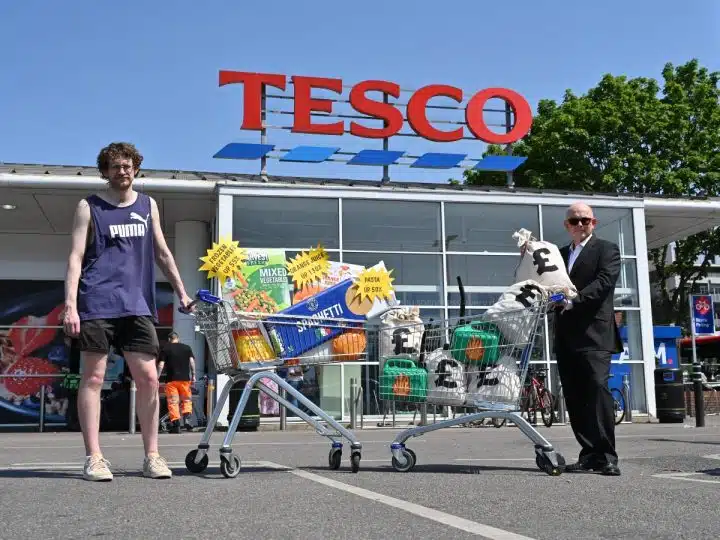

Campaigners from Fossil Free London staged a protest outside a supermarket in Hackney on Sunday 24 May, to draw attention to the rising cost of living in contrast with fossil fuel corporations’ soaring profits.
The stunt involved two trolleys. One, pushed by a campaigner dressed as an oil executive, was filled with sacks of money. The other was filled with placards shaped like common food items. Each placard displayed the item’s current cost and the amount it has risen by. For example: “Orange juice, £1.79, up 130%”. Behind them, a banner read: “Shell profits. We pay the price”.
The protest comes as Shell’s first quarter profits jumped 115%. This is whilst UK food prices are set to rise by 50% since the start of the cost of living crisis, driven by climate and energy shocks.
Robin Wells from Fossil Free London said:
Big Oil are vultures. They prey and profit from crisis, war, and human suffering. And they pilfer from and collapse the earth systems the give us life.
For as long as the fossil fuel industry persists, humanity’s very existence is threatened, and life is all the more miserable. Because whilst Shell continues to profit, we’re all paying the price. And the cost is only getting bigger.
Stu from Fuel Poverty Action said:
It is unconscionable that so many of us are going without because we can’t afford the basic energy we need for heating, eating and lighting.
Meanwhile, shareholders are laughing all the way to the bank, and the government is letting them get away with it. £500 of our energy bill already goes to profits, and that’s set to rise if politicians do nothing.
That’s why Fuel Poverty Action is calling on the government to Make Green Fair campaign, clamp down on energy company profiteering, and bring down our bills by passing the benefits of cheap-to-produce renewable energy back to us.
Featured image via Fossil Free London
By The Canary
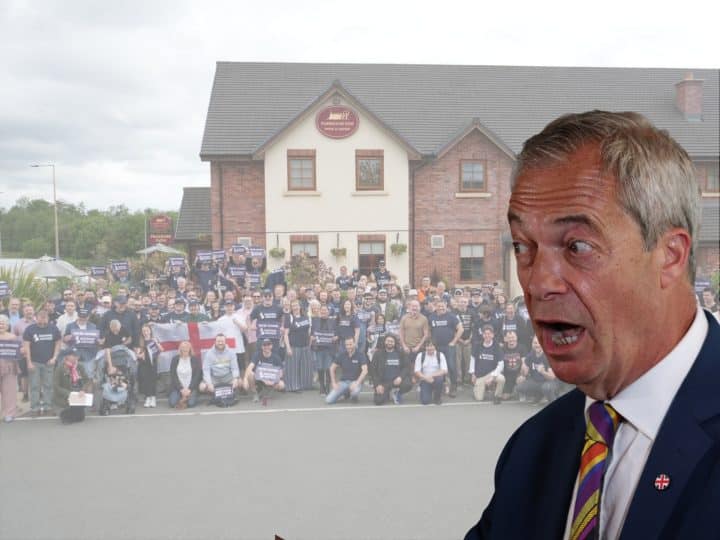

Many predicted that the Makerfield by-election would be a straight up race between Labour and Reform. Surprising many, however, Reform is now fighting on two fronts, with the even-more-hardline Restore Britain challenging the party from its right.
As we reported, this state of affairs has led to Reform panicking and lashing out. And the signs are that Reform’s decision to openly go to war with Restore may be working in the latter party’s favour:
So there is panic internally in Reform as I stated earlier being the reason for the Restore attacks and that there had to be internal polling issues
They are admitting to a Restore tally of around 18% and themselves being around 8% behind Labour pic.twitter.com/QX3QKuFK0b — dave lawrence

 (@dave43law) May 25, 2026
Reform panic stations
The leader of Restore is ex-Reform MP Rupert Lowe. Lowe formed the party after a falling out with Farage (and quite a dramatic falling out at that). In his own words:
Farage and Reform tried to put me in prison because I backed the mass deportation of Pakistani child rapists and their foreign wives/relatives who allowed it to happen.
My home was raided by armed police late on a Friday night as a direct result of Reform’s allegations. My guns were seized. They tried to ruin my life. In every way.
Farage admitted on national television it was all because I backed mass deportations.
He said that was the moment they realised they ‘had to get rid’ of me.
Not the bullshit allegations they went to the police with, but the fact I want the Pakistani rapists removed from our country.
He admitted it.
That all happened.
The polling post comes from Charlie Simpson of the right-wing GB Politics. While Simpson isn’t even old enough to vote, he does seemingly have contacts in Reform UK, because he’s broken several stories which later proved to be accurate.
If the data provided to Simpson is correct, Restore is doing significantly better than previous polls suggested. This is big news if so, because Farage was already panicking about Restore potentially ‘stealing’ a victory from him:
The Times have just released a new poll for the Makerfield by-election by Survation.
Robert Kenyon is the only candidate who can stop Andy Burnham. This is a two horse race – nobody else comes close. pic.twitter.com/zZ75PasBdt
— Nigel Farage MP (@Nigel_Farage) May 23, 2026
Splitters
On the matter of Restore ‘stealing’ votes, many have pointed out that Farage isn’t best placed to make this argument. After all, you could say Reform stole victory from Rishi Sunak in 2024 by appealing to former Tory loyalists. This is why Restore supporters are making the same argument that Farage himself made in 2024 (the video shows Farage criticising Robert Jenrick – the Tory who would later join Reform):
“You’re Splitting the Vote” Really? Watch this… — Orla Minihane (@orlaminihane) May 24, 2026
 a year on, Nigels making him his Chancellor !! The only “splitting the vote” was done when Reform sold out !! @RestoreBritain_ pic.twitter.com/RGKT1PXblM
The hypocrisy doesn’t end there either:
So Reform have gone from demanding an early election to desperately trying to stop one because they think they’ll lose. And they admit Andy Burnham really is so popular nationally he’ll be able to reverse Reform’s surge and win for Labour. https://t.co/hnhvOFmGgN
— (((Dan Hodges))) (@DPJHodges) May 25, 2026
As Labour has a huge majority and more than three years before it needs to announce a general election, it seems unlikely Burnham would call one. Reform politicians do need to give people a reason to vote for them, though, and this strategy shows they’re worried Restore is doing a better job of appealing to the far-right element of their base than they are.
If you’re wondering why Restore is hoovering up those voters, by the way, it’s because Lowe is pulling the same trick Reform pulled with the Tories – i.e. just being further right on everything.
The Reform UK account, meanwhile, has claimed the party has “all the momentum” in response to a national poll:
Reform has all the momentum in British politics. — Reform UK (@reformparty_uk) May 25, 2026
 https://t.co/ZiNG67Abn8
If Restore is gaining traction in Makerfield, however, this just isn’t true.
The media erupts
It’s not just Reform politicians gunning for Restore, either; it’s also the party’s allies in the establishment media. The genocide-denying Islamophobe Melanie Phillips wrote this for the Times:
Restore’s extremism is a problem for Nigel Farage https://t.co/Xw6QxYMJTz
— Times Politics (@timespolitics) May 25, 2026
Alex Phillips of Talk TV completely lost it when talking about Lowe:
The meltdown of Alex Phillips continues as Restore Britain gains grows in stature pic.twitter.com/CI2OEbq2Ky
— Basil the Great (@BasilTheGreat) May 24, 2026
GB News is covering what Farage said, but the outlet is somewhat guarded overall – possibly assuming their audience contains a lot of Lowe fans (what you might call ‘Lowe-lifes’):
Nigel Farage urges right to unite in Makerfield after poll claims Restore Britain would let Andy Burnham into No10 — GB News (@GBNEWS) May 25, 2026
https://t.co/ORglLzQqVl
This guardedness hasn’t stopped Lowe from suggesting GB News is part of the establishment:
Hit piece just gone up against Restore Britain in the Times – follows GB News, Hope not Hate, the Telegraph, Guardian and many others in the last few days.
We're going for a full house.
The establishment despises Restore Britain.
— Rupert Lowe MP (@RupertLowe10) May 25, 2026
Getting to the weirder side of the right-wing press, spiked published the following:
Rupert Lowe’s vanity is off the charts. His party, Restore Britain, is shaving votes from Reform UK in Makerfield. This could hand a victory to Andy Burnham and let the ‘King of the North’ become PM. Restore is the enemy of populism, says Brendan O’Neillhttps://t.co/LGj1YK4nhh
— spiked (@spikedonline) May 25, 2026
Restore Britain has also won the support of Twitter/X owner Elon Musk, with Farage responding as follows:
Farage has just gone to the media to attack Restore Britain, again. He says that Elon Musk is supporting a party 'that’s one man with a social media account.'
This is where Farage is so very wrong.
There are thousands and thousands and thousands of Restore Britain members,… — Rupert Lowe MP (@RupertLowe10) May 24, 2026
As much as we don’t want to defend the vile Lowe, it does seem he’s not wrong:
Jut for fairness, this does reflect what I found in Makerfield. Restore have much more of a presence on the ground than I was anticipating. Have to see if they can sustain it. But it's real. https://t.co/Vr43DKeHZa
— (((Dan Hodges))) (@DPJHodges) May 23, 2026
Also, if Restore was “just one man with a social media account”, Reform wouldn’t be dedicating so much time to attacking it.
A losing strategy
Reform’s Makerfield candidate Robert Kenyon had this to say:
Jesus how bad are the Restore numbers? https://t.co/vS3CN6OdYo
— w////am
 (@willuminare) May 25, 2026
It’s likely not the case that voters are telling him ‘it’s a two horse race‘, because that’s not the sort of thing a person would say to a political canvasser. It could be residents are only talking about Reform or Labour, but given the polling, we know that’s likely not true.
In other words, it’s almost certainly another instance of Reform trying to convince voters they have to vote for the party – not that it’s in their best interests. This is the strategy Labour and the Tories increasingly relied on, and we know in the long run it’s a loser.
If there’s anything the last few years have proven, it’s that British voters are sick of being told who they have to vote for. People aren’t playing by the establishment’s rules anymore, and Reform is clearly just another establishment-continuation party.
Featured image via Ryan Jenkinson (Getty Images)
By Willem Moore

The post The forbidden history of radical Islam appeared first on spiked.


North Belfast Global Sumud Flotilla (GSF) participant Fra Hughes returned to Ireland on Saturday 24 May 2026, after two days being held captive by ‘Israeli’ Occupation Forces (IOF). The long-time Palestine advocate was one of 14 Irish activists from the flotilla who were subjected to brutal treatment by the terrorist regime. The flotilla mission was an attempt to bring essential supplies to Palestinians suffering horrifically under Zionist starvation policies.
Still in his prison tracksuit and speaking at a reception in Belfast on Saturday evening, Fra gave a detailed account of a harrowing experience. Still, as he acknowledged, it was far less than that endured by Palestinians in Zionist dungeons.
He was on board a boat of six, which was intercepted by IOF criminals on 20 May. It began with the thugs training their firearms directly on the activists, red laser dots lighting up their foreheads.
The IOF goons ordered activists to strip down to just their t-shirts and trousers, then lie flat on the boat’s deck. Fra told the crowd of around 30 at the reception that he expected to be flung from the flimsy boat, as all he had to cling onto was a nearby rope.
“That was her blood” – IOF brutalise activists
The IOF then abducted the six men onto a nearby warship. The North Belfast man said the vessel was coated in razor wire, filled with rifle-wielding guards and armed with water cannons. He recounted:
They’d used the water cannons on people before I arrived. Someone shouted “Free Palestine” and the IOF shot them with a BB gun. They ended up – a woman – with her leg ripped open. We actually saw bandages with blood on them, and I thought, “I wonder if they’d been doing a simulation or something because it’s a warship”. That was her blood.
Soldiers then forced the flotilla members to lie on the metal floor for hours. Fra, who is 63, said:
We were out on the deck and they kept flushing it with water every few hours. I had no shoes on. All I had was jeans and a t-shirt, so I was f***ing freezing. I’m shivering there. My jeans didn’t dry out til lunchtime the next day.
Activists were moved to another area, and after some time, they demanded water, toilet roll and sanitary products for women. Fra, who has raised huge sums for Palestinians via his Palestine Aid Ireland charity, recalled that:
An hour later guards threw them down through a hatch, like we were animals.
He continued:
By the second day, the portaloos are filling up, the smell would choke you. We’re walking about in the water. Any sign of resistance was immediately followed by violence. Anyone who said “Free Palestine” – BANG – you got hit with the BB gun.
The IOF brought the flotilla members to the port of Ashdod, in occupied Palestine, sadly now more commonly referred to as ‘Israel’. From there, the Zionist authorities transported them to Ktzi’ot prison. Guards offered Hughes the chance to sign a form, which would mean admitting to the ‘crime’ of breaking the siege on Gaza. He would then get the chance to go home within 24 hours. He answered with:
I’m answering no questions, I’m signing no forms.
“I’m going to make your life a f***ing living hell”
Throughout the ordeal, soldiers repeatedly searched him, including strip searches. He was always transferred by guards forcing one hand behind his back, and pushing his head down to waist level.
He recounted one frightening moment in which two guards took him away to a separate room for a search, and noticed he had a couple of matches still in a jeans pocket. They yelled at him, saying “Oh, so you want to start a fire here?!” They then asked him to turn his head to one side, and open his mouth. Fra said he expected to be struck in the face, but ultimately it was just more intimidation.
Others who guards took to the same area weren’t so ‘fortunate’. Fra said people of colour were in particular danger. He said of the ‘Israelis’:
They’re racist f***s – when they saw Hāhona [Ngāti Maniapoto New Zealand citizen Hāhona Jason Ormsby], with [his] tattoos, and he does a bit of body-building, they zeroed in on him.
He continued:
They banged his head against a wall and nearly knocked him out. They took a taser and put it to his testicles, but somebody came in and said, “no no, not here”. So instead they kicked him in the testicles.
A guard then pulled down his mask and said to Hāhona:
Look at me. I am going to make your life a f***ing living hell from now on.
Fra estimated 70–100 activists were victims of serious assaults. 15 people have reported sexual violence from IOF criminals. The Irish activist said many who sustained broken ribs got them from IOF soldiers kicking them while they were on the floor.
Belfast activist kicked to the floor then hauled up by handcuffs
The worst violence Fra suffered was when a guard ordered him to assume a stress position on his knees. Hands cuffed behind his back, he struggled to get down, and the guard then kicked him to the floor. The same man then hauled Fra up by the cuffs, causing severe pain to his wrists. When Fra yelled out, the guard threw him to the ground, only to order him back to his feet 30 seconds later. Fra told listeners:
I didn’t really suffer. There were people sexually assaulted, people with broken ribs, people with dislocated shoulders, people shot in the ankles with BB guns.
After Fra and other activists continued their refusal to sign anything, guards eventually relented and gave them food and mattresses. Fra and the other Irish activists refused food throughout their illegal detention, however. The ‘Israeli’ land thieves ultimately realised quick release for the abductees was in the settler-colony’s interests, rather than have worldwide publicity centre on the flotilla crews for a longer period.
On Friday 23 May, IOF thugs bundled Fra and comrades onto a bus to the nearest airport. A fellow activist proposed a singsong, and Fra led the bus in delivering The Fields of Athenry, a ballad about Britain’s mid-1800s genocide in Ireland. That then proceeded to Bob Vylan’s more recent classic “Death, Death to the IDF“.
Eventually, an irate guard banged on the window to the activists’ bus compartment, yelling “shut the fuck up!” The criminal threatened to throw a tear gas canister into the enclosed space, at which point the choir decided silence may be the wiser option when dealing with a genocidal land thief.
Politicians must show they care about their own citizens more than appeasing ‘Israel’
The Belfast man managed to get in a few more gestures of defiance, shouting “Free Palestine” while walking through the ‘Israeli’ airport as he departed, and flashing V signs to passengers from the pseudo-state. From there, he travelled to Istanbul, then on to Dublin, where he and other flotilla crew were met by hundreds of supporters.
Fra arrived back in Belfast shortly after local activists had staged an occupation of its city hall. They kneeled on its marble floor in the stress position that IOF guards demanded flotilla activists adopt while out in the baking sun.
Their call was to politicians: Flotilla activists have risked their lives to highlight Palestinians suffering. What will you now do to match their efforts? No more siding with the Zionist entity while your own citizens are tortured, as the Irish government did last week. Full sanctions now – zero trade or cooperation of any kind with so-called ‘Israel’.
Featured image via Fra Hughes
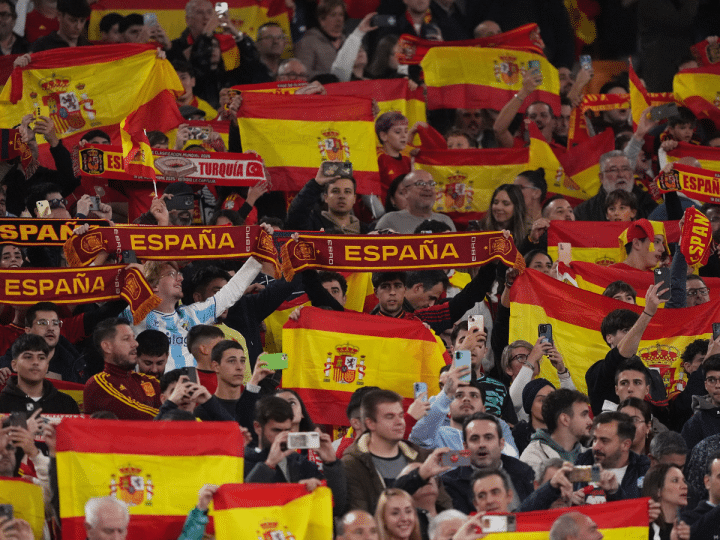

For the first time since Spain began competing in the World Cup, ‘La Roja’ are entering the tournament without a single Real Madrid player. Such an unprecedented development highlights the scale of the transformation currently taking place in Spanish football and the dominance of Barcelona’s up-and-coming generation within the national team.
Spain’s squad for the 2026 World Cup features no Real Madrid players whatsoever, whereas eight Barcelona players have been selected, led by Lamine Yamal, Pedri, Gavi, Alejandro Balde and Fermin López.
Spain: Madrid on the outs
This is not just about statistics; it is about breaking a tradition that has persisted for decades within the Spanish national team. Spain has taken part in 16 previous World Cups, and Real Madrid players have featured in every World Cup squad throughout history.
According to reports, the last time Real Madrid’s presence at the World Cup was least represented, aside from the current squad, was in 1950 when the Spanish national team fielded just one Real Madrid player; Real Madrid then maintained an unbroken presence in all subsequent tournaments, until the 2026 squad brought this historic run to an end.
Manager Luis de la Fuente appeared to favour the younger generation who have made a real difference for the national team in recent years, particularly the Barcelona players who have become the backbone of ‘La Roja’, at a time when injuries and a lack of match fitness have sidelined some of Real Madrid’s key players, most notably Dani Carvajal.
The current situation reflects a footballing turnaround within Spain; the club that has dominated the national team for decades now finds itself sidelined from the world’s biggest football stage, whilst Barcelona continues to supply its stars to lead Spain’s new project towards the 2026 World Cup.
Featured image via Juan Manuel Serrano Arce/Getty Images
By Alaa Shamali


In a move that reflects the political complexities surrounding the 2026 World Cup, FIFA has approved Iran to move its football team base from the US to Mexico.
The decision came after months of escalating political tension between Tehran and Washington, which had raised concerns within Iranian sporting circles regarding the national team’s participation in the World Cup, co-hosted by the US, Mexico and Canada.
The crisis reached a boiling point, with reports that Iran might withdraw from the finals.
FIFA president Gianni Infantino confirmed that the international federation was committed to the Iranian team participating as normal. He also denied any intention to exclude or replace the football team.
Iran moves the national team’s training camp
Iran’s national team had originally planned to hold its main training camp in Tucson, Arizona, as its three group stage matches were to be played in the US.
However, the Iranian Football Federation requested that the base be moved to Tijuana, Mexico, near the US border, a change to which FIFA has agreed.
In comments reported by the Guardian, Mehdi Taj, president of the Iranian Football Federation, noted that the move would help overcome any potential complications regarding visas or entry into the US.
Taj explained that the national team will enter the US via Mexico to play their matches, adding that there is a possibility of arranging return flights with Iran Air in an effort to facilitate the delegation’s travel during the tournament.
Participation under political pressure
These developments come at a time when Iran-US relations have seen a sharp escalation in recent months, amid growing concerns about the safety of the Iranian delegation during its US stay.
Despite this atmosphere, Iran’s national team is continuing its preparations for the historic first edition of the World Cup, which features 48 teams instead of 32.
The draw places them in Group G alongside Belgium, Egypt and New Zealand.
Iran’s national team begins its campaign against New Zealand on 16 June, before facing Belgium and then Egypt on 21 and 27 June respectively.
‘Team Melli’ hopes to progress beyond the group stage and reach the knockout rounds for the first time in its history.
Featured image via Amin M. Jamali/ Getty Images
By Alaa Shamali
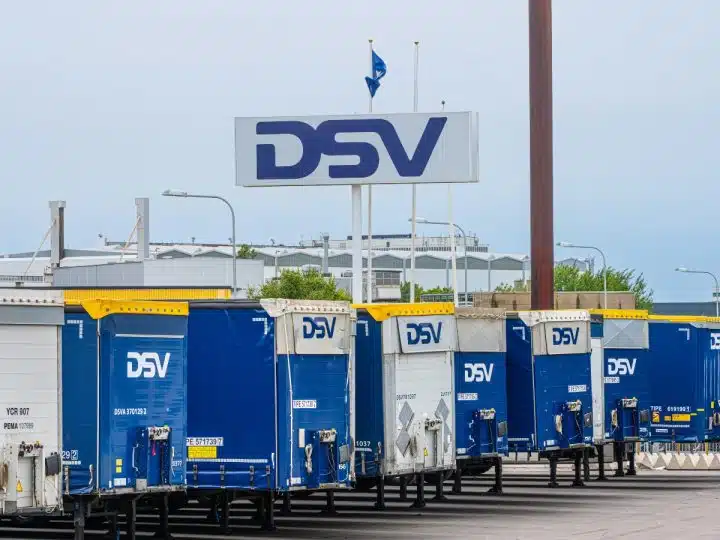

In an international action, Palestine Action Global targeted multiple sites of transport company DSV. The sites were covered in symbolic blood-red paint, with graffiti highlighting DSV’s role in assisting genocide. Numerous windows were also smashed, and DSV vehicles were put out of action.
Over the weekend (Friday 22 May – Monday 25 May), actions took place against the logistics firm, in the US, Germany and at two sites in France.
In a previous coordinated action on 31 March 2026, Palestine Action Global had targeted DSV in several countries, including in the US and across Europe.
The Danish-owned international transport and logistics company has been transporting weapons, and weapons components, for Elbit Systems, Israel’s biggest arms manufacturer. As a result, actionists across the world have repeatedly targeted it.
DSV took over the Elbit job after another shipping company, Kuehne + Nagel, one of the only six companies licensed to transport and handle weapons in Britain, was forced to cut ties with Elbit in 2024 following a series of actions by Palestine Action and broader public pressure.
Elbit produces 85% of the Israeli military’s killer drone fleet, and land-based equipment. Its weapons, which it boasts are “battle-tested” on Palestinians, have been used throughout the ongoing genocide in Gaza, in the Palestinian West Bank, against Syria and Yemen, and currently against Lebanon and Iran. Elbit’s drones have also been used to attack international aid flotillas in international waters.
A spokesperson for Palestine Action Global said:
Elbit Systems are only able to transport their weapons because of ruthless, amoral companies like DSV, who play a key role in the genocide in Gaza, and assist in killing people throughout West Asia.
By targeting them, we will disrupt the transport of Israeli weapons, and cost both Elbit and DSV money. It is not a matter of IF DSV will drop Elbit, but WHEN, because we will visit their sites again and again, until they stop facilitating genocide.
Featured image via Getty Images
By The Canary


Every time a country hosts the World Cup, it is completely transformed.
The streets are filled with flags, the airports are packed with fans, and the cities become one big open-air celebration.
But what if Palestine were the host? What would it have been like if the world had come to Gaza, Jerusalem and Ramallah for football, rather than to watch the war?
Joy over terror
Perhaps we would have seen people entering Palestine with cameras and mobile phones to capture moments of joy, rather than helmets and protective vests to shield themselves from the bombardment. Perhaps Gaza would have been overwhelmed by the noise of the crowds, rather than by grief and widespread destruction.
In a World Cup like this, children would have learnt the names of the players and teams rather than the names of the martyrs. They would have carried footballs and flags through the streets, instead of bags of belongings.
If Palestine were to host the World Cup, the night would be very different. It might be filled with the cheers and songs coming from the stands, rather than the sounds of explosions and aircraft.
Even the vocabulary would have been different. The phrase ‘occupying the stands’ would, for the first time, have become a joyful expression, signifying stadiums filled with fans, rather than the meaning with which Palestine had long associated the word: the theft of land.
On the streets, taxi drivers would talk enthusiastically about the national teams’ chances, the star players and the upcoming matches, rather than discussing the war, the details of the bombings and the names of the destroyed areas.
The kind of life Palestinians deserve
The Palestinian would have shown the visitor the way to the stadium or the supporters’ area, not the way to the nearest evacuation centre or safe place.
If Palestine were to host the World Cup, the world’s cameras would be looking for the most beautiful shots of goals or fan celebrations, not the most harrowing and painful images.
As for the planes flying over Gaza, they were supposed to be carrying national teams, fans and journalists, not missiles and bombs.
In a city historically known for the generosity of its people, whatever the circumstances, the people of Gaza would have welcomed visitors with coffee, food and souvenir photos, rather than searching for a piece of bread to save their children from starvation.
Perhaps the question has never been solely about football, but rather about the kind of life Palestinians deserve in the first place. The world, which travels everywhere in pursuit of football, has often known Palestine only through breaking news and images of destruction.
And if Palestine were ever to host the World Cup, perhaps the world would finally realise that Palestinians want nothing more than a normal life, just like everyone else on earth – a life in which people’s greatest concern is the outcome of a match, not surviving a war.
Featured image via David Ramos/Getty Images
By Alaa Shamali
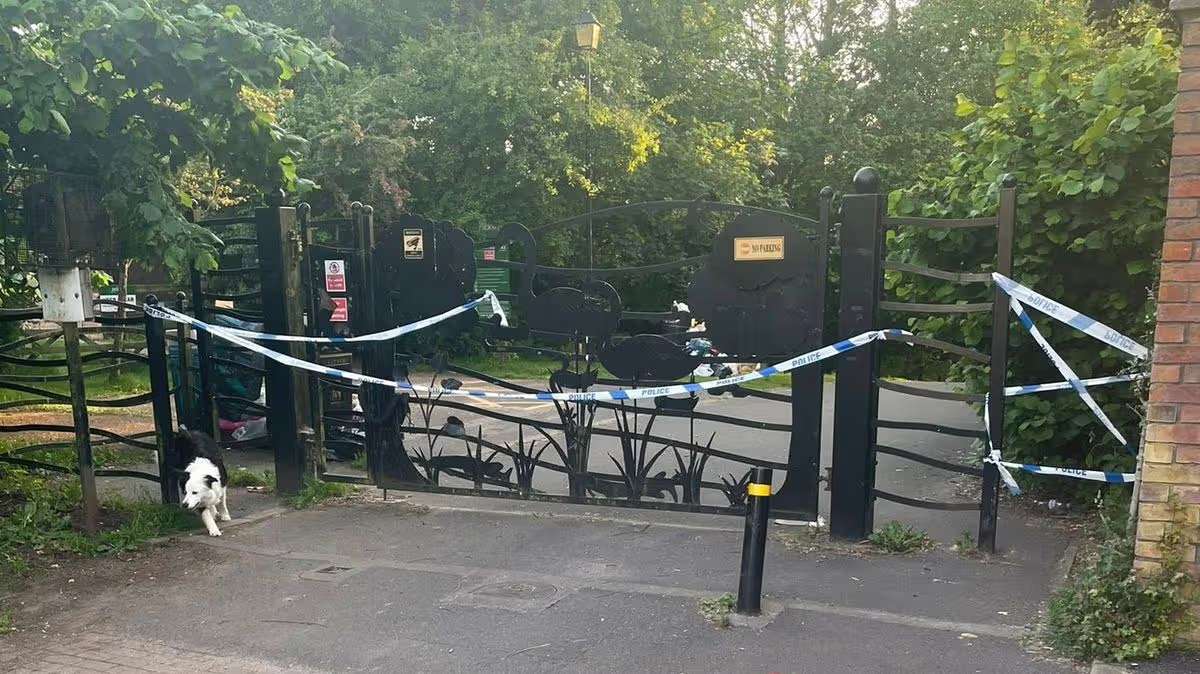
Search underway in lake near Knutsford after teenage boy goes missing while swimming

Neiman Young on Leadership, Discipline and Sustainable Performance

Spain blocks prediction markets Polymarket Kalshi


-

 Crypto World5 days ago
Blockchain.com files with SEC for U.S. IPO
-

 Fashion4 days ago
Holiday Weekend Open Thread – Corporette.com
-

 Business4 days ago
Dell Technologies DELL Stock Surges 15% on AI Server Momentum and Analyst Upgrades in 2026
-

 Crypto World5 days ago
Bitcoin Accumulation Weakens as BTC Realized Losses Hit $600M
-

 Crypto World3 days ago
Robinhood crypto COO Tanya Denisova exits
-

 Crypto World4 days ago
Space X IPO Is ‘Bad News’ for Tech Stocks: But What About Bitcoin?
-

 Politics4 days ago
Makerfield: a tale of two social-media histories
-

 Business2 days ago
NYT Strands Answers May 24 2026 Revealed for Puzzle No. 812 Theme Summer Essentials
-

 Tech1 day ago
Microsoft’s quiet Claude Code retreat and the real cost of enterprise AI
-

 Crypto World5 days ago
MicroStrategy’s Saylor Says Miners No Longer Set Bitcoin Price, Another Force Has Taken Over
-

 Tech5 days ago
WhatsApp ads could make Irish debut after discussions with DPC
-

 Crypto World4 days ago
AI infrastructure race heats up as IREN pitches full-stack strategy, WhiteFiber lands $160M deal
-
 Tech4 days ago
A 0.12% parameter add-on gives AI agents the working memory RAG can’t
-

 Tech5 days ago
You Can Now Add ChatGPT To PowerPoint
-
 NewsBeat5 days ago
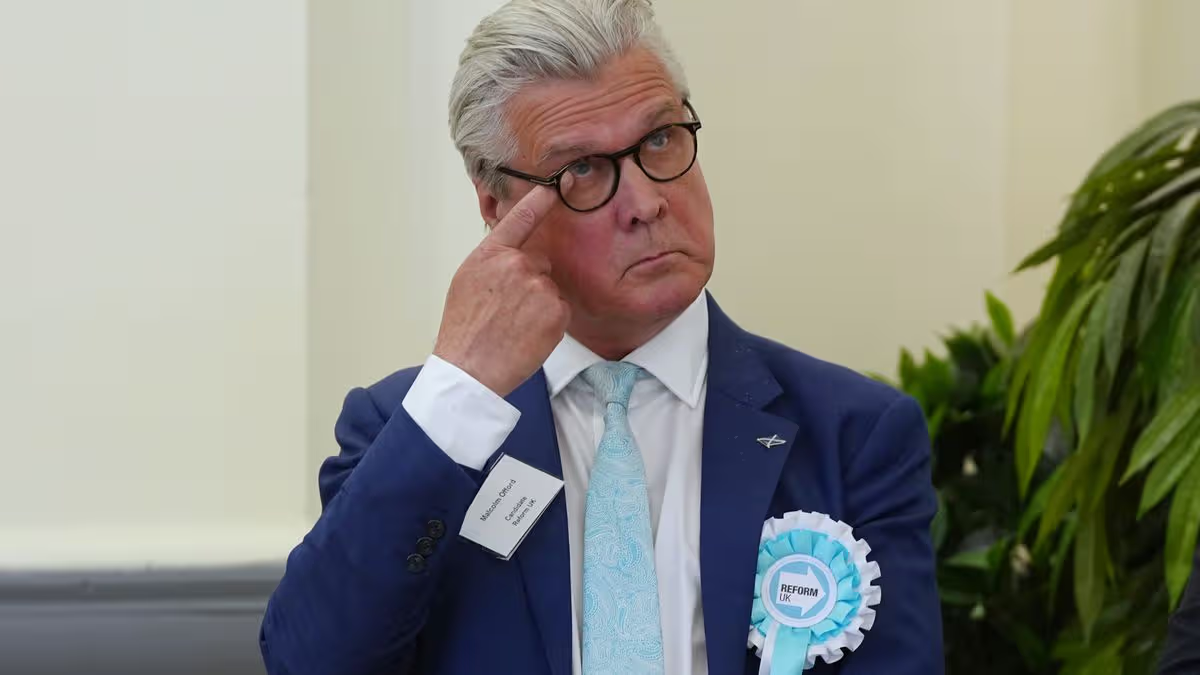
Charity run by Reform leader Malcolm Offord accused of ‘law breaking’ over Scottish registration
-

 Business5 days ago
Trump Invests $1M-$5M in Kura Sushi USA Chain With 27 California Locations
-
 Crypto World1 day ago
Nvidia (NVDA) CEO Calls on Super Micro to Strengthen Export Controls Amid Smuggling Probe
-

 Tech1 day ago
Westone Audio and Etymotic Acquired by Fidelity Collective in Major IEM Market Move
-
 Sports5 days ago
2026 CJ Cup Byron Nelson leaderboard: Brooks Koepka finds putting stroke in Round 1
-

 Crypto World6 days ago
Exa Labs raises $250 million in funding led by a16z
You must be logged in to post a comment Login