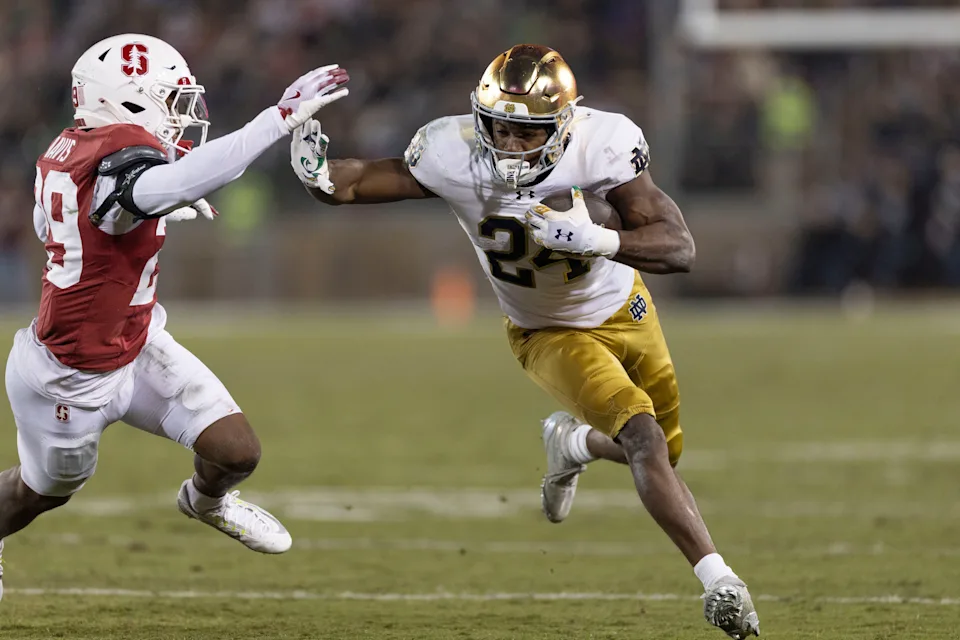
Nov 29, 2025; Stanford, California, USA; Notre Dame Fighting Irish running back Jadarian Price (24) runs with the football against Stanford Cardinal safety Darrius Davis (29) during the first quarter at Stanford Stadium. Mandatory Credit: Stan Szeto-Imagn Images
Prospect Information
College: Notre Dame Height/Weight: 5’ 11’’/203 Hands: 9 5/8″ Age: 22 (at the time of the 2026 season opener)
My Running Back Rookie Model evaluates running back prospects through the traits that historically translate best to fantasy production. The model weighs rushing efficiency, explosive play creation, tackle-breaking ability, receiving utility, athletic profile and expected draft capital, then compares each prospect against historical outcomes and stylistic comps.
Advertisement
Price stands out as one of the cleaner all-around profiles in the 2026 class. He may not be the flashiest back in the group, but the model likes how balanced his profile is across production, athletic translation and fantasy-friendly role indicators.
Advertisement
That matters because Price does not need one outlier trait to carry the profile. He wins through a mix of efficiency, enough athletic juice and the kind of all-around skill set that gives him multiple paths to fantasy relevance at the next level.
The Composite Athleticism Score blends size-adjusted speed, burst, agility and functional rushing traits. When testing is missing, the model can still derive portions of the athletic profile through production-based indicators, but in Price’s case we do have verified size and explosion data from the combine.
Advertisement
Historically, a percentile around this range lands in the average-to-above-average bucket. Price does not project as a rare outlier athlete, but he clears the bar for NFL translation and does so without carrying any major athletic red flags.
Advertisement
Rushing Efficiency Metrics
Price’s appeal starts with the way his profile balances efficiency and translatability. He is not just a volume accumulator. The model likes backs who can create on their own, hold up physically and offer enough juice to turn efficient rushing into fantasy value, and Price checks enough of those boxes to stand out in this class.
He profiles as a back who can generate yards in structure while still offering enough burst and functional movement ability to create chunk plays when blocking opens lanes. That blend gives him one of the steadier projections in the class.
Advertisement
Receiving Usage
Price’s receiving profile also helps his fantasy translation. He is not solely dependent on becoming a 20-carry grinder to matter, which is a key distinction in dynasty projection. Backs with enough pass-game viability tend to give themselves more ways to earn snaps early in their careers.
Advertisement
That does not automatically make him an elite receiving specialist, but it does support the idea that he can stay on the field in multiple situations and avoid being boxed into a one-dimensional role.
Production Snapshot
Price’s overall profile is built more on balance than on one overwhelming strength. That can sometimes make a player less flashy in the pre-draft process, but it also tends to produce some of the more stable model outcomes.
Advertisement
For fantasy purposes, that is often a good sign. The model generally prefers backs who bring enough rushing efficiency, enough functional athleticism and enough receiving utility to create several viable paths to production rather than needing everything to break perfectly.
Advertisement
Positive Indicators
Balanced all-around profile
Price does not need one extreme trait to carry his projection, because the model sees strength across multiple areas.
Verified athletic baseline
At 203 pounds with a 4.49 forty and solid explosion numbers, Price checks the athletic threshold needed for NFL translation.
Strong fantasy floor
His profile suggests a back who can earn work in different situations, which supports a safer fantasy projection than many peers in this class.
Advertisement
Advertisement
Areas of Concern
No truly elite athletic outlier
Price tested well, but not in a way that forces the model to project a rare ceiling outcome strictly from athleticism alone.
May depend on role quality for ceiling
Because he is more well-rounded than truly extreme in any one area, his long-term ceiling could be influenced more heavily by landing spot and usage.
Not purely traits-driven
Some backs can survive on overwhelming physical tools. Price’s profile is stronger because of balance, which can be a positive but also means the margin for error is slightly tighter if the role is capped.
Historical Model Comps
Miles Sanders Zach Charbonnet James Cook Jonathon Brooks J.K. Dobbins
Year 1: Flex/RB3 range with RB2 upside Year 2–3: RB2 with paths to RB1 seasons
Year 1 Fantasy Points: 48.4 Best-Year Fantasy Points: 67.3 3-Year Fantasy Points: 161.6
Advertisement
Dynasty Translation
Price profiles as one of the safer dynasty running back targets in the 2026 class. He brings enough verified athletic ability, enough overall balance and enough fantasy-friendly role flexibility to give himself a legitimate chance to become a useful early-career producer.
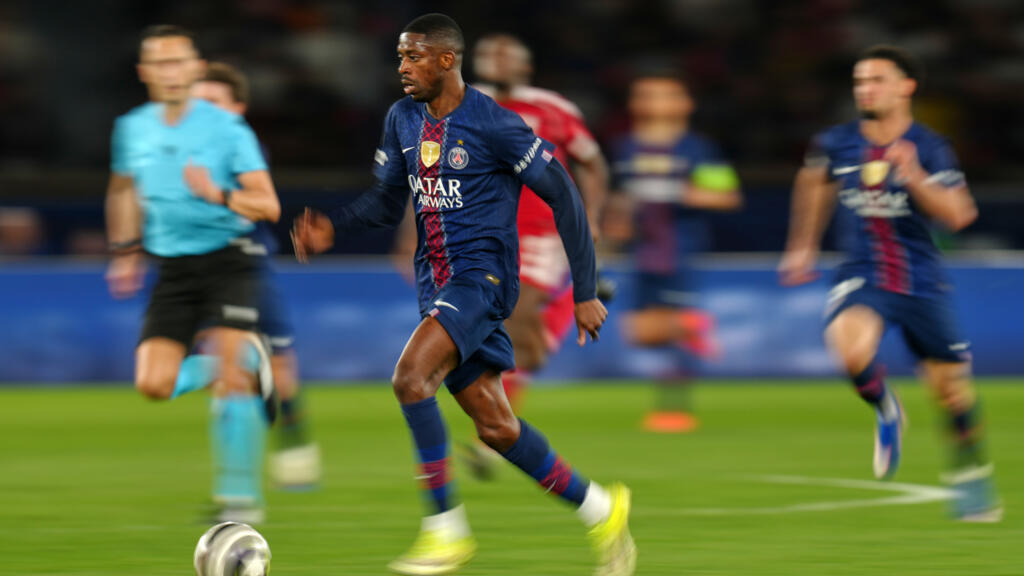
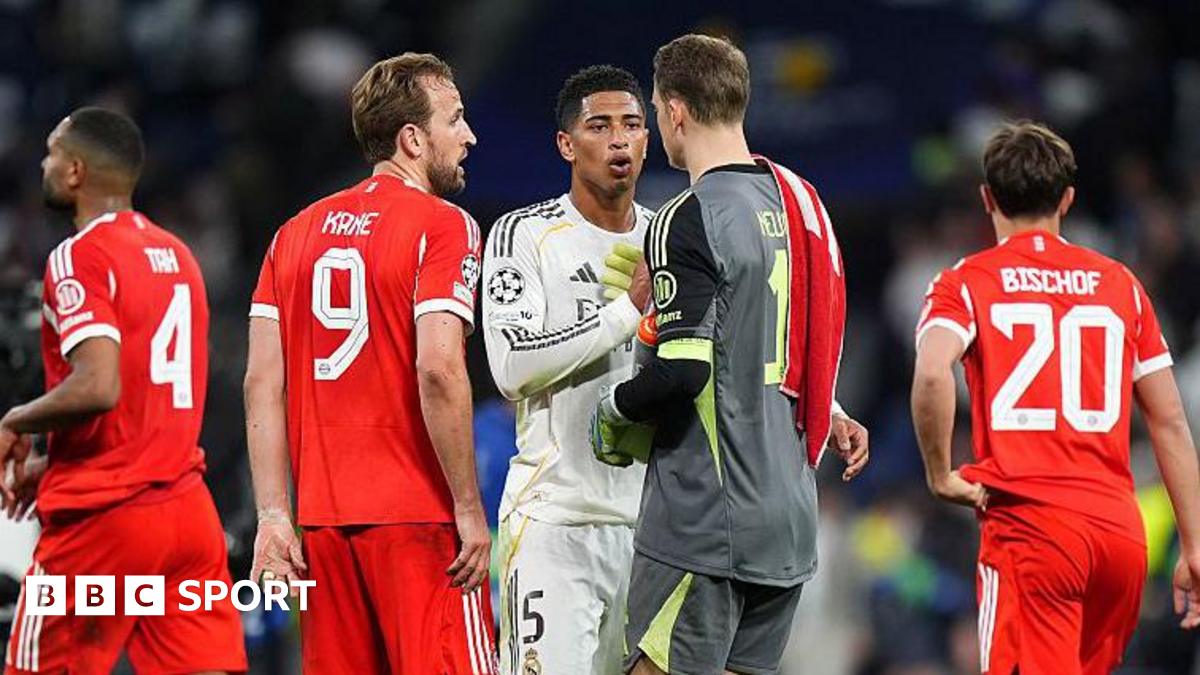
The Parisians head to Anfield for the second leg of their Champions League quarter-final against Liverpool. After a 2–0 first-leg win, the Paris club arrive with a strong advantage and are targeting a place in the Champions League semi-finals.
In the other second-leg quarter-final taking place on Tuesday, Atletico Madrid host Barcelona, who lost the first leg (2–0). The Catalan side will be without Raphinha through injury and Cubarsí through suspension, while Diego Simeone has underlined that his team’s aim is “a clear objective: qualification”. Lamine Yamal, meanwhile, stressed the need to play without losing their identity.
On the international stage, France‘s women’s team face the Netherlands in a two-legged tie on Tuesday and Saturday for World Cup qualification, with Mbock and Bacha returning to Laurent Bonadei’s squad.
Finally, in the NBA, Detroit finished top of the Eastern Conference ahead of Boston and New York, while Oklahoma City lead the Western Conference ahead of San Antonio and Denver. The play-in tournament begins this Tuesday for teams ranked from seventh to tenth.
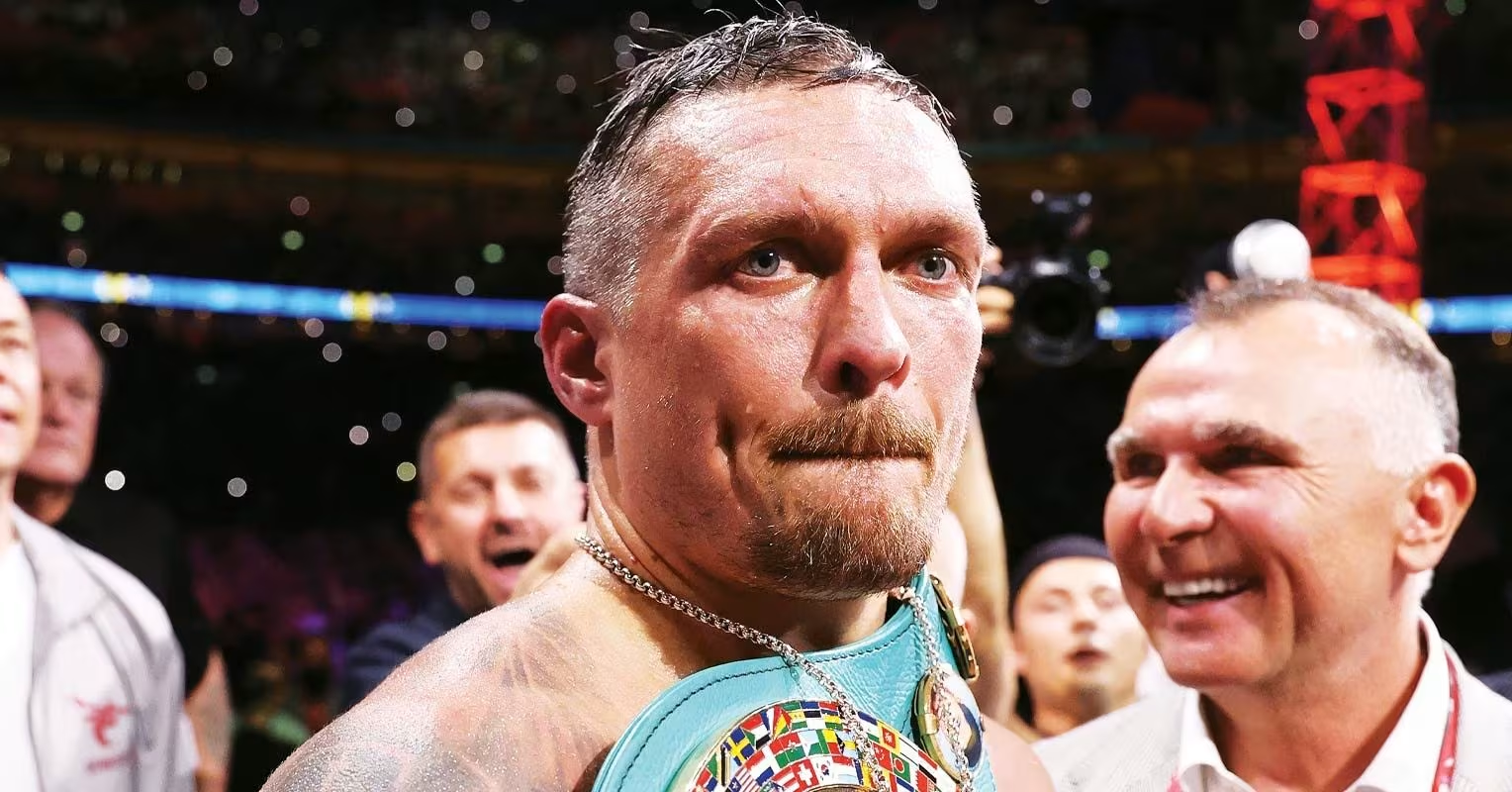
Unified WBC, WBA and IBF heavyweight world champion Oleksandr Usyk takes on kickboxing sensation Rico Verhoeven at the Pyramids of Giza next month. On that card, a future opponent for the Ukrainian could be determined.
Usyk will defend the WBC belt when he takes on Verhoeven in Egypt. On the undercard, Hamzah Sheeraz and Alem Begic compete for the vacant WBO super-middleweight world title, whilst Jack Catterall and Shakhram Giyasov clash in a bout to crown a WBA Regular welterweight champion.
In terms of the heavyweight picture, Cuba’s Frank Sanchez and the United States’ Richard Torrez Jr have a chance to impess on a big stage, with both men looking to earn a shot at the heavyweight throne.
Advertisement
Sanchez-Torrez is a long-awaited IBF final eliminator, meaning that the victor will be installed as Usyk’s mandatory challenger and thus be ordered for a fight with the Ukrainian, who could face being stripped of his IBF world title if he does not agree to defend his belt against the winner. The unified champion has not mentioned either man in his three-fight plan before retirement.
Unlike the WBC, neither the IBF or the WBA have confirmed that they will allow Usyk to defend their belts against 1-0 boxer Verhoeven, meaning he could be stripped of the titles regardless. Should that be the case, the winner of Sanchez-Torrez may well be elevated to full IBF world champion, just as Daniel Dubois was back in 2024 shortly after defeating Filip Hrgovic in a final eliminator.
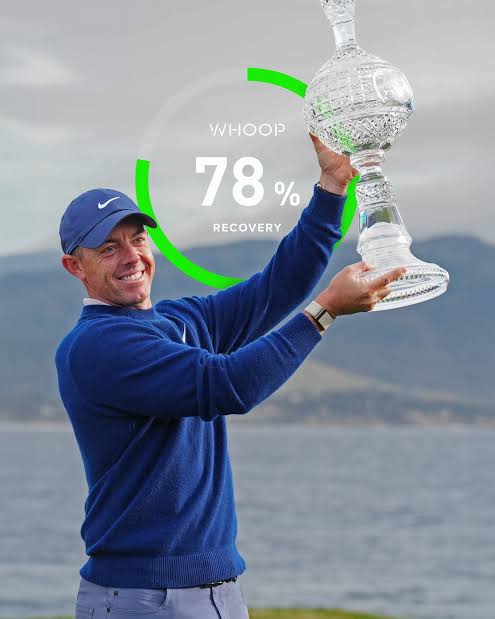
Rory McIlroy is an investor in Whoop, wears one of the company’s wristbands while playing, and allows the brand to share his data periodically.
Here are some of his Masters highlights:
• 24,000+ steps on Sunday • 91,000+ steps during the tournament
Rory’s heart rate spiked to 135 BPM during his tee shot on 18, dropped to 121 BPM during his approach shot, fell further to 105 BPM during his winning putt, and then jumped back up to 150 BPM during his celebration.
Advertisement
His resting heart rate for the week was 47-49 BPM.
Rory says he follows a strict routine during the PGA Tour season to ensure proper rest and recovery:
• No caffeine after 2 PM • Last meal at least 2 hours before bed • Magnesium and theanine for sleep quality • Blue-light-blocking glasses in the evening • Sauana or Epsom salt bath when available • Cool room temperature for sleep
He follows the same three-hour routine before every round: arrive at the course → warm up in the gym → eat breakfast → hit balls on the range → putting green.
Advertisement
Rory says he believes his focus on longevity will help him play another 10+ years at a high level, and his physiological age on Whoop is now 1.5 years younger than his actual age.
Plus, it turned out to be a pretty good investment.
Rory initially invested in Whoop in 2020 when the company was valued at $1.2 billion. While we don’t know exactly how much he invested, Whoop recently raised another round at a $10.1 billion valuation.
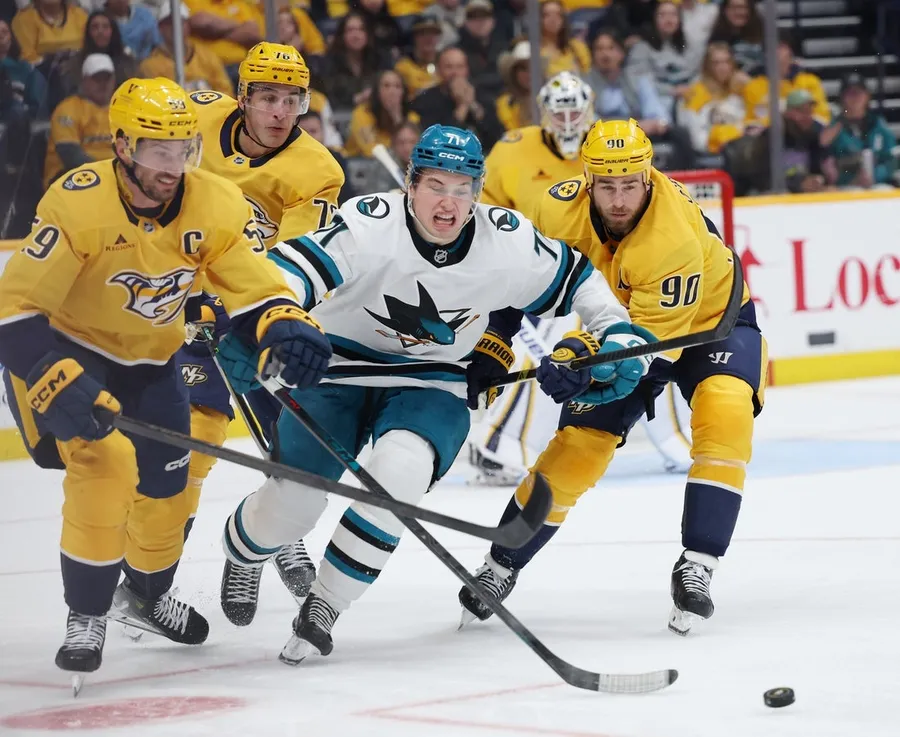
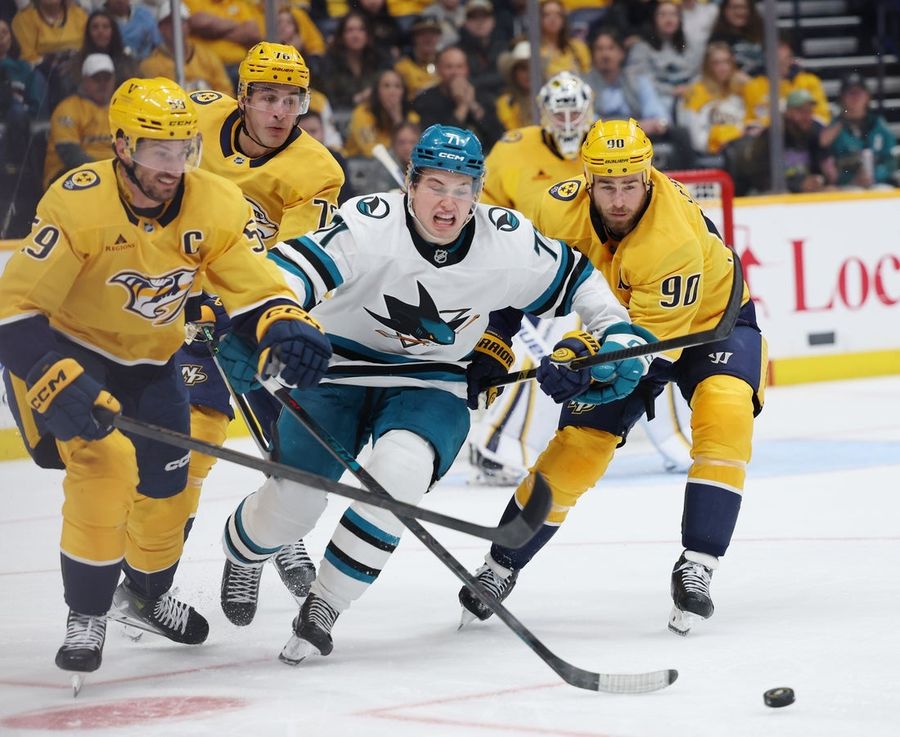
Apr 13, 2026; Nashville, Tennessee, USA; San Jose Sharks center Macklin Celebrini (71) competes for the puck against Nashville Predators defenseman Roman Josi (59) and center Ryan O’Reilly (90) during the third period of their game at Bridgestone Arena. Mandatory Credit: Alan Poizner-Imagn Images
Macklin Celebrini scored two goals and the visiting San Jose Sharks held on for a 3-2 win against the Nashville Predators on Monday night.
Igor Chernyshov had a goal and an assist for the Sharks (38-34-8, 84 points), who have two games remaining and kept their slim Stanley Cup playoff hopes alive. Alex Nedeljkovic made 25 saves.
Luke Evangelista scored two goals for the Predators (38-33-10, 86 points), who have one game remaining, against Anaheim on Thursday. Ryan Ufko had two assists, and Justus Annunen made 20 saves.
Both teams were eliminated from playoff contention with the Los Angeles Kings’ 5-3 win over the Seattle Kraken on Monday night.
Evangelista pulled the Predators within 2-1 at 15:39 of the third period. A perfect pass from Nick Perbix sent Evangelista in behind the defender and he beat Nedeljkovic with a wrist shot into the short-side top corner.
Advertisement
The Predators pulled Annunen and the Sharks nearly bungled a 3-on-1 rush before Celebrini scored into an empty net at 18:15 to make it 3-1.
With Annunen pulled again, Ufko’s shot deflected in off Evangelista at 18:50 to cut the deficit to 3-2.
The Sharks converted their only power-play opportunity; the Predators were 0-for-1.
Advertisement
San Jose outshot Nashville 11-6 in a scoreless first period.
Chernyshov gave the Sharks a 1-0 lead with a power-play goal at 9:53 of the second period. William Eklund got a rebound in the slot and passed to Chernyshov for a one-timer from the left face-off dot.
Celebrini made it 2-0 at 3:04 of the third period. After a disputed icing call forced a face-off in the Nashville end, the Predators cleared the zone, but Will Smith took the puck away and passed to Cheryshov, who skated down into the left circle, pulled up to draw the defender over and passed to Celebrini, who scored on a one-timer from the slot.
Nashville’s Filip Forsberg hit the post with about 14 minutes remaining.
Norwood Oval will play host to Sunday’s
Round 5 AFL game between Geelong Cats and
West Coast Eagles. The game kicks off at 12:30 pm with Geelong Cats heading into the game as favourites with the bookmakers. Continue reading for our in-depth preview of the Geelong Cats vs.
West Coast Eagles
game and give you our free tips and bets.
Geelong returns to more familiar territory after a narrow loss to Hawthorn, with Bailey Smith continuing his strong form and Ollie Henry providing a reliable scoring option. The Cats now face a West Coast side that struggled badly against Sydney, particularly with ball movement out of defence. The Eagles’ inability to handle pressure was exposed, and that shapes as a major concern against Geelong’s well-drilled system. With a strong record at home and superior structure, the Cats are well positioned to bounce back emphatically.
Coolmore Stud and master trainer Aidan O’Brien have once again demonstrated why they remain the gold standard in global horse racing — not just in breeding and training, but in branding.
The latest batch of two-year-olds to be named showcases a blend of elite pedigree, clever storytelling, and marketable identity. In a sport where first impressions matter, these names are doing serious early work.
Powerful Pedigrees, Even Stronger Names
Among the standout names is Abraham Lincoln, a son of Wootton Bassett out of a Group-winning daughter of Invincible Spirit. Purchased for €2.3 million, the name carries immediate authority and presence — exactly what you’d expect from a top-tier prospect.
Book of Kells is another striking entry. By Dubawi and out of a Galileo mare, this colt is a half-brother to multiple Group 1 winner Auguste Rodin. The name cleverly ties Irish heritage with class and legacy — a perfect fit for a horse with serious expectations.
Advertisement
Then there’s Capability Brown, linking art and prestige with racing excellence. As a half-brother to Saxon Warrior, the name reinforces a sense of refinement and stature.
Raging Bull brings a different energy — aggressive, memorable, and built for headlines. Meanwhile, Shakespeare and Opera continue the cultural theme, both reflecting depth, class, and timeless appeal.
Why Naming Matters in Horse Racing
In modern racing, a name is more than a label — it’s a brand. Before a horse ever sets foot on the track, its name shapes perception among punters, media, and owners.
Memorability: Names like “Raging Bull” stick instantly
Heritage: “Book of Kells” connects to Irish identity
Prestige: “Shakespeare” and “Opera” signal class
Marketability: Strong names drive media coverage and betting interest
Coolmore understand this better than anyone. They consistently produce names that feel like future Group 1 winners — and more often than not, they are.
The Coolmore Formula
The naming strategy aligns perfectly with their overall model:
With Aidan O’Brien preparing these horses for Ballydoyle, the expectation is clear — many of these names will soon be seen in Group races across Europe.
What Comes Next?
As the flat season unfolds, all eyes will be on these two-year-olds when they debut. History suggests that when Coolmore name a horse this well, it’s rarely by accident.
Don’t be surprised if Abraham Lincoln, Book of Kells, or Opera are making headlines before long.
Advertisement
Final Word
In an era where branding matters more than ever, Coolmore and Aidan O’Brien continue to set the standard. These aren’t just racehorses — they’re future stars with names to match.
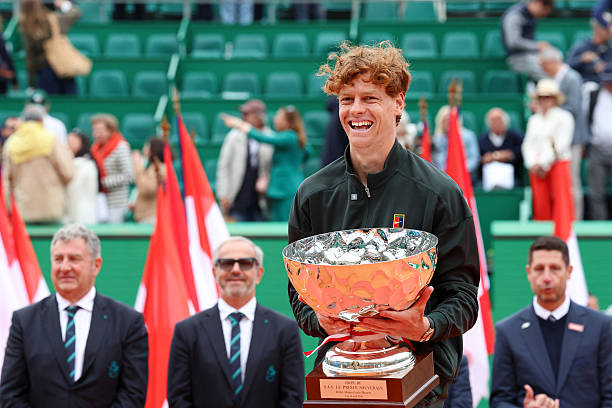
Italy’s Jannik Sinner celebrates with the trophy after winning the Monte Carlo ATP Masters Series Tournament final tennis match against Spain’s Carlos Alcaraz on Court Rainier III at the Monte-Carlo Country Club in Roquebrune-Cap-Martin, south-eastern France on April 12, 2026. (Photo by Valery HACHE / AFP via Getty Images)
Jannik Sinner is back at world No. 1 after winning the Monte Carlo title, overtaking Carlos Alcaraz in the latest ATP rankings.
The Italian now has 13,350 ranking points, the first time he has crossed the 13,000 mark in his career. Alcaraz follows closely behind with 13,240 points.
Between them, Sinner and Alcaraz now have more ranking points than the rest of the ATP Top 8 combined.
Advertisement
Sinner’s return to the top also marks his 67th career week as world No. 1, moving him ahead of Alcaraz in the all-time list.
Valentin Vacherot has also broken into the Top 20 for the first time after his run in Monte Carlo.
On the women’s side, Lilli Tagger also made a breakthrough, reaching the Top 100 after her run in Linz.
Advertisement
Right now, it’s Sinner and Alcaraz, then everyone else.
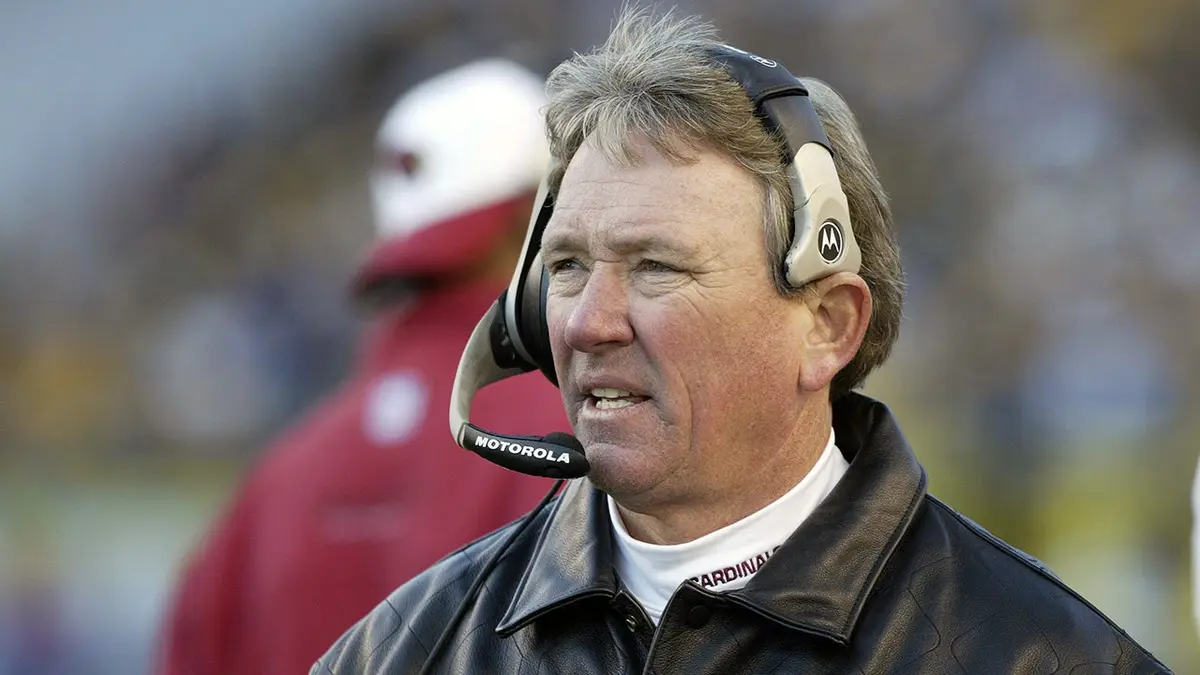
Dave McGinnis, a former Arizona Cardinals head coach and Tennessee Titans assistant coach, died on Monday. He was 74.
The Titans announced the death of McGinnis, who died after being hospitalized for an illness in early March. The Titans’ news release said that he passed away at Ascension St. Thomas Midtown Hospital with his family by his side.
“My heart aches with the loss of Coach Mac, who was so much more than a coach and broadcaster – he was family,” Titans owner Amy Adams Strunk said in a statement.
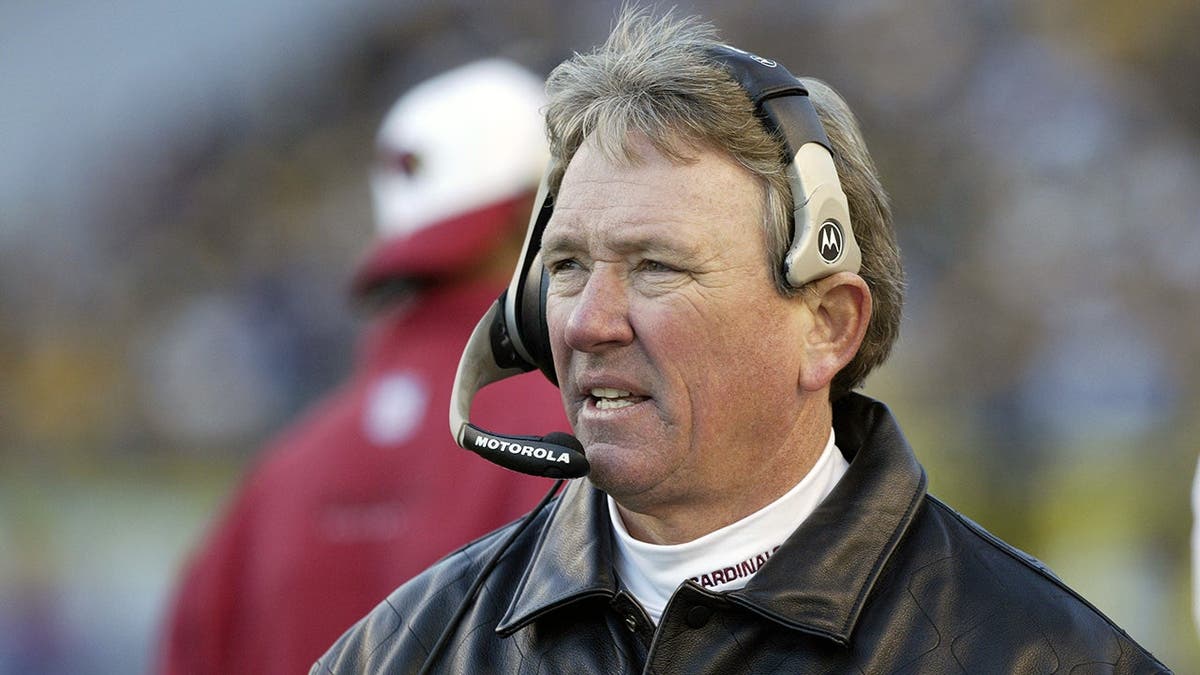
Head coach Dave McGinnis of the Arizona Cardinals watches from the sideline during a game against the Pittsburgh Steelers at Heinz Field in Pittsburgh, Pa., on Nov. 9, 2003. The Steelers defeated the Cardinals, 28-15.(George Gojkovich/Getty Images)
Cardinals owner Michael Bidwell also released a statement on McGinnis.
“As Dave often said, he was a ‘ball coach’ through and through, and no one ever filled that role with more passion, enthusiasm and charisma,” Bidwell said. “Coach Mac truly loved the game and everything – and everyone – associated with it, especially his players. He was one of a kind and will be greatly missed.”
McGinnis found himself in an interim head coaching role during the 2000 season with the Cardinals, the team for which he served as defensive coordinator in 1996. He was retained in the head coaching post from 2001-03.
In 57 career games, McGinnis went 17-40 with the Cardinals, ultimately being fired after a 4-12 season in 2003.
After he was fired, McGinnis landed with the Titans as a linebackers coach under head coach Jeff Fisher. He would become a mainstay in Nashville, holding that role and eventually being promoted to assistant head coach until 2011.
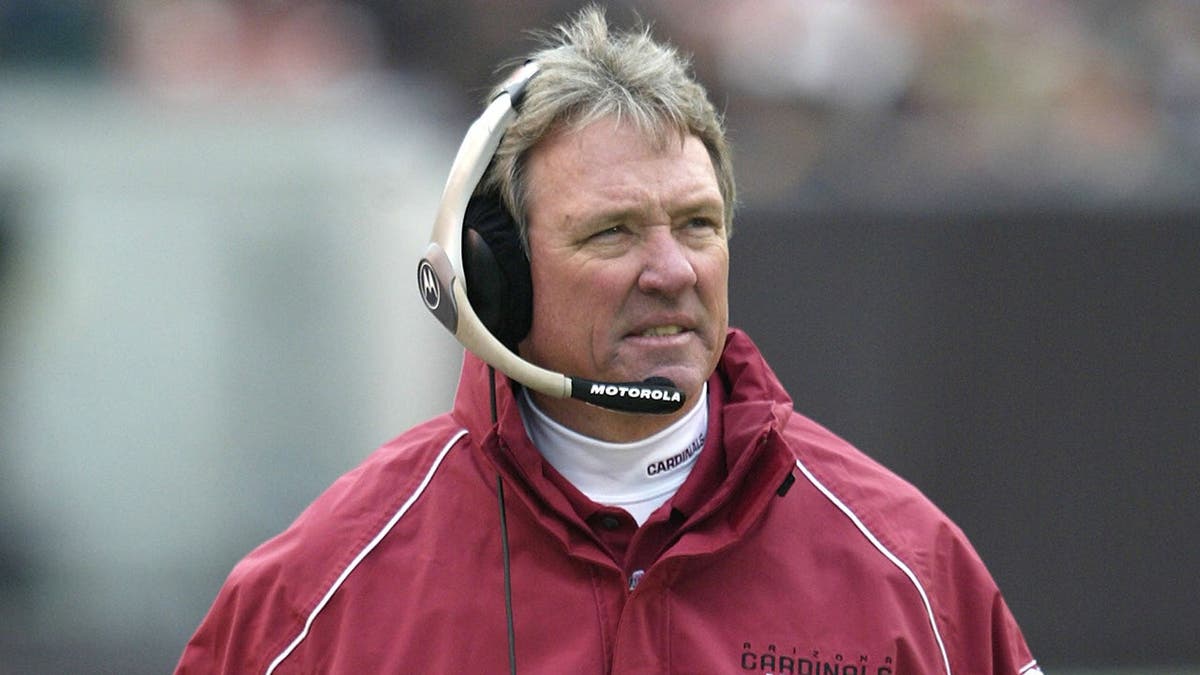
Coach Dave McGinnis of the Arizona Cardinals walks the sideline against the Cleveland Browns at Cleveland Browns Stadium in Cleveland, Ohio, on Nov. 16, 2003. The Browns won the game, 40-6.(Tom Pidgeon/Getty Images)
“Coach Mac gave so much of himself to this organization over the years, and his passion, loyalty and love for the Titans never wavered,” Strunk added. “He cared deeply about the people around him, and that kindness and authenticity left a lasting impact on everyone who knew him. He held a very special place in our family, and his presence in our lives and within this franchise will never be forgotten. We will miss him dearly, and we will always be grateful for the legacy he leaves behind.”
Advertisement
McGinnis’s coaching career began in 1973 when he was an assistant with TCU. He also held posts with Indiana State, Missouri and Kansas State until the 1986 season when he broke into the NFL with the Chicago Bears.
McGinnis served as linebackers coach for Chicago from 1986-95 before getting a promotion with the Cardinals. He also held roles with the St. Louis/Los Angeles Rams before leaving coach after the 2016 campaign.
McGinnis returned to Nashville to join Titans Radio in 2017, where he served as a color announcer for games.
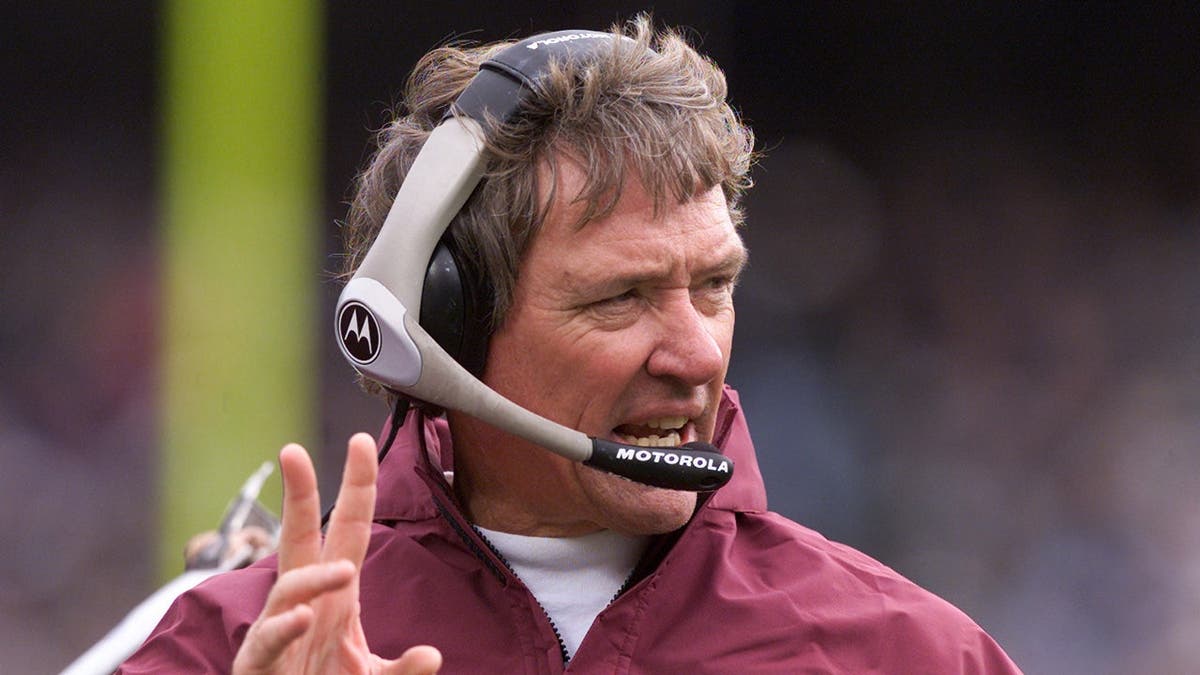
Arizona Cardinals head coach Dave McGinnis stands on the sideline during a game against the Oakland Raiders at Network Associates Coliseum in Oakland, Calif., on Dec. 2, 2001.(Jed Jacobsohn/Allsport)
“I love Dave McGinnis, and I don’t know that I’ve met anybody who was created for football, and a football life, more than Coach Mac,” said Burke Nihill, president and CEO of the Titans. “He just loved the game. Obviously, he played it for a long time and coached it for longer, and with everything he has done for us over the years as color commentator and a Titans personality. He lived such a special football life. He was such a special guy.



















































You must be logged in to post a comment Login