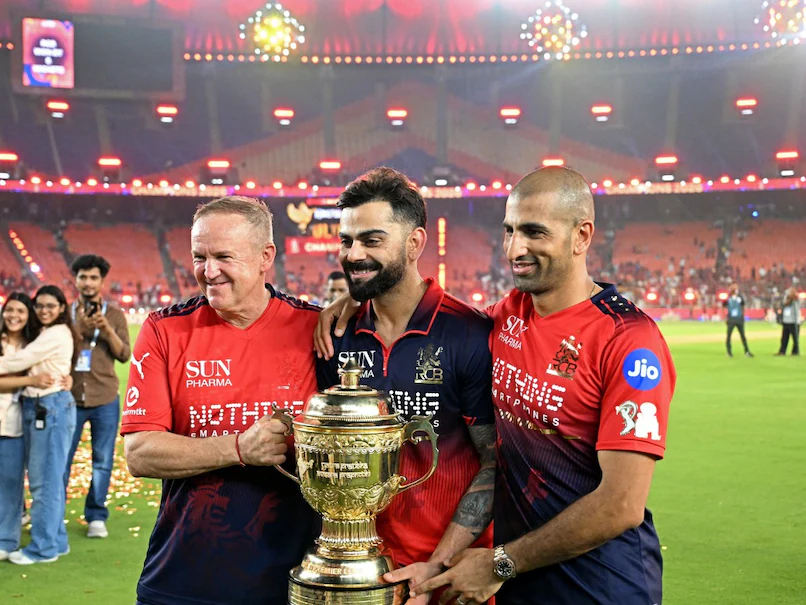
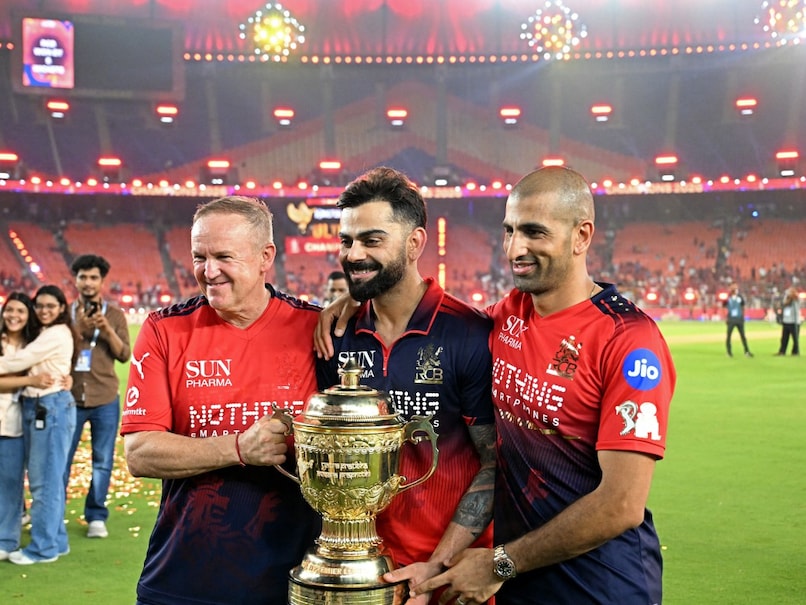
Royal Challengers Bengaluru won their second IPL title on Sunday night, and once again, the trophy-hunting Virat Kohli rose tall on the night of the final. He remained unbeaten on 75 (42) after knocking off his fastest IPL half century, which also accounted for 91.76 impact points, him winning the player of the match. Kohli, Rohit, Dhoni and Jadeja have played across seasons. MS Dhoni features on that list for 18 of the 19 seasons. While most of these Indian greats have experienced crests and troughs, Virat Kohli has been relentless, a study in individual excellence, high-octane passion, and a late-career evolution into a self-described “trophy hunter”.
WHY KOHLI STANDS APART
Virat Kohli has long been the benchmark for consistency in T20 cricket. Across 283 matches, he has piled up 9,336 runs while continually evolving his game. In 2026, he has taken his strike rate to 165.85 – higher than even his celebrated 2016 season. His longevity and output also put him comfortably ahead of contemporaries such as Rohit Sharma (7,329 runs) and MS Dhoni (5,439).
THE CHASEMASTER vs THE HITMAN
A comparison reveals a nuanced look at why Kohli is viewed differently from Rohit Sharma:
Consistency: Kohli’s 68 scores of 50+ dwarf the tallies of Rohit Sharma’s 49. He has 9 IPL 100s, Kohli has shown a far greater “appetite for big runs” than Sharma, who has batted for the Mumbai Indians in a similar timeframe.
Late Career Form: In the last 10 years, Kohli has had only two seasons of 300 runs… In 2024, he scored 741 and 675 in 2026. Rohit Sharma’s decline began around 2017, when he returned from a thigh injury and started batting at No. 4, repeatedly falling to leg-spin.
THE YEARS AT THE PEAK
Both Kohli and Rohit enjoyed their peak in 2016, 10 seasons ago.
For Kohli, that remains the greatest individual campaign in T20 history, in which he scored leg spinners)… The 2016 season remains the benchmark for Kohli in the IPL. He smashed a record 973 runs, including four centuries, and almost single-handedly carried RCB to the final. What’s stood out since then is not just the peak, but the longevity.
Nearly a decade later, Kohli continues to score heavily, maintaining a career average above 40 while adding nine IPL hundreds to his name. Few batters have managed to stay this productive for this long, and even fewer have done it while evolving their game.
Rohit Sharma’s best IPL years, by contrast, came when he had a settled role at the top of the order and the responsibility of captaincy. In 2016, he scored 489 runs at an average of 44.45 with five half-centuries, one of his most complete seasons with the bat.
TROPHY HUNTER MENTALITY
When Kohli roars, Wankhede soars. It is not just at the Chinnaswamy anymore. Like Sachin Tendulkar before him, Kohli carries a following that travels with him across India.
What has changed over the last few years is the way he talks about success. Earlier, the focus was on runs, records and carrying RCB’s batting. Now the conversation begins with trophies.
That shift was evident again in the final. Kohli’s unbeaten 75 in Ahmedabad came at a strike rate that would have been considered uncharacteristic of him a decade ago. He paced the innings aggressively from the start, finished unbeaten, and collected another Player of the Match award on the biggest night of the season.
For years, RCB were criticised for relying too heavily on Kohli and AB de Villiers. The franchise often produced extraordinary batting performances without the silverware to match. The second title does not erase that history, but it does strengthen Kohli’s argument that his career should be measured by more than numbers.
At 37, he is still scoring runs, still setting fitness standards and still demanding more from those around him. That may be the clearest reason he remains central to RCB’s plans.
THE NARRATIVE: Rohit Sharma’s IPL story has never been just about runs. Between 2013 and 2020, he led Mumbai Indians to five IPL titles and established one of the most successful dynasties in franchise cricket. Add India’s T20 World Cup triumph in 2024, and Sharma became synonymous with leadership success.
For years, that success afforded him a degree of patience that few players receive. Even when the runs weren’t flowing consistently, Mumbai Indians continued to back him because of what he brought as a captain. His tactical acumen and calm leadership helped build a champion team around match-winners such as Suryakumar Yadav and Kieron Pollard.
During those title-winning years, Sharma often played the stabilising role rather than being the side’s primary aggressor. The trophies kept coming, and discussions around his batting numbers were usually pushed into the background.
But the conversation has changed. Since stepping down as captain, Sharma’s performances have been judged almost exclusively on his returns with the bat. The leadership shield that once protected him from criticism is no longer there.
In a franchise known for making hard calls, questions that were once ignored are now being asked more frequently. Every lean patch attracts greater scrutiny, and every low score fuels debate about his future.
Former India batter and commentator Sanjay Manjrekar was among those who sensed the shift early. Speaking last year, Manjrekar said Sharma had reached a stage in his career where talent alone would not be enough. The challenge, he argued, was no longer about ability but about finding the motivation and intensity required to keep competing at the highest level.
For perhaps the first time in more than a decade, Rohit Sharma is being judged not as a captain, not as a leader, but simply as a batter. And that has made every innings matter more than ever.
During most of the Mumbai Indians’ 2026 campaign, he remained unfit, turned up for 9 of the 14 games, and scored 283 runs. Even though he has significantly improved his strike rate to 157, it was around 133 in 2016.
KOHLI’S FITNESS AS A FOUNDATION
One area where Kohli has clearly separated himself from his peers is fitness. Nearly two decades into his professional career, he remains among the quickest runners between the wickets and one of the fittest players in the league.
That physical foundation has allowed him to sustain a strike rate of nearly 166 this season while continuing to produce runs at a level few batters have matched over such a long period.
Rohit Sharma’s challenge has been different. Injuries and availability have increasingly become part of the discussion. He featured in only nine matches during Mumbai Indians’ 2026 campaign and finished with 283 runs. The intent remained aggressive, but his season was again interrupted by fitness concerns.
THE HEARTBEAT AND THE PLAYER’S CAPTAIN
The contrast between Kohli and Rohit has rarely been starker. Kohli is coming off another title, another Player of the Match performance in a final and another season that underlined his longevity. Nearly two decades into his career, he remains among the IPL’s most productive batters and one of its biggest attractions.
Rohit Sharma finds himself in a different place. The intent is still there, but consistency has become harder to find and fitness concerns have increasingly shaped his seasons. Since giving up the Mumbai Indians captaincy, his performances have been judged far more on runs than leadership.
There is little left for Rohit to prove in white-ball cricket. Five IPL titles as captain and a T20 World Cup with India place him among the most successful leaders of his generation. The debate now centres on his IPL career: whether there is one more significant contribution left in him, or whether his best years in the tournament are already behind him.
Featured Video Of The Day
IPL 2026 News | RCB Outplay CSK For 2nd Win On Trot, Ruturaj Gaikwad & Co Suffer 3rd Loss
Topics mentioned in this article











































You must be logged in to post a comment Login