

















Connect with us
DAPA Banner
DAPA Coin
DAPA
COIN PAYMENT ASSET
PRIVACY · BLOCKDAG · HOMOMORPHIC ENCRYPTION · RUST
ElGamal Encrypted MINE DAPA
🚫 GENESIS SOLD OUT
DAPAPAY COMING

Tech

Could Your Nonstick Air Fryer Basket Make You Sick? Here’s What You Need to Know

Published

on

Air fryers have surged in popularity over the last decade, with some 70% of US households either owning an air fryer or planning to buy one within the year. Air fryers offer a faster way to cook a wide range of foods with less oil. While avoiding excess cooking oil can be a boon for your health, most air fryers are manufactured with chemical nonstick baskets, which raises questions about the health risks of using them.

Home Tips

Quality Teflon and synthetic fluoropolymers are considered food-safe when used properly — namely, not heating above a certain temperature or damaging the surface and flaking it off into food — so there’s no need to hit the panic button. There are, however, best practices for using an air fryer or other chemical nonstick-coated cookware to avoid Teflon Flu and other health hazards.

So is your air fryer at risk of releasing toxic emissions that could cause Teflon Flu?

Advertisement

What is Teflon Flu?

teflon pan with caution tape above it

An elevated number of Teflon Flu cases were reported in 2023, according to a recent Washington Post investigation.

CNET

Polymer fume fever or commonly known as “Teflon Flu,” is an illness that occurs when noxious fumes from a Teflon or chemically-treated nonstick pan are inhaled. These fumes are emitted when nonstick pans overheat or burn. 

With normal use, nonstick coatings aren’t thought to cause a health risk, but when heated to above 500 F, there are increased emissions and the resulting polymer fume fever. Polymer fume fever causes a range of reported symptoms including fever, chills, muscle tension and headache. Symptoms of Teflon flu are temporary and generally start within 12 hours of exposure, but can take up to 24 hours to take hold.

Advertisement

Nonstick cookware is made with polytetrafluoroethylene (PTFE). PTFEs are known as “forever chemicals” because they can take decades, or even hundreds of years, to break down. 

Do air fryers still have Teflon coating?

hot dogs in air fryer basket

Most air fryer baskets are coated with Teflon or a similar nonstick coating.

David Watsky/CNET

The majority of air fryers in the market today have Teflon or nonstick-coated cooking baskets. They function similarly to nonstick cookware in that they release food easily and can be cleaned frequently with just hot, soapy water. As with Teflon and nonstick cookware, air fryer baskets will chip when exposed to hard metal cooking utensils or wire scrub brushes.

Advertisement

Air fryer manufacturers are moving away from nonstick baskets

air fryer shot from the side with bacon on crisping tray

Glass and ceramic air fryer baskets are becoming increasingly popular, though they tend to be more expensive.

David Watsky/CNET

A recent surge in air fryers with baskets made from 100% nontoxic materials has caught our attention. In fact, Ninja’s glass-bowl Crispi is our top pick out of dozens of air fryers we tested. Other air fryer producers, including Cosori and Fritairre, have released models with baskets crafted from glass, ceramic and other materials that contain no PFAS.  When I visited Ninja’s headquarters last year, a product rep for the brand told me they were phasing out all chemical nonstick-coated air fryer baskets and replacing them with nonstick ceramic or glass. 

So can your air fryer cause Teflon Flu?

Advertisement
hand pushing ninja air fryer button

Most air fryers don’t go above 450 F. If yours does, keep the temperature at 450 F or below and you may want to consider replacing it altogether.

Ninja

Technically, an air fryer basket could cause Teflon Flu if the surface were heated to 500°F or higher for an extended period, but most air fryers don’t exceed 450°F for that very reason. Many of the air fryers we’ve tested only reach a maximum temperature of 400 F.

It’s also important to avoid damaging your nonstick air fryer basket to avoid bits of the chemical coating flaking off into food. Always use soft utensils, such as wooden or food-safe silicone, when handling food inside the basket, and never scrub your basket with coarse sponges or wire scrubbies. 

What to do if your air fryer goes to 500 F

If your air fryer has a setting that allows it to reach temperatures above 500 F and a nonstick basket, avoid cooking at such high temperatures. You may consider replacing your air fryer with one that doesn’t just to be safe. If it’s capable of hitting 500 F, it might do so just from natural temperature fluctuations and is probably not worth the risk.

Advertisement

If you’re still worried about Teflon Flu or other complications associated with nonstick, there are air fryers with ceramic, stainless-steel and glass cooking chambers.

glass bowl air fryer sits on stylish countertop

This self-cleaning Fritaire air fryer features a glass bowl.

Fritaire

For more air fryer safety tips, see our guide to using these trendy countertop cookers safely. 

Advertisement

Source link

Continue Reading
Click to comment

You must be logged in to post a comment Login

Leave a Reply

Tech

Former California AG Bill Lockyer Offers A Dumb And Lazy Defense Of The Paramount Warner Bros Merger

Published

on

from the that’s-now-how-any-of-this-works dept

There’s just an exhaustingly long list of reasons why the $111 billion planned acquisition of Warner Brothers by Larry Ellison and Paramount is very, very bad. Bad for consumers, bad for labor, bad for journalism, bad for democracy, and bad for markets.

For one thing, it’s financed by a bunch of murderous overseas autocrats. The massive debt load from deals like this always result in mass layoffs, higher prices for consumers, and corner cutting, resulting in a steadily shittier company, worse overall products, and a less healthy media. There’s also issues with Ellison trying to buy up all the news outlets and turn them into (even worse) right wing coddling bullshit and agitprop machines helmed by incompetent bad actors like Bari Weiss.

So it’s great timing for former Democratic California Attorney General Bill Lockyer to pop up over at The Hollywood Reporter to give a pathetic defense of the deal that pretends none of this is happening.

Trade mags are generally terrible. Most of the merger coverage at places like The Hollywood Reporter, Deadline, and Variety go comically out of their way to avoid acknowledging these giant deals are always bad. As in, it’s not any sort of actual debate. There are fifty years of very clear history on this subject, recently culminating in the giant turd that was the AT&T–>Discovery–>Warner Bros disaster.

Advertisement

But here comes the 85-year-old Lockyer, who pretends to care about antitrust reform, right before he insists that people should ignore all of the terrible problems with Paramount’s latest deal. One of the central themes in his piece is that Paramount and Warner Brothers have to merge because it’s the only way they can compete with Netflix, Amazon, and Apple:

“Traditional studios are no longer competing only with one another. California cannot and should not ignore that reality. Paramount and Warner Bros. Discovery are competing against global technology platforms and streaming giants like Netflix, Amazon, Apple and others with enormous financial resources, diversified revenue streams and worldwide reach.”

That’s simply not how any of this works.

A Trump-allied oligarch and his nepobaby kid taking on a mountain of debt doesn’t magically result in a company that’s healthier and more competitive. All the debt costs are offloaded onto the back of workers, consumers, and product quality. These mergers always result in a less healthy company than ever, regardless of whatever silly smoke David Ellison is trying to blow up the ass of Hollywood elite.

It’s possible Lockyer is engaged in a DC policy paid advertorial on behalf of Paramount, though the Hollywood Reporter doesn’t offer any sort of financial conflict of interest disclosure, so one just has to assume Lockyer, like so many Democrats, doesn’t have any idea what he’s talking about when it comes to things like modern politics in the authoritarian era, or modern antitrust reform.

Advertisement

Though given Lockyer’s personal history of approving harmful consolidation (like his office allowing the Hearst Corporation-owned San Francisco Examiner to acquire its competitor the San Francisco Chronicle in 1999) or weak-kneed settlements or antitrust policy failures (Microsoft, Sutter Health), it’s maybe not surprising that he thinks one of the worst mergers in media history should be approved.

Lockyer’s also quick to shoot down concerns that Ellison’s domination of media is any sort of real world problem:

“Some have raised broader concerns about media ownership, editorial influence or political viewpoints, as the combined company would own both CBS News and CNN. This debate will undoubtedly continue to dominate talk shows and social media. I, too, worry about plutocratic dominance of media markets. But merger enforcement should remain focused on competition and the potential for consumer and worker harm — the core pillars of antitrust — not political disagreements over content or viewpoint.”

But this isn’t 1997. It’s now impossible to untangle corrupt authoritarian domination of media, and their relentless dismantling of media consolidation limits, from broader antitrust arguments (though I know there are centrist Democrats and MAGA “antitrust enforcers” who would very much like to). There are vast harms caused by the destruction of what’s left of journalism and public interest media, and any “antitrust reform” that doesn’t factor in media audience welfare and the health of electoral consensus in the age of Elon Musk and Larry Ellison enabled fascism isn’t reform, it’s patty cake.

Meaningful DOJ Antitrust reform would be nice, but it can’t fix things alone. We need an FCC that also actually cares about media consolidation. And it might be nice, as Gigi Sohn has long argued, to begin looking at meaningful media ownership diversity requirements in a bid to protect minority and independent journalism.

Advertisement

But we don’t have that. We have an FCC actively waging a war of censorship on anybody critical of an unpopular autocrat. We have a DOJ actively encouraging harmful consolidation at the hands of technofascist billionaires keen on pummeling the electorate with right wing agitprop. And an opposition Democrat party with weak knees and zero credibility on antitrust or media reform.

Trump and friends are self-serving autocrats dead seat on dismantling whatever’s left of meaningful competition and opposition. That Netflix, Comcast, Disney, and Apple still exist isn’t any consolation if the obvious ultimate end goal is zero restrictions on total consolidation. Instead of proudly advertising he doesn’t understand current political and market realities, Lockyer should probably just enjoy retirement.

Filed Under: antitrust, authoritarians, Bill Lockyer, diversity, larry ellison, media consolidation, mergers, reform

Companies: paramount, warner bros.

Advertisement

Source link

Continue Reading

Tech

Waymo’s spent robotaxi batteries will be used as grid storage

Published

on

Waymo has announced a deal with an energy storage company called B2U to use retired robotaxi batteries to serve electricity grids in California and Texas.

The deal helps answer the question of how Waymo is thinking about the end-of-life treatment of the thousands of robotaxis it has deployed around the United States. Almost all of those are currently Jaguar I-Pace EVs, though the company has recently started deploying a limited number of vans built by Chinese automaker Zeekr.

Waymo said the partnership will involve the deployment of “hundreds of megawatts of storage capacity” but did not offer any further specifics.

B2U is one of numerous companies focusing on battery repurposing rather than recycling. Redwood Materials, founded by former Tesla CTO JB Straubel and backed in part by Waymo’s parent company Alphabet, recently spun up its own second-life storage business using old EV batteries.

Advertisement

Source link

Continue Reading

Tech

How to watch FIFA World Cup 2026 in the UAE

Published

on

(All times GST)

GROUP STAGE

Thursday, June 11
11pm – Mexico vs South Africa

Friday, June 12
6am – South Korea vs Czech Republic
11pm – Canada vs Bosnia & Herzegovina

Advertisement

Saturday, June 13
5am – USA vs Paraguay
11pm – Qatar vs Switzerland

Sunday, June 14
2am – Brazil vs Morocco
5am – Haiti vs Scotland
8am – Australia vs Turkey
9pm – Germany vs Curacao

Monday, June 15
12am – Netherlands vs Japan
3am – Ivory Coast vs Ecuador
6am – Sweden vs Tunisia
8pm – Spain vs Cape Verde
11pm – Belgium vs Egypt

Tuesday, June 16
2am – Saudi Arabia vs Uruguay
5am – Iran vs New Zealand
11pm – France vs Senegal

Advertisement

Wednesday, June 17
2am – Iraq vs Norway
5am – Argentina vs Algeria
8am – Austria vs Jordan
9pm – Portugal vs DR Congo

Thursday, June 18
12am – England vs Croatia
3am – Ghana vs Panama
6am – Uzbekistan vs Colombia
8pm – Czech Republic vs South Africa
11pm – Switzerland vs Bosnia & Herzegovina

Friday, June 19
2am – Canada vs Qatar
5am – Mexico vs South Korea
11pm – USA vs Australia

Saturday, June 20
2am – Scotland vs Morocco
5am – Brazil vs Haiti
8am – Turkey vs Paraguay
9pm – Netherlands vs Sweden

Advertisement

Sunday, June 21
12am – Germany vs Ivory Coast
4am – Ecuador vs Curacao
8am – Tunisia vs Japan
8pm – Spain vs Saudi Arabia
11pm – Belgium vs Iran

Monday, June 22
2am – Uruguay vs Cape Verde
5am – New Zealand vs Egypt
9pm – Argentina vs Austria

Tuesday, June 23
1am – France vs Iraq
4am – Norway vs Senegal
7am – Jordan vs Algeria
9pm – Portugal vs Uzbekistan

Wednesday, June 24
12am – England vs Ghana
3am – Panama vs Croatia
6am – Colombia vs DR Congo
11pm – Switzerland vs Canada
11pm – Bosnia & Herzegovina vs Qatar

Advertisement

Thursday, June 25
2am – Morocco vs Haiti
2am – Scotland vs Brazil
5am – South Africa vs South Korea
5am – Czech Republic vs Mexico

Friday, June 26
12am – Curacao vs Ivory Coast
12am – Ecuador vs Germany
3am – Tunisia vs Netherlands
3am – Japan vs Sweden
6am – Turkey vs USA
6am – Paraguay vs Australia
11pm – Norway vs France
11pm – Senegal vs Iraq

Saturday, June 27
4am – Cape Verde vs Saudi Arabia
4am – Uruguay vs Spain
7am – New Zealand vs Belgium
7am – Egypt vs Iran

Sunday, June 28
1am – Panama vs England
1am – Croatia vs Ghana
3.30am – Colombia vs Portugal
3.30am – DR Congo vs Uzbekistan
6am – Algeria vs Austria
6am – Jordan vs Argentina

Advertisement

KNOCKOUT STAGE

ROUND OF 32

Sunday, June 28
11pm – A2 vs B2

Monday, June 29
9pm – C1 vs F2

Advertisement

Tuesday, June 30
12.30am – E1 vs A/B/C/D/F3
5am – F1 vs C2
9pm – E2 vs I2

Wednesday, July 1
1am – I1 vs C/D/F/G/H3
5am – A1 vs C/E/F/H/I3
8pm – L1 vs E/H/I/J/K3

Thursday, July 2
12am – G1 vs A/E/H/I/J3
4am – D1 vs B/E/F/I/J3
11pm – H1 vs J2

Friday, July 3
3am – K2 vs L2
7am – B1 vs E/F/G/I/J3
10pm – D2 vs G2

Advertisement

Saturday, July 4
2am – J1 vs H2
5.30am – K1 vs D/E/I/J/L3

ROUND OF 16

Saturday, July 4
9pm – Round of 16 game 1

Sunday, July 5
1am – Round of 16 game 2

Advertisement

Monday, July 6
12am – Round of 16 game 3
4am – Round of 16 game 4
11pm – Round of 16 game 5

Tuesday, July 7
4am – Round of 16 game 6
8pm – Round of 16 game 7

Wednesday, July 8
12am – Round of 16 game 8

QUARTER-FINALS

Advertisement

Friday, July 10
12am – Quarter-final 1
11pm – Quarter-final 2

Sunday, July 12
1am – Quarter-final 3
5am – Quarter-final 4

SEMI-FINALS

Tuesday, July 14
11pm – Semi-final 1

Advertisement

Wednesday, July 15
11pm – Semi-final 2

FINALS

Sunday, July 19
1am – Third-place playoff
11pm – 2026 FIFA World Cup final

Source link

Advertisement
Continue Reading

Tech

Bowers & Wilkins Unveils 801 D5 Flagship Loudspeakers for $65,000. Perfection Refined?

Published

on

It’s hard to believe it has been 47 years since Bowers & Wilkins first released their iconic 800 series loudspeakers with the original 801 in 1979. The speakers developed such a reputation for precise, natural sound virtually overnight that Abbey Road Studios brought a pair in to serve as their studio monitors while recording and mixing classic albums by The Beatles and Pink Floyd and legendary soundtracks like John Williams’ “Raiders of the Lost Ark.” (Brief aside, you haven’t heard the “Raiders” soundtrack until you’ve heard it on a pair of B&W 801 speakers).

bw-blog-history-of-800-series–900px
Bowers & Wilkins classic “Series 80, Model 801” loudspeakers, from 1979.

Today, at the High End HiFi show in Vienna, the legend continues with the unveiling of seven new models in the brand new Diamond D5 version of the 800 series loudspeakers. Price for the new models start at $15,000 USD/pair for the 805 D5 stand-mount (bookshelf) speakers up to $65,000/pair for the flagship 801 D5 towers. The price for the flagship is certainly a bit higher than what the “Series 80, Model 801” sold for in 1979 ($2,850/pair) – even when adjusted for inflation – but 40 years of good old-fashioned British sonic research and engineering has brought these speakers to their highest levels of both performance and industrial design.

800 D5 Series 2
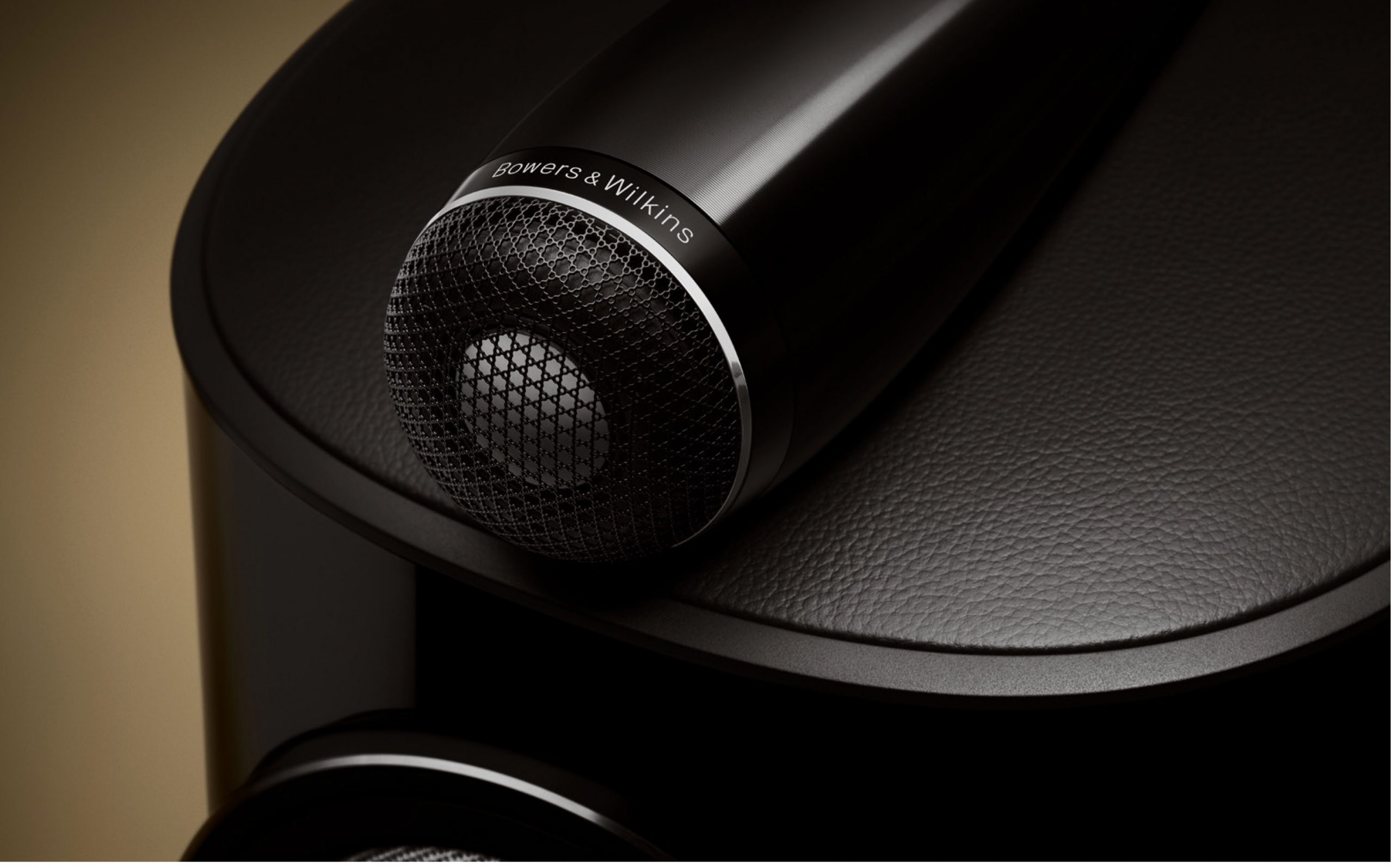
The Diamond D5 series carries on Bowers & Wilkins’ “tweeter on top” design, which reduces cabinet resonance and eliminates diffraction, resulting in improved imaging and a more expansive and realistic soundstage.

The company unveiled a full suite of D5 800 series speakers at the show, not only for two channel music listening, but also for home theater implementations with dedicated center channel speakers that provide a perfect tonal match to other speakers in the line. Whether you’re upgrading a classic two-channel HiFi system or building out a custom home cinema, there’s an 800 series D5 speaker (or twelve) for you, as long as your financial situation can accommodate the hefty price tags.

PXL_20260604_091205398.MP-bowers-d5-900px
Bowers&Wilkins new 800 Series D5 speakers on display at High End Vienna on June 4, 2026.

The Diamond D5 line-up is the fifth generation of the 800 series loudspeakers to use the company’s diamond dome tweeter which is primarily responsible for the speaker’s open airiness, realistic sound staging and sonic transparency. The company says the new 800 Series Diamond D5 range introduces “extensive acoustic, mechanical, and electrical improvements aimed at taking the already category-defining performance of the outgoing range to all-new heights.”

Bowers-Wilkins-Diamond-D5-series-towers-900px

Most of the enhancements have been inspired directly by the company’s highest performance “Signature Series” D4 loudspeakers. And most of the tweaks are designed to further reduce unwanted cabinet resonance and vibrations. Some of these refinements and technology highlights include:

  • Space Frame Bracing
  • New Plinth with Tuned-Mass Damping
  • Improved All-New Aluminum Top Plate
  • Enhanced Matrix Internal Bracing
  • New Aluminium Mid-range Enclosure (804 D5)
  • Signature specification grille mesh and drive unit motor systems
  • Upgraded wiring harnesses and crossovers
  • All Aluminum crossover mounting plate

More details on each of these enhancements can be found on the Bowers & Wilkins web site.

In addition to the sonic refinements, the Diamond D5 line-up features an new luxurious and lustrous aesthetic with four new finishes: Stealth Black, Warm White, Light Walnut and Dark Walnut.

Bowers-Wilkins-Diamond-D5-series-stand-mount-900px
The Bowers & Wilkins 805 D5 stand-mount speaker is a two-way tweeter-on-top design, ideal for smaller listening spaces.

The Reference Loudspeaker for Denon and Marantz

The Bowers & Wilkins 800 series speakers aren’t just featured in recording studios, and in the homes of well-heeled audiophiles and music lovers worldwide, they’re also used as reference speakers by sister companies Denon and Marantz. Every time a new Denon or Marantz A/V product is being developed, the company’s “sound masters” do extensive listening sessions at the company’s headquarters in Japan to evaluate the performance each piece of new gear. And the final approval from each soundmaster is only given after listening to each on Bowers and Wilson flagship 800 series speakers.

At a recent visit to these offices, we got to see (and hear) so many demos of the previous generation 801 D4 speakers playing vinyl and hi-res audio music tracks with top notch Denon and Marantz amps and receivers that we were trying to figure out how to sneak a pair out and hide it in with our carry-on luggage (but alas, they were too big for that).

PXL_20260604_093438038.MP~2-demo-andy-kerr-900px
Andy Kerr of Bowers & Wilkins demonstrates the 801 D5 speakers at High End, in Vienna.

Full Lineup and Pricing of Bowers & Wilkins 800 Series D5 Speakers:

  • 801 D5 | £43,000 / $65,000 / €50,000 per pair
    The new no-holds-barred flagship three-way tower loudspeaker from Bowers & Wilkins.
  • 802 D5 | £32,500 / $45,000 / €37,000 per pair
    Smaller version of the 801, but with the same cabinet proportions as the flagship for a slightly more compact and more affordable option with minimal compromises.
  • 803 D5 | £25,500 / $35,000 / €30,000 per pair
    An even more compact “headed” three-way loudspeaker design with both the midrange and tweeter separated from the main bass cabinet for optimal isolation in a smaller overall footprint than the larger tower speakers.
  • 804 D5 | £16,000 / $25,000 / €18,000 per pair
    The company’s most compact (and most affordable) three-way floor-standing tower in the Diamond D5 line-up.
  • 805 D5 | £10,000 / $15,000 / €12,000 per pair
    The two-way 805 D5 stand-mount loudspeaker is ideal for smaller spaces or for more compact home theater systems that use powered subwoofers for low frequency response and effects.
  • HTM81 D5 | £10,000 / $15,000 / €12,000 each
    A high performance three-way center channel for use with 801 and 802 D5.
  • HTM82 D5 | £8,000 / $12,000 / €10,000 each
    A slightly more compact three-way center channel for use with 803 and 804 D5.
  • FS-805 D5 | £1,600 / $2,000 / €1,800/p
    High-performance speaker stand, for use with 805 D5.
  • FS-HTM D5 | £1,100 / $1,500 / €1,300 each
    Center-channel speaker stand for use with HTM81 D5 or HTM82 D5 for ideal speaker height.
Advertisement. Scroll to continue reading.
Advertisement

Source link

Continue Reading

Tech

Ace Combat 8 Brings Aerial Dogfighting Into the Misinformation Age

Published

on

I’d just finished off several waves of fighter planes and attack helicopters headed for the last port still under the control of my desperate nation, keeping our feeble chances alive for one more day. I returned to our base, an aging aircraft carrier, to chat with the corporate bigwig who’d thrown in with our ragtag remainders. He pulled out his smartphone and showed me how he was manipulating photos to make it look like we had more fighter jets than the few we possessed, projecting strength through misinformation.

Strangereal is getting a dose of 2026’s reality.

As the first Ace Combat game in seven years, and the first on this generation of consoles, Ace Combat 8: Wings of Theve has a lot of technical and story modernizations. At a preview in Los Angeles, I played several hours of the game across six different missions. Rest assured: It wholly embodies the franchise’s particular flavor of tense aerial combat without the severe complexity of ultrarealistic flight simulators. 

Advertisement

It’s also undeniably set in the Ace Combat world of Strangereal, a fictional setting of vaguely European-styled nations embattled in generational wars fought with real-world planes… as well as massive flying wings and land battleships that wouldn’t look out of place in an anime. Yet in my time with the game, it’s what the developers at Project Aces — Bandai Namco’s internal team behind the Ace Combat series — pulled from our real-world 2026 that stuck with me.

An in-game screenshot of a view behind a fighter jet with a screen full of indicators for targets, altitude, ordnance, mission progress and more.

Players can choose between one of three visual perspectives: traditional HUD from the pilot’s seat under the canopy, a canopy-free HUD looking straight out from the plane’s nose and a behind-the-jet view (seen here).

Bandai Namco

It’s integral to Project Aces’ framing for Ace Combat 8, which focuses on relationships between pilots and people close to the player. The game opens up with an unnamed player character being rescued from the sea and taken aboard an aircraft carrier carrying the last military resistance of the Federation of Central Usea, or FCU, following its defeat by the Republic of Sotoa. Before long, the player takes on the role of the titular Wings of Theve, a heroic pilot whose identity is obscured so that when one is shot down, another takes their place. 

Advertisement

Taking on the mantle to preserve the myth is an old storytelling theme, but it takes on new life in Ace Combat 8. Project Aces wanted to bring the lens down from the skies to a more personal level, connecting players with the people they’re flying alongside and protecting aboard the ship. But the breaks between missions, when players bond with these fictional characters, also show them shooting smartphone videos of the Wings of Theve that are sent far and wide as promotional footage. As intentionally surreal as Strangereal is — an abstraction built to stage colossal wars and geopolitical upheaval — it’s still a little bizarre to see real-world smartphone propaganda used to win hearts and minds bleed into a franchise centered on fighter jet dogfights.

An in-game screenshot looking behind a jet as its missiles strike an enemy, with a HUD indicator confirming it's been destroyed.

Standard missiles will lock on within 2,000 meters of a target, but they’ll generally only hit if the player is flying behind the enemy.

Banda Namco

As CNET’s supervising editor of mobile coverage, it’s surreal to see social media warfare make its way into a military sim. But when the media sat down with Kazutoki Kono, the Ace Combat series brand director, at the preview, and I asked him about the inclusion of smartphone propaganda, Kono said he sees it as an extension of the player’s journey toward becoming an ace pilot.

Advertisement

“Obviously, there’s massive boss fights, different encounters, super challenging situations that you’ll have to deal with in dogfight situations, perhaps other ace pilots that are your rivals,” Kono said. “But on a much larger scale, I think social media and misinformation is another challenge that teams have to overcome nowadays. You could say that social media is just one among a wide range of challenges that needs to be overcome so the player feels that sense of growth.”

It’s a very specific choice considering which elements of our 2026 reality Project Aces didn’t include — such as drones, which have become more and more a part of modern warfare. I first spoke with Kono back in December after Ace Combat 8 was revealed at the Game Awards 2025. He shared that the unmanned aerial vehicle drone enemies included in Ace Combat 7 were disliked by fans; they wanted the man-on-man dogfight experience with radio chatter and human tension.

“There is always going to be this reality line that we’re going to want to aim for. That being said, we still can’t go for that line at the expense of the player experience,” Kono said in December. “For the player to have fun is always going to be a priority for us as a game design philosophy.”

Advertisement
An in-game screenshot showing the HUD of a fighter jet as it closes in on a frigate docked in a harbor.

The cockpit HUD view option is the purist simulator view, but it’s understandably more limited than the other two options.

Bandai Namco

Playing Ace Combat 8: Becoming the wings of legend

I was thinking about this push and pull between reality and fiction as I sat down at my station for the preview. Kono’s comments about eschewing real-world elements such as the rise of UAV aircraft made me wonder how much of Ace Combat 8 would be geared toward preserving the dogfighting fantasy evoked in popular media such as Top Gun, even as modern air combat continues to veer toward drones and beyond-visual-range engagements.

Indeed, after my player character was rescued and met the crew, he was sent into the air in the backseat behind the current Wings of Theve, whose aviator sunglasses and charming smile looked uncannily like those of Pete “Maverick” Mitchell in Top Gun. In another nod to misinformation, the pilot, Cope, has had his record of enemy kills greatly exaggerated. When an enemy ace shot our plane down, Cope’s untimely death paves the way for the player to take his mantle — though he sticks around as a ghostly presence to guide you going forward. It’s a fun bit of torch-passing flavor that also provides context, as the player character is a classic wordless protagonist.

Advertisement
An in-game screenshot during the moments before a mission, showing wingman The Professor with helmet and breath mask on.

The Professor is one of three wingmen for the main character.

Bandai Namco

After that prologue, the first mission has the player character taking on the mantle of the Wings of Theve as a publicity move to keep morale up. The second and third missions bring me together with my squadmates — former community college academic The Professor, taciturn Noise and former stunt pilot Tasha (whose colorful hair wouldn’t look out of place on a K-pop idol).

In-game, you can command them to focus fire on targets, choose their own or form up on you. It’s a nice bit of flexibility to suit your play style, though I often lost track of what they were doing while I focused on my mission objectives. Mostly, I enjoyed the radio chatter as they ribbed one another.

You can also kit them out with different aircraft and missile or bomb loadouts tailored to each mission, though I didn’t notice much of a difference when I split them between A-10 Warthog ground-attack aircraft and Eurofighter Typhoon air-superiority jets. (It’s possible I wasn’t paying close enough attention.) After starting out in the F/A-18C multirole fighter — which Kono told me in December is his favorite and serves as the game’s “hero aircraft”– players can unlock more than 30 real and fictional aircraft, each with its own stats and payload options. That variety makes some better suited for dogfights and others more effective against ground targets.

Advertisement
An in-game screenshot of the pre-mission menu showing a variety of jets to choose from along with their stats, perk loadouts and payload options.

Players will start with the F/A-18C jet, but can spend points earned completing missions to unlock over 30 others.

Bandai Namco

Unlocking is handled through a tech tree of sorts, starting with the F/A-18C and branching out not just to new aircraft but also to perks, including improved missile performance and larger bomb payloads. These can be equipped before missions, though each jet has a different perk capacity. With more than 100 standard missiles and dozens of additional missile and bomb options, armaments have always been where Ace Combat shifts from realistic aviation to arcade-style air combat. But it serves the heroic-pilot fantasy well — and makes missed shots a lot less painful.

We jumped around for the last segment of the preview. The fourth mission was a good blend of targets below and above, featuring harbors full of naval vessels to bomb, protected by enemy fighter jets. But it was the ninth mission that stopped me in my tracks: taking on a land battleship that looked like the USS Iowa on treads. My objective was to immobilize it while the iron leviathan’s guns, hovering quadcopter escorts and swirling defensive drone swarm tried to blast me out of the sky. They succeeded a few times, and it took several retries (and collapsed hotel buildings) to finally lock the beast in place.

Advertisement
An in-game screenshot of a cinematic showing the top of a steel-gray land battleship with massive triple-gun turrets angling up to shoot at the player.

The formidable land battleship has three railgun turrets that can shoot the player down from any distance.

Bandai Namco

The last mission we got to play, the 11th, had my squad taking on massive flying-wing aircraft transporting land battleship parts into enemy territory. Thanks to radar jamming, I had to track the skyborne behemoths by their long contrails, then bring my squad in close and rely on short-range missiles and gunfire to take them down. Flanked by fighter escorts, I screamed through the clouds in a visually breathtaking sequence, seeing firsthand the game’s Cloudly tech that Kono had described to me back in December.

Advertisement
An in-game screenshot showing the player's jet following an extremely wide-winged plane with multiple target options along its width.

Some targets like the Portage flying wing enemies (pictured) have several targets to hit before the whole vehicle goes down.

Bandai Namco

This feeling of breathless adventure among the clouds is one of the three core pillars at the heart of Ace Combat 8’s design philosophy, Kono told me and other media at the preview. Every decision they made needed to feed or strengthen one of them.

“The first [pillar] is photorealistic expression of the sky and giving the player the freedom to soar through it how they see fit,” Kono said. “The second is also at the player’s discretion, which enemies to engage with and the satisfaction of dogfights in the sky. The third is this process of becoming an ace pilot in the world, so you go from rookie to hero in the world of Ace Combat.” (Then he laughed, saying that there might be a fourth pillar they hadn’t even realized existed, given how vocal fans have been about the franchise’s background music.)

For all the effort devoted to realism, from recreating the world’s most iconic fighter aircraft to simulating cloud moisture droplets on the cockpit canopy, Ace Combat still delivers a powerful fantasy: that of a skyborne gunfighter fighting for what’s right. While I was caught off guard by Ace Combat 8’s decision to incorporate social media warfare, I was still swept up in watching my pilot’s legend grow — ideally through missiles and slick flying rather than doctored smartphone videos.

Advertisement

Source link

Continue Reading

Tech

Hackers Are After the Gaps in Your Vulnerability Program: Here’s Their Playbook

Published

on

Hacker hacking

A forum thread titled “Hacking for Profit. Working method” offers a rare glance into how underground communities pass information about vulnerability exploitation and hacking techniques in a form of tutorial.

The post, written by an actor using the name “Hercules”, is not especially long or technical.”Its value lies in breaking down a complex process into clear, actionable steps. It covers how to scan, detect, assess, exploit, and monetize vulnerabilities in the wild, while also offering rare insight into the significance of vulnerability disclosure programs.”

Flare researchers analyzed the original post along with the responses over a period of a few months. The activity around the thread shows that its influence was not limited to the original post. Multiple users thanked “Hercules”, asked to connect privately, described themselves as beginners, or said they wanted guidance on how to move from theoretical learning to practical hacking. The response around the thread suggests that “Hercules” did more than describe a method.

This post was so popular that the same method was reposted and discussed across four additional forums. The threat actor gives novice threat actors a simple framework for understanding vulnerability exploitation and how to gain money from it.

Advertisement
The initial post.  Screenshot taken from Flare's platform.
The initial post.  Screenshot taken from Flare’s platform.
Sign up for the free trial to access if you aren’t already a customer.

What the Tutorial Shows

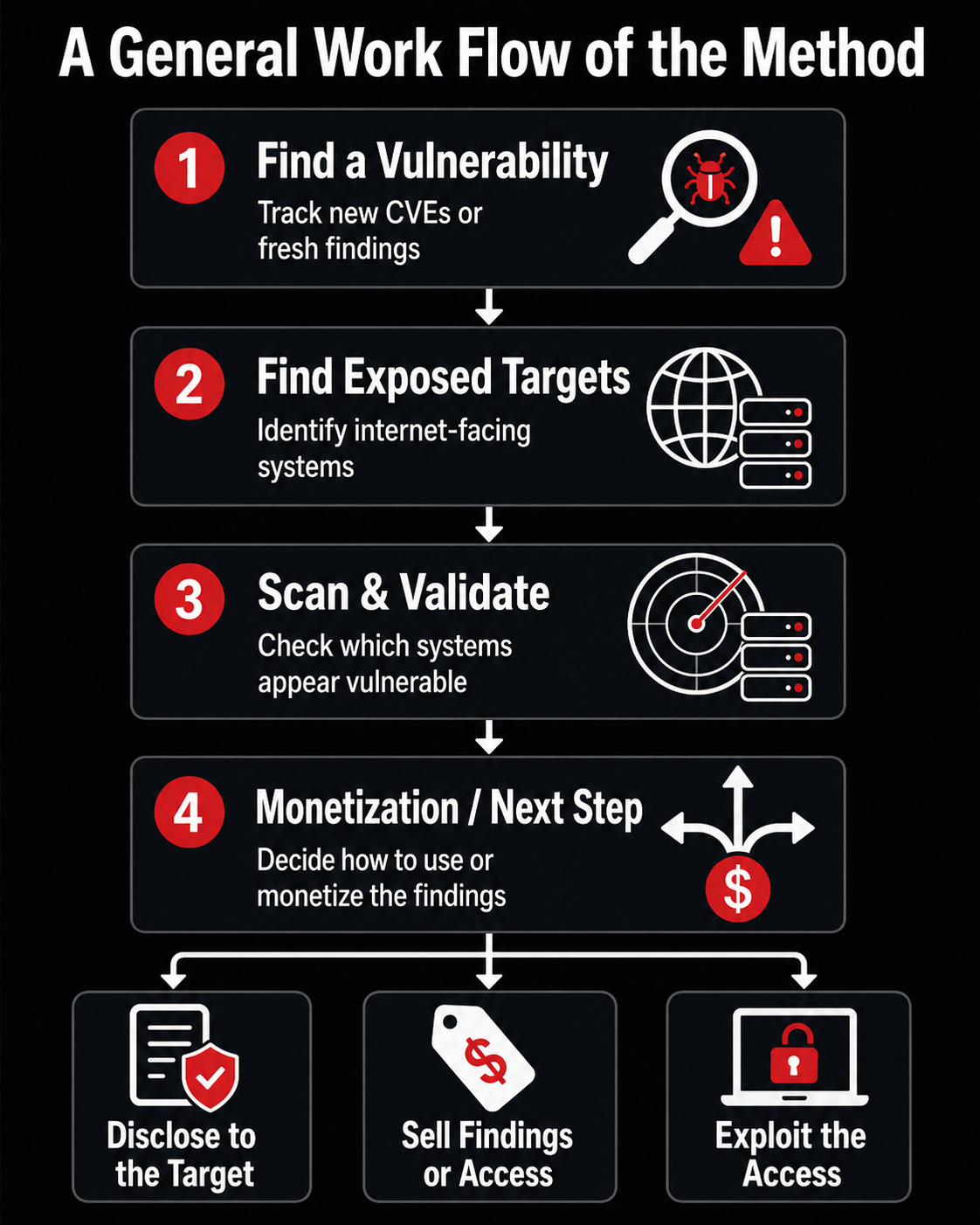
“Hercules” explains how to monetize a vulnerability discovery in the wild. He begins with advice on how to search for newly disclosed vulnerabilities, especially high-impact classes such as remote code execution, authentication bypass, account takeover, IDOR, and data exposure. He then moves to identifying exposed systems, validating whether those systems may be vulnerable, and deciding whether the results should be reported, sold, or exploited.

Workflow

Three aspects stand out in the threat actor’s tutorial:

  1. The usage of the Nuclei framework by projectdiscovery.io, which is highly popular among offensive security practitioners. 

  2. The understanding of the challenges defenders have when patching newly discovered vulnerabilities. These topics are further discussed in an educational blog by Yakir Kadkoda and Ilay Goldman in the “50 shades of vulnerabilities: Uncovering Flaws in Open-Source Vulnerability Disclosure”.

  3. The tutorial is divided into “legal” and “illegal” parts. Meaning the reader can stop at any stage and decide to move from vulnerability disclosure to hacking. 

Underground forums are actively teaching novice hackers to scan for, exploit, and monetize your vulnerabilities.

Advertisement

Flare monitors thousands of dark web sources, including the forums where these tutorials spread, so your team can detect exposure before attackers act on it.

Get a glimpse into the Dark Web for free

Accessibility as the Main Selling Point

The most effective part of the tutorial is not a technical trick. It is the tone. “Hercules” writes in plain language and presents the process as something that can be learned through action. He argues that many tutorials focus too much on computer science, operating systems, programming, or scanner parameters, while beginners want to “hack,” “break in,” and “gain access.”

He also suggests that users do not need to be advanced software engineers to begin. Public tools, community templates, automation, and even AI assistance are presented as ways to reduce the barrier, while programming skills are described as useful but not mandatory. The underlying message is simple: the technical gap is smaller than beginners think.

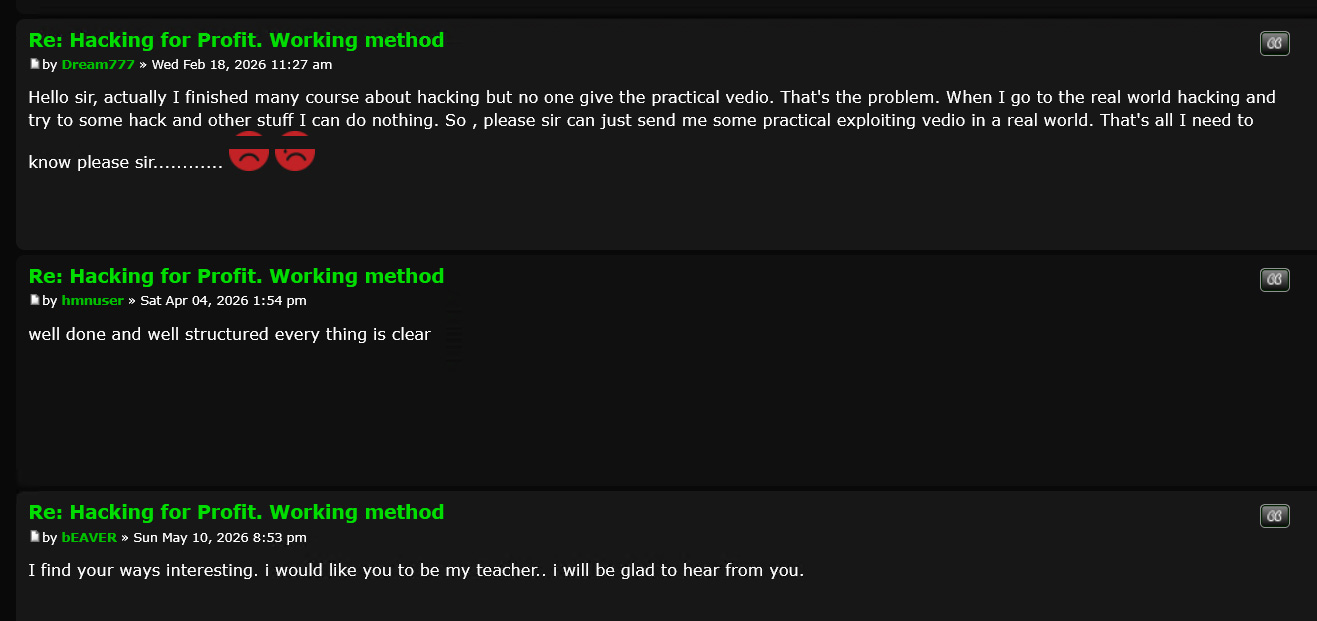
That message explains much of the forum response. One user said they had finished many hacking courses but still could not apply them in the real world. Another said they did not even know how to program and asked whether that would be a problem.

Advertisement

Others asked “Hercules” to contact them privately, said they wanted to learn under his guidance, or praised the post as clear and well structured.

Screenshot from the closing section of the method,

 where “Hercules” uses his personal hacking experience to frame practical action as more valuable than theory and invites readers to contact him for guidance.

The Monetization Layer

The most intriguing part of the method is the monetization logic. “Hercules” describes several actions his “students” can take once a vulnerability is discovered:

  1. Approach the owner of the server/website or hosting company and ask for payment in exchange for vulnerability information. Hercules even says that some people will provide payment in exchange for vulnerability disclosure and also says “…you can take your money home and be proud of yourself”.

  2. Offer the finding on the underground markets. “Hercules” even suggests that an actor could approach the victim and sell the information elsewhere at the same time. 

  3. Exploit the vulnerability and detect what’s on the server.

Remote code execution can become access sold to botnet operators, used for illicit resource abuse, or leveraged for data theft. Account takeover, IDOR, and data leak vulnerabilities are framed as assets that can be sold quickly.

Advertisement

“Hercules” describes himself as a hacker rather than a fraudster, preferring to sell quickly instead of conducting downstream fraud.

The Forum Reaction: Demand for Practical Mentorship

The replies show that the post resonated because it offered experience and confidence, not just information. Users repeatedly asked for private contact, mentorship, and additional guidance. Some were blocked by forum limitations and said they could not send private messages yet.

Others described the post as a useful starting point and waited for follow-up material. Following are some replies from the thread:

forum posts

Screenshots taken from the thread in the forum

This long tail of engagement is significant. A sophisticated exploit write-up may attract technical readers, but a simple, motivational workflow can attract a broader audience.

It can remain relevant for months because it does not depend on one specific vulnerability. It teaches a reusable mindset: monitor new flaws, find exposed systems, validate, monetize, and repeat.

Advertisement

From a threat intelligence perspective, that makes the thread valuable even without unique indicators. It reveals how new actors are taught to think, what vulnerability classes they are encouraged to prioritize, and how experienced forum members convert curiosity into participation.

The post is also a soft recruitment channel, with “Hercules” repeatedly inviting users to contact him privately.

Why This Matters for Defenders

This tutorial calls attention to three aspects in a vulnerability program. 

  1. Critical and reachable vulnerabilities are highly targeted. We don’t need a post in the underground to know that. There are many automated botnets in the wild that are updated minutes after newly vulnerabilities are disclosed and PoCs are released. But even novice hackers are being trained today that these are high-valued targets.

  2. Advertisement
  3. The long tail of old vulnerabilities also matters. These legacy servers, old Drupal or WordPress sites with 2019 vulnerabilities will also be exploited by novice hackers.

  4. Your paid vulnerability disclosure program matters. If they get paid, they will probably have more motivation to disclose the vulnerability. Even if they sell it on the dark web, once they disclosed the vulnerability, you will probably mitigate the risks.

Beyond “Hercules”

The thread is not important because it introduces a new hacking technique. It is important because it demonstrates how cybercrime scales through simplification. “Hercules” takes a complex topic and turns it into a practical business workflow that beginners can understand.

The replies show that this approach works: users who were unsure, inexperienced, or frustrated by theory responded with interest.

Cybercriminal capability does not grow only through elite malware development or zero-day exploitation. It also grows through accessible tutorials, mentorship, public tooling, and communities that make illegal activity feel achievable.

Advertisement

Learn more by signing up for our free trial.

Sponsored and written by Flare.

Source link

Advertisement
Continue Reading

Tech

Humanoid robots won’t be the future: purpose-built robots will

Published

on

Elon Musk said that humanoid robots will push Tesla’s market value to $25 trillion. He also believes that they will reshape labor.

No longer will humans need to do dangerous, repetitive, or mundane things.

Source link

Continue Reading

Tech

What Is ‘Magic Pointer’? Googlebook’s Flagship AI Feature, Explained

Published

on


It seems that every day the Valley is releasing new AI-powered tools designed to save us time and reshape how we interact with our devices. Many of these are minor changes you might not even notice if you don’t already know to look for them, but some mark pretty significant renovations. Google recently announced that it is bringing one such technology to its new line of Googlebook laptops. These laptops are specifically designed for seamless Gemini Intelligence integration, and one of the key features is the new Magic Pointer technology, which promises to rethink the way you use one of the most fundamental elements of the personal computer: The mouse cursor.

The company recently announced via Google DeepMind that it’s “been exploring new AI-powered capabilities to help the pointer not only understand what it’s pointing at, but also why it matters to the user.” Google noted that one of the main barriers to interacting with AI features is that they’re often relegated to separate windows. This adds extra steps as users type, copy and paste, or drag and drop information. The Magic Pointer is meant to cut out that part of the process, allowing the user to bring the AI-powered tools to the information rather than the other way around. This is meant to give users a more uninterrupted workflow.

Advertisement

What can the Magic Pointer do?

The intent behind the Magic Pointer is certainly a grand one. The idea to place all the power of Google’s AI directly on the cursor itself sounds overwhelming, but what does it look like in practice? It’s not yet clear what all the Magic Pointer will be able to do, but Google has already listed a few examples.

Advertisement

By giving your mouse a wiggle, a Gemini hot-menu will appear and offer a list of suggestions based on the context of the subject you’re pointing at on your screen. Google states that if you point at a date in an email, for instance, it might prompt you to set up a meeting or add an event to your calendar. You can point to two different images and select an option to combine them. You can point to a place on a map or an image of a building and select an option to “Show me directions,” and the AI will fill in the context and give you the information you want.

Google also shared a video showcasing some of these features, such as looking at a recipe online and using Gemini to add the ingredients to a shopping list, using a pop-up text box to issue commands for text revision and add emojis to a list, changing window colors, and using voice commands to tell the AI to perform tasks based on items being pointed at on screen.

Of course, there are some users who might not trust Gemini for their emails and other sensitive information, and this new method of using the AI probably won’t change that. It doesn’t appear to fundamentally change how the technology works, just how we interact with it.

Advertisement


Source link

Advertisement
Continue Reading

Tech

5 Best Smart Speakers (2026): Alexa, Google Assistant, Siri

Published

on

Amazon Echo Show 8 (4th Gen) for $180: This is a solid smart speaker with Amazon’s latest physical design and Alexa+ right out of the box, but it’s not a sound improvement over the older model, so I’d personally pick the third-gen option (see above) while it’s still available or upgrade to the Echo Show 11 ($220).

Amazon Echo Show 15 for $300: The Show 15 exists somewhere on the continuum of being a smart display and a smart TV, but it doesn’t quite fully nail being either. The widgets are fun to use since you can add so many to the Show’s 15-inch screen, but I’ve tried this device a few times, and I’ve always walked away underwhelmed. The Show 15 has grown on me while using it with Alexa+, though, particularly with a stand ($125) to sit on my desk. But it’s still larger than I need for day-to-day tasks, but smaller than what I’d want from a television.

Apple HomePod for $299: Apple’s flagship smart speaker has a muddy midrange and high-end, which is disappointing for the price point. The HomePod does have a lot of bass, though, if that’s your jam. If you want an Apple-powered smart speaker in your home, the Mini is a third of the price and has nearly identical capabilities to the full-size model.

Bang & Olufsen Beosound Level for $2,250: This is a gorgeous—though seriously expensive—speaker that’s built to last. The company has designed the high-end model to be repairable and upgradable over time. Made of natural fabric and wood, it’s a high-design flat speaker that comes with Google Assistant onboard—or you can buy it without a smart assistant for the same price.

Advertisement

JBL Authentics 200 for $200: This was my previous pick for a third-party smart speaker, but I’m uncertain of its access to Amazon and Google’s newest assistants. I’ll retest it once I confirm if it will gain access to one (if not both) assistants.

Sonos Era 100 for $189: Another third-party option, but it won’t grant access to Google support. You can connect it to Amazon Alexa, though. Plus, Sonos is a great investment if you’re really looking for a great speaker that can have smarts—but its smart assistant isn’t the primary feature.

Sonos Beam Gen 2 for $369: This is an older version of the Sonos Beam that still has Google support, but I’m uncertain if it’ll gain access to Gemini for Home.

WiiM A10 for $229: This speaker doesn’t have a voice assistant, but it does have compatibility with AirPlay 2, Google Cast, and Siri to be used as a Bluetooth speaker. WIRED reviewer Parker Hall says it reminds him of a Sonos speaker, but that it can instantly connect with Spotify Connect—faster than any other speaker he’s tried.

Advertisement

FAQs

How Should You Choose Between Alexa, Google, and Siri?

The easiest way to choose which smart assistant to add to your house is to consider which ecosystem you’re already using in some capacity. If you’re a big Google or Android user, for example, adding a Google Assistant–powered speaker to your home is a no-brainer. It’s not always that simple, though. Apple and iPhone users will also find benefits in choosing HomeKit-powered devices, but Apple’s ecosystem is so limited that you might want to choose a different assistant for the devices you want. Amazon’s Alexa has the widest range of offerings, but Google Assistant’s range of features has me coming back again and again.

Here’s what you should ask yourself to decide:

Advertisement
  • What assistant are you already using, if any?
  • What products do you want to use in your home, and which assistants are they compatible with?
  • What features do you want in a smart speaker? Which ecosystem can offer you those features?

Why Do I Prefer Google Assistant?

There are many reasons to love Amazon’s Alexa voice assistant, and it works pretty well. If you want to use your voice assistant to shop or use Amazon services like Prime Music or Prime Video, chances are an Alexa-powered speaker is best for you.

Google Assistant has fewer skills and is compatible with fewer smart home devices than Alexa, but Google Assistant can do enough to qualify as truly useful—plus, Google adds new skills fairly frequently. Speakers with Google Assistant work better when you network them together, and they’re compatible with a wide variety of Google apps and services. Google is better at answering random questions and telling you where to go out to eat, since it can access and send information to your phone through Google apps.

Spotify, Pandora, and YouTube Music are the main ways to play music with Google Assistant. The service can also send Netflix shows and movies to your TV if you have a Chromecast attached.

If you’re using a smart display, I also prefer Google smart display devices to Amazon’s because Alexa Show devices serve you sponsored content while Google’s will not. Amazon’s Show displays are already crowded with content by default that you’ll likely want to remove. (To do so, go to Settings on the device, and then click Home Content. You’ll currently find more than 40 options you can toggle on and off.) But you can’t fully remove the sponsored content unless you’re on Photo Frame mode. Meanwhile, Google’s displays make for better photo frames thanks to Google Photos and don’t have such a crowded interface of content to distract you. I’d stick to a Nest Home Hub unless you definitely want an Alexa display and won’t mind the occasional onscreen ad.

Advertisement

How Can I Get the Most Out of My Smart Speaker?

My biggest advice for enjoying a smart speaker to its fullest potential is to make sure you put it somewhere you’ll use it often. I love having a small speaker in my bedroom to ask about the weather while I’m getting ready for the day, and then I make sure there’s a smart speaker somewhere near my desk and living area (usually multiple, but I’m an odd case since I test these for a living) so that I can call out requests as I work, cook, and watch TV.

The next biggest to-do to maximize your smart speaker is to invest in other compatible smart home gadgets. Smart speakers work best when they have other devices to control and speak to. Set up some smart lights, a smart lock or two, a video doorbell, a couple of security cameras—you name it! And then command your smart speaker to help you control them or otherwise check on your home.

Can I Use My Smart Speaker With My TV or Entertainment System?

Advertisement

Sometimes! This varies by TV model and what you have connected to your TV. You can find some TVs that have built-in voice control, though some might be voice control through the remote rather than with the smart speaker. Apple’s smart speakers and Apple TV sync the best from what I’ve tested, if you’re looking for a single system. But otherwise, I haven’t found it as painless as I would have hoped.

If you’re looking for music entertainment, smart speakers are great. You can connect multiple smart speakers for a stereo system, or connect your smart speaker to existing systems. Depending on the system in question and what you already have, you might have to choose a smart speaker with a 3.5 mm wire-in option or a speaker that has built-in compatibility with Amazon Alexa and Google Assistant.

Should I Be Concerned About My Privacy?

Adding microphones to your home (and sometimes cameras) is a valid point of concern. Smart speakers are technically always listening, though they’re supposed to only listen for their wake word and otherwise ignore all other audio until asked a question. But there have been cases where police have requested audio recordings from smart speakers to use as evidence, including two separate murder cases in 2018 and 2019.

Advertisement

Most of the speakers I recommend have some method to shut down the speaker’s listening tendencies, whether an off switch or a camera cover, but it’s annoying to switch on and off if you want to use your speaker regularly. Alexa also no longer allows local processing, so everything you ask Alexa is now sent to the cloud to help Alexa+ run.

Ultimately, you should be concerned about your privacy, and it’s worth considering whether you want a set of microphones in your house. In my years of testing, I haven’t felt any of my smart speakers to be invasive, and they do a good job giving themselves away when activated (lighting up and asking “Hmm?” if they don’t understand the question), so it’s never felt like my speakers are sneakily listening to me. But it’s certainly a personal choice.

Will Smart Speakers Become Bricks?

The smart speakers in this guide are primarily made by large brands—Amazon! Google! Sonos!—and it’s unlikely any of them will suddenly vanish or become a useless brick speaker on your desk. There are even some first-generation Amazon Echos still working that are about a decade old (with mixed results, based on what users say online).

Advertisement

But a UK law passed in April 2024 adds more protection here. The law mandates three key points: more secure password procedures, more clarity on how to report bugs and security issues, and that manufacturers and retailers inform customers how long these products will receive support and software updates.

The last point is the most relevant for smart speaker users, since the fear is that you’ll buy a speaker that will suddenly stop getting updates and become unusable. I’ll be watching to see how much information is really offered to shoppers as it takes effect, but so far, we haven’t seen any changes. But it’s a law we like. While there’s not yet an equivalent law in the US, I’ll watch for updates here as well.

How Does WIRED Test Smart Speakers?

I employ a variety of tests with smart speakers. I do microphone tests, gauging how far away a speaker will hear and respond to a question, both while music is playing and while music is off. I also play a variety of songs to see how well the speaker performs at playing everything from chill lo-fi to our favorite metal band and beyond. I also sync it with smart devices to see how well it connects and controls those devices, and what kind of capabilities it has. If there’s a screen, I also test the features included with that. Finally, I also live with these speakers for at least a week (if not more like months!) to see how they fare on day-to-day use and long-term performance.

Advertisement

How Does WIRED Acquire Smart Speakers? What Does WIRED Do With Them After Testing Them?

Most of the smart speakers I test are provided as press samples by companies that make them. These samples are obtained with the understanding that no coverage is promised, nor are there any agreements about what that coverage will look like if it occurs. I also occasionally purchase my own speakers.

After testing, most smart speakers are kept for long-term testing or in storage for future comparison tests. If a smart speaker is deemed redundant, I usually locally recycle the device, as it likely won’t receive more updates or support from the company. If it’s still a viable speaker, I’ll donate it locally instead.

Power up with unlimited access to WIRED. Get best-in-class reporting and exclusive subscriber content that’s too important to ignore. Subscribe Today.

Advertisement

Source link

Continue Reading

Tech

Analysts say fresh grads have to ‘taper down’ salary expectations

Published

on

Among those who turned down job offers, nearly a third did so because it didn’t pay enough

If you’ve just graduated and are stressed about your starting salary, you’re not alone.

According to a CNA report, a Ministry of Manpower (MOM) survey of residents aged 22 to 28 found that graduates across most disciplines are earning less than they expected when entering the workforce.

And with global uncertainty still looming, analysts are telling fresh grads to manage their expectations—or risk sitting on the job hunt longer than they’d like.

How big is the salary gap?

CNA cited figures from MOM to show the gap between what fresh grads expected to earn and what they actually took home.

Advertisement

IT graduates were among those with the highest expectations at S$6,000, but averaged S$5,150—a $850 shortfall. Engineering sciences grads expected S$5,000 and landed at S$4,450.

The disparity was even larger among business administration graduates, who expected S$5,000 but earned approximately S$4,000. Graduates in natural and mathematical sciences also saw one of the widest gaps, with expected salaries of S$5,000 compared to actual earnings of S$3,700.

Only a handful of disciplines met or exceeded expectations.

Law graduates earned an average of S$7,500 despite expecting S$6,500, while education graduates earned S$4,000 against expectations of S$3,800. Fine and applied arts graduates reported earnings that matched expectations at S$3,500.

Advertisement

Low salaries remain the top reason for offer rejections

MOM’s survey also shed light on why some graduates turn down job offers.

Among university graduates who rejected an offer, nearly one-third (30.6%) cited low pay as the main reason.

Another 26.7% said they were holding out for better opportunities, while 11.3% were uninterested in the role itself. Around 10% pointed to unsuitable workplace environments, and 6.1% said the jobs lacked clear career progression.

Professor Lawrence Loh from the NUS Business School told CNA that graduates’ emphasis on salary reflects Singapore’s rising cost of living.

Advertisement

He noted that many young professionals want to secure the highest possible starting salary because future pay increments can be difficult to obtain. A stronger starting point, he said, provides better long-term earning potential and career mobility.

While MOM expects wages to continue rising, the ministry noted that employers are taking a more cautious approach to salary increases due to global economic uncertainty and inflationary pressures.

Hiring conditions are becoming more challenging

That said, analysts also told CNA that graduates may have to “taper down their expectations” or risk delaying their entry into the workforce.

Anurag Garg, country lead at recruitment firm Michael Page, said prolonged job hunts could leave candidates frustrated and potentially cause them to miss out on suitable opportunities.

Advertisement

On the employer side, companies competing for top talent may encounter higher rates of offer rejections, which can lengthen hiring timelines.

Garg added that mismatched expectations could also contribute to underemployment, where workers take on roles that do not fully utilise their skills and qualifications.

As hiring conditions become more challenging, analysts say both employers and graduates will need to strike a balance between compensation expectations and market realities.

  • Read other articles we’ve written on Singapore’s job landscape here.

Featured Image Credit: The Recruiter

Advertisement

Source link

Continue Reading

Trending

Copyright © 2025