





Connect with us
DAPA Banner

Tech

Data visualization all-stars unveil Ridge AI with $2.6M to fix the analytics problem for SaaS apps

Published

on

Ridge AI co-founders Jeffrey Heer and Ellie Fields. (Ridge AI Photo)

Ellie Fields and Jeffrey Heer know data visualization from the inside: Fields spent more than 12 years as a product and marketing leader at Tableau, and Heer is the University of Washington professor whose open-source tools are widely used for web-based visualization.

But even as they and their colleagues pushed the field forward, they couldn’t escape a similar conclusion: presenting and analyzing data on the web is basically still broken.

Their solution: Ridge AI, a Seattle-based startup that uses AI and browser-based technology to help software companies build and deploy interactive dashboards and data agents in hours instead of days or months, embedding them directly in their products for use by their customers.

The company calls its core product a “ridge” — a dashboard and a data agent that share a common data set, letting users get visual context from the dashboard and ask follow-up questions through the agent.

Funding: Ridge AI is emerging from stealth Monday with $2.6 million in pre-seed funding led by Madrona. The Seattle venture capital firm’s investment was spearheaded by Managing Director Tim Porter and Venture Partner Mark Nelson, the former CEO of Tableau.

Advertisement

Joining in the funding is a roster of angel investors that reads like a who’s who of analytics, AI and data: Chris Stolte, Tableau co-founder and former CTO; Carlos Guestrin, co-founder of Turi and director of Stanford’s AI Lab; Adrien Treuille, founder of Streamlit; Elissa Fink, former Tableau CMO; and Jeff Hammerbacher, Cloudera founder, among others.

Target market: Although their technology could be applied broadly, Ridge AI is focusing specifically at the outset on serving software as a service (SaaS) companies, giving them a way to present rich, interactive analytics to the people and businesses that use their products. 

In an interview, Fields said the need is especially acute when a SaaS company is trying to renew a customer’s contract. The product might be delivering real results, but if the people making the buying decision can’t see that in the data, the deal can be at risk.

“The CFO is going to be asking, is anyone even using this?” Fields said, calling it one of the use cases where Ridge AI’s technology could be of significant value to SaaS firms.

Advertisement

The pressure to prove this value has intensified amid the “SaaS-pocalypse,” as it’s known — as companies consolidate their software spending and the rise of custom AI-coded apps makes many of them question whether existing tools are worth keeping.

What they’re solving: Madrona’s Nelson said he experienced the larger problem during his time as CTO of Concur, where the company built an analytics product on top of IBM Cognos, giving customers the ability to glean insights into employee travel and spending.

It was important to the business, he said, but it was a pain to maintain, and it wasn’t in Concur’s core skillset. The problem persists for many SaaS companies to this day.

SaaS companies have historically had to choose between heavyweight business intelligence platforms like Tableau and Power BI, specialty embedded analytics tools, or building their own. Fields said none of those options was purpose-built for the problem Ridge is solving.

Advertisement

Founders: Ridge AI was co-founded by Fields, who serves as CEO, and Heer, chief scientist, who will continue as a UW professor in addition to working on the company.

Also on the team: Andy Caley, a founding engineer who previously worked at Tableau, and Fritz Lekschas, a founding research engineer with a Ph.D. from Harvard and more than 20 publications in data visualization.

From left, Madrona’s Tim Porter, Ridge AI CEO Ellie Fields, and Madrona’s Mark Nelson. (Madrona Photo)

Fields and Heer were introduced by Madrona’s Nelson and Porter. Nelson had known Fields since she worked for him at Tableau and he had separately kept in touch with Heer through his UW work. Porter, meanwhile, had gone to Stanford Business School with Fields. 

“I can’t think of two people I like more, and would bet on more, than Jeff and Ellie,” Nelson said, describing the pairing as an example of what’s possible in Seattle’s tight-knit tech community.

Heer previously co-founded Trifacta, a data transformation company acquired by Alteryx in 2022. He and his academic collaborators have produced some of the most widely used open-source tools in data visualization, including Vega(-Lite), D3.js, and the Mosaic framework that serves as Ridge AI’s technical foundation. 

Advertisement

Fields joined Tableau as its first product marketer and rose to senior vice president of product development over more than 12 years, spanning the company’s IPO and its acquisition by Salesforce. She went on to serve as chief product and engineering officer at SalesLoft, where she experienced firsthand the problem Ridge is now trying to solve.

Technology: Ridge runs in the user’s web browser rather than on a remote server, using Heer’s open-source Mosaic framework and an in-browser database called DuckDB. That architecture delivers near-instant interactivity and means the software company that embeds it doesn’t pay for cloud computing costs with every dashboard interaction. 

On the creation side, AI agents handle the visualization design, so product managers can describe what they want in business terms rather than learning a specialized tool.

What’s next: Fields said Ridge AI plans to focus on its SaaS wedge for at least a couple of years before expanding, noting that the market has historically been under-served. 

Advertisement

The company has been working with a small number of pilot customers, and is now inviting additional companies into a closed beta, accepting applications at ridgedata.ai.

Source link

Continue Reading
Click to comment

You must be logged in to post a comment Login

Leave a Reply

Tech

Samsung Music Studio 7 and 5 Wireless Speakers Debut With Erwan Bouroullec “Dot” Design and High Performance Audio

Published

on

Samsung has spent the better part of the last decade dominating the TV market and building a soundbar empire, but dedicated two-channel speakers and a whole home music ecosystem have never really been part of the conversation, until now. With the $499 Music Studio 7 (LS70H) and $299 Music Studio 5 (LS50H), Samsung is making a direct move into wireless whole home audio for 2026, and it’s not doing it quietly.

Following its latest OLED, Neo QLED, MiniLED, and Frame TV launches, these new Wi-Fi speakers, first previewed at CES 2026 and now fully detailed—pair a more refined, room-friendly sound with a distinctive “dot” design from Erwan Bouroullec that actually gives them an identity in a sea of forgettable boxes. Samsung isn’t chasing louder or flashier. It’s aiming for flexible multi-room and true two-channel performance wrapped in something people might actually want to look at for more than five minutes.

What sets Samsung’s Music Studio speakers apart from most competitors is that they can be used both for whole home audio (up to 10 speakers in the home) and also used as part of a multi-speaker home theater audio system (up to 5 speakers).

Music Studio 7 and 5 Shared Features

Here are some key features that the Music Studio 7 and 5 have in common:

Advertisement

Style: The Music Studio 7 and 5 feature a distinctive “dot” design concept created by renowned designer Erwan Bouroullec. The idea draws from a universal symbol found throughout music and visual art, while remaining rooted in Samsung’s current industrial design language. The result is a speaker that blends into a room naturally—doing its job without screaming for attention, which is how most people actually want their speakers to behave.

Wireless Streaming: Music Studio speakers support both Bluetooth and Wi-Fi streaming, with compatibility for Google Cast, AirPlay, and Roon Ready systems. That gives users real flexibility across platforms without being locked into a single ecosystem.

Voice Assistants and Control: Users can control the Music Studio 7 and 5 via voice commands using Alexa, Google Assistant, and Bixby. Non-voice control is available through onboard controls and the Samsung Sound App (coming soon). There is also a dedicated Spotify Connect button for direct playback. A traditional remote control is not included.

Audio Lab Pattern Control: This technology manages how sound is distributed across channels, reducing overlap and congestion so effects, music, and dialogue remain clearly defined.

Advertisement

AI Dynamic Bass Control: Designed to deliver deeper, more controlled low frequencies with minimal distortion, this system dynamically adjusts bass output in real time while supporting high-resolution audio up to 24-bit/96kHz.

Active Voice Amplifier Pro: Samsung’s AVA analyzes ambient noise in real time so voice audio remains clear and intelligible. Enabling this feature boosts dialogue from the Music Studio 7 and 5, making it easier to hear over background noise without cranking the overall volume. This is particularly handy for listening to podcasts, audiobooks, weather and news reports in a busy home.

Wireless Dolby Atmos: The Music Studio 7 includes a Dolby Atmos-compatible HDMI eARC connection with up-firing driver for height effects, while the Music Studio 5 offers neither of these things. Both speakers can reproduce Dolby Atmos music over a wireless connection from compatible streaming services, however, the Music Studio 5 virtualizes the height effects while the Music Studio 7 offers a discrete up-firing driver for the height channel. Both speakers can be a part of a Wireless Dolby Atmos system over Wi-Fi when used with compatible Samsung TVs and select streaming sources.

Advertisement. Scroll to continue reading.
Advertisement

Pro Tip: Samsung’s Wireless Dolby Atmos implementation is not the same thing as Dolby Atmos FlexConnect. Although the two systems share some features and functionality, they are entirely different implementations.

Eclipsa Audio: Samsung’s Music Studio wireless speakers incorporate Eclipsa Audio, an open immersive surround sound format developed by Samsung in partnership with Google and other companies. Similar to Dolby Atmos, Eclipsa Audio expands on traditional surround sound with the addition of height information. With Eclipsa Audio-encoded content, sound can come from all around and above the listener. This enables a more enveloping and immersive listening experience with sound emanating from all three dimensions, just like in real life. Eclipsa Audio is currently the only immersive surround sound format supported on YouTube.

Q-Symphony: This feature allows the Music Studio speakers to work in tandem with compatible Samsung TVs, soundbars, and Wi-Fi speakers to create a more immersive home theater system. Q-Symphony supports pairing up to five Samsung audio devices and can automatically optimize sound based on speaker placement within the room.

SpaceFit Sound Pro: Samsung’s room calibration technology is built into both Music Studio models via onboard microphones. SpaceFit analyzes your listening environment and adjusts output accordingly. It can recalibrate automatically on a daily basis or whenever the speaker is moved.

Advertisement

Waveguide: This design technology helps direct and disperse sound more evenly throughout the room, improving coverage so audio remains consistent regardless of where you’re sitting.

Music Studio 7 (LS70H)

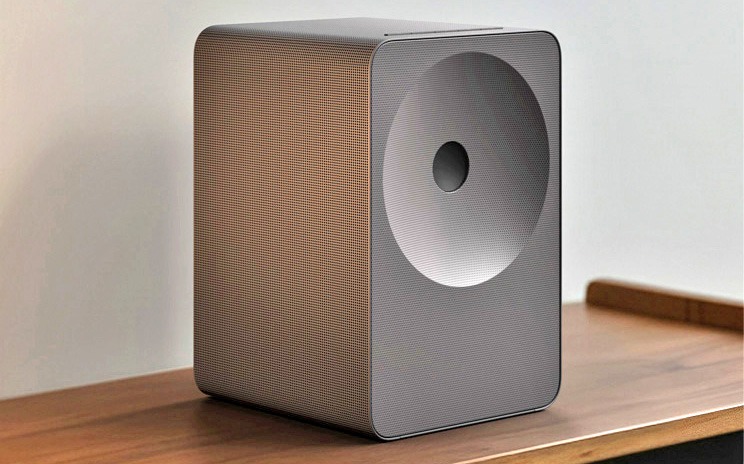
Samsung Music Studio 7 (LS70H) Wireless Speaker Closeup

The Music Studio 7 (LS70H) is the flagship of Samsung’s 2026 Wi-Fi speaker lineup, designed to deliver a more immersive listening experience from a single enclosure.

On the outside, it features a curved rectangular form that aligns with the series’ distinctive design language. Inside, Samsung has implemented a 3.1.1 channel configuration, including a built in subwoofer, with left, center, right, and top firing drivers working together to create a convincing sense of height and spatial depth without the need for a full surround system.

The LS70H measures 7.28 x 10.59 x 7.50 inches and weighs 12.35 pounds.

Music Studio 5 (LS50H)

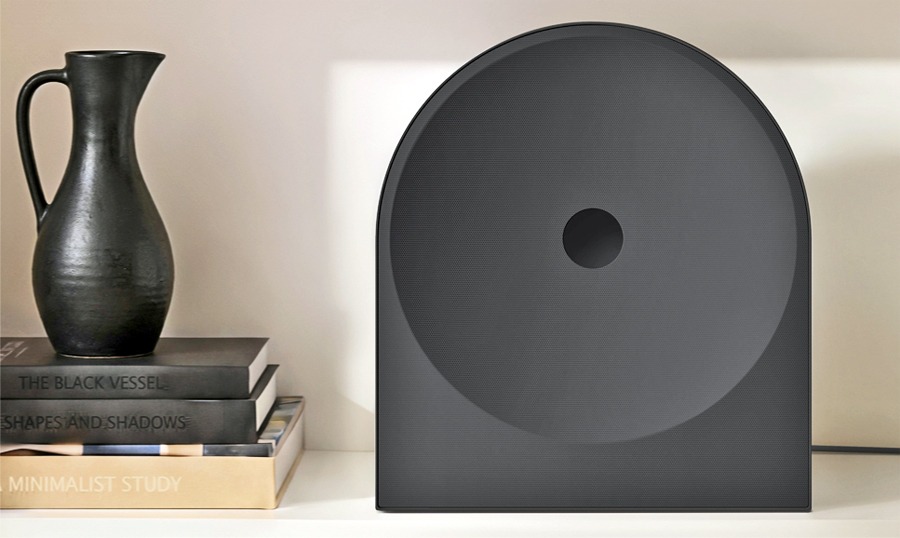
Samsung Music Studio 5 (LS50H) Wireless Speaker Close-up

The Music Studio 5 (LS50H) sits below the Music Studio 7 in Samsung’s 2026 Wi Fi speaker lineup and takes a different design approach, with a rounded top half and rectangular base that feels more decor friendly than most wireless speakers. It can reproduce stereo sound on its own or be paired with a second unit for a wider more enveloping soundstage. Though it has no built-in height speaker, it can reproduce virtualized Dolby Atmos immersive sound.

While it looks different from the Music Studio 7, the LS50H is still engineered to deliver controlled bass with minimal distortion and supports modern connectivity options, including Wi Fi casting, streaming services, voice control, and Bluetooth for seamless everyday use.

Advertisement

Inside, the Music Studio 5 uses a 2-channel configuration with a 4-inch woofer and dual tweeters, balancing clarity, low end presence, and a form factor that fits more easily into real living spaces.

The LS50H measures 9.88 x 11.18 x 5.39 inches and weighs 5.29 pounds.

Advertisement. Scroll to continue reading.

Comparison

Samsung Model  Music Studio 7 (LS70H) Music Studio 5 (LS50H)
Product Type Wi-Fi Speaker Wi-Fi Speaker
Price $499.99 $299.99
Number of Channels 3.1.1 2
Speaker Configuration 3 main channels (Left, center/front, right)
· 
1 Built-in Woofer ·
Advertisement

1 Up-firing 

2 Tweeters
· 
1 Built-in Woofer
HDMI ARC Yes (eARC) No
Dolby Atmos Yes Yes (virtualized)
Remote Controller No No
Q-Symphony compatible Yes Yes
SpaceFit Sound Pro Yes Yes
Built-in Mic Yes Yes
Group Play Yes Yes
Active Voice Amplifier (AVA) Pro Yes Yes
Connectivity Wi-Fi: Yes 

Bluetooth: Yes
 
Bluetooth Version: 6

Voice Assistants Built-in: Alexa, Bixby 

Advertisement

Works with: Google cast, Airplay

HDMI IN: No 

HDMI OUT: 1
 
HDMI CEC: Yes

Optical In: 1
 
USB: No

Advertisement

USB Music playback: No
 
Samsung Sound App: Yes
 
Spotify Connect: Yes 

Roon Ready: Yes

Wi-Fi: Yes
 
Bluetooth: Yes 

Bluetooth Version: 6

Advertisement

Voice Assistants Built-in: Alexa, Bixby 

Works with: Google cast, Airplay

HDMI IN: No 

HDMI OUT: No 

Advertisement

HDMI CEC: No

Optical In: 1
 
USB: No

USB Music playback: No 

Samsung Sound App: Yes
 
Spotify Connect: Yes 

Advertisement

Roon Ready: Yes

Audio Format/AV Decoding Dolby Atmos: Yes 

Dolby TrueHD: Yes 

Dolby Digital Plus: Yes
 
Dolby 5.1ch: Yes 

Advertisement

DTS:X: No 

DTS 5.1ch: No
 
DTS-HD HRA: No 

DTS-HD MA: No 

DTS Express: No 

Advertisement

MP3: Yes
 
AAC: Yes 

OGG: Yes 

FLAC: Yes 

WAV: Yes 

Advertisement

ALAC: Yes

AIFF: Yes

Dolby Atmos: Yes 

Dolby TrueHD: Yes 

Advertisement

Dolby 5.1ch: Yes 

DTS:X: No 

DTS 5.1ch: No
 
DTS-HD HRA: No 

DTS-HD MA: No 

Advertisement

DTS Express: No 

MP3: Yes 

AAC: Yes 

OGG: Yes 

Advertisement

FLAC: Yes
 
WAV: Yes 

ALAC: Yes

AIFF: Yes

Sound Modes Adaptive Sound: Yes
 
Night Mode: Yes
Advertisement

Voice enhance mode: Yes
 
Stereo: Yes

Adaptive Sound: Yes 

Night Mode: Yes

Voice enhance mode: Yes 

Advertisement

Stereo: Yes

Dimensions (inches WHD) 7.28 x 10.59 x 7.50 9.88 x 11.18 x 5.39
Weight (lbs) 12.35 5.29
Package Contents Speaker: Yes 

Power Cord: Yes

Speaker: Yes 
Advertisement

Power Cord: Yes

The Bottom Line 

The Music Studio 7 and Music Studio 5 mark Samsung’s most credible push yet into wireless whole home audio and two-channel audio. What makes them stand out isn’t just the feature list, it’s the combination of design, flexibility, and ecosystem integration. The Bouroullec “dot” design gives them a visual identity most wireless speakers lack, while support for Wi-Fi streaming, Roon, AirPlay, Google Cast, and Q Symphony makes them far more adaptable than the average plug and play box.

Samsung appears to be intentionally blurring categories here. The Music Studio speakers aren’t just lifestyle speakers. They can run in stereo mode, pair with each other for wider stereo separation, handle Dolby Atmos music, slot into a multi room system, or integrate into a home theater setup with Samsung TVs. That kind of versatility is where Samsung is clearly aiming to separate itself.

But there are tradeoffs. No analog input, no USB playback, and no phono stage means traditional sources are completely off the table without workarounds. If your system still revolves around physical media or external components, these aren’t built for you.

Advertisement

Competition is stiff. Sonos, Bluesound, Denon HEOS, Apple HomePod, and even higher end lifestyle brands like Naim all play in this space, and many offer deeper ecosystems or better support for wired sources. Samsung is betting that its design, TV integration, and Harman backed tuning will be enough to pull people in.

Who are these for? Not the purist with racks of gear and a Thorens spinning in the corner. These are for people building a modern system around streaming, multi room audio, and a Samsung TV who want something that looks good, sounds better than a soundbar on its own, and doesn’t require a weekend to set up.

Samsung isn’t just filling a gap here. It’s trying to create a new lane between soundbars and traditional stereo. Whether that lane gets crowded depends on how good they actually sound – and our initial listening sessions have us optimistic – but for the first time, it feels like Samsung is at least asking the right questions.

Pricing and Availability

Samsung Music Studio 7 (LS70H): $499.99 or less from Amazon  (available in Black)

Advertisement

Samsung Music Studio 5 (LS50H): $299.99 or less from Amazon (available in Black or White)

Source link

Advertisement
Continue Reading

Tech

AI agents that automatically prevent, detect and fix software issues are here as NeuBird AI launches Falcon, FalconClaw

Published

on

The mantra of the modern tech industry was arguably coined by Facebook (before it became Meta): “move fast and break things.”

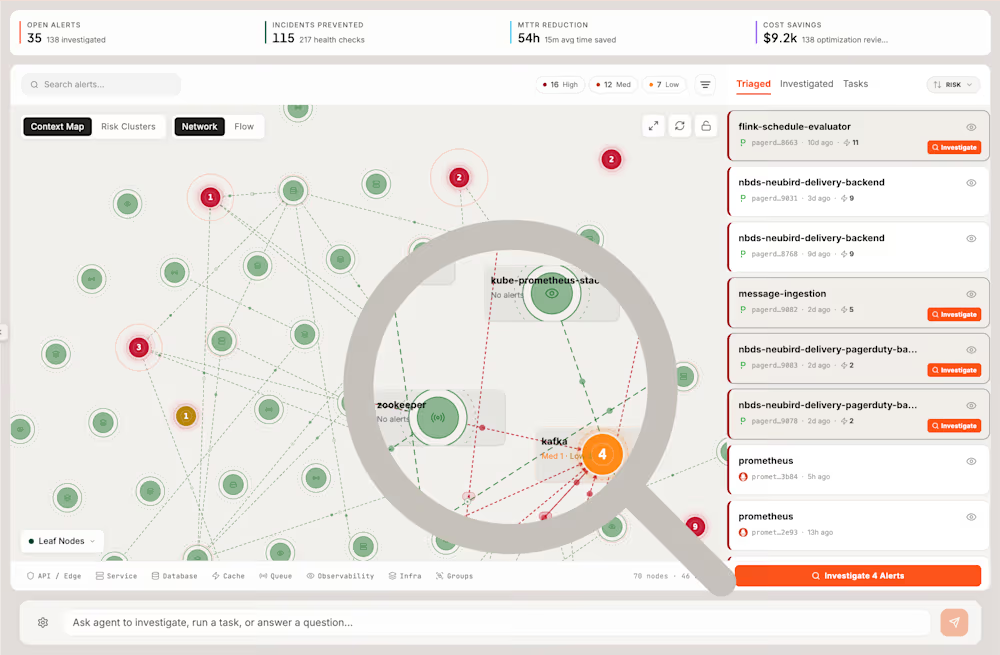
But as enterprise infrastructure has shifted into a dizzying maze of hybrid clouds, microservices, and ephemeral compute clusters, the “breaking” part has become a structural tax that many organizations can no longer afford to pay. Today, two-year-old startup NeuBird AI is launching a full-scale offensive against this “chaos tax,” announcing a $19.3 million funding round alongside the release of its Falcon autonomous production operations agent.

The launch isn’t just a product update; it is a philosophical pivot. For years, the industry has focused on “Incident Response”—making the fire trucks faster and the hoses bigger. NeuBird AI is arguing that the only sustainable path forward is “Incident Avoidance”.

As Venkat Ramakrishnan, President and COO of NeuBird AI, put it in a recent interview: “Incident management is so old school. Incident resolution is so old school. Incident avoidance is what is going to be enabled by AI”.

Advertisement

By grounding AI in real-time enterprise context rather than just large language model reasoning, the company aims to move site reliability engineering and devops teams from a reactive posture to a predictive one.

The AI divide: a reality check on automation

Accompanying the launch is NeuBird AI’s 2026 State of Production Reliability and AI Adoption Report, a survey of over 1,000 professionals that reveals a massive disconnect between the boardroom and the server room.