

Tech
Garmin Partners With MyKrida to Support Grassroots Athletes in India

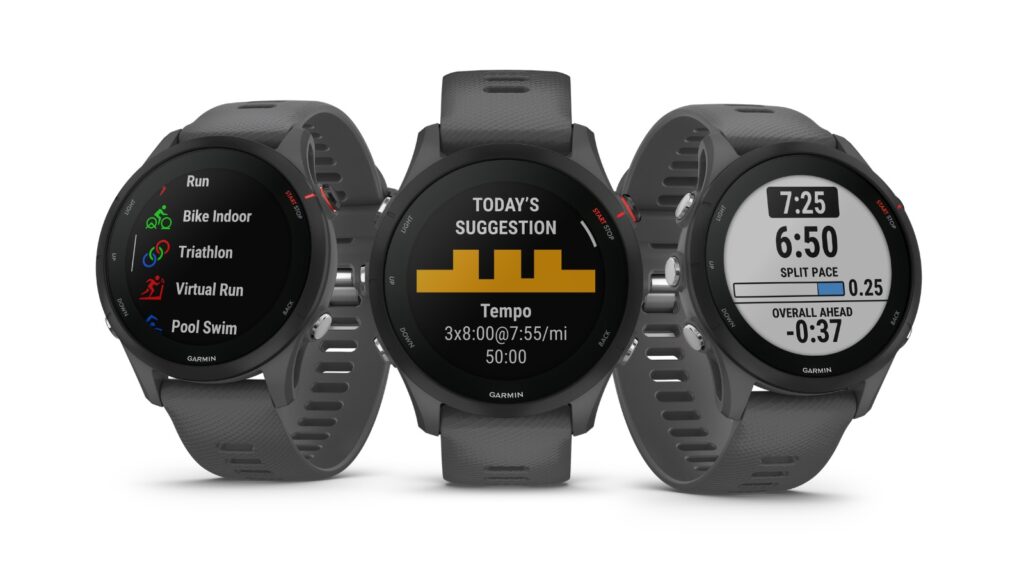
Fitness wearables today are usually marketed toward marathon runners, cyclists, and people already deep into the fitness ecosystem. But for many talented athletes in India, especially those from remote or underrepresented regions, access to proper training tools remains a major challenge. That’s something Garmin now wants to help address through a new initiative in partnership with MyKrida. The company has equipped seven emerging athletes from tribal regions across India with Garmin Forerunner smartwatches to help them access structured performance tracking and training insights.
Garmin Wants to Bring Data-Driven Training to More Athletes

The idea behind the initiative is fairly straightforward. Garmin’s Forerunner smartwatches can track metrics like heart rate, pace, distance, recovery, sleep quality, and training load. For professional athletes, this kind of data is already standard. But for many young athletes in smaller regions, access to these tools can genuinely change how they train. Garmin says the watches are meant to help athletes train smarter and improve consistency through better recovery and performance monitoring rather than simply increasing training intensity.
According to Deepak Raina, Director at AMIT GPS & Navigation LLP:
India has immense untapped athletic potential, particularly in regions where access to structured training tools remains limited. At Garmin, our focus is on enabling athletes with reliable, performance-led technology that brings clarity to how they train, recover, and improve. Through this initiative, we aim to support long-term athletic development and help these athletes compete with greater confidence and consistency.
The on-ground implementation is being managed by MyKrida, which works across grassroots and elite sports development programs in India. The platform focuses heavily on identifying athletes early and connecting them with structured support systems. According to MyKrida founder Shubham Sharma, the collaboration with Garmin helps bring “world-class performance technology directly to these athletes.”

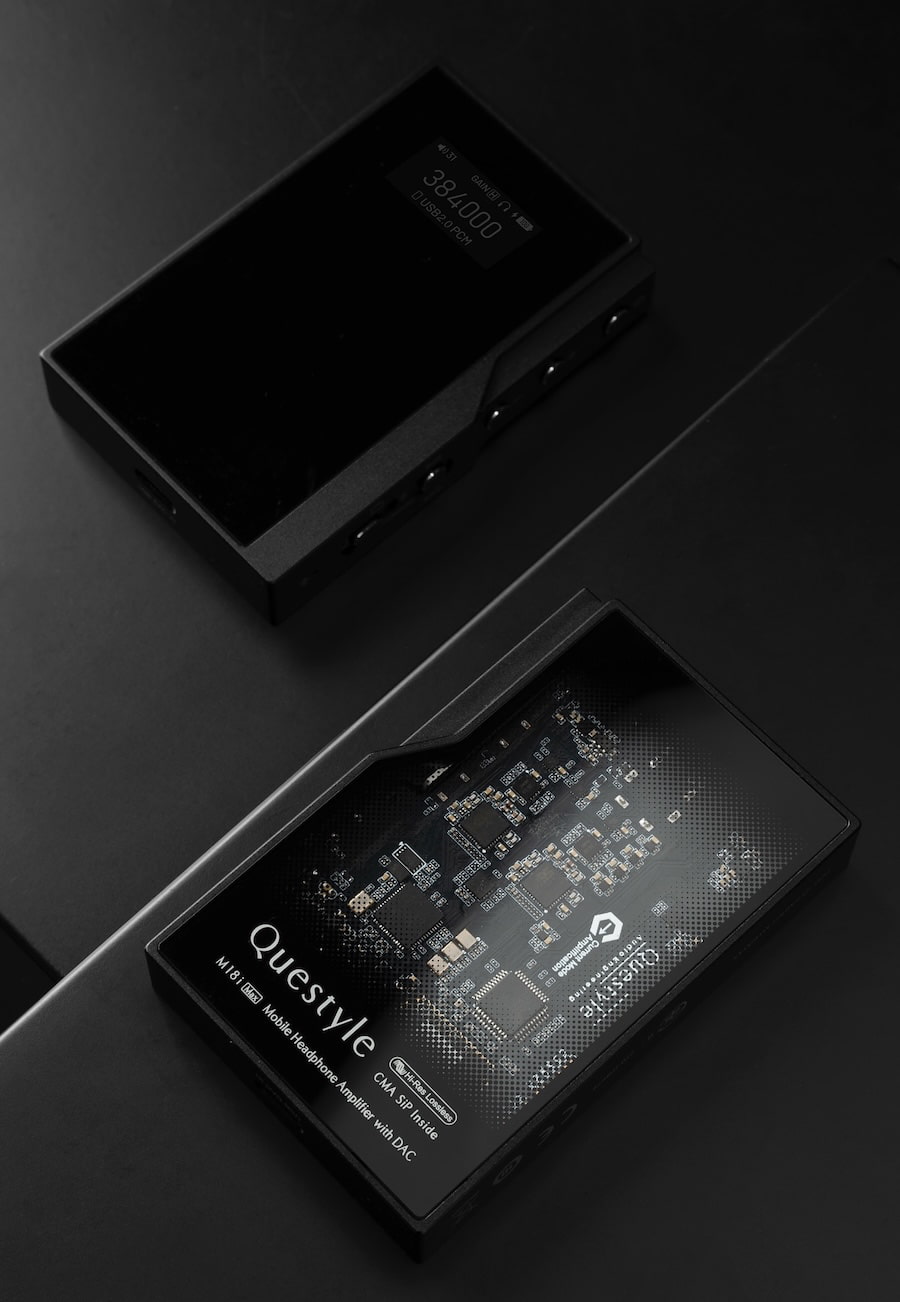
Questyle isn’t aiming low with the new M18i MAX. At $349 USD, this flagship mobile DAC and headphone amplifier targets listeners who expect more than convenience-grade audio. We’re looking at you, discerning audiophiles, music professionals, and mobile hi-fi users who actually read the spec sheet before surrendering the credit card.
Yes, even the Audio Science Review crowd. Still chasing that last decimal point of SINAD while the rest of us are listening to music. At some point, you have to step away from the measurements, come upstairs, and admit that enjoyment isn’t a graph. Momma called. Your TV dinner is ready.
The M18i MAX pairs Questyle’s patented Current Mode amplification with dual ESS ES9219Q DACs, Snapdragon Sound, and support for both USB DAC operation and lossless Bluetooth via aptX HD, LDAC, and LE Audio; all in a compact, premium design built to their usual level of quality at the factory in Shenzhen.
That also puts it on a very different path than Schiit’s new Vestri — the $99 Norse dongle DAC that basically says, “we don’t play that Schiit.” No screen. No Bluetooth. No wireless codecs. Just a stripped-down, wired-only approach that leans hard into simplicity and price. And to be fair, at $99, that’s kind of the point.
But in 2026, most people want options. Wired when it matters. Wireless when it’s convenient. High-quality codecs that don’t turn your library into sonic Bojangles. Questyle isn’t ignoring that reality — the M18i MAX is built around it.
What the Questyle M18i MAX Offers
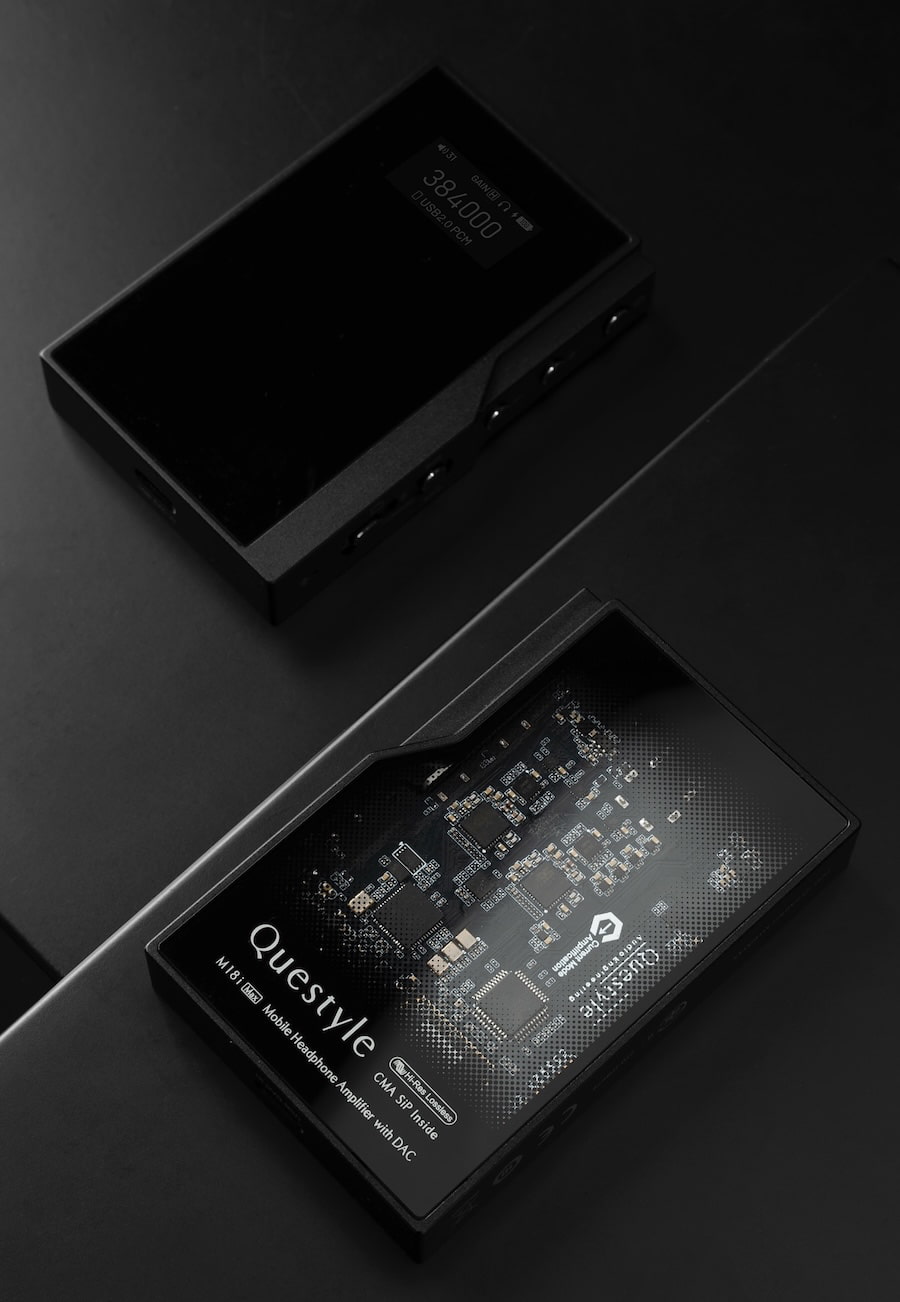
The Questyle M18i MAX uses a dual ESS ES9219Q DAC architecture with Questyle’s TTA decoding design, paired with four groups of patented Current Mode amplification rated at an ultra-low 0.0002% THD+N. It supports both Bluetooth 5.4 and USB DAC operation, giving users the flexibility to listen wirelessly or plug in directly when maximum signal integrity matters. It supports up to 384kHz/32-bit PCM and DSD256, which should cover 99% of the music that you might own or stream at this juncture.
Wireless support includes Snapdragon Sound, aptX Adaptive, aptX HD, LDAC, and LE Audio, which gives the M18i MAX broader codec support than many mobile DAC amps in this category. On the output side, it includes both 3.5mm single ended and 4.4mm balanced headphone connections, along with manual gain adjustment for better control with different IEMs and headphones.
Questyle also adds an intelligent battery management system with up to 12 hours of wireless playback, Apple MFi certification for smoother iPhone and iPad compatibility, an OLED display, and a premium CNC anodized aluminum chassis. In other words, this is not a bare bones dongle. It is a full featured portable DAC and headphone amplifier for listeners who want wired performance, wireless flexibility, and actual control in one pocketable device.
Questyle M18i MAX vs. M18i: What Changed and What We Still Don’t Know
Based on the currently available information, the M18i MAX looks more like an evolution of the original Questyle M18i than a complete redesign. A lot of the core DNA appears intact: dual ESS ES9219Q DACs, Questyle’s Current Mode amplification, Bluetooth plus USB DAC operation, balanced and single ended outputs, OLED display, and the same general “dongle that refuses to behave like a dongle” philosophy.
What does appear different so far is the positioning and feature refinement. Questyle is clearly leaning harder into the “flagship mobile DAC and headphone amplifier” language this time around, and the M18i MAX seems designed to address some of the criticisms surrounding the original M18i.
The biggest potential improvement is battery life. The original M18i earned praise for its sound quality, but eCoustics Headphone Editor Will Jennings and some users noted the relatively small 500mAh battery and limited runtime. In heavier use, especially over LDAC or the balanced output, real world playback could drop to roughly three hours.
The M18i MAX now claims up to 12 hours of wireless playback with a new intelligent battery management system. If that number holds up in real world use, that is not a small tweak. That changes the product from “desktop dongle with Bluetooth” into something people might actually use on flights longer than a Marvel movie.
Bluetooth support also seems more mature this time around. The original M18i already supported aptX HD, aptX Adaptive, LDAC, and LE Audio, but the M18i MAX branding and Snapdragon Sound emphasis suggest Questyle may have refined stability, latency, or wireless performance further. What we do not know yet is whether wireless output power has improved. As our review noted, the original M18i delivered its strongest performance in wired mode.
Technical Specifications
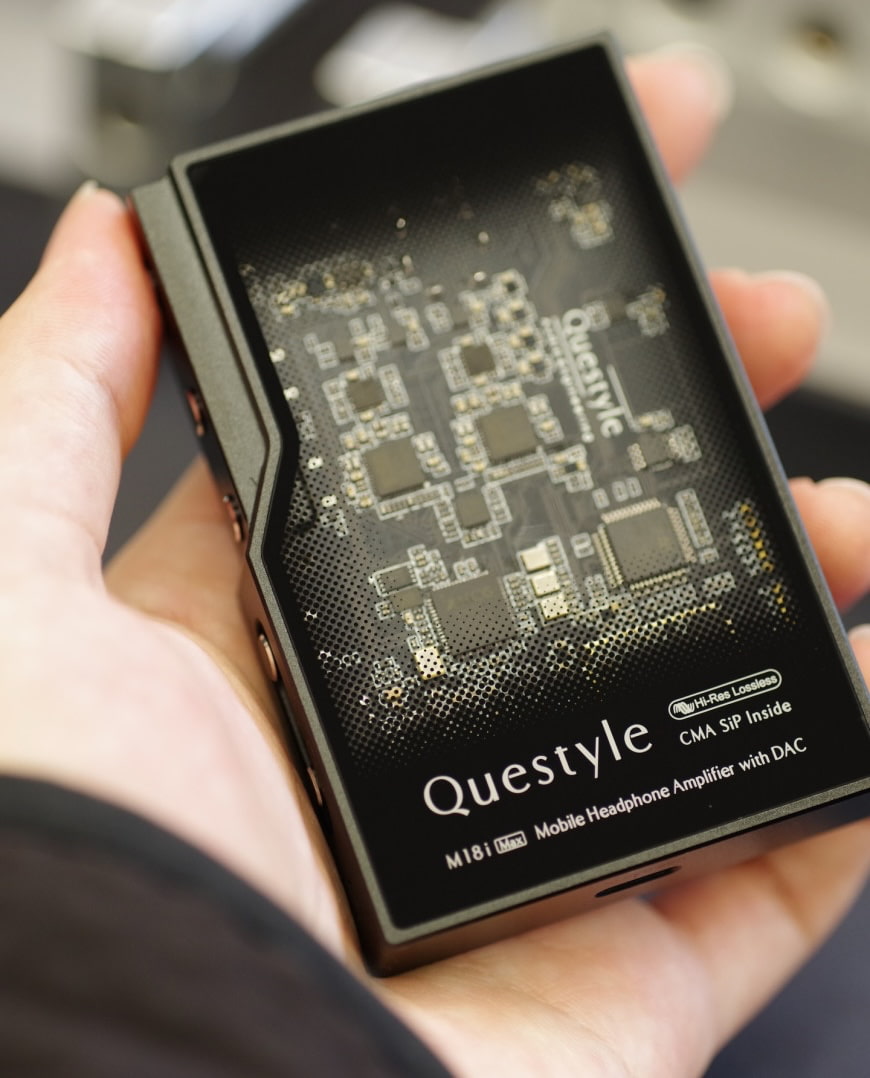
- Dual ESS ES9219Q DAC architecture with Questyle TTA (Three-Tier Architecture) decoding
- 4 groups of patented Current Mode amplification delivering ultra-low 0.0002% THD+N
- 1800mAh battery with Fast charging
- 12 hours of wireless playback
- Bluetooth 5.4 + USB DAC dual-mode operation
- TTA 3-stage amplification architecture
- OLED display and premium CNC anodized aluminum chassis
- 3.5mm single-ended and 4.4mm balanced outputs with manual gain adjustment
- Compatible codecs: SBC/aptX/aptX HD/aptX Adaptive/LDAC/LE Audio
- Apple MFi certification for seamless iPhone and iPad compatibility
- Size: 82 x 53 x 15 mm
- Weight: 100g
There are still a lot of unanswered questions about the M18i MAX.
We do not yet know:
- Actual output power ratings into common loads like 32Ω, 150Ω, or 300Ω
- Whether wired mode performance has improved over the original
- Whether battery bypass or battery protection features were added
- If thermal performance changed
- Whether Questyle added DSP, EQ, filters, or app support
- If gaming console compatibility has improved
- Whether the OLED interface offers more functionality or customization
- Whether the Bluetooth antenna and reception performance were upgraded
- If the MAX uses revised amplification modules or simply retuned existing CMA stages
And perhaps most importantly for the measurement crowd currently polishing their oscilloscopes in the basement: we do not know how much of the M18i MAX improvement is measurable versus audible. Questyle products have historically leaned into musicality, dynamics, and current mode implementation rather than chasing spec sheet theater alone. That tends to annoy people who listen to AP analyzer screenshots more than albums. Your dinner is getting cold.
The Bottom Line
The Questyle M18i MAX looks like a meaningful step forward because it keeps the original M18i formula intact while addressing the one issue that mattered most: battery life. What makes M18I MAX unique is the combination of wired DAC performance and serious wireless flexibility in one compact device. This is not a $99 plug in dongle with a very focused mission. The M18i MAX is for people who want one portable solution for laptops, phones, tablets, IEMs, and easier to drive headphones without giving up codec support or manual control.
What we still need to know matters. Questyle has not provided enough information yet on actual output power, thermal behavior, app support, EQ or filter options, wireless output performance, or whether the amplification section has been meaningfully revised beyond the original M18i. Until we test it, the “MAX” part remains a promise, not a verdict.
This is for mobile audiophiles, music professionals, frequent travelers, and anyone who wants a premium pocket DAC amp that works both wired and wirelessly. It is not for buyers who only need a simple dongle, refuse Bluetooth, or want desktop class power in their pocket. The M18i MAX looks far more complete than the original, but Questyle still has to prove that the longer battery life and updated feature set translate into better real world use.
Where to buy: $349, available May 20, 2026.
Related Reading:
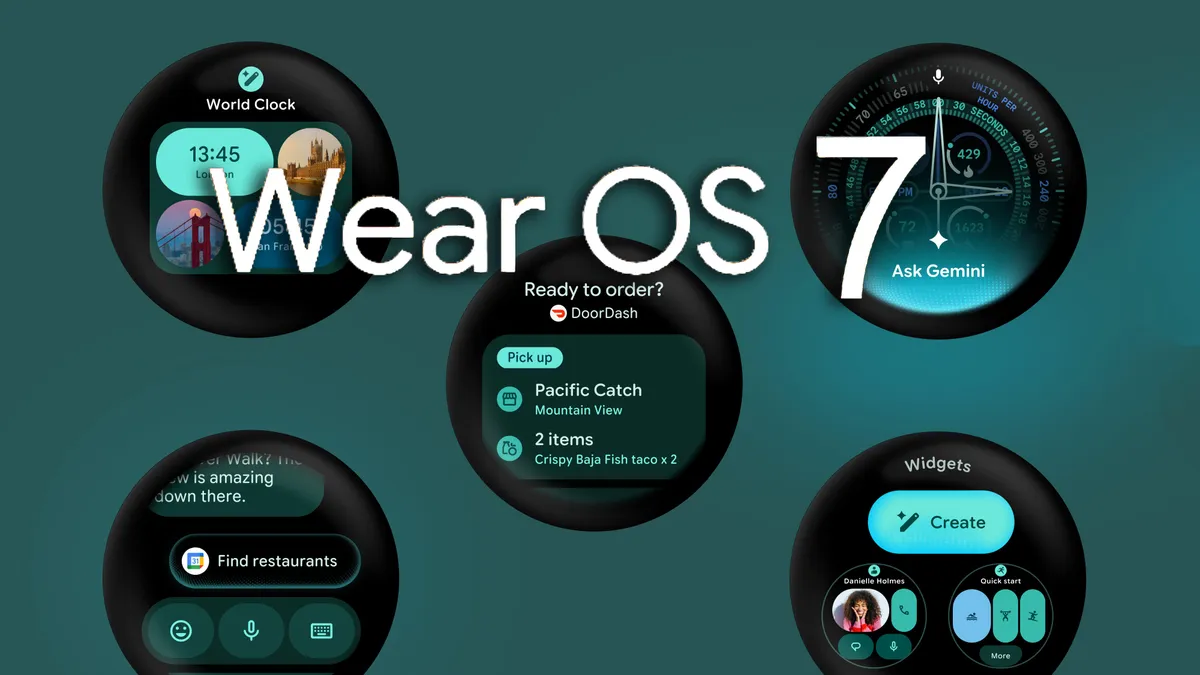
Google’s smartwatch operating system took a back seat at I/O this year, and its lack of prominence reveals where AI is heading next: your body.
Last year, Wear OS 6 debuted a redesigned interface, smoother animations, battery optimizations and, most importantly, Gemini on the wrist. The company framed smartwatches as the next major surface for AI, with Wear OS positioned as a central part of Android’s future.
Turns out this may have marked the beginning of a larger shift.
This year, Wear OS 7 got little more than a passing mention. Instead, Google I/O focused heavily on AI health tools, Gemini integrations, XR glasses and supporting hardware like the screenless Fitbit Air, a $100 band with no display, designed primarily as a gateway into Google’s health ecosystem. The redesigned Fitbit app has now become the Google Health hub, which centers around an AI health coach/concierge (with a $10 per month Premium subscription) that can give personalized training recommendations and surface broader health trends.
Google’s new Fitbit Air is a screen-less fitness tracker with a built-in coach.
Wear OS 7 updates, as described in an official blog post, focus mostly on minor tweaks under the hood: battery life improvements (10% over Wear OS 6), a shift from full-screen tiles to smaller Android-style widgets, refreshed Live Update notifications with dynamic information, a standardized universal workout-tracking experience for exercise apps and expanded Gemini Intelligence for “select” watches. This includes a new AppFunctions API that lets developers tie their apps into Gemini for task automation. Developers can now test features in the Wear OS 7 Canary emulator, based on Android 17. A broader consumer rollout is expected later this year.
That shift signals where Google sees hardware heading overall, with wearables taking a supporting role in Google’s main AI story. Phones, watches, glasses and earbuds are starting to feel secondary to the AI layer sitting on top of them. Hardware will still be important, but mostly because it gives Gemini more context, more sensors and more access to your life (and body). Google’s new AI health coach can now analyze biometric trends and even medical records to generate personalized recommendations.
Google isn’t alone in this broader industry trend. Apple is leaning on Google’s Gemini to power a revamped Siri, while also expanding its Apple Intelligence to watchOS on the Apple Watch. Companies like Whoop and Oura are building similar AI-driven coaching systems. Across the industry, hardware is increasingly presented as a delivery mechanism for AI services rather than the main product itself.
The Google Pixel Watch 4.
But before this AI-driven health future becomes reality, companies like Google will need to convince their customers that their most sensitive data is actually safe.
Google says its health features are designed with user privacy controls in mind, but the company hasn’t yet fully outlined how biometric and medical record data will be processed across Gemini-powered experiences.
Health data has a long history of being exposed, shared or sold, and even strong privacy promises have failed before. Anonymized health data can still be traced back to a specific person. Google will likely face an uphill climb to entice people to hand over access to their medical records.
Wear OS 7 is now available through the Canary Emulator for developers, giving app makers early access to new APIs and compatibility testing ahead of launch. Google says the broader Wear OS 7 rollout will begin later this year (no specific watch models have been listed yet), with some Gemini Intelligence features arriving independently on supported hardware based on region, manufacturer and account eligibility.
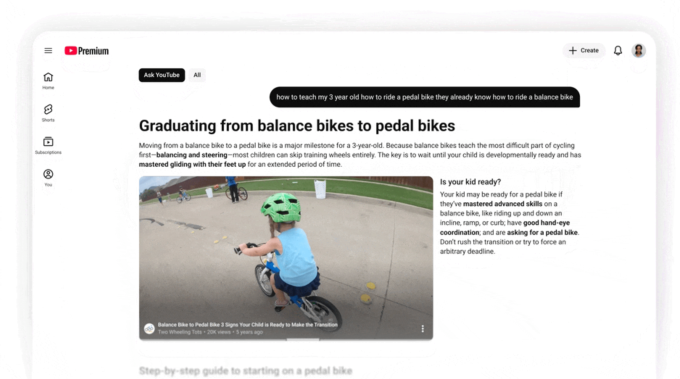
Google is completely revamping its search experience, and that doesn’t stop at YouTube. Like the rest of Google, YouTube’s search bar is getting infused with AI tools like “Ask YouTube,” a feature that is supposed to give users a more sophisticated search experience.
“With Ask YouTube, you can ask more complex search queries, such as wanting tips on how to teach your kid to ride a bike, or finding creator reviews of cozy games to play before bedtime,” the company explained. “You can even ask follow-up questions to continue refining what you’re looking for.”
YouTube will compile both Shorts and long-form videos and generate a response.
Premium subscribers in the U.S. on desktop can start using this feature now through YouTube’s optional Premium offerings to test new tools.

The company also announced that it is adding Gemini Omni, Google’s new AI video model, to YouTube Shorts Remix and the YouTube Create app.
“Remixing with Omni delivers a fresh way for users to create and build on each other’s imagination,” YouTube wrote in a press release. “The model better understands user intent creating more consistent and meaningful storytelling while also handling complex video and audio adjustments behind the scenes.”
Other companies like Meta and OpenAI have seen mixed reception when pushing for AI use in Shorts. OpenAI even sunsetted its social app Sora, where users could post and share their AI-generated clips. But YouTube seems to be rolling this out in a manner that feels a bit less front and center.
YouTube is also expanding its likeness-detection tool to creators 18 and older, which is supposed to help prevent creators from being deepfaked in other people’s AI content. If a creator sees themselves misrepresented in AI videos, they can request that the video be removed. Since this feature is only now expanding more broadly, it remains to be seen how effective it is.
When you purchase through links in our articles, we may earn a small commission. This doesn’t affect our editorial independence.
Vibe coding is allowed for App Store apps, but Apple doesn’t want it to make apps on an iPhone without oversight.
Vibe coding is great for the App Store economy, but Apple is still wary about its use without safeguards in place. It’s a fine balance that’s going to be hard to maintain.
The concept of vibe coding has risen in tandem with AI chatbots in recent years. Infiltrating many areas of the development process, it has turned the process of making an app into child’s play.
However, while it has its benefits and issues, there are also some areas that Apple is really worried about. Stuff that it is really keen to avoid becoming a serious problem in the future.
It’s something that Apple really wants to sort out now before it becomes a real issue.
What is vibe coding?
Vibe Coding, simply put, is the idea of making an AI chatbot create code for you. At its minimalist level, you tell a chatbot to make something, potentially with some basic specifications or guidance to follow, and it produces the app on its own.
It could be as simple a prompt as “Make me a driving game” or “Create an egg timer that can be adjusted to various durations, and with varying alarm sounds.”
The idea is one that makes it extremely easy for anyone to make an app that they want to use. It takes away the harder elements of learning how to code, how to structure a program, or even knowing how to properly use a development environment like Xcode.
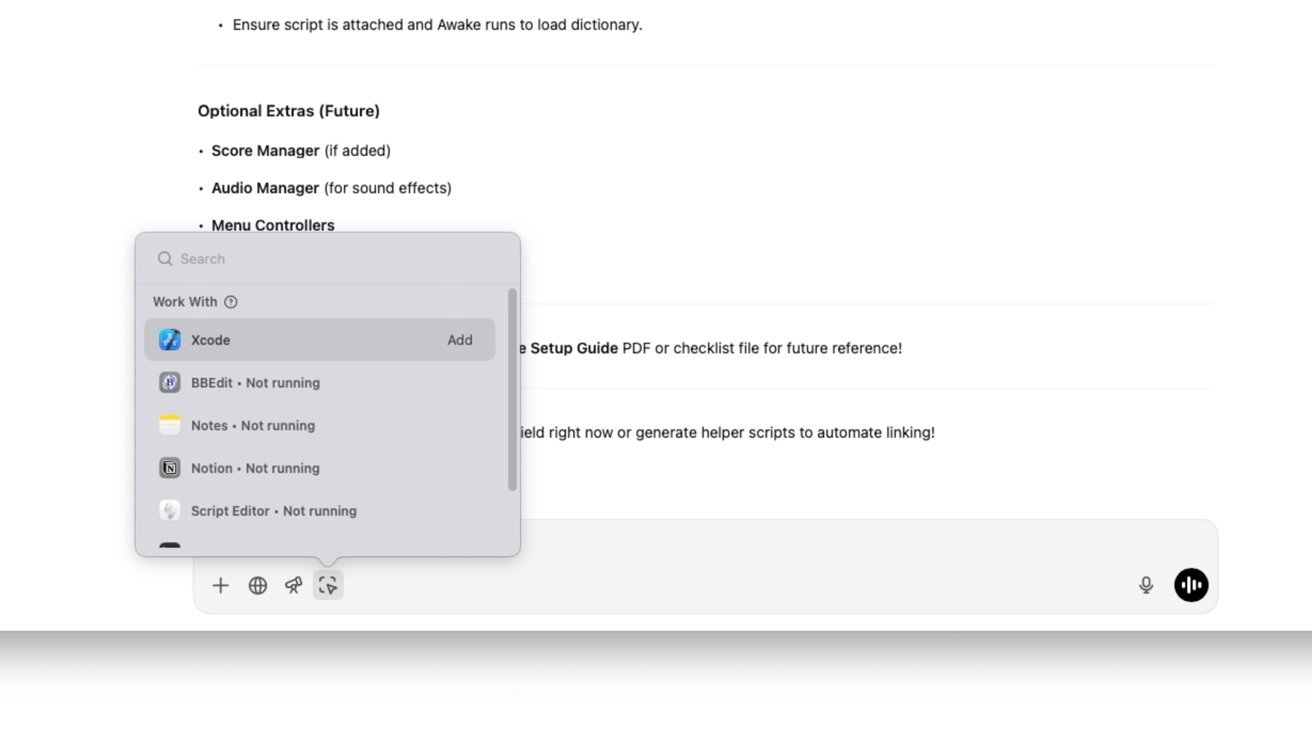
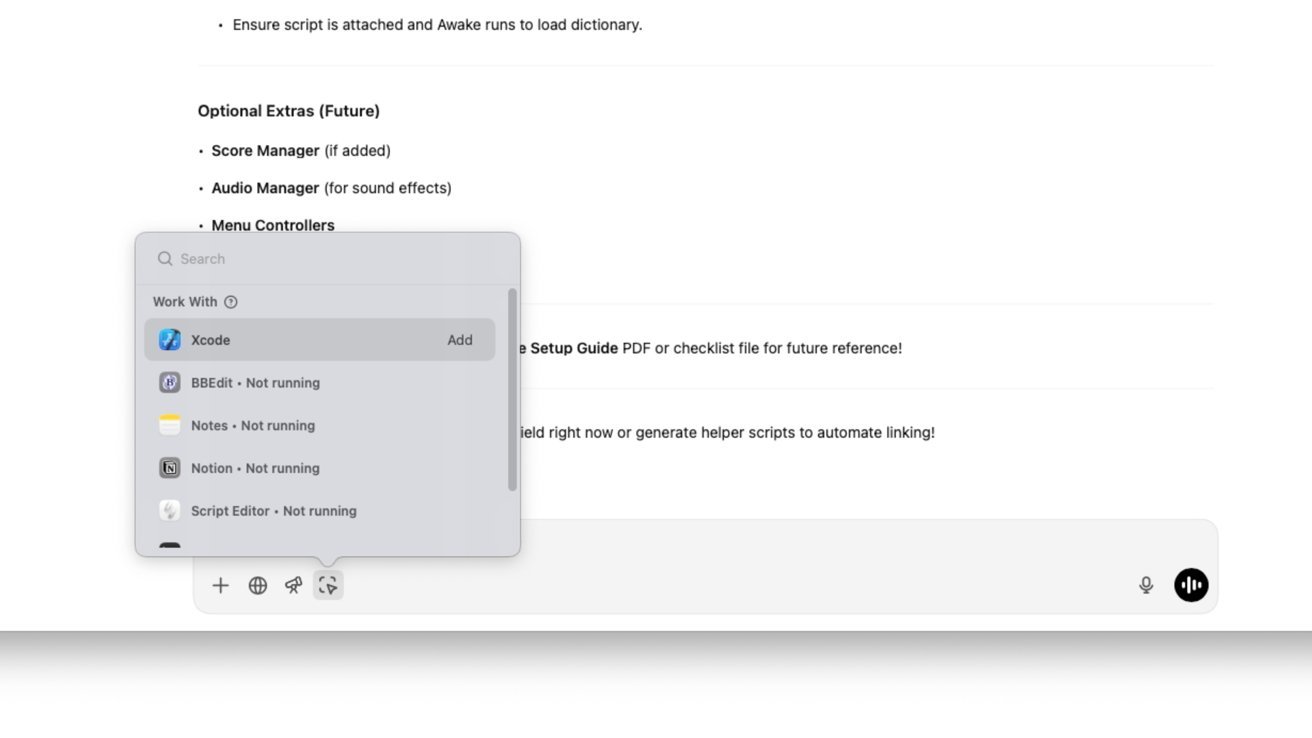
Connect ChatGPT to Xcode and you can ask the AI chatbot to help you make apps.
You could call it a natural but extreme extension of existing code-assistance tools developers already have access to for their work. A developer writing some script can be offered a ready-made element to complete the code, which can save them precious seconds of time.
Vibe coding goes multiple stages further, as you are effectively handing over the majority of the initiative over to an AI. It will follow whatever coding practices it has picked up when scouring the Internet, and produce an app in its own way, fulfilling your prompt.
In some cases, users simply ask for an app to be made and then use the app without examining code or questioning any element. They may give some feedback about a feature, such as asking for changes in font size or color, but the users may not even care about what processes have been undertaken.
The whole concept of telling an AI chatbot what to do goes beyond coding. You can also ask them to create designs and other things in apps, albeit with varying degrees of success.
When it comes to whether vibe coding is a good thing to allow or not, you have to look at it from two angles, as Apple currently does. There’s the case for it being used to make apps, but then there’s the issue of allowing vibe coding to occur beyond the App Store.
Vibe coding as an assistant
One of the areas that is completely fine to Apple is vibe coding outside of the App Store. Making apps to run on a Mac using an AI agent is perfectly fine to Apple.
Indeed, it even encourages it.
For quite some time, you could connect your choice of AI tool to a development environment to make edits to code. With increased integration, the developer environment can be used to the fullest extent by the AI agent, opening the door to full-blown project creation.
This was something that Apple introduced in Xcode 26.3. By enabling more access for AI services, it allowed for the creation of complete apps that followed Apple’s developer guidelines.
This can be a shockingly fast process too. As I found out in February connecting ChatGPT to Xcode, I was able to build a simple Pomodoro timer app and see it working on the Mac screen within two minutes.
A few button presses later, and I saw the exact same app working on a connected iPhone.
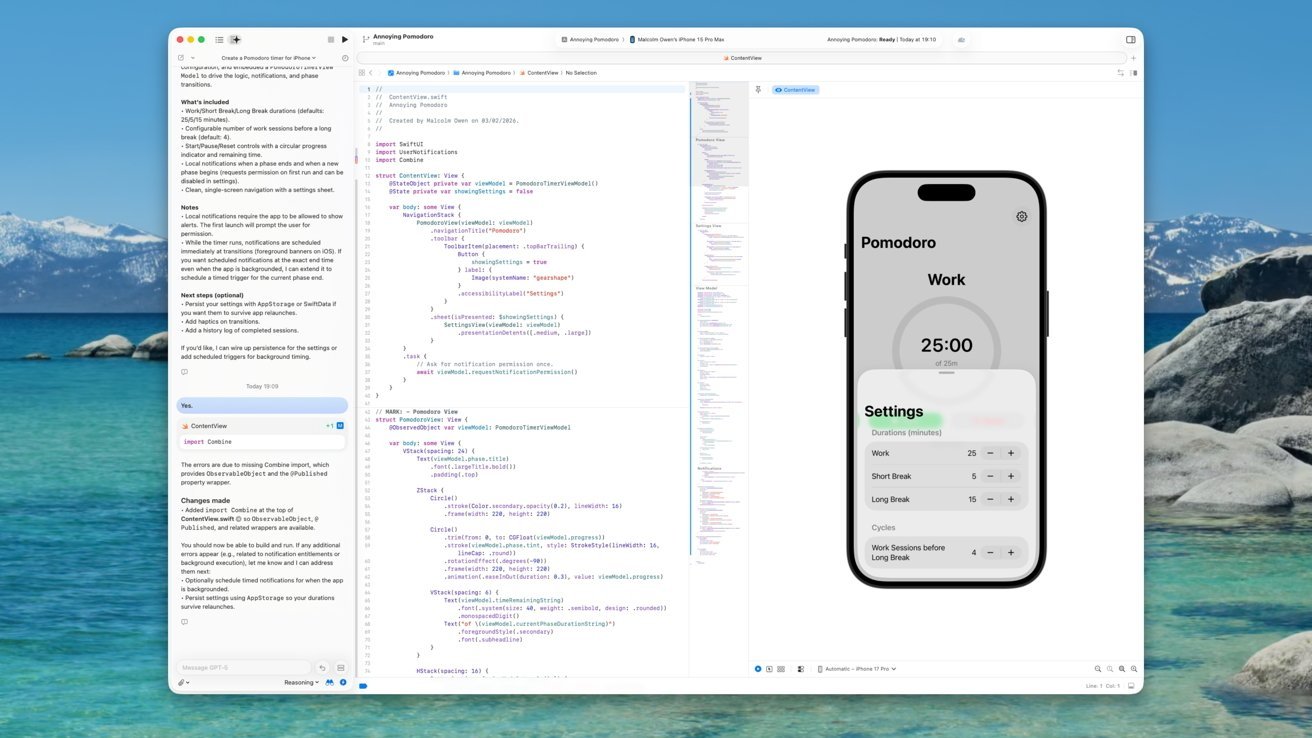
Vibe-coding a Pomodoro app within minutes using a simple prompt in Xcode.
This entire process democratizes app development, since you don’t need to know how to use Swift to create an app for your iPhone anymore. If you can describe it well enough to be understood by the AI, and if you don’t care too much about the exact result you get, the app will be usable enough.
Of course, you don’t have to settle for what the AI produces.
AppleInsider readers will be familiar with my development of a game, with the help of ChatGPT in Xcode. Rather than go full-on with vibe coding, I instead took the more careful route of making small and purposeful changes over time.
Every request was considered carefully, with the results checked thoroughly and corrected if needed before moving on. Less vibe coding, more being a project manager in control of a virtual programmer who knows everything about the topic.
It’s entirely possible that someone can vibe code the same game without too much trouble. But at the same time, they won’t know what will happen if something goes wrong and needs to be fixed.
They also won’t necessarily have a result that matches their vision.
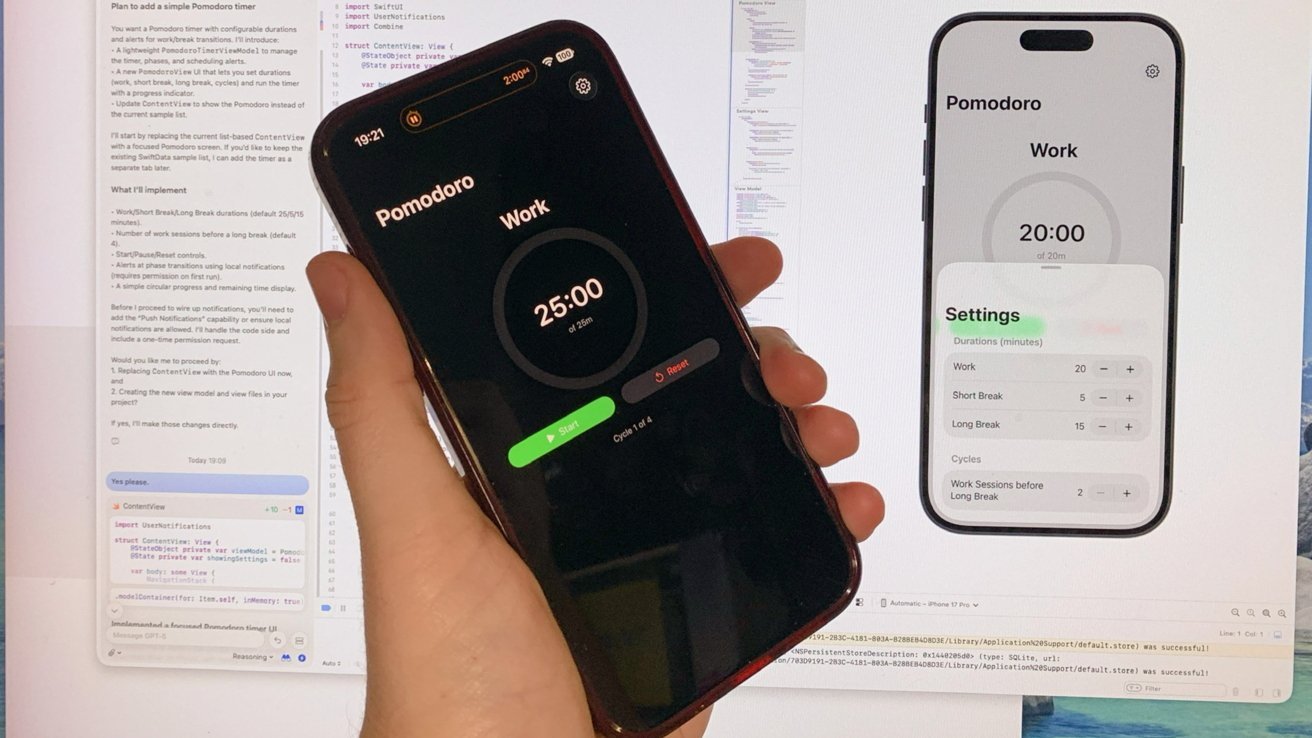
The same Pomodoro app on an iPhone, minutes later.
A vibe coder may want to include a feature in their app that they saw elsewhere, and simply ask the AI to do it. But, unless you know exactly how that feature operates and any other underlying elements the other app’s developer took into account, and somehow explain that to the AI perfectly, it won’t be a direct copy.
Sometimes, it’s the execution that actually matters.
With the Xcode integration enhancements, it’s safe to say that Apple is fine with people doing vibe coding in this way. Indeed, it’s something that has helped send a surge of apps through to the App Store review submissions process.
For Apple, vibe coding means more apps in the App Store, and more opportunities to earn from it.
At least, this sort of vibe coding is the version it’s fine with.
Beyond the App Store
The other kind of vibe coding that Apple has to deal with is the version that happens on an iPhone or iPad. This one is a problem because it’s something Apple can’t directly control.
Apple has consistently prevented anyone from being able to compile apps for the iPhone and iPad on the actual hardware. Sure, there’s some coding capability in Swift Playground, but that is a carefully managed experience, and you can’t create a separate standalone app.
This is not a technical limitation of the hardware, as an iPhone or iPad is a computer in its own right and easily capable. But it is a limitation of permissions for a few good reasons.
The App Store Review Guidelines, which app developers must follow, have rules preventing anyone from compiling code. That is, you can’t submit an app that generates code that can then run on the same iPhone or iPad as an app in its own right.
The rules make sense if you consider why the App Store Review Guidelines exist. One of the reasons is to maintain security and privacy, which it does so by checking apps that are submitted to the App Store for potential dangers.
The App Store Review process does accept vibe-coded apps.
For an app capable of coding and compilation, that means it’s possible for apps to be produced beyond the reach of the App Store Review Guidelines. Apple simply cannot check these generated-on-device apps at all.
The worst-case scenario is for someone to make malware on the iPhone or iPad directly, then use it to cause havoc.
With the capabilities of vibe coding as they are, if there are no guardrails in place, a user could create a prompt to make that hazardous software, with no oversight or protections in place.
There is also the argument that Apple would lose potential sales due to users making their own apps. But, in the face of possible malware generation and the potential harm to both the user’s private data and those of other victims, it’s not the one people should be worried about.
Of course, there are ways to enable vibe coding without running afoul of Apple’s guidelines.
For a start, the compilation could happen off-platform. Think of someone making a web app that is hosted on a server elsewhere, but using an iPhone app as a means to design it.
With the more recent development of AI chatbot services where the AI controls a user’s computer elsewhere based on prompts from a mobile app, it’s the same sort of remote-compilation workaround.
Vibe-coding by telling an AI prompt on your iPhone to build something on your Mac isn’t against Apple’s App Store’s rules.
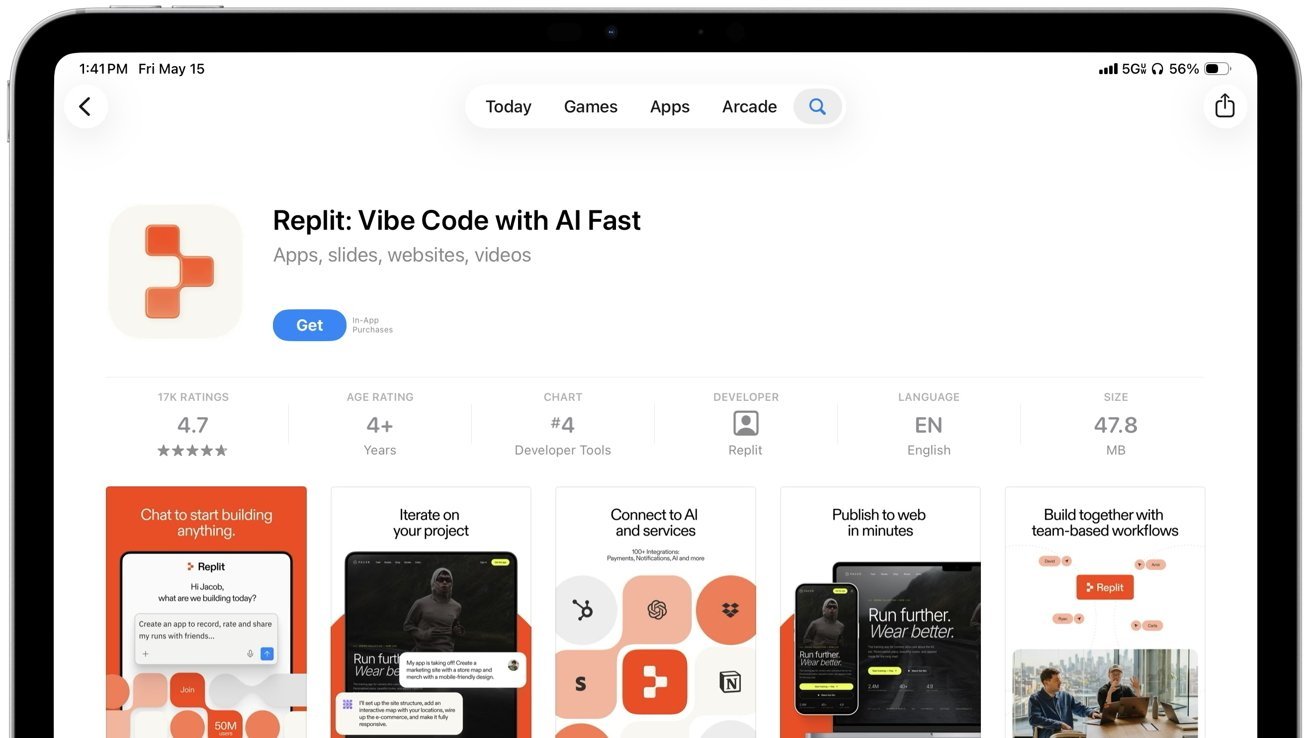
Replit was hit by Apple’s strict rules, but it fixed things and started getting updated again.
A timely example is Apple’s handling of Replit, which saw updates to the app being declined in January. Apple pushed back because it wasn’t happy with users being able to preview AI-built apps on the iPhone, which goes against rules about dynamically executed code.
In May, Replit made a number of changes to appease Apple and allow the app to be updated. The two “worked things out” without there being any real explanation of what changed, but it probably involved changes to that preview mechanism.
Right, but for how much longer?
Apple is, so far, handling the issue of vibe coding pretty well. Really, it’s two issues, and it has gone with the right answer for each one.
Using vibe coding for apps entering the App Store is a completely natural and expected use of the technology. For Apple, the only real downsides are dealing with a greater influx of apps to check and the possibility of the app flood making the market tougher for developers to sell their apps.
These are issues that can be solved by coming up with new ways to process higher numbers of apps, and to aid users in discovering the best apps for their particular needs.
The other side of the equation, the whole business of making apps on an iPhone that aren’t checkable by Apple’s workforce, is also being handled appropriately right now.

Apple is the judge, jury, and executioner when it comes to the App Store’s vibe coding apps.
Apple simply cannot check that a vibe-coded app theoretically running on the iPhone it was created on is actually safe. There are echoes of the whole third-party app storefront arguments when it comes to safety.
Again, I feel Apple is doing the right thing here. It doesn’t want an uncheckable piece of world-destroying malware to be made on an iPhone.
It could be proposed to Apple that it handles apps on an iPhone in the same way as on Mac. A platform that has to deal with apps downloaded from the Internet thanks to a notarization process where Apple checks the app before it becomes downloadable.
There’s more to the issue than that, but macOS proves that it can be done with relative success.
The real problem comes when the major AI players step in and demand that Apple allow for vibe-coded apps to be made and used on the same iPhone.
Despite protestations, Apple will eventually have to decide whether to allow them and deal with the safety and privacy issues, or risk losing out by angering OpenAI, Anthropic, and others.
It’s a problem Apple will have to face and solve at some point down the road. With the rate of change in the AI field, that time could come sooner than anyone thinks.
Tech
Jamo HYG Bluetooth Speakers Debut Ahead of High End Vienna 2026 With Scandinavian Comfort at the Core
Jamo isn’t easing back into the market. It’s making noise on multiple fronts ahead of High-End Vienna 2026. After being dropped by Voxx International in 2024 and re-emerging under Cinemaster and Rayleigh Lab, the Danish brand has already returned with the Concert Legacy and Concert Element speaker lines for mid to high-end two-channel and home theater buyers. Now it is moving into a far more crowded Bluetooth speaker category with the new HYG series.
Positioned as a premium lifestyle range built around the Danish concept of hygge, which focuses on comfort, warmth, and connection, the HYG lineup includes three models: Flex, Reflect, and Flow. Each is designed for a different use case, including indoor listening, outdoor spaces, and portable playback. Jamo is not just trying to revive its legacy. It is trying to prove it still belongs in the conversation.
HYG Flex
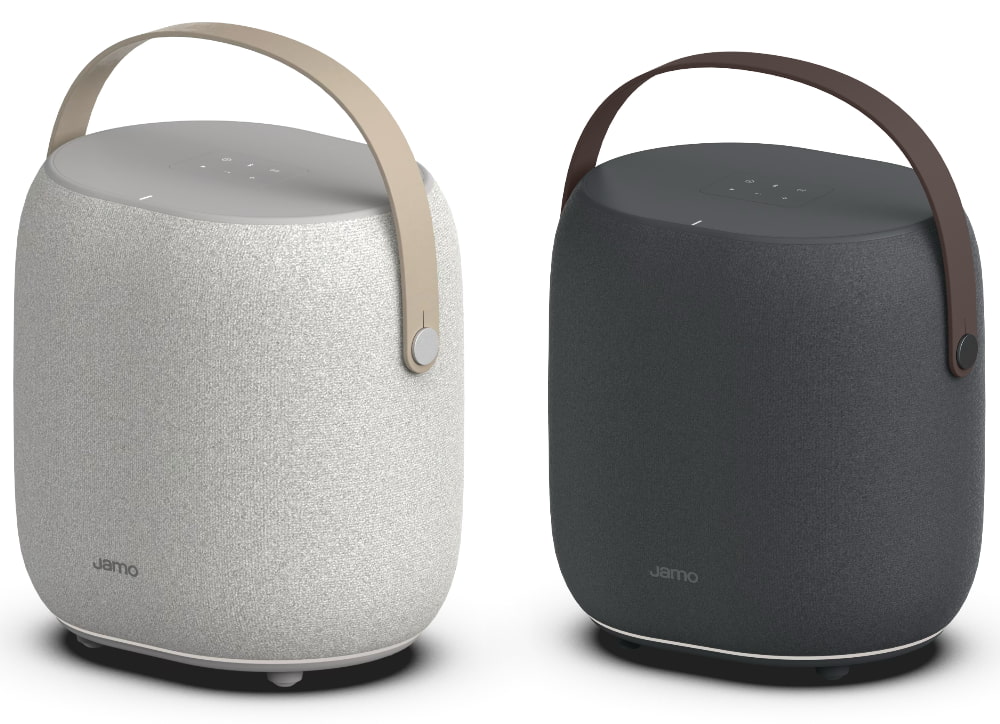
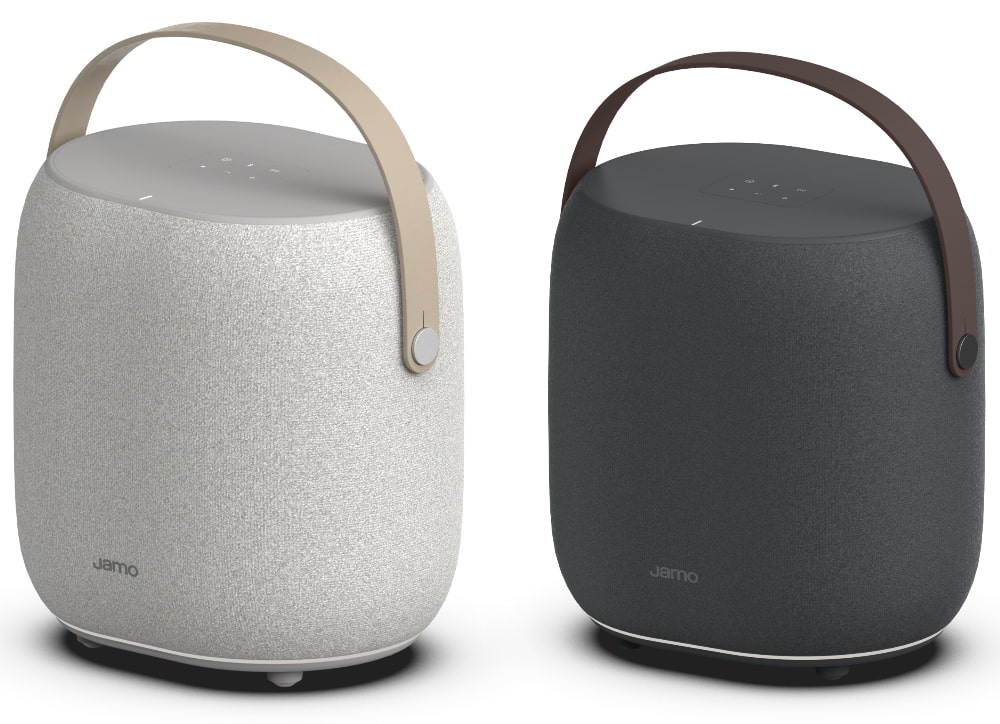
The HYG Flex sits at the top of Jamo’s new Bluetooth speaker lineup. It is aimed at listeners who want bigger sound from a portable speaker that still looks like it belongs in a living room, terrace, or outdoor space instead of a dorm-room crime scene.
The cylindrical cabinet is wrapped in soft fabric and designed for easy placement around the home. Inside, dual angled tweeters and a dedicated 5-inch woofer are intended to deliver wider dispersion, stronger bass, and greater scale than the smaller HYG models. Auracast support allows compatible Jamo speakers to connect for multi-speaker playback or stereo pairing, while the built-in ambient base light adds a softer visual touch for evening listening.
HYG Reflect
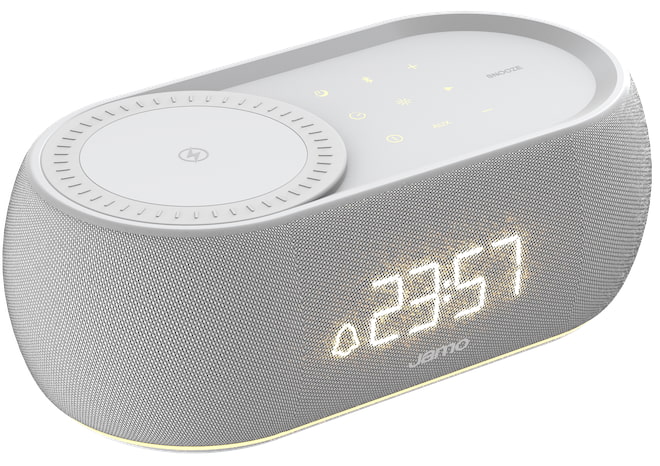
The HYG Reflect is Jamo’s bedside-focused Bluetooth speaker, designed for listeners who want music, light, and utility in one compact package. The built-in clock makes its intended location rather obvious, and the design leans into calm rather than flashing lights and “party mode” nonsense.
Reflect combines warm ambient lighting, wireless charging, and room-aware audio tuning that adjusts playback based on where the speaker is placed relative to the listener. It is the most lifestyle-focused model in the HYG lineup, built for bedrooms, nightstands, and smaller spaces where a speaker needs to sound good without looking like it escaped from a gaming desk.
The HYG Reflect also includes built-in ambient soundscapes inspired by Scandinavian nature, giving it a relaxation angle beyond basic Bluetooth playback. That makes sense for a bedside speaker, where blasting Slayer at 6:45 a.m. is technically possible but probably not the brand promise.
Two passive radiators and multi-stage tuning are designed to give the Reflect stronger low-frequency output than its compact size might suggest, while the integrated alarm and sleep timer keep the setup simple. The HYG Reflect is not a typical clock radio. It is Jamo’s attempt to make the bedside speaker feel more useful, calmer, and a lot less disposable.
HYG Flow
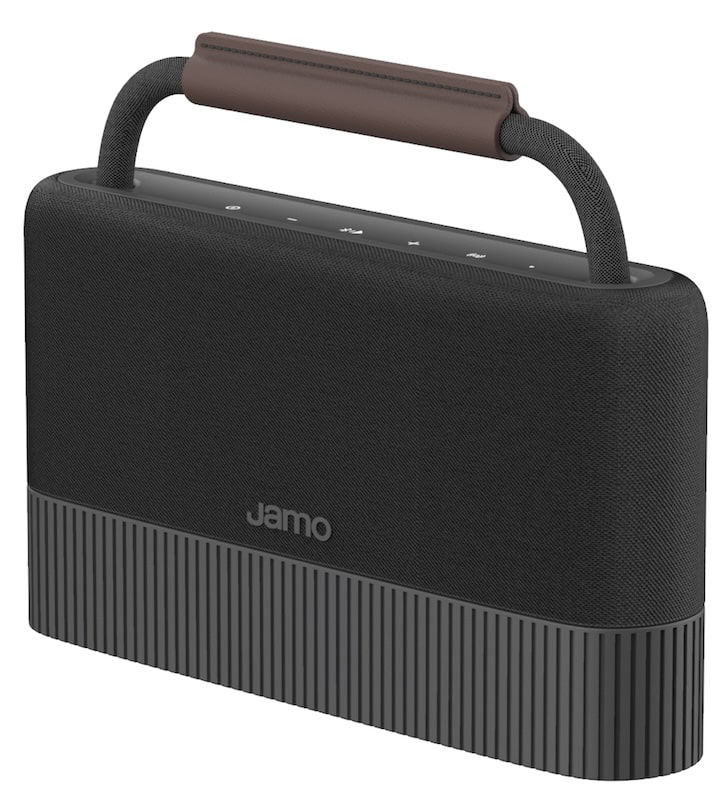
HYG Flow is designed primarily for outdoor spaces and road trips. Compact, portable, and IPX7 waterproof-rated, the HYG Flow combines Scandinavian-inspired aesthetics with durable materials and extended battery life. The HYG Flow is designed around portability and simplicity, with a braided handle and nano-coated water-resistant fabric.
Inside, the HYG Flow uses dual full-range drivers and two passive radiators to deliver balanced stereo sound from a compact portable design. Jamo has tuned it for vocal clarity and longer listening sessions, making it a strong fit for audiobooks, podcasts, radio, and background music that does not punish your ears after 30 minutes.
With up to 27 hours of battery life, Bluetooth 6.0, and Auracast support, the Flow is the most portable member of the HYG lineup and one of the more feature-complete options in Jamo’s new lifestyle range.
JAMO HYG Comparison
| HYG Flex | HYG Reflect | HYG Flow | |
| Product Type | Premium Bluetooth speaker | Bluetooth Clock speaker | Portable Waterproof Bluetooth speaker |
| Price | $279 | $149 | $129 |
| Configuation | 2-way vented box | Not Indicated | Not Indicated |
| Drivers | 2 x 1’’ (25 mm) Tweeter 1 x 5″ (127 mm) Woofer |
2 x 2’’ (51 mm) Full-range driver 2 x Passive radiator |
2 x 1.5’’ (38 mm) Full-range driver 2 x Passive radiator |
| Frequency Response (-6 dB) | 46 Hz – 20 kHz | 82 Hz – 20 kHz | 66 Hz – 20 kHz |
| Crossover Frequency | 2.5 kHz | N/A | N/A |
| Max SPL | 96 dB SPL @ 1m | Not Indicated | 90 dB SPL @ 1m |
| Amplification Power (AC Mode) | Total 56 W RMS Tweeter 2 x 8 W RMS Woofer 1 x 40 W RMS |
2 x 10W RMS 2 x 20W Peak |
2 x 5W RMS 2 x 10W Peak |
| Amplification Power (Battery Mode) | Total 28 W RMS Tweeter 2 x 4 W RMS Woofer 1 x 20 W RMS |
2 x 10W RMS 2 x 20W Peak |
2 x 5W RMS 2 x 10W Peak |
| Inputs | Bluetooth, AUX-in | Bluetooth, AUX-In 3.5 mm jack | Bluetooth |
| Wireless Streaming Feature | Bluetooth 6.0 | Bluetooth 6.0 | Bluetooth 6.0 |
| Bluetooth Codec | SBC, AAC, LC3 | SBC, AAC | SBC, AAC, LC3 |
| Auracast | Yes | Not Indicated | Yes |
| Ambient Soundscapes Tracks | Not Indicated | Ambient soundscapes tracks (x3) Golden Hour Daybreak Moonlight Echo |
Not Indicated |
| Power Supply | 100-240V AC | 100-240V AC adapter | Not Indicated |
| Maximum Music Playtime (Battery) | 15 hours | Not Indicated | 27 hours |
| Charging Time (AC port) | 3 hours | Not Indicated | 3 hours |
| Battery | 7.4V 2600 mAh | Not Indicated | 7.4V 2600 mAh |
| Battery Type | Not Indicated | Backup battery for clock (RTC Battery) | Not Indicated |
| Charging Output (USB-C) | 10 W maximum (5 V / 2 A) | Wireless charging pad: maximum 15W USB-C charging port: maximum 5V 2A |
USB-C |
| Clock Feature | No | Alarm – sleep timer – snooze feature – 12/24h mode | No |
| Ambient Light | Selectable brightness levels | Selectable brightness levels | Not Indicated |
| IP Rating | IPX2 | Not Applicable | IPX7 |
| Security | Not Indicated | Bluetooth naming setting (local rename) Safety lock |
Not Indicated |
| Product Dimensions (HWD) | 249.1 x 250.2 x 193 mm 9.8″ x 9.9″ x 7.6″(excluding handle) |
76 x 199 x 105 mm 3’’ x 7.8’’ x 4.1’’ |
141.5 x 182.9 x 41.8 mm 5.57” x 7.20” x 1.65” (including handle) |
| Net Product Weight | 3.3 kg / 7.28 lbs | 0.78 kg / 1.72 lbs | 0.6 kg / 1.32 lbs |
| Weight (Packaging Included) | 4.1 kg / 9.04 lbs | 1.4 kg / 3.09 lbs | 0.9 kg / 1.98 lbs |
| Available Colors | Dark Grey Light Grey |
Dark Grey Light Grey |
Dark Grey Light Grey Sand Dune Summer Bloom Red Oxide Sage Green |

The Bottom Line
Jamo’s HYG line is less about one Bluetooth speaker in three sizes and more about three lifestyle products with different jobs. Flex is the larger portable option for room-filling sound, Reflect is the bedside model with a clock, ambient lighting, wireless charging, alarm, sleep timer, and relaxation soundscapes, while Flow is the grab-and-go speaker with up to 27 hours of playback. That gives the lineup a clearer identity than the usual “small, medium, large” Bluetooth speaker playbook.
The missing pieces matter. There is no Wi-Fi, no app control, and no listed support for LDAC or aptX Lossless, which limits flexibility versus Sonos, JBL, Bose, and other established players. But with pricing from $129 to $279, the HYG series is aimed at listeners who want simple Bluetooth speakers with Scandinavian design, Auracast on select models, and easy placement around the home, garden, bedroom, or bag. Sonos does not need to panic. But Jamo has at least found a sensible way back into the conversation.
Price & Availability
The Jamo HYG Series Bluetooth Speakers will be available globally starting July 2026 through Authorized Dealers at the following prices:
Pro Tip: The Jamo HYG series will be previewed at High End Vienna from June 4 – 7, 2026
Related Reading:

from the buh-bye dept
Senator Bill Cassidy just lost his campaign for reelection to his Senate seat in Louisiana. With that, his career in federal government is likely over. It’s no secret as to why this happened. In early 2021, Cassidy suffered from a spasm of patriotism and voted to convict Donald Trump during his impeachment trial after the latter spurred on an attempted insurrection in the capitol that left several people dead, scores injured, and became the most famous stain on American democracy since the Bill Clinton era. Trump turned his retribution cannons on Cassidy, pumped the primary cycle full of vitriol for Cassidy, and managed to shove him from office.
But here’s the thing: fuck Bill Cassidy.
In the years since Trump’s second impeachment trial, Cassidy did his absolute best to throw as much unrequited love at Donald Trump as he possibly could. The moment the political realities became evident, Cassidy’s principles melted away. He spoke glowingly of Trump in his second term. He touted how well he and Trump work together, even as he acknowledged that Trump hates him. He was a reliable pro-Trump vote on nearly everything.
And he was the most important vote in confirming RFK Jr. to his current role as Secretary of HHS. And given how his vote to confirm Kennedy gave his colleagues cover to do so means that he may be the man most singularly responsible for Kennedy’s appointment other than Donald Trump.
Bill Cassidy is more at fault, because he actually knows better. RFK Jr. is an idiot with a brainworm, whereas Bill Cassidy is a doctor. A real doctor who worked in a charity hospital for the uninsured in Louisiana and, to his own testimony, has seen what happens when children don’t get vaccinated. He knew better, and yet he still provided the deciding vote to confirm Kennedy, almost definitely because he saw it as a way back into Trump’s good graces. Clearly, that didn’t happen.
And while he swore up and down that he had given Kennedy a real good talking-to and got all of the assurances that he would not screw with vaccines or change the CDC’s page stating that vaccines do not cause autism, that did not happen either.
He fucked us all to save his own skin, and ended up bloody and skinless anyway. He claimed it would be okay because of said “assurances” and because of his promise to monitor everything Kennedy did.
Monitor Kennedy he did, perhaps, but it certainly didn’t go beyond that. Save for a few contentious congressional hearings and Cassidy occasionally complaining to local news media about Kennedy’s actions at HHS, the man simply didn’t do anything to try to fix the mess he had a heavy hand in creating. He didn’t sign up to help the impeachment effort against Kennedy. He didn’t call for any new legislation to curb the chaos that is happening at HHS and its child agencies right now. He even had kind words to say about Kennedy’s approach to processed foods in the past few weeks.
Taking a moral stand is not a one-time project. Cassidy’s vote to convict Trump in 2021 was the right vote. Nearly everything he’s done since negates that moral stance, as he engaged in the most pathetic forms of boot-licking in an attempt to save his political career.
It didn’t work. Trump doesn’t work that way. Neither does Kennedy. Once you’re on the enemies hit list, you’re never coming off. The Senate will probably be worse for losing Cassidy generally. The Senate Health Committee certainly will be. And that’s too bad.
But fuck Bill Cassidy for foisting RFK Jr. as HHS boss on this country.
Filed Under: bill cassidy, donald trump, fuck that guy, rfk jr.

Looking for the most recent Mini Crossword answer? Click here for today’s Mini Crossword hints, as well as our daily answers and hints for The New York Times Wordle, Strands, Connections and Connections: Sports Edition puzzles.
Need some help with today’s Mini Crossword? It’s not too tough today, although I had to pause and think about 6-Down for a bit. Read on for all the answers. And if you could use some hints and guidance for daily solving, check out our Mini Crossword tips.
If you’re looking for today’s Wordle, Connections, Connections: Sports Edition and Strands answers, you can visit CNET’s NYT puzzle hints page.
Read more: Tips and Tricks for Solving The New York Times Mini Crossword
Let’s get to those Mini Crossword clues and answers.
The completed NYT Mini Crossword puzzle for May 20, 2026.
Mini across clues and answers
1A clue: Ross Edgley’s 1,700+-mile journey around Great Britain, for example
Answer: SWIM
5A clue: Fuzzy fruit
Answer: KIWI
6A clue: Someone who assumes the worst intentions in everything
Answer: CYNIC
7A clue: Orangutans, e.g.
Answer: APES
8A clue: Work well together
Answer: MESH
Mini down clues and answers
1D clue: Former competitor of Google Hangouts
Answer: SKYPE
2D clue: Signature products of Napa Valley
Answer: WINES
3D clue: “Yeah, in my dreams!”
Answer: IWISH
4D clue: Open ___ night
Answer: MIC
6D clue: Something found on a Mac (that anagrams to MAC)
Answer: CAM

It explained that it created the new rules due to Stripe’s policy.

Kickstarter has retracted the new set of rules around mature content that it released last week, following an outcry from creators whose campaigns are affected by the change. While the platform still allowed “romance and spicy literature, including comics” under that policy, it enforced stricter rules around pornographic and sexually explicit content. Now, Kickstarter has admitted that the response it got from its community let it know “loud and clear” that the crowdfunding platform got it wrong, so it’s going back to its previous rules.
It explained in its announcement that it updated its policy because of Stripe, its payment processor that operates under its own set of rules. Kickstarter explained that over the past few months, it has seen a growing number of campaigns that it had already approved get suspended by Stripe mid-funding due to their nature.
The platform would advocate for affected creators whenever that happened, and it was able to get Stripe to unfreeze their funds and to continue accepting money on their behalf so they could finish their campaigns. However, Kickstarter wasn’t always successful in getting Stripe’s decision reversed. It thought that the best path forward was to “close the gap” between its rules and Stripe’s so that creators would only have one set of rules to deal with.
“That was the intent, but the decision we made was an abandonment of the core counterculture, f*ck the establishment spirit of Kickstarter, and it left our community vulnerable,” it wrote in its post.
Under its previous rules, which have now been reinstated, pornography and illegal content are still prohibited. But the rules are less restrictive, as they’re more “bare bones and not as specific.” Kickstarter said that Stripe can still suspend campaigns due to their nature, but it promised to advocate for creators and to help them make adjustments to make their projects acceptable to Stripe. The platform called it an “imperfect temporary solution,” so it could still implement changes surrounding mature content in the future.
Kickstarter isn’t the only website affected by payment processors’ policies. Last year, Steam also started banning games that violate the rules and standards of “payment processors and related card networks and banks,” which affected titles with adult themes. Years before that, credit card companies Mastercard and Visa blocked the use of their cards on Pornhub and even severed ties with the advertising arm of the adult website’s parent company MindGeek.


The Dubai-founded global employment and payroll platform reached profitability in early 2025 before taking the round. EBRD Venture Capital led; 500 Global is the new strategic name alongside.\
RemotePass, the global employment, payroll, and spend platform co-founded by Kamal Reggad and Karim Nadi, has raised $17.4m in Series B funding led by EBRD Venture Capital, the company said on Tuesday. 500 Global joins the round as a new strategic investor, alongside returning backers Oraseya Capital, 212 VC, Access Bridge Ventures, and Khwarizmi Ventures.
The round comes 14 months after the company’s $5.5m Series A in March 2024 led by 212 VC, and takes total funding to roughly $23m on the company’s accounting of prior rounds.
The structural detail in the announcement is the profitability claim. RemotePass reached profitability in early 2025 and reinvested the operating-leverage runway in expansion rather than banking it.
Profitable HR-and-payroll-tech companies are unusual in the current vintage; the category is dominated by venture-scale platforms (Deel, Remote, Rippling, Velocity Global) operating on negative unit economics underwritten by repeated late-stage rounds. RemotePass is positioning itself as the discipline-led entrant.
What RemotePass sells is a category that has narrowed in the past two years. The platform handles Employer of Record (EOR) services, contractor management, cross-border payroll and compliance across more than 150 countries, with a fintech layer giving workers USD accounts, global cards and health insurance on top.
The company’s own published numbers put it at 35,000-plus workers across the platform and $800m-plus in cross-border payroll facilitated to date. Named customers include Logitech, Tata Group, InDrive, and Careem.
The product expansion, accelerating the company’s growth, is the fintech layer. In late 2025, RemotePass launched SpendCards, embedding corporate expense cards into the same platform that runs payroll. Expense management has been the operational layer cross-border HR incumbents have struggled with the most; finance teams running distributed workforces have historically had to stitch together payroll providers, expense-card issuers and reimbursement systems. RemotePass’s bet is that the integration of those three is itself the product differentiation.
Chief executive Kamal Reggad framed the round in operational terms: ‘We have the product, the traction, and now the partners to expand properly. Hiring is just the entry point. What companies actually need is a platform that supports their teams end-to-end, including the financial services that make distributed work function.’
The framing is positioning a category convergence as much as a product release. Global employment and embedded fintech, on Reggad’s read, are now the same business; RemotePass is structuring the round around that thesis.
EBRD Venture Capital is the venture arm of the European Bank for Reconstruction and Development, with a mandate across Central and Eastern Europe, the Caucasus, Central Asia and the southern and eastern Mediterranean.
Principal Amine Chabane framed RemotePass as ‘building a leading platform from an emerging market, with the product depth and commercial momentum to compete in Europe and the US’. 500 Global managing partner Amjad Ahmad added that ‘the emerging market depth, embedded fintech layer, and early AI investment create structural advantages that are hard to replicate’.
Deel, RemotePass’s largest competitor, was last reported to be managing in-house payroll teams in over 130 countries and serving 35,000-plus customers. RemotePass’s claim is that the incumbents have underserved cross-border employment cases involving emerging-market entities, banking infrastructure, and compliance complexity.
The MENA-anchored framing is consistent with the wider regional fintech cycle. Dubai has become an increasingly defended fintech hub over the past three years, with the UAE hosting the majority of the region’s most-funded startups and the city itself positioning as a launchpad for emerging-market-founded businesses scaling globally. RemotePass is the workforce-and-fintech variant of that thesis.
The broader labour-market context is tightening. Standard Chartered told investors on Tuesday that the bank would cut more than 15% of its back-office roles by 2030, in part by replacing what its CEO called ‘lower-value human capital’ with AI.
Multiverse’s $70m round earlier this month was framed around the upskilling-versus-replacing trade. RemotePass’s pitch is that it sits inside that intersection.
The company has not disclosed post-money valuation, run-rate revenue, or the geographic split of planned commercial expansion. The next twelve months of new-customer logo announcements will determine whether the Europe-US push lands at scale or whether the company remains an MENA-anchored player with international optionality.

Volvo's latest EV is its best yet, and best value too, but still comes up a bit short to the competition.


NRx Pharmaceuticals: 'Sell' On ZYESAMI/NRX-101 Failures & Depression Market Uncertainty

10 Most Suspenseful Movie Climaxes, Ranked

Arsenal crowned Premier League champions


-

 Crypto World4 days ago
BloFin War of Whales 2026 Grand Prix opens registration for $5M trading championship
-

 Fashion5 days ago
Weekend Open Thread: Theory – Corporette.com
-

 Crypto World5 days ago
E-Estate Announces 1 Year Live: Washington DC Summit as Real Estate Tokenization Enters Its Next Phase
-

 Tech5 days ago
Tech Moves: Microsoft AI leader jumps to OpenAI; former AI2 exec joins Meta; and more
-

 Tech4 days ago
Google reimburses Register sources who were victims of API fraud
-

 Crypto World6 days ago
Google’s Gemini AI Predicts Incredible Solana Price by the End of 2026
-

 Business5 days ago
H&R Real Estate Investment Trust (HR.UN:CA) Q1 2026 Earnings Call Transcript
-

 Sports4 days ago
Napoleonic enters 2026 Doomben 10,000 field via Abounding withdrawal
-
 Entertainment6 days ago
Zara Larsson Has Blunt Response To Chris Brown Diss
-
 Crypto World7 days ago
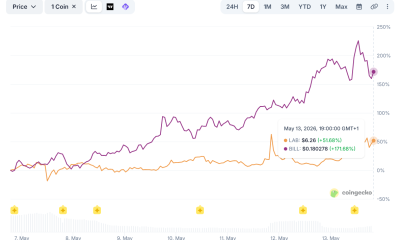
Two AI Tokens Lead May Rally, But Risks Are Rising
-
 Crypto World5 days ago
BeInCrypto 100 Institutional Awards Nomination: KAST for Best Digital Assets Neobank and Best Digital Assets Fintech
-

 Fashion3 days ago
On the Scene at Gucci’s Cruise Show in New York City: Mariah Carey, Kim Kardashian, Lindsay Lohan, Iman, and More!
-
 Crypto World4 days ago
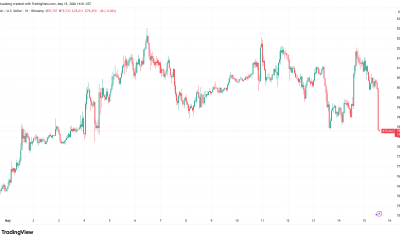
Bitcoin Battles US Bond Nerves With BTC Price Dip Toward New May Lows
-
 Crypto World4 days ago
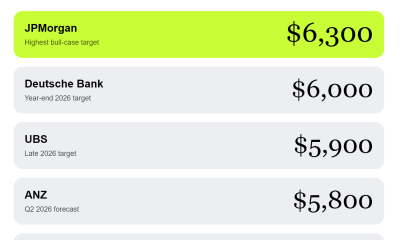
Wall Street’s Boldest Gold Prediction Has Russians Rushing to Buy
-

 Fashion4 days ago
Trending Western Style Vests Perfect for Summer
-

 Politics5 days ago
DWP PIP Timms review continues to be an absolute farce
-

 Crypto World4 days ago
ICE and CME urge US regulators to curb Hyperliquid energy trading
-

 Entertainment5 days ago
David Letterman Returns to Late Show, Blasts Cancellation
-

 Fashion3 days ago
Amazon Sundays: Memorial Day Hosting
-
 Crypto World5 days ago
Lido Finance Selects Chainlink CCIP as the Official Cross-Chain Infrastructure for wstETH Security
You must be logged in to post a comment Login