In shaping her career, Peru native Mariana Costa has asked herself a question: What can I do to make life better for women in Latin America?
The answer she landed on was training them for tech jobs.
Mariana Costa
Employer
Advertisement
Laboratoria
Title
Co-founder and president
Alma Maters
Advertisement
London School of Economics; Columbia
Such positions pay well and are in demand. And for too long, women across the region have been locked out of them, she says.
Costa is president of Laboratoria, a U.S.-registered nonprofit based in Miami that she helped found. Laboratoria has trained thousands of women in 11 Latin American countries for technology careers. She has built training centers in the countries and has placed graduates at major companies. Meanwhile, she has become one of the most recognized voices in the region on workforce equity and tech education for women.
IEEE recognized her work with its President’s Award this year for her “distinguished leadership and contributions to the betterment of society.” Recipients of the award are selected by the IEEE president with the consent of the IEEE Board of Directors.
Advertisement
Costa says the recognition came as a surprise because she is not an engineer by training and had never considered becoming affiliated with IEEE.
Costa grew up in Lima, Peru’s capital, in a household with no connection to engineering or technology. Her mother was an art historian and professor, and her father was a lawyer. The family was financially comfortable and traveled abroad regularly. Costa attended well-resourced schools.
That economic stability came with a reckoning, Costa says, in that she recognized early on that economic inequality had created separate societies inside Peru. Her parents, she says, made it “clear that my reality wasn’t the reality of most people in my country.”
Advertisement
Lima is a microcosm of the country, she says. The divide in the capital city is visible: A kilometers-long concrete wall topped with barbed wire separates wealthier neighborhoods from shantytowns, where residents lack running water.
Nationally, there are splits along ethnic and geographic lines. The highland and jungle regions remain home to mostly indigenous communities with limited educational access and a deep cultural distance from the Hispanic-dominated coast.
The questions that stirred in her as a child never left, she says.
“Why do I live in a country where so much depends on where you’re born?” she asked herself. “What does it mean to be Peruvian when individual realities are strikingly different?”
Advertisement
Those questions followed her to the London School of Economics, where she studied international relations, graduating with a bachelor’s degree in 2007. She held onto the questions when she moved to Washington, D.C., where she spent the next four years working for the Organization of American States, helping Latin American governments improve public services that fall under the heading of civil registration.
“I said, ‘How can it be? The tech space has so many rich opportunities. Why aren’t any women here?’”
The OAS Universal Civil Identity Program in the Americas provides technical support to national civil registry institutions, modernizing them to foster social inclusion and ensuring the right to civil identity for all people. Without civil identity, a person can’t access education, health care, legal employment, social services, or the right to vote. People without the classification don’t exist in the eyes of the government. They also can’t own property, get married officially, or pass citizenship rights to their children.
Doing that work deepened her concern about the socioeconomic disparities in her homeland, she says. In search of practical solutions to those problems, she went to New York City in 2011 to further her education. She earned a master’s degree in public administration and development from Columbia in 2013.
Advertisement
Technology was not yet part of a solution. But Costa already had met someone who would change that.
Falling in love with a programmer
While working in Washington, Costa met Herman Marìn, a software engineer who used digital tools in support of social causes. Because he was doing work she had never associated with programmers before, her assumptions about the field dissolved quickly.
“I had a vision of [programmers doing] something not very social—strictly technical,” she says. “And my then-boyfriend, now husband, actually worked for different social movements that used technology to address social causes.”
That realization cracked something open, she says: “I said, ‘Oh! Technology can actually be a tool to address some of the more stubborn problems in our societies.’”
Advertisement
After earning her degree at Columbia, Costa returned to Lima with her husband. She had been abroad for nearly a decade and felt the pull of home.
“The thought of not moving back to my country was something that tormented me a bit,” she says. “I really felt I had to move back, at least to try it out and contribute somehow.”
What Latin America’s tech space lacked
When Costa, her husband, and a friend from graduate school moved to Lima, they had modest savings and big ambitions. They wanted to build something that combined technology with social impact.
They started with what they had: a small digital services agency, where they built websites for clients.
Advertisement
The business grew, and they hired more employees. Their team expanded to a dozen software engineers. And as it did, Costa noticed three things.
First, there weren’t enough trained developers to meet the demand. Second, many of their best hires did not have traditional computer science degrees. Some had never even finished college.
“There was no other space where you could actually build an amazing career and get a well-paying job without a good degree from a good school,” she says. “The tech world was different. It was open in ways other fields weren’t.”
Thirdly, she noticed that there were no women on the team. In the first six months, Costa says, they didn’t interview a single female developer.
Advertisement
Her colleagues shrugged. It’s just how it is, they told her.
Costa, the outsider, didn’t accept that.
“I said, ‘How can that be? The tech space has so many rich opportunities,’” she says. “‘Why aren’t there any women?’”
Building Laboratoria
In 2014 she decided to launch Laboratoria. The business model was simple: Find talented women who hadn’t yet broken into tech, train them quickly on practical skills, and connect them with employers who needed developers.
Advertisement
Laboratoria started offering a six-month immersive boot camp that covered Web development, UX design, data literacy, strategic use of artificial intelligence, and soft-skills coaching such as interview prep and projecting confidence.
Just as important for career success, Costa says, is a user-centered mindset. She says Laboratoria’s program emphasizes the discipline of keeping the client’s needs in mind when designing the work.
The teaching model has evolved beyond the boot-camp structure, but the organization still focuses on helping Latin American women develop tech skills and land quality jobs in the digital age. These days, the training, conducted via twice-weekly live Zoom sessions, lasts six weeks.
“We needed developers ourselves,” she says of the company’s original logic. “I said, ‘Why don’t we run a program to train women—women who are incredibly talented but haven’t been given a chance yet—and help them gain the skills they need to get a great job as quickly as possible?’”
Advertisement
Mariana Costa [seated, right] poses with Laboratoria co-founder and CEO Gabriela Rocha and co-founder and chief product officer Rodulfo Prieto.Valeria Martens
It worked. Laboratoria expanded from Lima to Santiago, Chile; Mexico City; São Paulo, Brazil; and Bogotá, Colombia. The organization eventually incorporated as a nonprofit in the United States. Today its programs are held remotely in Latin America’s major job markets. So far, Laboratoria has opened the doors to tech careers for more than 3,500 women.
Costa says she believes the most important skills Laboratoria’s graduates need aren’t purely technical. Close behind the growth mindset is self-confidence, she says.
“Knowing who you are, valuing who you are, and learning to trust yourself and your capacities are indispensable traits,” she says.
Networking, she adds, is the third pillar, and often the hardest to build for women without access to elite schools or flexible work schedules.
Advertisement
“When you go out in the market,” she says, “you realize that having a network of people who trust you and know your work is such a valuable and critical asset.”
IEEE: a new connection
Costa’s introduction to IEEE came late—but it landed hard.
She is not an IEEE member, so when she was contacted this year about receiving the President’s Award, she did her homework on the organization. What she found, she says, was a public charity whose reach and values aligned with her mission.
“IEEE is about expanding access to opportunities in the world of technology,” she says. “And that’s also the core of what we do at Laboratoria.”
Advertisement
She says she also sees IEEE as a living example of something her company preaches every day: “I was talking about the value of professional networks, and I think IEEE is such an amazing reference in that space. It exemplifies this belief that human connection—not only doing your work but also sharing and learning with others—is at the core of building thriving technology careers.”
The engineering organization found her well after she launched her tech-related career. But it wasn’t too late. She says she intends to make the most of the connection.
Since the Mazda Miata launched in 1989, over a million units have sold across all generations, making it the best-selling sports car in history, and with good reason. The Miata is known for being fun to drive and adorable, all while having a convertible top. With its go-kart-like handling, the Miata is “always the answer,” whether it’s the track, canyons, a coastline cruise, or a morning drive to work. And perhaps the main selling point? It’s always been affordable through every generation, thanks to its minimalistic approach and small engines.
The Mazda MX-5 Miata recently made headlines for finally going over the $30,000 threshold — but it’s still the cheapest new sports car available in the United States at $31,665 to start. However, you can still find a cheap sports car for cheaper if you’re willing to buy one used. This could be a model that’s just a few years old, or perhaps a vintage sports car with the same focus on spirited driving.
Advertisement
Toyota GR86
If you can find a used Toyota GR86 that’s a few years old, you could spend just under $30,000 depending on the mileage and condition. With a 2.4-liter four-cylinder engine making 228 horsepower and a six-speed manual transmission (or an auto), the GR86 is known for its handling, steering, and overall visceral driving experience.
Advertisement
You’re looking at 0 to 60 mph in 5.4 seconds, thanks to a relatively small weight figure. Our own review of the 2024 model included a lot of comparisons to the Miata, since these are two cars with exceptional cornering, made even more fun with a manual transmission.
The downside to the GR86? Also like the Miata, it’s pretty cramped inside. The GR86 seats four, but it’ll be tough to find adults that want to sit in the back seats. The GR86 also gets pretty loud inside — it’s not the most luxurious ride. However, that adds to the charm.
Advertisement
Chevrolet Corvette (C6)
JustPhotos22/Shutterstock
The Chevrolet Corvette continues to push performance boundaries for its price point — the 2027 Corvette may be the only sports car that will get you to 200 mph (easily) at well under $100,000, but you can spend $30,000 on a Corvette if you go back to the C6, which ranges from model years 2005 to 2013.
The 2005 C6 has a 6.0-liter LS2 V8 engine, which produces 400 hp. 2008 introduced the LS3 engine, a 6.2-liter V8 that makes 428 hp. The C6 also has a nearly perfect weight distribution, so the handling is nimble and precise, while the power from the V8 engine offers incredible acceleration on straights. Like the Miata, the C6 Corvette is totally at home as a daily commuter or a weekend track monster, and the removable targa top also makes it a great cruiser. But, unlike the Miata, there is actually a good amount of trunk space in the C6.
Advertisement
Ford Mustang EcoBoost
Just dance/Shutterstock
If you go a few years back to 2024, the EcoBoost Mustang can be found for just under $30,000. The car community likes to joke about the EcoBoost, since it’s missing the iconic Coyote V8. Don’t knock the 2.3 EcoBoost, though; it makes 315 horsepower and 350 lb-ft of torque is enough to make the car feel powerful and fun to drive. It gets to 60 mph in 4.5 seconds and reaches the 1/4 mile in 13.2 seconds, making it a very fast four-cylinder option. And hey, it’s way more than the Miata’s 181-hp 2.0-liter engine.
The EcoBoost Mustang may not be as powerful as the GT, but it has always been known for having slightly better handling. This makes the EcoBoost a balanced option for the track, offering responsive steering and nimble turning, and not to mention less weight over the nose. However, the EcoBoost is also great for commuting. Unlike some others on the list, it’s quite comfortable in the cabin and almost peaceful. You get better gas mileage than the GT as well.
Advertisement
Mitsubishi Lancer Evolution X
The Mitsubishi Lancer Evolution X was released for 2008 and lasted until 2015, enduring quite a lot of market challenges. However, the Evo is now a pretty desirable sporty car for JDM fans, and there are plenty of options under $30,000 depending on mileage, condition, and modifications.
The Evo X sports the 4B11T engine, a 2.0-liter inline four turbocharged powerhouse that produced up to 440 hp in the FQ440 edition which, sadly, North America never got — USDM Evo X models topped out at 303 hp in the 2015 Final Edition. Fortunately, you can easily get 400 hp out of an Evo X. It’s also over 3,500 lbs, pretty hefty for a sporty car. With that combo of power and weight, the Evo X is known for needing its tires changed quite often, especially if you are taking it to the track.
While it’s not made with the most luxurious materials inside, the Mitsubishi Lancer Evolution X is actually quite reliable overall. However, you should look for a used example without a lot of modifications, which will make the search tougher. It’s very much worth it, since the Evo X is a fun show and track car with a very unique feel. Thank you, depreciation.
Advertisement
Toyota MR2 Spyder
S.Candide/Shutterstock
Looking for a fun, cute, convertible cheaper than the Miata? The third generation Toyota MR2’s average market rate right now is around $13,000, according to Classic.com, although the price will depend on the condition, mileage, and features. It has an expressive face thanks to its big, frog-like headlights and smiling grille. Its body is round yet sporty — and it’s also convertible.
If that doesn’t sound familiar enough, there’s also the fact that it has no cargo space (although there’s a tiny frunk). If you’re just wanting to have a fun daily driver or a car that’s perfect for spirited weekend driving, the MR2 fits the bill. It has a high-revving 1.8-liter engine four-cylinder, and yet it weighs only 2,195 lbs, making it light, zippy, and relatively fuel efficient.
Advertisement
There are actually two previous MR2 generations, although the Spyder is one of the most reliable and adorable. It’s honestly a shame the MR2 was discontinued, although Toyota is working on, and is almost ready to show a mid-engine MR2 successor quite soon.
Advertisement
How we came up with this list
There is truly nothing like the Mazda MX-5 Miata, but there are many sports cars that come close. To come up with this list, we first had to confirm the price of a new Miata — which has unfortunately reached beyond $30,000. There are really no other new sports cars that are $30,000, although there are some that come close: a new Mustang EcoBoost starts at $32,995, which isn’t too shabby.
To figure out the price of used sports cars, we used CarGurus and Cars.com, as well as Classic.com, to see listing prices as well as some averages. It was tough to narrow it down because there are plenty of classic sports cars that fit the bill, as well as older generations of popular current models. We chose sports cars from several eras, both a few years old and a decade or more, to give some variety. What do they all have in common? They had to be fun to drive and visually appealing, while bringing some of the Miata spirit with them, whether it was great handling, a convertible top, or a cute expression.
[Kevin Kelm] created something wondrous: Halcyon Dawn, an utterly unique and desperately challenging game that is equal parts intricate starship simulator, imposing hardware console, video game, and love letter to John Scalzi’s Old Man’s War book series. Grab a beverage for this one, because it’s chock-full of detail.
First, how is it played? The simulator represents the ship Halcyon Dawn, a stolen and renamed vessel, and the player representing its sole crew member. The ship’s new mission is to establish a home for its payload of genetically-engineered unfortunates, escaping a cruel sort of indentured military servitude. The former masters of course have a very different view of the whole situation, throwing around terms like “treason” and “theft” and in general preferring the version of the desperate protagonist they had the most control over.
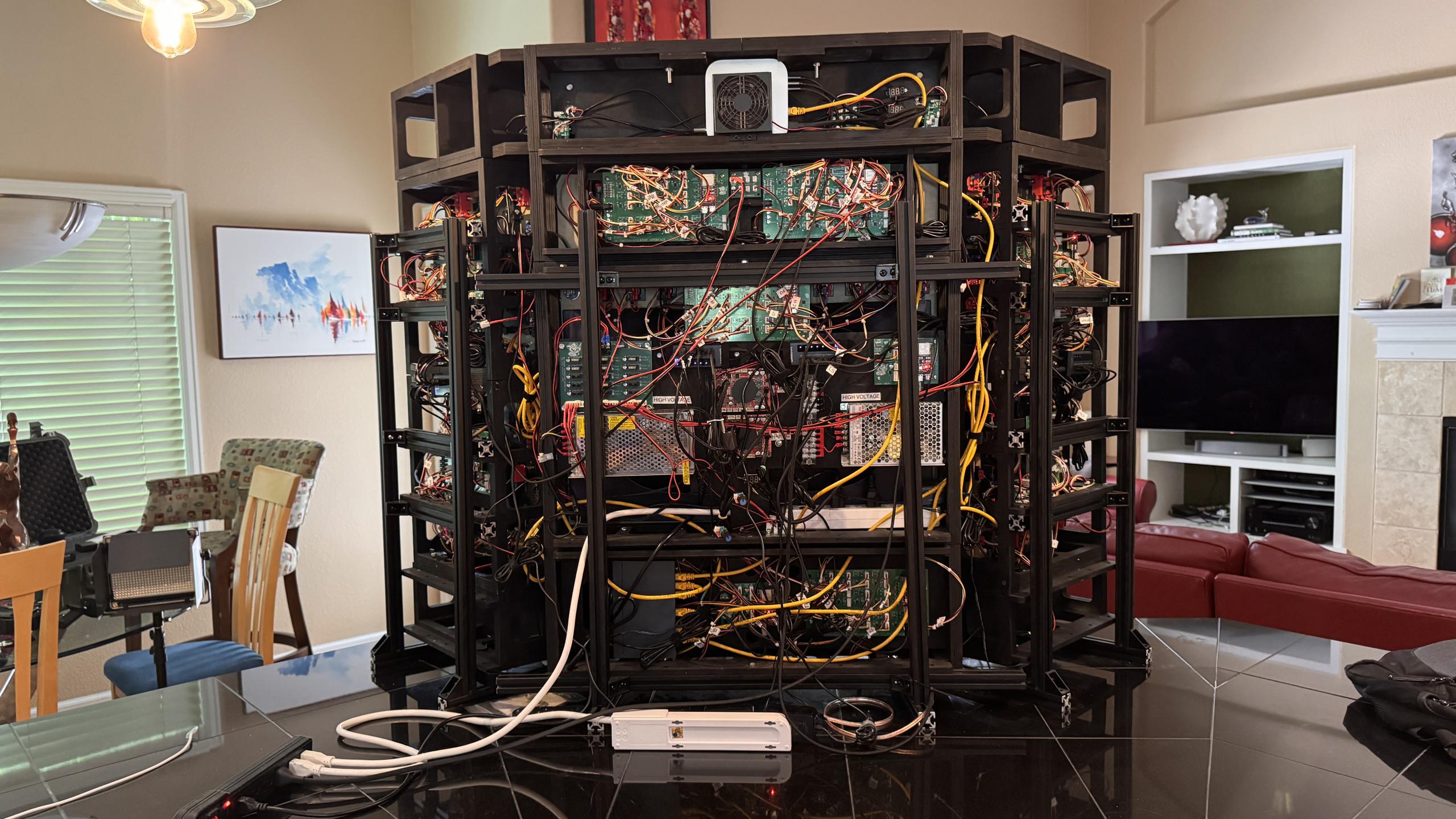
Aluminum extrusion, laser-cut panels, and custom PCBs for interfacing physical controls and displays make up the bulk of the build.
As the player is meant to be operating the ship on their own, the cockpit is imposing. All 152 controls and six screens are meaningful and will be needed to pilot the Halcyon Dawn, survive hostile actions, repel boarding attempts, mine and refine vast amounts of raw materials, and in general keep the ship running and intact until an autofactory can be deployed in orbit of a suitable planet to create a new home.
All easier said than done. It’s one thing to pilot and tweak a temperamental ship, but doing so while also performing damage control and thwarting a boarding attempt by manipulating life support is quite another. Want more details? Gameplay is documented here and the physical controls have their own library.
The product of a year of focused work, [Kevin] – now retired – pointed his decades of hardware and software experience at Halcyon Dawn after realizing one night that everything he needed to create it already existed. How this whole project came to be is also a tribute to the amazing tools and equipment that hobbyists and hackers of all kinds now have to turn an idea into something that actually exists in the world. Even so, it was a load of work he is not keen to repeat. Don’t miss the technical deep-dive and photo gallery of the build.
Advertisement
While the game itself — being a fan-made derivative of Scalzi’s work (and useless without the custom-made hardware console) — isn’t being released, [Kevin] has shared the underlying hardware framework it is built on. Enigma is an ESP32-based set of input and output PCBs made for integrating switches, knobs, displays, relays, and more with a Python library to make them easy to work with.
Starship simulators are a wonderful subset of projects, and every one is different from the last. Something about physical builds really works for them, and while we’ve seen a camper trailer converted to starship simulator [Kevin]’s project focuses the whole experience beautifully into the single-person console you see here. Watch a video of Halcyon Dawn running in an arcade-like “attract” mode embedded just below.
Facepalm: After users spent years waiting for mid-range and budget graphics cards to ship with more than 8GB of VRAM, the RAM crisis might not only extend this era of disappointing GPU memory pools but also drag GPUs backward. As AMD unveils a new entry-level member of the Radeon RX 9000 lineup, a leaked URL suggests that a 4GB variant exists.
The Radeon RX 9050 appeared on AMD’s website on Tuesday, with ASRock as the first partner to confirm its availability. Although the card is equipped with 8GB of GDDR6 VRAM on bothd AMD’s and ASRock’s listings, X user Ruby Rapids shared a now-dead link with placeholder text for a 4GB model.
Many experts already advise against playing high-end games on 8GB GPUs at resolutions above 1080p, especially with high-resolution textures and ray tracing. Even 12GB is often considered the bare minimum for gaming in 2026.
Graphics cards with only 4GB of VRAM have not been seen since AMD launched the Radeon RX 6400 and 6500 XT in 2022. While pricing information for the RX 9050 remains unavailable, it is hard to imagine the entry-level card pushing far beyond the 6500 XT’s $199 MSRP.
Advertisement
Digital Foundry reports that the RX 9050 utilizes the same Navi 44 GPU as the RX 9060. AMD’s website confirms that the lower-tier card has been cut down from 28 compute units to 16, with standard and boost clocks of 1,920 and 2,600 MHz. Ray accelerators and AI accelerators have also been reduced to 16 and 32, respectively. The GPU features 64 ROPs, 1,204 Stream processors, 64 texture units, and 29.7 billion transistors.
While the 8GB variant features a 128-bit memory interface with 288 GB/s of bandwidth, Digital Foundry fears that the 4GB variant, if it exists, might make matters worse by cutting its interface to 64 bits. AMD recommends a 450W PSU for the GPU, which draws 92W on its own. The company also estimates that it can achieve 60 fps in 007: First Light, 96 fps in Cyberpunk 2077, and 131 fps in Forza Horizon 6 at 1080p with medium settings, but it remains unclear whether the benchmarks apply to both models or only the 8GB variant.
ASRock aims to sell the AMD Radeon RX 9050 in Latin America and Asia.
If 4GB GPUs do return, DRAM shortages due to AI data center construction will be the primary cause. The crisis has driven numerous manufacturers to hike prices, including Apple, Microsoft, Sony, and GPU makers. Prior reports suggest that the shortages also delayed Nvidia’s rumored RTX 50 Super lineup, which is expected to introduce 3GB GDDR7 modules, allowing for 18GB and 24GB memory configurations.
Advertisement
No one is sure how long the DRAM shortages will last. Some manufacturers expect memory prices to stabilize in 2028, but ADATA warns that prices might remain elevated for another decade.
There are a number of telltale signs that your chainsaw’s chain needs to be replaced, such as seeing visible wear and tear on the saw’s chain or having to add too much of your own force in order for there to be any kind of effective cutting. When it comes time to get that a chain, there are several factors you need to consider when selecting that chain. Obviously, you need to know the pitch and the gauge for it to be able to snugly fit onto your blade. Beyond that though, there are other decisions that need to be made that can dramatically alter your sawing experience. The Stihl chainsaw brand makes that easier by splitting its available chains into two different categories: green and yellow.
One might think that these color distinctions indicate something like amateur and professional, but that isn’t the case. The green and yellow color markers are there to distinguish between low and high kickback chain models. One labeled as green is a low kickback model, while yellow indicates high kickback. On the various listings for the multitude of Stihl chains available, the company almost always recommends using green chains — along with green-labeled blades — with any of its chainsaw power heads, even on listings for yellow chains. Chainsaw kickback can be incredibly dangerous, and if you don’t have an extensive history with chainsaws, it can lead to serious injury if you can’t physically handle the kickback. For those with a lot of experience, they should be able to handle yellow chains. For most though, safety is of the utmost importance, and sticking with a low kickback green chain is the way to go.
Advertisement
How to tell the difference between green and yellow chains
While SlashGear considers Stihl to be the best chainsaw brand on the market, that doesn’t mean the company does everything perfectly. Yes, it smartly delineates its low kickback chains from its high kickback ones, but it makes actually figuring out which chain is which a lot trickier than it needs to be.
Advertisement
Purchasing in the store is a bit easier. Stihl chains each come in a box with a small colored square on the left side of the front of the packaging. There will also be additional rectangle on the left side of the box too. These shapes will either be colored green or yellow, depending on the which chain it is. The squares on the front of the box are quite small, so they can be a little easy to miss if you’re quickly scanning over your options in the hardware store. However, that’s a lot easier than the online process.
Annoyingly, the Stihl website doesn’t separate green chains from yellow ones. Every chain is grouped together, leaving you to go through them individually. Making things more complicated, it doesn’t label them as green or yellow in the product name. There are two ways to figure out. The first is by the picture. You’ll see a tiny green or yellow marker between chisels to indicate the difference, though not every picture has these colors featured. Your next hope is to read the full product description for kickback information, but unfortunately that’s not a guarantee either. If you aren’t sure what you’re getting, buying a chain in a hardware store is certainly the safer and easier option.
Sony’s decision to stop producing PlayStation discs starting in 2028 was met with a ton of initial backlash, especially in the wake of Sony reminding its customers yet again that a digital purchase of content isn’t actually a purchase of content at all and what you’ve bought can be ripped away from you with the barest of notice. But for some, including this writer, there was an assumption that the initial backlash is where this would all end. After all, the anti-consumer nonsense around digital products has been happening for over a decade now and little if anything has been done about it. Some others assumed that feckless gamers would end up just accepting the fate that Sony has planned for them.
And maybe they still will, but it seems that some folks are at least attempting to put up a fight first. Some activists have organized what they are calling the PSBlackout, attempting to get PlayStation owners to not make a purchase or even log into their consoles for a full calendar week in August, all in protest of Sony going disc-less.
As spotted by Push Square (via Eurogamer), the “PSBlackout” protest was announced by the game preservation and consumer rights group DoesItPlay last night on July 26, and it’s already starting to pick up some steam on social media.
DoesItPlay has scheduled the protest to run from August 23 to August 30, and asks that those who take part refrain from logging into, playing, or purchasing any content on PlayStation-related platforms during the week-long blackout.
“Whether it’s closing beloved studios like Bluepoint, pursuing a misguided live-service strategy, cancelling fan events, leaving PS VRS2 to die, or being completely out of touch with the franchises players want to see return, PlayStation has never felt more disconnected from its community,” reads DoesItPlay’s statement on X. “Ending physical discs in 2028 feels like the last straw.”
Advertisement
Now, Sony’s strategy for dealing with online and customer backlash in the past has been to simply wait it out. The company has also very clearly decided to employ that strategy in this case as well. Given enough time, Sony believes the anger will wane and be replaced by complacency, ultimately allowing the company to have its way.
A week long non-participation protest by PlayStation gamers, even if gets wide participation, is not going to cripple Sony. It’s not going to cripple any of its first-party or secondary studio partners. But it will make a statement at the very least, which might just be enough to make Sony’s ostrich routine no longer tenable.
And it’s not as though PSBlackout is the only form of backlash brewing over all of this.
Plus, provided news of the planned protest reaches enough ears, there’s certainly a sizable enough contingent of pissed-off fans out there ready to mobilize. The “Don’t Kill The Disc” Petition has continued to gain momentum over the last few weeks, having shot up from roughly 120,000 signatures on July 6 to just over 345,000 signatures on July 27.
Physical media shouldn’t go away. Not entirely, at least. The current consumer rules around digital purchases aren’t good enough to protect customers. There’s too much risk in non-preservation of gaming culture if everything is digital, thanks largely to copyright laws. And there’s still a sizable percentage of customers that want their shiny discs.
Advertisement
Now we’ll see if this protest gains momentum, or if the feckless gamer cliche is true.
Artificial intelligence (AI) is constantly reshaping everything we do. Across industries, it is changing the way we do work, but that rapid expansion can’t continue without bumping up against real tangible limitations.
Most notably, planning for hyper scaled data centers across the world and increasingly complex cloud computing infrastructures and AI systems are leading to difficult conversations around energy pricing, generation and availability.
Around the world, electricity consumption is increasing at some of the fastest rates seen in decades, and there are no signs of it slowing down. The International Energy Agency (IEA) projects global electricity demand growth of 3.3% in 2025 and 3.7% in 2026, driven heavily by those same data centers, AI deployment, and other advanced industrial expansion.
Advertisement
Latest Videos FromTechRadar
The IEA has also warned that electricity demand from data centers is expected to double by 2030, with AI-focused facilities alone projected to triple their power use over the same period.
Alain-Serge Porret
Vice President, Integrated & Wireless Systems at CSEM.
The financial implications and policy blowbacks are already starting to be felt. With limited expansions of electrical grids, more consumers are fighting for less resources, causing prices to only go up. In fact, according to S&P Global, some regions with AI data centers have seen wholesale electricity prices surge by more than 250% in the past five years.
This growing tension between AI advancement and energy availability is beginning to reshape how the technology sector thinks about the future of innovation. For years, the dominant assumption was that progress in AI would mainly come from scaling model size and centralized compute infrastructure.
Advertisement
But the next wave of value creation will also come from AI embedded in the physical world: machines, devices, buildings, industrial assets, medical wearables, and infrastructure that continuously sense, act, and adapt. In that context, the question is not only how to train larger models, but how to process massive streams of real-world data with minimal latency and minimal energy.
Sign up to the TechRadar Pro newsletter to get all the top news, opinion, features and guidance your business needs to succeed!
That is why alternative architectures, including low-power and decentralized AI, are becoming strategically important.
Advertisement
What low-power AI systems are
Low-power AI are systems specifically designed to minimize the resources required for inference and online learning, particularly energy consumption, while still delivering on high-performance expectation. Rather than relying entirely on massive cloud-based infrastructure and centralized data centers that guzzle down energy, these systems prioritize resource-efficiency at every level of the technology stack, from semiconductor architecture to data processing and deployment.
Low-power AI is not a single breakthrough at model level. It is a system-design discipline that spans sensing, signal conditioning, embedded processing, semiconductor architecture, algorithm optimization, and deployment. The real challenge is to co-design hardware and software for a specific use case so that intelligence is delivered where it matters, with the lowest possible energy budget.
This is precisely where research-transfer institutions such as CSEM can contribute: by combining expertise in sensors, edge computing, ultra-efficient IC design, and application-driven system integration to translate AI into robust real-world solutions rather than generic demonstrations.
Advertisement
Most of the focus in AI development has been in creating systems that are trained and operated on generalized architecture, handling a wide array of tasks simultaneously. These systems are immensely powerful but rely on the same models that require copious amounts of energy to keep them functioning.
On the contrast, low-power AI systems focus on more highly specialized systems, limited in scope and capabilities to a well-defined set of tasks that allow them to be less reliant on vast infrastructure and energy resources to function.
This includes edge AI, where data is processed directly within devices and systems rather than being sent continuously to remote cloud infrastructure. That shift matters even more in the era of physical AI. When intelligence is embedded into the real world, the volume of potentially relevant data generated by sensors, machines, vehicles, buildings, and other assets becomes enormous.
Sending everything to the cloud is not only inefficient, but often too slow and too costly. Many decisions must be taken locally, in real time, with strong constraints on power, bandwidth, privacy, and reliability.
Advertisement
Low-power AI therefore becomes essential not just to reduce energy use, but to preprocess data close to where it is generated, extract the small fraction of information that is meaningful, and enable the broader system to be monitored and optimized for performance, resources, and health.
Perhaps most importantly, low-power systems expand where AI tools can realistically operate. Wearable medical devices, industrial sensors, remote monitoring systems, transportation infrastructure, and smart manufacturing environments all require AI systems capable of functioning within strict energy constraints.
These contexts show places where sustainability is not only a cost-effective measure, but a functional requirement. At the sub-milliwatt level, some systems can even move beyond battery dependence and become energy-autonomous, harvesting ambient energy from light, heat, or vibration to enable a true fit-and-forget lifecycle.
Advertisement
Why efficiency is becoming an imperative
Power generation capacity, transmission infrastructure, cooling resources, and semiconductor supply chains are all facing mounting, simultaneous pressure. The assumption that future competitiveness depends solely on building larger and more power-intensive systems may no longer hold true, with further expansion likely bringing with it exponentially higher costs.
Organizations capable of delivering efficient, highly targeted distributed AI systems could gain major strategic advantages and offers a pathway toward greater technological resilience, as their design natively makes them more resistant to fluctuations in electricity pricing, supply disruptions and geopolitical instability.
Additionally, a more sustainable option can bring value by reducing environmental impact, while still not sacrificing function. The conversation around responsible AI therefore cannot remain focused solely on software governance and ethical frameworks but needs to be talking about how systems are powered, and how and where they process information.
Advertisement
A strategic opportunity for smaller nations
The rise of low-power AI also bears the opportunity to redefine who can meaningfully participate in the global AI race.
The United States and China have been postured as global tentpoles when it comes to the development of AI, and subsequently massive AI investments that have followed suit.
Both are examples of large nations that have the resources to invest billions into data centers, chip production and other infrastructure. On first glance, this paradigm forces many smaller nations to miss the financial and innovation benefits of the AI movement.
But with low-power and distributed AI systems, smaller countries do not need to compete on scale alone. They can compete through specialization, precision engineering, and the ability to translate research into deployable systems for demanding applications.
Advertisement
My home nation of Switzerland provides a useful framework for what this looks like in practice. Similar to most nations across the world, we cannot outspend the largest economies, but we do possess strong capabilities in microelectronics, embedded intelligence, sensing technologies, and high-value industrial and medical applications.
By recognizing these strong foundations, technology transfer organizations like ours can then play an important role in bridging these unique national strengths with industrial deployment, helping transform AI from a cloud-centric paradigm into efficient intelligence embedded in the physical world.
Even for relatively small nations with limited natural resources, there is an opportunity to be a leader in AI development by embracing low-energy system design. Chip producers with less resources will have to increasingly focus on creating specialized, energy-efficient technologies optimized for targeted applications to let them compete on the global stage.
As energy constraints become more severe, demand will likely grow for AI systems capable of operating efficiently in real-world conditions rather than exclusively within massive, centralized infrastructure environments.
Advertisement
In many ways, low-power AI could democratize portions of the AI boom by rewarding efficiency, precision, and specialization as opposed to simply providing opportunities for regions that can match scale. It can be said that virtually every country on earth has some level of specialized technical expertise that can be bridged to an AI use case.
The next generation of AI will see a shift from chat interfaces and cloud platforms to physical systems that shape daily life and industrial productivity. In that setting, efficient local intelligence is not a secondary optimization; it is a core architectural requirement.
Physical AI will depend on the ability to sense the world continuously, interpret it selectively, and act on relevant information without moving every raw data stream through centralized infrastructure.
The democratization of AI brings with it the need for more democratized solutions and opportunities for all to participate.
Advertisement
Looking ahead
While the early years of the AI boom have been defined by large, multi-purpose models and increasing scale, the next chapter will likely be written by developers and ecosystems that are able to utilize precision engineering to focus on low-power distributed systems that are by nature more resilient and sustainable.
Energy availability is no longer a secondary consideration in AI development and will increasingly be one of the defining variables shaping the future of the industry, and subsequently, how the global economy is built. That reality is making low-power AI an emerging necessity.
The next generation of AI systems must be designed with these restrictions in mind, requiring advances in semiconductor design, edge computing, specialized architectures, and intelligent energy management.
Advertisement
Countries and companies that embrace these more efficient and targeted systems may ultimately be better positioned for long-term competitiveness than those that rely instead on growing as large as possible as quickly as possible.
The European Union’s Joint Chips Undertaking is already bringing together its member nations, as well as some outside partners like Switzerland, to develop pathways to technologies like low-power chips. With that in mind, the future of AI may not belong solely to the biggest players, but to the smartest and most efficient ones.
For the global economy, that may prove to be one of the most important transitions of the AI era which only started to come to prominence recently with the growing controversies regarding hyperscale data centers.
This article was produced as part of TechRadar Pro Perspectives, our channel to feature the best and brightest minds in the technology industry today.
The views expressed here are those of the author and are not necessarily those of TechRadarPro or Future plc. If you are interested in contributing find out more here: https://www.techradar.com/pro/perspectives-how-to-submit
For the first time, a streaming service has overtaken the BBC as the place UK viewers say they turn to first. In Ofcom’s annual Media Nations report, published this week, Netflix was named first choice by 26% of viewers, just ahead of the BBC on 25% and ITV on 15%.
The measure is about instinct, not hours. Ofcom asked viewers which service they reach for first, and for decades the answer in Britain was overwhelmingly the BBC.
A single percentage point is not a rout, but it is a milestone. The corporation has anchored British viewing for generations, and being pipped by a Californian subscription service, however narrowly, marks a shift the BBC has long seen coming and long dreaded.
The wider numbers tell the same story more slowly. Around 70% of Britons watched traditional broadcasters for at least 15 minutes a week in 2025, down from 73% the year before and 78% in 2022, a gentle but unmistakable decline.
Advertisement
The 💜 of EU tech
The latest rumblings from the EU tech scene, a story from our wise ol’ founder Boris, and some questionable AI art. It’s free, every week, in your inbox. Sign up now!
The broadcasters are not standing still. Their own streaming apps, including iPlayer, ITVX, Channel 4 Streaming, and 5, grew 9% year on year, as viewers who left the schedule followed the same programmes onto on-demand.
Subscription streaming, meanwhile, looks close to saturated. Services such as Netflix, Disney+, and Amazon Prime Video now reach roughly 70% of British homes, a figure that has largely stopped climbing.
Advertisement
The plateau matters for what comes next. With most households that will pay for streaming already paying, growth now has to come from taking time off rivals rather than signing up newcomers.
The more striking mover is YouTube. Viewing of the Google-owned platform on actual television sets has doubled, to 19 minutes a day per person, up from nine minutes in 2022.
That growth is no longer confined to the young. Among Britons aged 75 and over, YouTube’s weekly reach rose to 33% in 2025 from 28% in 2022, a sign the platform has crept well beyond its digital-native base.
The generational pattern is the report’s throughline. Younger viewers have rebuilt their watching around on-demand and video platforms, and each year a little more of the older audience follows them there.
Advertisement
ITV, on 15%, sits some way behind both. The contest at the top is really between one public broadcaster and one global streamer, rather than a broad field of rivals.
Being first choice is not the same as being most watched, either. Traditional broadcasters still fill more total viewing hours than any single streamer, even as the habit of reaching for them first quietly erodes.
For the BBC, the report arrives at an awkward moment. The corporation is defending the licence fee and preparing for charter renewal, and a headline saying Netflix has passed it will make neither conversation easier.
The funding question sits beneath the viewing one. The licence fee is levied on the assumption that the BBC is a near-universal habit, and a ranking that now places it second hands its critics a fresh line of attack.
Advertisement
The competitive pressure is not only about attention. Netflix faces its own frictions in Europe, including a consumer lawsuit in the Netherlands over subscription price rises, a reminder that scale brings scrutiny.
Britain’s public broadcasters have weathered the streaming era better than many feared. Public-service programming still draws large crowds for live events and news, and the collapse once predicted for traditional UK television has looked more like slow erosion than a cliff.
Still, the direction is not in doubt. Each edition of Media Nations records the same drift, younger viewers leading and older ones following, from the schedule to the app and from broadcast to the feed.
What the report cannot say is where the line settles. Netflix’s one-point lead could widen or reverse next year, but the more durable finding is that “first choice” is now a contest the BBC has to win rather than a title it holds by default.
Physicists have been trying to measure the fundamental gravitational constant for well over two centuries. The current accepted value of big G, as it’s known, is 6.67430 × 10⁻¹¹ cubic meters per kilogram per square second. It also has an uncertainty of ±0.00015 × 10⁻¹¹m3/(kg s2). As far as constants of the universe go, that’s very uncertain.
Stephan Schlamminger
Schlamminger is a physicist at the U.S. National Institute of Standards and Technology.
Stephan Schlamminger recently completed a 10-year effort at the U.S. National Institute of Standards and Technology to replicate an earlier measurement of big G from the International Bureau of Weights and Measures, or BIPM (located near Paris) that’s notably higher than most measurements. He spoke with IEEE Spectrum about why it took so long to get a number—6.67387 x 10⁻¹¹ m3/(kg s2)—and why it’s notably lower than the BIPM result, to the tune of 0.0235 percent.
Advertisement
Why is it so difficult to measure big G?
Stephan Schlamminger: Gravity is very weak. When you were a kid, you probably played with fridge magnets, and it was a force you could feel. But if you have two coffee cups, you can try all you want—you can’t feel the force between them. It is there, but it’s so, so weak.
How did you attempt to measure big G?

NIST used a torsion balance with a fourfold geometry. This animation shows an exaggerated version of how the outer green masses gravitationally attract the inner blue masses.S. Kelley/NIST
Schlamminger: We used what’s called a torsion balance. The key idea in the torsion balance is that it decouples vertical gravity that you have from Earth from horizontal gravity, and that makes it sensitive to masses that are around the torsion balance but not the Earth below.
Advertisement
Ours had a fourfold geometry. It has a very thin torsion strip, then four cylinders in a “plus sign” arrangement. All of this is inside a vacuum. Outside, we have four larger cylinders that gravitationally attract the four smaller masses to them. If I move the outer masses just a tiny little bit, the plus sign will rotate, and we measure that angle that it moves. That angle is proportional to the gravitational torque.
Why try to replicate the BIPM value?
Schlamminger: We could move the field forward. The measurements have been plagued with inconsistencies, so by redoing an experiment, we hoped to shed light on the inconsistencies.
We did not find a smoking gun, so there’s no single reason why it’s different—our value versus their value. It’s still a big question mark.
Advertisement
What was it like spending 10 years on this?
Schlamminger: It’s a bit like herding cats. I’ve measured other fundamental constants, like Planck’s constant, and for most experiments, they have some sort of self-calibration built in. But with the gravitational constant, you have to keep track of every single mass that moves—where they are, how big they are, and weigh them.
How does your result compare to the rest?
Schlamminger: Our result is a little bit below the standard accepted literature value. I was disappointed because it doesn’t agree with the BIPM value, nor with the literature value. If there’s something wrong with the BIPM experiment, then the literature value—which includes that result—probably ought to come down a bit. But that is not for me to say. I think somebody else, independent, should figure out what the new mean value ought to be.
A Katalyst Space robot that was launched to grab on to a space telescope and raise it to a higher orbit tumbled out of control after a series of failures, NASA and the company said today.
The company is trying to stabilize the spacecraft using back-up systems, before NASA will decide if the mission can continue.
This is the first time the space agency has hired a private company to lift one of its space telescopes to a higher orbit, allowing the observatory to continue operations beyond its expected lifespan.
The Neil Gehrels Swift Observatory was launched in 2004, with the ability to swiftly point at ephemeral space events like gamma ray bursts. The spacecraft has been pulled back toward Earth and needs to be pushed back up to a higher orbit to continue doing its job.
Advertisement
The LINK spacecraft was launched into space on July 3 on board a Northrop Grumman Pegasus rocket. Over the past several weeks, flight controllers have worked to commission the spacecraft, activating its various systems before it heads off to rendezvous with Swift.
However, the spacecraft suffered issues controlling itself and began spinning over the weekend. According to NASA, the spinning has resulted in “sporadic communications” with the satellite, likely because its antenna flips away from the planet. Two of the three reaction wheels that control the spacecraft’s alignment have failed, and there are problems with one of the spacecraft’s thruster systems.
Flight controllers are working to recover the spacecraft using another set of thrusters on the spacecraft to slow the spin, and they said in a statement that “we have already begun this series of burns and are seeing the intended effect.” Katalyst told TechCrunch that “this remains an active mission, and we continue to move forward with plans to rendezvous with Swift.”
Katalyst’s Kieran Wilson, the principal investigator for the mission, told reporters ahead of the mission that the spacecraft had been built incredibly quickly because of the urgent need to raise Swift in the next few months.
Advertisement
“All this is challenging and risky,” he said at the time. “There’re a lot of spacecraft that have had far longer development cycles with far more funding behind them that have failed for mundane reasons.”
Katalyst raised a $12 million round in June to help support this mission, backed by investors Fortitude Ventures and Geodesic Capital. The company has also won funding from the U.S. military, which is interested in a dynamic vehicle that can service satellites or surveil rival spacecraft.
This story has been updated to include comment from Katalyst.
When you purchase through links in our articles, we may earn a small commission. This doesn’t affect our editorial independence.



 Mariana Costa [seated, right] poses with Laboratoria co-founder and CEO Gabriela Rocha and co-founder and chief product officer Rodulfo Prieto.Valeria Martens












![Rob49 - On Dat Money (with Cardi B) [Official Video]](https://wordupnews.com/wp-content/uploads/2026/05/1779115952_maxresdefault-80x80.jpg)




































You must be logged in to post a comment Login