
TL;DR
Google capped Meta’s Gemini access due to compute constraints. Meta told staff to use AI tokens more efficiently and is shifting to its own Muse Spark model.



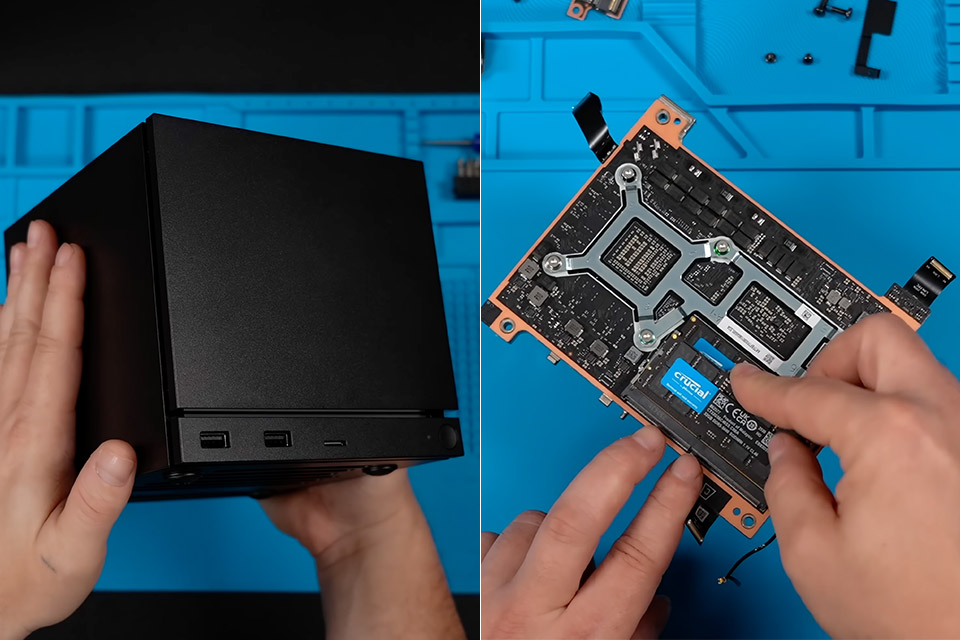
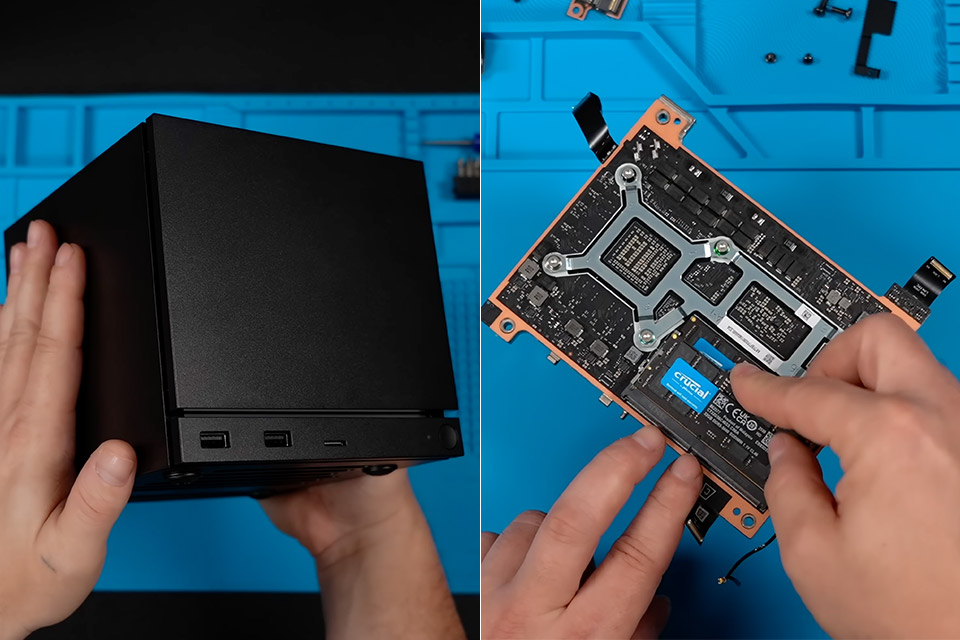
Valve just released Steam Machine, a compact computer designed to run SteamOS in living room settings. It arrives as a small black cube with ports along the base and a simple power button. The package includes a matching controller and targets people who want console convenience without giving up access to a full game library. A popular YouTuber who focuses on hardware decided to explore what sits inside one of these units. ETA Prime bought the 2TB version and set out to document every step of opening it while also pushing the specifications higher.
The outer casing is made of plastic, with a metal-reinforced rear part for added strength. A few screws hold the whole contraption together, with two in the rear and four more buried in the rubber feet. To detach the faceplate, press firmly down with a plastic spudger along the front edge, taking care not to yank it off with brutal force. Inside the case, a large cooling system takes center stage; copper pipes and thick aluminum fins do an excellent job of keeping the processor and graphics chip cool, and a custom fan is hidden in its own small shroud. The motherboard is wedged between the cooling block and the power supply, explaining why it appears tight at first glance.
Sale

Getting to the memory is a little difficult because you have to detach the antenna cables for the wireless features and remove a few screws from the small boards near the ports before sliding the whole internal assembly out. The heatsink assembly is removed using four screws, however there is no need to reapply thermal paste because the contact surfaces remain intact throughout the process. One memory stick was already installed and running in single channel mode, but ETA Prime removed it and replaced it with a matched pair of 32GB Crucial modules. They match the original speed rating exactly, and with both modules installed, the system now claims 64GB of memory, with approximately 62GB accessible for use. When the second stick is inserted, dual channel operation is instantly enabled.
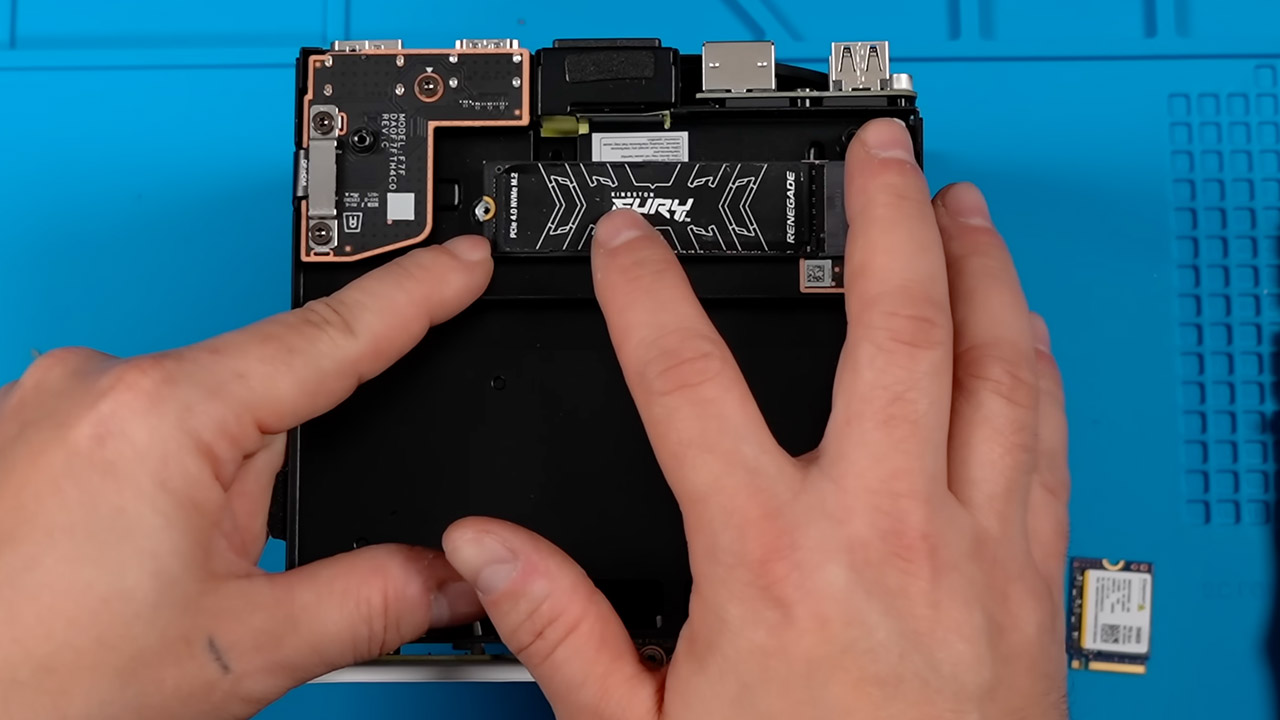
To be honest, storage access is straightforward because you only need to remove one panel on the side to see the drive region. The OEM device featured a smaller 2230 size M.2 solid state drive attached via an adapter and ribbon cable, however there was just enough room in the chassis for a full size 2280 drive, thus no modifications were necessary. A 4TB Kingston Fury Renegade drive replaced the original, and the read and write speeds are far quicker than before. To avoid having to reinstall the operating system, the previous disk was cloned onto the new one with free software on a different computer, which proceeded smoothly. After installation, the bigger drive exhibited its full capacity.
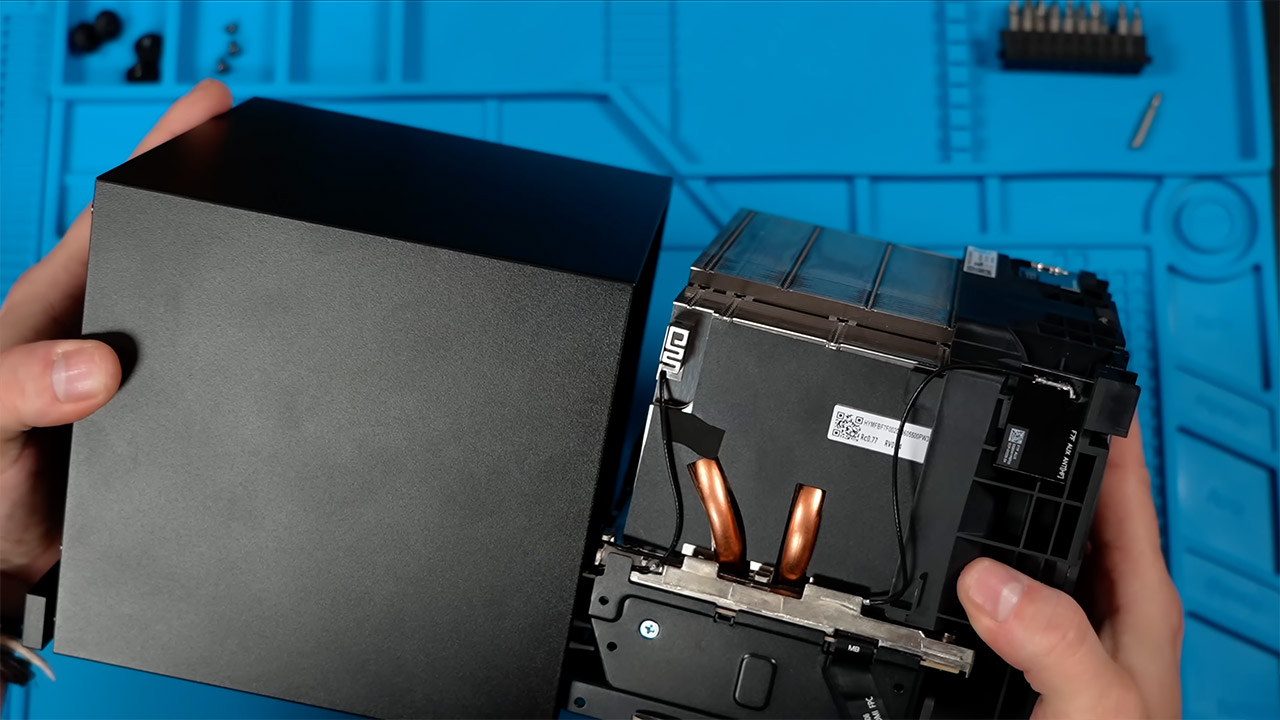
Reassembly is simple and gets everything back up and running quickly. You reattach the cables in the opposite sequence, screw everything back in place, and the outer case clicks into its groove. The computer booted into SteamOS without any warnings or missing hardware messages. The system information appears immediately, including the total memory quantity and the new storage size, with little fuss. Gameplay tests revealed that it continues to play as smoothly as possible, with occasional slight frame rate increases. For instance, the graphics chip only has 8GB of video RAM, thus adding system memory will make little impact in more demanding titles. Nonetheless, the dual channel RAM and increased storage facilitate multitasking and allow you to save a big number of games on the laptop without the use of external media.

However, the hardware required for the improvements is somewhat expensive, with the new memory kit costing around $820 and the new solid state drive costing nearly $1,000. Then you have to factor in the initial purchase price to get to around $3,247 for the full setup. Some believe that 64GB of RAM is too much for this system, but it’s comforting to know that Valve left the design open to a number of upgrades in important areas. Storage upgrades are easy and require little specialized tools.
[Source]
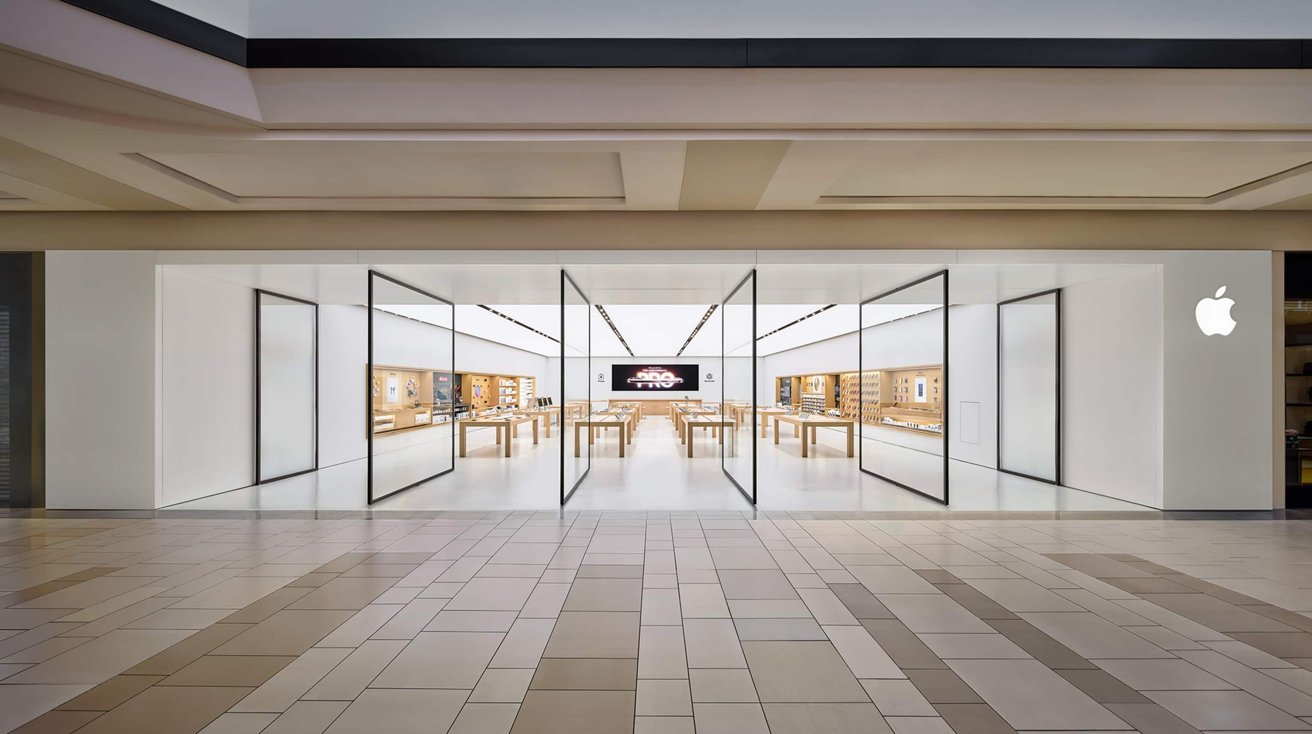
Signals from AirPods solved two crimes: a woman was arrested for refusing to leave an Apple Store, and a Bangladeshi presenter’s iPhone was stolen, all in this week’s Apple Crime Blotter.
The latest from an occasional AppleInsider feature, looking at the world of Apple-related crime.
A school board vice president in upstate New York has been indicted on child pornography and child endangerment charges, and child sex abuse material has been found on his iPhone. That’s according to court documents cited by CNY Central.
Travis J. Longo, the 46-year-old former vice president of the Cazenovia Board of Education, allegedly “engaged in a pattern of sexually explicit communications with a child under the age of 12.” A search of the iPhone 17 Pro Max, authorities say, led to the offending images, which were discovered by a Department of Homeland Security agent.
Following his arrest, the rest of the board unanimously voted to compel Longo’s resignation.
A 59-year-old Texas woman was arrested for criminal trespass after she refused to leave the Apple Store at Orland Square Mall in Illinois.
According to Southwest Regional Publishing, the incident took place in April. The woman went to the Apple Store to have her iPhone serviced, but was unhappy with the service.
After she “became loud,” she refused to leave the store, declaring that the mall was “public property.”
After refusing to leave, she was charged with criminal trespass.
On Memorial Day weekend, a crime victim followed a signal from a pair of stolen AirPods, which led police to a trove of stolen materials.
WLAF explains it started when a Kentucky man reported that numerous items had been stolen from his vehicle and that, when he followed the Find My iPhone signal, his AirPods were showing as located near a Popeyes.
The victim also noted that his stolen credit card had been used at a Love’s Travel Stop and viewed surveillance footage showing a GMC Sierra.
Police later located the vehicle, in which the alleged thief was asleep in the back.
The man claimed he was innocent and offered to let the detective search the car, which soon turned up credit cards belonging to the victim. Along with items paid for with those cards, some of which had receipts.
The man, currently on probation in Florida, was charged with theft of property under $2,500 and possession of a firearm by a convicted felon, and more charges are expected.
In another car burglary case solved with the help of an AirPods signal, a Wyoming teenager has been arrested in connection with a series of car break-ins.
According to Wyoming News Now, the teenager has been accused of breaking into eight cars in a Cheyenne neighborhood and stealing AirPods, guns, and other items.
That AirPod theft led the owner to track them, which had the teen’s residence pop up repeatedly. He was eventually arrested at the courthouse, while there in connection with an unrelated case, and he also had an outstanding warrant in yet another case.
He was charged with six counts of burglary and two counts of aggravated burglary.
A man from the Pennsylvania town of Jersey Shore has reported that his iPhone, and also a Rolex, had been stolen from him in a “disturbance.”
Fox 56 reports the incident took place on June 11 and a 2013 silver Chevrolet Silverado was “involved.” It is described as a “theft [with] no force.”
On May 31, an “unidentified person” entered the Children Aid Society in the Bronx and took an iPad and a laptop.
Per News 12 Brooklyn, the NYPD is “looking to identify someone they say is wanted” in the burglary. Anyone with information is urged to notify police.
Neel Hurerzahan, an actress and cricket show presenter based in Dhaka, Bangladesh, had her iPhone 17 Pro Max stolen in mid-June.
According to Daily New Nation, Hurerzahan posted a picture of the possible thief on her Facebook page.
“This afternoon, this man in the picture (white shirt) ran away from Shilpakala Academy with my iPhone 17 Pro Max (orange),” she wrote, asking for help in finding the device.
Another media professional from Asia reported having an Apple product stolen. This time it was Kim Hwan, a South Korean broadcaster who was in Guadalajara, Mexico, to cover the World Cup.
According to Asia Business Daily, Kim said on Instagram that his bag, containing his MacBook, was stolen from a hotel lobby, and that the computer contained “broadcasting materials.”
Kim went on to track the computer, first to a Walmart and then to the vacant lot behind it, where he ultimately found both the MacBook and an iPad. He believed that the thief “became aware of the tracking and abandoned the devices before fleeing.”
However, Kim has not recovered other items, including cash, a credit card, and his ID.
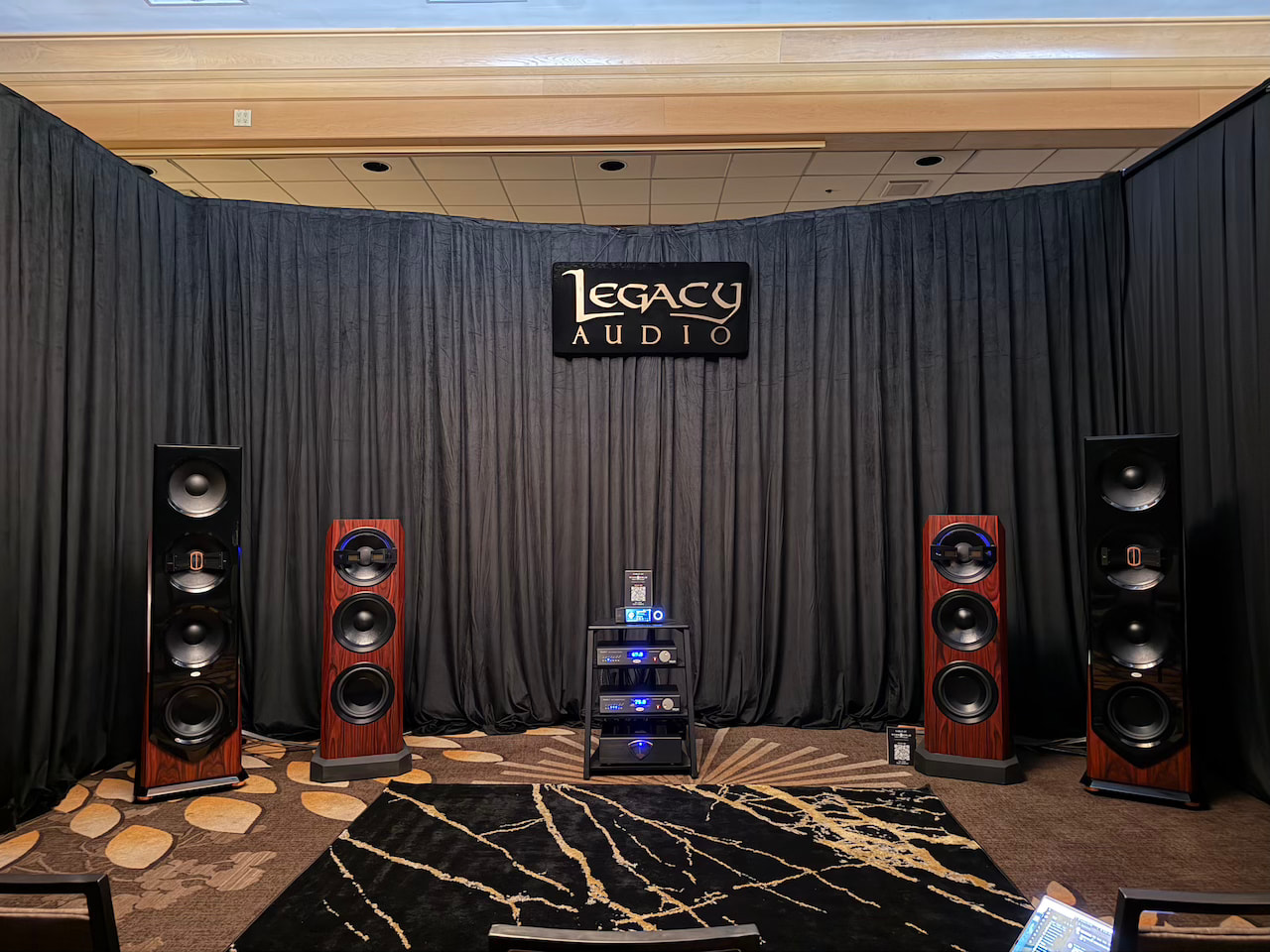
Coming just three weeks after HIGH END Vienna and on the same weekend as the North West Audio Show in the U.K., T.H.E. Show SoCal 2026 had a lot of competition for industry attention. The Costa Mesa event was clearly smaller than last year, but the rooms stayed busy and there was no shortage of genuinely impressive sound.
Affordable hi-fi was not really the theme. Active systems, ambitious analog front ends, low-powered tube amplification, and six-figure reference rigs dominated the better rooms. These are the systems that stood out most, not because they cost the most, but because they made music convincing enough to keep people planted in the chair.

Legacy Audio is another multiple Best in Show winner, with the Aeris XD earning the honor at T.H.E. Show SoCal 2025 and the Talos doing the same at AXPONA 2026. At this year’s event, however, Legacy brought its flagship: the Valor system, a nearly six-foot, 288-pound loudspeaker that represents the company’s biggest and most ambitious statement.
Priced at $100,000 per pair, the Valor combines 2,750 watts of onboard amplification per speaker with the Wavelet 2 DSP processor, room correction, and Legacy’s Stereo Unfold processing. It is not quite a “just add streamer” solution, as each speaker still requires an external amplifier channel for the high-frequency section, but it remains considerably less complicated than assembling a conventional reference system around separate passive loudspeakers, multiple power amplifiers, and outboard room correction.
Legacy rates the four-way Valor from 12 Hz to 30 kHz, ±2 dB, and its combination of large bass drivers, passive radiators, and serious internal power gives it the kind of output capability that makes polite background listening feel almost insulting. The dual 4-inch AMT tweeters are arranged in a post-convergent array designed to keep the top end consistent beyond the center seat, helping the Valor deliver a stable and expansive presentation across a wider listening area. It is also available in a deep roster of wood veneers and premium finishes, which matters when your speakers are roughly the size and visual commitment of small monoliths.
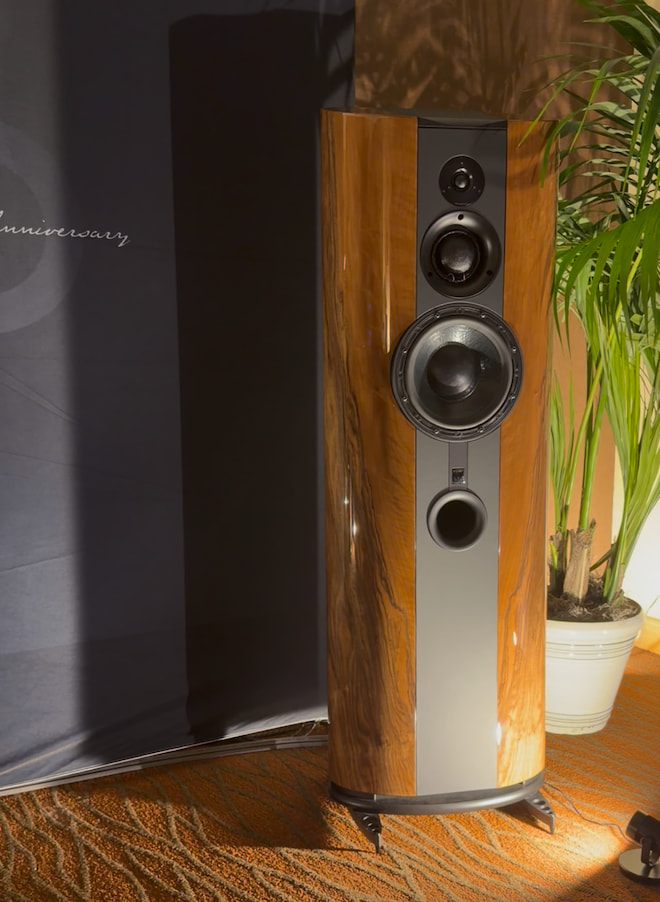
Staying with the active theme, ATC earns another Best in Show award for its EL50 Anniversary Edition active loudspeaker system, which was an easy unanimous selection at AXPONA just two months ago. Standing almost 56 inches tall and weighing 139 pounds each, these are not modest floorstanders, but they again proved remarkably comfortable in a smaller hotel room.
Lone Mountain Audio kept the core AXPONA system intact: ATC’s SCA2 preamplifier, the Innuos ZENith NG server, Playback Designs MPD-8 DAC, and WireWorld cabling. This time, the distributor also rotated in the Sonorus ATR10 Mk II reel-to-reel deck, which made a strong case for itself as an analog source in a room already blessed with excellent digital playback.
The EL50’s fully active three-way architecture remains the attraction. Each speaker contains dedicated 200-watt bass, 100-watt midrange, and 50-watt high-frequency Class A/B MOSFET amplification, with ATC’s active crossover and in-house drivers doing the heavy lifting. That integration helped the EL50 deliver the same qualities that stood out in Chicago: authoritative but controlled bass, natural scale, exceptionally clean midrange performance.
For those interested in learning more, read Ian White’s extensive report from AXPONA here. A full eCoustics review is planned for late summer.

This was my first experience with Odyssey Audio, and it was not one I am likely to forget. The packed room, littered with flickering faux candles, should have been the first clue that Klaus Bunge was not interested in another polite hotel-room demonstration.
The setup was not remotely conventional. The loudspeakers were positioned very close to the side walls and roughly a third of the way into the room from the rear wall, with each driven by Odyssey’s new Meilenstein monoblocks. On paper, it looked like the sort of placement audiophiles are taught to avoid. In practice, it worked spectacularly well. The speakers disappeared, leaving an image that extended well beyond the front wall with exceptional depth, focus, and clarity.
More importantly, this was not a demo built around the usual collection of pristine audiophile recordings. The Doors’ “Riders on the Storm” was genuinely immersive, placing the listener inside the recording’s rain-soaked atmosphere rather than merely showing off a wide soundstage. Tracks from Justin Bieber and Stone Temple Pilots followed and proved that the system could do more than flatter one particular type of music. Stella Acoustics’ room treatment clearly played a role as well, helping create a presentation that felt unusually open, three-dimensional, and convincing in a crowded hotel suite.

Acora Acoustics loudspeakers have consistently impressed in rooms built around VAC amplification, but this system showed how much more the company’s MRC-3 floorstanders can deliver when supported by a properly ambitious REL six-pack.
The MRC-3s were partnered with six REL Carbon Special Black Label subwoofers, arranged as triple stacks behind each speaker. At $4,999 apiece, that is essentially $30,000 worth of low-frequency reinforcement, which sounds absurd until you hear what the array does. The subs never called attention to themselves or turned the room into a bass demo. Instead, they added scale, weight, and low-end authority while preserving the speed, clarity, and dimensionality of the Acoras.
REL’s triple-stack approach also helps maintain the height and scale of the soundstage rather than simply adding more rumble below it. That was particularly apparent with the Acora MRC-3s, whose marble cabinets and ceramic drivers already deliver considerable control and resolution on their own. The result was a system that sounded full-range without relying on oversized tower speakers loaded with enough bass drivers to qualify for a municipal permit.
The rest of the chain was equally serious: Berkeley’s Alpha DAC Series 3P with Alpha Reference USB, Synergistic Research’s Voodoo Server, Soulution’s 541 CD player, and the Sonorus ATR10 MK2 tape machine fed VAC’s Master Preamplifier and 202iQ stereo/mono amplifiers. The system was supported by an Artesania Audio Exoteryc rack, Synergistic Research’s Galileo LUX, SRX XL, and Foundation XL cabling, along with ASC Tube Traps and Synergistic room-treatment products.
This room made a strong case for spending intelligently on bass management rather than assuming the only path to full-range performance is an enormous pair of loudspeakers with a small forest of woofers on the front baffle. The REL array gave the Acoras more authority, more scale, and more convincing low-frequency realism, while letting the speakers do what they do best.
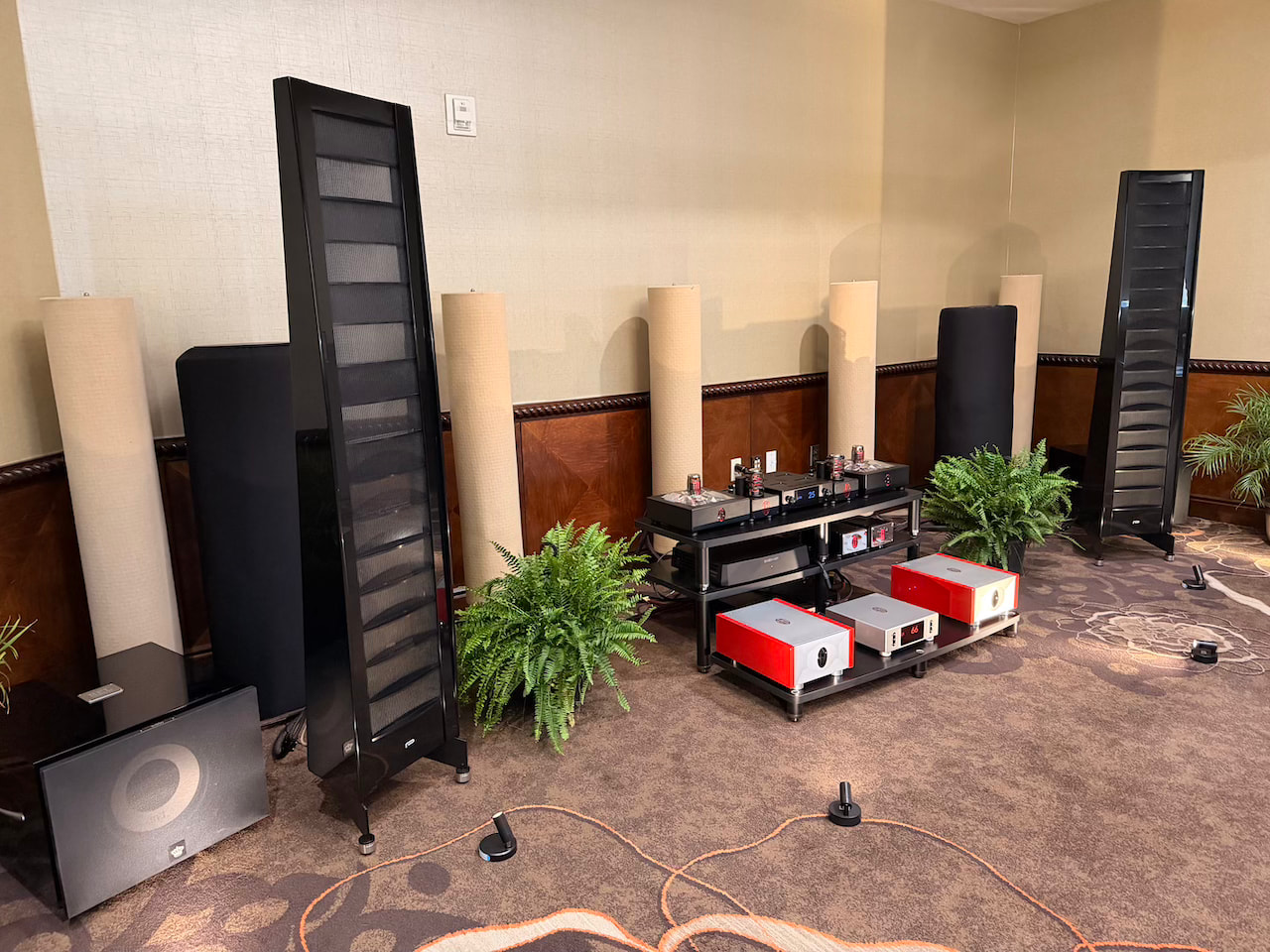
Prodigio Audio, formerly Popori Acoustics, is another repeat Best in Show winner. The Hungarian-made WR2 electrostatic loudspeakers were again paired with AGD electronics and Theoretica Applied Physics’ BACCH-SP adio processor, a combination capable of extracting spatial information from conventional stereo recordings that most two-channel systems simply leave on the table.
The tall WR2 panels are impressive even without processing. They are fast, revealing, and exceptionally transparent, with the kind of midrange clarity and transient speed that electrostatics can deliver when properly set up. Engage BACCH 3D, however, and the presentation becomes something else entirely. Instruments and effects extended well beyond the speakers, with spatial cues that could reach around the listener rather than remaining trapped between the two panels.
There is a caveat, because there always is. BACCH is a highly personalized, single-listener experience that works best from the precisely calibrated center seat. Move too far off-axis and the effect diminishes. Park yourself in the sweet spot, though, and the result can be startlingly immersive without requiring a room full of surround speakers.
This year’s larger room also benefited from a pair of REL S/850 subwoofers. The WR2s already offer more low-frequency presence than many listeners expect from a panel speaker, but the RELs added weight and extension without turning into the main event. They blended seamlessly, giving the system more foundation and scale while preserving the WR2’s speed, openness, and almost unnerving ability to disappear.
With the BACCH processor, REL subs, WR2 electrostatics, and AGD amplification, the system starts north of $85,000 before cables, accessories, and setup.
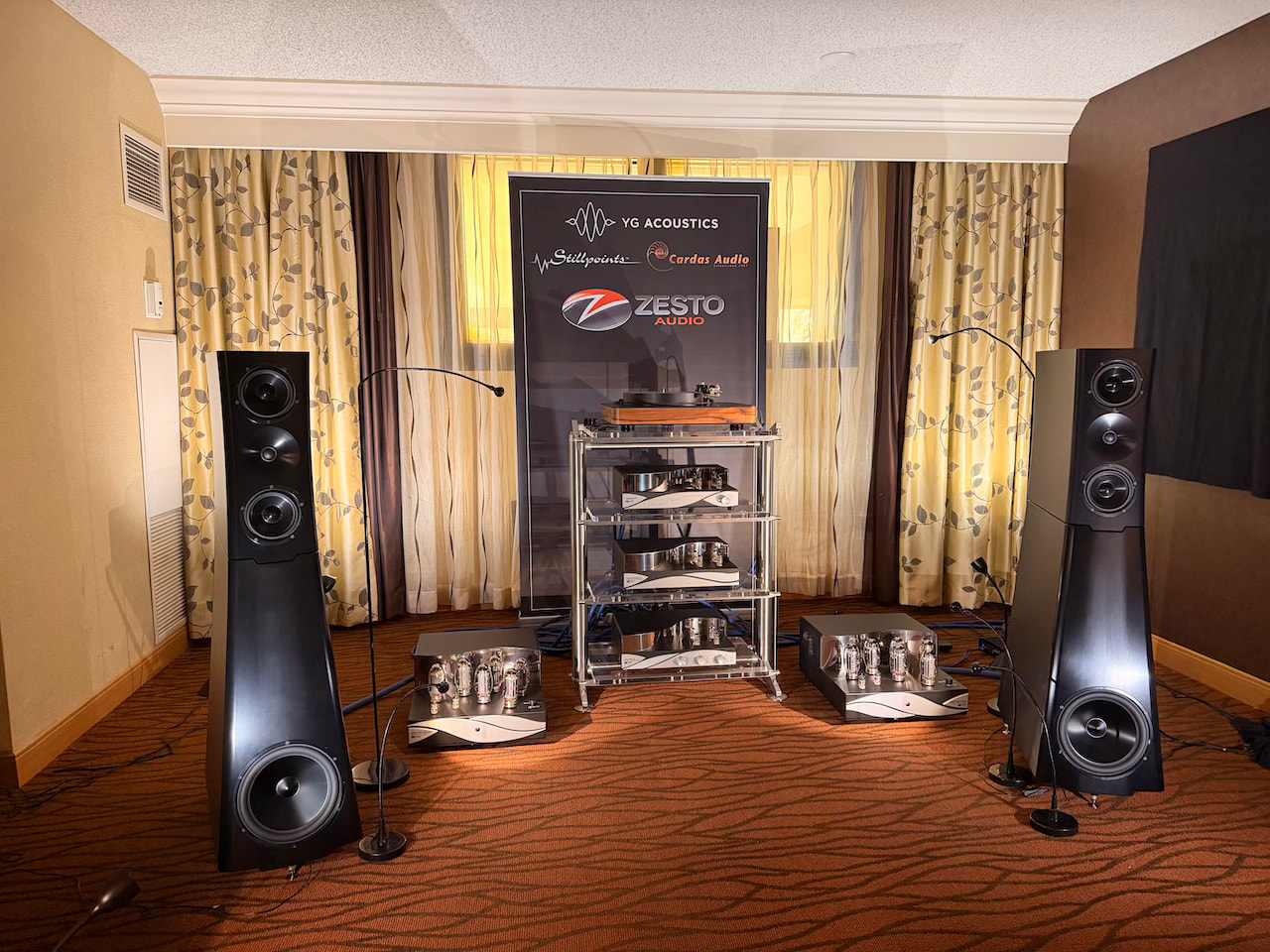
Zesto Audio returned with a full tube-based system built around its new Athena DAC, Leto Ultra II preamplifier, and Eros 500 Select Class A monoblocks. At $15,000, $11,900, and $35,000 per pair respectively, the electronics were partnered with YG Acoustics’ Sonja 3.2 loudspeakers, a $106,800-per-pair reference design that requires serious amplification and rewards it accordingly.
This was not a system chasing syrupy tube warmth or trying to sand down the edges of every recording. The Zesto and YG combination was all about resolution, control, and tonal precision, with Cardas cabling tying the system together. The Sonja 3.2’s aluminum cabinet, proprietary drivers, and exceptionally low-distortion crossover design gave the Eros 500s plenty to work with, resulting in a presentation that was detailed, dynamic, and remarkably composed.
The Athena DAC also provided a useful real-world demonstration of DSD playback. Switching among 1x, 2x, and 4x DSD files revealed audible differences, although the gains were not equal at every step. From outside the center seat, the move from 1x to 2x DSD seemed to offer the most noticeable improvement in refinement and separation, while the jump to 4x was far more subtle. That does not make 4x DSD pointless, but it does reinforce the reality that implementation matters far more than simply chasing the largest number on the display.
Zesto and YG Acoustics proved to be a highly potent pairing: tube electronics with enough speed, grip, and transparency to let the Sonja 3.2s show why they belong in the reference category.
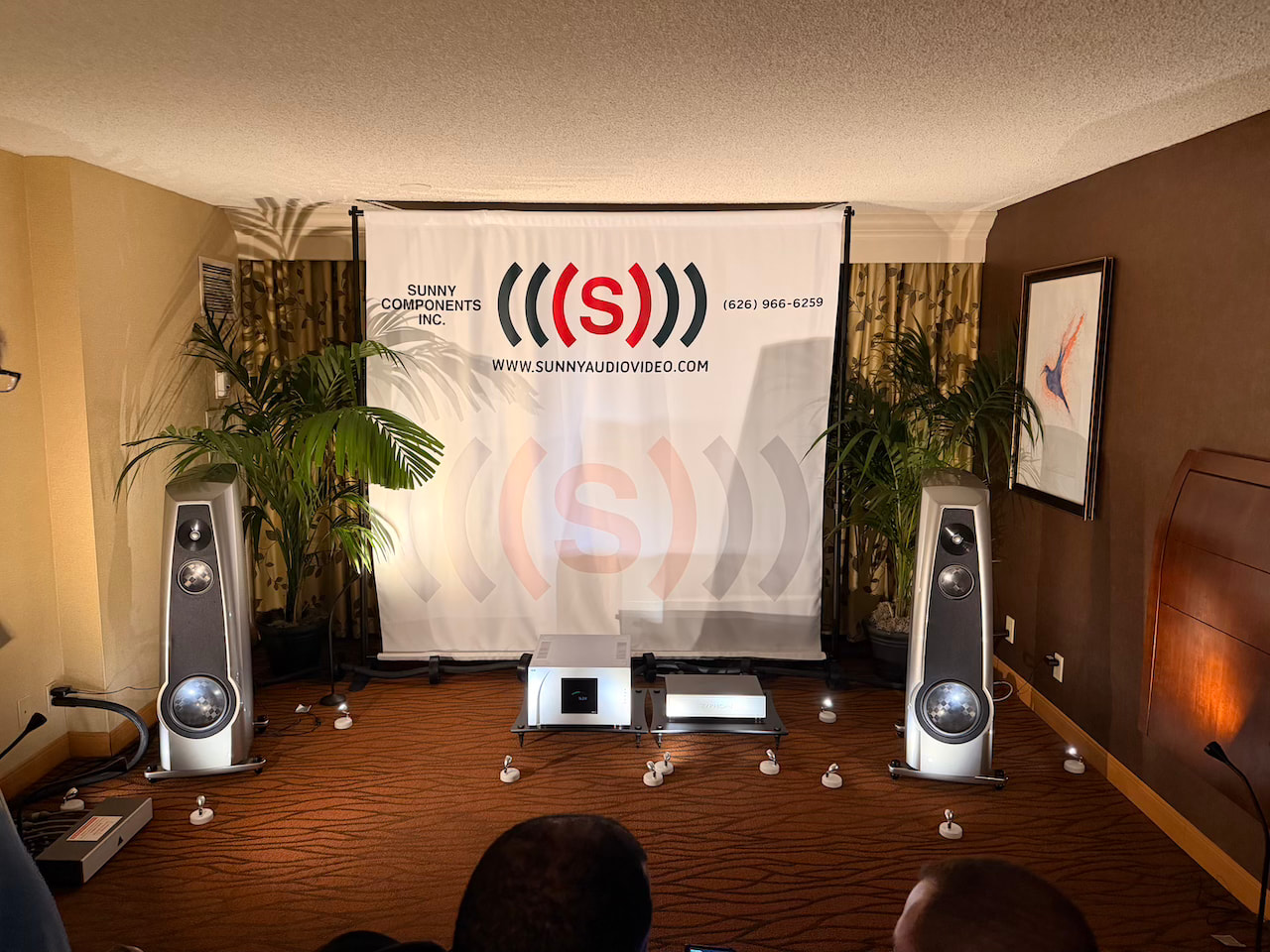
Rockport Technologies and CH Precision delivered one of the most expensive and meticulously assembled systems at T.H.E. Show SoCal 2026, built around the custom Lexus Silver Rockport Lynx loudspeakers and a full complement of Swiss electronics. With the speakers, Aurender N50 music server and NH10 network switch, plus CH Precision’s D10 SACD/CD transport, C10 Reference DAC, T10 Time Reference clock, L10 preamplifier, and M1.1 power amplification, this was a system hovering around the $500,000 mark before anyone started counting racks, power products, and cables.
The Rockport Lynx is a three-way floorstander with a 10-inch carbon-fiber sandwich woofer, 6-inch midrange driver, and waveguide-loaded beryllium tweeter housed in the company’s extraordinarily inert DAMSTIF3 aluminum enclosure. It is a speaker engineered to reveal everything upstream, which made it an ideal match for CH Precision’s ultra-low-noise, no-nonsense approach to solid-state electronics.
This was not a system designed to flatter weak recordings or wallpaper over the rough edges. It was all about control, silence, image specificity, and the kind of precision that makes small shifts in level, decay, and placement feel more obvious.
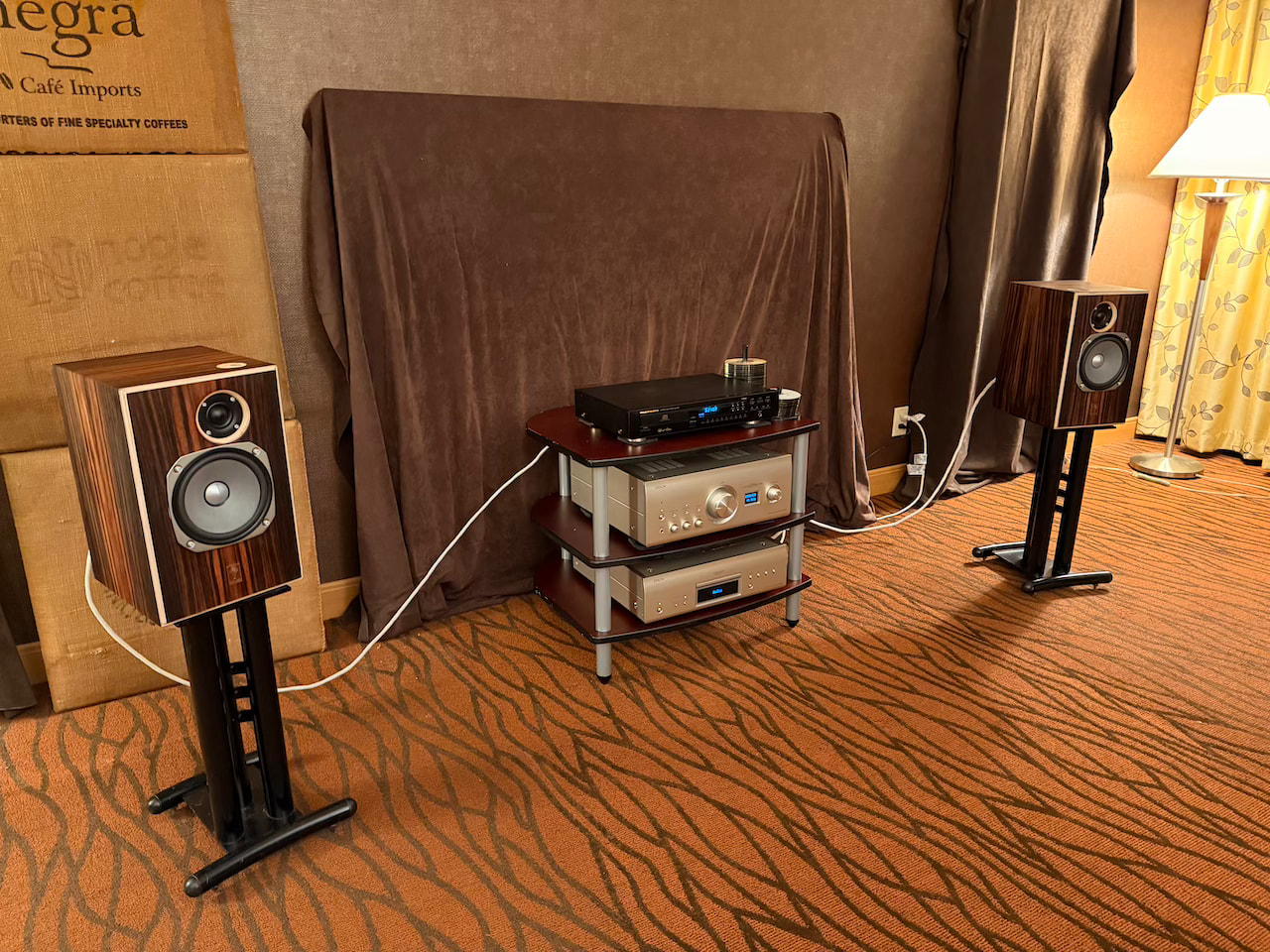
Scaling way back from the six-figure excess, Tony Minasian’s Oriaco room delivered one of the most affordable systems in this year’s Best in Show lineup. The previous winner returned with the Oriaco D6 stand-mount loudspeakers, now $6,300 per pair, driven by Denon’s PMA-3000NE integrated amplifier at $3,799. Add a CD player, stands, and cables, and the system still lands in five-figure territory, but compared with the financial carnage elsewhere at the show, this was refreshingly sane.
Minasian used a vintage Marantz CD player as the source, although the Denon’s capable onboard DAC means almost any suitable CD transport with a digital output could do the job. The PMA-3000NE delivers 80 watts per channel into 8 ohms, includes optical, coaxial, and USB-B digital inputs, and has enough current delivery to make the compact Oriacos sound far larger and more authoritative than their size suggests.
What separates Tony’s speakers is not flash or exaggerated hi-fi fireworks. They reproduce transients, decay, and vocal placement with an uncommon sense of natural ease. Percussion has real air around it, piano notes fade with convincing shape and weight, and vocals lock firmly into the center of the soundstage. The D6 uses a carefully voiced 6-inch full-range driver, front-mounted soft-dome tweeter, and a top-mounted ambient tweeter, all selected and tuned with far more care than the relatively understated cabinet suggests.
The most impressive demonstrations came from Minasian’s own recordings with working musicians, which makes sense because he knows exactly what those sessions should sound like. But the system was equally convincing with orchestral material, Snoop Dogg, and everything in between. It was another reminder that intelligent engineering, careful voicing, and good recordings can still embarrass systems costing many times more.
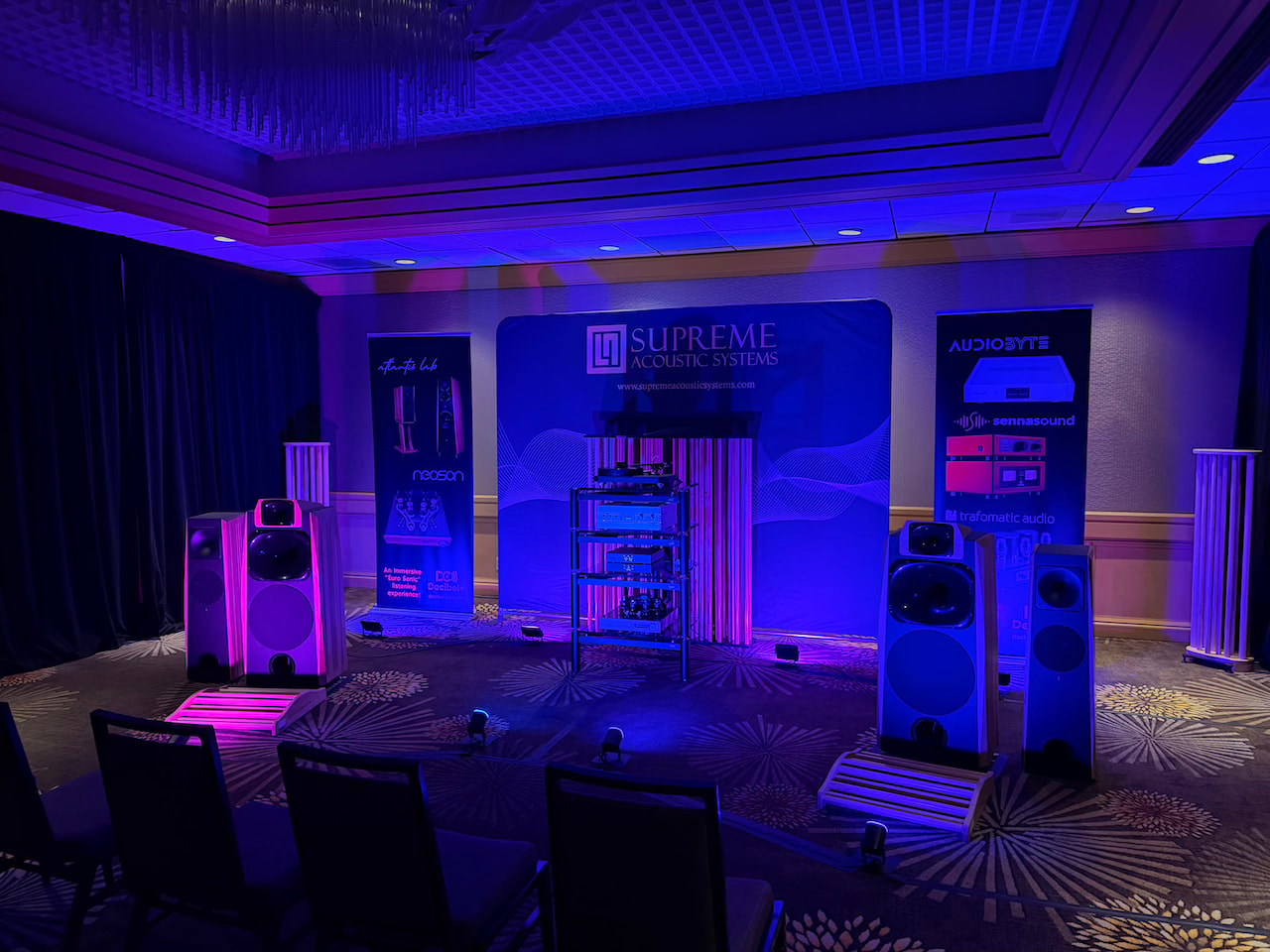
Atlantis Lab and Neoson earn a second Best in Show nod following their impressive T.H.E. Show Vegas debut earlier this year. The basic formula remained intact: high-sensitivity French loudspeakers, low-powered Class A tube amplification, and a digital front end designed to get out of the way. This time, however, the room also featured a BennyAudio turntable making its world premiere at the show.
The Atlantis Lab AT 23 PRO is the accessible entry point here at $6,466 per pair, although “accessible” becomes relative once it is partnered with the $11,828 Neoson Evolution tube amplifier and Audiobyte’s SuperHub streamer and SuperVOX DAC. That puts the digital system around $27,000 before cables, racks, and accessories. Add a serious analog front end and phono stage, and the total moves past $40,000 quickly. Welcome to high-end audio, where the inexpensive option can still require a modest conversation with your financial adviser.
The good news is that the system continues to justify the attention. The AT 23 PRO throws a genuinely wide soundstage, locks vocals firmly into place, and delivers bass with speed and control rather than overhang. The Neoson Evolution’s 20 watts per channel of Class A tube power proved more than sufficient, which is exactly the point of pairing it with loudspeakers this sensitive.
The flagship AT 38 PRO, at $23,939 per pair, brought additional bass weight, greater scale, and a richer, more expansive presentation. Its horn-loaded compression drivers and 38 cm woofer give it a more effortless sense of dynamic freedom, but it did not lose the smaller model’s quickness or ability to make voices feel present in the room.
We will have more to say about the Atlantis Lab AT 23 PRO and Neoson Evolution, both of which are currently under review.
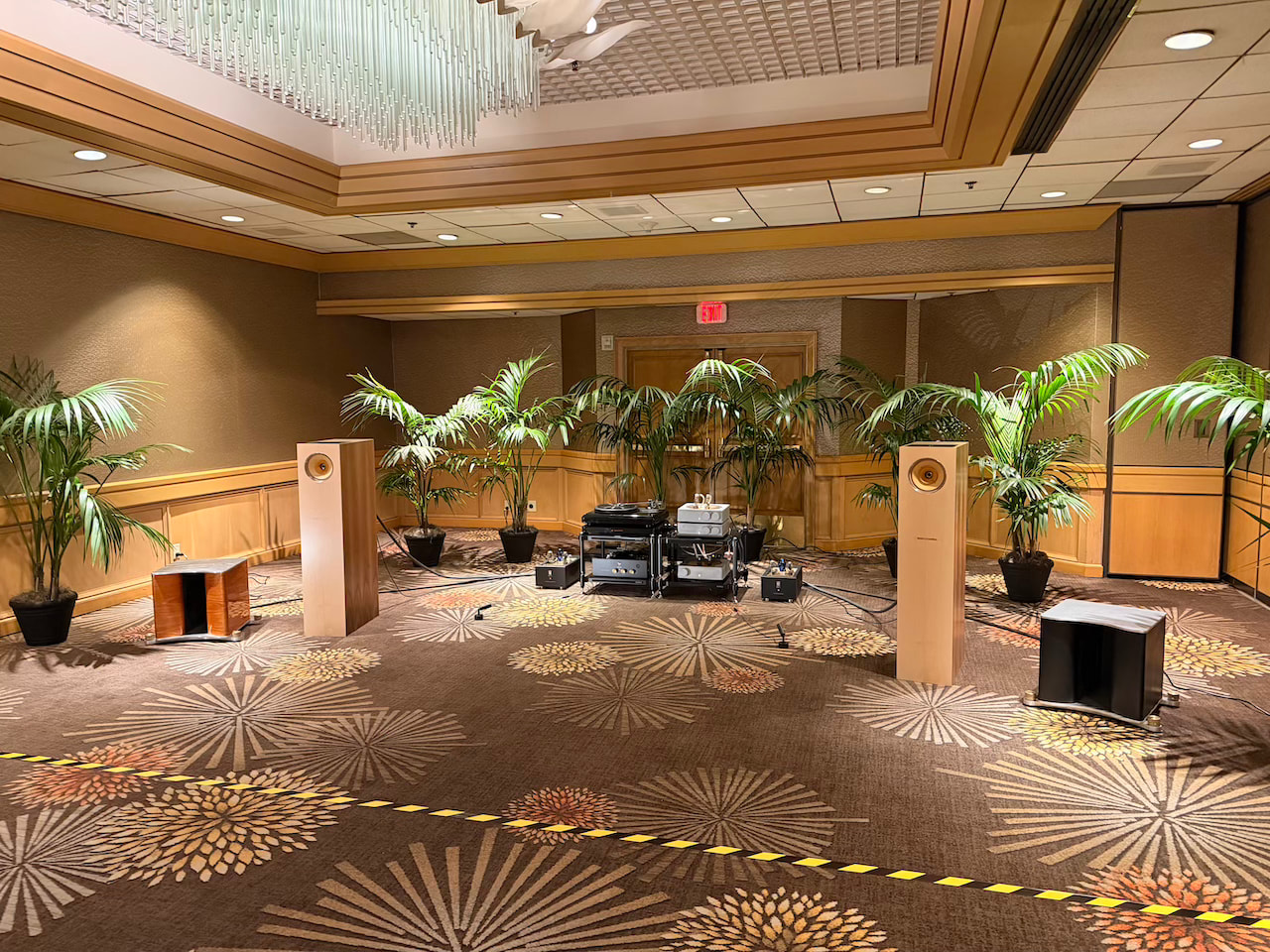
My first experience with the Wolf von Langa WVL 11620 ORGANIC loudspeakers was an instant delight. In a show full of systems flexing enormous power ratings, this room took a far more elegant approach.
The $39,995 German-made ORGANIC field-coil loudspeakers were paired with Cinnamon’s $17,995 Malabar VLF bass system, an SW1X PRE III Classic linestage ($28,041), and SW1X MPA V Special monoblocks ($37,836). The analog front end was equally formidable: a PrimaryControl Kinea II turntable ($27,995) with FCL tonearm ($38,995) and Fuuga MC cartridge ($10,995), feeding Cinnamon’s Galle phono stage ($32,995) and Galle step-up transformer ($8,250).
With nearly $250,000 invested in the core system before cables and accessories, this was not a modest setup. But the sound was not about brute force or audiophile fireworks. It was about finesse: natural vocal presence, excellent low-level detail, tonal color, and a sense of musical flow that made it easy to forget about the hardware.
The ORGANIC speakers delivered the speed, clarity, and realism that make a properly assembled low-power tube system so rewarding. Highly engaging at sensible listening levels, this room proved that a system does not need to turn the volume into an international incident to make a lasting impression.
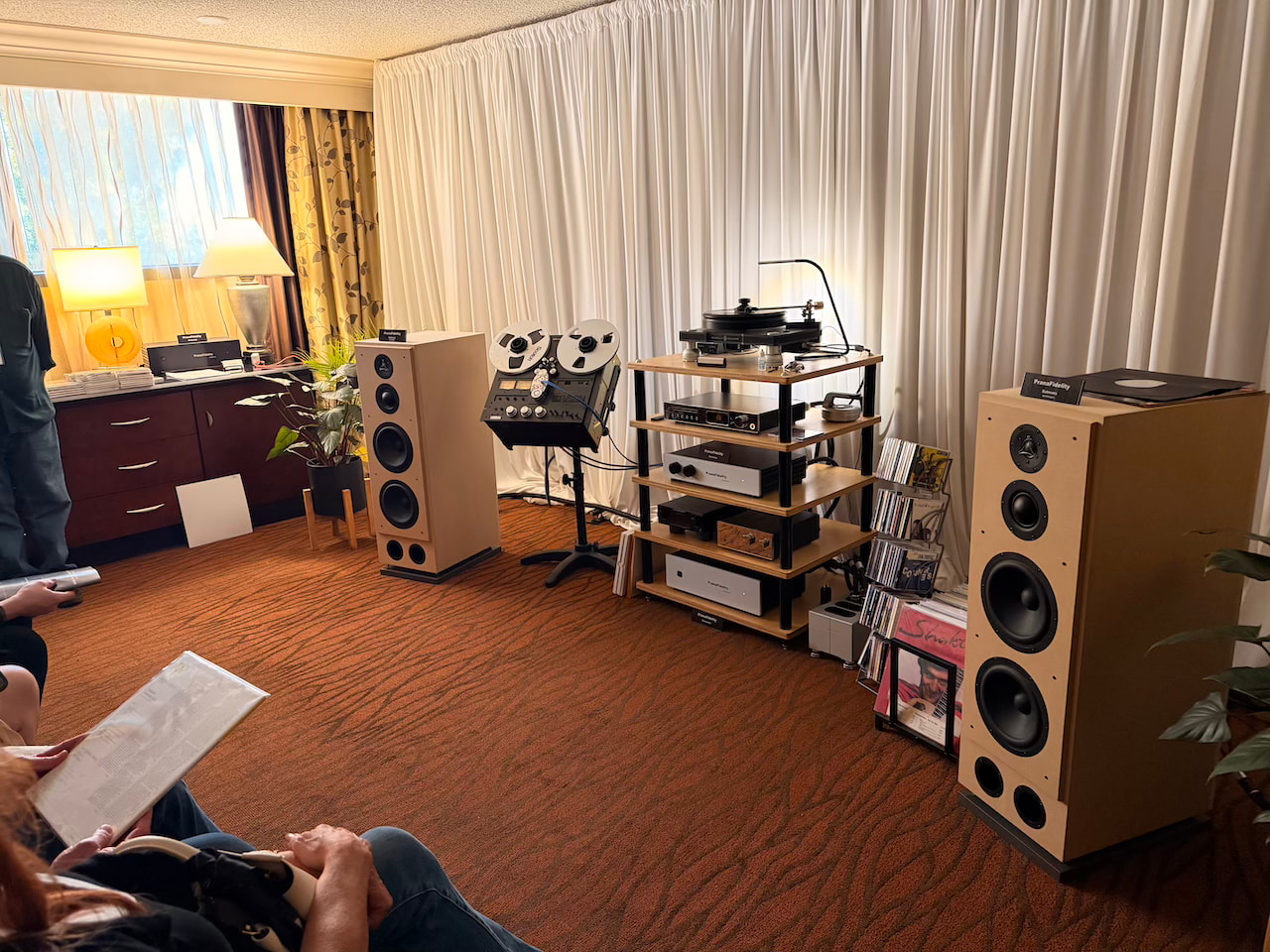
Steven Norber of PranaFidelity arrived at T.H.E. Show SoCal with something genuinely new: the Satmata, a three-way prototype floorstander completed just in time for the event. It is not a finished product yet, but based on what I heard, Norber would be wise not to overthink the final formula.
The analog front end was as serious as the speakers. A Merrill-Williams R.E.A.L. 101.3 turntable fitted with a Breuer Dynamics tonearm and OTTA Theorbo moving-coil cartridge fed an E.A.R. 88PB phono stage, while PranaFidelity’s purna/ma amplifier handled power duties. Furutech power distribution and cabling completed a system that looked deceptively straightforward by high-end show standards, at least until the music started.
The room was packed every time I stopped by. Late on the first day, I finally landed the coveted center seat and understood why. The Satmata created a presentation with real depth, nuance, spaciousness, and remarkably lifelike vocal presence. Rather than simply placing performers across a large soundstage, it pulled the listener closer to the recording without sacrificing scale or composure.
Nima Ben David’s Résonance showed off the system’s ability to reproduce the dynamic bowing, harmonic texture, and natural decay of solo viola da gamba. A mono selection from Porgy and Bess provided the encore, proving that even a straightforward recording can sound deeply immersive when the system gets tone, timing, and scale right. This was one of the most captivating analog rooms at the show.


Several European countries have been considering or already applying digital services taxes to large online platforms. These surcharges are aimed at revenue generated by activities such as digital advertising and online marketplaces – areas dominated by US-based companies.
Read Entire Article
Source link

Google capped Meta’s Gemini access due to compute constraints. Meta told staff to use AI tokens more efficiently and is shifting to its own Muse Spark model.
Google has placed limits on Meta’s use of its Gemini AI models because it cannot provide as much computing capacity as the social media company wanted, the Financial Times reported on Sunday. The restrictions have affected several Google clients, with Meta hit particularly hard.
The move has had a knock-on effect on Meta’s internal projects. The company has told staff to make more efficient use of AI tokens, according to three people familiar with the matter cited by the FT. Both Google and Meta declined to comment.
Meta had initially relied on Gemini, which proved better than its own Llama open-source models, to automate safety processes like removing harmful content and wiping out scams. It has increasingly been shifting workloads to Muse Spark, a new internal model, as it looks to reduce dependence on external AI providers. Google itself is so compute-constrained that it agreed to pay SpaceX $920 million a month for access to 110,000 Nvidia GPUs, calling it “bridge capacity” to meet surging demand for Gemini Enterprise.
The situation illustrates how the AI compute shortage is reshaping relationships between the industry’s largest companies. Google, which owns one of the world’s largest pools of AI infrastructure and is spending over $180 billion on capex this year, still cannot serve all of its customers’ demand. That it is rationing access to a company as large as Meta, while simultaneously renting GPUs from a rocket company, is the clearest signal yet that AI infrastructure buildouts have not kept pace with consumption.

The 💜 of EU tech
The latest rumblings from the EU tech scene, a story from our wise ol’ founder Boris, and some questionable AI art. It’s free, every week, in your inbox. Sign up now!
For Meta, the dependence on a competitor’s AI models was always an uncomfortable arrangement. The company cut 8,000 jobs in May and redirected billions toward AI infrastructure, with capex guidance of $115 to $135 billion for 2026. It has reassigned 7,000 workers to AI-focused roles and launched Muse Spark under its Superintelligence Labs division. The Gemini restrictions accelerate a transition Meta was already pursuing, from relying on external frontier models to building internal alternatives capable of handling critical workloads like content moderation at scale.
The broader pattern is consistent across the industry. Demand for AI compute is growing faster than even the most aggressive infrastructure spending can supply. Google is buying capacity from SpaceX. Anthropic is renting an entire data centre from SpaceX. Meta is being told to use fewer tokens by its own cloud provider. The AI boom’s most tangible bottleneck is not algorithms or talent. It is the physical infrastructure required to run them.
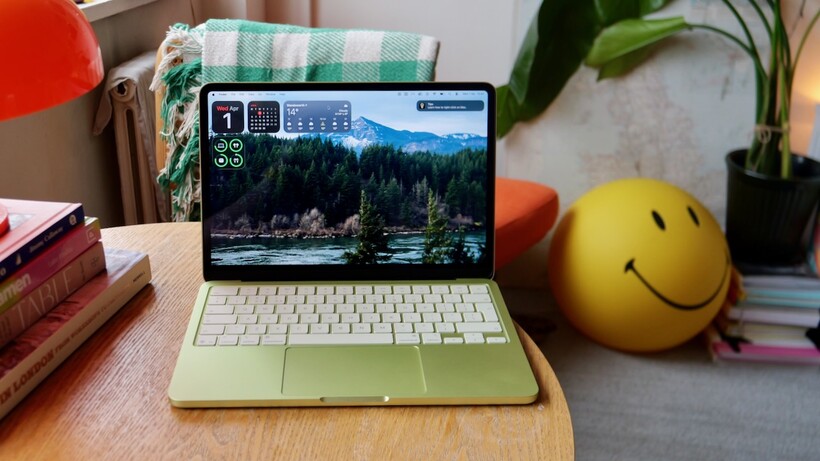
Apple might not have hiked the price of the iPhone 17 range this week, but the same likely won’t be true for the iPhone 18 Pro later this year.
Earlier this week, the multi-billion-dollar company jacked up prices on everything from budget iPads to workstation‑class Macs, blaming what it calls an “extraordinary surge” in the cost of memory and storage used in AI data centres.
But while many of Apple’s most popular products now cost more – and in some places, a lot more – there was one product line that remained untouched. The iPhone. Head over to the Apple Store and you’ll see the same £/$799 starting price for the iPhone 17 as last week.
Now, while you might assume that Apple is just doing everybody a solid by keeping its iPhone more attainable, I don’t think that’s actually the case – especially when the rumoured iPhone 18 Pro and foldable iPhone drop in a few months’ time.
Apple isn’t a company that’s usually known for cheap, affordable tech – but that didn’t stop it from hiking prices across many of its products this week.
The company says it has “never seen a component price increase this much, this quickly” and claims it’s “working tirelessly to find solutions”, but for consumers, it essentially boils down to paying more for the same kit.

On the Mac side, the budget-friendly Mac Mini and MacBook Neo are both up by £/$100, now at £/$799 and £/$699 respectively, while the MacBook Air has jumped by £/$200 to £/$1,299.
Higher up the range, the MacBook Pro has climbed from £/$1,699 to £/$1,999, and the Mac Studio with M4 Max is up £/$500 to £/$2,499. The wildest jump is reserved for the M3 Ultra Mac Studio, which now costs a whopping £/$5,299, a £/$1,300 leap from its previous £/$3,999 RRP.
It’s not just Macs, either. The 11-inch iPad Air is now £/$749 (up £/$150), the 11-inch iPad Pro has risen by £/$200 to £/$1,199, and the top-end 13-inch iPad Pro now comes in at £/$1,499. Even the HomePod mini hasn’t escaped, climbing by £/$30 to £/$129 – a 30% increase on what was once one of Apple’s more affordable gadgets.
Macs, iPads and even the humble HomePod mini all got price rises – but there was one very popular product line that was left, rather oddly, untouched. The iPhone collection.
All models of iPhone, from the budget-focused iPhone 17e to top-end models like the iPhone 17 Pro Max and iPhone Air, still cost the exact same as they did this time last week. I mean, they’re still expensive, but not 20% more expensive.

That might come as a welcome relief to iPhone fans planning to upgrade to the latest iPhone in the near future – but if you have plans to get yourself a shiny new iPhone, I’d recommend grabbing one sooner rather than later.
Simply put; there’s no way that Apple can eat the increased costs of components like RAM and storage vital to the iPhone experience. So why didn’t Apple boost iPhone prices at the same time?
Unlike Macs and iPads that tend to hold value for years on end and remain tempting options in the face of upgraded models, the iPhone is certainly a more seasonal device. We get a new one every year, like clockwork, with notable upgrades rather than just a simple chip upgrade like most other Apple products get.

And with the iPhone 18 Pro and possibly even the foldable iPhone expected to debut in just a few months, I suspect that raising prices on the iPhone 17 range would’ve likely discouraged users from buying what will, in a few months, be an outdated model, leaving Apple with plenty of stock to shift.
This way, at least, the iPhone 17 range looks like it’s offering great value for money while pretty much every other Apple product has jumped in price.
In my mind, there’s very little chance that the iPhone 18 Pro will cost the same as last year’s iPhone 17 Pro.
Yes, the fact that Apple has hiked prices across much of its hardware range already suggests the same is coming for the new iPhones later this year – but look at the rest of the smartphone industry and it’s much the same story.

Samsung’s Galaxy S26 range is a great example of this. The entry-level S25 would’ve set you back £799/$799, but this year’s Galaxy S26 has jumped to £879/$899, while the Galaxy S26 Plus also saw a £/$100 price hike.
Samsung tried to offset the price increase by ditching the previous 128GB model in favour of a 256GB base model, but it’s clear that Samsung has had to do some wrangling to make the numbers work.
The other option is to try to leave the base-level model untouched – or as close to last year’s RRP as possible – and instead bump up the higher storage tiers. That’s what Samsung did with this year’s Galaxy A57; the base 256GB model is £479/$549, which is actually £20 cheaper than its predecessor in the UK, but the model with 512GB of storage costs an almost unbelievable £649/$609.

Make no mistake; the latter is very much considered premium smartphone territory. Something that the A57, well… isn’t.
Nothing CEO Carl Pei has also warned consumers about price hikes across the board when it comes to smartphone tech, and rumours suggest that Google’s upcoming Pixel 11 range could face similar issues when it debuts in the coming months.
With all that in mind, and Apple openly admitting that component costs are an “unprecedented challenge”, it seems almost impossible that Apple could offer the iPhone 18 Pro at the same £/$1099 price point as last year – especially if the rumoured boost to 12GB of RAM is true. That RAM is like gold dust right now.
The question is, will Apple try to offset the base-level prices by increasing higher storage options, or will we see a flat increase across all models of Apple’s upcoming Pro-level iPhone? We’ll have to wait and see, I suppose.
And don’t even get me started on how all this could push up the price of the no-doubt already-expensive foldable iPhone Ultra. I think I might need to sell a kidney for that one at this point.

Although TikTok is widely described as a social media giant, it’s been gradually moving beyond that category. Over time, the video app added TikTok Shop, a map for local discovery, robust search, games, and so much more. Recently, it’s added hotel booking capabilities and is pursuing a fintech license.
It appears that TikTok is taking steps to evolve into a “super app,” a single platform where users can do much more than just watch and share videos and that can actually handle a wide range of needs in one destination.
The super app model is big in China with apps like WeChat, which is kind of like Facebook, WhatsApp, Apple Pay, and an app store all rolled into a single platform. Of course, there’s the question of whether a super app model would work outside of China, but that doesn’t mean TikTok won’t try.
Instead of switching between apps, TikTok is working to become the app that people use for most of their digital activities. After taking its biggest leap with TikTok Shop, the company — which, notably, transitioned to new, primarily U.S. ownership back in January — has applied the same playbook to recent developments.

Over the years, TikTok has steadily been looking to become a place where users can come for sports highlights and content. In early June, the company launched a dedicated hub for the FIFA World Cup where users can see scores, match schedules, standings, trending videos, highlights, videos from players, and more.
If people are already watching videos on TikTok but want to keep up with the score, they can do so without leaving the app or opening a dedicated sports news app or Google.
The World Cup hub was made possible through TikTok’s Sports-focused product called “TikTok GamePlan,” which is designed to allow sports teams, leagues, and broadcasters to drive discovery and engagement on the platform. The social media giant also has partnerships with Major League Soccer (MLS) and Major League Baseball (MLB) for behind-the-scenes and exclusive content.

In May, TikTok launched TikTok GO, a way for users to discover and book hotels, attractions, and experiences directly within its app in the United States. TikTok GO surfaces lodging and things to do through videos, search, and location pages. When users find something they’re interested in, they can view details, check availability, and complete a booking.
Instead of directing users to third-party websites after they find a destination or recommendation in a video, TikTok has started positioning itself as a one-stop platform where viral travel content can drive bookings and revenue.
While people have already been using TikTok as a search engine and replacement for Google, this latest step puts TikTok in more direct competition with Google’s core businesses, Search and Google Maps, because it’s working to not only be the app where you discover places, but also the platform where you purchase that trip.

In March, Reuters reported that TikTok had applied to Brazil’s central bank for approval to operate as a financial technology company offering lending and payment services.
The company is seeking two licenses. The first would allow it to provide prepaid accounts so users can store funds, receive money, and make payments. The second license would authorize it to operate as a direct credit provider, allowing it to lend its own capital or function as a platform that connects borrowers and lenders.
The move marks a significant way that TikTok is branching out beyond a social media platform and into a digital ecosystem. By aiming to bring financial services into its app, TikTok is looking to increase user engagement, open new revenue streams, and position itself to compete with fintech startups and e-commerce platforms.

It’s widely known that one of TikTok’s biggest leaps beyond social media was the launch of TikTok Shop. TikTok began testing TikTok Shop in 2021 and launched it in the U.S. in 2023. Since then, the company has been able to successfully compete with Amazon, Shein, and other online marketplaces.
According to eMarketer, TikTok Shop grew its U.S. sales by 407% in 2024 and another 108% in 2025 to reach $15.82 billion. As of last year, the company accounted for 18.2% of total social commerce in the U.S., with that number expected to reach 24.1% by 2027.
Additionally, TikTok began challenging digital marketplaces even further with the launch of TikTok Shop gift cards late last year. TikTok Shop has also recently expanded into luxury retail, after initially mainly being known for cheap goods.
TikTok’s popularity has influenced the music industry and how people discover new music, and the company tried to capitalize on this by launching a streaming service called TikTok Music in 2023 to take on platforms like Spotify and Apple Music, but ended up shutting it down a year later.
The company said it would focus on driving music listening and continue partnering with music streaming services rather than competing with them. TikTok hasn’t completely abandoned its music ambitions, however, as the company recently introduced a feature that lets Apple Music subscribers play full songs in the app after discovering them on their “For You” feed.

TikTok has launched a robust search experience that surfaces maps, local hashtags, and even reviews to help users discover trending restaurants, travel locations, shops, and local experiences. It has also added more detailed information about places and restaurants on dedicated pages, allowing users to quickly see things like opening hours, star ratings, price ranges, and more.
TikTok was already eating into Google’s Search business when it first launched, as it quickly surfaced videos featuring commentary and visuals of restaurant food and places. However, users may still have needed to turn to Google Search to find a place’s exact location or to read reviews. Over the past few years, however, TikTok has increasingly eliminated that need by integrating detailed information about places right within its app.

While TikTok is known for user-generated entertainment, the company has also begun embracing microdramas by launching an in-app Minis section and a dedicated stand-alone app for bite-sized TV shows that can be watched in a series of one-minute episodes. While TikTok already competes with streaming giants like Netflix for users’ attention, its move into scripted shows puts it in even more direct competition with them.
It’s worth noting that TikTok first took strides into entertainment with the launch of livestreaming and support for longer videos, a significant move away from its initial focus on 15-second videos.

TikTok has also launched a series of casual games in its app to get users to spend even more time on its platform and engage with others in DMs. The addition of games marked TikTok’s ongoing effort to go from a social media platform to an all-in-one entertainment platform where you can not only scroll through videos, but also challenge friends to easy-to-play games.
When you purchase through links in our articles, we may earn a small commission. This doesn’t affect our editorial independence.
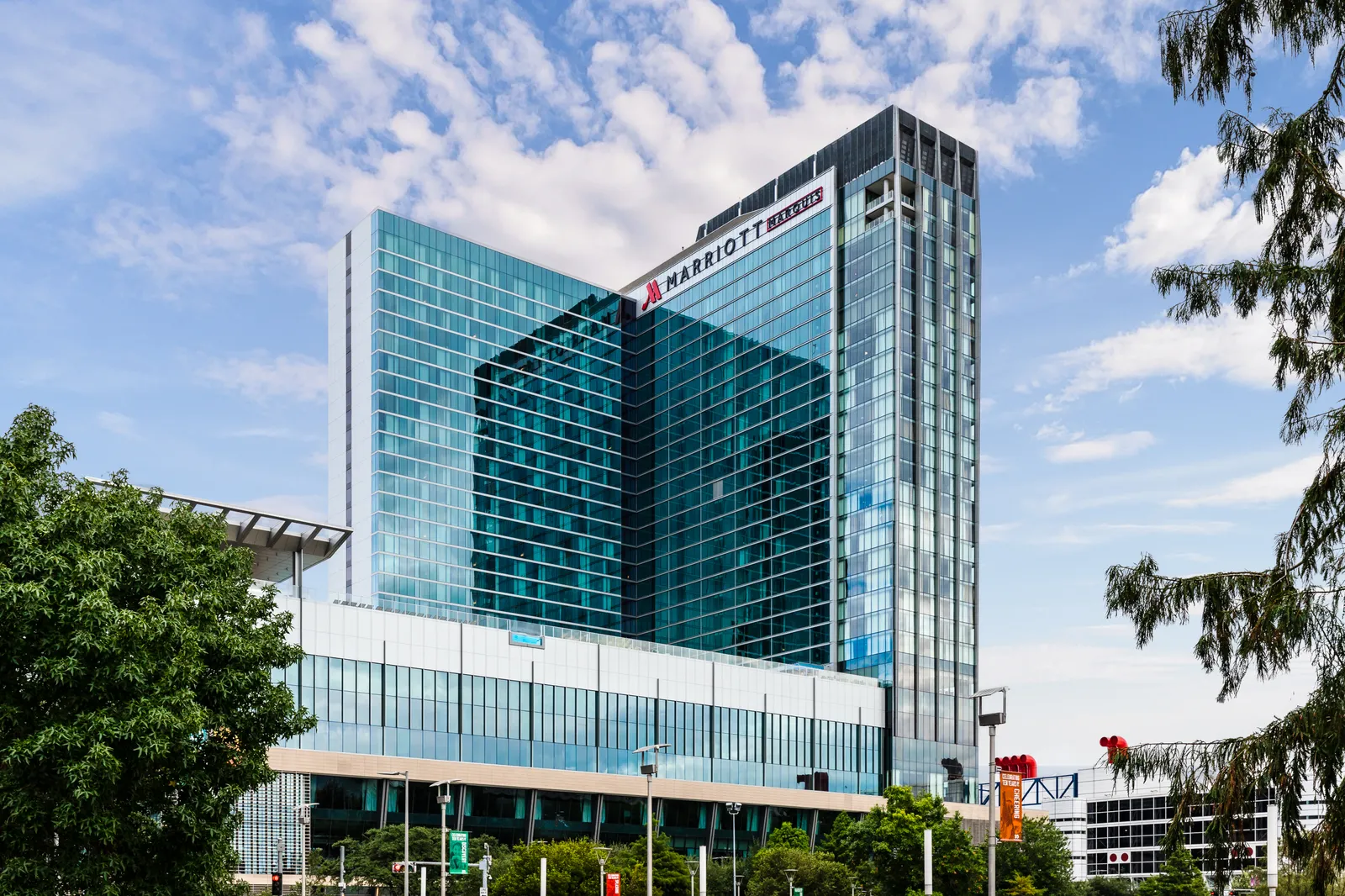

Houston, TX, USA – September 10, 2018: The Marriott Marquis is a Four Diamond hotel located in downtown Houston and features a Texas shaped pool, five restaurants and beautiful views from all angles.Joe Hendrickson
1777 Walker St., (713) 654-1777
Adjacent to the George R. Brown Convention Center downtown, the Marriott Marquis has another 100,000 square feet of meeting space of its own, including Houston’s largest ballroom. Often mentioned as the top hotel in town, it caters to business travelers and pleasure seekers alike, famously featuring the world’s largest Texas-shaped lazy river on its roof. If you don’t think that’s something anyone would brag about then you haven’t spent enough time in the state.
1100 Texas Ave., (713) 221-0011
A more affordable lodging option located in what was formerly Shell Oil’s headquarters, this refurbished downtown hotel offers quick access to the convention center and Daikin Park, which the Astros call home. You may not be able to paddle around in the rooftop plunge pool like you would at the Marquis, but a quick, cooling dip at the end of the day will not disappoint, nor will the free cookies at bedtime.

Courtesy of Bunkhouse Hotels
4110 Loretto Dr., (832) 844-0057
This new, midcentury-inspired gem can be found in the Montrose neighborhood, a block away from the Menil Collection, arguably the best and most eclectic museum in town. The boutique property includes just 71 rooms and is designed to fit in with its surroundings, which are largely residential and very subdued in comparison to the more raucous downtown. Despite its small size, it still has room for a small event space, private pool, and a slick lobby lounge.
111 N Post Oak Ln., (713) 680-2626
The Houstonian occupies a massive 27 acres in Houston’s West Oaks district, just outside the Loop. Despite its central location, the hotel offers a level of seclusion you won’t find anywhere else in town. It’s probably why George H. W. Bush used the hotel as his official residence for years in the 1980s and spent time here for decades after. The 125,000-square-foot spa is also the largest in the state.
2222 W Loop S, (713) 627-7600
Another Galleria-area hotel, this is an all-around good option for business travelers who need executive-focused amenities like 24-hour business and fitness center access, shuttle service, and meeting and event space (all 50,000 square feet of it). With 485 guest rooms on its 23 floors, there’s probably space for your whole organization to find a berth for the week.
Houston has hundreds of coworking spaces, so chances are you’ll be able to find something close to where you’re staying. As with most things in this city, travel time is an essential consideration. These picks may be some of the best options in town, but no sane Houstonian would recommend you spend an hour in traffic to get to one of them if another solid option is closer.

Courtesy of POST
401 Franklin St., (713) 999-2550
Named for the former post office that used to occupy this Museum District space (it was a railroad depot before that), POST was redeveloped in 2019 as a cultural center that includes food-hall-style dining, an art museum, a concert hall, and a rooftop garden. It’s also got loads of workspace options ranging from single desks to full offices, with day passes starting at $25.
4201 Main St.
Rice University helped to develop the Ion District, which occupies 16 acres in Midtown and serves as a technology park and innovation center for tech and energy outfits, and now includes the largest climate and sustainable energy incubator in the country. Coworking passes (starting at $60/day) get you access to the venue’s copious networking events plus snacks and coffee.
1430 Yale St., (832) 203-5115
This boutique office space is ideal for those doing business in the Heights, with amenities including an on-site notary, conference room rentals, and virtual office options for those who need a physical address in town. Plenty of usage options are available from $25 day passes to $359 monthly memberships (which include free conference room access).
Yes, there are nearly 200 Starbucks in the greater Houston area, and while you’re welcome to visit them or any other corporate chain for your pick-me-up, these spots offer a more refined (and independent) experience that, if nothing else, will help you impress your business colleagues with your sophisticated palate.
3201 Allen Pkwy. Ste. 170
8410 Hwy. 90 ALT, Bldg. B, Sugar Land, (346) 368-2895
Blendin focuses on sourcing coffee from unique locations with a “tree to cup” philosophy, which means your cup (or bag of beans) is likely to hail from a single farm in Panama, Ethiopia, Burundi, or somewhere further afield. Put yourself in the hands of the barista at one of the two locations to help you find the perfect base for your latte.
1018 Westheimer Rd.
At this beloved local coffee shop with a full menu, you’re best off pairing your Vietnamese matcha or Golden Monkey tea with a hearty brunch, like a smoked salmon scramble or scratch biscuits topped with smoked ham. Skip lunch to make room.

[Tony Goacher] has worked with a lot of cheap brushless DC motor controllers built in China. They can be very cost-effective, but sometimes limited in performance or capability, particularly when it comes to low-speed operation. Thus, he’s been working on a project to make cheap controllers more capable.
The prime problems [Tony] has faced are jerkiness, throttle deadspots, and inconsistent torque delivery at low speeds. This is especially the case when running brushless motors on heavier vehicles, where the greater inertia can compound any minor problems to the point things become undriveable. [Tony]’s solution has been to create a signal interceptor that lives in between a throttle and the cheap motor controller to change their overall behavior.
The demo vehicle for this build is TrakTrike, a sort of bicycle-half-track hybrid that [Tony] built for EMF Camp 2022. After blowing up some nicer controllers, [Tony] specced some cheaper parts from AliExpress. Only, the low-speed control was terrible, and the dual motor controllers didn’t respond identically to throttle and would cause the vehicle to steer or crab, making driving difficult. This was fixed by dropping in an Arduino Nano after the throttle, and before the two motor controllers. It allows calibrating the throttle output from the Arduino to eliminate dead spots, while also tuning the throttle output to left and right motors individually so they respond more similarly. There are also custom acceleration and deceleration curves that make the controllers respond more smoothly, and a precise crawling speed for consistent low-speed maneuvering.
Just by doing some fancy throttle smoothing and control, [Tony] was able to greatly improve the usability of these cheap controllers, for the price of an Arduino Nano and little more. Files are on GitHub for those eager to attempt the hack themselves. There are other ways to go about this of course, like diving into field-oriented control, if you’re so inclined. Alternatively, speculate on how you’d tackle this engineering challenge down in the comments.
OFFBEAT
Time to switch back to paper and harvest that suddenly valuable RAM
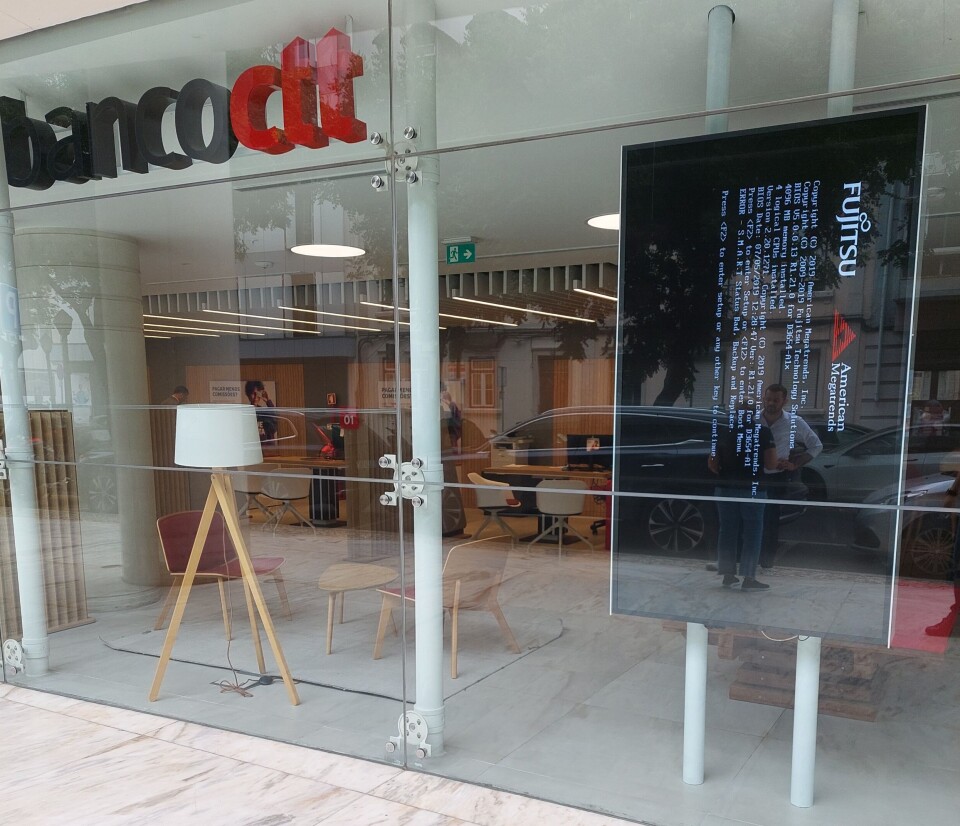
BORK!BORK!BORK! It’s not all sunshine and Pastel de nata in Portugal. Behind the hundreds of ways of cooking fish and bottles of sweet, fortified wine lurks our old friend – a BIOS screen misbehaving in a window.

Spotted by eagle-eyed Register reader Mário in Lisbon, the digital sign looking out on the street from a branch of Banco CTT looks like it is in imminent danger of a storage failure. The “S.M.A.R.T. Status Bad” indicates that something has made the storage media (hard drive or SSD) unhappy, and Banco CTT should take a break from flogging financial services to replace the unit before it fails completely.
A jab of a key should allow the digital sign to continue doing its thing, and there is some computer hardware in the background that we’re sure an enterprising Reg reader could plug into the screen to put it out of its misery – at least temporarily.
While we applaud Mário for his attentiveness, it is also worth noting that Lisbon is a lovely city with much to recommend – there is history to explore, cuisine to sample, and local culture to enjoy. This hack is a particular fan of the labyrinthine streets of Alfama, and the iconic trams are sufficient to satisfy anyone’s inner public transport nerd.
Back to the bork.
Visible on the screen is the amount of memory installed. Four gigabytes, by the looks of things, which seems excessive for something that is probably only going to show a jumped-up slideshow to passersby.
Then again, considering the cost of RAM nowadays, that screen might be considerably more valuable today than it was only a few months ago. While we’re not familiar with the financial products on offer from Banco CTT, we’d wager that few – if any – can keep up with the relentless rise in RAM prices.
It cannot be much longer before it makes more financial sense to replace digital signage with printed paper and harvest the suddenly valuable chips within, although where would that leave The Register’s bork desk? ®
NPCI CEO says AI will drive UPI to a billion daily transactions via fraud detection, credit, and voice onboarding. PhonePe and Google Pay hold 80%+ share.
India’s Unified Payment Interface has grown to over 750 million daily transactions, and the head of the body that oversees it says AI will be central to reaching a billion. Dilip Asbe, MD and CEO of the National Payments Corporation of India, told TechCrunch at Mumbai Tech Week that AI could drive the next half billion users through fraud prevention, credit distribution, and multilingual voice onboarding.
“AI will be used very effectively when we look at the next wave of UPI, and that includes all aspects, including reaching new users,” Asbe said. “We must use AI effectively to protect our current citizens, to find fraud, and to find mules. AI must also be used to provide credit to all the users and merchants who have digital footprints.”
NPCI launched a voice assistant-based payment system in 2023, but Asbe acknowledged adoption has not taken off yet. He said voice models need to be more accurate before they become a critical component of the payment ecosystem. India has been debating its AI sovereignty more intensely in recent weeks, with proposals for a $5 billion annual sovereign AI fund and calls to build small language models tailored to local languages and use cases.
The 💜 of EU tech
The latest rumblings from the EU tech scene, a story from our wise ol’ founder Boris, and some questionable AI art. It’s free, every week, in your inbox. Sign up now!
Asbe sees an opportunity there. “We have a very rich data set in our ecosystem,” he said. “I think there is a big opportunity for Indian companies, the banks, FinTechs, and the ecosystem, to create small language models which are sharp, specific, and as deterministic as possible.” NPCI already launched a model called FIMI to resolve user disputes, which Asbe said now serves over a million users for cancelling mandates and resolving issues.
On regulation, Asbe said India can adopt AI-powered finance with the right protections. He wants systems that can trace the instructions and consent a user gave to an AI agent if something goes wrong. NPCI demonstrated agentic commerce and payments with Razorpay last year, but a wider rollout has not followed.
The UPI market remains heavily concentrated. PhonePe and Google Pay control over 80% of transaction share. A regulatory cap that would limit any single app to 30% is set to take effect on December 31, 2026, unless NPCI defers the deadline again. Asbe said switching costs between apps are low and that the concentration reflects the absence of a viable commercial model for newer entrants. “The moment we see the commercial model being available to the ecosystem, I believe newer players will start investing very heavily,” he said.
NPCI’s own app, BHIM, holds roughly 1% market share despite growing transaction volumes. Asbe said there is no specific share target for BHIM, but as India’s digital economy scales toward its largest-ever tech IPOs and $110 billion AI infrastructure plans, NPCI wants BHIM to serve as a sovereign and secure alternative.




Two goals and an assist by sheer aura: Cristiano Ronaldo just entered the World Cup chat


Microsoft accidentally kills epic Outlook email threads


Weekend Open Thread: Staud – Corporette.com


The House | Manchesterism won’t survive the painful trade-offs unless it gets citizens on board


Potential 2028er World Cup attendee leaderboard


Asia stock markets slide as tech shares slump


A Look At A Gaggle Of Transputer Boards
Bitcoin (BTC) Dips Below $62K, Ethereum (ETH) Plunges 6% Daily: Market Watch

Dell (DELL) Shares Tumble Over 5% Following Analyst Downgrade to Hold


Securitize Wraps Roubini's SEC-Registered ETF as Dubai VARA Digital Security
Entergy settles forward sale agreements, raises $672 million in cash proceeds


Kraken's xStocks Opens Bending Spoons IPO Registration to EEA Retail


FIH Pro League: India defeat Pakistan 7-1, register biggest win of campaign | Other Sports News


RTX holders must register wallets before token distribution begins

Hyperliquid Named on Singapore MAS Investor Alert Register


India vs Bangladesh LIVE Score, Women’s T20 World Cup: Bangladesh Opt To Bat; India Enter ‘Do-Or-Die’ Stage As Semi-Final Race Heats Up
The DATA Foundation Launches to Tackle AI’s Multi-Billion Dollar Training Data Bottleneck


Strategy (MSTR) has a 10-month cash runway for dividends, but retail investors are losing faith

AAVE price tests 9-month trendline after 17% rebound as breakout hopes build


21Shares Cuts 2026 Crypto Forecasts as Institutional Demand Rises


You must be logged in to post a comment Login