Nvidia is retiring its classic Control Panel for GeForce Game Ready and Studio Driver users after 20 years, as it pushes users to a newer, more unified “NVIDIA” app. Longtime Slashdot reader BrendaEM first shared the news, commenting: “Nvidia seems to no long want you to have control over your own video card that you paid your hard-earned money for? WTF!?” VideoCardz.com reports: Existing Control Panel installs will remain on users’ systems. NVIDIA says the old panel will only disappear after a clean driver installation. Users who still need it can continue to download it from the Microsoft Store, but NVIDIA will no longer add new features, fixes, or other changes.
The retirement currently applies to Game Ready and Studio Drivers. NVIDIA RTX PRO users will continue to receive Control Panel support until the company moves professional features to the NVIDIA app. For GeForce users, NVIDIA says the app now includes the modern functionality previously available through Control Panel. […] The classic panel is therefore not being removed from every system overnight. It is being moved into maintenance mode for GeForce users…
According to a new survey from GBAO Strategies distributed by the United Food and Commercial Workers International Union, 65% of American voters think ESLs will cause grocery prices to increase, while 68% think surveillance pricing will have the same result. Read Entire Article Source link
Third-party UK Visa Portal website exposed 100,000 docs in an unsecured cloud repository
Cybercriminals with access to the affected PII could conduct identity theft or fraud
Victims advised to protect and monitor accounts, and await notification
UK Visa Portal, a third-party website separate from the official government offering, has reportedly left thousands of highly sensitive documents exposed in a major data leak.
Affected documents and details include passports, photos, verification selfies and other application information, leaving victims widely open to identity theft and potential financial fraud.
The issue happened as a result of documents being stored on an unsecured server without password protection, meaning anyone with a direct link could access and view them.
Latest Videos From
Advertisement
UK Visa Portal applications exposed
The data exposure was caused specifically by a misconfigured cloud storage repository that was entirely public – but worse than that, it’s also been revealed that the file directory structure allowed used a predictable URL, meaning attackers could easily guess or work out the link even if they didn’t have it in the first place.
Most evidently, primary passport pages exposing full names, passport numbers, nationalities, dates of birth, places of birth, and issue and expiry dates were included in the leak, but accompanying documents providing home addresses, contact numbers, email addresses and more provided attackers with even more PII.
TechCrunch reports at least 100,000 documents were available without restrictions, and as of May 26 2026, the issue had still not been addressed.
Many victims likely accessed the third-party website erroneously, believing this was the correct way to obtain an Electronic Travel Authorization – a process that the UK government offers in-house for a £20 fee.
Advertisement
Sign up to the TechRadar Pro newsletter to get all the top news, opinion, features and guidance your business needs to succeed!
Individuals who may have used the platform are being advised to monitor and protect their credit accounts and to secure online accounts with additional layers like multi-factor authentication and passkeys. Data protection laws also legally require affected individuals to be notified – it’s unclear if contact has already been made.
Karin Verspoor of RMIT University explores how AI is impacting research in STEM.
Many of the most exciting discoveries in science involve highly specialised knowledge and making connections between far-flung facts. Scientists must combine deep analysis with broad reasoning strategies.
As in many information-rich tasks, researchers are looking to artificial intelligence (AI) systems to speed up their work. AI tools may be able to support key steps such as generating ideas, reviewing existing work and analysing data.
The latest systems use large language models (LLMs) to allow scientists to interact naturally and directly with the vast body of knowledge captured in words in the scientific literature.
Advertisement
But as twonew systems described in papers just published in Nature show, when it comes to science, language alone can only go so far.
What AI is doing to science
A number of organisations, such as Sakana AI, are trying to automate the entire scientific process. To date, these efforts have largely focused on computer science, where ‘experiments’ mainly involved designing and writing code.
However, the Agents4Science conference organised at Stanford last October showcased a broader range of AI-generated papers. They covered topics from mechanical engineering and protein design to a system called BadScientist which deliberately produced “convincing but unsound” research.
AI systems clearly can’t be trusted to conduct the full process of science on their own. But how about using AI to help scientists get more done more quickly?
This is the intent of the two new systems described in Nature: Robin, made by non-profit Future House, and Co-Scientist, from Google DeepMind.
Both systems aim to accelerate scientific discovery, working in collaboration with a scientist. Both are also ‘multi-agent’ AI systems, meaning they are built as a collection of specialised agents each targeting specific steps of the scientific discovery process, coordinated by a ‘supervisor’ agent.
The agents that comprise Co-Scientist aim to mirror abstract cognitive tasks, such as a ‘reflection agent’ that acts as a critical scientific peer reviewer assessing the quality of a hypothesis. ‘Ranking agents’ debate research hypotheses in ‘tournaments’, using multiple interacting LLMs to simulate a discussion about the relative merits of two hypotheses.
Advertisement
Robin’s agents, on the other hand, are more tuned to specific tasks relevant to drug repurposing, aiming to identify new drugs for a given disease. One agent focuses on selecting experimental tests, while another analyses complex biomedical data.
How do the results stack up?
Co-Scientist can assess the quality of its generated proposals, using a method called the Elo rating which is best known for ranking chess players. Co-Scientist’s self-ratings of the novelty and impact of its outputs align quite well with the preferences of human experts and judgements by other LLM systems.
In a drug repurposing experiment, Co-Scientist selected 30 drug candidates as promising treatments for a kind of cancer called acute myeloid leukemia. Expert (human) oncologists refined the list, and five drugs were tested in the lab. Of these, three showed some positive results and one seemed to show particular promise.
Other experiments showed the potential of Co-Scientist to explore combinations of multiple drugs.
Advertisement
Notably, the predictions of Co-Scientist were not compared with the plethora of targeted computational and machine learning methods for drug repurposing that have been developed over decades of computational biology research. This means we don’t know whether the new general-purpose tool outperforms more specific AI approaches.
Both systems stop short of validating their hypotheses directly, which would involve real physical experiments. Both also rely heavily on human input to define the key scientific question, sense-check predictions and prioritise predictions for further investigation.
Co-Scientist focuses primarily on generating hypotheses through elaborate reasoning agents, leaving validation and interpretation to subsequent steps. Robin also uses an agent to analyse data produced from real-world experiments.
Robin was used to propose 30 drug candidates for a condition called dry age-related macular degeneration. The top five were selected for testing.
Advertisement
Robin also made proposals for the experiments, with several suggestions overridden by the human scientists. Through several rounds of brainstorming and analysis, two drugs were identified as promising.
Testing of Robin’s individual agents showed those that dug through earlier research were better at the task than general-purpose LLMs. The analytical agent did less well on questions about statistics and bioinformatics, and relied heavily on human-supplied prompts.
The limits of language alone
AI can help scientists to navigate the vast amount of documented knowledge humans have acquired over the millennia. Use of computation to find patterns in large datasets, to integrate dispersed information, and to drive new discoveries from existing literature has already contributed to scientific progress for decades.
New models such as Robin and Co-Scientist represent a shift towards working directly in the realm of the language of science, rather than the realm of raw data. This allows more natural collaborations between scientist and machine, through language-based ‘discussions’.
Advertisement
However, more natural doesn’t necessarily mean more effective. Language-based communication can be imprecise and ambiguous, where science must be specific.
Models that combine the best of these worlds are on the horizon. These aim to link structured quantitative data to the concepts and relationships that describe the core facts beneath it.
Such models ground scientific reasoning in the structure of knowledge. They allow scientific evidence ranging from genomic sequences and protein structures to cellular imaging to be connected.
Words are how science is communicated. AI tools that facilitate making sense of the information that is hidden in all of those words are surely valuable. But the complexity of the natural world means that AI (co-) scientists will only be truly effective when they can go beyond connecting words together, to modelling the full complexity of the systems those words describe.
Karin Verspoor is dean of the School of Computing Technologies at RMIT University. She works at the intersection of science and technology, applying artificial intelligence methods to analysis and interpretation of biological and clinical data, focusing particularly on natural language processing of unstructured text data. She is a fellow of the Australian Academy of Technological Sciences and Engineering and the Australasian Institute of Digital Health. She is also the co-founder and Victoria node lead of the Australian Alliance for Artificial Intelligence in Healthcare.
Don’t miss out on the knowledge you need to succeed. Sign up for the Daily Brief, Silicon Republic’s digest of need-to-know sci-tech news.
As we get out of the house, the gear-obsessed WIRED Reviews team is writing about our favorite bags and EDCs. Today, reviewer Louryn Stramperaves about her Osprey Farpoint 40 backpack. You can also read other Bag Check stories where WIRED writers share their carryall of choice.
While planning our 20-day trip to Asia in 2018, my boyfriend at the time was adamant that neither of us would check any luggage. As a proud overpacker, this intention both shocked and horrified me. I love options and hate paring things down. I wanted to bring 30 pairs of shoes and 348 pairs of underwear; I certainly did not want to painstakingly build a capsule wardrobe and strategically compile packing cubes. Ultimately, though, I agreed to the single-bag trip, and the Osprey Farpoint 40 quickly converted me to legitimately loving the light-travel life.
If you want the perfect backpack, or the most durable suitcase, or the best tote for toting your toteables, my colleagues have plenty of recommendations worth browsing. But if you seek a bag that makes carrying-on (to the plane, train, or automobile) and carrying-off (from hotel to hostel to hotel again) a blissfully pain-free experience, the Farpoint is my favorite.
Photograph: Louryn Strampe
Osprey
Farpoint 40L Travel Backpack
Advertisement
During that nearly three-week trip in 2018, my boyfriend and I were constantly on the move, visiting Shanghai, Tokyo, Osaka, Kyoto, Busan, Seoul, and Hong Kong. We took multiple flights and trains, and we stayed in both spacious rooms and cramped quarters. In the years since, I’ve taken my Osprey Farpoint to the East and West Coasts of the United States. It’s lived with me in three homes, joined me on dozens of road trips, and stayed with me in hundreds of hotels. I’ve used it for trips as long as three weeks and as quick as a single night. I’ve thrown it down flights of stairs, sat atop it on subways, used it to shield my head from the rain, crammed it into overstuffed vehicle trunks, and packed it to the brim nearly every time I’ve taken it anywhere. It’s still working just as well as it did on that first trip.
Needless to say, this bag is cavernous. Its 40-liter capacity lets you load it up to the brink of being too hefty to carry, but I’ve never had a problem bringing it onto a plane, partially thanks to the compression straps that help you squish down the silhouette. (Per Osprey’s website, the Farpoint meets domestic carry-on size requirements.) And it offers so many pockets, they’re difficult to track.
The outer shell has two mesh spaces that are perfect for shoes or water bottles, plus a smaller compartment where I like to stash my keys and passport. The pack itself features two main chambers, the first of which is a laptop compartment, complete with a zippered sleeve ideal for an e-reader or a tablet. The largest body pocket features two built-in compression straps to help you achieve that “sit on the top of the suitcase to close it” effect once you’re ready to zip up. On the opposite side, there’s another zippered mesh pocket that spans the entirety of the shell, which I use to stash my socks, underwear, toiletries, and other items that I need handy but don’t want mixed in with my clothes.
Somehow, the Farpoint makes it not only possible but also comfortable to carry everything I might need. Yes, when you wear a stuffed-to-the-brim Farpoint, you’ll resemble a turtle peeking out from under a shell. But you won’t need to move slowly, thanks to its stabilizing design. The shoulder and hip straps are padded, and there are clip straps for your hips and chest. The chest strap also has a built-in whistle, which won’t necessarily boost your comfort, but it might come in handy if you’re hiking. (I mostly use the whistle for funsies or to bother my campmates at festivals.)
Samsung’s 10.5%-of-profit bonus formula is only the second written profit-share agreement at a major Korean firm. Kakao’s union is already asking for more.
Samsung Electronics’ unionised workforce voted in favour of the government-mediated pay agreement on Wednesday, formally closing the deal that narrowly survived an injunction filing from a smaller non-chip union on Tuesday. The vote settles, in the immediate term, the largest labour dispute in the global semiconductor industry.
The wider effect is more durable: the agreement marks the first major win for a Samsung union in the company’s 56-year history, and it is being read across Korean industry as a structural shift in how labour bargaining works.
The substance of the deal is what makes it unusual. Samsung has agreed in writing to allocate 10.5% of its semiconductor operating profit to special bonuses for chip workers. It is, on Reuters’ count, only the second time a major South Korean company has put a fixed-percentage profit-share commitment into a binding labour agreement.
Advertisement
The 💜 of EU tech
The latest rumblings from the EU tech scene, a story from our wise ol’ founder Boris, and some questionable AI art. It’s free, every week, in your inbox. Sign up now!
Some memory-division employees will receive total bonus packages worth around $416,000 over the agreement period. The non-chip Donghaeng union, which had filed the injunction at Suwon District Court, has signalled it intends to keep pressing for a revised allocation regardless of the vote.
The wider Korean labour picture has moved with it. Workers at Kakao and four of its affiliates have threatened to strike if their demands, including a 13–15% profit-share allocation, are not met. Other major Korean employers are reportedly fielding similar requests from their own unions.
Advertisement
The Samsung settlement has, in effect, created a precedent the rest of the chaebol system will now be benchmarked against.
Two structural conditions made the deal possible. The first is the AI-driven memory supercycle. Samsung’s memory division has been generating profits on a scale the company has rarely seen, and the gap between what the division produces and what its workers had been paid was visible to everyone involved.
The second is the loss of workforce to SK Hynix, where the AI-memory boom has been concentrated and where bonuses have been larger for years. According to the Samsung union, chip workers had begun leaving for SK Hynix in numbers that made the bonus gap commercially unsustainable.
The Korean chaebol bargaining model has historically been resistant to fixed-percentage profit-sharing on the grounds that it imports the cyclicality of the underlying business into the labour cost line. The Samsung deal accepts that trade-off: the bonus pool falls automatically when memory profits fall.
Advertisement
Workers, in turn, have agreed to the contingent floor on their payouts (memory must generate at least 200 trillion won between 2026 and 2028 and 100 trillion won between 2029 and 2035 for the full payout). It is a recognisably modern profit-share structure, of the kind Western technology firms have used for years, transplanted onto a chaebol balance sheet for the first time.
The political question is whether this is the start of a structural shift or a memory-cycle-specific anomaly. Korean economists have argued for years that the chaebol system’s relatively weak wage-growth performance during good years was a function of the labour-bargaining frame rather than of profitability.
The Samsung deal tests that argument empirically. If memory profits hold, the formula delivers genuinely large worker payouts and the new pattern spreads. If memory profits revert, the union side’s structural complaint, that a one-off cycle-linked bonus is not a sustainable wage policy, returns with it.
Samsung shares closed up modestly on Wednesday. The Korean labour ministry, which brokered the original agreement, said it expects similar mediated settlements at other major firms within months.
Hollywood consolidation may not be done rearranging the furniture. With the Paramount and Warner Bros. Discovery deal still moving through the final stages, IMAX is now reportedly testing the waters for a possible sale, reaching out to undisclosed major entertainment and technology companies to gauge buyout interest. Nothing is guaranteed, and IMAX has not announced a formal sales process, but the mere suggestion that the premium large-format giant could be in play was enough to send its stock up more than 15%.
The timing is not exactly subtle. IMAX CEO Rich Gelfond opened the door to the idea in December 2025, saying the company could remain “an incredibly valuable player” as an independent business or become part of a larger corporate ecosystem. In an industry where theatrical exclusivity, premium ticket pricing, and branded cinema experiences matter more than ever, IMAX suddenly looks less like a niche exhibition technology company and more like a strategic asset. The kind that tends to attract phone calls from very large companies with very expensive lawyers.
The timing of any potential IMAX sale is what makes this story more than corporate tire-kicking. IMAX is not limping into the room looking for a rescue. The company is coming off record market-share gains and has reaffirmed full-year 2026 guidance of $1.4 billion in global box office from its network, which would be a record for the company. That makes any possible sale less about weakness and more about whether IMAX believes it can extract maximum value while premium theatrical experiences are still one of the few bright spots in the movie business.
Advertisement
That also means any buyer would need to understand what IMAX actually is. This is not AMC, Cinemark, or another traditional theater chain with popcorn margins and real estate headaches. IMAX is a premium large-format technology, licensing, distribution, and brand platform with deep ties to studios, exhibitors, filmmakers, and global audiences.
It also reaches beyond commercial theaters through IMAX Enhanced, its home entertainment certification program developed with DTS for compatible content and consumer electronics. Buy it for the wrong reason, and you risk damaging the very thing that makes it valuable. Very Hollywood. Very expensive. Very possible.
Who Could Buy IMAX?
If IMAX is genuinely testing the market, the buyer list is not hard to sketch. Analysts have floated the usual suspects: Sony, Netflix, Apple, Amazon, AMC, Cinemark, and private equity. Paramount is almost certainly out of the frame given its own Warner Bros. Discovery deal, which leaves the field to companies that either want more control over premium theatrical presentation, a stronger bridge between theaters and streaming, or a globally recognized cinema brand that still has real pricing power.
Advertisement
Sony
Sony may be the cleanest fit for IMAX, especially if the deal is viewed through a cinema technology lens rather than a streaming land grab.
Beyond its consumer electronics business, Sony already has deep roots across the theatrical ecosystem: Sony Pictures, the VENICE digital cinema camera platform, image sensors, professional displays, projection, production, and post-production. In other words, Sony would not need a guided tour of the building before figuring out where the expensive machines are plugged in.
That matters. If Sony acquired IMAX, the learning curve would be shorter than it might be for a company looking at IMAX purely as a brand extension or a content funnel. The more interesting opportunity would be technical integration: pairing Sony’s imaging, production, display, and cinema expertise with IMAX’s premium large format exhibition network and filmmaker relationships.
Sony also has one advantage that Apple, Amazon, and Netflix do not: streaming is not the center of its entertainment strategy. Sony Pictures sells and licenses content broadly, which could reduce some of the tension between theatrical exclusivity and streaming priorities. That does not make a Sony acquisition simple, cheap, or guaranteed. But on paper, Sony looks like one of the few potential buyers that could strengthen IMAX without turning it into just another corporate trophy mounted above the conference room espresso machine.
Advertisement
Netflix
Netflix is the more disruptive name on the potential IMAX buyer list, and not just because it would make theater owners reach for the antacids.
Advertisement. Scroll to continue reading.
After losing Warner Bros. Discovery to Paramount Skydance, Netflix still looks like a company with an internal appetite to do something large. The company declined to raise its Warner Bros. offer in February 2026, and Paramount’s winning bid reportedly required a $2.8 billion termination payment tied to the abandoned Netflix deal. That does not automatically mean Netflix turns around and buys IMAX. But it does mean the company has both motive and a very public reminder that scale still matters in Hollywood.
An IMAX acquisition would instantly give Netflix a deeper position in the theatrical world without requiring it to buy a traditional theater chain. That distinction matters. Netflix has been expanding its theatrical footprint more selectively, and its upcoming IMAX release of David Fincher’s The Adventures of Cliff Booth gives the company a very visible test case: a two-week exclusive IMAX window before the film lands on Netflix. That is not a takeover strategy by itself, but it is exactly the kind of move that makes people in this business start connecting dots with red string and expensive coffee.
Advertisement
The key would be restraint. If Netflix acquired IMAX, the smartest move would be to leave IMAX’s theatrical team, technical standards, filmmaker relationships, and exhibitor partnerships largely intact. IMAX works because it is not just a logo slapped on a bigger screen. It is a premium format ecosystem with trust built over decades. Netflix would need to strengthen that, not smother it under streaming-first logic.
There is also a Jersey Shore wrinkle that makes this more interesting from an eCoustics perspective. Netflix Studios Fort Monmouth is already underway, with Netflix planning to invest close to $1 billion into the 292-acre former Army post. eCoustics Editor in-Chief Ian White drives through the property daily, where the project is no longer theoretical. It is construction equipment, fencing, dirt, completed exterior soundstage walls, and the unmistakable smell of a very large check being cashed in Monmouth County.
Netflix is also building out its East Coast presence in New York, which gives the company a stronger production and corporate footprint on both sides of the Hudson. And just down the road from Fort Monmouth sits AMC Monmouth Mall 15 in Eatontown, the local AMC with an IMAX auditorium, now sitting inside a mall property being rebuilt into Monmouth Square. That does not make Eatontown the center of the cinema universe, but it does put Netflix’s future production campus and a working IMAX screen in unusually close proximity. Sometimes the map tells its own story.
Pro Tip: Netflix partnering with IMAX on The Adventures of Cliff Booth may not prove anything by itself. But after missing out on Warner Bros. Discovery, spending close to $1 billion on Fort Monmouth, and expanding its East Coast footprint, Netflix clearly wants a bigger seat at the Hollywood table. IMAX would be a very loud chair.
Advertisement
Apple
Apple does not need IMAX in the obvious way. The company already has one of the largest consumer technology ecosystems on the planet, built around iPhone, Mac, iPad, Apple TV, Apple Vision Pro, displays, services, computational photography, spatial video, and its growing Apple Original Films slate.
But that may be exactly why Apple would be interesting.
Apple does not have a meaningful theatrical footprint, and buying IMAX would change that overnight. It would give Apple immediate access to a premium global cinema platform, relationships with filmmakers and exhibitors, and a brand that still means something to audiences who are willing to pay more for a better moviegoing experience. For a company that already controls so much of the hardware, software, and services experience at home and on mobile devices, IMAX could become the missing theatrical piece.
The most logical integration would not be Apple turning IMAX into an Apple Store with reclining seats. Nobody needs that nightmare. The better fit would be technical and experiential: IMAX, IMAX Enhanced, Apple TV, Apple Vision Pro, spatial video, premium displays, and Apple’s broader content ecosystem all feeding into a more controlled high-end viewing pipeline.
Advertisement
That is also where the concern begins. If Apple owned IMAX, studios would immediately wonder whether Apple Original Films would receive preferential access to IMAX screens, premium release windows, or enhanced promotional treatment. Even the appearance of favoritism would create friction with other studios that rely on IMAX for tentpole releases. Hollywood loves partnerships until somebody thinks the lunch bill is rigged.
Apple could afford IMAX. It could probably integrate the brand more elegantly than most. But the question is whether Apple would preserve IMAX as a neutral premium cinema platform or slowly pull it deeper into the Apple ecosystem. The first version could strengthen IMAX. The second could make every rival studio start sharpening knives in conference rooms.
Advertisement. Scroll to continue reading.
Amazon
Amazon is another obvious name in the IMAX guessing game, because it has something most streamers still want: more credibility in theatrical film.
Advertisement
Amazon MGM Studios has already moved well beyond using movies as Prime Video inventory. Its handling of Project Hail Mary showed that Amazon is willing to treat the right film as a genuine theatrical event, not just a streaming appetizer with a short leash. The film opened in IMAX and was billed as “Filmed for IMAX,” giving Amazon a cleaner lane into premium theatrical presentation than most streaming rivals.
Owning IMAX would give Amazon a much bigger seat at that table. It could help the company secure premium screen space for major Amazon MGM releases, strengthen its position with filmmakers, and create a more direct pipeline from theatrical exhibition to Prime Video. That matters even more when Amazon already controls MGM, owns the James Bond franchise rights through that acquisition, and has the checkbook to chase larger theatrical ambitions without raiding the office couch cushions.
The appeal is not hard to understand. IMAX would give Amazon a premium global cinema brand, a technical platform, and a revenue stream that does not depend solely on Prime Video subscriber math. Even if Amazon never turned IMAX into a fully integrated Amazon MGM release machine, it could still benefit from IMAX’s growing importance as a premium format used by multiple studios.
The risk is the same one that would follow Apple or Netflix into the room. If Amazon owned IMAX, rival studios would immediately ask whether Amazon MGM titles would receive better access, better dates, or more favorable promotion. IMAX has value because it is trusted by the broader industry. Turn it into a house organ for one studio, and the pitchforks come out.
Advertisement
AMC or Cinemark
AMC and Cinemark both understand the theater business because they live in it every day. They operate multiplexes, sell premium tickets, manage screen allocation, and already use IMAX as part of their higher-end auditorium strategy. From an operational standpoint, neither company would need a remedial course in why IMAX matters.
That is the good part.
The problem is neutrality, and it is not a small one. IMAX works because it is available across multiple exhibitors and markets. If AMC bought IMAX, rival theater chains would immediately wonder whether AMC would gain preferential access to new IMAX installations, better terms, stronger marketing support, or more control over where IMAX screens are deployed. The same issue applies to Cinemark. Even if either company promised to keep IMAX open to competitors, the optics would be brutal. Hollywood notices these things, usually while pretending not to.
A theater-chain owner could also create headaches with studios. IMAX has value because filmmakers, distributors, and exhibitors see it as a premium format with broad industry reach. Put it under the control of one exhibitor, and suddenly every competing chain has a reason to rethink its long-term relationship with the format. That does not strengthen IMAX. It makes the room colder.
Advertisement
There is a counterargument. AMC or Cinemark would know how to optimize IMAX inside the real-world exhibition business. They understand seating, scheduling, ticket premiums, concession economics, and how premium large-format screens compete against Dolby Cinema, ScreenX, RPX, and other formats. They could probably find practical ways to improve deployment and squeeze more performance out of the existing footprint.
But ownership is different from partnership. IMAX is most valuable when it remains a neutral premium platform used across the theatrical ecosystem. Selling it to AMC, Cinemark, or another theater chain might create short-term operational logic, but long-term strategic friction.
Private Equity
Private equity might be the least flashy option for IMAX, but it could solve one major issue: neutrality.
Advertisement. Scroll to continue reading.
Advertisement
A sale to a private equity firm would avoid the obvious conflicts that come with studio, streamer, or theater-chain ownership. Rival studios and exhibitors would have fewer reasons to worry about preferential screen access, release windows, or IMAX being tilted toward one company’s content pipeline. In theory, IMAX could remain an independent premium format serving the entire theatrical ecosystem.
There is an upside if the buyer understands the asset. A smart private equity owner could invest in more IMAX installations, expand internationally, improve the technology stack, and keep IMAX Enhanced alive as a home entertainment licensing opportunity.
But the risk is obvious. Private equity also has a reputation for cost cutting, and IMAX is not a brand that should be managed like a spreadsheet with cupholders. Staff cuts, reduced technology investment, weaker support for underperforming locations, or selling off IMAX Enhanced could all damage what makes IMAX valuable.
IMAX works because audiences, filmmakers, studios, and exhibitors still trust the brand. Preserve that, and private equity could be a clean solution. Misread it, and the premium format starts looking a lot less premium.
Advertisement
The Bottom Line
For now, this is still speculation. IMAX has not announced a formal sale process, and Rich Gelfond may simply be reminding Wall Street that the company is valuable while premium theatrical formats are having a very good moment.
But selling from strength makes sense. IMAX is hot with studios, filmmakers, and moviegoers, and that is when a company usually gets its best price. Waiting until the theatrical business hits another rough patch would be the bargain-bin version of strategy.
Sony still looks like the cleanest fit because of its cinema technology, production, imaging, and theatrical ecosystem. Netflix would be the most disruptive. Amazon would be the most aggressive streaming power move. Apple could integrate IMAX into its broader hardware and content ecosystem, but studio politics would get loud fast. AMC or Cinemark would understand the format, but neutrality would be a serious problem. Private equity could keep IMAX independent, or damage it with cost-cutting.
IMAX does not need a rescue. That is exactly why buyers may be interested. The right owner could expand the brand without breaking the trust that makes it valuable. The wrong one could turn one of cinema’s strongest premium formats into another corporate asset with the life squeezed out of it.
Advertisement
We will continue to follow this story as it develops.
Toyota’s luxury brand Lexus burst onto the automotive scene in 1989 with two sedans in its lineup. Lexus’ latest compact luxury sedan is the 2026 Lexus IS, currently available only with a naturally aspirated, 3.5-liter V6 engine. This 311-horsepower engine, known by its internal Toyota code as the 2GR-FKS, has been powering the IS for well over a decade, actually since 2014. And while the Lexus IS’s engine is neither a hybrid nor a turbo, it has definitely contributed to the car’s reputation as the Lexus model with the best odds of hitting 250,000 miles, according to iSeeCars. The Lexus brand also came out on top as JD Power’s most dependable car of 2026.
Using a tried-and-true engine is an important part of why the Lexus IS has scored so highly on these key third-party measures of overall reliability, as well as customer satisfaction. So it should come as no surprise that other vehicles in both the Toyota and Lexus lineups have also used this engine, with varying amounts of power. These vehicles include the Lexus RC 350, the Lexus RX 450h, the Toyota Camry, the Toyota Sienna, and the Toyota Highlander.
Advertisement
And while the Lexus IS’s V6 engine was fine enough to be left alone, other parts of the Lexus IS that were more visible to the average customer did receive upgrades. There had been styling upgrades in both 2017 and 2021, with the 2026 model year seeing yet one more round of improvements.
Advertisement
What else should you know about the Lexus IS?
The Lexus IS debuted in 1999 and has since sold around 1.3 million examples worldwide. For the 2026 model year, the Lexus IS boasts a new exterior design, as well as a new dashboard and interior furnishings. Both the driver’s digital instrument cluster and the center screen, called the Lexus Interface, have been enlarged in size to 12.3 inches each. The Lexus IS is available with a single engine, designated as the IS 350, and is available in two trim levels, the F Sport Design and the F Sport. In addition, each of these trims comes as either a rear-wheel-drive or an all-wheel-drive version. While the RWD version is mated to an eight-speed automatic, the AWD gets a six-speed automatic.
Car and Driver put the Lexus IS through its paces to determine how well it performs in the real world. It generated a 0-60 mph time of 5.6 seconds, with the quarter-mile going by in 14.2 seconds at an even 100 mph. Lexus claims a 143 mph top speed for the IS, while it managed 0.89g roadholding on the skidpad. Our review of the Lexus IS appreciated its steering and suspension upgrades.
Pricing for the 2026 Lexus IS starts at $46,895, including delivery for the IS 350 F Sport Design RWD and tops out at $51,345 for the IS 350 F Sport AWD. Numerous options are available, including wheel upgrades, a handling package with adaptive suspension, a tech package, a power moonroof, and a 1,800-watt Mark Levinson audio system.
Product lead Ashraf Alkarmi is taking over as CEO, handing his role to Chrome’s Mike Torres.
File storage platform Dropbox founder Drew Houston is stepping down as CEO after 19 years in the role, handing over the reigns to company senior vice-president of core products Ashraf Alkarmi.
Houston and Alkarmi will head the company as co-CEOs for a transitionary period, following which Houston will take up the role of executive chairperson, and Alkarmi, the sole CEO.
“Our business is in a stronger position than it’s been in years, and a lot of that is because of Ashraf,” Houston said, explaining the company’s decision behind the move.
Advertisement
Dropbox announced the transition on 21 May in a security filing with the US government. Shares at the company fell nearly 3.5pc at market close yesterday (26 May), following a wider announcement.
Alkarmi, a Harvard graduate, previously led the products segment in companies including Motorola, Nokia, Meta, Amazon and Brightcove.
Prior to joining Dropbox in 2024, he spent a number of years as Vimeo’s chief product officer, as well as the general manager for Amazon’s Freevee. Alkarmi also founded audience engagement platform PresAsk in 2013.
For his new role, Alkarmi will be receiving an annual base salary of $825,000 in addition to bonuses and stock options.
Advertisement
The outgoing SVP of core products is handing his role to Chrome’s VP of product Mike Torres, effective 7 July. Torres has spent more than a decade each at Amazon and Microsoft in executive roles.
Dropbox, with more than 700m registered users, announced a revenue of $629.5m in the quarter past, marking a marginal growth of less than 1pc quarter to quarter. The company plans to shut down FormSwift, a platform for generating legal documents, later this year.
The file storage platform cut 20pc of its workforce in 2024, amounting to more than 500 employees. The layoffs followed a previous round a year prior that led to 500 job losses.
Don’t miss out on the knowledge you need to succeed. Sign up for the Daily Brief, Silicon Republic’s digest of need-to-know sci-tech news.
Canopii’s team among its robotic system and basil plants. CEO and co-founder David Ashton is tossing greens. (Canopii Photo / Bryan Aulick)
A running joke in the agricultural field is the average age of a U.S. farmer is 58 today, but that will tick up by one next year. The trouble is, it’s not so funny when the people who grow our food are aging out with no one to replace them.
An Oregon startup aims to address that with an environmentally sustainable, scalable farming solution.
“We’re trying to create the future job for local farmers, where essentially you franchise a robotic farm, you have almost no employees, and you can provide organic produce to your community,” said David Ashton, CEO and co-founder of Canopii.
The company has built a greenhouse system with a footprint smaller than a tennis court that requires little power or water and can be installed in urban settings to produce 40,000 pounds of greens per year — enough to supply roughly 20,000 people.
Canopii plans to kick off a WeFunder campaign this week to raise $1.5 million to build a commercial greenhouse in Portland and demonstrate its franchise model. The startup launched in 2021 and has received $3.6 million in funding, primarily through grants from the National Science Foundation and the U.S. Department of Agriculture, along with investments from Elevate Capital, Onami and Vertue Labs.
Advertisement
The team designed an automated conveyor system that takes specialty lettuces, herbs, Asian broccoli and other greens from seed to boxed produce. A robotic arm inserts seeds into soil pucks the size of mini cupcakes; once seedlings develop leaves, the system transplants them into larger containers and, at harvest, clips and deposits the greens into bins.
The company is pursuing a grant to develop AI-powered plant monitoring to further reduce labor, with conveyors routing trays to stationary cameras rather than outfitting the entire facility.
Ashton’s inspiration traces back to his time at California Polytechnic State University, situated in a rural stretch between San Francisco and Los Angeles. In the early-to-mid 2010s, California was enduring a record drought.
As part of his agricultural engineering program, “we traveled to all the different farms, and everyone was talking about water,” he said. Ashton was struck by the water demands of high-volume outdoor farms and the impacts of shipping produce over long distances.
Advertisement
He set out to build the smallest, most efficient greenhouse possible. The result is Canopii’s structure: 2,500 square feet and 30 feet tall, capable of producing in one-twentieth of an acre what would require 3 to 4 acres in a typical field.
A Canopii greenhouse has a footprint of 2,500 square feet and measures 30 feet tall. (Canopii Photo)
The six-person Canopii team currently has a prototype greenhouse operating in Hubbard, Ore., supplying greens to customers including Ōkta Farm and Kitchen, a nearby high-end restaurant.
The indoor farming sector has struggled in recent years. Well-funded ventures including Plenty, AppHarvest, Bowery Farming and Kalera have gone bankrupt, though others such as Oishii and Gotham Greens continue to operate. Ashton noted that most of those failures involved large-scale operations.
A Wyoming-based startup called Vertical Harvest is also building smaller urban greenhouses, differentiated by its use of soil-free hydroponic technology. Other Pacific Northwest players in the space include IUNU and Koidra.
Canopii is pursuing a franchise model in which it oversees the greenhouse installation, trains the owner and provides ongoing service and support, while the franchisee funds and runs the site. Each unit costs approximately $600,000. Target customers for the produce include independent grocery stores and restaurants, and the company has a letter of intent with the Confederated Tribes of the Umatilla Indian Reservation for an installation.
Advertisement
The startup partners with GK Machine, which helped build its robotics and is opening a facility capable of producing the systems at scale, and two construction companies for building installation.
For Ashton, the deeper appeal is about reconnecting communities with where their food comes from.
“It can be in a downtown, it can be a school yard, it can be at a restaurant, or at a supermarket — people can actually see it and understand where their food is actually coming from,” he said. “Local becomes less of just a brand, but actually an experience.”
Apple says testing missed flaws in new encryption designed to protect against future attacks from quantum computers, so it turned to mathematical proofs to make sure the code works correctly before wider rollout.
New research and source code published May 22 detail how Apple verified parts of its post-quantum cryptography stack. The research argues conventional software testing is good, but no longer provides sufficient guarantees for encryption systems used across more than 2.5 billion active devices.
The effort centers on corecrypto, Apple’s low-level cryptographic library used across iPhone, iPad, Mac, and other platforms. Future quantum computers could eventually break many of today’s public-key encryption systems, hence the effort.
Technology companies are racing to replace older encryption methods before practical attacks become possible.
Advertisement
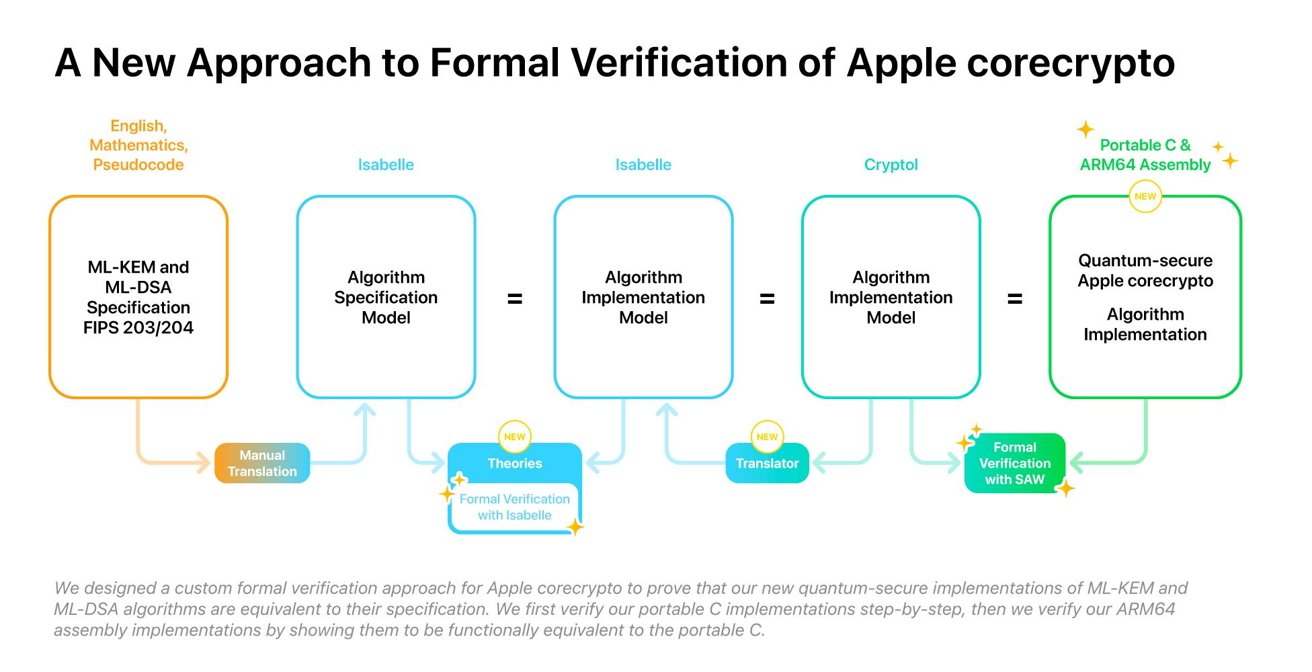
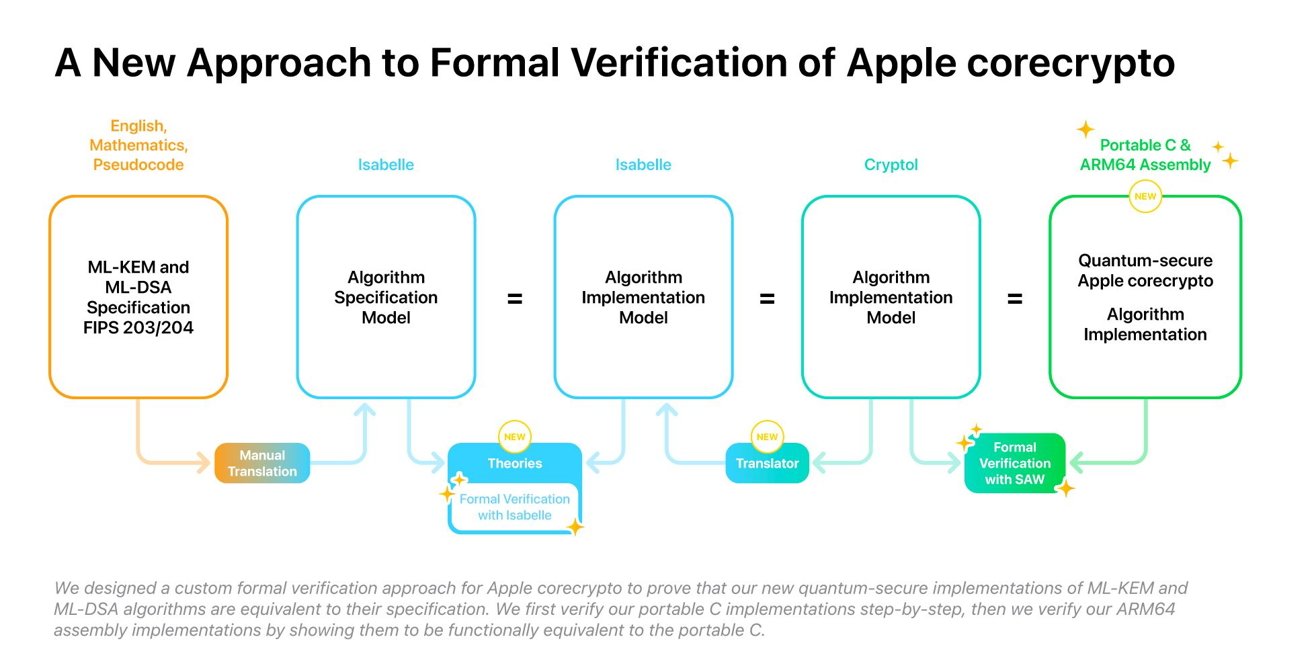
Apple built a custom formal verification system that checks its post-quantum implementations against official NIST specifications. Mathematical proofs also verify that Apple’s ML-KEM and ML-DSA code matches the standards for those algorithms.
Post-quantum protections have already reached iMessage. Apple is also expanding the technology into VPN services, TLS networking, and developer-facing CryptoKit APIs.
Cryptography that will defend against quantum computers is becoming foundational infrastructure inside Apple’s security stack. Security framework, CryptoKit, and CommonCrypto all rely on corecrypto, which gives the library a central role across Apple’s platforms and developer tools.
Apple says mathematical proofs caught bugs traditional testing missed
Formal verification work uncovered flaws that conventional testing missed during development. Engineers found a missing step in an early ML-DSA implementation that could produce incorrect cryptographic output in rare cases.
Advertisement
The research also identified and repaired an error in a third-party proof used during the project.
The missing-step issue could have silently corrupted cryptographic computations without triggering existing test suites. Cryptographic implementation bugs can weaken encryption without producing obvious crashes, warnings, or visible failures.
Corecrypto underpins encryption, hashing, digital signatures, and random number generation across Apple’s platforms. A critical flaw inside the library could affect nearly every app or service that depends on Apple’s security frameworks.
Post-quantum cryptography creates unusual implementation risks compared to older public-key systems. ML-KEM and ML-DSA rely on large polynomial arithmetic and deep mathematical operations that can produce subtle carry and borrow errors.
Advertisement
The paper notes the industry’s limited experience with newer post-quantum algorithms compared to older elliptic curve cryptography systems. Earlier elliptic curve deployments had subtle implementation flaws that later created exploitable vulnerabilities.
Apple verified optimized Apple silicon code
Apple verified optimized production code for Apple Silicon rather than limiting the work to simplified academic models. Formal proofs cover portable C implementations and hand-optimized ARM64 assembly routines designed to improve performance and reduce timing leaks.
Apple verified its quantum-secure ML-KEM and ML-DSA implementations by proving its portable C and ARM64 assembly code matched official specifications.
Post-quantum cryptography increases implementation complexity and expands the attack surface inside heavily optimized code paths. Apple also uses Apple silicon security features including Data Independent Timing, or DIT, and Pointer Authentication, known as PAC, to reduce some of those risks.
DIT reduces timing side-channel leakage, while PAC hardens software against certain memory corruption attacks. Engineers also rewrote sensitive cryptographic routines to gain tighter control over processor behavior during encryption operations.
Apple built a custom verification pipeline with Galois
Apple built a custom workflow combining Isabelle, SAW, Cryptol, and a new Cryptol-to-Isabelle translator developed with security firm Galois. The verification process translates implementations into formal mathematical models.
Advertisement
The resulting proofs required more than 50,000 individual proof steps. Apple also released updated corecrypto source code and several formal verification tools alongside the paper.
Published materials include Isabelle libraries, verification frameworks, ARM64 models, and the Cryptol-to-Isabelle translator used during development.
Formal verification isn’t a complete solution to cryptographic security problems. Apple admitted that it still assumes compiler correctness and that some ML-DSA verification relies on conventional testing due to tooling limitations.
Mathematical verification is becoming crucial as post-quantum cryptography moves into global production systems. Apple is using formal proofs to verify its post-quantum encryption before deploying the technology more broadly across its platforms.
























































You must be logged in to post a comment Login