Connect with us
DAPA Banner

Tech

Scaling AI into production is forcing a rethink of enterprise infrastructure

Published

on

Presented by Nutanix


Across industries, organizations are focused on how to move from AI pilots, proofs of concept, and cloud-based experimentation to deploying it at scale — across real workloads, for real users, in real business environments. VentureBeat spoke with Tarkan Maner, president and chief commercial officer at Nutanix, and Thomas Cornely, EVP of product management, about what that transition demands, and what it will take to get it right.

“AI in general is shifting everything we do, not only in technology, but across all vertical industries, from regulated industries like banking, health care, government, education to non-regulated industries like manufacturing and retail,” Maner said. “As a complete platform company, we welcome this change. It’s creating more opportunities for us as a company to serve our customers in better ways as we move forward.”

But there’s still a practical gap between experimentation and production, Cornely said.

Advertisement

“It’s one thing to do an experiment, to do a prototype. It’s a different thing to take that prototype and deploy it for 10,000 employees,” he explained. “We went from people focusing on training models to chatbots to now doing agents, where the demand and pressures on AI infrastructure are growing exponentially.”

Agentic AI introduces a new layer of enterprise complexity

The rise of agentic AI is what makes this transition especially consequential. These systems introduce multi-step workflows across applications and data sources, along with a degree of autonomy that creates new operational demands.

Enterprises now have to contend with multiple agents running simultaneously, unpredictable and real-time workloads, and the need to coordinate access to infrastructure across teams.

“OpenClaw is making it very easy now for anybody to build agents and run with agents,” Cornely said. “You want those agents to be running on premises with your data. You need to have the right constructs around it to protect the enterprise from what an agent could do.”

Advertisement

As these systems become more autonomous, the challenge extends beyond how they operate to how they interact with enterprise data, systems, and teams.

AI is augmenting human work, not replacing it

Agentic AI is fundamentally an amplifier of human capability rather than a substitute for it, Maner said. The goal for enterprises is not to eliminate human work but to find the right balance between human decision-making, AI-driven automation, and agent-based workflows.

“We believe that there’s going to be love, peace, and harmony between AI, agentic tools, and robotics systems, and human capital,” Maner said. “That harmony can be optimized for better outcomes for businesses, enterprises, governments, and public sector organizations, if the right vendors provide the right tooling and the right services.”

How enterprises are getting started with AI at scale

In practice, the move from experimentation into real-world deployment is where the challenges become most visible. Despite the momentum, many are still working through how to scale AI beyond initial use cases.

Advertisement

As they do, organizations quickly run into practical constraints. Many start in the cloud because of easy access to resources and services, but practical considerations like data, governance and control, and cost quickly come to the forefront.

The cloud can be used to experiment, with the ultimate goal of bringing applications back on premises as they move toward production, using platforms that solve for security and cost.

The use cases gaining the most traction include document search and knowledge retrieval, security and predictive threat detection, software development and coding workflows, and customer support and service operations. In the security realm, banking customers and others in Europe and the U.S. are deploying AI-driven tools including facial recognition and predictive threat detection. Meanwhile, there’s a growing focus on end-to-end, 360-degree customer engagement, from pre-sales through post-sales advocacy, in the customer support industry.

Industry-specific AI transformation is already underway

Across industries, the shift from experimentation to real deployment is already taking shape in distinct ways. In retail, AI is transforming store operations with cameras and robotics used for targeted in-aisle marketing at the moment of purchase decision, while cashier-less checkout is replacing traditional POS systems, and the human capital freed up is being redeployed to back-office and merchandising functions.

Advertisement

In healthcare, Nutanix works with customers on applications spanning diagnosis, treatment, remote health, and hospital operations, with cloud partners including AWS and Azure. In manufacturing and logistics, the transformation is equally significant.

The operational challenges of scaling enterprise AI

As AI use cases scale, enterprises are running into a new class of operational challenges. Managing multiple AI workloads and agents, coordinating infrastructure access across teams, ensuring security and governance, and integrating AI systems with existing business processes are now top-of-mind concerns for IT and business leaders alike.

The gap between AI developers pushing for speed and access, and infrastructure teams responsible for security, uptime, and governance, is one of the defining challenges of this moment.

“Now I’m running agents, and they’re all going to fight to get access to resources to solve my problems,” Cornely said. “What you want now is infrastructure that allows you to set constraints, govern resources.”

Advertisement

The AI factory: a shared platform for production AI

These challenges are driving demand for what Maner and Cornely describe as the AI factory: a shared infrastructure environment that supports multiple users and workloads simultaneously, enabling both experimentation and production while balancing developer agility with enterprise governance.

At GTC 2026, Nutanix announced the Nutanix Agentic AI Solution, a complete platform spanning core infrastructure, Kubernetes-based container services running on a topology-aware hypervisor, and advanced services for building and governing agents.

“We’re launching a complete platform, from core infrastructure through PaaS and advanced PaaS services to the whole management framework for your AI factories,” Cornely said. “Really enabling self-service for the teams that will build these applications in the enterprise.”

Hybrid environments are essential to enterprise AI strategy

Operating this kind of environment requires flexibility across infrastructure. Hybrid infrastructure is not a compromise, but a requirement. Some workloads will always run in the public cloud, while others must remain on premises due to security requirements, regulatory compliance, data sovereignty, or competitive IP considerations.

Advertisement

“Especially in the regulated industries, as sovereignty becomes a bigger issue, data gravity becomes a bigger issue, security, and also a lot of competitive differentiation in the industry, it’s going to depend on what the company wants for their own IP,” Maner said.

This is the foundation of Nutanix’s platform position, he added.

“We are the perfect harmony, bringing those applications, that data, and all the optimization for these use cases end to end, from on-prem to off-prem and in a hybrid mode,” he said. “Doing it not only in one cloud, but for multiple clouds.”

That flexibility also extends to the broader ecosystem. Nutanix works across hyperscalers including AWS, Azure, and Google Cloud, as well as regional service providers and emerging neoclouds. Nutanix offers neoclouds a full software stack to run their own clouds and deliver advanced AI services, giving enterprise customers already running Nutanix a simple extension of compute, networking, and AI capabilities.

Advertisement

Maner described the arrangement as a win for both sides. For enterprises, it means simplified access to hybrid AI services. For neoclouds, it means a proven platform to build on. It’s all automated and secure by default, Cornely added.

“All of those governance problems that now come up with agentic AI are the same problems we’ve been solving for the last 16 years for every other application running in your cloud,” he said.

From pilot to production: operationalizing AI across the enterprise

Ultimately, the goal is not to run a successful AI pilot, but to operationalize AI across real-world use cases, manage infrastructure as a shared resource, support collaboration between infrastructure teams and AI developers, and scale from initial projects to enterprise-wide deployment.

“There’s a massive gap right now between people building AI applications, those AI engineers, those agentic AI developers, and your classical infra teams,” Cornely said. “They need tooling to enable the infra teams, so they can support your AI engineers. That’s what we deliver with our agentic AI solution.”

Advertisement

Sponsored articles are content produced by a company that is either paying for the post or has a business relationship with VentureBeat, and they’re always clearly marked. For more information, contact sales@venturebeat.com.

Source link

Continue Reading
Click to comment

You must be logged in to post a comment Login

Leave a Reply

Tech

Ars Asks: Share your shell and show us your tricked-out terminals!

Published

on

The timer_stop function also has the job of converting the timer into a human-readable format, and it’s probably messier than it needs to be. I’m no developer, though, so this is what Past Lee settled on after a few hours of searching through examples.

Doing it in fish for folks like me

That’s for bash when I’m ssh’d into one of my Linux hosts, but I run fish on MacOS. I have a separate fish function for getting the same results there, complete with gross hacks for turning the measurement into human-readable form. I made this code, and I am unapologetic. Witness my cobbled-together StackOverflow-sourced kludge.

function fish_prompt --description 'Write out the prompt'
    # Save the last status
    set -l last_status $status

    # Calculate the command duration if available
    set -l cmd_duration ""
    if set -q CMD_DURATION
        # Convert milliseconds to microseconds for more precise comparison
        set -l duration_us (math "$CMD_DURATION * 1000")

        # Calculate different time units
        set -l us (math "$duration_us % 1000")
        set -l ms (math "floor($duration_us / 1000) % 1000")
        set -l s (math "floor($duration_us / 1000000) % 60")
        set -l m (math "floor($duration_us / 60000000) % 60")
        set -l h (math "floor($duration_us / 3600000000)")

        # Format duration string
        if test $h -gt 0
            set cmd_duration (string join '' "(" $h "h" $m "m)")
        else if test $m -gt 0
            set cmd_duration (string join '' "(" $m "m" $s "s)")
        else if test $s -ge 10
            set -l fraction (math "floor($ms / 100)")
            set cmd_duration (string join '' "(" $s "." $fraction "s)")
        else if test $s -gt 0
            set cmd_duration (string join '' "(" $s "." (printf "%03d" $ms) "s)")
        else if test $ms -ge 100
            set cmd_duration (string join '' "(" $ms "ms)")
        else if test $ms -gt 0
            set -l fraction (math "floor($us / 100)")
            set cmd_duration (string join '' "(" $ms "." $fraction "ms)")
        else
            set cmd_duration (string join '' "(" $us "us)")
        end
    end

    # Define unicode symbols for status
    set -l checkmark "✓"
    set -l cross "✗"

    # Colors
    set -l normal (set_color normal)
    set -l dark_gray (set_color 555555)
    set -l blue (set_color -o blue)
    set -l red (set_color red)
    set -l green (set_color green)
    set -l purple (set_color -o purple)

    # First line
    echo # New line
    echo -n -s $dark_gray "["(date +%T)"] $last_status " # Time in brackets and exit status

    # Status indicator with exit status
    if test $last_status -eq 0
        echo -n -s $green $checkmark
    else
        echo -n -s $red $cross
    end

    # Actually echo the duration
    echo -n -s $dark_gray " $cmd_duration"

    # Do the rest of the prompt
    echo
    set -l host_color $purple
    echo -n -s $host_color $USER "@" (prompt_hostname) $normal ":" $blue (prompt_pwd) $normal " \$ "
end

A splash of color

Spending my formative years immersed in ANSI BBS graphics has probably made me a little more fond of colorful text in my terminal than the average frumpy, button-downed admin. Look, I know some folks feel that syntax highlighting and colors in general kill comprehension and encourage skimming, but what can I say? I love them and rely on them. Perhaps I skim too much, but so be it. You can take my colorful shell tools from my cold, dead hands.

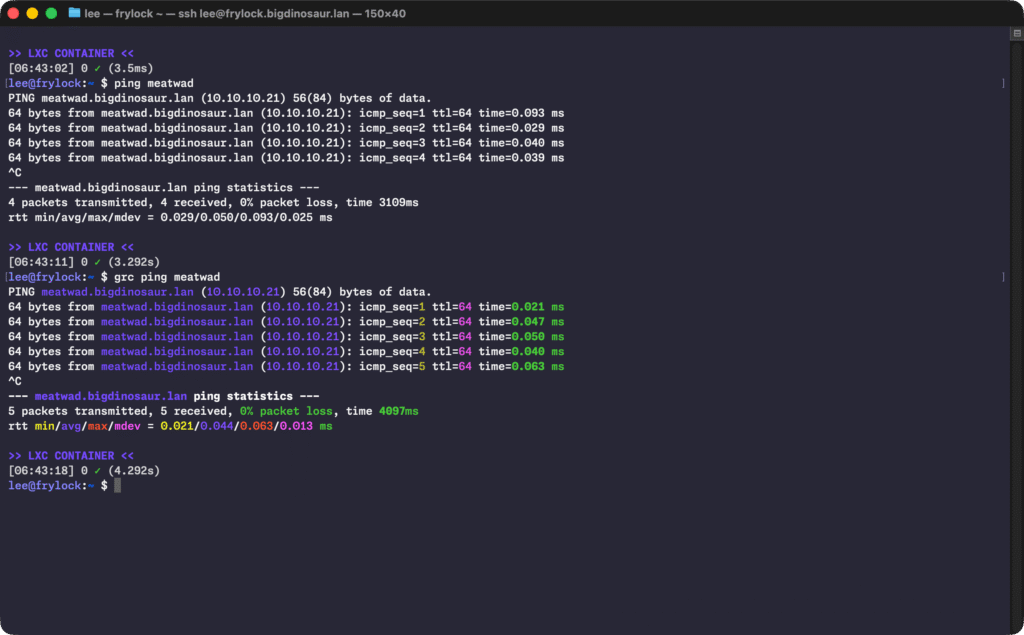
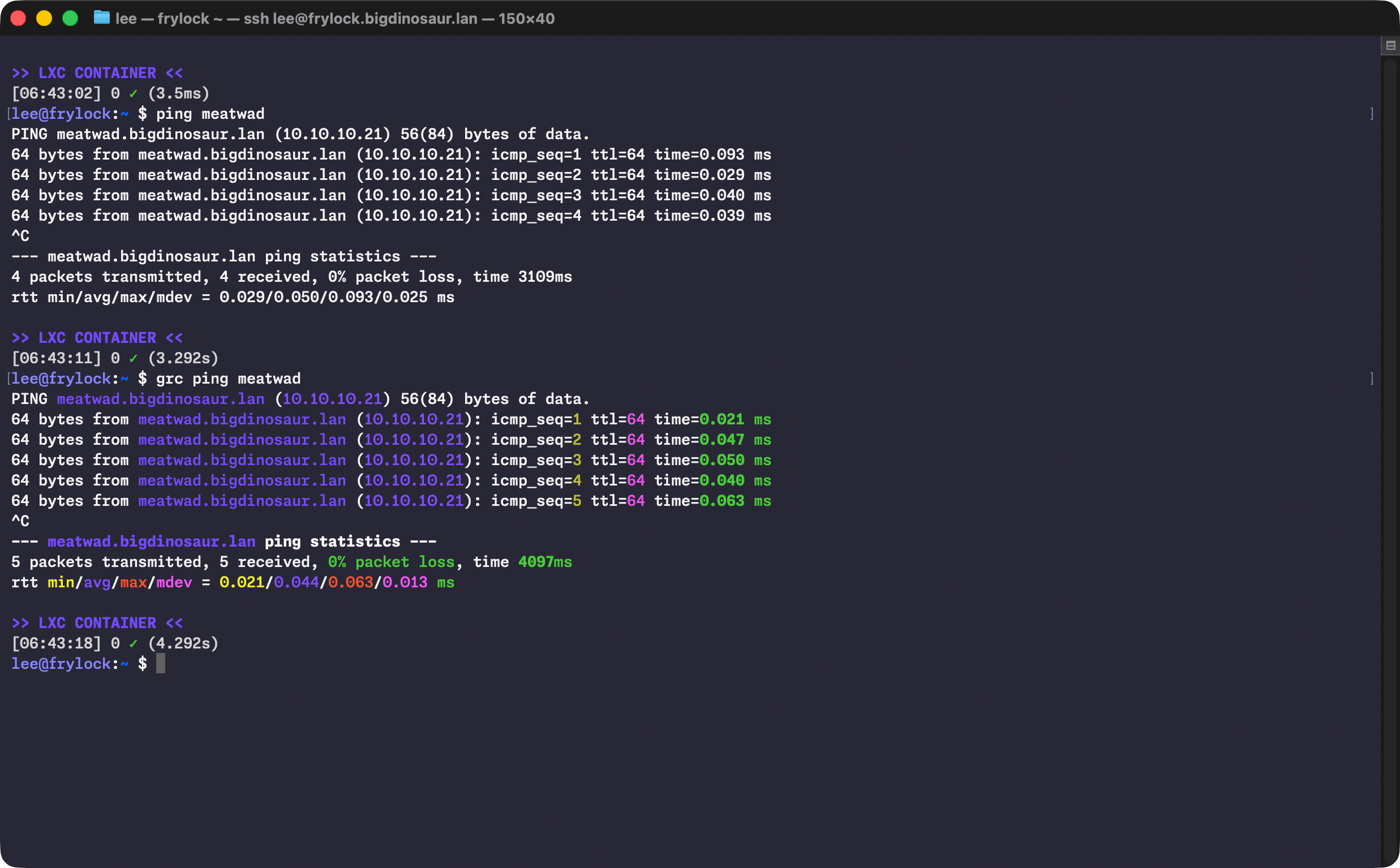
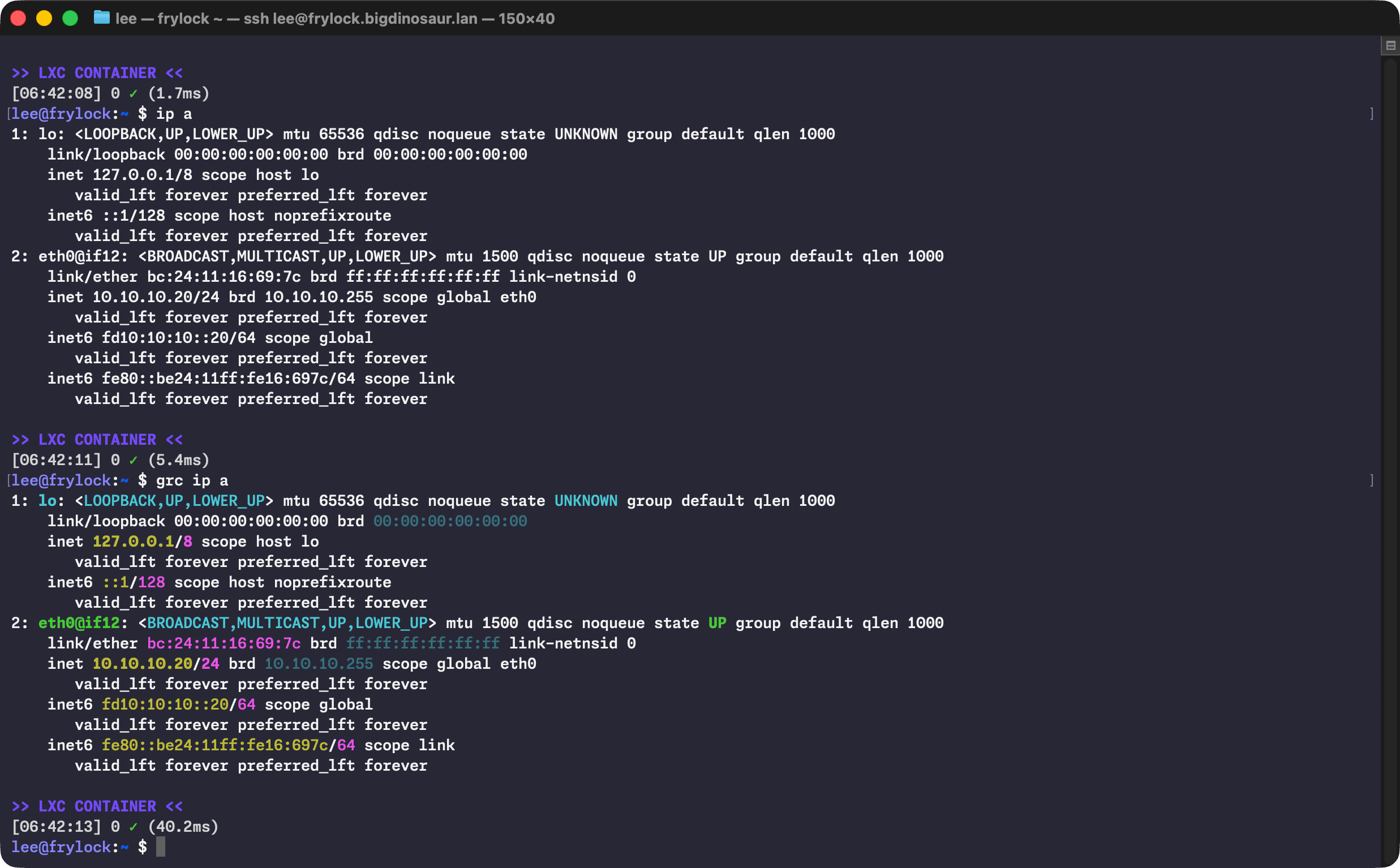
To that end, I lean on a little program called GRC (for Generic Colorizer) to add highlighting and coloration to other tools. It’s broadly available and works without any additional configuration.

Advertisement

Image showing the before and after of using GRC with ping
Nothing wrong with a little color!

Lee Hutchinson

Advertisement
Advertisement

There’s a bit of aliasing (which I keep in .bash_aliases like a good citizen) to make colorful output the defaults on some common commands:

    alias ls="ls --color=auto"
    alias ll="ls -AlFh --group-directories-first"
    alias df="grc df -h"
    alias du='grc du -h'
    alias free="grc free -h"
    alias ping='grc ping'
    alias traceroute="grc traceroute"
    alias ip='grc ip'

I’m also a big fan of making my numbers human-readable, and the -h switch is therefore applied liberally.

Advertisement

(Do note that wrapping commands like ip in GRC can sometimes do weird things if you’re piping its output into something else. Use caution. Or don’t! It’s your computer, knock yourself out!)

The terminal itself

Sharp-eyed readers will note from the screenshots that I’m using MacOS’s Terminal.app for my terminal program, despite there being far better options. I suppose the excuse I have is that I’m comfy with Terminal.app and nothing has pulled me off of it. I’ve test-driven the usual suspects—Ghostty, Alacritty, the mighty iTerm2 with its awesome tmux windowing integration, and even fancy new reinterpretations of the terminal experience like Warp.

Source link

Advertisement
Continue Reading

Tech

DAEMON Tools devs confirm breach, release malware-free version

Published

on

Daemon Tools

Disc Soft Limited, the maker of DAEMON Tools Lite, confirmed that the software had been trojanized in a supply chain attack and released a new, malware-free version.

In a statement published earlier today, Disc Soft says it has secured its infrastructure. Still, it has yet to attribute the attack to a specific threat actor or share additional information about the breach, including the attack vector used to access its systems, as it continues to investigate the incident.

“Following an internal investigation, we identified unauthorized interference within our infrastructure. As a result, certain installation packages were impacted within our build environment and were released in a compromised state. Version 12.6 of DAEMON Tools Lite, which does not contain the suspected compromised files, was released on May 5.” the company said.

“Users of other DAEMON Tools products, including paid versions of DAEMON Tools Lite, DAEMON Tools Ultra, and DAEMON Tools Pro are not affected by this incident and can continue using their software as usual.”

Advertisement

Users who downloaded or installed DAEMON Tools Lite version 12.5.1 (free) since April 8 are advised to uninstall the app, run a full system scan using security or antivirus software, and install the latest version of DAEMON Tools Lite (12.6) from the official website.

Disc Soft has removed the trojanized version, which is no longer supported, and now displays a warning prompting users to install the latest version of DAEMON Tools Lite.

As cybersecurity company Kaspersky revealed on Tuesday, hackers trojanized DAEMON Tools Lite installers and used them to backdoor thousands of systems from more than 100 countries that downloaded the software from the official website since April 8.

After the unsuspecting users executed the digitally signed trojanized installers (versions ranging from 12.5.0.2421 to 12.5.0.2434), the malicious code embedded in the compromised binaries deployed a payload designed to establish persistence and activate a backdoor on system startup.

Advertisement

The first-stage malware dropped in the attack was a basic information stealer that collected system data (including hostname, MAC address, running processes, installed software, and system locale) and sent it to attacker-controlled servers for victim profiling. Based on the results, some of the infected systems received a second stage, a lightweight backdoor that can execute commands, download files, and run code directly in memory.

In at least one case, Kaspersky observed the deployment of a QUIC RAT malware, which can inject malicious code into legitimate processes and supports multiple communication protocols.

While investigating the attack, Kaspersky found that retail, scientific, government, and manufacturing organizations in Russia, Belarus, and Thailand, as well as home users in Russia, Brazil, Turkey, Spain, Germany, France, Italy, and China, were among the victims whose devices were infected with malicious payloads.

Today, in an update to the original report, the Russian cybersecurity company confirmed that DAEMON Tools Lite 12.6.0, released yesterday, no longer exhibits malicious behavior.

Advertisement

“Following disclosure, the vendor acknowledged the issue and published a new version of the software to address it,” Kaspersky said. “The updated DAEMON Tools version 12.6.0.2445 no longer shows the malicious behavior.”

BleepingComputer contacted Disc Soft several times regarding the incident, but we have not yet received a response.


article image

AI chained four zero-days into one exploit that bypassed both renderer and OS sandboxes. A wave of new exploits is coming.

At the Autonomous Validation Summit (May 12 & 14), see how autonomous, context-rich validation finds what’s exploitable, proves controls hold, and closes the remediation loop.

Claim Your Spot

Source link

Advertisement
Continue Reading

Tech

In the flexible work era, how can we make the most of co-working spaces?

Published

on

Zihan Wang of the University of Sussex offers advice to professionals who want to maximise their time in shared spaces.

Co-working spaces have become a familiar part of the working landscape. A convenient alternative to working from home or an employer’s office, they have become the favoured option of millions of the world’s freelancers, entrepreneurs and remote workers.

In the UK, there are over 4,000 co-working venues to choose from. Prices vary, depending on location and facilities, but with a dedicated desk costing around £200 per month, it’s worth knowing how to make the most of what these spaces offer.

So how do you choose the right co-working space for you? And how do you get the maximum benefit? Here are four practical tips to consider:

Advertisement

Identify your needs

Not all co-working spaces serve the same purpose. Some people are simply looking for a quiet desk outside the home, while others want a social environment where they can meet people, exchange ideas and build connections.

Being clear about what you want, whether it’s productivity, networking opportunities or skill development, is the first step.

Smaller, independently run spaces often place greater emphasis on community building, with managers who organise regular informal events such as ‘lunch and learn’ sessions or workshops. These environments can create more opportunities for social interaction and learning.

By contrast, larger corporate-style spaces may offer more polished facilities and business services, but with fewer opportunities for facilitated interaction. Choosing the right co-working environment means considering the type of space and how you plan to use it.

Advertisement

Give it a try

Co-working spaces are often advertised as being open and inclusive. But research I worked on with colleagues shows that experiences can vary depending on factors such as age, gender or professional background.

Some spaces will probably feel more welcoming than others, particularly ones where equality, diversity and inclusion are a deliberate part of their design and ethos.

Many spaces are now also set up with specific groups in mind. For example, some cater to female entrepreneurs, while others offer tailored support for neurodivergent workers.

Before committing, it’s worth visiting a space, attending an event, or trying a short-term pass (for a couple of days or a week) to see whether it feels like a good fit.

Advertisement

It’s more than a desk

It’s easy to treat co-working spaces as simply a place to work. But research suggests much of its value lies in the connections, community and everyday interactions it makes possible.

Casual conversations in the kitchen or spontaneous exchanges over lunch can help build communication skills, expand professional networks and spark new collaborations. Evidence suggests that these benefits tend to be particularly strong for those who are newer to a city, earlier in their careers, or working independently. They may have less established local networks or fewer everyday opportunities for office-based interaction, making them more likely to seek out social connections within co-working spaces.

If you only show up, put your headphones while you work and then leave, you may miss out on some of the main advantages of co-working – the opportunity to connect with others and become part of a community. Making the most of these spaces often means being willing to take that first step, engage with others and gradually find your own circle.

Take advantage

If your work involves specialised tools, digital technology or continuous skill development, you may need more than just Wi-Fi and coffee from a co-working space.

Advertisement

Many now offer access to specialist software and cutting-edge equipment such as 3D printers or virtual reality devices, which can be costly or difficult to access by yourself.

Some go a step further and organise workshops and training sessions, or even events that reflect the latest developments in a particular field. These resources can be particularly valuable for independent workers including freelancers and the self-employed, who may not have access to structured on-the-job training through an employer.

Using them can help you build practical, up-to-date technical and digital skills, especially as new technologies and AI continue to reshape the skills demanded in many industries. So don’t overlook what’s on offer, whether it’s a workshop, a new tool, or a piece of equipment. Making use of these opportunities can help you stay adaptable, keep learning and be better prepared for what comes next.

Overall then, co-working spaces can offer valuable opportunities to learn new skills, build networks and adapt to changing ways of working. But these benefits are not automatic and they are not the same for everyone.

Advertisement

Getting the most out of co-working often depends on how you use the space and whether it matches your needs. At its best, co-working is not just about renting a desk, but about finding an environment where you can connect, learn and grow.

The Conversation

By Zihan Wang

Zihan Wang is a research fellow in geography and innovation at the University of Sussex. Her research examines skills as a core regional capability shaping innovation, productivity, labour market dynamics, and structural transformation. Using large-scale quantitative data including online job postings, LinkedIn data, and questionnaires, she investigates how skills are developed, deployed, and transformed across places. With a sectoral focus on manufacturing and the creative industries, she aims to bridge theoretical analysis and policy development, particularly in informing place-based skills policy and industrial strategy.

Don’t miss out on the knowledge you need to succeed. Sign up for the Daily Brief, Silicon Republic’s digest of need-to-know sci-tech news.

Advertisement

Source link

Continue Reading

Tech

Nvidia partners with Corning to build the fiber optic backbone for next-gen AI data centers

Published

on


Nvidia said the deal will expand Corning’s US-based optical connectivity manufacturing capacity tenfold and boost its domestic fiber production capacity by more than 50%. Collectively, the new facilities will create north of 3,000 high-paying jobs, we are told. Financial terms of the agreement were not disclosed, nor was a timeline…
Read Entire Article
Source link

Continue Reading

Tech

Google Search updates hope to turn AI answers into a starting point for you, not a dead end

Published

on

Google’s AI-powered Search features have fundamentally changed how we look stuff up. Instead of scrolling through the search results, most of us now just read the AI Overview and move on. Google wants to change that. The company is rolling out five updates to AI Mode and AI Overviews designed to surface more links and give users more reasons to click through to the websites behind them.

Further Exploration and inline links

The most notable addition is Further Exploration, a new section that appears at the end of AI Overviews with curated links to specific articles, case studies, or reports related to the query. For example, Google says if you search for how cities have added green space, you might see links to a stream restoration project in Seoul or a report on how architects designed New York’s High Line park. This should give users a reason to keep exploring instead of closing the tab after reading the overview.

Google is also placing more links directly within AI responses, next to the relevant text, rather than grouped at the bottom. The company explains that searching for a California bike trip, for instance, might surface a link to a Pacific Coast touring guide next to a bullet point about terrain, and a training blog post next to a bullet point about daily mileage. This will give users a more direct path from the AI answer to the source material behind it.

On desktop, hovering over any inline link will trigger a preview showing the website name and page title, which is aimed at giving users more confidence about visiting the website. Google’s internal testing found that users were more hesitant to follow links when they could not tell where they led, so the preview removes that friction before the click.

Subscriptions and community perspectives

AI Mode and AI Overviews will now label links from a user’s active news subscriptions so they stand out in results. Google says early testing showed users were significantly more likely to click those labeled links. For subscribers, it means the publications they already pay for will be easier to find inside AI search results rather than buried below them.

AI responses will also begin surfacing previews of perspectives from public forums, like Reddit, social media, and firsthand sources, with added context like a creator’s handle or community name.

A search about photographing the northern lights, for example, might surface tips from a specific photography forum, with a link to the full discussion thread. Thanks to this, users who want real-world advice rather than a synthesized summary will have a clearer path to the people who have actually been there.

The bigger picture

These updates also carry real stakes for publishers. AI Overviews have raised concerns across the media industry about declining referral traffic, and these features are Google’s most direct attempt yet to show that AI search and the open web can coexist. Whether they move the needle on click-through rates will be worth watching.

Advertisement

AI Overview accuracy, however, remains an open question. It has a history of confidently stating wrong information, and the featured image for this story is a reminder of that: it misidentifies today’s date as May 20, 2025. Getting users to click through to publishers may be a step in the right direction, but it’s hard to fully trust a guide that does not always know what day it is.

Source link

Advertisement
Continue Reading

Tech

iPod Nano Runs a Triple-Screen Desk Setup That Actually Delivers

Published

on

Apple iPod Nano Triple Screen Desk Workstation
Sixteen years after Apple discontinued production, a single 6th-generation iPod Nano currently stands in the center of a full workstation with three separate displays. The device, released in 2010 as the final iPod model Steve Jobs introduced, handles music playback, photo slideshows across every screen, and crystal-clear voice recordings all at once. A YouTube creator who runs the Will It Work? channel took on the challenge of stretching this tiny player into something far more capable.


He started by removing the built-in 30-pin connector and the touchscreen, which still works great after all these years. From there, it was simply a matter of converting this music player into a true multi-screen media center utilizing whatever parts were readily accessible. The entire operation is based on a 30-pin Apple keyboard dock that was originally designed for larger, more serious devices. He had to design a unique spacer to fit the iPod’s clip while yet leaving the audio jack accessible. The next stage was to connect composite video cables directly from the dock to three Sharp Aquos flat panels, which have been available since 2003. Those older monitors can be placed side by side without creating delay or without any additional software.


AGPTEK 64GB MP3 Player with Bluetooth, M3 2.4 inch Music Player with Speaker and FM Radio, Touch Buttons…
  • 【64GB BUILT-IN LARGE STORAGE CAPACITY】Different from other large memory MP3 players on the market, the AGPTEK M3 boasts an impressive 64GB of…
  • 【Bluetooth 5.3 & Automatic Reconnection】AGPTEK M3 MP3 music player adopts Bluetooth 5.3 technology, more stable connection, better compatibility…
  • 【HiFi Lossless Sound & Sports Partner】 With a professional audio decoding chip and smart noise reduction chip, AGPTEK MP3 player brings you…

Apple iPod Nano Triple Screen Desk Workstation
The audio is then split via a 3.5mm four-pole TRRS jack, with one path sending a signal to a desktop mic, which does a nice job of capturing voice memos that sound like they were recorded with a modern podcast setup. The other channel connects to a set of Apple Pro speakers that fill the room well. The powered stylus lets you glide across the iPod screen without leaving smudges. A double tap on the sleep button progresses to the next song. Tapping the arrow buttons moves you through the slideshow, while pressing pause stops both the music and the images dead in their tracks.

Apple iPod Nano Triple Screen Desk Workstation
Even the clock works properly thanks to a simple Lightning adapter that simply connects to the dock’s USB port and syncs with the iPod without interfering with the audio or video streams. The entire operation runs smoothly and completes its objectives. Try the Voice Memos app, and the external microphone does a decent job of picking up your speech and playing it back clearly.
[Source]

Advertisement


Author
Jackson Chung

A technology, gadget and video game enthusiast that loves covering the latest industry news. Favorite trade show? Mobile World Congress in Barcelona.

Advertisement

Source link

Advertisement
Continue Reading

Tech

Tinder owner Match Group is slowing hiring to pay for its increased use of AI tools

Published

on

You might think the big story out of Match Group’s first-quarter earnings is Tinder’s turnaround. The dating app’s revenue is slightly up again after quarter-after-quarter of declines.

But we’d like to point to a comment the chief financial officer made about how the company is slowing its hiring right now because it needs more money to pay for AI tools for its employees.

Ah, yes, the good ol’ “let’s blame AI” strategy!

While speaking to analysts on the first-quarter earnings call, Match Group CFO Steven Bailey talked about how the dating app giant was investing in AI technology for internal use at the company — as well as how Match was paying for it.

Advertisement

“We’re making a big push around AI enablement. We’re giving every employee in the company access to all the cutting-edge tools. We’re giving them the training they need to succeed. We’re setting expectations. We really want to become an AI-native company,” Bailey said.

“We think it’s a huge opportunity. But these tools cost a lot of money, as I’m sure you know, and so the way we’re helping to pay for that is by slowing our hiring plans for the rest of the year,” he added.

The company assured investors that the impact would be cost-neutral, as the slowed hiring and lower headcount would make up for the increased software expenses. Plus, Match Group is betting that the increased productivity from employees’ use of AI will ultimately increase revenue growth, the number-cruncher explained.

While on the surface, this looks like another example of AI taking people’s jobs — in this case, forcing a company to lower its number of open positions — there’s likely more nuance to this story.

Advertisement

Let’s keep in mind that Match Group’s flagship app, Tinder, has been struggling in recent years. This quarter may be the start of a turnaround, as monthly active users declined by 7% in March compared with the far-steeper 10% drop a year ago. Tinder registrations also grew for the first time since 2024, but by a mere 1%, as Bloomberg pointed out.

This is perhaps a positive sign for Tinder. Or it might be a brief blip driven by users’ curiosity around various product improvements and new features, like IRL events. Time will tell.

Dating meets a generational shift

Match Group remains a company that has to work to squeeze more money out of an oft-dwindling, less active user base — which, to the company’s credit, it did exactly that. Match’s revenue was $864 million in the first quarter, up 4% year-over-year. However, its next-quarter estimates are coming in lower — around $850-$860 million, down 2% to flat year-over-year.

All these struggles come after many months of what appears to be a growing disinterest in the use of dating apps by younger people. This generational shift sees people opting to meet up in real-life, perhaps by pursuing an interest, like running, book clubs, or a hobby that connects them with other people, which then, in turn, expands their network, increasing their chance of meeting someone new.

Advertisement

The trend coincides with a resurgence of nostalgic tech, like digital cameras, flip phones, boomboxes, and even landlines, signaling a generation that’s feeling burned out by always-on connectivity and looking for analog pleasures.

Match Group is aware of this significant shift and says it’s pivoting to address the challenge by increasing the number of its own IRL events.

“Gen Z desperately wants to connect. They know they want to meet new people. They just want to do it in a low-pressure, low-stakes way that doesn’t feel like a job interview,” Match’s CFO Rascoff told investors on the call. “Traditional dating apps are very highly structured and can be intimidating to a user under 30. So, I think the growth of these alternative ways to meet new people speaks to how Gen Z is trying to find lower-pressure ways to connect.”

“We’ve obviously adapted our roadmap to this reality,” he said.

Advertisement

When you purchase through links in our articles, we may earn a small commission. This doesn’t affect our editorial independence.

Source link

Continue Reading

Tech

ISTE+ASCD Names 2026-27 Voices of Change Fellows

Published

on

Bringing Voice to the Future of Learning

In the coming months, each fellow will produce a series of first-person essays, articles and videos. Their work will help readers understand how classrooms and school systems must adapt to our rapidly shifting digital landscape. Some of the questions fellows will explore:

  • How are you and/or your school community using technology or AI tools to support educator and student well-being — and what practices ensure those tools are used responsibly and equitably?
  • How do you and/or your school community leverage data, learning science, or AI-driven insights to design instructional strategies and assessments that help diverse learners succeed?
  • How do you and/or your school support students and educators in developing the digital citizenship and media literacy skills needed to critically and responsibly engage with AI and emerging technologies?

Celebrating Our Legacy

As we welcome this new group, I’d like to extend a sincere thank you to our 2025-26 cohort — April Jackson, Dan Clark, Melinda Medina, Nikita Khetan, Patrice Wade and Sofia Gonzalez. Their stories on mental health, engagement and changing school dynamics underscored a core truth: teaching must evolve alongside how students learn in the age of AI.

As our team embarks on this journey with the 2026-27 fellows, I hope you enjoy their dispatches from the field. You can follow their stories across our publications, primarily on EdSurge – the digital news site of ISTE+ASCD. We invite you to join us in meeting this moment with curiosity and a commitment to building the classrooms our students and teachers deserve.

Source link

Advertisement
Continue Reading

Tech

Mindtrip’s AI Flight Agent Wants to Solve the Messy Travel Plans Search Engines Can’t

Published

on

Over the weekend, I spent hours searching for flights for a summer girls’ trip and came up empty. Every option was either too expensive, landed at the wrong time or had two stops on the way — which I’m absolutely not doing. I checked multiple airlines, pieced together routes and even considered separate tickets. Nothing worked.

That kind of frustration is exactly what Mindtrip is betting on.

The AI-powered travel platform is launching a new flights feature designed for the kinds of messy, real-world searches that traditional booking tools struggle to handle. Instead of optimizing for simple routes, Mindtrip is focused on the complicated scenarios travelers actually face, where flexibility, preferences and trade-offs all collide.

Advertisement

Read also: Google’s New Travel Features Are Here in Time for Summer

Mindtrip AI planning and how it works

Mindtrip already combines conversational trip planning with a visual interface that pulls in maps, reviews and itineraries. With flights, it is extending that system into one of the most time-consuming parts of travel planning.

AI Atlas

In a virtual demo with CEO Andy Moss and product VP Abby West, the company positioned its approach as less about speed and more about reasoning. The goal is not just to return results quickly, but to think through constraints the way a real traveler would.

That shift is showing up in how people actually search, too. According to West, many people do not start with a fixed destination. Instead, they describe a set of conditions. For instance, they might want somewhere warm within a four-hour nonstop flight, or they’ll ask when they can get to Paris within a certain budget.

Advertisement

Those kinds of queries are difficult to execute manually. They require checking multiple destinations, comparing dates and factoring in seasonality. 

Mindtrip’s system treats them as a single problem. It samples across routes and timeframes, weighs constraints and returns a short list of options that fit.

“We’ve very much always focused on the full connected trip — how you plan everything you need around a vacation, from flights to hotels, to things to do, restaurants, anything,” Moss said. 

“The use case that Mindtrip flights is really focused on is the more complicated travel cases.”

Advertisement

In one demo, West searched for a trip from Washington, DC, to Los Angeles, with a long list of conditions. The trip needed to be four nights in June, return by a specific date, depart before 9 a.m., exclude a nearby airport and include a carry-on. Instead of forcing those filters into a rigid form, the system broke the request into parts, evaluated multiple airport combinations and surfaced a set of tailored itineraries.

Each result came with a short explanation of why it matched the request. From there, West could move directly into checkout to book her tickets.

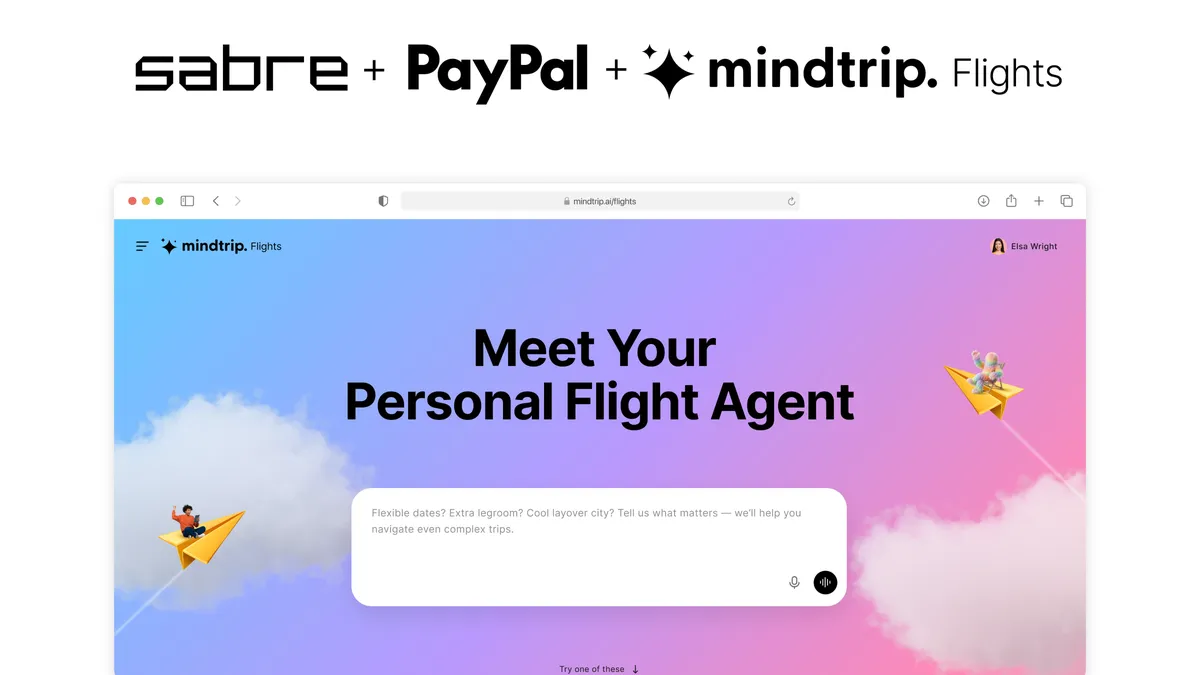
Mindtrip interface of its new flights booking feature

The goal of Mindtrip is not just to return results quickly, but to think through constraints the way a real traveler would.

Advertisement

Mindtrip

Tailoring trips to you 

The level of personalization depends on what Moss describes as “practical data,” not invasive tracking. The system can account for things like preferred airlines or whether someone prioritizes nonstop routes. It can also adapt to context, such as traveling with family versus traveling solo and then adjust recommendations accordingly.

“I do think you’re going to have a personal assistant [in the future]. I do think you’re going to have expert assistants that are really good at flights or hotels and those two things will work together and you’re just going to basically have a sort of situation where it’s almost like Jarvis from Iron Man combined with Her [to create an AI assistant] that knows you really well and understands you,” Moss said.

Flights also required a deeper level of infrastructure than other parts of the platform. Mindtrip partnered with Sabre to access global pricing and availability, and with PayPal to power checkout and buy-now-pay-later options. At launch, PayPal is offering a roughly $50 credit on qualifying bookings over $250, a small but notable incentive in a currently expensive travel market.

How Mindtrip is different from the crowd 

Mindtrip is not trying to replace tools built for quick, straightforward searches. Moss is clear that if someone wants a simple one-way flight, existing platforms like Google Flights already do that well. The focus here is on more complicated cases, where planning becomes time-intensive and fragmented.

Advertisement

That focus reflects a broader shift in how AI is being used. Instead of instant answers, companies are leaning into systems that take longer but handle more complexity. Moss believes that travelers are willing to wait for better outputs if it saves them significant time in return.

The same approach is expected to expand beyond flights. Mindtrip is already applying similar agent-driven logic to hotels and is working toward a more connected experience across booking, itineraries and in-trip planning. Over time, that could include more automated checkout flows as people grow more comfortable with letting AI handle multi-step transactions.

Even as airfares rise and the travel landscape shifts, demand has held steady. Moss sees that as a sign that planning tools will only become more important. “I don’t think there’s ever a time when people have needed to travel more,” he said. 

The challenge is not convincing people to travel, but helping them navigate an increasingly complicated, pricey system. After my own failed flight search, that pitch feels all too familiar. The problem isn’t a lack of options; it’s the effort required to sort through them.

Advertisement

For more travel advice, here’s the best time to shop for airline tickets and how to find cheap flights.

Source link

Advertisement
Continue Reading

Tech

All your M&A questions will be answered at Disrupt 2026

Published

on

The year keeps moving swiftly, and so is all of our planning for TechCrunch Disrupt 2026! We have an exciting new panel in store for founders in need of merger and acquisition advice … but first, we have a limited-time ticket offer to share.

Disrupt will once again be held in San Francisco’s Moscone West from October 13–15, and for a limited time, attendees can also bring a colleague, co-founder, investor, or teammate for less! You can buy one Disrupt 2026 pass here, and get 50% off a second pass of the same ticket type with a limited-time offer that ends May 8 at 11:59 p.m. PT.

As for the kind of programming that’ll keep you locked in during Disrupt’s three days, let’s dive into our newest panel that will be on the Builders Stage.

TechCrunch Disrupt 2026 Karl Alomar, Lindsey Mignano, Aklil Ibssa
Image Credits:TechCrunch

Hear at Disrupt how M&A is now an early-stage strategy

If you’ve been following our recent coverage, acquisitions and acqui-hires remain in vogue, especially within the AI scene. Whether it’s OpenAI buying Hiro, Anthropic acquiring Vercept, Google taking the team behind Hume AI, or Databricks pulling in two startups just for its security product, it’s been a busy year!

And being acquired is far from being the end of a long road for founders; it can be part of their early-stage journey. And with those, and many other acquisitions in mind, we’ve gathered an expert panel to help equip founders with what they need to know about all the M&A options that lie before them.

Advertisement

Their perspectives will equip you with a playbook for creating optionality for potentially selling, ways to make your startup more enticing to buyers, and the realities of going through the acquisition process. And for some background on our panel, let’s learn more about our industry leaders.

Aklil Ibssa, Head of Corporate Development and M&A, Coinbase

Image Credits:Coinbase

Aklil Ibssa brings a buyer-side perspective from one of the biggest companies in crypto, as he leads the company’s acquisition strategy and execution, helping identify where Coinbase should buy, invest, partner, or build. He’s overseen more than 14 acquisitions and nearly 50 early- and later-stage investments, and as one of the first hires on Coinbase’s corporate development team, he contributed to an M&A program that’s become among the most active in crypto, with more than 40 total completed acquisitions.

Techcrunch event

San Francisco, CA
|
October 13-15, 2026

Advertisement

Most importantly for founders, he’s seen firsthand how strategic buyers evaluate young companies: whether for technology, talent, licenses, product velocity, and beyond. And he’ll be able to speak to acquisitions, including Deribit, Liquifi, and Echo, and prominent investments in startups like Kalshi.

Lindsey Mignano, Founder, Mignano Law Group

Image Credits:S72 Business Portraits

Lindsey Mignano brings the legal and structural expertise that often determines whether an early-stage M&A deal can actually get to the finish line. As founder of Mignano Law Group, she represents emerging technology companies, SMEs, venture-backed startups, and venture firms as outside general counsel. Her practice spans everything from SAFE notes, priced rounds, and bridge financings to buy-side and sell-side acquisitions, acqui-hires, and everything else you can bring to mind.

That uniquely equips her to educate founders without insight into how early M&A readiness can begin. Many of her clients are seed through Series B companies, including enterprise SaaS, PaaS, and AI startups — exactly the kinds of companies now facing strategic interest, and she’ll be able to ground the conversation in the realities of cap tables, contracts, asset sales, and the necessary work for acquisitions to happen.

Karl Alomar, Managing Partner, M13

Image Credits:Tanya Gillogley

Now it’s time for an investor and operator to join the conversation. As managing partner at M13, Karl Alomar backs seed and Series A software founders across infrastructure, fintech, developer productivity, and other categories, feeling the brunt of the AI revolution. He has intimate knowledge of the earliest strategic decisions founders make: when to raise, when to partner, when to accelerate growth, and when an acquisition path may create the best outcome for the company, team, and investors.

As COO of DigitalOcean, Alomar helped build the cloud infrastructure company from its first product to roughly $250 million in ARR and an eventual NYSE IPO, with its valuation peaking around $15 billion. But as a founder, he’s been a part of the acquisition cycle too. China Export Finance grew to approximately $140 million in revenue before being acquired in 2010, and Clearview Networks was acquired in 2000. That combination gives Karl a nuanced perspective on the core question facing founders in the audience: When should they keep building with their team, and when is M&A the right path forward?

Advertisement

Get your second pass at 50% off by May 8

And remember: If you register for Disrupt 2026 by May 8 at 11:59 p.m. PT, you can take advantage of that offer to get your pass with savings of up to $410, and get 50% off a second pass of the same ticket type. All the insights Disrupt offers are best shared with a partner or colleague, so don’t miss this opportunity!

TechCrunch Disrupt 2024 Aravind Srinivas
Image Credits:Kimberly White / Getty Images

When you purchase through links in our articles, we may earn a small commission. This doesn’t affect our editorial independence.

Source link

Continue Reading

Trending

Copyright © 2025