Connect with us
DAPA Banner
DAPA Coin
DAPA
COIN PAYMENT ASSET
PRIVACY · BLOCKDAG · HOMOMORPHIC ENCRYPTION · RUST
ElGamal Encrypted MINE DAPA
🚫 GENESIS SOLD OUT
DAPAPAY COMING

Tech

Wayland Comes To Minecraft | Hackaday

Published

on

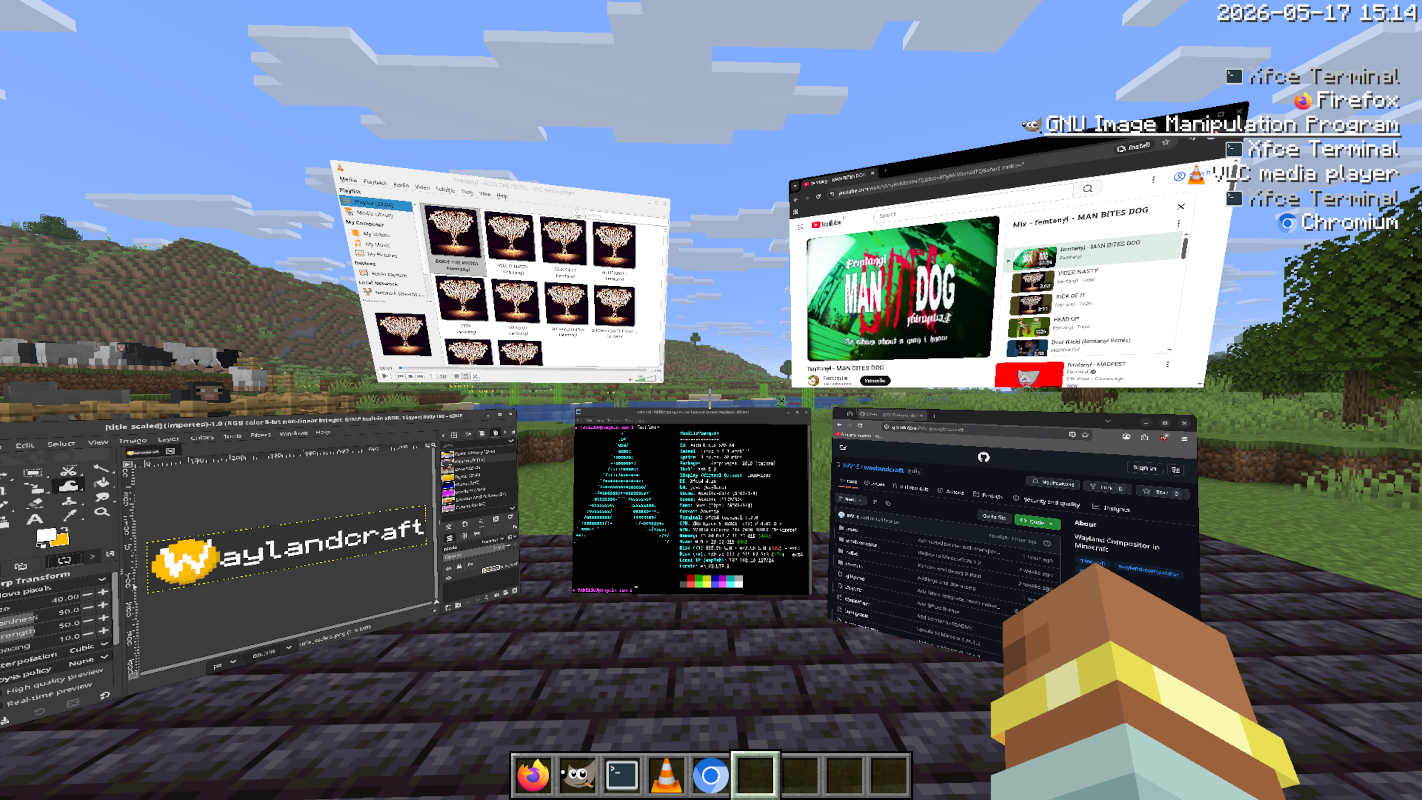
The overall adoption and implementation of Wayland — intended as a replacement for the decades-old X11 windowing system — in the Linux world has been full of fits and starts. But perhaps the most surprising adopter we’ve seen yet is this Minecraft patch which brings a full Wayland compositor into the game.

This software project, called Waylandcraft, is the brainchild of a developer known as [EVVIE] who spent a considerable amount of time and effort getting this to work. According to a post on GamingOnLinux it was also done the old fashioned way, with no AI involved.

Users wanting to run this compositor need a Linux system to run Minecraft, as well as the Fabric mod loader and a few other tools. For those wishing to show off to their friends, though, they’ll need to do so in-person as streaming the Wayland windows to other users in the server is not possible.

Advertisement

With everything running, you’ll be able to launch arbitrary programs and have the windows placed within the Minecraft world as if they were in-game. Users can place the windows in any orientation and can interact with them like any other desktop environment. [EVVIE] has released all of the code under the GPL for anyone wanting to try it out or build on the project itself.

If you haven’t spun up a Minecraft server at all yet, all you really need is something like an ESP32 to get started.

Advertisement

Source link

Continue Reading
Click to comment

You must be logged in to post a comment Login

Leave a Reply

Tech

Transforming Lamp Built With LED Filaments

Published

on

[Nick Electronics] had an idea to build a stylish lamp that could transform its shape while lit. This goal was achieved beautifully with the aid of many, many filament LEDs.

If you’re unfamiliar with filament LEDs, they’re basically thin plastic filaments stuffed with lots of individual LEDs that are very close together. This effectively creates a continuous, flexible, glowing string that can be used for all sorts of creative purposes.

[Nick] packed the lights into an interlocking stack of PCBs that make up the lamp’s structure. Each PCB layer hosts four filaments mounted around the outer edge, and has a pin that locks into a groove in the next layer to allow them to tug each other around as they turn. The PCBs rotate around a central shaft, with power passed from one to the other via interlinking wires. Drive is via a stepper motor on top of the lamp, controlled by an A4988 driver. There’s also an ATmega48 microcontroller onboard, which is the brains of the operation. A DC-DC converter onboard steps up the 5 V input voltage from USB-C to 10 volts for the stepper motor.

Advertisement

It’s neat to watch the lamp in action, glowing and slowly shifting in patterns as the layers catch and rotate in and out of alignment. We’ve seen interesting builds in this vein before, like this fantastic origami lamp from a few years ago.

Advertisement

Source link

Continue Reading

Tech

Russian Hackers Are Inside American Home Routers. The FBI Has a 5-Step Fix

Published

on

Most home routers sit in a corner, ignored, and that’s exactly what Russia’s military intelligence unit was counting on. The GRU group known as APT28, responsible for some of the most significant state-sponsored hacks of the past decade, spent years exploiting that neglect, working its way into thousands of home and small office routers across 23 US states and using the access to intercept traffic, steal credentials and build a shadow network of compromised devices. A joint federal advisory issued April 7 outlined the scope of the attack and the court-authorized operation that disrupted it. It also came with a clear instruction: There are five steps every router owner should take immediately.

The attack targeted small-office/home-office routers, also known as SOHO routers, and was carried out by a unit in the Russian military intelligence agency, the GRU. Government agencies are urging people to follow basic router hygiene steps, such as updating to the latest firmware and changing default login credentials. The UK’s National Cyber Security Centre includes a number of TP-Link routers specifically targeted by the hackers.

While that news sounds pretty alarming, it’s worth keeping in mind that the attack compromised enterprise routers specifically, so your home Wi-Fi router likely isn’t at risk. That said, some of the affected routers can be used as standard home routers, so it’s worth checking whether your model was exploited in the attack.

“There is a big trend of exploiting routers these days, and that goes both for the consumer and enterprise or corporate routers,” Daniel Dos Santos, vice president of research at the cybersecurity company Forescout, told CNET.

Advertisement

What type of attack is this?

A news release from the NSA notes that the attack indiscriminately targeted a wide pool of routers, with the goal of gathering information on “military, government, and critical infrastructure.”

This attack is linked to threat actors within the Russian GRU — which go by APT28, Fancy Bear, Forest Blizzard and other names — and has been ongoing since at least 2024, according to the FBI. 

It’s known as a Domain Name System hijacking operation, in which DNS requests are intercepted by changing the default network configurations on SOHO routers, allowing the actors to see a user’s traffic unencrypted. 

“For nation-state actors like Forest Blizzard, DNS hijacking enables persistent, passive visibility and reconnaissance at scale,” says a Microsoft Threat Intelligence report on the attack. 

Advertisement

Microsoft identified more than 200 organizations and 5,000 consumer devices impacted by the GRU’s attack. 

Which routers were affected?

The FBI’s announcement refers to one router specifically, the TP-Link TL-WR841N, a Wi-Fi 4 model that was originally released in 2007. The UK’s National Cyber Security Centre lists 23 TP-Link models that were targeted, but notes that it is likely not exhaustive.

Here is the list of affected devices:

  • TP-Link LTE Wireless N Router MR6400
  • TP-Link Wireless Dual Band Gigabit Router Archer C5
  • TP-Link Wireless Dual Band Gigabit Router Archer C7
  • TP-Link Wireless Dual Band Gigabit Router WDR3600
  • TP-Link Wireless Dual Band Gigabit Router WDR4300
  • TP-Link Wireless Dual Band Router WDR3500
  • TP-Link Wireless Lite N Router WR740N
  • TP-Link Wireless Lite N Router WR740N/WR741ND
  • TP-Link Wireless Lite N Router WR749N
  • TP-Link Wireless N 3G/4G Router MR3420
  • TP-Link Wireless N Access Point WA801ND
  • TP-Link Wireless N Access Point WA901ND
  • TP-Link Wireless N Gigabit Router WR1043ND
  • TP-Link Wireless N Gigabit Router WR1045ND
  • TP-Link Wireless N Router WR840N
  • TP-Link Wireless N Router WR841HP
  • TP-Link Wireless N Router WR841N
  • TP-Link Wireless N Router WR841N/WR841ND
  • TP-Link Wireless N Router WR842N
  • TP-Link Wireless N Router WR842ND
  • TP-Link Wireless N Router WR845N
  • TP-Link Wireless N Router WR941ND
  • TP-Link Wireless N Router WR945N

A TP-Link Systems spokesperson told CNET in a statement that the affected models all reached End of Service and Life status several years ago.

“While these products are outside our standard maintenance lifecycle, TP‑Link has developed security updates for select legacy models where technically feasible,” the spokesperson said. 

Advertisement

TP-Link is urging people with these outdated routers to upgrade to a newer device if possible. You can find a list of available security patches on its security advisory page addressing the recent attack. 

How to keep your router safe

The NSA referred organizations to a list of best practices for securing your home network. The most important thing you can do if you’re using one of the impacted devices is to upgrade your router as soon as possible. It likely hasn’t received firmware updates in years, which is like leaving the door to your network unlocked. 

“The longer you carry on doing that, the greater the risk,” said Rik Ferguson, vice president of security intelligence at Forescout. “The router sits in such a privileged position within any network. All of your communication, all of your traffic, has to pass through that device.”

In addition to using a newer device that’s still getting security updates, there are a few other steps you can take to lock down your network: 

Advertisement
  • Update your firmware regularly: Many networking devices allow you to enable automatic firmware updates in the settings. If this is an option, I’d highly recommend doing it. If it’s not, you can find updates for your router by logging into its web interface or using its app.
  • Reboot your router: The NSA’s guidance recommends rebooting your router, smartphone and computers at least once a week. “Regular reboots help to remove implants and ensure security,” the agency says. 
  • Change default usernames and passwords: One of the most common ways hackers gain access is by trying default, manufacturer-set login credentials. “There’s a whole underground economy that underlies all of that,” says Ferguson. “Basically, they just harvest credentials, either through attacks of their own, or by stockpiling them from other sources and buying them.” This username and password combination is different from your Wi-Fi login, which should also be changed every six months or so. The longer and more random your password, the better
  • Disable remote management: Most regular users don’t need to remotely manage their Wi-Fi router, and this is one of the primary ways threat actors can change your router’s settings without your knowledge. You can typically find this option in your router’s admin settings
  • Use a VPN: The FBI’s announcement on the attack specifically recommends that organizations with remote workers use a VPN when accessing sensitive data. These services encrypt your traffic as it passes through a remote server, keeping it safe from hackers.

Source link

Continue Reading

Tech

Kore.ai launches Artemis AI agent platform, expands challenge to Microsoft and Salesforce

Published

on

Kore.ai on Wednesday launched what amounts to a ground-up reinvention of its core technology: the Artemis edition of its Agent Platform, a system designed to let enterprises build, govern, and optimize AI agents using AI itself — compressing what has traditionally been months of engineering work into days.

The platform arrives at a moment when every major technology vendor — from Microsoft and Salesforce to Google and ServiceNow — is racing to become the default infrastructure for enterprise AI agents. Kore.ai’s answer to that crowded field is a bet on neutrality, a proprietary intermediary language for defining agents, and a philosophy that AI, not human developers, should do most of the heavy lifting.

“We’re trying to change the paradigm about how people design, build, deploy and optimize agentic AI applications,” Raj Koneru, the company’s founder and CEO, told VentureBeat in an exclusive interview ahead of the launch. “The whole theme that we are now coming out with is you do AI with AI — you design with AI, you build with AI, you test with AI, you deploy with AI, manage with AI, and optimize with AI.”

A new YAML-based language aims to standardize how enterprises define and govern AI agents

At the technical core of the Artemis platform sits Agent Blueprint Language (ABL), a compiled, declarative language built on YAML that standardizes how AI agents, workflows, and multi-agent systems are defined, validated, and governed. Kore.ai describes it as an intermediary layer that sits between the natural-language instructions a business user might provide and the production infrastructure where agents actually run.

Advertisement

ABL comes with its own parser, compiler, and runtime. It supports six built-in orchestration patterns — supervisor, delegation, handoff, fan-out, escalation, and agent-to-agent federation — that govern how multiple agents coordinate on complex tasks.

Koneru framed ABL as addressing a fundamental gap in the current AI landscape. “There’s a lot of value in generating code, and that code is used by developers to build applications,” he said. “What we saw is a gap between generating code and actually running it on infrastructure — with the deployment, version management, governance, and observability that production requires.”


Because ABL artifacts are YAML-based, they can be stored in GitHub, version-controlled through CI/CD pipelines, and reviewed by both developers and business stakeholders — a design choice intended to bridge the divide between no-code platforms and traditional software engineering. “The final artifact is ABL, a YAML-based construct — you can put it in GitHub, you can version-control it,” Koneru said. “It gives business people, developers, and IT a single standard to build on.”

Kore.ai’s AI architect translates plain-language business goals into production-ready agent systems

The second major innovation is Arch, an AI system that translates business requirements into production-ready ABL. Users provide specifications, data sources, and business rules in natural language. Arch then designs the multi-agent topology — selecting from the platform’s six orchestration patterns — generates the ABL code, produces test data, deploys the application, and monitors it in production.

Advertisement

Critically, Arch also handles optimization. It observes whether deployed agents are meeting their goals, identifies where and why they fall short, and automatically regenerates and redeploys refined ABL to improve performance.

“Think of it this way,” Koneru explained. “In the beginning, I wanted 50% automation for a particular use case. I’m getting 30%. Because of that cycle of optimization, it moves the needle to 50% by adjusting the application based on actual usage data.”

This closed-loop approach — design, build, test, deploy, manage, optimize — is Kore.ai’s bid to differentiate from both the no-code configuration platforms that dominated the previous era of chatbot development and the pro-code frameworks emerging from companies like Anthropic and OpenAI, which Koneru argues place too much burden on individual developers. “So that’s a paradigm shift in the way AI agents have been built up until now,” he said, “either with no code, configuration-based platforms — and we were one of them — or pro code capabilities that you get with Cloud code or a Codex or something else, which then puts the onus on the developer to build a platform for themselves.”

Why Kore.ai built a ‘dual brain’ to keep AI agents safe in banking, healthcare, and other regulated industries

Perhaps the most architecturally significant element of the Artemis platform is what Kore.ai calls its Dual-Brain Architecture: two cognitive engines — one for agentic reasoning powered by large language models, the other for deterministic execution of business rules — operating in parallel through shared memory within a single runtime.

Advertisement

This design reflects a hard lesson Kore.ai has learned from more than a decade of deploying AI in banking, healthcare, insurance, and telecommunications. In those environments, leaving all decision-making to a language model is a non-starter.

“Enterprises are not going to completely relegate decision-making to a model,” Koneru said. He drew a sharp contrast with newer AI-native startups: “A number of the AI-native companies that have emerged recently, especially in Silicon Valley, are essentially frameworks built as a wrapper around an LLM. That means much of the decision-making is left to the model — you’re heavily reliant on it, and the model itself is the one implementing the guardrails.”

Kore.ai’s approach flips that. Guardrails — both input and output — are enforced at the platform layer, not by the model. Evaluations run inside the platform’s governance engine. Business rules can execute deterministically when precision matters, while the LLM handles conversational responses and reasoning where appropriate. In a healthcare scenario where an AI agent is processing prescription refills for millions of consumers, or in a banking environment where an agent is advising clients on portfolio management, the consequences of a hallucinated response or an improperly executed workflow are severe. Kore.ai is positioning the Dual-Brain Architecture as the engineering answer to a trust problem that has slowed enterprise AI adoption across regulated sectors.

Inside Kore.ai’s deep partnership with Microsoft — and its pitch for vendor neutrality

Artemis launches initially on Microsoft Azure, integrating natively with Microsoft Foundry, Microsoft Agent 365, Entra ID, and the Microsoft Graph API. Kore.ai is a launch partner for Agent 365 and is working toward becoming a native Azure service within Azure Foundry.

Advertisement

The Microsoft partnership runs deep. Koneru described multiple co-build initiatives spanning the past year: agents built on Kore.ai’s platform can run on Azure Foundry using its models and infrastructure; Kore.ai’s AI for Work product integrates with Microsoft Copilot so that enterprise data and agentic workflows surface directly in the Copilot interface; and AI for Service integrates with Dynamics 365 as a joint go-to-market offering.

“There is a deep relationship,” Koneru said. “In fact, I’m at their CEO Summit, and then for the next three days.”

Stephen Boyle, CVP of Enterprise Partner Solutions at Microsoft, offered support for the partnership in the Artemis press release, noting that the platform “integrates with Microsoft Foundry and Microsoft Agent 365, giving customers a governed environment to build, deploy, and operate AI agents.”

Yet Kore.ai simultaneously pitches itself as the vendor-neutral alternative to Microsoft and its peers — a tension the company addresses head-on. “All of the vendors or tech companies that you mentioned have a legacy that they’re trying to protect,” Koneru said when asked why a CIO should choose Kore.ai over an incumbent. “There’s an inbuilt lock-in to their legacy, whether that’s a Salesforce application, ServiceNow application, Microsoft Azure cloud, or whatever.” The platform supports 175 different AI models — including those from OpenAI, Anthropic, and open-source providers — deploys across Azure, AWS, Google Cloud, and on-premises environments, connects to any data source via tool calling or MCP, and delivers across more than 40 voice and digital channels.

Advertisement

How a pharmacy chain and a global investment bank deployed AI agents at massive scale

Kore.ai’s claims about enterprise readiness are backed by deployments that rank among the largest AI implementations in the world.

One of the largest pharmacy chains in the United States — which Koneru declined to name but described in enough detail to make identification straightforward — receives approximately 750 million calls from consumers annually. The chain signed with Kore.ai at the end of March 2025, deployed on its own infrastructure, had half of its 9,000 stores live within three months, and reached full deployment across all stores within six months.

“The speed at which they were able to build out very complex functionality — which requires understanding what the prescription is all about, being able to answer questions about them, then tying it to their backend systems to fill the prescription, refill it — all of those processes was done essentially,” Koneru said.

A second example involves the world’s second-largest investment bank, which deployed Kore.ai’s AI for Work product to 135,000 employees and contractors. The bank uses the platform to give more than 30,000 financial advisors access to proprietary research and client portfolio data through a conversational interface, with agentic workflows handling routine tasks. The deployment went from initial users to global rollout within a year. A third customer — a major semiconductor manufacturer with 35,000 employees across multiple countries and languages — deployed AI for Work starting with HR use cases like onboarding, benefits management, and performance reviews, with backend integration to Workday, and has since expanded into IT, legal, and facilities management workflows.

Advertisement

Kore.ai’s analyst track record and funding history fuel its challenge to the hyperscalers

The Artemis launch lands in one of the most fiercely contested markets in enterprise technology. Microsoft’s Copilot Studio and Agent 365, Salesforce’s Agentforce, Google’s Vertex AI Agent Builder, and ServiceNow’s AI Agents all target the same CIO budget. Meanwhile, a wave of well-funded startups — from established players like UiPath to AI-native entrants — is flooding the market with agent-building frameworks and platforms.

Kore.ai’s competitive position rests on several pillars. The company has earned consistent recognition from major analyst firms: it has been named a Leader in the Gartner Magic Quadrant for Enterprise Conversational AI Platforms (positioned highest for Ability to Execute, according to the company), a Leader in the Forrester Wave for Cognitive Search Platforms with the highest ranking in the Strategy category, and an Emerging Leader in Gartner’s Emerging Market Quadrants for both Generative AI Engineering and GenAI Applications. Everest Group has also positioned Kore.ai as a Leader in its Agentic AI Products PEAK Matrix Assessment for 2026.

The company’s financial trajectory adds further credibility. In January 2024, Kore.ai raised $150 million in a round led by FTV Capital with participation from Nvidia, bringing total funding to approximately $223 million. TechCrunch reported at the time that the company’s annual recurring revenue exceeded $100 million, with the platform automating 450 million interactions daily. In January 2026, the company secured an additional strategic growth investment led by AllianceBernstein Private Credit Investors, with continued backing from Vistara Growth, Beedie Capital, and Sweetwater Private Equity. The company now claims more than 500 Global 2000 customers and partners, with 75% of its customer base in regulated industries and support for over 300 enterprise integrations.

What the Artemis launch means for the future of enterprise AI agent platforms

The Artemis platform is available today at kore.ai, launching initially on Microsoft Azure with broader cloud availability to follow. Koneru said existing customers — many of whom built their current deployments on Kore.ai’s previous no-code platform — are planning migrations to the new architecture, while all new customers are starting on Artemis.

Advertisement

The portability question remains partially unresolved. While ABL itself is a YAML-based artifact that customers can store and manage in their own systems, the runtime required to execute it is not yet available as a standalone component. Koneru said a lighter version of the runtime will be made available in the future for customers who want to run ABL outside the full Kore.ai platform, but acknowledged that the initial release prioritizes the integrated enterprise experience.

For CIOs navigating an increasingly crowded and fast-moving market for enterprise AI agents, the Artemis launch poses a clear choice: bet on a hyperscaler’s native platform and accept the lock-in that comes with it, or adopt a neutral layer that promises to orchestrate and govern agents across any model, any cloud, and any vendor — but requires trust in a company that, for all its scale and analyst recognition, remains far smaller than the giants it competes against.

“If I’m going to go down the path of one hyperscaler or one SaaS company that provides an agentic platform, I’m getting locked in in some fashion or the other,” Koneru said. “We need standardization. We need a central way to build and deploy. We need a central way to govern.”

It is a bold claim from a company that has spent 12 years building the plumbing for enterprise AI while flashier names grabbed headlines. But if the next chapter of the AI revolution is defined not by which model is smartest but by which platform can be trusted to run agents safely at scale, then Kore.ai’s long apprenticeship in the unglamorous trenches of compliance, governance, and regulated industry deployment may turn out to be exactly the right résumé for the job.

Advertisement

Source link

Continue Reading

Tech

AI is doing their job and they worry it’s after their desk too

Published

on

DevOps 

Most software engineers now use AI for most of their code and fear the existential threat

A “state of Web Dev AI” survey shows that nearly
half of web developers worry AI will displace their jobs, with one stating “it will be devastating to our sector.”

The survey
of 7,258 developers is the second on this topic to be conducted by Devographics,
home of other surveys including State of JavaScript and State of CSS. 

Advertisement

There are
big changes since the first in early 2025, when the majority
of respondents used AI to create less than 25 percent of their code, whereas
today 63 percent of devs use AI to generate more than half their code.
Over a quarter of respondents (27 percent) use AI for 90 percent or more of
their code.

Code generation is the top AI use case, followed by code review, research, and debugging.

The researchers gathered respondents from those who had
completed previous surveys plus others contacted via social media, and state
that the topic may have “biased the respondent set towards developers who
do have an interest in AI.”

Regarding job security, a common view is that although
developer skills remain relevant in an AI world, their bosses may be convinced
otherwise and let them go. 

Advertisement

“AI companies can convince employers that AI
can take my job, even if it can’t,” said one. Another commented that they
“already had to search for a new one, because my job as designer and
frontend dev got cancelled for AI.”

There is concern over loss of skills as junior hires decrease.
“Companies will rather spend the money on AI than train employees,”
one commented.

The most used model provider is ChatGPT (88.4 percent), just
ahead of Anthropic’s Claude (82.1 percent). When it comes to paid subscriptions
though, Claude is the winner (69 percent), followed by ChatGPT (49 percent) and
Google Gemini (32 percent).

Despite increased usage, the respondents are by no means AI
enthusiasts. Use of AI for image generation has fallen since last year, from 38
percent to 37 percent, and some respondents have ethical objections. 

Advertisement

“I do
not use image generators on principle,” said one, and another claimed “AI
image generators are built entirely on stolen images.”

AI risks: web developers worry most about job displacement but other concerns are close behind

AI risks: web developers worry most about job displacement but other concerns are close behind

A general section on AI risks revealed a multitude of
concerns: while job displacement topped the list, military use of AI,
environmental impact, and AI slop takeover were not far behind. Security issues
and rising costs were also areas of unease. The survey limited respondents to
three top choices; many comments showed that they would have liked to pick
more. 

From a technical perspective, the biggest issues cited were
hallucination and inaccuracies (64 percent); poor code quality (53 percent) and
lack of context (38 percent).

It is a strangely mixed picture, with respondents expressing
strong reservations about the overall impact of AI, while at the same time becoming
dependent on it. 74 percent agreed AI tools are integral to their
workflow, and 64 percent felt they were more productive thanks to AI. 88
percent feel the quality of AI tools has improved significantly year on
year.®

Advertisement

Source link

Continue Reading

Tech

Flipper One wants to be the Linux multi-tool in your pocket

Published

on

Personal Tech

Not a Zero successor, ARM box aims for openness, but shipping remains the hard part

Flipper Devices has announced the Flipper One, an ARM-based Linux computer built around openness, though its price tag may give you pause.

The computer is not a successor to the Flipper Zero, according to the manufacturer, despite the visual similarity. Whereas the Flipper Zero was more about hacking anything from NFC cards to infrared controls and RFID devices, the One is a full-fledged Linux computer.

Advertisement
Black handheld device with an orange screen, circular orange controls, and the Flipper logo on the side.

The Flipper One

The device uses a Rockchip RK3576 as its main CPU, and a Raspberry Pi RP2350B microcontroller to take care of the on-device controls and the 256 x 144 grayscale screen. There is also a pair of USB-C ports (one to charge the device), a USB-A port, and a full-size HDMI connector. Rounding out the package are two Gigabit Ethernet ports, a MicroSD card slot, and a 3.5 mm audio jack.

The device has 8 GB of LPDDR5 memory and 64 GB of internal storage. There’s also Wi-Fi and Bluetooth. For users keen to expand the device, there is an M.2 port and GPIO connectors.

The device’s cost is tricky – the aim is $350 for the base configuration without the cellular module. However, considering the volatility of chip prices at the moment (and the relentless rise in memory costs), the final figure might be different. The first prototype arrived earlier this year, and the inevitable Kickstarter campaign is due at the end of the summer.

The question is whether it is a worthwhile investment. The price elevates the device firmly out of the impulse purchase category, but its flexibility does have appeal. The HDMI port makes it a useful media box for connecting to televisions. It could also serve as a Linux workstation, and all the networking interfaces make the device a “multi-tool,” as the company put it.

Advertisement

Flipper Devices suggests use cases including VPN gateway, Ethernet sniffer, and USB Wi-Fi/Ethernet adapter.

As if to emphasize the clear blue water between the Zero and the One, there is no NFC reader or RFID onboard – hopefully an M.2 peripheral will handle that, or users can fall back on a Zero. Flipper Devices plans to keep development running – the Zero and One are very different categories of device.

Things get more interesting on the software front. Flipper Devices is aiming for full mainline Linux kernel support and has partnered with Collabora to bring the RK3576 SoC into the mainline kernel and give Flipper One full upstream support.

“The current state of ARM Linux is depressing,” it wrote. “Every vendor bolts on their own custom mess: closed boot blobs, vendor-specific patches, ‘board support packages’ that nobody outside the chip maker can really understand.

Advertisement

“You can no longer just read the specs and understand how computers work – you can only learn the workarounds for one specific chip with one specific BSP. We’re sick of this ourselves, and we don’t want to be part of the problem by shipping yet another product that just adds to the mess.”

But first you have to ship it.

Calling the Flipper One a “community-driven project,” Flipper Devices added: “We’ve made the entire development process open – so you can see how things are built and even take part in shaping Flipper One’s future.”

While the project has now been officially announced, prospective purchasers should keep in mind that there are no guarantees about what (if anything) will actually ship. And, of course, one should always exercise caution when backing Kickstarter projects.

Advertisement

In the announcement, Flipper Devices boss Pavel Zhovner wrote: “There’s a lot of uncertainty in this project, along with technical challenges and financial risks (like the current RAM chip crisis).

“I don’t know if we’ll be able to do everything we’ve planned, but we’ll give it everything we’ve got. Thank you all, and welcome to a new adventure.” ®

Source link

Advertisement
Continue Reading

Tech

Magnets Are Bad For Hardware Again

Published

on

If you were around tech in the bad old days, magnets could be really bad news. They were fine on the fridge, no problem at all. Put one near a floppy disk, or a hard drive, or even a computer monitor, though, and you were in for some pain. You’d lose data, possibly permanently destroy a disk or drive, or you’d get ugly smeary rainbow effects all over your screen.

The solid state revolution has eliminated a lot of these problems. We all use SSDs, flash drives, and LCD monitors now, all of which care a lot less about flirting with magnets. However, the same can’t be said about all our modern hardware, for a magnet could cause your smartphone some major grief indeed.

Magnetic Fields

Something as simple as a folio case with a magnetic closure could cause problems for a modern smartphone’s camera, depending on how the magnets are located. Credit: Acabashi, CC BY-SA 4.0

As you might expect, the magnetic susceptibility of certain modern smartphones once again comes down to non-solid state parts. Now, there aren’t exactly a lot of phones out there that are packing hard drives or floppy drives or any sort of magnetic storage. Instead, it all comes down to cameras.

Take the modern iPhone line, for example. Apple is quite careful to warn against carelessly using magnetic accessories with the smartphone, because it can interfere with the cameras. Specifically, it’s because of the optical image stabilization (OIS) and closed-loop autofocus systems that are built into the cameras themselves. These devices use magnetic position sensors to determine lens position to compensate for focus, vibration, and movement, and use magnetic voice coil actuators to move optical elements, in order to take the best possible photos and videos at all times. If there’s a strong magnetic field in the vicinity of the lenses, it can interfere with this operation.

It’s common for modern smartphones to have tiny actuators built into the camera assemblies to handle autofocus and optical image stabilization. Credit: Samsung

Few of us are sticking fridge magnets on our iPhones, to be sure. However, there are a lot of magnetic cases and mounts and other accessories that give people a great reason to stick magnets on their phone. In the cases of some third-party accessories that are poorly designed, it’s possible for these to cause problems with the camera if the magnets are too strong or too close to the key hardware. It’s worth noting that in typical use, something like a magnetic case or other small magnet won’t cause a lot of permanent harm. It will generally just degrade the operation of the camera until the magnet is removed.

This isn’t solely an iPhone problem, either. It can affect any phone that has any sort of magnetic sensing or actuation involved in the camera mechanism. Indeed, Samsung has even filed a patent on ways to mitigate this problem through carefully orientating the magnets used in folding phone mechanisms, and the appropriate use of shielding. Ultimately, similar camera technology is used in a great many phones, all of which are susceptible to this problem.

Advertisement

It’s true that in day to day use, you’re probably not going to run into a lot of problems waving around a magnet near your smartphone. Nor did floppy disks fail en masse in the 90’s, unless one of your colleagues was feeling vindictive and wiped them all with a fridge magnet on their lunch break. Still, like the oddball helium problem that because apparent with smartphones a few years ago, it’s funny to think that magnets could be causing trouble with computer hardware today. The fact is that a modern smartphone contains multitudes, and thus can surprise you with its edge case frailties.


Source link

Advertisement
Continue Reading

Tech

Nicolas Cage Swings Through Shadows and Sand in Spider-Noir’s Final Trailer

Published

on

Nicolas Cage Spider-Noir Final Trailer Release
Viewers get their clearest look yet at the live-action Spider-Noir series that places the web-slinger in a rain-soaked 1930s New York. The new footage opens with Cage as Ben Reilly, a private investigator who has tried to leave his vigilante days behind. A nightclub singer named Cat Hardy approaches him with a case that pulls everything back into focus. She needs answers about a disappearance, and the trail leads straight into trouble.


First, the trailer introduces two more key villains in great detail. Jack Huston appears as the Sandman, a man who vanished and then reappeared as this creature who can shift and collapse like living sand. Brendan Gleeson plays Silvermane, a crime boss who has taken over the city and assembled a gang of seriously improved goons. Another small peek provides us a different perspective on Electro, hinting at what we might be in for if Silvermane gets his way.

This show’s production is done in a very stylish manner, with each episode being released in not one but two versions. One is in crisp black and white, evoking the classic noir style of shadows, moonlit streets, and all that jazz. The second version uses full-on color, which the developers refer to as “real hue,” which keeps the same lighting while adding a whole new layer of depth to the clothes and locations.


Reilly isn’t the only one on this show; Lamorne Morris appears as Robbie Robertson, Karen Rodriguez as Janet, and Abraham Popoola pulls a WWI veteran into the mix. Then there’s Li Jun Li as Cat Hardy, the femme fatale who set everything in motion in the first place. Guest appearances by Lukas Haas and a few others round out the group of shady street-level operatives and news reporters who populate this other city.

This first season consists of eight episodes, which will premiere on MGM+ on May 25th, followed by all installments on Prime Video two days later. Oren Uziel and Steve Lightfoot, the brains behind it all, took the reigns and collaborated with some of the biggest names in film, including Phil Lord, Chris Miller, and Amy Pascal. Harry Bradbeer helmed the first two episodes to get things started well, and based on the teaser, he appears to have set the tone for the entire season.

Advertisement


The series is based on the 2009 Marvel comics, but it takes its own path by focusing on Ben Reilly rather than Peter Parker. Reilly bears the wounds of previous choices as well as a personal loss that the video alludes to without revealing. Each additional footage reinforces the impression that this is less a movie about boundless power and more about a man determining whether one more struggle is worth it.

Source link

Advertisement
Continue Reading

Tech

Grok’s federal stall is undercutting SpaceX’s IPO growth story

Published

on

Downloads have fallen from 20m in January to 8.3m in April, paid conversion is a fifth of ChatGPT’s, the $0.42-per-agency GSA deal is now stalled, and SpaceX has rented out the Memphis Colossus 1 cluster to Anthropic for $1.25bn a month.

SpaceX’s S-1 filed on Tuesday rests on an AI-revenue line Grok is no longer obviously delivering.


Grok is not selling in Washington, and on Thursday it became Wall Street’s problem. Reuters reported that Elon Musk’s xAI chatbot has failed to convert its September 2025 GSA OneGov agreement into the kind of federal-agency adoption that competitors OpenAI and Anthropic are now operationalising.

Only three days after SpaceX filed an S-1 prospectus in which the company’s AI-revenue line is positioned as the growth engine underwriting what would be the largest IPO in history.

Advertisement

The consumer-side numbers are sharper still. Grok downloads falling to about 8.3 million in April from a January high above 20 million.

Advertisement

Paid conversion, on the Reuters reporting, sits at roughly 0.174% of surveyed US consumers and workers in Q2 2026, against more than 6% who pay for ChatGPT.

The growth curve that powered Grok’s 2025 IPO-narrative contribution has reversed across the past four months.

The GSA OneGov agreement Musk signed in September is the part Washington-watchers have been tracking most closely. The $0.42-per-organisation 18-month deal, announced by the GSA in late September 2025, was designed to deliver Grok 4 and Grok 4 Fast to every federal agency at a token price.

Public Citizen has petitioned the OMB twice to suspend federal use of Grok over accuracy and bias concerns, citing prior outputs the group describes as racist, antisemitic and factually incorrect.

Advertisement

Senator Elizabeth Warren has separately pressed Defense Secretary Pete Hegseth over the Department of Defense granting Grok classified-system access despite NSA and GSA concerns.

The compute-side trade is the bit that gives the story its commercial sharpness. SpaceX has rented out the Memphis Colossus 1 data centre, the 220,000-Nvidia-GPU, 300-megawatt facility that was Grok’s primary training environment, to Anthropic for $1.25bn per month through May 2029.

The implication is mechanically straightforward: with Grok’s consumer demand falling, xAI has more compute than it needs, and selling that capacity to Anthropic, the lab whose Mythos model has been displacing Grok on the federal-agency procurement list, is the cleanest way to monetise the shortfall before the SpaceX IPO prices.

The financial picture inside the SpaceX S-1 makes the trade necessary. xAI losing $6.4bn from operations on $3.2bn of revenue in 2025, with revenue growth of about 22% well below the published rates at OpenAI, Anthropic and Google DeepMind.

Advertisement

The structural complication is that the Anthropic deal is xAI selling its own competitor the compute Grok was originally trained on.

Musk’s AI portfolio is ‘falling apart’ in part because the compute-monetisation trade signals to public-market buyers that the underlying product cannot generate enough demand to absorb the capacity Musk built for it.

SpaceX’s roadshow, which begins inside the next two weeks, will be the first formal test of whether institutional buyers are willing to underwrite the AI-revenue-line projection against the federal-stall and consumer-decline data Reuters has now laid out.

Musk’s broader portfolio fortnight has compounded the timing. xAI’s $420 tax-return commitment to employees has slipped past the promised payment window, and the Delaware court’s procedural rulings against him in the OpenAI litigation have continued to compound.

Advertisement

SpaceX itself has not, on the available reporting, addressed the Reuters article publicly. The prospectus does not break out Grok-specific revenue from the broader xAI line, leaving institutional buyers to interpret the federal-adoption stall against the headline AI-line growth figure.

The next visible proof point will be the S-1 amendment expected ahead of the roadshow launch, where any updated Grok-adoption disclosure would be the first formal signal of whether xAI is willing to put numbers behind the consumer and federal demand picture Reuters has now made the public story.

Source link

Advertisement
Continue Reading

Tech

Mercedes-AMG’s GT 4-Door Coupe Finally Goes Electric, Packs Over 1,110HP

Published

on

Mercedes-AMG GT 4-Door Coupe
Mercedes-AMG just revealed its most powerful vehicle ever, and this time the GT 4-Door Coupe runs purely on electricity. Available in two versions, the GT 55 and the flagship GT 63, the new model swaps out any combustion engine for three axial flux motors that sit low and deliver instant force without any lag. The top version hits 1,153 horsepower when conditions line up, enough to push it from zero to 60 miles per hour in about two seconds. Even the milder GT 55 produces 805 horsepower and covers the same sprint in roughly 2.4 seconds. Both models share the same long, low body that stretches just over 200 inches from nose to tail, yet they weigh around 5,423 pounds thanks to a mix of aluminum, steel, and carbon-fiber pieces that keep everything stiff.


Power flows through an all-wheel-drive system that can instantly shift torque between the front and back axles. Up front, you get a single motor, which helps with launches and provides more grip when needed, while the back wheels are handled by two larger ones. These axial flux motors are extremely thin, allowing engineers to essentially position them right in the center of the vehicle for better balance. Plus, they produce far more constant power than earlier motors, so even sustained high-speed runs seem effortless. When the optional performance package is added, both versions of the car will reach 186 mph, but the most exciting aspect is how the car handles on a twisty road.

Sale


LEGO Speed Champions Mercedes-AMG G 63 & SL 63 Building Toys – Kids Pretend Play Toy Cars for Boys…
  • 2 Mercedes toy cars for kids – LEGO Speed Champions Mercedes-AMG G 63 & Mercedes-AMG SL 63 vehicle playset for boys and girls ages 10 and up and…
  • 2 driver minifigures – Each buildable vehicle toy comes with a driver minifigure wearing a Mercedes outfit so kids can role-play fast-paced races
  • Authentic Mercedes design – Each collectible car model features design details from the real life versions, including front grilles, hoods, wheels…


There’s a 106-kwh battery pack sitting down on the floor, with 2,660 individual cells cooled by oil that runs directly around them. This ensures that temperatures remain extremely steady even after repeatedly driving the car. The 800-volt system allows you to take up to 600 kilowatts from a fast charger. This implies you can fill up to 80% in around 11 minutes. Official estimates range from 370 to 435 miles on the milder European test cycle, but since the American market will be slightly different, we’ll have to wait and see what it turns out to be.

Advertisement


Mercedes-AMG concentrated on getting the driving experience just perfect, so you won’t miss the old V8. They included a special mode called AMGFORCE Sport+, which, believe it or not, plays over 1,600 recorded sound effects from speakers both inside and outside the car to mimic the AMG GT R’s snarl and burble. They even incorporate seat vibrations to correspond with each simulated gear shift and throttle lift. You also get paddle shifters on the steering wheel, which allow you to manage a simulated nine-speed transmission that provides the appropriate amount of hesitation and power loss, much like a real automatic. The whole thing is so convincing that many people will swear up and down that there is an engine under the hood, but if you don’t care about the sound effects, you can just turn it off in Race mode and enjoy the pure electric rush.

Mercedes-AMG GT 4-Door Coupe Interior
On the center console, you’ll find three large rotary dials that allow you to choose how the automobile behaves. One allows you to adjust throttle sharpness, another controls how violently torque vectoring yanks or pushes the car through corners, and the third allows you to set traction slip on a scale of one to nine. The air suspension automatically adjusts the ride height based on speed, while active roll control maintains the body flat without the use of traditional sway bars. Then there are all those sophisticated aerodynamic gadgets under the car and on the rear spoiler that may add downforce or reduce drag as needed. Finally, all-carbon-ceramic brakes up front and super-sized steel discs in the rear prevent overheating after repeated stops.

Mercedes-AMG GT 4-Door Coupe Interior
Inside the cabin, you’ll find a spacious interior with four strongly cushioned seats and ample storage for golf bags or skis owing to the full width pass-through in the back. A large front trunk provides extra storage, which is always welcome. The center of the dash is dominated by a bank of screens, which includes a digital gauge cluster up front for the driver to monitor, a central display screen, and a separate screen for the passenger to keep them out of the loop. You’ll also discover some proper knobs for the AMG race mode controls that are conveniently situated just where you need them, allowing you to keep your eyes on the road – no fiddling while driving here.

Mercedes-AMG GT 4-Door Coupe
Production of the GT 55 is slated to begin soon at the Sindelfingen facility in Germany, with the GT 55 arriving at US dealers later this year and the GT 63 following early in 2027. Prices will have to be confirmed by Mercedes-AMG, but we anticipate a range of $140k to $210k depending on the features you choose.

Source link

Advertisement
Continue Reading

Tech

NYC and LA Are Teaming Up to Fight for EVs

Published

on

It is indeed a weird time to be an automaker, as US federal incentives disappear and support dwindles for newer electric-powered cars. “Manufacturers would really like to know what the future will be and what are the rules,” says Mike Finnern, the senior vice president and zero-emission fleet lead at WSP, a consulting firm. Guarantees of large, future orders from fleet managers like city governments, but also private businesses, “will help them be stable for a while.”

EVs are a nice fit for government fleets, Finnern says. Surveys suggest that regular car buyers are still plenty apprehensive about shifting to a plug-in from gas cars they’re used to, and they want cars with even longer ranges, even if they seldom use the whole battery. But governments know exactly how their vehicles are used, can more precisely control charging, and are able to see that today’s ranges of 250 to 400 miles per charge fit their needs fine. Plus, EVs might help governments save money on fueling and maintenance. Private operators like Amazon aren’t stopping their forays into EVs, and “they wouldn’t do it if it didn’t pencil out,” he says.

“I regret every electric and hybrid vehicle we haven’t bought yet,” says Kerman. “It would’ve shielded us from the doubling of fuel costs that we’re now enduring.” By partnering with the US Department of Transportation, his agency has found that switching to battery electrics improves New York City’s vehicle energy economy by 6 percent.

Still, both governments say they have plenty to learn about how and where EVs fit best and that the partnership will help them share and create best practices so that other cities might eventually follow.

Advertisement

One big takeaway from the government’s experience so far is that officials need to be proactive and mindful about getting city workers on board. There are technical challenges—maintenance workers need to be retrained to maintain EVs instead of gas-powered vehicles, and everyone needs to remember to plug them in—and trickier morale ones, too.

Workers don’t always appreciate sudden changes. And while New York’s data suggests that the intelligent speed assistance built into many of its new EVs reduces speeding and possibly crash severity in city vehicles, employees have lingering worries about workplace surveillance. (In March, the city workers’ union reached an agreement outlining how data collected from city vehicles might be used in disciplinary actions.)

A workforce that’s enthusiastic about EVs can make all the difference. “We’ve seen some deployments be really successful and some, not so much. They have the exact same problems, but some were able to overcome them because their people were excited about it and trained,” Finnern says.

Image may contain Car Transportation Vehicle Chair Furniture and Tire

Courtesy of California Internal Services Department

Haynes, who used to work with Kerman in New York before moving to Los Angeles, recalls that he was once an EV skeptic but changed his mind once Kerman coaxed him into trying out a Tesla. It was, above all, fun.

Advertisement

“I will tell you, no one goes into these electric cars, walks out and says, ‘I hate this car,’” Kerman says. “They all say, ‘I love the car.”

Source link

Continue Reading

Trending

Copyright © 2025