Connect with us
DAPA Banner

Tech

Why Teachers Need Recovery, Not More Resilience

Published

on

Teacher burnout has reached crisis levels, and proposed solutions often miss the mark. Another professional development session on self-care. Another webinar on stress management. Another reminder to practice gratitude. These well-meaning interventions place the burden on individual teachers to cope with systemic problems: inadequate funding, unrealistic mandates and stretched resources.

But what if the conversation shifted from what teachers should do differently to what conditions actually allow teaching to be sustainable? According to Dr. Damian Vaughn, chief programs officer at BetterUp, the answer isn’t about individual resilience. It’s about how we design the environments where teaching happens. “We’re asking schools to do near impossible things with shrinking resources,” Vaughn says.

Vaughn is a former NFL player turned organizational psychologist who has spent years studying high-performing teams in sports, military and educational settings. He spoke with EdSurge about what gets in the way of sustainable teaching and what becomes possible when the right conditions exist.

EdSurge: What can education learn from sports and the military about sustained performance?

Vaughn: Sports teams and military units understand something essential: Sustained performance is a function of rhythm, recovery, clarity, trust and shared purpose, not grinding people into compliance. High-performing teams obsess over what I call “the four Cs”: communication, cohesion, clarity and collective accountability.

Advertisement

The best athletic programs periodize training. They alternate between high-intensity work and active recovery because they understand adaptation happens in the rest period, not just in the training itself. Schools operate the opposite way: constant demands, no recovery, relentless urgency — and then we’re shocked when people burn out.

Here’s what I’d love to see: schools that design their calendars, their professional development, their expectations around the actual neurobiology of sustained performance rather than industrial-era assumptions about productivity. Build in recovery periods. Create genuine team cohesion. Celebrate collective wins, not just individual achievements. That’s not about importing military culture into schools — it’s about respecting how human systems stay healthy and effective over time.

What does it look like when a school leader leads from presence rather than pressure?

When a leader leads from presence, the whole system exhales — and I mean this physiologically, not metaphorically. It’s a leader who walks into a meeting and actually sees people, not as resources to deploy or problems to solve, but as human beings with their own nervous systems, histories and capacities. They respond with what’s needed rather than with what the constant-urgency culture demands.

Pressure narrows attention: It activates threat responses, collapses creativity and makes everyone smaller. Presence expands attention: It activates what polyvagal theory calls the ventral vagal system, the state where collaboration, creativity and higher-order thinking become possible.

Advertisement

A leader’s nervous system is the tuning fork for the entire building. When they regulate themselves, everyone else stabilizes. When they operate from chronic activation and urgency, everyone inherits that panic. I’ve worked with leaders who’ve transformed entire school cultures not by implementing a new program, but by doing their own contemplative practice consistently and showing up more regulated. The ripple effects are measurable: teacher retention improves, student behavior incidents decrease, creative problem-solving increases. This isn’t soft skills; this is the hardest leadership work there is, because it requires you to work on yourself first.

How can leaders protect attention and energy in schools where demands never stop?

Attention is the rarest resource in modern education — rarer than money, rarer than time, definitely rarer than new initiatives. Protecting it requires boundaries: fewer goals, clearer priorities, shorter meetings, strategic “no’s” to things that don’t serve the core mission, and explicit breaks where people can actually recover.

Energy protection is cultural more than tactical. It requires leaders to celebrate recovery, not just effort, to normalize stepping back to reset, to model boundaries themselves, to resist the toxic productivity culture that treats burnout as a badge of honor. The best school leaders I work with understand that sustainable high performance requires what organizational psychologists call “strategic renewal” — built-in cycles of exertion and recovery. You can’t sprint a marathon, and you can’t ask humans to operate at full capacity without recovery periods and expect anything other than eventual system collapse.

Advertisement

Schools that treat attention as sacred perform better across every metric that matters. Not because people are working less, but because when they work, they’re actually present, focused and capable of the kind of thinking that education requires.

When schools provide those conditions, what becomes possible in classrooms?

When the right conditions exist, you feel it before you can measure it. There’s this quiet hum of shared attention where everyone is leaning in because something real is happening. Students move from following directions to generating insights. The teacher’s energy shifts from managing to catalyzing: Their nervous system settles, their creativity expands and suddenly they’re responding to the room with more flexibility.

The lesson becomes a dialogue rather than a monologue. Humor and connection show up naturally, improvisation becomes possible, and they stop fighting for attention because attention is willingly given. Both teachers and students lose track of time in the best possible way — because they’re so absorbed in collaborative thinking. That’s the difference between surviving the year and remembering why you signed up for this impossible, beautiful profession in the first place.

What would you say to an educator experiencing burnout?

Advertisement

I’d say this gently, without an ounce of judgment: Burnout isn’t a personal failure; it’s a message from your nervous system asking for different conditions. You didn’t get here because you’re weak or uncommitted. You got here because you’ve been operating in a system that demands more than any human nervous system can sustainably provide without adequate recovery and support.

The path back often starts through micro-moments, not grand transformations. Two minutes of genuine curiosity about a student’s question instead of rushing to the next thing. A spark of unexpected connection when someone shares something real. One lesson in which you follow your own interests instead of strictly adhering to the pacing guide.

Start by reclaiming even small pockets of autonomy. Reconnect with what originally drew you to this work, not the romantic fantasy, but the real moments of aliveness. Notice what lights you up, even a little bit. Protect that. Build around that.

You may find that a boundary is needed — not as a personal shortcoming, but as a realistic response to unsustainable conditions. You might need to say no to something that everyone expects you to say yes to. You might need to lower the bar on perfection and raise the bar on presence. I’m not asking you to fix the system or become a superhero. I’m inviting you to tend to your own nervous system with the same compassion you show your students. Teaching can still be a source of meaning and vitality instead of just exhaustion, but the path there isn’t through doing more — it’s through creating the spaciousness for aliveness to return.

Advertisement

Source link

Continue Reading
Click to comment

You must be logged in to post a comment Login

Leave a Reply

Tech

Why more S’poreans are choosing jobs below their credentials

Published

on

1 in 5 Singaporeans are overqualified for their jobs, according to a new MOM study

Singapore workers are better educated than ever, but that doesn’t always translate into the jobs they take.

A new Ministry of Manpower (MOM) study, released on Apr 14, finds that nearly one in five (19.4%) of resident workers held qualifications higher than what their jobs required in 2025, up from 16.3% in 2015.

And most of them chose this path voluntarily, with about nine in 10 underemployed workers—equivalent to 17.7% of the resident workforce—saying they had done so by choice.

Many were motivated by factors such as job stability, opportunities to apply their skills, and more interesting work. Others cited preferences such as better work-life balance and working hours, personal interests, or higher earnings in roles like sales, rather than an inability to find jobs that matched their qualifications.

Advertisement

NTUC Assistant Secretary-General Patrick Tay said many workers are making deliberate career choices that prioritise flexibility, fulfilment, or life-stage needs, reflecting a labour market that offers diverse pathways rather than one that is structurally misaligned.

Despite the rise in overqualification rates, the data suggests it is not driven by a shortage of suitable jobs, The Straits Times reported. Roles requiring tertiary education now account for 64.2% of the job market, closely matching the 64% share of tertiary-educated workers, up from 51.6% in 2015.

Only 1.7% of the resident workforce were involuntarily overqualified: a figure that has stayed below 3% for the past decade, according to MOM’s study, which draws on labour force surveys and international benchmarking. MOM said this suggests a limited structural mismatch in the labour market.

The report also found that overqualification was more common among younger workers, particularly those early in their careers. Among those who are involuntarily overqualified, more than one-third are under 35.

Advertisement

MOM noted that this likely reflects career building, with younger workers gaining experience before moving into better-matched roles later on.

Overqualified tertiary-educated workers tend to cluster in sales jobs, which may offer high earning potential, or in administrative and financial-related roles, where younger workers gain experience in entry-level roles before progressing to higher positions.

Many are also found in clerical roles such as general office clerks and client information clerks, or private-hire car drivers.

For older workers aged 60 and above, voluntary overqualification rises, with some choosing less demanding roles or alternative paths as retirement nears.

Advertisement

Employers are increasingly looking at skills and experience over paper qualifications

The studies also highlighted a shift in hiring trends, with employers increasingly favouring skills and experience over academic qualifications.

In 2025, academic credentials took a back seat for nearly 80% of vacancies. 48.2% of employers prioritised relevant experience, while 20.1% focused on skills instead.

At the same time, employers continue to face difficulties filling roles requiring specialised expertise, such as data scientists, teaching and training professionals, and civil engineers, pointing to skills gaps in the workforce.

These gaps have resulted in increased workloads for existing staff, missed business opportunities and slipping quality standards.

Advertisement

MOM and NTUC pointed out that these findings point to “differences in perspective between workers and employers”. 

“This suggests the key issue is not excess qualifications per se but ensuring that workers’ skillsets remain aligned with evolving job requirements,” MOM added.

NTUC called for expanded worker support across all career stages, with particular focus on early-career assistance, multi-skilling opportunities, and transition programs for those entering new career phases.

  • Read more articles we’ve written on Singapore’s job trends here.

Featured Image Credit: Shadow_of_light/ depositphotos

Advertisement

Source link

Continue Reading

Tech

What Makes Edtech Work for Students [Infographic]

Published

on

Even the most well-intentioned edtech can fall short if it does not meet students where they are. After several years studying the usability of edtech for teachers, the research team at ISTE+ASCD turned its attention to students — examining how the technical and pedagogical design of digital tools shapes their learning experiences.

In partnership with In Tandem and Sesame Workshop, researchers spoke with high school students across the United States to understand how they actually use edtech in real learning contexts. The findings identify five areas that matter most to students and offer guidance for educators and product designers seeking tools that are intuitive, meaningful and engaging.

Click here to see the full infographic.

A full framework and guidance for edtech buyers and product providers will be released in 2026.

Source link

Advertisement
Continue Reading

Tech

DeVore Fidelity Orangutan O/Reference at AXPONA 2026: When Tone Matters More Than Everything Else

Published

on

Year 26 for DeVore Fidelity and John DeVore wasn’t chasing spectacle at AXPONA 2026. He was doing something far more dangerous. In a show packed with $100,000 loudspeakers, including his own Orangutan O/Reference, most systems impressed for five minutes and then slowly gave the game away. This one didn’t follow that script. It didn’t try to overwhelm you. It didn’t ask for attention. It just sat there and delivered tone, weight, and emotional clarity in a way that made a lot of other rooms feel like expensive distractions.

That should make people uncomfortable. It should. Because once you hear it, the usual suspects asking for down payment money and ballroom sized rooms to prove their point start to feel a little less convincing.

This is a four piece system with real bandwidth and real room flexibility, but that’s not the point. It sounds like music with consequences. And at six figures, it has to do more than impress. It has to mean something.

We all claim we’re chasing the same thing, but it’s more complicated. This has always been a solitary pursuit. After decades and more than 80 shows, it’s clear the draw isn’t the gear. It’s the search. The hope that a system can deliver both emotional and intellectual connection. Not just analysis, but something that lingers after the last note fades, when the glow of the tubes slips into darkness and you’re left alone with it, letting whatever it stirred settle in. And it has to cut through whatever you brought with you into the room, including the cheap Scotch.

Advertisement

That’s where the divide really lives. Technical precision is easy to admire. Resolution, speed, imaging. We can all point to those things and agree they exist. But connection is harder. It asks more from the listener and more from the system. It demands that the music move beyond being a collection of sounds and become something personal. Something that reaches past the brain and settles somewhere deeper. That’s the part no spec sheet can quantify, and the part most systems never quite deliver.

The problem is that a lot of high-end audio, especially at the six figure level, mistakes luxury for meaning. It reminds me of riding in a Mercedes Maybach S-Class. Immaculate finishes. Impressive engineering. A price tag that clears the room. And total isolation from the experience. You’re removed from the road. Removed from the moment. Audio can fall into the same trap.

At some point, you have to feel something or the whole thing starts to ring hollow. 

If you’ve never had that moment, where a system pushes you past analysis and into something uncomfortable and real, then none of this matters. The gear. The price. The endless debates online with nasty idiots. It’s just expensive insulation from the thing you said you wanted in the first place.

Advertisement

DeVore Fidelity Orangutan O/Reference: Engineering That Serves the Music

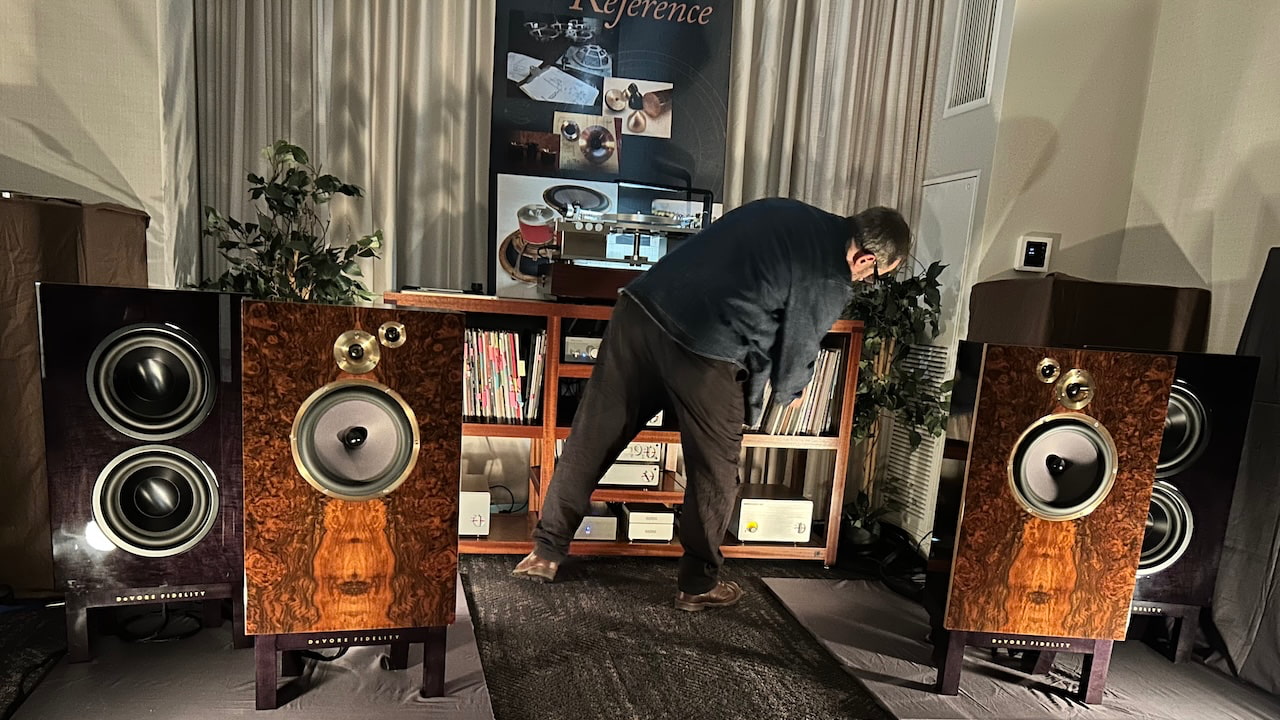
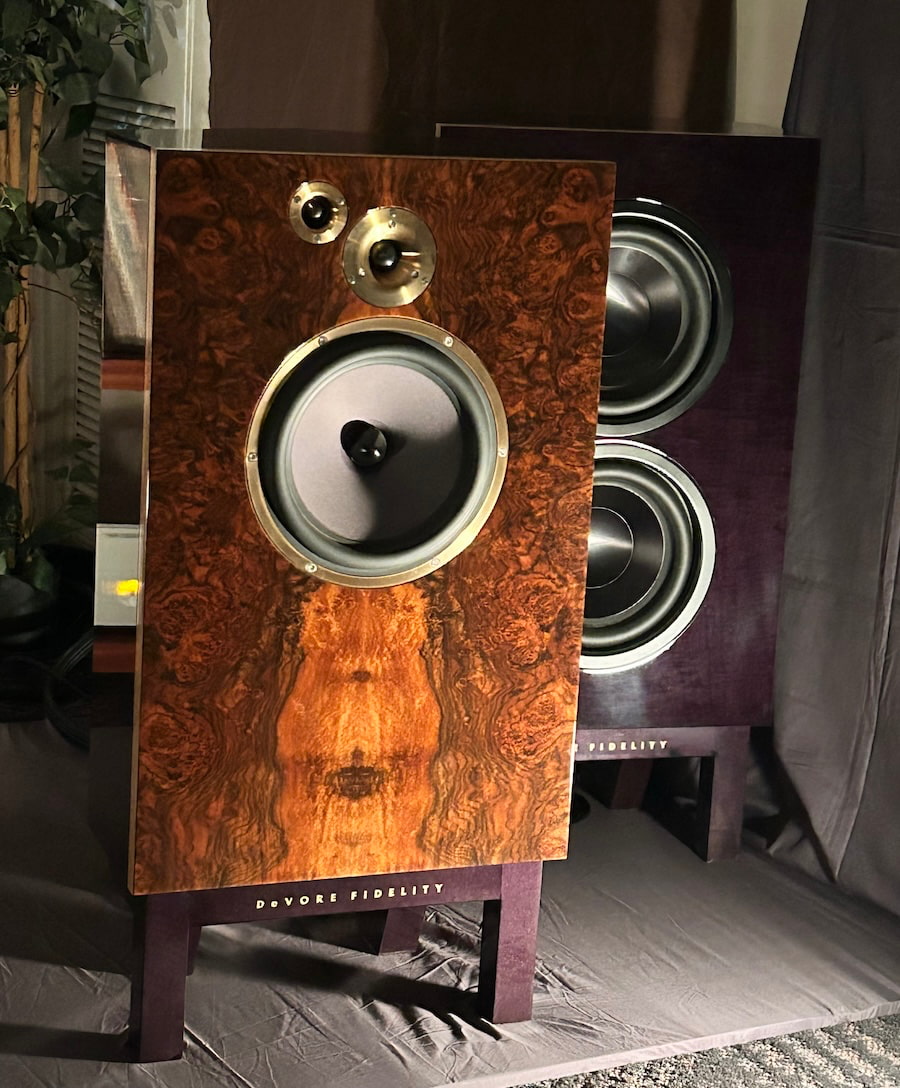
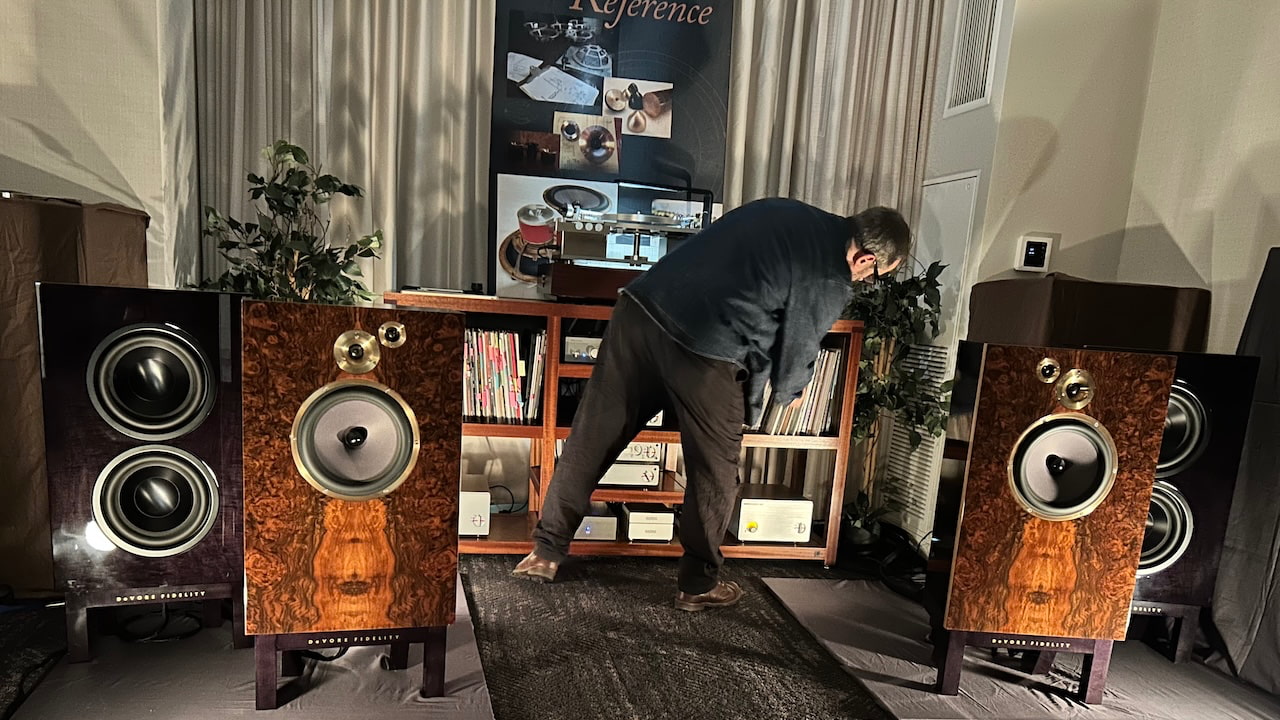
DeVore Fidelity Orangutan O/Reference Loudspeaker System at AXPONA 2026

The Orangutan O/Reference is a four piece system split into the A and B modules, each with a clear role. The A handles the main range with a 10-inch paper cone woofer built around an AlNiCo motor, copper Faraday rings, and a bronze phase plug to keep distortion low and behavior consistent across the band. Above that, a 1-inch silk dome tweeter and 0.75-inch super tweeter are both horn loaded in machined bronze, which helps with sensitivity and control without pushing the top end into something aggressive. The cabinet details are not cosmetic. Bronze ports and a decoupled brass input plate are there to reduce vibration and keep things clean.

The B module takes care of the bottom end with an 11-inch aluminum woofer and a matching passive radiator tuned below 20 Hz, powered by a dedicated 700 watt Class D amplifier with an all analog control section. You get adjustable crossover, phase, and low frequency EQ, but the key is how it connects to the rest of the system. The bass section takes its signal from the same amplifier driving the A module, so the tonal balance and texture remain consistent from top to bottom. It is not doing its own thing off to the side. It follows the same chain, which makes integration far less of a guessing game.

At $99,000, none of this should surprise anyone. What does stand out is that DeVore Fidelity actually gives you a meaningful range of finish options that let the speakers work in real living spaces. That should be standard at this level, but too many brands still treat it like an afterthought. John DeVore has never had that problem. His speakers don’t dominate a room visually, even when they are capable of filling it sonically.

Advertisement. Scroll to continue reading.

They scale in a way that feels almost deceptive. Bigger than they look. More powerful than they have any right to be. And maybe most important, they invite experimentation.

Advertisement

I’ve heard DeVore systems driven by everything from low powered tubes to blowtorch solid state, across a wide range of sources, and there isn’t a single “correct” answer. That’s rare. Most speakers at this level demand a specific chain and punish you if you get it wrong. These don’t. They let you find your own way.

Where Tone Stops Being a Preference and Starts Being the Point

devore-fidelity-orangutan-right-axpona-2026

One of the constants in any DeVore room is that you’re not subjected to the same audiophile greatest hits you’ve heard 500 times. No safe demo tracks polished to death. If you’ve spent any time watching John DeVore speak on YouTube, you already know where that comes from. He’s direct. Intelligent. Thoughtful. He understands the subject and doesn’t hide behind it. And in the room, that translates to a kind of quiet confidence. He’s not hovering. Not steering reactions. He built it. He knows what it does.

There’s a reason his speakers divide people. Some listeners want scale, impact, and the visual statement of something that looks engineered to within an inch of its life. Polished metal. Exotic materials. A kind of precision that feels clinical. DeVore goes in a different direction. Across his lineup, including the Orangutan series, the emphasis is on how instruments and voices actually sound. Not as data points, but as living things.

Tone is the anchor. The weight of a piano. The texture of a saxophone. The human edge in a voice when it starts to crack. These speakers are not microscopes. They behave more like instruments themselves, moving air, resonating, and shaping energy in a way that feels closer to the real thing.

By his standards, the system looked almost restrained. A rack of Nagra electronics, not the top tier, feeding a Yuki AP-01EM with Glanz tonearms into a Phasemation phono stage and cartridges, all tied together with AudioQuest. Nothing about it leaned on excess. The sound told a different story. It was clear, grounded, and saturated with tone, with bass that filled the room without taking control of it.

Advertisement

Before I left, the gentleman running the room put on Nick Cave. Just a quiet nod and the needle dropped. That voice carries history. The piano behind it has mass and decay that can collapse into something flat if the system misses the mark. I’ve heard far more expensive setups get it wrong. This one didn’t. It held together. It felt intact.

I moved into the second row and leaned forward, resting my chin on my hands against the back of the chair in front of me. Closed my eyes and remembered her. Her soft blonde hair in my hands. Those eyes. The smile that made me feel like I could take on the entire Empire by myself. It wasn’t nostalgia. It wasn’t distant. It was right there. Immediate. And a little dangerous in how quickly it pulled me in.

When a system can pull something like that out of you without asking permission, it’s doing something very few ever manage. If you’re looking for a reason to care, that’s it. And if you’re wondering what it might take to get there, start saving.

And before anyone starts wondering if I stumbled into a pot of gold after AXPONA, between the ATC EL50 Anniversary, Quad 2912X, and these from DeVore Fidelity, let’s be clear. I’ll be reviewing a pair of Orangutan O/baby this summer. Those I can afford. The emotional aftermath is another story.

Advertisement

MSRP: $99,000/pair at devorefidelity.com/oref/

Advertisement. Scroll to continue reading.

Source link

Advertisement
Continue Reading

Tech

Best Standing Desks of 2026

Published

on

I tested the Seville Classics Airlift Height Adjustable Desk with Glass Top, the Seville Classics Airlift Pro S3 Electric Height Adjustable Standing Desk (no longer available), the Steelcase Solo Sit-To-Stand Desk, the Fezibo Height Adjustable Electric Standing Desk with Double Drawer and The Grovemade Desk but they didn’t make the cut. The Airlift with Glass Top came close to earning a spot above. It’s a beautiful, sturdy desk at a midrange price that would be a great add to a modern workspace. It also features a small center drawer for holding the basics. Unfortunately, its built-in touchscreen wasn’t very responsive and the two USB-A ports, while theoretically a nice tech feature, are outdated for most of today’s phones and tablets.

The Airlift Pro S3 was a decent desk, but it was a little tougher to install than the others in its size range, and it had a cheaper-looking finish than the overall winner for best standing desk (the Uplift V3 Standing Desk).

The Steelcase Solo desk was surprisingly simple to install for its size. Instead of using screws to install the legs, these simply lock into place. The desk is sturdy, looks nice and is quiet when raising and lowering.

The Fezibo model was intriguing to me because of its built-in storage, but I found this model more difficult to assemble than many of the others. Still, it’s a reasonable option if you’d like storage compartments integrated into your desk and two levels: one for holding your monitor and the other for your keyboard and related accessories.

Advertisement

The Grovemade Desk I received had some mechanical errors. While the team was great about getting this fixed and working with me on it, it did mean having to take the desk halfway apart and put it back together. After replacing the legs, the lift function was louder and a bit more clunky than others we have tested. The cord management and craftsmanship are fantastic and the drawer allows you to keep your desktop clean while a lot of standing desks don’t offer that. While the price of the Grovemade Desk likely reflects the great care they take in hand crafting the desktops, compared to other desks on this list, you can get great quality options for much less money.

As always, consider your specific needs before you buy a sit-stand desk. Do you have a lot of space and a higher budget? Consider the Uplift models. The Ikea model is a fantastic midsize manual desk at a great price. Regardless of your home setup, one of these models is bound to suit your needs. If you aren’t sold on a standing desk, consider a standing desk converter for your existing desk instead.

Source link

Advertisement
Continue Reading

Tech

‘If these centers aren’t thoughtfully planned and coordinated, they can place extraordinary demands on electric infrastructure, the surrounding environment and host communities’: Maine becomes first US state to pass data centre construction ban

Published

on


  • Maine becomes the first US state to ban large data centers
  • A temporary moratorium will restrict power to under 20MW
  • A dedicated council will report back on its findings

Maine has passed a new law restricting, and in many cases effectively banning, new data center construction in certain areas.

In doing so, Maine has become the first state to pass such a law, and with many others worried over the environmental impact of data centers, it might just be the first of many.

Source link

Advertisement
Continue Reading

Tech

Adobe’s new Firefly AI Assistant wants to run Photoshop, Premiere, Illustrator and more from one prompt

Published

on

Adobe today launched its most ambitious AI offensive to date, unveiling the Firefly AI Assistant — a new agentic creative tool that can orchestrate complex, multi-step workflows across the company’s entire Creative Cloud suite from a single conversational interface — alongside a raft of new video, image, and collaboration features designed to position the company at the center of the rapidly evolving AI-powered content creation landscape.

The announcements, which also include a new Color Mode for Premiere Pro, the addition of Kling 3.0 video models to Firefly’s growing roster of third-party AI engines, and Frame.io Drive — a virtual filesystem that lets distributed teams work with cloud-stored media as though it lived on their local machines — represent Adobe’s clearest signal yet that it views agentic AI not as a feature upgrade but as a fundamental reshaping of how creative work gets done.

“We want creators to tell us the destination and let the Firefly assistant — with its deep understanding of all the Adobe professional tools and generative tools — bring the tools to you right in the conversation,” Alexandru Costin, Vice President of AI & Innovation at Adobe, told VentureBeat in an exclusive interview ahead of the launch.

The stakes could hardly be higher. Adobe is fighting to convince Wall Street, creative professionals, and a wave of well-funded AI-native competitors that its decades-old software empire can not only survive the generative AI revolution but lead it.

Advertisement

How Adobe turned a research prototype into a 100-tool creative agent

The centerpiece of today’s announcement is the Firefly AI Assistant, which Adobe describes as a fundamentally new way to interact with its creative tools. Rather than requiring users to manually navigate between Photoshop, Premiere, Illustrator, Lightroom, Express, and other apps — selecting the right tool for each step of a complex project — the assistant lets creators describe an outcome in natural language. The agent then figures out which tools to invoke, in what order, and executes the workflow.

The assistant is the productized version of Project Moonlight, a research prototype Adobe first previewed at its annual MAX conference in the fall of 2025 and subsequently refined through a private beta. “This is basically [Project] Moonlight,” Costin confirmed to VentureBeat. “We started with all the learnings from Moonlight, and we engaged with customers. We looked internally. We evolved that architecture to make it more ambitious.”

Under the hood, Adobe says it has assembled roughly 100 tools and skills that the assistant can call upon, spanning generative image and video creation, precision photo editing, layout adaptation, and even stakeholder review through Frame.io. The system is built around a single conversational interface inside the Firefly web app where users describe what they want and the assistant maintains context across sessions. Pre-built Creative Skills — purpose-built, multi-step workflow templates such as portrait retouching or social media asset generation — can be run from a single prompt and customized to match a creator’s own style. The assistant also learns a creator’s preferred tools, workflows, and aesthetic choices over time, and understands the content type being worked on — image, video, vector, brand assets — to make context-aware decisions.

Crucially, outputs use native Adobe file formats — PSD, AI, PRPROJ — meaning users can take any result into the corresponding flagship app for manual, pixel-level refinement at any point. “We always imagine this continuum where you can have complete conversational edits and pixel-perfect edits, and you can decide, as a creative, where you want to land,” Costin said. The Firefly AI Assistant will enter public beta in the coming weeks, though Adobe did not specify an exact date.

Advertisement

Why Wall Street is watching Adobe’s AI pricing model so closely

For a company whose AI monetization story has faced persistent skepticism from investors, the pricing structure of the Firefly AI Assistant will be closely watched. Costin told VentureBeat that, at launch, using the assistant will require an active Adobe subscription that includes the relevant apps — meaning users who want the agent to invoke Photoshop cloud capabilities, for instance, will need an entitlement that includes the Photoshop SKU. Generative actions will consume the user’s existing pool of generative credits, consistent with how Firefly credits work across the rest of Adobe’s platform.

“To use some of these cloud capabilities from Photoshop and other apps, you need to have a subscription that includes access to the Photoshop SKU,” Costin explained. “You’ll be consuming your credits when you use generative features.” He acknowledged, however, that the model could evolve: “As we better understand the value of this — and the costs of operating the brain, the conversation engine — things might change.”

The question of whether Adobe can convert AI enthusiasm into meaningful revenue growth is anything but theoretical. When Adobe reported its most recent quarterly results in March, it touted 10% year-over-year revenue growth to $6.4 billion and disclosed that annual recurring revenue from AI standalone and add-on products had reached $125 million — a figure CEO Shantanu Narayen projected would double within nine months.

Adobe adds Chinese AI video models to Firefly, raising commercial safety questions

Alongside the assistant, Adobe is expanding Firefly’s roster of third-party AI models to include Kling 3.0 and Kling 3.0 Omni, two video generation models developed by Kuaishou, the Chinese technology company. Kling 3.0 focuses on fast, high-quality production with smart storyboarding and audio-visual sync, while the Omni variant adds professional controls for shot duration, camera angle, and character movement across multi-shot sequences. The additions bring Firefly’s model count to more than 30, joining Google’s Nano Banana 2 and Veo 3.1, Runway’s Gen-4.5, Luma AI’s Ray3.14, Black Forest Labs’ FLUX.2[pro], ElevenLabs’ Multilingual v2, and others.

Advertisement

When asked whether Adobe had concerns about integrating a model from a Chinese tech company given the current geopolitical climate, Costin was direct: “We think choice is what we want to offer our customers.” He explained that Adobe’s strategy distinguishes between its own commercially safe, first-party Firefly models — trained on licensed Adobe Stock imagery and public domain content — and third-party partner models, which carry different commercial safety profiles. “For some use cases, like ideation, non-production use cases, we got requests from customers to support some external models,” Costin said. “If I’m in ideation, I might be more flexible with commercial safety. When I go into production, I’d want to have a model that gives you more confidence.”

This raises an important nuance for the agentic era. When the Firefly AI Assistant autonomously selects which model to use for a given task, the commercial safety guarantees may vary depending on which engine it invokes. Costin pointed to Adobe’s Content Credentials system — the metadata-and-fingerprinting framework developed through the Content Authenticity Initiative — as the mechanism for maintaining transparency. “The agentic power — and the fact that the assistant has access to all of those models — means it could decide to use a model that carries different content credentials,” he acknowledged. “But with the transparency of content credentials, the user will know how a particular piece of content was created and can decide whether that’s commercially safe or not.” Adobe offers commercial indemnity for its first-party Firefly models but applies different indemnity levels for third-party models — a distinction that enterprise buyers, in particular, will need to carefully evaluate.

Inside Adobe’s active collaboration with Nvidia on long-running AI agent infrastructure

Adobe’s agentic ambitions also intersect with its strategic partnership with Nvidia, announced earlier this year at Nvidia’s GTC conference. When asked whether the Firefly AI Assistant’s agentic capabilities are built on NVIDIA’s agent toolkit and NeMo infrastructure, Costin revealed that the collaboration is active but has not yet made it into a shipping product.

“We’re in active discussions — investigating not only Nemotron,” Costin said. “They have this technology called Open Shell and Nemo Claw, which give us the ability to efficiently run long-running agentic workflows in a sandboxed environment.” He said the technology would become increasingly important as Adobe pushes the assistant to handle longer, more autonomous creative tasks — but cautioned that “it’s not shipping yet. It’s being actively explored.”

Advertisement

For Nvidia, which is building an ecosystem of enterprise AI agent platforms with partners like Adobe, Salesforce, and SAP, the partnership could eventually serve as a high-profile proof point for its agent infrastructure stack in the creative vertical. For Adobe, the ability to run complex, long-duration agentic workflows efficiently and securely in sandboxed environments could be the technical foundation that separates the Firefly AI Assistant from lighter-weight chatbot integrations offered by competitors. The partnership also signals Adobe’s recognition that the computational demands of agentic AI — where a single user request may trigger dozens of model calls and tool invocations — require infrastructure partnerships that go well beyond what a software company can build alone.

Premiere Pro’s new color grading mode and the tools Adobe is shipping today

Beyond the headline AI assistant announcement, Adobe’s broader set of updates reflects a company trying to strengthen its position across every phase of the content creation pipeline. Color Mode in Premiere Pro may be the most significant near-term upgrade for working editors. Entering public beta today, Color Mode is described as a first-of-its-kind color grading experience built specifically for the way editors — rather than dedicated colorists — think and work. Adobe notes that it was developed through an extensive private beta with hundreds of working editors, and that participants reported they “actually enjoy color grading” — a sentiment suggesting Adobe may have found a way to democratize one of post-production’s most intimidating disciplines. General availability is expected later in 2026.

The Firefly Video Editor gains audio upgrades including the Enhance Speech feature migrated from Premiere and Adobe Podcast, direct Adobe Stock integration with access to more than 800 million licensed assets, and simple color adjustment controls with intuitive sliders and one-click looks. On the image editing front, Adobe introduced Precision Flow, which generates a range of semantic variations from a single prompt and lets users browse them via an interactive slider — a novel approach that Costin described as “the best slider-based control mixed with the best semantic understanding of not only the existing scene, but what the scene could be.” AI Markup complements this by letting users draw directly on images to specify where and how edits should be applied. After Effects 26.2 adds an AI-powered Object Matte tool that dramatically accelerates rotoscoping and masking — create accurate mattes of moving subjects with a hover and click, refine with a Quick Selection brush, and perfect edges with a Refine Edge tool.

Frame.io Drive wants to kill the shipped hard drive and make cloud media feel local

Rounding out the announcements, Frame.io Drive addresses one of the most persistent pain points in distributed video production: getting media from point A to point B without losing hours — or days — to downloads, syncing, and shipped hard drives. Frame.io Drive is a desktop application that mounts Frame.io projects to a user’s computer so media appears in Finder or Explorer and behaves like local files. The underlying technology, called Frame.io Mounted Storage, streams media on demand as applications request it, while local caching ensures smooth playback. The product builds on streaming technology provided by Suite Studios, and the real-time file access capability is included with every Frame.io account. Adobe emphasized that all content lives solely within Frame.io and is never shared with third parties.

Advertisement

The move positions Frame.io not just as a review-and-approval tool at the end of the production pipeline but as the central media layer from the very beginning of a project — from first capture through final delivery. If successful, the strategy could significantly deepen Adobe’s lock-in with professional video teams by making Frame.io the single source of truth for distributed productions. Frame.io Drive and Mounted Storage will roll out in phases, with Enterprise customers gaining access starting today and accounts on other plans following shortly. Others can join a waitlist.

Adobe’s biggest challenge isn’t building the AI — it’s convincing creators to trust it

Taken together, today’s announcements paint a picture of a company executing aggressively across multiple fronts — but also one that is navigating a complex moment. Adobe first introduced Firefly in March 2023 as a family of generative AI models focused on image and text effects, with a strong emphasis on commercial safety through training on licensed Adobe Stock content. In the two years since, the company has rapidly expanded into video generation, multi-model access, and now agentic workflows — a trajectory that mirrors the broader industry’s shift from standalone AI features to AI-native systems.

But the competitive field has grown dramatically. Runway, Pika, and a host of AI-native video generation startups have captured mindshare among creators. Canva has aggressively integrated AI into its design platform. And the emergence of powerful foundation models from OpenAI, Google, and Anthropic — the latter of which Adobe says it will integrate with Firefly AI Assistant capabilities — means the barrier to building creative AI tools has never been lower. Adobe is also navigating these product ambitions against a complex corporate backdrop: the impending departure of CEO Shantanu Narayen, an actively exploited zero-day vulnerability in Acrobat Reader (CVE-2026-34621) that had been used by hackers for months before being patched this week, a U.K. antitrust investigation over cancellation fees, and a recent $75 million lawsuit settlement.

Adobe’s response, articulated clearly through today’s launches, is to lean into what it believes is its deepest moat: the integration of AI into a set of professional-grade, category-leading applications that no startup can replicate overnight. Costin framed the agentic transition as empowering rather than threatening to creative professionals, comparing Creative Skills to a next-generation version of Photoshop Actions — the macro-recording feature that has long allowed power users to automate repetitive tasks. “We want to help our customers become — from the ones doing all the work — to be creative directors, doing some of the work, but most importantly, guiding the assistant in executing some of those creative visions,” he said.

Advertisement

It is a compelling pitch — and, in its own way, a revealing one. For three decades, Adobe made its fortune by selling the tools that turned creative vision into finished pixels. Now it is asking its customers to let an AI agent handle more of that translation, trusting that the human role will shift from operating the tools to directing the outcome. Whether creators embrace that bargain — and whether Wall Street rewards it — will determine not just Adobe’s trajectory but the shape of an entire industry learning to create alongside machines.

Source link

Continue Reading

Tech

Accel raises $5B to back late-stage bets

Published

on

Accel announced on Tuesday that it raised $5 billion in fresh capital to back late-stage companies.

The venture firm told Bloomberg that $4 billion will go to its late-stage Leaders Fund, for which it hopes to cut at least 20 checks, averaging $200 million each. Accel is looking to invest in companies building AI-powered technology, with a focus on software, hardware, robotics, defense tech, and data center infrastructure.

Accel limited partners also poured in $650 million, which will go to a “sidecar” fund, Bloomberg reported, allowing the firm to increase its investments in certain companies. 

Accel has backed more than 800 companies to date, including Anthropic, Perplexity, and Lovable. This latest fundraise comes as the firm hopes to keep up with the AI boom competition.

Advertisement

A spokesperson for Accel did not respond to a request for comment.

Source link

Continue Reading

Tech

Stealth Satellite TV Defeats Iran’s Internet Blackout

Published

on

On 8 January 2026, the Iranian government imposed a near-total communications shutdown. It was the country’s first full information blackout: For weeks, the internet was off across all provinces while services including the government-run intranet, VPNs, text messaging, mobile calls, and even landlines were severely throttled. It was an unprecedented lockdown that left more than 90 million people cut off not only from the world, but from one another.

Since then, connectivity has never fully returned. Following U.S. and Israeli airstrikes in late February, Iran again imposed near-total restrictions, and people inside the country again saw global information flows dry up.

The original January shutdown came amid nationwide protests over the deepening economic crisis and political repression, in which millions of people chanted antigovernment slogans in the streets. While Iranian protests have become frequent in recent years, this was one of the most significant uprisings since the Islamic Revolution in 1979. The government responded quickly and brutally. One report put the death toll at more than 7,000 confirmed deaths and more than 11,000 under investigation. Many sources believe the death toll could exceed 30,000.

Thirteen days into the January shutdown, we at NetFreedom Pioneers (NFP) turned to a system we had built for exactly this kind of moment—one that sends files over ordinary satellite TV signals. During the national information vacuum, our technology, called Toosheh, delivered real-time updates into Iran, offering a lifeline to millions starved of trusted information.

Advertisement

How Iran Censors the Internet

I joined NetFreedom Pioneers, a nonprofit focused on anticensorship technology, in 2014. Censorship in Iran was a defining feature of my youth in the 1990s. After the Islamic Revolution, most Iranians began to lead double lives—one at home, where they could drink, dance, and choose their clothing, and another in public, where everyone had to comply with stifling government laws.

Photo of a helmeted soldier with a machine gun standing in front of an Iranian flag and cell tower.Iran’s internet infrastructure is more centralized than in other parts of the world, making it easier for the government to restrict the flow of information. Morteza Nikoubazl/NurPhoto/Getty Images

My first experience with secret communications was when I was five and living in the small city of Fasa in southern Iran. My uncle brought home a satellite dish—dangerously illegal at the time—that allowed us to tune into 12 satellite channels. My favorite was Cartoon Network. Then, during my teenage years, this same uncle introduced me to the internet through dial-up modems. I remember using Yahoo Mail with its 4 megabytes of storage, reading news from around the world, and learning about the Chandra X-ray telescope from NASA’s website.

That openness didn’t last. As internet use spread in the early 2000s, the Iranian government began reshaping the network itself. Unlike the highly distributed networks in the United States or Europe, where thousands of providers exchange traffic across many independent routes, Iran’s connection to the global internet is relatively centralized. Most international traffic passes through a small number of gateways controlled by state-linked telecom operators. That architecture gives authorities unusual leverage: By restricting or withdrawing those connections, they can sharply reduce the country’s access to the outside world.

Over the past decade, Iran has expanded this control through what it calls the National Information Network, a domestically routed system designed to keep data inside the country whenever possible. Many government services, banking systems, and local platforms are hosted on this internal network. During periods of unrest, access to the global internet can be throttled or cut off while portions of this domestic network continue to function.

Advertisement

The government began its censorship campaign by redirecting or blocking websites. As internet use grew, it adopted more sophisticated approaches. For example, the Telecommunication Company of Iran uses a technique called deep packet inspection to analyze the content of data packets in real time. This method enables it to identify and block specific types of traffic, such as VPN connections, messaging apps, social media platforms, and banned websites.

The Stealth of Satellite Transmissions

Toosheh’s communication workaround builds on a history of satellite TV adoption in Middle Eastern and North African countries. By the early 2000s, satellite dishes were common in Iran; today the majority of households in Iran have access to satellite TV despite its official prohibition.

Unlike subscription services such as DirecTV and Dish Network, “free-to-air” satellite TV broadcasts are unencrypted and can be received by anyone with a dish and receiver—no subscription required. Because the signals are open, users can also capture and store the data they carry, rather than simply watching it live. Tech-savvy people learned that they could use a digital video broadcasting (DVB) card—a piece of hardware that connects to a computer and tunes into satellite frequencies—to transform a personal computer into a satellite receiver. This way, they could watch and store media locally as well as download data from dedicated channels.

Photo of satellite dishes adorning the side of an apartment building.Many Iranian citizens have free-to-air satellite dishes, like the ones on this apartment building in Tehran, and can thus download Toosheh transmissions, giving them a lifeline during internet blackouts.Morteza Nikoubazl/NurPhoto/Getty Images

Toosheh, a Persian word that translates to “knapsack,” is the brainchild of Mehdi Yahyanejad, an Iranian-American technologist and entrepreneur. Yahyanejad cofounded NetFreedom Pioneers in 2012. He proposed that the satellite-computer connections enabled by a DVB card could be re-created in software, eliminating the need for specialized hardware. He added a simple digital interface to the software to make it easy for anyone to use. The next breakthrough came when the NFP team developed a new transfer protocol that tricks ordinary satellite receivers into downloading data alongside audio and video content. Thus, Toosheh was born.

Advertisement

Satellite TV uses a file system called an MPEG transport stream that allows multiple audio, video, or data layers to be packaged into a single stream file. When you tune in to a satellite channel and select an audio option or closed captions, you’re accessing data stored in different parts of this stream. The NFP team’s insight was that, by piggybacking on one of these layers, Toosheh could send an MPEG stream that included documents, videos, and more.

An illustration of an 8 step process for sending digital files via satellite TV signals. HOW TOOSHEH WORKS: At NetFreedom Pioneers, content curators pull together files—news articles, videos, audio, and software [1]. Toosheh’s encoder software [2] compresses the files into a bundle, in .ts format, creating an MPEG transport stream [3]. From there, it’s uploaded to a server for transmission [4] via a free-to-air TV channel on a Yahsat satellite that’s positioned over the Middle East to provide regional coverage [5]. Satellite receivers [6] directly capture the data streams, which are downloaded to computers, smartphones, and other devices, and decoded by Toosheh software [8].Chris Philpot

A satellite receiver can’t tell the difference between our data and normal satellite audio and video data since it only “sees” the MPEG streams, not what’s encoded on them. This means the data can be downloaded and read, watched, and saved on local devices such as computers, smartphones, or storage devices. What’s more, the system is entirely private: No one can detect whether someone has received data through Toosheh; there are no traceable logs of user activity.

Toosheh doesn’t provide internet access, but rather delivers curated data through satellite technology. The fundamental distinction lies in the way users interact with the system. Unlike traditional internet services, where you type a request into your browser and receive data in response, Toosheh operates more like a combination of radio and television, presenting information in a magazine-like format. Users don’t make requests; instead, they receive 1 to 5 gigabytes of prepackaged, carefully selected data.

Access to information is not only about news or politics, but about exposure to possibilities.

Advertisement

During this year’s internet blackout, we distributed official statements from Iranian opposition leader Crown Prince Reza Pahlavi and the U.S. government. We provided first-aid tutorials for medics and injured protesters. We sent uncensored news reports from BBC Persian, Iran International, IranWire, VOA Farsi, and others. We also shared critical software packages including anticensorship and antisurveillance tools, along with how-to guides to help people securely connect to Starlink satellite terminals, allowing them to stay protected and anonymous as they sent their own communications.

How to Combat Signal Interference

Because Toosheh relies on one-way satellite broadcasts, it evades the usual tactics governments use to block internet access. However, it remains vulnerable to satellite signal jamming.

The Iranian government is notorious for deploying signal jamming, especially in larger cities. In 2009, the government used uplink interference, which attacks the satellite in orbit by beaming strong noise in the frequency of the satellite’s receiver. This makes it impossible for the satellite to distinguish the information it’s supposed to receive. However, because this type of attack temporarily disables the entire satellite, Iran was threatened with international sanctions and in 2012 stopped using the method .

A chart displayed on a cellphone shows internet connectivity in Iran dropped from almost 100% to 0% on 9 January 2026. A graph of network connectivity in Iran shows that on 9 January 2026, internet access dropped from nearly 100 percent to 0. Samuel Boivin/NurPhoto/Getty Images

The current method, called terrestrial jamming, uses antennas installed at higher elevations than the surrounding buildings to beam strong noise over a specific area in the frequency range of household receivers. This attack is effective in keeping some of the packets from arriving and damaging others, effectively jamming the transmission. But it’s short-range and requires significant power, so it’s impossible to implement nationwide. There are always people somewhere who can still watch TV, download from Toosheh, or tune into a satellite radio despite the jamming. Even so, we wanted a workaround that would keep our transmissions broadly accessible.

Advertisement

NFP’s solution was to add redundancy, similar in principle to a data-storage technique called RAID (redundant array of independent disks). Instead of sending each piece of data once, we send extra information that allows missing or corrupted packets to be reconstructed. Under normal circumstances, we often use 5 percent of our bandwidth for this redundancy. During periods of active jamming, we increase that to as much as 25 to 30 percent, improving the chances that users can recover complete files despite interference.

From Crisis Response to Public Access

Toosheh initially came online in 2015 in Iran and Afghanistan. Its full potential, however, was first realized during the 2019 protests in Iran, which saw the most widespread internet shutdown prior to the blackout this year. Wired called the 2019 shutdown “the most severe disconnection” tracked by NetBlocks in any country in terms of its “technical complexity and breadth.” Our technology helped thousands of people stay informed. We sent crucial local updates, legal-aid guides, digital security tools, and independent news to satellite receivers all over the country, seeing a sixfold increase in our user base.

When that wave of protests subsided, the government allowed some communication services to return. People were again able to access the free internet using VPNs and other antifilter software that allowed them to bypass restrictions. Toosheh then became a public access point for news, educational material, and entertainment beyond government filtering.

Toosheh’s impact is often personal. A traveling teacher in western Iran told NFP that he regularly distributed Toosheh files to students in remote villages. One package included footage of female athletes competing in the Olympic Games, something never broadcast in Iran. For one young girl, it was the first time she realized women could compete professionally in sports. That moment underscores a broader truth: Access to information is not only about news or politics, but about exposure to possibilities.

Advertisement

The Cost of Toosheh

Unlike internet-based systems, Toosheh’s operational cost remains constant regardless of the number of users. A single TV satellite in geostationary earth orbit, deployed and maintained by an international company such as Eutelsat, can broadcast to an entire continent with no increase in cost to audiences. What’s more, the startup cost for users isn’t high: A satellite dish and receiver in Iran costs less than US $50, which is affordable to many. And it costs nothing for people to use Toosheh’s service and receive its files.

We aim not just to build a tool for censorship circumvention, but to redefine access itself.

However, operating the service is costly: NetFreedom Pioneers pays tens of thousands of dollars a month for satellite bandwidth. We had received funding from the U.S. State Department, but in August of 2025, that funding ended, forcing us to suspend services in Iran.

Then the December protests happened, and broadcasting to Iran became an urgent priority. To turn Toosheh back on, we needed roughly $50,000 a month. With the support of a handful of private donors, we were able to meet these costs and sustain operations in Iran for a few months, though our future there and elsewhere is uncertain.

Advertisement

Satellites Against Censorship

Toosheh’s revival in Iran came alongside NFP’s ongoing support for deployments of Starlink, a satellite internet service that allows users to connect directly to satellites rather than relying on domestic networks, which the government can shut down. Unlike Toosheh’s one-way broadcasts, Starlink provides full two-way internet access, enabling users to send messages, upload videos, and communicate with the outside world.

In 2022, we started gathering donations to buy Starlink terminals for Iran. We have delivered more than 300 of the roughly 50,000 there, enabling citizens to send encrypted updates and videos to us from inside the country. Because the technology is banned by the government, access remains limited and carries risk; Iranian authorities have recently arrested Starlink users and sellers. And unlike Toosheh’s receive-only broadcasts, Starlink terminals transmit signals back to orbit, creating a radio footprint that can potentially be detected.

A photo of a laptop screen says the user is offline. The internet shutdown in Iran continued after the attacks by Israel and the United States began in late February, preventing Iranians from communicating with the outside world and with one another.Fatemeh Bahrami/Anadolu/Getty Images

Looking ahead, we envision Toosheh becoming a foundational part of global digital resilience. It is uncensored, untraceable, and resistant to government shutdowns. Because Toosheh is downlink only, it can sometimes feel hard to explain the value of this technology to those living in the free world, those accustomed to open internet access. Yet, people living under censorship have few other choices when there’s a digital blackout.

Currently, NFP is developing new features like intelligent content curation and automatically prioritizing data packages based on geographic or situational needs. And we’re experimenting with local sharing tools that allow users who receive Toosheh broadcasts to redistribute those files via Wi-Fi hotspots or other offline networks, which could extend the system’s reach to disaster zones, conflict areas, and climate-impacted regions where infrastructure may be destroyed.

Advertisement

We’re also looking at other use cases. Following the Taliban’s return to power in Afghanistan, NetFreedom Pioneers designed a satellite-based system to deliver educational materials. Our goal is to enable private, large-scale distribution of coursework to anyone—including the girls who are banned from Afghanistan’s schools. The system is technically ready but has yet to secure funding for deployment.

We aim not just to build a tool for censorship circumvention, but to redefine access itself. Whether in an Iranian city under surveillance, a Guatemalan village without internet, or a refugee camp in East Africa, Toosheh offers a powerful and practical model for delivering vital information without relying on vulnerable or expensive networks.

Toosheh is a reminder that innovation doesn’t have to mean complexity. Sometimes, the most transformative ideas are the simplest, like delivering data through the sky, quietly and affordably, into the hands of those who need it most.

From Your Site Articles

Advertisement

Related Articles Around the Web
Source link

Continue Reading

Tech

Snap up this powerful Asus TUF F16 Gaming Laptop with an RTX 4050 for under $1,000 at Amazon

Published

on

If you’re keen to game on the move but also dealing with a tight budget, you’re in luck. Right now, you can buy the Asus TUF F16 Gaming Laptop at Amazon for $999.99 (was $1.199.99). That’s a pretty sweet deal for a gaming laptop which has an RTX 4050 GPU — ideal for 1080p gaming.

The Asus TUF F16 Gaming Laptop is a limited-time deal, so you’ll likely need to move fast. It offers a reasonable set of specs for the price, with a 16-inch full HD+ display with a 144Hz refresh rate working well alongside the budget-friendly RTX 4050 GPU. It also has 512GB of SSD storage, 16GB RAM, and an Intel Core i7-13620H CPU. The laptop looks pretty stylish, too, without completely succumbing to an excessive gamer aesthetic.

Asus TUF A16 Gaming Laptop, which was awarded a strong four out of five stars. It doesn’t quite compete with the very best gaming laptops, but it’s excellent value for money.

It has a good mixture of hardware that complements each component well. It looks pretty sleek yet stylish without being too in your face. It also has military-grade durability, so it can handle a more physical life if needed (but please don’t throw your laptop).

Little details like a backlit keyboard, HDMI port, Thunderbolt port, and plenty of USB ports all add up nicely as well. If you want one of the best laptops around, but also be able to game, this is worth checking out if you’re on a budget and can’t go all out with your purchase.

If you’re interested in seeing what else is out there, there are other cheap gaming laptop deals around. If you want a regular laptop, there are also some strong laptop deals to look through.

Advertisement

Source link

Continue Reading

Tech

FCC hands Netgear an effective monopoly on router sale in the US

Published

on

Following a total ban on non-US made routers, the Federal Communications Commission is allowing Netgear to sell wireless routers in the United States, practically giving it a monopoly. However, it’s unclear exactly why that approval was granted.

Black Nighthawk WiFi router with four upright antennas centered over a faded Federal Communications Commission seal featuring an eagle, stars, and a satellite icon in the background
Netgear Nighthawk router

In March, the U.S. Federal Communications Commission made the decision to ban imports of all foreign-made routers, due to national security concerns. At the time, no exemptions were made, so the ban affected practically every router being sold in the United States.
However, on April 14, Netgear got a rare reprieve. In an update to the list of equipment and services covered by Section 2 of the Secure Networks Act, the FCC lists Netgear under a very short list of conditional approvals for routers.
Continue Reading on AppleInsider | Discuss on our Forums

Source link

Continue Reading

Trending

Copyright © 2025