

Crypto World
Proposed Bill Seeks to Ban President, Congress from Prediction Markets

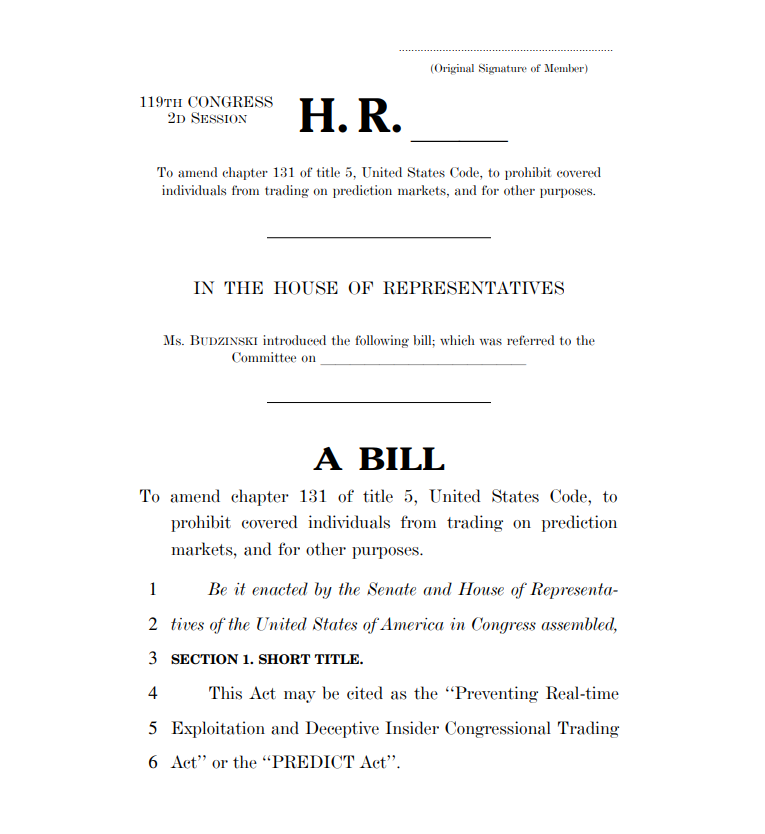
US lawmakers have introduced a bill aiming to ban members of the US Congress, the president and other high-ranking government officials from wagering on prediction markets.
The proposed bill, a bipartisan effort from US Representative Adrian Smith and Representative Nikki Budzinski, was introduced on Tuesday and is called the Preventing Real-time Exploitation and Deceptive Insider Congressional Trading Act (PREDICT Act).
“In recent months, we’ve seen instances of little-known traders making massive profits on events ranging from war with Iran to how long a government shutdown will last, raising necessary questions about the use of inside information,” Budzinski said.
The move comes amid growing scrutiny of prediction markets in the US, with lawmakers and regulators taking aim at platforms such as Kalshi and Polymarket over contracts related to sports, war and politics.
The bill seeks to bar members of Congress, the president, vice president and political appointees from wagering on the “outcomes of political events, policy decisions, and other government actions on prediction markets.” It also extends to the spouses and dependents of these government officials.

The potential penalties listed in the PREDICT Act include a 10% fine on the total value of the contract and the disgorgement of all profits to the US Treasury.
Commenting on the bill, Budzinski stressed the importance of closing loopholes to ensure people with inside knowledge “cannot profit from it.”
Budzinski isn’t the only one sounding off on alleged corruption on prediction markets. Earlier this month, two Democratic lawmakers introduced a separate bill called the Banning Event Trading on Sensitive Operations and Federal Functions (BETS OFF) Act.
Speaking about the bill, Senator Chris Murphy alleged that it was likely that people used “inside information” to make bets on US President Donald Trump’s military actions involving Iran.
US lawmakers turn up heat on prediction markets
US lawmakers aren’t just flagging concerns with insider trading on prediction markets. Sports-related contracts have also recently drawn attention at both the federal and state levels.
Cointelegraph reported earlier this week that 11 states have taken legal action against prediction markets, while another two states also have pending legal action in the works.
At the federal level, Sens. John Curtis and Adam Schiff introduced a bill on Monday aiming to ban any Commodity Futures Trading Commission (CFTC) registered entity from listing prediction market contracts that resemble “a sports bet or casino-style game.”
Related: Why Argentina is blocking Polymarket despite its global growth
The senators argued that many companies have been offering significant amounts of contracts that “are indistinguishable from gambling” and also took aim at the CFTC for its approach to the sector.
“For fifteen years, the CFTC has enforced its authority to prohibit the listing of a contract that involves, relates to or references ‘gaming.’ However, the CFTC and its chair have abruptly reversed course — intervening in ongoing litigation and proceeding with rulemaking to significantly relax the CFTC’s enforcement of this clause,” they said.
Following the move, both Kalshi and Polymarket, two of the largest prediction market platforms, made efforts to tighten their rules to stop professional athletes and political candidates from wagering on prediction markets.
Magazine: Are DeFi devs liable for the illegal activity of others on their platforms?


Fidelity International is expanding the tokenization frontier in public markets with the launch of the Fidelity USD Digital Liquidity Fund (FILQ). The fund, described as a tokenized liquidity vehicle, has been rated AAA-mf by Moody’s Ratings—a designation that signals high credit quality and robust liquidity for money-market-like assets. FILQ is issued on blockchain infrastructure connected to Chainlink and rolled out via Sygnum Bank’s tokenization platform, illustrating how traditional cash-equivalent instruments can move on-chain within a regulated framework.
According to Sygnum, the fund’s AAA-mf rating from Moody’s Ratings marks an important milestone for the on-chain money-market space. The rating distinguishes FILQ as a highly liquid, credit-worthy option suitable for institutional investors seeking yield-bearing liquidity while maintaining risk controls associated with regulated money-market products. Fatmire Bekiri, Sygnum’s head of tokenization, described the development as a meaningful step in bringing regulated, high-quality liquidity onto the blockchain.)
Fidelity International did not immediately respond to requests for comment at publication, while Fidelity Investments and Fidelity International operate as separate entities in different jurisdictions. The move sits within a broader push by large asset managers to tokenize cash and near-cash products, offering traditional yields with on-chain settlement and visibility.
Chainlink expands role in tokenized real-world assets
FILQ’s architecture relies on Chainlink’s data network to deliver on-chain net asset value (NAV) and distribution metrics. By providing verifiable, real-time NAV and payout data on-chain, the fund aims to give international investors a transparent, auditable view of value and income—addressing one of the core challenges in tokenized real-world assets: ensuring data integrity and timely information for fund investors. Fernando Vazquez, president of capital markets at Chainlink Labs, framed the approach as a crucial bridge between traditional finance and the on-chain economy, emphasizing tamper-proof transparency as a foundation for digital liquidity products.
In addition to Chainlink’s data feeds, JPMorgan is slated to contribute approved daily NAV data for FILQ, reinforcing the model of established market players supplying regulated inputs to a tokenized funds structure. The collaboration between Fidelity International, Sygnum, and Chainlink builds on prior production use cases that align NAV and distribution data with on-chain fund representations, including earlier deployments involving Fidelity International and Sygnum for NAV data integration in 2024.
Chainlink’s involvement underscores a broader industry trend: real-world assets are increasingly being connected to blockchains through standardized data feeds and governance models that aim to preserve regulatory compliance while enabling on-chain liquidity and settlement. This approach addresses one of the most persistent barriers to mainstream adoption of tokenized funds: ensuring data verifiability, accuracy, and timeliness in a decentralized environment.
Tokenized funds: a broader industry shift
The FILQ launch adds momentum to a wave of tokenized money-market and liquidity products emerging from major asset managers. In recent years, venerable players such as BlackRock and Franklin Templeton have introduced tokenized money-market offerings aimed at converting cash-like assets into on-chain formats that still route through traditional risk controls and counterparties. The trend is driven by the desire to provide stable yields with greater liquidity, while leveraging blockchain rails for settlement efficiency and transparency.
Industry watchers note that the growing interest in tokenized liquidity comes with a set of practical considerations. For one, real-time NAV data and transparent payout scheduling can improve governance and investor confidence, but participants must navigate custodial arrangements, regulated disclosure requirements, and the interplay between on-chain activity and existing financial-market infrastructure. The involvement of Moody’s Ratings, Chainlink, and JPMorgan signals a collective effort to embed credible, regulated data streams into tokenized funds, rather than relying on unvetted on-chain information alone.
Within Fidelity’s broader ecosystem, the firm has previously explored tokenized money-market constructs, including Fidelity Digital Interest Token (FDIT) and related initiatives anchored by traditional cash-management strategies. The on-chain fund model seeks to keep reserves aligned with fiat currency exposure while offering near real-time visibility to investors and managers. As the market tests these approaches, observers will be watching how regulators respond to tokenized money-market products, particularly with respect to liquidity buffers, reserve backing, and disclosure standards.
What this means for investors and the on-chain promise
For investors, FILQ represents a concrete instance of how regulated, high-quality liquidity can be tokenized without sacrificing the governance and credit safeguards associated with traditional money-market funds. The AAA-mf rating provides a signal of credit quality and liquidity that may appeal to institutions exploring on-chain cash equivalents as part of liquidity management, treasury operations, or cross-border funding programs.
For builders and developers in the on-chain finance space, the FILQ case highlights two enduring requirements: robust data integrity and interoperable market infrastructure. On-chain NAV data, verified by established market participants, helps reduce information asymmetry between on-chain and off-chain counterparts. At the same time, the collaboration among Fidelity International, Sygnum, Chainlink, and JPMorgan demonstrates a practical model for multi-party governance around tokenized assets—one that leverages regulated involvement to raise on-chain legitimacy and scalability.
Still, the emergence of tokenized liquidity products also invites scrutiny of regulatory boundaries and operational risk. While the involvement of Moody’s, a trusted rating agency, and JPMorgan’s data inputs provides guardrails, the on-chain settlement of money-market instruments must align with applicable securities, banking, and cross-border rules. Market participants will likely watch how supervisory approaches evolve as more large asset managers bring tokenized liquidity funds to market, and how custody, settlement, and disclosure standards adapt to a hybrid asset class that sits between traditional finance and blockchain networks.
Closing perspective
FILQ marks a notable inflection point in the ongoing experiment of tokenized liquidity. As more traditional managers pilot on-chain cash products with formal ratings, standardized data feeds, and reputable custodial partners, the industry gains a clearer template for combining regulatory discipline with the efficiency and transparency of blockchain rails. The coming months will reveal how scalable this model proves to be, how regulators respond to broader adoption, and which other fund families may follow suit into tokenized money-market instruments.
Watch for further details on how FILQ performs relative to its on-chain NAV feeds, and for additional updates on how JPMorgan’s daily NAV inputs integrate with the fund’s distribution schedule. The collaboration among Fidelity International, Sygnum, Chainlink, and JPMorgan may well set a precedent for next-generation tokenized liquidity offerings across the sector.

TLDR
- Grayscale filed a Form S-3 with the SEC to convert its Zcash Trust into a spot ETF.
- The proposed Zcash ETF would trade on NYSE Arca under the ticker ZCSH.
- The fund plans to hold actual ZEC tokens and track the CoinDesk Zcash Price Index.
- Grayscale appointed Coinbase Custody as custodian and prime broker for the proposed ETF.
- Bank of New York Mellon would serve as the administrator for the fund.
Grayscale Investments has filed a Form S-3 with the US Securities and Exchange Commission to convert its Zcash Trust into a spot exchange-traded fund. The proposed product would list on NYSE Arca under the ticker ZCSH. The filing positions the fund as the first US spot ETF tied to a privacy-focused cryptocurrency.
Grayscale Advances Plan for Zcash ETF Conversion
Grayscale seeks to transform its closed-end Zcash Trust into an open-ended ETF structure. The existing trust manages more than $200 million in assets. The firm stated that the ETF would hold actual ZEC tokens.
The proposed Zcash ETF would track the CoinDesk Zcash Price Index. Therefore, the fund would reflect the market price of ZEC. Investors would gain regulated exposure without managing wallets or private keys.
Grayscale appointed Coinbase Custody as custodian and prime broker for the fund. The Bank of New York Mellon would act as administrator. These arrangements outline the operational framework described in the filing.
Closed-end trusts often trade at discounts or premiums to net asset value. However, an ETF allows authorized participants to create and redeem shares. This mechanism keeps the share price aligned with the underlying asset.
Regulatory Context and Market Response to Zcash ETF Proposal
The SEC recently ended a review related to privacy coins. The agency did not announce enforcement actions or issue public warnings. This development forms part of the backdrop to the filing.
Zcash differs from other privacy coins in its design. It allows both transparent and shielded transactions. In contrast, some privacy coins enforce privacy for every transfer.
Zcash uses zk-SNARKs technology to validate transactions. The term stands for zero-knowledge succinct non-interactive arguments of knowledge. This method proves validity without revealing the sender, receiver, or transaction amount.
Following the filing, ZEC traded above $550. Market data showed Bitcoin trading above $80,800 during the same period. Traders linked broader crypto strength to price momentum in altcoins.
The filing states that the SEC may approve or reject the proposal. It also outlines that regulators could impose conditions on the product. The review process will determine whether the Zcash ETF can proceed to listing on NYSE Arca.


- Ethena’s native token, ENA, saw its price decline as Bitcoin slid below $79,000
- The slight dip happened despite ENA notching a 5-week high in whale activity.
- Prices could fall further, but a rebound for BTC could boost ENA.
Ethena (ENA) price faced downward pressure today, dropping nearly 4% to intraday lows of $0.11 as Bitcoin grappled with renewed selling amid macroeconomic headwinds.
This decline unfolded even as on-chain metrics signaled robust interest from large holders.
Analysts say the move highlights a disconnect between whale behavior and short-term price action.
Ethena hits 5-week high in whale activity
On-chain data shows Ethena’s ecosystem has managed notable momentum.
For one, the network just hit its largest daily network growth in over three months.
The platform did not just see a surge in new wallet creations, but had ENA whale activity surging to a five-week peak, with this aligning with heightened interest bolstered by several bullish catalysts.
📈 Ethena has just seen its largest day of network growth (new wallets created) in over 3 months. Additionally, $ENA whale activity has just hit a 5-week high. Why? There has been a series of high-impact events that converged in the days leading up to May 12th:
🎯 Grayscale… pic.twitter.com/ZMZf0BZgkN
— Santiment Intelligence (@SantimentData) May 13, 2026
According to Santiment, one of the key drivers was Grayscale’s decision on May 7 to incorporate ENA into its DeFi Fund.
Ethena also recently saw a massive $310 million USDC transfer, a transaction that injected fresh liquidity and drew widespread attention.
Santiment has also highlighted that the spotlight on ENA increased further when LayerZero announced a temporary bridge suspension on May 9, keeping Ethena at the forefront of DeFi discussions.
Adding to the optimism, the Ethena Foundation recently affirmed that all conditions outlined by its Risk Committee for activating the “fee switch” have been satisfied.
This mechanism, designed to distribute protocol fees to stakers, awaits a governance vote from ENA holders in the coming days.
The whale positioning ahead of the pivotal vote helped ENA price pump to highs of $0.14 on May 10.
Why’s ENA price down?
Despite the positive catalysts, ENA’s price succumbed to broader market dynamics.
Both RSI and MACD on the 4-hour chart suggest prices could fall further.

On May 13, crypto sentiment soured following the release of U.S. Producer Price Index (PPI) data.
This came in hotter-than-expected and exacerbated fears of persistent inflation and delayed rate cuts.
US stocks slid, and Bitcoin, the crypto sector’s bellwether, tumbled below $79,000 during intraday trading.
Declines meant bulls retreated to levels seen following Tuesday’s Consumer Price Index (CPI) report.
BTC prices had earlier bounced to above $81,000.
This macro-driven risk-off mood rippled across altcoins, with Ethereum down near $2,250, Solana slipping to $90, and XRP capped under $1.50.
Many DeFi tokens mirrored the weakness, including ENA, which traded from intraday highs of $0.12.
The profit-taking could extend losses to support at $0.10.
While the dip impacts ENA’s short-term outlook, network fundamentals and overall market outlook could position the token for potential recovery.

Bitcoin edges higher as altcoins rally and 21Shares debuts Canton Network ETF
Bitcoin briefly traded above $82,800 last week before a modest pullback, while a number of alternative tokens posted outsized gains as investors sought broader exposure to the crypto market. The price action coincided with the Nasdaq listing of the TCAN 21Shares Canton Network ETF, the first US-listed fund to track Canton Coin, the native token of the Canton Network.
The market moves were highlighted in commentary dated 11 May 2026 from eToro’s crypto analyst Simon Peters, who noted resilience in bitcoin amid macro uncertainty and renewed momentum across altcoins as investors diversify within digital assets.
Market snapshot and altcoin leadership
Bitcoin’s short-lived advance above $82,800 reflects continued interest at higher price levels, but the weekend pullback underlines persistent volatility. Measured by market share, bitcoin dominance dipped about 1 percentage point to 60.60 percent, indicating the recent leadership came from alternative coins rather than bitcoin itself.
Among the most notable moves, TON jumped roughly 67 percent following remarks from Telegram founder Pavel Durov that Telegram would assume development responsibilities for the TON blockchain and roll out a new roadmap. Jupiter (JUP) and Internet Computer (ICP) each rose more than 40 percent over the week, while Solana showed renewed strength as well. Such concentrated rallies are typical in risk-on stretches and can weigh on bitcoin’s share of total market capitalization as traders rotate into higher-beta tokens.
Macro and regulatory catalysts to watch
Traders are entering a week with potentially market-moving US macro data, including the Consumer Price Index and Producer Price Index releases. These inflation prints could influence expectations for Federal Reserve policy and, by extension, risk appetite for crypto assets. Elevated inflation or surprising readings could increase volatility across both bitcoin and altcoins.
At the same time, the crypto sector remains focused on US regulatory developments, particularly the proposed CLARITY Act and the possibility of a Senate Banking Committee markup. Any substantive legislative or regulatory action could reshape market access and the institutional case for digital assets, affecting both spot prices and demand for regulated investment products such as ETFs.
What the TCAN ETF signifies for institutional demand
21Shares’ TCAN ETF offers US-listed investors direct exposure to Canton Coin and represents a shift in ETF product strategy away from bitcoin-only offerings toward blockchain infrastructure plays. Canton markets itself as a privacy-enabled network geared to regulated financial institutions, enabling compliant data sharing and private transactions between counterparties.
From an institutional perspective, ETFs tied to infrastructure-layer tokens can serve several functions: they provide a familiar wrapper for access, create clearer channels for capital allocation, and enable portfolio managers to express views on blockchain utility rather than store-of-value narratives. For issuers and investors, the presence of a regulated ETF can also reduce some operational and custody frictions associated with direct token holdings, though important considerations remain.
Operational, compliance and market-structure considerations
While an ETF listing expands distribution, it does not eliminate underlying risks. Institutional adoption depends on custody solutions, compliance with anti-money-laundering and know-your-customer rules, liquidity of the underlying token, and how exchanges and market makers handle the asset. Canton’s focus on institutional-grade privacy and compliance could make it more attractive to certain regulated investors, but the token will still be subject to market liquidity and on-chain risks.
Regulators will also scrutinize whether utility tokens tied to specific networks meet securities law standards in various jurisdictions. The regulatory backdrop in the US remains a top-line concern for asset managers and allocators contemplating crypto exposure, and potential legislative action tied to the CLARITY Act could alter how products are structured or approved going forward.
Implications for investors and market participants
For portfolio managers and institutional allocators, the key takeaway is that product innovation is broadening the investment toolkit beyond bitcoin. That creates opportunities to express differentiated views on blockchain infrastructure and application-layer development. However, buyers and allocators should assess ETFs and token exposures with the same discipline applied to other niche or thematic allocations, including due diligence on token economics, custody arrangements, and the regulatory roadmap.
For traders, the current environment underscores the influence of macro prints and regulatory headlines on short-term price dynamics. The CPI and PPI releases, together with any Senate action on crypto legislation, could act as short-term catalysts, shifting flows between bitcoin, altcoins and newly listed infrastructure ETFs.
Conclusion
Last week’s price action and product launches signal that institutional appetite for crypto is evolving beyond bitcoin, with ETFs now targeting blockchain networks and infrastructure tokens. That trend could widen investor participation but will also bring increased scrutiny from regulators and market operators. In the near term, macro data and legislative developments are likely to remain the main drivers of volatility across crypto markets.


In a significant shift in bitcoin’s market structure the amount of supply held by “conviction buyers” has surged to nearly 4 million BTC, according to BitGo data cited by Bitfinex on Wednesday.
Bitcoin in long-term buyers’ hands currently represents a 300% increase since the end of 2025, signaling a massive migration of the crypto’s realized value into large, low-activity entities, according to Bitfinex.
The massive “conviction” capital is valued at just over $320 billion, based on bitcoin’s current price of roughly $80,000.
“While the exact methodology behind BitGo’s ‘conviction buyers’ metric isn’t immediately clear, the broader signal is notable,” said Mati Greenspan, a market analyst and founder of Quantum Economics. “Historically, periods of tightening liquid supply combined with renewed demand have created the conditions for bitcoin’s most aggressive upside expansions.”
The current accumulation trend marks the largest two-quarter surge in high-conviction buying since the 2020 COVID-19 crash, Bitfinex said. Conviction buyers are long-term investors, whether they be individuals or institutional.
Long-term buyers holdings are not part of the estimated 5.6 million BTC that has been inactive for over a decade, according to Jameson Lopp, a core bitcoin developer. The total amount of bitcoin in circulation is 20.03 million currently, according to CoinDesk data.
Bitfinex analysts noted that a growing share of bitcoin’s realized value is no longer circulating on crypto exchanges, but is instead moving into the hands of entities that rarely transact, regardless of price volatility.
This structural shift suggests that long-term holders, ranging from institutional “whales” to corporate treasures, are aggressively absorbing the available bitcoin supply, most notably Strategy (MSTR), the largest publicly traded corporate holder of bitcoin. This company, which is currently sitting on $4.6 billion in unrealized gains, recently increased its total holdings to 818,869 BTC, which it acquired for nearly $62 billion. When supply moves into these low-activity entities, it effectively reduces the liquid supply available on the open market, creating a potential “supply shock” dynamic.
Supporting this narrative of strengthening the market floor, CEX.IO research . Their analysis reveals that nearly 70% of recent buyers’ supply is now in profit, a metric that often serves as a psychological buffer against sell-offs, according to CEX.IO research.
CEX.IO also suggests that as most new bitcoin investors move into the “green,” their urgency to exit positions during minor pullbacks decreases, which helps stabilize the price of BTC.
“People who actually get bitcoin always want to accumulate as much as possible and never want to sell, particularly now with all the new existing ways to borrow against BTC holdings,” Ran Hammer, vice president of Business Development at Orbs, told CoinDesk. “That changes the supply equation entirely, with more BTC structurally removed from the market.”
In a separate email comment to CoinDesk, Connor Howe, CEO and co-founder at Enso, said he believes BTC’s long-term scarcity narrative is maturing from theory into market structure.
“With ETF flows and institutional accumulation becoming more structural than speculative, a larger share of supply is moving into conviction hands,” he said, adding that “this could make future scarcity far more visible when demand accelerates.”
Societe Generale said its digital assets subsidiary Societe Generale-FORGE will deploy EUR and USD CoinVertible stablecoins on the Canton Network and support tokenized collateral and repo financing activity on the network.
The Paris-based bank said it plans to use the network for collateral management and short-term financing transactions tied to tokenized assets. It added that Canton’s infrastructure could be used for collateral mobility, margin management and risk management workflows tied to tokenized assets.
SG-FORGE said its EURCV and USDCV stablecoins will be used for settlement, financing and cash management activity on the network in permitted jurisdictions. The stablecoins are restricted to non-US permitted participants and are not registered under the US Securities Act, according to the announcement.
Societe Generale will also participate in the network as a strategic partner and validator. The bank previously issued a tokenized green bond on the Canton Network in November 2025 through SG-FORGE.
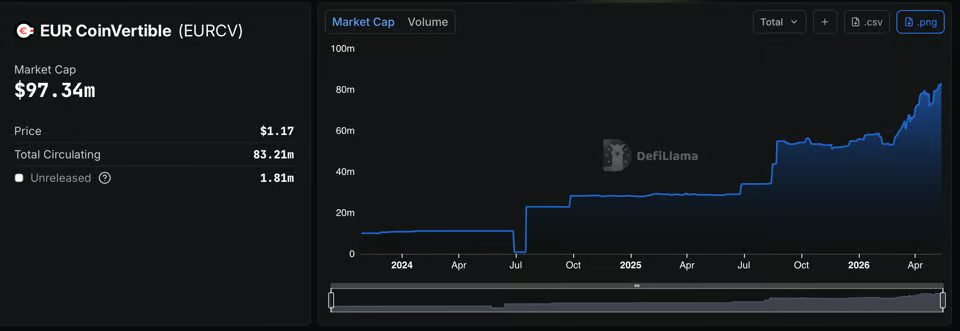
SG-FORGE launched its euro-denominated EURCV stablecoin in 2023 and introduced the US dollar-denominated USDCV stablecoin in 2025. Data from DeFiLlama shows EURCV has a market capitalization of about $97 million, while USDCV has roughly $20 million in circulation.
Last month, the bank integrated USDCV into the MetaMask wallet through a partnership with Consensys.

Source: DefiLlama
Related: Stablecoins won’t strengthen global role of euro, ECB’s Lagarde says
Financial institutions expand tokenized collateral infrastructure
The announcement comes as banks and financial institutions are expanding their use of blockchain-based systems for collateral management, repo financing and stablecoin settlement.
This week, JPMorgan filed to launch a tokenized money market fund on Ethereum through its Kinexys Digital Assets unit. The fund will invest in Treasury bills and overnight repurchase agreements collateralized by Treasurys or cash.
On Tuesday, The Depository Trust & Clearing Corporation said it will integrate infrastructure from Chainlink into its collateral management platform ahead of a planned 2026 launch to support tokenized collateral movement, valuation and settlement workflows. DTCC’s subsidiaries processed $4.7 quadrillion in securities transactions in 2025.
Separately, Broadridge Financial Solutions yesterday announced it expanded its infrastructure to support tokenized stocks, funds and money market instruments across trading and post-trade operations. The company said its distributed ledger repo platform tokenizes more than $365 billion in assets daily.
RWA.xyz data shows more than $31.6 billion worth of real-world assets, excluding stablecoins, are currently tokenized on blockchain networks. Tokenized US Treasury products account for the largest share of the market at more than $15.3 billion, followed by commodities at about $5.1 billion.

Snapshot of tokenized real-world assets. Source: RWA.xyz
Magazine: eToro founder timed Bitcoin top perfectly due to belief in 4 year cycles
The White House is reportedly weighing roughly 250 presidential pardons to mark America’s 250th birthday, the Wall Street Journal reports. Crypto’s most prominent legal cases are already running the numbers.
The plan remains preliminary. Yet it surfaces as Sam Bankman-Fried (SBF), Roger Ver, and other crypto defendants intensify their bids for clemency from Donald Trump.
A Pardon Pool Built for Symbolism
Trump has already issued more than 1,600 acts of clemency in his second term. That is several times more than the 250 he granted across his entire first term, and a meaningful share has flowed straight into the crypto industry.
In October 2025, the president pardoned Binance founder Changpeng Zhao after his guilty plea on anti-money laundering charges.
Earlier the same year, the BitMEX co-founders and Silk Road creator Ross Ulbricht received clemency of their own.
A symbolic batch of 250 pardons, packaged around Independence Day, would extend a pattern critics call transactional and supporters frame as a correction of past prosecutions.
“Ulbricht was sentenced to two life sentences, plus 40 years, a sentence worse than the worst drug sellers on the site,” wrote Collin Rugg.
Follow us on X to get the latest news as it happens
Who in Crypto Could Still Walk Free
Three names dominate the speculation. Sam Bankman-Fried, the convicted founder of FTX, has run a sustained public campaign for relief. Trump explicitly denied the request in January, but allies have not stopped lobbying.
While SBF’s pardon hopes have been dashed, Trump has signaled openness to clemency in other crypto-related cases. The President recently said he would “look at” the case of Samourai Wallet CEO Keonne Rodriguez.
Roger Ver, the early BTC backer widely called “Bitcoin Jesus,” has pushed harder than almost anyone. He hired political operative Roger Stone and recorded a direct video plea.
Elon Musk has reportedly explored backing his case as well, just like Ethereum co-founder Vitalik Buterin and other crypto leaders.
“Genuine good faith mistakes should be treated by giving the actor the opportunity to pay back taxes if needed with interest and penalties, not with prosecution,” Buterin proposed in reference to Roger Ver.
Joby Weeks, a miner who pleaded guilty to tax-related charges tied to a crypto scheme, is also seeking inclusion.
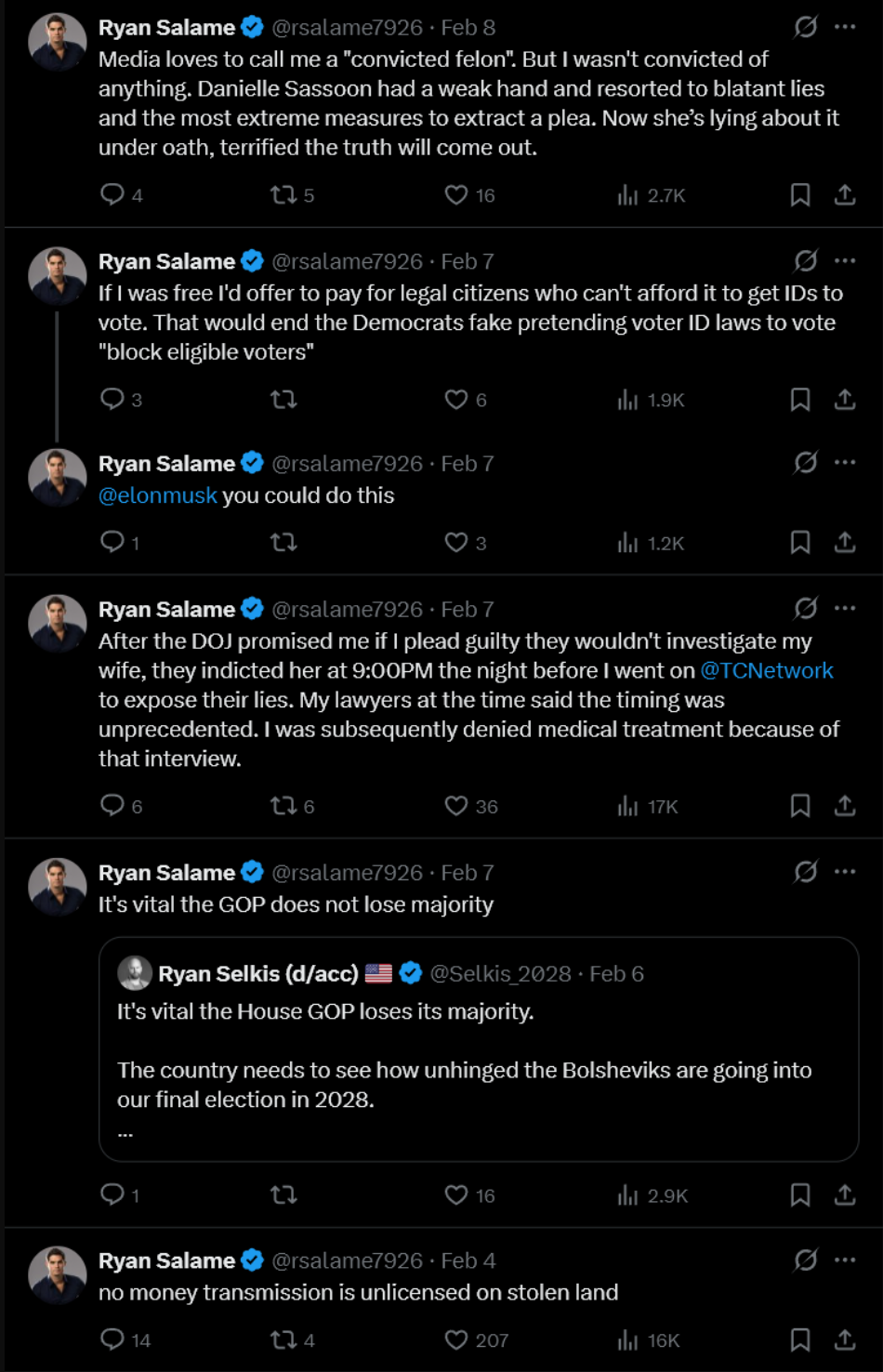
Former FTX executive Ryan Salame has openly aligned with MAGA messaging in his own quiet bid for relief.

Others have even called for extending clemency to Do Kwon, the embattled founder of the collapsed Terra/Luna ecosystem.
Meanwhile, Polymarket is already running a market for this development, with Ryan Salame (13%), SBF (11%), Do Kwon (9%) already in the list of prospects to be pardoned before 2027.

Why Summer 2026 Is the Window to Watch
The Senate is already investigating Trump’s crypto pardons. A bundled July 4 announcement would magnify scrutiny but also let the administration tuck clemency inside a celebratory national moment.
The stakes stretch beyond any single defendant, particularly for crypto. Each pardon resets how prosecutors and exchanges read the regulatory mood.
A symbolic 250 could send the loudest signal yet that the legal cost of running a crypto business has fundamentally shifted in the United States.
The final list, if it materializes, may surface in weeks rather than months. Which founder, hacker or trader earns a spot remains anybody’s guess.
The post Crypto Hopefuls Watch As Trump Weighs 250 Pardons for America’s 250th Birthday appeared first on BeInCrypto.
Key points:
- Bitcoin has reached a crucial support, as a break below the $79,000 level may deepen the pullback.
- Several major altcoins are facing selling pressure, indicating that the bears remain in the game.
Bitcoin (BTC) extended its pullback on Wednesday and slipped below the $80,000 level. However, analysts remain optimistic about BTC’s prospects in the near term.
Analyst CRG said in a post on X that BTC did not break above the Ichimoku cloud even once during the previous bear market, and when it did, a new bull market started. Interestingly, BTC has risen comfortably above the Ichimoku cloud, weakening the comparison with the previous bear market cycle.
Another bullish projection came from Maelstrom chief investment officer Arthur Hayes, who said in a Substack post that BTC “retaking the $126,000 is a foregone conclusion.” He expects BTC to pick up momentum after breaking above $90,000, where “many call over-writers will rush to cover as their strike gets taken out.”
Hayes expects the AI sector race with China and the ongoing war with Iran to result in money printing, benefitting the crypto ecosystem.
BTC’s bullish view is not shared by everyone. A BTC whale, known by the moniker ‘pension-usdt.eth,’ is short 1,000 BTC, worth roughly $81 million, with 3x leverage. The trade, which was opened when BTC was at $67,990, is down about $13 million, but the trader confirmed on X that he was still short as “the trade makes sense.”
Could BTC and the major altcoins rebound off their support levels? Let’s analyze the charts of the top-10 cryptocurrencies to find out.
Bitcoin price prediction
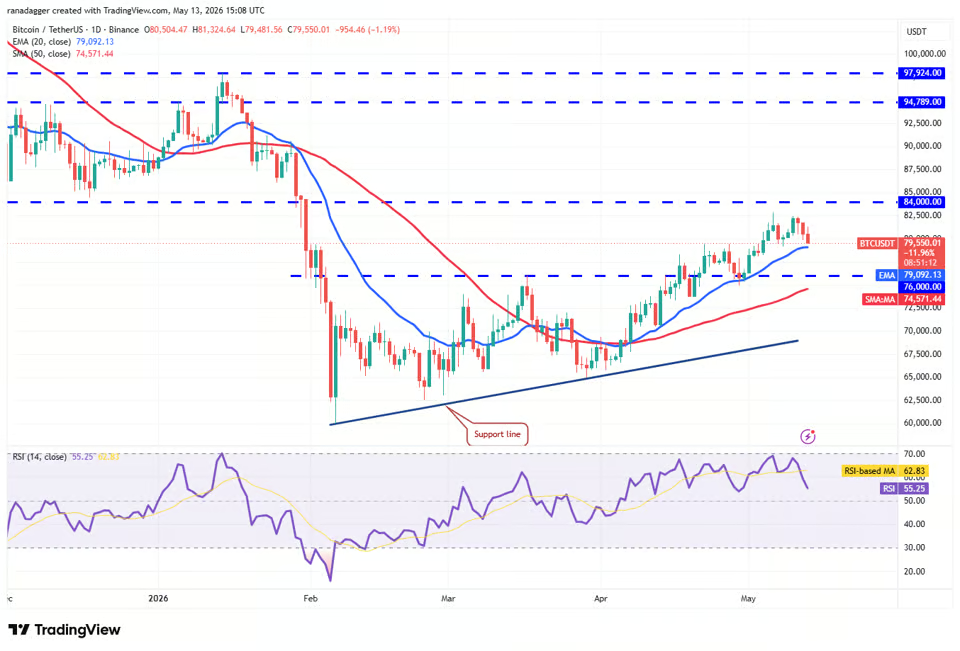
BTC has dipped to the 20-day exponential moving average ($79,092), which is a critical near-term support to watch.

BTC/USDT daily chart. Source: Cointelegraph/TradingView
If the price rebounds off the 20-day EMA with strength, the bulls will try to push the BTC/USDT pair above the $84,000 resistance. If they succeed, the BTC price is expected to pick up momentum and skyrocket toward $92,000 and subsequently to $97,924.
This bullish view will be invalidated in the near term if the price continues lower and breaks below the 20-day EMA. That suggests traders are booking profits. That may start a deeper pullback toward the 50-day simple moving average ($74,571) and later to the support line.
Ether price prediction
Ether (ETH) attempted to start a recovery from the 50-day SMA ($2,245), but the long wick on the candlestick shows selling at higher levels.

ETH/USDT daily chart. Source: Cointelegraph/TradingView
A break and close below the 50-day SMA opens the doors for a drop to the support line of the ascending channel pattern. Buyers are expected to fiercely defend the support line, as a close below it may sink the ETH/USDT pair to $1,916.
The first sign of strength will be a break and close above the $2,465 resistance. The ETH price may then ascend to the resistance line, which is a critical level to watch. A break above the resistance line may catapult the pair toward $3,050.
BNB price prediction
BNB (BNB) rebounded off the 20-day EMA ($643) on Tuesday and reached the $687 overhead resistance on Wednesday.

BNB/USDT daily chart. Source: Cointelegraph/TradingView
The upsloping 20-day EMA and the RSI near the overbought zone signal that the bulls have the upper hand. A close above the $687 level opens the doors for a rally to $730 and later to $790.
Sellers will have to tug the BNB price back below the 50-day SMA ($623) to weaken the bulls. If they manage to do that, the BNB/USDT pair may consolidate inside the $570 to $687 range for a while longer.
XRP price prediction
XRP (XRP) has been stuck between the downtrend line of the descending channel pattern and the moving averages for the past few days.

XRP/USDT daily chart. Source: Cointelegraph/TradingView
A tight consolidation below a crucial resistance suggests that the bulls are holding on to their positions as they anticipate an upside breakout. If the downtrend line is scaled, the XRP/USDT pair may surge to $1.61. Sellers are expected to defend the $1.61 level with all their might, as a close above it signals a potential trend change. The XRP price may then soar to $2.40.
Conversely, a close below the moving averages suggests that the bulls have given up. The pair may then descend to the $1.27 level, where the buyers are expected to step in.
Solana price prediction
Solana (SOL) turned down from the $98 resistance on Tuesday, indicating that the bears are active at higher levels.

SOL/USDT daily chart. Source: Cointelegraph/TradingView
The upsloping 20-day EMA ($89) and the RSI in the positive territory indicate an advantage to buyers. If the price rebounds off the 20-day EMA, the bulls will again attempt to pierce the $98 resistance. If they can pull it off, the SOL/USDT pair may climb to $106 and then to $117.
This positive view will be negated in the near term if the SOL price continues lower and breaks below the 20-day EMA. Such a move suggests that the pair may continue to oscillate between $76 and $98 for some more time.
Dogecoin price prediction
Dogecoin (DOGE) bounced off the 20-day EMA ($0.10) on Tuesday, indicating that the bulls are viewing the dips as a buying opportunity.

DOGE/USDT daily chart. Source: Cointelegraph/TradingView
The bulls tried to clear the $0.12 overhead hurdle but are facing significant resistance from the bears. However, if the bulls prevail, the DOGE/USDT pair may rally to $0.14 and subsequently to $0.16.
Sellers are likely to have other plans. They will attempt to defend the overhead resistance and pull the DOGE price back below the 20-day EMA. If they do that, the pair may extend its stay inside the $0.09 to $0.12 range for a few more days.
Hyperliquid price prediction
Hyperliquid (HYPE) continued lower and broke below the 50-day SMA ($40.55) on Tuesday, indicating profit-booking by short-term traders.

HYPE/USDT daily chart. Source: Cointelegraph/TradingView
If the price breaks below $38.70, it suggests that the HYPE/USDT pair may have topped out in the near term. The HYPE price may then tumble to $34.45.
Buyers have an uphill task ahead of them. Any recovery attempt is expected to face selling at the 20-day EMA ($41.56) and then in the $43.76 to $45.77 zone. The bulls will have to drive and sustain the price above the $45.77 level to signal the resumption of the up move. The pair may then surge to $50.
Related: Bitcoin to $100K in Q2? Strategy’s STRC unlocks potential to buy 3K BTC in two days
Cardano price prediction
Cardano’s (ADA) pullback is attempting to find support at the 20-day EMA ($0.26), but the bears continue to exert pressure.

ADA/USDT daily chart. Source: Cointelegraph/TradingView
If the price continues lower and breaks below the moving averages, it suggests that the ADA/USDT pair may remain inside the $0.22 to $0.31 range for a few more days.
Buyers will have to fiercely defend the moving averages and start a rebound off it to signal strength. The ADA price may then rise to $0.29 and later to $0.31. Sellers are expected to defend the $0.31 level, as a close above it indicates the start of a new up move. The pair may soar to $0.36 and eventually to the pattern target of $0.40.
Zcash price prediction
Zcash (ZEC) bounced off the $560 level on Tuesday, but the bulls could not sustain momentum on Wednesday.

ZEC/USDT daily chart. Source: Cointelegraph/TradingView
If the ZEC price closes below the breakout level of $560, it signals profit booking by short-term traders. The ZEC/USDT pair may then slump to the 20-day EMA ($481). A deeper correction to $400 may begin if the 20-day EMA cracks.
Contrarily, if the price bounces off the 20-day EMA with force, it suggests that the bulls remain in charge. Buyers will then make one more attempt to drive the price above the $643 level. If they succeed, the pair may surge to $750.
Bitcoin Cash price prediction
Bitcoin Cash (BCH) fell below the moving averages and the $443 support on Tuesday, indicating that the bears have an edge.

BCH/USDT daily chart. Source: Cointelegraph/TradingView
Sellers will attempt to pull the BCH price to the solid support at $419. Buyers are expected to aggressively defend the $419 level, as a close below it may resume the downtrend. The next stop on the downside may be $375.
Instead, if the price turns up sharply from $419 and breaks above the moving averages, it suggests that the BCH/USDT pair may remain range-bound for some more time. Buyers will be back in the driver’s seat on a close above $486.
Crypto World
UnitedHealth Group (UNH) Stock Surges to 52-Week Peak Following Impressive Q1 Performance

Key Takeaways
- UNH reached a 52-week peak of $404.14 mid-week, climbing approximately 30% in the last 30 days
- First quarter revenues totaled $111.7 billion, representing a 2% annual increase, while adjusted EPS exceeded forecasts at $7.23
- Operating margins at UnitedHealthcare expanded from 6.2% to 6.6% during the first quarter
- The company’s Medical Care Ratio declined to 83.9% in Q1, a significant improvement from the previous quarter’s 88.9%
- Strategic reduction of 1.3 million Medicare Advantage members in 2026 aims to preserve profitability
UnitedHealth Group (UNH) reached a 52-week peak of $404.14 during Wednesday’s trading session, concluding an impressive rally that pushed shares up approximately 30% during the previous month.
UnitedHealth Group Incorporated, UNH
For the current year, UNH has advanced roughly 21%. Looking at the trailing twelve-month period, the stock has delivered gains of about 29%.
This upward momentum represents a dramatic reversal from earlier weakness. Between January and late March, shares tumbled from $336 down to $259 — representing approximately a 23% decline.
The turnaround gained momentum following UnitedHealth’s first quarter earnings report in late April, which surpassed Wall Street estimates and included an upward revision to full-year guidance.
First quarter revenues reached $111.7 billion, marking a 2% year-over-year expansion. Adjusted earnings per share landed at $7.23, exceeding analyst projections. Reported EPS registered at $6.90.
UnitedHealthcare’s operating margins expanded from 6.2% to 6.6%, representing a modest yet significant enhancement for an organization navigating a transitional phase.
Medicare Advantage Continues to Present Challenges
Medicare Advantage has emerged as one of the more prominent headwinds for UNH. Federal reimbursement rates have failed to match the acceleration in program expenses, creating margin compression in recent years.
To address this dynamic, UnitedHealth strategically reduced its Medicare Advantage enrollment by 1.3 million participants for 2026. While challenging, leadership characterized this decision as essential for maintaining long-term financial health.
The financial results are reflecting this strategic shift. UnitedHealth’s Medical Care Ratio — representing the portion of premium revenue allocated to claims payments — dropped to 83.9% in Q1, compared to 88.9% in the fourth quarter of 2025.
This substantial quarter-over-quarter improvement indicates the enrollment reductions are already positively impacting the company’s cost profile.
Early 2025 Presented a Contrasting Scenario
The start of 2025 proved turbulent. UnitedHealth experienced significant selling pressure in early January following disappointing fourth quarter 2024 results and a Centers for Medicare & Medicaid Services proposal for Medicare Advantage rate adjustments that fell short of industry expectations.
The organization has additionally navigated executive transitions and an active antitrust review. While these concerns persist, market participants currently appear focused on operational performance rather than these ongoing issues.
At its current valuation near $400, UNH offers a dividend yield of approximately 2.3%, with a market capitalization hovering around $360 billion.
The stock’s 52-week trading range extends from $234.60 to $404.15 — with Wednesday’s high matching the upper boundary of that range.
Wednesday’s volume registered approximately 4.8 million shares, trailing the average daily volume of 8.5 million, indicating the advance occurred without exceptional trading activity.
UNH closed Wednesday’s session at $400.38 according to the most recent available pricing data.
Key Takeaways
- OpenAI CEO Sam Altman delivered approximately 4 hours of testimony in the federal lawsuit filed by Elon Musk in Oakland, California
- Altman maintained that Musk left OpenAI voluntarily, contradicting Musk’s allegations of a stolen charitable mission
- According to Altman, Musk demanded complete majority ownership of OpenAI, a proposal that left him “extremely uncomfortable”
- Defense attorneys questioned Altman’s credibility, referencing previous allegations of dishonesty from former colleagues
- The trial moves to closing statements on Thursday; the jury will provide an advisory verdict only
Sam Altman, CEO of OpenAI, appeared in federal court on Tuesday to defend against claims made by Elon Musk that he and fellow executives undermined OpenAI’s foundational nonprofit principles.
During his roughly four-hour testimony at the Oakland, California federal courthouse, Altman presented a clear counternarrative: rather than having his charitable endeavor taken from him, Musk chose to walk away from the project.
“We were kind of left for dead,” Altman stated during his testimony.
The legal proceedings originated from a 2024 complaint filed by Musk against OpenAI, Altman, and Greg Brockman, OpenAI’s president. Musk alleges that this trio diverted the organization from its initial nonprofit framework. Additionally, he contends that his approximately $38 million in contributions were redirected toward commercial ventures without his consent.
Altman denied making any commitments to Musk regarding maintaining OpenAI’s nonprofit status. He characterized their relationship as one marked by fundamental disagreements over strategic direction, ultimately leading to Musk’s complete loss of confidence in the organization.
To support his account, Altman referenced a December 2018 email from Musk stating: “My probability assessment of OpenAI being relevant to DeepMind/Google without a dramatic change in execution and resources is 0%. Not 1%.”
Altman emphasized these words were “burned into my memory.”
The Battle Over Ownership
A significant portion of Altman’s court appearance centered on Musk’s insistence on securing majority ownership of any for-profit iteration of OpenAI. According to Altman, Musk demanded controlling authority while making only vague references to potentially reducing his stake in the future.
Altman expressed skepticism about this happening. “My belief is he wanted to have long-term control,” he told the court.
He recounted what he characterized as a “hair-raising” exchange. When fellow co-founders questioned what would become of OpenAI should Musk pass away while maintaining control, Musk allegedly responded casually, suggesting his children could potentially inherit his stake.
Altman emphasized that OpenAI’s founding principle centered on preventing any individual from controlling artificial general intelligence. This made Musk’s ownership demands fundamentally incompatible with the organization’s values.
During negotiations, Musk floated the idea of combining OpenAI with Tesla. Altman declined, arguing that Tesla’s identity as an automotive manufacturer made it unsuitable for advancing OpenAI’s objectives.
Musk officially departed from OpenAI’s board in February 2018. Altman testified that staff reactions were mixed, with some experiencing a “morale boost,” while others feared Musk might pursue “vengeance.”
Defense Targets Altman’s Trustworthiness
Steven Molo, representing Musk, utilized cross-examination to cast doubt on Altman’s reliability. His questioning began bluntly: “Are you completely trustworthy?” Altman initially responded “I believe so,” before modifying his answer to an unqualified yes.
Molo highlighted previous accusations from former associates, including Dario Amodei, who founded Anthropic, and cited Monday’s testimony from Ilya Sutskever, OpenAI’s former chief scientist. Sutskever claimed to have documented what he characterized as recurring instances of dishonesty by Altman.
Altman also discussed his temporary 2023 ouster as CEO. He described the experience as an “incredible betrayal” and noted that board members offered minimal justification beyond claiming he hadn’t been forthcoming with them.
“I had poured the last years of my life into this,” Altman testified. “I was watching it about to be destroyed.”
OpenAI currently carries a valuation exceeding $850 billion according to private market investors. Musk’s lawsuit seeks the removal of both Altman and Brockman, along with redirecting over $130 billion to OpenAI’s nonprofit foundation. Final arguments are set for Thursday. The jury will deliver an advisory opinion, with final authority resting with Judge Yvonne Gonzalez Rogers.

Fidelity builds Moody’s-rated tokenized fund on Chainlink

The Netflix Sci-Fi Thriller Series Battlestar Galactica Fans Need To Check Out

How To Start Trading Crypto As A Beginner In 2026

Manchester United reach agreement with Casemiro over contract clause amid transfer speculation

US brings back mandatory military draft registration

Steven Gerrard disagrees with Gary Neville over ‘shock’ Chelsea and Arsenal claim | Football


-
 Crypto World5 days ago
HarrisX Poll Found 52% of Registered Voters Support the CLARITY Act
-

 Fashion5 days ago
Weekend Open Thread: Marianne Dress
-

 Crypto World6 days ago
Upbit adds B3 Korean won pair as Base token gains Korea access
-
 NewsBeat6 days ago
NCP car park operator enters administration putting 340 UK sites at risk of closure
-

 Fashion2 days ago
Coffee Break: Travel Steam Iron
-

 Fashion3 days ago
What to Know Before Buying a Curling Wand or Curling Iron
-

 Tech4 days ago
Auto Enthusiast Carves Functional Two-Stroke Engine from Solid Metal
-

 Politics2 days ago
What to expect when you’re expecting a budget
-
 Business4 days ago
Ignore market noise, India’s long-term story intact, say D-Street bulls Ramesh Damani and Sunil Singhania
-

 Politics5 days ago
Politics Home Article | Starmer Enters The Danger Zone
-

 Tech3 days ago
GM Agrees To Pay $12.75 Million To Settle California Lawsuit Over Misuse Of Customers’ Driving Data
-

 Politics6 days ago
Simon Cowell Says He Was ‘Horrible’ To Susan Boyle During BGT Audition
-

 Entertainment7 days ago
Sarah Paulson Called Out For Met Gala ‘Hypocrisy’
-

 Entertainment6 days ago
General Hospital: Ric & Ava Bombshell – Ric’s Massive Secret Exposed!
-

 Crypto World7 days ago
Robinhood says Wall Street is building onchain
-

 Entertainment7 days ago
Bold and Beautiful Early Spoilers May 11-15: Steffy Revolted & Liam Overjoyed!
-

 Sports7 days ago
UEFA Champions League final schedule, teams, venue, live time and streaming | Football News
-

 Entertainment6 days ago
Why David Letterman Called CBS ‘Lying Weasels’
-

 Fashion7 days ago
The Best Work Pants for Women in 2026
-
 Sports7 days ago
Mike Tyson speaks out on status of Floyd Mayweather fight
You must be logged in to post a comment Login