NEW YORK — Starbucks Corp. shares slipped in midday trading Tuesday, falling 1.62% to $97.35 as investors grew cautious ahead of the coffee giant’s fiscal second-quarter 2026 earnings report scheduled for April 28, with concerns over slowing same-store sales growth and ongoing challenges in China weighing on sentiment.
At 12:24 p.m. EDT, SBUX stock had declined $1.60 from the previous close amid moderate volume. The modest pullback followed a period of relative stability in recent sessions, with shares trading near $98-100 after recovering from earlier 2026 lows. The stock remains down significantly from its all-time highs above $110 in 2021, reflecting persistent pressure on the company’s core business amid shifting consumer habits and heightened competition.
The upcoming earnings report, set for release after market close on April 28 with a conference call at 1:15 p.m. Pacific Time, has become a focal point. Analysts expect revenue around $9.1 billion to $9.3 billion for the quarter ended March 30, 2026, with adjusted earnings per share near $0.59 to $0.65. Consensus forecasts suggest continued softness in comparable store sales, particularly in North America and China, where same-store sales have faced headwinds from cautious consumer spending and competitive pricing.
Starbucks has been working to stabilize its business under CEO Brian Niccol, who took the helm in 2025. The company has introduced new menu items, including Energy Refreshers launched in early April, spring beverages with ube, coconut and lavender flavors, and enhancements to its rewards program aimed at boosting partner (employee) retention and customer loyalty. A new incentive rewards program rolled out in April seeks to share more success with hourly partners through improved pay and benefits, starting in July.
Advertisement
Despite these initiatives, traffic and transaction trends remain mixed. In China — once a key growth engine — same-store sales have struggled with economic slowdown and intense local competition. North American same-store sales have shown modest improvement in some periods but continue to face pressure from inflation-weary consumers trading down or visiting less frequently. The company has responded with value-focused promotions, new afternoon refreshment options and store remodels, including plans to refresh 1,000 locations in 2026.
Starbucks also announced a joint venture with Boyu Capital to accelerate long-term growth in China and is exploring supply chain optimizations, including a new office presence in Nashville, Tennessee, for certain teams. These moves signal a broader effort to improve efficiency and adapt to changing market dynamics. However, union-related labor disputes continue in some U.S. markets, adding another layer of complexity.
The stock’s recent performance reflects a market that remains skeptical about the speed of recovery. While new menu items and rewards enhancements have generated buzz — particularly the April Energy Refreshers and limited-time spring offerings — investors are waiting for concrete evidence of sustained traffic growth and margin expansion in the upcoming report.
Analysts have mixed views heading into earnings. Some maintain Hold ratings, citing valuation concerns and the need for clearer signs of turnaround. Others see potential upside if Starbucks can demonstrate progress on same-store sales, partner retention and China stabilization. The average price target sits modestly above current levels, though forecasts vary widely depending on assumptions about consumer spending and competitive intensity.
Advertisement
Broader market context on Tuesday showed selective strength in consumer discretionary names, but Starbucks traded lower as investors rotated away from names facing near-term uncertainty. The Dow Jones Industrial Average advanced modestly, while other restaurant and retail stocks showed mixed results.
For Starbucks, the path forward involves balancing innovation with cost control. The company has invested in digital ordering, loyalty enhancements and new beverage platforms to drive afternoon and evening traffic. Yet rising labor and commodity costs continue to pressure margins, making operational efficiency critical.
Longer-term tailwinds include the global appeal of the Starbucks brand, expansion opportunities in emerging markets and potential benefits from a more normalized interest rate environment that could support consumer spending. However, near-term risks include further economic slowdown, intensified competition from local coffee chains and execution challenges on store refresh and menu strategies.
Retail investors have shown divided sentiment. Some see the current price as an attractive entry point for a recovery play, citing the company’s strong brand equity and cash-generating ability. Others remain wary, pointing to repeated misses on same-store sales targets in recent quarters and the heavy lifting required to reignite growth.
Advertisement
As midday trading continued, volume remained steady without the extreme spikes seen during major news events. Options activity suggested measured positioning ahead of earnings, with implied volatility indicating expectations for a meaningful post-report move — potentially 6-8% in either direction based on historical patterns.
Starbucks operates more than 40,000 stores globally, with a significant presence in the U.S., China and other international markets. The company has faced scrutiny over store closures in underperforming locations and strategic shifts in its approach to third-place experiences versus convenience-driven purchases.
The upcoming Q2 report will also provide updates on progress with the new rewards program, partner incentives and any color on full-year guidance. Management has previously emphasized a multi-year transformation focused on restoring growth, improving margins and enhancing the customer and partner experience.
Tuesday’s 1.62% decline appears largely anticipatory, with investors locking in gains or reducing exposure ahead of what could be a pivotal earnings update. Whether the stock rebounds or faces further pressure will depend heavily on the tone and specifics shared on April 28.
Advertisement
For a company that once enjoyed near-uninterrupted growth, the current environment demands disciplined execution and clear communication. Starbucks remains a cultural icon with enormous brand loyalty, but translating that into consistent financial results has proven challenging in recent years.
As the clock ticks toward the April 28 earnings release, all eyes are on whether Starbucks can demonstrate tangible progress or if headwinds will persist. In the meantime, the modest midday dip serves as a reminder of the uncertainty surrounding consumer-facing stocks in an uneven economic recovery.
HM Revenue and Customs has confirmed it will appeal against a First-Tier Tribunal ruling that would cut VAT on public electric vehicle charging from 20% to 5%, in a decision that has drawn stinging criticism from charge point operators, campaigners and SME-led infrastructure businesses across the country.
The ruling, handed down last month, followed a case brought by Charge My Street, a not-for-profit charging operator, which argued successfully that electricity supplied through public chargers should fall within the reduced 5% rate applied to domestic electricity use. Judge Harriet Morgan found that applying the standard 20% rate was a “strained construction” of the VAT Act, which treats electricity as being for domestic use provided a single user does not consume more than 1,000 kilowatt hours at one premises in a given month, enough, in practical terms, to recharge a Tesla Model Y sixteen times over.
That finding, uncovered after accountancy firm Deloitte spotted the discrepancy and worked pro bono alongside Charge My Street, offered the clearest hope in years that the long-standing gulf between home and public charging costs might finally close. Three days of tribunal argument turned on the interpretation of a handful of words, notably “a month” and “premises”, before the judge came down firmly against HMRC’s position.
The Treasury, however, has no intention of conceding. In a statement on Tuesday, an HMRC spokesperson said: “We’re appealing this case, as our position is that standard rate VAT applies to electricity supplied through public EV charging infrastructure.”
For drivers, the stakes are considerable. Those fortunate enough to have a driveway pay 5% VAT when charging at home; the estimated 40% of UK households without off-street parking are stung with 20% at public chargers, four times the rate for what is, electrically speaking, identical electricity. In some cases, industry figures note, running an EV on public charging alone can cost up to ten times more per mile than charging at home, eroding the very economic case government policy relies upon to accelerate the switch from petrol and diesel.
Advertisement
According to calculations by charger-mapping company Zapmap, the VAT differential currently nets the Treasury roughly £85m a year. That figure is projected to climb to £315m by 2030 and into the billions thereafter as the national EV fleet scales. Against a fiscal backdrop strained by the Iran conflict, mounting pressure to scrap a planned fuel duty increase, and the government’s own commitment to introduce pay-per-mile taxation on electric cars, ministers are evidently reluctant to surrender a growing revenue stream to replace the £24.5bn currently generated annually by fuel duty.
The appeal has triggered an unusually unified response from an industry more often given to commercial rivalry than common cause.
Will Maden, director at Charge My Street, was blunt: “About 40% of the UK population, they don’t have drives. Transitioning to EVs is a huge problem. Adding 20% makes a huge difference. My personal view is we should be making the transition to EVs as cheap as we can. This is an environmental issue.”
John Lewis, chief executive of charge point operator char.gy, described the appeal as “a deeply disappointing decision, and one that sends entirely the wrong signal to the millions of people who rely on public charging.” Lewis confirmed his firm would pass any eventual VAT cut straight through to customers, adding that “the government talks about accelerating EV adoption, yet is actively choosing to maintain a tax structure that makes public charging more expensive than it needs to be and undermines the transition.”
Advertisement
Tanya Sinclair, chief executive of Electric Vehicles UK, accused ministers of defending inequality by proxy: “Drivers without off-street parking already pay more to charge simply because of where they live. HMRC appealing this ruling is the government choosing to defend that inequality. If you’re serious about EV adoption, you don’t fight the ruling that would fix your most regressive charging cost.”
Ginny Buckley, chief executive of Electrifying.com, questioned the political optics. “For a government that talks about standing up for ‘working people’, the decision to appeal flies in the face of that,” she said. “This hits those without driveways the hardest, making it more expensive for them to switch, and in some cases, that makes EVs more expensive to run than petrol.”
Warren Philips, campaign lead at FairCharge, which has spearheaded the lobbying effort, called the appeal indefensible: “People unable to charge at home pay four times the VAT rate of their neighbours for identical electricity. By appealing, the government is telling 1.4 million current EV drivers, and more than 30 million who will have to switch, that it is willing to go to court to keep public charging costs high.”
The tribunal ruling, for now, binds only Charge My Street. Should HMRC’s appeal fail at the Upper Tribunal, however, the floodgates will open: operators across the sector are understood to be preparing claims for overpaid VAT stretching back years, a liability that could run into hundreds of millions of pounds.
Advertisement
For the UK’s SME charge point operators, many of them small, founder-led businesses already grappling with grid connection delays, planning bottlenecks and capital costs, the appeal represents more than a fiscal irritation. It is, in their view, a test of whether Whitehall is serious about the commercial foundations of the net zero transition, or merely content to talk about them.
Jamie Young
Jamie is Senior Reporter at Business Matters, bringing over a decade of experience in UK SME business reporting.
Jamie holds a degree in Business Administration and regularly participates in industry conferences and workshops.
When not reporting on the latest business developments, Jamie is passionate about mentoring up-and-coming journalists and entrepreneurs to inspire the next generation of business leaders.
The architects who will design the hotel are behind other luxury accommodation in Chelsea, Fitzrovia, Bristol, Battersea, and Chester
A rendering of the hotel(Image: Paul Treacy Architects)
Planning permission has been granted for the construction of a new four-star hotel in the heart of Cardiff. The council has granted permission to J. B. S. L. Holdings Ltd for the remodelling and change of use of part of the existing building at 125-139 Queen Street in Cardiff.
The plans relate to part of the large building opposite the Capitol Centre at the end of Queen Street where Newport Road becomes Dumfries Place. Plans also include a new three-storey extension plus a roof-top pavilion containing a fine dining restaurant and sky-bar.
The top floors of the hotel(Image: Paul Treacy Architects)
Another view of the hotel(Image: Paul Treacy Architects)
According to the application, the development aims to provide 158 high-quality four-star rooms for visitors to Cardiff while “enhancing the streetscape and contributing positively to the local economy”. Never miss a Cardiff story by signing up to our daily newsletter here
The sky bar and fine dining restaurant are envisioned as “flexible multi-functional spaces that can accommodate various dining and social experiences and be used by hotel guests and visitors alike”.
Advertisement
Its internal design is said to maximise views with “carefully positioned” seating areas that “offer panoramic perspectives of the surrounding cityscape”.
This ensures that “every guest experience is enhanced by the exceptional visual connectivity and spatial quality of the top floor”.
The hotel’s design is said to be inspired by the “historic architecture of Cardiff and the existing buildings’ art deco inspiration ” but with a “modern and contemporary twist”.
The hotel will also offer a range of facilities and services including a lobby, reception area, access to the sky bar and restaurant and fitness centre.
Advertisement
This ensures “guests have access to everything they need for a pleasant and enjoyable stay”.
Paul Treacy Architects has been hired to design the new hotel. Previously it has designed luxury hotels in Chelsea, Fitzrovia, Bristol, Battersea, and Chester.
Sustainability is said to be a “core” aspect of the development incorporating features such as green roofs, solar panels, and “energy-efficient building systems to minimise environmental impact and promote overall energy efficiency”.
“Innovative” approaches to waste management and water usage will also further enhance the project’s sustainability credentials, it’s stated.
Advertisement
Access to the hotel and sky bar will primarily be from Queen Street to ensure “pedestrian traffic flows seamlessly”.
The application reads: “The proposed hotel development represents a significant opportunity to contribute positively to the built environment of Cardiff while meeting the growing demand for hotel accommodation in the area”.
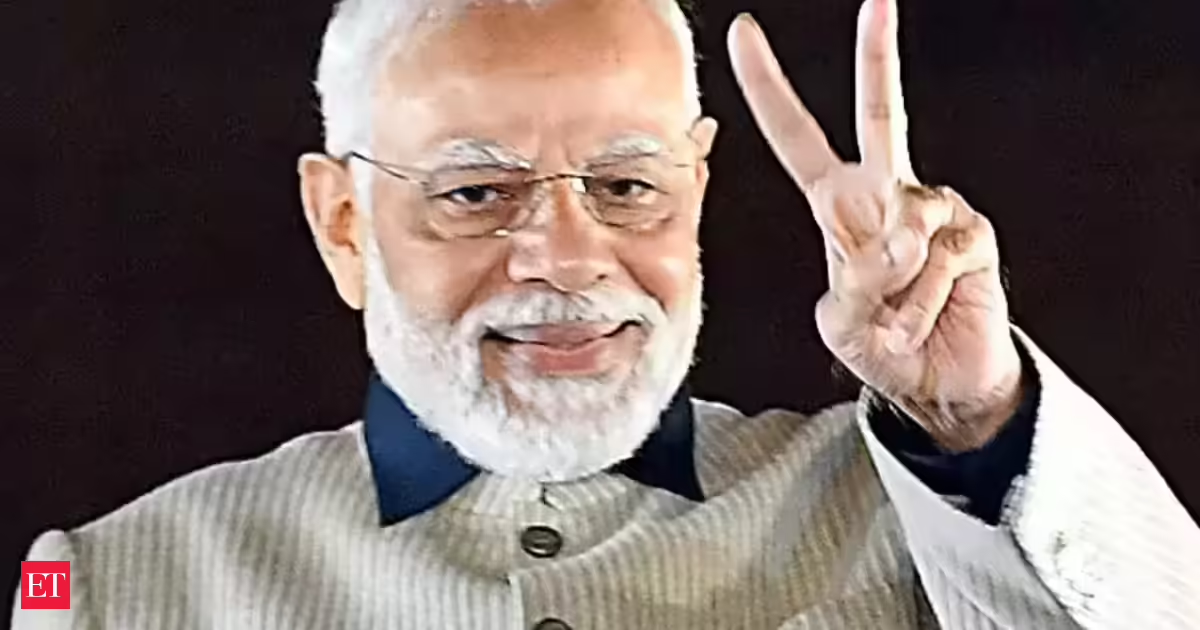
Ahmedabad: The charisma of Prime Minister Narendra Modi is among the key factors most likely to influence voters in the ensuing Lok Sabha elections in Gujarat, according to political observers.
Lok Sabha polls in Gujarat will be held in a single phase on May 7. Counting of votes will be held on June 4. Anti-incumbency, unemployment, inflation, education and healthcare facilities are some of the other important issues in the election, where the ruling BJP in Gujarat will attempt to retain all the 26 Lok Sabha seats it won in 2019.
Gujarat is among the states which will play a crucial role in deciding the outcome of the elections to the Lower House of Parliament. In the 2014 and 2019 Lok Sabha elections, the Bharatiya Janata Party won all the 26 seats in the state.
Here are some issues that will play a decisive role in the elections in Gujarat:
PM Narendra Modi’s charisma: The ruling BJP has a trump card in the form of the prime minister, who hails from Gujarat and was its chief minister from 2001 to 2014 before occupying the top post of the country. His sway over the followers in his home state is still intact. Anti-incumbency: Observers feel that the opposition will try to take advantage of any anti-incumbency sentiment during the last 10 years of BJP rule at the Centre. They feel that “floating voters” who do not vote on the basis of ideology can be swayed by the opposition if they offer proper alternatives.
Advertisement
Live Events
Inflation: Low and middle-income households are the worst-affected in terms of the effects of inflation. So this will be a decisive factor considering how the price rise has impacted the lives of people in the last 10 years. The opposition has been constantly targeting the Modi government over this issue. Unemployment: This is another point that the opposition parties have been using to hit out at the Centre. Since this issue directly affects the lives of common people, this will be high on the mind of voters when they exercise their franchise. Lack of basic education and health facilities in remote areas: If school classrooms are constructed in remote rural areas, there is a dearth of teachers. The lack of primary health centres and doctors also adversely affects health services in rural pockets. Farmers’ issues: Issues like lack of adequate compensation for crop loss due to excess rains, non-availability of fertilisers and land acquisition for project development will also play a major role in affecting voter sentiment, the observers said.
Good day, and thank you for standing by. Welcome to the Vicor First Quarter 2026 Earnings Conference Call. [Operator Instructions] Please be advised that today’s conference is being recorded.
I would now like to hand the conference over to your speaker today, Jim Schmidt, Chief Financial Officer. Please go ahead.
Advertisement
James Schmidt Corporate VP, CFO, Treasurer, Corporate Secretary & Director
Thank you. Good morning, and welcome to Vicor Corporation’s Earnings Call for the first quarter ended March 31, 2026. I’m Jim Schmidt, Chief Financial Officer, and I’m in Andover with Patrizio Vinciarelli, Chief Executive Officer; and Phil Davies, Corporate Vice President, Global Sales and Marketing.
Earlier this morning, we issued a press release summarizing our financial results for the 3 months ended March 31, 2026. This press release has been posted on the Investor Relations page of our website, www.vicorpower.com. We also filed a Form 8-K today related to the issuance of this press release. I remind listeners this conference call is being recorded and is the copyrighted property of Vicor Corporation. I also remind you various remarks we make during this call may constitute forward-looking statements for the purposes of the safe harbor provisions under the Private Securities Litigation Reform Act of 1995.
Except for historical information contained in this call, the matters discussed on this call, including
Liquidators of Andrew Donnelly-linked Profounder Turfmaster have been cleared to enter into a funding agreement as they navigate the company’s estimated $3.7 million debt.
The chief executive of the Celtic Freeport has stepped down from her role less than two years after first taking the job.
Advertisement
The Celtic Freeport, which covers the ports of Milford Haven and Port Talbot and benefits from a number of UK Government funded tax breaks and incentives, has confirmed that Brazilian Luciana Ciubotariu had stood down.
While no further detail on the resignation was given, a representative speaking on behalf of the Celtic Freeport board thanked her for her contribution to the development of the Celtic Freeport, and wished her every success in the future.
Ms Ciubotariu, who was formerly part of the senior management team of the Thames Freeport in London, started her role in May 2024, where she headed up the early foundation stages of the Welsh freeport plans.
Advertisement
The move comes just weeks after Neath Port Talbot Council agreed to enter a memorandum of understanding with the UK and Welsh Governments, Pembrokeshire County Council, and Celtic Freeport Company Limited.
This was intended to formalise the authority as the accountable body for the freeport moving forward as it enters its “delivery phase”.
A statement released by the Freeport said: “During her time as chief executive, Luciana led the organisation through the approval of its full business case and the signing of a Memorandum of Understanding with the UK Government and Welsh Government.
“This will unlock £25m of public investment for the Celtic Freeport and represents a significant milestone in the wider investment programme across the region.
Advertisement
“The Celtic Freeport Board would like to thank Luciana for her contribution to the development of the Celtic Freeport and wishes her every success in the future.”
LOS ANGELES — The long-awaited Michael Jackson biopic “Michael” hit theaters with a star-studded premiere and mixed early reactions Tuesday, offering dazzling musical sequences and a breakout performance by Jaafar Jackson while drawing criticism for its sanitized portrayal of the King of Pop’s complicated life.
Directed by Antoine Fuqua and written by John Logan, the film traces Jackson’s journey from child prodigy in the Jackson 5 to global superstar through the release of his landmark 1982 album “Thriller.” Produced with the cooperation of the Michael Jackson Estate and distributed by Lionsgate, “Michael” arrives in theaters Friday after a world premiere in Berlin on April 10 and a high-profile U.S. premiere in Los Angeles on Monday night.
Jaafar Jackson, Michael’s nephew, stars as the adult version of the icon, delivering what many early viewers called a “tremendous” and “mesmerizing” performance that captures his uncle’s mannerisms, vulnerability and stage presence. Young Michael is portrayed by Juliano Krue Valdi, who also earned praise for his portrayal of the child star. Supporting roles include Colman Domingo as the stern patriarch Joe Jackson, Nia Long as Katherine Jackson, Miles Teller as manager John Branca, and appearances by Laura Harrier, Larenz Tate and others.
Advertisement
Early reactions from the Los Angeles premiere and select critics highlighted the film’s strengths in recreating iconic performances. The “Thriller” and “Beat It” sequences reportedly feature impressive choreography and visual spectacle, with Jaafar Jackson’s dancing and singing earning comparisons to the original. Reviewers described the musical numbers as “off-the-charts” and “electrifying,” providing the emotional high points that fans have anticipated.
However, several critics noted the film’s decision to avoid the most controversial chapters of Jackson’s life. The narrative stops in the mid-1980s, before the major child abuse allegations surfaced, and reshoots reportedly removed references to those events due to legal constraints from a 1994 settlement. Some reviewers called the approach “saccharine” and “reverential,” likening it to a “bland daytime TV movie” that prioritizes celebration over complexity. One critic described it as “terrified to explore the interiority” of its subject, offering little new insight beyond familiar highlights.
Fuqua, known for intense dramas like “Training Day,” opts for a straightforward chronological structure rather than a bold reinterpretation. The film humanizes Jackson through quieter family moments and his struggles with fame and his father’s expectations, but many felt it played things too safely. The estate-backed production emphasizes the music, legacy and artistry, presenting Jackson as a visionary entertainer whose personal struggles are acknowledged but not deeply examined.
The $200 million production faced multiple delays and reshoots, including 22 additional days of filming in 2025 that reportedly cost $10 million to $15 million. These changes, along with a shift from an initial 2025 release to April 24, 2026, fueled speculation about creative differences and legal hurdles. Some reports suggested the final cut functions as “Part One,” with potential sequels exploring later chapters.
Advertisement
Despite the controversies, many fans and early audience members left theaters impressed by the spectacle and emotional payoff. Social media buzzed with praise for Jaafar Jackson’s transformation, with some calling it a “breakout performance” that makes viewers “forget he isn’t the real thing.” The film’s respectful tone and focus on Jackson’s genius resonated with those seeking a celebratory tribute rather than a critical exposé.
Critics’ scores remain mixed ahead of wide reviews dropping Wednesday. Positive voices highlight the musical excellence and Jaafar Jackson’s commitment, while detractors argue the film glosses over Jackson’s complexities, resulting in a polished but shallow biopic. The approach mirrors other estate-approved projects that prioritize legacy preservation over unflinching examination.
For Jackson’s global fanbase, known as the Army of Love, the film offers a chance to relive the magic of his early career on the big screen. The recreation of Motown performances, the rise to “Thriller” dominance and the cultural impact of breaking MTV barriers provide nostalgic satisfaction. Yet for those hoping for a nuanced exploration of fame’s toll, the absence of later controversies leaves a noticeable gap.
Director Fuqua aimed to capture both the showman and the sensitive artist behind the hits. The film includes tender scenes of family life in Gary, Indiana, and Jackson’s drive to innovate, but stops short of the scandals that defined much of his later public image. Producers, including Graham King (known for “Bohemian Rhapsody”), positioned the project as a tribute to the music and legacy rather than a definitive biography.
Advertisement
The cast’s dedication shines through. Jaafar Jackson trained extensively to embody his uncle’s voice, dance moves and emotional depth, drawing from family stories and archival footage. Domingo brings simmering intensity to Joe Jackson, portraying the demanding father whose influence shaped Michael’s ambition and insecurities. Nia Long adds warmth as Katherine, grounding the family dynamic.
Visually, the film leans into cinematic spectacle with vibrant recreations of iconic videos and performances. Cinematography and choreography aim to transport audiences to the height of Jackson’s creative peak, complete with moonwalks, glove spins and crowd hysteria.
As “Michael” prepares for wide release, it faces the challenge of satisfying both devoted fans eager for celebration and broader audiences seeking deeper insight. The estate’s involvement ensures a protective lens, but some critics argue this limits the film’s dramatic potential and cultural resonance.
Early box office projections suggest strong opening weekend interest, particularly among fans nostalgic for Jackson’s unparalleled showmanship. International appeal remains high given Jackson’s global icon status.
Advertisement
The film arrives amid ongoing conversations about separating Jackson’s art from his personal controversies. By focusing on the pre-1990s era, “Michael” sidesteps much of that debate, presenting a version of the story centered on talent, perseverance and groundbreaking success.
Whether the biopic changes minds or reinforces existing views remains to be seen. For many, Jaafar Jackson’s performance alone justifies the ticket price, delivering a heartfelt homage to one of music’s most influential figures.
As reviews roll in and audiences experience the film this weekend, “Michael” stands as both a lavish tribute and a reminder of the challenges in portraying larger-than-life legends. The King of Pop’s story continues to captivate, even when told through a carefully curated lens.

























































You must be logged in to post a comment Login