
Crypto World
Google’s Quantum AI Just Spooked Ripple Into Building a 2-Year Defense Plan for XRP: Should Holders Be Worried?


Ripple published an official multi-phase roadmap on April 20, 2026, outlining how the XRP Ledger will transition to post-quantum cryptography, targeting full readiness no later than 2028. The plan is a direct response to Google Quantum AI research confirming that blockchain cryptography – wallet security, transaction signing, key management – is breakable by sufficiently advanced quantum computers.
The threat isn’t alive today. But as Ripple frames it: “The threat has moved from theoretical to credible, and preparation timelines now matter.”
- Ripple targets full post-quantum cryptography readiness for XRPL by 2028
- Phase 2 experimentation with NIST-recommended algorithms begins H1 2026; Phase 3 Devnet hybrid deployments follow in H2 2026
- XRPL’s native key rotation gives it a structural migration edge over Ethereum, where no protocol-level equivalent exists
- A ‘Quantum-Day’ contingency plan is already scoped – if classical cryptography breaks unexpectedly, XRPL enforces a hard shift to post-quantum accounts using zero-knowledge proofs
- Ripple is collaborating with Project Eleven on validator testing, Devnet benchmarking, and a post-quantum custody wallet prototype
Discover: The best pre-launch token sales
What Ripple’s Post-Quantum Roadmap Actually Includes
The roadmap runs across four phases:
Phase 1 – already scoped – is a Quantum-Day contingency: if classical cryptography breaks before the transition is complete, XRPL enforces a hard cutover, rejecting classical public-key signatures and requiring funds to migrate to post-quantum secure accounts. The migration path uses PQ-based zero-knowledge proofs to prove key ownership without exposing the keys themselves.
Phase 2 (H1 2026) expands experimentation with NIST-finalized algorithms, benchmarking signature size, verification cost, throughput impact, and storage overhead under real XRPL workload conditions. Engineer Denis Angell is already prototyping ML-DSA on AlphaNet. Project Eleven is building a hybrid post-quantum signing implementation alongside validator-level testing and a custody wallet prototype for Devnet.
Phase 3 (H2 2026) moves from isolated testing to running post-quantum signature schemes in parallel with existing elliptic curve signatures on Devnet – live for application developer testing without disrupting mainnet. This phase also extends into post-quantum-friendly primitives for zero-knowledge proofs and homomorphic encryption, relevant to XRPL’s Confidential Transfers work for tokenization use cases.
Phase 4 (targeting 2028) is the full transition: a new XRPL protocol amendment for native post-quantum cryptography, production-hardened for validator performance and deterministic settlement. Ripple describes it as “not just a cryptographic challenge” at this point – the primary risk is breaking what already works on a live global settlement network.
The applied cryptography team leading the work – Dr. Murat Cenk, Dr. Tamas Visegrady, Dr. Oleg Burundukov, and Dr. Aanchal Malhotra – is designing for cryptographic agility: multiple NIST-standardized algorithms rather than a single scheme, so the protocol can adapt as post-quantum standards evolve.
What This Means for XRP Holders and Protocol Risk
For XRP holders tracking the long-term protocol outlook, the roadmap does two things: it validates that Ripple is treating quantum risk seriously enough to allocate dedicated cryptography talent and a multi-year engineering budget, and it draws a clear distinction between XRPL’s migration path and the far messier upgrade scenarios facing networks without native key management tools.

Contingency planning is the most underappreciated element. Most blockchain quantum roadmaps assume an orderly, years-long transition. Ripple’s Phase 1 plans for the disorderly version – a sudden cryptographic break – using ZK proofs to enable safe fund recovery even in a compromised environment. That’s a materially different risk posture than “we’ll upgrade eventually.”
The honest caveat: 2028 is still two years out, post-quantum cryptography at ledger scale remains technically unsolved in production, and larger signature sizes could create real performance headaches for a network that competes on settlement speed.
Phase 2 benchmarking results – expected H1 2026 – will be the first real data point on whether the performance tradeoffs are manageable. Watch for those Devnet numbers. XRPL’s protocol evolution is moving fast on multiple fronts simultaneously, and quantum readiness is now officially one of them.
Discover: The best crypto to diversify your portfolio with
The post Google’s Quantum AI Just Spooked Ripple Into Building a 2-Year Defense Plan for XRP: Should Holders Be Worried? appeared first on Cryptonews.



Optimism’s first privacy offering by core developer Sunnyside uses ZK and TEE hybrid technology to enable confidential computing for enterprises on the OP Stack.
Privacy Boost, a privacy offering built by Sunnyside—an Optimism core developer—launched on OP Mainnet on Tuesday, April 21. The product is a drop-in SDK enabling confidential computing for Sunnyside’s customers on any OP Stack chain. The hybrid architecture combines zero-knowledge proofs and trusted execution environments (TEE), with sub-500ms proof generation and compliance-compatible design.
Privacy Boost targets enterprise demand for onchain transaction privacy without exposing customer data. The protocol’s high-throughput design is expected to expand to additional blockchains beyond Optimism. The launch addresses institutional adoption barriers on Ethereum and Layer 2 networks where regulatory and operational requirements demand confidential data handling.
Sources: Optimism | Decrypt
This article was generated automatically by The Defiant’s AI news system from publicly available sources.

TLDR
- Nium has selected Coinbase to integrate USDC payments across its global network in more than 190 countries.
- The integration allows businesses to fund cross-border payouts in USDC and settle in stablecoins or local currencies.
- Coinbase provides custody, liquidity, and wallet infrastructure to support the new payment setup.
- Nium’s system enables just-in-time settlement, which removes the need for prefunded accounts in multiple jurisdictions.
- The company supports over 100 currencies, real-time payouts in more than 100 corridors, and holds over 40 regulatory licenses worldwide.
Singapore-based Nium has selected Coinbase to power USDC payments across its global network. The integration enables businesses to send, receive, and convert stablecoins across more than 190 countries. The rollout connects stablecoin liquidity with local fiat payouts through a single platform.
Coinbase powers USDC integration across Nium network
Nium will use Coinbase infrastructure for custody, liquidity, and wallet services across its payments network. The setup allows clients to fund cross-border payouts in USDC and settle in stablecoins or local currencies. As a result, businesses can avoid prefunding accounts in multiple jurisdictions and streamline capital use.
The integration supports just-in-time settlement, which deploys funds at payout instead of holding balances overseas. Nium also allows customers to link stablecoin balances to card programs for real-world spending. The company said the system connects settlement, compliance, and integration within one framework.
Nium stated that its network supports over 100 currencies and local collection in 40 markets. It also processes real-time payouts in more than 100 corridors worldwide. The company holds over 40 regulatory licenses across various jurisdictions.
The company recently launched a platform for stablecoin-funded cards on Visa and Mastercard networks. That platform converts balances to fiat at the point of sale. It also manages settlement and compliance through a unified system.
USDC expands global role in cross-border payments
USD Coin, known as USDC, launched in 2018 through Circle and Coinbase. The stablecoin maintains a 1:1 peg with the US dollar. It backs reserves with cash and short-term US Treasury holdings.
According to DefiLlama, USDC holds a market capitalization of about $78 billion. It ranks second among stablecoins by size. Tether’s USDT leads the market with roughly $188 billion in capitalization.
Circle has increased USDC adoption through partnerships focused on cross-border payments. In March, Circle partnered with Sasai Fintech to expand USDC corridors across Africa. The initiative targets remittances, business payments, and mobile wallet integrations.
In parts of Sub-Saharan Africa, remittance costs exceed 7%, according to industry data. The United Nations has set a 3% target for remittance fees. Circle said it aims to lower transfer costs through stablecoin settlement.
Earlier this month, Circle partnered with Thunes to extend USDC settlement across its payments network. Thunes operates in more than 140 countries worldwide. The integration enables near real-time transfers while reducing reliance on prefunded accounts.
Recent data shows rising USDC activity in the first quarter. A CEX.IO report found that USDC supply grew by about $2 billion during the period. In contrast, USDT supply declined by roughly $3 billion over the same timeframe.

Crypto World
USDT Now Live on Solana, Plasma, and Ethereum With 1:1 USD Onramps and Offramps: Privy and Ramp
Ramp expands stablecoin access by launching USDT across Solana, Plasma, and Ethereum with seamless 1:1 USD conversion for global money movement.
Ramp has launched USDT across Solana, Plasma, and Ethereum with integrated 1:1 USD onramps and offramps, according to an announcement from Privy on Tuesday, April 21, 2026. The expansion enables faster and cheaper cross-chain stablecoin access for thousands of businesses globally, with the infrastructure protected by Privy’s authentication and wallet solutions.
The deployment adds to Ramp’s growing multi-chain stablecoin infrastructure, positioning USDT across three major blockchain networks to reduce friction in fiat-to-crypto conversion flows. This move targets businesses seeking efficient global money movement rails without traditional banking intermediaries.
Sources: Privy (Official X Account)
This article was generated automatically by The Defiant’s AI news system from publicly available sources.


After attackers deposited rsETH from an exploited Kelp bridge and borrowed Wrapped ETH, Aave had frozen WETH across multiple markets.
Aave announced earlier today, April 21, that it has unfrozen wrapped ETH (WETH) reserves on its Ethereum Core V3 market, just over 24 hours after locking down WETH across multiple markets in response to the $290 million Kelp bridge exploit.
“WETH reserves on the Ethereum Core V3 market have been unfrozen and users can supply WETH to Ethereum Core V3 again,” Aave wrote on X this morning. WETH is a tokenized version of ETH compatible with decentralized finance smart contracts.
Late evening ET on April 19, Aave had frozen WETH reservers across its Core, Prime, Arbitrum, Base, Mantle, and Linea markets. “This action prevented new borrows against WETH collateral and contained the risk of stress spreading to other reserves, including stablecoins,” and April 20 incident report co-authored by Aae and LlamaRisk explained.
As The Defiant has reported, this year’s largest DeFi exploit so far happened on April 18, when a hacker exploited a vulnerability in liquid restaking protocol Kelp’s LayerZero bridge to forge a cross-chain message, releasing 116,500 KelpDAO Restaked ETH (rsETH), worth over $290 million, without any real tokens being sent.
The attacker deposited most of the rsETH as collateral on Aave and borrowed roughly $190 million in WETH across Ethereum and Arbitrum.
Aave’s risk team froze rsETH across all its markets within hours, then froze WETH itself on April 20 to stop the crisis from spreading further. Users had been unable to withdraw WETH or supply new deposits since.
As of April 21, WETH supply on Ethereum Core V3 is open again, though WETH’s loan-to-value ratio remains at zero, meaning it cannot be used as collateral for new borrowing. WETH on Ethereum Prime, Arbitrum, Base, Mantle, and Linea remains frozen, Aave noted on X.
The decision drew criticism from Spark’s head of strategy, who argued on X that the current interest rate configuration turns the unfreeze into a near-risk-free looping opportunity for holders of liquid staking and restaking tokens (LSTs and LRTs, which represent staked or restaked ETH positions) — keeping WETH locked up and making withdrawals even harder for ordinary depositors.
Depending on how Kelp ultimately allocates losses from the exploit, Aave faces between $124 million and $230 million in bad debt, per the protocol’s April 20 incident report. The Aave DAO holds $181 million in its treasury as of April 20, and says it has already received indicative commitments from ecosystem participants to help cover potential shortfalls.
Kelp is the second-largest liquid restaking protocol in DeFi per DefiLlama data, with $1.55 billion in total value locked across sixteen chains.
This article was written with the assistance of AI workflows. All our stories are curated, edited and fact-checked by a human.


Revolut has told investors it is targeting a valuation of $150 billion to $200 billion for a future initial public offering (IPO), the Financial Times reported on Tuesday.
The London-based fintech, which was valued at $75 billion in a secondary share sale last November, would not seek a stock market listing before 2028. No formal valuation target has been set, a source close to the company told the FT.
Revolut Eyes Up to $200 Billion Valuation in Future IPO
The company’s financial performance supports the ambition. Revolut’s pre-tax profit hit a record £1.7 billion ($2.3 billion) in 2025, a 57% increase from the prior year.
Revenue climbed 46% to £4.5 billion as its retail customer base grew 30% to 68.3 million.
Reports also indicate that Revolut is preparing for a secondary share sale in the second half of 2026. That transaction could value the company at around $100 billion, laying a stepping stone toward the IPO target.
Co-founder Nik Storonsky said in December that his personal stake would be worth roughly $80 billion if the company reached a $200 billion valuation.
Banking Licenses Fuel Global Expansion
Revolut received a full UK banking license from the Prudential Regulation Authority in March 2026, ending a years-long application process.
The license allows the crypto-friendly fintech to offer lending, savings, and credit products to UK customers.
The company also applied for a US banking license with the Office of the Comptroller of the Currency (OCC) in early March.
If approved, Revolut would operate more like a traditional bank in the world’s largest economy.
Can Revolut justify a $200 billion price tag? This may hinge on how quickly it converts new banking powers into lending revenue and grows its US footprint before any listing.
The post Revolut Builds $200 Billion IPO Case on Record Profits appeared first on BeInCrypto.


For all its talk of decentralized, autonomous, permissionless finance, the DeFi sector’s response to Saturday’s $290 million Kelp DAO hack tells a different story.
The firms involved are playing a messy, very human blame game over responsibility for the $14 billion fallout.
While the projects shirk responsibility, users have funds stuck in what had been considered the safe, reassuringly boring side of DeFi, and are potentially facing haircuts to cover bad debt.
Meanwhile, amid the uncertainty, the industry as a whole bleeds credibility.
Influential voices are urging the three key parties involved to get together and come up with a path forward. But, so far, it seems the firms are determined to play hardball.
LayerZero blames Kelp DAO’s choice of validator setup, while Kelp DAO says it followed LayerZero’s defaults. Aave stays out of it, hoping to get back to business as usual while avoiding its own role in driving rsETH’s deep integration.
Let’s take a look at the case against each of the projects involved.
Read more: Resolv hack shows DeFi learned nothing from last contagion
Kelp DAO
Kicking off with Kelp DAO, whose rsETH token was hacked on Saturday, there’s not an awful lot to go on.
The firm kept quiet for 48 hours after its initial acknowledgement of Saturday’s hack.
Users waiting to hear how losses might be distributed were finally presented with a brief statement that provided no new information.
It merely confirmed the mechanics of the exploit, congratulated, highlighted that Kelp DAO’s 1/1 DVN configuration is “the default for any new OFT deployment,” and congratulated itself on blocking a further $95 million hack attempt.
Read more: Hyperbridge exploited less than two weeks after April Fools’ day hack prank
It even came off as rather tame, given the potential attack of LayerZero which had been teased the previous day.
As for loss distribution, the firm says it’s “concurrently assessing the potential next steps.”
In praising Arbitrum’s decision to seize stolen ether (ETH), it didn’t give much more away, saying it’s “pursuing all available avenues to… mitigate the impact of the incident across the Defi ecosystem.”
We’ll keep waiting, then.
LayerZero
LayerZero has faced plenty of criticism, not just from Kelp DAO, that its architecture passes off the burden of security onto individual project teams, or ““empowers each application and asset issuer to define their own security posture,” as LayerZero puts it.
While the firm claims it recommends individual asset issuers to choose a secure setup, analysis from Dune suggests that almost half of over 2,500 OApp bridging contracts use a 1/1 DVN configuration.
One example, highlighted by blockchain security expert Taylor Monahan, explicitly states “use the LZ defaults” in its code comments.
Read more: Inside the $280M Drift hack: weeks of setup, minutes to drain
Indeed, in the wake of Saturday’s incident, many well-known crypto and DeFi projects paused bridging of their assets through LayerZero, including Ethena, EtherFi, WBTC, Tron and Curve.
Another point of contention is the lack of disclosure of the specific attack vector which granted access to its infrastructure leading to manipulation of the DVN, operated by Layer Zero itself.
Aave
Despite being furthest from the actual theft, DeFi’s former number-one protocol (now knocked off the top spot due to recent outflows) created the conditions for such widespread damage.
The use of rsETH as collateral in e-mode with targeted total value locked by allowing highly leveraged looping of ETH-correlated liquid (re)staking tokens, one of Aave’s key uses.
The risk assessments for these setups focused on “market and liquidity risk”, with bridging configurations deemed “a structural feature of composability rather than a scope question.”
Bridged rsETH had the same parameters as on mainnet, discounting any cross-chain risk entirely.
It appears likely that rsETH was specifically targeted for its deep liquidity, a feat achieved thanks to these decisions.
Aave appeared untouchable just a few months ago, but recent turmoil, hindsight on past hubris, and contributors lashing out at competitors, paints a different picture altogether.
Read more: Oracle error adds to turmoil at DeFi giant Aave
Arbitrum’s silver lining
Earlier today, Arbitrum’s security council pulled off a rescue of over 30,000 ETH ($71 million) of the hacker’s proceeds in the nick of time.
Shortly after, laundering of funds began on Ethereum. On-chain analysts confirmed DPRK involvement, spotting links to other TraderTraitor-related hacks, BTC Turk and ByBit.
While some of DeFi’s decentralization zealots may have an issue with the move, having the ability to seize illicit funds and not doing so would be the worst of both worlds, argued Curve Finance’s Michael Egorov.
Such a move is not without precedent, after all. In 2023, proceeds from the preceding year’s Wormhole hack were recovered with the help of Oasis, and in 2024, Blast seized $97 million from a rogue developer.
Yearn’s banteg also hopes that Arbitrum will have now scared off future attempts by Lazarus.
Important questions remain over the potential for similar actions in the future, centering on the need for a court order or a defined threshold above which to step in.
More pressingly, though, the question of how to redistribute the seized funds also remains to be answered.
Got a tip? Send us an email securely via Protos Leaks. For more informed news and investigations, follow us on X, Bluesky, and Google News, or subscribe to our YouTube channel.
Kalshi is set to launch cryptocurrency perpetual futures trading on April 27, according to a report from The Information. The move would mark the prediction market platform’s entry into crypto derivatives.
The company, valued at $11 billion, teased the product via a cryptic LinkedIn video. A rotating torus shape appears alongside the word “Timeless” and the April 27 launch date in New York City.
What Kalshi Perpetual Futures Mean for Traders
Perpetual futures allow traders to speculate on asset prices without owning the underlying token. Unlike traditional futures, these contracts have no expiration date.
Positions stay open indefinitely, with a funding rate keeping prices aligned with spot markets.
The product name carries a clear signal. “Timeless” maps onto a contract designed to run continuously rather than settle on a fixed date.
John Wang, Kalshi’s Head of Crypto, argued in August 2025 that perpetual futures and prediction markets are functionally converging.
Why This Matters
Perpetuals are already the highest-volume product in crypto trading. US-regulated versions have gained traction, with Cboe recently launching Bitcoin and Ether perpetual futures.
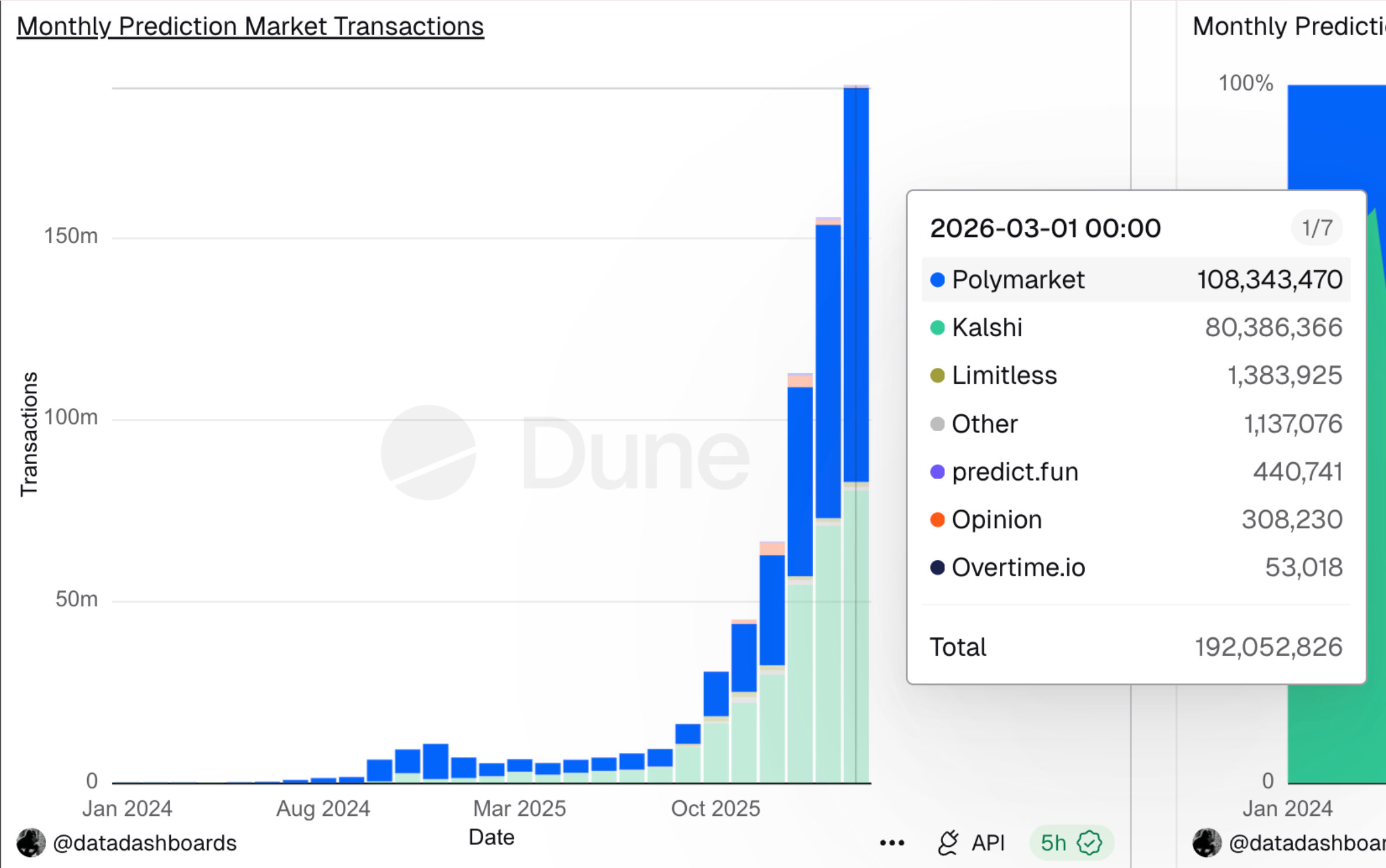
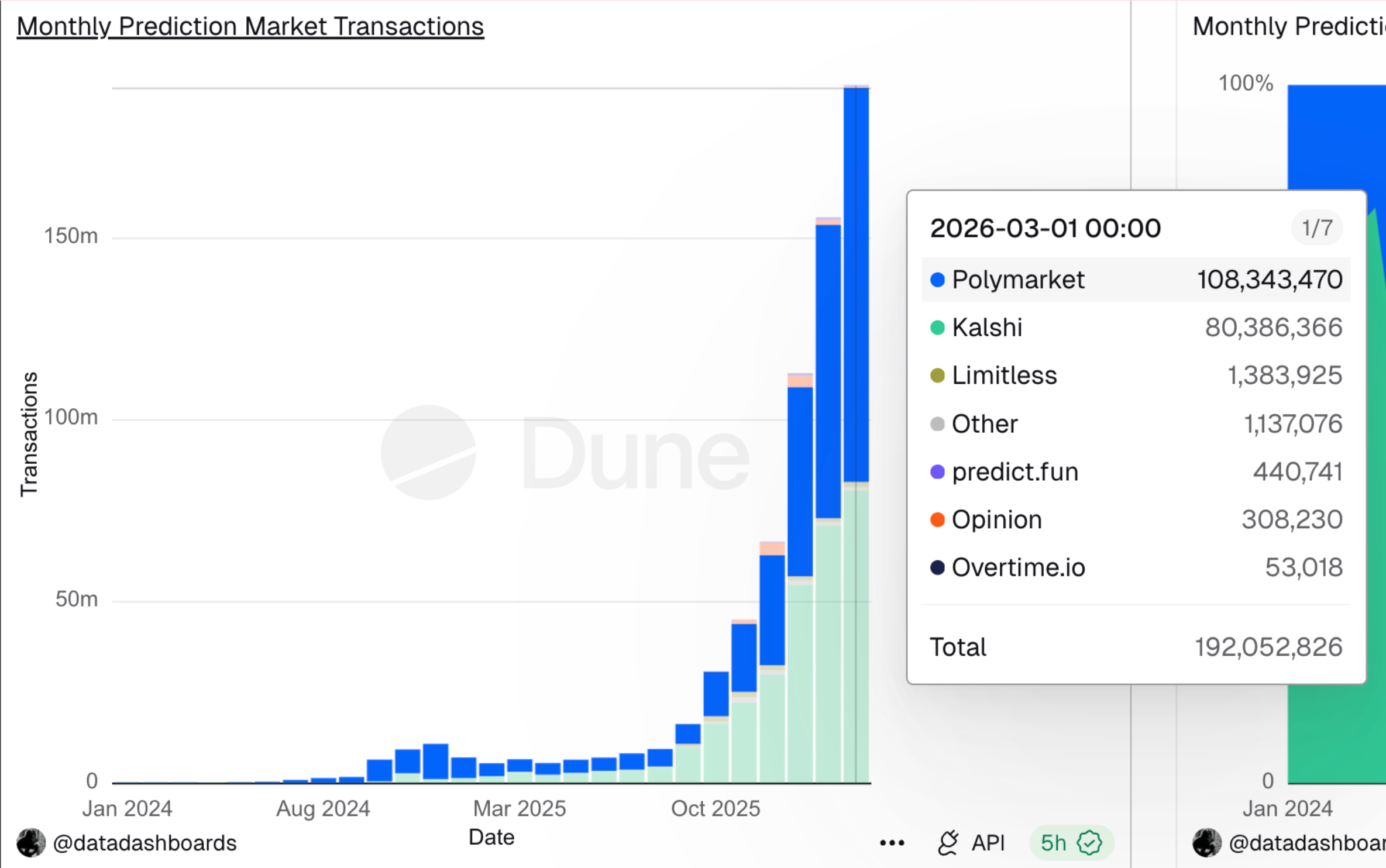
Prediction market transactions hit a record 192 million in March 2026.
By merging perpetual futures mechanics with prediction market infrastructure, Kalshi could attract institutional traders. The model offers continuous exposure rather than event-based binary contracts.
The platform operates under CFTC oversight, which may provide a regulatory edge over offshore competitors. Adding perpetual contracts would also let liquidity accumulate continuously rather than dispersing each time an event contract resolves.
The full scope of the product will become clear on April 27.
The post Kalshi Prediction Market Plans Crypto Perpetual Futures Launch On April 27 appeared first on BeInCrypto.


Spark’s MonetSupply says Aave’s decision to unfreeze its Core WETH market lets LST/LRT whales farm ~45% weETH loops while aEthWETH sits at 100% utilization, trapping regular users.
Summary
- Spark strategy director MonetSupply says Aave’s decision to unfreeze its Ethereum Core WETH market is “ill-considered” under current liquidity conditions.
- With aEthWETH utilization at 100%, he warns that high‑leverage weETH loops chasing ~45% APY will trap normal depositors and stablecoin borrowers trying to exit.
- The move, he argues, hands out arb opportunities without fixing aEthWETH liquidity, further degrading conditions for regular users already struggling to refinance.
Aave (AAVE) has decided to unfreeze its Ethereum Core WETH market just as liquidity is at its tightest, drawing sharp criticism from Spark’s strategy director MonetSupply. In a post on X, he called the move “quite ill‑considered,” arguing that under the current interest rate model, LST and LRT holders can spin up aggressive circular leverage loops using assets like weETH while ordinary users are effectively locked in.
High-octane loops on a dry WETH market
According to his calculations, traders can exploit roughly a 0.5% discount on weETH’s secondary‑market price relative to ETH and an Aave ETH borrowing rate capped around 5.15% to construct recursive long ETH positions with an annualized return profile near 45% when stacked on top of the base staking yield. With the aEthWETH market already sitting at 100% utilization, every fresh loop tightens the squeeze on exit liquidity for plain‑vanilla depositors and borrowers.
The problem, MonetSupply argues, is that unfreezing WETH under these conditions does nothing to relieve the liquidity stress facing aEthWETH users. “This decision provides arbitrage opportunities without addressing the liquidity tension of aEthWETH,” he wrote, warning that users trying to withdraw WETH or roll over leveraged stables are discovering there is simply no buffer left in the pool.
Recent comments from the Spark strategist on related ETH‑market fragilities flagged how similar dynamics can spiral: once utilization is pinned at 100%, suppliers lose incentives to stay, while borrowers lose room to deleverage, raising the risk of stuck positions and cascading liquidations if rates or collateral prices move against them. Combined with post‑Kelp DAO nerves and elevated demand for on‑chain ETH liquidity, Aave’s decision to reopen the throttle on WETH looks, in his view, less like restoring normalcy and more like inviting sophisticated loopers to farm a basis trade atop an already strained market.
If those incentives persist, the likely outcome is a familiar split: whales and structured funds capturing leveraged carry via weETH loops, while retail depositors and stablecoin borrowers face rising odds of being trapped in a market where the exit door is technically open—but functionally blocked by 100% utilization.


Polymarket announced perpetual futures trading on April 21, letting users go long or short on prediction markets around the clock.
The announcement arrived just hours after reports surfaced that rival Kalshi plans to launch its own perpetual product, codenamed “Timeless,” on April 27.
Prediction Market Perps Race Heats Up
Polymarket’s new perps feature will allow traders to take leveraged positions on prediction market outcomes without waiting for a contract to expire.
The platform framed the product as a way to “go long or short the markets you know 24/7,” according to its official announcement.
The timing appears strategic. Kalshi CEO Tarek Mansour teased “Timeless” on April 13 with a cryptic video revealing an April 27 launch date in New York.
Kalshi’s product will also include crypto perpetual futures, putting it in direct competition with exchanges like Coinbase and Robinhood.
Both platforms have grown aggressively in recent months. Prediction market transactions surpassed 192 million in March 2026, an all-time record.
Kalshi, now valued at $11 billion, processes over $100 billion in annualized trading volume. Polymarket, valued at $9 billion, has seen weekly notional volume consistently exceed $1 billion through Q1 2026.
The rivalry between the two platforms mirrors a broader shift. Prediction markets increasingly resemble TradFi products, and perpetual contracts could accelerate that trend by attracting institutional-style trading flow.
Whether Polymarket’s head start translates into a lasting advantage may depend on how quickly both platforms can build liquidity for their new offerings.
The post Polymarket Unveils Perpetual Futures In Time To Beat Kalshi’s Crypto Launch appeared first on BeInCrypto.
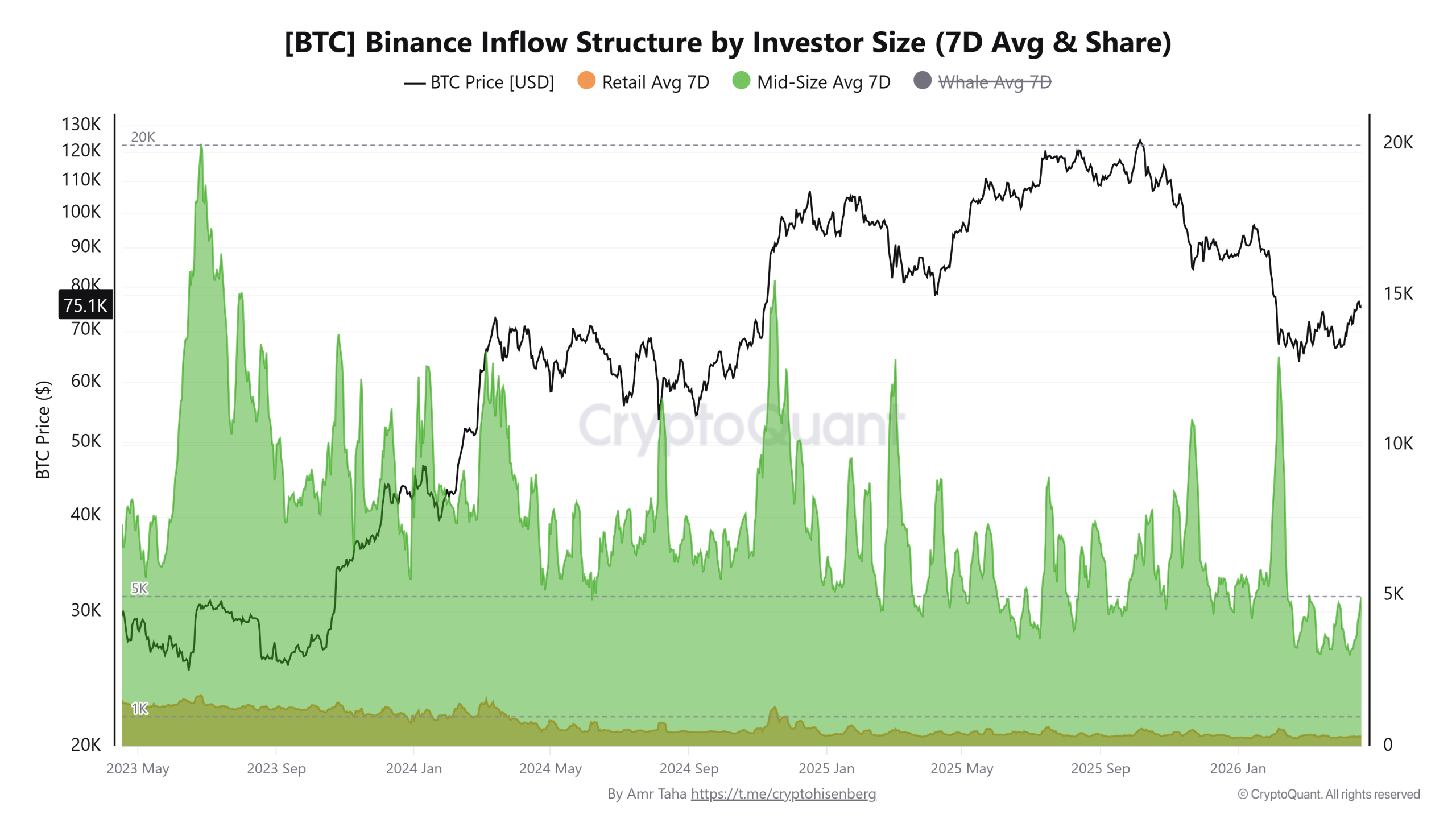
Bitcoin (BTC) mid-size wallet inflows to Binance fell to 3,000–4,000 BTC, marking a multi-year low in sell-side activity from this cohort.
This coincides with Coinbase recording about 8,500 BTC in inflows from similar wallets on April 19, while other exchanges saw much smaller flows. Binance exchange Bitcoin inflows have also fallen to 2023 levels, but how is this significant to today’s market?
Binance BTC inflows cool sharply to 2023 levels
CryptoQuant data classifies mid-size wallets as the entities holding roughly 100–1,000 BTC, often linked to active traders and smaller institutions. These wallets tend to move coins to the exchanges during distribution periods, making their inflows a useful proxy for near-term selling intent.

Crypto analyst Amr Taha noted that seven-day average Bitcoin inflows from this cohort into Binance have dropped to 3,000–4,000 BTC. This remains well below the deposits observed during April to May 2023, which ranged from 5,500 to 6,000 BTC.
The lowered inflow levels suggest reduced immediate sell-side pressure, as fewer coins are being positioned on the exchange, although inflows alone do not translate into active selling.
The chart shows no comparable surge from retail participants (1-100 BTC) either, with smaller wallets contributing limited inflows of less than 300 BTC on Tuesday. This indicates a contained flow profile rather than broad-based selling pressure.
Related: Bitcoin metrics line up bull signals with $78K the BTC price level to beat
Bitcoin flows on Coinbase dominate
The distribution of BTC inflows across exchanges provides another perspective. Data from CryptoQuant shows that mid-size investor inflows into Coinbase reached about 8,500 BTC on April 19, approaching levels last seen after the FTX exchange collapse in November 2022.

BTC activity across other exchanges remained relatively muted. Amr Taha noted that a broad distribution phase would typically reflect synchronized inflows across multiple exchanges, which is not evident in the current data.
A similar spike on Coinbase was observed on Jan. 14, shortly before Bitcoin declined from $95,000 to below $67,000 in February. However, the current conditions differ, as exchange inflows appear fragmented rather than market-wide, suggesting mixed sentiment rather than coordinated distribution.
Data from Bitcoin researcher Axel Adler Jr. also highlights a deeper shift in supply dynamics. Bitcoin’s 30-day net flow dropped to -300,000 BTC in March from +94,000 BTC in February, signaling a strong withdrawal phase. The metric stands near -98,000 BTC as of April 21, with outflows continuing at a slower pace.

Adler Jr. added that exchange reserves have declined for seven consecutive weeks, falling by over 105,000 BTC since early March. Notably, even during the April 2 pullback toward $67,000, there was no significant return of coins to exchanges.
Related: Inside the ‘fake police raid’ that forced a $1M Bitcoin transfer
This article is produced in accordance with Cointelegraph’s Editorial Policy and is intended for informational purposes only. It does not constitute investment advice or recommendations. All investments and trades carry risk; readers are encouraged to conduct independent research before making any decisions. Cointelegraph makes no guarantees regarding the accuracy or completeness of the information presented, including forward-looking statements, and will not be liable for any loss or damage arising from reliance on this content.

Privacy Boost, Sunnyside’s Privacy SDK, Goes Live on Optimism Mainnet: Optimism

Young and the Restless: Sally’s Shocking Pregnancy Rocks Adam – Explosive Fallout

You Can Save $5,000/Month in Alberta But Should You? #Finance #Canada #Shorts

Manchester United reach agreement with Casemiro over contract clause amid transfer speculation

Steven Gerrard disagrees with Gary Neville over ‘shock’ Chelsea and Arsenal claim | Football

US brings back mandatory military draft registration


-

 News Videos6 days ago
Secure crypto trading starts with an FIU-registered
-

 Fashion4 days ago
Weekend Open Thread: Theodora Dress
-

 Sports4 days ago
NWFL Suspends Two Players Over Post-Match Clash in Ado-Ekiti
-

 Politics4 days ago
Palestine barred from entering Canada for FIFA Congress
-

 Business2 days ago
Powerball Result April 18, 2026: No Jackpot Winner in Powerball Draw: $75 Million Rolls Over
-
Entertainment2 days ago
NBA Analyst Charles Barkley Chimes in on Ice Spice McDonald’s Fiasco
-

 Crypto World4 days ago
Russia Pushes Bill to Criminalize Unregistered Crypto Services
-

 Politics23 hours ago
Gary Stevenson delivers timely reminder to register to vote as deadline TODAY
-

 Tech3 days ago
Auto Enthusiast Scores Running Tesla Model 3 for Two Grand and Turns It Into Bare-Bones Go-Kart
-
 Business5 days ago
Creo Medical agree sale of its manufacturing operation
-

 Politics2 days ago
Zack Polanski demands ‘council homes not luxury flats for foreign investors’
-

 Tech6 days ago
‘Avatar: Aang, The Last Airbender’ Leaked Online. Some Fans Say Paramount Deserves the Fallout
-

 Crypto World4 days ago
Russia Introduces Bill To Criminalize Unregistered Crypto Services
-

 Tech7 days ago
Microsoft adds Windows protections for malicious Remote Desktop files
-
 Entertainment7 days ago
Dave Portnoy Slams Dianna Russini: ‘Makes Zero Sense’
-

 Crypto World7 days ago
X Launches New Cashtag Feature for Stocks and Crypto: X
-

 Entertainment7 days ago
Prince Carter Brings Fans Front Row and Backstage at Boys 4 Life Tour
-

 Sports6 days ago
British climbers complete new route in Swiss Alps
-
 Crypto World7 days ago
Paxos Labs Raises $12M to Launch Crypto Yield and Lending Platform
-

 Crypto World7 days ago
Bitcoin surpasses halfway mark in current halving cycle
You must be logged in to post a comment Login