

Crypto World
Ethereum Price Primed for Quantum Narrative: Citi Says ETH Could Survive While Bitcoin Struggles


Ethereum price is falling by almost 8% this week, but Citi’s research notes could change how big money views the ETH/BTC relationship. The bank’s research cuts deeper than the quantum computing argument. Governance, not just cryptography, could decide which crypto survives Q-Day.
In a widely circulated research note this week, Citi analysts warned that recent quantum computing breakthroughs have compressed the timeline for practical attacks on digital assets, and Bitcoin carries structurally greater exposure than Ethereum.
Bitcoin transactions expose the sender’s public key on-chain until confirmed, creating a window for a quantum attacker to exploit private keys and redirect funds.
Citi’s analysis states the real vulnerability is not just technical on a technical level. Bitcoin’s conservative, consensus-driven governance makes rapid migration to quantum-resistant cryptography slow and politically contested, while Ethereum’s history of regular protocol upgrades gives it structural flexibility.
Separately, Citi has raised its Ethereum year-end price target to $4,500, with a 12-month projection of $5,440. That combination of quantum resilience and rising institutional targets is moving ETH into a bullish narrative.
— Cointelegraph (@Cointelegraph) October 2, 2025
 LATEST: Citi sets a 12-month target of $181K for $BTC and $5,440 for $ETH. pic.twitter.com/zPr6YojbVu
The implications for near-term price action are significant. If institutional capital begins rotating on quantum risk differentiation ETH’s technical setup becomes a lot more interesting.
Discover: The best crypto to diversify your portfolio with
Realistically, How Far Can the Ethereum Price Goes?
Ethereum is currently consolidating in the $2,100 support that acts as a major floor. A sustained close above $2,500 would signal the beginning of a larger breakout phase, with Citi’s year-end target of $4,500 as the initial institutional benchmark.
The bull case is straightforward: quantum narrative accelerates institutional rotation into ETH, spot ETH ETF inflows pick up through Q3, and DeFi/tokenization activity drives fee revenue that justifies higher multiples. Under that scenario, Citi’s bull-case projection of $5,000 comes into view by mid-2026.

However, Citi’s $4,500 year-end target assumes steady ETF demand and continued Layer-2 adoption without a major macro shock.
ETH needs to see a meaningful uptick in spot buying, not just derivatives activity, to confirm any move through $3,000 is sustainable rather than a liquidity squeeze. Recent institutional outlooks remain broadly bullish on ETH into 2026, though the quantum angle adds a new variable that price models haven’t historically incorporated.
Discover: The best pre-launch token sales
Bitcoin Hyper Targets Early Mover Upside as Quantum Narrative Hits BTC
If Citi’s quantum risk framing gains traction, the pressure will land squarely on Bitcoin’s limitations. BTC is known for slow transaction speeds, high fees, and a governance structure that resists rapid cryptographic upgrades.
Bitcoin’s recent price struggles already reflect institutional uncertainty about its near-term ceiling, with Citi trimming its BTC 12-month target while lifting ETH’s. The rotation narrative is forming. The question is where early capital moves.
Bitcoin Hyper ($HYPER) is positioning directly against Bitcoin’s structural weaknesses as the first-ever Bitcoin Layer 2 with Solana Virtual Machine (SVM) integration, delivering faster smart contract execution than Solana itself at a fraction of BTC’s native cost.
The project has raised north of $32 million at a current presale price of $0.0136, with staking incentives live for early participants. The SVM integration is the differentiator: it brings Ethereum-grade programmability to the Bitcoin ecosystem without sacrificing Bitcoin’s security base, a direct architectural response to the governance rigidity Citi just flagged.
Research Bitcoin Hyper here before the next price increase.
The post Ethereum Price Primed for Quantum Narrative: Citi Says ETH Could Survive While Bitcoin Struggles appeared first on Cryptonews.


Wego integrates stablecoin payments through Triple-A partnership
Wego, the travel marketplace that says it is the leading travel app in the Middle East and North Africa, has added support for stablecoin payments via a partnership with payments firm Triple-A. The move lets customers complete bookings with supported stablecoins while Wego receives settlement in local fiat currencies, a setup that aims to bridge consumer demand for crypto payment options with merchant needs for predictable settlement.
The integration reflects growing interest among travel platforms in digital-asset rails for cross-border payments, where card declines, interchange fees, and foreign-exchange frictions can undermine booking completion. Wego said the new option will be available for flight and other travel bookings, with the payments conversion, compliance checks and custody handled by Triple-A.
How the flow works and what it changes
Under the arrangement, a traveler pays in a supported stablecoin at checkout. Triple-A processes the incoming digital-asset payment, runs the necessary anti-money laundering and know-your-customer checks, converts the stablecoins, and settles the merchant in traditional local currencies. From the merchant perspective, the integration preserves Wego’s existing settlement structure while adding an alternative payment rail for customers.
Triple-A positions itself as a licensed global payment institution with registrations and licenses across jurisdictions, including the United States, Singapore, and European oversight, and it says it supports more than 1,000 enterprise customers and reaches roughly 700 million digital currency owners. Those institutional capabilities are central to the value proposition: merchants gain access to crypto-native demand without taking on custody or foreign-exchange exposure.
Market context: why travel is an early use case
Travel is an inherently cross-border industry, making it a natural candidate for alternative payment rails. Card declines are more common for international transactions, and many consumers in regions with limited card penetration prefer nontraditional payment methods. Stablecoins, which are designed to maintain a peg to a fiat reference, reduce the volatility issues that otherwise complicate merchant acceptance of cryptocurrencies.
Payments providers and travel platforms have been experimenting with crypto rails for several years, ranging from direct acceptance to tokenized loyalty and payment orchestration. Wego’s approach follows a broader trend of using intermediaries to convert crypto payments into fiat before settlement, a model that reduces operational complexity for travel sellers while tapping crypto demand.
Implications for bookings, merchants and consumers
One immediate operational aim of the integration is to improve booking completion rates in markets where card acceptance is constrained or where international transactions have elevated decline rates. By offering a native crypto checkout, travel platforms may reduce friction for customers who already hold stablecoins and prefer to use them for everyday purchases.
For merchants, the key advantage is access to new payment demand without assuming custody or FX risk. Third-party processors like Triple-A handle conversion and compliance, which can shorten the path to offering crypto payment options while maintaining existing back-office processes.
However, wider adoption depends on consumer education, merchant economics, and regulatory clarity. Travel platforms will need to assess the incremental cost of accepting crypto-derived payments versus other digital rails and the potential lift in conversions.
Regulatory and compliance considerations
Payments that originate in digital assets remain subject to evolving regulation. Triple-A emphasizes compliance through AML and KYC controls and its cross-jurisdictional registrations. That compliance layer is crucial for travel companies that operate across multiple countries and for regulators scrutinizing stablecoin flows.
Policymakers in several regions are increasingly focused on stablecoins, covering issues such as reserve backing, consumer protections, and cross-border settlement. Travel companies integrating these payment options must monitor regulatory developments and ensure their partners maintain transparent custody and conversion practices.
Outlook
Wego’s partnership with Triple-A illustrates how travel companies are experimenting with crypto payments while limiting exposure to volatility and custody complexity. If the integration improves conversions in target markets, it could encourage other travel platforms to pursue similar arrangements. At the same time, broader merchant acceptance will hinge on clear economics, consumer demand, and a stable regulatory environment for stablecoins.
As the travel sector continues to globalize its payment stack, intermediaries that can combine compliance, liquidity and local settlement may play an increasingly important role in connecting crypto-native customers with traditional merchants.
Disclosure: This article is based on statements and data provided by the companies involved. Quotes attributed to Wego and Triple-A were included in their public announcement.
NUVA launched this week with nearly $19 billion in tokenized real-world assets from Figure Technologies, aiming to bring regulated U.S. yield products into DeFi.
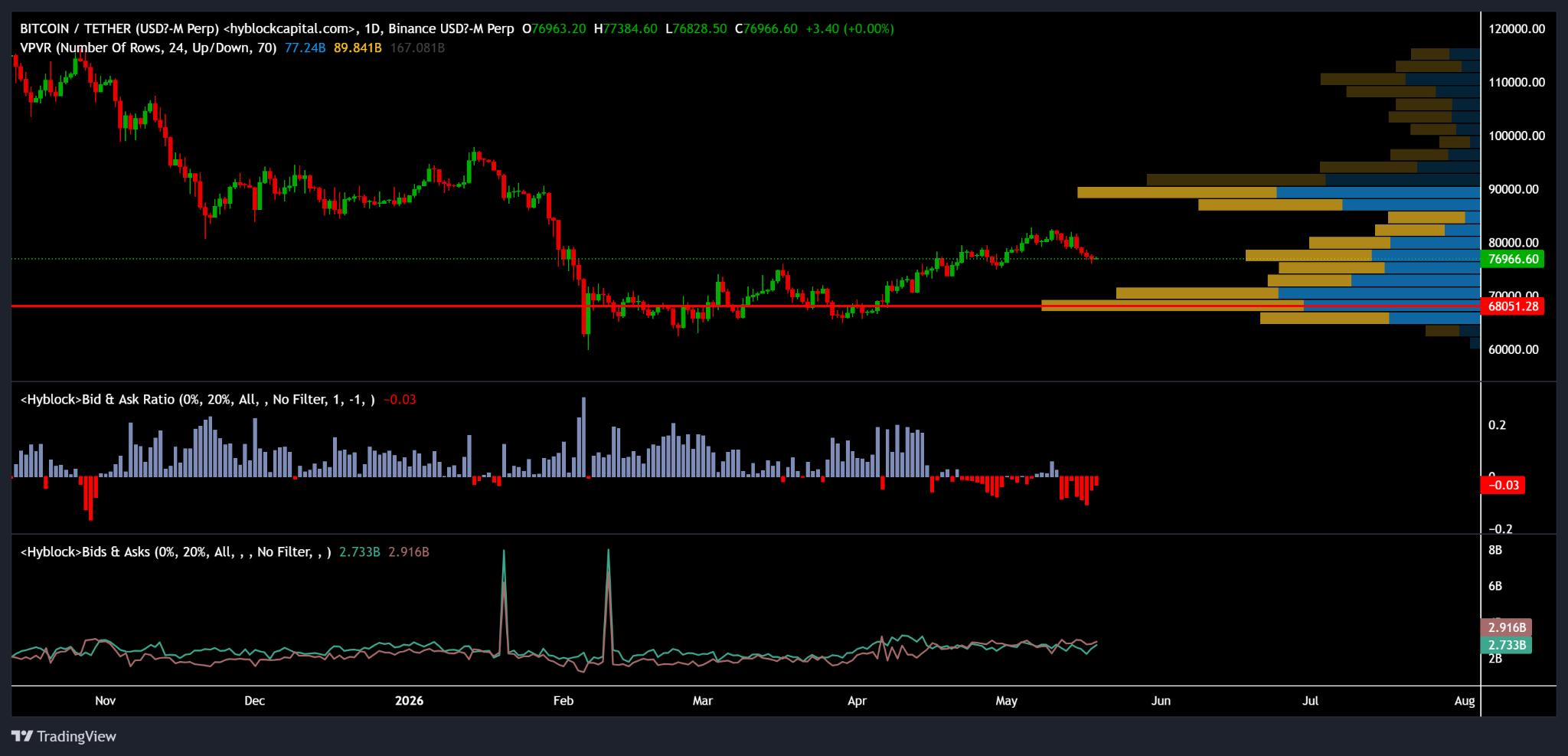
Bitcoin (BTC) traders have shifted their focus lower after futures and order book data point to strong buyer interest in the $68,000-$70,000 zone.
Sell pressure has increased in the derivatives markets and the daily bid-ask ratio fell to -0.03, showing sellers are currently more aggressive than buyers as traders position around liquidation levels.
Bitcoin buyers cluster near $68,000
The visible range volume profile (VRVP) indicator shows the $68,000-$70,000 region as the most densely traded zone on the chart since November 2025. High trading activity in that price range suggests most positions were opened near those levels over the past few months.
The order book data also shows a bid-ask ratio of -0.03, with the metric remaining in negative territory for most of the past month as sell-side activity continued to outweigh aggressive buying pressure.
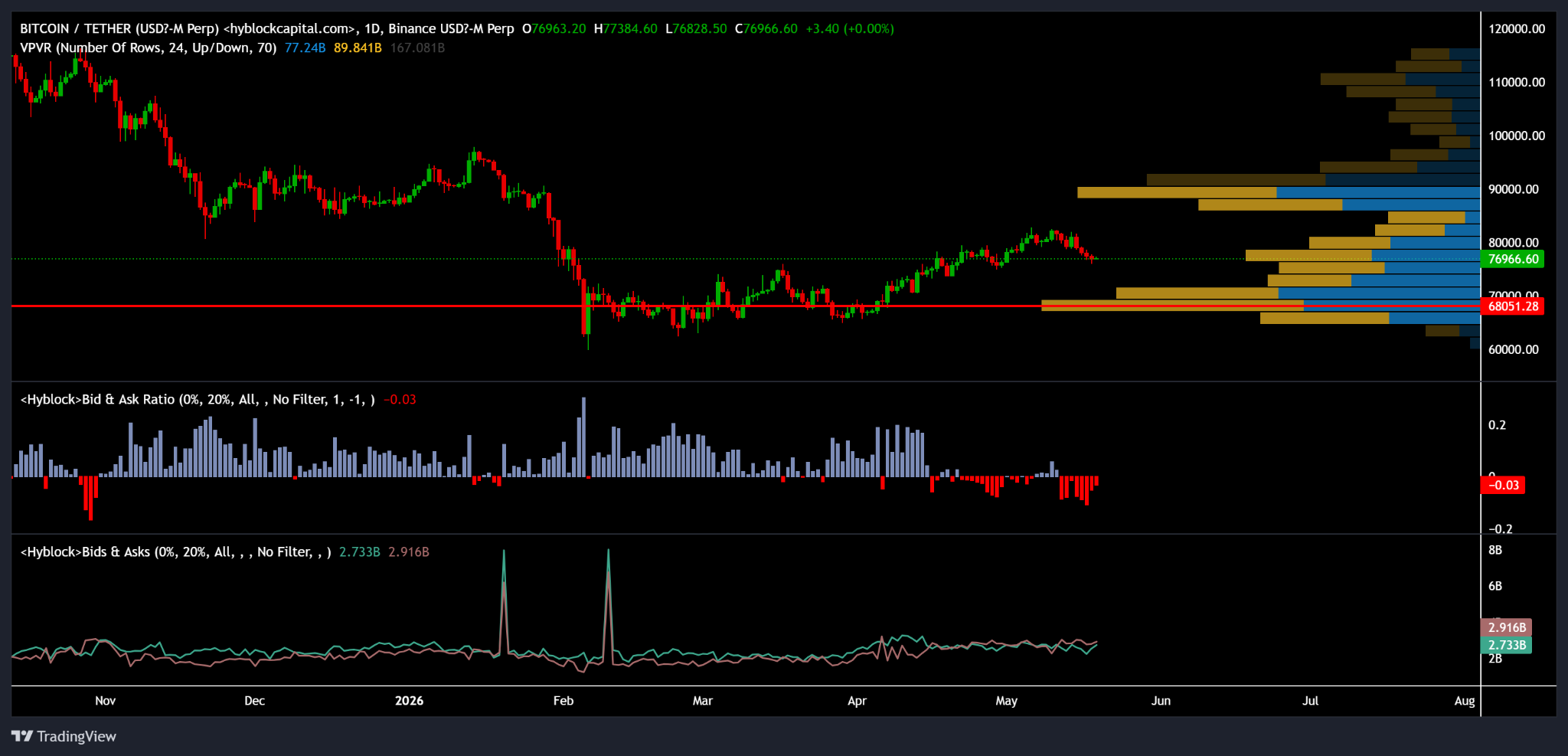
BTC/USDT price, bid-ask ratio and VPVR profile. Source: Hyblock
Liquidation data adds another pressure point. The heatmap shows more than $3.4 billion in cumulative long positions exposed near $74,700. The figure rises toward $11 billion if Bitcoin falls to $70,000 across the 90-day liquidation range.
Taken together, the positioning data suggests traders are prioritizing deeper liquidity pools rather than chasing higher prices above $80,000.
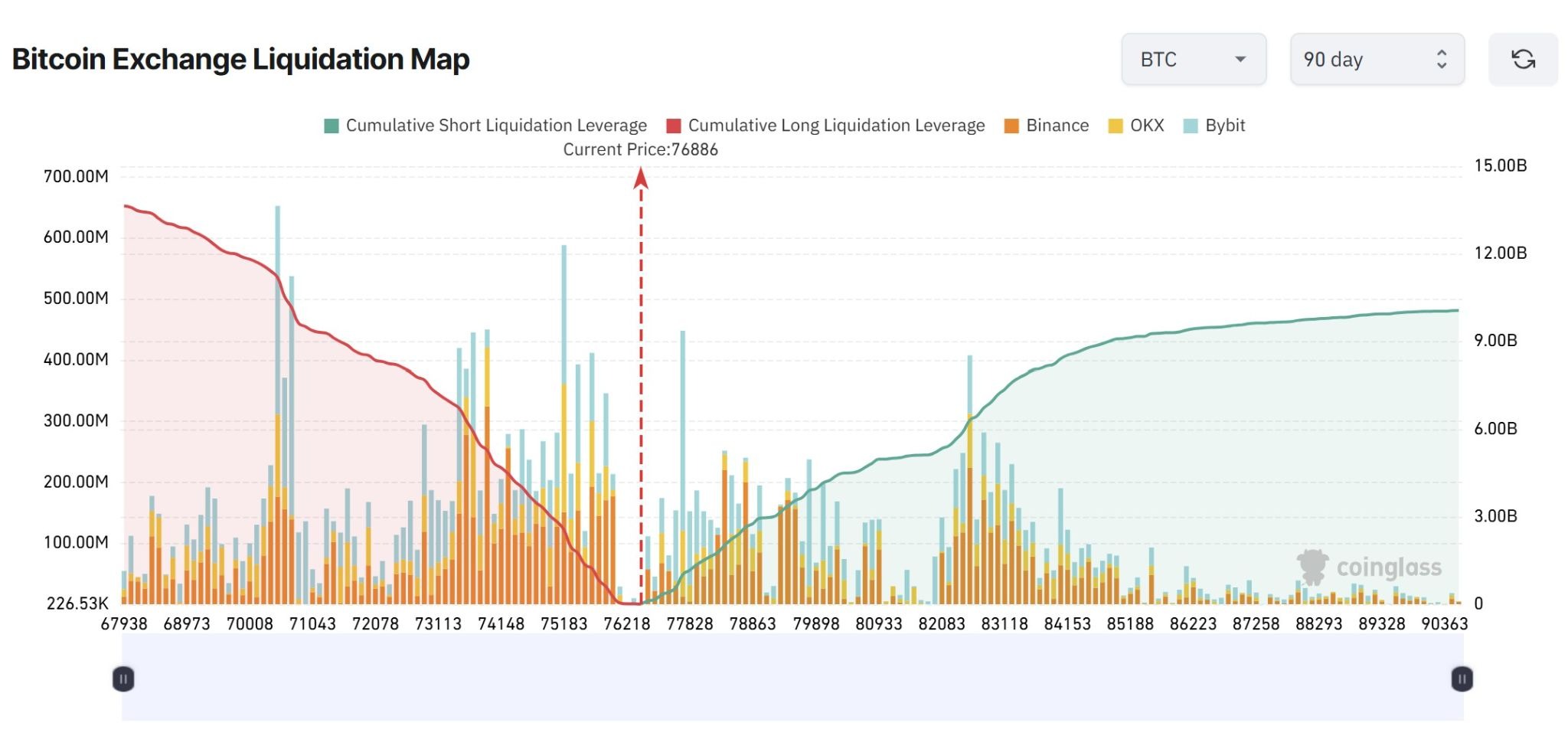
Bitcoin exchange liquidation map. Source: CoinGlass
Related: Bitcoin price stays under $77K as US bond yields near 20-year highs
BTC retail longs are crowded
Crypto analytics platform Hyblock noted Bitcoin retail traders are again leaning heavily bullish as its “True Retail Accounts” long percentage metric climbed above 60%. The indicator tracks the share of retail futures accounts holding long positions.
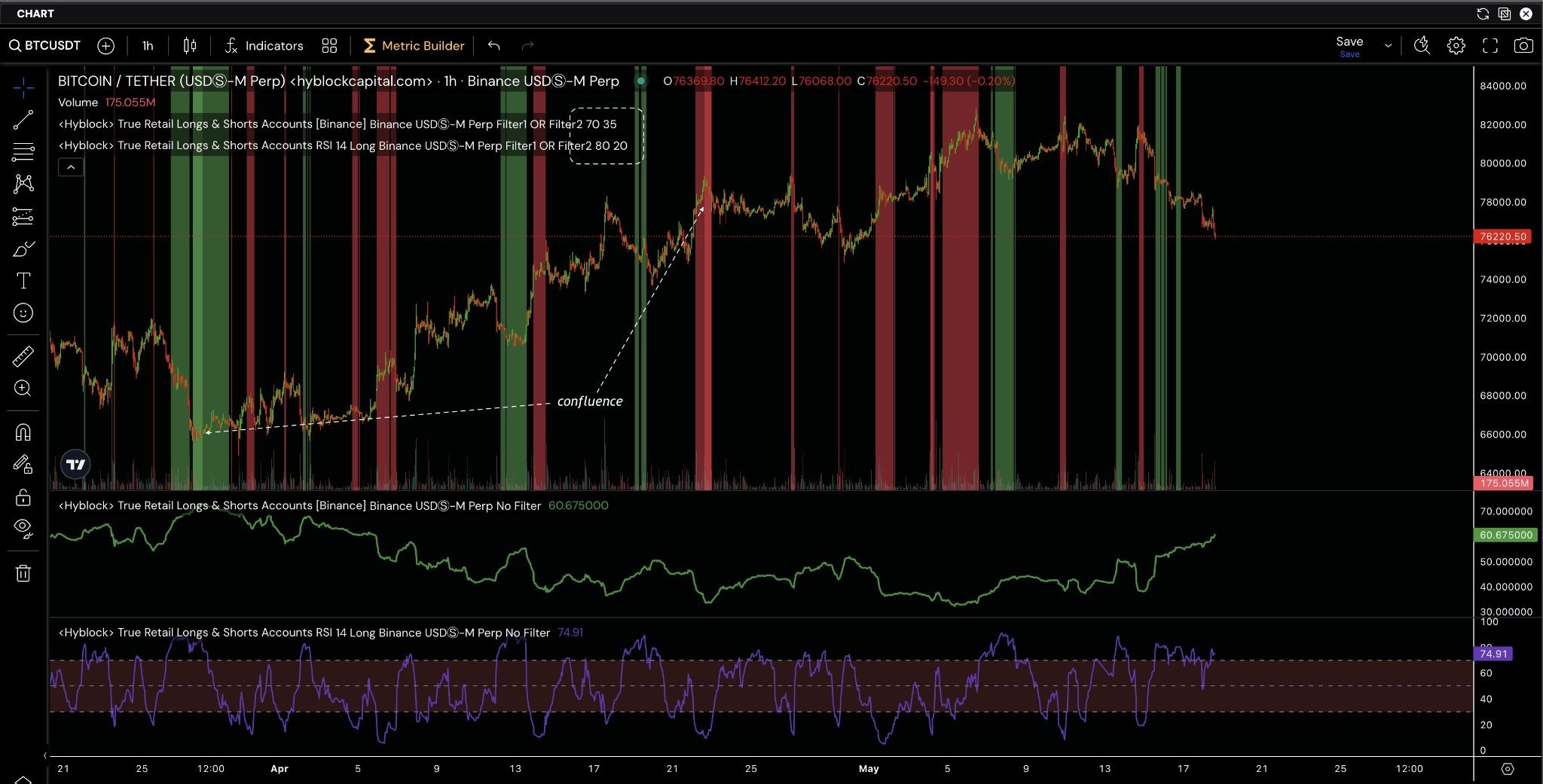
BTC/USDT, one-day chart. Source: Hyblock/X
Previous spikes into the platform’s “extreme long” zone aligned with short-term local tops during rallies toward the $78,000-$82,000 range in early May. The price momentum later cooled after retail positioning became too crowded.
Hyblock explained that the strongest recovery points appeared when retail traders turned aggressively bearish. Several periods when fewer than 35% of retail accounts held long positions emerged near Bitcoin’s lows in March and April, before BTC rebounded from the mid-$60,000 range.
Hyblock combines the retail positioning metric with a 14-period relative strength index (RSI) reading to identify sentiment extremes for BTC.
The latest reading shows the TRA Long (%) near 60.7%, while the RSI stayed elevated at 74.9, suggesting retail traders are still positioned for prices near $76,000. This could lead to deeper correction if BTC follows its previous market behavior.
Related: Bitcoin miner Canaan posts $88.7M net loss in Q1 amid BTC decline
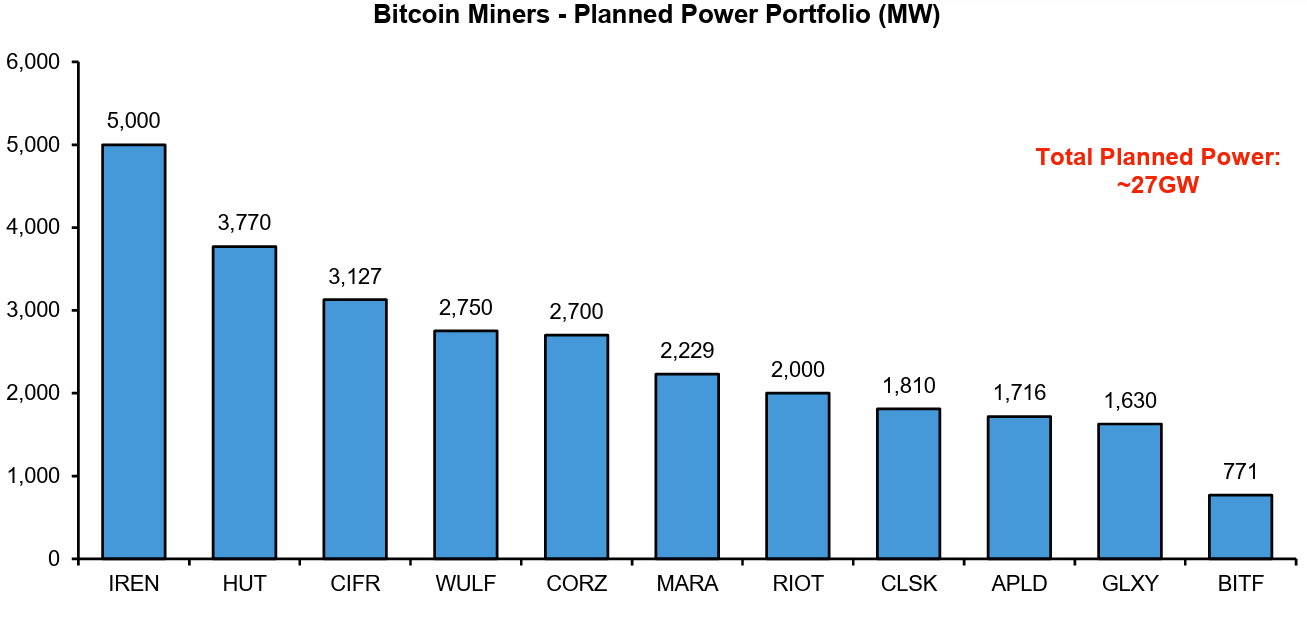
Bitcoin miners are emerging as an important part of the AI infrastructure supply chain because they control large amounts of power capacity and data center real estate that are increasingly difficult to secure, according to a new research note from Bernstein.
Analysts Gautam Chhugani, Mahika Sapra, Sanskar Chindalia and Harsh Misra estimate that publicly traded Bitcoin miners control more than 27 gigawatts of planned power capacity and have announced more than $90 billion in AI-related agreements covering 3.7 gigawatts with hyperscalers, neocloud providers and chipmakers.
An April 29 research brief from RAND said that it expects the US will add approximately 82 GW of additional net available capacity by 2030.
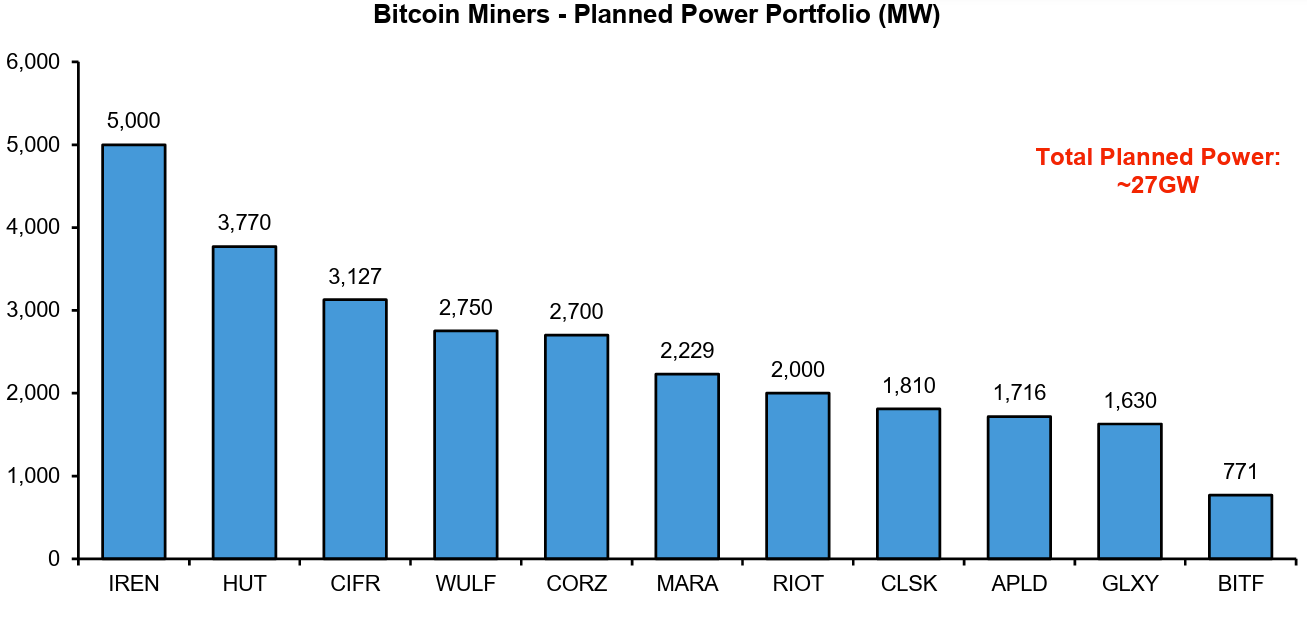
The planned power portfolio of 11 public Bitcoin mining companies. Source: Bernstein
According to Bernstein, access to electricity, rather than chips, has become the primary bottleneck for scaling AI data centers. Utility providers can take more than four years to approve new grid connections, even in data center-friendly states such as Texas.
“The median waiting time to secure a GW of power is nothing less than ~50 months across states, and even in politically friendly states such as Texas, the utility is following a batch review process to navigate the interconnect queue and resource load,” the analysts wrote.
Growing regulatory scrutiny and local opposition to large-scale data centers are adding to those delays, giving Bitcoin miners an advantage because they already operate grid-connected sites and have experience managing high-density computing facilities.
Related: The real ‘supercycle’ isn’t crypto, it’s AI infrastructure: Analyst
A shift in miner economics
Bernstein said Bitcoin miners are increasingly diversifying into AI infrastructure as they look for new revenue streams following the 2024 halving, which reduced mining rewards and put pressure on profit margins.
The report said several miners have moved beyond their traditional focus on Bitcoin production to develop AI data centers and high-performance computing facilities.
One recent example is Soluna Holdings, which reported a 58% increase in first-quarter revenue, driven primarily by its data center hosting business, while crypto mining contributed a smaller share of total sales.
Bernstein has also highlighted IREN as a leading example of the shift. The firm said IREN is well-positioned to transition much of its business toward AI infrastructure following its multibillion-dollar agreements with Microsoft.
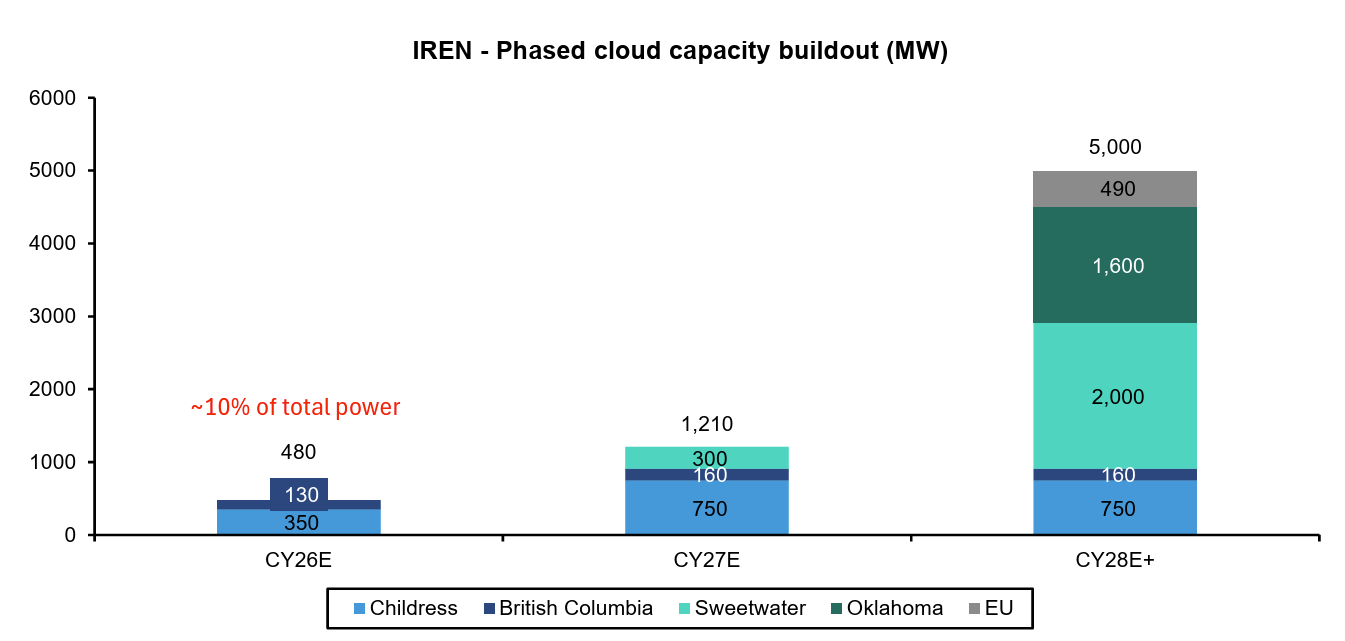
IREN’s partnership with Microsoft could fundamentally change its business model, according to Bernstein. Source: Bernstein
Related: CoreWeave’s $8.5B loan shows how AI is replacing crypto mining finance
Crypto World
‘What's happening at the EF?’ Ethereum community looking for answers after high-profile departures


A wave of recent high-profile departures at the Ethereum Foundation has reignited longstanding questions from community members about what is going on inside the organization.
Crypto World
Cardano Price Prediction Stuck 92% Below Peak as Whales Stack Record Holdings, While Pepeto Crosses $10 Million With 150x Profit Math
ADA whale wallets now hold 25.09 billion tokens, 67% of the total supply and the highest share since 2020, yet Cardano still trades 92% below its all-time high.
The Cardano price prediction has turned into a waiting game where the biggest holders keep buying a token that has not paid them back in years, and Pepeto offers very different math with more than $10 million raised and a Binance listing that has not reset the price yet.
ADA Whales Hit Record Levels as SuperTrend Flips to Buy
Wallets holding at least one million ADA now control 25.09 billion tokens according to CoinDesk, the highest whale share since 2020. The buying has been running since December 2023, even as ADA lost 71% of its value over nine months, which means the biggest holders kept adding while everyone else sold.
On May 14 the SuperTrend flipped to a buy signal for the first time since September 2025 according to Coinpedia.
The Cardano price prediction now has a fresh chart signal, but ADA at $0.25 still needs a full market rally to move in any real way.
Pepeto and ADA: Whale Buying Meets Presale Opportunity
Pepeto
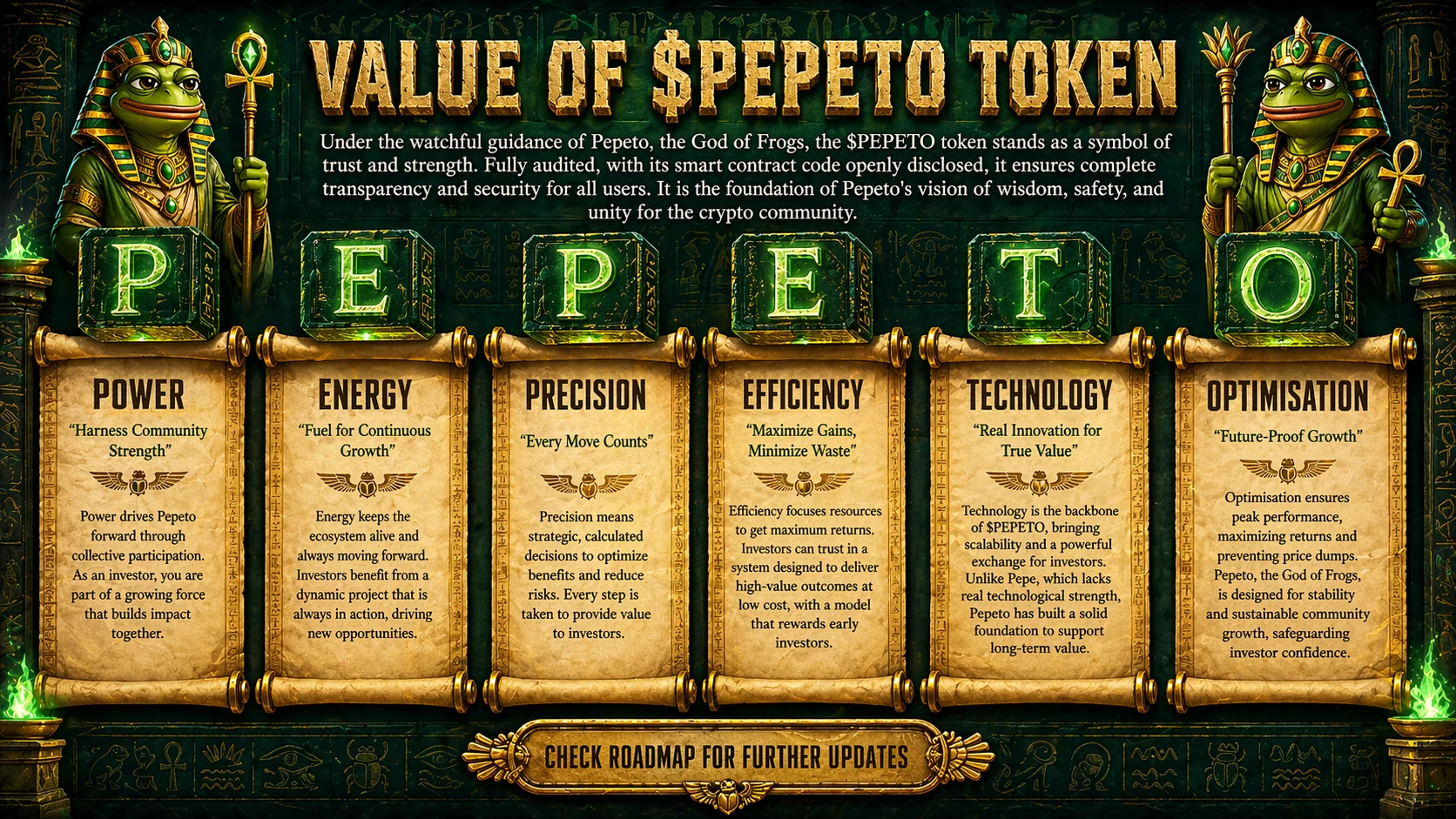
While ADA whales keep buying through a crash with no clear end, Pepeto is building a trading platform at a price so low that the listing alone could give profits Cardano cannot match in years, and the person who created the original Pepe coin leads the team alongside a former Binance expert who knows exchange systems from the inside.
The bridge moves tokens between Ethereum, BNB Chain, and Solana with zero fees while the risk scorer checks every token contract before money goes in, so traders entering this presale get both free cross chain access and safety tools that protect their capital before they trade.
SolidProof checked every contract before the first dollar came in, and that safe base is one reason more than $10 million has flowed in at $0.0000001871 during a time when most tokens lost value. Staking at 172% APY grows holdings every day while the Binance listing gets closer, and analysts say 100x to 300x profit could come from the listing alone because the moment trading starts the presale price is gone and a new higher price takes its place.
The Cardano price prediction debate is about whether ADA can get back to $1 from $0.25, a 4x that takes years, but Pepeto with the same 420 trillion supply that took the original Pepe coin to $11 billion now has a working platform behind it. The wallets that bought today hold the price that late buyers will wish they had for the rest of this cycle, and every day that passes without buying is one day closer to that price being gone forever.
ADA Forecast: Whale Buying Meets Price Resistance at $0.25
The Cardano price prediction for 2026 stays careful as ADA trades near $0.25 according to CoinMarketCap. Cryptopolitan sees a peak of $1.33, while Changelly puts ADA between $0.27 and $0.37 through December.
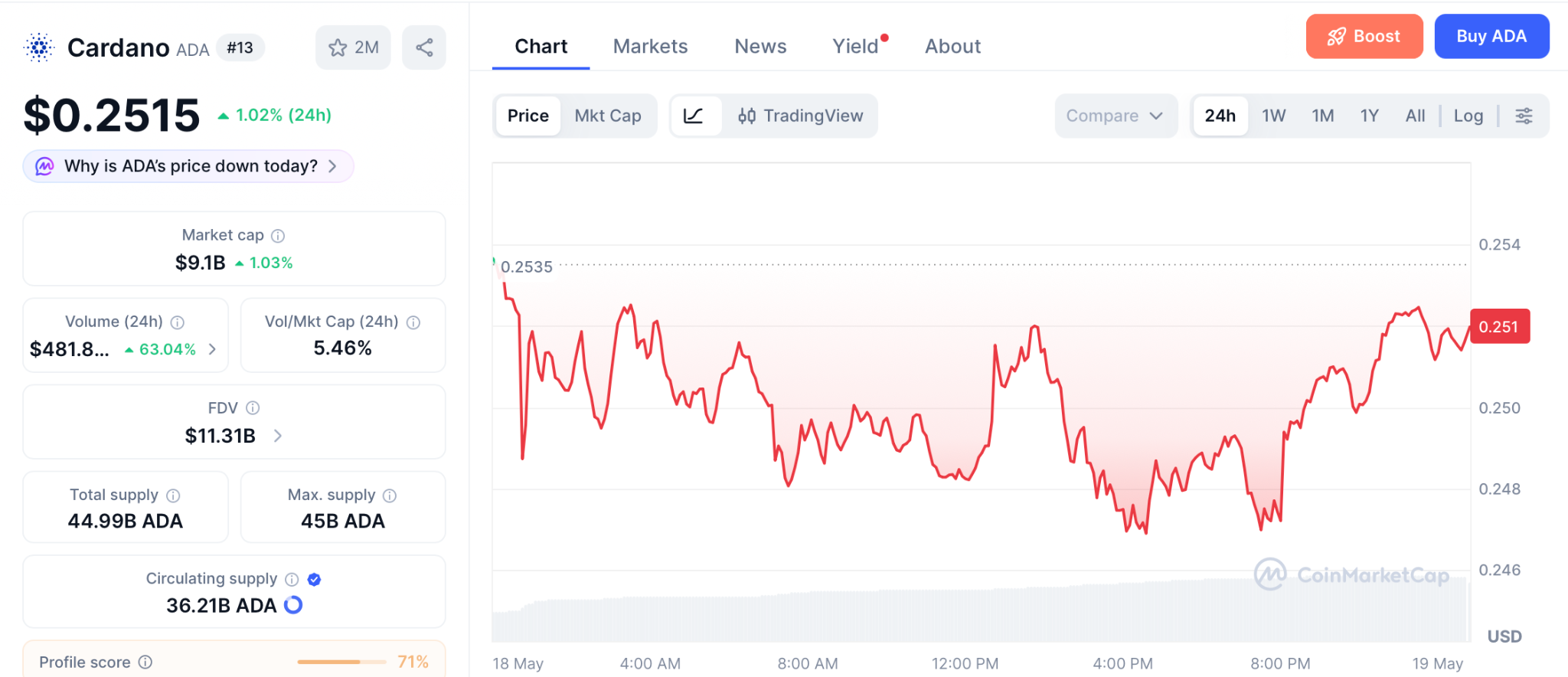
CoinCodex stays negative, saying ADA may not get back above $1.24. ADA sits 92% below its $3.10 all-time high from September 2021 and fell from $0.44 in January even with whales buying. Even reaching $1.33 is a 5.3x from $0.25, a gain that needs a full bull run.
The Cardano price prediction math shows waiting that pays off over years, while a presale before a Binance listing could give that kind of return in weeks.
Conclusion
Every Cardano price prediction and large coin recovery story comes down to the same thing: time. ADA needs months or years before the profit shows up, and even the best forecast puts the top at $1.33, a 5.3x that needs a full market recovery to happen. Pepeto sits in a completely different spot as a working platform presale with a Binance listing ahead and no price ceiling set.
The cofounder proved the math once when the original Pepe coin hit $11 billion with zero products and 420 trillion supply, and reaching that level from the Pepeto presale is 150x, this time with a working exchange, a SolidProof audit, and 172% APY staking growing positions every day.
The entry at $0.0000001871 does not exist once the listing gives every token a new price, and $10 million from wallets that already made their choice sits in the presale right now. The Pepeto official website shows the numbers for anyone ready to move before the listing closes this window for good.
Click To Visit Pepeto Website To Enter The Presale

FAQs
What is the Cardano price prediction for 2026?
The Cardano price prediction targets $0.27 to $1.33, but ADA at $0.25 sits 92% below its $3.10 peak and needs a full bull cycle before real profits show up.
Is Pepeto a better buy than Cardano right now?
Pepeto is the stronger early entry because it raised $10 million at $0.0000001871 with a Binance listing ahead and 150x profit potential the Cardano timeline cannot offer.
Disclaimer: This is a Press Release provided by a third party who is responsible for the content. Please conduct your own research before taking any action based on the content.

Crypto World
The SEC wants to let newly public companies raise cash instantly in its biggest rule change in decades
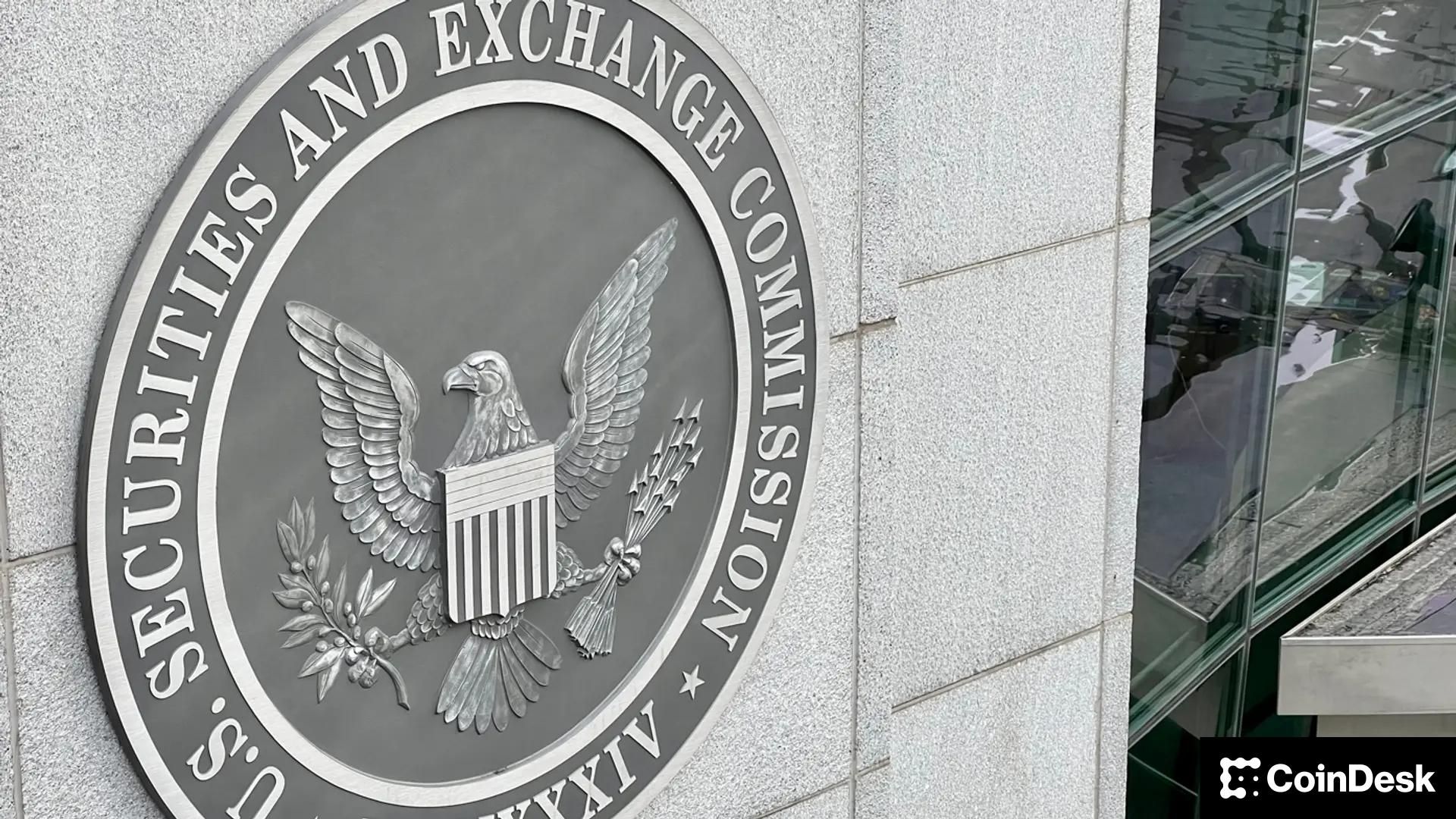
The agency is proposing its largest overhaul of public listing rules in over 20 years, cutting compliance costs and giving crypto firms a much easier path to raise cash on Wall Street.
The XRP Alliance launched on May 19, linking D’CENT’s 720,000 hardware wallet users to XRP yield vaults via Flare Smart Accounts.
Summary
- D’CENT Wallet and Flare launched the XRP Alliance on May 19, allowing XRP holders to deposit directly into yield vaults from hardware devices using two signatures on the XRP Ledger.
- Two vaults are available at launch: the Monarq XRP Yield Vault targeting 3% to 4% annually through options trading and basis arbitrage, and the Clearstar earnXRP vault for on-chain yield.
- The integration requires no new chain, wallet, or gas token and carries a 0% platform fee for D’CENT users through the Flare campaign running from May 19 to June 8.
D’CENT Wallet and Flare Network announced the XRP Alliance on May 19, a coalition that connects D’CENT’s estimated 720,000 hardware wallet users directly to XRP-denominated yield vaults without requiring a new chain, separate wallet, or gas token.
XRP holders can deposit into vaults directly from the D’CENT app using two signatures on the XRP Ledger, with Flare Smart Accounts minting FXRP and depositing it into the selected vault in a single flow.
Two vaults are available at launch. The Monarq XRP Yield Vault (MXRPY), managed by Monarq Asset Management on Upshift infrastructure, targets 3% to 4% annually through options trading, basis and funding-rate arbitrage, and on-chain XRPFi strategies.
The earnXRP vault, curated by Clearstar, offers the first fully on-chain yield product denominated in XRP, with returns automatically compounded. “Through our partnership with Flare, we are happy to provide the best and easiest way to deposit and manage XRP in the Monarq Yield Vault with top-tier hardware security,” D’CENT said in its campaign announcement.
XRP Alliance brings yield infrastructure to hardware wallets
The alliance also includes Doppler, Banxa, and Squid alongside D’CENT and Flare, with the stated objective of building distribution and interoperability across the XRP ecosystem.
As crypto.news reported in February, Flare expanded modular lending for XRP via Morpho and Mystic earlier in 2026, establishing the vault infrastructure that the D’CENT integration now makes accessible to hardware wallet holders for the first time.
For most of XRP’s history, holders have had limited ways to put the asset to work in programmable finance. As crypto.news documented, XRP ETF products pulled in $81.63 million in net inflows in April 2026, the best month of the year, reflecting growing institutional demand for XRP exposure.
The D’CENT integration extends that institutional-grade infrastructure toward the self-custody retail and semi-institutional holder base, which stores an estimated billions of XRP in hardware devices.
What the 0% fee campaign means for XRP yield adoption
D’CENT is offering a 0% platform fee through June 8, meaning users pay only Flare’s standard base fees. The firm noted that most other platforms charge an additional platform fee on vault deposits.
The Monarq vault carries an initial deposit cap of 500,000 FXRP, with both vaults accessible to non-D’CENT users through the Upshift platform. The XRP price page at crypto.news tracks the live market conditions that affect vault returns, given that yields vary with XRP price movements and strategy performance.


- NEAR price surged to $1.66 amid a notable volume spike.
- AI tokens bounced sharply, including Injective, Theta Network, and Akash Network.
- The near-term outlook for NEAR suggests a retest of $2 if momentum holds.
NEAR Protocol (NEAR) has traded higher in the past 24 hours as bulls eye near-term gains.
The uptick for the artificial intelligence-related token aligned with a broader AI tokens surge on Tuesday, with NEAR seeing a notable rise in trading activity.
NEAR price gains amid 32% spike in daily volume
NEAR is trading at $1.62, up about 7% over the past 24 hours and roughly 4% higher on the weekly chart despite Monday’s brief plunge beneath $1.50.
The price appreciation coincides with a 32% surge in daily volume, with intraday action putting the metric at $295 million as of writing.

Notably, that spike in activity has allowed NEAR to outpace many peers as the broader market navigates renewed downside pressure.
Likely, rotation into projects tied to on-chain compute and decentralized application ecosystems is driving the uptick.
The bounce in AI-related tokens provided additional strength to Injective, Theta Network, and Akash, each of which delivered gains of more than 5% in the past 24 hours.
Render also showed signs of eyeing a retest of a critical resistance level.
Crypto AI is trading up ahead of Nvidia’s first-quarter earnings results.
The industry heavyweight will report on May 20, and tokens across crypto are up amid broader anticipation.
Nvidia’s CEO Jensen Huang recently traveled to China with President Trump, with the US president meeting Chinese President Xi Jinping in a key summit.
NEAR price prediction
Technical indicators suggest a short-term bullish bias for NEAR.
On the daily chart, price action is forming what appears to be a cup-and-handle pattern.
This is a consolidation structure that often precedes continuation to the upside if the handle resolves on renewed volume.
NEAR also currently trades above major moving averages, an arrangement that typically favors buyers. But that’s not all.
Momentum metrics bolster the constructive outlook, with the average directional index (ADX) on the daily frame pointing to a strengthening trend.
Elsewhere, the relative strength index (RSI) sits near 64, indicating momentum with room for further appreciation before reaching overbought territory.
The Awesome Oscillator and MACD indicators both show bullish readings that align with a buying opportunity in the near term.
Price targets and risk levels
If bullish conditions persist, NEAR could extend above the $1.70 level.
Near-term upside targets would be in the $2.00 to $2.50 range, should volume maintain its recent lift and the cup-and-handle pattern get validated.
On the flipside, the initial support band lies around $1.50. The region marks a key consolidation zone, below which could be $1.20.
Crypto World
Ethereum News: The Ethereum Foundation ‘Brain Drain’ vs. Tom Lee’s Bullish 2026 ETF Outlook

Ethereum News: The Ethereum Foundation is losing another wave of senior researchers, Carl Beek and Julian Ma are both departing, adding to exits by Barnabé Monnot, Tim Beiko, and Josh Stark in a churn that now spans every layer of the foundation’s Protocol Cluster.
Yet Fundstrat’s Tom Lee is calling the governance turbulence short-term noise, pointing instead to Spot ETH ETF inflows and institutional accumulation as the dominant 2026 signal.
The tension between those two reads, structural fragility versus decentralization-as-feature, is the trade active ETH holders are pricing right now.
Discover: The best pre-launch token sales
Ethereum News: ETH Governance Under Pressure as Protocol Cluster Reshuffles
Carl Beek’s final day is May 29, 2026, closing a seven-year tenure that included foundational work on the Beacon Chain and Ethereum’s proof-of-stake transition.
Julian Ma, exiting after roughly four years, leaves behind two pieces of infrastructure that matter: FOCIL (EIP-7805), a censorship-resistance mechanism built around inclusion lists, and the Fast Confirmation Rule, which compressed bridging time between Ethereum Layer 2s and mainnet to 13 seconds.
The mechanism here is worth understanding precisely. FOCIL allows a distributed set of validators to independently propose inclusion lists, making it structurally harder for block builders to censor specific transactions.
Ma’s Fast Confirmation Rule directly addresses one of the biggest UX friction points in the L2 ecosystem. These are not peripheral research projects, they sit on the Hegotá roadmap alongside Verkle Trees and account-abstraction upgrades.
Beek’s public statement framed the exit with characteristic understatement: “Ethereum’s strength remains with the people building it.” He recently welcomed a child and said he plans to take time with his family before deciding his next move.
Ma made no announcement of a destination either. Neither departure reads as adversarial, but the timing compounds a broader pattern confirmed by the Ethereum Foundation’s own May 11 blog post, which disclosed that Monnot and Beiko are also moving on and Alex Stokes is taking a sabbatical.
The governance read here is layered. Vitalik Buterin’s 2025 restructuring explicitly repositioned the Ethereum Foundation away from top-down roadmap ownership toward a focused research and grants hub, with execution pushed outward to client teams and independent organizations.
Buterin himself has been pushing execution further into the ecosystem, funding external research capacity through EF’s Academic Grants program rather than scaling internal headcount.
The departing researchers, Dankrad Feist to Tempo, Tomasz Stańczak briefly as co-executive director before stepping back, largely remain in the ecosystem as advisors or external contributors, blurring the line between brain drain and planned decentralization.

Will Corcoran, Kev Wedderburn, and Fredrik are the new Protocol Cluster leads. How cleanly they absorb Glamsterdam, Hegotá, and FOCIL delivery timelines is the live test of whether EF’s institutional memory transferred or evaporated.
ETH sentiment is already under pressure from separate market headwinds, any roadmap delay compounds the narrative risk.
Discover: The best crypto to diversify your portfolio with
Tom Lee’s ETH Price Prediction: Why Institutional Crypto Ignores the Noise
Fundstrat’s Tom Lee has consistently argued that Ethereum governance churn is a feature of the decentralization thesis, not a bug.
His ETH price prediction for 2026 rests on three pillars: Spot ETH ETF inflows continuing to mature as institutional allocators build regulated exposure, Layer-2 fee revenue compounding as the network scales, and ETH’s emerging framing as an “Internet Bond” for institutional crypto portfolios seeking yield-bearing infrastructure exposure.
The institutional crypto bid is not theoretical. Spot ETH ETF products have drawn sustained inflows since approval, and institutional appetite for regulated crypto exposure is broadening across multiple assets.
For Lee, the departure of individual Ethereum Foundation researchers, however senior, does not register as systemic risk in a network maintained by dozens of independent client teams and thousands of contributors outside the EF payroll.
ETH is currently consolidating in the $2,400–$2,600 range, with near-term resistance at $2,700 and support holding above the 200-day EMA. RSI is neutral. The chart is not confirming the bearish governance narrative, but it is not breaking higher either.
Discover: The best pre-launch token sales
The post Ethereum News: The Ethereum Foundation ‘Brain Drain’ vs. Tom Lee’s Bullish 2026 ETF Outlook appeared first on Cryptonews.

Trump takes reporters to ballroom construction site

Ian Reight and the Ideas That Shaped a Surgical Career

Wego partners with Triple-A to accept stablecoin payments

Manchester United reach agreement with Casemiro over contract clause amid transfer speculation

US brings back mandatory military draft registration

Steven Gerrard disagrees with Gary Neville over ‘shock’ Chelsea and Arsenal claim | Football

why Financial independence is important for women??#motivation#viral#ytshortsvideo

Schools Hidden Financial Secrets: They Don’t Want You to Know #BossAtHeart #FinancialLiteracy

9 Daily Habits of Rich People | Success & Money Mindset #Success #Wealth
-

 Crypto World4 days ago
BloFin War of Whales 2026 Grand Prix opens registration for $5M trading championship
-

 Fashion4 days ago
Weekend Open Thread: Theory – Corporette.com
-

 Crypto World4 days ago
E-Estate Announces 1 Year Live: Washington DC Summit as Real Estate Tokenization Enters Its Next Phase
-
Crypto World7 days ago
Bitcoin Suisse expands with Digital Asset License and Investment Business Act Registration Approval in Bermuda
-

 Tech5 days ago
Tech Moves: Microsoft AI leader jumps to OpenAI; former AI2 exec joins Meta; and more
-

 Crypto World7 days ago
Bitcoin Suisse expands with Digital Asset License and Investment Business Act Registration Approval in Bermuda
-
 Crypto World5 days ago
Google’s Gemini AI Predicts Incredible Solana Price by the End of 2026
-

 Tech4 days ago
Google reimburses Register sources who were victims of API fraud
-

 Business4 days ago
H&R Real Estate Investment Trust (HR.UN:CA) Q1 2026 Earnings Call Transcript
-

 Sports4 days ago
Napoleonic enters 2026 Doomben 10,000 field via Abounding withdrawal
-
 Entertainment5 days ago
Zara Larsson Has Blunt Response To Chris Brown Diss
-

 Politics7 days ago
Palestine’s flag becoming a regular sight at European football stadiums
-
 Crypto World6 days ago
Two AI Tokens Lead May Rally, But Risks Are Rising
-

 Crypto World4 days ago
BeInCrypto 100 Institutional Awards Nomination: KAST for Best Digital Assets Neobank and Best Digital Assets Fintech
-

 Fashion3 days ago
On the Scene at Gucci’s Cruise Show in New York City: Mariah Carey, Kim Kardashian, Lindsay Lohan, Iman, and More!
-
 Tech7 days ago
Why AI is making typography a boardroom conversation
-

 Crypto World7 days ago
Senate Approves Kevin Warsh to Federal Reserve Board Seat
-
 Crypto World4 days ago
Wall Street’s Boldest Gold Prediction Has Russians Rushing to Buy
-
 Crypto World4 days ago
Bitcoin Battles US Bond Nerves With BTC Price Dip Toward New May Lows
-

 Entertainment7 days ago
The Young and the Restless: Phyllis & Victor Both Crash in Huge Twist!
You must be logged in to post a comment Login