

Crypto World
Fed to hike? When traders see a rate increase coming

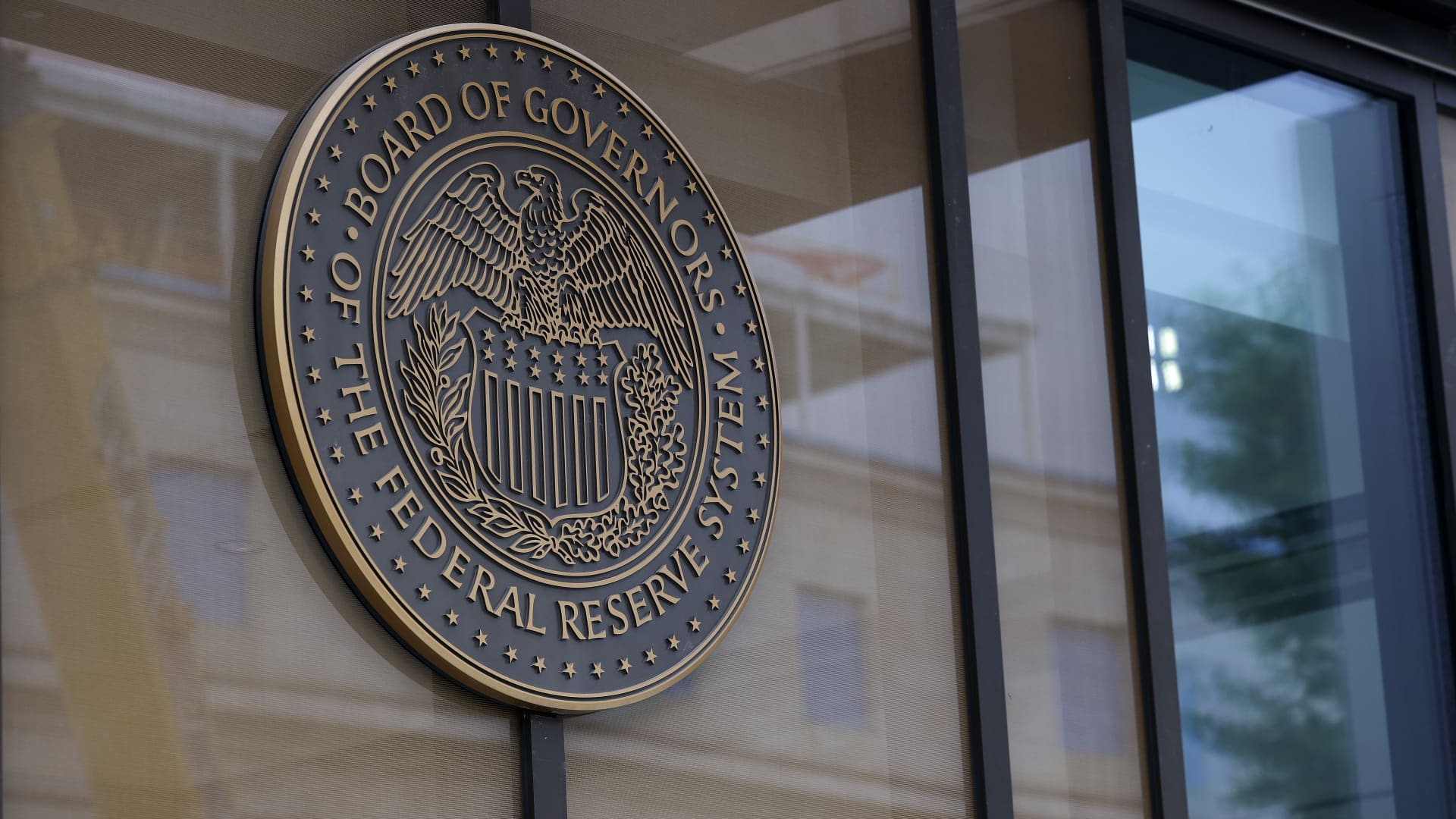
The Federal Reserve logo is seen on the William McChesney Martin Jr. Building in Washington, Sept. 16, 2025.
Kevin Dietsch | Getty Images
While President Donald Trump made his pick for chair of the Federal Reserve with interest rate cuts in mind, his appointee may preside over the first rate hikes since 2023.
That’s according to traders on prediction market platform Kalshi, where there’s a rising likelihood the Fed will move to increase rates in the next year.
Traders place 64% odds on the next interest rate hike coming by July 2027. They also think there’s a 43% chance tighter policy happens as soon as this year.
Odds of a rate hike have jumped in the last 24 hours in reaction to ballooning yields on U.S. Treasurys, concern that inflation will continue to march higher and as oil prices show no signs of materially falling in the midst of the unresolved Iran war. Traders previously assigned just 50-50 odds that a rate hike would come in the first half of 2027.
Incoming Federal Reserve Chair Kevin Warsh during a Senate Banking, Housing, and Urban Affairs Committee confirmation hearing in Washington, April 21, 2026.
Graeme Sloan | Bloomberg | Getty Images
“Who’s actually in the monetary-policy driver’s seat? We’d argue that it’s the Bond Vigilantes,” Yardeni wrote.
But Wolfe Research chief investment strategist Chris Senyek in a Tuesday note said the moves in the bond markets might force a resolution to the war in the Middle East, potentially easing inflation pressures.
“We believe the U.S. Treasury market has been signaling persistent inflation and this week was the final straw,” he said. “Our sense is that there is potential for bond vigilantes to push yields higher in [an] attempt to push the Trump Administration to come to a quick resolution on Iran.”
Traders on Polymarket assign 35% odds that there is a rate hike in 2026.


Bitcoin miners are increasingly positioning themselves as pivotal players in the AI infrastructure supply chain, leveraging their control of sizable power capacity and data-center real estate to support surging demand for AI workloads. A fresh Bernstein analysis shows publicly traded miners collectively plan more than 27 gigawatts of power capacity and have disclosed AI-related agreements totaling over $90 billion, covering about 3.7 gigawatts with hyperscalers, neocloud providers and chipmakers. The finding adds a new dimension to the industry’s post-halving trajectory, suggesting energy and site access could become the true bottlenecks in scaling AI computing, even as crypto mining undergoes a notable pivot toward AI-focused data centers and high-performance computing facilities.
Meanwhile, a RAND research brief released last week estimates the United States could add roughly 82 gigawatts of net available capacity by 2030, underscoring a broader backdrop of expanding demand for data-center-grade power. Bernstein emphasizes that the real constraint now is electricity access—grid interconnections and approvals can take years, complicating plans to scale AI infrastructure at pace. In practice, the wait times for securing a gigawatt of power can stretch to about 50 months across states, with even growth-friendly jurisdictions such as Texas applying batch-review processes to manage interconnection queues and resource loads. The combination of regulatory scrutiny and local opposition to large-scale data centers further compounds these delays, in Bernstein’s view giving miners an edge due to their existing, grid-connected sites and experience running high-density computing facilities.
With AI demand rising, the report frames Bitcoin miners as potential accelerants for AI infrastructure rather than mere participants in a crypto cycle. The authors note that the bottleneck has shifted from silicon to electricity, a change that could reshape strategies across the crypto and broader tech infrastructure sectors.
The analysis arrives amid a broader narrative that the so-called AI supercycle is not only about chip technology or cloud-scale compute, but also about who can reliably provide the energy and real estate required to run demanding AI workloads at scale. The piece links to prior coverage on how miners are moving beyond traditional Bitcoin production to build data-center ecosystems capable of hosting AI-related infrastructure and computing workloads.
Key takeaways
- Miners control a planned power portfolio exceeding 27 GW and have disclosed more than $90 billion in AI-related agreements covering about 3.7 GW with hyperscalers, neocloud providers and chipmakers, according to Bernstein.
- Access to electricity has become the primary scaling constraint for AI data centers, with grid interconnection queues and permitting delays stretching into multi-year timelines in several states.
- RAND projects a significant growth path for US capacity, estimating around 82 GW of net available capacity could be added by 2030, highlighting a larger macro backdrop for AI infrastructure expansion.
- The regulatory environment and local opposition to large data centers are contributing to delays, reinforcing the advantage for miners already operating grid-connected facilities.
- Miner economics are evolving: after the 2024 halving reduced mining rewards, several players are expanding into AI data centers and high-performance computing, with Soluna Holdings reporting a substantial rise in data-center hosting earnings, while IREN is cited as a prime pivot candidate thanks to Microsoft-backed AI agreements.
AI infrastructure takes the lead, while electricity remains the hurdle
Bernstein’s analysis paints a picture of miner-turned-AI infrastructure players extending beyond their core Bitcoin mining activities. After the 2024 halving compressed mining margins, the sector has increasingly pursued revenue diversification through AI data centers and high-performance computing facilities. The emphasis is shifting from raw hashing power to the ability to secure reliable power and proximity to robust data-center ecosystems—assets that miners already command through long-standing grid connections and experience managing complex, dense computing environments.
The practical implication for investors and builders is clear: the value proposition for miners hinges less on the price of Bitcoin and more on their capacity to unlock and monetize AI-ready energy and real estate. The interconnection bottleneck is no longer a theoretical risk but a real choke point that can slow or derail expansion plans. In this context, utility providers’ approval processes, capacity queues and the pace of grid upgrades become material factors shaping the pace of AI infrastructure deployment. This dynamic helps explain why miners with established infrastructure networks may enjoy a structural advantage as AI workloads proliferate across industries.
Real-world pivots: from mining to AI clouds and data centers
The Bernstein study spotlights concrete examples of diversification beyond traditional crypto mining. Soluna Holdings, for instance, reported a meaningful uptick in first-quarter revenue, driven largely by its data-center hosting business rather than crypto mining. The shift mirrors a broader pattern among miners seeking recurring, sizable revenue streams tied to AI-ready facilities rather than volatile mining rewards alone.
Another prominent example cited by Bernstein is IREN, which is viewed as well-positioned to pivot toward AI infrastructure following multibillion-dollar agreements with Microsoft. The premise is simple: if miners can leverage existing sites and operational expertise to house AI compute and related services, they may unlock new growth channels that complement, or even supplant, traditional mining economics over time.
These moves are not merely opportunistic. They reflect a strategic recalibration in response to both market pressures and regulatory realities. By leveraging grid-connected sites and building AI-capable data centers, miners could become essential partners in AI value chains—providing power, cooling, and space for AI cloud services, while also contributing to the resilience and redundancy of AI compute ecosystems.
For investors, the takeaway is that AI infrastructure demand is not a standalone trend but a potential economic expansion path for miners with the scale and site access to support large, power-intensive deployments. It also underscores a broader market shift: the traditional crypto cycle may increasingly ride on AI-driven demand for compute and data-center capacity, rather than price dynamics alone.
What remains uncertain, however, are the policy and regulatory trajectories across different geographies and how quickly grid operators can modernize the interconnection process. The RAND projection of 82 GW of additional capacity by 2030 provides a bullish backdrop, but the pace at which administrators authorize new connections will be crucial. The coming years could determine whether the mining-to-AI infrastructure pivot achieves its intended scale or encounters persistent friction in the form of permitting delays and local opposition.
Beyond the headline figures, the evolving economic model invites a closer look at how specific players balance energy costs, capital expenditure for data-center facilities, and revenue from AI-related services. The Soluna and IREN cases illustrate how diversified revenue streams—from hosting to cloud-style AI offerings—may become a backbone for miner profitability, particularly as traditional block rewards continue to adjust post-halving cycles.
Additionally, the broader AI hardware supply chain remains a critical factor. As miners court partnerships with hyperscalers, cloud providers and chipmakers, the question becomes not only who can secure the most power but who can integrate seamlessly with AI platforms and meet reliability standards essential for enterprise-grade compute workloads. In this sense, the Bernstein analysis casts miners as potential accelerants for AI infrastructure growth, provided they can navigate energy and regulatory complexities with the same efficiency they apply to data-center management.
In short, the convergence of Bitcoin mining and AI infrastructure signals a meaningful shift in how digital asset infrastructure assets are valued. It points to a future where energy access, site strategy and long-term power commitments may determine which players lead in AI-enabled compute—and which ones struggle to scale in the face of interconnection bottlenecks and policy headwinds.
Readers should watch how grid operators, regulators and utility providers respond to this evolving landscape, as well as how mining firms optimize their asset portfolios to capitalize on growing AI demand while managing the risk profile that comes with long interconnection timelines and the complex economics of data-center deployments.

TLDR
- BlackRock transferred 5,847 Bitcoin worth about $450 million to Coinbase Prime through 20 separate transactions.
- The transfer occurred as Bitcoin prices fluctuated near $77,000 after a recent dip earlier in the week.
- Coinbase Prime serves as the custody and trading platform for BlackRock’s iShares Bitcoin Trust ETF.
- The movement likely reflects ETF operations such as redemptions, rebalancing, or internal fund management.
- IBIT has grown to nearly $63 billion in assets since its launch in January 2024.
BlackRock transferred 5,847 Bitcoin worth about $450 million to Coinbase Prime on Tuesday through multiple transactions. The movement occurred as Bitcoin prices fluctuated near $77,000 after a recent dip. Market data shows institutional activity continues alongside shifting price trends.
BlackRock Shifts Bitcoin to Coinbase Prime Accounts
BlackRock executed 20 separate transactions to move 5,847 Bitcoin into Coinbase Prime custody accounts. The transfers drew attention from traders tracking institutional wallet activity.
Coinbase Prime serves as the custody and trading platform for BlackRock’s iShares Bitcoin Trust, known as IBIT. The platform handles asset storage and transaction processing for institutional clients.
The asset manager uses Coinbase Prime to manage Bitcoin, backing its exchange-traded fund holdings. Therefore, such transfers often relate to fund operations rather than direct market sales.
Market participants observed the timing as Bitcoin hovered near $77,000 after dropping to $76,000 earlier. Price data from CoinGecko confirmed the short-term fluctuation.
Analysts stated that transfers to Coinbase Prime may signal ETF redemptions or internal portfolio adjustments. Others added that operational needs also drive these transactions.
One market analyst said, “Movements like these often reflect fund mechanics rather than immediate selling pressure.” The statement reflects common interpretations of institutional transfers.
IBIT launched in January 2024 after regulatory approval for spot Bitcoin ETFs in the United States. The fund has since grown to nearly $63 billion in assets.
Bitcoin Whale Wallets Rise as Accumulation Continues
Data from Santiment shows wallets holding at least 100 Bitcoin increased to 20,229 over the past year. The figure rose from 18,191 wallets recorded during the same period.
These wallets typically belong to institutional investors, large holders, and high-net-worth individuals. Each wallet holds Bitcoin valued at roughly $7.7 million based on current prices.
The steady rise occurred despite price volatility across the past year. Bitcoin experienced several swings, yet large wallet counts continued to grow.
Santiment reported that the increase represents an 11% rise in whale wallet numbers. The data highlights continued accumulation by larger holders.
Smaller traders showed mixed sentiment during recent market movements. However, large holders maintained consistent accumulation patterns.
A market observer said, “Large wallets tend to expand holdings during uncertain periods.” The comment reflects ongoing accumulation trends.
Bitcoin’s price remained close to $77,000 at the time of reporting. Market data showed recovery following the brief dip earlier in the week.

Crypto World
Polkadot Price Prediction 2026 Shows 300% Potential While One Presale Could Deliver That Return Before Lunch
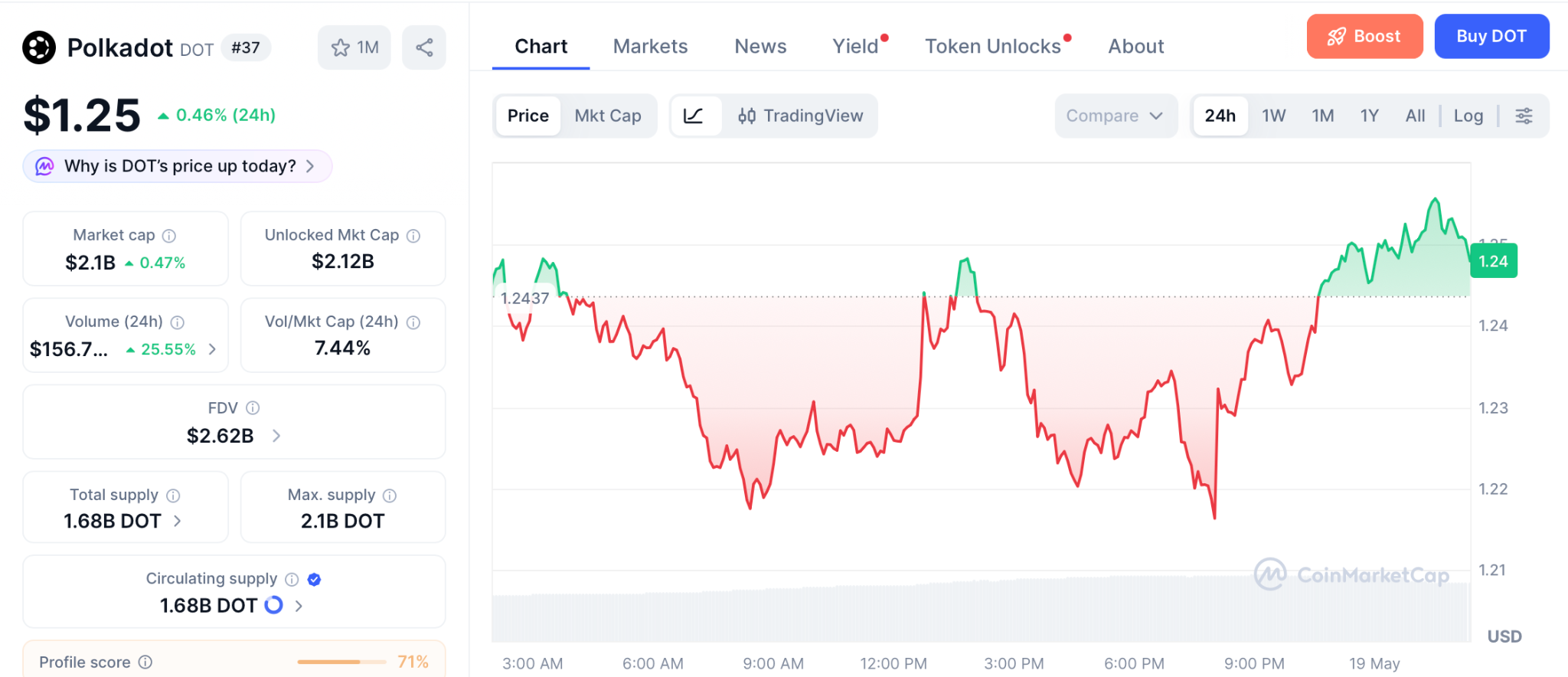
The Polkadot price prediction is getting attention again as DOT trades near $1.25, which is 97% below its all-time high of $55 and close to the lowest price the token has ever hit.
Polkadot launched Bulletin Chain earlier this month, a new storage system that replaces the central servers most Web3 apps still use.
But even with that upgrade, a 300% move from here only turns $1,000 into $4,000, while a single listing event from a presale entry can deliver that kind of return in one day.
Polkadot Launches Bulletin Chain as DOT Trades Near All-Time Low
Polkadot announced Bulletin Chain on May 4 as a storage layer for Web3 apps that still run on central servers, according to CoinDesk. Developer activity has not turned into real user growth, with total DeFi value locked still below $300 million.
A bridge exploit in April showed a weak spot per Crypto.com. The DOT outlook for 2026 still depends on whether real users follow the builders who are already there.
Where the Biggest Returns Are Being Built Before Exchange Listing
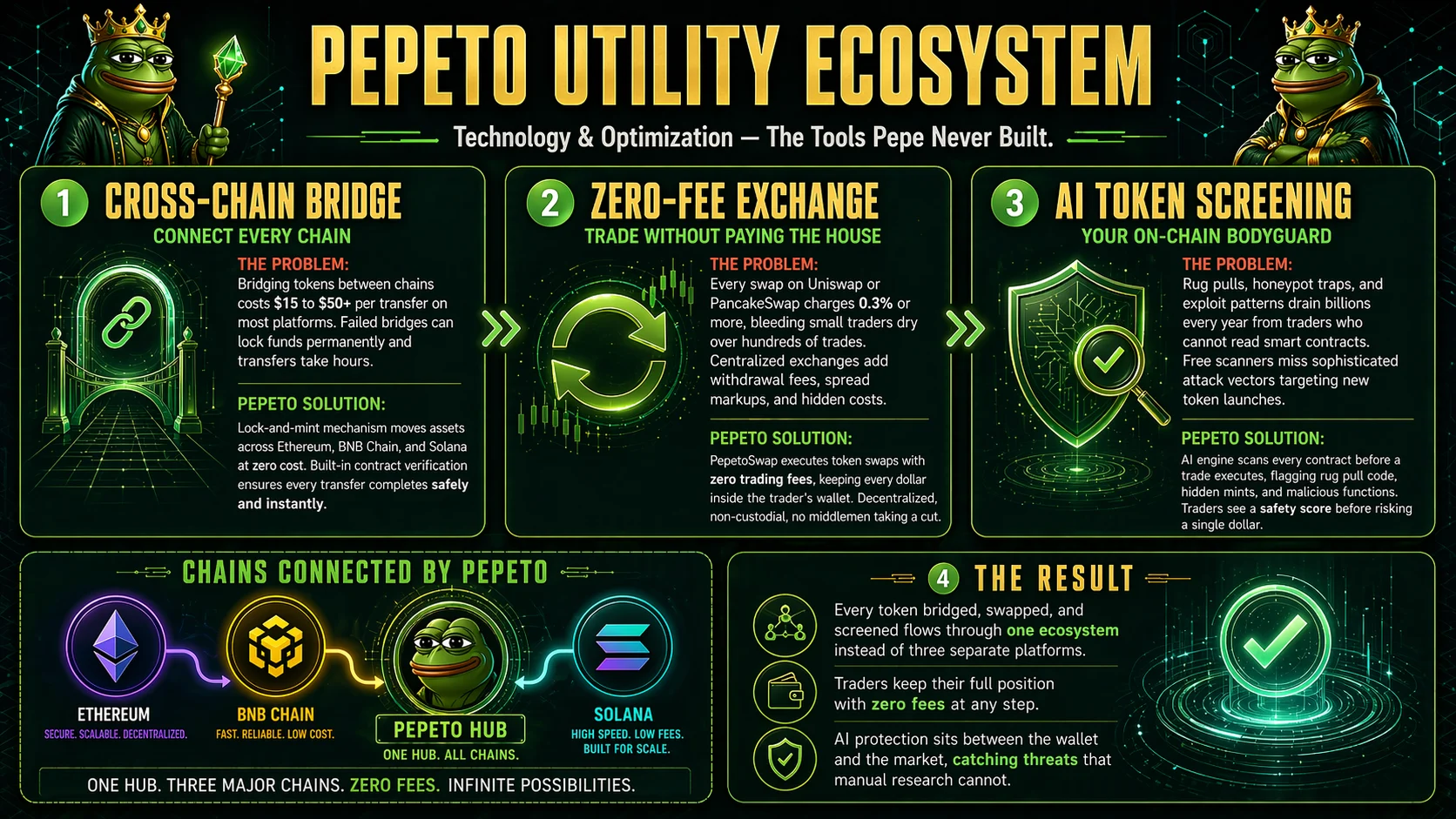
Pepeto Collects $10.08 Million as a Working Protocol Delivers Before Listing Day
The gap between builders and real users on big chains is exactly why presale money keeps going to Pepeto, a project made by a PEPE cofounder that has pulled in more than $10.08 million because the tools work today and not on some future date.
The bridge moves tokens between blockchains so holders save on gas fees, the swap runs trades through the Pepeto official website so money never sits with a third party, and the AI scanner checks contracts before traders go near them, so every tool feeds demand back into one place from the very first trade.
Staking at 172% APY grows the value of every token bought at $0.0000001871 before any exchange opens, and because SolidProof ran the full audit and all 420 trillion tokens are locked at launch with nothing new added after, the free float keeps dropping with each holder who stakes.
A Binance listing is expected when presale funding fills up, and that is the moment where a fixed supply meets exchange volume for the first time.
The Pepeto site shows the product running right now, and that proof is why Pepeto keeps pulling in wallets faster every week while large caps like DOT sit 97% below their highs waiting for a recovery that could take years.
Polkadot Price Prediction Targets Through 2026 and 2027
Polkadot trades at $1.25 with a market cap around $2.12 billion according to CoinMarketCap, ranked 43rd. Analysts see a possible 2026 high of $5.29 according to PricePrediction, while Changelly sees $1.89 by December.
The 2027 range goes from $1.01 to $2.35. A $1,000 buy at $1.25 growing to $5.29 returns about $3,266, strong for a large cap but still a fraction of what a presale entry before listing day can bring in one session.
Conclusion
The entry in Pepeto today at $0.0000001871 will not be here next week, because every person who made real money in crypto made one choice that set them apart from everyone else, and that choice was to act before the listing instead of planning to come back later.
The Polkadot price prediction may show DOT climbing from $1.25 toward $5 over many months, and that would be a good gain, but the wallets that changed lives in every cycle found presale entries where one listing event turned years of waiting into one price move.
The presale already passed $10.08 million, the staking pool at 172% APY grows every day, and a PEPE cofounder running the project with a Binance listing on the way is what makes this different from everything else in the market.
The presale ends when the listing opens, and every day of waiting is one day less to get in at this price. Missing this by one day could be the gap between collecting the listing gain and reading about the wallets that did.
Click To Visit Pepeto Website To Enter The Presale

FAQs
What is the Polkadot price prediction for 2026?
The Polkadot price prediction for 2026 shows DOT could reach $5.29 at the top, while Changelly sees $1.89 by December. DOT trades at $1.25, down 97% from its $55 high.
What is the best presale to buy alongside the Polkadot price prediction?
The best presale to buy is Pepeto because it can deliver from one listing event what DOT at $1.25 would take years to match, with $10.08 million raised and a Binance listing on the way.
Disclaimer: This is a Press Release provided by a third party who is responsible for the content. Please conduct your own research before taking any action based on the content.
South Korean retail investors are pulling savings, fixed deposits, and life insurance funds to buy SK Hynix and Samsung Electronics. Both stocks trade near record highs on AI chip demand.
Savings bank deposits fell below ₩100 trillion ($66.24 billion) for the first time in four years. Commercial bank time deposits dropped by roughly ₩12 trillion ($7.94 billion) since February as cash rotated into equities.
Older Investors Drive a Leveraged Bet on Two Stocks
Investors over 50 now hold about 62% of all margin loans at South Korea’s top brokerages. Margin debt among those in their 60s doubled from ₩3.9 trillion ($2.58 billion) to ₩8 trillion ($5.29 billion) in a year. Domestic securities firms disclosed the surge.
Insurance policy surrenders at the top three life insurers jumped 16% in Q1 2026. Savings-type policies surged 23% as households cashed out for equities.
“The marginal buyer is now liquidating insurance policies, withdrawing savings, borrowing on margin, and leveraging existing assets just to stay in the rally,” analayst and YouTuber Crypto Rover highlighted.
AI Chip Demand Fuels Concentration Risk
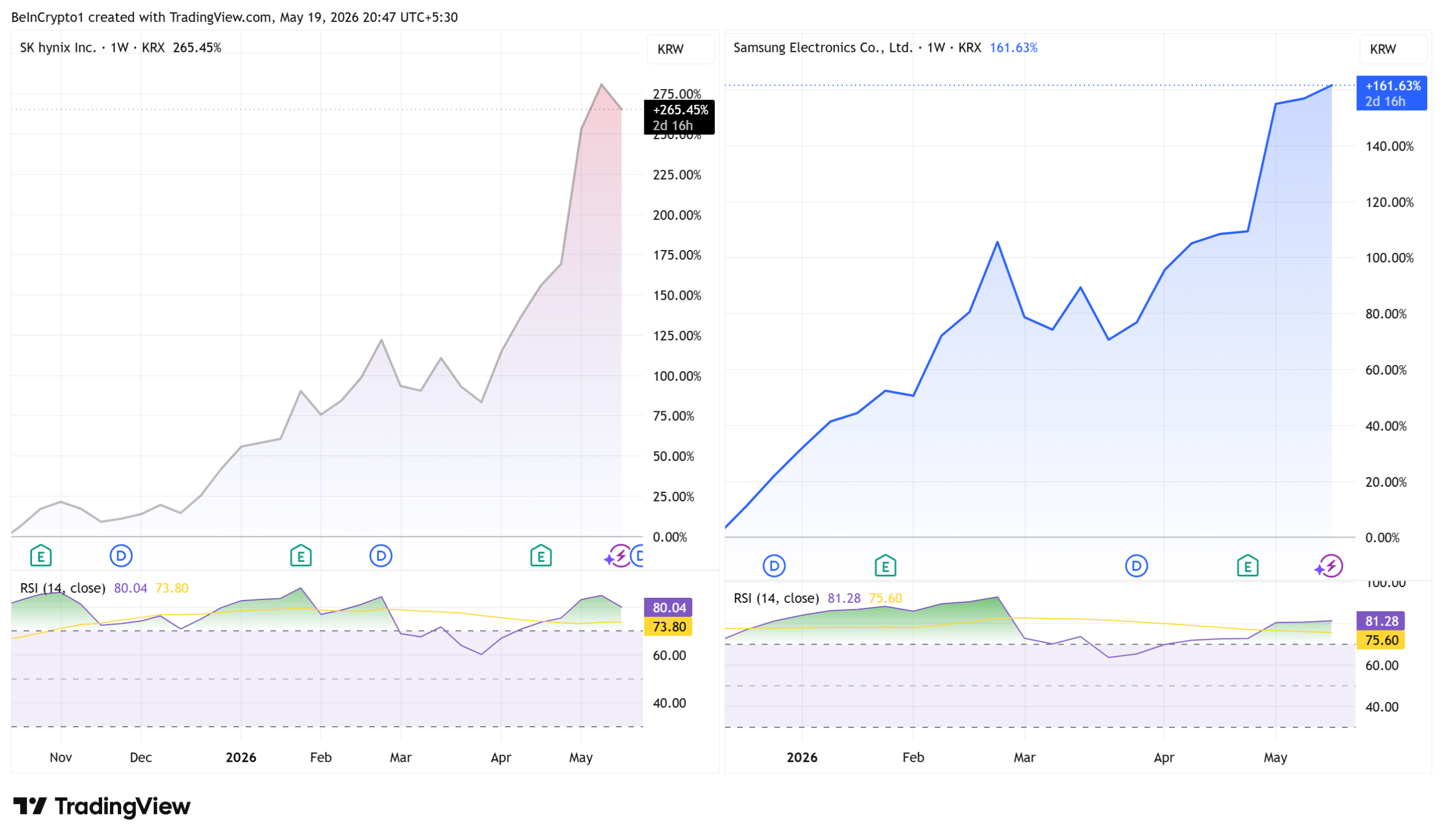
SK Hynix and Samsung Electronics together account for roughly 42% of the KOSPI after AI-fueled rallies. SK Hynix has gained 265% since November while Samsung climbed 162%, according to weekly TradingView data.

Korea’s government added a ₩33 trillion ($21.86 billion) support package for the chip sector, layering policy fuel onto record retail flows.
The KOSPI dropped 19% in March before recovering, with leveraged older investors averaging roughly 20% losses during the slide.

The same risk appetite has spilled into crypto. Korean Won handles about 30% of global spot volume on Upbit and Bithumb.
Weekly RSI readings above 80 on both stocks signal overbought conditions. The next Samsung and SK Hynix earnings cycle will test the leverage holding this rally together.
The post South Koreans Liquidate Savings and Insurance to Chase SK Hynix and Samsung Rally appeared first on BeInCrypto.
Ethereum remains under persistent selling pressure after failing to reclaim key resistance zones, with recent price action pointing to weakening bullish momentum and a growing probability of deeper retracement. The market is now testing critical support levels that could determine ETH’s next major move.
Ethereum Price Analysis: The Daily Chart
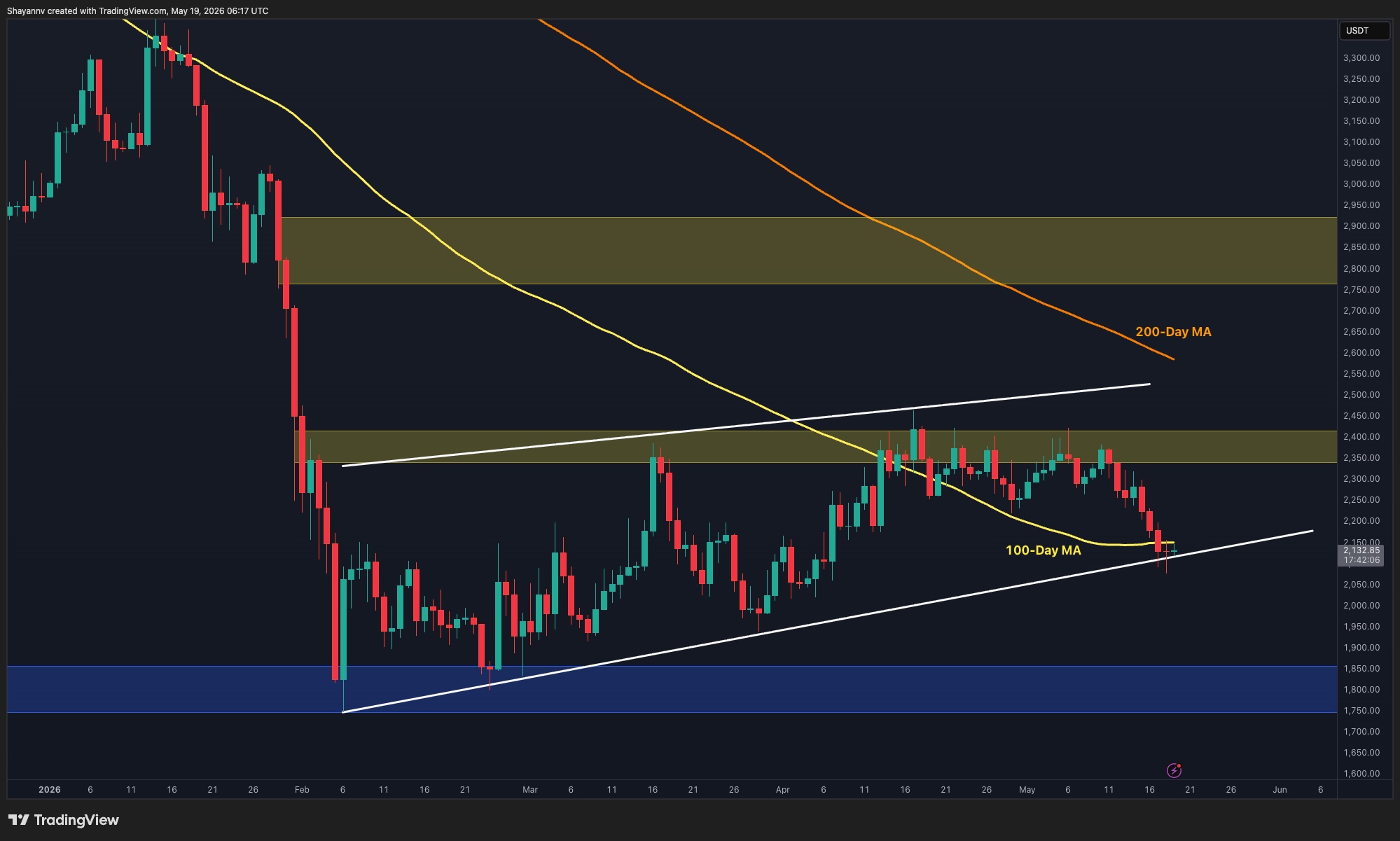
Ethereum has extended its corrective phase after repeated failures to sustain momentum above the $2.3K–$2.4K resistance region. The asset recently lost the 100-day moving average near $2.15K and is now hovering around the lower boundary of the broader ascending channel at the $2K area, signaling increasing bearish dominance in the medium term.
This rejection suggests that sellers remain active during every recovery attempt. If ETH fails to defend the current channel support, a sharper decline toward the major demand region around $1.8K becomes increasingly likely.
On the upside, reclaiming the $2.4K resistance would be required before considering any meaningful shift in sentiment. Until then, the broader structure favors continued consolidation or downside pressure.
ETH/USDT 4-Hour Chart
On lower timeframes, Ethereum has confirmed a bearish breakdown below the ascending wedge structure that had contained the price action for several weeks. Following the breakdown, ETH attempted a recovery toward the lost trendline but faced immediate rejection, validating the breakout and reinforcing bearish continuation scenarios.
The recent selloff has now pushed the price toward a key support zone around $2.1K, where short-term buyers are attempting to stabilize the market. This region aligns with a notable demand block and the lower boundary of the broader rising channel, making it an important level to monitor.
If this support fails, the next downside target could emerge around the $2K-$2.05K area. Conversely, holding above current levels may trigger a temporary rebound, though significant resistance remains overhead near $2.2K and later $2.4K.

Sentiment Analysis
The 3-month liquidation heatmap reveals a substantial concentration of liquidity resting above the current price, particularly around the $2.45K-$2.5K region. Historically, markets tend to gravitate toward large liquidation pools as they provide fuel for volatility and position unwinding.
However, in the short term, Ethereum has begun tapping liquidity pockets below current levels near $2.05K-$2.1K while bearish momentum remains dominant. This suggests downside pressure could persist before any larger recovery attempt toward upper liquidity clusters occurs.
The imbalance between nearby downside liquidity and heavier long-term clusters overhead points to elevated volatility ahead. Whether ETH first sweeps lower support zones or stages a recovery toward $2.5K will likely depend on how price reacts around the current $2.1K demand area.

The post Ethereum Price Prediction: Is Sub-$2K Inevitable for ETH After Losing the 100-Day MA? appeared first on CryptoPotato.
Crypto World
BeInCrypto Institutional Research: 10 Chain Foundation Programs Driving Web3 Ecosystem Development

Best Web3 Ecosystem Development Program is a category within the BeInCrypto Institutional 100, an annual research-driven program recognising institutional digital asset excellence across 26 categories and six pillars.
This category sits under Pillar 6: Tokenization & Enterprise Blockchain. The 10 programs below are listed alphabetically by parent chain and are not ranked. A shortlist will be named in May 2026, with the winner announced at Proof of Talk in Paris on June 2–3, 2026.
Key Facts
- Long list: 10 named programs across grants, accelerators, hackathons, retroactive funding, gas rebates, incubators, AI-focused programs, and strategic ecosystem funds
- Initial pool: More than 25 chain-foundation programs screened; 10 advanced to the long list
- Order: Listed alphabetically by parent chain, not ranked
- Scoring: 30% quantitative data · 50% Expert Council · 20% disclosed company data
- Criteria assessed: Capital deployed, graduate impact, institutional focus, program quality, ecosystem growth, transparency
- Boundary scope: This category evaluates a specific named program, not the underlying chain or the chain’s wider ecosystem
| Program | Parent Chain | Program Scale & Structure | Representative Outcomes |
|---|---|---|---|
| Aptos $50M Markets and Machines Commitment | Aptos Run by Aptos Foundation and Aptos Labs |
Announced May 7, 2026 $50M+ strategic capital commitment across on-chain markets, protocol infrastructure, research, AI agents, and trading partners |
Decibel surpassed $1B cumulative volume after Feb 2026 mainnet launch Shelby supports AI-agent workloads through hot storage and licensed dataset exchange |
| Arbitrum Trailblazer AI Grant Program + Trailblazer 2.0 | Arbitrum Run by Arbitrum Foundation |
Trailblazer AI launched Nov 2024; Trailblazer 2.0 launched Jun 2025 $2M total budget across immediate grants and Vibekit-based agentic DeFi tooling |
Onboarded AI projects including Allora, ARC Agents, Eternal AI, Hyperbolic, Ora, and Eliza Vibekit launched with integrations for Pendle, GMX, Aave, and Camelot |
| Avalanche Retro9000 Retroactive Grants Program | Avalanche Run by Avalanche Foundation |
Launched Nov 2024 Up to $40M in retroactive grants plus $2M referral pool, with quarterly snapshots and C-Chain fee-based grant rounds |
Cohort 1 funded 19 grantees with more than $1M Cohort 2 funded 8 grantees; Cohort 3 funded 4 grantees, including infrastructure and app builders |
| Ethereum ESP New Grants Program | Ethereum Run by Ethereum Foundation Ecosystem Support Program |
Relaunched Nov 3, 2025 after redesign pause Dual-track Wishlist and RFP model focused on cryptography, privacy, application-layer development, security, and community growth |
ESP database includes 1,039 funded projects since 2024 2025 Academic Grants Round expanded to $2M, alongside Office Hours and new grant tooling teams |
| Hedera Crypto Economy Fund + Thrive 2025 Grants + Verifiable AI Tooling | Hedera Run by Hedera Foundation |
Crypto Economy Fund ongoing since 2022; Thrive 2025 grants launched in 2025 Multi-track structure across community innovation, enterprise grants, academic research, AI, tokenization, identity, and RWAs |
AI Studio and Verifiable Compute launched with EQTY Lab, NVIDIA Blackwell, Accenture Public Sector, and SCAN UK Hedera donated its codebase to Linux Foundation Decentralized Trust as Project Hiero |
| NEAR AI x HZN Incubation Program + NEAR AI Agent Fund | NEAR Run by NEAR Foundation and NEAR.AI |
Incubator launched May/Jun 2024 with follow-on phases through May 2025 $100K NEAR investment per team, up to $250K from Delphi Labs, $50K Aethir credits, and $20M AI Agent Fund |
Initial cohort funded Mizu, Pond, Nevermined, Hyperbolic, Ringfence, and Exabits Hyperbolic raised $7M seed; Mizu launched beta with 20K users in its first week |
| Polygon AggLayer Breakout Program | Polygon Run by Polygon Foundation and Polygon Labs |
Launched Apr 24, 2025 Structured incubator-to-graduation program for projects building around AggLayer, with 5–15% token airdrops to POL stakers |
Privado ID graduated after testing with HSBC and Deutsche Bank Miden raised $25M seed; Katana became an AggLayer CDK chain with VaultBridge |
| Solana Frontier Hackathon 2026 + Colosseum Accelerator Series | Solana Run by Solana Foundation and Colosseum |
Frontier ran Apr 6–May 11, 2026 Colosseum deploys more than $2.5M into select winners; up to 10 teams enter accelerator with $250K pre-seed funding |
Breakout Hackathon drew 10,000+ participants from 140+ countries and 1,412 final projects Colosseum alumni have raised more than $650M in venture capital |
| Starknet Propulsion v2 Program | Starknet Run by Starknet Foundation |
Original pilot launched May 2024; Propulsion v2 live Nov 27, 2025 Up to $1M per project in STRK, with gas-rebate funding tied to demonstrated user adoption |
Starknet user-centric projects grew from 72 to 193 between Nov 2023 and Nov 2024 Notable v2 participants include Ready, Focus Tree, AVNU, Endur, Ekubo, and Cartridge |
| Sui Foundation Ecosystem Development Program | Sui Run by Sui Foundation |
$50M new grants announced Feb 2026 Multi-track structure across RFP grants, flash RFPs, research awards, Hydropower accelerator, Sui Overflow, and DeFi ecosystem funding |
Sui Overflow 2025 drew 352 project submissions Monthly active developers reached 1,300 in Q1 2026, while Sui recorded $111B stablecoin volume in Jan 2026 |
About This List
The BeInCrypto Institutional 100 — Best Web3 Ecosystem Development Program (2026 Long List) identifies specific named programs run by chain foundations to grow Web3 ecosystems. These include strategic capital commitments, AI-focused grant programs, retroactive funding, RFP models, enterprise-backed foundation grants, incubators, hackathon-to-accelerator pipelines, gas-rebate mechanisms, and vertical-specific ecosystem funds.
The category evaluates the program itself. The underlying chain is evaluated separately under Category 6.2: Best Blockchain Infrastructure. Enterprise blockchain implementations built on these chains are evaluated under Category 6.1: Best Institutional Enterprise Blockchain Implementation. Pure-capital VC programs operated by venture firms are routed to fund-manager categories.
Methodology
This category is evaluated under Track B of the BeInCrypto Institutional 100 methodology: 30% quantitative metrics, 50% Expert Council scoring, and 20% disclosed company data.
Assessment spans six criteria: capital deployed through the program, portfolio impact of graduates, institutional focus, program quality and structure, ecosystem growth attributable to the program, and transparency.
The disclosed data weighting reflects the limited public visibility into foundation grant economics, including capital actually deployed versus committed, post-grant portfolio performance, and graduate retention.
Data was verified using foundation press releases, official program pages, on-chain ecosystem metrics, portfolio-company funding announcements, relevant regulator filings, audited ETF disclosures, Linux Foundation Decentralized Trust filings, and mainstream financial press.
The post BeInCrypto Institutional Research: 10 Chain Foundation Programs Driving Web3 Ecosystem Development appeared first on BeInCrypto.
TLDR
- Google introduced a redesigned Search experience powered by Gemini 3.5 Flash at I O 2026.
- The new interface supports longer and more conversational user queries instead of short keywords.
- Google added an AI-powered autocomplete that suggests refined and follow-up questions in real time.
- AI Overviews now appear more consistently and provide summarized answers at the top of results.
- Users can move between AI summaries and chatbot-style interactions without leaving the search page.
Google introduced a redesigned Search platform powered by Gemini 3.5 Flash at I/O 2026. The update blends traditional search with AI-generated responses and conversational features. The company confirmed that the rollout aims to shift user behavior toward natural language queries.
Google presented the updated interface as part of its broader Gemini strategy across products and Android systems. The company emphasized faster responses and improved context handling through the new model. Robby Stein said users will “reliably” see AI Overviews for conversational queries.
Google Expands Conversational Search and AI Summaries
Google redesigned the search box to support longer and more detailed user queries. The interface now encourages full questions instead of short keyword searches. As a result, users can ask complex queries like protocol explanations and receive structured answers.
The company also introduced AI-powered autocomplete that suggests refined questions in real time. This system builds on user intent and offers follow-up prompts during typing. Google stated that this feature helps guide users toward more complete and relevant searches.
AI Overviews remain central to the new experience and appear at the top of results pages. These summaries compile information from multiple sources into a single response. Stein explained that the system connects directly to AI Mode for extended conversations.
Users can now transition between summaries and chatbot interactions without leaving the search page. This integration allows continuous dialogue powered by Gemini 3.5 Flash. Google positioned the model as faster and more efficient than earlier versions.
Gemini Model Powers Deeper Integration Across Devices
Google confirmed that Gemini 3.5 Flash supports both cloud and on-device processing. Some AI tasks will now run locally on Android devices. This approach reduces latency and improves performance for certain features.
The company linked this update to its broader Gemini Intelligence initiative. It aims to embed AI capabilities across mobile ecosystems and services. Google also highlighted ongoing work on open models for developers.
The search redesign aligns with Google’s focus on unified AI experiences across platforms. The company plans to expand these capabilities in future updates. Current deployments began following the I/O announcement.
Google did not disclose exact rollout timelines for all regions. However, it confirmed gradual availability across devices and markets. The company continues to test features through limited releases.
Changes in Search Structure Affect Information Visibility
Google confirmed that AI Overviews synthesize content from multiple indexed sources. The system selects key data points and presents a summarized response. This process reduces reliance on traditional link-based navigation.
The company acknowledged that users may interact less with individual websites. AI-generated answers often provide direct responses without requiring clicks. Google did not provide specific metrics on traffic changes.
Platforms that provide structured data may still contribute to AI summaries. However, their visibility depends on how Gemini selects information. Google continues refining its ranking and synthesis systems.
Crypto World
BeInCrypto Institutional Research: 8 Neobanks Setting Standards for Digital Asset Accessability

Digital-asset neobanking has moved beyond basic crypto access. The category now covers firms combining bank-account-style services — checking, direct deposit, debit, savings, and banking partnerships or charters — with native crypto products built into the primary financial app.
Best Digital Assets Neobank is a category within the BeInCrypto Institutional 100, under Pillar 1: Retail to Crypto Bridge. The 8 firms below are listed alphabetically and are not ranked. A shortlist will be named in May 2026, with the winner announced at Proof of Talk in Paris on June 2–3, 2026.
Key Facts
- Long list: 8 firms across bank-chartered neobanks and BaaS, EMI, or VASP-licensed fintechs with crypto integrated into the primary banking app
- Initial pool: 18 firms screened; 8 advanced to the long list, with 3 outreach candidates retained
- Order: Listed alphabetically, not ranked
- Scoring: 30% quantitative data · 50% Expert Council · 20% disclosed company data
- Criteria assessed: User base, crypto user count, product depth, regulatory licensure, payments and card integration, geographic reach, financial performance, innovation
- Data sources: OCC, FCA, BaFin, DNB, ACPR, MAS, CSSF, NYDFS, BACEN, CNBV, GFSC, MiCA-CASP, SEC EDGAR, audited filings, reserve attestations, on-chain data, PitchBook, Crunchbase, Tracxn
| Firm | HQ | Reach | Top Licensure / Charter | Representative Work |
|---|---|---|---|---|
| Bunq | Amsterdam, Netherlands | 17M+ users across 30+ EEA countries 2024 net profit of €85.3M, up 65% year over year |
Full Dutch banking licence from De Nederlandsche Bank EU passporting, MiCA-compliant; UK banking and US broker-dealer licences applied for in 2025–26 |
Launched Bunq Crypto through Kraken partnership in Apr 2025 Offers 300+ cryptocurrencies inside a licensed-bank environment; first-year crypto trades passed €100M |
| Cash App | Oakland, USA Block, NYSE: XYZ |
59M monthly active users in Q4 2025 9.3M primary banking actives; $316B total customer inflows in 2025 |
Banking via Sutton Bank partnership FDIC-insured checking, direct deposit, Cash Card, savings; NYDFS-licensed Bitcoin business |
Launched Proof of Reserves dashboard in Apr 2026 covering 8,883 BTC Bitkey self-custody wallet expanded; 5% Bitcoin Back rolled out across Cash App Card |
| KAST | Singapore / New York | 1M+ users across 170–190 countries About $5B annualized transaction volume; 150M+ merchants accepted globally |
Holds MSB Canada, MSB US, VASP EU, TCSP Hong Kong Uses regulated partners including Bridge, Tazapay, Reap, Fireblocks, BitGo, and Privy |
Closed $80M Series A in Mar 2026 at $600M valuation KAST Business beta launched in May 2026; security stack includes Sardine, Elliptic, ChainPatrol, Vanta, and Scanner.dev |
| Mercado Pago | Buenos Aires, Argentina Mercado Libre, NASDAQ: MELI |
100M+ users across Brazil, Mexico, Argentina, Colombia, Chile, Uruguay, and Peru via MELI ecosystem | Jurisdiction-specific fintech and payments licences across Latin America VASP authorisations for MELI Cripto in operating markets |
MELI Cripto expanded to 17 tokens by May 2026 Trading fee cut to 0.2%; Meli Dólar stablecoin available across Brazil, Mexico, and Chile |
| Nomad | São Paulo, Brazil | 1M+ users Brazilian USD-account neobank focused on retail consumers and global investment access |
Brazilian fintech registration Banking issued through Brazilian and US partner banks; CVM-regulated investment platform component |
Pioneered XRP Ledger settlement for Brazilian USD payments Adapting to Brazil BCB Resolution 561, which restricts crypto and stablecoin use in cross-border eFX settlement |
| Nubank | São Paulo, Brazil Nu Holdings, NYSE: NU |
110M+ customers 7M+ NuCripto users; Berkshire Hathaway among significant shareholders |
Full Brazilian banking licence from BACEN OCC US national bank branch conditional approval; Mexico and Colombia authorisations |
Earn Crypto staking launched in Mar 2026 with Solana promotional yield NuCripto now supports 20+ assets; USDC partnership with Circle deepened crypto access |
| Revolut | London, UK | 70M+ customers across 40+ countries as of Jan 2026 2025 revenue of $6B and profit before tax of $2.3B |
Lithuanian EU banking licence UK banking licence, Mexican banking licence, MiCA-CASP authorisation, US charter in progress |
Reached $75B valuation in Nov 2025 capital raise Revolut X offers 230+ digital assets, staking, low-fee trading, and RWA token listings |
| SoFi | San Francisco, USA NASDAQ: SOFI |
12.6M members Q1 2026 revenue of $1.1B with $166.7M net income |
SoFi Bank N.A. OCC-regulated national bank and FDIC-insured depository institution |
Launched retail crypto trading in Nov 2025 Opened 239,509 crypto accounts in Q1 2026; SoFiUSD stablecoin launched in Dec 2025 |
About This List
The BeInCrypto Institutional 100 — Best Digital Assets Neobank (2026 Long List) identifies digital-first consumer and SMB banking platforms that combine bank-account-like services with substantial depth in digital assets.
Two structural models qualify: bank-chartered direct entities such as Bunq, Nubank, Revolut, and SoFi; and BaaS-partnered, EMI-licensed, or VASP-licensed crypto fintechs that integrate crypto into the primary banking app, such as Cash App, KAST, Mercado Pago, and Nomad.
The category does not include crypto exchanges with payment cards added on, self-custody spending cards without banking services, stablecoin issuers, institutional digital asset banks, defunct crypto banking platforms, or chartered neobanks without native crypto products.
Methodology
This category is evaluated under Track B of the BeInCrypto Institutional 100 methodology: 30% quantitative metrics, 50% Expert Council scoring, and 20% disclosed company data.
Assessment spans seven criteria: total user base and crypto user count; crypto and stablecoin product depth; regulatory licensure; payments and card integration; geographic footprint; financial performance and sustainability; and innovation during the award window.
Data was verified using regulatory registers, company filings, SEC EDGAR, audited financial statements, reserve attestations, Proof of Reserves disclosures, relevant on-chain data, private-market sources including PitchBook, Crunchbase, and Tracxn, and mainstream financial press.
The post BeInCrypto Institutional Research: 8 Neobanks Setting Standards for Digital Asset Accessability appeared first on BeInCrypto.
Crypto World
Ape and Pepe (APEPE) Announces Ecosystem Expansion Through the Launch of Community FLOW
[PRESS RELEASE – New York, USA, May 19th, 2026]

Ape and Pepe (APEPE), a Polygon-based, community-driven hybrid meme ecosystem project, has officially announced the launch of “Community FLOW,” a new initiative aimed at expanding global community engagement and enhancing ecosystem transparency.
The launch of Community FLOW is part of APEPE’s long-term ecosystem expansion strategy focused on building a more community-centered culture and participation structure within the Web3 environment.
According to the APEPE community team, Community FLOW aims to introduce a more open and community-oriented approach toward ecosystem discussions, campaign participation, and future expansion directions. Through this initiative, the project seeks to enhance interaction among global community members and reinforce the foundation for long-term ecosystem growth.
Originating on Polygon, APEPE has continued expanding through various global campaigns, wallet integrations, and ecosystem collaborations. The project currently has a global community reach of over 2 million users and more than 400,000 on-chain holders.
In addition, it has expanded its presence across various global exchanges and communities, including HTX, Gate, MEXC, BingX, Coinone, and GOPAX. Recently, the ecosystem has continued to grow through global community campaigns, expanded wallet integrations, AI-based tools, collaboration with neofinance app TRIA, and partnerships related to gaming IPs.
APEPE has previously demonstrated its direction as a community-driven meme ecosystem through initiatives such as the Times Square community campaign and various user-generated meme content activities.
A community representative stated that APEPE plans to continue expanding the ecosystem through additional community initiatives, partnerships, integrations, and global campaigns.
About APEPE
APEPE is a Polygon-based community-driven meme ecosystem project focused on community participation, ecosystem expansion, and Web3 culture. The project continues to expand through global campaigns, wallet integrations, partnerships, and community-led initiatives.
Website: https://apepe.lol/
X (Twitter): https://x.com/APEPE_MEME
The post Ape and Pepe (APEPE) Announces Ecosystem Expansion Through the Launch of Community FLOW appeared first on CryptoPotato.
Crypto World
BeInCrypto Institutional Research: 10 Regulatory Frameworks Defining Institutional Digital Asset Markets

Best Regulatory Framework of the Year is a category within the BeInCrypto Institutional 100, an annual research-driven program recognising institutional digital asset excellence across 26 categories and six pillars.
This category sits under Pillar 5: Regulation & Governance. The 10 frameworks below are listed alphabetically by framework name and are not ranked. A shortlist will be named in May 2026, with the winner announced at Proof of Talk in Paris on June 2–3, 2026.
Key Facts
- Long list: 10 jurisdiction-level frameworks across comprehensive crypto regimes, stablecoin legislation, market-structure laws, VASP licensing, and consumer-protection regimes.
- Initial pool: More than 20 jurisdiction-level frameworks screened; 10 advanced to the long list.
- Order: Listed alphabetically by framework name, not ranked.
- Scoring: 20% quantitative data · 80% Expert Council.
- Criteria assessed: Legislative substance, activity scope, operational readiness, enforcement record, market coverage, institutional adoption, international influence, regulatory architecture.
- Boundary scope: This category evaluates jurisdiction-level statutory, regulatory, or licensing regimes, not single guidance notes, industry self-regulation, CBDC-only frameworks, or global soft-law standards.
| Regulatory Framework | Lead Authority | What It Achieves |
|---|---|---|
| Brazil BCB Crypto Framework | Banco Central do Brasil With CVM for securities tokens |
Creates Brazil’s first comprehensive crypto framework. Requires VASP authorisation and brings stablecoin transfers into the foreign-exchange regime. |
| CLARITY Act | US Congress Joint SEC and CFTC framework |
Would establish a federal US crypto market-structure law. Clarifies SEC/CFTC jurisdiction and creates registration routes for crypto exchanges, brokers, and dealers. |
| Dubai VARA Full Market Regulations | Virtual Assets Regulatory Authority Dubai, excluding DIFC |
Establishes Dubai’s standalone virtual asset regime. Covers VASP licensing, token issuance pathways, and enforcement for exchange, custody, broker-dealer, lending, and payments activity. |
| EU Markets in Crypto-Assets Regulation (MiCA) | ESMA and EBA With EU national regulators |
Harmonises crypto regulation across EU member states. Creates CASP passporting, stablecoin reserve rules, market abuse controls, Travel Rule integration, and operational resilience requirements. |
| GENIUS Act | OCC, Federal Reserve, and FDIC With state regulators for smaller issuers |
Creates the first US federal stablecoin framework. Requires high-quality liquid reserves, monthly disclosures, AML controls, and federal or state issuer pathways. |
| Hong Kong Stablecoins Ordinance | Hong Kong Monetary Authority | Establishes Hong Kong’s fiat-referenced stablecoin licensing regime. Requires 100% backing, strict reserve assets, paid-up capital, and one-business-day redemption at par. |
| Japan Payment Services Act Amendment 2025 | Financial Services Agency of Japan | Strengthens Japan’s regulated stablecoin framework. Limits issuance to banks, trust companies, and fund transfer providers, with reserve and redemption obligations. |
| Singapore MAS DTSP + Stablecoin Framework | Monetary Authority of Singapore | Combines digital payment token licensing, offshore DTSP oversight, and single-currency stablecoin rules. Sets high compliance standards for Singapore-incorporated firms serving global users. |
| South Korea Virtual Asset User Protection Act (VAUPA) | Financial Services Commission and Financial Supervisory Service With KoFIU |
Creates a consumer-protection regime for South Korea’s crypto market. Requires cold storage, cybersecurity insurance or reserves, unfair-trading monitoring, and reporting to regulators. |
| UAE Federal Capital Markets VASP Framework | Capital Market Authority UAE federal onshore perimeter, excluding DIFC and ADGM |
Replaces the prior federal VASP regime with a capital markets rulebook. Covers licensed virtual asset activities, higher governance standards, and recovery rules for systemically important VASPs. |
About This List
The BeInCrypto Institutional 100 — Best Regulatory Framework of the Year (2026 Long List) identifies jurisdiction-level regimes that materially shaped how regulated institutions issue, trade, custody, and intermediate digital assets during 2025 and 2026.
Coverage spans comprehensive crypto-asset frameworks, federal stablecoin legislation, market-structure laws, federal and emirate-level VASP architectures, and consumer-protection regimes with active enforcement.
The category does not evaluate single guidance documents, industry self-regulation, global soft-law standards, CBDC-only frameworks, or unilateral agency interpretations. These may influence regulation, but they do not qualify as standalone jurisdiction-level frameworks for this category.
Methodology
This category is evaluated under Track C of the BeInCrypto Institutional 100 methodology: 20% based on quantitative metrics and 80% based on Expert Council scoring.
Assessment spans eight criteria: legislative substance, scope of activities covered, operational readiness, enforcement track record, market coverage, institutional adoption, international influence, and novelty of regulatory architecture.
Data was verified using primary regulator publications, official gazettes, parliamentary records, legal-advisory firm analyses, CASP and VASP licence registers, regulator enforcement notices, prosecution announcements, blockchain analytics for market context, and mainstream financial press.
Negative-signal scans were applied for framework pauses, regulatory rollbacks, agency continuity issues, and conflicts with adjacent regimes.
The post BeInCrypto Institutional Research: 10 Regulatory Frameworks Defining Institutional Digital Asset Markets appeared first on BeInCrypto.

How to Remove Nonconsensual Intimate Images Under the Take It Down Act
Two men stabbed as police called to ‘reports of violence’ in Littleport

Ford and Filson announce new Bronco SUV built for rugged outdoor durability

Manchester United reach agreement with Casemiro over contract clause amid transfer speculation

US brings back mandatory military draft registration

Steven Gerrard disagrees with Gary Neville over ‘shock’ Chelsea and Arsenal claim | Football


-
 Crypto World4 days ago
BloFin War of Whales 2026 Grand Prix opens registration for $5M trading championship
-

 Fashion4 days ago
Weekend Open Thread: Theory – Corporette.com
-

 Crypto World4 days ago
E-Estate Announces 1 Year Live: Washington DC Summit as Real Estate Tokenization Enters Its Next Phase
-
Crypto World7 days ago
Bitcoin Suisse expands with Digital Asset License and Investment Business Act Registration Approval in Bermuda
-

 Tech5 days ago
Tech Moves: Microsoft AI leader jumps to OpenAI; former AI2 exec joins Meta; and more
-

 Crypto World7 days ago
Bitcoin Suisse expands with Digital Asset License and Investment Business Act Registration Approval in Bermuda
-
 Crypto World5 days ago
Google’s Gemini AI Predicts Incredible Solana Price by the End of 2026
-

 Tech4 days ago
Google reimburses Register sources who were victims of API fraud
-

 Business4 days ago
H&R Real Estate Investment Trust (HR.UN:CA) Q1 2026 Earnings Call Transcript
-

 Sports4 days ago
Napoleonic enters 2026 Doomben 10,000 field via Abounding withdrawal
-
 Entertainment5 days ago
Zara Larsson Has Blunt Response To Chris Brown Diss
-
 Crypto World6 days ago
Two AI Tokens Lead May Rally, But Risks Are Rising
-

 Fashion3 days ago
On the Scene at Gucci’s Cruise Show in New York City: Mariah Carey, Kim Kardashian, Lindsay Lohan, Iman, and More!
-
 Crypto World4 days ago
BeInCrypto 100 Institutional Awards Nomination: KAST for Best Digital Assets Neobank and Best Digital Assets Fintech
-
 Tech7 days ago
Why AI is making typography a boardroom conversation
-
 Crypto World4 days ago
Wall Street’s Boldest Gold Prediction Has Russians Rushing to Buy
-
 Crypto World4 days ago
Bitcoin Battles US Bond Nerves With BTC Price Dip Toward New May Lows
-

 Fashion4 days ago
Trending Western Style Vests Perfect for Summer
-

 Entertainment7 days ago
Bold and the Beautiful: Brooke’s Twisted Revenge Plot Against Katie!
-

 Politics7 days ago
Brad Raffensperger targeted by threat as he runs for governor
You must be logged in to post a comment Login