

Crypto World
Trump Media (DJT) Transfers $205M in Bitcoin to Crypto.com Amid Mounting Losses


Key Takeaways
- On May 22, 2026, Trump Media deposited 2,650 bitcoin valued at approximately $205 million to Crypto.com.
- Company representatives claim no sale occurred, describing the move as part of an expanded “trading strategy.”
- Trump Media acquired 11,542 BTC at a $118,522 average cost basis, significantly above current market prices.
- Unrealized losses on the company’s complete bitcoin position are estimated at approximately $455 million.
- First-quarter 2026 results showed a $405.9 million net loss against revenue of only $871,200.
Trump Media & Technology Group executed a transfer of 2,650 bitcoin to Crypto.com on May 22, 2026. Valued at roughly $205 million based on prevailing market rates, this marks the second instance of the company relocating substantial bitcoin assets to a centralized trading platform.
A company representative informed CoinDesk that Trump Media “transferred, but did not sell” the bitcoin, characterizing the transaction as an element of a more comprehensive trading approach. Nevertheless, the action has sparked scrutiny from market observers and shareholders monitoring the firm’s cryptocurrency portfolio.
On-chain analytics from Lookonchain and Arkham Intelligence verified the deposit. Following this transaction, Trump Media’s blockchain wallet retains approximately 6,889 BTC, currently valued at around $533 million.
Significant Unrealized Losses Accumulate
Trump Media initially purchased 11,542 bitcoin for roughly $1.37 billion, establishing a cost basis averaging $118,522 per token. Bitcoin has subsequently declined considerably below that acquisition price, hovering near $77,341 during the transfer timeframe.
This substantial price differential indicates the company carries approximately $455 million in unrealized losses across its cryptocurrency portfolio.
This wasn’t Trump Media’s inaugural exchange transfer. Four months prior, the company relocated 2,000 BTC to an exchange platform when bitcoin traded around $87,378. Officials attributed that earlier movement to internal custody restructuring. The recent transfer, executed at comparatively elevated prices, has generated additional scrutiny.
Trump Media has not disclosed its rationale for selecting Crypto.com specifically or detailed the terms of this arrangement. Whether the transfer relates to custodial requirements, liquidity management, or alternative objectives remains undisclosed.
Deteriorating Financial Performance
Trump Media disclosed a first-quarter net loss totaling $405.9 million in May 2026. During this identical timeframe, the organization generated merely $871,200 in revenue. The previous year’s corresponding quarter showed a $31.7 million net loss, highlighting the dramatic deterioration.
The majority of Q1’s losses stemmed from mark-to-market valuation adjustments on cryptocurrency holdings, which depreciated as bitcoin and Cronos valuations declined from their late-2024 highs. These represent paper losses rather than realized cash deficits.
The company’s primary business operations, encompassing Truth Social and related media ventures, produced $17.9 million in positive operating cash flow during the quarter.
Despite this, the overall financial picture has dampened investor confidence. Trump Media shares declined in morning trading sessions following disclosure of the transfer.
Trump Media also recently retracted its application for a spot bitcoin exchange-traded fund. ETF market specialists suggested the withdrawal reflected unfavorable market conditions in the bitcoin ETF sector rather than regulatory obstacles.
Unlike Strategy, which maintains over 818,000 bitcoin and has publicly declared a long-term accumulation philosophy, Trump Media CEO Devin Nunes has not articulated a comparable commitment. He has characterized the cryptocurrency holdings as a balance-sheet diversification initiative.
The company has not announced plans for a conference call or released formal statements addressing the transfer.


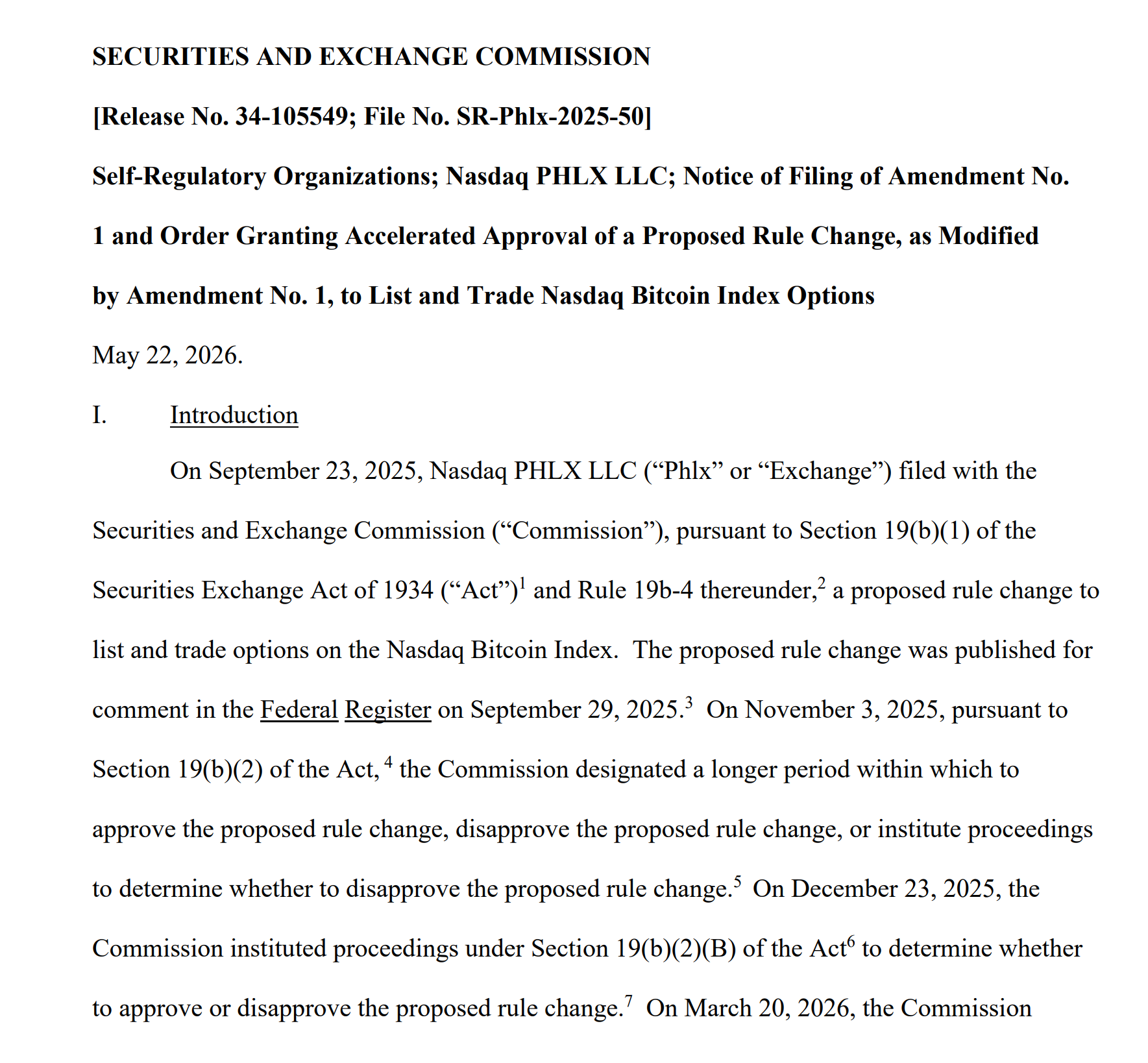
The Securities and Exchange Commission has approved Nasdaq’s proposal to list cash-settled Bitcoin index options on the Philadelphia Stock Exchange.
The options are European-style contracts tied to the Nasdaq Bitcoin Index, a benchmark that tracks one one-hundredth of the CME CF Bitcoin Real Time Index, which updates with data from major cryptocurrency exchanges every 200 milliseconds. The approval was granted on an accelerated basis and published Friday on the SEC’s website.
The new contracts are cash-settled, meaning holders receive the difference between the Bitcoin spot price and the strike price at expiration. Unlike options on spot Bitcoin ETFs, there is no physical Bitcoin involved and no risk of early assignment, offering traders an alternative way to bet on the price of the cryptocurrency.
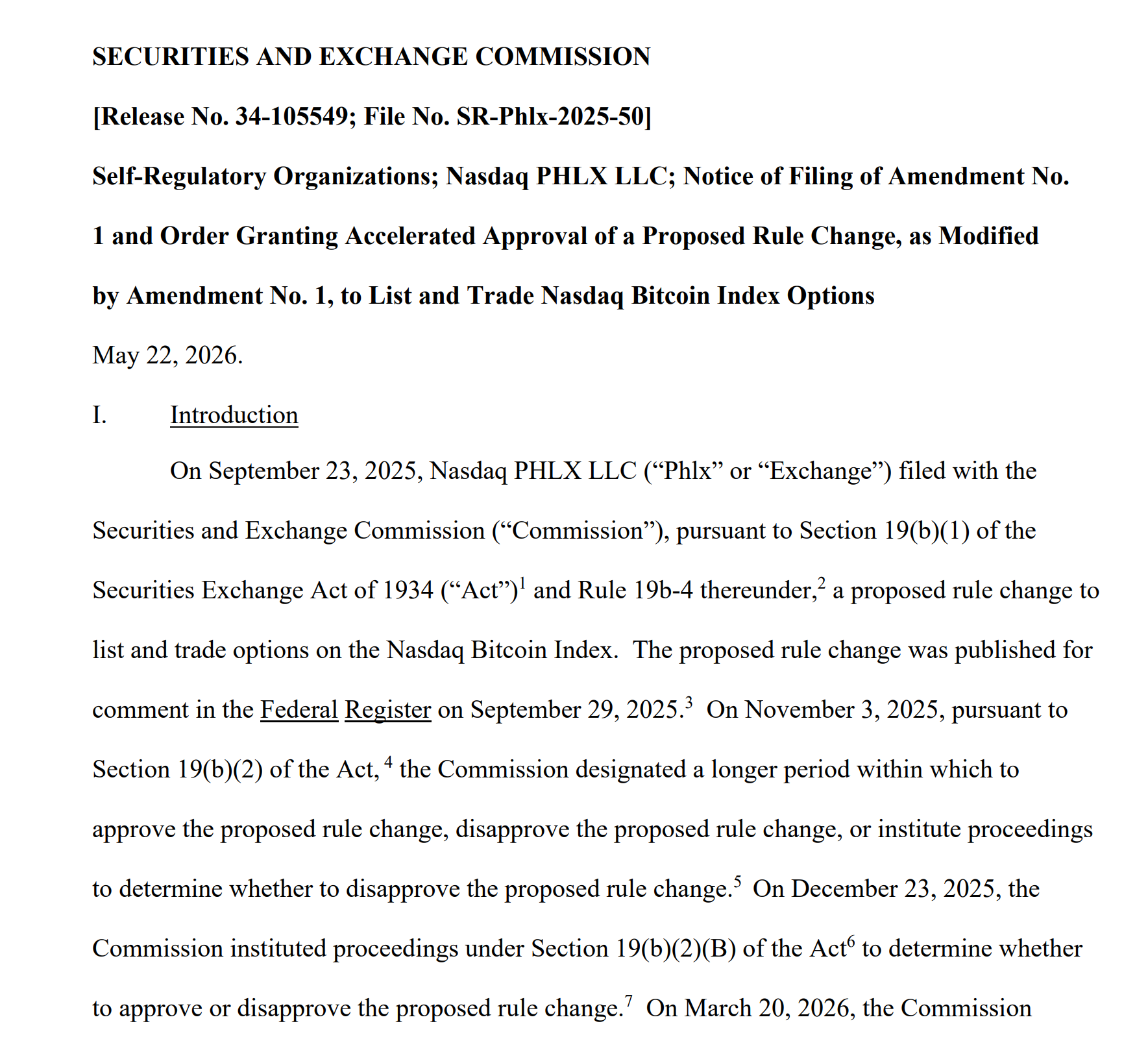
Source: SEC
The contracts will trade under the ticker QBTC on Phlx, with a minimum increment of $0.01 and a position limit of 24,000 contracts per side, equivalent to roughly 0.12% of Bitcoin’s outstanding supply, the SEC noted in its order.
Related: $1.26B Bitcoin ETF outflows spark ‘contrarian’ buy signal: Santiment
CFTC approval still needed
Despite the SEC green light, the options cannot begin trading until the Commodity Futures Trading Commission grants its own exemptive relief due to Bitcoin’s classification as a commodity, which falls under the CFTC’s jurisdiction.
CME Group, which has offered Bitcoin futures options since 2020, filed a comment letter in October last year arguing the contracts fall under CFTC’s exclusive jurisdiction. In the filing, the SEC noted that Section 717 of the Dodd-Frank Act is not limited to “novel derivative products” and allows for concurrent jurisdiction between the SEC and CFTC when the latter grants exemptive relief.
“The concept of shared jurisdiction between the Commission and the CFTC is not new,” the SEC wrote in the filing, citing existing examples such as mixed swaps and security futures.
Related: Nasdaq and S&P 500 Closed At Record Highs as Tech Stocks Rallied
SEC grows more crypto-friendly
The SEC, under Chairman Paul Atkins, is moving toward a more crypto-friendly regulatory posture. Atkins has moved to drop several high-profile enforcement cases against crypto firms that were initiated under the previous administration, and has publicly called for clearer regulatory frameworks that encourage innovation rather than stifle it.
As Cointelegraph reported, the agency is preparing an “innovation exemption” that would allow blockchain-based tokenized trading of public company shares on decentralized crypto platforms, even without the consent of the companies being tracked.
Magazine: Guide to the top and emerging global crypto hubs — Mid-2026


Bitcoin liquidations surpassed $320 million in longs on May 22 after the SEC unexpectedly delayed its tokenized stock plan.
Summary
- Crypto markets saw $320 million in long liquidations on May 22, with longs accounting for roughly $296 million of the total according to CoinGlass data.
- The SEC delayed a plan to grant broad exemptions for US crypto firms to trade tokenized assets linked to US stocks, Bloomberg reported on May 22.
- Bitcoin fell toward $76,000 following the news, extending a week of sustained selling pressure and a six-session Bitcoin ETF outflow streak.
The SEC delayed a plan on May 22 to provide broad exemptions for US crypto firms to trade tokenized assets linked to US stocks. The agency’s staff had been preparing to release an innovation exemption for tokenized stocks as soon as this week, according to people familiar with the matter.
The delay triggered a sharp move in derivatives markets. Crypto long positions worth approximately $320 million were liquidated in the hours following the announcement, with longs accounting for roughly $296 million of the total.
Why the SEC tokenized stock delay hit long positions so hard
Leveraged long positioning had been building in anticipation of a regulatory green light for tokenized equities. When the exemption was pulled back, traders positioned for a near-term catalyst were forced to exit. Bitcoin fell toward $76,000 during the session, its lowest print in approximately a week.
The tokenized stock market is already active internationally. Exchanges outside the US offer US stock tokens to non-residents, giving offshore users exposure to Apple, Tesla, and other US equities via blockchain.
An SEC exemption would have opened US-registered platforms to the same product, unlocking a market analysts have estimated at multiple billions of dollars. Crypto.news has tracked the broader regulatory calendar pressure in 2026, with the Clarity Act, tokenized equity rules, and stablecoin legislation all competing for bandwidth simultaneously.
What the SEC delay means for crypto market structure
The postponement continues a pattern of cautious regulatory movement on crypto market structure in 2026. Crypto.news has reported on the first May outflow event for Bitcoin ETFs earlier this month, which also coincided with regulatory uncertainty dampening market sentiment.
/The combined effect of ETF outflows and derivative liquidations reflects a market that had positioned more optimistically than the regulatory environment warranted. The Bitcoin (BTC) price page tracks live movements as the market digests the SEC’s delay and positions for what comes next on tokenized equities.


Kevin Warsh formally assumed the role of Federal Reserve Chair, taking the oath of office and receiving unanimous backing from the Federal Open Market Committee.
Warsh steps into the position as inflation remains elevated and the FOMC faces internal division. The Fed has held rates at 3.50%–3.75% through its most recent meeting. The White House has grown critical of the central bank’s cautious posture.
A Confirmation Built on Narrow Margins
The Senate confirmation vote passed 54-45 this month, the narrowest approval margin for any Fed chair in US history. President Donald Trump nominated Warsh on March 4, 2026. His term as chair runs through May 2030, with his board seat extending to January 2040.
Warsh previously served as a Fed governor from 2006 to 2011 under Chair Ben Bernanke. During the 2008 crisis, he helped coordinate the Bear Stearns sale to JPMorgan Chase, the Lehman Brothers proceedings, and the AIG rescue. After departing the board, he spent years as a fellow at Stanford’s Hoover Institution before returning to private finance.
Jerome Powell will remain on the Fed’s Board of Governors after stepping down as chair, having served in the role since 2018.
Policy Priorities and What to Expect Under Warsh
Warsh has pledged to serve as a “strictly independent” chair, pushing back against Trump’s repeated calls for lower borrowing costs. He supports a smaller Fed balance sheet and a narrower institutional mandate. He has also called for stricter limits on public communications from Fed officials about the rate path.
His crypto and AI financial disclosures revealed personal stakes in stablecoin project Basis and crypto asset manager Bitwise. However, Warsh has argued that Bitcoin (BTC) is too volatile to serve as a medium of exchange.
With US PPI reaching 6% in April, markets are closely watching the Fed’s current rate pause. Warsh’s first FOMC meeting will be the first real test of his independence from Trump.
The post Kevin Warsh Becomes Fed Chair After Unanimous FOMC Vote appeared first on BeInCrypto.
After it was rejected at $78,000 earlier this week, bitcoin’s troubles worsened with a nosedive to a monthly low of just over $74,000, where it finally found some support.
Most altcoins have followed suit on the way down, with ETH dipping to $2,000 today, BNB going down to $640, and XRP sliding to $1.31.
BTC Charts Monthly Low
The progress made on the CLARITY Act at the end of the previous week resulted in an impressive but short-lived BTC price pump that drove the asset to $82,000. However, it was almost immediately rejected at that level for the second time that week, but this correction has been a lot more painful.
The cryptocurrency first slipped to $79,000 by that Friday before it dropped to $78,000 during the weekend. The business week began on the wrong foot with a nosedive to $76,000. After it bounced to $78,000 on Tuesday and Wednesday, the bears stepped up on the gas pedal once again and didn’t allow a more impressive rebound.
Just the opposite; bitcoin dropped to $76,000 yesterday evening and kept plunging on Saturday to $75,000 at first and then to $74,200 minutes ago. The latter became BTC’s lowest price point in just over a month. Here are some possible reasons for its $8,000 drop in less than 10 days.
For now, its market capitalization has dumped below $1.5 trillion on CG, while its dominance over the alts has retreated slightly to 58%.

Alts Bleed Out
As mentioned above, bitcoin’s correction is not an isolated case. Essentially, the entire larger-cap altcoin field is in the red today. Ethereum dipped to $2,000 earlier today before it jumped slightly to $2,025 as of now. BNB is down to $640, XRP struggles to remain above $1.30, while SOL has plunged by over 6%.
Similar or more painful declines come from DOGE, HYPE, ZEC, ADA, BCH, LINK, SUI, and many others.
The cumulative market cap of all crypto assets has shed $100 billion since Thursday and is down to $2.570 trillion on CoinGecko.

The post Bitcoin Sees New Monthly Low, Ethereum Dips to $2K: Weekend Watch appeared first on CryptoPotato.

US-based spot Bitcoin ETFs have logged more than $1 billion in net outflows over the past week, intensifying a notable flow dynamic that traders are watching for clues about the price trajectory of the world’s largest cryptocurrency. In a Friday briefing, crypto sentiment platform Santiment framed these withdrawals as a potential buying signal, arguing the pattern may represent a healthy market reset rather than a straightforward bearish turning point.
Bitcoin was trading around $75,410 at the time of writing, after hitting as high as $79,052 on May 16, according to CoinMarketCap.
Key takeaways
- Spot Bitcoin ETF outflows exceed $1 billion over the last trading week, with six sessions contributing to a total of about $1.26 billion in net withdrawals across 11 funds, per Farside data.
- Santiment describes the flows as a counter-indicator, noting that ETFs largely reflect retail conviction rather than smart-money positioning and may presage patient accumulation.
- Bitcoin’s price sits near $75.4k, having briefly tested higher levels in mid-May, underscoring a dissonance between flow signals and near-term price moves.
- Analysts expect ETF inflows to push past previous record levels, with James Seyffart citing roughly $60 billion in inflows since the ETF launch and indicating more products are on the way.
- The market remains split on how to interpret ETF flows: a bearish signal for some, a potential setup for long-term holders and accumulators for others.
Santiment’s counter-indicator thesis on ETF outflows
Santiment argues that the current outflow regime from spot Bitcoin ETFs may represent a healthy market reset rather than a loss of confidence. In its Friday report, the analytics firm pointed out that ETF movements often align with retail sentiment, which can overshoot in both directions. The authors noted that sustained ETF outflows have historically correlated with conditions favorable for patient accumulation rather than panic selling, suggesting a potential setup for stronger demand once prices stabilize.
To illustrate the current dynamic, Santiment highlighted that retail investors appeared to be growing impatient after Bitcoin failed to sustain a move above $80,000 in May. The firm’s takeaway is that the outflows could be resetting the market’s price discovery process, creating opportunities for longer-term participants who can time entries with greater discipline.
For context, data tracked by Farside shows that the 11 US spot Bitcoin ETFs recorded about $1.26 billion in net outflows over the last five days across six trading sessions, underscoring a persistent trend rather than a one-off event. These figures contribute to a broader debate about whether ETF flows are a reliable barometer of demand or simply a reflection of shifting retail appetite.
Price action and the outflow narrative
Bitcoin’s price action in the near term remains a point of contention. While the current price sits in the mid-$70k range, the mid-May spike above $79,000 underscored a potential decoupling between ETF flow signals and immediate price gains. The prevailing narrative in the broader crypto industry has often treated repeated ETF outflows as a bearish signal that retail sentiment is waning. Santiment’s perspective, however, offers a counterpoint: if outflows are concentrated among retail-oriented instruments, the result could be a more resilient base of holders primed to accumulate on dips.
Observers will want to monitor whether the outflow pattern abates or accelerates in the coming weeks, and how price reacts as new ETF products enter the market. The mixed interpretation underscores a wider theme in crypto markets: structural products can influence price discovery, but their implications are not universally agreed upon and may hinge on the behavior of different participant cohorts.
Looking ahead: ETF inflows and the path to new records
On the bullish side, market-watchers have begun revisiting the ceiling of ETF-driven inflows. James Seyffart, an ETF analyst, contends that the sector has already clawed back most of the roughly $9 billion in outflows recorded between October and February. Speaking on Michael van de Poppe’s YouTube show, he estimated that total inflows since the ETFs’ launch sit near $60 billion and suggested the pace could push past prior all-time highs as more products enter the market.
“We’re around $60 billion in inflows since the ETFs’ launch. So, we’re almost at that all-time high peak,” Seyffart said, adding that additional ETF launches are on the horizon. The prospect of higher inflows could offer a counterpoint to the narrative of sustained retail weakness, particularly if inflows begin to outpace outflows in the coming months.
As this dynamic unfolds, investors are left to weigh the reliability of ETF flow signals against real-time price action and macro risk sentiment. The broader debate—whether ETF outflows portend stronger downside or set the stage for a durable rebuying phase—remains unsettled, but the flow data clearly remains a key focal point for traders and portfolio managers.
Related coverage: SEC signals nuance around tokenized assets and the regulatory landscape for innovative exchange-traded products continue to evolve, a factor that market participants will watch closely as new vehicles seek regulatory clarity and market access.
Watch next for continued updates on ETF flow momentum, the arrival of new spot Bitcoin ETFs, and how price action responds as liquidity dynamics evolve. As always, the coming weeks will test whether this period of outflows translates into a more favorable terrain for long-term holders or reinforces a renewed phase of volatility.
TLDR:
- The ETH Smart Money Flow Index recorded an 18% net inflow rise over seven days despite bearish ETF data.
- Large non-exchange ETH wallet cohorts net-added ETH across nine of the last twelve trading sessions.
- The same cohort bridged ETH to Hyperliquid and Base during the May 14 dip, signaling repositioning not selling.
- This accumulation pattern mirrors October 2023 wallet behavior, which preceded ETH’s move from $1,500 to $4,100.
The ETH Smart Money Flow Index has recorded an 18% net inflow rise over seven days, even as ETF outflows mount. This divergence is drawing attention from on-chain analysts tracking large wallet behavior.
While exchange data and ETF metrics point toward capitulation, a separate layer of on-chain activity tells a different story.
The contrast between these two data streams is reshaping how some analysts interpret current ETH market conditions.
Large Wallet Cohorts Net-Buy ETH During Price Decline
ETH lost its $2,200 support level recently, triggering widespread bearish sentiment across the market. ETF outflows totaled $431.86 million across eight sessions between May 11 and May 20. Public dashboards broadly reflected capitulation signals during that same stretch.
However, Alphractal posted on X that the Smart Money Flow Index told a different story. The metric tracks the largest non-exchange ETH wallet cohorts and monitors where they route liquidity on-chain. According to the post, these wallets net-added ETH in nine of the last twelve sessions.
This metric does not read ETF wrappers or aggregate exchange balances. Instead, it focuses on wallet-level activity from cohorts historically tied to large ETH price moves. That distinction separates it from most publicly available tracking tools.
The same cohort also began bridging ETH to Hyperliquid and Base during the May 14 dip. This movement suggests repositioning rather than outright selling, which differs from what exchange flow data currently shows.
On-Chain Repositioning Mirrors a Pattern Seen in October 2023
Alphractal noted that this behavior mirrors a pattern the same cohort displayed in October 2023. At that time, these wallets accumulated ETH before the asset moved from $1,500 to $4,100. The current setup is drawing comparisons to that earlier accumulation phase.
The post stated that stacking ETF outflow data alongside Smart Money Flow data produces a clearer picture. Retail investors and ETF allocators appear to be selling below $2,200. Meanwhile, the cohort tied to previous cycle bottoms continues to absorb that supply.
No single metric is sufficient for reading ETH market structure accurately. ETF outflows appear bearish in isolation, while Smart Money Flow reads bullish on its own. Combining both layers reveals the divergence between surface-level sentiment and deeper on-chain activity.
Alphractal stopped short of predicting an immediate price rally. The post clarified that the takeaway is about net buying behavior, not a short-term price call. The divergence between front-page narratives and wallet cohort activity remains the central point of the analysis.
Crypto World
Prediction Market Giants Polymarket and Kalshi Face Congressional Insider Trading Investigation
Key Highlights
- James Comer, Chairman of the House Oversight Committee, issued formal letters to Polymarket and Kalshi executives requesting comprehensive documentation related to potential insider trading violations.
- Investigators identified more than 80 questionably timed wagers on Polymarket preceding American military strikes targeting Iran, exhibiting an extraordinary 98% success rate.
- Federal prosecutors charged a member of the US Army with criminal offenses for purportedly leveraging confidential military intelligence to generate profits exceeding $400,000 through Polymarket wagers involving Venezuela.
- The Committee Chairman indicated potential legislative action to prohibit congressional members and federal employees from participating in prediction market platforms.
- Industry analysts from Bernstein project prediction market transaction volumes reached $51 billion throughout 2025, with forecasts suggesting $240 billion for 2026.
James Comer, who chairs the House Oversight Committee, is requesting comprehensive internal documentation from executives at two prominent prediction market platforms amid growing concerns that individuals with access to classified government information may be exploiting it for financial gain.
Correspondence dispatched on Friday to Shayne Coplan, Chief Executive of Polymarket, and Tarek Mansour, who leads Kalshi, requested comprehensive information regarding each platform’s user verification procedures, geographical access controls, and systems for detecting abnormal betting patterns.
“Concerns have emerged that congressional representatives, administration officials, and any category of federal employee could leverage privileged insider information to generate substantial returns on government-related prediction markets,” Comer stated during an interview on CNBC’s Squawk Box.
The investigation focuses on over 80 transactions identified as suspiciously coordinated with the timing of United States military operations directed at Iran. A May 13 investigation by The New York Times documented multiple instances involving wagers related to Israeli military actions against Iran, a ceasefire announcement from Trump, and political election markets.
Nicolas Vaiman, who co-founded the blockchain intelligence platform Bubblemaps, revealed that his research team discovered 80 Polymarket transactions achieving a 98% profitability rate. “Pure chance cannot account for such consistent winning outcomes,” he stated.
Military Personnel Indicted for Classified Information Misuse
This congressional investigation emerged following criminal indictment proceedings initiated in April against Master Sergeant Gannon Ken Van Dyke of the United States Army. Federal prosecutors contend he exploited classified intelligence obtained from a military operation connected to Venezuelan President Nicolás Maduro, generating more than $400,000 in profits through Polymarket event contract trading.
Van Dyke entered a not guilty plea to multiple charges, including commodities fraud and unauthorized disclosure of confidential governmental information. He secured release following posting of $250,000 bail.
Both prediction market platforms rejected the allegations and defended their practices. Polymarket emphasized it “operates a thorough market integrity system” and pledged full cooperation with congressional investigators. Kalshi expressed pride in its “extensive safeguards preventing insider trading” and committed to working with legislative authorities.
Senate Investigation Compounds Pressure
The House inquiry emerged merely 48 hours following a Senate Commerce Committee session during which legislators across party lines questioned prediction market platform representatives. Ted Cruz, chairing the Senate Commerce Committee, condemned the industry for facilitating cheating incidents within sports betting, while Senator John Hickenlooper accused these companies of predatory marketing tactics aimed at younger demographics through social media channels.
Polymarket revised its insider trading prevention protocols in March. Kalshi prohibited three American political candidates from its platform in April after they wagered on their own electoral contests.
Comer announced he may introduce legislative proposals specifically prohibiting congressional members, executive branch personnel, and additional government workers from engaging with prediction market platforms.
According to research published by Wall Street firm Bernstein, prediction market trading volumes attained $51 billion during 2025, with projections indicating potential growth to $240 billion throughout 2026. Industry analysts forecast the sector could expand to approximately $1 trillion in total value by 2030.
Vaiman cautioned that irregular trading patterns detectable by independent researchers remain equally visible to foreign adversaries of the United States, creating national security vulnerabilities extending beyond standard financial oversight considerations.
Crypto World
Blockchain Technology Is the Key to Solving the US Debt Crisis, Says Ethereum Co-Founder Lubin
TLDR:
- Joseph Lubin links the US debt crisis to the gold standard’s removal and unchecked government spending.
- Satoshi Nakamoto’s Bitcoin white paper inspired Lubin to build decentralized financial systems.
- MetaMask has grown into a full financial platform, giving users direct control over their assets.
- Lubin warns that centralized AI and big tech control could shape a negative future for society.
Blockchain technology may hold the answer to the United States’ growing debt crisis. Ethereum co-founder Joseph Lubin made this case on the When Shift Happens podcast on May 7, 2026.
Lubin, who also serves as CEO of ConsenSys, pointed to decentralized systems as a remedy for failing financial structures.
He traced the root of today’s debt problem to the abandonment of the gold standard, which he said enabled unchecked government spending.
Broken Systems and the Case for Decentralized Trust
Moving off the gold standard, Lubin argued, created a deeply damaging cycle. “It created a loop among corporations, lobbyists, and legislators,” he said, describing how public debt became a structural feature.
This cycle, he continued, is one that current political systems simply cannot break. As a result, governments have been able to print money without meaningful restriction.
Lubin drew a direct connection between this financial structure and broader public distrust. Events like the September 11 attacks made the situation worse.
The Patriot Act that followed normalized widespread surveillance across the country. These developments, he said, deepened his concern about centralized power over everyday lives.
His outlook shifted after reading Satoshi Nakamoto’s white paper on Bitcoin. “Satoshi’s white paper showed me that decentralized trust could fix this,” Lubin noted on the podcast.
He came to see Bitcoin as an antifragile asset capable of withstanding systemic pressure. That realization later drove him to help build Ethereum and the wider DeFi ecosystem.
Lubin also raised concerns about the concentration of AI power within large tech companies. He warned against centralized surveillance systems designed to influence human behavior at scale.
“We need decentralized architectures to prevent control over human behavior and global systems,” he stated. The same principles behind blockchain technology, he added, should shape how artificial intelligence evolves.
MetaMask, DeFi, and the Push for Financial Sovereignty
Building on those foundations, Lubin described Ethereum as enabling an entirely new form of finance. He referred to it as a “world ledger” and a “global digital asset settlement layer.”
Through ConsenSys, his team has focused on building the infrastructure to support that vision. Tools like MetaMask and Infura have been central to that work.
MetaMask, specifically, has grown well beyond a basic Ethereum wallet. “MetaMask has evolved from an Ethereum interface into a comprehensive financial platform,” Lubin explained.
The tool gives individuals direct, self-managed control over their financial activity. He described this self-sovereignty as a defining goal of blockchain technology today.
The accessibility of DeFi has also improved steadily, according to Lubin. He noted that the space has become safer and easier to navigate over time.
More users can now participate without needing deep technical knowledge. That progress, he said, is key to making financial independence widely achievable.
Looking ahead, Lubin outlined two distinct futures depending on how these technologies develop. “There is a fork in the road between positive and negative futures,” he warned.
One path leads to a society built on decentralized systems with healthy AI integration. The outcome, he suggested, rests entirely on decisions made by builders, regulators, and everyday users.

Bitcoin’s price troubles seem to have no end currently, as the asset just posted yet another leg down that drove it to a monthly low of just over $74,000.
This comes as popular analyst CW claimed that retail investors have been disposing of their assets, while whales have set up buy orders that can absorb the pressure.
Bearish Market Structure Returns
After losing $8,000 in just over a week, many analysts have turned the page on their price analysis. Jelle, for example, warned that BTC has dropped below both the 100D and 50D Moving Averages as the local market structure is “back to bearish.”
Previously, the analyst cautioned that a price drop beneath both these crucial levels could open the door for a more profound correction as “there’s a lot of untapped liquidity ripe for the taking below.”
Fellow analyst CW tried to bring some positivity to the table, arguing that bitcoin whales have stepped up by attempting to absorb the selling volume through buy orders at current price levels. After they removed their sell orders at higher prices, they are “absorbing selling volume from retail investors,” CW added.
CryptoPotato listed five reasons earlier today behind BTC’s crash, which at the time was stopped at $75,000. Some of them include selling from major investors, but perhaps the most valid one is the growing uncertainty and tension between the US and Iran. The most recent reports on the war front indicate that the ceasefire might be coming to an end soon, which has historically led to immediate price declines from risk-on assets like BTC.
What BTC Needs to Do
Another popular analyst, Daan Crypto Trades, outlined bitcoin’s potential path to recovery if it’s to rebound soon. The key level that has to be reclaimed remains the low $80,000 region with the “horizontal and Daily 200MA/EMA sitting right around” it.
He explained that the bulls need to “turn this into a higher low and proceed to break that resistance.” However, he warned that a failure to do so soon will become just another “lower high in what has been a bigger down trend ever since the October 2025 all-time high.”
$BTC It is still pretty straight forward from here looking at the chart.
Bitcoin needs to clear that low $80Ks region with the horizontal and Daily 200MA/EMA sitting right around the same region.
This is the first “bigger sell off” this leg up after the April move higher.… pic.twitter.com/01yL1CqatF
— Daan Crypto Trades (@DaanCrypto) May 22, 2026
The post Bitcoin Slumps Again to $74K as Bearish Market Structure Intensifies appeared first on CryptoPotato.
Key Takeaways
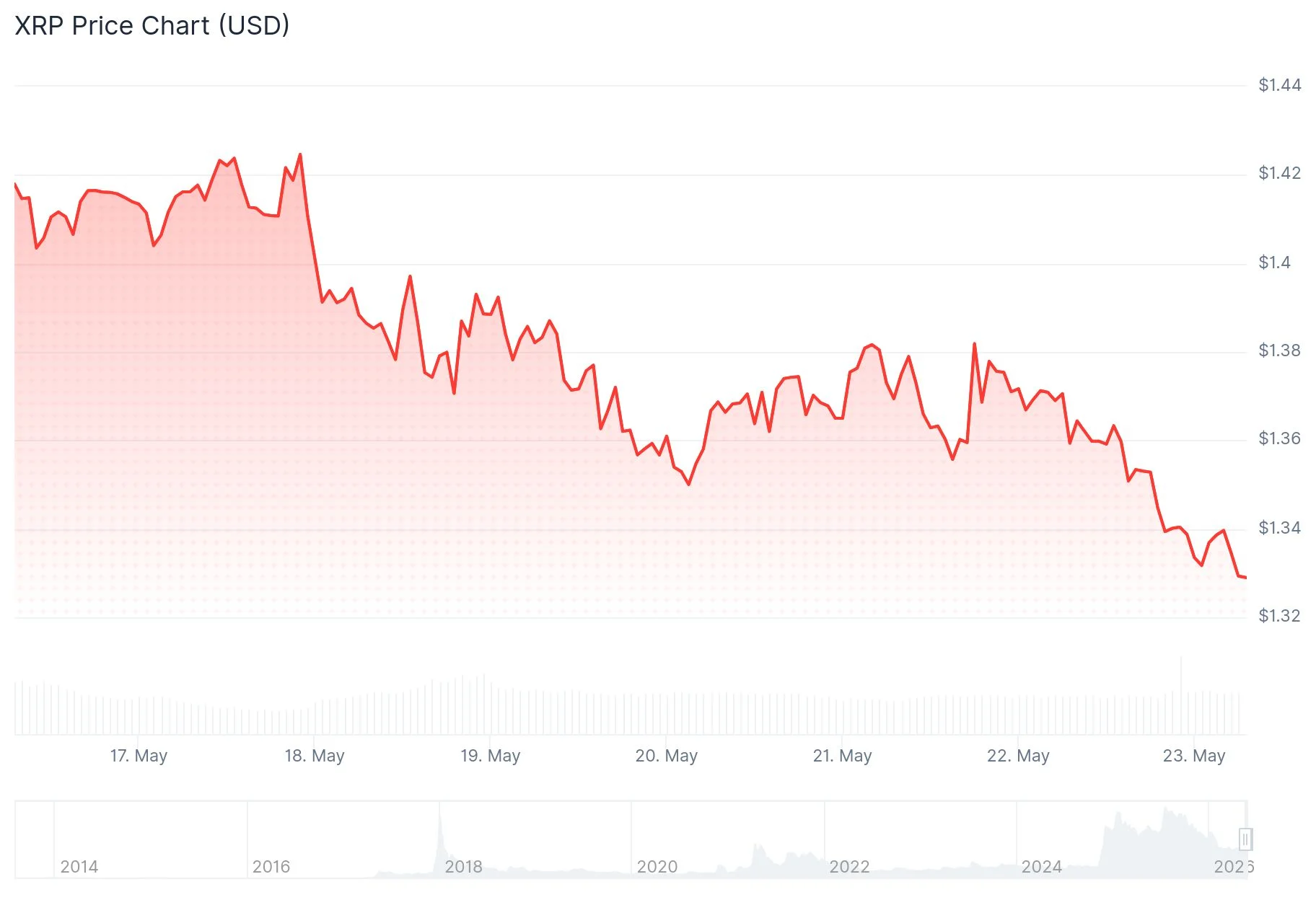
- XRP is currently hovering near $1.36, struggling beneath its 50-day, 100-day, and 200-day exponential moving averages
- Cumulative spot XRP ETF inflows have reached $1.39 billion, with $12.57 million added this week alone
- Binance XRP reserves declined from 2.78 billion to 2.74 billion tokens, suggesting accumulation behavior
- On May 20, the XRP Ledger registered 4,300 new wallets within 24 hours — marking 2026’s fourth-largest daily expansion
- The token remains 62% beneath its July 2025 peak of $3.66, with critical resistance levels between $1.40 and $1.55
XRP is currently positioned around $1.36 following an unsuccessful attempt to surpass $1.39 during Thursday’s trading session. The digital asset is maintaining a foothold just above critical short-term support at $1.35, though the overall momentum continues to face headwinds.
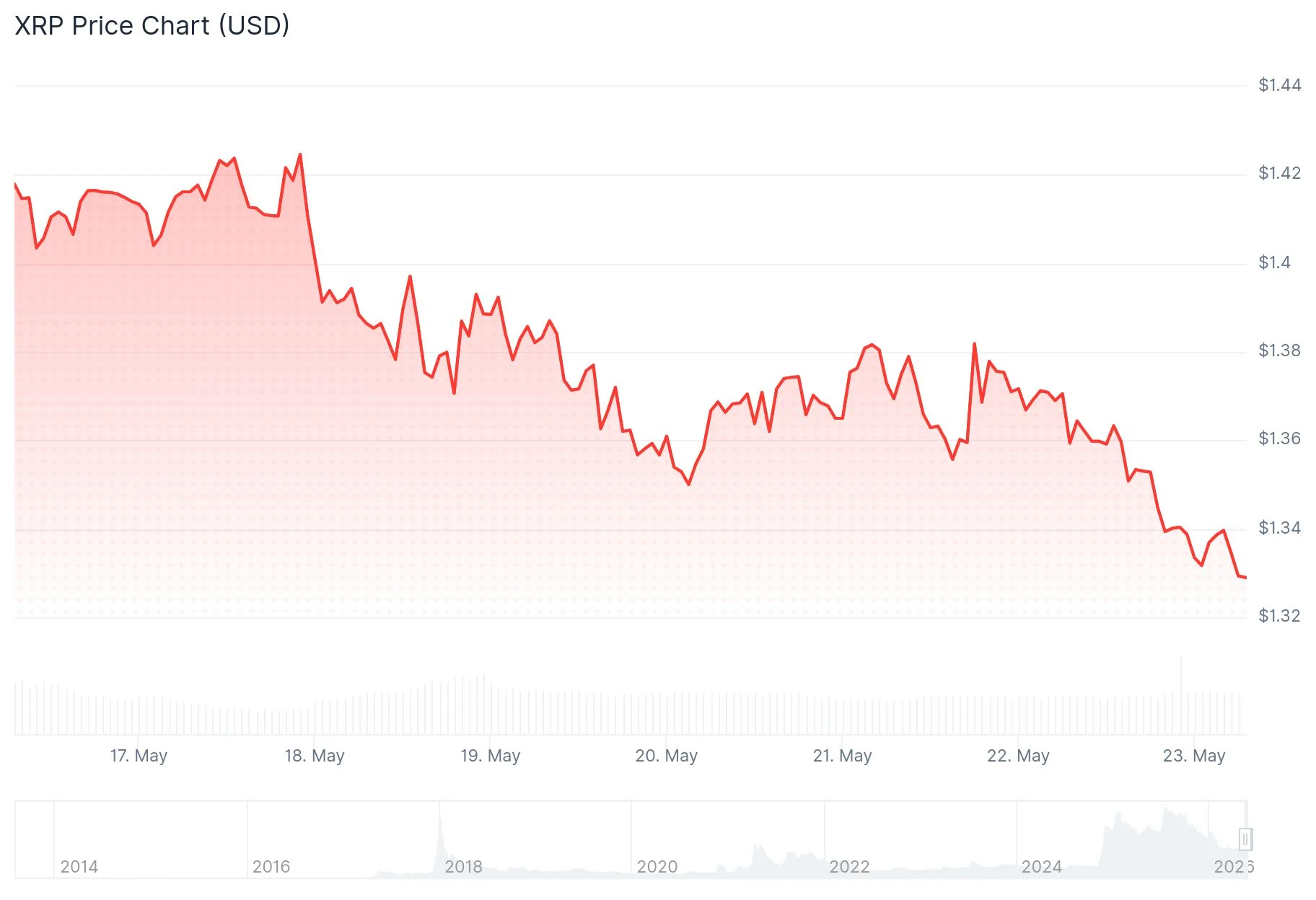
The current price level remains confined below three significant moving averages. The 50-day exponential moving average stands at $1.41, the 100-day at $1.48, and the 200-day at $1.70. With all three indicators positioned above spot price, market observers suggest this configuration restricts potential upward momentum.
The Relative Strength Index (RSI) currently registers near 42 on the daily timeframe. This indicates moderate selling pressure without reaching oversold conditions. Meanwhile, the MACD histogram remains in negative territory, signaling continued short-term bearish control.
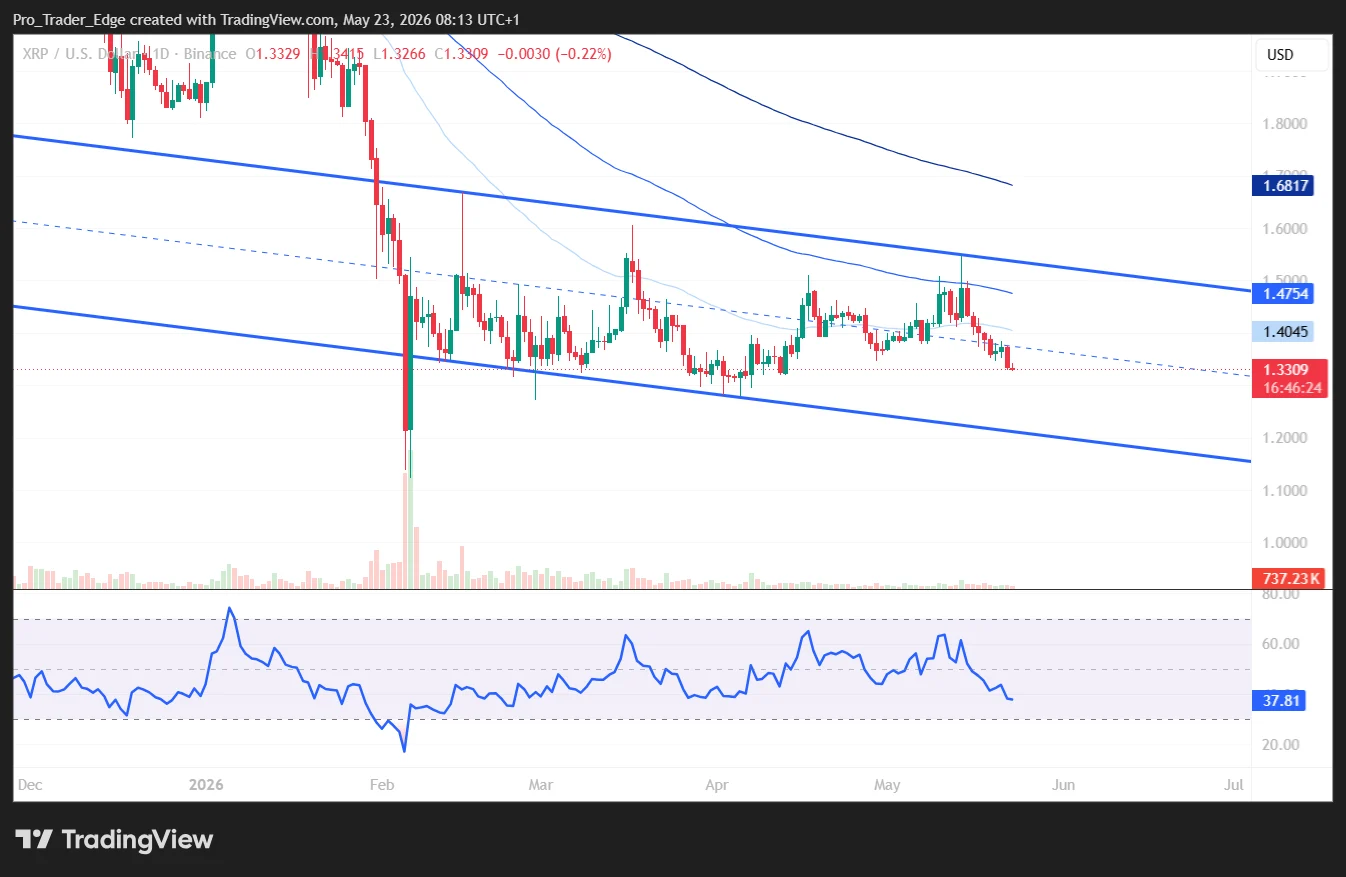
Should XRP fall through the $1.35 threshold, the subsequent support zone appears around $1.30, where market participants may seek entry opportunities.
Institutional Capital Continues Flowing Into XRP Products
Contrary to the subdued price performance, institutional capital continues entering XRP-focused investment vehicles. Spot XRP exchange-traded funds recorded $12.57 million in aggregate inflows through Thursday, representing the third consecutive week of net positive flows.
Total cumulative inflows have now climbed to $1.39 billion, with assets under management reaching $1.15 billion. Thursday’s trading session alone contributed $8.8 million in net inflows, extending the streak of positive ETF flows to 12 consecutive days.
U.S.-based spot XRP ETFs currently control approximately 1.34% of the token’s circulating supply. Throughout May, these investment products have absorbed roughly $107.3 million worth of XRP.
Simultaneously, XRP holdings on Binance decreased from a May peak of 2.78 billion tokens to 2.74 billion. Declining exchange balances typically signal bullish sentiment, as it indicates investors are transferring assets to private wallets rather than positioning for sales.
On-Chain Metrics Reveal Growing Network Participation
Blockchain analytics revealed a notable increase in XRP Ledger engagement on May 20. The network registered 4,300 newly created wallets during a single 24-hour window — representing 2026’s fourth-largest daily expansion according to Santiment data. Concurrently, daily active addresses surged from 32,000 to 43,520.
Analyst Amonyx highlighted this development, questioning whether it might signal a potential trend reversal. Santiment emphasized that “network growth is among the top leading signals to identify reversals.” Fellow analyst Niroshan682 observed that wallet proliferation frequently precedes broader network adoption, particularly when accompanied by strengthening ETF demand and institutional participation.
However, overhead resistance zones continue limiting upside potential. According to Glassnode cost-basis analysis, investors currently hold approximately 3.75 billion XRP at average acquisition prices between $1.37 and $1.45. This concentration could generate selling pressure as the token approaches break-even levels.
An additional resistance barrier exists between $1.68 and $1.70, where roughly 3.8 billion XRP was accumulated. The token currently trades 62% below its July 2025 high of $3.66.
For bullish momentum to materialize, XRP must decisively clear the $1.40–$1.55 range to validate a breakout from its current consolidation pattern. Thursday’s $8.8 million ETF inflow represents the most encouraging data point amid an otherwise range-bound trading week.

NBA Playoffs: Knicks take 2-0 Lead after Game 2 Win

UK MPs slam digital ID rollout as a ‘fiasco’ after botched launch

“It was a very difficult day” – Richie Murphy and Nick Timoney reflect on Ulster’s crushing Challenge Cup final defeat


-

 Crypto World2 days ago
Blockchain.com files with SEC for U.S. IPO
-

 Fashion15 hours ago
Holiday Weekend Open Thread – Corporette.com
-

 Crypto World6 days ago
Intesa Sanpaolo’s crypto holdings jump to $235M as XRP enters
-

 Business19 hours ago
Dell Technologies DELL Stock Surges 15% on AI Server Momentum and Analyst Upgrades in 2026
-

 Crypto World19 hours ago
Space X IPO Is ‘Bad News’ for Tech Stocks: But What About Bitcoin?
-

 Fashion6 days ago
On the Scene at Gucci’s Cruise Show in New York City: Mariah Carey, Kim Kardashian, Lindsay Lohan, Iman, and More!
-

 Politics7 days ago
Watch: far-right flag-fanatics run over victim, attack locals – Setup By the Left wing for your entertainment
-

 Fashion7 days ago
Trending Western Style Vests Perfect for Summer
-

 Politics15 hours ago
Makerfield: a tale of two social-media histories
-

 Fashion6 days ago
Amazon Sundays: Memorial Day Hosting
-

 Entertainment6 days ago
Off Campus Easter Eggs Explained: Characters, Stories, More
-
 Tech21 hours ago
A 0.12% parameter add-on gives AI agents the working memory RAG can’t
-
Crypto World5 days ago
Revolut Launches Dogecoin Debit Card Across UK and EU
-

 Crypto World20 hours ago
AI infrastructure race heats up as IREN pitches full-stack strategy, WhiteFiber lands $160M deal
-
 NewsBeat2 days ago
Charity run by Reform leader Malcolm Offord accused of ‘law breaking’ over Scottish registration
-

 Sports1 day ago
2026 CJ Cup Byron Nelson leaderboard: Brooks Koepka finds putting stroke in Round 1
-

 Crypto World1 day ago
Bitcoin Accumulation Weakens as BTC Realized Losses Hit $600M
-
Business6 days ago
Australia defends property tax changes designed to fix ‘broken’ housing
-

 Crypto World1 day ago
Trump Media’s Bitcoin Stash Shrinks Again as 2,650 BTC Lands on Crypto.com
-

 Tech1 day ago
WhatsApp ads could make Irish debut after discussions with DPC
You must be logged in to post a comment Login