

Crypto World
Echo Protocol Hack Autopsy: The $76 Million Exploit That Wasn’t Really a Hack

2026 DeFi losses crossed $1 billion in four months, with April alone draining $634 million across 28+ incidents, the worst month on record.
Drift ($285M) and KelpDAO ($292M) alone accounted for $577 million of April’s losses, and neither was a code exploit.
DefiLlama’s 2026 hack breakdown tells the same thing.
The biggest slices are LayerZero bridge exploits (18%), compromised admin keys (16%), spoof tokens (14%), and private key compromises (11%).
Combined, operational and key-management failures account for the majority of all stolen value this year. Smart contract bugs like re-entrancy and oracle manipulation barely register.
Echo Protocol just became the latest data point.
On May 18, an attacker broke into the Echo Protocol on Monad and printed 1,000 fake eBTC for themselves. That’s $76.7M on paper.
The problem is, fake tokens don’t buy you anything unless you can trade them for something real. So they took a small chunk, dropped it into Curvance’s lending app as collateral, and borrowed real Bitcoin against it.
Then bridged that Bitcoin to Ethereum, swapped it for ETH, and ran it through Tornado Cash. Final take: around $816,000.
Everyone’s calling it $76.7 million but the real number is $816,000, and why those two numbers are so far apart is the main story here.
This breakdown covers what happened, how, and what it says about DeFi security right now.
The bottom line: The contract was fine. A stolen admin key and lazy controls did everything else, and that’s how most of 2026’s DeFi losses are happening.
Post Mortem (The Summary)
- Echo Protocol was not hacked through bad smart contract code. The attacker stole or accessed an admin key.
- That admin key controlled minting rights for Echo’s eBTC token on Monad. One private key was enough to create fake Bitcoin-backed tokens.
- The attacker minted 1,000 fake eBTC, worth about $76.7 million on paper. But those tokens had no real BTC backing.
- They could not cash out the full amount because Monad liquidity was thin. So they used 45 fake eBTC as collateral on Curvance.
- Curvance accepted the fake eBTC as normal collateral and let the attacker borrow real WBTC.
- The attacker escaped with about $816,000 in real value, not $76.7 million.
- Echo later burned the remaining 955 fake eBTC and paused affected functions.
- Monad itself was not hacked. Curvance’s main protocol was not directly hacked either. The failure came from Echo’s admin setup and Curvance trusting newly minted collateral.
- The core lesson: DeFi attackers are now targeting keys, admins, bridges, infrastructure, and team operations more than smart contract bugs.
- Basic protections could have reduced or stopped this: multisig admin control, timelocks, mint caps, rate limits, and collateral checks.
- Echo got lucky. The attacker only failed to drain more because there was not enough liquidity to cash out the fake tokens.

The Players
Here’s the full breakdown of what happened, and how.
- Echo Protocol
A BTCFi (Bitcoin DeFi) project. Their pitch: take your BTC, get a yield-bearing wrapped version of it that works in DeFi.
Their home base is Aptos, where the token is called aBTC. They hit a peak TVL of $878 million on Aptos in May 2025, currently sitting around $254 million.
Echo expanded to Monad as part of Monad’s mainnet ecosystem push. On Monad, their wrapped BTC token is called eBTC.
This is critical: aBTC and eBTC are completely separate, non-bridgeable assets. They’re parallel deployments, not connected. The hack hit eBTC on Monad only.
- Monad
A new high-performance parallelized EVM L1. One of the hyped chains of 2025-26. Just out of the mainnet, with lots of protocols deploying fresh.
Echo is one of them. Monad itself was NOT compromised in any way. Co-founder @keoneHD confirmed the network ran normally throughout. It was a protocol-level failure on top of Monad.

- Curvance
A lending protocol deployed on Monad. Functions like Aave but with isolated markets, where each collateral asset lives in its own siloed pool so a compromised asset can’t infect the rest of the lending protocol.
They had listed eBTC as a collateral asset.
- Tornado Cash
Sanctioned ETH mixer. You send ETH in, you get ETH out from a different wallet, and break the on-chain trail. Standard exit tool for hackers.
What Got Exploited
Echo’s eBTC token on Monad is a standard ERC-20 contract that uses OpenZeppelin’s role-based access control system. This is industry standard, used by basically every serious DeFi project.
Two roles matter in its setup:
- DEFAULT_ADMIN_ROLE: the master role. Can grant or revoke any other role on the contract.
- MINTER_ROLE: can call mint() and create new eBTC tokens.
Normally, only Echo’s team holds these. Minting only happens when real BTC gets locked somewhere, and the team mints the matching eBTC. That’s the entire trust model behind a wrapped token.
Here’s where Echo messed up.
The DEFAULT_ADMIN_ROLE sat on a single EOA, basically just a normal wallet with one private key behind it. And the wallet had no safety nets. Whoever held that key could mint as much as they wanted, whenever they wanted, with nothing to slow them down.
So the entire $254M+ Echo ecosystem on Monad was, in security terms, sitting behind one private key. That key got stolen. Nobody’s said how yet. Could be phishing, malware on a team laptop, an infra breach, an insider, secrets leaked in a repo, supply chain attack through a dev tool. Echo hasn’t disclosed.
The Attack Step by Step
Date: May 18, 2026, around 5:55 PM ET
- Step 1: Attackers use the stolen admin key to grant themselves DEFAULT_ADMIN_ROLE on a fresh wallet. They’re now admin too.
- Step 2: From that new admin role, they grant themselves MINTER_ROLE. They can now mint.
- Step 3: They call mint(attacker_wallet, 1000e8). 1,000 eBTC shows up in their wallet. Notional value $76.7M. Real BTC backing: zero. These tokens are completely fake, phantom claims on Bitcoin that don’t exist anywhere.
- Step 4: They revoke the original Echo admin and their own admin role too. Cleanup move so it looks less suspicious on-chain. From the outside, it just looks like a random wallet holding 1,000 eBTC.
At this point, the peg is mathematically broken. There are 1,000 more eBTC tokens than there is BTC backing them.
But the attacker hasn’t actually taken anything yet. Fake tokens are worthless unless you can convert them into real money.
The Cashout Flow
You can’t just dump 1,000 fake eBTC on a DEX. Monad’s DEXs don’t have anywhere close to that liquidity. You’d crash the price to zero before extracting anything, and arbitrageurs would catch it instantly. So the attacker went to a lending market instead.
- Step 5. Deposit 45 eBTC ($3.45M paper value) into Curvance as collateral. Curvance accepts it because, from the contract’s view, eBTC is eBTC. No oracle or check that separates “freshly minted fake eBTC” from “legit BTC-backed eBTC.” That’s the second failure of this hack. Lending markets just accept new collateral at face value without checking where it came from.
- Step 6. Borrow 11.29 WBTC against it, about $868K of real wrapped Bitcoin. WBTC is the major BTC-on-Ethereum token, deep liquidity, fully backed. They now have $868K of real value, secured by $3.45M of fake collateral they’re never coming back for.
- Step 7. Bridge the WBTC to Ethereum. That’s where liquidity lives and where Tornado works.
- Step 8. Swap WBTC to ~384 ETH on Ethereum (~$822K).
- Step 9. Run the 384 ETH through Tornado Cash. Trail breaks. Funds land in fresh wallets that can’t be traced back.
Total real money out: approximately $816,000.
How Echo Responded
Within hours of the hack going public, Echo reclaimed the admin key, burned the 955 eBTC still sitting in the attacker’s wallet (which no longer exists), and paused all cross-chain functionality on Monad.
They also paused the Aptos bridge and Aptos lending even though Aptos was clean, just to be safe. Pushed a contract upgrade on Monad to restrict the affected operations and said they’d patch their other EVM bridge deployments too.
Curvance paused the eBTC market, confirmed that their own contracts were fine, and noted that their isolated market design prevented the damage from spreading to other lending pools.
Keone from Monad clarified the chain was untouched and pegged the actual loss at around $816K.
The Breakdown
The gap between $76.7 million and $816,000 is the whole story. Curvance was the only viable exit, and its depth capped the borrow at approximately $868,000.
eBTC minted
1,000 (notional $76.7M)
Deposited to Curvance
45 eBTC
WBTC borrowed
11.29 (~$868K)
Sent through Tornado
~384 ETH (~$822K)
Actually stolen
~$816K
eBTC burned by Echo
955
Aptos exposure
~$71K
ECHO drawdown
~11-12%
The other 955 eBTC had nowhere to go until Echo burned it. Monad’s thin liquidity saved Echo from a much bigger loss. On Ethereum, this would’ve been close to $76M out the door.
Why this was an operational hack, not a smart contract hack
The code wasn’t the issue. It worked the way it was supposed to. The real problem was how Echo set things up around the contract:
- The admin role was held by a single wallet instead of a multisig. Stealing a single private key was enough to take over the entire protocol.
- There was no time lock. When the attacker granted themselves admin and then minter rights, those changes went live immediately. No delay, no window for the team to notice and respond.
- The contract had no maximum supply. Minting 1,000 eBTC with zero BTC backing was technically allowed by the rules of the contract itself.
- No rate limit either. The attacker minted the entire 1,000 in a single transaction, rather than being forced to spread it out.
- Curvance accepted the freshly minted eBTC as collateral without checking whether it was legitimately backed. The lending market just saw eBTC tokens in a wallet and treated them the same as real ones.
None of these are obscure or experimental fixes. Multisigs, timelocks, mint caps, and supply checks are stuff serious DeFi protocols have been shipping for years. Echo just didn’t bother with any of them.
May 2026 looks like this
Echo is the 14th hack this month. The year so far:
| Protocol | Loss | Vector |
| KelpDAO (Apr) | $292M | RPC poisoning + DDoS (Lazarus) |
| Drift | $285M | Social engineering (Lazarus, UNC4736) |
| THORChain (May 15) | $10M+ | Vault breach |
| Verus bridge (May 17) | $11.6M | Cross-chain verification |
| Echo (May 18) | $816K | Admin key |
| Transit Finance | $1.88M | Deprecated contract |
Approximately $328.6 million lost to bridge hacks in 2026 across 8 incidents. None of these were Solidity bugs. Keys, signers, RPC endpoints, off-chain verifiers, that’s where the money is leaving now. The attackers moved up the stack. A few from this year worth paying attention to:
- Drift (April): Not a technical exploit. UNC4736 (North Korea) spent six months social engineering Drift employees, then drained $285M in 12 minutes. Six months of prep, 12 minutes of execution. That’s a military op, not a hack.
- KelpDAO (17 days later): Same group, completely different vector. They poisoned LayerZero’s RPC infrastructure and forged cross-chain messages for $292M. State-sponsored teams running multiple playbooks in parallel.
- AI is showing up too: Google confirmed the first AI-powered mass exploit on May 11 (AI found a zero-day and wrote bypass code for 2FA). GoPlus reported a 231% MoM jump in Web3 losses partly tied to AI. CrowdStrike puts the average eCrime breakout time at 29 minutes, with the fastest at 27 seconds. The attack side is automating, defense mostly isn’t.
- Resolv Labs (March): Admin key compromise on a stablecoin issuer. Attacker minted 80M unbacked USR, drained $25M, and USR depegged by 80%. Same root cause as Echo, completely different protocol type. The pattern doesn’t care what you’re building.
Ondo Finance put it bluntly in their post-incident analysis: “there is no single class of vulnerability to defend against.” That’s the part most protocols still haven’t internalized.
So when Echo got drained through a stolen admin key, it didn’t happen in a vacuum. It happened during the most hostile threat environment DeFi has ever seen, and the protocol was set up as if it were still 2022.
So what?
DeFi spent the last five years getting good at smart contract security. Audits, bug bounties, formal verification, all of it.
So the attackers stopped targeting the code and started targeting everything else. Keys, infrastructure, employees, signers. None of that gets audited.
For any wrapped BTC protocol, the only security question that actually matters is who can mint, and how hard is it for someone to take that power from them.
If the answer is “a multisig with a timelock, a mint cap, and a lending market that checks where new collateral came from,” you have a real protocol. If the answer is “one wallet with one key,” you have $254M sitting there waiting to be taken. Echo was the second kind.
The damage doesn’t stay in one place either. Aave wasn’t hacked in April, but it lost $5.4B in TVL within 48 hours of the KelpDAO exploit anyway. People just panicked and pulled their money out of everything. That’s what happens now. One protocol gets hit and the whole sector gets repriced.
The fixes are not new. They’ve been around for years. Multisig the admin, timelock the changes, cap the supply, check the collateral. It’s just that none of it makes a protocol more competitive on the front end, so nobody ships it until they’re the next headline.
Echo got off easy because Monad’s liquidity was too thin for the attacker to fully cash out. The next protocol probably won’t have that excuse.
The post Echo Protocol Hack Autopsy: The $76 Million Exploit That Wasn’t Really a Hack appeared first on BeInCrypto.



Hyperliquid has launched its first US macro event market using HIP 4 outcome contracts, letting traders bet USDC on the May 2026 CPI year over year print in a fully collateralized, no liquidation format that settles on June 10 off official Bureau of Labor Statistics data.
Summary
- New CPI market uses HIP 4 outcome contracts settled on BLS May 2026 CPI YoY release
- Contracts trade as bounded probabilities in USDC, with early volume around $3,000 and open interest near $5,000
- Outcome markets sit alongside perpetuals under a unified margin system, blending crypto speed with tradfi macro events
HIP 4 is Hyperliquid’s protocol upgrade that adds “outcome contracts” to its L1, a native primitive for prediction style markets and options like products that are fully collateralized, dated, and free of leverage and liquidation risk.
On May 2, the protocol activated HIP 4 on mainnet, and MEXC reports that the initial roll out featured recurring daily Bitcoin price binaries that recorded over 6.05 million contracts and roughly 4,000 unique traders on day one, capturing about 0.7 percent of global prediction market volume.
How does Hyperliquid’s CPI outcome market work?
The new CPI market extends that template from crypto native prices to US macro data.
According to coverage of HIP 4 and outcome trading, each contract represents a discrete event that ultimately settles to 0 or 1 based on whether a predefined condition is met, with prices between 0 and 1 before resolution reflecting the market implied probability of a “yes” outcome.
For the May CPI year over year market, traders are effectively buying or selling slices of the distribution for the twelve month change in the Consumer Price Index as reported by the Bureau of Labor Statistics on June 10, 2026, with tick values and brackets defined in the market spec and all settlement keyed to the official BLS release.
Unlike perpetuals, HIP 4 outcome contracts are fully collateralized at entry: Hyperliquid’s documentation stresses that there is “no leverage, no liquidations,” and that a buyer’s maximum loss is the principal posted, while payouts at expiry are fixed based on the event result, much like a binary option.
Crucially, outcome contracts run directly on HyperCore and share the same unified margin account as perpetuals, so traders can post USDH or bridged USDC once and deploy that collateral across perps, spot and event markets without siloed balances.
In early CPI trading, probabilities have clustered in a balanced range, with order books showing roughly 34 percent to 43 percent odds across the key brackets and total traded volume just over $3,000, with open interest near $5,000 – tiny in absolute terms, but consistent with a fresh listing in a brand new product line.
Why CPI markets matter for Hyperliquid and crypto prediction rails
The CPI listing is not an isolated experiment; it is part of a broader push to turn Hyperliquid from a pure perp DEX into a full stack derivatives venue that can natively host prediction markets across crypto, macro and sports.
Binance’s explainer on HIP 4 notes that the upgrade “brings native prediction markets to Hyperliquid,” with outcome contracts designed to trade election results, sports events, Bitcoin price thresholds and “whether specific conditions are met before a certain point in time,” all with fixed expiry and no liquidation risk.
Unchained and MEXC both highlight the competitive angle: by running outcome markets in the same core engine as perps, with a unified margin account and low fees, Hyperliquid is explicitly challenging off chain prediction venues like Polymarket on UX, capital efficiency and product breadth.
Macro inflation is a natural first target.
Market outlook pieces for May and June emphasize that CPI remains the single most important US datapoint for risk assets, with recent consensus pointing to year over year readings in the 3.3 percent to 3.7 percent range and traders watching closely for signs that energy driven price pressures are becoming entrenched.
By listing a CPI YoY outcome market, Hyperliquid is essentially letting its existing perp traders express that macro view directly in the same interface where they already trade BTC, ETH and basis trades, instead of routing through an external prediction protocol or centralized broker.
In practice, that means a single USDH or USDC margin pool can now back a book of positions like long BTC perps, short ETH perps, and a “CPI above 3.7 percent” outcome contract, all risk managed by one engine – bringing a more tradfi style cross product book to a crypto native chain.
If volumes and participation grow from the current few thousand dollars in CPI bets to millions, the launch could mark the beginning of a more serious migration of macro prediction flow onto L1 derivatives platforms, blurring the line between perps DEXs and on chain prediction markets and pulling future event risk – from inflation prints to elections – directly into crypto collateral stacks.

Hyperliquid (HYPE) reached a new all-time high of over $64 on Sunday as on-chain trackers documented sharply contrasting whale behavior across the rally. Some wallets added millions in fresh exposure while others cashed out.
The token climbed more than 40% over the past week. According to the latest data from BeInCrypto Markets, the altcoin traded at $63.7, up over 0.53% over the past day.

Whales Pour Millions Into Hyperliquid While Others Cash Out at Highs
Wallet 0x9137 spent $15.1 million in USDC (USDC) to acquire 238,811 HYPE at $63.25, according to Lookonchain data. A newly created wallet separately withdrew 63,780 HYPE worth $4.06 million from Bybit.
BitMEX co-founder Arthur Hayes appears to have reversed his earlier position. Lookonchain reported that a wallet linked to Hayes deposited 115,453 HYPE worth $6.33 million into Bybit at $54.81. The same address later withdrew 85,714 HYPE worth $5.37 million from the exchange at $62.69.
Subscribe to our YouTube channel to watch leaders and journalists provide expert insights
Moreover, Garrett Jin has accumulated 145,050 HYPE tokens, worth $9.05 million, over the past four days. He also placed a time-weighted average price order to buy another 39,940 tokens worth $2.44 million.
“He still holds a 504.4 BTC ($38.9M) long and a 57,460 ZEC ($38M) short, currently down $2.11M,” Lookonchain added.
However, not every whale chased the rally higher. Wallet 0x632B sold 151,574 HYPE worth $9.25 million. The same address queued limit sell orders for another 170,000 tokens between $63.45 and $70.55.
Follow us on X to get the latest news as it happens
Whether continued buying offsets profit-taking near the current price levels will shape the next move.
The post Hyperliquid Whales Show Conflicting Moves as HYPE Hits Fresh Peak appeared first on BeInCrypto.

Polymarket traders price 39% odds that the United States announces a new Iran agreement by May 31, even as Memorial Day market closures mute Wall Street reaction to a sweeping diplomatic push from President Donald Trump.
Trump on Monday issued a public mandate for Saudi Arabia, Qatar, Pakistan, Egypt, Turkey, and Jordan to sign the Abraham Accords as a condition tied to any final Iran settlement, broadening the diplomatic scope of the talks.
Polymarket Odds Frame the Diplomatic Window
The 39% probability on the Polymarket US-Iran agreement contract reflects measured caution among prediction-market traders.

The 11% probability that Iran agrees to hand over its highly enriched uranium signals far steeper doubts on the deal’s most technical demand.
Traditional finance markets, closed for Memorial Day, have not yet priced the diplomatic signals.
Crypto markets, which trade through the holiday, have absorbed the weekend reporting without sharp moves, leaving the Bitcoin and oil flip dynamic intact.

“Trump keeps signaling two things at once… Middle East normalization expansion… And potential progress with Iran. Markets are increasingly trying to price whether this becomes a real geopolitical reset… or just another temporary negotiation cycle,” analyst Kyle Doops noted, highlighting that traders are weighing whether the current talks mark a structural reset or another short cycle.
Follow us on X to get the latest news as it happens
Draft Framework Stages Uranium Disposal Against Sanctions Relief
Reports indicate that Iran’s supreme leader has approved the broad template of a draft deal.
Tehran has agreed in principle to dispose of highly enriched uranium in exchange for the lifting of the US blockade, with the Vice President, Steve Witkoff, and Jared Kushner involved in the talks.
Reportedly, a senior US official said that sanctions relief will be staged, with no fixed timeline and no dollar figure yet requested by Iran.
The official described the approach as “no dust, no dollars,” tying any oil shock liquidity selloff risk to verified Iranian delivery of nuclear concessions.
US officials also want the Strait of Hormuz operating with no tolls and free passage for ships, coordinated with Gulf partners.
That target directly addresses the Iran Bitcoin Hormuz toll regime that Tehran rolled out earlier in the conflict.
Abraham Accords Expansion Pushed as Diplomatic Lever
In a Truth Social post on Monday, Trump wrote that it “should be mandatory” for Saudi Arabia, Qatar, Pakistan, Turkey, Egypt, Jordan, and Bahrain to simultaneously sign the Abraham Accords, with the United Arab Emirates already a member.
He floated the possibility that Iran itself could later join.
Israeli Prime Minister Benjamin Netanyahu confirmed coordination with Trump on a memorandum of understanding covering the Strait of Hormuz and the broader Iran framework.
Netanyahu reiterated that any deal must remove Iran’s enriched material from its territory.
Saudi Arabia has so far shown no public willingness to formalize ties with Israel, and an Iranian source has separately denied that Tehran has committed to handing over its uranium stockpile.
Those gaps suggest the framework remains contingent rather than settled, even as the Bitcoin Strait of Hormuz trade thesis loses some of its acute risk premium.
The post Memorial Day Lull Masks Iran Deal Signals as Trump Mandates Abraham Accords Push appeared first on BeInCrypto.

ARiQO unveiled its plan to move real-world assets on-chain at Southeast Asia Blockchain Week in Bangkok, signaling a capital-first approach to building on-chain infrastructure before a dedicated token market matures. The public reveal occurred on May 21, with ARiQO outlining a three-phase framework designed to lay the groundwork for tokenized RWAs and, eventually, a native perpetual DEX tied to real-world assets. A private, high-profile networking event followed, underscoring the project’s ambitions even before its token generation event.
During a floor-level discussion, ARiQO co-founder Emanuel Escobar Duro (CBO) spoke with teams from Orca and Viva Republica (Toss) about how DeFi platforms must evolve to attract institutional capital. The sentiment was consistent: capital is moving on-chain, but the market still lacks the robust infrastructure needed to manage and trade tokenized real-world assets at scale. The realism in the conversations reflected a broader industry challenge—without reliable on-chain rails, liquidity and onboarding of institutions will remain slow.
That evening, ARiQO hosted Alpha After Dark: Where Liquidity Meets Opportunity. Co-hosts included Canton Foundation, Viva Republica (Toss), BitGo, Bitkub Exchange, and BLOCKSTREET. The event, running from 8 p.m. to midnight, gathered a mix of institutional investors, liquidity providers, and protocol builders to exchange candid views on market gaps and practical steps forward.
The discussions highlighted three focal threads. First, there is a structural gap in the current RWA market: demand for tokenized assets is rising, yet the on-chain infrastructure to trade and manage these assets remains in a nascent stage. Second, the “cold-start” liquidity problem persists for new on-chain venues—traders need liquidity, and liquidity needs traders. Third, what institutional capital expects from DeFi is becoming clearer: transparent yield structures, rigorous smart-contract audits, and predictable capital-management practices. Attendees explored how far existing protocols meet those standards and where improvements are required to unlock broader participation.
What stood out was the credibility implied by ARiQO’s willingness to host such a gathering before launch. The presence of large, established names as co-hosts signaled a serious commitment to solving real-world liquidity and infrastructure issues, not merely marketing for a token launch. The conversations laid bare unresolved problems—how to close the loop from capital to on-chain yield and back to the capital base that fuels further growth—and where participants believe real progress can come from.
Key takeaways
- ARiQO presents a three-phase, capital-first infrastructure plan to bring tokenized real-world assets onto the blockchain, with a native RWA perpetual DEX planned for later stages.
- The rollout starts with Vault, followed by Terminal, and culminates in a native RWA perp DEX, designed to create a self-sustaining liquidity and revenue cycle.
- The private Alpha After Dark event, co-hosted by Canton Foundation, Toss, BitGo, Bitkub Exchange, and BLOCKSTREET, signals notable industry credibility ahead of any public token launch.
- The token generation event for ARIQO’s AQV token is slated for the second half of 2026, after the Vault and Terminal go live, with fee flows intended to support buybacks and the Vault’s capital base.
- The Jurisprudence of the plan centers on easing the “cold start” problem and delivering transparent, auditable, and scalable on-chain yields for institutional participants.
A structured path to on-chain RWA liquidity
ARIQO defines its approach less as a single product and more as an architectural blueprint for DeFi-enabled RWAs. The guiding principle, the team says, is simple: “Capital first. Flow second. Native market last.” This order reflects a deliberate departure from product-first token launches toward building the breathing room and governance for sustained capital inflows.
The Vault is the inaugural phase, targeted for launch in Q3 2026. It will host multiple stablecoin vaults with varied risk-return profiles, creating an initial capital base for the rest of the stack. The emphasis here is reliability and capital stewardship rather than chasing high yields, laying the foundation for subsequent growth without compromising risk controls.
Following Vault, the Terminal will serve as a trade-aggregation layer that connects to existing venues such as Binance and OKX. Users can continue trading where they already operate, while ARIQO’s interface routes trades in a way that optimizes rebates across exchanges. The plan envisions automatic reinvestment of these rebates into the Vault, effectively funneling external liquidity into ARIQO’s ecosystem without requiring users to abandon their current trading venues.
The final stage introduces a native RWA Perp DEX—an orderbook-based perpetuals platform spanning crypto, commodities, indices, and synthetic RWAs. This exchange is timed to launch only after the Vault and Terminal have established a liquidity base and a user flow, addressing the classic “cold start” challenge that often hampers new DEX launches. Revenue generated at this stage would cycle back into AQV buybacks and reinvestment into the Vault, completing a closed-loop model designed to sustain growth and liquidity.
In tandem with the product roadmap, ARIQO has signaled that the AQV token generation event will occur in the second half of 2026, once the two initial layers are live. The company’s leadership team—co-founders Jin Tang (COO) and Emanuel Escobar Duro (CBO), alongside CTO Julius Nielsen and CSO Daniel J. Aldridge—outlined responsibilities that together aim to deliver the technical backbone and operational discipline required for a multi-phase rollout.
Official information and a waitlist for ARIQO are available at ariqo.com, with updates also shared via the project’s official X handle.
As ARiQO transitions from private discussions to a public launch cadence, investors and builders will be watching how the Vault’s risk management, the Terminal’s cross-exchange efficiency, and the native DEX’s liquidity depth align with real-world asset adoption. The three-phase framework—and the emphasis on capital-first infrastructure—could offer a blueprint for other projects seeking to bridge traditional finance with on-chain markets, provided the team can deliver on risk controls, transparency, and scalable liquidity.
The next milestones to watch are the Vault’s Q3 2026 rollout, the Terminal’s integration with major trading venues, and the timing and mechanics of the AQV TGE. If ARIQO can translate private-market credibility into verifiable on-chain performance, it could become a notable case study in institutional onboarding for DeFi’s RWAs narrative.
Readers should monitor ARIQO’s updates for any changes to the timeline, additional partner disclosures, and further details on the AQV tokenomics as the project approaches its anticipated mid-to-late-2026 milestones.

Bitcoin (BTC) climbed back toward $78,000 on Monday after analysts tied the latest rebound to easing tensions between the USA and Iran, and the prospect of a broader recovery across risk assets.
Traders who spent much of the past two weeks bracing for another leg down are now watching whether the flagship cryptocurrency can reclaim the low-$80,000 range and drag altcoins higher with it.
Peace Deal Is the Macro Catalyst Crypto Has Been Waiting For
Writing on X earlier today, analyst Michaël van de Poppe laid out the chain of events he expects to follow a Middle East peace agreement:
“Oil goes down. Yields go down. Risk on assets will do well. Bitcoin breaks above $80k+ again. Altcoins will have their time for the entire summer.”
According to him, the concern had been whether BTC could reclaim a key resistance area, which it now appears to have done so.
“From that point on, many charts look like they want to break upwards, and that would be putting crypto back on the map,” he wrote.
The timing of the post matters, considering that Bitcoin had dropped to just above $74,000 on Saturday morning, its lowest point in May, after a new round of threats from President Trump directed at Iran.
The reversal came quickly once Trump himself announced that both sides had made real progress toward a permanent peace deal, with BTC climbing back to around $77,200 before running into resistance.
At the time of writing, the OG crypto was trading near $77,500, which is still well off its 7-day high of roughly $78,000 and down about 38% from its all-time high above $126,000 set in October 2025.
Meanwhile, over the past year, Bitcoin has lost about 28% of its value.
Trader Sykodelic, posting around the same time as van de Poppe, was cautiously optimistic but warned that a peace deal announcement this week might actually produce an initial dip before any sustained move higher.
“Take out the weekend lows, another go at that $74,000 level, tempt the bears one more time…then we run it up leading into June,” he wrote.
He also noted that Bitcoin had closed the week above both its 50 and 100 simple moving averages and what traders call the bull market support band, which he had been tracking for around three months.
Not Everyone is Rushing to Call the Bottom
Elsewhere, on-chain analyst Axel Adler Jr. flagged a less-than-ideal data point from last week: around 18,000 BTC flowed onto exchanges, while US spot Bitcoin ETFs saw outflows of roughly 16,000 BTC.
“ETF demand did not absorb the exchange inflow. It added to the pressure,” he noted.
Another market watcher, Merlijn The Trader, put a short-term target on the $82,000 to $82,000 range, describing it as a “liquidity cluster” where trapped sellers will face pressure.
But he was explicit that this is where he expects to set up a short position, with a longer target of $67,000 below.
Meanwhile, analyst Dean Crypto Trades had previously argued that BTC needs to reclaim the low $80,000 area, where the 200-day moving average sits, and turn it into a higher low.
Without that, he warned, the recent recovery is just another lower high in a downtrend that has been in place since the October 2025 peak.
The post Bitcoin Eyes $80K Rally on Middle East Peace Hopes: Analyst appeared first on CryptoPotato.

Key Highlights
- Coinbase achieved record crypto trading-volume market share during Q1 2026
- Prediction markets platform scaled to $100M annualized revenue within two months of U.S. debut
- Coinbase One subscriber base crossed ~1 million users; Q1 subscription/services revenue projected at $550M–$630M
- Workforce reduction of approximately 700 employees (~14% staff) implemented amid market turbulence
- Analyst consensus on COIN stands at Hold with $252.20 average price target over 12 months
The Coinbase of today bears little resemblance to the platform from three years back. What began as a retail-focused crypto exchange has transformed into a diversified financial services company spanning subscriptions, stablecoin operations, institutional services, custody solutions, derivatives trading, and now prediction markets.
The prediction markets offering particularly captured attention. Reaching $100 million in annualized revenue by March 2026 — merely two months post-U.S. launch — represents one of the fastest product scaling achievements in the company’s timeline. The numbers speak for themselves.
First quarter 2026 delivered encouraging results across multiple fronts. The exchange posted an unprecedented high in crypto trading-volume market share while simultaneously demonstrating the prediction markets momentum.
Subscription and services revenue has emerged as a critical narrative component. Coinbase projected Q1 2026 subscription and services revenue within the $550 million to $630 million range. This matters substantially because revenue from these sources demonstrates greater stability compared to transaction fees that fluctuate dramatically with crypto market conditions.
The Coinbase One subscription service reached approximately 1 million users. Platform-held USDC volumes also touched record levels, underscoring the company’s expanding stablecoin market presence.
Building a More Resilient Revenue Engine
Historical Coinbase performance correlated directly with spot trading activity. Today’s platform operates with significantly more diversification. Revenue streams now include subscriptions, stablecoins, custody operations, institutional trading services, and emerging products — extending far beyond basic retail transactions.
Reuters coverage from May 2 indicated that Coinbase announced agreement on a critical provision within major Senate crypto legislation. Enhanced regulatory clarity would disproportionately advantage established operators like Coinbase compared to smaller competitors lacking comparable infrastructure and policy influence.
Should this regulatory development proceed, it could represent a substantial catalyst for long-term business expansion.
Workforce Reductions Reflect Market Realities
Notwithstanding platform advancement, Coinbase eliminated approximately 700 positions in early May — representing roughly 14% of total staff. Management characterized the decision as strategic repositioning for artificial intelligence integration while controlling expenses throughout crypto market uncertainty.
The messaging appears somewhat contradictory. Leadership emphasizes platform strength while simultaneously reducing personnel. However, the action demonstrates fiscal discipline, which investors typically value over unchecked expenditure.
The fundamental Coinbase investment thesis tension persists: improved business fundamentals operating within an unpredictable environment. Declining crypto valuations and trading volume contractions continue impacting stock performance significantly.
Wall Street maintains a measured stance on the equity. Coinbase currently carries a Hold consensus from 33 MarketBeat analysts — comprising 19 buy ratings, 10 hold ratings, and 4 sell ratings. The consensus 12-month price target stands at $252.20.
This divided perspective reveals substantial insight. Analysts acknowledge legitimate platform diversification progress. Simultaneously, they recognize COIN’s vulnerability to sharp declines when crypto sentiment deteriorates.
The immediate focus remains the Q1 2026 subscription and services revenue guidance of $550M–$630M, which upcoming earnings results will either validate or challenge.

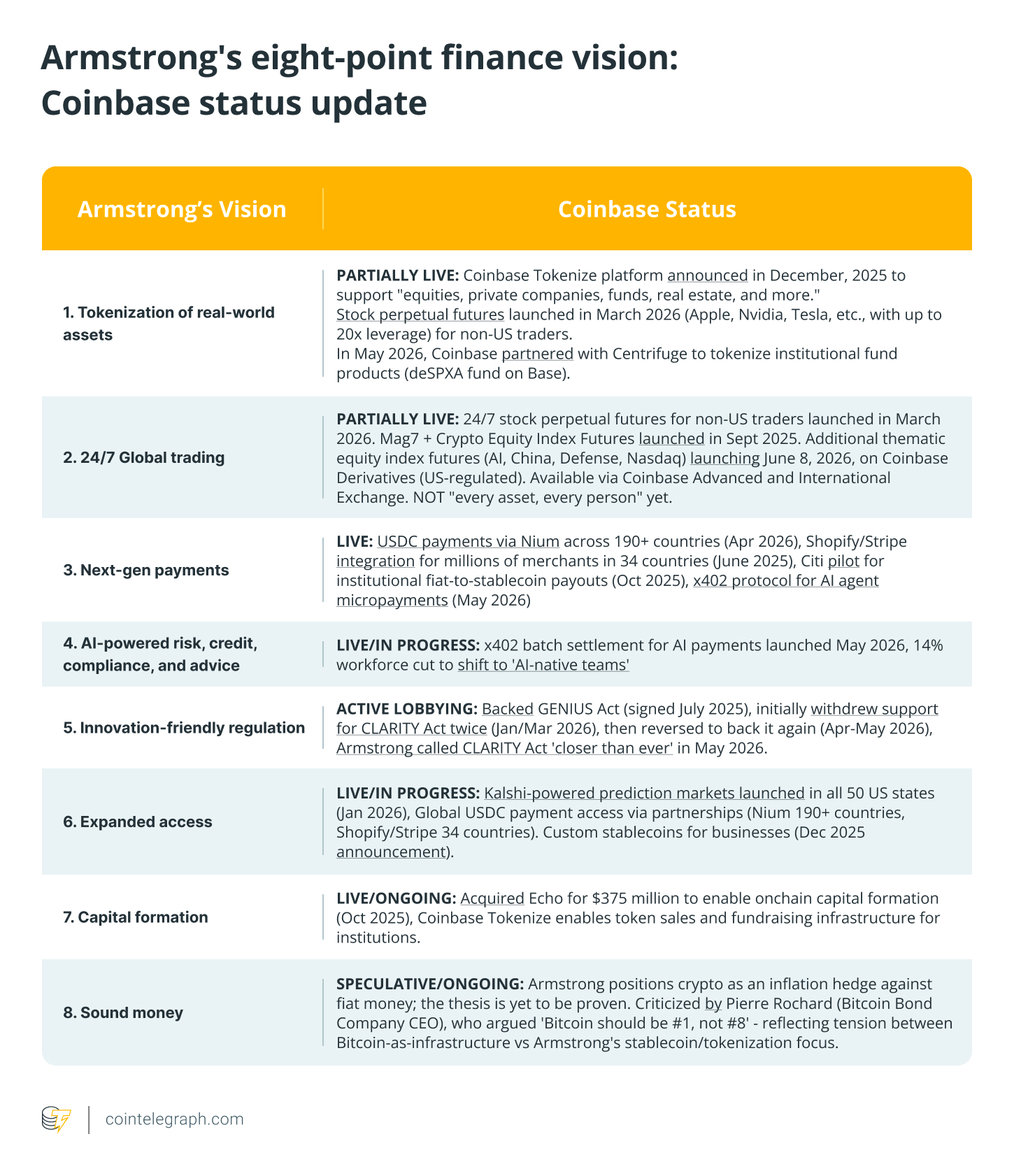
Brian Armstrong posted an eight-point blueprint for upgrading global finance Monday, which closely tracks Coinbase’s expansion into stocks, prediction markets and stablecoin infrastructure, as the exchange continues its push to become an “everything” platform.
The Coinbase CEO’s priorities, posted Monday on X, include tokenized real-world assets, 24/7 global trading, stablecoin payments, AI-powered compliance, open access, capital formation, regulation and sound money.
Coinbase is broadening beyond crypto trading into payments, tokenized assets and financial infrastructure as exchanges compete to capture a larger share of global capital markets. The exchange is positioning itself against rivals like Binance and Kraken, which offer equity perpetuals and synthetic stock exposure under varying regulatory frameworks.
Some of Armstrong’s priorities already align with live products, while others remain aspirational. Armstrong’s call for “tokenization of real-world assets” and “24/7 global trading,” for example, aligns with Coinbase’s March rollout of stock perpetual futures for non-US traders, offering round-the-clock, leveraged exposure to Apple, Nvidia and major indices in 26 European countries.
The company earlier launched perpetual futures contracts for institutional clients via Coinbase International Exchange, extending crypto-style derivatives into equity products, though access remains restricted to accredited investors in select jurisdictions rather than “every person” globally as Armstrong envisions.
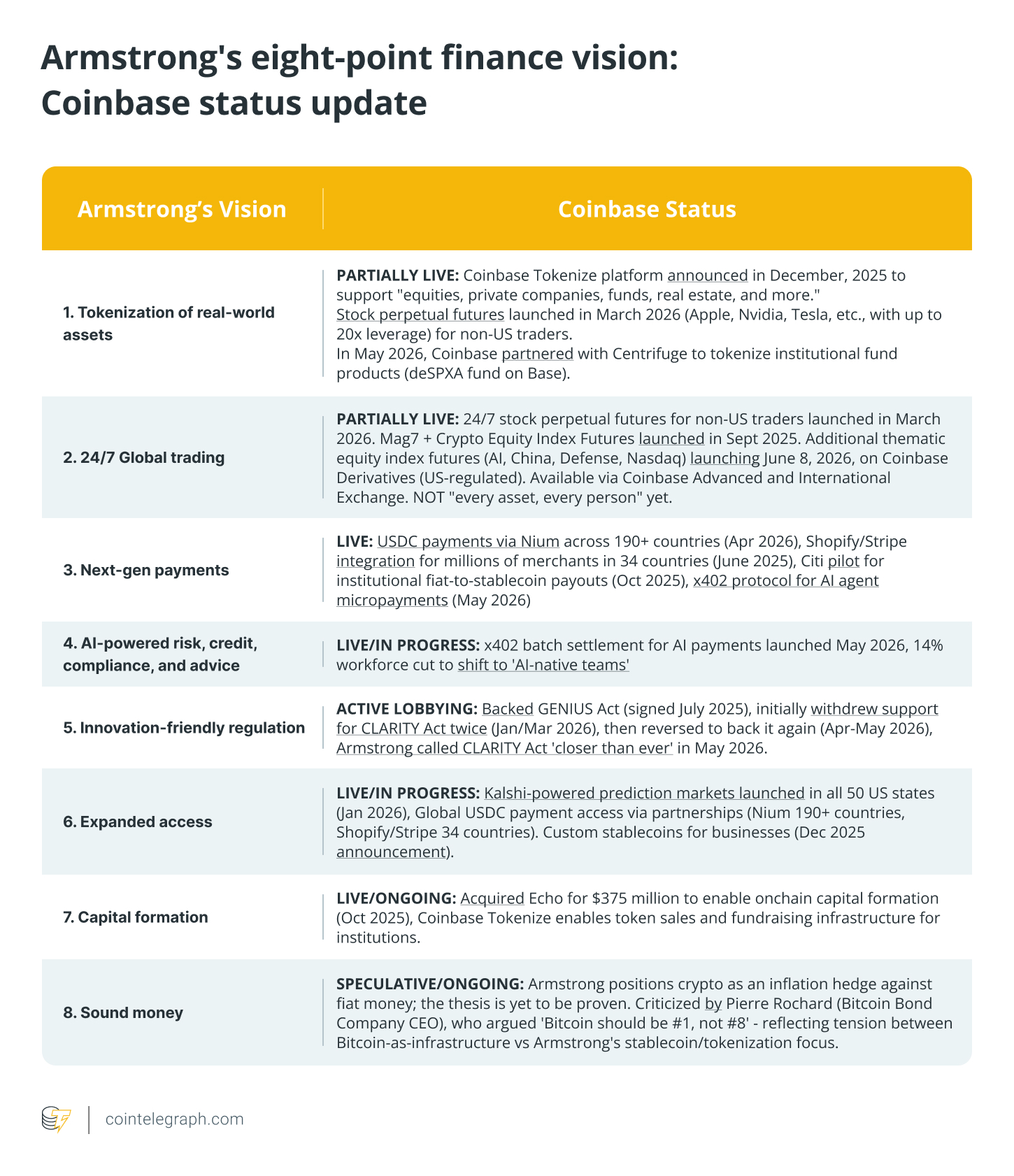
Brian Armstrong’s 8-point finance vision.
On “next-gen payments,” Coinbase partnered with Singapore fintech Nium in April to integrate USD Coin stablecoin settlement across more than 190 countries, enabling businesses to fund cross-border payouts on demand without prefunding multi-jurisdiction accounts.
The company also collaborated with Shopify and Stripe in June 2025 to roll out USDC payments to millions of merchants across 34 countries, with automatic fiat conversion and zero foreign-exchange fees.
In October 2025, Coinbase announced a collaboration with Citigroup to explore fiat-to-stablecoin payout methods for institutional clients, further integrating crypto infrastructure with traditional finance systems.
Related: KuCoin launches perpetual futures tracking Tesla and Strategy stocks
Expanding access and capital formation
Armstrong’s mention of expanded access through “open protocols” and capital formation also reflects live initiatives. Coinbase launched Kalshi-powered prediction markets in all 50 US states in January, allowing users to trade event contracts on sports, politics and culture.
The launch puts Coinbase in a market Bernstein estimates will reach $240 billion in volume this year and $1 trillion annually by 2030.
The priority for “innovation-friendly regulation” tracks Coinbase’s lobbying for the Digital Asset Market Clarity Act. After publicly withdrawing support twice, Armstrong said that CLARITY was closer than ever in early May after Senate compromises on stablecoin yield and decentralized finance provisions.
Coinbase also championed the Guiding and Establishing National Innovation for US Stablecoins (GENIUS) Act, signed into law in July 2025, to establish federal stablecoin oversight with one-to-one dollar backing requirements.
On “AI-powered risk, credit, compliance,” Coinbase backed the x402 payment protocol in May, adding batch settlement to enable AI agents to authorize micropayments below $0.0001. The feature launched weeks after Armstrong cut 14% of Coinbase’s workforce, citing a shift to “smaller AI-native teams” using automation tools to boost output.
Related: Binance launches SpaceX-linked perpetual futures ahead of IPO
Sound money as an inflation hedge
Armstrong’s final point, “sound money” as an inflation hedge, drew pushback from Pierre Rochard, chief executive of The Bitcoin Bond Company, who stated that Bitcoin should be the top priority, rather than left for last.
The pushback reflects a deeper divide: Bitcoin advocates believe it should be the foundation of a new financial system, not just a backup option when fiat currencies fail.
“Bitcoin is #1,” echoed Blockstream chief executive Adam Back, who was rumored to be Bitcoin’s anonymous creator Satoshi Nakamoto earlier this year.
Magazine: Guide to the top and emerging global crypto hubs — Mid-2026

TLDR
- Micron achieved unprecedented fiscal Q2 2026 revenue of $23.86 billion with Q3 guidance pointing to approximately $33.5 billion
- SK Hynix delivered exceptional Q1 2026 revenue of KRW 52.57 trillion, fueled by accelerating AI memory sales
- These semiconductor giants dominate high-bandwidth memory (HBM) production critical for AI server infrastructure
- Wall Street remains optimistic on both stocks: Micron earns a Buy recommendation while SK Hynix commands a Strong Buy
- Investment thesis differs: Micron provides diversified memory market access; SK Hynix represents a concentrated AI memory position
The artificial intelligence memory revolution has created two standout investment opportunities: Micron and SK Hynix. While both companies are capitalizing on explosive AI demand, their investment profiles differ significantly. Micron dominates as America’s premier memory manufacturer, delivering comprehensive exposure across DRAM, NAND, and high-bandwidth memory segments. Meanwhile, SK Hynix has established itself as the frontrunner in HBM technology, the specialized memory architecture essential for powering advanced AI processors.
For investors tracking the AI infrastructure expansion, these companies control critical nodes in the technology supply ecosystem.
Micron’s Performance Reaches Unprecedented Heights
Micron delivered exceptional fiscal Q2 2026 results with revenue reaching $23.86 billion, accompanied by an impressive gross margin of 74.4% and net income totaling $13.79 billion. The semiconductor manufacturer generated $11.9 billion in operating cash flow during this single quarter.
Looking ahead, the company projects fiscal Q3 revenue around $33.5 billion with gross margins climbing toward 81%. These metrics represent extraordinary performance across any industry sector.
Micron’s Cloud Memory Business Unit contributed $7.75 billion in quarterly sales. The Core Data Center division generated an additional $5.69 billion. Consumer electronics no longer dominate the revenue mix. Hyperscale cloud providers and AI-focused data centers now drive the company’s growth trajectory.
MarketBeat data reveals analyst sentiment favoring Micron with a Buy consensus across 39 professionals. The breakdown includes 5 Strong Buy recommendations, 30 Buy ratings, and 4 Hold positions, with zero Sell calls.
SK Hynix Emerges as the Pure-Play AI Memory Investment
SK Hynix announced exceptional Q1 2026 performance with revenue hitting KRW 52.57 trillion alongside operating profit of KRW 37.61 trillion. Management indicated that AI processor demand will outstrip their production capabilities, highlighting ongoing HBM supply limitations.
Following announcements from leading American technology companies about intensified AI data center investments in early May, SK Hynix stock experienced substantial gains. This price movement demonstrates the tight correlation between SK Hynix’s valuation and AI infrastructure capital expenditure.
Compared to diversified competitors like Samsung, SK Hynix presents a more straightforward investment narrative. Shareholders are essentially wagering on sustained HBM demand growth. This singular focus represents both the investment opportunity and the potential vulnerability.
Investing.com data shows SK Hynix commanding a Strong Buy consensus among 38 analysts, comprising 36 Buy ratings, 2 Hold recommendations, and zero Sell opinions.
Understanding the Key Differences
Micron delivers comprehensive memory market participation spanning DRAM, NAND, and HBM technologies, supported by robust cash flow generation and convenient U.S. exchange listing. SK Hynix offers investors a more focused, aggressive position targeting AI server memory specifically.
While both securities often trade in tandem, the underlying drivers diverge. Micron’s performance mirrors overall memory market conditions. SK Hynix’s valuation tracks AI infrastructure investment velocity.
Analyst sentiment favors both companies strongly. The investment decision ultimately depends on whether portfolio managers prefer diversified memory sector exposure or concentrated AI hardware demand correlation.


Ethereum co-founder Vitalik Buterin said the Ethereum Foundation will choose “longevity over breadth,” reduce ETH sales and narrow its focus to CROPS: censorship resistance, capture resistance, openness, privacy and security.
In a lengthy post on X, Buterin detailed that the Ethereum Foundation holds roughly 0.16% of all ETH, well below the 10% to 50% he said it’s common for the central foundations of other blockchains to hold.
Nearly 90% of his own net worth sits in ETH, with the remaining roughly $40 million in onchain fiat already earmarked for open-source biotech, software and hardware initiatives, Buterin added.
His influence within the EF will continue to decrease as the board expands, aligning with his desire to be less influential there. However, he also hedged his words, saying, “This is only my own view. The board is not just me, and I have no extra special powers on the board that the other board members do not.”
He framed the EF as “one node, with a defined purpose, alongside other nodes,” not the center of Ethereum. Addressing throughput, Buterin said it would be a mistake for Ethereum to maximize it.
“Being as fast and as scalable as possible, and only a small epsilon more decentralized than the others, is a route to mediocrity, and if we try it, we will lose.”
Instead, Buterin pointed to Ethereum striving to be “deeply impressive” in what he called the “CROPS dimension.” That involves making Ethereum provably bug-free, which is argued to be within reach given AI-powered verification.
The post landed after at least 8 senior EF contributors left or announced departures in 2026, 5 in May alone, reigniting debate over the foundation’s direction.
Crypto community reacts
Prominent Ethereum voices were supportive of Buterin.
Anthony Sassano, an independent Ethereum educator, angel investor and advisor, replied directly to the post, thanking Buterin. A separate quote tweet from Sassano focused on Buterin’s framing of ETH as the most high-value “product” of the Ethereum blockchain.
Author and early Ethereum advisor William Mougayar quote-tweeted the post: “Basically, Ethereum just got its own Clarity Act over the weekend. It was a crystal clear message, and the road ahead is super clear. Ethereum is untouchable.”
Developer Suhail Kakar also replied directly, calling the post “bullish.” “A foundation voluntarily shrinking its own power is the rarest thing in crypto. genuinely the most cypherpunk thing I’ve read in a long time.”
Meanwhile, core developers picked at the CROPS framework.
Go-Ethereum developer Marius van der Wijden replied that security was being underdiscussed: “When people talk about CROPS, they seem to focus on the CR, OS and Privacy part. The security part is in my opinion the most important! Without a secure L1 none of this makes any sense and we have taken Ethereum’s base layer security for granted by now.”
Consensus layer developer Potuz followed up in the thread, noting that “one of Ethereum’s biggest selling points is the no downtime since genesis” and that the record made every fork a concentrated risk.
Laura Shin, host of Unchained, asked the governance question the post left open: “What’s the process for adding new members to the board?” Buterin did not publicly answer at the time of writing. DeFiPrime founder Nick Sawinyh noted the EF now sounded “less like a cathedral and more like a protocol commons operator.”
Others criticized the cryptocurrency’s performance. Ether has fallen nearly 60% against bitcoin over the last five years, to 0.02738 BTC. Over that period, bitcoin’s price nearly doubled from $35,600 to $77,500 at the time of writing.
Read more: Ethereum’s identity crisis is deepening after high-profile ‘brain drain’ frustrates the community


Jeremy “jercos” Sturdivant, the recipient of the historic Bitcoin Pizza Day transaction, has confirmed he spent his 10,000 Bitcoin (BTC) on a road trip across the United States after running out of money.
The story resurfaced after Adam Back, CEO of Blockstream, reposted a video clip of Sturdivant discussing the exchange. The post spread quickly across crypto social media and drew fresh attention to one of Bitcoin’s most often-cited transactions.
The 10,000 BTC That Funded a Road Trip
On May 22, 2010, Sturdivant received 10,000 BTC from developer Laszlo Hanyecz. The payment covered two Papa John’s pizzas ordered on Sturdivant’s credit card. That transaction is now observed annually as Bitcoin Pizza Day and stands as the first documented commercial use of Bitcoin.
Sturdivant said he never considered the BTC an investment. He treated the coins as functional currency and spent them as their value gradually climbed. He emphasized that Bitcoin was meant to be used, not stored as a speculative asset. When a cross-country road trip left him short on funds, the Bitcoin covered the gap.
Bitcoin reached an all-time high of approximately $126,000 in October 2025. At that price, the original 10,000 BTC would have been worth over $1.26 billion. BTC traded near $77,787 on Pizza Day 2026, still placing the notional value of that stack above $770 million.
Bitcoin Pizza Day Revives an Old Debate
Back stands among Bitcoin’s most prominent advocates. He has been vocal about long-term holding strategies as fiat currencies weaken. Just days before reposting the clip, he urged investors to buy BTC at current price levels. His decision to amplify Sturdivant’s remarks was notable for the contrast it implied.
Sturdivant’s approach was to use the coins as money, not accumulate them. Back’s position represents the opposite view. That divide sits at the center of a Bitcoin in culture debate that has persisted since the network’s earliest transactions. Sturdivant wanted BTC to function as a living currency. Back has argued that people should treat it as a hard monetary asset.
Sturdivant has said he has no regrets. The transaction was worth roughly $41 at the time. How that philosophy holds up depends on where the current Bitcoin price cycle ends up.
The post Bitcoin Pizza Day Recipient Speaks Out: How the 10,000 BTC Was Spent appeared first on BeInCrypto.

MASSIVE BLOW FOR CRYPTO FROM THE SEC TOKENIZING STOCKS #crypto #stocks #finance

Katie Price reveals ‘kidnapped’ husband Lee Andrews had three phones

Iran war poses new threat to harvests in hunger-stricken Sudan

US brings back mandatory military draft registration

Steven Gerrard disagrees with Gary Neville over ‘shock’ Chelsea and Arsenal claim | Football

Register Renaming | Hackaday
MASSIVE BLOW FOR CRYPTO FROM THE SEC TOKENIZING STOCKS #crypto #stocks #finance

The Iran “Financial” Trap – Most People Have No Idea What’s About To Happen To USA

CLARITY Act Next Steps (How Crypto Investors Should Prepare)
-

 Crypto World4 days ago
Blockchain.com files with SEC for U.S. IPO
-

 Fashion3 days ago
Holiday Weekend Open Thread – Corporette.com
-

 Business3 days ago
Dell Technologies DELL Stock Surges 15% on AI Server Momentum and Analyst Upgrades in 2026
-

 Crypto World3 days ago
Bitcoin Accumulation Weakens as BTC Realized Losses Hit $600M
-

 Crypto World3 days ago
Space X IPO Is ‘Bad News’ for Tech Stocks: But What About Bitcoin?
-

 Politics3 days ago
Makerfield: a tale of two social-media histories
-

 Crypto World2 days ago
Robinhood crypto COO Tanya Denisova exits
-
 Crypto World4 days ago
MicroStrategy’s Saylor Says Miners No Longer Set Bitcoin Price, Another Force Has Taken Over
-

 Business23 hours ago
NYT Strands Answers May 24 2026 Revealed for Puzzle No. 812 Theme Summer Essentials
-

 Crypto World3 days ago
AI infrastructure race heats up as IREN pitches full-stack strategy, WhiteFiber lands $160M deal
-
 Tech3 days ago
A 0.12% parameter add-on gives AI agents the working memory RAG can’t
-

 Tech4 days ago
WhatsApp ads could make Irish debut after discussions with DPC
-
 Crypto World7 days ago
Revolut Launches Dogecoin Debit Card Across UK and EU
-

 Tech4 days ago
You Can Now Add ChatGPT To PowerPoint
-

 Business3 days ago
Trump Invests $1M-$5M in Kura Sushi USA Chain With 27 California Locations
-
 NewsBeat4 days ago
Charity run by Reform leader Malcolm Offord accused of ‘law breaking’ over Scottish registration
-

 Sports4 days ago
2026 CJ Cup Byron Nelson leaderboard: Brooks Koepka finds putting stroke in Round 1
-

 Crypto World3 days ago
Trump Media’s Bitcoin Stash Shrinks Again as 2,650 BTC Lands on Crypto.com
-
Business3 days ago
Goldman Sachs reinstates Ageas stock coverage with neutral rating
-

 Crypto World5 days ago
Exa Labs raises $250 million in funding led by a16z
You must be logged in to post a comment Login