Financial markets have always reacted swiftly to news, but seasoned
investors often caution against confusing short-term narratives with long-term realities. As geopolitical tensions, policy shifts, and technological disruptions continue to influence
market sentiment, the challenge for investors is separating temporary market reactions from enduring structural trends.
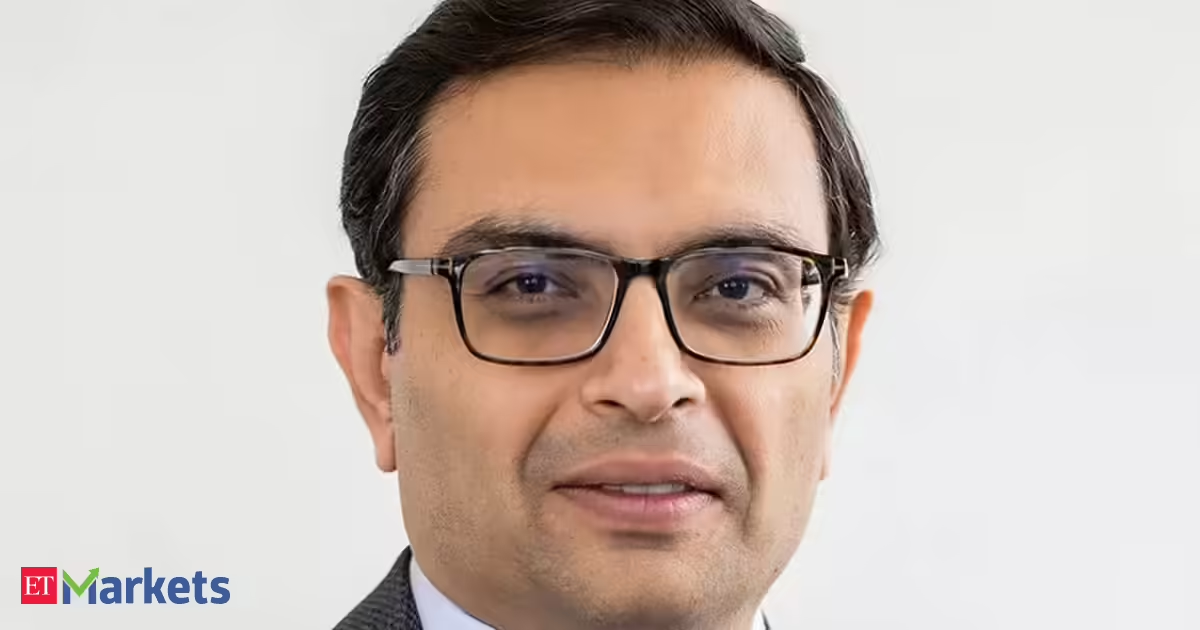
Speaking on the current investment landscape to ET Now, Hiren Ved, from Alchemy Capital Management, argued that while markets are efficient in pricing news, they often struggle to accurately assess the long-term implications behind those headlines.
Responding to a question from Ayesha Faridi from ET Now on whether markets have already factored in the repercussions likely to unfold over the next six months, Ved highlighted the distinction between narratives and reality.
“In today’s day and time, news gets discounted very quickly. But there is a difference between discounting news and trying to discount reality. And sometimes there is a gap between the two because, as I said, the narrative builds up, and the narrative may be right or it may be wrong. Only with time and in hindsight do you get to know that.”
Ved noted that investors frequently react sharply to headlines, often overlooking broader structural developments. He cited the market’s reaction following the 2024 general election as an example.
“In mid-2024, when the expectation was that this government would get a complete majority and they did not, while they had to take support from their NDA partners, suddenly the theme on defence and capex just gave way because people immediately reacted to that news to say that ab to capex nahi hoga. Everybody, if you remember, went and bought consumer stocks.”
However, he pointed out that the reality eventually reasserted itself.”Maybe these sectors or companies underperform for a year, but the reality caught on and the trend reasserted itself.”
According to Ved, successful long-term investing requires patience and conviction rather than reacting to every headline.
“I do not think long-term investing works that way. You have to sometimes step back, think, and really understand. Finally, what I have seen over the years in the markets is that numbers speak for themselves. Narratives can come and go, news can be good or bad, but it is finally the numbers that matter.”
Using oil prices as an example, Ved said markets often reveal reality more effectively than political commentary.
“Trump may flip and flop every morning and evening, but whether we are coming closer to a resolution of the war or not, the oil price will tell you the story because that is the reality. All the wisdom and all the risk-taking will get reflected in that one variable.”
A Global Capex Supercycle
When asked about the long-term structural story driving markets, Ved identified what he believes is one of the defining investment themes of the decade: a global capital expenditure supercycle.
“In my view, we are in a global capex supercycle. Whether it is because of disruption, geopolitics, wars, or oil shocks, it is very clear that every country has realised that certain foundational capabilities are critical.”
He explained that countries are increasingly prioritising defence, semiconductor technology, energy security, and supply-chain resilience.
“Every large country that has an ambition to become big is today trying to figure out how it can be self-sufficient or hedge itself. How do you hedge your supply chains? That is driving a large global capex cycle, and that is a reality.”
Ved believes these investments will continue regardless of short-term geopolitical developments.
“Even if the war stops tomorrow and oil prices come down, as a country we cannot stop investing in electrification. We cannot stop trying to do capex to achieve energy security because once you have been hurt, you have to address it at a very fundamental level.”
India’s Hidden AI Opportunity
One of the most debated narratives in recent months has been whether India has a meaningful role to play in the artificial intelligence revolution. Ved challenged the common perception that AI opportunities are limited to the United States.
“The big narrative today in India is that India has no AI play. Agar aap ko AI khelna hai toh you have to go to the US. We are an anti-AI play.”
He argued that investors often overlook the infrastructure ecosystem supporting AI development.
“Currently in AI, most of the spending is happening at the infrastructure level. People are setting up data centres and related infrastructure.”
To illustrate the point, Ved shared findings from a custom index created by his team.
“I told my team to build a custom India AI index. These are all physical businesses like power equipment, cooling equipment, cables, and everything that goes into building a data centre. An equal-weighted 12-stock India AI index, in three years, in dollar terms, has delivered a 52% compounded return versus the Magnificent Seven plus Nvidia, which has delivered a 24% compounded return.”
For Ved, the lesson is straightforward.
“If you look hard enough and if you are creative, there is always a way to play a trend. Narratives are narratives. The more narratives there are, the more opportunities there are to make money because you can find an anti-narrative. You can find the reality that the narrative does not represent, and that is where the profit-making opportunity is.”
Earnings Fears May Be Overstated
The discussion also touched on investor concerns surrounding corporate earnings amid global uncertainties and rising energy prices.
Sajeet Manghat pointed out that despite supportive policy measures and external tailwinds such as currency movements, markets remain unconvinced about the growth outlook.
Ved acknowledged that memories of previous shocks continue to influence investor behaviour.
“If you look at what happened in 2022 when the Russia-Ukraine war broke out, we had a similar geopolitical shock, an energy shock, and a supply-chain shock. For about two quarters, we had a significant earnings slowdown. So that playbook is still very fresh in the minds of investors.”
While he expects some margin pressure in the near term, Ved believes the corporate sector is much better prepared today.
“It is fair to say that there will be some compression in margins. But I also believe that a depreciation of the currency and a little bit of pick-up in inflation are actually very good for corporate profitability.”
He noted that businesses have learned from previous inflationary cycles and are likely to pass on higher costs more effectively.
“My sense is that this time, learning from the 2022 cycle, corporates are going to become much smarter in terms of passing on higher costs to the end consumer.”
Ved also challenged fears that inflation will spiral uncontrollably.
“One of the narratives was that because of tariffs, US inflation would spike. But US inflation did not spike. It only picked up recently because of the energy shock. The latest readings were largely driven by energy prices.”
Focus on Reality, Not Headlines
While uncertainty remains a constant feature of markets, Ved’s overarching message was that investors should focus on enduring structural trends rather than getting distracted by daily news flow.
“Because of an old playbook and correlations that are still fresh in the minds of investors, people feel ki earnings mein bahut bada impact aayega. I think the jury is still out. My feeling is that we will be okay with earnings, and once the market is convinced about that, it will respond.”
As markets navigate geopolitical uncertainty, technological transformation, and shifting economic conditions, the distinction between narrative and reality may prove to be one of the most important factors determining investment success in the years ahead.




















































You must be logged in to post a comment Login