

Crypto World
Altcoin Sales Hit $266B as Investors Rotate Out of Crypto

Altcoin spot demand has been under sustained pressure, but derivatives activity suggests traders are still heavily engaged with non-Bitcoin assets. On June 16, altcoins (excluding Ether) recorded $266 billion in net selling volume on centralized exchanges—the deepest reading since CryptoQuant began tracking spot demand in 2020—according to figures cited by analyst IT Tech on CryptoQuant.
At the same time, altcoins are taking a leading share of derivatives attention. CryptoQuant data referenced in the report shows altcoins accounted for 51% of daily futures trading volume on Binance on June 16, versus 28.85% for Bitcoin and 20.20% for Ether—an imbalance that points to capital rotating within crypto markets and into other exchange-linked products rather than consistently flowing into altcoin spot.
Key takeaways
- Altcoins excluding Ether saw one-year cumulative net outflows of $266 billion on centralized exchanges on June 16, the lowest since CryptoQuant’s 2020 tracking began.
- Despite those spot outflows, altcoins represented 51% of Binance futures trading volume on June 16, leading both Bitcoin and Ether.
- The divergence implies active trading and potential recycling of liquidity rather than fresh spot accumulation.
- Exchange stablecoin balances appear broadly steady since December 2024, suggesting liquidity remains available even as allocation becomes more selective.
- CryptoQuant data cited in the report points to rapid growth in exchange-linked “traditional asset” derivatives, including metals and pre-IPO perpetual products.
Spot selling hits a record low while futures stay crowded
The clearest tension in the data is between spot flows and market participation. IT Tech, quoting CryptoQuant analytics, said the one-year cumulative buy-sell difference for altcoins (excluding Bitcoin and Ether) fell to -$266 billion on June 16. The metric’s significance lies in what it represents: aggregate spot demand strength versus selling pressure over an extended period.
Such a persistent negative balance typically indicates that, at least on net, buyers have not been able to absorb the supply leaving exchanges. In this case, the report frames the shift as selling pressure outweighing buying demand “for an extended period,” pushing the cumulative figure to a new low.
But the story changes when looking at trading activity. CryptoQuant data cited alongside the spot metric shows that altcoins are dominating daily futures volume on Binance. On June 16, altcoins made up 51% of trading volume, while Bitcoin and Ether lagged with 28.85% and 20.20% respectively.
CryptoQuant’s referenced coverage also notes that altcoins have led exchange trading volumes for most of 2025, except for a short interval in February when Bitcoin temporarily overtook the sector. For investors, this is an important nuance: negative spot demand and heavy futures participation can coexist, often because derivatives positions do not require the same net spot purchases as long-only spot strategies.
What the divergence may mean for liquidity recycling
The report’s interpretation is that the combination of low or deeply negative spot demand and high futures turnover suggests capital rotation within altcoin markets—potentially involving repeated entering and exiting of positions—rather than a sustained inflow of spot capital.
In practical terms, when net selling pressure rises, traders may still keep deploying into altcoin exposure via futures, perps, or other leveraged instruments. That can sustain high derivatives volume even when exchange spot balances reflect ongoing selling. Meanwhile, fresh buying—if it exists—may be getting directed elsewhere or arriving in smaller, less consistent bursts.
This matters for market participants monitoring “demand” signals. For example, a decline in spot buy-sell balances might not immediately translate into reduced trading activity, especially if leverage and hedging strategies continue to concentrate volume in altcoins. Traders watching for a directional shift may therefore want to track whether futures dominance changes at the same time as spot outflows improve—or if futures remain strong while spot selling persists.
The report also flags a broader pattern: attention and liquidity may be spreading beyond altcoin spot entirely, moving toward other exchange products that can absorb stablecoin and trading capital.
Stablecoin balances look resilient, while deployment gets more selective
Another pillar of the report concerns exchange-held stablecoins. Analyst MorenoDV indicated that exchange stablecoin balances have changed little since December 2024. Using CryptoQuant’s “exchange supply ratio” for ERC-20 stablecoins, the report states that the figure has generally fluctuated between 0.40 and 0.46—meaning roughly 40% to 46% of circulating ERC-20 stablecoins have remained on exchanges for more than a year.
In other words, the liquidity needed to trade has not disappeared. Instead, the allocation of that liquidity appears to be shifting. The report contrasts this stability with price volatility: it says Bitcoin experienced swings exceeding 50% during the same period, trading between $60,000 and $120,000. Meanwhile, Binance’s share of total stablecoin supply has been described as sitting in the 25% to 30% range, accounting for more than half of exchange-held reserves.
For investors, the key takeaway is that “available liquidity” and “where it gets deployed” are becoming two separate questions. Stablecoin balances may remain broadly steady, but traders and capital providers may be deploying that liquidity into a wider set of instruments rather than keeping the money concentrated in spot.
Traditional-asset derivatives and pre-IPO contracts gain traction
The report points to a possible explanation for that shift: exchange users are increasingly spreading liquidity across assets that resemble traditional-market instruments. CryptoQuant data cited in the piece highlighted the expansion of metals futures and other non-crypto exposures.
According to CryptoQuant, metals futures volume peaked at nearly $500 billion in March 2026 as gold and silver reached record highs. The report also notes that the trading activity in “pre-IPO perpetual” products expanded rapidly—from about $2 million in March to $715 million in May and $2 billion in June.
On Binance specifically, the report says the exchange processed $10.3 billion in pre-IPO perpetual volume in June, roughly 20 times higher than the entire month of May, while maintaining around 83% control of that segment. It links this acceleration to growth across multiple asset categories—metals, oil, equities, and pre-IPO contracts—suggesting that exchange venues are pulling liquidity into derivatives that do not rely solely on crypto-native token spot demand.
The inclusion of these product categories helps contextualize why altcoin futures might stay active even as altcoin spot selling worsens. If stablecoin liquidity is being reallocated into broader derivative suites, altcoin spot buyers may face stronger competition for capital—while traders still retain access to altcoin exposure through leveraged instruments.
For market participants, the main uncertainty is whether the current pattern is temporary rotation or a longer structural rebalancing. Readers should watch next for signs of stabilization in altcoin spot buy-sell balances and whether altcoin dominance in futures changes as liquidity continues to migrate toward metals, oil, equities, and pre-IPO perpetual markets—areas where the report indicates Binance retains the largest concentration of deployable stablecoin capital.



Stablecoin issuer Tether is winding down Alloy by Tether and its gold-backed, overcollateralized aUSDT stablecoin after just two years to focus on products and areas with stronger demand.
Tether announced its “strategic changes” on Wednesday following a review of user activity, market demand, and the company’s “broader priorities.”
Tether said it has decided to focus resources on areas where it is seeing “stronger user demand, deeper liquidity and broader long-term market opportunity,” including its gold-backed digital asset XAUT and other core products across its ecosystem.
While stablecoins remain Tether’s core business, the company has shown a growing interest in technology outside stablecoins. Its investments include Bitcoin mining infrastructure, artificial intelligence, cloud computing and robotics. Most recently, it led German tech company NEURA’s $1 billion funding round on June 11.
Tether’s aUSDT is an overcollateralized derivative product built on top of XAUT using Ethereum smart contracts, which also reflects the demand for gold-backed and tokenized real-world assets.
Alloy by Tether allowed users to deposit XAUT as collateral to mint aUSDT, with the value of XAUT locked exceeding the value of aUSDT issued, similar to how some stablecoins or synthetic dollars are created against crypto collateral in DeFi.
Users could borrow or mint against their XAUT holdings, letting them access dollar-like liquidity without selling their gold exposure.
Alloy by Tether, announced in June 2024, has a current market capitalization of $1.2 million and is backed by 14.73 kilograms of gold worth around $2.2 million, according to Tether.
Tether Gold remains popular
The winding down will happen in phases, the first of which starts immediately by preventing the opening of new positions or the minting of new aUSDT. Users have three months to return their aUSDT and reclaim their XAUT until the cut-off date on Sept. 17.
Related: Tether expands robotics push with lead role in NEURA’s $1B-plus funding round
XAUT remains popular with a market capitalization of $3 billion and is backed by 22,169 kilograms of physical gold, according to the company.
Its market cap surged earlier this year when gold prices hit an all-time high of just over $5,300 per ounce. However, it has retreated by 19% since then.
Tether also bought a 12% stake in precious metals platform Gold.com for $150 million in February, with plans to integrate XAUT into the platform.
Chinese yuan and euro stablecoins axed
Alloy by Tether is not the only product the company has shelved this year.
In February, Tether announced it was discontinuing its Chinese yuan stablecoin, CNHT, citing “evolving market conditions, low interest in the product, and limited sustained community demand,” relative to other supported assets.
In November, it wound down its euro stablecoin, EURT, citing European regulatory issues and a focus on other initiatives such as Hadron, its asset tokenization platform launched in 2024.
However, in May, Tether announced that it planned to launch a Georgian lari stablecoin, GELT, in cooperation with the government of Georgia.
Magazine: The end of anon? AI could unmask crypto’s hidden identities

Kentucky has sued five prediction market platforms, including Kalshi and Polymarket, adding to a wave of US states launching legal fights with prediction markets over sports event contracts.
State Attorney General Russell Coleman said in a statement Wednesday that his office filed lawsuits in state court against Polymarket and Kalshi — also naming Kalshi partners Coinbase, Robinhood and Webull — accusing them of “operating unlicensed and illegal sports betting and gambling platforms.”
“Kalshi and Polymarket are operating illegal sportsbooks in Kentucky and breaking our laws,” Coleman said. “These multi-billion dollar corporations and their legal fictions don’t pass the sniff test. As one of our state legislative leaders said it best, ‘If it looks like a duck and quacks like a duck…’”
Kalshi and Polymarket together recorded $25 billion in monthly trading volume in May, per Token Terminal. Lawsuits from multiple US states risk locking them out of some of the largest markets in the US.

Kentucky Attorney General Russell Coleman gives a speech in April. Source: YouTube
At least 17 other states have taken prediction market operators to court, attracting the involvement of the US Commodity Futures Trading Commission and the White House.
Multiple state authorities have argued that event contracts tied to sports are sports betting and require state-level licenses. Prediction markets have argued that their event contracts are swaps regulated under federal commodities law.
That position is backed by the CFTC, which has sued eight states after they took action against prediction markets, claiming they were stepping on its authority.
Kentucky’s lawsuits claimed that Polymarket, Kalshi and their partners are “doing business without a Kentucky gaming license or following state regulations” and that their sports event contracts “fall squarely within the definition of ‘sports wagering’ under Kentucky law.”
The state also alleged the platforms offer users “few or no resources” to identify or seek help for a gambling problem as required by state law.
A Polymarket spokesperson told Cointelegraph Kentucky’s action “runs counter to the CFTC’s established framework for regulating prediction markets. We look forward to addressing these claims through the appropriate legal process.”
Kalshi spokesperson Jacki McGavick told Cointelegraph that “Kalshi is a federally regulated exchange — the CFTC is our regulator, not the states. Courts have already recognized this, and we’re confident they will here too.”
The CFTC did not immediately respond to a request for comment.
Related: Prediction market battle gets closer to Supreme Court
Kalshi and Polymarket, through a coalition of platforms, are already tied up in legal action with Kentucky after suing the state on Friday to claim its first-in-the-country 14.25% tax on prediction market transaction fees is discriminatory and oversteps federal law.
Kentucky’s action comes after authorities in Montana, Nevada, Utah, Iowa, Illinois, Ohio, Tennessee, New York, New Jersey, Connecticut and Maryland had issued cease-and-desist letters to prediction markets and were subsequently sued by the platforms.
Washington, Arizona, New Mexico, Wisconsin, Michigan, Massachusetts and Kentucky have also chosen to sue prediction market platforms, including Kalshi.
Some of the legal battles have so far reached appeals courts and have seen mixed results. On Wednesday, a Michigan federal judge ruled against Polymarket in its lawsuit against the state, finding that its sports event contracts are not swaps under the CFTC’s authority.
Other courts have also sided with prediction markets, such as the Third Circuit Court of Appeals’ ruling in April that New Jersey regulators could not prevent Kalshi from offering sports event contracts in the state.
US President Donald Trump, whose son Donald Trump Jr. is on the advisory board for Polymarket and is an adviser to Kalshi, said in May that it was “critically important that the CFTC’s exclusive authority over Prediction Markets is maintained.”
Magazine: Should users be allowed to bet on war and death in prediction markets?


Bitcoin has recently been flirting with a level that has historically proved a near-perfect entry point for bulls, generating handsome returns, crypto exchange Kraken’s Chief Economist Thomas Perfumo told CoinDesk.
That level is the 200-week simple moving average (SMA), which represents the token’s average price over that period, providing traders with a clear glimpse of the long-term trend while cutting through day-to-day noise.
Twice in the past two weeks, BTC dipped briefly below its 200-week SMA before climbing back above it by the end of each week. As of writing, bitcoin is trading at $63,900, just above the 200-week SMA of $62,358.
That’s notable because, as per Perfumo, closes below this level have been rare, occurring on only about 10% of trading days since mid-2017, and have historically marked unusually attractive entry points for buyers.
“Historically, buyers at this level have gone on to see median returns north of 113% over the following year and 313% over two years,” Perfumo said in an email.
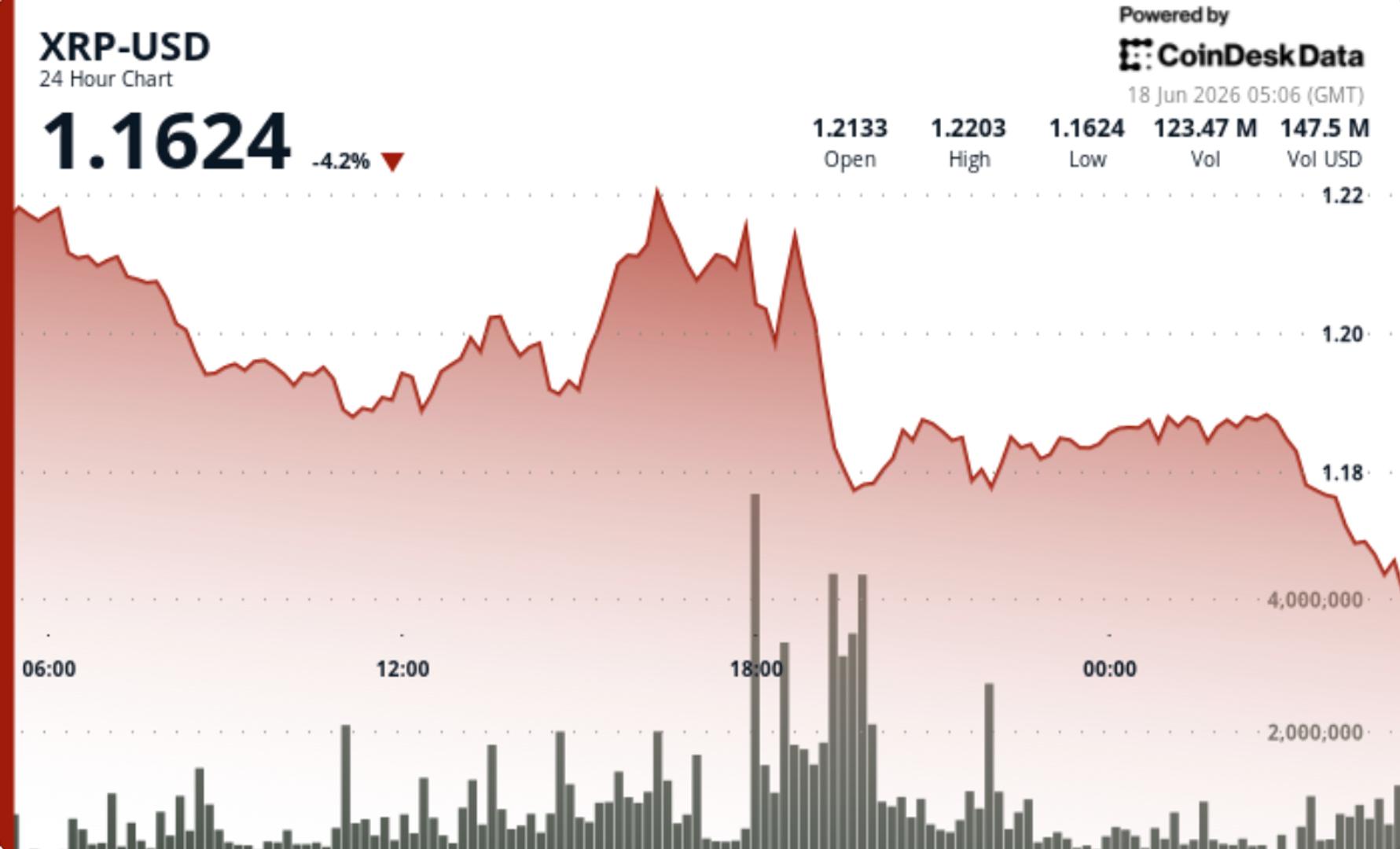
XRP’s push toward $1.25 ran into the same problem that has capped every rally since the spring selloff: sellers waiting overhead. After briefly trading above $1.22, the token lost the $1.20 level on heavy volume and spent the rest of the session trying to stabilize above support near $1.18.
The pullback doesn’t fully undo last week’s breakout, but it does show buyers still have work to do before the market can challenge higher resistance levels.
News Background
• XRP remains in focus after recent ETF inflows and growing institutional participation helped drive last week’s rally above $1.20.
• Analysts continue to watch the $1.11-$1.15 demand zone that launched the latest recovery, viewing it as the line separating a correction from a larger breakdown.
• Longer-term charts still show XRP trading beneath major moving averages despite the rebound from early June lows.
Price Action Summary
• XRP fell from $1.2170 to $1.1869 during the 24-hour session, losing 2.5%.
• Selling intensified during the June 17 19:00 UTC session when volume surged to 128.7 million XRP, more than double normal levels, breaking support at $1.20.
• The token later found buyers near $1.1750 and recovered modestly into the close, holding above the session low of $1.1747.
Technical Analysis
• The loss of $1.20 is the key development. That level had acted as support after XRP’s breakout above $1.14 and $1.18 earlier in the week.


Kentucky Attorney General Russell Coleman has filed lawsuits against Kalshi, Polymarket and several related partners, accusing them of offering unlicensed sports betting in the state.
Summary
- Kentucky says prediction markets crossed into sports betting, while platforms claim federal law controls contracts.
- Kalshi and Polymarket now face lawsuits, tax disputes, and split court rulings across several states.
- The CFTC backs federal oversight as state regulators push licensing, consumer protections, and gambling rules.
The Kalshi case also names Coinbase, Robinhood and Webull, which Kentucky says helped give users access to sports event contracts.
The lawsuits were filed in Franklin Circuit Court. They argue that the platforms offered markets tied to game winners, point spreads and player statistics without a Kentucky gaming license. Coleman said, “Kalshi and Polymarket are operating illegal sportsbooks in Kentucky and breaking our laws.”
State says sports contracts fall under betting law
Kentucky claims the products fit the state definition of sports wagering, even when platforms call them event contracts. The state says users can place trades on outcomes that look similar to wagers offered by licensed sportsbooks, including money lines, spreads and prop-style markets.
The attorney general’s office also accused the platforms of offering few or no tools for users who may need help with gambling problems. Kentucky law requires licensed operators to meet consumer protection rules. The state says those protections are missing from the platforms named in the cases.
Kalshi and Polymarket reject state control
Kalshi and Polymarket have argued in other cases that their products fall under federal commodities law, not state gambling law. Kalshi has said it operates as a federally regulated exchange under the Commodity Futures Trading Commission. A company spokesperson said, “The CFTC is our regulator, not the states.”
Polymarket has also pushed back against state action. The company said Kentucky’s lawsuit goes against the CFTC’s framework for prediction markets and said it will address the claims through the legal process. Both companies say state licensing rules should not control contracts listed under federal commodities oversight.
Broader legal fight grows across the U.S.
The Kentucky cases come as prediction market firms face pressure from several state regulators. Montana, Nevada, Utah, Iowa, Illinois, Ohio, Tennessee, New York, New Jersey, Connecticut and Maryland have sent cease-and-desist letters or taken legal steps against operators. Washington, Arizona, New Mexico, Wisconsin, Michigan, Massachusetts and Kentucky have also sued platforms tied to sports event contracts.
The CFTC has taken the opposite view in several disputes. The agency has sued states, saying event contracts traded on federally regulated exchanges fall under its authority. Courts have not reached one clear answer. The Third Circuit sided with Kalshi in a New Jersey case, while other courts have allowed state gambling cases to move forward. For users, the cases may decide which rules platforms must follow before offering sports markets.
Tax dispute adds another front
Kentucky is also fighting prediction market firms over taxes. A coalition that includes Kalshi, Crypto.com and Polymarket sued the state over a new 14.25% tax on prediction market transaction fees. The group says the tax targets federally regulated markets and treats prediction platforms worse than some state gambling businesses. The tax suit remains separate from the new gambling complaints.
The legal pressure comes as trading volumes and product lines grow. Kalshi has expanded into crypto-linked perpetual futures and reported more than $5.5 billion in volume within two weeks of launch. At the same time, compliance concerns are rising. Kalshi recently partnered with StarCompliance to help financial firms monitor employee prediction market trades.


It was the first decision under new Chairman Kevin Warsh, who said there had been rigorous debate before the vote and vowed the central bank would deliver price stability. A more hawkish Fed means tighter financial conditions, which tend to drain the liquidity that fuels risk assets like crypto.
Stocks took the week’s news better, helped by a separate development. President Donald Trump signed an interim deal to end the war with Iran and reopen the Strait of Hormuz, putting the agreement into effect.
S&P 500 futures rose as much as 0.9% and Nasdaq futures gained 1.5%, while Brent crude fell toward $78 a barrel. Crypto did not catch that bid, a sign it is trading more on the Fed than on the geopolitical relief for now.
Analysts expect bitcoin to stay rangebound until a clearer catalyst arrives.
“We expect bitcoin to continue to trade in the $60,000 to $70,000 range in the coming weeks absent any major catalyst,” said Gerry O’Shea, head of global market insights at Hashdex, naming the signing of the CLARITY Act, a crypto market-structure bill, into law or further US-Iran de-escalation as the kind of trigger that could break the range.
He added sentiment has been weak as IPOs and AI stocks pulled attention away from crypto, but expects capital to rotate back as institutional interest grows and regulation formalizes.
Bernstein has reaffirmed its buy rating on Coinbase and maintained a $330 price target after the company unveiled a series of new products designed to extend its business beyond crypto trading.
Summary
- Bernstein maintained a buy rating on Coinbase and kept its $330 price target after the System Update event.
- Coinbase unveiled AI-powered trading tools, prediction markets, tokenized stocks, and pre-IPO trading products.
- Barclays stayed bearish with a $107 target, while Benchmark and Cantor Fitzgerald remained bullish.
According to Bernstein, the latest announcements from Coinbase’s System Update event support its long-term bullish view on the company despite a sharp reduction from its earlier $440 target following the broader crypto market downturn.
Bernstein continues to see substantial upside in Coinbase shares, citing growth opportunities across stock trading, stablecoin infrastructure, blockchain services, custody, and institutional products.
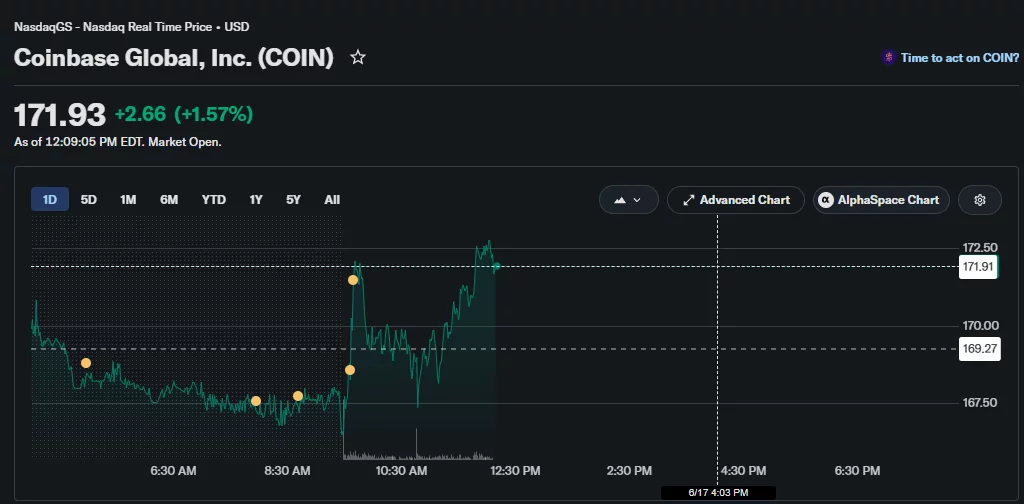
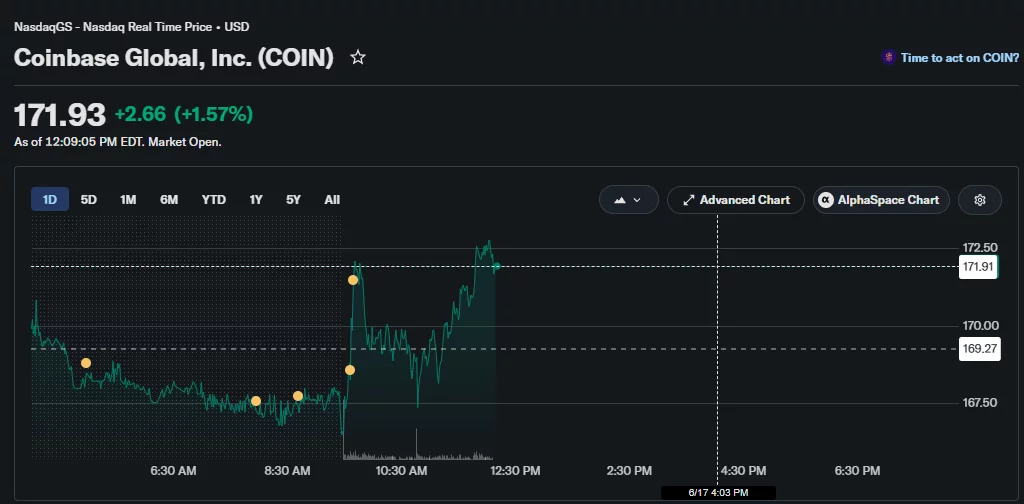
Coinbase shares traded higher on Wednesday, rising about 1.6% to around $171.93 after closing 0.2% lower at $169.27 in the previous session. While investors continued monitoring the Federal Reserve’s policy decision and the outlook for interest rates, several Wall Street firms reassessed Coinbase’s latest product expansion and long-term growth strategy.
Coinbase adds AI tools and traditional market products
During its System Update event, Coinbase introduced an SEC-registered AI investment advisor that can access customer portfolio data and account history. According to Coinbase Chief Executive Officer Brian Armstrong, users will be able to interact with the advisor through natural language prompts and receive portfolio suggestions directly through the platform.
The company also announced that artificial intelligence agents can now connect directly to Coinbase. Using systems such as ChatGPT and Claude, customers can establish trading parameters and authorize AI-powered agents to execute trades on their behalf.
Alongside the AI products, Coinbase revealed plans to expand access to derivatives, prediction markets, and pre-IPO trading products tied to large private technology companies. The rollout follows the exchange’s recent announcement that it intends to launch tokenized stocks backed one-for-one by underlying shares.
According to Coinbase, the initiatives form part of its effort to develop what it describes as an “Everything Exchange,” combining crypto services with products traditionally associated with mainstream financial markets.
Analysts remain divided on Coinbase valuation
Not all Wall Street firms share Bernstein’s optimism. Following the same product event, Barclays reiterated its underweight rating and maintained a $107 price target on Coinbase shares.
According to Barclays, new offerings including tokenized equities, AI-powered advisory services, equity options, and agentic payments are unlikely to fully compensate for weaker crypto trading activity if market volumes remain subdued.
Elsewhere, Benchmark reiterated its buy rating and set a $270 price target. Benchmark analyst Mark Palmer argued that Coinbase is evolving beyond its role as a cyclical crypto brokerage and is building a platform capable of attracting demand from traditional financial markets.
Cantor Fitzgerald also maintained its overweight rating and kept its $250 price target unchanged. According to the firm, Coinbase’s continued product development during a challenging market environment strengthens its competitive position, although analysts cautioned that fluctuations in crypto asset prices could still create cyclical headwinds.
At the same time, broader market conditions remain a factor for Coinbase and other crypto-related stocks. Bitcoin briefly fell below $65,000 ahead of the Federal Reserve’s policy decision, while stronger-than-expected retail sales data reinforced expectations that policymakers could keep interest rates elevated for longer.

Key Highlights
- Amazon Web Services has joined CrowdStrike’s Project QuiltWorks AI-driven cybersecurity initiative
- Enhanced Falcon AI Detection and Response now supports AI applications developed on Amazon Bedrock, Kiro, and Strands Agents
- Three Falcon security solutions now available with complimentary 30-day trials through AWS Marketplace
- Enhanced capabilities include AWS PrivateLink support across regions and streamlined CloudWatch and S3 connectors
- Shares of CRWD advanced 1.1% to $687.51 after the partnership news broke
CrowdStrike (CRWD) unveiled Wednesday a significant expansion of its collaboration with Amazon Web Services, incorporating AWS into Project QuiltWorks while broadening its AI-powered security capabilities to encompass applications developed on AWS infrastructure.
The stock traded 1.1% higher at $687.51 when the partnership expansion was announced.
CrowdStrike Holdings, Inc., CRWD
Project QuiltWorks represents CrowdStrike’s strategic framework built to provide ongoing monitoring and protection for cloud workloads facing AI-specific security threats. With AWS now part of this initiative, the scope of protected cloud infrastructure expands considerably.
The centerpiece of Wednesday’s announcement involves broadening Falcon AI Detection and Response capabilities. This security solution now supports AI applications developed on AWS platforms, specifically Amazon Bedrock, Kiro, and Strands Agents.
The technology delivers immediate security assessment of interactions between agents and large language models. Its primary objective is identifying and stopping prompt injection attacks, unauthorized data exposure, and harmful AI behaviors in real-time.
CrowdStrike has also simplified the onboarding process for prospective clients. Three flagship offerings — Falcon Next-Gen SIEM, Falcon Cloud Security, and Falcon Endpoint Security — can now be accessed via AWS Marketplace featuring 30-day complimentary trials through flexible pay-as-you-go pricing.
This approach creates a frictionless entry point for enterprises looking to evaluate the platform before committing.
Enhanced Developer Resources and Network Capabilities
For software developers, the company unveiled a Falcon MCP integration compatible with Kiro. This integration enables developers to access CrowdStrike threat intelligence and security information directly within their development environments while building applications.
The integration connects with Falcon Next-Gen SIEM and Falcon Cloud Security to safeguard non-human identities and manage data movement throughout AWS ecosystems.
Network infrastructure receives notable improvements as well. CrowdStrike now supports AWS PrivateLink functionality across multiple regions, enabling companies to keep Falcon platform communications entirely within AWS’s private network infrastructure instead of traversing public internet connections.
Additionally, Quick Start connectors designed for Amazon CloudWatch and Amazon Simple Storage Service access logs are being introduced to accelerate deployment processes.
Continuing Strategic Growth
This AWS partnership enhancement doesn’t exist in a vacuum. CrowdStrike recently secured AWS Agentic AI Specialization Partner designation, and Wednesday’s announcement represents a natural progression of that relationship.
Project QuiltWorks is simultaneously growing beyond the AWS ecosystem. CrowdStrike continues expanding its Falcon AI Detection and Response solution across additional AI gateway collaborators, including Databricks, Google Cloud, and Microsoft Azure.
The cybersecurity firm has also been strengthening identity protection capabilities. Its recently introduced Continuous Identity for AI Agents functionality provides real-time authorization of AI agent activities based on assessments of agent ownership, calling identity, and device risk profiles.
From an analyst perspective, Piper Sandler maintains an Overweight rating on CRWD. InvestingPro data indicates 27 analysts have recently increased their earnings projections for the company.
CrowdStrike reported $5.1 billion in revenue over the trailing twelve months, marking 23% year-over-year growth, while achieving a gross profit margin of 75%.
The company’s latest announcement acknowledges that certain referenced features remain under development and may undergo modifications.

Bitmine has strengthened expectations for a potential stock rally after Chairman Tom Lee highlighted the company’s chances of joining the Russell 1000 index ahead of the benchmark’s latest reconstitution update.
Summary
- Tom Lee said Bitmine could join the Russell 1000, potentially attracting fresh institutional buying demand.
- Bitmine holds 4.72 million ETH worth about $8.1 billion, making it the largest Ethereum treasury company.
- The company expects roughly $219 million in annual staking rewards to help support BMNP dividends.
According to Tom Lee, the updated list of companies entering and exiting the Russell 1000 is scheduled for release on June 18, with Bitmine Immersion Technologies potentially qualifying for inclusion.
Lee argued that membership could increase demand for the stock because many institutional funds and asset managers are required to allocate capital only to companies included in major indexes.
The comments arrived as Bitmine continued expanding its position as one of the largest corporate holders of Ethereum. As crypto.news reported earlier, the company recently disclosed holdings of 4,718,677 ETH, valued at approximately $8.1 billion based on an ETH price of $1,718. Bitmine said the position makes it the largest Ethereum treasury company globally and the second-largest crypto treasury overall behind Strategy.
Russell 1000 inclusion could attract institutional demand
Speaking about the upcoming Russell reconstitution, Lee said index inclusion could open the door to additional buying from funds that track or benchmark against the Russell 1000. According to Lee, those investment mandates could create a new source of demand for BMNR shares if the company is added to the index.
Investors have closely watched Bitmine’s stock performance in recent sessions as the company rolls out new funding vehicles tied to its Ethereum accumulation strategy.
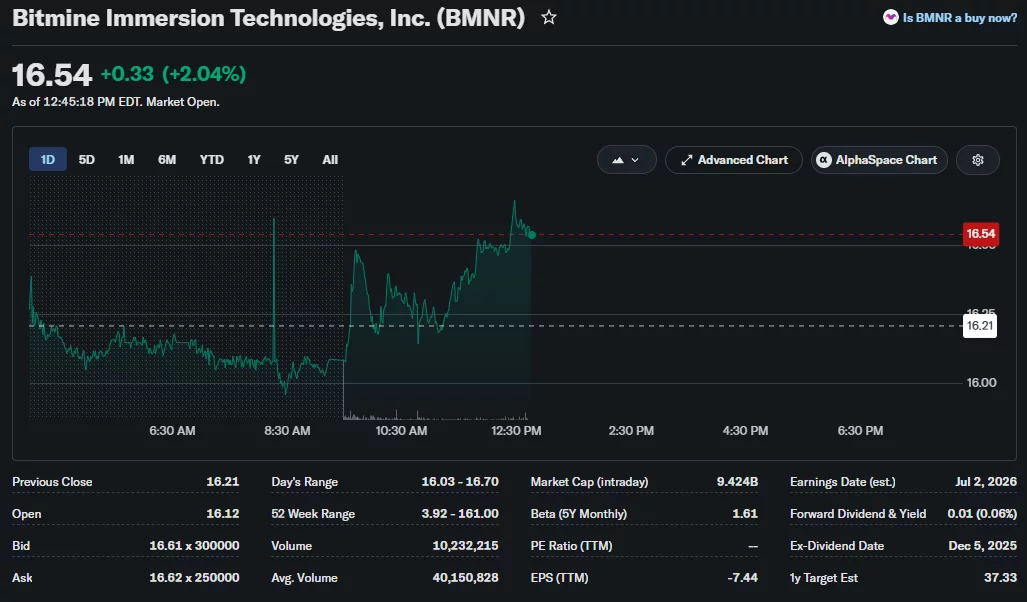
BMNR shares remained volatile but continued to hold above a closely watched support zone near $16. Yahoo Finance data showed the stock trading around $16.54 on June 17, up roughly 2% on the session after moving between $16.03 and $16.70.
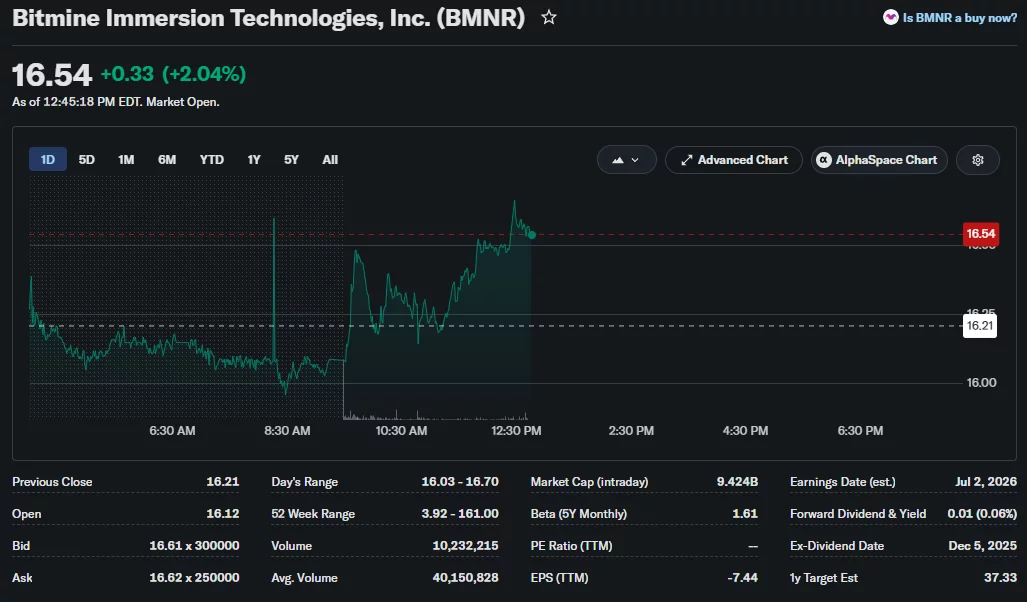
The shares had previously closed at $16.21 after reaching an intraday high of $17.26 following the launch of Bitmine’s preferred stock.
At the same time, Bitmine’s newly listed BMNP preferred shares began trading on the New York Stock Exchange on June 16. The security, formally known as the 9.50% Series A Perpetual Preferred Stock, was issued after the company sold 3.5 million shares at $80 each on June 10, generating approximately $273.8 million in net proceeds after fees and expenses.
Ethereum staking supports preferred stock strategy
Bitmine has tied the preferred stock directly to its Ethereum treasury operations. According to company disclosures, proceeds from the offering will support additional ETH purchases, while staking rewards generated from the company’s holdings are expected to help fund dividend payments.
Lee stated that projected annualized staking rewards of roughly $219 million provide recurring cash flow to support dividends tied to the preferred shares. The preferred stock carries a 9.50% dividend rate, with payments distributed weekly.
Trading data from the NYSE showed BMNP climbing above its initial offering price after listing. The preferred shares changed hands near $89 at press time after fluctuating between roughly $88 and $92 during early trading, while exchange data showed the security previously reaching as high as $88 following the initial offering.
By combining a growing Ethereum treasury, staking-generated income, and a new preferred stock structure, Bitmine has positioned itself as one of the most closely watched crypto-linked equities ahead of the Russell 1000 update that Lee believes could become the company’s next major catalyst.

France’s national cybersecurity agency ANSSI said Tuesday that it will stop certifying security products that lack quantum-resistant encryption, reflecting growing concern among governments about quantum threats to cryptography.
ANSSI chief of staff Samih Souissi said at the France Quantum 2026 Summit that it would halt such certifications in 2027 and that businesses should buy only quantum-safe products by 2030, Reuters reported.
“ANSSI has been telegraphing this move for years,” Marin Ivezic, the founder of consulting firm Applied Quantum, said in a post on LinkedIn. “What changed yesterday is that ANSSI’s chief of staff said it publicly at a major conference, in front of the French quantum ecosystem, with Reuters in the room. The guidance became a commitment.”
ANSSI certification is a prerequisite for use across French government agencies and critical infrastructure operators. The move would force vendors to demonstrate post-quantum cryptography capability by 2027 or lose access to government contracts.
“It’s not only a technical issue,” Souissi said. “It’s a matter of governance, industrial planning, regulation, and sovereignty.”

ANSSI Chief of Staff Samih Souissi speaking at Orange OpenTech 2025 Source: YouTube
France’s 2027 cutoff aligns with a move from the US National Security Agency (NSA) to require all national security systems to use its suite of quantum-resistant algorithms, known as CNSA 2.0, by 2027.
Under CNSA 2.0, all new national security system acquisitions are required to support the approved algorithms by Jan. 1, 2027. Noncompliant systems must be phased out by the end of 2030, and by the end of 2031, all national security systems must use CNSA 2.0 algorithms.
“Two of the world’s most demanding cryptographic certification authorities, serving two of the world’s largest defense and government technology markets, have independently converged on the same year to make PQC [post-quantum cryptography] a pass-fail requirement,” Ivezic said.
Crypto grapples with quantum threat
Quantum threats to cryptography has also been a growing concern within the cryptocurrency industry.
In May, data analytics platform Glassnode estimated that nearly 10% of the total supply of Bitcoin (BTC), around 1.92 million BTC, is considered “structurally unsafe” in the event of a quantum computing breakthrough.
Related: Researchers say quantum computers could, in theory, be ready by 2030
In April, Coinbase warned that proof-of-stake blockchains, including Ethereum and Solana, may be at greater risk from quantum computing because of the signature schemes validators use to secure the network.
However, Coinbase also acknowledged that many blockchains have already begun work to harden their systems against quantum threats.
Coinbase said layer-1 blockchain Algorand has a “staged roadmap toward full quantum readiness” and is among the first networks to have deployed cryptography designed to be secure against quantum computers.
It also said Aptos, a competing layer-1 blockchain, was “well-positioned for the transition to post-quantum secure transactions.”
Solana and Ethereum have also created clear roadmaps to address quantum threats, including upgrading signatures to be quantum-resistant.
Magazine: The end of anon? AI could unmask crypto’s hidden identities

12 players quit Liverpool with two more set to leave as Andoni Iraola’s reign begins

Apple to raise prices due to memory chip shortage, CEO tells WSJ

Tether Winds Down Alloy and aUSDT Gold-Backed Stablecoin

Blockchain.com files with SEC for U.S. IPO

Israel says it has killed new Hamas military leader in Gaza City airstrikes

No Jackpot Winner as $257 Million Prize Rolls Over to $269 Million Monday Draw

JULY 2026 HOROSCOPE: Shocking Surprises & Big Financial Shifts!All 12 Signs Saturn Retrograde 2026

how i’m investing in crypto for the next big move

URGENT CLARITY ACT UPDATE! NEW DEADLINE #xrp #crypto #bitcoin #ai #finance
-
 Business4 days ago
No Jackpot Winner as $257 Million Prize Rolls Over to $269 Million Monday Draw
-

 Fashion5 days ago
Weekend Open Thread: Tuckernuck – Corporette.com
-

 Crypto World7 days ago
Oppenheimer backs SpaceX as $70 billion retail frenzy builds
-

 Crypto World7 days ago
Markets Rally as SpaceX IPO Looms Amid Iran Tensions and Inflation Surge
-
 Crypto World3 days ago
Zimbabwe Requires Crypto Businesses to Register Annually Under New FIU Regulations
-

 Tech5 days ago
NanoClaw integrates JFrog registries to secure AI agent downloads
-

 Crypto World5 days ago
Bitget enters Argentina’s regulated crypto market through PSAV registration
-

 Tech6 days ago
This Week In Security: Microsoft On Microsoft, Register Your Domains, Linux On ARM, And FreeBSD Joins The File Cache Club
-

 NewsBeat6 days ago
El Nino has formed in the Pacific and could set records, forecasters say
-
 Tech7 days ago
Dutton Ranch star claims they ‘didn’t see any disruption’ on set following Chad Feehan’s exit from Yellowstone spinoff fueled by Taylor Sheridan clash rumors
-

 Politics7 days ago
Politics Home | Healey Resignation Is “Colossal Failure Of Government”, Says Former Labour Defence Secretary
-
 Entertainment7 days ago
Donnie Wahlberg & More Heat Up Las Vegas at Circa’s Barry’s Downtown Prime
-
 Tech7 days ago
Opendoor Ends India Operations, Fueling a Bigger Conversation About AI and Outsourcing
-

 Sports7 days ago
First Time Since 1971: Australia Register Historic Low In ODI Cricket
-

 Politics7 days ago
Belfast burns, while Met chief points finger at Iran and Russia
-

 NewsBeat5 days ago
FBI searches office of Ohio voter registration group
-

 Business7 days ago
AT&T: Verizon's 27% Outperformance Sets Up A Solid Entry Point
-
 Tech6 days ago
Anthropic is spending $150M to embed 1,000 AI fellows inside nonprofits. No degree required.
-

 Politics7 days ago
Modi thanks Trump for wishes as US attacks Indian seafarers
-
 Entertainment6 days ago
‘The Pitt’s Fan-Favorite Doctor Confirms Noah Wyle Gave His Blessing to Return [Exclusive]
You must be logged in to post a comment Login