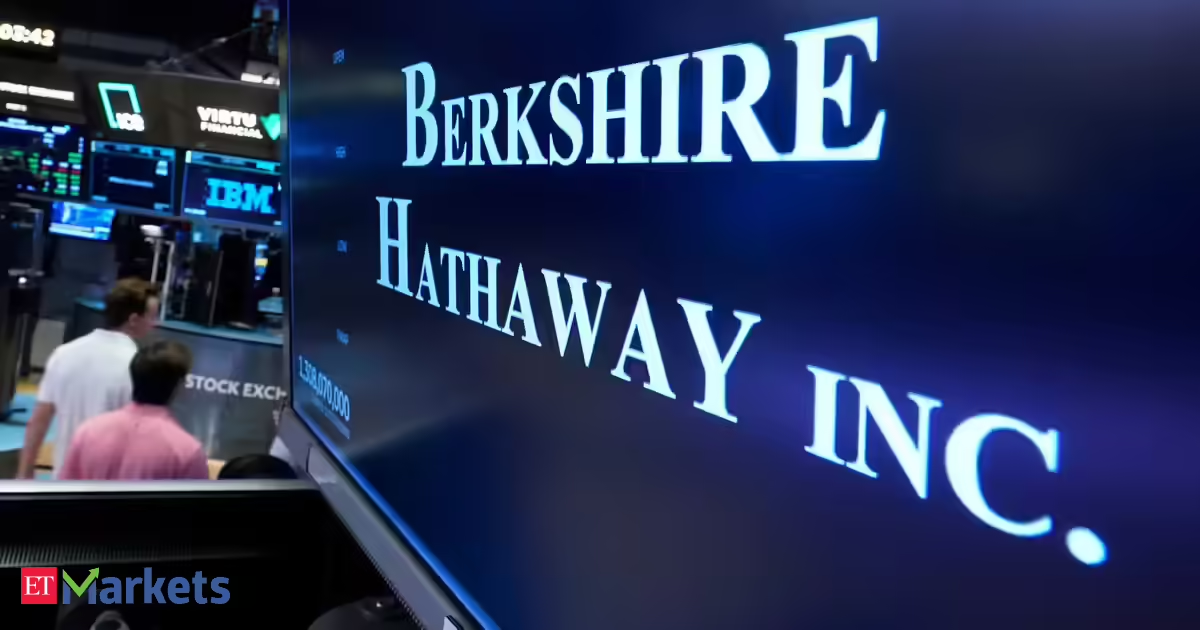



Berkshire Hathaway shares on Monday had their largest decline since Warren Buffett announced he would step down as chief executive, after the conglomerate posted financial results that fell short of some analysts’ expectations and expressed caution about investing its cash.
The Class A shares fell as much as 5.3% by early afternoon, and Class B shares, worth about 1/1,500th as much, fell about the same amount. Shares fell as much as 6.8% last May 5, after Buffett unexpectedly announced that Greg Abel would take charge starting in 2026. Buffett had led Berkshire since 1965, and remains chairman.
Berkshire on Saturday said fourth-quarter operating profit, which excludes gains and losses on common stocks led by Apple , fell 30% to $10.2 billion, including a 38% overall decline at Geico and other insurance businesses.
In his first annual letter to shareholders, Abel said Geico may face continued pressure to keep customers as rivals lower car insurance rates, while other insurance and reinsurance operations face pricing pressures as more capital enters their markets.
Advertisement
While saying Berkshire’s $373 billion cash stake did not signal a “retreat from investing,” Abel gave no indication Berkshire planned to resume stock buybacks after 1-1/2 years with none, or pay a shareholder dividend.
Live Events
“We will assess value carefully, act patiently, and hold for the long term – preferably forever,” he wrote. Keefe, Bruyette & Woods analyst Meyer Shields, who rates Berkshire “underperform,” on Monday said results “broadly” missed forecasts, also reflecting weakness at the BNSF railroad and in energy, manufacturing and retailing operations. He lowered his 2026 earnings forecast by 5%.
With the NFL’s legal tampering window set to open Monday, March 9, at noon ET, and the new league year kicking off Wednesday, March 11, at 4 p.m. ET, trade speculation is heating up alongside free agency buzz. While signings dominate headlines, blockbuster trades often reshape rosters before free agents even put pen to paper, especially with the franchise tag deadline passed and teams maneuvering around cap space and needs.
IBTimes US
The 2026 offseason features intriguing trade candidates at quarterback, wide receiver, edge rusher and more, fueled by contract situations, team resets and contender pushes. Analysts from ESPN, NFL.com, CBS Sports and others highlight players like A.J. Brown, Maxx Crosby and Kyler Murray as prime movers. Here are 10 trades generating the most chatter and why they could materialize in the coming days or weeks:
1. A.J. Brown, WR, Philadelphia Eagles to Buffalo Bills. Brown’s name tops many lists after reports of potential Eagles’ willingness to move him amid coordinator changes and cap considerations. The Bills, eyeing a Super Bowl push with Josh Allen, could offer significant draft capital for the proven playmaker. NFL.com suggested this as one of two trades that “should happen,” noting Buffalo’s urgency to go all-in.
2. Maxx Crosby, EDGE, Las Vegas Raiders to Detroit Lions. Crosby’s trade front has quieted somewhat per ESPN’s Jeremy Fowler, but his elite pass-rush ability makes him a perennial target. The Lions, building a dominant defense, could pursue him to bolster their edge rotation. Bleacher Report and others floated Crosby-to-Detroit hypotheticals, with the Raiders potentially seeking high picks amid a rebuild.
3. Kyler Murray, QB, Arizona Cardinals to Minnesota Vikings. Murray’s future remains uncertain after injury-limited play and coach Jonathan Gannon’s preference for Jacoby Brissett as QB1. The Vikings, seeking a veteran bridge or starter, could offer a Day 2 pick or package. NBC Sports and ESPN combine buzz listed this as a realistic fit, with Minnesota needing QB stability post-Sam Darnold era.
Advertisement
4. Mac Jones, QB, San Francisco 49ers to Miami Dolphins. Jones, a former first-rounder now in a backup role, could fetch interest from cap-strapped teams like Miami looking for affordable QB depth with extension potential. NBC Sports highlighted Dolphins as a suitor, noting his low 2026 cap hit makes him attractive for teams planning extensions.
5. Trey Hendrickson, EDGE, Cincinnati Bengals to a contender (e.g., Rams or Chargers). Hendrickson requested a trade last year but stayed; now a free agent-to-be, a pre-free agency move could maximize value. ESPN tiers and combine intel point to high demand for his sack production despite age/injury concerns. The Rams, with cap flexibility and Super Bowl aspirations, emerge as logical landing spots.
6. De’Von Achane, RB, Miami Dolphins to a running back-needy team (e.g., Broncos or Bengals). ESPN ranked Achane among the top 15 trade candidates for his explosive speed. Miami’s backfield depth could prompt a deal for draft assets, with rebuilding teams like Denver seeking dynamic playmakers.
7. Brian Thomas Jr., WR, Jacksonville Jaguars to an AFC contender. As ESPN’s No. 1 trade candidate, the young receiver’s upside draws interest despite Jacksonville’s investments. A trade could net high picks if the Jaguars pivot, with teams like the Bills or Ravens in the mix for WR upgrades.
Advertisement
8. DJ Moore, WR, Chicago Bears to Buffalo Bills or AFC West team. Barnwell’s ESPN proposals floated Moore westward, but Buffalo remains a fit for explosive talent alongside Stefon Diggs remnants or new additions. Chicago’s cap and roster decisions could force movement.
9. Jermaine Johnson, EDGE, New York Jets to Tennessee Titans (or reverse). A rare one-for-one trade involving Johnson and Titans’ Tvondre Sweat was noted in combine buzz, signaling EDGE movement. The Jets’ rebuild could see more defensive pieces shipped for picks.
10. Matthew Stafford-related package or veteran QB moves impacting draft trades. With Stafford’s future in question, Rams GM Les Snead’s history of bold moves — like past Stafford acquisition — could involve trading up/down or bundling vets. Bleacher Report hypotheticals included Raiders trading No. 1 overall or Crosby, shaking free agency and draft dynamics.

These potential deals highlight the fluid nature of the offseason: trades often precede or coincide with free agency to clear cap room, acquire assets or fill holes before March 11 signings explode. Teams like the Seahawks (Super Bowl champs facing cap hits on extensions for Jaxon Smith-Njigba and Devon Witherspoon), Jets (ample picks and cap) and Patriots (post-Super Bowl adjustments) could drive activity.

Advertisement
Cap space leaders and draft-rich squads hold leverage, but contenders rarely wait. As tampering opens, verbal agreements could spark chain reactions, with trades becoming official March 11.
The league’s emphasis on quarterback stability, defensive fronts and explosive weapons ensures these 10 scenarios — and others — will dominate discussions. Fans should brace for surprises as GMs wheel and deal to reshape 2026 rosters.
Australian shares have tumbled as the deepening Middle East conflict heightens fears around spiralling energy costs and increasingly likely interest rate hikes.
The escalation of hostilities between the US, Israel and Iran has once again pushed geopolitics to the forefront of global markets. Missile strikes, retaliatory attacks and fears of a broader Middle East conflict have predictably unsettled investors, with many wondering how to adjust their mutual fund portfolios in this uncertain environment.
According to a note by Axis Mutual Fund, for India, geographically distant but economically exposed, the more relevant question is not whether near-term volatility will rise, but whether such episodes meaningfully alter the country’s long-term investment trajectory. History suggests they rarely do.
Wars and geopolitical conflicts typically trigger short-term market turbulence, but they have not resulted in sustained equity underperformance, particularly when conflicts remain regional. Indian markets have demonstrated this resilience repeatedly, absorbing external shocks, repricing risk briefly and then reverting to fundamentals, the note said.
Recent moves by the US and Israel to strike Iranian targets have triggered a classic “risk-off” mood among investors, where money tends to flow out of riskier assets like equities and into safer ones such as gold, silver and government bonds.
Live Events
The conflict has pushed up prices of traditional safe-haven assets. Precious metals like gold and silver have surged as many investors seek protection from market volatility. Shrikant Chouhan, Head Equity Research, Kotak Securities, told ETMutualFunds that currently the market appears directionless, making it difficult to predict the short-term trend. Markets generally dislike uncertainty, and the prevailing global concerns are keeping sentiment volatile. From a 12-month perspective, current levels look attractive for investing in large-cap stocks. While investors rarely catch the exact bottom, adopting a staggered investment approach during major declines can help build meaningful exposure. Gradual accumulation at lower levels increases the probability of generating alpha over the medium to long term, Chouhan added. The note by Axis Mutual Fund highlighted that oil is the most immediate transmission mechanism. India imports more than 80% of its crude requirements, making it sensitive to Middle East instability. A sharp rise in crude prices raises input costs, widens the current account deficit and feeds inflation.
Equity markets tend to react quickly, particularly in oil-sensitive sectors such as aviation, paints, cement and chemicals. However, history shows that oil shocks alone have not derailed Indian equities unless they persist long enough to damage growth and monetary stability.
Advertisement
Nehal Meshram, Senior Analyst, Morningstar Investment Research India, said mutual fund investors should stay anchored to long-term goals and avoid making reactive portfolio changes based on short-term market moves. During such periods, it is essential to stick to long-term asset allocation across equities, debt and gold.
“Avoid panic selling in equities, as this often results in locking in losses right before markets stabilise. For investors with ongoing SIPs and long horizons, it makes sense to continue investing steadily.”
Meshram further said investors should focus on portfolio quality rather than short-term tactical trades. If markets correct further, consider gradual rebalancing instead of trying to time the bottom. A portfolio tilted towards large-cap, flexi-cap or multi-cap funds can help manage downside risk. One should avoid taking excessive exposure to small-cap or narrow sector themes during such volatile periods.
Periods of geopolitical stress typically strengthen the US dollar, putting pressure on emerging market currencies, including the rupee. The note by Axis Mutual Fund showed how the Nifty has behaved over the past 15 years during conflict-driven stress events such as Arab Spring or Middle East unrest (2011), Uri surgical strikes (2016), Russia-Ukraine war (2022), Israel-Hamas conflict (2023), and Operation Sindoor (2025).
Advertisement
During the Arab Spring or Middle East unrest in 2011, it was a volatile year, driven more by global growth fears than geopolitics, and markets recovered as domestic fundamentals stabilised. During the Russia-Ukraine war in 2022, the Nifty 50 fell 5% on invasion day but finished the year in positive territory, despite oil shocks and aggressive global rate hikes.
At the time of Operation Sindoor in 2025, initial market jitters gave way to stability as escalation risks remained contained, reinforcing the market’s tendency to look through short-term uncertainty.
The note said the pattern is consistent: conflict-driven drawdowns are shallow and temporary, while longer-term returns are dictated by earnings growth, liquidity and domestic demand.
Anshi Shrivastava, Head – Personal Finance Training at 1 Finance, told ETMutualFunds that given current market volatility due to global conflicts, Indian investors should remain calm and focus on long-term investment goals. Mutual funds typically experience only brief declines before recovering.
Advertisement
While sharing how the benchmark indices have performed around various geopolitical events, Shrivastava said that for equity mutual funds, maintaining a 10-15 year investment horizon is important to achieve optimal growth. Currently, adding gold and silver to a portfolio is advisable.
(Disclaimer: Recommendations, suggestions, views and opinions given by the experts are their own. These do not represent the views of The Economic Times.)
If you have any mutual fund queries, message ET Mutual Funds on Facebook or Twitter. We will get them answered by our panel of experts. Do share your questions at ETMFqueries@timesinternet.in along with your age, risk profile and Twitter handle.
Cineworld unit in Leigh has been vacant since January 2025
Chris Gee and Local Democracy Reporter
04:00, 03 Mar 2026
The former Cineworld cinema at The Loom retail park(Image: Local Democracy Reporting Service)
A former cinema in Leigh town centre is set to be converted into a large DIY store.
Advertisement
The proposal, recently lodged with Wigan council, is for the former Cineworld cinema at The Loom retail park, Spinning Jenny Way.
In December, 2024, Cineworld announced that the cinema would close and the unit has since been vacant since January, 2025. Cineworld opened at The Loom in 2011.
A supporting letter on behalf of applicant Realty Income Ltd, to change the use of the building to retail, has been published on the council’s planning portal.
It said: “The proposal is made to accommodate a national multiple retailer of DIY, trade and home improvement goods at the site. We note that there are no existing retailers of ‘bulky goods’ in or at the edge of Leigh town centre.
Advertisement
“In addition, the former B&Q store on Kirkhall Lane, to the north of the town centre, has recently closed down. On the basis that the B&Q store (which is significantly larger than the site) previously served the town, we conclude that the proposal is very unlikely to result in any adverse impacts upon the vitality and viability of Leigh town centre.
“Furthermore, the context demonstrates that there is an identified need to accommodate a new retailer of ‘bulky goods’, which would improve local consumer choice and trade in the wider retail catchment.”
The letter added that the reuse of the former cinema will contribute towards objectives to revitalise Leigh, attract investment and provide services and amenities which meet a demonstrable unmet need in the area.
The application seeks permission for the change of use of the former cinema to enable the unit to be used for retail purposes.
Advertisement
The proposal will result in a net loss of floorspace at the site, as a result of the removal of the first floor level.
The application works including minor alterations to the existing elevations of the building, the creation of a dedicated service yard, suitable for access by large HGVs, the creation of four oversized spaces for large vans and two disabled bays.
Those changes would result in the net loss of 72 parking bays at the site.
The new Home Bargains store store opened in Leigh last month on the site of the town’s former B&Q store, off Kirkhall Lane.
Advertisement
The Cineworld building application will be considered by planners at Wigan council in the coming weeks.
To find all the planning applications, traffic diversions, road layout changes, alcohol licence applications and more in your community, visit the Public Notices Portal.
U.S. stock futures tumbled sharply on March 2, 2026, as investors reacted to intensified military conflict in the Middle East following joint U.S. and Israeli strikes on Iran over the weekend, spurring a flight to safety, surging oil prices and a retreat from risk assets.
New York Stock Exchange
Dow Jones Industrial Average futures (YM=F) fell more than 500 points, or about 1.2%, while S&P 500 futures (ES=F) dropped around 1.1% and Nasdaq 100 futures (NQ=F) slid 1.4%. The moves pointed to a volatile open for Wall Street, with the CBOE Volatility Index (VIX) jumping to a three-month high near 23.7, signaling heightened fear.
The geopolitical shock compounded recent market pressures, including AI-related uncertainties, hotter inflation data and private credit jitters. President Donald Trump indicated military operations in Iran could persist for weeks, raising concerns about prolonged disruptions to global trade, energy supplies and inflationary pressures.
Crude oil prices soared amid fears of supply interruptions. U.S. benchmark West Texas Intermediate jumped around 8-9% to near $73 per barrel, while Brent crude climbed nearly 10% toward $80. Energy stocks were poised for gains, with North American producers likely benefiting, though broader market selling pressured sectors like airlines after some carriers halted flights in the region.
Gold and silver futures rose as safe-haven demand increased. The 10-year Treasury yield edged higher to around 3.99%, reflecting shifting expectations for borrowing costs amid potential inflation from energy shocks.
Advertisement
The sell-off extended from Friday’s close, when major indexes finished lower. The Dow Jones Industrial Average dropped 521.28 points, or 1.05%, to 48,977.92. The S&P 500 declined 0.43% to 6,878.88, and the Nasdaq Composite lost 0.92% to 22,668.21. February proved challenging, with the Nasdaq and S&P 500 posting their worst monthly performances since March in recent years, though the Dow eked out slight gains for its 10th straight positive month.
Analysts noted the market’s vulnerability to geopolitical catalysts. Reuters reported futures sliding over 1% as investors priced in a potentially weeks-long conflict disrupting flows. USA Today highlighted hits to airlines and financials from the cloudy global outlook.
Despite the immediate pressure, some optimism persisted for March. Fundstrat’s Tom Lee, in a CNBC appearance, forecasted an up month for stocks historically, averaging 1.0% gains with a 64% frequency over five decades. He suggested the current dip could prove temporary amid ongoing AI momentum and economic resilience.
Trading Economics data showed the U.S.500 index (tracking the S&P 500) dipping to around 6,798-6,806 points on March 2, down 1.06-1.52% in recent sessions, though still up significantly year-over-year at about 16%. The index hit an all-time high near 7,002 in January but has pulled back amid volatility.
Advertisement
Sector rotations favored defensives and commodities. Health care, energy and consumer staples outperformed in recent closes, while technology and financials lagged. Defense contractors gained traction from heightened tensions, with potential for further upside if conflict escalates.
European and Asian markets largely sold off in sympathy, with energy-sensitive regions feeling the pinch. Bitcoin hovered around $66,000 after dipping below $63,000 over the weekend.
Investors eyed upcoming data and Fed commentary for clues on rate paths, though geopolitical developments dominated. The conflict’s duration and scope could dictate near-term direction, with supply chain risks and inflation implications in focus.
Wall Street braced for choppy trading, as the combination of macro uncertainties and fresh Middle East flare-ups tested recent resilience. Long-term bulls pointed to historical March strength and AI-driven growth, but short-term caution prevailed amid the risk-off mood.
Advertisement
As markets opened, attention turned to whether energy and defense gains could offset broader declines, or if the sell-off would deepen on sustained uncertainty.