

Business
Concert ticket prices are reshaping summer live music demand


Rolfo | Moment | Getty Images
This summer, mega artist Harry Styles will take the stage at Madison Square Garden in New York City for an exclusive 30-show residency – his only planned stop in the country and a show that’s garnered intense attention since its announcement.
Despite her best efforts, Shira Elfassy won’t be there.
“His tickets were absurd,” Elfassy, 29, told CNBC. “It felt like an insult going in and seeing, like, not only can I not get in, not only are there no tickets left, but even then, the most basic price point is $500 for a nose-bleed seat — and this is becoming commonplace.”
Instead, Elfassy said she got tickets to see other artists live, like Florence + the Machine and Olivia Rodrigo, at far lower price points. She said feeling “priced out” of some concerts is now a common occurrence.
“It’s just a weird dynamic now. … At this point, if I have to make the decision between making more summer plans or hanging out with my friends — or even just [to] pay rent — or I can go to this concert, it’s a no-brainer,” she said. “But it didn’t used to be that way.”
Elfassy represents a growing cohort of consumers who aren’t willing to keep up with the rising prices for live music, creating a K-shaped demand curve where higher-income consumers are spending more — and keeping prices inflated — while lower-income consumers are pulling back.
That dynamic has played out across discretionary spending categories, like retail, dining and travel, as Americans grapple with persistent inflation, economic uncertainty and, now, soaring gas prices.
In live music, this K-shaped environment is spurring fears that the lower end of the market is falling out entirely.
Some are calling the demand shifts “blue dot fever,” named for the blue dots on Ticketmaster seating maps that denote an unsold ticket. For some artists, it’s forcing them to take a critical look at their performances. Post Malone, Zayn and The Pussycat Dolls are just a few examples of artists who have canceled shows or tours in recent months, with the last group openly admitting that poor ticket sales was the catalyst.
Last summer, even before the most recent pricing pressures, industry research suggested higher ticket prices were helping to prop up the overall health of the market. Goldman Sachs analysts wrote in a 2025 report that demand for live music was expected to grow at a 7.2% compounded annual growth rate between 2024 and 2030.
Average ticket price for a concert in one of the top 100 global tours, the report found, was $136 in 2024, up 50% from an average of $91 in 2019.
How inflation is changing concert spending
Several of the major ticketing companies told CNBC they’re not seeing more show cancellations this summer than an average year.
“Of all the shows Live Nation has on the books this year, less than 1% have been cancelled,” a spokesperson for the Ticketmaster parent said. “That’s not ‘blue dot fever’ — it’s a normal touring year; in fact, 2026 is shaping up to be a record with concert ticket sales up 11% for the year.”
The spokesperson added that roughly 70% of tickets sold on its platform are priced under $100.
Live Nation and Ticketmaster have faced scrutiny over the company’s ticketing practices and dominant influence in the music industry. The company faced legal challenges over alleged anticompetitive behavior and reached a settlement with the Department of Justice in March. A federal jury found last month that Live Nation held an anticompetitive monopoly, though the company said in a statement at the time, “The jury’s verdict is not the last word on this matter.”
The Live Nation website arranged on a laptop in New York, US, on Wednesday, April 17, 2024.
Gabby Jones | Bloomberg | Getty Images
StubHub, a ticket reseller, told CNBC that the company is seeing the K-shaped pattern take shape in live music, with demand diverging fast between various events.
While StubHub said overall concert demand is up nearly 10% year-over-year, it’s not across the board. Ticket demand for stadium-scale events is up significantly, while demand for mid-size and smaller venues is waning.
The events that are struggling to sell are facing a “supply-sizing problem,” according to Jill Gonzalez, head of consumer communications at StubHub. The events earning the strongest fan attention, she said, are stadium tours, residencies and marquee festivals.
“What our data makes clear is that fan demand for live music hasn’t softened, but it’s sharpened,” Gonzalez told CNBC. “Fans are making deliberate choices about where they spend, and when they decide a show is worth it, the demand signal is as strong as anything we’ve seen on our platform.”
Ticket platform SeatGeek said while more artists are announcing tours, the resale environment remains healthy.
“If you have more artists that are flooding the market with tours, you’re going to have the gross number of cancellations pick up year-over-year, so that’s expected,” said Oliver Marvin, the company’s senior director of strategic finance. “But the overall number, cancellations as a percentage of people who are out on tour, is not too much different than what we’ve seen in prior years.”
He added that the company is seeing some consumers dive in for last-minute tickets out of hope the prices will drop for tours that aren’t garnering as much immediate demand.
Why stadium tours still draw big demand
Experts say dropping demand for some shows may be more nuanced than what meets the eye.
As prices everywhere rise, and consumers begin to be more intentional about how they’re spending their money, the blame of unsold tickets may be more appropriately placed on the macroeconomic environment rather than on the artists themselves, according to Sam Howard-Spink, the director of music business at New York University.
“It’s really mostly to do with the economics of live performance and touring right now, which is also at the moment, I would say, very closely tied to economic conditions and cost-of-living questions,” Howard-Spink said.
Tighter spending among fans can turn a tour misstep into a disaster, he suggested, like if an artist plans dates at an inappropriately sizes venue or in an off-base market. While nostalgia for older acts can occasionally draw crowds, it’s struggling to outweigh all other factors.
And while bigger artists can still sell out a stadium, less-popular acts are falling short.
“Harry Styles, Bad Bunny, Lady Gaga, Ariana Grande — these are acts of, ‘I’m not really going to have too much trouble,’” he said. “But if you’re talking about like … an early 2000s band that might not just be able to pull in those crowds, maybe they are overconfident in the kinds of venues that they think that they can fill up.”
Artur Debat | Moment | Getty Images
Howard-Spink added that the business of music has long been considered largely “recession-resistant,” even weathering the pandemic well. But because concert tickets are a scarce resource, as opposed to music streaming, it’s allowed the prices to rise rapidly.
Music publicist Eric Alper noted artists couldn’t have foreseen these macroeconomic factors currently at play when booking out their tours months in advance. There’s also more artists on tour this year than past years, he said, crowding the schedule.
With prices broadly higher, fans are also seeking out more experiences that give them a bang for their buck, he added, as the live music scene sees a rise in residencies, along with unique new venues like The Sphere in Las Vegas.
“What people want, they want the choreography, they want the lights, they want the superior sound, they want great sightlines,” Alper said. “They’re not just going to sit there and spend $150 to go watch a band play with very bare bones.”
Still, Alper said, he believes the diehard fans are willing to pay up.
“If you’re a fan of an artist, I don’t think you care about the high ticket prices as much as people think that they do,” Alper said. “People want the experience, and they also want to tell people that they were there.”

SANTA MONICA, Calif. — Lionsgate Studios Corp. shares climbed 15.80% to close at $14.95 on May 22, 2026, following the release of stronger-than-expected fiscal fourth-quarter 2026 financial results and continued momentum from recent theatrical releases.
The company reported revenue of $906.5 million for the quarter ended March 31, 2026, compared with $865.6 million in the year-ago period. Non-GAAP net income reached nearly $112 million, or $0.37 per share, more than tripling from the prior-year quarter. Both figures exceeded analyst estimates.
Operating income totaled $117.5 million, up 52% year-over-year. Adjusted OIBDA stood at $165.4 million. The Motion Picture segment generated revenue of $651.9 million and segment profit of $187.1 million, increases of 23% and 39% respectively.
Film Performance Driving Growth
The theatrical and ancillary performance of “The Housemaid,” which grossed nearly $400 million worldwide, contributed significantly to results. The film also set records on premium video-on-demand and became the top Pay One title ever on STARZ.
Earlier in 2026, the Michael Jackson biopic “Michael” opened to $217 million globally in its first weekend, marking Lionsgate’s biggest opening since the pandemic.
Trailing 12-month library revenue topped $1 billion for the third consecutive quarter, rising 5% year-over-year. More than half of the company’s film, television and live entertainment slates consist of branded, repeatable properties.
CEO Jon Feltheimer stated, “All of the pieces of our business are coming together – our library has achieved a billion dollars in trailing 12-month revenue for three quarters in a row, more than half of our film, television and live entertainment slates are comprised of branded, repeatable properties, and massive hits like The Housemaid and Michael are strengthening our brand and increasing our forward visibility.”
Analyst Response
Benchmark maintained a Buy rating and raised its price target following the earnings release. Other firms including Baird and Morgan Stanley had issued upward target revisions in recent weeks. Consensus price targets ranged from approximately $12 to $16.
Company Background
Lionsgate Studios operates as a standalone public company following its separation from Lions Gate Entertainment. The studio focuses on motion pictures, television production and library monetization across theatrical, streaming and ancillary channels.
The stock reached an all-time high during the May 22 session with elevated trading volume. Shares have shown strong year-to-date performance in 2026, reflecting investor confidence in the company’s content pipeline and library value.
Financial Position
Lionsgate reported improvements in free cash flow and adjusted OIBDA. Year-end leverage improved to 6.1 times. The company continues to focus on disciplined capital allocation while investing in its slate of upcoming releases.
Upcoming Slate
Lionsgate has several tentpole films and television projects in development or production for fiscal 2027. The studio emphasized its strategy of prioritizing branded, franchise-driven content with strong repeat viewing potential.
Industry Context
Lionsgate competes in a dynamic entertainment landscape dominated by major studios and streaming platforms. Its focus on mid-budget films and a valuable library has provided revenue stability amid industry-wide shifts toward streaming and theatrical recovery.
Analysts project earnings growth in coming years tied to successful slate execution and continued library monetization. The company’s performance reflects broader trends in Hollywood where proven intellectual property and efficient production models are increasingly valued.
Market Reaction
The May 22 stock movement represented a strong positive reaction to the earnings beat and optimism around recent box office results. Trading activity remained active into after-hours with shares around $14.91.
Lionsgate management hosted its fiscal 2026 fourth-quarter earnings conference call on May 21. A replay and transcript were made available afterward. Further details on fiscal 2027 guidance and film slate will be monitored in upcoming updates.
Strategic Focus
The company has prioritized building a diversified portfolio of content with global appeal. Lionsgate continues to expand its presence in international markets and explore new distribution models across traditional and digital platforms.

Ionis Pharmaceuticals’ SWOT analysis: stock gains momentum on FDA approval


Exclusive-Ukraine’s Zelenskiy says proposal of associate EU membership ’unfair’

JACKSONVILLE, Fla. — Redwire Corporation shares rose 13.94% to close at $17.49 on May 22, 2026, on the New York Stock Exchange as investors responded to the company’s first-quarter financial performance and continued contract momentum in space infrastructure and national security programs.
The stock traded in a daily range between $15.12 and $17.60 with above-average volume. In after-hours trading, shares moved slightly higher to around $17.53.
Q1 2026 Financial Results
Redwire reported first-quarter 2026 revenue of $82.4 million, up 28% year-over-year. The growth was driven by increased activity in its space infrastructure and national security segments. Gross profit reached $22.1 million with a gross margin of 26.8%.
The company posted a net loss of $1.8 million, or $0.03 per share, narrowing from a larger loss in the prior-year period. Adjusted EBITDA improved to $8.7 million. Redwire ended the quarter with $412 million in total backlog, representing a book-to-bill ratio above 1.2.
Key Contract Wins
Redwire secured multiple new contracts in recent months. The company was awarded a follow-on contract from the U.S. Space Force for the Cyber Resilience Orbital Platform program. It also received additional orders under existing agreements for spacecraft components and in-space manufacturing technology.
In April 2026, Redwire announced a partnership expansion with a major defense prime contractor for advanced deployable structures. The company continues to support NASA missions, including contributions to Artemis program hardware and commercial low-Earth orbit platforms.
Analyst Views
Analysts have maintained positive coverage. Roth MKM reiterated a Buy rating with a $22 price target in mid-May. Benchmark maintained a Buy rating with a $20 target. Consensus price targets cluster around $18 to $24, reflecting expectations for continued growth in defense and commercial space sectors.
Company Background
Redwire Corporation provides space infrastructure, components and services for civil, commercial and national security customers. The company went public in 2022 through a SPAC merger and has expanded through organic growth and strategic acquisitions. Its portfolio includes solar arrays, deployable structures, avionics, sensors and in-space manufacturing capabilities.
Redwire operates facilities across the United States and Europe. The company has supported more than 150 space missions and maintains a growing presence in both government and commercial markets.
Market Position
Redwire operates in a space economy experiencing strong growth driven by increased defense spending, commercial satellite demand and exploration programs. The company competes with larger aerospace firms while focusing on specialized infrastructure and components. U.S. government initiatives, including those from the Space Force and NASA, have created opportunities for specialized providers.
Shares have shown significant volatility in 2026, trading in a 52-week range between approximately $8.50 and $24. The May 22 movement reflected renewed investor interest following quarterly results and contract announcements.
Strategic Initiatives
Redwire continues to invest in its in-space manufacturing and biotechnology platforms. The company has demonstrated 3D printing capabilities in orbit and is developing pharmaceutical manufacturing processes for microgravity environments. These technologies are positioned for both government and commercial applications.
The company maintains a disciplined approach to capital allocation, focusing on high-margin programs and backlog conversion. Management has highlighted opportunities in responsive space and resilient architectures for national security customers.
Outlook Factors
Redwire has guided for continued revenue growth in 2026 with expectations for improving profitability. The company’s backlog provides visibility into future quarters. Management has expressed confidence in executing on existing contracts while pursuing new opportunities in both defense and commercial sectors.
Upcoming milestones include potential additional contract awards and progress on current programs. Analysts will monitor gross margin trends, cash flow generation and execution against full-year guidance in subsequent reports.
Broader Industry Context
The space sector has seen increased investment in 2026, particularly in areas related to national security, satellite communications and in-orbit servicing. Redwire’s focus on infrastructure components aligns with these trends. The company benefits from bipartisan support for space programs in Congress and growing commercial interest in low-Earth orbit infrastructure.

META: Investors' Concerns Are Valid.


U.S. and Iran report progress on talks ending war, looking to next few days


I am interested in a lot of technology and AI stocks like Google, Nvidia, AMD, Tesla and Amazon.
Analyst’s Disclosure: I/we have a beneficial long position in the shares of AGNC, NLY either through stock ownership, options, or other derivatives. I wrote this article myself, and it expresses my own opinions. I am not receiving compensation for it (other than from Seeking Alpha). I have no business relationship with any company whose stock is mentioned in this article.
Seeking Alpha’s Disclosure: Past performance is no guarantee of future results. No recommendation or advice is being given as to whether any investment is suitable for a particular investor. Any views or opinions expressed above may not reflect those of Seeking Alpha as a whole. Seeking Alpha is not a licensed securities dealer, broker or US investment adviser or investment bank. Our analysts are third party authors that include both professional investors and individual investors who may not be licensed or certified by any institute or regulatory body.

The gas explosion occurred late on Friday at the Liushenyu coal mine in Qinyuan county, with 247 workers on duty underground, state media Xinhua reported earlier in the day.
Chinese President Xi Jinping called for authorities to “spare no effort” in treating the injured and conducting search and rescue operations, while ordering a thorough investigation into the cause of the accident and strict accountability in accordance with the law, according to Xinhua.
Premier Li Qiang echoed the instructions, calling for timely and accurate release of information and rigorous accountability.
Rescue operations were ongoing and the cause of the accident was under investigation, according to the local emergency management authority in Qinyuan.

China has significantly reduced coal mine fatalities – often caused by gas explosions or flooding – since the early 2000s through more stringent regulations and safer practices. The Liushenyu incident, though, was one of the deadliest reported in China in the past decade.
Executives of the company responsible for the mine have been detained, Xinhua reported.Earlier Xinhua had reported only eight dead, with more than 200 people brought safely to the surface. It did not explain the jump in the death toll.
Business
June quarter earnings to determine market direction, says Sunil Subramaniam, warns on risks in near term
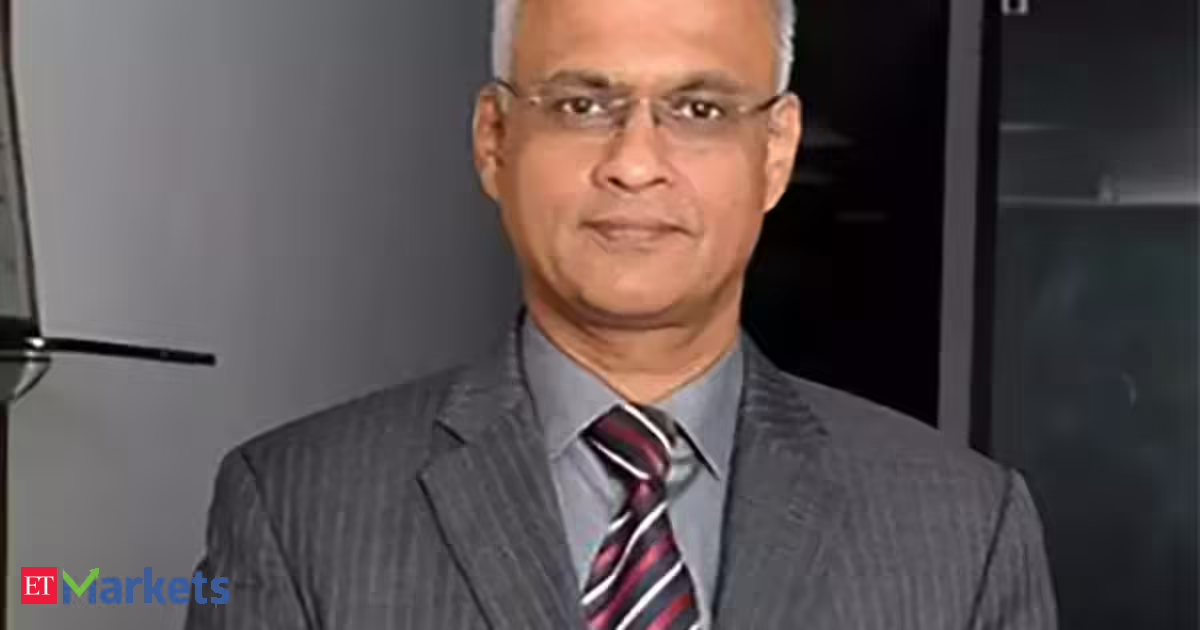
Speaking to ET Now, Subramaniam said the recent rally in pharma stocks was partly aided by rupee depreciation, which boosted export-oriented companies. However, he warned against extrapolating recent quarterly earnings into the future as the current numbers do not fully capture the impact of higher input costs, especially for active pharmaceutical ingredients (APIs), freight and global supply disruptions caused by geopolitical tensions.
“The previous quarter is not reflective of the current situation,” he said, adding that investors should avoid reading too much into recent earnings announcements. According to him, the full impact of the global conflict will likely become visible only in the June quarter earnings season. As a result, he is not particularly bullish or bearish on the pharma sector at the moment and prefers a wait-and-watch approach.
Consumer Durables to do well, FMCG under margin pressure
On the consumption theme, Subramaniam expects consumer durables to outperform FMCG companies in the near term. He believes a strong summer season and robust demand for products such as air conditioners, refrigerators and premium automobiles could help consumer durable companies offset rising input costs through volume growth.
He explained that companies in this segment typically enjoy high operating leverage, meaning strong topline growth can cushion the impact of higher raw material prices. Rising crude prices, however, are expected to increase costs for inputs such as tyres, paints, steel and packaging materials.
For FMCG companies, he expects margin pressures to intensify in the current quarter due to rising prices of palm oil, fertilisers and other crude-linked raw materials. He pointed out that the previous quarter’s earnings were relatively protected because companies used lower-cost inventory accumulated earlier in the year.
Subramaniam said many FMCG firms are already responding by cutting advertising expenses and focusing more on premium products where margins are higher. However, he cautioned that companies may struggle to pass on higher costs to mass-market consumers, particularly if rural demand weakens due to an uneven monsoon.
He also expressed optimism about high-end retail and digital-first platform companies benefiting from India’s ongoing premiumisation trend. While he does not track individual stocks in the segment, he believes rising aspirations and stronger discretionary spending among affluent consumers could continue to drive growth in premium retail businesses.
Among sectors he currently favours, Subramaniam highlighted consumer durables and capital goods as his top investment themes. According to him, capital goods companies are relatively insulated from immediate geopolitical shocks and stand to benefit from continued government and private sector capital expenditure.
He said the government is unlikely to sharply reduce infrastructure spending despite fiscal pressures, while private capex is also gradually improving. He further noted that reconstruction demand in the Gulf region after the conflict could create additional opportunities for Indian capital goods exporters.
Why public banks may beat private ones
On banking, Subramaniam remains more positive on public sector banks (PSBs) than private lenders. He argued that the recent rally in private banks was largely driven by short covering rather than genuine buying conviction from foreign institutional investors (FIIs).
According to him, FIIs continue to remain cautious on India and their flows play a major role in determining the performance of large private banks. He added that with the Reserve Bank of India unlikely to cut rates in the near term — and discussions even emerging around possible rate hikes — the environment may not be favourable for private banks.
PSBs, on the other hand, are better positioned due to their stronger CASA deposits, improving asset quality and greater alignment with the capital expenditure cycle, he said.
Mid, smallcap rally driven by earnings
Subramaniam also shared his views on the broader market rally in midcap and smallcap stocks. He said the surge has been driven by a combination of strong earnings growth, abundant domestic liquidity and retail investor optimism following the sharp correction seen during the geopolitical selloff earlier this year.
He noted that many midcap and smallcap companies reported earnings growth of 30-40% in the previous quarter, helped partly by the fact that raw material cost increases had not yet fully impacted margins.
At the same time, strong mutual fund inflows and growing retail participation have continued to support valuations in the broader market. However, he warned that this momentum could come under pressure if geopolitical tensions worsen or if the RBI adopts a hawkish stance in its upcoming policy meeting.
June quarter earnings to shape market direction
According to Subramaniam, the June quarter earnings season beginning in July will be critical in determining the market’s next direction. If the war continues and higher costs start hurting margins significantly, broader markets could face pressure. However, if the geopolitical situation stabilises by then, investors may overlook weak quarterly earnings and focus instead on future recovery prospects.
Given this uncertainty, he advised moderate investors to maintain balanced portfolios with roughly equal exposure to largecaps and mid/smallcaps. More aggressive investors with a longer investment horizon can increase exposure to midcaps and smallcaps but should be prepared for elevated volatility.
He also identified sectors to avoid in the current environment. Energy stocks, according to him, are “too hot to handle” due to extreme volatility linked to crude price movements and geopolitical developments. He also remains cautious on information technology stocks because of persistent concerns around the impact of artificial intelligence on the sector’s long-term growth outlook.
On automobiles, Subramaniam maintained a positive long-term view but believes much of the good news is already priced into stocks after the recent rally. He advised investors to hold existing positions but monitor monthly sales trends, particularly rural demand, two-wheeler sales and entry-level car demand, before adding fresh exposure.
(Disclaimer: Recommendations, suggestions, views, and opinions given by experts are their own. These do not represent the views of the Economic Times)

LOS ANGELES — A source close to Brad Pitt and Angelina Jolie has claimed that Jolie conducted a campaign of alienation that has successfully turned their six children against Pitt.
The source told the Daily Mail: “There has been a campaign of alienation [by Jolie] which has been successful. The antagonism is huge. He has been alienated from the kids completely. It is devastating to him.”
Pitt and Jolie, who were married for two years and together for more than a decade, have been locked in a contentious divorce and custody battle since their separation in 2016. The couple shares six children: Maddox, Pax, Zahara, Shiloh, and twins Knox and Vivienne.
Graduation Absence
Pitt did not attend the recent college graduation of his daughter Zahara from Spelman College. A source told TMZ that nothing prevented him from attending the event. The source added: “Zahara’s mum and siblings, who have been involved over the four very special years, were present and cheering her and her Spelman sisters on.”
The source continued: “Nothing prevented him from showing up for her. Or ever visiting her. The day was about all she accomplished. Not whether he was willing to attend.”
Name Changes
Maddox Jolie-Pitt, the couple’s eldest son, dropped “Pitt” from his name in the credits of a recent film project. Shiloh Jolie also removed “Pitt” from her name in legal documents filed in 2023.
Ongoing Legal Battles
Jolie and Pitt continue to litigate several matters, including the ownership of Château Miraval, the French winery they purchased together in 2008. Jolie scored a legal win in that case in May 2026 when a Los Angeles court ruled in her favor on certain aspects of the dispute.
The former couple’s divorce proceedings have stretched for years. Pitt has visitation rights included in their divorce agreement, but sources close to the situation say contact with the children has been minimal in recent years.
Pitt’s Public Stance
Pitt has rarely spoken publicly about the estrangement. In previous interviews, he has expressed a desire to rebuild relationships with his children while acknowledging the difficulties following the high-profile split.
The actor continues to work in Hollywood, producing and starring in films through his Plan B Entertainment company. He has maintained a relatively low public profile regarding personal matters in 2026.
Jolie’s Activities
Angelina Jolie has focused on directing, acting and humanitarian work. She has appeared in several films and continues to advocate for children’s rights and refugee issues through her work with the United Nations and other organizations. She has also been involved in wine production at Miraval following the legal developments.
Background on the Relationship
Pitt and Jolie began their relationship in 2005 after meeting on the set of “Mr. & Mrs. Smith.” They announced their engagement in 2012 and married in 2014 in a private ceremony in France. Jolie filed for divorce in September 2016, citing irreconcilable differences.
The divorce has involved multiple court hearings, custody evaluations and property disputes. Both parties have been represented by high-profile legal teams throughout the process.
Children’s Current Status
The six children range in age from 14 to 24 as of May 2026. Several have pursued creative and academic interests. Zahara recently graduated from Spelman College. Maddox has worked in film production. Shiloh has shown interest in dance and modeling. The younger children, Knox and Vivienne, have appeared in some of Jolie’s film projects.
Public Interest
The Pitt-Jolie family situation continues to generate significant media coverage and public discussion. Sources close to both sides have periodically shared perspectives with entertainment outlets, though both Pitt and Jolie have largely avoided direct public commentary on the family dynamics in recent years.
The latest claims from Pitt’s associate highlight the ongoing emotional toll of the estrangement on the actor. The source described Pitt as devastated by the lack of relationship with his children.

“Evil Money” // PROPHET LOVY

Progressives land a big win in Philadelphia and hope more are coming

Lionsgate Studios LION Stock Soars 16% on Strong Q4 Earnings Beat and Film Success


-

 Crypto World2 days ago
Blockchain.com files with SEC for U.S. IPO
-

 Fashion21 hours ago
Holiday Weekend Open Thread – Corporette.com
-

 Crypto World6 days ago
Intesa Sanpaolo’s crypto holdings jump to $235M as XRP enters
-

 Business1 day ago
Dell Technologies DELL Stock Surges 15% on AI Server Momentum and Analyst Upgrades in 2026
-

 Crypto World1 day ago
Space X IPO Is ‘Bad News’ for Tech Stocks: But What About Bitcoin?
-

 Fashion7 days ago
On the Scene at Gucci’s Cruise Show in New York City: Mariah Carey, Kim Kardashian, Lindsay Lohan, Iman, and More!
-

 Crypto World1 day ago
AI infrastructure race heats up as IREN pitches full-stack strategy, WhiteFiber lands $160M deal
-

 Politics21 hours ago
Makerfield: a tale of two social-media histories
-

 Crypto World5 hours ago
Robinhood crypto COO Tanya Denisova exits
-
 Tech1 day ago
A 0.12% parameter add-on gives AI agents the working memory RAG can’t
-

 Fashion6 days ago
Amazon Sundays: Memorial Day Hosting
-

 Entertainment6 days ago
Off Campus Easter Eggs Explained: Characters, Stories, More
-

 Crypto World1 day ago
Bitcoin Accumulation Weakens as BTC Realized Losses Hit $600M
-
 Crypto World5 days ago
Revolut Launches Dogecoin Debit Card Across UK and EU
-
 NewsBeat2 days ago
Charity run by Reform leader Malcolm Offord accused of ‘law breaking’ over Scottish registration
-

 Tech2 days ago
WhatsApp ads could make Irish debut after discussions with DPC
-

 Sports2 days ago
2026 CJ Cup Byron Nelson leaderboard: Brooks Koepka finds putting stroke in Round 1
-
Business6 days ago
Australia defends property tax changes designed to fix ‘broken’ housing
-

 Crypto World1 day ago
Trump Media’s Bitcoin Stash Shrinks Again as 2,650 BTC Lands on Crypto.com
-

 Business1 day ago
Trump Invests $1M-$5M in Kura Sushi USA Chain With 27 California Locations
You must be logged in to post a comment Login