



Connect with us
DAPA Banner
DAPA Coin
DAPA
COIN PAYMENT ASSET
PRIVACY · BLOCKDAG · HOMOMORPHIC ENCRYPTION · RUST
ElGamal Encrypted MINE DAPA
🚫 GENESIS SOLD OUT
DAPAPAY COMING

Business

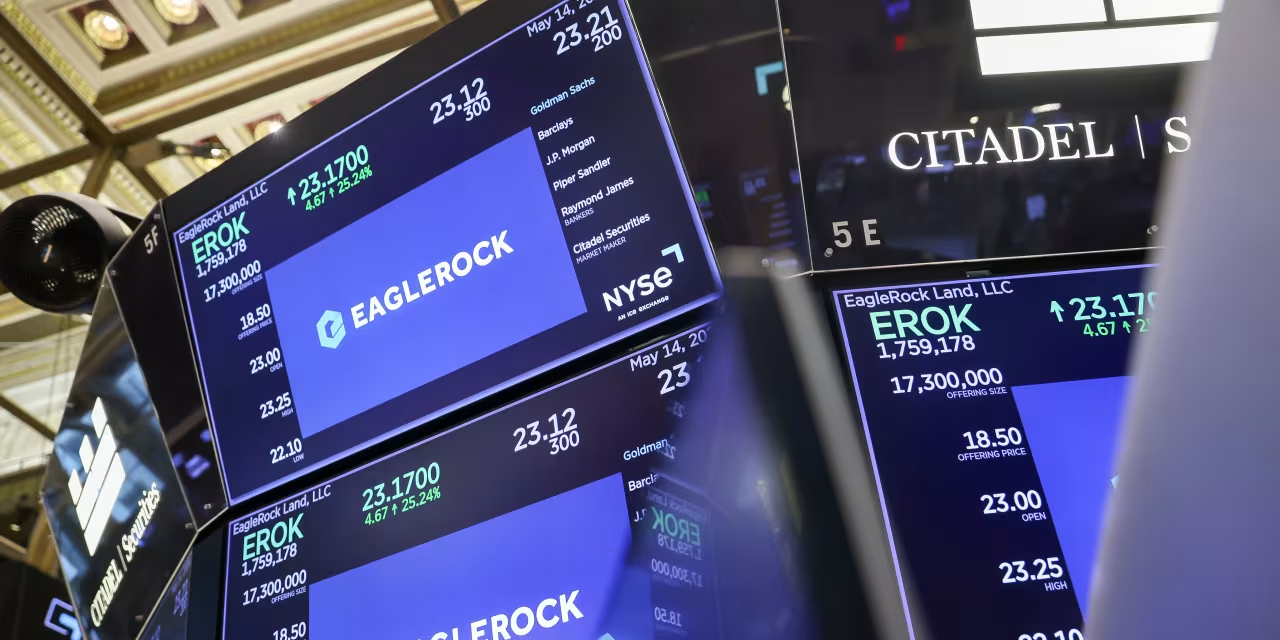
Energy IPOs Are Back. The Winners Have One Thing In Common.

Published

on

Energy IPOs Are Back. The Winners Have One Thing In Common.
Continue Reading
Click to comment

You must be logged in to post a comment Login

Leave a Reply

Business

Russia attacks Odesa and Dnipro, Ukraine strikes Belgorod region

Published

on

Russia attacks Odesa and Dnipro, Ukraine strikes Belgorod region


Russia attacks Odesa and Dnipro, Ukraine strikes Belgorod region

Continue Reading

Business

Iran fires a fresh threat: After oil, your Insta reels, Amazon deliveries, WhatsApp chats and Netflix streams could be the next target

Published

on

Iran fires a fresh threat: After oil, your Insta reels, Amazon deliveries, WhatsApp chats and Netflix streams could be the next target
After months of using oil routes in the Strait of Hormuz as leverage during tensions with the US and Israel, Iran is now signalling that it could target another critical global network — the undersea internet cables carrying everything from Instagram reels and WhatsApp chats to Google searches, Amazon deliveries and Netflix streams. According to reports by CNN and Iranian state-linked media, Tehran is considering imposing fees on submarine communication cables passing beneath the Strait of Hormuz, a move that could affect global technology companies and disrupt international internet traffic.

Iranian military spokesperson Ebrahim Zolfaghari wrote on X, “We will impose fees on internet cables.”

State-linked media associated with Iran’s Revolutionary Guards later reported that operators of subsea cables would have to comply with Iranian laws and pay licensing charges. The reports also said repair and maintenance work on those cables could be restricted to Iranian companies.
The proposal could affect firms including Google, Microsoft, Meta and Amazon, whose services rely heavily on the global subsea cable network.

Why these cables matter

The Strait of Hormuz is known globally as one of the world’s most important oil shipping routes, but it is also a major digital corridor linking Europe, Asia and the Middle East. A dense network of fibre-optic cables beneath the waterway carries financial transactions, cloud computing traffic, artificial intelligence data, military communications and internet services used daily across the world.

Advertisement


Any major disruption could affect banking systems, stock market trading, international payments and internet connectivity across several regions. Experts say even temporary disruptions could slow down digital services relied on by businesses and consumers.
Iranian state media and the Tasnim news agency have increasingly highlighted the vulnerability of these cables. One report warned that “simultaneous damage to several major cables” could trigger major internet outages across the Gulf region.According to Alan Mauldin, research director at TeleGeography, most international cable operators have historically avoided Iranian waters because of security concerns and instead route cables along the Omani side of the strait.

However, two major cable systems, Falcon and Gulf Bridge International (GBI), still pass through Iranian territorial waters.

Concerns over enforcement and repairs

It remains unclear how Iran would enforce such a plan, especially because US sanctions prohibit American companies from making payments to Tehran.

Experts also warn that cable maintenance could become difficult if tensions in the region escalate further. Repair ships typically need to remain stationary for long periods while fixing damaged subsea infrastructure, making operations risky in conflict zones.

Although internet traffic can often be rerouted through alternative networks, a large-scale disruption in the Strait of Hormuz could still affect connectivity and digital services across parts of Asia, the Middle East, Europe and East Africa.

Advertisement

India could also face disruptions to sections of international internet traffic because of the region’s role in connecting Asian and European digital networks.

Iran-US ceasefire remains fragile

The latest developments come as tensions between Iran, Israel and the US continue despite a fragile ceasefire reached in April.

US President Donald Trump warned Tehran that “the clock is ticking” and said Iran needed to move “FAST, or there won’t be anything left of them” after talks with Israeli Prime Minister Benjamin Netanyahu.

At the same time, Iranian officials have continued issuing warnings to Gulf countries seen as supporting Washington and Israel. Senior Iranian MP Esmail Kowsari warned the UAE that Tehran would respond “more forcefully” if Abu Dhabi continued backing US and Israeli operations.

Advertisement

CNN also reported that Trump met senior national security officials over the weekend to discuss the next phase of the Iran conflict amid concerns over disruptions in the Strait of Hormuz and rising oil prices.

Continue Reading

Business

Apple’s MacBook Neo Surges Past Expectations With Massive Early Demand and 10 Million Unit Target

Published

on

MacBook Neo

CUPERTINO, Calif. — Two months after its blockbuster launch, Apple’s budget-friendly MacBook Neo has shattered sales forecasts, prompting the company to double production targets to 10 million units for 2026 and establishing itself as a game-changing entry into the affordable laptop market.

The 13-inch MacBook Neo, priced starting at $599, hit shelves on March 11, 2026, following its announcement on March 4. Powered by the A18 Pro chip, it delivers solid everyday performance, all-day battery life and full macOS integration at roughly half the price of the MacBook Air. The response has been overwhelming: online inventory sold out through April within weeks, with shipping estimates stretching into May and beyond as demand continues to outpace supply.

Industry analysts and supply chain sources confirm the MacBook Neo’s explosive start. Initial projections from TrendForce called for 4-5 million units in 2026, but Apple quickly ramped up orders to suppliers Foxconn and Quanta, targeting 10 million units for the first generation. Reports indicate the company has already secured capacity for significantly higher volumes after early sell-outs and record first-time Mac buyer numbers.

Apple CEO Tim Cook highlighted the success shortly after launch, noting on social media that the Mac posted its “best launch week ever for first-time Mac customers.” The affordable price point, combined with Apple’s ecosystem lock-in, has drawn Windows switchers, students, families and emerging markets in unprecedented numbers.

Advertisement

Exact worldwide sales figures remain closely guarded by Apple, which does not break out individual model shipments. However, analysts estimate several million units have already moved in the first two months, contributing to a broader Mac shipment surge. Omdia reported Apple shipped 7.1 million Macs in Q1 2026 — its strongest quarter in years — with the Neo playing a major role despite launching mid-quarter.

Sigmaintell forecasts full-year MacBook shipments climbing 21.7% to around 28 million units, with the Neo accounting for a substantial portion as Apple becomes potentially the third-largest laptop maker globally. The device’s success has shocked competitors, with Asus executives calling the $599 pricing a “shock to the entire market.”

The MacBook Neo features a durable aluminum chassis in eye-catching colors — blush, indigo, silver and citrus — a 13-inch Liquid Retina display, up to 16 hours of battery life, a 1080p camera and Magic Keyboard. While it uses base-level specs compared to pricier MacBooks, its A18 Pro chip handles web browsing, streaming, photo editing and AI tasks efficiently, outperforming many Intel-based Windows laptops in the same price range.

Education pricing at $499 has fueled strong adoption in schools and universities. Apple’s sales teams have aggressively pushed the device, helping it capture entry-level market share that was previously dominated by Chromebooks and low-end Windows machines. Counterpoint Research predicts Apple could seize 15% of the entry-level laptop segment by year-end.

Advertisement

Supply chain challenges have emerged as a direct result of the runaway demand. Chip allocation for the A18 Pro was initially set for 5-6 million units, but strong orders forced Apple to secure more. Shipping delays pushed many April orders into May, with some configurations quoting late-month delivery as of early May. Despite this, availability at retail partners like Best Buy and Amazon has helped meet some immediate needs.

The Neo’s impact extends beyond hardware sales. It serves as a powerful on-ramp to Apple’s services ecosystem, including iCloud, Apple Music, Arcade and future AI features. Analysts like Gene Munster estimate it could generate $2 billion in annual revenue while delivering far greater lifetime value through customer retention.

Competitors are taking notice. Google’s Chromebook efforts and Windows OEMs face fresh pressure as Apple undercuts them on price while offering premium build quality and software polish. Microsoft and partners have responded with promotions, but the Neo’s momentum appears difficult to slow in the near term.

Wall Street has reacted positively. Apple shares have benefited from the Mac resurgence amid broader iPhone challenges. The company’s services and wearables segments provide balance, but the Neo represents a strategic expansion into volume-driven PC markets previously ceded to others.

Advertisement

Consumer feedback highlights the device’s appeal. Reviews praise its value, portability and seamless integration for non-power users. Students appreciate the long battery and lightweight design, while families value the durability and parental controls in macOS Tahoe. Some critics note compromises in storage and performance for heavy tasks, yet most agree it delivers where it matters for the target audience.

Production remains split between Vietnam and China facilities. Apple continues working with suppliers to ease bottlenecks in displays, memory and other components amid rising costs. Higher DRAM prices have affected the broader PC industry, yet Apple’s scale and vertical integration provide advantages.

Looking ahead, speculation swirls around potential updates. A refreshed Neo with improved specs could arrive later in 2026 or 2027, but the current model’s strong sales suggest Apple may maintain the lineup longer than typical. Holiday season demand, back-to-school promotions and expanded international availability will likely drive further growth.

The MacBook Neo arrives at a pivotal time for the PC industry. Global notebook shipments face an 8% decline in 2026 due to economic pressures and higher component costs, yet Apple stands out as the only major OEM posting significant growth. The Neo’s success validates Apple’s decision to extend its Mac lineup downward, challenging the notion that premium pricing is the only path forward.

Advertisement

For Apple, the device strengthens its position in education, small business and consumer segments. It also hedges against softening iPhone sales by broadening the hardware portfolio. Tim Cook has emphasized the Mac’s role in Apple’s long-term strategy, and early Neo results reinforce that vision.

As summer approaches, interest remains high. Online configurator wait times and store stock levels continue fluctuating, signaling sustained momentum. While precise cumulative sales as of mid-May are not public, the combination of sell-outs, production ramps and analyst upgrades points to millions of units already in customers’ hands — with many more on the way.

The MacBook Neo’s story is still unfolding, but its early chapter has already rewritten expectations for what an affordable Apple laptop can achieve. In a market hungry for value without sacrificing quality, Apple has delivered a surprise hit that could define its PC strategy for years to come.

Advertisement
Continue Reading

Business

AFX Launches Sovereign Layer 1, Providing an Optimized Execution Environment for On-chain Perp DEXes

Published

on


AFX Launches Sovereign Layer 1, Providing an Optimized Execution Environment for On-chain Perp DEXes

Continue Reading

Business

Nedlands student accommodation tower to add wind turbines

Published

on

Nedlands student accommodation tower to add wind turbines

Centurion has sought changes to an approved $60 million Nedlands project, including adding wind turbines on the rooftop.

Continue Reading

Business

Eos Energy: Margin Is Next Indicator To Watch (NASDAQ:EOSE)

Published

on

Eos Energy: Margin Is Next Indicator To Watch (NASDAQ:EOSE)

This article was written by

First Principles Partners is an equity research analyst specializing in technology, innovation, and sustainability investment. My unique approach, “First Principles,” involves breaking down complex problems to their most basic elements in terms of financial and technology, enabling me to uncover overlooked investment opportunities.With a strong background in investment, private equity and venture capital, I have a proven track record of delivering strong returns for readers. Articles on Seeking Alpha focus on emerging technologies, sustainable investing, and the intersection of innovation and finance. I am passionate about sharing insights with a wider audience and learning from fellow investors. Together, we can drive positive change and contribute to a more sustainable and innovative world.

Analyst’s Disclosure: I/we have no stock, option or similar derivative position in any of the companies mentioned, and no plans to initiate any such positions within the next 72 hours. I wrote this article myself, and it expresses my own opinions. I am not receiving compensation for it (other than from Seeking Alpha). I have no business relationship with any company whose stock is mentioned in this article.

Seeking Alpha’s Disclosure: Past performance is no guarantee of future results. No recommendation or advice is being given as to whether any investment is suitable for a particular investor. Any views or opinions expressed above may not reflect those of Seeking Alpha as a whole. Seeking Alpha is not a licensed securities dealer, broker or US investment adviser or investment bank. Our analysts are third party authors that include both professional investors and individual investors who may not be licensed or certified by any institute or regulatory body.

Advertisement
Continue Reading

Business

Travel perks push at City of Perth council

Published

on

Travel perks push at City of Perth council

There’s a fresh controversy brewing at the troubled City of Perth over a move by some councillors to bolster their travel, hospitality and other entitlements.

Continue Reading

Business

HAL shares fall 10% in 3 days after Q4 results but Jefferies, Nuvama, other brokerages are raising target prices, here’s why

Published

on

HAL shares fall 10% in 3 days after Q4 results but Jefferies, Nuvama, other brokerages are raising target prices, here’s why
Shares of Hindustan Aeronautics (HAL) dropped around 5% on Monday, extending losses to 10% over three days after the defence major released its results for the January-March quarter of the financial year 2026, although brokerages remain bullish on the stock.

The company on Thursday reported a consolidated net profit of Rs 4,196 crore for the March-ended quarter, marking a 6% year-on-year (YoY) rise from the Rs 3,977 crore profit reported in the year-ago period. The defence major’s revenue from operations rose 2% YoY to Rs 13,942 crore in Q4FY26, from Rs 13,700 crore reported in the corresponding quarter of the previous financial year.

Hindustan Aeronautics shares had closed marginally lower on Thursday after the results. The stock crashed 5% on Friday and another 5% on Monday to hit an intraday low of Rs 4,175 apiece on NSE in the morning trading hours. The shares of the company have fallen by over 12% in one week and by around 5% in one month. The stock has declined by over 18% in one year.

Jefferies on HAL

Jefferies retained its ‘Buy’ call on the shares of HAL, increasing its target price to Rs 6,300 apiece. This implies an upside potential of nearly 44% from the stock’s previous closing price of Rs 4,386.20 apiece on NSE.
The international brokerage highlighted that the company’s March quarter EBITDA was 10% below its estimates, led by a 9% revenue miss. “However, PAT was 3% above expectations, given better other income. We lower FY27E-28E EPS by 3-8% factoring lower gross margins that were seen in the March quarter. We believe as execution picks up, particularly delivery of Tejas Mk1A aircraft in next 3 months, the stock should move higher,” it said.

Advertisement

Nuvama on HAL

Nuvama Institutional Equities also maintained its ‘Buy’ rating on HAL shares, citing inexpensive valuations. It raised the target price to Rs 5,040 apiece for the stock, implying an upside potential of nearly 15% from the stock’s previous closing price.
The brokerage highlighted that the firm reported a tepid quarter with execution growing merely 1.8% YoY. That said, Nuvama added that the backlog of Rs 2.54 trillion (~7.7x FY26 sales) continues to provide long-term visibility, but execution ramp-up across key platforms (LCA Tejas, ALH, HTT-40) are critical to drive growth momentum.
“Ramp-up in LCA Tejas deliveries in H2FY27, contingent on timely supplies from GE remain key monitorable. Execution across ALH, HTT-40 and Sukhoi programmes, along with conversion of the INR900bn order pipeline, are critical for sustaining growth visibility. Margin sustainability amid improving execution coupled with new order inflows remain key re-rating triggers,” Nuvama further said.

Equirus Securities on HAL

Equirus Securities upgraded its rating on the shares of HAL to ‘Long’ from ‘Short’ following the recent valuation correction, while raising its target price to Rs 5,330 apiece, implying an upside potential of more than 21%. The brokerage highlighted that the firm reported another execution-constrained FY26, with revenue rising a mere 7% as LCA Mk1A deliveries slipped entirely into FY27.

“We cut FY27/FY28 EBITDA estimates by 10%/9% to reflect deferred execution ramp-up, though higher other income largely cushions EPS impact,” it added.

JM Financial on HAL

JM Financial, however, downgraded HAL shares to ‘Add’ from ‘Buy’, while reducing the target price to Rs 4,770 apiece. The domestic brokerage said that HAL reported a weak set of results for Q4 FY26.

Advertisement

Also read: Delhivery shares tumble 5% after Q4 results. Why Nuvama, Elara & other brokerages remain bullish

“We cut our EPS estimates for FY27/28 by ~2% each to account for the delay in deliveries of Tejas Mk1A and lower profitability. We cut our gross margin estimates to account for a weaker gross margin in FY26. This is partially offset by lower provisions. We expect ~15% revenue CAGR driving ~10% EPS CAGR over FY26–28E,” it added.

(Disclaimer: Recommendations, suggestions, views and opinions given by the experts are their own. These do not represent the views of The Economic Times)

Advertisement
Continue Reading

Business

US states reject anti-vaccine bills as public health groups fight MAHA

Published

on

US states reject anti-vaccine bills as public health groups fight MAHA


US states reject anti-vaccine bills as public health groups fight MAHA

Continue Reading

Business

Kaynes Technology shares tumble 25% in 3 days after weak Q4; Elara cuts rating to ‘Accumulate’

Published

on

Kaynes Technology shares tumble 25% in 3 days after weak Q4; Elara cuts rating to ‘Accumulate’
Kaynes Technology India shares declined as much as 4.27% on Monday to hit an intraday low of Rs 3,132, marking the third consecutive session of losses and taking the stock’s three-day decline to nearly 25%, after the company reported a weaker-than-expected Q4 performance last week. Brokerage firm Elara Securities also downgraded its rating on the company to “Accumulate” from “Buy”.

The company reported a consolidated net profit of Rs 91 crore for the March quarter, down 22% year-on-year from Rs 116 crore in the corresponding period last year. Revenue from operations, however, rose 26% YoY to Rs 1,243 crore compared with Rs 984 crore a year earlier.

According to Elara Securities, Kaynes Technology India Ltd missed its revised FY26 guidance on three key parameters. Revenue came in at Rs 36 billion against the revised guidance of Rs 40 billion, while operating cash flow (OCF) remained negative at Rs 6 billion despite expectations of turning positive. Net working capital (NWC) days also stayed elevated at 125 days, missing the company’s sub-100-day target.

For FY27, management has guided for 30% growth, lower than its earlier target of 40–50%, though still ahead of the broader EMS industry growth rate. Elara noted that the company’s expectations of improving OCF and reducing working capital in FY27 could remain challenging.

Advertisement

The brokerage cut its target price on the stock to Rs 3,530 from Rs 5,700, valuing the company at 36x March FY28 estimated earnings, versus 42x earlier. It also reduced FY27E and FY28E EPS estimates by 23% and 33%, respectively, citing lower Q4 sales, weaker guidance visibility, and persistent concerns around cash flow and working capital.


Despite the downgrade, Elara believes the recent weakness was likely due to deferred execution rather than order cancellations. The brokerage highlighted that the upcoming OSAT plant is expected to contribute meaningfully to revenue from FY27 onward, while margins continue to remain among the highest in the industry.
Elara expects earnings CAGR of 40% during FY26–29E, with average RoE and RoCE estimated at 11% and 10%, respectively, during FY27E–29E. The brokerage added that improvement in working capital management and operating cash flow would remain key triggers for any potential rerating in the stock.On the technical front, according to Trendlyne data, the stock’s 14-day RSI stands at 31.9—where a reading below 30 is considered oversold and above 70 indicates overbought conditions. The stock also shows a bearish setup, trading below all 8 out of 8 simple moving averages (SMAs).

(Disclaimer: Recommendations, suggestions, views and opinions given by the experts are their own. These do not represent the views of The Economic Times)

Continue Reading

Trending

Copyright © 2025