Connect with us
DAPA Banner
DAPA Coin
DAPA
COIN PAYMENT ASSET
PRIVACY · BLOCKDAG · HOMOMORPHIC ENCRYPTION · RUST
ElGamal Encrypted MINE DAPA
🚫 GENESIS SOLD OUT
DAPAPAY COMING

Business

ETMarkets Smart Talk | Don’t mistake FII outflows for a loss of confidence in India’s growth story: Himanshu Srivastava

Published

on

ETMarkets Smart Talk | Don't mistake FII outflows for a loss of confidence in India's growth story: Himanshu Srivastava
Foreign investors pulled nearly $5 billion from India-focused offshore funds and ETFs during the March 2026 quarter, raising concerns about whether global investors are reassessing their outlook on one of the world’s fastest-growing major economies.

However, Himanshu Srivastava, Principal Analyst at Morningstar India, believes the outflows should not be interpreted as a loss of confidence in India’s long-term growth story.

In this edition of ETMarkets Smart Talk, Srivastava explains that the selloff was driven largely by a combination of global risk aversion, elevated US yields, geopolitical uncertainties and stretched valuations in certain pockets of the Indian market.

He argues that foreign investors are becoming more valuation-conscious rather than structurally bearish on India, while highlighting the resilience shown by domestic investors during the correction.

Advertisement

Srivastava also shares his views on the growing role of passive investing, the future of India’s weight in global emerging market portfolios, the impact of currency movements on foreign flows, and why the country’s structural growth narrative remains firmly intact despite near-term volatility. Edited Excerpts –


Kshitij Anand: In your report, you suggested that India-focused offshore funds and ETFs saw net outflows of nearly $5 billion in the March 2026 quarter. How much of this is India-specific, and how much is simply global risk aversion at play?
Himanshu Srivastava: I would say the outflows were driven by a combination of both global and India-specific factors, though global risk aversion was probably the larger driver during the quarter.
Globally, the investment environment turned extremely challenging for emerging markets. We had heightened geopolitical tensions in the Middle East involving the US, Israel, and Iran. We had a stronger dollar, elevated US bond yields, and uncertainty around the timing of Fed rate cuts. All these factors reduced global risk appetite among investors and led them to move towards safer assets such as US Treasuries and the dollar.
At the same time, India-specific factors also contributed. Indian equities were trading at relatively premium valuations compared with several other emerging markets, especially in the mid- and small-cap segments. After the strong rally over the years, many foreign investors chose to book profits as earnings growth expectations moderated.

If you look at these flows, they were not a reflection of a loss of confidence in India’s long-term structural story. Rather, it was a phase where global risk-off sentiment coincided with a valuation recalibration in Indian markets.

One of the most important factors we observed was that, during this correction and challenging market environment, domestic investors remained very resilient. They cushioned the markets from a deeper correction and prevented sharper dislocations. That, in itself, reflects confidence in India’s long-term fundamentals.

Kshitij Anand: Despite strong domestic fundamentals, FIIs remain aggressive sellers. Can we say that foreign investors have become more valuation-sensitive when it comes to India?
Himanshu Srivastava: Well, that is increasingly becoming more visible now.

Advertisement

Historically, foreign investors were willing to pay a premium for India because of its stronger growth outlook, relatively stable macroeconomic environment, and better earnings visibility compared with many other emerging markets. However, valuations in certain pockets, as we discussed earlier, especially in the mid- and small-cap segments, had become quite stretched.

As a result, FIIs are now becoming more selective and valuation-conscious. They are not just evaluating India’s growth story; they are also looking at the price they are willing to pay for that growth and that story.

During periods of global uncertainty and tight liquidity, investors naturally compare opportunities across markets, and premium valuations can lead to some profit-booking. That is what we have seen.

That said, this does not mean foreign investors are turning negative on India from a structural perspective. The long-term India story remains intact, but investors are now more sensitive to valuations and earnings visibility.

Advertisement

Kshitij Anand: In the report, you also suggested that ETFs were relatively more resilient than actively managed offshore funds. Does this indicate a structural shift towards passive investing in India globally?
Himanshu Srivastava: I would avoid calling it a complete structural shift at this stage, but there is definitely a gradual increase in the role of passive investing within India allocations globally. Yes, these could be early signs, but the growth has been quite gradual in nature.

Globally, ETFs have been gaining traction because they are cost-efficient, liquid, and operationally flexible. During volatile periods, investors often prefer ETFs because they allow quicker tactical allocation changes and offer an easier entry and exit mechanism compared to traditional active funds.

That is exactly what we observed during the quarter as well. While both segments witnessed outflows, ETFs were relatively more resilient than actively managed offshore funds.

However, it is important to note that actively managed India-focused offshore funds still account for nearly 70% of the category’s assets. That suggests many foreign investors still believe active management can add value in a market like India, where stock dispersion, sector rotation, and alpha opportunities remain significant.

Advertisement

So, rather than a complete shift away from active investing, I would describe it as a broadening of investor preferences, where passive vehicles are increasingly being used for tactical and flexible allocations, while active funds continue to remain relevant for long-term India allocations.

Kshitij Anand: The sharp correction in mid- and small-cap stocks triggered profit-booking globally. Do you think foreign investors are becoming more cautious about the India growth story? The reason I ask is that mid- and small-cap stocks are often seen as carrying much of the India growth narrative.
Himanshu Srivastava: I would differentiate between caution on valuations and caution on the India growth story. I think they are two very different aspects altogether.

I do not think foreign investors are losing confidence in India’s long-term potential. India continues to benefit from strong domestic demand, infrastructure spending, and relatively healthy economic growth.

What changed was that valuations in the segments we discussed had become quite expensive. During a phase of global uncertainty, investors naturally become more selective and cautious. In that sense, the outflows and the correction were more of a valuation reset or recalibration rather than a rejection of the India growth story.

Advertisement

This is just one quarter in which we have seen significant outflows. To get a much clearer picture, we need to wait for more time, more data, and more information to emerge before calling it something structural in nature.

If conditions improve from here, these trends can easily reverse. We have seen similar situations in the past, and reversals have occurred when the environment became more supportive.

Kshitij Anand: Looking at the bigger picture, do you think India’s weight in global emerging market portfolios can continue rising over, let’s say, the next five years despite near-term volatility?
Himanshu Srivastava: India’s weight in global emerging market portfolios has increased meaningfully over the years and is now an important part of the emerging market universe. Its representation in global indices is already significant. I think it is only behind Taiwan, China, and South Korea, at around 11% to 11.5%. I do not recall the exact figure, but it is somewhere around that level.

This has largely been supported by India’s relatively stronger economic growth, expanding market capitalisation, improving corporate earnings profile, and increasing participation from global investors.

Advertisement

While we have seen outflows in recent times, we have also seen global investors return to India whenever they identify compelling opportunities and believe valuations offer better value than what we are seeing at present. Again, this could be a temporary phase.

At the same time, flows and allocations can fluctuate in the short term because of factors such as global risk sentiment, valuations, currency movements, and liquidity conditions. So, near-term volatility may impact flows intermittently.

India continues to remain a very significant market within the broader emerging market landscape, and one simply cannot ignore India. Therefore, India’s weight can rise further going ahead, although the path may not be linear. If the fundamentals remain intact and the global environment remains supportive, I do not see a reason why India’s allocation will not increase over time.

Kshitij Anand: What role do currency expectations play in global investors’ decisions on India allocations?

Himanshu Srivastava: Currency plays a very important role because foreign investors ultimately measure returns in dollar terms.

Even if Indian equities deliver positive returns in local currency terms, rupee depreciation can reduce or even wipe out those returns when measured in dollars. Therefore, when the rupee is under pressure—for example, due to higher crude oil prices, a stronger dollar, or widening external imbalances—FIIs tend to become more cautious. Recent rupee depreciation is a good example of this.

Advertisement

That said, it is important to understand that currency weakness does not automatically make India unattractive. If investors believe that earnings growth and market returns can more than compensate for currency depreciation, they will continue to allocate capital to India.

However, a stable rupee, or one that depreciates gradually, is generally more comfortable for long-term foreign investors than a currency experiencing sharp volatility.

Kshitij Anand: Lastly, passive products such as ETFs are gaining market share globally. Could India eventually see a much larger ETF-driven foreign ownership structure?
Himanshu Srivastava: I do not think active management will lose relevance in India anytime soon. However, I do believe that foreign investor participation in Indian markets through ETFs could see a gradual increase.

Globally, ETFs are gaining market share because they are cheaper, more liquid, transparent, and easy to use for tactical allocations. For foreign investors, India-focused ETFs provide a quick way to increase or reduce exposure without taking on individual stock-selection or manager-selection risk. That is one reason why ETFs tend to remain relatively resilient and are often used for short-term allocation decisions.

Advertisement

However, India remains a market where active managers can potentially add value because of wide sector dispersion, stock-specific inefficiencies, and the breadth of opportunities across the large-, mid-, and small-cap universe.

Therefore, the likely outcome is not passive investing replacing active investing, but rather passive investing acting as a co-pilot to active investing in foreign investors’ portfolios, particularly for tactical and benchmark-linked allocations.

(Disclaimer: Recommendations, suggestions, views, and opinions given by experts are their own. These do not represent the views of the Economic Times)

Advertisement
Continue Reading
Click to comment

You must be logged in to post a comment Login

Leave a Reply

Business

At Close of Business podcast May 28 2026

Published

on

At Close of Business podcast May 28 2026

Ella Loneragan and Isabel Vieira discuss the under-representation of female leaders in public companies.

Continue Reading

Business

Tech-Stock Rally Pushes Micron to $1 Trillion Market Cap

Published

on

Jared Mitovich hedcut

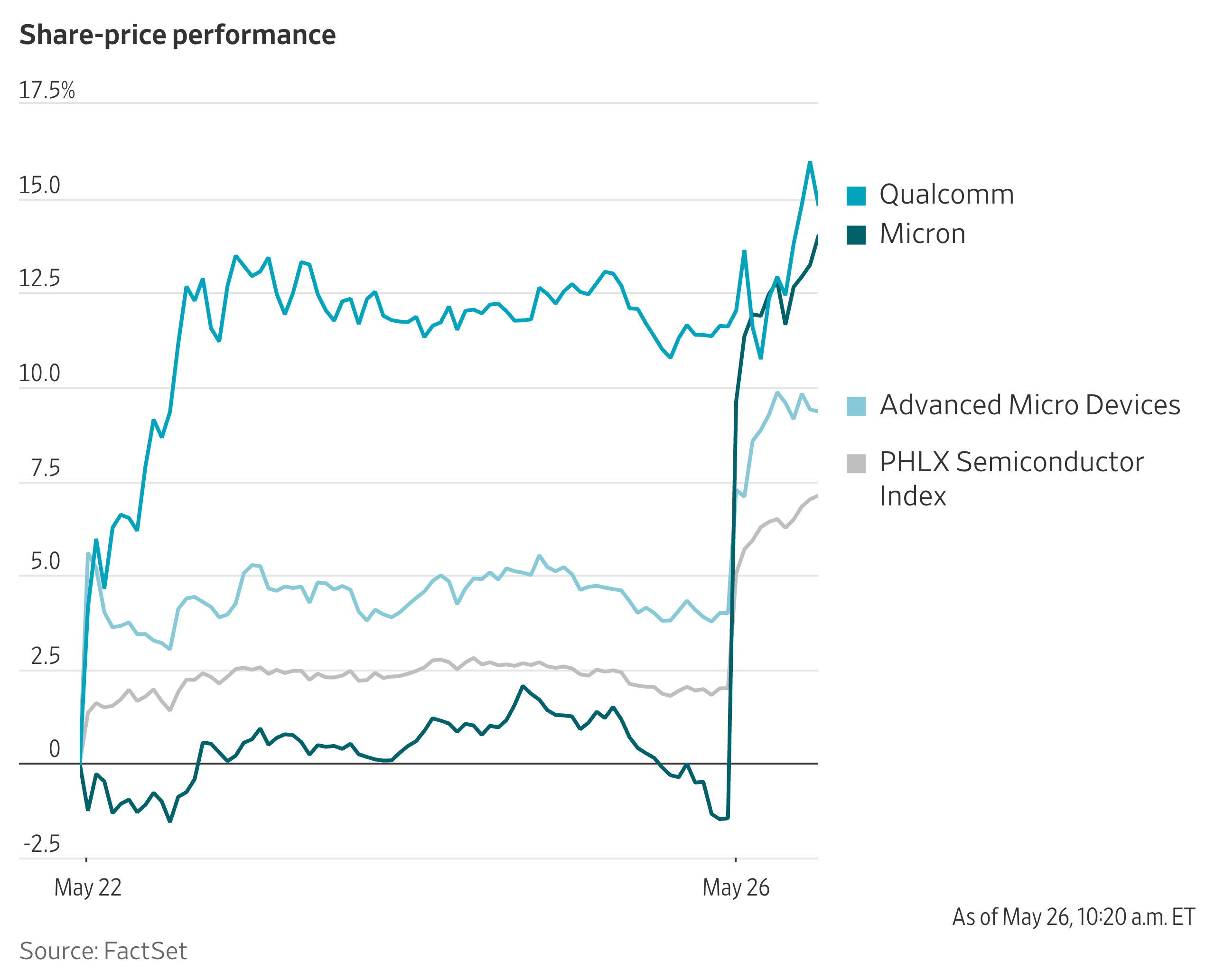
U.S. semiconductor and memory stocks rallied on Tuesday, led by Micron, which soared 19% and traded above a $1 trillion market capitalization for the first time.

After its biggest daily gain since 2011, the tech stock passed Walmart and Eli Lilly to become the 10th-largest U.S. company by market value.

Micron stock, which closed at $895.88, is up a staggering 830% from a year ago, when it closed at $96.38.

The latest stage of the revival began Friday when shares of Qualcomm rose more than 12% on the company’s deal with global automaker Stellantis to support artificial-intelligence-powered vehicles. The momentum continued earlier Tuesday in Asia, with South Korea’s Kospi index rallying 2.6%, helped by gains in chip-making champions Samsung Electronics and SK Hynix.

Advertisement
Continue Reading

Business

Reliance Industries, Infosys, among 10 stocks which saw highest buying by retail investors in Q4 – Retail Buying Surge

Published

on

Reliance Industries, Infosys, among 10 stocks which saw highest buying by retail investors in Q4 - Retail Buying Surge

Dixon Technologies (India) Ltd. witnessed retail buying of 0.08 crore shares during the March 2026 quarter. Retail holding increased to 0.76 crore shares from 0.68 crore shares. Estimated net buying stood at Rs 866 crore, while the stock declined 20.07%.

(Disclaimer: Recommendations, suggestions, views and opinions given by the experts are their own. These do not represent the views of The Economic Times)

Continue Reading

Business

Shares drop and oil surges as US, Iran trade strikes

Published

on

Shares drop and oil surges as US, Iran trade strikes

Australian shares have had their worst day in weeks after a re-escalation of the US-Iran conflict dimmed hopes of a peace deal and boosted oil prices.

Continue Reading

Business

Military drone company backed by Donald Trump’s son opens Swindon factory

Published

on

Business Live

Xtend was founded in Tel Aviv in Israel and now has sites around the world

Will Stone, MP for Swindon, and Ofer Shahaf, managing director UK, XTEND near XTEND UK Office

Will Stone, MP for Swindon, and Ofer Shahaf, managing director UK, XTEND near XTEND UK Office(Image: XTEND)

A military drone company backed by Donald Trump’s son Eric has opened a factory in Swindon after securing a near-£2m deal to support UK defence activities.

Xtend was founded in Tel Aviv in Israel and is now headquartered in Florida, and specialises in software systems and artificial intelligence-powered robotics.

Its new Wiltshire facility – known as XFAB – is modelled on the company’s Tampa site, which supplies the US government’s Department of War.

It will serve as a gateway for supporting NATO and allied forces across Europe, the company said. It is understood XTEND is planning to invest up to £20m to expand its UK hub and operations.

Advertisement

“Modern warfare is shifting from manually operated systems to human-guided autonomy, where a single operator can control complex missions with precision and speed,” said Aviv Shapira, chief executive and co-founder of XTEND.

“The UK is undergoing a significant transformation in how it fields combat capabilities, and this expansion allows us to support that shift with systems designed to operate in the most complex and contested environments while keeping operators out of harm’s way.”

XTEND said its expansion builds on growing demand across multiple UK defence units and follows successful live operational trials with the 2nd Battalion Parachute Regiment (2 PARA) at Salisbury Plain, the UK’s largest military training area.

The trials included the first live-fire demonstration of an uncrewed aerial system by UK forces on British soil, Xtend said. The initial trials have already generated follow-on interest and engagement from other Armed Forces units.

Advertisement

The activity is part of a multi-phase engagement with 16 Air Assault Brigade, with upcoming phases expected to expand operational use cases and support joint training exercises.

“The UK is not just a market for us, it is a strategic hub for operational deployment, local capability, and NATO-aligned growth,” said Ofer Shahaf, managing director UK at XTEND. “As operational requirements evolve, UK forces need systems that can be deployed rapidly, operated with minimal training, and perform in the most complex environments.”

Will Stone, MP for Swindon, said the investment positioned the Wiltshire town “at the forefront” of advanced defence technologies and supported UK efforts to strengthen capabilities in autonomous and AI-powered systems.

“I am delighted that XTEND UK has chosen to set up in Swindon and I look forward to working with them to expand our growing defence sector in the town,” he said.

Advertisement

In February, Nasdaq-listed JFB Construction Holdings entered into a definitive agreement to combine with XTEND in an all-stock transaction.

The deal was supported by strategic investments from President Trump’s son, Eric Trump, along with Unusual Machines, American Ventures, LLC, Protego Ventures, and Aliya Capital.

Following the closing of the business combination, the joint company is expected to be renamed XTEND AI Robotics and be listed on a US national securities exchange under the XTND.

Advertisement
Continue Reading

Business

Forget the SpaceX IPO. These 2 New Stocks Stand Out Right Now.

Published

on

Forget the SpaceX IPO. These 2 New Stocks Stand Out Right Now.

While investors continue to wait for the SpaceX IPO, several recently public companies are quietly flying under the radar and beginning to show compelling setups. Many of these newer names have avoided the speculative frenzy tied to high-profile IPOs, yet they demonstrate constructive technical patterns that deserve closer attention.

Continue Reading

Business

GCHQ draws up plans for world-first national AI cyber defence system

Published

on

Business Live

The plans were revealed by the director of GCHQ at the spy agency’s inaugural annual lecture

GCHQ in Cheltenham.

GCHQ in Cheltenham.(Image: Barry Batchelor/PA Wire)

GCHQ has developed plans for a new national AI cyber shield, thought to be the first of its kind in the world. The system, which is hoped to be running within five years, will use AI agents to detect and flag threats to critical national infrastructure, airlines, telecoms firms and other major companies.

Advertisement

It aims to make hacks such as the breach that targeted Jaguar Land Rover dramatically less likely.

The plans were revealed by the director of GCHQ at the spy agency’s inaugural annual lecture held at Bletchley Park, the wartime headquarters of GCHQ’s predecessor, on Wednesday.

During the speech, agency chief Anne Keast-Butler said that AI is an “unstoppable force” that the UK must harness for good as the technology gets increasingly autonomous.

She said: “In the past few months, GCHQ has developed the blueprint for a new national cyber defence capability that will hardwire cutting-edge agentic AI into machine-speed cyber defence.

Advertisement

“And as we draw on decades of expertise in machine learning to reimagine cyber security, we’re also embedding frontier AI deeper into our operations – responsibly and ethically – to enhance algorithms, translate foreign language, and find needles in haystacks quicker than ever before.

“AI is an unstoppable force with great opportunity. But it’s also a force with risks.

“As AI gains increased autonomy, we all have an intergenerational duty to harness and secure it for good; to protect our national security, our economy and our way of life.”

She urged the technology industry and those working in national security to “anticipate and drive advancements, together, at the speed of the frontier”, and called on the public to take action “from boardrooms to living rooms” to increase cyber security.

Advertisement

“The AI revolution is now fully upon us – with ever faster pace of model releases, increasingly sophisticated agents and greater system autonomy – transforming the world with both promise and peril.

“That’s equally true for intelligence and security, where the latest frontier AI is rapidly unearthing the fault lines in technologies that our society relies on every single day.

“The ground beneath our feet is shifting, and shifting fast. Which means cyber security has never been more important.

“That message may sound familiar – the National Cyber Security Centre is 10 years old, after all – but I’m now saying it with utmost urgency. Cyber security is a critical priority for all businesses.

Advertisement

“Our experts are producing unprecedented levels of advice and guidance, but we need businesses to take immediate action. Not just to protect livelihoods and customers, but for the front line defence of our nation and our economy.”

The director of GCHQ, which is now headquartered in Cheltenham, also warned that Russia was “relentlessly” targeting critical infrastructure, democratic processes, supply chains and public trust in the UK and Europe.

She set out how Russia is increasing its daily hybrid activity against countries including Britain, and urged the public and businesses to make cyber security “10 times more urgent”.

The agency is “disrupting Russia’s efforts to smuggle Western tech, fending off cyber attacks and countering reckless sabotage and assassination attempts”, and “as we remain steadfast in our support for Ukraine, (Russian President Vladimir) Putin is going backwards on the battlefield”, she said.

Advertisement

New intelligence shows that nearly 500,000 Russian soldiers have been killed in the conflict in Ukraine, the audience heard.

Russia is “relentlessly targeting critical infrastructure, democratic processes, supply chains and public trust” and the speed of advancements in technology means there is a “narrowing window for the UK and allies to stay ahead” she said.

“China is now a science and tech superpower, with sophisticated capabilities across their intelligence, cyber and military agencies”, the audience was told.

Earlier this year, Dr Richard Horne, head of the National Cyber Security Centre which is part of GCHQ, warned that most nationally significant cyber attacks on Britain were carried out by hostile states, including China, Iran and Russia.

Advertisement

He said the body dealt with around four of these attacks each week, and warned businesses to be prepared to protect themselves against cyber attacks without needing the option of paying ransoms, because the UK could be targeted “at scale” if it were to become involved in an international conflict.

Continue Reading

Business

Several feared dead in Kenya school fire, local media says

Published

on

Several feared dead in Kenya school fire, local media says
Nairobi: Several girls were feared dead in a school fire in Kenya, local media said Thursday. The fire broke out at around 1:00 am local in Utumishi Girls Academy in Nakuru County, local media said, but was only reported at around 3:30 am, according to the Kenyan Red Cross.

Several local media reported that at least 10 girls had died, with Citizen TV saying 16 children had been killed and 74 hospitalised, but this was yet to be confirmed by police.

“First responders, ambulance crew and our support personnel are currently on the ground,” a spokesperson for the Kenyan Red Cross told AFP, declining to give a toll.

Frantic parents were being held outside the school buildings by authorities, according to local media.

There have been many devastating school fires in Kenya, where boarding schools are common.

Advertisement


A fire in 2024 killed 21 boys after flames engulfed a dormitory at the Hillside Endarasha Academy in Nyeri county.

Continue Reading

Business

Apple Just Hit a Record High With Its AI Engines Idling. Imagine What Happens When It Kicks In.

Published

on

Apple Just Hit a Record High With Its AI Engines Idling. Imagine What Happens When It Kicks In.

Apple Just Hit a Record High With Its AI Engines Idling. Imagine What Happens When It Kicks In.

Continue Reading

Business

The Quickest Way for Businesses to Extract PDF Data

Published

on

Wealth management once operated on predictable formulae: cultivate relationships through family connections, recommend conservative fixed deposits, and maintain capital preservation.

UK business owners manage hundreds of documents every week. Invoices, receipts, and client reports arrive in fixed formats that lock information away. Staff members waste valuable hours typing these numbers into tracking systems.

This friction slows down decision-making and reduces weekly productivity. Finding a fast method to unlock this information keeps operations running smoothly. Modern tools remove this administrative bottleneck completely. Companies can now shift their attention toward growth and revenue generation.

The Administrative Burden on Modern UK Firms

Small and medium enterprises handle high volumes of paperwork daily. Financial managers track expenses from multiple suppliers across the country. Managing these documents by hand creates major operational delays.

Errors frequently happen when staff copy rows of figures manually. A single misplaced digit can disrupt quarterly financial projections completely. Leaders need a dependable system to protect their operational accuracy

Office workers spend up to a third of their week on repetitive tasks. This time drain stops them from completing higher-value projects. Reducing manual labor allows small teams to achieve much more every day.

Advertisement

Why Manual Data Entry Stalls Business Growth

Modern business teams face heavy administrative burdens when typing out physical financial updates. Finding a reliable PDF to Google Sheets converter saves hours of manual labor for accounting departments. Teams can focus on scaling operations instead of fixing minor typing mistakes.

Growth requires staff to work on strategic analysis instead of repetitive typing. Employees experience higher job satisfaction when they avoid monotonous administrative tasks. Shifting talent toward creative problem-solving improves company retention rates.

Slow data entry creates bottlenecks that hold back new customer acquisition. Sales reps wait days for clear pricing details from backend logs. Eliminating these pauses makes a firm more competitive in fast markets.

Limitations of Traditional Cloud Spreadsheets

Many teams try to use standard office software to handle incoming documents. An industry guide notes that the primary cloud spreadsheet platform cannot open these document files directly. Users find themselves stuck copying data manually, line by line.

Advertisement

Copying text directly from a document viewer often breaks the structural layout. Numbers end up scattered across the wrong columns and rows. Fixing these layout issues takes up more time than the original entry work.

Standard copy-paste actions fail to recognize clean horizontal grids. Hidden formatting codes embed themselves into cells and mess up equations. Teams require a smarter approach to handle complex document formatting.

The Role of Specialized Transformation Software

A tech publication explains that specialized software transforms files between these static formats and popular spreadsheets. This technology bridges the gap between fixed documents and editable rows. Companies gain immediate access to their figures without retyping a single line.

Using these programs provides several distinct advantages for small operations:

Advertisement
  • Speeding up the preparation of monthly client expense reports.
  • Eliminating the human errors linked to overnight data entry.
  • Standardizing the layout of incoming supplier billing sheets.
  • Reducing the reliance on external administrative support teams.
  • Simplifying the path toward digitizing paper records completely.

These benefits allow departments to maintain lean budgets during economic challenges. Leaders protect their profit margins by optimizing internal workflows. Clean data feeds directly into secondary business intelligence tools.

How Artificial Intelligence Changes Information Extraction

New tools incorporate smart algorithms to read complex document layouts. A software review shares that automated tools handle extraction by pushing reviewed data straight into your spreadsheet. This approach removes middle steps from the tracking process.

Smart systems recognize table borders and column headers without manual guidance. The system learns from historical files to handle future documents faster. Accuracy rates remain high even with scanned or skewed document images.

AI understanding goes beyond basic optical character recognition technology. The models interpret context to separate tax numbers from total balances. This intelligence speeds up validation checks for the accounting department.

Streamlining Financial Reports and Invoices

Accounting teams see the most immediate improvements from automation. Standardizing invoice tracking helps managers keep a close watch over cash flow. The entire process takes minutes instead of taking multiple days.

Advertisement

Automated data pipelines support several core financial tasks:

  • Tracking weekly transport and fuel costs across delivery fleets.
  • Auditing corporate credit card receipts from remote sales teams.
  • Consolidating regional sales figures into a main spreadsheet.
  • Organizing tax records before seasonal filing deadlines arrive.
  • Merging disparate bank statements for easier cash reconciliation.

Clear visibility over these numbers helps directors make faster purchasing decisions. Cash flow management becomes a predictable routine rather than a stressful event. Managers spot negative spending trends before they harm company profits.

Security and Data Protection Considerations

Handling sensitive corporate records requires strict attention to data protection rules. UK firms must protect client details from unauthorized external viewing. Selecting platforms with strong encryption keeps corporate secrets safe.

Managers should review where information is processed before uploading files. Clear data policies protect companies from regulatory penalties and fines. Secure systems maintain client trust and maintain fast processing speeds.

Audit trails show exactly who uploaded each file to the system. This accountability satisfies compliance checks during annual corporate reviews. Keeping data clean and protected minimizes external operational risks.

Advertisement

Cloud storage options must match national privacy standards to avoid legal issues. Data controllers need absolute certainty about vendor storage locations. Secure protocols prevent data leaks during bulk conversion tasks.

Simple Steps for Team Adoption

Introducing new software to a busy team requires a straightforward plan. Training should focus on the immediate time savings for individual workers. Employees adopt tools quickly when they see a reduction in their workload.

Start with a small pilot program in one specific department. Gather feedback from daily users to fix any early operational hitches. Expand the system across the broader company once success is proven.

Set clear goals for how many hours the team should save each week. Reviewing these milestones keeps the software implementation on track. Success builds confidence among staff members resisting change.

Advertisement

Supervisors can reward workers who find creative ways to optimize their new workflow. Sharing positive case studies internally drives faster adoption across other branches.

Transitioning to automated document processing protects valuable corporate resources. Businesses save money and eliminate costly human mistakes during financial reporting.

Modern software handles the heavy lifting of extraction so teams can focus on commercial success. Embracing these tools positions a firm ahead of slow-moving competitors.

Advertisement

Continue Reading

Trending

Copyright © 2025