
Business
Fall Officially Begins Tonight With the Equinox, But Warmer Than Normal Temperatures Are Still Expected


The astronomical start of fall arrives Tuesday evening in the Northern Hemisphere, but forecasters say anyone hoping the change of season will bring a quick break from summer heat may be disappointed, with a combination of El Niño and climate change expected to keep U.S. temperatures running warmer than normal through much of the fall.
The autumnal equinox occurs precisely at 8:05 p.m. Eastern time Tuesday, the moment worldwide at which the sun sits directly above the equator. The word “equinox” derives from the Latin words “aequalis” and “nox,” meaning equal night, reflecting the fact that day and night run roughly 12 hours each across most of the world on the date of the equinox. That near-equal split will hold true Tuesday from as far north as Utqiagvik, Alaska, formerly known as Barrow and located north of the Arctic Circle, all the way south to Wellington, New Zealand, the world’s southernmost capital city. Day and night are not precisely equal on the equinox itself because Earth’s atmosphere refracts, or bends, sunlight in a way that creates the appearance of slightly more daylight than technically exists at that moment, meaning the date when day and night are truly equal in length typically falls a few days after the equinox.
South of the equator, Tuesday’s equinox marks the opposite seasonal transition, signaling the start of spring rather than fall for the Southern Hemisphere.
Despite the equinox’s popular association with the “official” start of fall, no government or scientific administrative body actually designates it as such in any formal capacity. Meteorologists and climatologists instead define the seasons differently, using a system based on the calendar month rather than the sun’s position relative to Earth. Under that meteorological definition, summer, defined as the three hottest months of the year in the Northern Hemisphere, June, July and August, officially ended on August 31, more than three weeks before Tuesday’s astronomical equinox.
Whichever definition is used to mark summer’s end, forecasters say the transition into fall is unlikely to bring the kind of widespread cooldown many might expect. Zach Labe, a climate scientist at Climate Central, said the combination of a developing El Niño pattern and the broader effects of human-caused climate change points toward a high likelihood of warmer-than-normal temperatures continuing through the fall season. “The summer that is just ending was one for the record books, with record ocean heat, the warmest month recorded globally,” Labe said. “And extremes like these could be just the beginning.”
According to Labe, global temperature records set this summer were substantial in scope. Worldwide, August ranked as the warmest such month on record when accounting for combined land and ocean temperatures, and the U.S. national average for August set records across all three standard measurements: maximum, average and minimum temperatures. Labe explained that El Niño’s influence on those record-setting figures stems from the pattern’s underlying mechanics. “El Niño is all about redistributing heat,” he said, describing how the phenomenon transfers stored ocean heat into the atmosphere, a process that tends to provide an additional boost to global temperatures during El Niño years.
The scale of this year’s warmth has extended well beyond isolated regional records. Through August, the average temperature across 2026 has ranked as the warmest on record for the contiguous United States as a whole, according to Labe. At the state level, Arizona, California, Colorado, Montana, Nevada, New Mexico, Oklahoma, Texas, Utah and Wyoming have each recorded their warmest start to a calendar year on record through the same period.
Even as El Niño draws attention for its role in this year’s heat, Labe was careful to emphasize that the underlying driver of the broader warming trend lies elsewhere. “It’s not really El Niño that is breaking those records,” he said. “It’s human-caused climate change. That’s what’s driving the long-term trend.” Federal forecasters expect the current El Niño pattern to peak later this fall or in early winter and to rank among the strongest El Niño events on record, though Labe cautioned against assuming that intensity alone will translate directly into more severe weather impacts. “That doesn’t always necessarily mean stronger impacts,” he said. “Every El Niño has its own flavor. Each one is different. And so that’s really important to keep in mind.”
For much of the country, the practical upshot of Tuesday’s equinox is likely to be more symbolic than immediately noticeable in day-to-day weather. While the sun’s angle and daylight hours will continue shifting toward shorter days and longer nights as the Northern Hemisphere moves deeper into fall, the broader warmth that has defined this record summer appears poised to linger well past the calendar’s official seasonal marker, according to the forecast outlined by Labe and other climate researchers tracking the current pattern.
With El Niño’s peak still weeks or months away and the long-term warming trend tied to climate change continuing to shape baseline temperature expectations nationwide, forecasters say residents across much of the United States should prepare for a fall season that, despite its astronomical start Tuesday evening, may look and feel considerably warmer than the season traditionally has in years past.


The market is not the only thing that shrinks to a city radius. The evidence an assistant needs before it will name a business shrinks too, and most local operators have never audited whether that evidence actually exists.
Why does a city-level market behave differently to a national one in AI search?
A national brand can earn a citation through scale: enough content, enough backlinks, enough independent coverage that an assistant has plenty of material to draw on regardless of exactly who is asking. A city-level business does not get that luxury.
SOCi’s 2026 Visibility Index found ChatGPT recommends just 1.2% of those locations, compared to a 35.9% appearance rate in the Google local 3-Pack. AI search is roughly 30 times more selective than traditional local search, which means a city-level business does not have the volume of corroborating signals to absorb inconsistency the way a national brand can.
Its entire addressable market is often 200,000 people, and the pool of independent sources able to mention it is proportionally small: a handful of local directories, 1 or 2 industry bodies, a council register, and occasionally a regional trade press mention.
That means a local business has far less room for error. A missing or inconsistent detail that a national brand can absorb across thousands of other signals becomes, for a local business, 1 of only a dozen or so signals an assistant has to work with. Get 3 of those wrong and there is nothing left to build a confident answer from.
What are the 3 inputs that decide local AI visibility?
Local visibility comes down to 3 inputs, and all 3 need to be right at the same time. None of them substitutes for the others.
BrightLocal’s 2026 consumer survey found 45% of consumers now use AI tools for local business recommendations, up from 6% the year prior. Getting these 3 inputs right is no longer a technical preference. It is a commercial requirement.
| Input | What it covers | What breaks it |
| Profile completeness and consistency | Business name, category, hours, service area, and contact details across the places layer | The same business listed slightly differently in 2 places (a different suburb spelling, an old phone number, an outdated category) |
| Local third-party mentions | Council registers, chamber of commerce listings, industry-body directories, local press | A business that only exists on its own website and nowhere else independent |
| Service-area phrasing | Content that names the suburb, region or city the same way buyers actually search for it | Generic copy that never states where the business actually operates, or states it once in a footer |
Each input answers a different question an assistant is implicitly asking: is this business real and current, does anyone besides the business itself vouch for it, and does its content actually match the phrase a local buyer typed in. A business that gets 2 of the 3 right and skips the third is not two-thirds visible. It is invisible on exactly the questions the third input was meant to answer, because an assistant weighing whether to name a business rarely has enough local evidence to compensate for 1 input that returns nothing at all.
What Does “Consistent” Mean for Profile Completeness?
Consistency means the business’s core facts, name, category, hours, service area, and contact details, read identically everywhere they appear, not just accurately on the business’s own site. Google’s local ranking guidance is explicit that local rankings depend on relevance, distance, and prominence, and that complete, accurate information is what allows a business to be matched correctly against a search in the first place.
Relevance is the input a business controls most directly, and it is also the one most often left half finished. A trade business that lists 6 services but only names 2 of them anywhere in its profile description is asking Google, and by extension any assistant drawing on that data, to guess at the other 4. A profile with an outdated service area, a category that no longer matches what the business does, or hours that haven’t been updated since a public holiday last year, all quietly reduce that relevance score before an assistant even reaches the content on the website itself.
A pattern worth checking specifically: businesses that update their own website regularly but treat their places profile as a one-time setup task. The website gets a new services page every few months. The profile, set up 3 years ago, still lists an old address format, an outdated category, or a service area that hasn’t kept pace with where the business now actually works. An assistant weighing the profile against the website sees 2 sources describing 2 slightly different businesses, and resolves that inconsistency by trusting neither fully.
It’s why specialist teams such as Intelligent Resourcing, a Melbourne answer engine optimisation team, start a local audit at the profile layer before touching citations or content. It’s the fastest gap to close, and the first thing an assistant checks.
Why Do Council, Chamber and Industry-Body Citations Carry Weight?
A profile a business controls is a claim. A council register, a chamber of commerce directory, or an industry body’s member list is a claim made by someone else, and that distinction matters more at city scale than at national scale, because a local business has so few of these independent sources available to it in the first place.
A Perth-based water filtration company is a useful illustration of exactly this gap. Its own site named its services and location clearly and consistently, everything the first input above would ask for, yet it still went unnamed when local buyers asked an assistant which water treatment company to use, because almost nothing beyond its own homepage corroborated what the homepage said. No local trade directory listing, no chamber of commerce mention, no industry-association page repeating the same facts independently.
That gap is what local third-party mentions close. Whitespark’s 2026 ranking factors, the first edition to specifically track AI search visibility alongside the traditional local pack, found that citation signals and third-party authority carry weight across both surfaces: “In AI SEO, mentions (citations) are the new link.” A city-level business with 3 or 4 credible independent mentions is working from a materially stronger position than one relying on its own website alone.
This is also where a generic backlink strategy misreads the problem. A link from an unrelated national blog does very little for a city-level business, because it says nothing about whether this business operates in this city and does this specific work. A single line in a chamber of commerce member directory, by contrast, is a small signal that says exactly that, and it is the kind of signal an assistant weighing a local query is specifically looking for.
Why Do the Same Tactics Not Transfer Between Local and National Businesses?
The clearest way to see why local and national visibility need different playbooks is to put a city-level trade business and a national software company side by side.
| Melbourne trade business | National SaaS company | |
| Addressable market | 1 metro area, tens of thousands of potential buyers | Every business in the country that fits the ICP |
| Available third-party sources | A handful: local directories, chamber, industry body, regional press | Hundreds: review platforms, integration partners, press coverage, analyst mentions |
| What “consistency” protects against | A handful of listings going stale removes most of the available evidence | A handful of listings going stale is invisible against everything else that’s correct |
| What content needs to prove | That the business serves this specific suburb or region, in the phrasing buyers use | That the product solves this specific problem, regardless of where the buyer is |
| Where effort pays off fastest | Local third-party mentions, because there are so few available | Passage-level content and case studies, because the third-party pool is already large |
A national SaaS company that spends a quarter chasing 2 more local directory listings has wasted the quarter, because those listings are a rounding error against everything else already vouching for it. A Melbourne trade business that spends the same quarter writing more blog content instead of fixing its council and chamber listings has made the same mistake in reverse. The tactic that wins for one is close to irrelevant for the other, because the size of the available evidence pool is what decides where the marginal hour of work actually pays off.
The practical takeaway is not that content or backlinks stop mattering for a local business. It is that the order of operations flips. A national company can afford to treat citations as a background task while it invests most of its effort in content, because it already has hundreds of citations working in its favour. A city-level business gets the opposite return on the same hour: closing 1 citation gap changes more than writing 1 more page, simply because it is filling 1 of a dozen slots rather than 1 of several hundred.
LocaliQ’s 2026 SEO statistics confirm 46% of all Google searches carry local intent. That volume is weighted against evidence pools of very different sizes: a national brand may have hundreds of independent sources vouching for it, whereas a city-level business has a handful.
When Is It Worth Bringing in Outside Help for a Local AI Audit?
Alt Text Image 03: Five-day local AI visibility audit timeline showing three stages: business profile audit, third-party citation check, and local content review, with icons connected in a horizontal process flow.
Five-day local AI visibility audit timeline showing three stages: business profile audit, third-party citation check, and local content review, with icons connected in a horizontal process flow.
A local business does not need external help to run a first pass on all 3 inputs. It needs a week and a checklist.
Day 1 to 2: Profile completeness
- Confirm the business name, category, hours, and service area match exactly across every places listing the business controls
- Fill in every service the business actually offers, not just the top 2 or 3
- Check the phone number and address are current everywhere, including on old directory listings the business no longer actively manages
Day 3 to 4: Third-party mentions
- List every council register, chamber of commerce, and industry body the business is eligible to join or already belongs to
- Confirm the business is actually listed, and that the listing states the same facts as the profile
- Identify the 2 or 3 gaps that are realistic to close within a month
BrightLocal’s expert citation survey found 90% of local SEO experts say accurate citations are important to local search ranking. The third-party mention step is where that accuracy gap is most commonly found.
Day 5: Service-area phrasing
- Read the site’s own content and check whether it names the suburb or region the way a local buyer would actually type or ask it, not just once in a footer
- Rewrite the first sentence of any page that never states where the business operates
That week produces a clear list of gaps, and closing the easy ones takes another few weeks of a business owner’s own time. Where it usually pays to bring in outside help is the third-party mention gap specifically, because building relationships with the right local directories, associations, and press contacts is slower and less DIY-friendly than fixing a profile field.
It is also worth treating this as an ongoing check rather than a one-off project. A council register or industry-body listing that was accurate this year can drift out of date after an office move or a rebrand, and a competitor entering the same directories resets the comparison an assistant is implicitly making. Reviewing all 3 inputs once a quarter, rather than once and never again, is what keeps a local business’s evidence pool from quietly going stale.
A specialist team with working relationships across local citation sources can close that gap in weeks rather than the months it takes a business owner doing it alone alongside their actual job.
The businesses that get named are not always the best ones. They are the ones an assistant has enough independent evidence to name confidently, and for a city-level business, that evidence pool is small enough that every gap actually matters.

Coinbase Global, the largest U.S. crypto exchange, said Monday that it is allowing users to request shares of companies ahead of their stock-market debuts.
Starting this week, traders will be able to request shares of upcoming initial public offerings at offer price in the Coinbase app. Their requests may be filled in full, in part or rejected depending on demand. Eligible users can start with smart-ring maker Oura’s IPO this week.
Coinbase said its allocation algorithm will prioritize long-term investors.

Trump bought and sold shares in Musk’s SpaceX in July, financial disclosure shows

Scott Peters from California’s 50th District Conducts Significant Trades in August 2026




Business
Scott Kresan Tilbe on Creativity, Structure, and Building a Career Across Different Interests

Raised in Goderich and Barrie, Tilbe developed an early interest in both structured and creative activities. He played saxophone, earned recognition at local music festivals, studied karate to black belt level, and became interested in photography, history, science, and visual art.
His education followed a similarly varied path. After studying introductory media, he completed programmes in digital photography and web design at Georgian College. He later studied computer science at Laurentian University and film and television at Canadore College.
Scott Kresan Tilbe has worked as an independent photographer and web designer and has held photography roles with organisations including Auction House Barrie and Edge Imaging. Earlier customer-facing roles at Toys “R” Us and RONA also gave him experience in sales, support, and communication.
For the past four years, he has worked as an office administrator at a gastroenterology clinic in Barrie. His role involves supporting day-to-day office operations, managing priorities, and helping maintain an organised environment for staff and patients.
Across each stage of his career, Tilbe has continued to build practical skills while maintaining his creative interests. His experience shows how technical knowledge, visual thinking, and strong organisation can complement one another across different professional settings.
How did your early interests shape the direction of your career?
I had a lot of different interests when I was younger, and I think that shaped the way my career developed. I played saxophone and competed in local music festivals. I also trained in karate and eventually earned my black belt. At the same time, I became interested in photography, history, science, art, and computers.
Those things may sound unrelated, but they all taught me something useful. Music required practice. Karate required discipline. Photography trained me to notice details. History and science encouraged me to keep asking questions. I think I carried all of that into my education and later into my work.
You studied several different subjects. Was that always intentional?
Not completely. I knew I was interested in media and visual work, but I also liked technology. I studied introductory media and then completed programmes in digital photography and web design at Georgian College. Later, I studied computer science at Laurentian University and film and television at Canadore College.
I was interested in understanding both the creative and technical sides of media. Photography taught me composition and visual communication. Web design made me think about how people interact with information. Computer science introduced a more structured approach to problem-solving.
I do not think every educational experience has to lead to one specific job. Sometimes the value is in the way it changes how you think.
What did working in photography teach you about professional responsibility?
Photography is creative, but professional photography also requires a great deal of preparation and organisation. You have to understand what the client needs, pay attention to deadlines, manage equipment, communicate properly, and still produce work that meets a certain standard.
I worked independently and also had photography roles with organisations such as Auction House Barrie and Edge Imaging. Those experiences taught me that having technical ability is only part of the job. You also need to be dependable.
A good photograph may be the final result people see, but there is usually a lot of planning behind it.
How did web design add to that perspective?
Web design made me think more about the person using the finished product. Something can look impressive but still be difficult to navigate. I learned to think about layout, clarity, function, and how information is presented.
When I worked on independent web design projects, I tried to balance visual appeal with practicality. I still use that way of thinking in other areas. You have to ask what someone actually needs rather than only thinking about what you personally like.
You also worked in retail. What did those roles contribute to your career?
Working at Toys “R” Us and RONA gave me experience dealing directly with customers and working as part of a larger team. Retail can teach you a lot about communication because you interact with many different personalities.
You also learn that people do not always explain exactly what they need. Sometimes you have to listen carefully, ask the right questions, and then help them find a solution. That is useful in almost any profession.
How did you move into office administration?
For the past four years, I have worked as an office administrator at a gastroenterology clinic in Barrie. It is different from photography or web design, but there are more similarities than people might expect.
Administration requires attention to detail, prioritisation, communication, and the ability to manage several responsibilities at once. I use schedules and task lists to decide what needs immediate attention and what can be handled later.
I like having structure. At the same time, office work can be unpredictable, so you have to be able to adapt when priorities change.
Has your creative background helped you in administrative work?
Yes. Creative work teaches you to look at a problem from more than one angle. In photography, moving a few feet or changing the lighting can completely change the result. In web design, changing how information is organised can make something much easier to understand.
I think that translates into administration. If a process is not working well, I naturally start thinking about how it might be organised differently.
What do you think makes someone dependable in the workplace?
For me, it comes down to completing work properly and on time. I want the finished result to meet the standards of the people I am working with, but I also have my own standards.
I measure success partly by whether I can look at something I have completed and know that I gave it the attention it required. Positive feedback matters, but you also have to be able to evaluate your own work honestly.
How do you continue developing professionally?
I read constantly, especially about history and science, and I attend conferences or learning opportunities when they relate to my interests. I also like talking with people who know more about a subject than I do.
I think curiosity is important. Your formal education ends at some point, but learning does not have to.
What has your career taught you about having several professional interests?
I used to think that having several interests might make it harder to define what I do. Now I see it differently.
Administration, photography, and web design each use different skills, but there is overlap. They all require organisation, patience, communication, attention to detail, and the ability to understand others’ needs.
I do not think everyone has to fit neatly into one category. Sometimes having experience in several areas gives you a better way of approaching the work in front of you.

The S&P 500 fell 0.43 points, or 0.01%, to 7,764.27 points while the Nasdaq Composite rose 121.15 points, or 0.45%, to 27,243.24. The Dow Jones Industrial Average fell 184.94 points, or 0.36%, to 51,863.89.
Chip stocks extended their recent gains while shares of consumer-focused software companies declined as investors assessed the strong response to Meta Platforms’ new AI assistant.
The assistant, called Muse, launched earlier this month can send emails and carry out transactions on a user’s behalf. Its early success lifted AI-related chip stocks in recent sessions, but it also sparked concerns that the technology could disrupt retailers, online brokerages and other consumer businesses. Amazon blocked Muse from shopping on its platform on Monday.
“There are a lot of tech stocks that are down today on Muse-related fears of one sort or another,” Jed Ellerbroek, portfolio manager at Argent Capital Management, told Reuters. “People fear that Muse will be used to manage your insurance relationships, book your travel and search for stuff to buy.”

Uber Technologies and Lyft fell about 1% each, while Expedia dropped 4% and Charles Schwab slid 5.5%. Micron gained 3.9%, and SanDisk surged 7.2%.
Oil prices were choppy near $100 a barrel, while the yield on the benchmark 10-year Treasury note hovered around 4.94% after US President Donald Trump warned in a speech to the UN General Assembly that he could “annihilate the Islamic Republic” if no deal is reached to end the Middle East conflict.Investors also turned their attention to Thursday’s US-China summit amid speculation that the trade truce with Beijing could be extended and that the talks may include AI regulation.
“What people are looking for is at least the start of a conversation that maybe you can come up with some sort of global framework as opposed to fighting each other and having this race and so,” said Joe Saluzzi, head of equity market structure research at Themis Trading.
JPMorgan Chase and Wells Fargo both lost ground.
Meanwhile, Boston Federal Reserve President Susan Collins said she supported last week’s interest-rate increase because of inflation risks. New York Fed President John Williams said the Fed’s framework for managing short-term rates had effectively supported financial markets.
Traders saw a 53% probability that the central bank would raise interest rates by at least 25 basis points in October, according to CME Group’s FedWatch Tool.
(Disclaimer: This article is based on inputs from agencies. These do not represent the views of The Economic Times)


Erie Indemnity Company (ERIE), with a market capitalization of approximately $11 billion, is a management company serving Erie Insurance Exchange, a subscriber-owned property and casualty insurer. Based in Erie, Pennsylvania, it manages key sales, underwriting, policy issuance, and administrative functions on behalf of policyholders through the Erie Insurance Group.
Companies valued between $10 billion and $200 billion are generally classified as “large-cap stocks,” and Erie Indemnity fits this description, with its market capitalization reflecting its substantial size and established position within the financial services sector. Erie Indemnity stands out for its strong financial foundation and focused insurance business model. As attorney-in-fact for Erie Insurance Exchange, it receives recurring management fee revenue, while low debt, strong cash flow, and high profitability support financial resilience and operational stability.
More News from Barchart
Despite these strengths, ERIE has slipped 27.7% from its 52-week high of $330.54, reached on October 27, 2025. Over the past three months, ERIE stock has climbed 8.1%, outperforming the State Street Financial Select Sector SPDR ETF (XLF), which has gained 4.3% during the same time frame.

Shares of ERIE have declined 16.6% year-to-date and 25.2% over the past year, trailing the ETF’s 2% year-to-date gain and 3.2% increase over the same period.
ERIE shares have traded below both their 50-day and 200-day moving averages only since mid-September, signaling a recent downtrend.

Erie Indemnity has lagged the broader market over the past year, with its weaker stock performance coinciding with moderating premium growth and policy retention. The company’s recent results showed slower growth in direct written premiums, while policies in force and retention also declined, pointing to a more challenging growth environment.
Still, Erie reported second-quarter results on July 30, with net income rising 3.2% year over year to $180.3 million, or $3.45 per share, while revenue increased 2.8% to $1.09 billion. The results highlighted continued earnings resilience despite slower growth trends. Erie shares subsequently jumped 3.6% in the following trading session, suggesting a positive market reaction to the quarterly results.
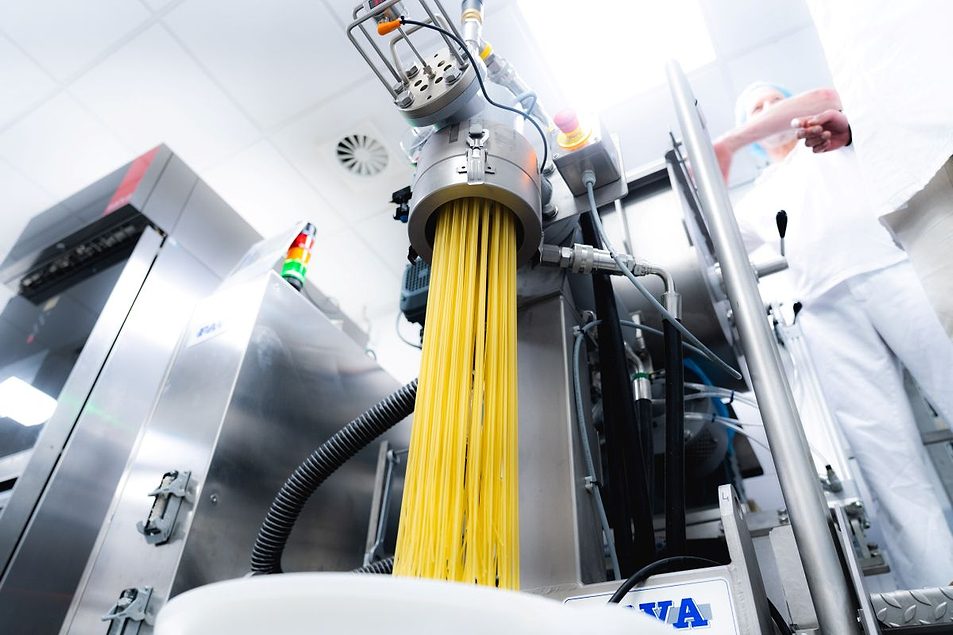

AHRENSBURG, GERMANY—MC Mühlenchemie now offers enzyme systems in its Pastazym HighProtein series that are designed specifically for producing pasta with protein content of 18% or higher.
Both the amount and the source of protein may affect pasta negatively, according to the Ahrensburg-based company. Protein sources like wheat germ and legumes may overpower pasta flavor and alter color. Other potential issues are unstable dough, difficult extrusion, susceptibility to breaking, rough or matte surfaces, sticky texture, and variable cooking stability. The MC Mühlenchemie enzyme systems address the issues by stabilizing the protein network, reducing stickiness, improving surface quality and cooking tolerance, and contributing to sensory quality.
“At protein contents up to about 22% the challenges can generally be dealt with using targeted enzyme technology, making additional support of the gluten network beneficial,” said Jana Russnak, head of pasta applications at MC Mühlenchemie.
Higher protein content may require adding wheat gluten, according to the company.

AI Search for Local Businesses (2026 Guide)

Executives of the Year: Dawn Baker

Where is the Village? PT Usha questions Asian Games accommodation model | Asian Games 2026 News




-

 Fashion4 days ago
Weekend Open Thread: Talbots – Corporette.com
-

 Tech2 days ago
Researchers escape OpenAI Codex sandbox to run commands on host
-

 Crypto World4 days ago
Circle launches Arc Studio AI agent for building onchain apps
-
 NewsBeat4 days ago
Trump says US has reached an agreement to take permanent control of Greenland’s security
-

 Crypto World2 days ago
Who Needs CLARITY Anyway? ARB Could See 70X Increase: Hodler’s Digest
-

 Crypto World4 days ago
Bitcoin price breaks channel as RSI climbs to 63
-

 Crypto World4 days ago
Trading Bitcoin on Robinhood? Why 2% Spread Has Traders Worried
-

 Crypto World6 days ago
US Charges Robinhood Engineers Over Crypto Listing Trades
-

 Crypto World7 days ago
What Is the Status of the U.S.-Iran Peace Talks? Here's What Both Sides Are Saying
-

 Tech7 days ago
Webb’s IC 348 Mosaic Includes Two-Jupiter Dwarfs, Twin Jets, and a Nursery Still Making Worlds
-

 Crypto World5 days ago
Mortgage and refinance interest rates today, Thursday, September 17, 2026
-

 Crypto World4 days ago
World Money launches in 150+ countries with Stripe
-

 Entertainment7 days ago
Big Brother Update: Melody Explodes at Drew as Illness Sweeps BB28 House
-

 Business2 days ago
Analog Devices (ADI) Bets $1.35 Billion on Chips that Let Machines Think for Themselves
-

 Crypto World4 days ago
Silver prices recover quickly, hitting weekly high today
-

 Tech5 days ago
GPT-6 Astra Reached the Nether in Minecraft, Lost Its Stash to a Creeper, and Farmed Potatoes for Hours
-
 NewsBeat4 days ago
US was ‘on brink of war’ with China over false AI report of nukes moving in Middle East
-

 Crypto World2 days ago
Coinbase, Robinhood, Circle Seen as Tokenized-Stock Winners
-
 Crypto World2 days ago
Bitcoin price holds above $81K as key catalysts line up
-

 Business7 days ago
Federal Reserve expected to hike interest rates 25 basis points at FOMC meeting
You must be logged in to post a comment Login