

Editor’s note: This article is intended to provide a general overview of the ETF for educational purposes only and, unlike other articles on Seeking Alpha, does not offer an investment opinion about the ETF.
Business
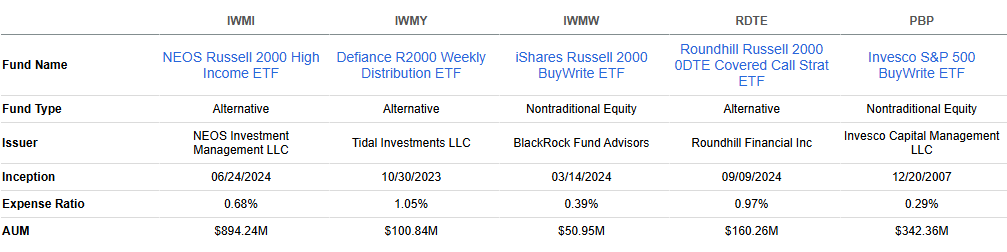
IWMI Provides Current Income For Those Seeking Equity Exposure To The Russell 2000 Index



We Are/DigitalVision via Getty Images
The NEOS Russell 2000 High Income ETF (IWMI) is a buy-write strategy designed to provide investors equity exposure to the Russell 2000 while overlaying a call options strategy to earn income for the portfolio. With a 13.66% yield, IWMI can be utilized by investors seeking current income in place of capital growth as part of an income-oriented investment strategy.
About NEOS Russell 2000 High Income ETF
IWMI was launched by NEOS ETF Trust on June 24, 2024, on the CBOE BZX Exchange. IWMI has a competitive expense ratio of 76 bps, 68 bps of which derives from the management fee.
Seeking Alpha
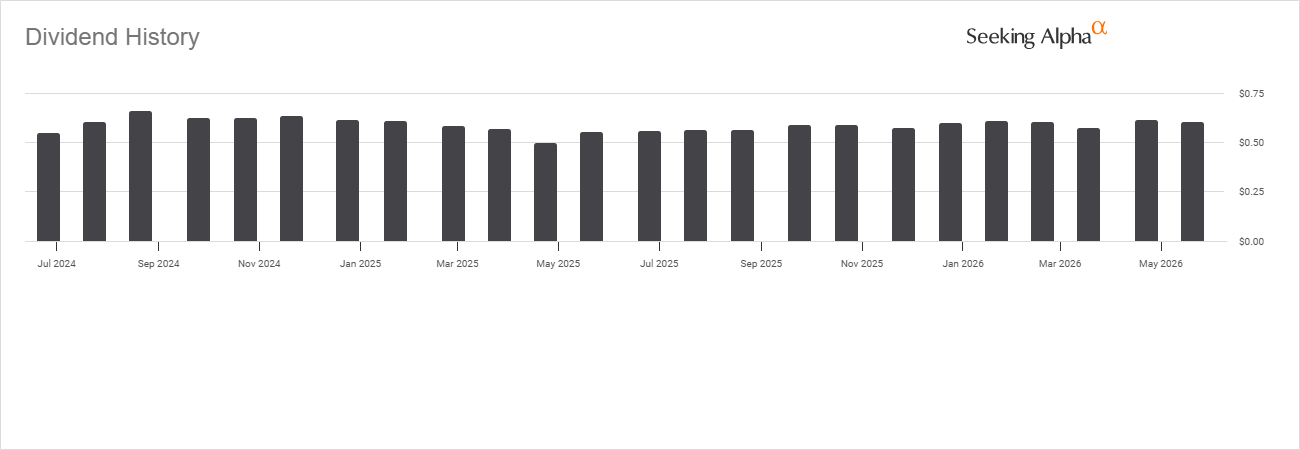
IWMI pays out a monthly distribution largely derived from the performance of the options strategy. The ETF has paid out $7.03/share over the last twelve months for a yield of 13.66%. The distribution can vary from month to month, though the fund has generally remained in a relatively narrow range since inception. In general, the majority of the distribution will derive from return of capital, returning investors’ principal investment over time. The result of this will lower the investor’s cost basis as a tax-deferred benefit until the cost basis reaches $0/share, at which point excess ROC will be taxed as short-term capital gains or ordinary income. While this type of strategy may not be suitable for investors seeking long-term growth through index investing, the strategy can be used by those seeking current income, effectively facilitating retirement distributions without the need to sell shares.
Seeking Alpha
One result of ROC will be NAV erosion over time, which will be present when comparing the price return of the Russell 2000 Index and IWMI. When comparing the performance of the fund, investors should view IWMI on a total return basis to evaluate the relative performance of the fund to the Index.
IWMI has two components that make up the portfolio:
Equity investments.
Options investments.
The equity component of the portfolio consists entirely of the Vanguard Russell 2000 ETF (VTWO). From an investment perspective, exposure to VTWO will provide investors with equity growth with respect to the Russell 2000 Index.
The options strategy utilizes Section 1256 Russell 2000 (RUT) index options contracts to gain short exposure to the Index. These contracts exhibit a special tax benefit with a 60/40 split between long- and short-term capital gains, potentially lowering the entirety of the tax burden on investors. The fund will effectively write covered call options on the underlying Index to earn income for investors.
The options trading strategy comes with some caveats that may limit the full upside potential of the equity component of the fund. Given that the fund writes call options on the Index, the fund will limit its upside potential to the strike price of these short option positions. If the Index were to exceed the strike price, the fund may lose money making up the difference between the strike price and the price of the Index at the time the options are rolled forward. In order to protect the fund from significant losses, IWMI may trade call spreads in order to limit the full downside risk. This means that the fund will purchase call options with a higher strike price with respect to the written options, limiting the exposure to risk. The call spreads will essentially create an opportunity for IWMI to limit the downside potential of the short options positions with respect to the strike price of the long call options, limiting losses to the spread between options and the premium paid for the protection.
Investor Suitability
IWMI can be best utilized by income-oriented investors seeking current income while investing in an equity-linked portfolio strategy. Investing in IWMI will provide both equity upside potential along with options premium income over time. The benefit of utilizing IWMI over a standard Index fund is that monthly income can be pulled without having to sell shares of the fund. IWMI can be utilized as an alternative strategy for fixed income or as an equity component as part of a diversified portfolio strategy. Investors will be issued a Form 1099-DIV at the end of the calendar year for tax reporting purposes.
Risks Related To IWMI
IWMI is a buy-write strategy designed to provide equity and options income exposure to the Russell 2000 Index, creating certain risks that should be considered prior to making a final investment decision. IWMI may limit the full upside potential with respect to the underlying Index as a result of the covered call strategy. The fund may also face losses during periods of significant Index growth, which would result in IWMI experiencing a potential loss on the short options positions. The options positions are actively traded by the portfolio management team, exposing investors to manager risk and their ability to effectively purchase and sell call options.
Final Thoughts
IWMI can be utilized by income-focused investors seeking to gain equity exposure using the Russell 2000 Index. The fund’s distributions can benefit income investors by returning invested capital over time, reducing the need to sell shares for portfolio distributions.
This article answers three main questions about IWMI:
- What type of investor is IWMI best suited for?
- What are the benefits and risks of investing in IWMI?
- Does IWMI have any tax advantages for investors?

Continue Reading
OKLAHOMA CITY — The Western Conference finals shift back to Paycom Center on Tuesday night for a pivotal Game 5 with the series tied 2-2, as the San Antonio Spurs and Oklahoma City Thunder prepare for what could be a defining moment in both franchises’ seasons.
After the Spurs evened the series with a dominant 103-82 victory in Game 4 on Sunday in San Antonio, the road team has won every game so far. Now, the Thunder return home looking to regain control, while the Spurs aim to steal another victory on the road and move within one win of the NBA Finals.
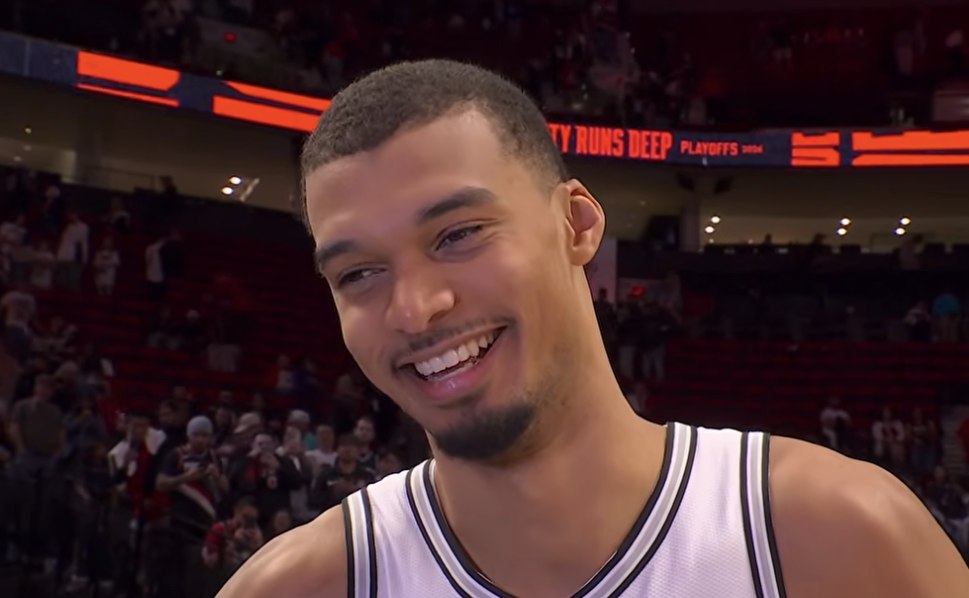
Victor Wembanyama has been the story of the series. The 22-year-old French phenom delivered his most complete playoff performance yet in Game 4, recording 33 points, eight rebounds, five assists and three blocks. His ability to dominate both ends of the floor has given the Spurs a fighting chance against the top-seeded Thunder, the defending champions.
The Spurs lead the series in several key statistical categories, particularly defensive efficiency and points off turnovers. San Antonio forced 20 turnovers in Game 4 while holding Oklahoma City to just 82 points on 33% shooting. That defensive intensity will be tested again in Game 5 against Shai Gilgeous-Alexander and a Thunder team known for its pace and offensive versatility.
Gilgeous-Alexander, the two-time MVP, has averaged strong numbers throughout the series but has been contained more effectively in recent games. Oklahoma City’s depth and home-court advantage make them dangerous, but injuries and fatigue have started to show as the series reaches this critical juncture.
For the Spurs, maintaining the defensive connections that limited the Thunder in Game 4 will be essential. Coach Mitch Johnson has emphasized discipline and collective effort, particularly in containing Oklahoma City’s transition game and perimeter shooting. The Spurs’ length, anchored by Wembanyama, has disrupted the Thunder’s rhythm, but executing away from home remains the primary challenge.
Wembanyama downplayed individual heroics after Game 4. He stressed team defense and consistency as the keys moving forward. The Spurs have shown resilience throughout the postseason, responding well after losses and maintaining focus in hostile environments.
Oklahoma City enters Game 5 with home-court advantage and the experience of being defending champions. Coach Mark Daigneault’s squad has been remarkably consistent all season, but the Spurs have exposed vulnerabilities, particularly in half-court defense and rebounding when Wembanyama is on the floor.
The Thunder will likely adjust by increasing physicality and trying to draw Wembanyama away from the rim. How they handle the Spurs’ switching defense and secondary scoring from players like Devin Vassell, Stephon Castle and De’Aaron Fox will determine if they can reclaim the series lead.
Game 5 represents a classic playoff chess match. The Thunder need to regain their offensive flow and limit turnovers that plagued them in San Antonio. The Spurs must sustain their defensive intensity on the road while getting enough production from their supporting cast to complement Wembanyama’s dominance.
The series has lived up to expectations as a clash between two young, talented cores. Oklahoma City entered as favorites with superior regular-season record and championship experience, but San Antonio has proven it belongs on the same stage. The back-and-forth nature has showcased the future of the Western Conference.
Injuries have played a subtle but important role. Both teams have managed key absences, and fatigue becomes a bigger factor as the series extends. How each side adapts their rotations and manages energy in Game 5 could prove decisive.
For San Antonio, advancing to the NBA Finals would represent a remarkable achievement in just the third year of the Wembanyama era. For Oklahoma City, a return trip to the Finals would validate their status as a dynasty in the making.
The atmosphere at Paycom Center is expected to be electric. Thunder fans have been vocal and supportive throughout the postseason, and they will look to create a hostile environment that disrupts the Spurs’ rhythm.
Wembanyama’s growth has been the most compelling storyline. In his third NBA season, he has elevated his game on the biggest stage, drawing comparisons to all-time greats for his two-way impact. His ability to guard multiple positions while stretching the floor offensively has created matchup nightmares for Oklahoma City.
The Thunder’s defensive schemes have evolved to meet the challenge, but containing Wembanyama while also accounting for San Antonio’s perimeter threats remains difficult. Gilgeous-Alexander’s ability to create his own shot will be crucial in countering the Spurs’ length.
Both teams have shown championship-level poise at different moments. The Spurs’ response after Game 3 demonstrated mental toughness, while the Thunder’s resilience in earlier rounds highlighted their experience.
As Game 5 approaches, focus turns to adjustments. Small changes in defensive rotations, offensive sets and rebounding battles could swing the outcome. The winner of Game 5 will carry significant momentum into the remainder of the series.
The Western Conference finals have already provided memorable moments, from Wembanyama’s logo buzzer-beater in Game 4 to hard-fought battles in Oklahoma City. Game 5 promises more drama as two of the league’s brightest young cores battle for a chance at the championship.
For basketball fans, the series represents the best of the modern NBA — athleticism, skill, tactical sophistication and emerging superstars. Regardless of the outcome, the Western Conference will emerge stronger from this matchup.
Tuesday night’s game carries championship implications. A Spurs victory would give them a 3-2 lead and put them one win away from the Finals. A Thunder win would restore home-court advantage and put Oklahoma City back in the driver’s seat.
As the teams prepare for what could be the most important game of the season so far, the basketball world will be watching. The series has exceeded expectations, and Game 5 has the potential to be its defining chapter.

Chile’s SQM doubles Q1 net profit on higher lithium prices, but misses expectations
Business
Ellington Credit Company 2026 Q4 – Results – Earnings Call Presentation (NYSE:EARN) 2026-05-26

Q4: 2026-05-19 Earnings Summary
EPS of $0.19 misses by $0.05
| Revenue of $10.02M (8.31% Y/Y) misses by $1.92M

Seeking Alpha’s transcripts team is responsible for the development of all of our transcript-related projects. We currently publish thousands of quarterly earnings calls per quarter on our site and are continuing to grow and expand our coverage. The purpose of this profile is to allow us to share with our readers new transcript-related developments. Thanks, SA Transcripts Team

TSA Group chair Tim Ungar has been appointed chair of the WA Cricket Foundation, effective from June 1.

Architects are adapting the way they work amid ongoing global challenges.

LONDON — Global oil benchmarks showed sharp and divergent movements Tuesday as fresh US military strikes in southern Iran reignited fears over supply disruptions through the Strait of Hormuz, even as diplomatic efforts for a potential peace deal continued in the background.
Brent crude, the international benchmark, rose 2.95% to $98.98 per barrel, reflecting renewed risk premiums tied to potential threats to shipping lanes. In contrast, West Texas Intermediate crude fell 4.29% to $92.46 per barrel, highlighting market uncertainty and differing interpretations of the latest geopolitical developments.
The volatility underscores how sensitive energy markets remain to events in the Middle East. The Strait of Hormuz, a narrow chokepoint through which roughly 20% of the world’s petroleum supply passes, has become a focal point for investors monitoring both military actions and diplomatic signals.
Analysts said the mixed price action reflects conflicting forces: immediate concerns over possible Iranian retaliation or shipping disruptions following US strikes, tempered by hopes that ongoing negotiations could lead to de-escalation and reopening of key routes.
The US military confirmed it conducted self-defense strikes in southern Iran, injecting fresh uncertainty into already fragile energy markets. This development reversed some of the earlier optimism that had driven prices below $100 per barrel on expectations of a diplomatic breakthrough.
Market participants are closely watching developments around US-Iran peace negotiations. Optimism about a potential agreement had previously eased prices, but military friction has kept supply expectations uncertain and risk premiums elevated.
Other benchmarks reflected similar volatility. The OPEC Basket fell 1.72% to $113.44 per barrel, while Urals oil dropped 4.92% to $96.32. RBOB gasoline declined 3.39% to $3.34 per gallon, and heating oil slipped 2.66% to $3.78 per gallon.
Energy strategists noted that the divergent movements between Brent and WTI highlight regional differences in supply concerns and refining dynamics. Brent’s rise points to global supply risks, while WTI’s decline may reflect ample US domestic production and storage levels.
The latest flare-up comes amid broader efforts to stabilize the region. Diplomatic sources have indicated that talks between Washington and Tehran are ongoing, though progress remains fragile. Any agreement that secures safe passage through the Strait of Hormuz could significantly ease pressure on global energy prices.
Oil traders said the market is pricing in a range of scenarios, from limited military exchanges to more prolonged disruptions. The possibility of Iranian-backed groups targeting shipping has added another layer of complexity to already volatile trading conditions.
Major consumers like Europe, Asia and the United States are monitoring the situation closely. Higher energy costs could exacerbate inflation concerns and slow economic growth if the tensions persist.
The energy sector’s reaction has rippled through global financial markets. Shares in major oil companies showed mixed performance, with some gaining on higher prices while others faced pressure from broader risk aversion.
Analysts warn that sustained disruption in the Strait of Hormuz could push Brent crude well above $110 per barrel. Conversely, a successful diplomatic resolution could see prices retreat quickly toward the $80-85 range.
The current volatility echoes previous periods of Middle East tension that have historically triggered sharp moves in commodity markets. However, today’s energy landscape differs due to higher global spare capacity and the rapid growth of renewable energy sources, which provide some buffer against prolonged shocks.
US strategic petroleum reserves and increased domestic production have also helped moderate some of the price spikes. Nevertheless, the psychological impact of potential supply disruptions continues to influence trading decisions.
For consumers, the latest price swings may soon translate into higher costs at the pump and for heating. Airlines and shipping companies are already adjusting fuel surcharges in response to the uncertainty.
Emerging markets with high energy import dependence face particular risks. Countries in Asia and Africa could see increased pressure on budgets and inflation if oil prices remain elevated for an extended period.
The International Energy Agency and OPEC continue monitoring the situation. Both organizations have emphasized the importance of maintaining stable oil flows through critical chokepoints like the Strait of Hormuz.
Market participants expect continued volatility in the coming days as developments unfold. Diplomatic updates, military statements and shipping data will be closely watched for signals about potential supply impacts.
The current environment highlights the delicate balance between geopolitical risks and economic realities. While short-term price spikes grab headlines, longer-term trends toward energy diversification and renewable adoption may eventually reduce the world’s vulnerability to such events.
For now, traders remain on edge as they assess the latest chapter in long-running tensions between the United States and Iran. The coming weeks could prove decisive in determining whether current price levels represent a temporary spike or the beginning of a more sustained period of elevated energy costs.
As markets digest the latest developments, the focus remains on the narrow waterway that carries so much of the world’s oil. Any escalation or resolution there will likely set the tone for energy prices through the remainder of 2026.
The mixed movements in benchmarks today serve as a reminder of oil’s enduring role as a geopolitical barometer. Even as the world transitions toward cleaner energy, events in key producing regions continue to send ripples through global economies.
Wendel (WNDLF) Shareholder/Analyst Call May 21, 2026 9:00 AM EDT
Company Participants
Nicolas ver Hulst
Sébastien Metzger – General Counsel
Laurent Mignon – Group CEO & Chairman of the Executive Board
David Darmon – Deputy CEO & Member of Executive Board
Christine Anglade-Pirzadeh – Director of Communications & Sustainable Development and Advisor to the Executive Board
William Torchiana
Alain Missoffe
Conference Call Participants
Malcom Sossou
Conversation
Nicolas ver Hulst
Good afternoon, ladies and gentlemen. It’s a great pleasure to be with you this afternoon. You’ve turned up in greater numbers. So thank you very much for being with us. There are more shareholders than we have representatives of the Wendel Group. The first 2 rows are made up of Wendel people, and then the rest of the room is shareholders, and that’s great to see. So thank you very much for outnumbering us in such a way.
I’m going to be chairing today’s proceedings. Today’s assembly is now officially open. We have Laurent Mignon and David Darmon here next to me. Laurent chairs the Executive Board, and David Darmon is a member of the Executive Board and General Director. You know both of them. And to my left, Sébastien Metzger, whom you might not know. He is the Legal Director for Wendel and Secretary of the Executive Board. Sébastien is with us with his Head of Legal Director since 2008. He joined in 2008, which was a great vintage, a great year to join us and to deal with a lot of debt-related issues that we had back then. So someone who’s acquired over the years, a great deal of experience.
I would like to also thank François de Wendel, my predecessor. He’s here in the room, and good afternoon also to all the members of the Supervisory Board with the Head of the Audit Committee and

Check out what’s clicking on FoxBusiness.com.
This year’s FIFA World Cup is a historic one on multiple levels, from its new 48-team format to the 104 total games played beginning June 11.
It’s a tournament for the ages and one that needs help behind the scenes to provide insight, innovation and much more.
Enter Lenovo, the global technology powerhouse that serves as the official technology partner of FIFA, is helping deliver AI solutions to power the World Cup this summer at host sites across North America and around the world.
CLICK HERE FOR MORE SPORTS COVERAGE ON FOXBUSINESS.COM

Lenovo is the official technology partner of FIFA heading into the 2026 World Cup. (Lenovo / Fox News)
“The FIFA World Cup represents the biggest stage in global sports and one of the most complex technology environments in the world,” Jeff Shafer, senior vice president of corporate marketing and chief communications officer at Lenovo, told Fox Business in an exclusive statement. “As the Official Technology Partner of the tournament, Lenovo is helping power an event that will connect billions of fans across 16 venues and three countries, where performance and reliability must be flawless every moment of every match.
“For us, this partnership is about far more than putting our logo on the field; it’s an opportunity to demonstrate how Lenovo’s full-stack portfolio — from devices and infrastructure to AI-powered solutions and services — can deliver at the highest possible scale and under the most intense pressure. If our technology can help power the world’s biggest tournament, it can help organizations solve their toughest challenges anywhere.”
As Shafer says, this partnership goes well beyond just the visual presence Lenovo will have at FIFA World Cup matches. It’s a swathe of tech solutions both entities have worked on together to impact all areas of the game, starting with the landmark announcement of Football AI Pro.
FIFA, FANATICS JOIN FORCES IN MAJOR PARTNERSHIP FOR OFFICIAL TRADING CARDS, COLLECTIBLES
Co-developed by FIFA and Lenovo, Football AI Pro will bring unprecedented access to millions of data points and over 2,000 performance metrics for every team participating in the World Cup to access with strong privacy safeguards. The insight and analysis that can be done by coaches, players and analysts can help level the playing field for those teams that lack the same resources as bigger clubs like France, England and the U.S.
“With Football AI Pro, we will democratize access to data by providing the most complete set of football analytics to all competing teams and soon to fans as well,” FIFA president Gianni Infantino said in a statement. “But of course, this is just the beginning, so fans should stay tuned for more exciting developments with Football AI, and other innovations, as FIFA and Lenovo create unforgettable experiences in the months and years ahead.”
While teams will be using that tool on and off the pitch, one of the more noticeable AI applications by Lenovo and FIFA will be for all to see during matches: digital avatars.

Argentina forward Lionel Messi (10) kisses the World Cup Trophy after winning the 2022 World Cup final against France at Lusail Stadium. (Yukihito Taguchi/USA Today Sports / IMAGN)
There will be 3D avatars produced of players at the tournament using 3D assets and Advanced GenAI technology, which will help support the efficiency of the decision-making process made by referees during matches. In just six seconds, a player will step into a circle filled with cameras that scan their body to build the 3D asset, which will be used in key situations.
For example, during an offside replay in a match, 3D animations will appear on-screen, providing a greater visual contextualization for fans watching at home and in the stadium. The digital avatars will replicate the individual physical dimensions of the players competing.
“AI-enabled 3D avatars mark a major step forward in how officiating technology supports accuracy and transparency,” FIFA secretary general Mattias Grafström, said in a statement. “By combining precise player data with advanced visualization, this innovation strengthens confidence in key decisions and brings fans closer to the process than ever before.”
Furthermore, a new vantage point of the intense play on the pitch will be seen through a referee camera, which Lenovo’s AI solution helps stabilize in the moment, providing a clear visual for the viewer at home.
“This is a very practical application of AI,” Art Hu, Lenovo’s chief information officer and the chief technology delivery officer for the Solutions and Services Group, said in a statement. “This is not abstract. It’s very real and we’re working with FIFA to make it very accessible, intuitive and easy to use.”

Detail of the FIFA World Cup 2026 Match Ball “Trionda” at Brooklyn Bridge Park on October 2, 2025, in New York City. (Sarah Stier/Getty Images / Getty Images)
Finally, the unprecedented logistical and operational challenge the World Cup has for FIFA and its partners is the biggest it’s ever been in 2026 given matches being held across an entire continent and billions more watching around the globe.
There will be an Intelligent Command Center supporting all functional areas at FIFA, while providing insightful daily summaries generated by AI, which will monitor all FIFA World Cup operations in real-time. It will help officials observe, respond to situations if needed and view trends across the tournament’s footprint.
And this will help fans, as Lenovo developed “digital twins” of all the venues being used, where they can provide real-time data that will show where crowds are building, where lines are shortest and how people are moving throughout a venue.
Lenovo’s Smart Wayfinding, which provides cities, fan zones, landmarks, venues and every key point of interest that can be explorable for fans in an interactive space, will have real-time intelligence and AI-guided navigation attached to it, providing a frictionless experience for all.

Lenovo is offering FIFA a realm of AI possibilities that will impact officials, players and coaches, and fans ahead of the 2026 FIFA World Cup. (Lenovo / Fox News)
GET FOX BUSINESS ON THE GO BY CLICKING HERE
To enhance Lenovo’s messaging about how it’s impacting the FIFA World Cup, as well as the FIFA Women’s World Cup in 2027, the brand launched its “Maximum David” campaign with legend David Bekcham. The campaign highlights how AI-driven technology elevates the creativity, performance and impact of Beckham and ultimately how it will impact all those participating in the tournament.
From teams looking into data for an advantage to fans getting never-before-seen views of the world’s greatest show on the pitch, Lenovo and FIFA are working side by side to deliver the game like it’s never been seen on a global stage.
It will also start soon, as the first World Cup match will be held on June 11.
Follow Fox News Digital’s sports coverage on X and subscribe to the Fox News Sports Huddle newsletter.

Donny DBM/iStock via Getty Images

After a strong start in January the market corrected largely due to the Strait of Hormuz crisis. Technology was the quarter’s worst-performing S&P 500 sector, especially software-related companies which suffered from AI disruption fears, excessive stock-based compensation and high valuations. Adding to that were monetization concerns over a sizable increase in “hyperscaler” capital expenditures in excess of $660 billion. The conflict in Iran and resulting Strait of Hormuz shutdown effectively halted shipping of 20.5-21 million barrels per day of crude oil and refined products that pass through what is one of the world’s most critical commodity corridors. This boosted energy, the best performing sector. Value outperformed growth with the Russell 1000 Value Index advancing 2.10% compared to a decline of 9.78% for the Russell 1000 Growth Index.
Defense Spending on the Rise
Geopolitical uncertainties over the last several years have brought about steadily increasing defense budgets, particularly in the United States which saw an increase from $715 billion in 2020 to just under $850 billion in 2025. For the first time ever, the 2026 budget exceeds $1 trillion. These increases have been driven by events like the Russia-Ukraine conflict as well as the war in Israel. Most recently, the US proposed a $1.5 trillion defense budget for 2027, citing factors like increasing global threats and the need for more domestic defense infrastructure. Lockheed Martin (LMT), Northrop Grumman (NOC) and RTX (RTX) stand to be among the largest beneficiaries of rising defense budgets, as all three are prime contractors for the US’s proposed $185 billion “Golden Dome” nationwide missile defense system. General Dynamics (GD), meanwhile, serves as the prime contractor for the nation’s $65.8 billion naval modernization effort. Boeing (BA) should see consistent revenue following their award of the F-47 next-generation aircraft contract, which is particularly attractive as aircraft programs typically run for decades. The previous generation F-35 first delivered in 2011 is still in production. Outside of traditional defense companies, we also see some tech names as beneficiaries of higher military spending with Nvidia (NVDA), Intel (INTC) and Qualcomm (QCOM) providing processing and compute for current and future autonomous vehicle and drone programs.
Growing Risk in Private Equity and Private Capital
The private equity and credit markets have exploded in growth over the last decade and are among the fastest-growing alternative asset classes. S&P Global estimated that private market assets under management totaled $15 trillion in 2024, up from $10.89 trillion in 2022. They project that those markets could reach more than $18 trillion by 2027. Private equity investments account for over half of the market. This lightly regulated industry is now facing headwinds. Payment-in-Kind loans have flourished as borrowers struggle to meet cash interest payments. Private equity funds are unable to exit their mid-market companies and investors are questioning valuation parameters. The opaque nature of these funds has further damaged investor confidence.
AI Disruption Fears Hit Software Companies Hard
The Software as a Service (SaaS) industry was one of the hardest hit areas of the market during the first quarter as investors have increasingly become uncertain over AI’s potential for disruption that could commoditize the industry and compress profit margins. Forbes reported that the software sector’s price-to-earnings ratio fell to 20 times during the first quarter compared to around 35 at the end of 2025, the lowest level since 2014. Companies like Intuit (INTU), Adobe (ADBE), Salesforce (CRM) and FICO (FICO) saw their shares fall 30%-37% during the first quarter despite reporting strong earnings. Investors fear that AI agents could replace much of the work currently performed by software companies for a fraction of the cost. Intuit has been working to counter the fears by heavily investing in their AI agent platform, bringing it to all their existing products. Adobe has been doing the same and both companies have seen strong support for AI features with around 90% of users taking advantage of the new capabilities. On the commodity risk side, these companies possess an advantage over popular general purpose AI models as they have access to specialized proprietary data they can use to train their own models. Adobe owns hundreds of licensed images they use for training and provides protection from litigation. Intuit instills confidence that taxes and business operations will comply with laws and regulations. AI models training only on public general data have a history of hallucinating false information and presenting it as fact which could be incredibly costly when dealing with important financial information. Proprietary data and the promise of security is something that we see as an advantage for long-standing SaaS companies that could help them better compete with growing AI players. It is amazing to see the P/E compression of these stocks since Covid. Fiserv (FI)—an unglamorous back-office processor for banks—was valued at over 100x earnings four years ago and now trades at just 7x, despite delivering 39 consecutive years of double-digit earnings-per-share growth.
Contributors
Bank of New York Mellon (BK) reached all-time highs following their first quarter earnings report of a 42% increase in year-over-year earnings per share along with an 18% increase in interest income resulting from higher yields. Assets under management grew 12% to a record $59.4 trillion. AI initiatives have been paying off as AI agents led to 20% faster client onboarding and 80% faster settlement inquiry investigation; agents are now writing 40% of all code. They returned $1.4 billion through repurchases and dividends and authorized a new $10 billion share repurchase program. CEO Robin Vince has done an exceptional job since taking over four years ago. Major US banks as a whole are aggressively retiring stock in 2026 due to recent deregulation, with a record $33 billion bought back in the first quarter alone—up 35% from the prior year quarter. This is the type of “double play” return we seek; an undervalued, vital, dull business with inspired management improving operating results leading to a sixfold return on our investment.
Industrials were the best performing sector during the quarter relative to the overall Fund, due in part from strong reshoring thanks to low domestic natural gas prices, legislation like the CHIPS and Inflation Reduction Acts as well as geopolitical risks that incentivize companies to return manufacturing to the US. Last year’s massive increase in hyperscaler capital expenditures continues, projected to be over $650 billion this year and may account for up to half of US GDP growth. Strong performers in the Fund included Gates (GTES), Caterpillar (CAT), Corning (GLW), and FedEx (FDX). Corning has seen strong demand for their optical connectivity products used in AI-focused data centers. Corning CEO Wendell Weeks is impressive in his ability to execute.
Defense and aerospace companies Boeing, Parker-Hannifin (PH), General Dynamics and RTX have reaped the benefits of a massive increase in global defense spending in response to rising conflicts.
Skilled labor educators Lincoln Educational (LINC) and Universal Technical Institute (UTI) have reported strong growth in student starts as demand for trades continues to rise. The expansion of data centers has led to high demand for electricians, HVAC technicians, welders and CNC machining engineers. AI automation is expected to impact many professional industries, driving interest in trades that are viewed as more resistant to disruption. Reshoring trends in the US specifically in the semiconductor and defense industries are also contributing to strong student starts.
Energy refiners Valero (VLO) and Phillips 66 (PSX) outperformed with diesel and Jet A fuel prices soaring. The crack spread hit a record $88.25 per barrel of oil in March. Chevron (CVX) has been a major beneficiary of years of diligent investments in oil and gas production.
Detractors
UnitedHealth (UNH) has been a major laggard for the past quarter and year. However, since CEO Stephen Hemsley’s return last May operating performance has been improving. We made over a fivefold return under his previous tenure from 2006-2017 and are confident that he can navigate a successful turnaround going forward. The recent medical cost ratio (MCR) of 83.9% is the lowest in two years and combined with a 2.48% CMS rate increase this spring has been a big boost. The lower amount spent on patient medical claims follows the company’s late 2025 shift to focus on higher margin patients over aggressive membership growth. Total membership has fallen by about 700,000 since the end of 2025. Management cited their higher margins as the reason for raising their full year adjusted earnings per share guidance to over $18.25, up from their previous guidance of $17.75 in January and consensus estimates of $17.86. Going forward, management also announced at least $1.5 billion in spending on artificial intelligence technology in 2026. This technology will be focused on areas like helping members understand their coverage and automating some administrative tasks and claims processing.
Software-related stocks in the portfolio have been hit hard due to the threat of margin compression from artificial intelligence. Microsoft (MSFT)’s 21.9% drop in the quarter was the worst decline since the 2008 financial crisis. They are spending $190 billion on AI-related capital expenditures in 2026 yet their AI Copilot product has failed to scale, with less than 15 million total paid seats. Google Gemini has successfully integrated their AI and captured the largest share of casual AI users with 2 billion people interacting with “Gemini-powered AI overviews” in Google Search every month. Microsoft has a large installed base with Fortune 500 companies. They have over $88 billion in cash on the balance sheet which is a huge competitive advantage. It is hard to bet against CEO Satya Nadella who took over in February 2014 and has a great record with the stock up over elevenfold.
First Quarter 2026 Performance Update
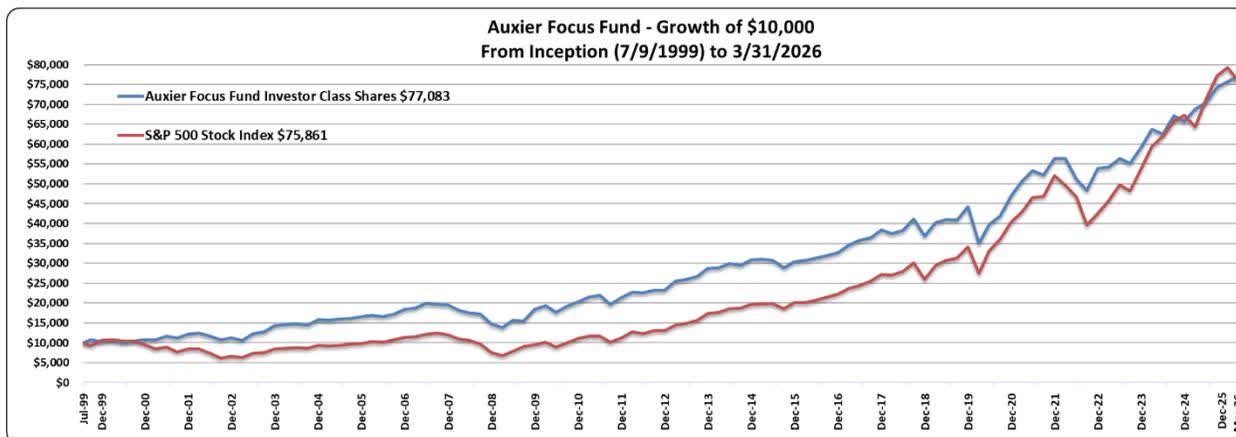

Auxier Focus Fund’s Investor Class gained 1.73% in the first quarter of 2026 with stocks up 2.00%. For the same period the S&P 500 cap-weighted index declined 4.33% and the equal weight returned 0.67%. The Russell 1000 Value was up 2.10%. For the quarter, fixed income investments as measured by the S&P US Aggregate Bond Index returned 0.04% and the longer-dated ICE US Treasury 20+ Year Index was up 0.11%. Stocks in the Fund comprised 92% of the portfolio. The breakdown was 82.5% domestic and 9.5% foreign, with 8.0% in short-term debt instruments. A hypothetical $10,000 investment in the Fund from inception on July 9, 1999 to March 31, 2026 is now worth $77,083 vs $75,861 for the S&P 500 and $65,542.76 for the Russell 1000 Value Index. During the same period, equities in the Fund (entire portfolio, not share class specific) have had a gross cumulative return of 1,323.34% vs 658.61% for the S&P. The Fund had an average exposure to the market of 82% over the entire period. Our results are unleveraged.
In Closing
We continue to seek businesses and managements displaying a strong culture with a heart and soul. Great leadership combined with enduring business models purchased in periods of fear and uncertainty have generated most of our returns over the past three decades. We have had good luck
with gritty founder CEOs who love their business. There is however a shortage of great operators. The key is to identify these managers and businesses ahead of time and do vigorous daily research to determine the sustainable earnings power of each entity. While we are aggressively monitoring the risks of a continued Strait of Hormuz shutdown, we remain mindful that many opportunities can be missed by focusing too much on macro headlines and not enough on micro details of improving operating fundamentals with exceptional leaders. Program trading dominates the investment landscape, but we firmly believe that investing is still the craft of the specific and knowing what you own is crucial to mitigating risk and improving investment odds.
Finally, during this time of global turmoil Warren Buffett said it best: “What we learn from history is that people do not learn from history. You can count on fear, greed and folly to be ever present in the marketplace. Their sequence is unpredictable; their duration is unpredictable; and their effects are unpredictable. But their presence is certain. ” Emotional and psychological responses to money often lead to substantial misappraisals in auction markets, creating new opportunities.
We appreciate your trust.
Jeff Auxier
Editor’s Note: The summary bullets for this article were chosen by Seeking Alpha editors.
Editor’s Note: This article covers one or more microcap stocks. Please be aware of the risks associated with these stocks.

Rocket Pharmaceuticals CEO Shah sells $171,840 in stock

News Videos1 minute ago
OMG WE JUST WON BIG… BONDS WILL MOVE ON TO XRP!!?!?!

NewsBeat2 minutes ago
Doctor brutally stabbed with ‘big knife’ in hospital A&E by ‘smirking patient’

Business3 minutes ago
Wembanyama Faces Critical Test as Series Hangs in Balance


-

 Crypto World5 days ago
Blockchain.com files with SEC for U.S. IPO
-

 Fashion4 days ago
Holiday Weekend Open Thread – Corporette.com
-

 Business4 days ago
Dell Technologies DELL Stock Surges 15% on AI Server Momentum and Analyst Upgrades in 2026
-

 Crypto World5 days ago
Bitcoin Accumulation Weakens as BTC Realized Losses Hit $600M
-

 Crypto World4 days ago
Robinhood crypto COO Tanya Denisova exits
-

 Crypto World4 days ago
Space X IPO Is ‘Bad News’ for Tech Stocks: But What About Bitcoin?
-

 Politics4 days ago
Makerfield: a tale of two social-media histories
-

 Business2 days ago
NYT Strands Answers May 24 2026 Revealed for Puzzle No. 812 Theme Summer Essentials
-

 Tech1 day ago
Microsoft’s quiet Claude Code retreat and the real cost of enterprise AI
-
 Crypto World5 days ago
MicroStrategy’s Saylor Says Miners No Longer Set Bitcoin Price, Another Force Has Taken Over
-

 Tech5 days ago
WhatsApp ads could make Irish debut after discussions with DPC
-

 Crypto World4 days ago
AI infrastructure race heats up as IREN pitches full-stack strategy, WhiteFiber lands $160M deal
-
 Tech5 days ago
A 0.12% parameter add-on gives AI agents the working memory RAG can’t
-

 Tech5 days ago
You Can Now Add ChatGPT To PowerPoint
-
 NewsBeat6 days ago
Charity run by Reform leader Malcolm Offord accused of ‘law breaking’ over Scottish registration
-
 Crypto World2 days ago
Nvidia (NVDA) CEO Calls on Super Micro to Strengthen Export Controls Amid Smuggling Probe
-

 Business5 days ago
Trump Invests $1M-$5M in Kura Sushi USA Chain With 27 California Locations
-

 Tech1 day ago
Westone Audio and Etymotic Acquired by Fidelity Collective in Major IEM Market Move
-

 Sports5 days ago
2026 CJ Cup Byron Nelson leaderboard: Brooks Koepka finds putting stroke in Round 1
-

 Crypto World6 days ago
Exa Labs raises $250 million in funding led by a16z
You must be logged in to post a comment Login