

Business
Minerals Council pitches freight train plan to unlock North West's next boom




Stocks to Watch: Nvidia, Qualcomm, easyJet

Britain’s letter writers, and the small businesses that still depend on the post for invoices, contracts and statutory notices, are paying the price for another year of underperformance at Royal Mail.
Just 75.7% of first-class mail was delivered on time in the 12 months to the end of March, the postal operator confirmed on Friday, a country mile from its 93% regulatory target and the first full-year snapshot of life under Czech billionaire Daniel Kretinsky’s EP Group, which completed its £3.6bn takeover last spring.
Performance has actually slipped since the company’s final year on the London Stock Exchange, when 76.9% of first-class and 92.2% of second-class letters arrived on time. The new figures show only 90.2% of second-class post landed within three working days, against a target of 98.5%.
The communications regulator described itself as “very concerned” by the figures. Business Matters understands Ofcom is preparing to open a formal investigation into Royal Mail’s performance as soon as next week – a move that would almost certainly lead to a further multi-million-pound fine on top of the £21m penalty imposed last October, the third-largest in the watchdog’s history.
It is six years since Royal Mail last hit its second-class target and a decade since it cleared the bar on first-class. The slump that began during the pandemic has stubbornly refused to reverse.
Chief operating officer Jamie Stephenson struck a contrite tone, insisting the business is on course to meet new, softer targets of 90% for first-class and 95% for second-class by this time next year.
“We’re putting significant investment into improving reliability and reaching these new delivery targets, but delivering lasting change across a network of this scale takes time,” he said.
The company is ploughing £500m into its five-year improvement plan, which includes offering part-time posties longer hours and scrapping second-class Saturday deliveries – a structural overhaul agreed with Ofcom and rolled out from April.
For Britain’s 5.5 million small businesses, however, the patience required is wearing thin. SMEs remain disproportionately reliant on physical mail for cheques, payment reminders, HMRC correspondence and signed agreements. Slow post means delayed cash flow, missed deadlines and, in the worst cases, penalties from regulators whose own letters arrive late.
Tom MacInnes, policy director at Citizens Advice, was withering in his assessment. Poor performance at Royal Mail, he said, was “business as usual”.
“What’s worse, Royal Mail claims people will have to wait another year until it can meet its new, lower delivery targets,” he added.
In February, postal workers told the BBC that letters had been sitting undelivered in depots for weeks because staff had been instructed to prioritise parcels, which carry fatter margins. Mr Kretinsky was hauled before MPs on the Business and Trade Committee in March, where he said he was “deeply sorry for any letter that arrives late” but flatly denied that parcels were being put ahead of letters. As the House of Commons Library has documented, letter volumes have collapsed from 20 billion items in 2004-05 to around 6.6 billion last year, putting the universal service economics under unprecedented strain.
Ofcom has already eased Royal Mail’s regulatory burden. Since April, the operator has been measured against the lower targets of 90% next-day delivery for first-class and 95% three-day delivery for second-class. The regulator argued the previous benchmarks were “more stretching” than in comparable European countries and would “carry higher costs which would need to be recovered through higher prices” – an unwelcome trade-off for any SME owner who has watched a first-class stamp climb to £1.70.
Whether £500m and a slacker rulebook can finally turn around an institution that has failed its own customers for the best part of a decade is the question now landing on Mr Kretinsky’s desk. On the evidence of Friday’s numbers, the answer is not yet in the post.

Jamie Young
Jamie is Senior Reporter at Business Matters, bringing over a decade of experience in UK SME business reporting.
Jamie holds a degree in Business Administration and regularly participates in industry conferences and workshops.
When not reporting on the latest business developments, Jamie is passionate about mentoring up-and-coming journalists and entrepreneurs to inspire the next generation of business leaders.

BofA raises Icon stock price target to $125 on booking trends

Starting August 3, 2026, the normal market closing time for equity derivatives will be extended by 10 minutes to 3:40 pm from the current 3:30 pm. While the extension is noteworthy, the bigger change lies in how closing prices for eligible securities will be determined.
The move aims to ensure a smoother transition between the cash and derivatives markets at the end of the trading day while maintaining consistency in the pricing framework across segments.
What is the closing auction session?
The CAS is a structured trading window held at the end of the trading day. During this period, market participants place buy and sell orders to determine a single closing price for a security through an auction-based mechanism.

Unlike the current system where prices evolve through normal trading until market close, the auction process discovers a fair closing price based on orders entered during the designated session.
According to the exchange, CAS will initially apply only to securities in the cash segment that have derivative contracts available. The framework will roll out in phases, and any future expansion will be subject to SEBI guidance and separate operational instructions from the exchange.
Why are derivatives trading hours being extended?
Although CAS applies only to the equity segment, NSE decided to extend trading hours in the derivatives segment to ensure both markets remain aligned during the closing process.
The exchange also clarified that the price bands and pre-trade risk control measures introduced as part of CAS in the cash market will be mirrored in the derivatives segment. This is intended to maintain consistency between the two segments during the closing phase of trading.
How will the closing auction session work?
The CAS will run for 20 minutes, from 3:15 pm to 3:35 pm. The process will begin with a transition phase between 3:15 pm and 3:20 pm, during which the reference price will be calculated using the volume-weighted average price (VWAP) of trades executed between 3:00 pm and 3:15 pm.
Between 3:20 pm and 3:25 pm, participants will be able to enter both market and limit orders. From 3:25 pm to 3:30 pm, only limit orders will be permitted. During this period, market orders cannot be modified or cancelled.
The order entry session will close randomly at any point between 3:28 pm and 3:30 pm, after which the auction process will determine the final closing price.
How will closing prices be calculated?
One key point highlighted by NSE is that there will be no change in the methodology used to calculate closing prices of derivative contracts. The volume-weighted average price (VWAP) used for derivatives closing price calculation will continue to be based on trades executed during the final 30 minutes of trading. However, because market hours are being extended, that 30-minute window will now shift to 3:10 pm-3:40 pm instead of the current 3:00 pm-3:30 pm.
For securities eligible for CAS, the closing price in the cash segment will be determined through the auction process.
Ashish Nanda, President and Digital Business Head at Kotak Securities summed up the shift by noting that the market is moving from a “continuous trading close” to an “auction discovered close”.
Under the current framework, closing prices are derived from the VWAP of trades executed between 3:00 pm and 3:30 pm. Under the new framework, closing prices for F&O-eligible stocks will effectively be linked to a 20-minute auction process running from 3:15 pm to 3:35 pm.
What happens if a stock is removed from F&O?
NSE clarified that eligibility for CAS is linked to the presence of derivatives on the stock. If a security is excluded from the equity derivatives segment on both exchanges, it will no longer be eligible for the CAS.
In such cases, the closing price will revert to the existing methodology and be determined using the VWAP of trades executed during the last 30 minutes of trading. However, if the security continues to be part of the derivatives segment on at least one exchange, it will remain eligible for CAS.
What happens to pending orders?
The exchange outlined operational changes relating to order management. All unexecuted special orders, including stop-loss orders and disclosed quantity orders, will be cancelled. Pending orders that fall outside the revised price band will also be cancelled automatically, and members will receive appropriate cancellation notifications.
Why does this matter for traders?
For many market participants, the biggest implication is that the final closing price may no longer mirror the last traded price visible on trading screens at 3:30 pm.
According to Ashish Nanda, this could require adjustments to trading strategies, particularly for option writers and arbitrageurs who rely heavily on closing prices for valuation, settlement and hedging decisions.
While the derivatives market will remain open until 3:40 pm, the broader shift is not simply about extending trading by 10 minutes. It marks a change in how closing prices for eligible securities are discovered, with the exchange moving toward an auction-based mechanism designed to determine a single closing price at the end of the trading day.
What happens to existing market timings?
Apart from the revised closing time, most trading schedules remain unchanged. The pre-open session in the derivatives segment will continue to begin at 9:00 am and the normal trading session will continue to start at 9:15 am. Similarly, the trade modification window will remain unchanged and continue until 4:15 pm.
(Disclaimer: Recommendations, suggestions, views and opinions given by the experts are their own. These do not represent the views of The Economic Times)
Business
Q4 earnings review: Motilal Oswal highlights broad-based beat on estimates, lists 6 sectors that exceeded expectations

In its latest Indian strategy report, Motilal Oswal Financial Services said that aggregate earnings of the companies under its coverage grew 16% year-on-year, beating its estimate of 8% growth in the January-March quarter of FY26. According to the domestic brokerage, the better-than-expected earnings growth was powered by BFSI (profit grew 18% YoY vs. brokerage’s estimate of 11%) and supported by metals (profit surged 50% YoY vs. brokerage’s estimate of 24%) and OMCs (profit jumped 62% YoY vs. brokerage’s estimate of 7% growth). Further, technology (+13% YoY), telecom (+8.4x YoY), and automobiles (+13% YoY vs. brokerage’s estimate of 6% decline) propelled earnings, Motilal added.
On the other hand, aggregate earnings growth was dragged by oil & gas (excluding OMCs), which posted a profit dip of 10% YoY vs. Motilal’s estimate of 1% growth.
The Nifty 50 companies delivered 4% YoY growth in net profit, beating Motilal’s estimate of 2% growth. The domestic brokerage, however, noted that Nifty reported a single-digit earnings growth for the eighth consecutive quarter, the first time since the pandemic (June 2020).
“Barring Reliance Industries, which posted a profit dip of 13% YoY, and Interglobe Aviation, which posted a loss of Rs 24 billion vs. a profit of Rs 30.7 billion YoY, the Nifty Universe posted a 9% YoY earnings growth. Five Nifty companies – Bharti Airtel, JSW Steel, HDFC Bank, Infosys, and TCS – contributed 75% of the incremental YoY accretion in earnings. Conversely, Reliance Industries, Interglobe Aviation, Adani Enterprises, Power Grid, Dr Reddy’s, Cipla, Tata Motors PV, Sun Pharma, and Maruti Suzuki dragged down earnings. Within the Nifty, 15 companies reported lower-than-expected profits, while 18 posted a beat, and 17 registered in-line results,” Motilal added.
Also read: IndiGo soars 5% after Q4 results. What Goldman Sachs, Jefferies and others are saying
Largecaps, midcaps beat estimates, smallcaps post in-line earnings
The domestic brokerage noted that among the companies under its coverage, around 90 largecap companies on average posted an earnings growth of 12% YoY. Around 101 midcap companies, meanwhile, showed improvement and delivered earnings growth of 36% YoY (vs. the brokerage’s estimate of 25%).
“Multiple mid-cap sectors, such as BFSI, metals, OMCs, and healthcare, lifted the overall performance. These sectors contributed ~89% of the incremental YoY accretion in earnings. In contrast, smallcaps (168 companies) delivered in-line performance, with earnings rising 19% YoY (our estimate of +18%). Within small-caps, 68% of the coverage universe exceeded/met our estimates. Conversely, within the large-cap/mid-cap universes, 74%/73% of the companies exceeded/met our estimates,” Motilal Oswal said.
It noted that Nifty EPS for FY26 stood at Rs 1,065 per share, marking a second consecutive year of single-digit growth. It cut its Nifty EPS estimate for FY27 by 0.9% to Rs 1,235 per share, led by SBI, Reliance Industries, JSW Steel, ONGC, and Coal India. “Earnings estimates of the MOFSL Universe were cut by 1.3% for FY27, fueled by PSU Bank, Oil & Gas, Healthcare, Telecom, and Technology. The MOFSL large-cap universe reported an earnings cut of 0.9%, while the mid-cap universe recorded a downgrade of 2.2%, and the MOFSL small-cap universe posted a downgrade of 2.8% for FY27,” it added.
Q4 earnings season fared better than expectations
Motilal concluded by saying that the Q4 earnings season fared better than expectations, but forward earnings revisions continue to exhibit weakness. Following India’s sharp underperformance in FY26 and record FII outflows, a favorable base has likely been set for Indian equities, it said, adding that in the near term, however, the market will remain hostage to volatile developments arising from the West Asian crisis.
“Higher commodity prices will be the key monitorables, as a prolonged elevated level could affect India’s macro parameters and engender a tight monetary policy stance. Our model portfolio broadly reflects our preference for growth visibility, structural domestic growth plays, and select global value names. We firmly believe that this is a bottom-up market, despite India witnessing both time and price corrections relative to EM peers. Our key overweight sectors are Autos, PSU Banks, Diversified Financials, Manufacturing & Industrials, Consumer Discretionary, and New-age platforms. In contrast, we are underweight on Oil & Gas, Private Banks, Metals, Consumer Staples, IT, and Commodities/Utilities,” the brokerage said.
Also read: PSU bank stocks vs private banks in FY27: The valuation trap you need to avoid
Motilal Oswal’s top picks
It listed Bharti Airtel, State Bank of India (SBI), ICICI Bank, Mahindra & Mahindra (M&M), Titan, Bharat Electronics (BEL), Eternal, Tata Steel, Infosys and IndiGo as its top Nifty 50 picks, while non-Nifty 50 picks included TVS Motor Company, ICICI Prudential AMC, Groww, Indian Hotels, AU Small Finance, Dixon Tech, Lenskart, Waaree Energies, Coforge, Radico Khaitan and Delhivery.
(Disclaimer: Recommendations, suggestions, views and opinions given by the experts are their own. These do not represent the views of The Economic Times)

LISBON — Portuguese Football Federation president Pedro Proenca has cast doubt on the possibility of Cristiano Ronaldo playing at the 2030 World Cup, stating that it would require a “huge surprise” physiologically for the 41-year-old superstar to feature at age 45 when Portugal co-hosts the tournament.
Proenca, speaking at the Bola Branca Conference, acknowledged Ronaldo’s extraordinary career and enduring link to the national team but emphasized biological realities as the primary barrier to a sixth World Cup appearance. The five-time Ballon d’Or winner remains Portugal’s all-time leading scorer and a central figure for the Selecao, but questions about his long-term playing future continue to grow.
“I’ll say that, physiologically, a huge surprise would have to happen for him to be in another World Cup,” Proenca said. He added that any participation in the European Championship would depend on the coach at the time, Ronaldo’s form and various technical factors.
The comments reflect a pragmatic approach from Portuguese football’s governing body as it prepares for the 2030 World Cup, which Portugal will co-host alongside Spain and Morocco. While Ronaldo has defied age-related expectations throughout his career, Proenca suggested that expecting him to compete at the highest level in 2030 would be unrealistic without exceptional circumstances.
Ronaldo’s Enduring Legacy
Despite the tempered expectations for on-field participation, Proenca made clear that Ronaldo’s connection to Portuguese football will remain permanent. The forward’s global brand, marketability and contributions to the sport have elevated the profile of the national team significantly.
“Cristiano Ronaldo will be whatever he wants to be in Portuguese football,” Proenca stated. “It’s an absolutely extraordinary case, not only in terms of notoriety, capacity, and brand mobilization. Sporting-wise, I dare say it’s a unique case of talent development in Portuguese football.”
This assurance suggests that once Ronaldo decides to retire from playing, the federation envisions a significant ongoing role for him, potentially in ambassadorial, coaching, or advisory capacities. Ronaldo’s influence extends far beyond the pitch, with his presence helping secure sponsorships, boost youth development programs and maintain international interest in the Portuguese team.
Planning for the Post-Ronaldo Era
Proenca emphasized that the federation is proactively preparing for life after Ronaldo’s playing career without treating it as a crisis. The organization has diversified its revenue streams and partnerships to reduce dependence on any single player or sponsor.
“The Portuguese Football Federation has always been preparing its present and its future, in terms of revenue, so as not to depend on participating in international competitions solely on one or two sponsors and one or two players,” he explained.
This forward-thinking approach aims to ensure stability regardless of who wears the national team jersey. Portugal has produced several talented young players in recent years, and the federation is focused on creating a sustainable pipeline of talent to maintain competitive success.
Ronaldo’s Current Standing
At 41, Ronaldo continues to perform at a high level with Al-Nassr in Saudi Arabia and for Portugal. He was instrumental in Portugal’s Nations League success and remains a key goal threat in qualifying matches. However, the physical demands of elite international football at an advanced age present increasing challenges.
Ronaldo has repeatedly expressed his desire to play at the 2030 World Cup on home soil, viewing it as a potential fairytale ending to his international career. His dedication to fitness and recovery is legendary, but Proenca’s comments highlight the scientific limits that even the greatest athletes eventually face.
Broader Implications for Portugal
The 2030 World Cup represents a monumental opportunity for Portuguese football. As co-hosts, the country will benefit from infrastructure development, increased global visibility and economic gains. Ensuring a competitive national team during the tournament is a priority, but the federation appears committed to building depth rather than relying solely on Ronaldo’s star power.
Younger talents such as Rafael Leao, Bruno Fernandes and Joao Felix are expected to form the core of the team in the coming years. The transition from the Ronaldo era will require careful management to maintain fan enthusiasm and competitive performance.
Ronaldo’s Global Impact
Regardless of his playing status in 2030, Ronaldo’s legacy as one of football’s greatest players is secure. His record-breaking goal tallies, Champions League successes and influence on the sport’s commercialization have reshaped modern football. In Portugal, he remains a national icon whose achievements inspire generations of young players.
The federation’s willingness to offer Ronaldo any role he desires post-retirement recognizes both his sporting contributions and his value as a global ambassador. This approach could help ensure a smooth transition while preserving the emotional connection between Ronaldo and Portuguese supporters.
As the 2030 World Cup draws closer, discussions about Ronaldo’s future will intensify. For now, Proenca’s comments provide a realistic framework for expectations while celebrating Ronaldo’s unparalleled contributions to Portuguese football.
The coming years will reveal whether Ronaldo can continue defying age expectations or if 2030 will mark the beginning of his next chapter in a non-playing capacity. Whatever the outcome, his place in football history and Portuguese sporting culture remains firmly established.
BOISE, Idaho — A retired Idaho couple has filed a federal class-action lawsuit against Bitcoin Depot Inc., alleging the cryptocurrency ATM operator’s network enabled scammers to drain their entire $76,000 retirement savings over five days in August 2025 through a sophisticated social engineering scheme.

Karen and Robert Lacey filed the complaint on May 11, 2026, in U.S. District Court for the District of Idaho (Case No. 1:26-cv-00288-DKG), accusing Bitcoin Depot of processing suspicious high-value cash deposits without adequate intervention despite clear red flags. The suit claims the company profited from fraud while failing to protect vulnerable customers using its machines.
According to the 43-page filing, fraudsters posing as Norton customer service representatives and FBI agents convinced the Laceys that their accounts were linked to child pornography and illegal gambling investigations. The scammers instructed the couple to deposit large sums of cash at Bitcoin Depot ATMs between August 9 and August 13, 2025. To bolster the deception, the perpetrators allegedly caused wireless networks labeled “FBI” to appear on the couple’s phones — signals that reportedly remained visible for months afterward.
The lawsuit alleges Bitcoin Depot processed each transaction “without meaningful intervention,” despite the unusual pattern of first-time users making large cash deposits while actively speaking with unknown parties on the phone. The company charges transaction fees as high as 50 percent, and the plaintiffs describe its on-screen warning stickers as “demonstrably ineffective.”
After their son filed a federal crime complaint, Bitcoin Depot issued two $1,000 refund checks — an amount the lawsuit states did not even cover the fees collected by the company. Karen Lacey, already retired at the time of the fraud, has since returned to work with rotating hospital shifts to help rebuild their finances.
Broader Pattern of Bitcoin ATM Fraud
The Laceys’ experience reflects a growing national problem. Federal Trade Commission data shows Bitcoin ATM fraud losses increased nearly tenfold between 2020 and 2023, with a median victim loss of $10,000. By 2025, the FBI reported Americans lost $333 million to Bitcoin ATM scams, affecting more than 10,000 victims in a single year.
Bitcoin Depot, once one of the largest operators of crypto ATMs in North America with more than 9,000 machines, filed for voluntary Chapter 11 bankruptcy on May 18, 2026. The company had previously disclosed a $3.6 million Bitcoin theft from its own wallets in March 2026 and reported a 49.2 percent revenue decline in the first quarter of 2026. It has since shut down its entire network.
The lawsuit cites Bitcoin Depot’s own SEC filings, which acknowledge that its services “may be exploited to facilitate illegal activity such as fraud” and that its risk management “may not be sufficient.” Plaintiffs are seeking a jury trial, injunctive relief, compensatory and punitive damages, restitution of fees paid, and attorney’s fees.
How the Scam Unfolded
The complaint details a classic “pig butchering” or grandparent-style scam variant tailored to cryptocurrency. Scammers created urgency by claiming immediate action was needed to prevent legal consequences. They directed the Laceys to specific Bitcoin Depot locations and remained on the phone during transactions to guide them through the process.
This real-time coaching is a common tactic that allows fraudsters to bypass ATM warnings and complete large transfers quickly. The Laceys, like many elderly victims, trusted the authoritative personas presented by the callers and acted quickly out of fear.
Consumer protection advocates say Bitcoin ATMs are particularly dangerous because transactions are irreversible once completed, and many machines lack robust identity verification for high-value transfers. Critics argue operators have profited from these vulnerabilities while shifting responsibility to users through disclaimers.
Growing Regulatory Scrutiny
Bitcoin ATM operators have faced increasing legal and regulatory pressure nationwide. Several states have imposed stricter licensing requirements and transaction limits on crypto kiosks following surges in reported fraud. Consumer advocates have called for mandatory ID verification, transaction monitoring, and clearer consumer warnings at all machines.
The Lacey lawsuit seeks class-action status to represent other victims who allegedly suffered similar losses through Bitcoin Depot machines. If certified, it could expose the company to significant liability even amid its bankruptcy proceedings.
Bankruptcy experts note that claims related to alleged facilitation of fraud may receive different treatment than standard creditor claims. The plaintiffs argue Bitcoin Depot’s business model inherently enabled criminal activity by prioritizing volume and fees over consumer protection.
Impact on Victims and Lessons Learned
For the Laceys, the financial and emotional toll has been severe. Losing their life savings at retirement age has forced lifestyle changes and renewed employment. Their story highlights the particular vulnerability of older adults to sophisticated scams that exploit trust and fear.
Financial crime experts recommend several precautions when dealing with unsolicited calls claiming security issues. Legitimate companies rarely demand immediate cash transfers to cryptocurrency, and the FBI or tech support services will never ask for payments in Bitcoin. Victims should hang up and contact authorities or known trusted contacts independently.
The case also underscores the irreversible nature of cryptocurrency transactions. Once funds are converted and sent, recovery is extremely difficult, even with law enforcement involvement. This reality makes prevention far more effective than recovery efforts.
Industry Response and Future Outlook
Bitcoin Depot’s bankruptcy filing has left thousands of machines offline, temporarily reducing access points for both legitimate users and potential scammers. Other operators may face increased scrutiny as regulators examine industry practices more closely.
Consumer protection groups are pushing for federal legislation that would impose stricter oversight on crypto ATMs, including mandatory transaction monitoring for suspicious patterns and clearer liability standards for operators.
As the lawsuit proceeds, it may set important precedents for accountability in the cryptocurrency kiosk industry. The outcome could influence how similar businesses operate and the level of protection afforded to consumers using these machines.
For now, the Laceys’ case serves as a cautionary tale about the evolving tactics of financial scammers and the challenges of safeguarding retirement savings in an increasingly digital economy. Their federal complaint seeks not only compensation but systemic changes to prevent similar tragedies for other vulnerable individuals.
Authorities continue to urge anyone who believes they may have been victimized through Bitcoin ATMs to report incidents to the FBI’s Internet Crime Complaint Center and their state consumer protection offices. Early reporting can help identify patterns and support broader enforcement actions against fraudulent operations.

When a team member starts to drift, the underlying assumption is almost always the same: the person has a discipline problem, and the fix is more accountability.
Damian Creamer, founder and CEO of StrongMind, thinks the entire diagnosis is wrong.
“I don’t see disengagement as a work ethic problem,” Creamer says. “I see it as an alignment problem. When there’s a real connection to the ‘why,’ effort feels lighter and momentum follows. When there isn’t, even small tasks feel heavy, no matter how capable someone is.”
It is the kind of take Creamer himself flags as contrarian, the kind of belief he is willing to admit “almost nobody agrees with.”
And yet, having spent more than 25 years building organizations and watching people thrive or stall inside them, he has come to see it as one of the most consequential reframes a leader can make. Disengagement, in his view, is rarely about character. It is almost always about architecture.
The Orthodoxy He’s Pushing Against
Most modern management thinking treats motivation as the responsibility of the individual. The professional, in this framing, is someone who can deliver consistent, high-quality work regardless of personal interest, emotional resonance, or connection to the mission.
Damian Creamer does not entirely dispute that this approach can produce results. “You can produce acceptable work that way,” he acknowledges. The trouble, in his view, is that “acceptable” is the ceiling, not the floor.
“Great work is different,” Creamer says. “It requires extreme ownership, curiosity, and an extra level of thought that’s hard to fake. When people care about the outcome, the quality goes up, the thinking gets sharper, and accountability shows up naturally.”
That last phrase is the one that quietly upends the conventional approach. Accountability, in Creamer’s framework, is a byproduct of alignment.
When the alignment is real, accountability emerges on its own. When the alignment is missing, no amount of process can manufacture it convincingly.
Why the Reframe Matters
The practical implications of this shift are significant. If disengagement is fundamentally a discipline issue, the manager’s job is to apply more pressure: clearer expectations, tighter deadlines, more visible consequences.
If disengagement is fundamentally an alignment issue, the manager’s job changes entirely. The first question is no longer “How do I get this person to try harder?” but “Where did the connection between this person and this work break down?”
That second question demands honesty about the role itself, the stated mission, and whether the day-to-day work actually reflects the why a leader claims to be building toward.
It asks whether the person is in the wrong seat, the wrong company, or the wrong moment in their career, none of which can be fixed with a stern conversation.
Creamer’s framing also reorients hiring. If alignment is the variable that determines great work, then a hiring process focused primarily on capability is incomplete.
A highly capable person who cannot connect to the problem will produce work that meets the brief and never exceeds it. A moderately capable person who is genuinely obsessed with the problem will often outperform expectations in ways that are difficult to predict.
Damian Creamer makes this point bluntly: “It’s really hard to do truly great work on something you don’t actually care about.” The statement reads as obvious until you consider how rarely organizations design around it.
The Founder’s Lens
This is not a theoretical position for Creamer. It is observable in how he runs StrongMind, the K-12 learning platform he has spent over two decades building. The company’s approach to product, leadership, and culture consistently reflects a belief that mission-clarity is not a soft variable.
“Ideas don’t come to life because they’re brilliant,” Creamer says. “They come to life because they’re aligned, actionable, and owned.”
Creamer’s own daily structure mirrors this principle in miniature. He aims to make all important decisions by 2 p.m., protects deep focus blocks aggressively, and is open about cutting nonessential meetings. The reasoning is not just personal productivity. It is that misaligned activity, even high-energy activity, dilutes the signal of what actually matters. “Less noise, more signal,” he says. “Fewer meetings, better decisions.”
A leader who internalizes that discipline at a personal level tends to extend it to the team. The question stops being “Are people busy?” and becomes
“Are people working on what matters most, and do they understand why it matters?” Those are very different questions, and they produce very different cultures.
Where Most Managers Get Stuck
Treating disengagement as an alignment problem requires admitting that the problem might originate at the top.
This is why the alignment frame is uncomfortable for organizations built on the assumption that any sufficiently disciplined professional can be deployed against any reasonably defined task. That assumption keeps things simple. It also keeps things average.
Damian Creamer‘s argument, distilled, is this: average is what you get when you treat people as interchangeable units of execution. Greatness is what you get when you treat alignment as a leadership responsibility, not an employee virtue.
The Practical Takeaway
For founders and managers, the implication is straightforward but rarely acted on. The next time someone on a team starts to disengage, resist the reflex to reach for the accountability playbook first. Instead, ask:
- Does this person understand the why behind the work, not just the what?
- Has the why genuinely been communicated, or just assumed?
- Does the work itself reflect the why, or has the day-to-day quietly drifted from it?
- Is this person in the right seat to contribute to that why, or has the role evolved past their genuine interest?
If the answers are uncomfortable, that is the diagnosis. The fix is to repair the problem. Sometimes, that might mean redefining the role. Othertimes, it could mean reframing the mission itself.
“When there’s a real connection to the why, effort feels lighter and momentum follows,” Creamer says.
It is a deceptively simple observation. It is also the difference between a team that performs and a team that does great work.
Business
Crude oil shock clouds near-term outlook, but FY27 earnings growth still intact: Karthikraj Lakshmanan
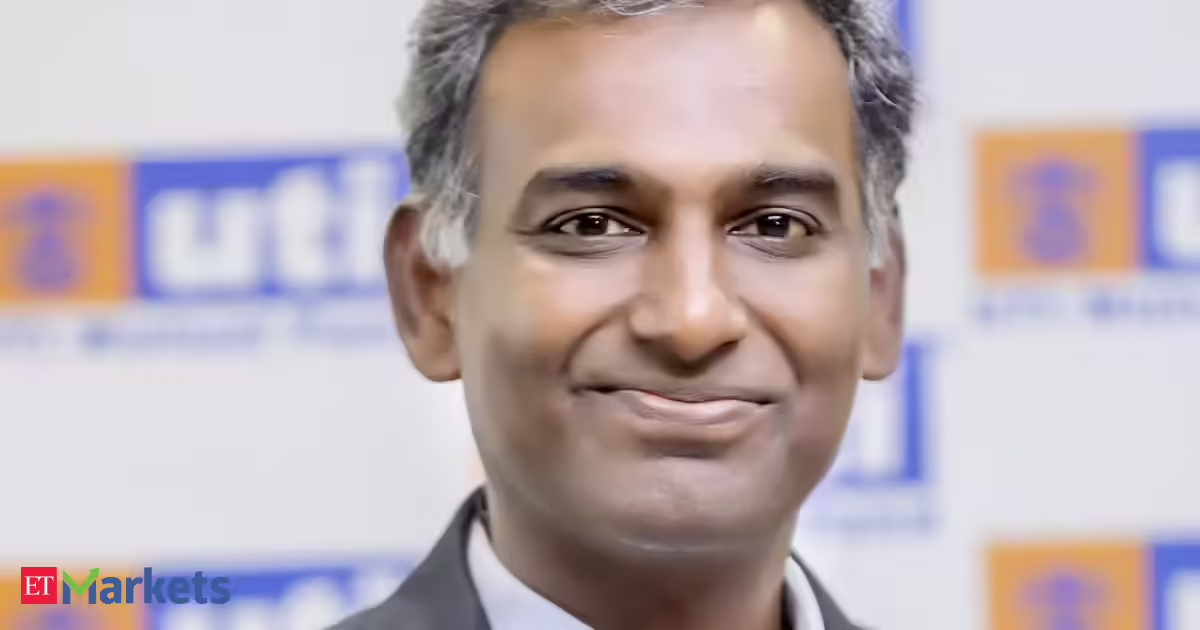
He noted that by February, most macro concerns had already been absorbed by the market, including progress on trade deals with the US and Europe, and expectations of double-digit nominal GDP growth along with mid-teen earnings growth after a subdued phase. However, the recent Iran–US conflict and the resulting sustained rise in crude prices over the past few months have reintroduced macro pressure, with potential implications for India’s current account deficit, inflation, and marginally even GDP growth. While acknowledging the possibility of some earnings cuts due to higher crude, he emphasized that India remains in a stronger position compared to past stress periods such as 2013, and still retains the potential for double-digit earnings growth in FY27.
He added that Q4 earnings have been relatively broad-based and better than earlier quarters, although Q1 could see some impact in select sectors due to elevated oil prices, making crude the most important variable to watch going ahead.
On the FY27 earnings outlook, Lakshmanan said consensus estimates are broadly in the mid-to-high teens range, though there could be some moderation at the index or large-cap level due to commodity pressures. He pointed out that while certain sectors may face margin pressure from higher crude and input costs, nominal revenue growth could remain strong due to inflation returning and overall higher nominal economic activity. On demand conditions, he said inflation is unlikely to spike meaningfully as the economy was earlier coming off a low inflation base, keeping overall conditions manageable. However, he flagged monsoon trends as an important near-term risk, noting that if rainfall comes in below the long-term average, food inflation could temporarily rise and add some pressure to consumption.
On sector allocation, he remained positive on financials, particularly private banks and insurance, citing their strong long-term return ratios, attractive valuations relative to history, and the ability to grow consistently above nominal GDP as seen over the past three decades. He also highlighted that rising interest rates could further support profitability in the banking sector. Despite concerns about high domestic investor ownership in financials, he maintained that valuations and fundamentals remain the primary drivers of his investment thesis rather than fund flow dynamics, which he said are inherently unpredictable and should not guide long-term positioning.
He continued to hold an overweight stance on IT stocks, calling it a contrarian call given weak Street positioning. According to him, Indian IT companies continue to generate strong ROCEs and cash flows, while returning a large portion of earnings via dividends and buybacks, offering attractive yield support. He also highlighted that even modest rupee depreciation provides additional earnings visibility. While acknowledging concerns about slower constant currency growth and fears of disruption from AI, he argued that IT services companies are still likely to play an important role in AI implementation, and historical transitions such as ERP and cloud shifts have not structurally disrupted long-term growth trajectories.
On healthcare, he said mid and small-cap companies offer better growth opportunities compared to large-cap names, which are relatively mature and offer steadier expansion. In capital goods, he acknowledged strong near-term momentum driven by power sector demand, transmission and distribution opportunities, and potential long-term tailwinds from data centre-related capex. However, he cautioned that valuations in several capital goods stocks have run up sharply, already pricing in high growth expectations, and advised a more selective, bottom-up approach rather than broad sector optimism at current levels.Finally, on capital flows, he stressed that market positioning should not be based on assumptions around FII or domestic inflows, as these are highly unpredictable and can shift quickly. Instead, he reiterated that investment decisions should remain anchored in fundamentals, earnings visibility, and valuation comfort. Overall, his view suggested that while near-term volatility from crude oil and inflation risks cannot be ignored, India’s broader earnings cycle into FY27 still points toward steady growth, with selective sector opportunities continuing to drive market returns.

Shoppers enter and exit a Dior luxury boutique in Venice, Italy, on Nov. 16, 2025.
Michael Nguyen/NurPhoto via Getty Images
The retail industry emerged from a choppy first quarter relatively unscathed, but higher than usual tax refunds and an uptick in buy now, pay later use likely helped to buoy spending.
As Wall Street looks ahead to the second quarter, the period could offer a clearer view on consumer health and just how much high gas prices and persistent inflation have disrupted the economy and pressured already-strained household budgets.
“Once you got through April and May, you’re really not seeing the impact of tax refunds anymore, and those months were a little bit choppier, so there’s a lot of moving pieces that maybe kept the consumer going for longer than we would have expected,” said Janine Stichter, a retail analyst and managing director at BTIG.
“As you peel back these tax refunds, you might start to see some of the underlying weakness … the consumer has not yet fully fallen apart and that’s why I think people are really looking to Q2 to say, ‘All right, well, what does the health of the consumer actually look like?’”
The period between February and May — which encompasses many retailers’ fiscal first-quarter results — brought a fresh wave of concerns about household spending. President Donald Trump started a new conflict in the Middle East, which led to surging gas prices, plummeting consumer confidence and renewed concerns about the health of the U.S. economy.
But when retailers reported their first-quarter results over the last few weeks, there were few cracks to be found as sales rose, profits grew and outlooks stayed consistent at many of the largest U.S. companies.
“It was a surprisingly robust quarter,” said Neil Saunders, retail analyst and managing director at GlobalData. “Despite the rising gas prices, I think despite the choppiness in consumer sentiment, I think despite the uncertainty over the economy and everything else that’s going on in the world, consumers still showed up and they opened their wallets and they spent.”
However, right around the same time the conflict in the Middle East began, tax refunds started trickling in. The number of people who received them, and the amounts they got, were higher than last year, which gave cash-strapped consumers some extra pocket money to go shopping.
“That was a very helpful offset in terms of spending. I think without them there would have still been growth, but they really did provide the icing on the cake,” said Saunders.
Take Target, which said same-store sales jumped 5.6% during its fiscal first quarter, its first positive same-store sales number in five quarters with strength across all six of its core merchandising categories. But the strength wasn’t just because of Target’s turnaround efforts, as finance chief James Lee acknowledged higher tax refunds helped to fuel spending.
“That benefit will be fading over the rest of the year,” Lee said last week. “While consumers have proven to be resilient so far, sentiment has been declining recently and we’re keeping a close eye on their spending behavior.”

Similar trends were spotted at Best Buy, Burlington Stores, Ross and Wayfair. At Best Buy, comparable sales rose 2%, and executives acknowledged part of that growth came from higher tax refunds. Considering the overall electronics market grew by about 3.6% during the first quarter, Best Buy still underperformed and lost market share, even with extra stimulus in the economy, Saunders said in an emailed note last week.
The impact was particularly acute in the off-price sector. Burlington estimated higher tax refunds were worth between 1.5 to 2 percentage points of its comparable sales growth, which was 6% during the quarter. Competitor Ross saw comparable sales jump a staggering 17%, beating expectations of 9%, and also attributed some of its outsize growth to extra stimulus.
During a call with analysts in mid-May, Wayfair finance chief Kate Gulliver said tax refunds had helped “buttress” the impact of higher gas prices.
“The consumer’s been able to hang in there a little bit because of stimulus sort of helping,” she said.
Meanwhile, there was also an uptick in buy now, pay later use during the quarter, which could’ve helped fuel spending as well, said Stichter. During the first quarter, buy now, pay later adoption hit new highs across income cohorts, with an estimated 15% to 17% of those making up to $150,000 using the services, Stichter said in a May research note, citing transaction data from Consumer Edge. Among shoppers making over $150,000, adoption rose to just under 13%.
“There probably is some level of either actual stress or kind of emotional pullback across all income cohorts on some level, we’re just not really seeing it in the earnings results yet,” she said. “Maybe it’s that they’re pulling back in other areas, maybe that they’re finding other ways to make payments.”
That could start to change in the current quarter, as a range of retailers gave conservative guidance that suggested consumers may not be able to weather high gas prices as well as they did earlier in the year.
“Ross had a ridiculously good quarter, I mean, almost unprecedented in terms of the level of growth,” said Saunders. “Even with that in the bank for the first quarter, their view going into the second quarter and the rest of the year is that things will still be good for them, but they will normalize.”
Walmart is another example. The mega retailer saw sales rise 7% during its fiscal first quarter, but only reaffirmed its full-year outlook, and issued weaker guidance for the second quarter than Wall Street expected.
Walmart finance chief John David Rainey told CNBC the company’s outlook was strong given everything happening in the economy, but said consumers may feel more strain as the effect of tax refunds fades in the second quarter.
“I think higher tax returns muted some of the pressure related to higher fuel prices,” said Rainey. “As we’re in a period of time right now where those tax refunds are largely not coming in, I think consumers are going to feel more of that pressure from higher fuel prices.”
TJX Companies also had a strong quarter – posting its biggest earnings per share beat since August 2021 as same-store sales jumped 6%, almost 2 percentage points above Wall Street expectations. Still, its second-quarter guidance for earnings per share and same-store sales came in short of estimates.
Meanwhile, E.l.f. Beauty delivered sizable beats on the top and bottom lines but still issued a weaker-than-expected outlook. CEO Tarang Amin told CNBC the “consumer is suffering” and said the company plans to roll back some tariff-fueled price increases as a result.
While retailers can at times be “more cautious in their guidance than the reality might suggest,” executives and analysts generally agree they could see a more strained consumer in the current quarter and the rest of the year, said Saunders.
“[That] tells you that retailers are kind of seeing the signs that some of this trough around the growth rate won’t persist across the balance of this year,” said Saunders. “Not that it will be terrible, but just the heat will come out of some of that momentum, and I think that is related to the fading impact of tax [refunds] and the picture of inflation that will probably pick up across the balance of this year.”

You Can Now Trade 8,000 US Stocks on Binance Using Your Stablecoins

Christian Pulisic leads USA to impressive World Cup warm-up win against Senegal

The Painful Truth About Long Covid


-

 NewsBeat5 days ago
Israel says it has killed new Hamas military leader in Gaza City airstrikes
-

 Tech5 days ago
NASA taps Blue Origin to deliver lunar rovers for Moon Base initiative
-

 Politics7 days ago
Bridgerton Season 5: Cast, Release Date And Everything We Know So Far
-

 Sports6 days ago
2026 NBA Finals schedule, odds: Knicks await Thunder or Spurs after winning East
-

 News Videos5 days ago
XRP *JUST* SUCCEEDED!!!! CLARITY ACT EXPOSED!!! (SHE EXPOSED IT)
-

 News Videos3 days ago
This is BROKEN! INSANE 5x MONEY CAR WASH WEEK! The NEW GTA Online UPDATE Today! (GTA5 New Update)
-
 Crypto World6 days ago
Micron Crosses $1 Trillion Market Cap as AI Demand Reshapes Memory Sector
-
 NewsBeat7 days ago
Hottest May day ever as London hits 34.8C in 2C leap from previous records
-

 Business5 days ago
Selena Gomez Reportedly Upset Over Benny Blanco’s Comments on Her ‘Terrible’ Diet
-
 Tech6 days ago
China assigns ID codes to 28,000+ humanoid robots
-

 Business6 days ago
Nikkei 225 Surges Past 65,000 for First Time as Iran Peace Hopes Fuel Record Rally
-

 Tech7 days ago
Microsoft’s quiet Claude Code retreat and the real cost of enterprise AI
-

 Tech3 days ago
Waymo dominates autonomous vehicle registrations as Tesla trails behind
-
 Entertainment6 days ago
‘Breaking Bad’ Star’s Easy-to-Binge 6-Part Crime Series Spin-Off Is Finally Heading to Free Streaming
-

 NewsBeat7 days ago
Crowds find riverside shade in York as temperatures soar
-
Tech5 days ago
The Samsung pay deal is the moment Korean unions changed register
-

 Entertainment6 days ago
Days of our Lives 2-Week Spoilers May 25-June 5: Gwen Rages, Abe Confesses & 2 Tragic Anniversaries!
-
 Tech2 days ago
SpaceX just won a second Golden Dome contract. This one is $4.16 billion.
-

 Tech7 days ago
Westone Audio and Etymotic Acquired by Fidelity Collective in Major IEM Market Move
-
 Entertainment6 days ago
Taylor Swift Fans Label Travis Kelce’s Beer-Chugging A ‘Red Flag
You must be logged in to post a comment Login