
Business
Strait of Hormuz Crisis Triggers Oil Price Surge as Iran Fires on Ships Amid US Blockade


DUBAI, United Arab Emirates — Shipping traffic through the Strait of Hormuz ground nearly to a halt Wednesday as Iran fired on commercial vessels and seized others, escalating tensions with the United States and sending world oil prices sharply higher amid fears of a prolonged disruption to one-fifth of global crude supplies.

By midday Wednesday, April 22, commercial shipping in the narrow waterway linking the Persian Gulf to the Gulf of Oman was at a virtual standstill, with reports of Iranian gunboats opening fire and Revolutionary Guard forces seizing at least two vessels. Video footage showed tankers and cargo ships making abrupt U-turns to avoid the zone, while maritime tracking data confirmed only minimal transits in recent days.
The latest flare-up comes as a fragile ceasefire between the U.S. and Iran nears expiration and follows a confusing series of openings and closures of the strait over the past week. Iran briefly declared the waterway open on April 17 before reimposing tight controls days later in response to the ongoing U.S. naval blockade of Iranian ports, imposed April 13. On April 18-20, traffic slowed dramatically after shots were fired and vessels were turned back.
Oil markets reacted swiftly to the renewed uncertainty. Brent crude, the global benchmark, climbed toward the $100-per-barrel mark, with intraday trading reflecting heightened risk premiums. West Texas Intermediate futures also rose, though the Brent-WTI spread remained wide due to regional shipping disruptions. Analysts noted prices had already spiked significantly since the U.S.-Israeli military operations against Iran began Feb. 28, with Brent briefly exceeding $110 earlier in the crisis before easing somewhat on hopes of diplomacy.
The Strait of Hormuz has long been the world’s most critical energy chokepoint. Before the 2026 crisis, roughly 20-21 million barrels of oil and petroleum products passed through its waters daily, accounting for about one-fifth of global seaborne oil trade and significant volumes of liquefied natural gas. Major exporters including Saudi Arabia, Iraq, the United Arab Emirates, Kuwait and Qatar rely heavily on the route, which is only about 21 miles wide at its narrowest point.
Iran’s actions this week included reports of its forces firing on three ships and seizing two others accused of violating restrictions. The Revolutionary Guard Corps said Wednesday it stopped vessels attempting unauthorized crossings and directed them toward Iranian waters. U.S. officials maintained their blockade of Iranian ports, with the Navy forcing several ships to turn around in recent days. A ceasefire extension pushed by President Donald Trump appeared under strain, with both sides accusing the other of violations.
Shipping firms have grown increasingly cautious. War-risk insurance premiums have soared, and many operators now demand clarifications on mine threats and safe passage before committing vessels. Satellite imagery and tracking services showed hundreds of ships idling outside the strait or rerouting via longer, costlier paths around Africa’s Cape of Good Hope. Industry executives warned that even a full reopening could take months to restore normal flows due to backlog, insurance issues and damaged confidence.
The crisis traces back to Feb. 28, when U.S. and Israeli strikes targeted Iranian sites, leading to the assassination of Supreme Leader Ali Khamenei and Iran’s subsequent declaration of the strait as closed or heavily restricted. Traffic plummeted by up to 70-80% in the following weeks, with attacks on vessels reported and some ships abandoned or damaged. At least a dozen incidents involving merchant ships have occurred since early March, resulting in crew casualties.
Diplomacy has produced mixed results. Talks in Islamabad aimed at extending the ceasefire stalled over key issues including sanctions relief and nuclear concerns. Iran has used the strait as leverage, alternating between threats of full closure and conditional openings while demanding the U.S. lift its port blockade. Trump has publicly stated that Iran wants the waterway open to resume oil revenue, but U.S. forces continue enforcing restrictions on Iranian-linked shipping.
Global energy markets have felt the strain. Oil prices surged in March as the disruption deepened, with Brent climbing well above $100 and the Brent-WTI spread widening dramatically due to higher shipping costs for Middle East crude. While some relief came from strategic reserve releases and alternative routing, analysts warn that prolonged restrictions could exhaust inventories and force rationing or deeper economic pain. Global supply losses from Iranian outages and reduced Gulf exports have already mounted.
Major consuming nations are scrambling for alternatives. China, a top buyer of Iranian oil, has explored workarounds, while European and Asian refiners face higher costs for rerouted cargoes. The United Arab Emirates and Saudi Arabia have accelerated plans for pipelines and infrastructure that could bypass the strait entirely, a shift that could permanently alter regional export patterns even if tensions ease.
For the shipping industry, the Hormuz crisis has been devastating. Thousands of seafarers remain at risk, with some vessels going “dark” by disabling tracking signals to slip through quietly. Freight rates for alternative routes have spiked, and insurers review coverage every 48 hours. Port operators in the Gulf report reduced activity, while downstream effects ripple into higher fuel costs for airlines, trucking and manufacturing worldwide.
Environmental and humanitarian concerns have also surfaced. Attacks on tankers raise the specter of oil spills in sensitive waters, and delays in LNG and fertilizer shipments could affect global food and energy security. The International Maritime Organization and maritime security centers continue issuing warnings to vessels to avoid the area where possible.
U.S. Central Command has reported forcing multiple ships to reverse course near the blockade zone, emphasizing freedom of navigation while targeting Iranian economic lifelines. Iran, meanwhile, portrays its actions as defensive responses to aggression, vowing swift retaliation if the U.S. does not back down.
Market participants remain on edge ahead of the ceasefire deadline. Some analysts predict further volatility, with oil potentially testing new highs if traffic stays frozen into May. Others see potential for de-escalation if backchannel talks progress, though trust is low after repeated reversals on strait access.
The 2026 Strait of Hormuz crisis has underscored the vulnerability of global energy supplies to geopolitical flashpoints. What began as part of broader conflict with Iran has evolved into a high-stakes contest over one of the planet’s most vital maritime arteries. For now, with gunboats active and vessels turning away, the world watches anxiously as oil prices climb and supply chains strain.
Longer term, the episode may accelerate diversification efforts. Pipeline expansions, floating storage strategies and investment in non-Gulf sources could reduce reliance on the strait. Yet for the immediate future, the narrow passage between Iran and Oman remains the focal point of a crisis with consequences far beyond the region.
As Wednesday’s events unfolded, shipping data showed continued low activity, with experts cautioning that full normalization — if it occurs — would require sustained calm, mine clearance and restored insurer confidence. Until then, the Hormuz chokepoint continues to dictate headlines and energy costs worldwide.


Operator
Good day, and welcome to the AMERISAFE First Quarter 2026 Earnings Call. Today’s conference is being recorded. At this time, I would like to turn the conference over to Kathryn Shirley, Chief Administrative Officer. Please go ahead.
Kathryn Shirley
Executive VP, Chief Administrative Officer & Secretary
Thank you, operator, and good afternoon, everyone. Welcome to the AMERISAFE 2026 First Quarter Investor Call. If you have not received the earnings release, it is available on our website at amerisafe.com.
Today, this call is being recorded. A replay of today’s call will be available. Details on how to access the replay are in the earnings release.
During this call, we will be making forward-looking statements intended to fall within the safe harbor provided under the securities law. These statements are based on current expectations and assumptions that are subject to various risks and uncertainties. Actual results may differ materially from the results expressed or implied in these statements.
If the underlying assumptions prove to be incorrect or as the results of risks, uncertainties and other factors, including factors discussed in the earnings release, in the comments made during today’s call and in the Risk Factors section of our Form 10-K, Form 10-Q and other reports and filings with the Securities and Exchange Commission. We do not undertake any duty to update any forward-looking statements.
I will now
Business
Is Grok Down Now? Grok AI Experiences Intermittent Outages Amid High Demand on April 23 2026
SAN FRANCISCO — xAI’s popular Grok chatbot faced scattered connectivity issues and response delays Thursday as some users reported errors while trying to interact with the AI on the web, mobile apps and integrated X platform, though official status pages indicated services remained largely operational with no major declared incidents.
Complaints surfaced Wednesday evening and early Thursday, with users describing messages such as “Sorry about that, something didn’t go as planned. Please try again” or temporary unavailability for chat responses and image generation. A handful of posts on X directly asked whether Grok was down, while others noted slower replies or failed prompts even for simple queries.
xAI’s official status dashboard at status.x.ai showed “Service fully operational” for Grok (Web), Grok on iOS and Android, and API endpoints as of early Thursday. The company reported no active incidents and high uptime over the past 30 days. Independent monitoring sites presented a mixed picture: some detected user-reported spikes in problems linked to high demand, while others confirmed normal operation.
Downdetector and similar trackers logged increased reports in the past 24 hours, with the majority centered on the mobile app followed by the website. Common issues included delayed responses, login hiccups and temporary “high demand” messages that prevented immediate access for some free-tier or lighter-subscription users. StatusGator noted hundreds of user-submitted reports attributing slowdowns to surging traffic rather than outright server failure.
The timing coincided with growing global interest in Grok, which has seen rapid adoption since its launch and subsequent model updates. As one of the more uncensored and real-time capable AI assistants, Grok often experiences traffic spikes during major news events, viral memes or when competing chatbots face their own limitations. Analysts suggested that recent model enhancements and expanded features could be driving heavier usage, occasionally straining resources even without a full outage.
xAI has not issued a public statement on the latest reports. In past episodes of high demand, the company has encouraged users to wait a few minutes and retry, noting that backend systems automatically scale but can still show temporary friction for some accounts. SuperGrok subscribers and X Premium users have generally reported fewer interruptions, pointing to possible prioritization in resource allocation during peak loads.
For affected users, common troubleshooting steps include refreshing the browser, restarting the app, clearing cache, checking internet connection or trying the service at a less busy time. Some also switched between grok.x.ai, the X app integration and mobile versions to regain access. Persistent problems may warrant checking xAI’s status page or waiting for automatic resolution, as many prior “outages” resolved within one to two hours without intervention.
This is not the first time Grok has drawn attention for availability questions. Earlier in 2026, brief disruptions occurred around major updates or high-traffic periods, often resolved quickly. Unlike some competitors that have suffered prolonged global blackouts, Grok’s issues have typically been localized or demand-related rather than widespread infrastructure failures.
The chatbot’s integration with the X platform adds another layer: when X experiences heavy usage, Grok responses embedded in the app can feel slower even if core servers are stable. Users in different regions, including Asia and Europe, reported varying experiences, with some in high-demand time zones noticing more delays.
xAI continues to invest heavily in infrastructure, including new data centers and optimized inference systems, to support growing demand. Elon Musk, xAI’s founder, has publicly emphasized the goal of making Grok maximally truth-seeking and available to as many users as possible, while balancing compute costs and performance.
Industry observers noted that AI services worldwide face similar challenges as adoption surges. Rapid growth in conversational AI means companies must constantly balance user experience against backend capacity. Grok’s real-time knowledge via X and less restrictive personality have made it especially popular, sometimes leading to usage patterns that stress systems more than purely productivity-focused tools.
For subscribers wondering about paid tiers, SuperGrok and higher X Premium plans often provide priority access during congested periods. Free users may encounter rate limits or “try again later” prompts more frequently. xAI has not detailed exact thresholds but has hinted at ongoing improvements to fairness and scalability.
As of Thursday morning, most users appeared able to access Grok normally after short waits, suggesting the reported problems were intermittent rather than a systemic outage. Monitoring sites showed reports tapering off after initial spikes, consistent with past demand-driven fluctuations.
The episode highlights the evolving nature of consumer AI services. What once were occasional server issues have become tests of how well companies manage explosive growth. Grok’s team has a track record of transparent communication via status pages and quick fixes, helping maintain user trust even during rough patches.
Meanwhile, competitors like OpenAI’s ChatGPT, Google’s Gemini and Anthropic’s Claude have faced their own intermittent availability questions in recent months, underscoring that no major AI chatbot is immune to scaling pains. Users have grown accustomed to checking dedicated status dashboards rather than assuming permanent downtime.
For those still encountering errors, experts recommend trying incognito mode, a different device or network, and monitoring official channels. If problems persist beyond a few hours, reaching out through X support or xAI feedback channels can help surface individual account issues.
Grok’s development team continues pushing model improvements, with hints of larger versions and enhanced capabilities on the horizon. Such updates often precede temporary strain as new features attract fresh waves of users testing limits.
In the broader context, Thursday’s scattered reports serve as a reminder of how reliant millions have become on AI assistants for everything from quick facts to creative tasks. Brief hiccups, while frustrating, rarely signal deeper problems when official systems show green across the board.
As traffic normalizes, most users should regain seamless access. xAI’s focus on rapid iteration suggests any underlying demand pressures will be addressed through expanded capacity rather than reduced features.
The situation remains fluid, but current indicators point to high demand rather than a full-scale outage. Users are advised to stay patient, try again shortly, and consult status.x.ai for the latest confirmed information.
Grok’s resilience amid rapid growth reflects both its popularity and the challenges of delivering cutting-edge AI at global scale. For now, the service appears operational for the vast majority, with only pockets of users navigating temporary speed bumps on an otherwise busy Thursday.

Earnings call transcript: IBM Q1 2026 beats earnings expectations
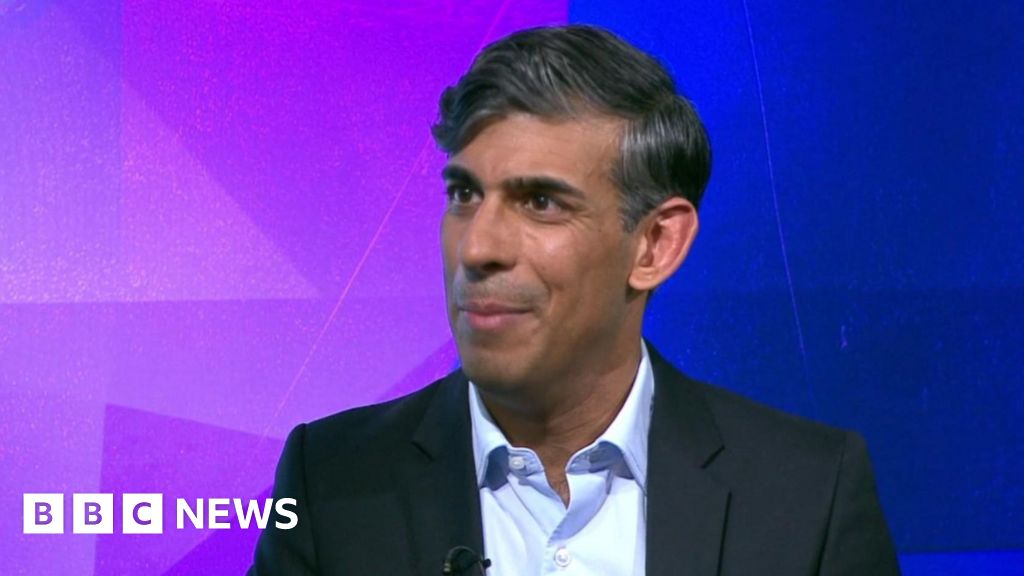
The former prime minister said graduates’ concerns about getting entry-level jobs are justified.

The broader market has undergone a sharp correction, with the Sensex falling nearly 8% from its 52-week high. In contrast, the BSE 150 MidCap index has been relatively resilient, slipping only around 3%. But beneath this surface stability lies considerable damage — 42 midcap stocks in the index have corrected between 25% and 50%.To understand the deeper trend, we analysed FII activity in the March 2026 quarter, using shareholding data available for about 135 midcap companies. The numbers offer valuable insight into foreign investor sentiment amid the selloff.Read more

Stifel Financial: IB Leads The Way Despite March Dealmaking Snag
Generation Income Properties amends Series A preferred unit redemption terms
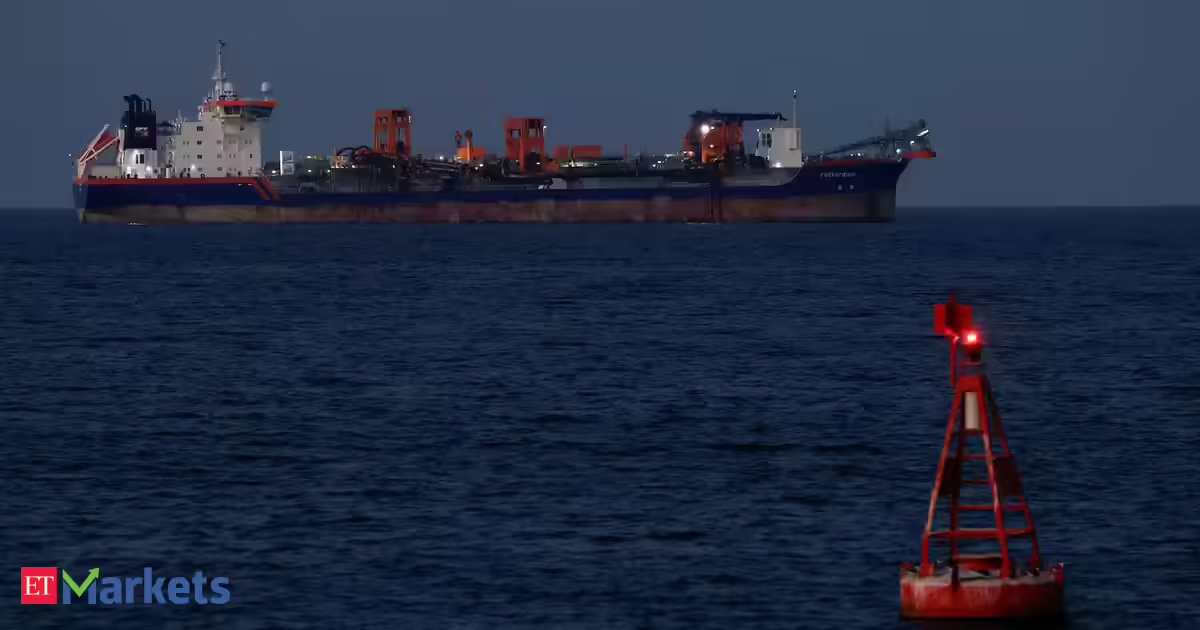
The clarification came after two Indian vessels had to turn back from the Strait of Hormuz after Iranian forces fired upon them as they attempted to cross the crucial waterway on April 18.
Before turning back, the captain of Indian tanker Sanmar Herald, in an audio recording that has surfaced, is heard pleading with Iranian forces to stop firing despite prior clearance to pass the Strait of Hormuz. “This is motor vessel, Sanmar Herald. You gave me clearance to go, my name is second on your list… You are firing now. Let me turn back.” While New Delhi has consistently rejected claims of any financial arrangements with Tehran for ship movement through the critical energy corridors, some reports linked the April 18 incident to a crypto scam.Reports suggest scammers are offering shipowners fake safe passage through the strait in exchange for crypto. At least one ship fell victim to the scam and was fired at while attempting to pass through the waterway, according to Marisk, a maritime risk services company.

At a news briefing, Mukesh Mangal, Additional Secretary in the Ministry of Ports, Shipping and Waterways, termed as “fake news” the report of any payment being made for the safe passage of Sanmar Herald.
“News is spreading about a reported payment by the captain of the vessel Sanmar Herald in US dollar to persons claiming to represent the Islamic Revolutionary Guard Corps (IRGC) Navy to grant passage, and fell victim to cyber criminals. We spoke with the owner of the vessel, and he confirmed that it is fake news and no such incident had happened,” he said.He said his ministry, in coordination with the Ministry of External Affairs, assesses the situation before asking Indian vessels, stranded in the Persian Gulf since the start of the Iran war, to cross the Strait of Hormuz.
“This unfortunate incident (of Iranian guards firing on Indian ships) happened on April 18. There was firing on two of our vessels, that’s why they had to go back,” he said. “As we have been telling in past also, we do not have any new data, any confirmation on any of our vessels has paid money to any of the authorities for this purpose.”
He termed as “fake news” reports suggesting that Sanmar Herald paid money to some cybercriminals, and that’s why it was fired upon.
“There is no relation (between the firing and the reports),” he said. “This is fake news.”
Chennai-based Sanmar Shipping denied any payment.
“It has come to our attention that there have been reports on social media about Sanmar Shipping’s very large crude carrier, Sanmar Herald, flying the Indian flag, falling prey to a cryptocurrency scam.
“We would like to clarify that these reports are completely false,” it said in a statement.
The shipping line said it is working in close coordination with the relevant agency of the Indian government to ensure the safe passage of Sanmar Herald.
According to shipping monitor TankerTrackers.com, two India-flagged ships, including a supertanker carrying Iraqi crude, were forced to turn back on April 18 after coming under fire.
The disruptions come as scores of commercial vessels and thousands of seafarers remain stranded in the Persian Gulf since the outbreak of the West Asia war on February 28, which has sharply curtailed movement through the Strait of Hormuz.
The Strait of Hormuz handles about a fifth of global oil and liquefied natural gas flows, making it one of the world’s most critical energy arteries. Iran’s ability to disrupt traffic through the narrow passage has emerged as a key lever in the conflict.
The halt in transit has driven up energy prices, triggered supply shortages in parts of the world and forced some countries to ration fuel, underscoring the global impact of the standoff.

Lululemon store sign on March 2,, 2026 in London, United Kingdom.
Peter Dazeley | Getty Images
Lululemon on Wednesday named Heidi O’Neill as the athleisure company’s new CEO, effective Sept. 8.
The news comes after the company has seen more than a year of disappointing performance and been embroiled in a dramatic proxy battle, with founder Chip Wilson criticizing the business.
Shares of the company sank more than 5% in extended trading.
O’Neill has held multiple roles at Nike, contributing to the sportswear behemoth’s growth. She also held positions at Levi Strauss, Hyatt Hotels and Spotify.
“Heidi is an inspiring leader and proven, consumer-driven brand strategist, with a rare ability to both imagine a new future for a brand and to create the structure and processes to deliver on that vision,” said Marti Morfitt, the company’s executive chair of the board of directors, in a statement. “We selected Heidi because of the breadth of her experience, her demonstrated success delivering breakthrough ideas and initiatives at scale, and her ability to be a knowledgeable change and growth agent.”
O’Neill said in a statement that she plans to focus on building off of the company’s core foundation and unlock growth in global markets. O’Neill will start with a base salary of $1.4 million, according to an 8-K filing.
“I am humbled by the opportunity and energized by what the team is already building,” she said in her statement. “I look forward to joining the company and helping to define and deliver the organization’s next chapter of success.”
Lululemon has been struggling with weak sales and increased competition, as well as mounting costs from tariffs. In its last earnings report, the retailer said it expects tariffs to cost the company $380 million this year.
Wilson, Lululemon’s largest shareholder, has also been placing increased public pressure on the company to make changes to its board of directors. He did not immediately respond to a request to comment on the appointment.
In a statement, GlobalData managing director Neil Saunders said O’Neill has “a very strong pedigree in the activewear and sporting space” and “has an intimate knowledge of how the industry works.”
“There will be some, mostly activist investors, who see O’Neill as something of a safe and traditional choice,” Saunders said. “This argument is partly valid as a lot of cultural change is needed at Lululemon in order to improve performance. However, in our view, O’Neill is her own person who will come with an agenda of change.”
While at Nike, O’Neill played a key role in the company’s doomed direct-to-consumer sales strategy, where the brand pivoted away from wholesale partners in favor of its own website and stores under former CEO John Donahoe. When current CEO Elliott Hill took over as Nike’s next chief executive, he made it a priority to walk back the direct selling plan.
Prior to leaving Nike, O’Neill also oversaw product and innovation at a time when the brand faced criticism for falling behind on new products and focusing too heavily on the same legacy lifestyle franchises, Dunks, Air Force Ones and Air Jordans. While the franchises briefly led to a surge in sales, fueling Nike’s growth to a $50 billion plus brand, they ultimately became ubiquitous in the market and viewed as uncool by some consumers.
Now, Hill is still working on unwinding that strategy and clearing inventory from those franchises from the marketplace, which has hit Nike’s margins and led to a decline in sales online.
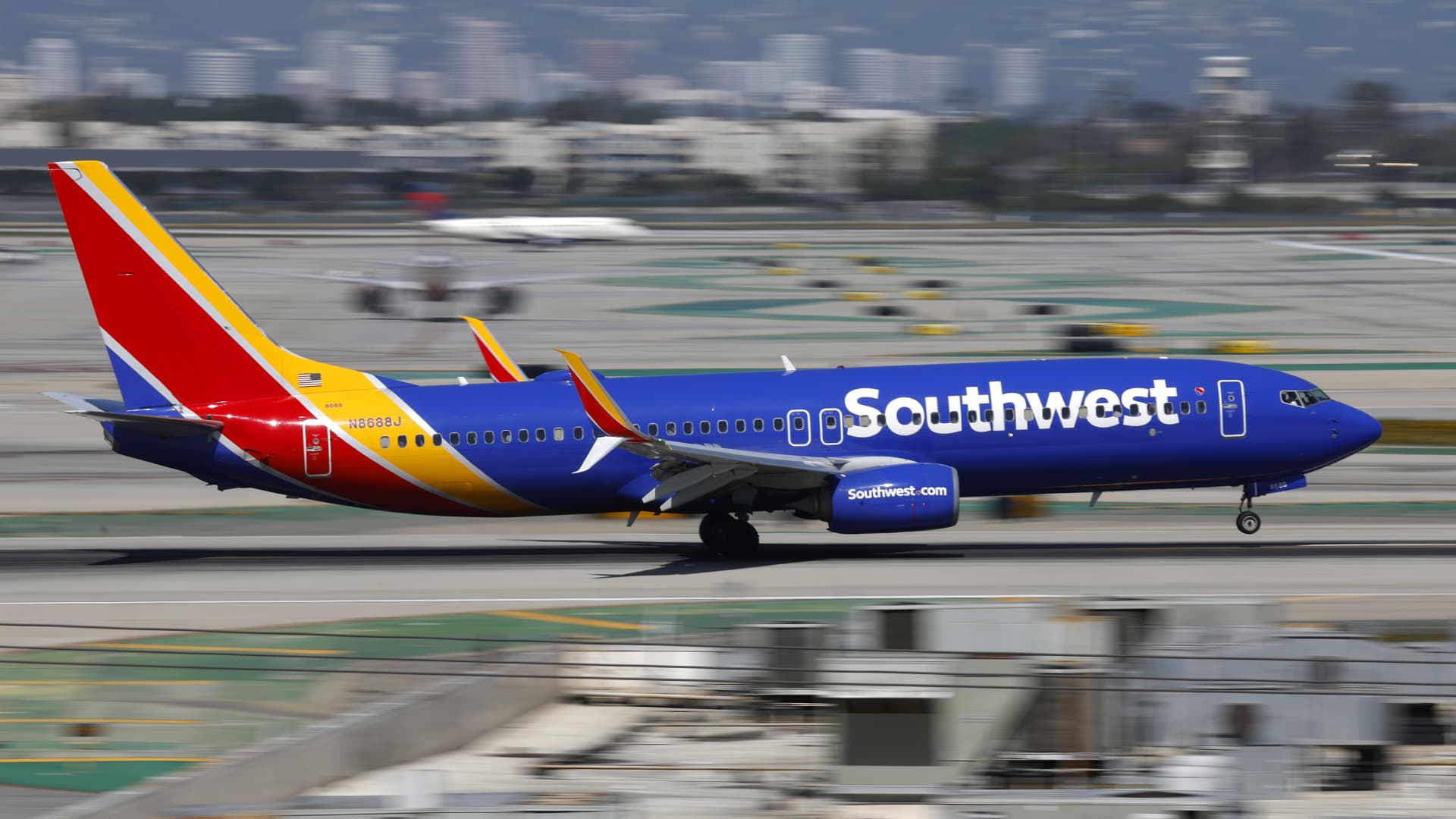
A Southwest Airlines Boeing 737 airplane lands at Los Angeles International Airport after arriving from Chicago on March 7, 2026 in Los Angeles, California.
Kevin Carter | Getty Images
Southwest Airlines forecast second-quarter earnings below analyst estimates, citing higher fuel prices, while holding off on updating its full-year 2026 forecast.
Southwest expects to earn between 35 cents and 65 cents a share in the current quarter, while analysts polled by LSEG expected 55 cents a share.
The airline in January forecast earnings per share of $4 this year, saying that it expected its new initiatives would pay off. Southwest has sought to increase revenue with checked bag fees and seat assignment fees.
“Achieving this outcome would require lower fuel prices and/or stronger revenue performance to offset higher fuel expense. The Company expects to provide updates to this guidance as appropriate,” Southwest said in an earnings release Wednesday.
Airlines have been either cutting their full-year forecasts or holding off on further forecasts because of volatile prices for jet fuel, generally their biggest expense after labor. They are also pulling back on their capacity growth plans to cut costs, which can drive up airfare when fewer seats are for sale.
Southwest said it expects its capacity to be flat to up no more than 1% in the second quarter, and unit revenues to rise by 16.5% to as much as 18.5% over last year.
“Demand continues to be strong, and we remain focused on controlling what we can control by managing costs, optimizing revenue initiatives, and directing capacity toward higher‑return opportunities,” CEO Bob Jordan said in the earnings release.

Here’s what the company reported for first quarter compared with Wall Street expectations, according to consensus estimates from LSEG:
- Earnings per share: 45 cents vs. 47 cents cents expected
- Revenue: $7.25 billion vs. $7.27 billion expected
Southwest swung to a profit of $227 million, or 45 cents a share in the first quarter, compared with a $149 million loss, or a loss of 26 cents per share, a year earlier.
Revenue rose nearly 13% to $7.25 billion compared with $6.43 billion in the year-earlier period.

Spud Boys responds to customer who said they ‘won’t return’

AMERISAFE, Inc. (AMSF) Q1 2026 Earnings Call Transcript

Trump-linked American Bitcoin’s shares rise by over 12% after deploying nearly 11,300 more rigs

Manchester United reach agreement with Casemiro over contract clause amid transfer speculation

Steven Gerrard disagrees with Gary Neville over ‘shock’ Chelsea and Arsenal claim | Football

US brings back mandatory military draft registration


-

 Sports6 days ago
NWFL Suspends Two Players Over Post-Match Clash in Ado-Ekiti
-

 Fashion5 days ago
Weekend Open Thread: Theodora Dress
-

 Politics5 days ago
Palestine barred from entering Canada for FIFA Congress
-
Entertainment3 days ago
NBA Analyst Charles Barkley Chimes in on Ice Spice McDonald’s Fiasco
-

 Business3 days ago
Powerball Result April 18, 2026: No Jackpot Winner in Powerball Draw: $75 Million Rolls Over
-

 Tech4 days ago
Auto Enthusiast Scores Running Tesla Model 3 for Two Grand and Turns It Into Bare-Bones Go-Kart
-

 Politics4 days ago
Zack Polanski demands ‘council homes not luxury flats for foreign investors’
-

 Crypto World5 days ago
Russia Pushes Bill to Criminalize Unregistered Crypto Services
-

 Politics2 days ago
Gary Stevenson delivers timely reminder to register to vote as deadline TODAY
-

 Tech7 days ago
‘Avatar: Aang, The Last Airbender’ Leaked Online. Some Fans Say Paramount Deserves the Fallout
-
 Business6 days ago
Creo Medical agree sale of its manufacturing operation
-

 Business13 hours ago
Rolls-Royce Voted UK’s Most Iconic Trade Mark as IPO Register Hits 150
-

 Politics4 hours ago
Disabled people challenge government SEND proposals over segregation concerns
-

 Politics4 hours ago
Making troops accountable for war crimes threatens US alliance, ex-SAS colonel warns
-

 Crypto World5 days ago
Russia Introduces Bill To Criminalize Unregistered Crypto Services
-

 Politics5 hours ago
Starmer handler McSweeney to be dragged from shadows by Foreign Affairs Committee
-

 Politics5 hours ago
Zack Polanski responds to home secretary’s taser threat
-
Politics6 hours ago
Wings Over Scotland | How To Get Away With Crimes
-
 Crypto World4 days ago
Kelp DAO rsETH Bridge Hack Drains $292M as DeFi Losses Top $600M in Two Weeks
-

 Tech7 days ago
Ford EV and tech chief leaving automaker
You must be logged in to post a comment Login