
Business
Why U.S. brands like Nike and Starbucks struggle in China


China was once one of the most attractive and fastest-growing markets for many American brands.
With its population of more than 1.4 billion people and massive opportunities for businesses, companies were racing to take advantage of the boon that China could offer.
But in recent years, some consumer brands, including Nike, Starbucks and General Motors, have begun to see the tide turn. With rising geopolitical tensions, a surge in domestic competition and a disconnect from the Chinese consumer, American companies have lost ground in the region that once offered fuel for growth.
“China is such a big market. The numbers are so big so quickly when you talk about China that sort of everybody has wanted to try, and that’s why all brands went there,” Aaron Cheris, head of global retail practice at Bain & Company, told CNBC.
Yet those companies haven’t adjusted to the local market and its changing structures and needs, he said.
“If anything, the question isn’t what’s going wrong in China — it’s why isn’t that happening in the rest of the world,” Cheris added.
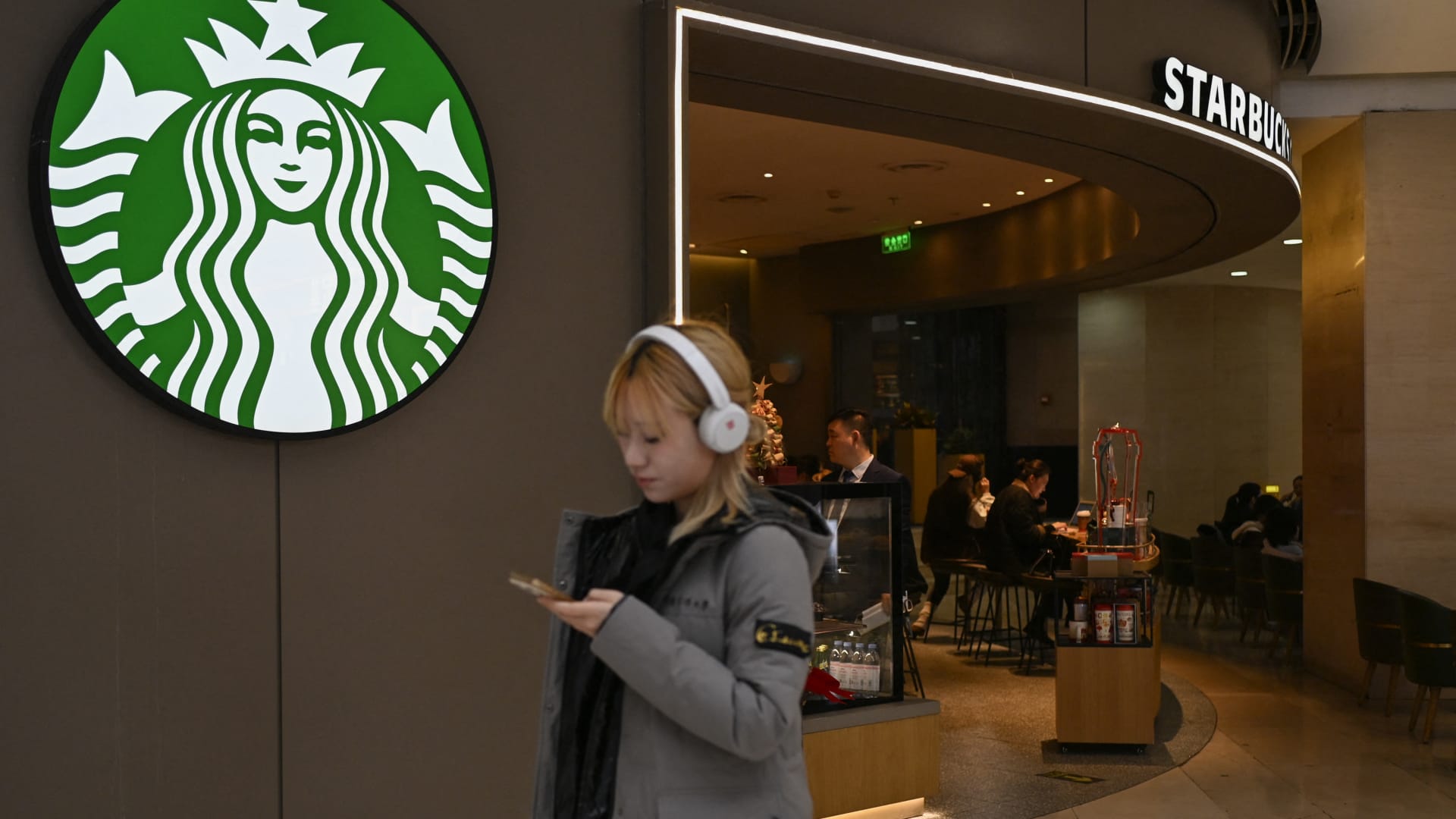
A person walks past a Starbucks coffee shop at a mall in Beijing, Nov. 5, 2025.
Wang Zhao | Afp | Getty Images
Cheris said price premiums for American products are often not worth it for Chinese consumers, and Chinese brands often have a fast innovation cycle and better distribution within the region.
“We’re just not nearly as developed. Our brands don’t necessarily think and develop quite in the same way,” Cheris said.
The U.S. and China have also been embroiled in geopolitical tensions over the past few years, especially with President Donald Trump‘s volatile tariff agenda. And while the political backdrop may be disincentivizing Chinese consumers from buying American, it coincides with a rise in pride for domestic brands as consumers look to buy more local.
Some of those domestic brands have also disrupted the broader industry, reset innovation cycles and launched price wars.
Still, some companies — such as Lululemon, Ralph Lauren and Kentucky Fried Chicken — are finding success in China with their products, a discrepancy Cheris said is due to “the basics” of their business strategies.
“Am I coming in with a good value? Did I have a compelling product that felt locally relevant? Am I advertising and making it available in the channels and stores that are winning in that market?” he said. “It really is a blocking and tackling and running your brand right kind of story.”
For more U.S. companies to turn around their China businesses, Cheris said, they’ll have to make sure the product is worth the price premium and quality.
“The key will be which brands take it seriously enough and really build enough local capability to do that, rather than just saying, ‘I’m going to take what I built globally and try to sell it to a Chinese consumer,’” he said.
Here’s how some consumer companies have seen their influence in China dwindle over the past few years:
Retail
Some retailers’ popularity and relevance have tanked in China over recent years as their bets to go big internationally faltered.
Nike is one of the biggest victims. The sneaker company has seen its China business shrink 30% since 2021, with its annual revenue hitting its lowest level in eight years in the spring. While China was once Nike’s fastest-growing region, shoppers are increasingly turning to domestic brands over international ones, while Nike is attempting to overhaul its distribution model in the country.
Yaling Jiang, founder of consumer research firm ApertureChina, previously told CNBC that Nike has “just become irrelevant” in China, while Adidas has gained traction.
That slowdown is against a backdrop of China’s sports renaissance, with the country’s sportswear market more than doubling over the past decade, according to GlobalData.
And Nike isn’t sure it’ll be able to recover its losses. On its most recent earnings call in June, outgoing CFO Matt Friend said he was unable to determine when the company’s China business would return to growth. Still, Cathy Sparks, the vice president and general manager of Greater China for Nike, previously told CNBC the company is actively working to reconnect with Chinese consumers.
A Nike store in Guangzhou, Guangdong Province, China, July 22, 2026.
Qin Zihang | Visual China Group | Getty Images
Other retailers have seen similar struggles.
Beauty retailer Estée Lauder has faced significant headwinds in China, with CEO Stéphane de La Faverie saying on a conference call in early June that he doesn’t believe China will soon resume to double-digit growth.
“We deal by making sure that our brands are the most locally relevant in the market where we operate,” he said, adding that he’s “confident” the company’s performance will be revived.
In 2022, Gap sold its China business to e-commerce firm Baozun in a $40 million all-cash deal after experiencing a slowdown in its business and an inability to connect with Chinese consumers. Under the deal, Baozun refined the company’s local strategy and Gap broke even for the first time earlier this year, with plans to open 50 new stores in mainland China in 2026.
Abercrombie & Fitch is also reportedly looking for local partners in China to hand off the reins of its business there and strengthen its performance.
Some brands, such as Lululemon and Ralph Lauren,have managed to maintain relevancy and sales. Lululemon has seen its China business rise and now expects China to grow about 20% for the year, while Ralph Lauren saw 40% growth in China in its most recent quarter.
Food and consumer packaged goods
While some food and beverage companies, such as Kentucky Fried Chicken, have continued to see success in the region, others have seen stark declines.
Starbucks entered mainland China in 1999, and it became the company’s second-largest market by 2015. But the Covid-19 pandemic started a downward turn for the company, which saw Chinese consumers seeking out lower-priced local brands instead.
“The market is going through a transition as we see an increase in mass market competitors, which we believe will shake out over time, and the market will emerge looking fundamentally different than what we see today,” then-CEO Laxman Narasimhan said on a Starbucks earnings conference call in early 2024.
Starbucks has seen intense competition from Chinese brand Luckin Coffee, which now has more than three times the number of stores in China. It also sells its drinks at a steep discount.
At the same time, Starbucks’ U.S. business was struggling, leading CEO Brian Niccol to create a joint venture with Boyu Capital to operate the company’s business in China. Boyu holds a roughly 60% stake in the joint venture and aims to use its local knowledge to lift Starbucks’ sales in China once again.
China is also the second-largest market for consumer packaged goods giant Procter & Gamble. But in recent years, P&G’s product sales have struggled in China.
“Coming out of Covid, [Greater China] was a depressed market. It was a tough competitive environment, and the results were not great,” P&G CEO Shailesh Jejurikar said on the company’s earnings conference call in late July.
Sales of its pricey SK-II skincare brand have seesawed. Chinese consumers are traveling less and scaling back spending even when they do go on vacation, hurting sales of SK-II, which relies heavily on luxury travel retail and duty-free stores. In late 2023, SK-II, which originated in Japan but is owned by P&G, also saw sales plummet, as anti-Japanese sentiment weighed on demand from Chinese consumers.
Still, P&G maintains that many of its brands are strong in China, saying some segments are hurt more by the consumer environment than a loss in brand equity. Company executives said they can grow sales in China, such as with diapers made with silk fibers that are winning over consumers.
“We are now growing share in China for the first time in 15 quarters, driven by fundamental changes we made similar to what we’re doing in the company,” Jejurikar told analysts in late July.
Autos
Employees work on a car assembly line at the SAIC General Motors Co., May 18, 2022.
Ren Yong | SOPA Images | Lightrocket | Getty Images
The U.S. automotive industry has been crippled in China.
What was once the largest potential growth market for automakers a decade ago has now turned into a massive restructuring, largely driven by the rise of domestic Chinese car companies and overcapacity creating a price war.
Detroit’s “Big Three” automakers — GM, Ford Motor and Chrysler parent Stellantis, which is no longer based in the U.S. — have collectively fallen from a global market share of 21.4% in 2019 to an estimated 15.7% in 2025, according to S&P Global Mobility. As a result, they’ve retreated from the region or restructured their Chinese operations.
General Motors, which is the longest-standing U.S. automaker in the country, is now just a shell of its former self in China. Its earnings in the region fell from around $2 billion annually in 2018 to two consecutive years of losses in 2024 and 2025.
GM’s fall from grace in the country comes as the automaker is seeing increased domestic competition and changing consumer sentiment. Experts have said local automakers are being fueled by government funding, as well as a culture of innovation and speed that China has instilled in its workers.
Still, a slowing Chinese market and underutilization have forced domestic companies — such as BYD, Geely and more — to begin exporting to major auto markets globally, including Europe, Canada and South America.
More Chinese consumers are also choosing electric vehicles over traditional gas-powered cars for their price and quality. New energy vehicles, which include battery and hybrid-powered cars, accounted for 65.1% of new passenger cars sold in July — up from 54% a year ago, according to China Passenger Car Association data released Tuesday.
GM isn’t the only American automaker considering its future in the region. EV leader Tesla is reportedly weighing the sale or spinoff of its Chinese business, according to a July report by The Wall Street Journal.
Ford, which in recent years has worked to position itself as the most American automaker, has been moving more of its operations and sales efforts to the U.S., including shifting the production of its Lincoln models from China to the U.S. beginning in 2030.
Between 2018 and 2022, Ford said, it saw a 32.4% decline in China sales. The company no longer reports its financial results by region.
– CNBC’s Gabrielle Fonrouge, Amelia Lucas and Mike Wayland contributed to this report.


The price of bitcoin continued to soar into Friday, hitting a three-month high following the Treasury Department’s announcement to increase its long-term bond buybacks. The rally coincides with a renewed push from the Trump administration to introduce digital asset regulations and pass the Clarity Act. Crypto stocks powered higher this week along with the price of bitcoin. The price of…
Copyright ©2026 Investor’s Business Daily, LLC. All rights reserved. 87990cbe856818d5eddac44c7b1cdeb8

Yes. Corporate subscriptions are available for teams and organisations, with discounted rates as user numbers increase. Pricing starts from $1,625 + GST per user.
Get in touch
to discuss the right option for your organisation.
Business News subscriptions are used by executives, investors, consultants and professionals who need to stay informed and make better decisions about the WA market. When you subscribe you’ll get
- Unlimited access to WA’s most trusted business journalism
- Data & Insights — detailed profiles of WA companies, people, projects and deals
- MyBN — a personalised feed based on the companies, people and sectors you follow
- Special publications and industry reports
- Daily and weekly email newsletters
Data & Insights is a research tool built specifically for the WA market. It draws on more than 30 years of Business News reporting, updated regularly to reflect what’s happening now. Use it to:
- Look up detailed profiles of WA companies, including financials, directors and ownership
- Find decision-makers and track their career movements
- Research live and completed projects across WA industries
- Monitor deals, appointments and market activity
- Access industry rankings and league tables
Data & Insights is updated daily by our dedicated research team, which uses the latest announcements, ASX filings and editorial coverage to keep our person, company, list and project records up to date.
Business News welcome all opportunities to make our dataset accurate, complete and current, so if you have an update request, please email the team at
general@businessnews.com.au, and we’d be happy to assist.
MyBN
is part of every subscription. It’s your personalised view of Business News. You can follow the companies, people, sectors and projects that matter to you, and get a news feed and alerts tailored to your interests. You can save articles to read later and retain only what you need.
Only subscribers have full access to all content on the Business News website.
If staying informed about the WA economy is part of your job, and/or you’re looking for networking opportunities in WA, Business News is built for you.
Business News subscribers are:
- Executives and directors tracking competitors, clients and market movements
- Investors and advisers researching companies, deals and industry trends
- Consultants and professionals staying across sectors relevant to their clients
- Business owners looking for leads, context and market intelligence
Most Business News publications cover national or global markets. Business News is focused entirely on Western Australia, which means the journalism, the data and the intelligence are all built around WA companies, people and projects — not adapted from a national feed. Data & Insights, included with every subscription, combines more than 30 years of WA-specific editorial research with live business data. There’s no comparable product for the WA market.
The Morning Digest Email provides a comprehensive wrap of the major headlines, relevant to WA business, and includes with a snapshot of the overnight news covering oil, gold and ASX-listed companies.
The Afternoon Wrap Email focuses on the news covered by our team of journalists during the course of the working day, including exclusive stories and analysis, all of which relates to WA business and the local economy.
The BN Weekender Email contains a wrap of the Business News from the week that was, highlighting the top stories in each area of WA business.
Sign up for free.
We’re happy to help.
Get in touch
and our team will come back to you.
The short answer is that no public figure exists showing exactly what an hour of downtime costs Dropbox specifically, since the company has never disclosed that number. But using Dropbox’s own reported financial data alongside broader industry research on the cost of IT outages, it’s possible to build a reasonably grounded estimate — with an important caveat: for a subscription business like Dropbox, “revenue lost during an outage” and “money that actually disappears” are two very different things.
Start with the raw math
Dropbox reported $2.52 billion in revenue for fiscal 2025, according to the company’s own annual report filed with the SEC. Dividing that by the 8,760 hours in a year works out to roughly $287,700 in revenue flowing through the company, on average, during any given hour.
That figure is often the starting point analysts use when estimating downtime costs for any company. But it’s a crude proxy, and treating it as Dropbox’s actual “loss” during an outage would be misleading for one central reason: Dropbox is a subscription business.
Why subscription revenue doesn’t just vanish
Unlike an e-commerce retailer, where a website outage during a sales event can mean transactions that simply never happen, Dropbox’s revenue comes almost entirely from recurring monthly and annual subscriptions. A paying Dropbox user doesn’t stop being billed because the service went down for an hour — their subscription renews on schedule regardless. So the $287,700-per-hour figure represents revenue that continues flowing to Dropbox even during an outage, not revenue that gets erased by one.
This distinction matters enough that industry analysts specifically flag it. One 2026 industry cost-of-downtime analysis put it directly: “SaaS downtime costs primarily through churn and SLA breach penalties — the [small] direct [monthly recurring revenue] loss from a four-hour outage is rarely the real number once trust effects are modeled.” In other words, the immediate, hour-by-hour “loss” for a subscription company is close to zero in accounting terms. The real cost shows up later, and in different forms.
Where the real costs actually come from
For a company like Dropbox, an hour of downtime is more likely to translate into cost through a few specific channels:
Service-level agreement credits. Cloud services typically promise a minimum level of uptime — often 99.9% or higher — to paying business and enterprise customers. When that threshold is breached, affected customers are usually entitled to service credits, which function as a direct, contractually obligated refund of part of their subscription fee. Dropbox has not published its specific SLA credit formula publicly, but this is standard practice across the cloud storage industry.
Customer churn. According to industry research on SaaS outages, a single major disruption can measurably increase monthly customer cancellation rates, with some estimates putting the increase in the range of 2% to 5% following a significant incident. For a company the size of Dropbox, even a small uptick in churn translates into a meaningfully larger revenue impact than the outage hour itself, since it affects future recurring billing rather than the hour in question.
Support and engineering costs. Handling a spike in customer support tickets, plus the engineering time spent diagnosing and fixing the underlying issue, carries a real labor cost, though this tends to be modest relative to the other factors for a company of Dropbox’s scale.
Reputational and trust effects. These are the hardest to quantify but often cited as the most consequential long-term cost, particularly for a company whose core value proposition is reliably storing and syncing people’s files.
What broader industry benchmarks suggest
Independent research firms have tried to quantify downtime costs across companies more broadly, and their figures vary widely depending on company size and industry. According to ITIC’s 2024 Hourly Cost of Downtime Survey, more than 90% of mid-size and large enterprises now report that a single hour of downtime costs their organization more than $300,000, with 41% of enterprises reporting hourly costs between $1 million and $5 million. A separate widely cited benchmark from Gartner, dating to 2014 but still commonly referenced, put the cross-industry average at $5,600 per minute, or roughly $336,000 per hour. More recent research from Splunk and Oxford Economics, published as part of their “Hidden Costs of Downtime” analysis, estimated the 2026 average downtime cost across company sizes at approximately $15,000 per minute, or $900,000 per hour, with aggregate annual downtime losses across the world’s 2,000 largest companies reaching roughly $600 billion.
Notably, those figures are generally drawn from companies across all industries, including manufacturing and financial services, sectors where an hour of downtime can halt physical production lines or trigger regulatory reporting obligations, both of which carry costs that simply don’t apply to a cloud storage company like Dropbox. A B2B SaaS platform, by contrast, tends to sit toward the lower end of industry cost estimates specifically because its core cost driver is churn and reputational damage rather than immediate, hard transactional losses.
Putting it together for Dropbox specifically
Applying Dropbox’s own revenue-per-hour figure of roughly $287,700 as a rough proxy, and layering on the SaaS-specific caveat that direct revenue loss is minimal for subscription businesses, a reasonable estimate is that the immediate, quantifiable cost of a one-hour Dropbox outage — SLA credits plus support overhead — likely falls well below that headline revenue figure, possibly in the tens of thousands of dollars for a single hour, rather than hundreds of thousands. The larger financial risk comes not from the hour itself, but from whether the outage is severe or frequent enough to meaningfully affect customer retention over the following weeks and months.
Dropbox has experienced a handful of confirmed outages in recent years, including a roughly two-hour global disruption in May 2025 that generated a sharp spike in user complaints before the company restored service. The company has not published a post-incident cost estimate for that event or any other specific outage, which is typical practice across the cloud software industry — companies rarely disclose exact financial figures tied to individual downtime incidents, both because the numbers are commercially sensitive and because, as the analysis above suggests, isolating a clean dollar figure for a single hour of downtime is inherently difficult for a subscription-based business.

The Dow Jones Industrial Average and other major indexes rose Friday, as the stock market looked to rebound from the previous session’s sell-off stoked by geopolitical concerns. With risk appetite rising, bitcoin climbed to a three-month high and thrust crypto-linked companies higher on stock market today. The cryptocurrency’s price has spiked up roughly 20% for the week. Just after Friday’s…
Copyright ©2026 Investor’s Business Daily, LLC. All rights reserved. 87990cbe856818d5eddac44c7b1cdeb8

More than 53,000 British businesses are in critical financial distress and at risk of collapse, with companies that depend on consumer spending under particular pressure as economic uncertainty weighs on confidence.
The number of firms in critical distress rose 9 per cent to 53,756 in the three months to the end of June, compared with 49,309 a year earlier, according to the latest Red Flag report from BTG, the insolvency and restructuring group formerly known as Begbies Traynor.
“The persistent rate of critical and significant financial distress in the UK is a clear sign that businesses are walking a tightrope as we move through the second half of 2026,” said Julie Palmer, managing partner at BTG.
All but one of the 22 sectors covered by the research recorded an increase in companies under critical distress. Leisure and culture businesses were worst affected, with a 27.1 per cent rise year-on-year to 1,478, while hotel and accommodation businesses saw a 26.6 per cent increase to 510. The number of sports and health clubs in critical distress rose 21 per cent to 980, and food and drug retailers were up 18.4 per cent to 2,350.
BTG defines companies in critical distress as those facing severe liquidity shortages, active creditor enforcement, or formal legal action such as winding-up petitions. Those in significant distress show clear financial pressure but remain operational, with time to restructure, refinance or cut costs.
Significant distress rose 1.1 per cent year-on-year to 674,030 firms. The sectors with the highest numbers in that category included support services, construction, and real estate and property services.
The figures follow a run of high-profile casualties and warnings. Ardmore, one of the construction industry’s go-to contractors, moved to appoint administrators in June. Mothercare, the struggling retailer of baby products, warned last week of “material uncertainty”, citing ongoing risks around its debt refinancing, pension deficit negotiations and weak trading.
London topped both distress lists, with 204,851 businesses in significant distress and 17,718 in critical distress. Outside the capital, the southeast, the Midlands and the northwest had the greatest number of businesses in both categories among the English regions.
The report also highlighted the scale of overdue tax liabilities. BTG found that HMRC was owed around £27 billion in corporation tax, VAT and PAYE at the end of 2025, underlining the pressure facing indebted companies as creditor enforcement activity increases. An earlier edition of the research had already warned that a new wave of zombie companies faced collapse as that tax backlog was pursued.
Creditors are increasingly turning to the courts. Ministry of Justice data cited in the report recorded 6,411 winding-up petitions last year, a 15.7 per cent increase on the previous year.
Ric Traynor, executive chairman at BTG, said: “There appears to be no relief in sight for distressed UK businesses. Whilst the extent of the impact is still unknown, the escalation in winding-up petitions is an ominous sign. Sadly, when confidence and spending remain subdued, I expect the resulting shockwaves to be felt across many other industries later this year and into 2027.”
For owners of smaller firms, the detail matters as much as the headline number. The sharpest rises are concentrated in sectors that rely on discretionary consumer spending, and the growth in winding-up petitions points to creditors, HMRC among them, being less willing to wait for payment. Traynor’s warning that the shockwaves will spread to other industries suggests suppliers and landlords to those sectors should be watching their own debtor books closely.

Jamie Young
Jamie Young is Senior Reporter at Business Matters, covering SME finance, employment law and Westminster policy since 2016. He has reported on every Budget and Autumn Statement since 2018, helped make sense of the ‘covid era’ and the bounce-back loan scheme from launch through the fraud investigations, and broke the magazine’s coverage of the 2024 late-payment reforms. He joined Business Matters straight from completing his BA in Administration from Exeter University and is NCTJ-qualified. Reach him at jyoung@cbmeg.co.uk
Royal Mail has once again missed its delivery targets for first and second class post, but said it is making progress towards the goals as its turnaround plan continues.
The postal service delivered 85% of first class deliveries the next day between March and June, up from 76% in the same three months of 2025, but below regulator Ofcom’s 90% target.
Second class mail was delivered within three days 91% of the time, another improvement from the previous year, but short of Ofcom’s 95% target.
Royal Mail said the results are “encouraging and show that the work we are doing to improve the service is having an impact”.
Royal Mail, which is owned by International Distribution Services (IDS), has struggled with rising competition in the delivery market, fewer people sending letters and fines from the regulator for missing targets in recent years.
But it said that, compared with the same period last year, the portion of first class mail delivered next-day had risen significantly while the amount of second class mail delivered within three days had improved slightly.
Chief operating officer Jamie Stephenson said: “These results are encouraging and show that the work we are doing to improve the service is having an impact.
“First Class performance is well ahead of where we expected to be at this stage of our Improvement Plan, while Second Class is tracking in line with the plan.”
Stephenson added that there is “more to do”, pointing to a £500m investment plan to improve the firm over the next five years. The plan includes a commitment to meet Ofcom’s delivery targets by May 2027.
The postal service has faced years of criticism from politicians and the public over the slowness of its letter delivery.
It is currently under investigation by Ofcom for the second year running for failure to meet its delivery targets.
The regulator fined it a record £21m in October last year for missing targets in 2024-25.
In March, postal workers from across the UK told the BBC they were being asked to move or hide mail from senior bosses so it looks like delivery targets were being met.
The firm apologised to Gloucester residents where post was sometimes delayed for months, admitting its service there was “totally unacceptable”.
Most recently, people in Worcestershire hit out over postal delays, complaining of weeks-long delays for important post to arrive, with some missing hospital appointments.
Royal Mail recently said it aims to meet regulator Ofcom’s targets by May 2027 as part of a turnaround plan costing around £500m in the next five years.
“We know there is more to do,” Stephenson wrote in a statement. “We are investing £500 million over five years and making significant changes across our network… None of this progress would be possible without the continued hard work of our frontline colleagues, including through the recent extreme heat.”
IDS was bought in 2025 by Czech billionaire Daniel Kretinsky.
Hundreds of pharmacies are facing closure because of soaring business rates, with owners warning that high taxes are forcing them to cut services for vulnerable patients.
Almost half of the 420 pharmacy owners surveyed by the National Pharmacy Association (NPA) said they were considering shutting down their practices because of higher business rates bills. The trade body found 55 per cent were considering moving to cheaper premises, raising fears that some rural and coastal communities could be left without a local branch.
Pharmacies, many of which are family-run businesses, are unable to offset the higher tax burden by raising prices, which are fixed by the NHS. Roughly 90 per cent of pharmacies’ income comes from the health service, the NPA said, leaving owners with no commercial lever to pull when fixed costs rise.
Prime Minister Andy Burnham has made lowering business rates for high-street businesses a key pillar of his summer policy blitz, announcing a 20 per cent reduction for pubs, clubs and live music venues from April next year. Pharmacies have been excluded from the relief.
The tax squeeze has intensified since business rates were increased for many properties after Rachel Reeves’s second Budget. Bills have also been affected by the latest revaluation of commercial property, which fed new rateable values into bills from April. GPs and NHS dentists, meanwhile, have their business rates reimbursed.
Onkar Singh, who runs 20 pharmacies across the Black Country, Staffordshire, Herefordshire and Worcestershire, has seen his business rates bill rise by roughly 20 to 30 per cent in the past year. His total bill is now about £250,000.
He has closed two of his pharmacies in the past two years and reduced opening hours across virtually his entire estate. He has also been forced to cut back services, such as offering free medicine deliveries to elderly patients.
Singh said: “The last three years have been the worst period in my 30 years of pharmacy.
“People are having to close a lifetime’s worth of work and effort, and having to close or reduce hours or dip into their pension pot just to keep going for their communities.”
The NPA survey found that 92 per cent of pharmacies said their rates bill was preventing them from investing in their workforce or renovations. Some pharmacists have warned that their bills have tripled, echoing the anger among small firms over the revaluation that prompted thousands to write to the then chancellor.
Singh said the impact was particularly painful because pharmacies were often being asked to fill gaps elsewhere in the NHS.
He said: “It is frustrating that pubs and restaurants get the headlines, but pharmacies are actually delivering care.
“The NHS accepted that pharmacy did an exceptional job, but in terms of funding and support with business rates we seem to be forgotten.”
The NPA said 44 pharmacies had already closed this year, leaving the national network at its smallest since 2006. Nine in 10 council areas have lost at least one pharmacy since 2022.
Olivier Picard, the chairman of the trade group, said pharmacies should receive the same rates treatment as GPs and dentists, arguing that they provide an essential health service.
A government spokesperson said: “Pharmacies already benefit from our wider business rates reforms, including permanently lower multipliers and our £4.3bn package to support ratepayers, and the government has increased funding for the sector by £340m this year as part of our shift to bring care closer to home.”
For owners of other high-street businesses, the pharmacy case is a reminder that rates relief is being targeted sector by sector, as with the £150m package for town centres that business leaders dismissed as a sticking plaster, rather than applied across the board. Firms whose prices are set by a third party, whether that is the NHS, a franchisor or a long-term contract, have no way of passing the increase on, and the NPA’s finding that 92 per cent of pharmacies have shelved investment shows where the money goes instead.
Jamie Young
Jamie Young is Senior Reporter at Business Matters, covering SME finance, employment law and Westminster policy since 2016. He has reported on every Budget and Autumn Statement since 2018, helped make sense of the ‘covid era’ and the bounce-back loan scheme from launch through the fraud investigations, and broke the magazine’s coverage of the 2024 late-payment reforms. He joined Business Matters straight from completing his BA in Administration from Exeter University and is NCTJ-qualified. Reach him at jyoung@cbmeg.co.uk
Business
Dropbox Down Now? Users Report Access Issues as Monitors Show Cloud Storage Service Mostly Operational

Some Dropbox users reported difficulty accessing the popular cloud storage and file-sharing service in recent days, though independent monitoring tools have largely characterized the platform as operational, illustrating the kind of mixed signals that often accompany scattered or localized service disruptions.
Dropbox, which offers online backup, file sharing and file synchronization across desktop, mobile and web platforms, relies on a dedicated application to keep files synced between users’ devices and its cloud-based storage servers. Any disruption to that syncing infrastructure can leave users temporarily unable to access, upload or share files stored on the platform.
Independent status-tracking services have offered a range of readings on Dropbox’s recent performance. According to UptimeRobot, the most recent automated check of Dropbox’s core infrastructure, conducted Aug. 18 from North American servers, did not detect any unusual response times or error codes. IncidentHub similarly listed Dropbox as currently operational as of a check performed Aug. 20, though the service noted Dropbox had recorded one confirmed outage across one component within the preceding 30 days. According to that same tracker, all of Dropbox’s major components, including its API, Dash platform, desktop application, DocSend service, MCP server and mobile application, showed normal operational status as of the most recent check.
StatusGator’s tracking similarly found no evidence of a widespread, ongoing disruption. The service reported that its most recent check, conducted July 27 at 9:14 a.m. UTC, found Dropbox operational, with no user-submitted outage reports logged in the preceding 24-hour period at that time. According to StatusGator, the most recent officially acknowledged Dropbox outage occurred on July 23, 2026, a date that multiple independent monitoring services have cited as the platform’s last confirmed service disruption prior to this week.
Despite that general pattern of operational status across most monitoring tools, individual user complaints have continued to surface on various outage-tracking and community platforms. According to VeePN’s Dropbox status tracker, isolated reports of access problems can occur even when broader monitoring infrastructure shows the service functioning normally, particularly when an issue is limited to a specific feature, such as login functionality or file syncing, rather than affecting the platform as a whole. The service noted that a genuine, widespread outage is typically identifiable by a sudden, simultaneous spike in user reports combined with failures detected across multiple independent monitoring regions, whereas a more limited or localized problem tends to show a much smaller and more contained pattern of complaints.
Dropbox’s own community forums have continued to reflect periodic user frustration with connectivity and syncing issues. According to StatusGator, one longtime Dropbox user described ongoing difficulty accessing the service over an extended period, writing in a forum post that they had been unable to connect to the platform for several months despite repeated attempts, a complaint that predates this week’s reports but illustrates the kind of individual, sustained access problems that can sometimes persist even when broader service monitoring shows no confirmed platform-wide outage.
Dropbox has a documented history of both brief, isolated outages and larger, more disruptive incidents affecting users broadly. In May 2025, the service experienced a global outage lasting approximately two hours, according to Tom’s Guide, which began around 10:45 a.m. Pacific time and prompted a sudden spike of roughly 1,500 user reports on the outage-tracking service Downdetector. During that incident, users reported being unable to access their files or upload new content across Dropbox’s browser, desktop and mobile applications simultaneously. Dropbox acknowledged the issue relatively quickly at the time and began investigating, ultimately implementing a fix by around 12:45 p.m. Pacific, though it took an additional 30 to 40 minutes for the company’s official status page to fully return to a normal, all-green operational status. The precise cause of that particular global outage was not disclosed publicly at the time.
Dropbox’s status page has, on rare occasions, displayed unusual or informal incident descriptions during past outages. Historical incident records associated with the company’s status page have included candid, sometimes lighthearted internal updates during active outages, such as one earlier incident in which engineers described database issues using informal language while working to restore service, a pattern reflecting Dropbox’s historically more casual internal communication style during active technical incidents, even as the underlying disruptions themselves were treated with appropriate urgency by the company’s engineering teams.
For users currently experiencing difficulty accessing Dropbox, monitoring services have generally recommended a standard set of troubleshooting steps before assuming a broader, platform-wide outage is underway. According to UptimeRobot’s guidance, users should first attempt to access Dropbox from an alternative browser, device or network, such as a mobile hotspot, and consider disabling any active VPN connection, clearing their device’s DNS cache, or restarting their router. If the service loads successfully through any of those alternative methods, the underlying issue is more likely to be local to the user’s specific device or network rather than reflecting a confirmed, company-wide Dropbox outage.
Given the discrepancy between scattered individual user reports and the largely operational readings recorded by independent monitoring services this week, it remains possible that any access issues experienced by Dropbox users reflect a more limited or intermittent disruption rather than a broad, platform-wide outage comparable to the company’s more significant service disruptions in the past. As of this report, Dropbox had not issued a public statement acknowledging any specific, ongoing service disruption beyond the previously confirmed July 23 incident, and the company’s official status page, along with the majority of independent third-party monitoring tools, continued to reflect normal operational status across the platform’s core components as of the most recent available checks.
Business
COVID-19 Cases Growing in All 50 States as ‘Nimbus’ Variant Drives Late-Summer Surge Nationwide
COVID-19 infections are growing or likely growing in all 50 states, according to the latest estimates from the Centers for Disease Control and Prevention, marking a dramatic nationwide expansion of the virus’s seasonal summer wave just as students return to school and Americans wrap up summer travel.
As of Aug. 12, 2026, the CDC’s Current Epidemic Trends model estimated that COVID-19 infections were growing or likely growing in 50 states and declining or likely declining in zero states, with the agency reporting no estimate available for Iowa due to insufficient data. According to the CDC’s own modeling summary, that leaves the entire country, apart from Iowa’s data gap, showing an upward trajectory in transmission for the first time this summer.
The shift represents a striking reversal from conditions just weeks earlier. According to Newsweek, on July 22 the CDC had estimated infections were growing or likely growing in only 37 states, with 11 states showing little change in transmission at the time. By mid-August, those stable pockets had disappeared entirely from the map, with 47 states now classified as “Growing” and New Hampshire, Rhode Island and the District of Columbia categorized as “Likely Growing.” In many states, the CDC estimates there is greater than a 99% probability that infections are actively increasing.
The reversal is even more pronounced compared with earlier this summer. According to a report from Political.org, the CDC had estimated infections were declining or likely declining in 41 states, with growth seen in just one state, as recently as June 2. The speed of that turnaround reflects a now-familiar seasonal pattern public health officials have observed for several consecutive years.
Andrew Pekosz, a professor of molecular microbiology and immunology at Johns Hopkins Bloomberg School of Public Health, described the current surge as consistent with an established late-summer pattern. “This looks like a pattern that has been documented in the past few years,” Pekosz told Newsweek, referring to the recurring late-summer and early-fall increase in COVID-19 transmission the country has experienced in recent years.
Dr. John Brooks, an infectious disease physician at Emory University in Atlanta who previously worked at the CDC, offered a similar assessment while acknowledging the psychological gap between public perception and current data. “I think most of us kind of feel like it’s fading away and are certainly very grateful for that,” Brooks said. “But nationally we’re seeing it ticking up pretty much everywhere.”
Wastewater surveillance data has provided further confirmation of the trend’s scale. Amanda Bidwell, scientific program manager for WastewaterSCAN, told Today.com that viral concentrations detected in wastewater samples have risen sharply this month. “So far in August, SARS-CoV-2 concentrations are up 106% compared to July 2026,” Bidwell said, adding that the West and South currently show the highest concentrations nationally.
Despite the widespread geographic growth, health officials have emphasized that overall COVID-19 activity remains comparatively low and that the surge has not translated into a significant strain on hospitals. According to the CDC, as of Aug. 14, the amount of acute respiratory illness prompting people to seek medical care remains very low overall, even as COVID-19 activity specifically is increasing in the West and South. Emergency department visits tied to COVID-19 have similarly remained low, according to multiple outlets citing CDC data.
Dr. Patrick Koo, division chief of pulmonology and critical care at Erlanger Hospital, said fewer patients are seeking emergency care for COVID-19 compared with earlier phases of the pandemic, attributing the shift both to the virus’s evolution and to more people managing mild illness at home. “The virus has, of course, gone through multiple passes and mutations, and therefore the symptoms of COVID-19 are now much much milder compared to what we saw during the pandemic, so I think that if we take proper precautions and you know try to practice good hand hygiene to stay away from others that are sick for until they get better, of course, and that would minimize a lot of the transmission,” Koo said. He added that current seasonal patterns should not cause alarm. “We do see periodic rises in certain months usually in the summer and then also in the winter as well so and so I think that there’s no there’s nothing to be alarmed about COVID-19 right now,” Koo said.
The current wave has been driven primarily by a variant known as NB.1.8.1, commonly referred to as “Nimbus,” a descendant of the JN.1 Omicron lineage that had already accounted for an estimated 43% of circulating cases by late June, according to Political.org’s reporting. Separately, a more heavily mutated strain known as BA.3.2, nicknamed “Cicada,” has been spreading globally since emerging earlier this year, though it has not gained significant traction within the United States. According to Today.com, roughly 15% of current U.S. cases are attributed to the Cicada variant, even as no major new mutation has driven the current wave beyond the continued spread of Nimbus.
Public health researchers have noted that COVID-19’s biannual surge pattern, occurring in both summer and winter, remains distinct from more familiar seasonal illnesses such as influenza, which typically peaks only during colder months. The precise biological reason behind COVID-19’s dual seasonality remains unclear, according to reporting from Political.org, though experts have pointed to a combination of factors, including waning immunity following winter infections, increased indoor gatherings in air-conditioned spaces during hot summer months, and continued summer travel patterns, as likely contributors to the recurring late-July and August peaks the country has now experienced for three consecutive years.
Symptoms associated with the current wave remain broadly consistent with those seen in earlier omicron-lineage variants, typically appearing within two to 14 days of exposure. According to the CDC, common symptoms continue to include fever, cough, fatigue, congestion, sore throat, and loss of taste or smell, among other cold- and flu-like signs.
As students return to classrooms and colder weather approaches in the coming months, health officials are likely to continue monitoring whether the current nationwide growth trend persists, plateaus or begins to recede, following the pattern of prior late-summer surges. This story includes information on a virus that can pose greater risk to certain populations. If you are concerned about COVID-19 symptoms or exposure, particularly if you are immunocompromised, elderly or otherwise at higher risk, consult a health care provider for personalized guidance.

PEO: An 8% Yielding Income Powerhouse To Buy Now

Peterborough man ran around waving a knife on Christmas Day

Bitcoin Rally Tops $79,000. Crypto Shorts, ETF Flows Soar. CFTC Explores Crypto Rules.

Trump admin taps JPMorgan alum Matt Zames to advise Social Security agency





-

 Fashion7 days ago
Weekend Open Thread: Ann Taylor
-

 Sports6 days ago
Birmingham 2026: Day 6 Timetable for Irish Athletes
-
 NewsBeat6 days ago
Myanmar says over 300,000 Rohingya refugees verified for repatriation as exodus enters ninth year
-

 Business3 days ago
SMA Solar Technology AG (SMTGY) Q2 2026 Earnings Call Transcript
-

 Politics6 days ago
SEQ Code: The Three Letter Boarding Pass Code That Could Give You The Worst Seat
-

 Crypto World6 days ago
Pi Network Protocol 27 endgame: last upgrade before what?
-

 Tech3 days ago
Qwen3.8-27B runs frontier-class coding agents and reasoning locally, no cloud API required
-

 Crypto World4 days ago
OCC Greenlights Trump Family Crypto Firm for Trust Charter
-
 Tech6 days ago
Every fusion startup that has raised over $100M
-
 Entertainment6 days ago
Marvel Studios Reveals New X-Men Cast Including Adam Driver and Sadie Sink
-
 Business6 days ago
Monarch Mutual Fund set to enter MF space with maiden overnight fund; files draft with Sebi
-

 Fashion7 days ago
Weekly News Update, 8.14.26 – Corporette.com
-

 Fashion7 days ago
Silver bangles for women – Newbridge Silverware
-

 Business6 days ago
Facebook Down Now? Users Report Login And Loading Problems As Outage Trackers Monitor Ongoing Issues
-

 Business6 days ago
Cristiano Ronaldo’s Secret Wedding Deepens As Presenter Claims Family Learned ’30 Seconds’ Before
-

 News Videos1 day ago
Don’t Leave Your Financial Future To Chance | August 19, 2026
-

 Crypto World5 days ago
Data of 54K Wallet Users Leaked, Clarity Odds Just 10%: Hodler’s Digest, Aug. 16
-

 Fashion7 days ago
Cart Confidential Vol. 44 – Julia Berolzheimer
-

 Crypto World4 days ago
NAVI Prime launches institutional lending framework on Sui
-

 Politics5 days ago
Britain is facing a housing disaster
You must be logged in to post a comment Login