

Crypto World
3 Things That May Move Bitcoin Price This Week

Crypto markets remained flat over the weekend following heavy losses last week. Bitcoin and Ether remain weak, with no immediate catalysts to spur a recovery.
Meanwhile, fresh labor market data and updated readings on manufacturing and services activity are on the table this week.
“We also await further details about a potential US-Iran deal, which appears to be dragging on again,” said the Kobeissi Letter.
Economic Events June 1 to 5
May’s ISM Manufacturing PMI report is due on Monday, which will shed light on the US manufacturing sector.
This is followed by April’s JOLTS Job Openings data on Tuesday and May’s ISM Non-Manufacturing PMI data on Wednesday.
Initial Jobless Claims data is on Thursday, and the big May Jobs Report is due on Friday.
The labor market data is keenly eyed as it is one of the Federal Reserve’s two mandates for monetary policy decisions. The outlook is currently mixed, with more-than-expected hiring in April and May, but experts are divided.
Some economists believe the labor market is rallying after a slow year in 2025, while others claim the growth reflects surging demand for health care workers driven by an aging population rather than economic expansion, according to reports.
Key Events This Week:
1. May ISM Manufacturing PMI data – Monday
2. April JOLTS Job Openings data – Tuesday
3. May ISM Non-Manufacturing PMI data – Wednesday
4. Initial Jobless Claims data – Thursday
5. May Jobs Report – Friday
6. Total of 7 Fed Speaker Events This Week…
— The Kobeissi Letter (@KobeissiLetter) May 31, 2026
The major stock indexes finished a month of gains at record highs last week, buoyed by enthusiasm for tech stocks and dipping oil prices, but crypto remained deep in bear territory.
Crypto Market Outlook
May ended with Bitcoin losing 3.6% following two green months. It made a weekend high of $74,000 but could not advance further and fell back towards $73,000 during Monday morning trading.
The asset has lost 5% over the past week and is moving to the lower bands of its four-month-long range-bound channel.
Ether had lost the $2,000 level again on Monday morning after spending most of the weekend just above it.
“Several meaningful catalysts are converging in June that could prove significant for Bitcoin’s near-term trajectory,” reported 10x Research on Monday.
“The headwinds are real and visible: ETF outflows, stablecoin contraction, and trading volumes at historic lows all point to near-zero conviction, but that is precisely the environment we anticipated for a major cycle bottom.”
The post 3 Things That May Move Bitcoin Price This Week appeared first on CryptoPotato.



Coinbase has opened direct Indian rupee (INR) deposits and withdrawals for customers in India, letting them move money between bank accounts and the exchange without intermediaries.
The rollout is gradual. Several Indian users report a “Buys not supported” prompt after finishing onboarding, while the company says access keeps expanding.
Coinbase’s Second Attempt After the 2022 Retreat
Coinbase routes the new deposits through the Immediate Payment Service (IMPS), India’s interbank transfer system. It is not using the Unified Payments Interface (UPI) for now.
That choice matters. In 2022, the exchange launched with UPI support and suspended it within three days. The shutdown followed a public statement from the National Payments Corporation of India.
Chief executive Brian Armstrong later blamed informal pressure from the Reserve Bank of India. The dispute forced Coinbase into crypto-to-crypto trades and a snag right after launch.
Coinbase reopened Indian sign-ups last year but returned without fiat support, keeping users on crypto-to-crypto trades. By choosing IMPS now, it sidesteps UPI specifically, though IMPS, too, runs on rails that NPCI operates. The exchange is registered with India’s Financial Intelligence Unit (FIU-IND).
On X, one user said he completed onboarding and KYC only to hit the buy block. Coinbase India’s product lead, Akshay Chugh, frames the limits as a staged release rather than a country-wide restriction.
Trading Into a Heavy Tax Regime
The launch adds spot trading and perpetual futures, supported by a local INR order book. That lets Indian users trade against domestic liquidity rather than global prices. Offering perpetual futures to retail traders also pushes into a grey area, since India still lacks a dedicated crypto law.
Coinbase has said INR deposits carry no fee, while trading costs aim to match local rivals. Direct bank rails also cut the premiums common on peer-to-peer routes that Indian users leaned on.
One forecast sees India’s crypto market nearing $14 billion by 2034. Local demand stays strong despite the cost of trading at home.
The market is large but constrained. Chainalysis ranks India first in grassroots crypto adoption. Still, a flat 30% tax on gains and a 1% tax deducted at source remain in force.
India’s 2026 budget kept both rates unchanged. The regime has already pushed trading volume offshore, with most Indian activity now routed through foreign platforms.
Coinbase also holds influence after it invested in CoinDCX, one of India’s largest exchanges. That stake gives it local reach while it builds its own rupee rails.
To stand apart from local rivals, Coinbase points to its NASDAQ listing, institutional custody work, and deeper liquidity. That positioning aims at cautious and higher-volume traders.
The post Coinbase Opens Direct INR Deposits for Indian Users appeared first on BeInCrypto.
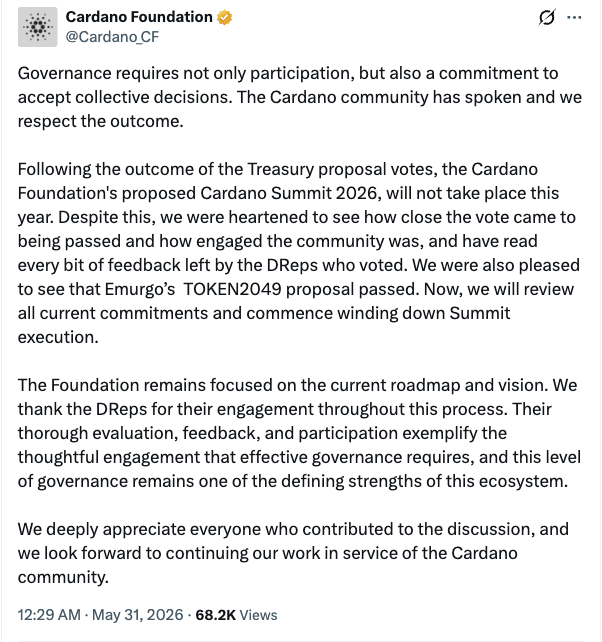
The Cardano Foundation has canceled its 2026 annual conference after its governance community shot down a revised proposal seeking to fund the event with treasury tokens.
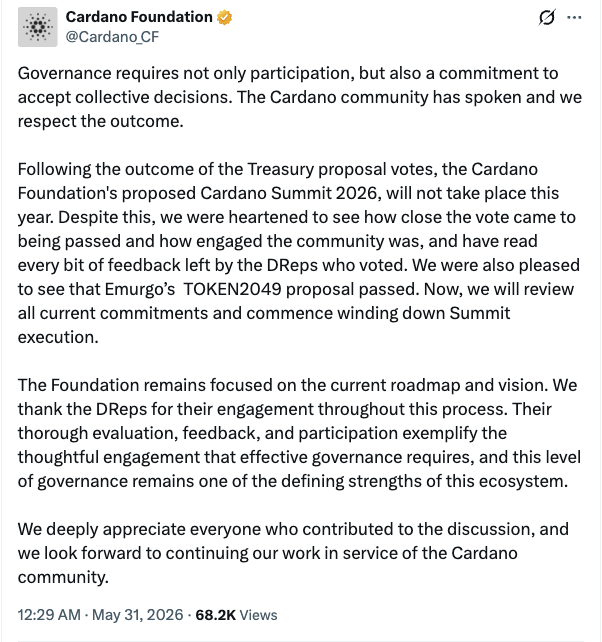
“Governance requires not only participation, but also a commitment to accept collective decisions. The Cardano community has spoken and we respect the outcome,” the foundation posted to X on Saturday after voting closed on Friday.
The proposal sought to use 7.8 million Cardano (ADA) tokens worth $1.84 million to fund the event. 65.2% of votes were cast in favor of the proposal, which was just short of the 66.67% threshold needed to pass.
Source: Cardano Foundation
The conference, called the Cardano Summit, was scheduled to take place on Oct. 5 and 6 in Singapore.
135 voters were in favor of proceeding with the event, while 61 were against and 24 abstained.
The vote follows a months-long dispute between Cardano founder Charles Hoskinson and many so-called Delegated Representatives (DReps), who have pushed for tighter spending from the foundation’s treasury.
The DReps, which are people or organizations that ADA holders can delegate their voting power to, voted against a similar proposal on May 9 that sought to use about 14 million ADA tokens to fund the event.
Only 10% of DReps voted in favor of that proposal, prompting the foundation to lower the requested funding amount under a new proposal.
Despite the cancellation, EMURGO, the investment and commercial arm behind the Cardano blockchain, passed a proposal to represent the Cardano ecosystem at the TOKEN2049 conference in Singapore on Oct. 7 and 8.
Related: Cardano can now be used to pay at 137 Spar stores across Switzerland
Hoskinson is gauging interest in the possibility of scaling up the booth at TOKEN2049 and hosting an “embedded MiniSummit.”
The Cardano token has a market capitalization of $8.8 billion, but the network has less than $129 million in total value locked on the protocol, ranking 28th among blockchains.
The Cardano network has made $356,400 in network fees so far in 2026, a fraction of the $8.35 million it recorded in 2022.
Magazine: Big Questions: Do we really only need 2–5 cryptocurrencies?
Key Takeaways
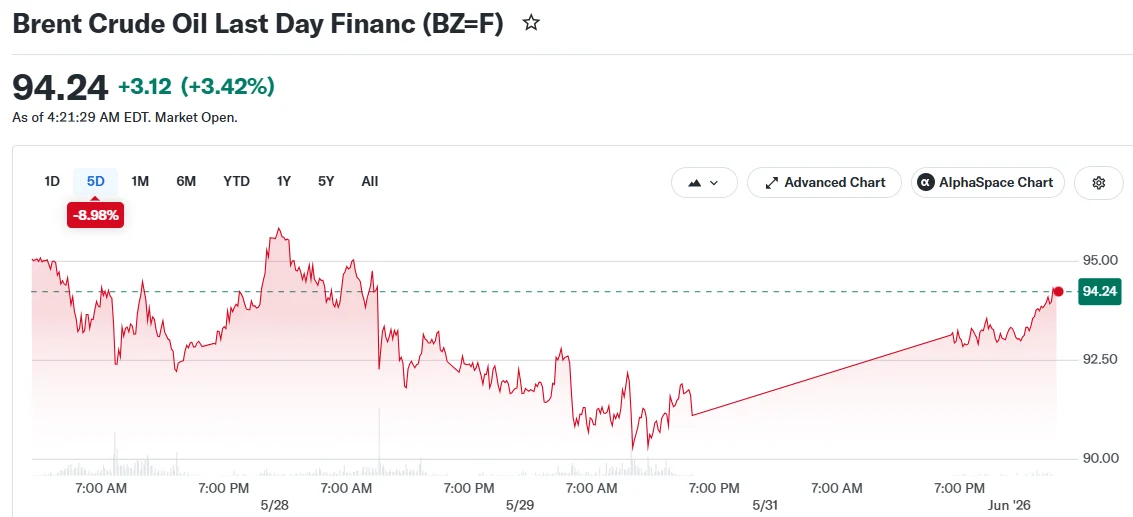
- Brent crude surged more than 3% to approximately $94 per barrel following weekend military confrontations between the U.S. and Iran
- WTI crude futures advanced roughly 3.5% to $90.40 per barrel, rebounding from steep weekly declines
- American forces targeted Iranian military infrastructure; Tehran retaliated with strikes on a U.S.-operated air facility
- Diplomatic efforts toward a ceasefire continue, but substantial obstacles persist after nearly two months of negotiations
- Approximately 20% of worldwide oil transport flows through the Strait of Hormuz, which faces ongoing disruptions
Crude oil markets rallied more than 3% on Monday following a weekend of military escalation between Washington and Tehran, intensifying worries about potential supply interruptions across the Middle East.
Brent crude futures advanced to approximately $93.95 per barrel, while West Texas Intermediate climbed to around $90.40. The gains came after both benchmarks had tumbled roughly 10% during the prior week — marking their steepest weekly declines in recent periods.
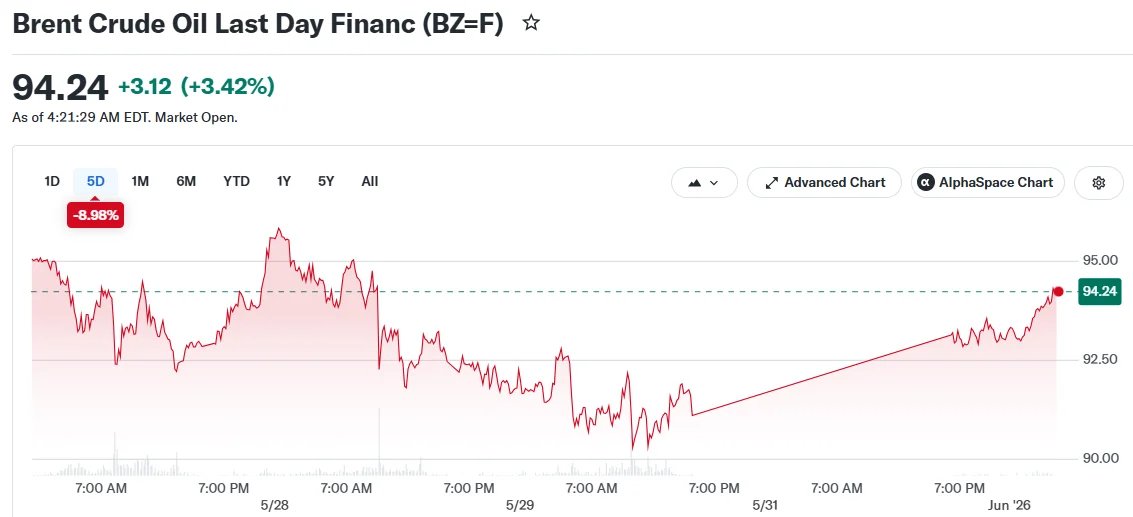
Last week’s downturn emerged following indications that American and Iranian officials were advancing toward a ceasefire arrangement. However, optimism evaporated rapidly after the weekend’s military actions.
Weekend Military Escalation Details
U.S. military officials confirmed operations targeting Iranian air defense systems, unmanned aerial vehicle command centers, and supporting infrastructure. The strikes followed Tehran’s alleged downing of an American drone operating in international airspace.
Iran’s Revolutionary Guards launched retaliatory strikes against an airfield utilized by American military personnel. Kuwait’s defense systems intercepted additional missile and drone attacks, underscoring the region’s volatility.
Israel intensified regional tensions by directing military forces to advance further into southern Lebanon, expanding operations against Hezbollah. The maneuver sparked concerns about potential broader regional warfare.
Critical Chokepoint Under Pressure
The Strait of Hormuz represents the planet’s most vital oil transit corridor. Roughly one-fifth of global oil supplies move through this narrow waterway.
Maritime traffic through the strait continues operating below typical volumes. Market analysts note that current prices haven’t fully accounted for a complete or prolonged shutdown, suggesting significant upward potential if conditions deteriorate.
Ipek Ozkardeskaya, senior analyst at Swissquote, noted that worldwide petroleum reserves are declining rapidly and emphasized that substantial upside price risks remain should disruptions persist through the Strait of Hormuz.
Diplomatic Discussions Advance Slowly
Negotiators are working on a memorandum of understanding designed to resolve blockages in the strait while establishing a 60-day period for addressing disputes concerning Iran’s nuclear activities and sanctions alleviation.
President Trump commented Saturday that the United States was “close to a very good deal” with Iran. He acknowledged, however, that resumed hostilities remained possible should negotiations collapse.
Amarpreet Singh, commodities analyst at Barclays, observed that markets are anxious to incorporate a resolution into pricing, but an agreement remains elusive following seven weeks of diplomatic engagement.
Major obstacles include regional security frameworks, sanctions removal timelines, and maritime passage rights through the strategic waterway.
Crude prices have experienced dramatic volatility in recent weeks as market participants responded to evolving developments on both military and diplomatic fronts.
During early Monday sessions, both Brent and WTI maintained their upward momentum, though experts warned that market direction could shift rapidly based on whether negotiations progress or military operations intensify.

Crypto World
Score a Premium World Cup Hospitality Experience! ZOOMEX World Cup Carnival Opens with a $300,000 Prize Pool


From May 28 to June 28, 2026, users who complete designated contract trading tasks will have the chance to unlock premium hospitality experiences for select group-stage, semi-final, and final matches, while also participating in a share of the $300,000 total prize pool. Rewards include USDT bonuses, travel subsidies, trial funds, BTC position-opening vouchers, and more.
As the global football fever of 2026 continues to build, global digital asset trading platform ZOOMEX has officially launched its “Win a Trip to the World Cup!” campaign. Centered around a $300,000 total prize pool and premium World Cup hospitality experiences, the campaign invites users worldwide to take part in an annual celebration created for both traders and football fans.
During the campaign period, users who complete designated contract trading tasks will have the chance to participate in a share of the $300,000 total prize pool, while unlocking multiple rewards including USDT bonuses, trial funds, BTC position-opening vouchers, deduction vouchers, travel subsidies, and premium matchday travel support. Selected hospitality experiences will cover on-site experiences related to designated group-stage, semi-final, and final matches, including viewing seats, matchday hospitality, and travel support. Specific reward details, quotas, match arrangements, and distribution rules are subject to the official ZOOMEX campaign page.
The ZOOMEX World Cup trading campaign will run from May 28 to June 28, 2026, with a total prize pool of up to $300,000. During the campaign, users who complete designated contract trading volumes will have the chance to unlock major rewards, including World Cup group stage tickets, semi-final VIP tickets, and World Cup final VIP tickets. Users may also redeem high-value USDT cash rewards, travel subsidies, flight subsidies, and hotel subsidies in accordance with the official campaign rules.
During the campaign period, users who complete designated contract trading tasks will have the chance to participate in a share of the $300,000 total prize pool, while unlocking multiple rewards including USDT bonuses, trial funds, BTC position-opening vouchers, deduction vouchers, travel subsidies, and premium matchday travel support. Selected hospitality experiences will cover on-site experiences related to designated group-stage, semi-final, and final matches, including viewing seats, matchday hospitality, and travel support. Specific reward details, quotas, match arrangements, and distribution rules are subject to the official ZOOMEX campaign page.
The campaign will run from May 28 to June 28, 2026. As the core mechanism of the campaign, ZOOMEX combines the global excitement of football with platform trading tasks, offering users across different tiers a more engaging and rewarding participation experience. During the campaign, users who complete designated contract trading volumes will have the chance to unlock corresponding reward tiers, including premium hospitality experiences, USDT cash rewards, exclusive travel subsidies, flight and hotel subsidies, and other benefits.
According to the campaign rules, users who complete the required trading tasks may have the chance to receive premium hospitality experiences related to designated group-stage matches and redeem up to 1,500 USDT. Users who complete higher-tier trading tasks may unlock premium hospitality experiences related to semi-final matches, with the opportunity to redeem up to 5,000 USDT plus travel subsidies. Higher-tier rewards will also cover premium hospitality experiences related to the final match, with users able to redeem up to 8,000 USDT and receive exclusive flight and hotel subsidy support.
In addition to premium hospitality experiences, ZOOMEX has also prepared exclusive deposit benefits for new users. During the campaign period, new users who make their first deposit can participate in dedicated reward programs, with the chance to receive up to $200 in trial funds and a $300 BTC position-opening voucher. The higher the deposit amount, the more reward benefits users may unlock, providing stronger incentives for new users to explore the platform and experience contract trading.
At the same time, ZOOMEX has introduced multi-tier trading task rewards. Users who complete designated trading tasks during the campaign period will be eligible to participate in a share of the $300,000 total prize pool. Rewards include USDT airdrops, trial funds, BTC position-opening vouchers, deduction vouchers, and other benefits. All rewards are available in limited quantities and will be distributed on a first-come, first-served basis according to the campaign rules, further enhancing user participation and campaign momentum.
A ZOOMEX brand representative stated that global football events are not only a celebration for fans, but also an important opportunity for brands to build stronger emotional connections with users. Through this football trading carnival, ZOOMEX aims to combine trading tasks, premium hospitality experiences, and global sports excitement to deliver a more engaging and memorable platform campaign experience. ZOOMEX will continue to focus on user needs and launch more brand campaigns that combine entertainment, interactivity, and reward value, further improving the trading experience for users worldwide.
As the global football fever of 2026 continues to rise, the integration of sports marketing and digital asset trading experiences is becoming an important way for brands to expand visibility and strengthen user engagement. By using football as a key theme, ZOOMEX is offering premium hospitality experiences, USDT rewards, travel subsidies, and new user benefits to further enhance brand recognition among global users and inject more excitement and participation into digital asset trading activities throughout the 2026 football season.
The ZOOMEX World Cup Trading Carnival is now officially live. Join the campaign today and unlock your own World Cup glory moment with ZOOMEX.
Disclaimer: This campaign is independently launched by ZOOMEX and is not sponsored, endorsed, administered, or organized in cooperation with any relevant international football event organizer, rights holder, or their affiliates. ZOOMEX is not an official sponsor, official partner, official ticketing agent, or official hospitality sales agent of any relevant event. Premium hospitality experiences, travel subsidies, and related rewards involved in this campaign are subject to the official ZOOMEX campaign rules.
About Zoomex
Founded in 2021, Zoomex is a global cryptocurrency trading platform with over 3 million users across more than 35 countries and regions, offering 600+ trading pairs. Guided by its core values of “Simple × User-Friendly × Fast,” Zoomex is also committed to the principles of fairness, integrity, and transparency, delivering a high-performance, low-barrier, and trustworthy trading experience.
Powered by a high-performance matching engine and transparent asset and order displays, Zoomex ensures consistent trade execution and fully traceable results. This approach reduces information asymmetry and allows users to clearly understand their asset status and every trading outcome. While prioritizing speed and efficiency, the platform continues to optimize product structure and overall user experience with robust risk management in place.
As an official partner of the Haas F1 Team, Zoomex brings the same focus on speed, precision, and reliable rule execution from the racetrack to trading. In addition, Zoomex has established a global exclusive brand ambassador partnership with world-class goalkeeper Emiliano Martínez. His professionalism, discipline, and consistency further reinforce Zoomex’s commitment to fair trading and long-term user trust.
In terms of security and compliance, Zoomex holds regulatory licenses including Canada MSB, U.S. MSB, U.S. NFA, and Australia AUSTRAC, and has successfully passed security audits conducted by blockchain security firm Hacken. Operating within a compliant framework while offering flexible identity verification options and an open trading system, Zoomex is building a trading environment that is simpler, more transparent, more secure, and more accessible for users worldwide.
For more info: Website | X | Telegram | Discord
The post Score a Premium World Cup Hospitality Experience! ZOOMEX World Cup Carnival Opens with a $300,000 Prize Pool appeared first on BeInCrypto.
A $1.26 billion block trade in BlackRock’s iShares Bitcoin Trust (IBIT) made last week was likely a whale making a quick exit on a directional trade, says Greg Cipolaro, the head of research at financial services company NYDIG.
On Tuesday, an unknown trader sold 29.2 million shares of BlackRock’s IBIT on a dark pool, a private trading platform that institutions use to discreetly make large trades outside public markets, sparking speculation about who made the trade and why.
Cipolaro said in a research note on Friday that several indicators were “consistent with a large directional holder exiting a concentrated position rather than a contemporaneous basis-trade unwind.”
He added that the seller accepting the sale at $1.01 below the market price of $44.17, forgoing $29.5 million in exchange for immediate execution, and using a private trading platform, pointed to such a large directional holder exiting.
Large transactions can move markets and affect overall sentiment. However, in this case, Bitcoin (BTC) slid 2.8% over the day after the trade. Bloomberg ETF analyst Eric Balchunas said at the time the market absorbed the sale well despite the significant block sale.
“The key unanswered question is whether the seller was responding to idiosyncratic constraints or expressing a broader investment view,” Cipolaro said.
“While the transaction details themselves cannot answer that question, they do, however, demonstrate that at least one sophisticated holder was willing to pay approximately $29.5 million to eliminate a $1.26 billion bitcoin-linked position immediately.”
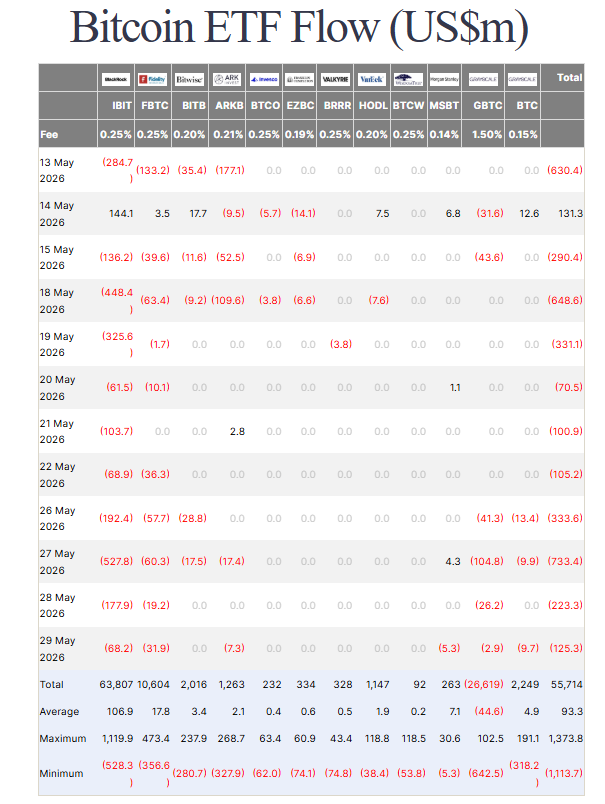
US-listed Bitcoin ETFs have now recorded 11 straight trading days of net outflows, with a $333.6 million outflow on the same day as the massive IBIT trade, according to Farside Investors data.
More than $2.9 billion has now flowed out from the ETFs since May 14, the last recorded net inflow across multiple funds.
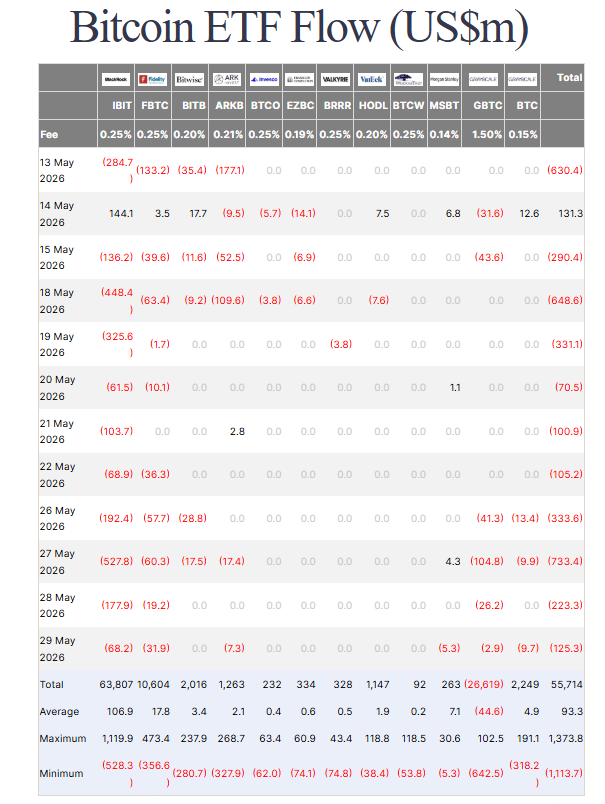
U.S.-listed Bitcoin ETFs have recorded 11 straight trading days of net outflows. Source: Farside Investors
Related: Bitcoin falls out of the global top 10 assets as market cap dips below $1.5T
Meanwhile, sentiment has also been volatile. The Crypto Fear & Greed Index, which measures overall crypto market sentiment, returned a score of 29 out of 100 on Monday, indicating “fear” in the market. It also posted an average rating of “fear” for May.
Cipolaro said the methods used by the whale entity to sell show urgency, but the motive remains unclear. He speculates that it could have been a forced sale driven by investor redemptions and balance-sheet constraints or an attempt to reduce the risk of exiting over multiple sessions.
“Public data cannot distinguish conclusively between these explanations,” he said.
“However, the weakening technical backdrop, ongoing ETF outflows, and willingness to pay a substantial execution premium for immediacy are more consistent with discretionary liquidation rather than investor redemptions or a portfolio rebalance.”
Magazine: Big Questions: Do we really only need 2–5 cryptocurrencies?
Crypto World
Whitehat developer unlocks $2 million stuck in a 2016 Ethereum ICO contract for nine years
A security researcher who goes by 0xflorent worked with the team behind a 2016 Ethereum (ETH) ICO contract to unlock about $2 million in ether that had sat trapped for nine years, in a coordinated whitehat recovery that exploited an integer-overflow flaw the original developers had never patched.
The contract belongs to HongCoin, a 2016 token sale that fell short of its funding goal and was supposed to auto-refund investors’ ether but failed to do so because of a bug in the refund function.
0xflorent’s path unfroze 1,003.62 ETH, with 48 original investors now eligible to claim. Two have done so, retrieving a combined 96.5 ETH worth roughly $193,000, he said in an X thread Sunday.
First white-hat exploit on Ethereum: I unlocked 1,003.62
Ξ ($2,000,000) trapped in a 2016 ICO smart contract
for 9 years.The 48 original investors can now claim their funds. pic.twitter.com/lyh5iyaDu7
— 0xflorent.eth (@0xFlorent_) May 31, 2026
The contract’s refund logic rejected any holder whose token balance exceeded a global counter that years of partial refunds had dragged down to 356, capping further refunds at 3.56 ETH.
0xflorent found that an admin function on the contract, restricted to HongCoin’s multisig wallet, lacked the integer-overflow protections later built into the Solidity programming language. Calling it with a specific input value reset a holder’s balance to one, allowing the refund check to pass and releasing the funds.
The recovery was not a unilateral exploit, however. Because the admin function required HongCoin’s multisig to execute, 0xflorent emailed the team, validated the unlock sequence on a test fork of Ethereum’s mainnet, and the team itself signed the unlock transactions.
It signed 41 transactions, one per blocked holder, freeing the roughly 1,000 ETH that was truly stuck. Another seven holders held small enough balances to refund directly without the workaround.
It is the second such recovery 0xflorent has publicized in eight days.
On May 24, he said he had returned 19.329 ETH, worth about $40,590, to its original owners, including 5.141 ETH from a failed January 2018 ICO and 14.190 ETH from seven expired atomic swaps in a Liquality Wallet user account that had become inaccessible after the wallet shut down in 2024.
The recovery lands during a heavy stretch of DeFi exploits, with April alone seeing hundreds of millions of dollars drained across protocols, headlined by a roughly $293 million hit on Kelp DAO.

Key Takeaways
- May 2026 witnessed cryptocurrency security losses totaling $68.3 million, representing a 90% decrease compared to April’s $650 million
- This marks the third occasion in 2026 where monthly losses remained below the $100 million threshold
- A cross-chain bridge exploit targeting Verus Protocol resulted in the month’s most significant single incident at $11.5 million
- Flawed code implementations were responsible for approximately 66% of total damages, equating to roughly $45 million
- Cross-chain bridge infrastructure emerged as the primary target category, representing 42% of aggregate monthly losses
Blockchain security analysis firm CertiK reports that cryptocurrency platform vulnerabilities resulted in $68.3 million in losses throughout May, marking a dramatic 90% reduction from April’s staggering $650 million figure.
The security firm published their findings via X, highlighting that May represents the third consecutive month in 2026 where total security-related losses stayed beneath the $100 million mark.
April’s numbers had established one of the most severe monthly records for the industry. When the massive $1.5 billion Bybit breach from February 2025 is excluded, April’s figure represented the highest monthly loss total documented since March 2022. The Kelp DAO incident, which cost $291 million, drove much of April’s elevated losses.
May’s security landscape proved considerably calmer by comparison.
Phishing schemes accounted for $2.6 million of the monthly total. Security efforts resulted in approximately $9.4 million in stolen cryptocurrency being either recovered or voluntarily returned throughout the period.
Bridge Protocols and Programming Errors Dominated Vulnerability Landscape
The month’s most substantial security breach occurred on May 18 when Verus Protocol’s cross-chain bridge infrastructure was compromised, resulting in $11.5 million in stolen assets. THORChain experienced the second-largest incident, with attackers successfully extracting $10.1 million during a mid-May security breach.
Cross-chain bridge platforms represented the most frequently exploited infrastructure type, accumulating $28.6 million in losses—constituting 42% of May’s total damages.
Programming vulnerabilities emerged as the predominant root cause when measuring losses by dollar value. Approximately $45 million, representing roughly 66% of aggregate losses, stemmed from defective code implementations. Wallet breaches and private key compromises ranked second among attack vectors, accounting for $13.7 million in stolen funds.
According to DeFiLlama’s tracking data, May recorded 29 distinct security incidents. Private key compromises were implicated in seven of these separate attacks.
The month concluded with two final incidents reported on May 30, affecting both Alephium Bridge and Gravity Bridge platforms. Alephium sustained $815,000 in losses while Gravity Bridge lost $5.4 million—both breaches attributed to compromised private key security.
CertiK’s analysis additionally identified an emerging trend involving AI-enhanced malware deployment throughout May. Threat actors increasingly targeted cryptocurrency and artificial intelligence developers through compromised code repositories, manipulating AI-powered coding assistants to execute malicious operations.
Despite the improved figures relative to April, cybersecurity experts emphasize that cross-chain bridge infrastructure and private key management protocols continue to represent significant vulnerability areas requiring attention throughout the remainder of 2026.


Kyle Samani said Web3 is dead, adding that DeFi and DePIN are the only major crypto sectors left with a clear role.
Summary
- Kyle Samani said Web3 is dead, naming DeFi and DePIN as crypto’s remaining core sectors.
- Eli Ben-Sasson said crypto faces identity pressure as institutions enter while longtime crypto OGs leave.
- Recent reports show DeFi, DePIN, and tokenization still draw broad market attention globally.
“Web3 is dead. All we have is DeFi and DePIN,” Multicoin co-founder Kyle Samani said in a post on X.
The comment came in response to a wider debate started by StarkWare CEO and Zcash co-founder Eli Ben-Sasson. Samani’s remark framed Web3 as a fading label, while pointing to decentralized finance and decentralized physical infrastructure networks as the areas still carrying clear market use.
Samani remains one of the better-known investors linked to Solana, Helium, and other crypto infrastructure plays. He stepped back from Multicoin’s day-to-day work earlier in 2026, but has continued to speak about crypto markets and remains tied to Forward Industries.
Ben-Sasson points to crypto identity crisis
“Crypto seems to be going through an identity crisis,” Eli Ben-Sasson said on X.
Ben-Sasson said several long-time crypto figures have left, while institutions and traditional finance firms are showing more interest. He said this shift challenges crypto’s core story because the sector once positioned itself against those same institutions.
His comment reflects a debate already playing out across the market. Crypto started as a movement built around open networks, self-custody, and less reliance on banks. In 2026, much of the new capital and product growth is linked to ETFs, tokenized assets, stablecoins, and regulated finance firms.
DeFi and DePIN remain in focus
Samani’s comment puts DeFi and DePIN at the center of the debate. DeFi covers lending, trading, stablecoins, and other financial tools that run on blockchain networks.
DePIN refers to blockchain-linked physical infrastructure. This can include wireless networks, storage, computing, sensors, and other real-world systems supported by token incentives.
Recent market reports show why these two sectors still attract attention. Standard Chartered has projected large growth in tokenized assets by 2028, with mature DeFi protocols expected to handle much of the activity.
DePIN has also become a clearer market category. Projects in the sector aim to connect blockchain rewards with real infrastructure instead of focusing only on digital apps and token communities.
TradFi interest changes crypto’s debate
The stronger role of institutions has changed how crypto talks about adoption. Banks, asset managers, payment firms, and trading companies now play a larger part in the market.
This creates tension for builders who view crypto as an open alternative to the financial system. It also gives crypto projects a new source of liquidity, users, and regulated products.
Samani’s post did not argue that crypto itself is finished. Instead, it suggested that broad Web3 branding has lost force, while DeFi and DePIN still offer clearer use cases.
The debate now turns on what crypto can prove in real markets. For Samani, finance and infrastructure remain the clearest answers.
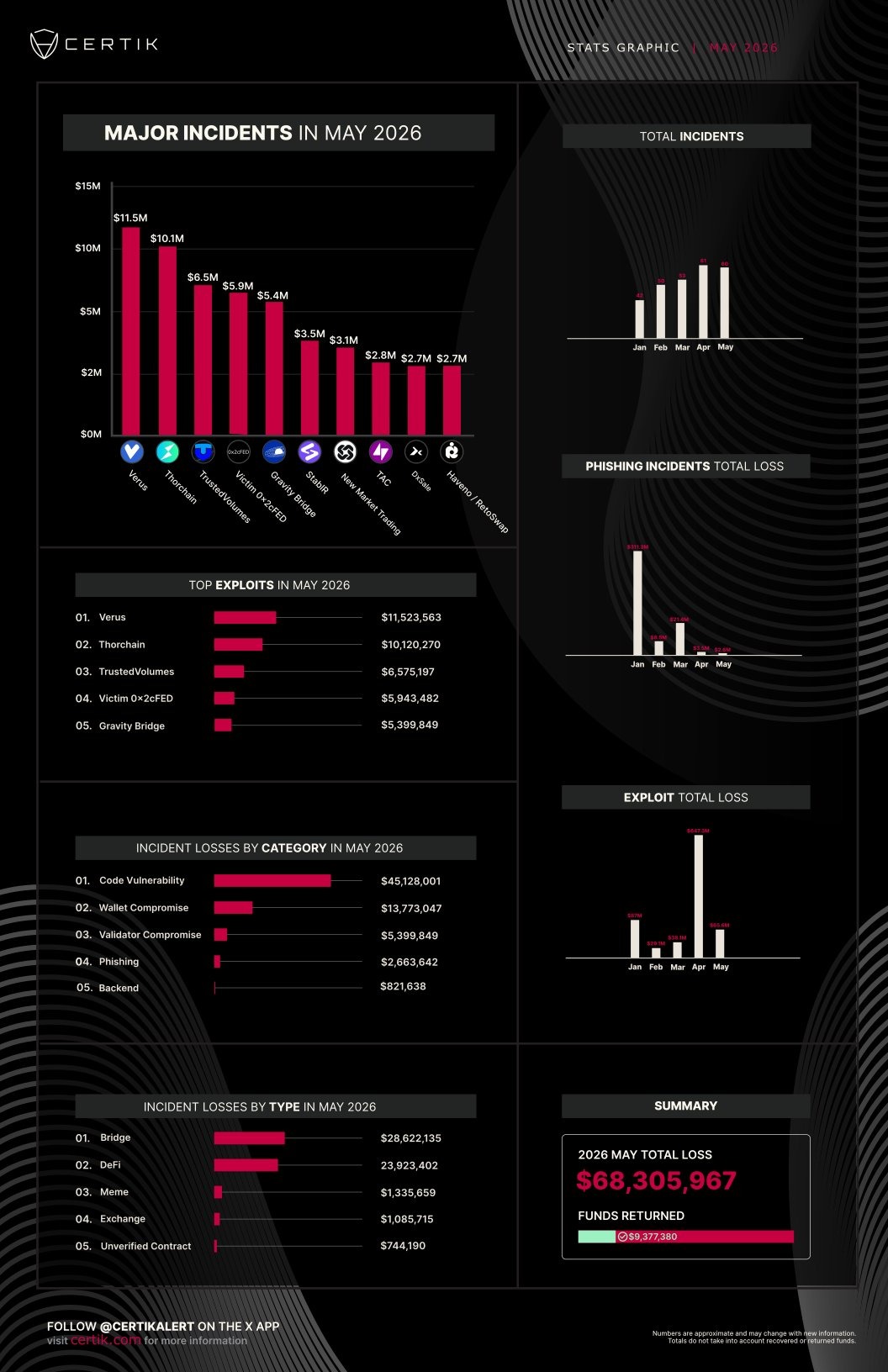
Losses from exploits of crypto platforms fell to $68.3 million in May, down almost 90% from the $650 million lost in April, says crypto security company CertiK.
“After a particularly bad April, May is now the third month of 2026 to record losses under [$100 million],” CertiK posted to X on Sunday.
Around $2.6 million of the total crypto stolen in May was due to phishing attacks, while roughly $9.4 million was recovered or returned, it added.
Excluding the $1.5 billion hack on Bybit in February 2025, April saw the highest losses recorded in a month since March 2022, with the largest loss that month coming from a $291 million exploit of Kelp DAO.
An exploit of Verus Protocol’s cross-chain bridge on May 18 was the largest in terms of losses last month, with $11.5 million stolen. THORChain was second after an exploit in mid-May saw $10.1 million stolen from the protocol.
Code vulnerabilities were the category with the highest value of losses over the month, with about 66% of the total, or around $45 million lost. Wallet or private key compromises were the second-most costly, with $13.7 million stolen.
Cross-chain bridges were the most targeted, with $28.6 million, or 42% of the total monthly losses, followed by decentralized finance protocols.
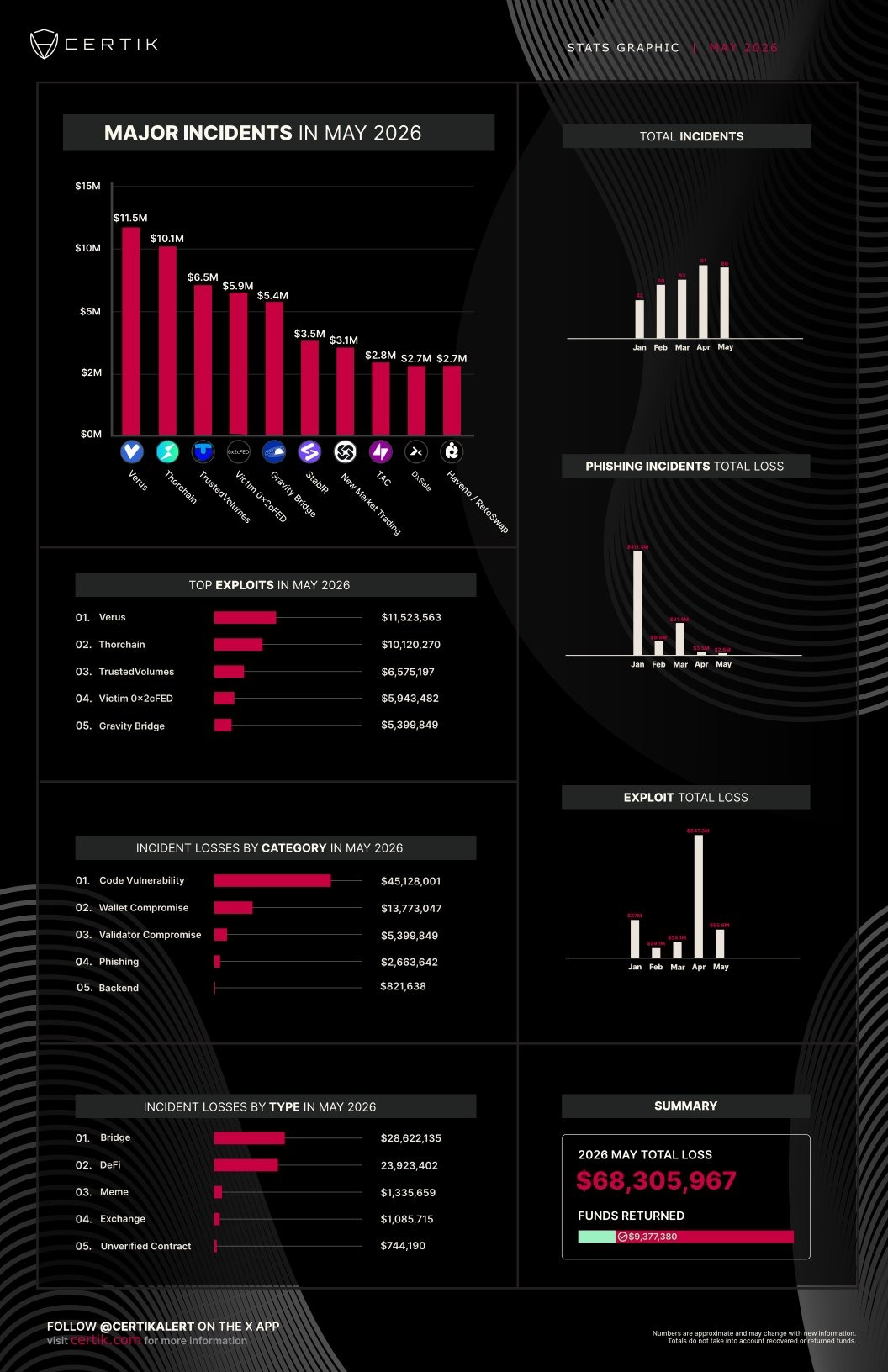
Crypto exploit losses in May reached $68.3 million. Source: CertiK
Related: Scammers make $400K through fake Uniswap ads on Google
DeFiLlama data shows that there were 29 incidents in May, seven of which involved compromised private keys.
The latest two incidents, reported on May 30, were the Alephium Bridge and Gravity Bridge, which were respectively exploited for $815,000 and $5.4 million due to compromised private keys.
Malware developed with artificial intelligence assistance has also been on the rise as malicious actors targeted crypto and AI developers in May by compromising code repos and tricking AI coding assistants.
Magazine: HYPE chases $100 target, ETH could dump below $1800: Market Moves
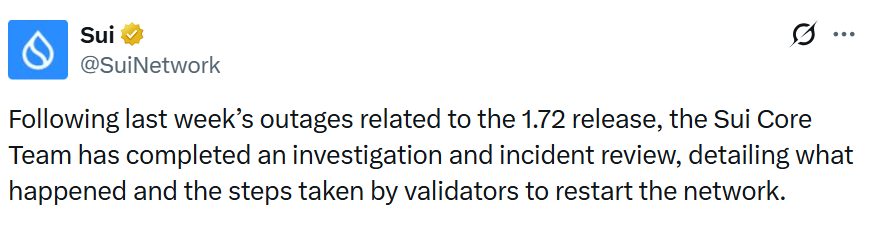
The Sui Foundation, the nonprofit organization behind the Sui Network, says it has made a “major upgrade” to address issues that caused three recent outages and left the blockchain down for more than 15 hours across two days.
Sui experienced an outage on Thursday that lasted nearly six hours and two more on Friday. The first lasted eight hours and 25 minutes while the second lasted 43 minutes, according to the Sui network’s uptime dashboard. All systems are listed as operational as of Monday.
The Sui Foundation said in a blog post on Sunday that it applied an upgrade to fix the bugs that caused the outages. It also flagged several issues for improvement, such as better failure containment, end-of-epoch resilience and further investment in artificial intelligence agents, which helped with diagnoses, querying validator logs and assembling metrics.
“As of now, validators have fully addressed the known issues caused by both the original gas-charging bug and the randomness-state bug, and network activity has resumed,” the Sui Foundation said. It added that “during the outages, no user funds were at risk, and the network did not revert any committed transactions when it resumed.”
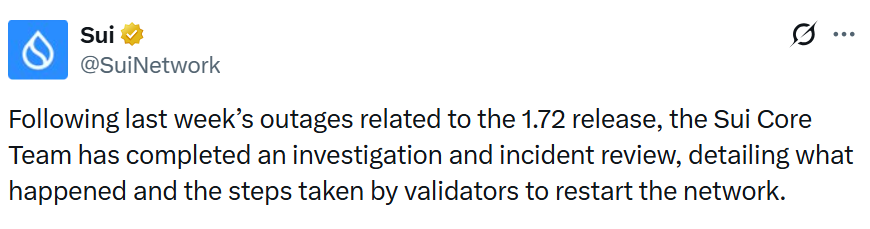
Source: Sui
Sui had a similar outage in January, which knocked the network offline for more than six hours. Another incident occurred in November 2024, when all validators were stuck in a crash loop for about 2.5 hours. Sui is the 13th-largest blockchain by total value locked at $519 million and hosts 137 protocols, according to DefiLlama.
Bugs introduced during software update
The Sui Foundation said the blockchain’s two most recent outages stemmed from “crash bugs” introduced in its 1.72 software release. The bugs impacted gas charging, causing the network to charge funds before canceling transactions for insufficient balances. This created negative balances that crashed the system
An interim fix for the initial bug triggered the third outage. The fix aimed to bring the network back online until a permanent solution could be devised, but it had “a known issue with a low probability of causing a halt.”
Related: CME Group expands crypto futures with Avalanche and Sui contracts
The Sui (SUI) token has declined since the outages. It traded at about 99 cents on Thursday before the first outage, according to data from crypto aggregator CoinGecko. It has since dropped roughly 11% and is worth about 88 cents as of Monday.
In early May, the token climbed 50% to $1.41 following several positive developments, including a Nasdaq-listed company staking a large portion of the supply.
Sui launched its mainnet in May 2023, aiming to be scalable and capable of processing transactions fast enough for mainstream financial institutions.
Magazine: HYPE chases $100 target, ETH could dump below $1800: Market Moves

Coinbase Opens Direct INR Deposits for Indian Users

Apple TV’s New Mystery Series Is One of the Biggest Shows on Streaming

The House Article | Michael Grade: I Am Very, Very Worried About The Future Of British TV


-

 NewsBeat5 days ago
Israel says it has killed new Hamas military leader in Gaza City airstrikes
-

 Tech5 days ago
NASA taps Blue Origin to deliver lunar rovers for Moon Base initiative
-

 Politics7 days ago
Bridgerton Season 5: Cast, Release Date And Everything We Know So Far
-

 Sports6 days ago
2026 NBA Finals schedule, odds: Knicks await Thunder or Spurs after winning East
-

 News Videos5 days ago
XRP *JUST* SUCCEEDED!!!! CLARITY ACT EXPOSED!!! (SHE EXPOSED IT)
-

 News Videos3 days ago
This is BROKEN! INSANE 5x MONEY CAR WASH WEEK! The NEW GTA Online UPDATE Today! (GTA5 New Update)
-
Crypto World6 days ago
Micron Crosses $1 Trillion Market Cap as AI Demand Reshapes Memory Sector
-
 NewsBeat7 days ago
Hottest May day ever as London hits 34.8C in 2C leap from previous records
-

 Business5 days ago
Selena Gomez Reportedly Upset Over Benny Blanco’s Comments on Her ‘Terrible’ Diet
-
 Tech6 days ago
China assigns ID codes to 28,000+ humanoid robots
-

 Business6 days ago
Nikkei 225 Surges Past 65,000 for First Time as Iran Peace Hopes Fuel Record Rally
-

 Business7 days ago
BTS Sells Out Four Las Vegas Shows at Allegiant Stadium for ARIRANG World Tour
-

 Tech7 days ago
Microsoft’s quiet Claude Code retreat and the real cost of enterprise AI
-

 Tech3 days ago
Waymo dominates autonomous vehicle registrations as Tesla trails behind
-
 Entertainment6 days ago
‘Breaking Bad’ Star’s Easy-to-Binge 6-Part Crime Series Spin-Off Is Finally Heading to Free Streaming
-

 NewsBeat7 days ago
Crowds find riverside shade in York as temperatures soar
-
Tech5 days ago
The Samsung pay deal is the moment Korean unions changed register
-

 Entertainment6 days ago
Days of our Lives 2-Week Spoilers May 25-June 5: Gwen Rages, Abe Confesses & 2 Tragic Anniversaries!
-

 Tech7 days ago
Westone Audio and Etymotic Acquired by Fidelity Collective in Major IEM Market Move
-
 Tech2 days ago
SpaceX just won a second Golden Dome contract. This one is $4.16 billion.
You must be logged in to post a comment Login