
Crypto World
63,000 BTC Profit Realized as Bitcoin Tops $76K; Market Rebound?


Bitcoin’s rally above $76,000 cooled on Tuesday as short-term holders started taking profits at the strongest pace seen in 2026, even as longer-term investors continued to accumulate. The dynamic—profit-taking from new entrants meeting persistent demand from whales—could influence BTC’s ability to push into the $80,000 zone in the near term.
Data from on-chain trackers show a contrasting pair of behaviors: fresh buyers and short-term traders trimming gains versus entrenched holders quietly adding to their stacks. The tug-of-war helps explain why Bitcoin has paused near a key resistance level while still showing underlying bid support from larger investors.
Key takeaways
- Short-term holders booked profits: Bitcoin in profit moved to exchanges reached 63,000 BTC on April 14, the highest in 2026, compared with a 44,800 BTC spike on January 14.
- Fresh supply to exchanges and local profit-taking: The 1 day-to-1 week cohort transferred roughly 2,000 BTC back to Binance while BTC hovered near $76,000, suggesting coins are rotating into sell-side liquidity at a key resistance level.
- Early-stage cooling signal from buyers: Crypto analyst Amr Taha described the move as the first clear wave of profit-taking after the retest of monthly highs, signaling a natural cooling of upside momentum.
- Whales step in as buyers of last resort: Inflow of about 71,000 BTC into accumulation addresses represented the largest bullish influx since early 2022, as large holders absorbed available supply from short-term sellers.
- Liquidation landscape hints at a near-term dip before a potential rebound: The market’s liquidity map shows a cluster of long liquidations around $73,000 (about $1.4 billion) and $70,500 (around $3.5 billion in long positions at risk), while a move toward $80,000 could expose roughly $2 billion in leveraged short bets.
Profit-taking versus whale-driven demand
On-chain analysis indicates a sharp contrast between the actions of newer market entrants and those of veteran holders. The surge in BTC moved to exchanges by short-term holders—63,000 BTC in profit on April 14—marks the highest such metric in 2026, following a notable spike of 44,800 BTC on January 14. This activity aligns with a broader pattern: investors new to the market take profits near obvious resistance, a tactic that can temper momentum in bear-market cycles.
Separately, the 1-day-to-1-week cohort reallocated nearly 2,000 BTC back to Binance during the same window, suggesting freshly acquired coins are being used to provision sell-side liquidity as BTC trades around the $76,000 mark. Crypto analyst Amr Taha framed this as the first clear wave of profit-taking after the retest of monthly highs, a signal that momentum may be cooling rather than reversing decisively.
Against this backdrop, a markedly different flow emerged from the so-called smart money. A tweet from market watcher CW highlighted a single-day inflow of more than 71,000 BTC into accumulation addresses—the largest bullish influx in years. This pattern implies that large holders are absorbing supply from the sellers, potentially stabilizing price action while preserving upside potential for longer-horizon players.
Liquidity pockets and near-term price dynamics
The price action around the $76,000 area has been telling. After forming equal highs near that level, BTC faced a rejection at the 100-day exponential moving average, marking the first test of this resistance since mid-January. The immediate result was a pullback toward the mid-$70s, with prices dipping to around $73,500 in the near term.
Looking at the intraday liquidity landscape, buyers’ interest appears to accumulate around $73,000 and $72,000 on shorter timeframes. This could generate bid activity that would help sustain a trend continuation, should the market find fresh thrust from stronger hands.
Another lens on the risk surface comes from liquidation maps. The current heatmap shows roughly $1.4 billion in cumulative long liquidations concentrated near $73,000, and about $3.5 billion worth of long positions at risk near $70,500. On the flip side, an ascent toward $80,000 would expose around $2 billion in leveraged short positions. The spread between these long- and short-side risk zones suggests the market could retest the lower end of the range before attempting a meaningful move higher.
For context, investors should also note related coverage on the broader macro and product side of the Bitcoin market. A separate Cointelegraph report this week highlighted inflows into Bitcoin exchange-traded products as Goldman Sachs reportedly filed for a BTC ETF, signaling continued institutional interest and potential long-term demand drivers for the asset class. Bitcoin ETFs post $412M in inflows as Goldman Sachs files for BTC ETF.
As observers weigh these flows, the critical question remains: will long-term holders’ accumulating pressure sustain a phase of consolidation, or can the market muster enough demand to push through the next major hurdle around $80,000? The answer may hinge on how new buyers balance the temptation to realize gains against the willingness of whales to absorb supply and push price higher in a market still grappling with macro uncertainty and evolving regulatory signals.
In the near term, traders should keep a close watch on how the price behaves around the $72,000–$73,000 range, where bid interest and on-chain liquidity could set the tone for the next move. Eyes also stay on broader market catalysts, including ETF-related flows and any shifts in risk sentiment that could tilt the balance between profit-taking and accumulation.
Related: Bitcoin ETFs post $412M in inflows as Goldman Sachs files for BTC ETF.
Bitcoin’s current dynamics illustrate a market that’s no longer dominated solely by momentum players. A growing chorus of long-term holders and institutions suggests that even as spot prices wobble around resistance, the supply-demand balance may remain tight enough to underpin a continuation of the bull narrative—albeit with increased volatility and intermittent retracements as traders calibrate risk and realize gains.



AI agent ‘Valerie’ now runs a San Francisco vending machine on OpenClaw, testing how far people will trust code with pricing, marketing and real‑world cash.
Summary
- AI agent “Valerie” runs a physical vending machine in San Francisco using the OpenClaw framework, setting prices, naming products, and managing cash flow.
- Built by developer Chris van der Henst at Frontier Tower, the machine tracks sales on a live dashboard and even raises prices when demand is strong.
- The experiment showcases both the commercial potential and security risks of autonomous AI agents that can access bank accounts and execute real‑world transactions.
An AI agent called Valerie is now operating a real vending machine in San Francisco, autonomously deciding what to sell, how much to charge, and how to market products using the open‑source OpenClaw framework.
The machine, installed at the AI‑heavy Frontier Tower building, has been described as “an AI agent… running an actual physical vending machine,” with “no human in the loop,” according to posts amplifying the installation on X.
Developer Chris van der Henst, known as @cvander on X, built the system so that OpenClaw acts as the vending operator “decides what to sell, names the products, sets the prices, creates the ads, and tracks every sale.”
Valerie’s behavior has already highlighted how autonomous agents respond to market signals, with one widely shared post noting that “it even put the prices way up, and justified it because people kept buying,” while also “runs her own Instagram and controls her own bank account.”
OpenClaw itself has quickly become one of the most prominent agent frameworks in crypto‑adjacent circles since its public release in November 2025, amassing more than 250,000 GitHub stars and an estimated 300,000 to 400,000 users as it spreads from developers to Web3 firms.
Nvidia CEO Jensen Huang has called OpenClaw “probably the single most important release of software… probably ever,” arguing that “every company needs a strategy” for agentic systems as they evolve into a new layer of business infrastructure.
Yet security researchers warn that the same tools enabling Valerie to monitor sales and move money can also expose users to “unauthorized actions, data exposure, system compromises and drained crypto wallets,” with audit data showing over 130,000 internet‑exposed OpenClaw instances and more than 280 security advisories and 100 CVEs since launch.
According to cybersecurity firm CertiK, the rise of agents like Valerie is forcing developers and regulators to confront what happens when code that can “autonomously take actions on users’ computers” is wired directly into payments, banking apps and crypto wallets, making experiments like the Frontier Tower vending machine an early test case for how far people are willing to let AI run the till.
Crypto World
Bitcoin devs float ‘quantum tripwire’ that triggers coin freeze only if attack is proven


Bitcoin developers are debating a radical change to how the network would respond to a future quantum computing threat: don’t freeze vulnerable coins unless someone proves the threat is real. But there’s a catch: The proposal assumes the attacker will reveal capability for a bounty instead of maximizing profit through theft.
A proposal published this week by BitMEX Research outlines a “canary” system that would trigger a network-wide restriction on older bitcoin wallets only if a quantum-capable attacker demonstrates it on-chain, replacing earlier plans to impose a pre-scheduled freeze years in advance. At its core, the proposal is a “wait and react” strategy.
It works by placing small number of bitcoin into a special address that only a quantum-capable attacker could unlock, with any spend from that address serving as public proof that the threat has arrived and automatically triggering a network-wide freeze of older wallets.
Bitcoin wallets rely on digital signature schemes that are secure against classical computers but could be broken by advances in quantum computing, and a recent Google research paper lowered estimates for the resources required, with some observers now pointing to the end of the decade as a potential risk window.
The approach is designed as an alternative to BIP-361, a controversial proposal that would impose the same restrictions on a fixed five-year timeline regardless of whether quantum computers are actually capable of attacking Bitcoin’s blockchain. BIP-361 would phase out vulnerable addresses over several years before invalidating the old signature schemes entirely, leaving any unmigrated coins permanently frozen.
Critics have called that outcome “authoritarian and confiscatory,” arguing it undermines Bitcoin’s core principle that control rests solely with private key holders.
Layered atop the of BitMEX’s detection mechanism is a financial incentive. Users could contribute bitcoin to the address, creating a bounty that rewards the first entity to demonstrate a quantum attack publicly rather than quietly drain vulnerable wallets. Contributors would not need to give up their funds permanently, as the structure allows withdrawals at any time.
The proposal also introduces a “safety window” designed to make stealth attacks harder. Vulnerable coins could still move, but the recipient would be unable to spend them for an extended period, potentially around a year. If the canary is triggered during that window, those coins would be frozen retroactively, increasing the risk to any attacker attempting to quietly extract funds.
There’s a catch
The canary reduces the risk of disrupting users prematurely, but it rests on an uncomfortable bet that the first entity capable of breaking Bitcoin would claim a bounty rather than execute what could be the largest theft in the network’s history and walkaway with millions of bitcoin.
That bet cuts against the kind of worst-case scenario Bitcoin’s design has always tried to prevent, and the network has historically shown little appetite for undoing such events after the fact. Ethereum’s response to the 2016 DAO hack, a hard fork that reversed the theft and split the network into Ethereum and Ethereum Classic, is the kind of protocol-level intervention Bitcoin’s culture has long resisted.
If the bet fails, Bitcoin risks the worst of both worlds — the catastrophe it was trying to prevent, and the realization that a fixed-timeline defense would have stopped it.


The ETH/BTC ratio climbed to 0.0313 on Wednesday, its strongest reading since January, as record Ethereum network activity and a $180 billion stablecoin milestone signal a potential shift in market momentum.
Summary
- The ETH/BTC ratio reached 0.0313, recovering from a 2026 floor of 0.028 in February, though it remains well below the January 18 peak of 0.038.
- Ethereum added 284,000 new users in Q1 2026, an 82% quarterly jump, while stablecoin supply on the network hit a record $180 billion.
- Analysts say a weekly close above 0.035 is required to confirm durable rotation into ETH rather than a short-term bounce.
The ETH/BTC ratio is making its clearest recovery move of the year. Ethereum gained 4% over the past seven days, narrowly outpacing bitcoin’s 3.9% gain over the same period, with the ratio recovering from prior lows and pushing to its best level in three months.
The move is backed by concrete on-chain data. Ethereum added 284,000 new users in Q1 2026, an 82% quarterly jump, while stablecoin supply on the network reached an all-time high of $180 billion, a 150% increase over three years.
Ethereum now holds roughly 60% of the global stablecoin market, reinforcing its position as the primary settlement layer for tokenized dollars. That concentration of real economic activity gives ETH a structural demand base that extends beyond price speculation.
The ETH/BTC ratio spent much of 2026 at depressed levels as bitcoin ETF-driven demand kept capital anchored in BTC. The current bounce suggests that rotation may be beginning, though analysts urge caution before calling it a confirmed trend. CoinMarketCap analyst CryptoAnu noted the ratio must reclaim 0.035 on a weekly closing basis to signal genuine altcoin rotation rather than a short-lived squeeze, adding that the Pectra upgrade is “finally being felt in 2026 with over 30% of supply now staked and locked away.”
The Level That Has to Break
The ETH/BTC pair peaked above 0.08 in late 2021, then entered a prolonged slide through 2024 and 2025 driven by weakened Ethereum base-layer fee revenue, the Dencun upgrade’s impact on mainnet activity, and sustained bitcoin ETF dominance. The 2026 floor of 0.028, set in February, is now being left behind.
Analyst Ledgix described the current outperformance as “a signal to observe” rather than chase, noting that when flows begin rotating in the crypto market, ETH is typically the first major recipient given its ecosystem depth, staking yield, and growing institutional footprint.
Where ETH Stands Despite the Bounce
ETH is still more than 50% below its 52-week high of $4,831. Near-term resistance sits at $2,400, with $2,500 as the next significant test above that. In ratio terms, 0.035 is the weekly close that would shift the technical picture from bounce to breakout. Until that level is reclaimed, the recovery remains fragile.


Kevin Warsh crypto holdings in more than 20 blockchain companies are now public record after Trump’s Fed chair nominee filed a 69-page financial disclosure with the U.S. Office of Government Ethics, with his Senate confirmation hearing set for April 21.
Summary
- Warsh’s disclosure reveals indirect stakes in Solana, dYdX, Optimism, Dapper Labs, Polymarket, and over 20 other crypto-linked entities through venture fund structures.
- His combined assets with wife Jane Lauder, an Estee Lauder heir, total at least $192 million, with two individual positions each exceeding $50 million that he has pledged to sell if confirmed.
- If confirmed, Warsh would be the first Federal Reserve Chair in history with prior exposure to crypto venture capital.
Kevin Warsh crypto holdings now span every major sector of the digital asset industry, from Layer 1 blockchains to DeFi, NFT infrastructure, and prediction markets. Trump nominated Warsh in January 2026 to succeed Jerome Powell, whose term as Fed Chair ends May 15. The financial disclosure now gives the crypto industry a precise picture of just how deep his exposure runs.
His crypto positions, detailed in the OGE Form 278e, are concentrated across several venture fund structures rather than direct token purchases.
Through AVGF I, Warsh holds indirect stakes in Solana, Optimism, and Lightning Network infrastructure. Through DCM Investments 10 LLC, his exposure includes dYdX, Polychain, Compound, and Blast, an Ethereum Layer 2 protocol. A separate AVF fund series captures Dapper Labs, DeSo, Zero Gravity, and Friends With Benefits. Under OGE disclosure rules, positions listed without a dollar value are each worth less than $1,000, meaning these are small venture bets rather than concentrated positions.
The two largest individual holdings are in Juggernaut Fund LP, each exceeding $50 million, with underlying assets shielded by confidentiality agreements. Warsh has pledged to divest both if confirmed. He also earned $10.2 million in consulting fees from Duquesne Family Office, the investment vehicle of Stanley Druckenmiller.
The Regulatory Conflict at the Center of His Hearing
As Fed Chair, Warsh would hold direct influence over stablecoin legislation, bank tokenization approvals, and the regulatory environment that governs the exact protocols sitting in his portfolio. Ethics officials confirmed he will be in compliance with the Ethics in Government Act once required divestitures are completed, but the recusal landscape remains complicated given the breadth of his holdings.
Warsh has previously called bitcoin a “good policeman” for economic policy, and his portfolio reflects a deliberate, if small-scale, bet on the infrastructure layer of the crypto economy.
Senate Timeline and What Comes Next
Senate Banking Committee Chair Tim Scott said the process is “getting closer and closer” and expects a committee vote before moving to the full Senate floor. Republican Sen. Thom Tillis has signaled he may block the nomination until the DOJ’s investigation of Powell concludes, adding procedural risk to an already tight timeline.
With Powell’s term ending May 15, the April 21 hearing carries urgency that few Fed confirmation processes have seen in recent history.


Bitget rebuilt its core trading systems to cut order‑processing latency by up to 40%, a move it pitches as the technical backbone for its Universal Exchange strategy that blends crypto and TradFi under one account.
Summary
- Bitget rebuilt its core trading systems, cutting order‑processing latency by up to 40% across the platform.
- The upgrade targets more stable execution for large and complex orders during volatility, supporting Bitget’s Universal Exchange (UEX) strategy.
- CEO Gracy Chen says UEX aims to unify crypto and traditional assets under a single account system as tokenized markets scale toward the trillions.
Bitget has completed a major overhaul of its trading infrastructure, claiming it has cut order‑processing latency by as much as 40% in a bid to make the exchange more competitive for high‑frequency and derivatives traders as it pivots toward a “universal” trading model. The upgrade, announced on April 15, 2026, restructures Bitget’s matching engine and account‑system modules and applies to all users, including Bitget PRO clients and market‑making firms.
According to the company, the revamp improves response speeds from order submission through to execution and is specifically designed to “significantly enhance the execution stability of large orders and complex trading strategies during periods of market volatility.” That kind of resilience can be critical when liquidation cascades or macro shocks drive order books thin, a point Bitget has stressed as it promotes itself as a venue that can handle institutional‑scale flows in both crypto and tokenized TradFi products.
The latency upgrade slots into Bitget’s broader Universal Exchange, or UEX, strategy, which seeks to integrate crypto, tokenized real‑world assets and traditional financial markets under a unified account system. In a UEX white paper co‑authored with Bitget’s research team, CEO Gracy Chen said the goal is to “eliminate the fragmentation of asset access” and create a single platform where users can move between on‑chain assets, U.S. stocks, FX and other instruments without shifting venues or collateral.
Chen has argued that the future of exchanges “will not hinge on whether they provide crypto or traditional assets, but rather on how successfully they blend both,” framing Bitget’s interface and infrastructure upgrades as preparation for a world where tokenized assets and conventional markets sit side by side. Earlier this year, Bitget and security firm BlockSec introduced a UEX‑specific security standard that shifts the focus from individual‑asset protection to “system‑level” resilience across unified margin and settlement layers, reflecting the higher stakes of running multi‑asset infrastructure on shared rails.
Nansen research on Bitget’s institutional push has highlighted the exchange’s focus on low‑latency APIs, high rate limits of up to 200 requests per second and maker‑taker structures aimed at professional market participants, all of which stand to benefit from faster and more predictable matching. For active derivatives traders, the newest upgrade is a signal that Bitget wants to fight on the same execution terrain as larger venues, in a year when the race to capture flows from both the $2.4 trillion digital‑asset market and a traditional finance stack nearing $900 trillion in notional exposure is intensifying.
In previous crypto.news coverage of centralized exchange upgrades, tokenized real‑world assets and the CLARITY Act’s impact on market structure, matching‑engine performance has been framed as the quiet backbone that determines whether an exchange can survive stress events and support the next wave of institutional adoption, a role Bitget clearly wants its new infrastructure to play in this story, this story and this story.


Hormuz oil bitcoin dynamics shifted Tuesday as the Rich Starry, a Chinese-owned, U.S.-sanctioned tanker, slipped through the Strait of Hormuz in the first known breach of the U.S. naval blockade, sending WTI crude to $90.4 a barrel on April 15.
Summary
- The Rich Starry, owned by Shanghai Xuanrun Shipping, passed through the Strait carrying 250,000 barrels of methanol loaded at the UAE port of Hamriyah, not an Iranian port.
- WTI crude fell 0.88% to $90.4 per barrel on Wednesday as the crossing and diplomatic signals eased immediate supply pressure.
- Bitcoin has closely tracked oil prices since the conflict began in February, and crude holding below $95 could support BTC breaking above the $76,000 resistance it has failed three times.
Hormuz oil bitcoin markets have a new variable to price in. The Rich Starry crossed the Strait on Tuesday carrying methanol loaded at a UAE commercial port, not from an Iranian facility. That technical distinction likely explains why no confrontation occurred. U.S. Central Command had clarified that its blockade covers vessels to and from Iranian ports only. “CENTCOM forces will not impede freedom of navigation for vessels transiting the Strait of Hormuz to and from non-Iranian ports,” the command said in a statement.
WTI crude sits at $90.4 a barrel as of Wednesday morning, down sharply from the $103 spike logged when the blockade was first announced. That matters directly for bitcoin.
The blockade has been tested from its opening hours. Maritime intelligence firm Windward identified at least two vessels transiting the Strait in the first 24 hours of enforcement. The Rich Starry’s sanctioned status, flying a Malawi flag despite being Hong Kong-registered, using a spoofed AIS transponder, and departing UAE anchorage is the clearest signal yet that the shadow fleet built to circumvent sanctions is still functioning.
China’s Foreign Ministry called the blockade “dangerous and irresponsible,” urging parties to “abide strictly” to the ceasefire. Roughly 40% of China’s oil supply transits the Strait, giving Beijing a structural interest in keeping it open regardless of Washington’s pressure on Tehran.
The Oil-BTC Equation and What $90 Unlocks
Bitcoin has closely tracked oil prices throughout the conflict. BTC dropped into the low $60s when Iran first closed the Strait in late February. It rallied to $72,700 when the April 7 ceasefire was announced. Every diplomatic signal or supply relief has produced a corresponding BTC move.
“When Iran closed the Strait of Hormuz, Bitcoin dropped into the low $60s alongside everything else,” Tesseract Group’s Head of Commercial Adam Saville Brown noted in a recent analysis. The reverse is equally true: oil at $90 versus $103 removes the energy inflation narrative that has kept rate cut expectations suppressed and risk appetite compressed.
What Has to Hold for This to Matter
WTI at $90 puts crude below the $95 level analysts have flagged as the threshold where energy inflation stops crowding out Fed pivot expectations. If that level holds through the April 22 ceasefire expiry and into the April 28 FOMC meeting, bitcoin’s macro backdrop improves meaningfully. The IMF cut its 2026 global growth forecast to 3.1% from 3.3%, citing energy costs as the primary driver, making any sustained oil decline a catalyst with broad market implications.
Bitcoin sits at $74,000 after three failed breakout attempts at $76,000. The supply of crowded shorts has not unwound. A durable move in oil toward $85 to $90 could provide exactly the external catalyst that internal derivatives signals have been waiting on.
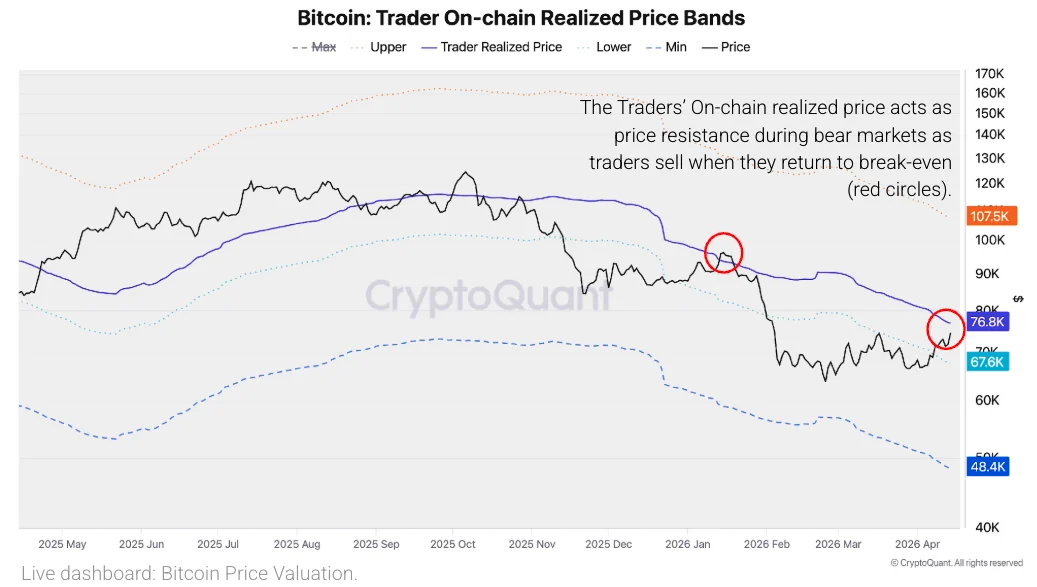
Bitcoin deposits to crypto exchanges surged on Tuesday as it rallied above $76,000, suggesting it is hitting “near-term selling pressure” as investors move their coins into a position for sale, according to CryptoQuant.
In a report on Wednesday, CryptoQuant said the size and rate of Bitcoin (BTC) inflows to exchanges have increased since the rally, with hourly inflows spiking to 11,000 BTC, the highest since December.
CryptoQuant said it is a “historically reliable warning signal of near-term selling pressure, as holders move coins to exchanges in preparation for potential distribution at key resistance zones.”
It added that the average deposit size also increased to 2.25 BTC, the highest since July 2024, and similar to January, when average deposits peaked at 2 BTC before the price nearly halved from $100,000 to $60,000.
Crypto investors have been hoping for a Bitcoin rally as the war in Iran appears to be de-escalating. However, a large shift of Bitcoin into crypto exchanges could suggest any rally would be short-lived.
TradingView shows Bitcoin hit $76,052 on Coinbase on Tuesday, securing its highest price since early February.
However, CryptoQuant said that as Bitcoin nears its $76,800 realized price, it will act “as a ceiling for relief rallies,” and traders who are nearing breakeven on their holdings will be “incentivized to sell, capping further upside.”
It added that Bitcoin’s rally in January was capped as it hit its realized price at the time, which caused prices to reverse, and “the same dynamic may repeat if selling pressure builds from current levels.”

Related: Ether open interest sees 26% increase as markets rally: Are traders into ETH again?
However, CryptoQuant said that profit-taking is “still in its early stages” as daily realized profits hover at $500 million, below the threshold of $1 billion that has “historically coincided with, or slightly preceded, local price tops.”
Daily realized profits could move above the $1 billion mark if Bitcoin rallies above $76,000 or moves toward the $76,800 realized price, CryptoQuant said, adding that could bring greater selling pressure and increase the likelihood of a stall or reversal.
Magazine: Bitcoin may take 7 years to upgrade to post-quantum — BIP-360 co-author


US Iran talks bitcoin and oil markets are watching their most consequential diplomatic moment yet as American and Iranian officials meet face-to-face for the first time, with WTI crude at $92 a barrel and BTC at $74,000.
Summary
- US and Iranian officials are holding direct talks on April 15 for the first time, with US officials saying more time is needed to reach a formal agreement.
- All prior negotiations ran through Pakistani intermediaries, including the 20-hour Islamabad session that collapsed April 13 and triggered the naval blockade.
- Analysts say a credible outcome could push oil toward $80 a barrel and send BTC above $76,000, replicating the pattern from the April 7 ceasefire rally.
US Iran talks bitcoin and oil markets are at a pivot point on April 15. Al Jazeera reported that direct negotiations between the two sides are under way, a format that differs from the Pakistani-mediated sessions that defined all prior contact. US officials described the session as preliminary, stating that more time is needed, but markets have already begun pricing the development.
WTI crude fell from $103 at the blockade announcement to $92 today. Bitcoin, which has closely tracked every diplomatic signal in this conflict, sits at $74,000 after tagging $76,000 on April 14.
Every prior round of contact between the US and Iran ran through intermediaries. The Islamabad session on April 11 and 12, mediated by Pakistan’s military leadership, lasted 20 hours and ended without an agreement. Vice President JD Vance said Iran chose “not to accept our terms.” Trump announced the naval blockade hours after Vance departed.
Direct talks remove one layer of friction from the process. When the April 7 ceasefire was announced through Pakistan, BTC jumped from $68,500 to $72,700 in under 12 hours and liquidated $427 million in short positions. A direct diplomatic breakthrough would carry materially more weight than a brokered one.
The Oil and BTC Math in Real Time
The ceasefire rally template is established. Oil lifted BTC off its post-Islamabad lows every time a credible de-escalation signal emerged. Brent’s 13% single-day fall on the original ceasefire announcement drove BTC from $68,500 to $72,700 within hours. At $92 a barrel today, oil is already 13% below the blockade-announcement spike of $103.
Coin Bureau founder Nic Puckrin has outlined $85,000 to $90,000 as the Bitcoin target in a genuine ceasefire scenario, requiring oil to fall toward $80 and softer US economic data. Every hour of direct talks that does not collapse moves that scenario forward in time.
What Markets Need to Hear
The minimum outcome markets would treat as bullish is a joint statement from both sides agreeing to extend the ceasefire past April 22. A commitment to a formal second-round negotiation process, even without a resolution, would likely push oil below $85 and give BTC the catalyst it has been waiting on through 46 straight days of negative derivatives funding rates.
“We’ve been called by the other side, and they would like to make a deal very badly,” Trump said earlier this week. That framing, now combined with the first direct engagement between the sides, puts a deal closer to the market’s horizon than at any point since the Islamabad collapse.


USDT issuer Tether quietly turned its Bitcoin reserve wallet into a $7.2b war chest, built by funneling 15% of profits into BTC as USDT’s balance sheet goes quasi-sovereign.
Summary
- Tether withdrew 951 BTC worth about $70.47m from Bitfinex into its reserve wallet.
- The address now holds 97,141 BTC, roughly $7.2b in Bitcoin, with about $2.175b in unrealized profit.
- The stack, built using 15% of profits, reinforces USDT’s balance sheet and systemic market role.
Tether has added another 951 BTC, worth roughly $70.47m, to its dedicated Bitcoin reserve address, lifting the wallet to 97,141 BTC (about $7.2b) and cementing USDT’s “quasi-sovereign” profile in crypto markets.
According to on-chain analyst Ember, “Tether’s BTC reserve address recently withdrew 951 BTC ($70.47M) from Bitfinex, acquired in Q1 2026 using 15% of profits,” with the position now sitting on an estimated $2.175b in unrealized gains at an average cost of around $51,312 per coin.
That reserve wallet now ranks as the fifth-largest Bitcoin address globally, underscoring how the issuer of USDT has quietly become one of the market’s biggest direct BTC holders.
Tether first disclosed in 2023 that it would “allocate up to 15% of net realized operating profits to Bitcoin as part of reserve diversification,” a policy it has reiterated in multiple updates as it steadily increased its stack.
In a previous crypto.news story, the company’s Q4 2023 attestation showed it made $2.8b in net profits, driven partly by appreciation in its Bitcoin and gold holdings, while also growing excess reserves above $5b.
Subsequent reporting highlighted Tether buying 8,888 BTC tranches through 2024 and 2025, pushing holdings beyond 96,000 BTC even before the latest move, as USDT supply — tracked on the crypto.news USDT price page — expanded alongside record Treasury-bill income.
The latest 951 BTC withdrawal is therefore less about another bullish Bitcoin bet and more about fortifying USDT as a dollar-pegged instrument with its own hard-asset war chest that can buffer redemptions and market stress.
While the transaction technically increases BTC exposure, the crucial story is USDT’s balance sheet and growing resemblance to a private-sector reserve manager whose decisions can sway crypto liquidity and risk sentiment.
As crypto.news has reported on the rise of regulated stablecoins and tokenized real-world assets, stablecoin issuers sit at the center of flows between traditional Treasuries, tokenized commodities and on-chain lending markets, making reserve composition a key macro variable rather than a footnote.
If Tether continues to channel double-digit billions in annual profits into Bitcoin and other hard assets, each quarterly rebalance will not only move spot markets, but also shape how regulators, banks and trading venues assess the quality and resilience of USDT’s backing.

Eric Swalwell resignation took effect April 15 as the California Democrat stepped down from his seven-term House seat, capping a political collapse that erased both his congressional career and his frontrunner status in the California governor’s race in under one week.
Summary
- Swalwell announced his resignation April 13 under bipartisan pressure, with the House Ethics Committee having opened a formal investigation the same day into whether he engaged in sexual misconduct toward a staffer under his supervision.
- A fifth woman, Lonna Drewes, held a news conference April 14 in Beverly Hills alleging she was drugged and assaulted by Swalwell in a West Hollywood hotel in 2018.
- The resignation leaves California’s 14th district vacant ahead of the November midterms, with California Gov. Gavin Newsom to call a special election.
Eric Swalwell resignation marked the abrupt end of a 13-year congressional career that had, as recently as last week, been on course to produce California’s next governor. Swalwell, 45, resigned after at least five women publicly accused him of sexual misconduct and assault in reports first published by the San Francisco Chronicle and CNN.
“I will fight the serious, false allegations made against me,” Swalwell wrote in his resignation statement. “However, I must take responsibility and ownership for the mistakes I did make.”
The allegations surfaced late last week. A former staffer told CNN she was sexually assaulted by Swalwell on two occasions, including one incident that left her “bruised and bleeding.” Three other women alleged unsolicited explicit messages and nude photos via Snapchat. By Sunday, all 21 of Swalwell’s congressional endorsements for the governor’s race had been withdrawn. He suspended the campaign that night.
The collapse accelerated April 14 when a fifth woman, Lonna Drewes, appeared at a Beverly Hills news conference represented by attorney Lisa Bloom. Drewes alleged Swalwell drugged and assaulted her in a West Hollywood hotel in 2018. “When I arrived at his hotel room I was already incapacitated,” she said in remarks carried by multiple outlets. “He raped me.” Swalwell’s attorney denied all assault allegations.
The Congressional Math After His Exit
The House Ethics Committee opened a formal investigation April 13. That probe will likely end with his departure. Republican Rep. Anna Paulina Luna had introduced a resolution to expel Swalwell, but confirmed she withdrew it once his resignation was official. Republican Rep. Tony Gonzales of Texas also announced his own resignation the same day, citing an affair with a former staffer who later died by suicide.
Swalwell’s exit leaves a vacancy in California’s 14th district, a safe Democratic seat east of San Francisco. The special election timeline is at Newsom’s discretion. Democrats head into the November midterms with one fewer House member and a significant reputational story to manage in what is already a challenging election cycle.
Democratic Party Fallout
Senator Adam Schiff, who had endorsed Swalwell’s gubernatorial campaign, told reporters the allegations were “shocking and deeply upsetting,” adding that he believed the resignation was “the right decision.” No prominent Democrat has publicly disputed that assessment.
The California governor’s race remains wide open. Swalwell had led several early polls before the scandal surfaced, and his exit reshuffles a Democratic primary that was already crowded with candidates hoping to succeed Newsom.

NFL Players from Saguaro H.S. (Scottsdale, AZ)

You can now buy physical books in the Spotify app

Snooker star felt ‘complete embarrassment’ during ‘absolutely nuts’ Crucible qualifier


-

 Politics5 days ago
US brings back mandatory military draft registration
-
 Sports5 days ago
Man United discover Nico Schlotterbeck transfer fee as defender reaches Dortmund agreement
-

 Fashion5 days ago
Weekend Open Thread: Veronica Beard
-

 Politics6 days ago
Malcolm In The Middle OG Turned Down ‘Buckets Of Money’ To Appear In Reboot
-

 Politics4 days ago
World Cup exit makes Italy enter crisis mode
-

 Crypto World7 days ago
Canary Capital Files SEC Registration for PEPE ETF
-

 Business5 days ago
Tesla Model Y Tops China Auto Sales in March 2026 With 39,827 Registrations, Beating Cheaper EVs and Gas Cars
-

 Crypto World2 days ago
The SEC Conditionalises DeFi Platforms to Be Avoided for Broker Registration
-

 Crypto World2 days ago
SEC Signals Exemption for Crypto Interfaces From Broker Registration
-

 News Videos20 hours ago
Secure crypto trading starts with an FIU-registered
-
 NewsBeat3 days ago
Pep Guardiola and Gary Neville agree over Arsenal title problem that benefits Man City
-

 Business6 days ago
OpenAI Halts Stargate UK Data Centre Project Over Energy Costs and Copyright Row
-

 Business5 days ago
Ireland Fuel Protests Enter Day 5 as Blockades Spark Shortages and Government Prepares Support Package
-

 Crypto World5 days ago
Federal judge blocks Arizona from bringing criminal charges against Kalshi
-

 Politics6 days ago
LBC Presenter Mocks Trump Over Iran War Failures
-
 NewsBeat4 days ago
JD Vance announces ‘no agreement’ with Iran over nuclear weapons fear
-

 Crypto World2 days ago
SEC Proposes Certain Crypto Interfaces Don’t Need to Register as Brokers
-

 NewsBeat2 days ago
Trump and Pope Leo: Behind their disagreement over Iran war
-

 Tech6 days ago
A version of Windows 10 released a decade ago is now eligible for additional security patches
-

 Business5 days ago
IMF retains floor for precautionary balances at SDR 20 billion
You must be logged in to post a comment Login