
Crypto World
Analyst Says $15 Dogecoin Target Is Dead After Long-Term Channel Break


Analyst Ali Martinez says the $15 Dogecoin target he has been tracking since the token’s early days is dead, now that DOGE has broken below the long-term rising channel the whole thesis was built on.
The call undoes months of bullish setups other analysts pointed to through August, from whale accumulation to a technical buy signal that had suggested a rally back toward that same structure.
The Channel That Defined the $15 Case Just Broke
The channel in question is a rising parallel one that Martinez says has defined Dogecoin’s price action since inception. Every time the price touched its lower boundary, it marked what he calls a generational buying opportunity, pointing to gains of 9,221% in 2017 and 30,694% in 2020.
When DOGE returned to that support in February 2026, the setup pointed to the possibility of another historic run, with $15 as the projected target. Now that DOGE has broken below the boundary, Martinez says the move has removed “the technical foundation behind the $15 thesis.”
The OG meme coin was trading around $0.0806 at the time of writing, down about 6.6% for the week and 3% on the day, sitting just below the $0.0813 level several analysts had flagged earlier this month as the line to hold.
Against Bitcoin, the token is almost flat, down about half a percent, so this isn’t a case of DOGE lagging some broader market pullback so much as losing a level tied to its own chart. It also remains 89% below its all-time high of $0.7316, set in May 2021.
How the Bullish Case Built Up Through August
The bullish case has been building for weeks. On August 15, Martinez pointed to a monthly TD Sequential buy signal alongside an inverted hammer and a developing doji candle, a combination he compared to a setup from August 2022 that preceded a 145% monthly rally.
He also flagged whale wallets adding more than 430 million DOGE that week. As CryptoPotato reported, the meme coin had slumped below $0.07 days earlier, its lowest level in almost three years, with active addresses climbing from 38,000 in July to 44,000, and other analysts, including Crypto Patel, marking the $0.07 to $0.10 range as a long-term accumulation zone.
By late August, DOGE had rallied 30% in a week to near $0.09, clearing that $0.0813 level the market was watching. More aggressive traders went further still, with MikybullCrypto calling for $3 and Vuori Trading predicting $10, a target that would require Dogecoin’s market cap to top $1.5 trillion.
That rally has since faded, with DOGE back under the same resistance it broke through weeks earlier.
The post Analyst Says $15 Dogecoin Target Is Dead After Long-Term Channel Break appeared first on CryptoPotato.


Coinbase has launched crypto derivatives trading in Canada, giving eligible users access to perpetual and dated futures tied to Bitcoin (BTC), Ether (ETH), Solana (SOL) and other assets.
The products are offered through Coinbase Financial Markets, a futures commission merchant registered with the US Commodity Futures Trading Commission, which operates in Canada under foreign dealer and futures commission merchant exemptions.
Coinbase said Wednesday that the offering includes 23 crypto perpetual and dated futures, five commodity futures and the Coinbase 50 Index. The company said it is the first major crypto-native platform to offer direct native crypto futures in Canada.
Access is limited to eligible Canadian customers, including those with at least $5 million in net financial assets or registered investment advisers and dealers. The contracts use nano-sized positions and offer leverage of up to 10x.
Related: BlackRock launches 2 Canada ETFs, with one allocating 3% to Bitcoin
US trading platforms expand in Canada
The Coinbase launch comes as US trading platforms broaden their crypto offerings in Canada.
On Monday, US online brokerage Webull expanded crypto trading to Canadian customers using Coinbase’s infrastructure for trading and custody, adding digital assets alongside its existing stocks, ETFs and options offerings.
Webull cited rising adoption as one reason for the move, with crypto ownership in Canada climbing to 25% this year from 10% in 2023, according to Ontario Securities Commission research.
Robinhood entered the Canadian market in June through its $180 million acquisition of local crypto company WonderFi, gaining control of Canadian exchanges Bitbuy and Coinsquare. The deal also brought roughly 300,000 funded customers, along with WonderFi’s Canadian licenses and regulatory approvals, under Robinhood.

Robinhood entered Canada after completing its acquisition of WonderFi. Source: Vlad Tenev
The influx of trading platforms comes as Canada tightens oversight of other parts of the crypto market. In April, Ottawa proposed banning crypto ATMs over concerns about scams and money laundering, while lawmakers advanced legislation that would prohibit cryptocurrency donations to political parties and candidates.
Magazine: BTC will hit $1M by 2030… but Arthur Hayes is buying ETH instead


The crypto exchange operator, which confidentially filed for a U.S. listing last November, had already put its IPO plans on hold amid difficult market conditions.
The US state of Wyoming is adding near-real-time onchain reserve verification to its state-issued Frontier Stable Token through an expanded integration with blockchain oracle network Chainlink.
The Wyoming Stable Token Commission said Wednesday it adopted Chainlink Proof of Reserve to publish verified data on FRNT’s reserves and token supply onchain. The system combines independent examinations by The Network Firm with Chainlink’s infrastructure to make the data available in near real time.
Wyoming already publishes daily reserve attestations for FRNT, while the GENIUS Act requires monthly disclosures of reserve composition and outstanding stablecoin supply. The commission said the integration will provide more timely visibility into changes in FRNT’s backing between reporting periods.
The commission is also working to adopt Chainlink’s Secure Mint feature, which would require verified reserves to equal or exceed FRNT’s total supply before new tokens can be minted.
FRNT, launched in January, is backed by US dollars and short-term US Treasurys, with interest income generated from its reserves deposited into Wyoming’s School Foundation Program.
The move comes about two weeks after Wyoming fully migrated FRNT from LayerZero to Chainlink’s Cross-Chain Interoperability Protocol, making CCIP the token’s exclusive cross-chain infrastructure.
Related: Charles Schwab adda Solana, Avalanche and Chainlink to nascent crypto platform
Chainlink expands institutional footprint
Chainlink has picked up several integrations across tokenized equities, stablecoin settlement and traditional financial market infrastructure in recent months.
Most recently, Chainlink became the pricing-data provider for Coinbase’s B20 tokenized equities following their August launch on Base. The feeds cover stocks including Apple, Nvidia, Meta and Alphabet, allowing DeFi protocols to value the tokens for uses including lending, trading and collateral.
In June, Chainlink joined European and South Korean banking groups in Project Pangea, which is exploring the use of regulated euro- and won-denominated stablecoins for atomic foreign exchange settlement across the two regions.
Its push into traditional financial infrastructure has also included the Depository Trust and Clearing Corporation (DTCC), which said in May it would integrate Chainlink technology into a planned 24/7 platform for managing tokenized collateral. That month, Fidelity International also launched a tokenized liquidity fund using Chainlink and Sygnum infrastructure, with JPMorgan providing daily net asset value data for pricing.
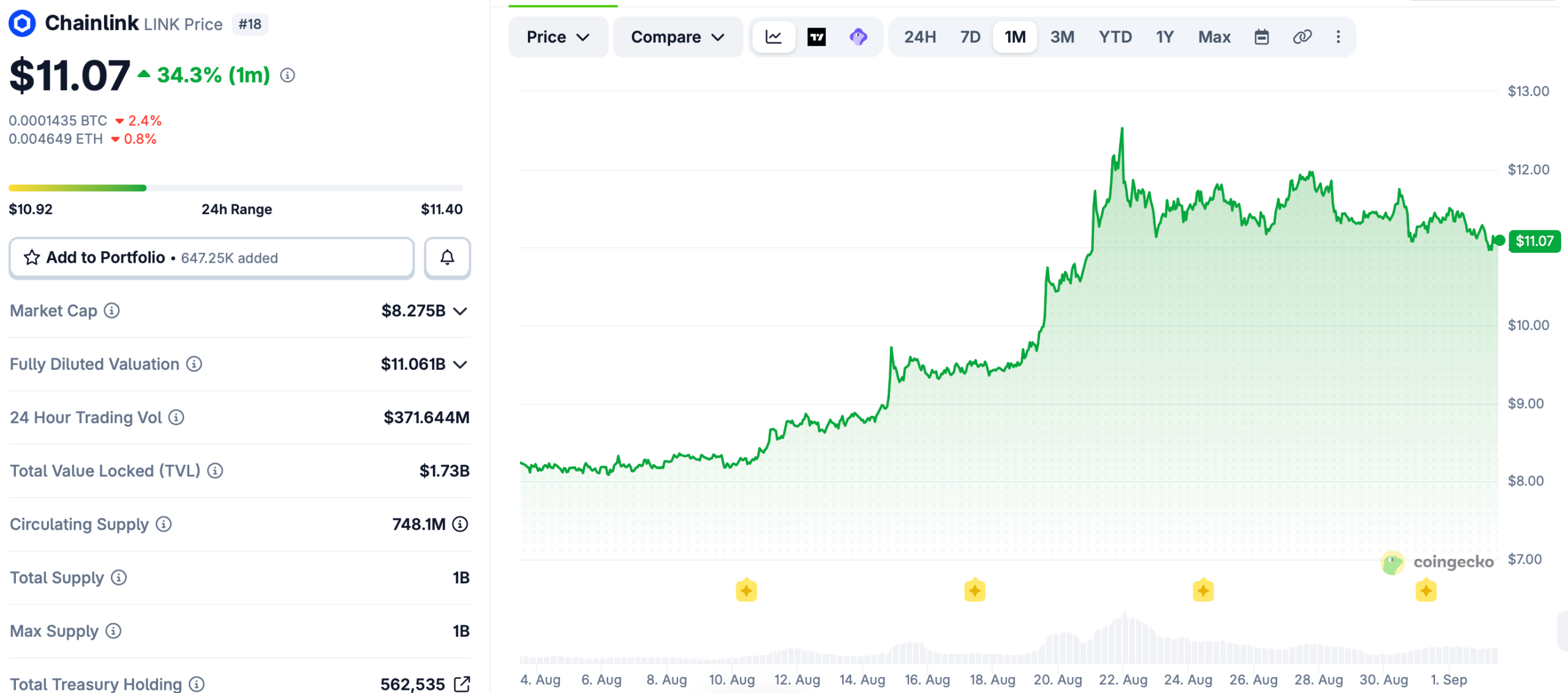
Chainlink’s LINK token has gained more than 34% over the past month, trading at around $11.07 on Wednesday, according to CoinGecko data.
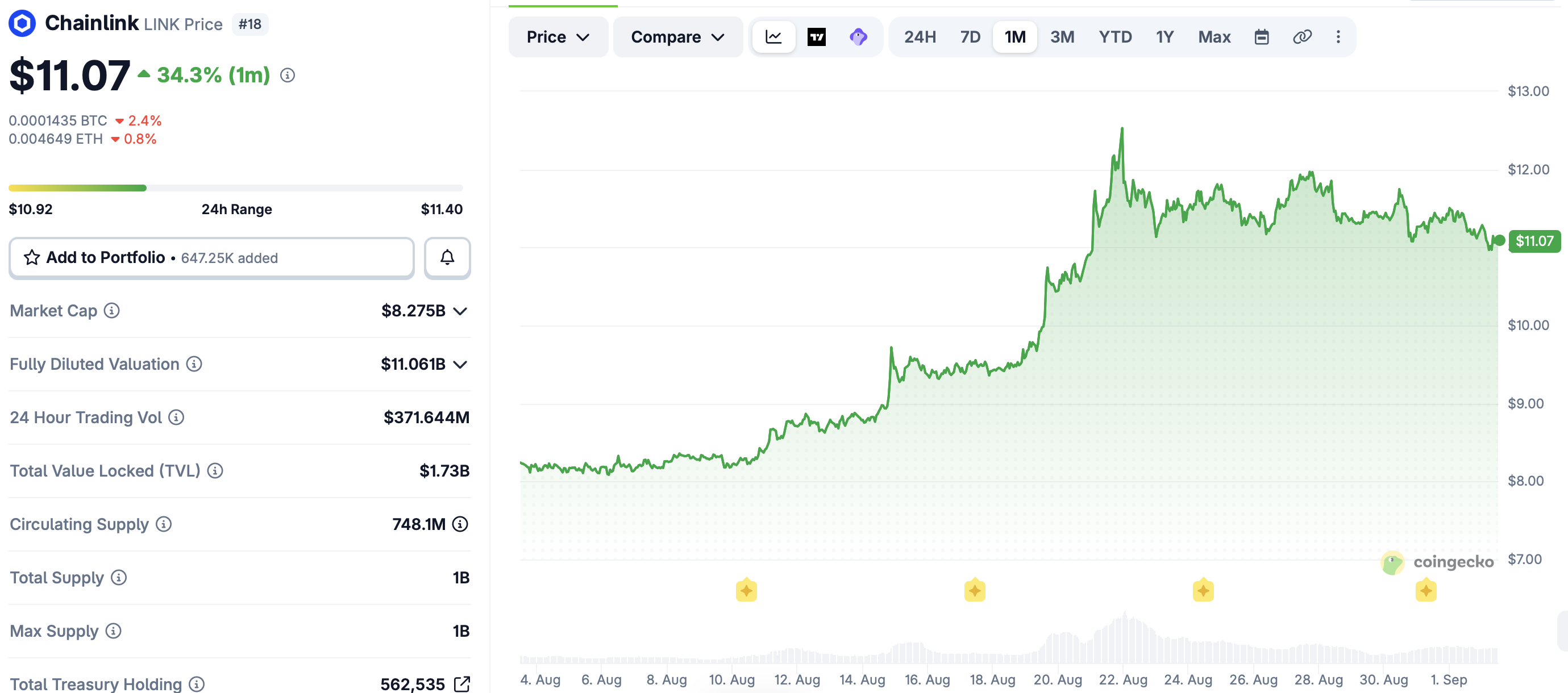
LINK has gained around 34% over the past month. Source: CoinGecko
Magazine: Does the Bitcoin rally mean we haven’t wasted our lives in crypto?

To close such gaps, companies hoping to build at home could start by using modular, off-site methods that can cut project timelines by half and capital costs by 10 to 20%, and deploying technology, collaborative contracting, and more to lower construction costs. Also AI- and robot-first operating models can help employers transform labor productivity. Our analysis found such steps could close half to two-thirds of the U.S. cost gap.
Where cost competitiveness isn’t possible, companies can compete on service quality, brand, customer proximity, and innovation. Complex drug therapies, for example, command premium margins and a decade or more of effective commercial exclusivity. Performance and trust can sustain premium prices. Increasingly, unrestricted access to the U.S. market also matters.
Policymakers face their own challenges. They cannot protect, nurture, ringfence, or subsidize every industry. Instead, they can support industries that can solve America’s so-called “Achilles heels,” the roughly 25% of imported manufactured goods that are critical to national security, exposed to supply concentration, and derived from geopolitically distant trading partners. The scale of intervention required, whether selective trade measures, financial support, industrial policy, or other measures, is substantial. The task is about triage, deciding which industries justify a scale of intervention that would change the playing field, starting with the 25% of imported manufactured goods in which dependencies are most pronounced. Policymakers will also want to work to address existing skews in the international trading system.

New Jersey’s Attorney General and the state’s interim director for the Division of Gaming Enforcement have officially petitioned the US Supreme Court to hear a case aimed at resolving whether state authorities or federal agencies have jurisdiction over prediction market companies.
On Wednesday, Attorney General Jennifer Davenport and gaming enforcement interim director Mary Jo Flaherty filed a petition for a writ of certiorari to the US Supreme Court over New Jersey’s enforcement against prediction market platform Kalshi over sporting event contracts. Officials cited civil cases brought by gaming authorities in “at least 20 states,” seeking the highest court in the US to decide whether prediction market companies could be in compliance with the Commodity Futures Trading Commission (CFTC) while violating state laws.
“Companies like Kalshi claim to offer legal sports betting in all 50 States, but they refuse to follow the gambling laws of any State,” said Davenport. “These companies have no right to offer their sports bets without following state law, which is why dozens of States across the ideological spectrum have opposed them […] We’re calling on the Supreme Court to resolve this issue and recognize that Congress did not silently make the sports-betting industry immune from state law.”

Source: New Jersey Attorney General
Citing New Jersey’s enforcement against Kalshi, the petition presented the Supreme Court with the question of “whether the 2010 Dodd-Frank Wall Street Reform and Consumer Protection Act preempted States from regulating sports bets that occur within their jurisdictions if those bets are offered on markets registered with the [CFTC].” Cointelegraph reached out to the CFTC for comment but did not receive an immediate response.
Related: Kalshi issues first lifetime ban for Republican politician over insider bets
The petition challenges an April opinion from the US Court of Appeals for the Third Circuit, in which judges ruled 2-1 against New Jersey’s gaming authorities, saying Kalshi’s argument that the company had a ”reasonable chance of success” in claiming that the CFTC’s Commodity Exchange Act preempted state law. It specifically challenges the CFTC’s claim that sports bets on prediction market platforms amount to “swaps” under the agency’s purview and argued “federal law does not preempt state sports-gambling laws regardless.”
What are the potential consequences for Kalshi and other prediction markets?
“Because federal law prohibits trading swaps off CFTC-registered markets, a victory for Kalshi would mean that all sports gambling off such CFTC-registered markets would seemingly become illegal even if state law allows it,” said the New Jersey AG’s announcement on the petition.
Kalshi spokesperson Dani Lever told Cointelegraph that the company disagreed with New Jersey’s decision to appeal to the Supreme Court, saying that it could not be “regulated by 50 different regulators.“
”We remain confident in the lower courts’ rulings, and nothing in New Jersey’s filing today changes our view,” said Lever.
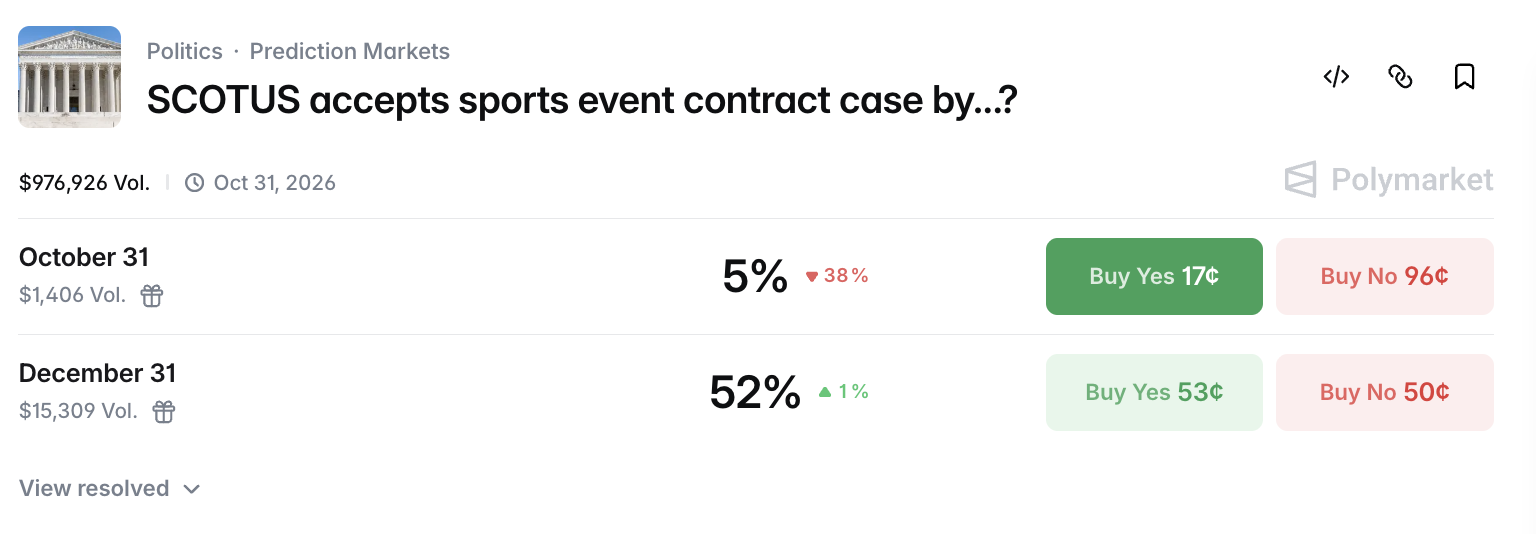
Event contract on when the US Supreme Court will hear a prediction markets case. Source: Polymarket
Whether the Supreme Court justices will take up the issue of prediction markets is unclear. Many experts have been speculating that the justices could weigh in on a case that went to the appellate court in Nevada. Whether the court chooses the Kalshi case in Nevada, the one in New Jersey or an enforcement action against a different company down the road, any potential decision could decide which authorities can regulate prediction markets.
Magazine: Who is legally liable when an AI agent goes rogue?


Caterpillar CEO Joseph Creed disclosed his sale of $26.2 million worth of stock on Tuesday, after exercising an options package four and a half years early.
He sold 32,401 shares on the New York Stock Exchange on August 28, emptying his oldest outstanding tranche of options that had a March 2031 expiration date.
The options had a $219.76 strike price — allowing Creed to exercise 72% below the current stock price that regular investors have to pay today.
Creed’s proceeds of $26.2 million had a weighted average of $808.98 per share, slightly below the filing’s $812.98 valuation for shares surrendered to cover his exercise price or tax liability.
He disposed of 12,002 shares under a filing code for paying an exercise price or tax liability. Their value almost exactly matched the grant’s $9.76 million exercise cost.
Even after the incredible payday, Creed’s August 28 sale only reduced his 2021-vintage options grant to zero. In addition, Caterpillar’s proxy filing lists another 110,651 option grants from years 2022-2025, including vested and unvested compensation.
Moreover, he retained ownership of 34,555 shares of stock, plus another 11,839 shares in his 401(k) retirement account.
Read more: Jefferies slashes SanDisk price target 42% despite record earnings
Creed sells after post-earnings decline
Creed’s sales occurred a few weeks after Caterpillar’s quarterly earnings report.
A few weeks before he would sell $26.2 million, Creed said, “This is the first time in company history that we have generated over $20 billion in sales and revenues in a single quarter.”
Investors haven’t sustained his optimism. Shares of Caterpillar have shed 16% of their value since their $935 high on the day the company reported those earnings.
Creed’s filing didn’t classify his options exercises and associated stock sales under a predetermined, Rule 10b5-1(c) trading plan.
Since 2023, the SEC has required insiders of public companies to tick a checkbox on their Form 4 filings for transactions following a predetermined trading plan, as well as that plan’s adoption date.
Certain pre-2023 grandfathered trading plans are exempt.
Because Creed’s checkbox remained blank, investors are able to speculate more widely about the discretion he exercised in making these sales, rather than dismiss them immediately as unremarkably predetermined.
Got a tip? Send us an email securely via Protos Leaks. For more informed news and investigations, follow us on X, Bluesky, and Google News, or subscribe to our YouTube channel.


Grayscale told the US Securities and Exchange Commission (SEC) to leave crypto exchange-traded fund (ETF) rules alone. New limits would cost investors money and buy them nothing.
The asset manager filed on Aug. 31, the last day of the comment window. The SEC is weighing whether these funds need their own rulebook.
Grayscale Draws a Line on Crypto ETF Rules
The SEC opened the review on June 30 with 27 questions. Crypto is one of seven asset types in the frame.
Chairman Paul Atkins pointed to scale. ETF assets have tripled since 2019. Some sponsors have already parked new launches while the review runs.
One question cuts closest to Grayscale. Should the word “ETF” belong only to funds registered under the Investment Company Act of 1940?
Grayscale said no. Its spot crypto products, including the pending Zcash ETF, are commodity trusts instead. It has run them that way since 2013.
Follow us on X to get the latest news as it happens
Chief Legal Officer Craig Salm went further.
“The term ETF accurately describes the economic reality of exchange-traded commodity trusts, and restricting its use to registered investment companies would create investor confusion rather than resolve it,” read an excerpt in the comment letter.
The 81-Day Delay Behind the Argument
Grayscale also opposed rewriting Rule 6c-11. That 2019 rule lets ETFs launch without case-by-case approval.
Adding portfolio limits or asset-class bans would push up fees, the firm said. Shareholders pay that bill.
Its sharpest evidence is its own record. SEC staff cleared a NYSE Arca listing rule for Grayscale’s five-asset crypto fund on June 30, 2025. The Commission then stayed the decision.
The fund did not trade on the exchange until Sept. 19, a wait of 81 days. Grayscale now wants a confidential pre-filing process with a 45-day staff reply window.
The window has closed. Crypto ETF demand has cooled since the launch boom.
The 1940 law at the center of this fight turns 86 this year. What the SEC does with it sets the pace for every crypto fund still in line.
The post Grayscale Battles SEC Over Future of Crypto ETFs: “Don’t Break What Works” appeared first on BeInCrypto.


XRP Ledger order-book volume has increased 79% year over year in the second quarter of 2026, even as the number of daily trading accounts has fallen 40%, according to Evernorth.
Summary
- XRPL order-book volume averaged 3.57 million XRP per day, up 79% from Q2 2025.
- Daily order-book traders fell from 1,864 to 1,111, while average volume per account nearly tripled.
- Average RLUSD balances on XRPL rose 642% year over year to $539 million.
- Value held on the ledger reached a quarterly average of $4.26 billion.
Evernorth’s Q2 2026 XRP Liquidity Report showed that fewer accounts were responsible for heavier trading activity during the three months through June, creating a more concentrated market even as the amount of value held on the network continued to rise.
Order-book activity averaged 3.57 million XRP per day during the quarter, compared with about 1.99 million XRP a year earlier. Daily accounts initiating order-book trades declined from 1,864 to 1,111 over the same period, leaving each participating account to trade an average of 3,217 XRP per day.
A year earlier, the average account traded 1,072 XRP daily. Evernorth’s figures therefore put the increase in volume per trader at close to threefold, indicating that larger orders offset the drop in the number of active participants.
XRP Ledger trading has become more concentrated
Total decentralized exchange volume on the XRP Ledger averaged 4.42 million XRP per day in Q2, about 20% above the same quarter in 2025, the report said. Order books accounted for 81% of that activity, up from 54% a year earlier.
Compared with the first quarter of 2026, however, total trading volume decreased by 16%. Evernorth described Q1 as an unusually active period, making the yearly and quarterly comparisons important when assessing whether the second-quarter pace can continue.
Average daily trading accounts across the XRP Ledger DEX fell to about 2,435, while order-book accounts recorded a steeper 40% decline. The report did not identify individual traders or determine how much of the remaining activity came from institutions, market makers, or automated strategies.
Institution-focused infrastructure may have contributed to the concentration, according to Evernorth, after permissioned domains and permissioned trading features became available in February. Such tools allow approved participants to transact within controlled environments, although the report did not assign a specific portion of Q2 volume to those venues.
The reduced account count also extended beyond trading. Daily transacting accounts averaged 16,587, while new accounts averaged 2,783 per day, with both measures down about 25% year over year.
Evernorth compared the decline with weaker activity across other crypto networks. According to the report, on-chain exchange volume across seven major programmable networks fell 46% from the previous year, while transaction fees paid on Ethereum, BNB Chain, Base, Arbitrum, Polygon, Optimism and Avalanche collectively dropped 38%.
Account counts are among the report’s most retail-sensitive measures, Evernorth said. The simultaneous decline across multiple chains therefore placed XRPL’s lower participation within a marketwide contraction in trading rather than attributing it solely to conditions on the ledger.
RLUSD liquidity has accelerated on XRPL
Ripple USD activity produced one of the quarter’s largest yearly increases. Evernorth found that average RLUSD balances on the XRP Ledger reached $539 million, rising 642% from $73 million in Q2 2025.
Value moved through RLUSD increased 925% over the same period, while the XRP Ledger’s share of the stablecoin’s total supply grew from 20% to 34%. The report measured quarterly averages, meaning its $539 million balance figure differs from later point-in-time supply readings.
By the end of June, RLUSD supply on XRPL had reached about $676.9 million. The stablecoin continued expanding after the reporting period and passed $1 billion in circulating supply on the ledger on Aug. 28, when it represented about 82% of XRPL’s stablecoin market.
Ripple’s stablecoin also crossed $2 billion in total market value across supported networks in late August, less than two years after its December 2024 launch. As crypto.news previously reported, around $963 million was issued on XRPL, and approximately $1.05 billion was held on Ethereum when the total passed that level.
Because RLUSD seeks to maintain a value of $1, increases in its market capitalization mainly represent additional issuance rather than token price gains. Ripple reported $1.98 billion in reserve assets against $1.87 billion in circulation as of Aug. 20, with monthly independent attestations prepared by Deloitte.
Earlier in 2026, Evernorth reported that RLUSD pairs had generated more than $2.5 billion in XRPL trading activity since launch. The RLUSD/XRP pair contributed about $900 million over six months, while the stablecoin’s share of on-chain trading increased from below 1% to about 12%.
The earlier liquidity findings also placed monthly RLUSD trading transactions near 1 million. Each transfer or trade settling natively on XRPL requires network fees paid in XRP, although transaction activity does not automatically show how much lasting demand it creates for the token.
During Q2, RLUSD also expanded through Wormhole’s Native Token Transfers system to Base, Optimism, Ink, Unichain and the XRPL EVM sidechain. Ripple already supported the stablecoin natively on XRPL and Ethereum.
Value held on XRPL has reached a quarterly record
Average value held on the XRP Ledger rose to $4.26 billion during Q2, according to Evernorth, setting the highest quarterly reading in the report’s series. Six quarters earlier, the comparable figure stood at $99 million.
The measure increased in every quarter across that period, even when trading participation weakened. It includes value represented by issued assets on the ledger and is separate from XRP’s total market capitalization, which tracks the circulating token supply multiplied by its market price.
Tokenized assets and stablecoins contributed to the increase. A portion of a tokenized U.S. Treasury fund also completed its on-ledger asset settlement in under five seconds during the quarter, although the reported timing covered the blockchain leg rather than the entire banking and payment process.
RLUSD’s growth formed a large part of the asset increase, while XRP produced a strong market move after Q2 ended. The token gained about 37% in August, rising from a 2026 low of $0.9874 on Aug. 15 to a six-month high of $1.6963 on Aug. 22 before moving back into the $1.35 to $1.50 range near month-end.
U.S.-listed spot XRP exchange-traded funds recorded $110.49 million in net inflows during the week ending Aug. 28, their highest weekly total of 2026. Seven funds had accumulated more than $1.66 billion in net inflows by that point, while combined August trading volume reached $723 million.
Evernorth’s U.S. listing ties the data to public investors
Evernorth’s report also carries relevance for U.S. investors because the Ripple-backed company is seeking to become a publicly traded XRP treasury business through a merger with Armada Acquisition Corp. II.
Under an amended SEC registration, the proposed company expects to list on Nasdaq under the ticker XRPN if the transaction closes. Investor commitments exceed $1 billion and include Ripple, SBI Holdings, Pantera Capital, Kraken, and Arrington Capital.
Evernorth previously disclosed $387.1 million in XRP holdings, while Ripple contributed more than 126.7 million XRP to the treasury plan. The company has also said it plans to operate XRPL validators, use RLUSD in institutional decentralized finance services, and support tokenized real-world assets.
The SEC must declare the registration statement effective before Armada Acquisition Corp. II shareholders can vote on the business combination. The filing remained under SEC staff review, with the regulator providing comments on the proposed transaction.
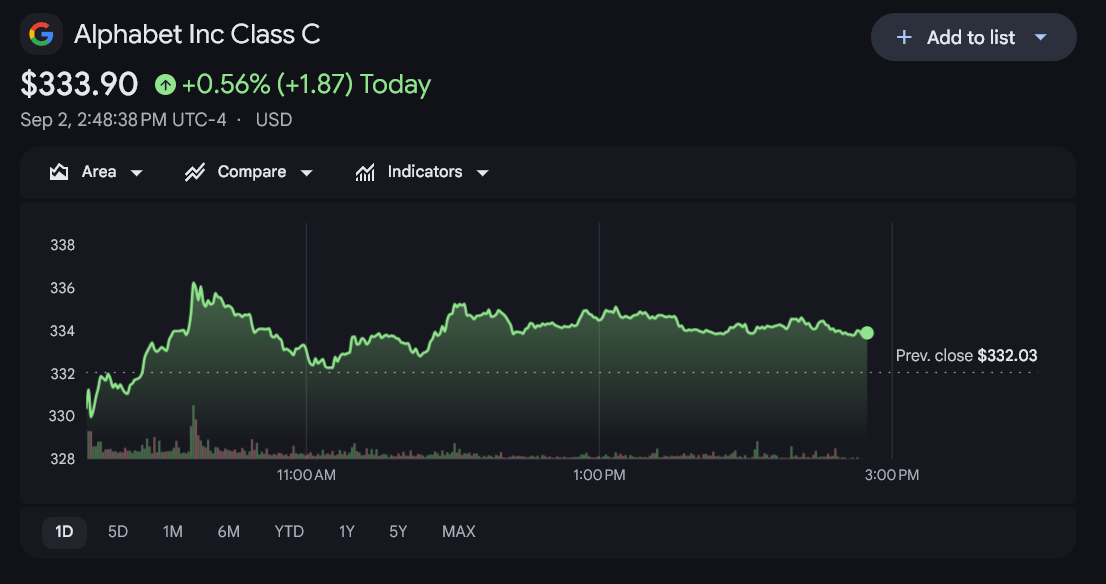
Google was accused of having an illegal advertising monopoly. On Wednesday, it still walked away with the business intact.
US District Judge Leonie Brinkema rejected the Justice Department’s attempt to force Google to sell AdX, the exchange at the heart of its advertising system. Alphabet shares rose modestly after the breakup threat disappeared.
Instead, Brinkema ordered changes to how Google operates its ad tools, including giving rivals greater access to bidding data.
A Narrow Escape for Google?
The case began in 2023, when the Justice Department and several states accused Google of dominating the technology publishers use to sell online ads.
In April 2025, Brinkema agreed. She found Google had illegally tied publishers to AdX, where it collects a 20% fee.
“substantially harmed Google’s publisher customers, the competitive process, and, ultimately, consumers of information on the open web,” Reuters reported, citing Brinkema.
Google argued that selling AdX would be technically difficult and disruptive for customers. The judge rejected the breakup.
The ruling extends a striking pattern. Exactly one year earlier, another judge allowed Google to keep Chrome. Meta then kept Instagram and WhatsApp in November. US regulators have now lost three straight attempts to break up Big Tech.
Ad Manager itself is small beside Alphabet’s $4.08 trillion valuation. It generated 4.1% of Google’s revenue and 1.5% of operating profit in 2020.

The pressure has hardly disappeared. Google still faces regulatory problems in Europe, while its AI position remains less settled and Alphabet’s huge AI spending is becoming a bigger question for investors.
Follow us on X to get the latest news as it happens
The post Google Stock Gets Another Bullish Signal From US Courts appeared first on BeInCrypto.


Bitcoin has gained roughly 22% over the past month, but Nansen analyst Nicolai Søndergaard has warned that weak spot flows, divided whale positions, and ETF withdrawals have yet to confirm a new bull market.
Summary
- Bitcoin remains below its seven-day average despite maintaining positive daily and weekly trends.
- Nansen tracked about 3,700 BTC in net exchange inflows from labelled entities over the past week.
- Large Hyperliquid whales remain heavily short as open interest falls and taker selling continues.
- Bitcoin must hold $77,400–$77,650 before another test of the $80,000 resistance level.
Bitcoin’s 22% recovery lacks spot confirmation
Nansen senior research analyst Nicolai Søndergaard told crypto.news that Bitcoin’s market structure has improved after its 22% monthly recovery, though several flow indicators have stopped him from declaring the start of a confirmed bull phase.
Positive daily and weekly trends suggest Bitcoin has moved past the weakest part of its previous decline, according to the analyst. More recent data have produced a less convincing picture, with BTC trading below its seven-day average while short-term momentum remains weak.
“The recovery is real, but spot flows haven’t confirmed the bull market yet,” Søndergaard said.
Labelled entities tracked by Nansen sent a net 3,700 BTC to exchanges during the past week. Because exchange deposits can precede sales, the analyst included the increase among the factors limiting his confidence in the rally, although transfers to trading platforms do not always lead to immediate selling.
US-listed spot Bitcoin exchange-traded funds also recorded around $236 million in withdrawals in the latest reading cited by Søndergaard. The reversal followed a period of stronger institutional activity during August, when ETF demand supported Bitcoin’s advance from below $65,000 to above $80,000.
As previously reported by crypto.news, Bitcoin gained approximately 24% in August, delivering its strongest performance for the month since 2017. US spot ETFs attracted $1.92 billion during their strongest weekly run since October 2025, while $6.55 billion in short liquidations accumulated across two weeks.
The later outflow does not erase the earlier buying, but Søndergaard said the market still needs consistent spot demand before the recovery can qualify as a lasting cycle turn.
“That combination suggests the recovery still lacks consistent spot-flow confirmation,” he said, referring to ETF withdrawals, exchange deposits and weaker short-term momentum.
Whale positions leave Bitcoin exposed in both directions
Large Bitcoin traders have not adopted one clear position during the recovery, according to Nansen’s data. Whales tracked across the firm’s monitored addresses remain slightly net long, while accounts trading large notional amounts on Hyperliquid hold heavy short exposure.
Funding rates remain positive but moderate, indicating that traders holding long perpetual-futures positions are paying shorts without reaching the elevated levels commonly associated with an overcrowded trade. At the same time, declining open interest shows that total derivatives exposure has contracted, while taker-flow data point to continued market selling.
According to Søndergaard, the combination creates the conditions for a short-covering bounce because lower-timeframe momentum has already entered oversold territory. A price increase could force bearish traders to close positions by purchasing Bitcoin, adding fuel to an advance even without an immediate increase in spot buying.
Such a move would not automatically confirm a breakout, he added, because leverage-driven buying can fade after short positions have been closed.
Long traders face a separate risk if Bitcoin loses $76,400, which the analyst identified as an important downside level. A break below it could pressure leveraged bullish positions and weaken the local-bottom case.
Bitcoin recently traded near $76,500 after retreating from levels above $81,000. A recent market assessment identified $76,350 as a nearby support area, with deeper downside levels around $74,500 and $72,000 if sellers regain control.
Although both analyses place support in a similar region, Søndergaard’s test also depends on the type of demand behind any rebound. Nansen would view stronger spot volume differently from a rise led mainly by perpetual futures and forced position closures.
Bitcoin’s $80K test requires stronger ETF demand
For the recovery to become more durable, Bitcoin must first reclaim and hold the $77,400–$77,650 range, according to Søndergaard. A successful move through that area would bring the $80,000 level back into focus after several failed attempts to remain above it.
Stronger spot volume and improving ETF flows would provide the confirmation the analyst is seeking. Funding would also need to remain moderate as open interest expands gradually, a combination that would show traders are adding exposure without creating an immediate leverage imbalance.
“If that happens while funding stays moderate and open interest grows gradually, I would see the recovery as becoming more durable and expect broader participation across crypto.”
A renewed rejection at $80,000 would produce a different signal if exchange inflows remained elevated and derivatives exposure rebuilt without fresh spot demand. Under that scenario, Søndergaard would consider the rally increasingly dependent on leverage and vulnerable to another correction.
Strategy has taken a more aggressive position despite the unresolved market signals. The company purchased 4,603 BTC for $369.7 million between Aug. 24 and Aug. 30, ending a pause of more than two months.
According to an Aug. 31 filing with the US Securities and Exchange Commission, Strategy paid an average of $80,318 per coin, including fees. The transaction increased its holdings to 845,050 BTC, acquired for $63.73 billion at an average cost of $75,412.
Strategy funded the purchase through its at-the-market common-stock program, selling more than 4.5 million MSTR shares for $602.8 million in net proceeds. Of the remaining capital, the company used $151.8 million to repurchase STRC preferred shares, allocated $50.7 million to STRC dividends, and added $30 million to unrestricted dollar cash.
Chief Executive Phong Le has said financing costs, rather than Bitcoin’s trading price alone, determine the company’s purchase decisions. Speaking as Bitcoin approached $80,000, Le described the market as a “pretty heavy bull market” and said Strategy intended to keep buying regardless of price.
US jobs and Treasury yields add another test
Macroeconomic conditions have also limited Nansen’s confidence, with the US 10-year Treasury yield trading near 4.80% as rising oil prices and inflation concerns pushed bond yields higher.
Higher real yields increase the return available from inflation-adjusted government debt, which can reduce demand for assets that do not generate income. Søndergaard cited the yield environment as one of the constraints facing Bitcoin, alongside stablecoin supply that Nansen measured at roughly $310 billion with little recent growth.
Federal Reserve policy expectations have moved toward another rate increase following Chair Kevin Warsh’s Jackson Hole address. After his remarks, Bitcoin fell from above $80,000 to around $79,200, while prediction-market traders raised the estimated probability of a 2026 increase to 68%, according to an earlier market report.
Fresh labor data have since complicated the outlook. ADP reported that US private employers added 38,000 jobs in August, below economists’ forecasts and down from a revised 46,000 in July. Manufacturing lost 17,000 positions, while professional and business services shed 16,000.
The Bureau of Labor Statistics is scheduled to publish the official August employment report on Sept. 4 at 8:30 a.m. Eastern Time, including nonfarm payrolls, unemployment, and wage-growth data.

Crypto Currency Scam in Jagtial District | Politicians & Doctors Lose Crores |

Republican Senator calls on Trump to fire Hegseth for ‘inept management’
Microsoft offers first quarter outlook under new segment structure





-

 Fashion5 days ago
Weekend Open Thread: Maeve – Corporette.com
-

 Crypto World6 days ago
Bitcoin’s 22% rally now needs real demand to outlast Treasury liquidity boost
-

 Business6 days ago
Apple Confirms September 9 Keynote and Reveals Its Full Pre-Order Schedule
-

 Crypto World7 days ago
Elon Musk Grok Bot Promise: We Will Make You Whole if AI Loses Your Money
-

 Business6 days ago
Salesforce Stock Soars 19% as Blowout Earnings and Agentforce AI Growth Silence Software Skeptics
-

 Business5 days ago
Onto Innovation Stock: AI’s Next Bottleneck Is Yield (NYSE:ONTO)
-

 Crypto World7 days ago
NVIDIA revenue hits $96.2B as AI demand doubles
-

 Crypto World5 days ago
Bitcoin price tests $82K resistance as Brandt stays long
-
 Tech4 days ago
Hugging Face built a $4.5 billion empire on free AI models. Now Nvidia is buying it for $12.9 billion
-

 Business5 days ago
iPhone 18 Pro Pre-Orders Could Shift to Saturday as Apple Reportedly Avoids September 11 Anniversary
-

 Tech7 days ago
Claude Cowork gets its own browser that doesn’t touch your tabs, bookmarks, or saved passwords
-

 Crypto World6 days ago
Truflation calls for Fed rate cut after PCE forecast
-

 Crypto World7 days ago
GENIUS Act missed its deadline as OCC writes rules anyway
-

 Tech5 days ago
PaperCut releases second emergency patch for exploited flaws
-

 News Videos3 days ago
Charlie Munger on Robinhood: No one should believe that Robinhood’s trades are free
-

 Tech7 days ago
Apple’s iPhone 18 Pro event is on September 9
-

 Tech6 days ago
The fix for the AI agent that hijacked a company’s DNS: it can propose the change, but it can’t approve it
-

 Tech4 days ago
As the influencer economy drives retail sales, Seattle startup raises $22M to play matchmaker
-
 Entertainment5 days ago
‘Adults’ Creators Break Down Season 2’s Most Shocking Moments and Tease a Potential Season 3
-

 Tech4 days ago
Tamagotchi Ring Takes the 30-Year Digital Pet and Places it on Your Finger
You must be logged in to post a comment Login