

Crypto World
Binance Australia Mandates Sender and Beneficiary Info for All Crypto Transfers Starting July 1, 2026


TLDR:
- Binance Australia will require sender and beneficiary details for all crypto transfers from July 1, 2026.
- Australian users must re-login to Binance accounts on July 1 as part of the mandatory system update rollout.
- Transactions missing required sender or beneficiary information may be delayed, rejected, or returned to origin.
- Users sending crypto to themselves on another exchange only need to provide the receiving exchange’s name.
Binance Australia will introduce new crypto transfer requirements starting July 1, 2026. Australian users must provide sender and beneficiary information for all crypto deposits and withdrawals.
The changes align with local regulatory requirements. Transactions that lack the necessary details may face delays, rejection, or return to the originator. Users should prepare their login credentials, as re-authentication will be required from that date.
New Information Requirements for Crypto Deposits and Withdrawals
The updated procedures will affect all crypto deposit and withdrawal transactions on Binance for Australian users. When receiving crypto, users must visit the deposit page and click on transactions pending credit.
A pop-up will then prompt them to enter the originator’s details. These details include a full name, country of residence, unique identifier, and city or locality.
For outgoing transfers, users will see a pop-up after confirming withdrawal details. They must then enter the beneficiary’s full name, country of residence, and city or locality.
However, users sending assets to themselves on another exchange only need to provide that exchange’s name. This simplifies the process for self-transfers between platforms.
Binance described the move as a step toward full compliance with Australian regulatory standards. The exchange stated it will gradually roll out these changes to ensure a smooth transition.
Users who do not perform crypto transfers are not required to take any action. The changes are strictly limited to deposit and withdrawal activity.
It is worth noting that incomplete information can result in transactions being delayed or rejected outright. In certain deposit cases, assets may be returned to the originating exchange or wallet.
Users are therefore encouraged to have all required details ready before initiating any transfer. Binance also directed users to its privacy notice for details on personal data handling.
What Australian Users Should Prepare Before the July 1 Deadline
As the deadline approaches, Australian users should review their account credentials and ensure they can log back in after July 1. Binance has confirmed that re-login will be mandatory when the new system goes live.
Failing to log in or provide the required details could disrupt access to funds. Early preparation can help users avoid any disruption to their trading activity.
Users sending crypto to external wallets or other exchanges should also gather beneficiary information in advance. Knowing a recipient’s full name, location, and country will speed up the withdrawal process.
For deposits, users should coordinate with the sending party to collect originator details promptly. This coordination becomes especially important for time-sensitive transactions.
Binance’s move is part of a broader global trend where crypto exchanges are aligning with financial regulations. Australia has been tightening its oversight of digital asset platforms in recent years.
These new procedures reflect that regulatory direction. Binance’s proactive approach aims to keep its Australian operations fully compliant while serving its user base without interruption.




U.S. inflation data came in as expected on Wednesday, reinforcing the view that the Federal Reserve will keep interest rates at 350-375 bps at its June 17 meeting but is likely to increase rates by 25 bps by the end of the year.
The Consumer Price Index year over year rose 4.2% in May, according to a report from the Bureau of Labor Statistics. Economists had been expecting a rise of 4.2% following the April 3.8% increase.
On a month-over-month basis, CPI rose 0.5%, against expectations of 0.5% and against April’s 0.6% rise. Core CPI, which excludes food and energy costs, rose 0.2% in May versus forecasts of 0.3% and April 0.4%. Year-over-year core CPI was higher by 2.9% versus forecasts of 2.9% and April’s 2.8%.
While bitcoin saw a slight uptick after the data was published, it still remains under pressure. Bitcoin traded just above $61,000 following the report, mostly unchanged over the past 24 hours. U.S. stock index futures were down across the board, and the 10-year Treasury yield rose to 4.5%. WTI crude oil continues to head lower, down a further 1% on the day at $88.
Ahead of the CPI data, markets were pricing in a 98% probability that the Federal Reserve would leave interest rates unchanged at its June meeting, according to the CME Fed Watch tool.
The election season is ramping up in the United States, meaning that airwaves and social media are flooded with campaign ads.
Candidates, in addition to the political action committees (PACs) supporting and opposing them, are projected to spend a record-breaking $10 billion in ads this cycle. Some of that is going into AI deepfakes.
At least 15 AI-generated campaign ads have run since November, according to NBC News. Some have used deepfakes to portray a candidate doing or saying things that compromise their campaign’s image.
Transparency advocates say the ads, which are illegal in some states, could harm the integrity of American elections.
Ad runs afoul of local election laws
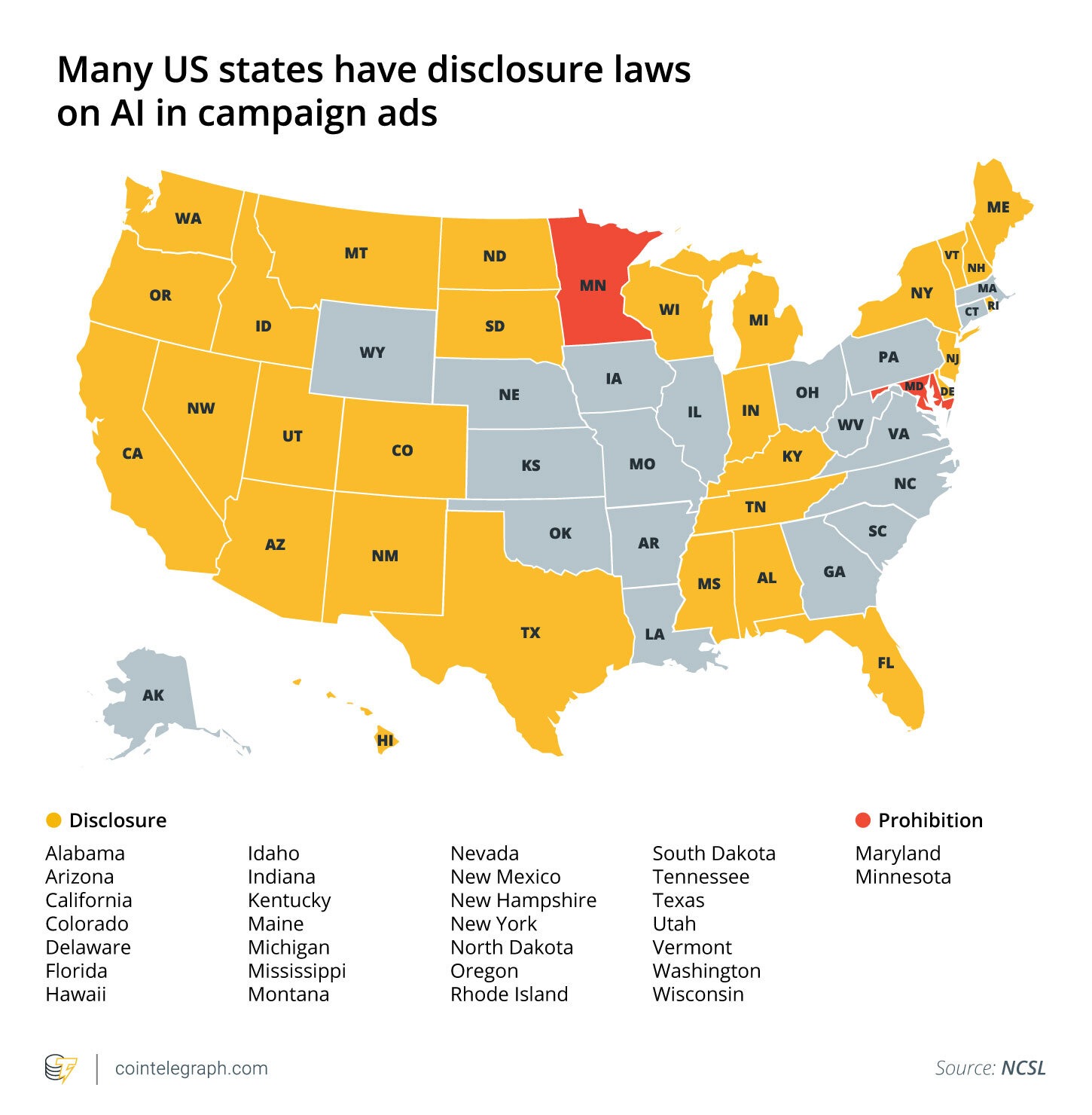
In the context of campaign ads, AI is mostly governed at the state level. Some 28 states have disclosure laws, while in two states, it is prohibited, though not totally.
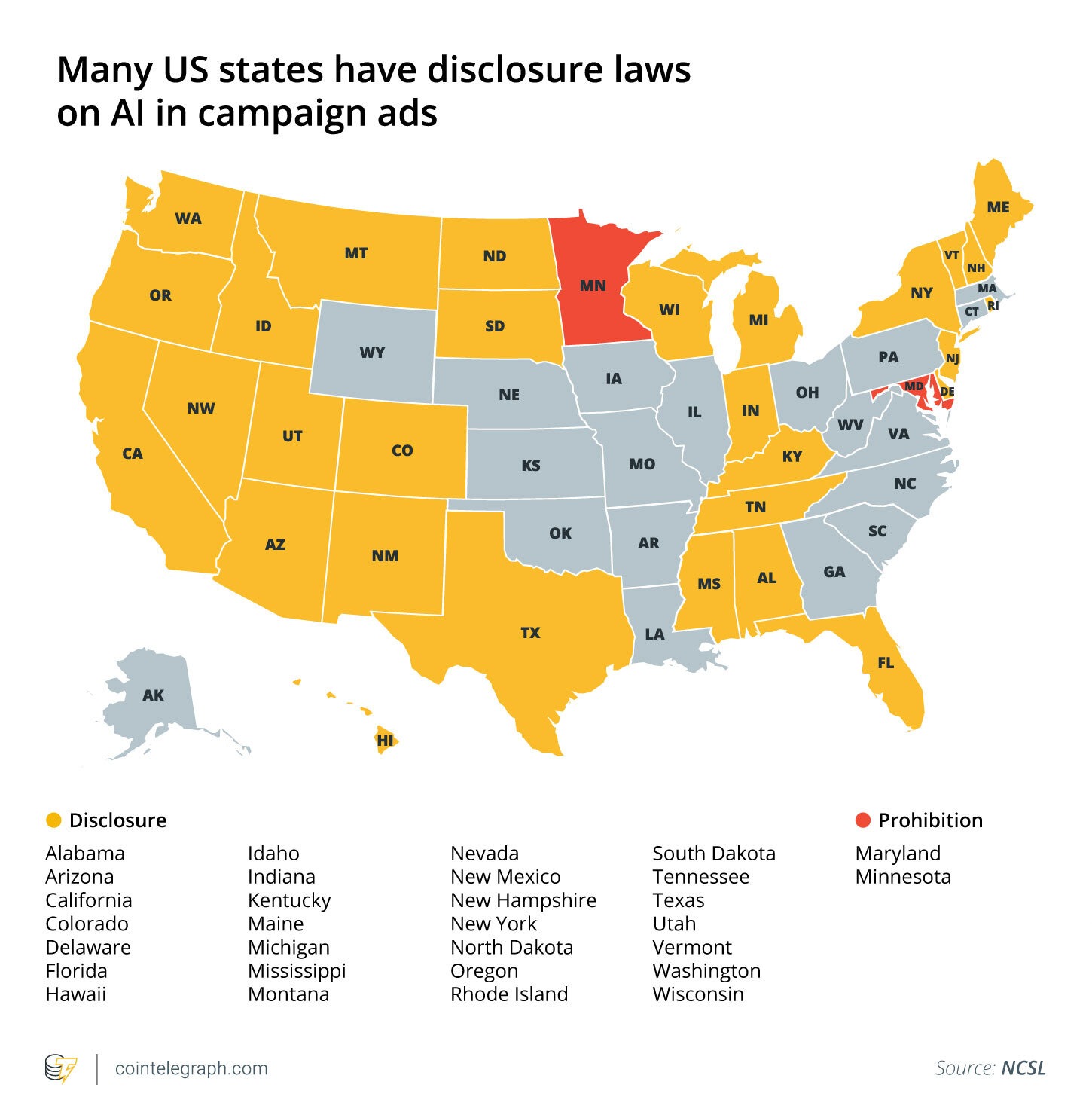
In Minnesota, one ad campaign has already bumped up against local legislation. Minnesota Lt. Governor Penny Flanagan posted on BlueSky on June 3 “you might see a TV ad starring something that… kind of looks like me.”
Flanagan was referring to an ad run by a PAC supporting her opponent in the Senate primary race, fellow Democrat and US Representative Angie Craig. The ad shows Flanagan standing atop a large pile of cash, and criticizes her alleged ties to special interest groups.
“My opponent’s super PAC is using an AI deepfake of me to mislead voters. They can’t win with the truth – so they’re resorting to lies.”
“It’s disgusting. Minnesotans deserve better.”
The ad may run afoul of Minnesota campaign laws. In 2023, Democratic State Representative Maye Quade introduced a bill that bans AI deepfakes. It was passed into law, and “anyone who widely shares a deep fake within 90 days of an election” is guilty of a crime. This, provided that the person also:
- Knows or should have known the ad was a deepfake and made without the consent of the depicted person
- Acted with the intent to harm a candidate’s reputation to influence an election
The ads ran after the DFL, Minnesota’s Democratic party, nominated Flanagan, so technically it may have not violated the law. Still, Flanagan’s campaign is reportedly consulting lawyers.
Quade told local media that the ad violated the spirit of the law, and that people in general don’t like AI being used this way. “People don’t like this, broadly […] What campaign on either side of the aisle is going to help voters feel good about their candidate using this?”
Related: Prediction markets legal battles heat up in Minnesota, Rhode Island
On the Democratic side of the aisle, 40 DFL state legislators signed a letter condemning the use of AI deepfakes in campaign materials. They noted that, in 2023, “lawmakers voted nearly unanimously to ban the use of deceptive AI-generated deepfakes in elections, recognizing the threat manipulated AI content poses to voters and public trust.”
“Regardless of party, the use of AI-generated deepfakes in campaign advertising is unacceptable.”
Mark Jablonowski, the CEO of advertising firm DSPolitical, told NBC that he thinks most politicians will rise above it. “I think most campaigns on both sides of the aisle probably want to do the right thing […] There, of course, are going to be examples that you can point to where people are going about it the wrong way.”
The PAC that issued the ad, North Star Dawn PAC, did not respond to Cointelegraph’s request for comment.
What do election laws say about AI deepfakes?
As noted above, some 30 states have laws on the books regarding AI use in elections. The vast majority of these relate to simple disclosure, with many states only having civil penalties for infractions.
The Federal Elections Commission (FEC), the regulator responsible for creating funding, disclosure and other rules concerning elections. Regarding ads, the FEC told Cointelegraph:
“Commission regulations require clear and conspicuous disclaimers to appear on certain campaign advertisements, including public communications that are distributed by a federal candidate’s campaign committee.There is also a prohibition against ‘fraudulent misrepresentation.’”
Public Citizen, a consumer advocacy group, submitted a petition for rulemaking before the FEC in 2023, asking the commission to issue rules for AI. Instead, the body “decided not to initiate a rulemaking.”
“The Commission determined that the statute’s fraudulent misrepresentation ban is technology neutral, applying to all means of the specified fraud, including AI-assisted media.”
One may not expect quick action from the federal government, at least not from Congress, on AI. In 2023, Senator Amy Klobuchar and Representative Yvette Clarke, both Democrats, introduced the REAL Political Advertisements Act in their respective chambers. However, the bill failed to pass in either house.
If anything, the US Congress shows a total unwillingness to meaningfully regulate AI. Nearly one year ago, President Donald Trump signed the One Big Beautiful Bill Act into law. The final version narrowly avoided including a 10-year ban on any state and local regulation of AI, giving the industry carte blanche for anything from building data centers to how AI would be used in popular media.
Now, two Congressmen are back at it. Democrat Lori Trahan and Republican Jay Obernolte on June 4 introduced a bill that, if passed, would ban states from passing laws “targeting artificial intelligence model development.”
According to the American Civil Liberties Union (ACLU) “This could include anything from privacy regulations to antidiscrimination requirements to AI safety laws.”
The ACLU noted that the aforementioned 10-year ban was stripped from the Senate file in a near-unanimous 99-1 vote.
Jina John, senior policy counsel for AI, privacy and technology at the ACLU, said, “This draft bill fails to learn from Congress’s previous attempts to block state AI regulations. States must be able to protect their own residents from harm, hold tech companies accountable, and ensure that AI is safe and trustworthy.”
Magazine: Korea probes Polymarket users, crypto PACs sweep primaries: Hodler’s Digest, May 31- June 6
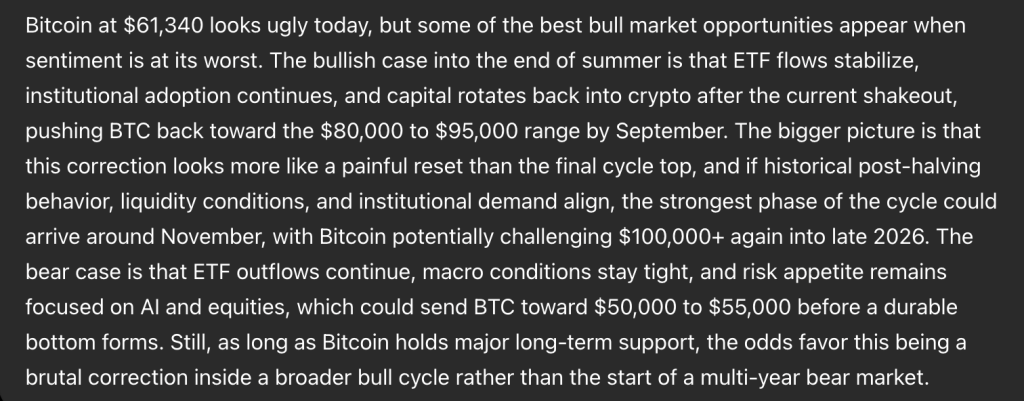
Sam Altman model ChatGPT AI just looked at an ugly Bitcoin chart and predicts for a rebound into the $80,000 to $95,000 range by September. With BTC sitting at $61,340 right now, that is a 30% to 55% climb at the exact moment sentiment feels its absolute worst, and that timing is the whole point.
The core thesis is simple. The best bull market entries almost never feel good. They show up when the chart looks broken and everyone has given up, not when price is ripping and the news is glowing.
Right now BTC price looks ugly, but the read is that this is a painful reset inside a bigger bull cycle, not the final top. That single distinction is what separates a generational buy from a falling knife, and the call leans hard on it being the former.
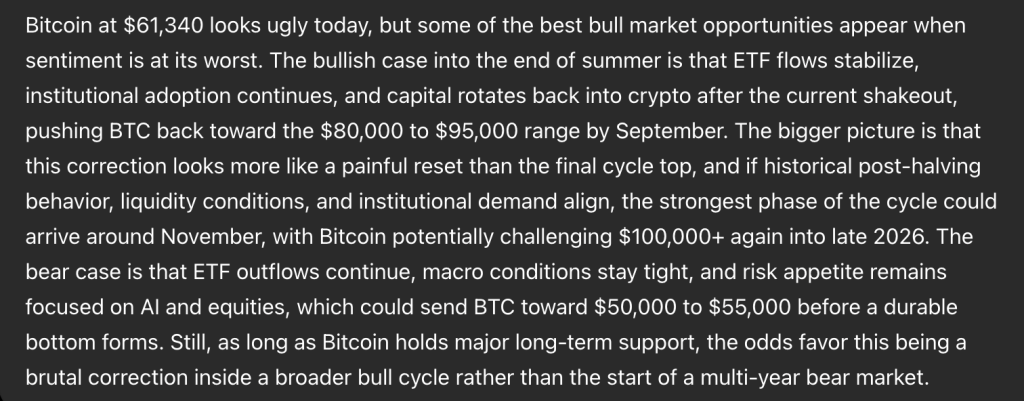
The bull case says ETF flows stabilize, institutional adoption keeps grinding higher, and capital rotates back into crypto once this shakeout finishes.
That mix pushes BTC back toward $80,000 to $95,000 by September. The bigger picture is even more interesting.
If historical post-halving behavior, liquidity conditions, and institutional demand all line up, the strongest phase of the cycle could land around November, with Bitcoin challenging $100,000 plus again into late 2026.
The bear case is real and worth respecting. If ETF outflows keep bleeding, macro stays tight, and risk appetite stays glued to AI and equities, BTC could slide toward $50,000 to $55,000 before a durable bottom forms.

That is the zone where the deeper flush plays out. Still, as long as Bitcoin holds major long-term support, the odds favor this being a brutal correction inside a broader bull cycle rather than the start of a multi-year bear market.
Bitcoin Price Prediction: When The Chart Looks Broken Is When The Cycle Pays
Now the chart. BTC is on the weekly and price sits at $60,800 after a steep drop from the $128,000 top set last July.
The structure is a deep correction, a clear stack of lower highs since that peak with price now sliding into a major demand zone.
Pattern wise this is a return to the wide accumulation band that runs from roughly $52,000 to $61,000, the same shelf that launched the entire last leg up.
Key support sits at $60,000, with the next floor near $55,000 and deeper demand around $52,000. Resistance stacks at $70,000, then $80,000, and the heavier ceiling at $90,000.
RSI is reading 32.79 with its signal line at 40.31. So momentum is sitting well below its average and pressing toward oversold on the high timeframe.
That wide gap of about 7.5 points shows real selling pressure short term, but on the weekly, this kind of stretch into oversold has marked major cycle lows before.
When RSI curls back above the 40.31 signal, it flips the long-term read back to bullish. Tie it together, and the chart is sitting right on the support that has historically launched the next leg. Hold this $52,000 to $61,000 band and the path back toward $80,000 and beyond opens up exactly like the prediction lays out.
You Might Like What ChatGPT AI Predicts About LiquidChain
The rotation has started. Most people will recognize it after it has already happened.
Large caps are not broken. They are capped. Bitcoin, Ethereum, and XRP are pinned under the same resistance they have been testing for weeks. The macro catalyst keeps getting rescheduled. The institutional inflows keep getting pushed back. Waiting on things outside your control is not positioning. It is just sitting still.
Capital that understands cycles moves before the next thing becomes obvious. Not after.
Early stage infrastructure works on different math. Small market cap means a modest capital rotation produces dramatic movement. Returns arise from the gap between what something is genuinely worth and what the market has priced it at. That gap closes the moment the project gets discovered. Right now it is still open.
Multi-chain fragmentation is one of the most expensive unsolved problems in DeFi. Bitcoin, Ethereum, and Solana run completely isolated systems. Every user crossing those boundaries pays for that in fees, slippage, and failed transactions. Every single time.
LiquidChain removes the cost entirely. All 3 networks in one execution layer. One deployment. Full ecosystem access. No cross-chain tax.
The presale is at $0.01454 with just over $820,000 raised. Still early. Still undiscovered.
Execution is unproven. Adoption is unknown. Established assets offer a smoother ride toward a ceiling that is already priced in. LiquidChain is a seat at a table that has not been set yet.
Explore the LiquidChain Presale
The post Nobody Predicts Sam Altman ChatGPT AI Would Say This About Bitcoin appeared first on Cryptonews.
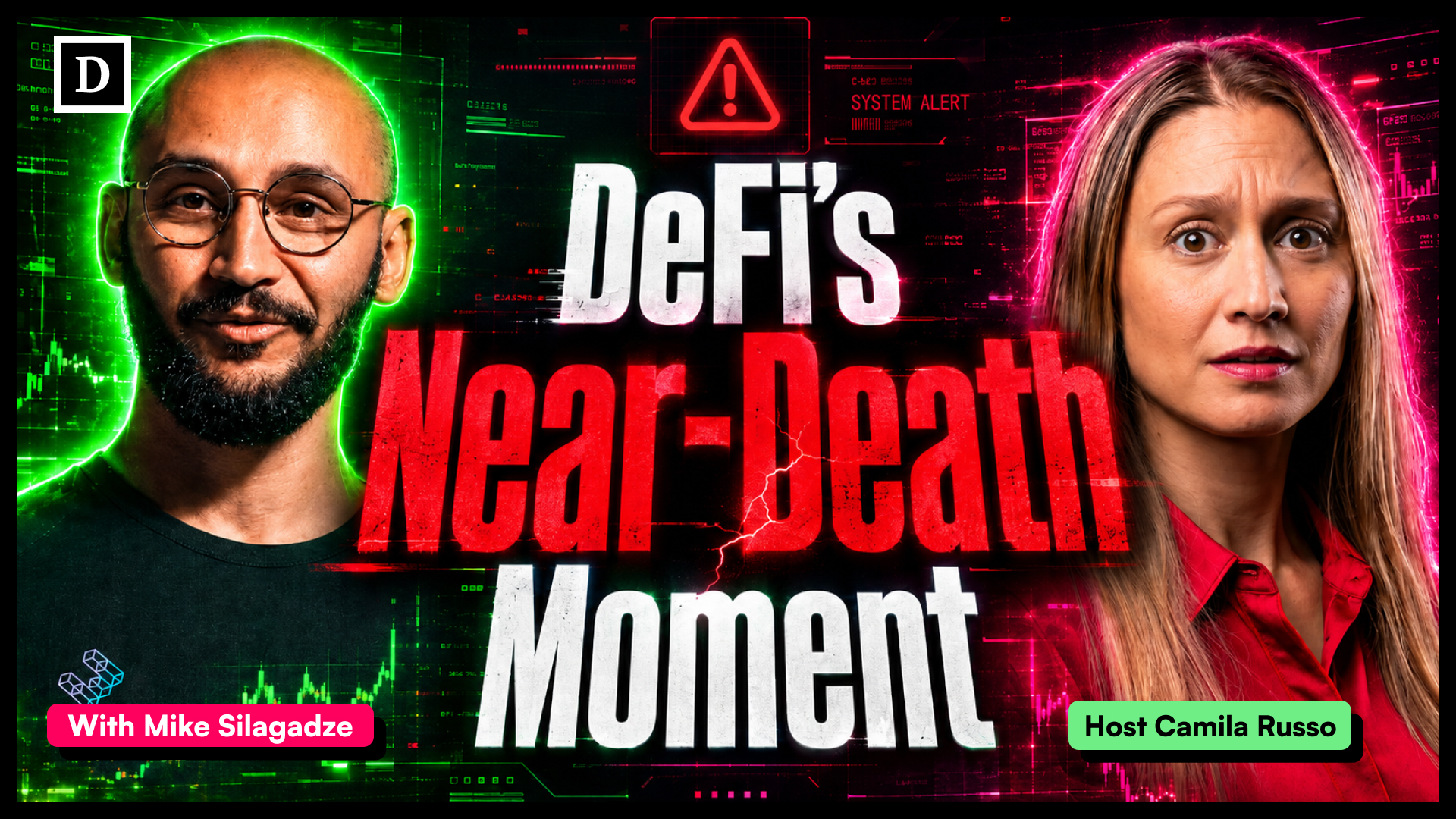
🎧 Listen to Interview 💻 Watch Video… Read the full story at The Defiant


Lava Network, a blockchain infrastructure protocol, has signed a preliminary agreement to help design a tokenization sandbox for Alba Bay, a planned Caribbean residential development of more than 40,000 units. Lava said it is the protocol's first real-world asset mandate. BHL says the project will… Read the full story at The Defiant


The World Series of Poker (WSOP) is bringing cryptocurrency payments to its global tournament circuit by teaming up with the Solana Foundation.
The world’s largest and most prestigious poker tournament series will allow players to use Solana-based payments, powered by MoonPay, to buy into tournaments with no processing fees, starting at the WSOP in Las Vegas.
Blockchain-based payments will then expand at WSOP Paradise in the Bahamas this December, where winners will have the option to receive payouts in stablecoins on Solana.
The move marks a noteworthy integration of blockchain-based payments into a major live sporting and gaming event, potentially streamlining cross-border transactions for the WSOP’s international player base.
WSOP CEO Ty Stewart said this aims to modernize payments for players. “We are incredibly proud to bring such an innovative and passionate community into the fold,” Stewart said. “Solana’s ecosystem, like the WSOP, constantly challenges conventions and remains laser-focused on the consumer experience.”
Read more: Solana is shedding its memecoin reputation as big banks move billions into its ecosystem
Tempers are flaring as the bitcoin bear market deepens.
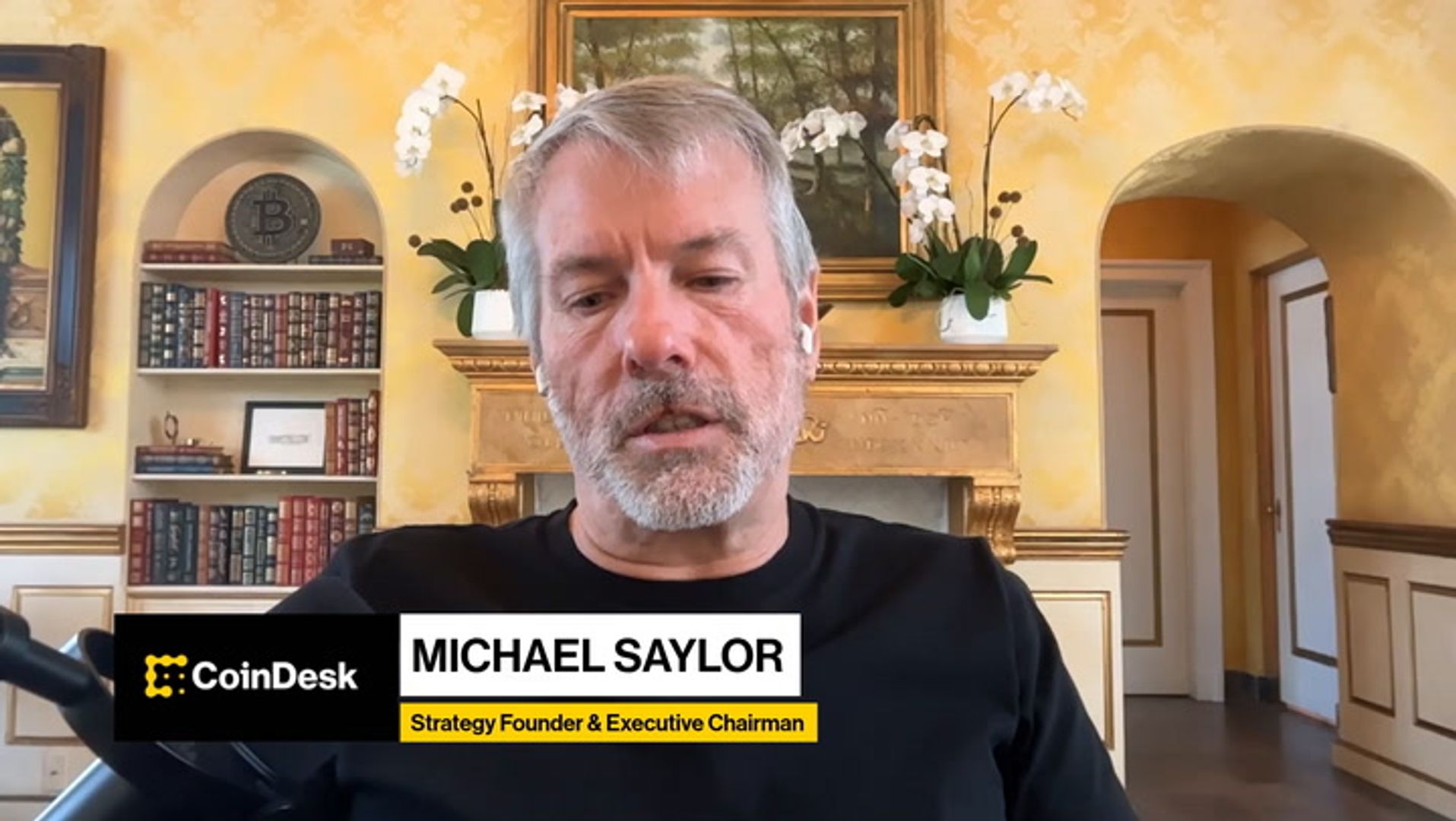
Strategy’s (MSTR) latest bitcoin purchase has sparked a public debate on X between Executive Chairman Michael Saylor and bitcoin advocate Matthew Kratter over whether the company’s most recent capital raise was accretive or dilutive for shareholders.
The disagreement centers on Strategy’s own bitcoin performance metric, BTC Yield, which is designed to track changes in bitcoin holdings per assumed diluted share. According to Strategy’s latest figures, BTC Yield fell from 13.0% on June 1 to 12.8% on June 8, after the company acquired an additional 1,550 BTC.
Kratter argued that the decline shows the transaction was dilutive on a bitcoin-per-share basis. Over the same period, Strategy’s bitcoin holdings rose from 843,706 BTC to 845,256 BTC, while assumed diluted shares outstanding increased from 382.756 million to 384.180 million. BTC Gain YTD also fell from 87,754 BTC to 86,328 BTC.
Saylor pushed back, saying BTC Yield is a narrow KPI that measures only bitcoin per share, not total shareholder accretion. Saylor said the transaction also added approximately $100 million of U.S. dollar reserves, taking the total USD reserve to $1 billion, making the deal accretive when both bitcoin and cash are included.
If viewed strictly through BTC Yield, the latest raise appears dilutive. But if cash reserves and broader balance-sheet effects are included, Saylor argues that the transaction improved shareholder value.
Others jumped in. “Notice they keep changing the rules to fit the financial alchemy they’re doing,” sniped Wazz. “First $BTC yield was boasted everywhere and plastered accross every buy announcement as the standard accretive metric. Now it’s a ‘narrow KPI’ which is irrelevant.”
“As a short seller, I’ve watched innumerable companies ‘move the goalposts,’ and try and focus the market on new metrics when old ones aren’t showing the story they want them to anymore,” wrote Quoth the Raven. “Sometimes, companies outright delete key performance indicators (KPIs) and use new ones.”


From Sept. 23–25, 2026, the Blockchain Week Bulgaria 2026 will bring together technology leaders, financial institutions, policymakers, researchers, and infrastructure providers at Sofia Tech Park. Designed as a European platform for dialogue and collaboration, the event will explore digital finance, tokenization, artificial intelligence infrastructure, cybersecurity, distributed systems, and digital sovereignty.
The programme combines two major conferences: ETHSofia, focused on blockchain technology, infrastructure, and research, and F3 – Future Finance Forum, dedicated to the transformation of financial systems and capital markets
ETHSofia serves as the technical and infrastructure pillar of Blockchain Week Bulgaria, bringing together engineers, researchers, protocol architects, developers, and technology leaders working on the foundations of next-generation digital systems. The conference focuses on distributed computing, blockchain infrastructure, cybersecurity, privacy-preserving technologies, AI infrastructure, and scalable network architectures. Discussions will explore how secure and resilient systems are being designed and deployed across both public and enterprise environments, with an emphasis on research, engineering excellence, and real-world implementation.
F3 – Future Finance Forum will address the institutional adoption of digital technologies across banking, payments, capital markets, and public-sector infrastructure. Key topics include tokenisation, digital assets, central bank digital currencies (CBDCs), settlement infrastructure, regulatory developments, fintech innovation, and the role of AI in financial systems. The event will attract banks, financial institutions, policymakers, fintech executives, infrastructure providers, and institutional investors from across Europe.
Blockchain Week Bulgaria 2026 is supported by a growing ecosystem of industry and infrastructure partners, including UEB3, Pashov Audit Group, UNRAMP, BITOMAT, and BRAIN++.
A key collaborator of the event is BRAIN++, the Bulgarian AI Factory and part of the EuroHPC network of AI factories. BRAIN++ provides the fintech sector with on-demand access to AI models and secure, in-country data infrastructure.
Strategic ecosystem partners include the University of National and World Economy (UNWE) and the Financial Supervision Commission, reflecting the event’s commitment to connecting technology, finance, academia, and public institutions.
Participants and invited organisations across Blockchain Week Bulgaria include representatives from the Digital Euro Association, Sygnum Bank, Crédit Agricole, Chainlink Labs, ChainSecurity, the Aave Chain Initiative, and a broad range of European institutional and infrastructure stakeholders.
“Europe is entering a new phase of digital transformation where AI, financial infrastructure, and distributed technologies are increasingly interconnected,” said the organizers of Blockchain Week Bulgaria “Our goal is to create a platform where technical experts, institutions, and policymakers can engage in meaningful discussions about the systems that will shape the next decade.”
Taking place at Sofia Tech Park, Blockchain Week Bulgaria 2026 highlights Sofia’s growing role in Europe’s digital infrastructure landscape and provides a platform for conversations that extend beyond technology into policy, regulation, finance, and economic competitiveness.
Additional speakers, partners, and side events will be announced in the coming months as Blockchain Week Bulgaria 2026 continues to expand its programme and international participation.
For event information and registration, visit Blockchain Week Bulgaria Media inquiries, accreditation requests, and partnership opportunities can be directed to the Blockchain Week Bulgaria team.
The post Blockchain Week Bulgaria 2026 Brings European Blockchain and Finance Leaders to Sofia appeared first on BeInCrypto.
US-based equipment finance platform Trad.Fi announced plans to bring up to $650 million in private credit onchain over the next 48 months.
The initiative targets one of the largest and least digitized credit markets in the US, the trillion-dollar industry funding manufacturing equipment, industrial systems and residential solar installations, according to an announcement shared with Cointelegraph.
Trad.Fi said the $650 million is not deployed capital but a credit pipeline that will be minted onchain, backed by committed senior credit facilities and signed Letters of Intent from anchor borrowers. The company said it currently has about $85 million in signed term sheets and about $40 million expected to close imminently.
The initiative seeks to address the financing chokepoint in the manufacturing industry by reducing digital credit approval to a single business day, compared with weeks or months of approval time for traditional lines of credit.
Related: JPMorgan, Citi-backed Clearing House plans tokenized deposit network in 2027: WSJ
US equipment financing is a fast-growing industry that still relies on paperwork, making credit approval slower and costing businesses, said Alexander Szul, CEO of Trad.Fi.
He added:
“Small businesses lose deals waiting for financing, and the only way to fix that is to move the capital, the records and the workflow onto programmable rails.”
Investors to gain exposure through tokenized credit pool
The initiative will also include an onchain investment pool that gives investors exposure to the equipment-finance loans originated through the platform. The pool will be operated by a third party that has not yet been named and is expected to launch in the coming weeks. US-based investors will not be eligible during the initial phase.
W3 will provide the infrastructure for tokenizing the loans and managing the associated credit records across the Base, Arc and Avalanche blockchains. Legal agreements tied to the loans, including UCC-1 filings and borrower documentation, will remain offchain.
Other companies that offer similar tokenized credit products include Centrifuge, Tradable, Maple Finance, Figure Technologies and Credix.
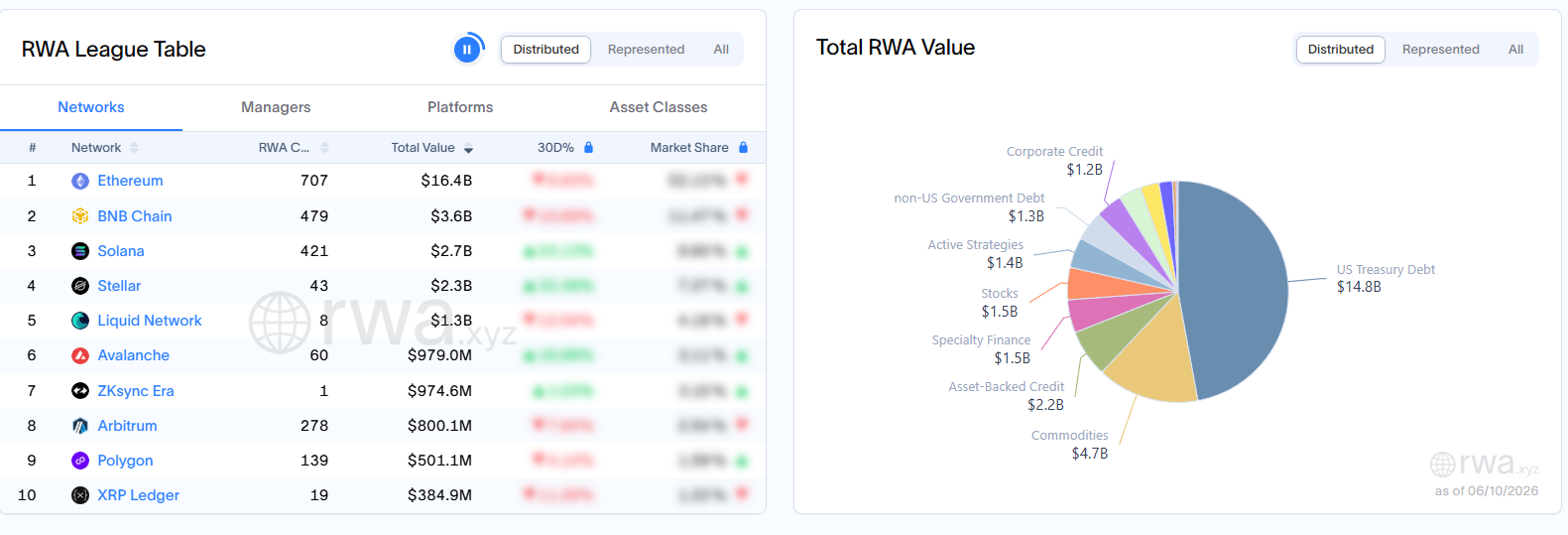
The initiative would add to the growing market for tokenized real-world assets (RWAs), although the sector has cooled in recent weeks, with total value falling 4.4% over the past 30 days to $31.3 billion.
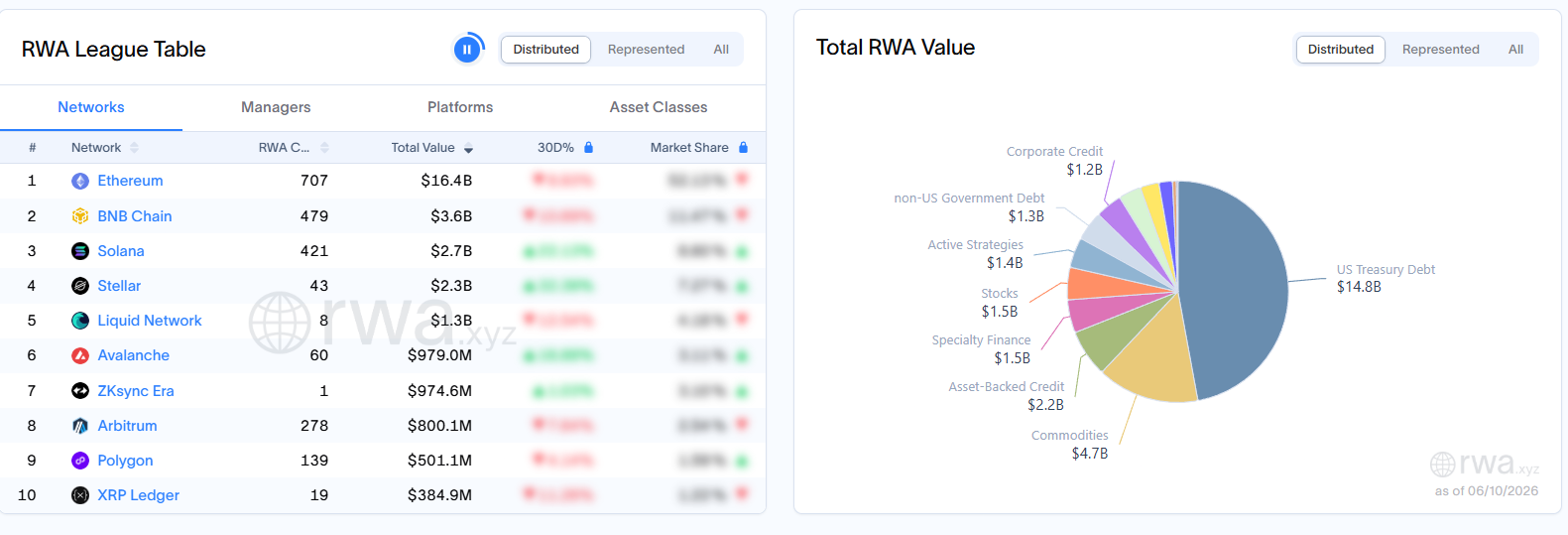
Total RWA value by category. Source: RWA.xyz
Tokenized US Treasury debt accounted for $14.8 billion of the total RWA market, while tokenized corporate credit accounted for $1.2 billion as the smallest segment, according to RWA.xyz data.
Magazine: Can Robinhood or Kraken’s tokenized stocks ever be truly decentralized?
Crypto World
VS Media Holdings (VSME) Stock Explodes Over 300% on Debt Restructuring and AI Strategy

Key Highlights
- VSME shares exploded more than 300% following the conversion of a $3.8 million convertible note into equity with Singapore entity S T Meng Pte. Ltd.
- The transaction increased VS Media’s voting interest in S T Meng to 41.52%, establishing a controlling minority stake.
- The company unveiled intentions to pursue AI Smart Living initiatives, targeting smart home technology, digital healthcare, and intelligent community platforms.
- The AI strategy remains conceptual with no finalized agreements, confirmed partners, or revenue commitments in place.
- As a micro-cap entity with approximately $2.5–$2.9M market capitalization, VSME exhibits extreme volatility in response to corporate developments.
Shares of VS Media Holdings (VSME) captured widespread attention on Wednesday, June 10, skyrocketing more than 300% during early market hours. The stock launched from below $1.00 to highs around the mid-$6 level before settling back into the $3–$4 territory as trading continued.
VS Media Holdings Limited Class A Ordinary Shares, VSME
The dramatic price action stemmed from two concurrent developments: an SEC disclosure filed late Tuesday regarding a debt-to-equity restructuring, and a separate strategic announcement concerning AI Smart Living expansion.
Details of the Debt Restructuring Transaction
On the evening of June 9, VS Media submitted regulatory filings with the SEC revealing the conversion of a US$3.8 million convertible promissory note into equity through a Debt Conversion and Share Subscription Agreement with S T Meng Pte. Ltd., a Singapore-registered trading enterprise.
The arrangement eliminated S T Meng’s outstanding cash repayment requirement entirely. Following completion, VS Media’s cumulative voting stake in S T Meng climbed to 41.52%, representing a significant increase from the initial 21% equity position established in February 2025.
The 41.52% ownership level positions VS Media as a controlling minority shareholder in S T Meng, strengthening its presence within Southeast Asia’s social eCommerce landscape.
No analyst rating changes or insider buying activity were identified as factors behind the rally. Broader market conditions actually worked against the move — the S&P 500 declined 0.3%, the Nasdaq fell 1.0%, and VSME’s explosive gain occurred in isolation from macroeconomic trends.
The stock’s ultra-small capitalization structure amplified the reaction. Trading with a market cap estimated between $2.5–$2.9 million and limited float, even moderate buying interest sparked by significant news can trigger dramatic price volatility.
Strategic Shift Toward AI Smart Living
Concurrent with the debt conversion disclosure, VS Media revealed strategic plans to enter the AI Smart Living sector — an initiative encompassing smart home solutions, digital health applications, and intelligent community infrastructure.
Company leadership indicated plans to leverage its established creator ecosystem, content production expertise, and cross-border distribution channels to support the expansion. The operational framework includes a BVI holding structure and Singapore-based operating platform, maintaining Southeast Asia as a strategic focal point.
However, management emphasized the preliminary nature of these plans. No binding contracts have been executed, no strategic partners have been confirmed, and no revenue generation is assured. The entire initiative remains in conceptual and exploratory phases.
This disconnect between strategic vision and operational reality represents both the opportunity and the risk for investors.
From a financial perspective, VSME recorded approximately $7.52M in revenue with an enterprise value near $3.87M, yielding a price-to-sales ratio around 0.65. Book value per share stands at roughly $1.50, indicating that trading levels below $1.00 prior to this week represented a discount to book value.
The company’s balance sheet reflects approximately $9.33M in total assets offset by $5.20M in liabilities, resulting in shareholder equity of around $4.14M. Capital efficiency metrics remain significantly negative — the business has yet to achieve positive cash flow generation.
Intraday trading patterns illustrated textbook low-float behavior: news-catalyzed spike accompanied by elevated volume, extreme price swings, and rapid profit-taking reversals. Pre-market activity showed gains exceeding 321%. Once regular trading commenced, appreciation remained firmly above the 300% threshold.
As of Wednesday morning trading, VSME posted gains of approximately 305% for the session, with the AI Smart Living strategic announcement and the S T Meng debt conversion serving as the documented catalysts driving investor interest.

Hundreds call for street near Bristol Temple Meads station to be pedestrianised

U.S. inflation data better than hoped, boosting BTC

Introducing the COS Vacation Wardrobe – Comfort and effortless style

HarrisX Poll Found 52% of Registered Voters Support the CLARITY Act

BloFin War of Whales 2026 Grand Prix opens registration for $5M trading championship

Blockchain.com files with SEC for U.S. IPO

Trade with Rs. 100 @deltaexchange || #trader #trading #bitcoin #cryptocurrency #deltaexchange

Important full form of Finance and Banking #fullform #shortfeed #shorts #youtubeshorts

Financial Accounting one shot || full syllabus of financial accounting ||Bcoc 131 IGNOU || #bcom#bba
-

 Fashion5 days ago
Weekend Open Thread: Evereve – Corporette.com
-
 Crypto World5 days ago
Jensen Huang Approves Samsung, SK Hynix, and Micron for NVIDIA (NVDA) HBM4 Memory Supply
-

 Crypto World2 days ago
Anatomy of the June crypto crash: Fed, Iran, Saylor
-
 Entertainment4 days ago
The Best Mystery Series of All Time Is Surging on Streaming 30 Years After It Ended
-

 NewsBeat3 days ago
Alexander Zverev wins the French Open to finally earn a 1st Grand Slam title
-

 Tech5 days ago
Suspicious Polyfill login prompts pop up on Toshiba, Muji websites
-
Crypto World4 days ago
Senator Cynthia Lummis Calls CLARITY Act the Most Consequential Financial Legislation of This Generation
-

 Tech3 days ago
Microsoft unveils seven homegrown AI models in new bid for ‘long term self-sufficiency’
-

 Tech5 days ago
Microsoft launches MXC, an OS-level sandbox for AI agents, with OpenAI and Nvidia already on board
-

 Business5 days ago
(VIDEO) Justin Bieber Delivers Surprise Happy Birthday Serenade to Diners at Los Angeles Mexican Restaurant
-
 Business4 days ago
The Pain Points Taking a Fragile Tech Rally Down a Notch
-
Crypto World5 days ago
LBank Surpasses 25 Million Users Worldwide as AFA Partnership Continues to Drive Global Growth
-

 Crypto World3 days ago
Trump’s AI Ownership Plan Could Benefit Anthropic at OpenAI’s Expense
-

 Tech5 days ago
Meta steals a tactic from Tesla and builds data centers in tents
-

 Tech5 days ago
Von der Leyen’s AI envoy pick draws conflict-of-interest fire
-
 Crypto World2 days ago
Eli Lilly (LLY) Stock Surges 4% Following Breakthrough Sleep Apnea Trial Results
-
 Sports23 hours ago
Bangladesh beat Australia after 20 years in ODIs, register only their second win over six-time world champions | Cricket News
-

 Business2 days ago
High Stakes for Wembanyama as New York Pushes for 3-0 Lead
-

 Tech4 days ago
Hackers now exploit SolarWinds Serv-U flaw to crash servers
-

 Tech3 days ago
Notion restores access to Anthropic after service disruption
You must be logged in to post a comment Login