
Crypto World
Bitcoin Bear Market Not Over, Benjamin Cowen Says Despite Recent Rally

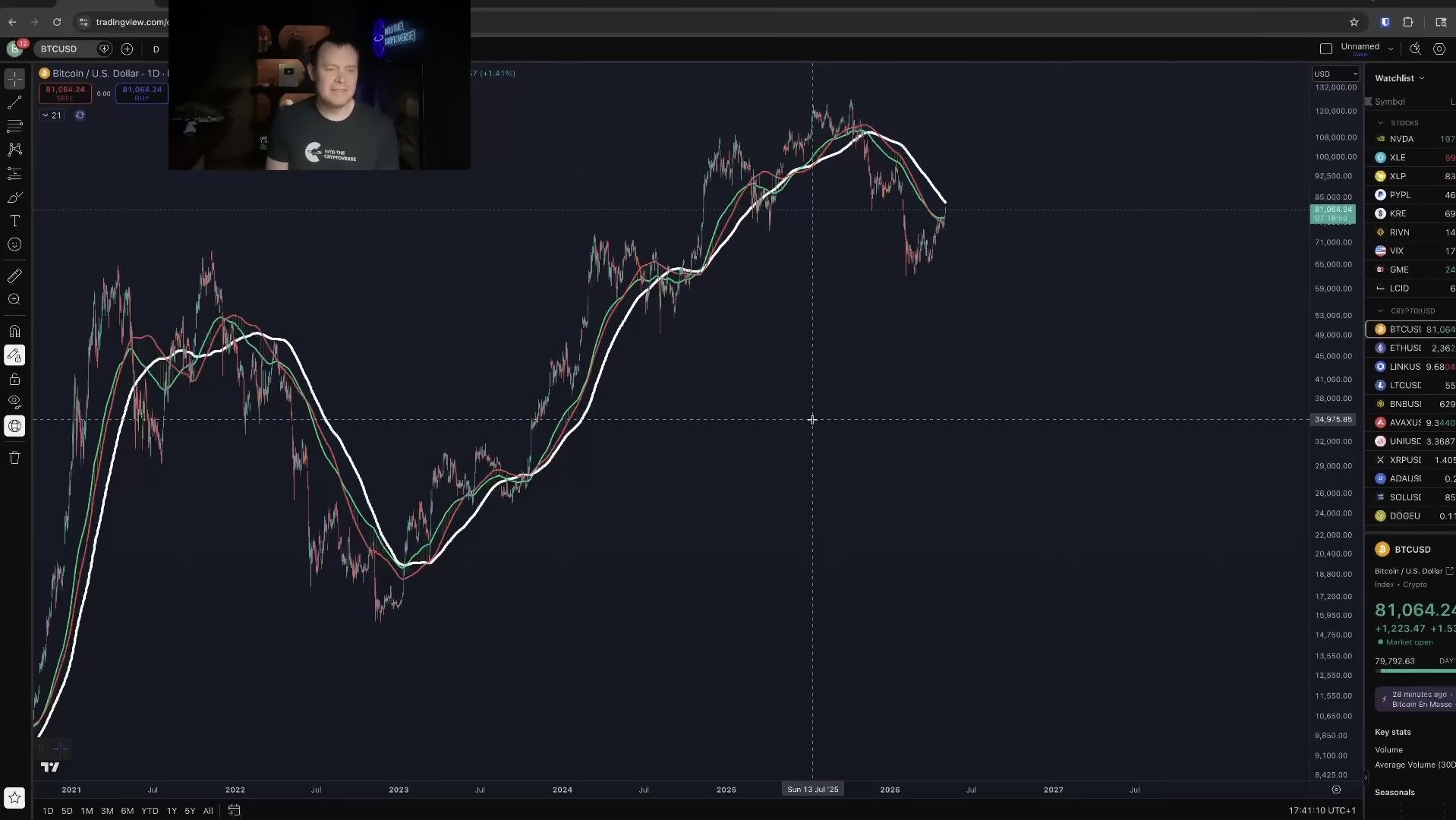
Bitcoin’s recent rally has not convinced Benjamin Cowen that the bear market is over. The Into the Cryptoverse founder warns the current move is likely to top within weeks before another decline, with a possible low arriving in October.
His thesis hinges on a pattern that repeated in 2014, 2018, and 2019, when Bitcoin climbed above key moving averages mid-bear market before resuming the downtrend. Time between cycle lows historically runs 140 to 174 days.
Bitcoin Bear Market Still Intact
In a recent video, Cowen said he is keeping his “bear goggles on” despite Bitcoin’s continued strength. He argues the current playbook still tracks past cycles.
“I think this will likely yield a rally that finds a top within the next few weeks and then we come back down to those levels.”

The Bullish Counterargument
Cowen acknowledged several reasons the bear case could be wrong. Bitcoin’s year-to-date return is currently outperforming the average midterm year by a wide margin. The token sits roughly 10% below its yearly open, compared with a typical decline of 30 to 35% at this stage.
It has also reclaimed the bull market support band. Cowen flagged another structural shift.
“Bitcoin topped on apathy rather than euphoria.”
Retail interest never returned, and altcoins continued bleeding against Bitcoin throughout the rally. That apathetic peak could mean a different kind of bear market this time.
Why the Pattern Still Points Lower
Past cycles offer the strongest case for staying defensive. In 2014, 2018, and 2019, Bitcoin rallied above the bull market support band before pulling back, with the 200-day moving average serving as resistance.
“If I’m right, it will seem so obvious… If I’m wrong, then by the time you do something that’s different enough, you’re already well off the lows.”
Time between cycle lows is the other signal Cowen tracks. Recent cycles waited roughly 140 to 174 days before printing a new low.
“We’re currently on day 88. So, who’s to know what’ll happen in 3 months.”
Cowen expects the current rally to peak within weeks before retracing toward the bull market support band, with a possible October low. For investors who exited near last year’s peak, his takeaway is direct.
“Anyone who took profits on Bitcoin in Q4 when everyone else was screaming 300K is still doing fine.”
The post Bitcoin Bear Market Not Over, Benjamin Cowen Says Despite Recent Rally appeared first on BeInCrypto.


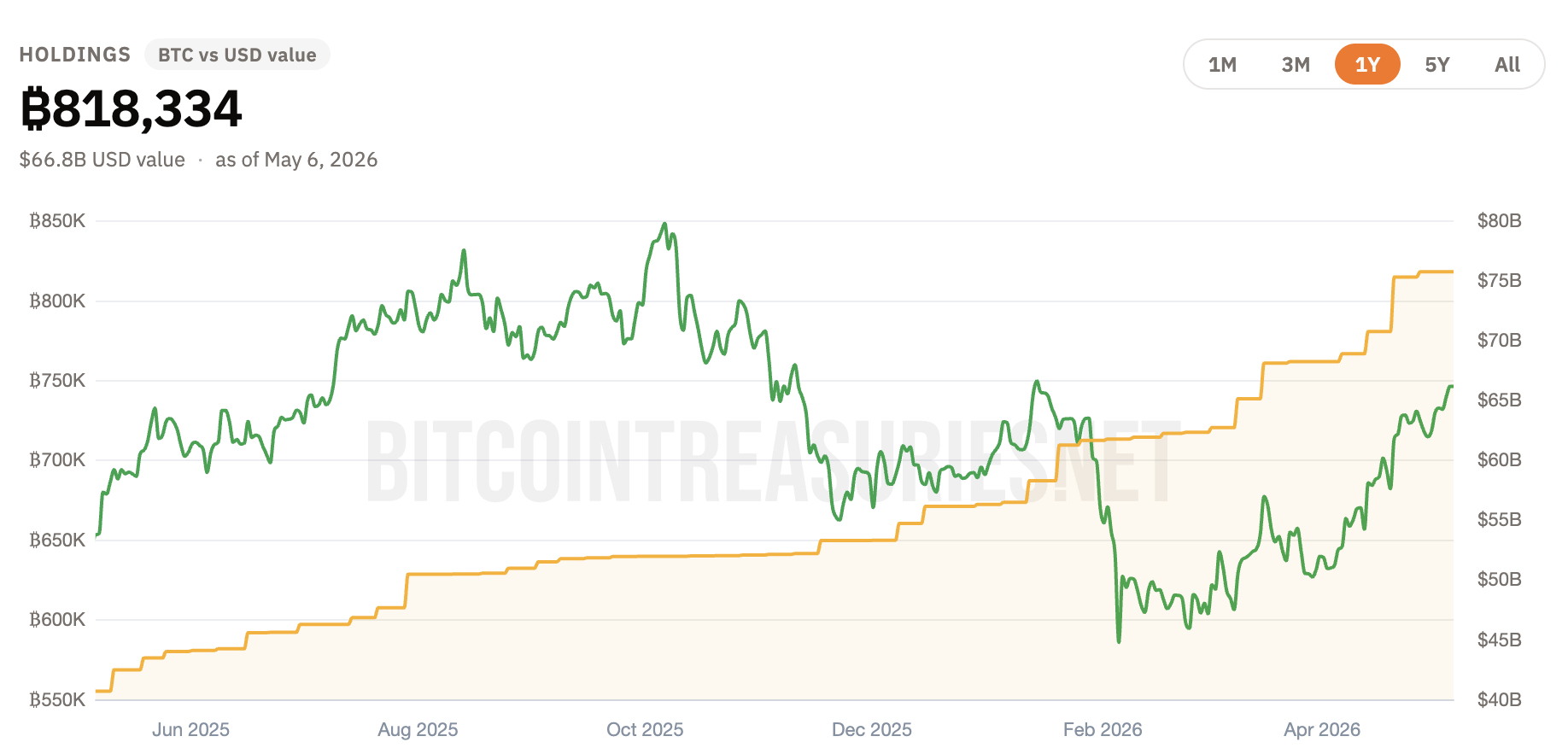
Strategy is making huge news as it abandons its never-sell Bitcoin policy, putting 818,334 BTC, or nearly 4% of total supply, in play as an actively managed treasury asset. CEO Phong Le confirmed on Tuesday’s earnings call that the company will now consider selling BTC to buy dollars or retire debt, provided the trade is accretive to bitcoin per share. A direct reversal of the philosophy Michael Saylor built the entire Strategy brand around.
“We will sell Bitcoin when it is advantageous to the company.” – @Strategy-CEO @PhongLe https://t.co/KFJBOql40V pic.twitter.com/yKHeF2Bvuw
— Tristan – Blocktrainer.de

 (@tristanblcktrnr) May 5, 2026
The position was acquired for $61.81 billion at an average cost of $75,500 per coin. A $12.5 billion net loss in Q1 2026, driven by the BTC price decline at the start of the year, provided the financial pressure that forced the pivot. MSTR shares jumped 3% in after-hours trading on the announcement.
Will Strategy dump its entire stack? It almost certainly will not. But thinking of selling when people were asked to sell their kidneys is not a good look.
Discover: Bitcoin price analysis – key support levels and what breaks them
What Happens to Bitcoin If Strategy Starts Selling?
Strategy’s 818,334 BTC is worth $61.8 billion at the average acquisition cost, but at the current spot value of $81,500, the position is valued at $66.8 billion. The number is way too big for a single order book to absorb cleanly.
Strategy’s purchases of $500 million–$1 billion in BTC have reliably moved spot prices upward by 2%–4% in the sessions following disclosure. The reverse dynamic of a coordinated sell program would face thinner liquidity on the ask side, particularly below the $75,000–$78,000 support band, where institutional bids concentrate.
Any meaningful disposal would almost certainly route through OTC desks and not exchange order books. That limits slippage but does not eliminate price impact. A block sale of 5,000–10,000 BTC would represent one of the largest single institutional transactions in recent cycle history and would carry significant signal weight regardless of execution venue.
Le’s stated condition of selling only when it is accretive to bitcoin per share creates a governor on the program. But the market liquidity at the $70,000–$74,000 band is thin. If BTC breaks below the company’s average cost basis, the calculus around debt servicing versus hodling shifts materially.
Forget the News, You Can Buy Bitcoin Hyper and Still Keep Your Kidney
Strategy’s current news is scary for retail Bitcoin holders. People are looking for an asymmetrical upside when BTC is stuck under $100K, something that has Bitcoin security, built to fix Bitcoin flaws, and doesn’t require selling a kidney to buy.
Bitcoin Hyper ($HYPER) is a project drawing attention. Positioned as the first-ever Bitcoin Layer 2 with Solana Virtual Machine (SVM) integration, it aims to address Bitcoin’s three core limitations simultaneously: slow transactions, high fees, and limited programmability.
In short, Hyper is delivering sub-second finality and low-cost smart contract execution while inheriting Bitcoin’s security model.
The presale has raised more than $32.5 million at a current token price of $0.0136, with 36% APY staking available for early participants. It’s still cheap, and at that raised level, meaningful institutional and retail appetite is already present, but the price remains early-stage by any measure. Keep your kidneys and get Hyper.
Research Bitcoin Hyper before the presale concludes.
The post Bitcoin News: Saylor “Sell a Kidney” Call is Now a BTC Exit? appeared first on Cryptonews.

A blockchain analytics firm has flagged a tightly coordinated wave of activity around the Mystery (MYSTERY) memecoin at launch, where 90 newly funded wallets purchased roughly 90% of the token’s supply within minutes of trading opening. Bubblemaps labeled the pattern a “textbook scam,” arguing that the wallet cluster—funded by a single address known as 0x544E—appears to have orchestrated an outsized early stake before selling into the market and leaving late participants exposed to sharp price moves.
The wallet cluster allegedly funded by 0x544E previously moved 20 Ether from the crypto exchange Binance, according to Bubblemaps. After accumulating the majority of the supply at launch, the same cluster reportedly dumped about $100,000 worth of Mystery tokens and continues to hold around 40% of the total supply, Bubblemaps reported in a Tuesday post on X. The firm’s assessment underscores ongoing concerns that automated buying and coordinated wallet activity can dominate launches for thinly traded memecoins, undermining the principle of a fair, open starting line for all participants.
Key takeaways
- Coordinated launch boost: 90 wallets linked to 0x544E purchased about 90% of Mystery’s supply at launch and, after a partial sell-off, still control roughly 40% of the supply, according to Bubblemaps.
- “Textbook scam” characterization: Bubblemaps described the pattern as a textbook scam, highlighting how automated buying clusters can sidestep ordinary traders in nascent memecoins.
- Market performance swing: Mystery’s market capitalization surged to about $7.5 million on April 28, then declined roughly 75% to around $1.9 million, based on Dexscreener data.
- Broader context: The incident adds to a history of sniping-related risk in memecoins, a theme that has featured in prior reporting on fast-launch tokens and launch-time manipulation.
- Related signals and responses: The phenomenon has drawn attention in other memecoin episodes, including high-profile sniper activity and debates about fair launches in crypto communities.
Dissecting the launch tactic and its implications
Sniping—where bots or automated trading tools snap up newly listed tokens the moment a market opens—has long been a contentious practice in the memecoin ecosystem. Bubblemaps’ July 2024 analysis and subsequent observations emphasize that a cluster of wallets can secure a lion’s share of supply in a live launch, creating a barrier for ordinary traders who enter later. The immediate consequence is a higher risk that early holders may exit with outsized gains, while late entrants face steeper losses if the early buyers choose to sell more aggressively.
In this case, Bubblemaps noted that the cluster funded by 0x544E not only acquired most of Mystery’s supply at launch but also proceeded to liquidate a portion of its stake, selling about $100,000 worth of tokens and maintaining a substantial position. The firm framed the pattern as a classic case of market manipulation in a space where liquidity is thin and bot-driven activity can disproportionately influence price discovery. For investors and users, the episode reinforces the importance of transparent launch mechanisms and robust anti-bot controls in new-token ecosystems.
Cointelegraph reached out to Mystery for comment on the allegations but did not receive a response at the time of publication. The project brands itself as a free-spirited frog from Matt Furie’s “The Night Riders” universe and has claimed to have acquired the HEDZ NFT IP rights from Furie, according to a Monday post on X. Whether those claims will be substantiated remains unclear, and the lack of public comment from Mystery leaves unanswered questions about governance, rights, and long-term token utility.
Market trajectory: from peak to pullback
Mystery’s price action has mirrored a broader pattern often seen with memecoins: rapid appreciation fueled by novelty and social media chatter, followed by a sharp retracement as early participants take profits and new buyers reassess risk. Dexscreener data show the token’s market capitalization peaking at roughly $7.5 million on April 28, before retreating by about three-quarters to an estimated $1.9 million at the time of reporting. The chart highlights the volatility that can accompany freshly minted memecoins, particularly when a minority of wallets controls a large portion of the supply and liquidity remains shallow.
The all-time dynamics of Mystery, including its stated IP ambitions and branding around a meme character, add another layer to the story: a token whose narrative is as much about community culture as it is about on-chain mechanics. Such narratives can amplify demand in the short term, but they also attract scrutiny from researchers and on-chain watchers who assess sustainability, governance, and true fractional ownership of the supply.
For readers tracking this space, the Mystery episode is a reminder that market depth, holder concentration, and the presence of automated buying bots can significantly shape a token’s initial trajectory. Those factors, in turn, influence risk for late entrants and the potential for sharp, abrupt corrections after launch hype subsides.
Broader context: snipers, front-running, and the memecoin landscape
The incident sits within a longer arc of memecoin launches where snipers and bot-driven strategies have repeatedly captured headlines. In early 2025, a prominent sniper reportedly earned nearly $28 million on the Broccoli (BROCCOLI) memecoin, illustrating how launch-phase dynamics can generate outsized profits for a small group of participants. The episode followed public commentary from notable figures in the crypto space and underscored how launch windows can become focal points for automated, rapid trading activity.
Earlier reporting also touched on allegations surrounding new token distributions, including assertions that clusters of wallets had accumulated substantial shares of tokens at launch in other projects. While some projects disputed these claims, the pattern remains a touchstone in ongoing discussions about launch fairness and market integrity in memecoin markets. For additional context, readers can review related coverage on the topic, including notes on possible front-running considerations ahead of exchange listings.
As the ecosystem contends with these dynamics, observers are watching for clearer best practices around fair launches, anti-bot measures, and governance frameworks that can help ensure that new token markets remain accessible to a broad base of participants without enabling a small group to secure outsized control from day one.
Related reporting from Cointelegraph and its coverage network has highlighted these tensions from multiple angles, including analyses of front-running before listings and the regulatory and technological responses that may influence how exchanges and projects structure launches in the future.
Source notes and embedded context referenced in this article include Bubblemaps’ X posts detailing the 0x544E wallet cluster’s actions, Dexscreener’s price-history data, and Mystery’s public statements about IP-related claims. Readers seeking deeper, source-specific color can refer to the linked items in the original reporting for the exact timestamps and on-chain footprints.
As the market digests this episode, investors should monitor how Mystery evolves, whether the project clarifies its IP claims, and how the broader memecoin community responds to concerns about fair-launch integrity and anti-bot safeguards in the near term. The pace of regulatory and platform-level responses could also shape the risk profile for new token launches in the months ahead.
Crypto World
UAE Regulators Launch First Joint Audit Quality Inspections to Strengthen Financial Oversight

The Dubai Financial Services Authority (DFSA), the UAE Ministry of Economy and Tourism, and the Capital Market Authority (CMA) have announced the launch of their first joint Quality Management audit inspections, marking a new step toward strengthening financial oversight and regulatory coordination across the United Arab Emirates.
According to the announcement, the initiative is designed to improve oversight standards for audit firms operating within the UAE and reinforce confidence in the country’s financial reporting ecosystem.
The joint inspections follow recently signed Memorandums of Understanding between the participating authorities aimed at improving regulatory cooperation and information sharing related to auditor supervision across multiple jurisdictions.
Focus on International Audit Standards
The inspections will specifically assess how audit firms implement the International Standard on Quality Management 1 (ISQM 1), a globally recognized framework focused on quality control and governance within audit and assurance practices.
Regulators said the initiative is intended to ensure that financial institutions and market participants operating across the UAE benefit from consistent and high-quality audit standards aligned with international best practices.
The collaboration also reflects broader efforts by UAE authorities to strengthen transparency, governance, and investor confidence as the country continues positioning itself as a leading regional and global financial hub.
Strengthening the UAE Financial Ecosystem
The move comes as the UAE continues accelerating reforms across financial services, capital markets, compliance, and corporate governance.
Over recent years, regulators including the DFSA and other UAE authorities have increased their focus on international regulatory alignment, financial supervision, and institutional governance standards in support of long-term market development.
The latest initiative is expected to further enhance coordination between regulators while supporting the integrity and resilience of the UAE’s financial ecosystem.
The WHO has sounded global alarms over a hantavirus outbreak that has already claimed three lives on the MV Hondius cruise ship. Bitcoin investors are recalling Black Thursday in March 2020.
The parallel with the start of COVID-19 reopens doubts about a possible sharp reaction from the crypto market.
What is Hantavirus and why is it a cause for concern at the WHO?
Hantavirus is a serious viral disease transmitted through contact with the urine, feces, or saliva of infected rodents. Its fatality rate can reach 50% in the Americas, and there is no approved vaccine or specific antiviral treatment.
The WHO (World Health Organization) confirmed yesterday that seven people aboard the MV Hondius have fallen ill, with three deaths , one person in critical condition, and three with mild symptoms. The cruise ship departed from Ushuaia , Argentina, on April 1, 2016.
The most worrying element comes from the WHO itself. The organization did not rule out person-to-person transmission among close contacts on board the cruise ship, although it maintains the overall risk as low for now.
A 69-year-old Dutch woman disembarked in Saint Helena on April 24 and died after flying to Johannesburg. The WHO is now tracing more than 80 passengers and six crew members who traveled on the same regional flight.
Follow us on X for the latest news in real time
Hantavirus, COVID-19 and Bitcoin: parallels and differences with Black Thursday 2020
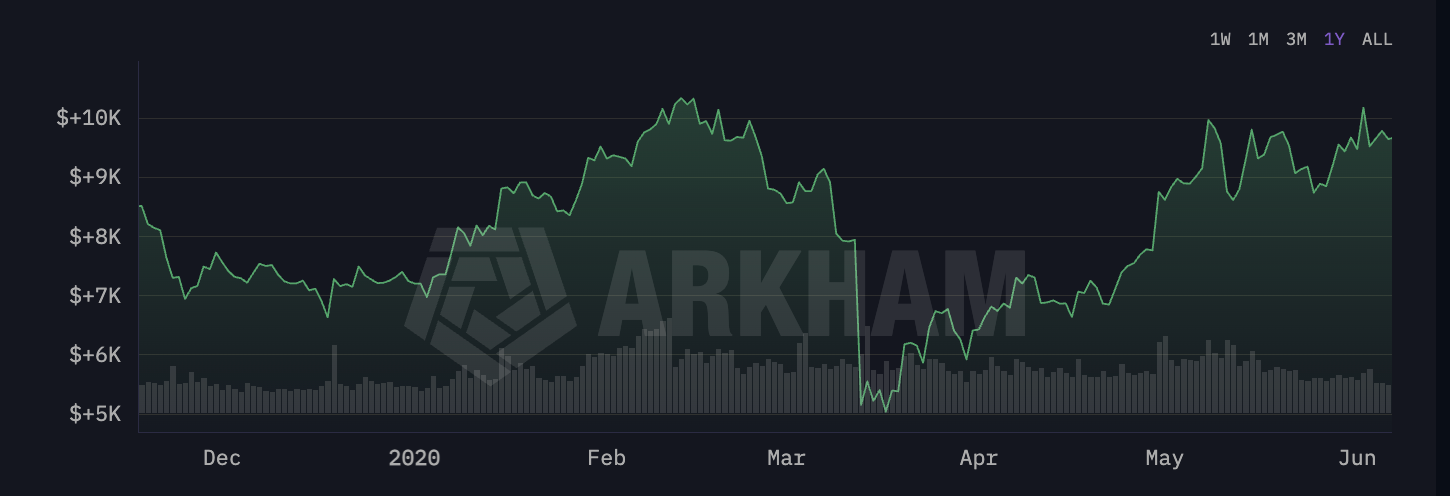
For Bitcoin investors, the scene evokes bitter memories . When the WHO declared COVID-19 a pandemic on March 11, 2020, global markets collapsed.
That episode was dubbed the crypto “Black Thursday.” Bitcoin hit lows of around $4,000 and lost more than 50% of its value in 48 hours. The total market capitalization was cut in half in just a few days.
The narrative of Bitcoin as “digital gold” was temporarily shattered. The asset acted as a source of liquidity, and investors liquidated positions to reduce risk. Only gold and Treasury bonds partially withstood the first wave of global panic.
However, Bitcoin then staged a historic recovery. It took just a month and a half to regain the price lost after the March 12 crash , launching one of the biggest bull rallies in its recent history.

The current context differs from that which precipitated Black Thursday. The WHO assesses the global risk of Hantavirus as low and limited to the cruise ship environment , with no visible community spread on the mainland so far.
Hantavirus is also not transmitted as easily as SARS-CoV-2. Human-to-human transmission is exceptional and requires very close contact. This substantially reduces the likelihood of a global pandemic capable of paralyzing economies.
Bitcoin is also more mature at this point. It boasts massive corporate treasuries, approved spot ETFs, a Strategic Reserve backed by the White House, and a greater institutional presence than in March 2020, when it was still a marginal asset.
Even so, traders are watching closely. A worsening of the outbreak or further deaths could trigger a bout of risk aversion in the markets, initially impacting volatile assets like Bitcoin and less liquid altcoins .
“For God’s sake, let BTC go up for a month without war or coronavirus,” exclaimed onchainmonk on X
What should investors be watching now?
The key will be the speed of the health response. If the WHO contains the outbreak and rules out sustained human-to-human transmission, the impact on financial and crypto markets will likely be limited and very short-lived.
Conversely, a global escalation would generate immediate macroeconomic uncertainty. Bitcoin could suffer an initial shock similar to that of March 2020, although the depth and duration will depend on the monetary response and recent institutional flows.
The post Hantavirus Scare Sparks Bitcoin Crash Fears, Is 2020 Repeating? appeared first on BeInCrypto.

Key Highlights
- Major oil producers including Exxon and Chevron experienced losses exceeding 3.5% amid plunging crude prices driven by diplomatic optimism
- Brent crude experienced a dramatic decline of more than 10%, falling to approximately $97.97 per barrel and breaking below the $100 threshold
- West Texas Intermediate saw an 11% plunge, settling near $90.35 per barrel
- President Trump temporarily suspended the “Project Freedom” military initiative in the Strait of Hormuz, pointing to significant diplomatic advancement
- Major European energy corporations faced substantial losses, with BP shedding over 5% and Shell losing 4.5%
Energy sector equities experienced a significant downturn on Wednesday following President Donald Trump’s declaration of a temporary halt to U.S. military activities in the Strait of Hormuz, attributing the decision to meaningful advancement in diplomatic discussions with Iran.
In a Truth Social post released late Tuesday evening, Trump revealed the suspension of “Project Freedom,” a military initiative designed to ensure the strait remained operational. He indicated the suspension would be brief while negotiations with Iranian officials progressed.
The revelation triggered a sharp decline in oil prices. Brent crude plummeted over 10% to approximately $97.97 per barrel, falling beneath the psychologically important $100 level. West Texas Intermediate saw an even steeper decline of over 11%, reaching $90.35 per barrel.
Exxon Mobil experienced a roughly 3.6% decline during morning trading sessions. Chevron shares dropped approximately 3.3%. These companies ranked among the most severely impacted within the American energy industry.
Additional U.S. petroleum companies witnessed comparable downturns. Occidental Petroleum topped premarket declines with a 7.6% slide. Marathon Petroleum decreased 6.3%, ConocoPhillips fell 5.4%, Devon Energy declined 5.7%, and Diamondback Energy dropped 4.5%.
Occidental simultaneously released quarterly results on Wednesday. The energy producer reported substantially improved adjusted earnings, though total revenue fell short of Wall Street projections for the opening quarter.
APA shares declined 4.6% during the session. Meanwhile, the broader S&P 500 index climbed 0.8%, as diminishing geopolitical concerns boosted sentiment across other market segments.
European Energy Giants Hit Hard
The decline extended beyond American borders. European energy conglomerates experienced comparable losses.
In London trading, BP tumbled more than 5% to 542.2p. Shell retreated 4.5% to 3,165.5p. France’s TotalEnergies declined 5.4% to €75.07 on the Paris exchange.
According to Axios reporting, the Trump administration expressed confidence in nearing completion of a concise memorandum of understanding with Tehran that could resolve ongoing Middle Eastern tensions. The outlet cited two administration officials and two additional informed sources.
Understanding the Crude Price Collapse
The fundamental catalyst behind the price collapse centered on expectations of diminishing tensions throughout the Persian Gulf region. A diplomatic resolution with Iran would significantly lower the probability of supply chain interruptions through the Strait of Hormuz, an essential corridor for international petroleum transport.
In his announcement, Trump emphasized that the existing blockade would “remain in full force and effect” throughout the pause duration.
Earlier in April, Iran temporarily reopened the Strait of Hormuz before implementing another closure after Washington declined to remove its blockade of Iranian maritime facilities.
As of Wednesday morning, diplomatic negotiations between American and Iranian delegations continued, with no conclusive agreement formally announced.



IBM introduced new enterprise artificial intelligence tools on Tuesday aimed at helping organizations build and manage internal AI systems across hybrid cloud environments.
Summary
- IBM introduced new AI tools to help businesses manage AI systems across hybrid cloud environments.
- The company launched Context Studio for building AI agents tied to enterprise data, while Process Studio is set to automate legacy operational workflows.
- IBM also expanded AI partnerships with SAP, AWS, Pearson, and Providence as competition in enterprise AI infrastructure continues to grow.
According to a May 6 press release, IBM announced new additions to its IBM Enterprise Advantage and IBM Consulting Advantage platforms during its Think conference, alongside collaborations involving Pearson, Providence, SAP, Amazon Web Services, and U.S. government cloud infrastructure.
IBM said the updates are designed to help enterprises deploy AI agents with greater control over data, workflows, and interoperability across different systems.
One of the new offerings, called Context Studio, is now available and allows companies to create AI agents tied to internal business data and operational processes. IBM said the system is intended to improve the accuracy and relevance of AI-generated outputs while supporting data sovereignty requirements.
Another tool, Process Studio, is expected to launch later and will focus on converting legacy operational procedures into workflows that can be handled by AI agents. IBM said internal testing on a client project involving 1,400 procedures identified more than 1,000 workflow improvement opportunities and could help reduce operating costs by over 25% within 18 months.
IBM also highlighted examples of enterprise adoption. Healthcare provider Providence said it used IBM’s AI tools to automate parts of its hiring process. According to the company, managers spent 90% less time on recruitment-related tasks after deployment, while internal job transfers became faster and more accurate.
Meanwhile, Pearson and IBM are jointly developing a system designed to verify and continuously assess AI agents to ensure they can perform assigned tasks correctly.
The company also expanded interoperability between its AI systems and SAP’s Joule AI agents through the Agent2Agent standard, allowing AI agents from both companies to coordinate tasks across enterprise applications.
In addition, IBM Consulting Advantage is now available in a FedRAMP-authorized environment through AWS GovCloud, enabling U.S. federal agencies to access the platform while meeting government security and compliance requirements.
The announcement follows a broader push by major technology firms to develop enterprise-focused AI systems capable of automating operational workflows.
Companies including Microsoft, Google Cloud, and Salesforce have recently expanded investments in AI agents and enterprise automation tools as competition in business AI infrastructure intensifies.
OpenTrade, an institutional-grade platform for onchain and real-world asset (RWA)-backed lending and stablecoin yield products, has raised fresh capital to expand its yield infrastructure.
The platform secured $17 million in its latest strategic funding round led by Mercury Fund and Notion Capital, OpenTrade said in a Wednesday announcement seen by Cointelegraph.
The new funding will support the continued expansion of OpenTrade’s permissioned and permissionless yield infrastructure, as well as the growth of its vault-focused service Curation+, CEO David Sutter told Cointelegraph.
“The company also plans to expand its asset management and trading team, increase engineering capacity, and build a dedicated customer success function to support its growing client base,” Sutter said.
CEO positive on regulation amid CLARITY Act debate over stablecoin rules
The raise comes as US lawmakers debate how stablecoin rewards should be regulated under the CLARITY Act, a broader digital asset market structure bill that has been delayed partly by disputes over whether crypto firms should be allowed to offer interest-like incentives on stablecoin balances. Sutter expressed optimism over recent progress around the stalled legislation.
CLARITY is nearing a Senate Banking Committee vote after a compromise between crypto and banking stakeholders. The deal would allow usage-based rewards like cashback or discounts on stablecoin activity but prohibit yield on idle balances.
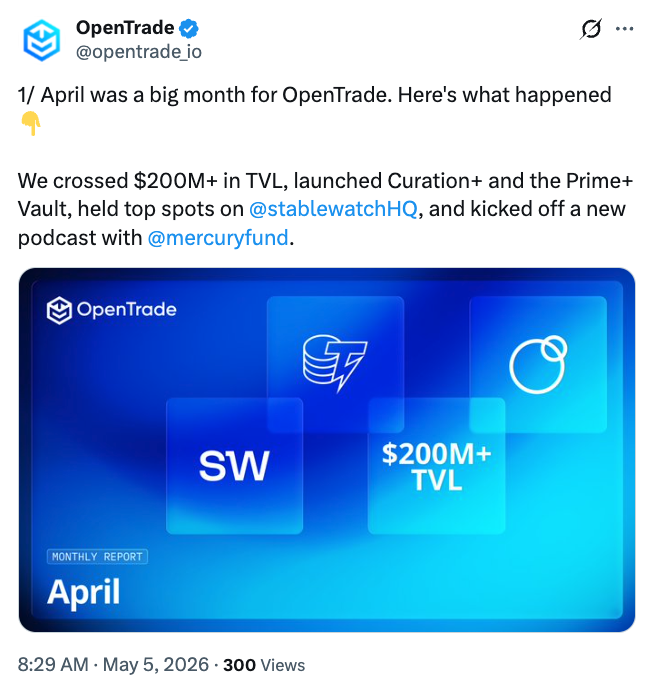
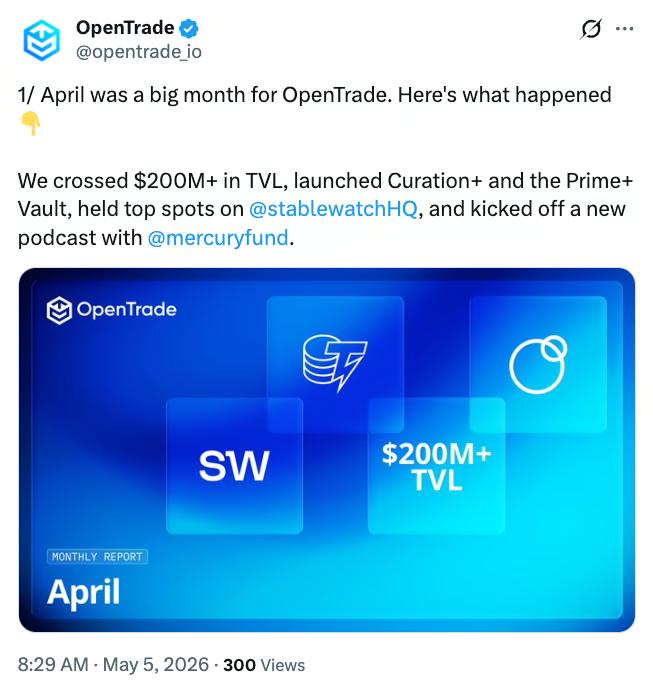
OpenTrade surpassed $200 million in total value locked (TVL) in April. Source: OpenTrade
“Our structure is derived from securities lending in traditional finance, but adapted to the lending of stablecoins instead of securities,” Sutter said, adding that there may be market-specific nuances affecting availability to institutional or qualified investors.
Sutter told Cointelegraph that the legal architecture underpinning the platform has been purpose-built to offer its products to clients globally while maintaining compliance with existing traditional finance and digital asset regulatory standards.
“There are strong regulatory tailwinds for the industry at large, which will be conducive to continued growth for stablecoins,” Sutter added.
Related: Ripple CEO says market structure bill not ‘done deal,’ despite compromise
Circle Ventures was an early investor in OpenTrade
Founded in 2023, OpenTrade seeks to provide scalable and compliant yield products for fintechs and institutional investors.
OpenTrade’s infrastructure routes user deposits into tokenized vaults that allocate capital across a mix of yield sources, primarily RWAs such as fixed-income instruments, alongside selected decentralized finance (DeFi) strategies. Each vault follows a defined allocation strategy and operates through smart contract-based mechanisms that manage deposits, track positions and distribute returns.
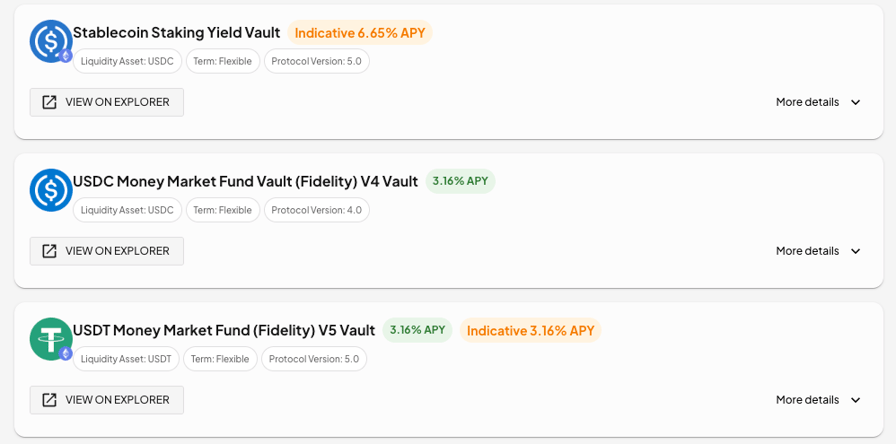
OpenTrade vaults (an excerpt). Source: OpenTrade
The latest funding round brings OpenTrade’s total funding to $30 million and included backing from prominent industry investor a16z Crypto. The London-based company previously raised $7 million in a strategic round led by Mercury Fund and Notion Capital in June 2025, following a $4 million seed round in November 2024.
OpenTrade also secured funding from investors such as Circle Ventures and Polygon Ventures in May 2023, while announcing plans to launch a platform for USDC-denominated investments and tokenized financial assets.
OpenTrade co-founders Dave Sutter and Jeff Handler previously worked at Centre, a now-dissolved consortium of Circle and Coinbase providing standards governance for the USDC stablecoin.


Stockcoin.ai has raised a seed round led by Amber Group to build an AI-native trading OS that pipes on-chain signals into stock and crypto futures flows while adding Hong Kong IPO and US pre‑IPO access from a single interface.
Summary
- AI-native trading platform Stockcoin.ai has closed a seed round led by Amber Group, with backing from angel investors across crypto and traditional finance.
- The startup plans to bridge on-chain data with global stock and crypto futures markets, and will add Hong Kong IPO subscription and US pre-IPO access.
- The raise underscores Amber Group’s continued push into AI-driven trading tools, following similar bets on platforms like OlaXBT.
Stockcoin.ai, an AI-driven platform for stock and cryptocurrency futures trading, has completed its seed financing round led by digital asset heavyweight Amber Group, the company announced on X. According to the disclosure, a group of unnamed angel investors from both the crypto and traditional finance sectors also joined the round, though terms and valuation were not made public.
Positioning itself as an “AI native” trading operating system, Stockcoin.ai says it focuses on fusing on-chain signals with listed equity and futures markets, giving traders a single interface to deploy algorithmic strategies across crypto and stocks. Amber Group, which offers trading, market‑making, lending, and asset management for institutional and retail clients, framed the investment as part of its broader push into data‑driven trading infrastructure.
In its announcement, Stockcoin.ai added that it will “subsequently launch Hong Kong IPO subscription and US Pre‑IPO features,” opening the door for users to access primary and late‑stage equity deals through the same platform. That would mirror how brokers such as Interactive Brokers and other Hong Kong platforms let clients subscribe to IPOs directly from trading accounts, but with AI tools layered on top to screen deals and size orders.
Amber Group has been active in backing AI‑driven trading startups, having previously led a $3.38 million seed round for AI crypto trading venue OlaXBT, which also emphasized algorithmic execution and data‑driven strategies. According to Amber Group, the firm manages more than $5 billion in client assets and has raised hundreds of millions in venture funding to expand its product suite.
If Stockcoin.ai follows through on its Hong Kong IPO and US pre‑IPO roadmap, it will be entering an increasingly competitive segment where exchanges and brokers are racing to list private and pre‑IPO assets for a broader retail audience. A recent Yahoo Finance report noted that major crypto venues have begun listing pre‑IPO instruments, bringing exposure to tens of millions of users.
For readers tracking related capital‑markets infrastructure, crypto.news has previously covered how tokenized Treasury products and AI‑driven quant platforms are blurring the line between TradFi and on‑chain markets in stories such as this analysis, a feature, and a recent report.


The cousin of Cambodia’s Prime Minister (PM) Hun Manet has revealed that he once owned a significant stake in a payment firm linked to alleged $4 billion crypto laundering enterprise Huione Group.
According to local media, a lawyer acting on behalf of Hun To released a statement today confirming that he previously held a 30% stake in Huione Pay.
The firm, which acts as Huione Group’s banking arm, was sanctioned last year by the US and UK along with another alleged South Asian crypto scam conglomerate Prince Group.
Huione Pay’s banking license was also revoked last year due to noncompliance with regulators.
Hun claimed that he had held no managerial authority within Huione Pay and that he didn’t “contribute the required capital in cash” corresponding with his 30% stake.
Additionally, he says he’s never received any profits, dividends, or assets from Huione Pay.
The businessman stressed, “I have never received any invitation for any meeting, general assembly of shareholders. I have never been appointed nor have authorised any proxy or nominee to act on my behalf as a shareholder in the company.”
Hun To is a member of Cambodia’s political class
Hun’s political family connections extend beyond Cambodia’s current PM; he’s also the nephew of the country’s former PM Hun Sen.
Reuters reported in 2024 that Hun was one of three directors working for Huione Pay. Its coverage also detailed the payments firm receiving over $150,000 from the North Korean hacking group Lazarus.
It noted that it had no evidence that Hun was aware of the transactions, and a Huione Pay spokesperson told Reuters that his role in the firm doesn’t include oversight of its day-to-day operations.
Read more: Cambodia has deported 48K foreigners since scam center crackdown began
Hun has also been linked to a heroin trafficking and money laundering group targeting Australia. He denies any involvement.
He launched defamation proceedings against The Australian over an article it published in 2022 alleging his involvement in human trafficking, cyberbullying, and drug trafficking rings.
Hun won the proceedings, and The Australian deleted the article, claiming it “did not intend to make any such allegations against Hun and accepts his denials of such conduct.”
Cambodia’s current PM has overseen a dramatic crackdown on crypto scam centres over the past three years.
Read more: China executes four more in pig butchering scam crackdown
In that time, Cambodia claimed to have deported 48,000 workers, many of which have been trafficked against their will, back to their country of origin.
Last month, the country reportedly deported 600 Thai nationals linked to crypto scam centres. The government also claimed that over 240,000 people alleged to have been involved in the scam operations “voluntarily departed” the country.
Got a tip? Send us an email securely via Protos Leaks. For more informed news and investigations, follow us on X, Bluesky, and Google News, or subscribe to our YouTube channel.
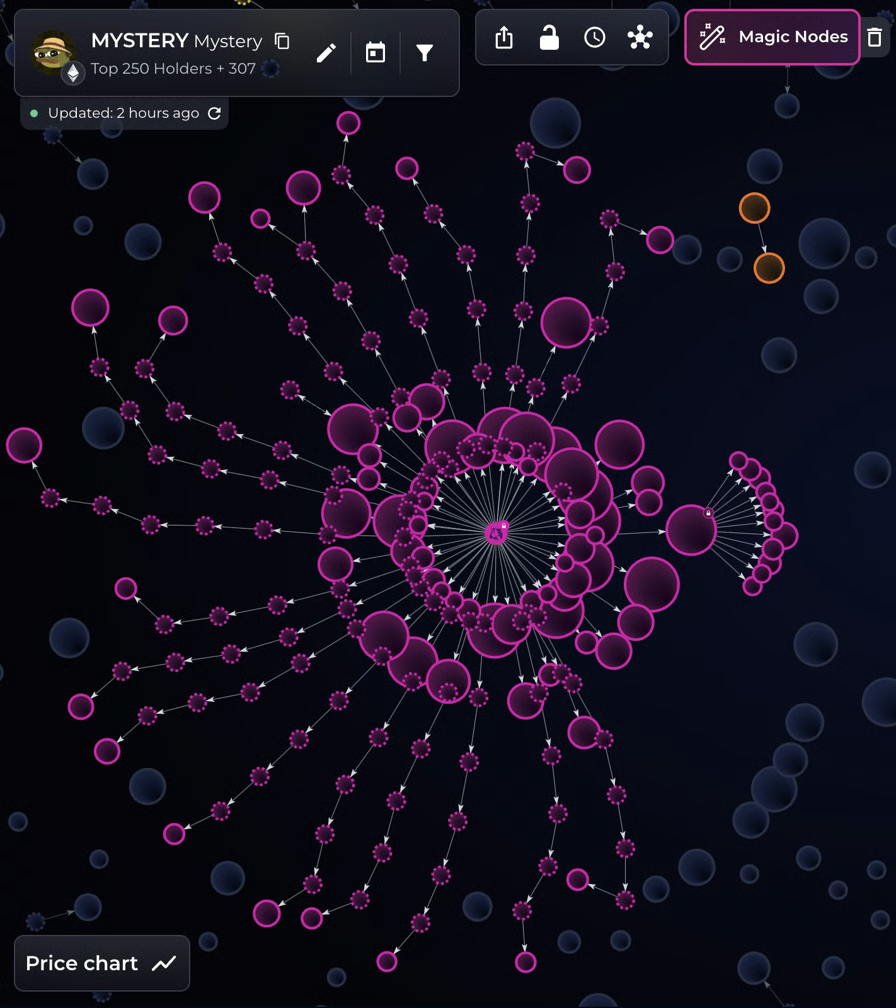
Blockchain analytics platform Bubblemaps said 90 newly funded wallets bought 90% of Mystery (MYSTERY) memecoin supply at launch, raising concerns about coordinated sniping.
The wallets were all funded by wallet “0x544E,” which previously withdrew and distributed 20 Ether from crypto exchange Binance. After buying up 90% of the supply at launch, the wallet cluster sold about $100,000 worth of tokens and still holds 40% of the supply, said Bubblemaps in a Tuesday X post. The analytics company described the pattern as a “textbook scam.”
Sniping refers to using bots or automated trading tools to buy newly launched tokens immediately after trading opens, often before ordinary traders can react. The findings highlight how automated buying and coordinated wallet clusters can dominate thinly traded memecoin launches, leaving later buyers exposed to sharp losses if early holders sell.
A fair launch is meant to give all participants an equal chance to buy a token when trading opens, without insiders or coordinated wallet clusters gaining early control of supply. The concentration flagged by Bubblemaps would undermine that principle if the wallets were acting together.
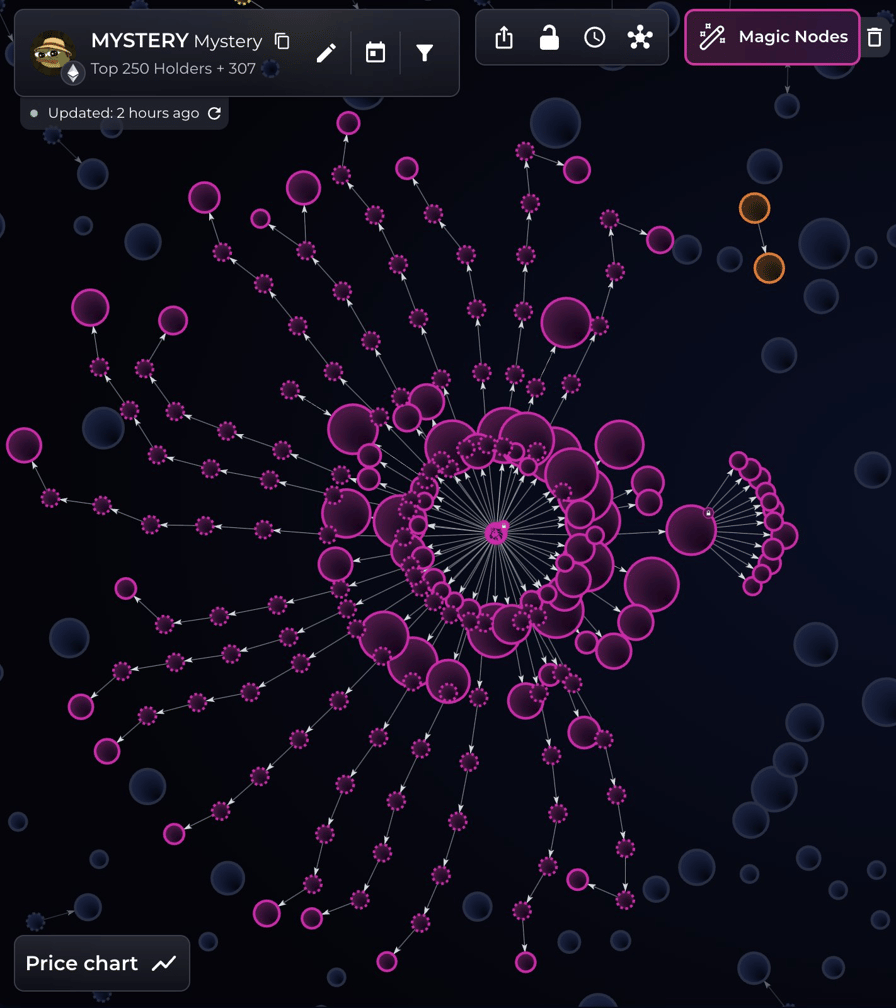
Source: Bubblemaps
Mystery token down 75% from peak
The Mystery token rose to a peak of $7.5 million market capitalization on April 28, before falling around 75% to a $1.9 million market capitalization at the time of writing, Dexscreener data shows.
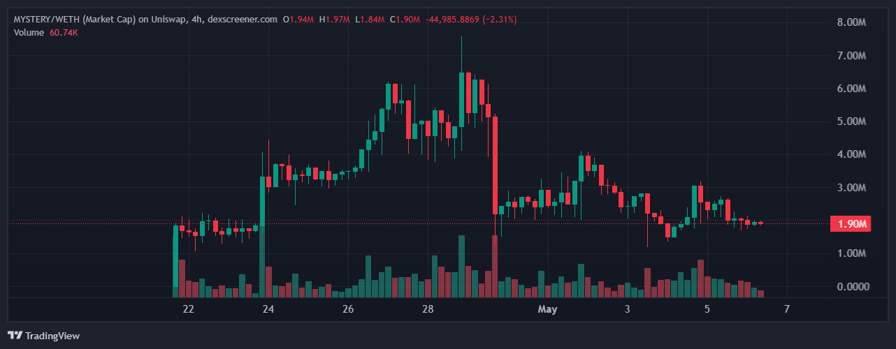
Mystery/WETH, all-time chart. Source: Dexscreener
The memecoin project brands itself as a free-spirited frog from Matt Furie’s “The Night Riders” and claims to have acquired the official HEDZ NFT and related IP rights from Furie, according to a Monday X post.
Cointelegraph was unable to contact Mystery for comment.
Related: Kaiko flags possible front-running before Robinhood token listings
Sniping activity has been a long-standing value-extraction issue in the memecoin space.
In February 2025, a cryptocurrency sniper made nearly $28 million on the Broccoli (BROCCOLI) memecoin, shortly after Binance co-founder and former CEO, Zhangpeng Zhao, revealed that his Belgian Malinois was named “Broccoli,” sparking a wave of community-driven memecoin listings on launchpad Pump.fun.
In November 2025, Bubblemaps claimed that a cluster of about 160 wallets accumulated 30% of decentralized lending protocol Edel Finance’s (EDEL) token supply at launch, worth over $11 million. James Sherborne, the co-founder of Edel Finance, denied the allegations, claiming the team planned to acquire 60% of the token supply.
Magazine: Bitcoiners eye ‘sell in May,’ SBF’s bid for new trial shut down: Hodler’s Digest, April 26 – May 2

Crypto Trading LIVE: BTC Live Trading Bitcoin Analysis | 06 MAY #crypto #bitcoin #btc

Principal of West Belfast school announces early retirement

Campaigners call for ban on use of weedkiller glyphosate at harvest time

Manchester United reach agreement with Casemiro over contract clause amid transfer speculation

US brings back mandatory military draft registration

Steven Gerrard disagrees with Gary Neville over ‘shock’ Chelsea and Arsenal claim | Football


-
 Business7 days ago
Tesla Officially Registers Elon Musk’s Stock: What Investors Need to Know
-

 NewsBeat3 days ago
Channel 5 – All Creatures Great and Small series 7 new post
-

 Entertainment7 days ago
Insider Claims Reason Behind Key & Peele Split
-
 Tech5 days ago
Trump’s 25% EU auto tariff breaches Turnberry Agreement that also covers semiconductors and digital trade
-
 Sports5 days ago
Paul Scholes issues Marcus Rashford reality check as agreement emerges over Man United star
-

 Entertainment5 days ago
Met Gala 2026 Rumored Guest List Is Turning Heads
-

 Entertainment6 days ago
Celebrities Who Are Attending the 2026 Met Gala Event
-

 Business5 days ago
Strait of Hormuz Blockade Persists Amid US-Iran Standoff, Sending Oil Prices Soaring
-
 Sports5 days ago
David Benavidez responds to team Canelo saying the fight will never happen
-
Business7 days ago
Strait of Hormuz Remains Heavily Restricted on April 29 Amid Iran Conflict
-
Entertainment5 days ago
New on Prime Video in May 2026 — Full List of Movies and Shows
-

 Sports5 days ago
Cavaliers vs. Raptors Game 6 live score, updates, highlights from 2026 NBA playoffs first-round series
-

 Crypto World7 days ago
Meta (META) starts stablecoin payout to creators in Circle’s USDC on Polygon, Solana via Stripe
-

 Tech7 days ago
Texas Instruments made a new flagship graphing calculator: the TI-84 Evo
-

 Entertainment5 days ago
Kylie Jenner Hit With Second Lawsuit From Ex-Housekeeper
-

 Sports5 days ago
Plane crash in Wimberley, Texas kills 5 pickleball players at tournament
-
 Sports5 days ago
IPL 2026: ‘Love you darling’- Hardik Pandya’s reaction to MS Dhoni steals the show |Watch | Cricket News
-

 Sports7 days ago
Saudi Arabia set to withdraw LIV Golf funding after 2026 season, per reports
-

 Tech6 days ago
Mark Zuckerberg Says Meta Is Working On AI Agents For Personal And Business Use
-

 Entertainment5 days ago
Young and the Restless Next Week: Cane Arrested & Matt’s Deadly New Scheme!
You must be logged in to post a comment Login