
Crypto World
Bitcoin price climbs to $77,500 on Trump ceasefire extension, Strategy’s $2.5 billion buy



Bitcoin is breaking out of the Iran-headline chop.
Bitcoin traded at $77,541 on Wednesday morning, up 2.2% over 24 hours and 4.3% on the week, after Trump said he would extend the Iran ceasefire indefinitely and Strategy disclosed the purchase of 34,164 BTC for $2.54 billion. Ether rose 2.1% to $2,366, BNB climbed 1.3% to $640, and Solana gained 1.8% to $87. The only red in the top 10 was a trickle of 0.1% declines in stablecoins and Tron.
S&P 500 futures rose 0.5% and Nasdaq 100 futures gained 0.6% after Trump’s extension, though the underlying benchmarks closed lower Tuesday as talks briefly wobbled. Brent crude hovered near $98 a barrel. The MSCI Asia Pacific Index slipped 0.7% as investors weighed how long the Middle East conflict runs.
Trump blamed negotiation collapses on what he called a “seriously fractured” leadership structure in Tehran, and said the US would hold off on fresh attacks while keeping its Strait of Hormuz blockade in place.
Strategy’s buy is the largest bitcoin purchase by the company since November 2024. The 34,164 BTC acquisition at an average $74,395 per coin brings the firm’s holdings to 815,061 BTC, bought for $61.6 billion at an average cost basis of $75,527. With bitcoin at $77,541, the position is now modestly in profit for the first time in months.
Spot flows back the move. Global crypto funds pulled in $1.4 billion last week according to CoinShares, the strongest week of inflows since mid-January. Bitcoin took $1.12 billion, Ethereum $328 million, Chainlink $5 million, and Sui $2 million. XRP saw $56 million in outflows and Solana $2 million, despite both trading higher on price.
Two structural signals point the same direction. Bitcoin is now holding above the realized price of short-term holders at around $69,400 per analyst Darkfost, the level at which recent buyers are sitting on gains rather than losses, which historically reduces the odds of a cascade liquidation if sentiment reverses.
Separately, a Nomura survey found 65% of Japanese institutional investors now hold bitcoin for portfolio diversification, with 31% viewing the market outlook positively and most planning 2% to 5% allocations over the next three years.
Whether bitcoin can hold $77,000 through the European session depends on how markets price the ceasefire extension against continued Strait of Hormuz disruption.
A clean break above $80,000 would confirm the 46-day funding rate compression is flipping into a short squeeze. A reversal below $75,000 would mean the extension already priced in and the rally needs a fresh catalyst.



- Coinlocally expands into tokenized equities with 10 new stock trading pairs.
- Users can trade major stock tokens against USDT with zero fees for one month.
- Move aligns with rising interest in RWAs and blockchain-based financial products.
Coinlocally today launched 10 new tokenized stock pairs on its trading platform and introduced a zero-fee trading campaign for all newly-listed stock pairs.
The new listings include widely recognized companies such as Tesla, Amazon, Apple, NVIDIA, and Alphabet.
Starting on April 14, users can trade TSLAX, COINX, AMZNX, AAPLX, NVDAX, GOOGLX, MCDX, HOODX, METAX, and CRCLX against USDT with zero trading fees through May 14, 2026.
This new group of listings gives users exposure to some of the most closely Marco watched names across technology, consumer internet, and digital finance, while keeping that access within Coinlocally’s existing trading environment.
Tokenized real-world assets (RWAs) continue to grow across the digital asset market, with more than $26 billion in distributed on-chain value.
At the same time, interest in tokenized equities has been building as more companies look at blockchain-based versions of traditional financial products.
Coinlocally’s new listings arrive as tokenized stocks begin to attract wider attention from both crypto platforms and traditional market infrastructure players.
“We want users to be able to access newly-listed tokenized stock markets without extra cost during the launch period,” said Sam Baumann, COO at Coinlocally.
Listing these pairs with zero-fee trading is a practical way to make the product easier to try and more accessible to a wider range of traders.
The rollout reflects Coinlocally’s broader strategy of connecting traditional market exposure with digital asset trading.
The platform supports more than 600 digital assets across spot, margin, and futures markets, with tools for both retail and professional users.
The new tokenized stock pairs expand that offering by bringing another set of familiar market names onto the platform.
Coinlocally has also been building out a wider product ecosystem beyond its main trading markets.
In addition to spot and derivatives trading, the platform offers services such as P2P trading, Earn, Launchpad, and educational resources aimed at users with different levels of experience.
Within that broader mix, the new stock pairs give users another way to access tokenized versions of traditional assets without leaving the platform.
Users can visit Coinlocally’s trading platform to explore the newly listed tokenized stock pairs and start trading with zero fees.
About Coinlocally
Founded in 2020, Coinlocally is a global fintech and digital asset exchange offering secure, fast, and transparent access to cryptocurrency and forex markets.
With high liquidity and advanced trading tools, including spot, futures, bot trading, grid strategies, and copy trading, the platform serves both beginners and professional traders worldwide.
Coinlocally’s mission is to bridge traditional finance with the emerging world of decentralized finance, empowering users with greater control of their assets through a compliance-driven, seamless transition from centralized (CEX) to decentralized (DEX) trading and broader Web3 innovation.
For more information, users can visit coinlocally.com or follow Coinlocally on Telegram or X.
This article is authored by a third party, and CoinJournal does not endorse or take responsibility for its content, accuracy, quality, advertisements, products, or materials. Readers should independently research and exercise due diligence before making decisions related to the mentioned company.


Uzbekistan has created a special crypto mining zone across Karakalpakstan under a presidential resolution signed on April 17, opening a supervised framework that lets approved mining companies sell mined digital assets on foreign platforms while keeping the proceeds inside the country’s banking system.
A presidential decree effective April 20 creates the “Besqala Mining Valley,” a special mining zone across the Republic of Karakalpakstan, where registered legal entities can carry out crypto mining, use a mix of power sources and apply for resident status through a new directorate under the republic’s Council of Ministers.
The framework gives miners in the zone the right to sell crypto assets obtained through mining on national crypto exchanges or foreign platforms, including through direct contracts, and to exchange them for other liquid crypto assets. Still, the opening comes with strict controls over how mining revenues move through the financial system, and proceeds from those sales must be transferred to bank accounts in Uzbekistan.
Tax breaks aim to lure miners
The decree also provides for a tax exemption through Jan. 1, 2035, while requiring them to pay a monthly fee equal to 1% of income from mining activity to the zone’s directorate. The resolution separately instructs officials to submit draft amendments to Uzbekistan’s tax code within two months.
The new decree adds to Uzbekistan’s recent use of special-zone incentives in Karakalpakstan to attract investment into a region that a 2025 United Nations Development Programme report described as having high poverty rates and limited industrial development.
The new framework also adjusts Uzbekistan’s earlier approach to crypto mining. In 2023, Uzbekistan’s National Agency for Perspective Projects (NAPP) issued a decree on licensing crypto mining operations, requiring firms to only use solar power to mine digital assets.
The new decree allows a wider mix of power sources within the zone, including renewable, hydrogen and grid electricity, with higher tariffs applied for grid usage.
Related: Uzbekistan increases fees for crypto operations
Uzbekistan expands special-zone strategy to draw investment
The move also fits a broader investment strategy in Karakalpakstan. According to a Reuters report in November 2025, the government had established a separate tax-free zone for artificial intelligence and data center projects, offering discounted electricity and tax exemptions to draw foreign investors.
Under the initiative, foreign firms investing $100 million or more get full tax and duty exemptions until 2040. According to the report, Uzbekistan expects to attract over $1 billion in foreign investment by 2030 from the AI special zone project.
Related: Uzbekistan greenlights stablecoins for payments under new sandbox regime
Magazine: Adam Back says current demand is ‘almost’ enough to send Bitcoin to $1M


A Polymarket contract on whether Kelp DAO will spread the losses from the weekend’s $292 million exploit beyond those directly affected is pointing to a clear answer: probably not.
Bettors are giving a 14% chance that Kelp will “socialize the losses,” or implement a mechanism forcing rsETH holders on Ethereum, which wasn’t hit, to share the pain of users on other chains.
The attackers drained roughly 116,500 rsETH from a LayerZero-powered bridge that held the reserves backing the token across more than 20 blockchains. That left parts of the system undercollateralized, with some holders effectively owning tokens no longer fully backed by ether (ETH).
“Socializing the losses” would mean Kelp redistributes the shortfall across all rsETH holders, including those on the Ethereum mainnet, rather than leaving losses concentrated among users and protocols tied to the compromised bridge.
The most widely cited precedent of this approach came in 2016, when Bitfinex imposed losses on all users after a $60 million hack, effectively mutualizing the hit to avoid shutting down.
More recently, derivatives exchanges have used variations of the concept through auto-deleveraging (ADL), in which profitable positions are forcibly reduced to cover losses when insurance funds are exhausted.
During the October flash crash, ADL mechanisms were triggered across some venues, closing out even market-neutral positions and leaving traders exposed. These moves are rare and controversial, but they have been used as a last resort to stabilize systems under stress.
Kelp’s situation is more complex. The exploit drained the reserve backing rsETH across more than 20 chains, leaving losses fragmented across different user groups and platforms.
Holders on affected networks face impaired backing, while others remain relatively insulated. Any attempt to equalize losses would require coordination across chains, clear accounting of liabilities, and a willingness to impose losses on users who may not see themselves as affected.
That makes a clean, system-wide redistribution both technically and politically difficult, which may explain why Polymarket traders are approaching the question with skepticism.
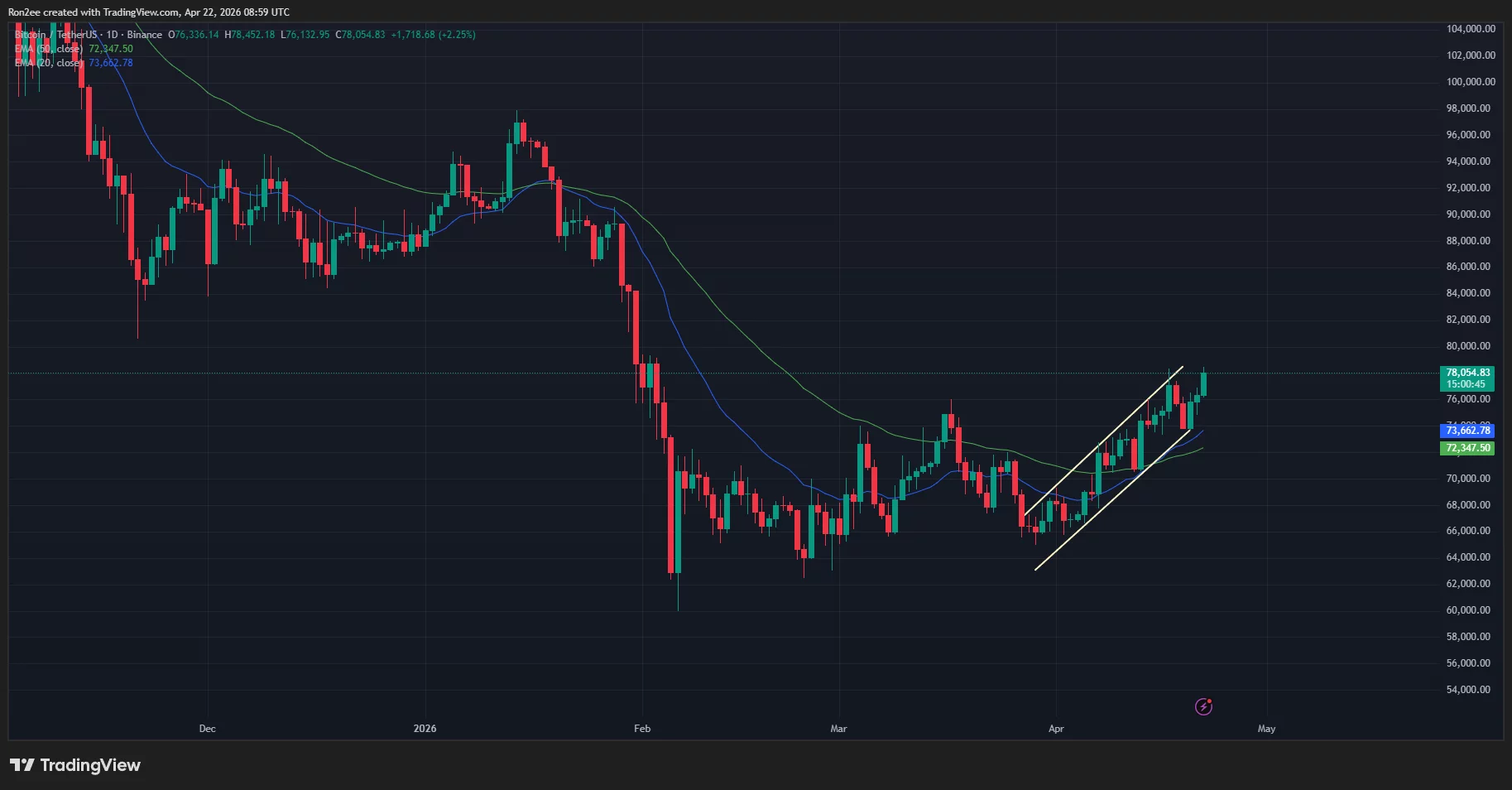
As Bitcoin price continues to march higher towards $80,000, Grayscale researchers believe the asset has likely already formed a market bottom and is entering the early phase of a new bull cycle.
Summary
- Bitcoin price climbed to a 10-week high above $78,000 after U.S. President Donald Trump extended the Iran ceasefire, easing geopolitical tensions.
- Grayscale Research said on-chain data points to a market bottom, with short-term holders nearing breakeven and sell pressure declining.
- Bitcoin futures open interest rose 5.6% to $60 billion, signaling increased bullish positioning as traders anticipate further upside.
Bitcoin (BTC) price reached a 10-week high above $78,000 on Wednesday as geopolitical tensions eased.
According to data from crypto.news, Bitcoin price rose 4.4% on April 22 to $78,251, after which it stabilized around $78,000 at the time of writing. At its present price, the token is 19% higher than its lowest point last month and 24% above its year-to-date low.
Bitcoin price rallied following Trump’s announcement to extend the ongoing ceasefire with Iran, as the market awaits more substantive talks to bring an end to the eight-week war that began on Feb. 24.
Despite the extension, Trump noted that the U.S. blockade on the Strait of Hormuz and Iranian ports would remain in action until Iran submits a proposal for talks to resolve the conflict permanently.
With Bitcoin trading close to a two-month high, Grayscale Research’s head of research, Zach Pandl, outlined a constructive outlook for the asset. Writing in The Stack, Pandl cited on-chain indicators showing that recent buyers are nearing breakeven following a rebound of over 20% from February lows near $63,000.
The realized price for coins that moved within the past one to three months now sits around $74,000. That shift suggests short-term holders have largely exited loss-making territory, which could ease selling pressure and support a change in sentiment. Pandl views the $65,000 to $70,000 range as a firm base.
While Bitcoin remains below its October 2025 peak, the current recovery mirrors early-stage behavior seen in previous upcycles.
“If Bitcoin price rises further in the coming days, more recent buyers would move into positive PnL, which can be an indicator for marking the first phase of a bull market,” Pandl said.
Data from the Bitcoin derivatives market compiled by CoinGlass seems to show that investors have already started repositioning for further gains. In the past 24 hours, total Bitcoin Futures open interest has risen by 5.6% to $60 billion. This suggests that an increasing number of investors are betting on Bitcoin to climb higher, a sentiment evident with a long/short ratio of 1.02.
Bitcoin price analysis
On the daily chart, Bitcoin price action has formed an ascending parallel channel pattern where it consistently carves out higher highs and higher lows. As long as Bitcoin successfully trades within the boundaries of this channel, the asset would continue to remain in an uptrend, potentially reaching $80,000 next before moving toward its previous record highs.
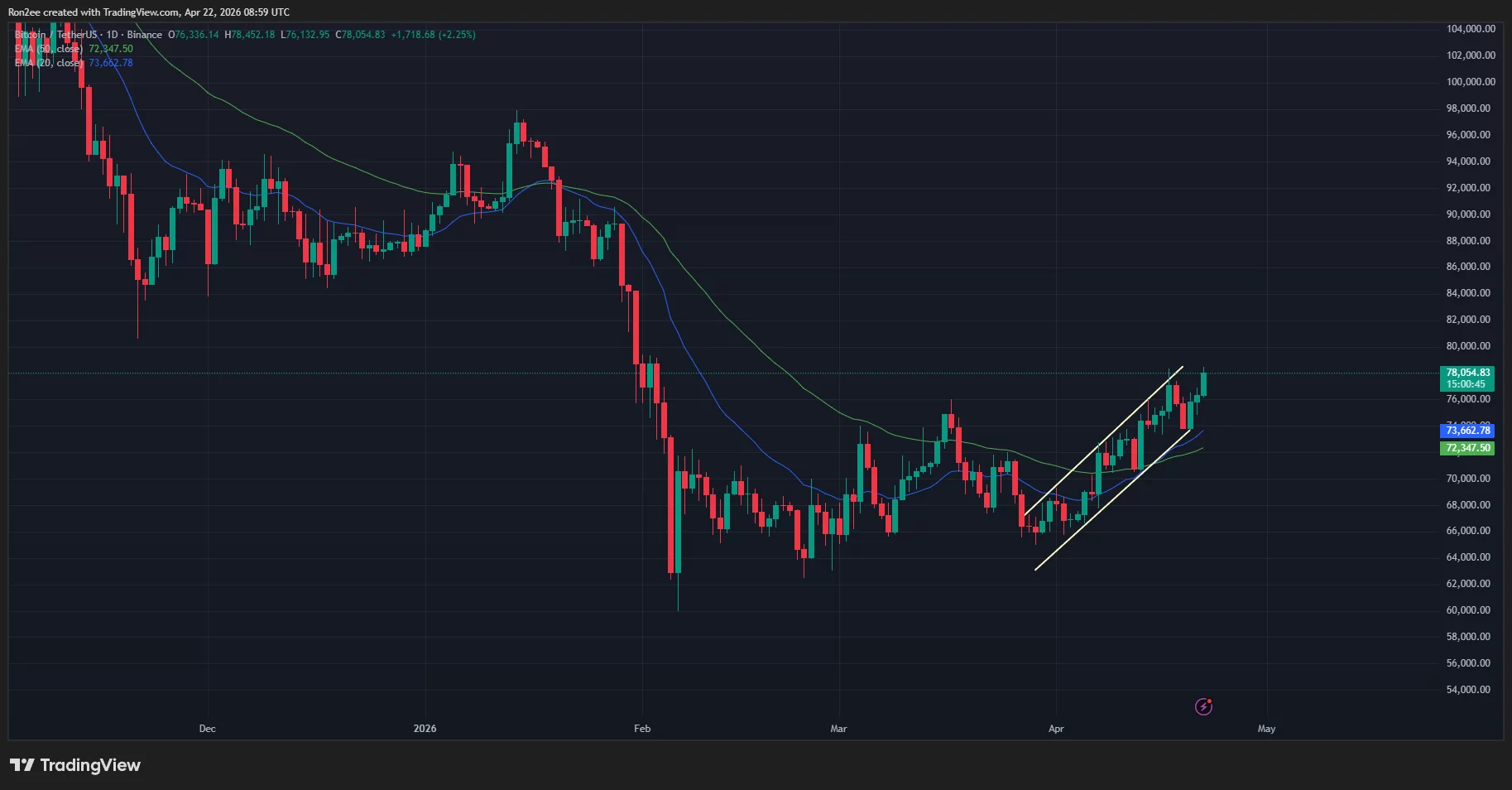
The 20-day EMA has formed a bullish crossover with the 50-day EMA, which means the short-term momentum is now firmly in favor of the buyers. Meanwhile, the daily RSI shows there is still room for further gains before the market becomes overbought, allowing for more growth before experiencing any significant pullback.
Disclosure: This article does not represent investment advice. The content and materials featured on this page are for educational purposes only.


Mozilla shipped Firefox 150 this week with patches for 271 security vulnerabilities discovered by Anthropic’s Claude Mythos Preview in an initial evaluation.
The scan forms part of Project Glasswing, Anthropic’s coordinated defense effort that grants limited Mythos access to critical infrastructure partners.
Mozilla Patches 271 Vulnerabilities After Claude Mythos Evaluation
In a recent blog post, Firefox CTO Bobby Holley explained that browser security has traditionally followed an offense-heavy model.
Under this approach, vendors acknowledged that fully eliminating exploits was unrealistic and instead focused on making attacks so costly or complex that they would not be widely abused.
“As these capabilities reach the hands of more defenders, many other teams are now experiencing the same vertigo we did when the findings first came into focus. For a hardened target, just one such bug would have been red alert in 2025, and so many at once makes you stop to wonder whether it’s even possible to keep up,” Holley said.
Follow us on X to get the latest news as it happens
The executive stated that since February, the Firefox team has been working intensively with advanced AI tools to identify and remediate “latent security vulnerabilities in the browser.”
Earlier collaboration with Anthropic, using its Opus 4.6 model, led to fixes for 22 security-sensitive issues in Firefox 148.
The latest update represents a sharp escalation in scale, roughly a twelvefold increase, highlighting how AI-driven audits are reshaping modern cybersecurity practices.
“Encouragingly, we also haven’t seen any bugs that couldn’t have been found by an elite human researcher,’ he added.
Why the Firefox Result Matters for Crypto
The Firefox evaluation lands as exchanges weigh their own exposure to AI-assisted attacks. Anthropic says Mythos can “identify and then exploit zero-day vulnerabilities in every major operating system and every major web browser when directed by a user to do so.”
This marks the same surface that hot wallets and decentralized applications depend on. While private keys are generally protected within wallet environments, attackers can still gain control over on-chain assets by tricking users into approving harmful transactions or exploiting compromised extensions.
Interest in such capabilities is already expanding. Coinbase has reportedly explored access to Anthropic’s Mythos. This builds on its existing use of Claude models for customer support across more than 100 regions.
Subscribe to our YouTube channel to watch leaders and journalists provide expert insights
The post Claude Mythos Identifies 271 Vulnerabilities in Mozilla’s Firefox appeared first on BeInCrypto.


Firefox developer Mozilla revealed that an early version of Anthropic’s Claude Mythos AI identified 271 vulnerabilities in the Firefox browser during internal testing, all of which were patched this week.
Summary
- Mozilla said Anthropic’s Claude Mythos AI identified 271 vulnerabilities in Firefox during internal testing, all of which were patched this week.
- The model showed it can scan large codebases and detect security flaws faster than traditional human-led reviews, though no findings went beyond what elite researchers could uncover.
The findings point to how advanced AI systems are starting to scan large codebases at a scale that once depended on long hours of manual work by cybersecurity researchers. Mozilla said even hardened software targets could now be examined more deeply in a shorter time.
“As these capabilities reach the hands of more defenders, many other teams are now experiencing the same vertigo we did when the findings first came into focus,” Mozilla wrote. “For a hardened target, just one such bug would have been red-alert in 2025, and so many at once makes you stop to wonder whether it’s even possible to keep up.”
Earlier testing using another Anthropic model had uncovered 22 security-sensitive bugs in a previous Firefox release. Despite that progress, Mozilla noted that eliminating software exploits entirely has long been considered unrealistic.
“Until now, the industry has largely fought security to a draw,” the company wrote. “Vendors of critical internet-exposed software like Firefox take security extremely seriously and have teams of people who get out of bed every morning thinking about how to keep users safe.”
Mozilla said the new system can review source code and flag weaknesses in ways that previously required highly specialized human expertise. Internal results showed the model did not uncover bugs beyond the reach of top-tier researchers.
“Some commentators predict that future AI models will unearth entirely new forms of vulnerabilities that defy our current comprehension, but we don’t think so,” the company said. “Software like Firefox is designed in a modular way for humans to be able to reason about its correctness. It is complex, but not arbitrarily complex.”
Launched in March, Claude Mythos is described by Anthropic as its most advanced model for reasoning, coding, and cybersecurity tasks, positioned above its earlier Opus series. Pre-release testing suggested it could identify thousands of unknown vulnerabilities across operating systems and browsers.
Access to the system remains limited through a restricted initiative known as Project Glasswing, which allows select firms, including Amazon, Apple, and Microsoft, to scan software for security flaws.
Security researchers warn that the same capability could be used offensively. AI tools that can analyze code at scale may also automate the discovery of exploitable bugs across widely used software systems.
Testing by the U.K.’s AI Security Institute showed the model could carry out complex cyber operations on its own, including completing a multi-stage corporate network attack simulation without human input. Those results have drawn attention from governments and intelligence agencies.
Despite earlier tensions with Donald Trump’s administration over the use of Anthropic’s technology, the National Security Agency has deployed Claude Mythos Preview on classified networks, according to people familiar with the matter. The move signals growing interest among U.S. agencies in AI tools that can detect critical software vulnerabilities.
Anthropic has also acknowledged that current cybersecurity benchmarks are struggling to keep pace with its latest models, raising questions about how to measure AI performance in this field.
Mozilla said the results suggest a possible turning point, where defenders may begin to narrow the long-standing gap with attackers.
“We are extremely proud of how our team rose to meet this challenge, and others will too,” the company wrote.
“Our work isn’t finished, but we’ve turned the corner and can glimpse a future much better than just keeping up. Defenders finally have a chance to win, decisively.”
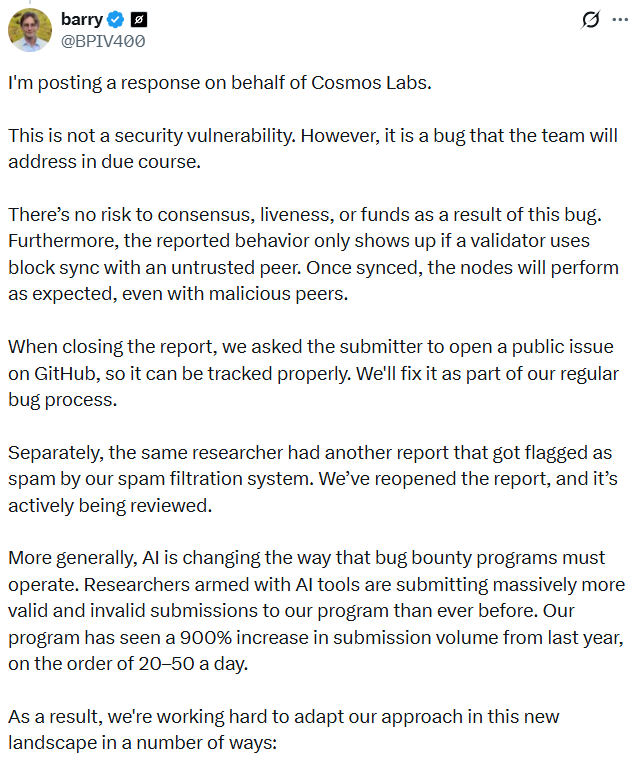
Crypto protocols have warned that an increase in AI use has led to a flood of bogus bug bounty submissions, putting a strain on teams trying to identify real threats to their protocols.
Bug bounties are a system to reward “good” hackers for submitting reports about potential vulnerabilities and are popular in the crypto industry. AI has now made it easier to sift through large amounts of code to find possible bugs, though AI is also known to hallucinate.
“AI is changing the way that bug bounty programs must operate,” said Barry Plunkett, co-CEO of Cosmos Labs, on Tuesday, responding to a bug bounty hunter who accused the protocol of ignoring their vulnerability report.

“Our program has seen a 900% increase in submission volume from last year, on the order of 20-50 per day,” he said, adding that it’s led to a huge increase in both valid and invalid reports.
Kadan Stadelmann, a blockchain developer and chief technology officer at Komodo Platform, told Cointelegraph he has also seen a notable increase in bug bounty submissions and payouts across organizations.
“There has definitely been an increase in low-quality bug bounty submissions, some of which have been false positives, potentially suggesting AI sourcing. One potential explanation is that AI has caused a decrease in the cost to produce a report, resulting in an influx of submissions.”
In January, Daniel Stenberg, the creator of the open-source data transfer tool curl, which is used in many apps, including blockchain infrastructure, announced he was ending his bug bounty program because of an influx of “AI slop in vulnerability reports,” and he was exhausted from sifting through them.

HackerOne, one of the largest bug bounty platforms in the world, reported in January that there were 85,000 valid bounty submissions in 2025, up 7% from the previous year.
AI could be both the cause and the solution
Plunkett said Cosmos Labs has already started to adapt its approach as a result of the uptick in bug bounty submissions by tightening how it scores submissions, prioritizing trusted researchers with a proven track record and working with other bug bounty providers that offer more advanced triage.
Meanwhile, Stadelmann said bug bounty programs have proven integral to defending decentralized systems, and adopting AI to assist in sifting through the noise could be a solution.
“Blockchain teams will have to create AI deterrents to sift through incoming bug bounties. The smaller the team, the bigger the problem of increased bug bounties will become. Software engineers won’t have the capacity to examine everything,” he said.
“This is where defensive AI systems to automatically sift through incoming bug bounties will be crucial. Teams dependent on bug bounties will need to develop stricter standards on their bug bounty programs as a means of lowering the number of incoming reports.”
Related: Crypto hackers stole $17B over past 10 years: DefiLlama

Key Takeaways
- Ruben Roy from Stifel Nicolaus increased AMD’s price target to $320 from $280, maintaining a Buy recommendation
- This fresh target suggests approximately 17% potential upside and exceeds the Street’s average forecast of around $291
- The upgrade reflects AI infrastructure demand surpassing expectations and significant partnerships with Meta and OpenAI
- AMD’s previously announced long-term EPS target of $20+ was established prior to the Meta partnership, suggesting room for upward revision
- Supply chain bottlenecks represent a significant concern that could hamper AMD’s ability to capitalize on robust demand
Shares of Advanced Micro Devices surged on Tuesday following a notable price target revision from Stifel Nicolaus, with the semiconductor stock climbing 3.47% during trading.
Advanced Micro Devices, Inc., AMD
Ruben Roy, a Stifel analyst who ranks eighth among equity research professionals covering Wall Street, increased his price forecast for AMD to $320 from his previous $280 target while reaffirming his Buy recommendation. This updated projection indicates potential appreciation of approximately 17% from present trading levels within the coming year.
Roy’s optimistic stance positions him notably above the Street’s collective view. Currently, 37 analysts with Buy ratings on AMD have established an average price target hovering around $291.
The strategic timing is noteworthy. With AMD’s quarterly earnings report on the horizon, institutional investors appear to be adjusting their positions in anticipation.
Catalysts Driving the Bullish Thesis
Stifel’s upgraded outlook rests on two primary pillars. First, demand for AI computing infrastructure is accelerating beyond previous forecasts across both specialized accelerators and conventional processor designs. Second, AMD has secured transformative customer agreements — particularly multi-gigawatt strategic commitments with Meta and OpenAI.
Roy highlighted an important consideration regarding AMD’s financial guidance. The company had previously communicated a long-term earnings-per-share target exceeding $20, but Roy emphasized that this benchmark predated the announcement of the Meta collaboration. He characterized this $20+ figure as a baseline rather than an upper limit.
Stifel isn’t the only institution expressing increased confidence in AMD’s trajectory. Bank of America lifted its price objective to $310 from $280 on April 18. BofA’s Vivek Arya calculated that each gigawatt of deployed AI infrastructure capacity could generate approximately $15–$20 billion in net revenue for AMD, projecting data-center segment growth exceeding 60% year-over-year throughout 2026 and 2027.
Manufacturing Constraints Pose Challenge
Despite the optimistic outlook, the price target increase includes an important caveat. Stifel identified deteriorating supply chain constraints as a material risk factor. AMD may struggle to manufacture sufficient chip volumes to satisfy the accelerating customer demand.
This disconnect between robust market appetite and constrained production capacity represents the critical dynamic in AMD’s investment narrative at present. The company’s success in addressing this imbalance will significantly influence whether the $320 price target proves achievable.
AMD’s processor and graphics technologies form the backbone of AI-powered data center infrastructure. Additionally, the company is developing Helios, a comprehensive AI server rack platform scheduled for commercial availability in the latter half of 2026.
Year-to-date, AMD shares have appreciated 31.16%, while posting remarkable gains of 218.75% over the trailing twelve months. Tuesday’s trading volume reached approximately 9.09 million shares, substantially below the three-month average daily volume of 32.47 million shares.
The consensus Wall Street rating for AMD stands at Moderate Buy, reflecting 20 Buy recommendations and eight Hold ratings issued during the past three months, with a mean price target of $287.33.



One in four European investors has invested in cryptocurrency, according to a new study of 6,000 people across Germany, Italy, Spain, and France.
The findings, referenced by Boerse Stuttgart Digital, indicate rising interest in digital assets.
Crypto Adoption Gains Ground Across Europe
Market research firm Marketagent polled investors aged 18 to 70 between August 2025 and January 2026. The findings revealed that Spain leads crypto adoption with nearly 28% participation. Germany follows at 25%, with Italy (24%) and France (23%) slightly behind.
The survey also highlights sustained interest, with 36% of crypto investors likely to reinvest within five years. Spain again ranks highest in overall interest at over 40%, followed by France (36%), Germany (35%), and Italy (34%).
Follow us on X to get the latest news as it happens
“Crypto adoption across Europe is continuing to grow, with Spain emerging as a frontrunner. Notably, it is not only the number of investors entering the market that is significant, but also the sustained intention to invest further in the coming years, even in the face of market volatility,” Dr. Matthias Voelkel, CEO of Boerse Stuttgart Group, stated.
Despite rising interest, limited understanding remains a key barrier. Investors in Germany report higher confidence than their peers. Yet 65% still find crypto too complex, compared to 73% in Spain and France, and 70% in Italy.
Improved knowledge could drive further adoption. 54% in Spain, 49% in France, and 44% in both Italy and Germany say they would invest more if better informed.
Notably, Boerse Stuttgart Digital highlighted that the interest presents a clear strategic opportunity for banks, brokers, and asset managers.
Nearly one in five investors expect their bank to offer crypto access within three years. The demand is strongest in Germany (22%), followed by Spain (19%), Italy (18%), and France (16%).
The potential for customer movement reinforces this shift, as 35% of European investors would consider switching banks for better crypto services.
Spain shows the strongest inclination (40%), ahead of Italy (35%), France (33%), and Germany (29%), indicating that crypto offerings are becoming a key competitive factor.
Beyond banking, insights from BeInCrypto Legal and Regulatory Expert Council suggest crypto is moving into mainstream political debate in the United Kingdom.
“So we have something we call a crypto voter, and we believe very strongly that will become a bigger issue,” Adriana Ennab, UK Director at Stand With Crypto, told BeInCrypto.
Dion Seymour, Crypto Tax Technical Director at Andersen and former HMRC policy lead, noted that the growing number of crypto holders in the UK signals the issue is no longer marginal and demands greater political attention.
Subscribe to our YouTube channel to watch leaders and journalists provide expert insights
The post Crypto Adoption Hits 25% Across Europe’s Four Leading Economies appeared first on BeInCrypto.
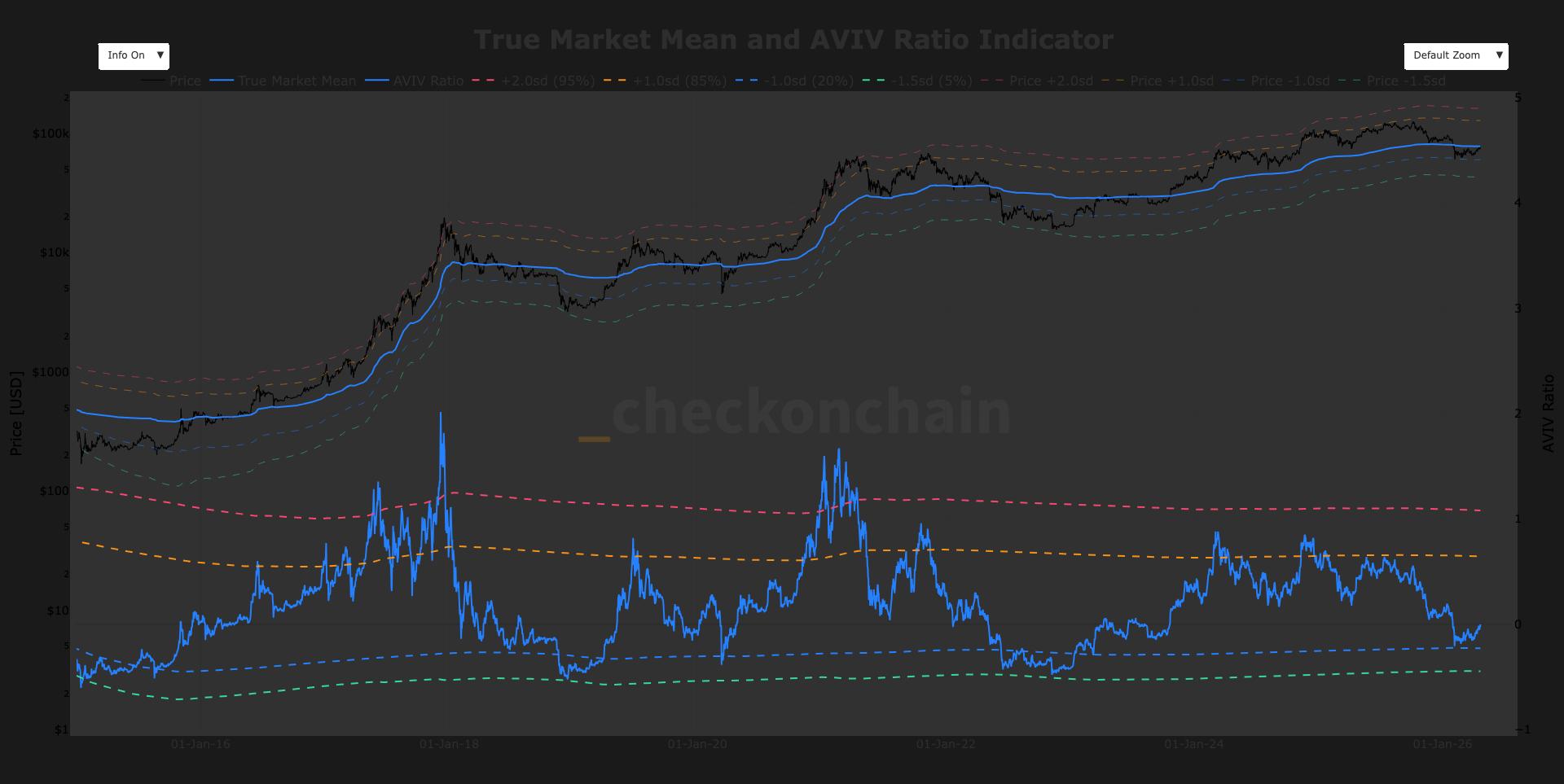
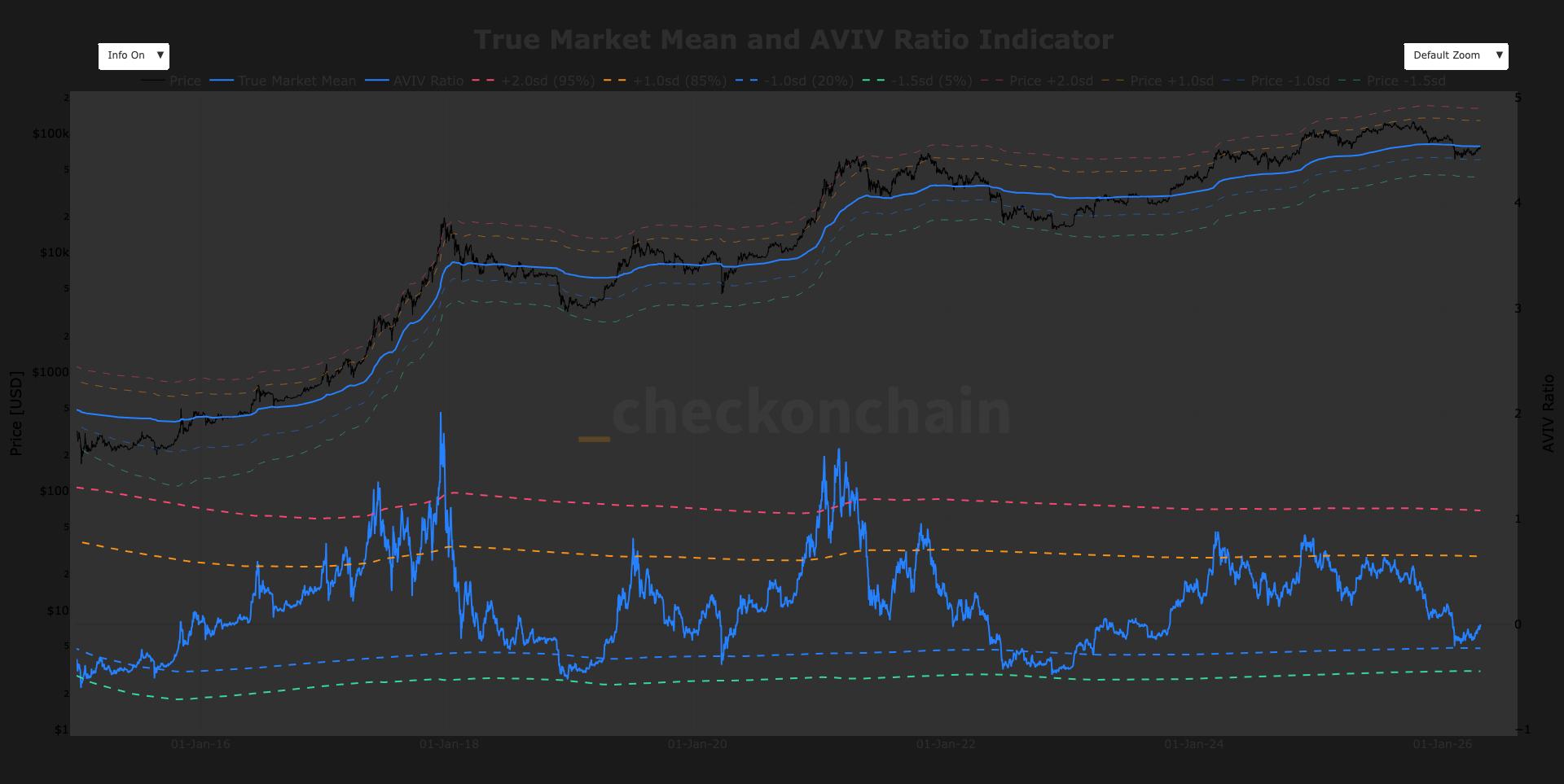
True Market Mean and Short-Term Holder cost basis form a critical $78.2K to $79.2K range that could define the next major move.

PEEL report rates North Yorkshire Police good in 6 areas

Aussie shares fall as war dims hopes for US rate cuts

Coinlocally lists Tesla, Amazon, Apple token pairs, launches zero-fee trading

Manchester United reach agreement with Casemiro over contract clause amid transfer speculation

Steven Gerrard disagrees with Gary Neville over ‘shock’ Chelsea and Arsenal claim | Football

US brings back mandatory military draft registration


-

 Fashion5 days ago
Weekend Open Thread: Theodora Dress
-

 Sports5 days ago
NWFL Suspends Two Players Over Post-Match Clash in Ado-Ekiti
-

 Politics5 days ago
Palestine barred from entering Canada for FIFA Congress
-
Entertainment2 days ago
NBA Analyst Charles Barkley Chimes in on Ice Spice McDonald’s Fiasco
-

 Business3 days ago
Powerball Result April 18, 2026: No Jackpot Winner in Powerball Draw: $75 Million Rolls Over
-

 Politics3 days ago
Zack Polanski demands ‘council homes not luxury flats for foreign investors’
-

 Crypto World4 days ago
Russia Pushes Bill to Criminalize Unregistered Crypto Services
-

 Politics2 days ago
Gary Stevenson delivers timely reminder to register to vote as deadline TODAY
-

 Tech3 days ago
Auto Enthusiast Scores Running Tesla Model 3 for Two Grand and Turns It Into Bare-Bones Go-Kart
-

 Tech6 days ago
‘Avatar: Aang, The Last Airbender’ Leaked Online. Some Fans Say Paramount Deserves the Fallout
-
 Business6 days ago
Creo Medical agree sale of its manufacturing operation
-

 Crypto World4 days ago
Russia Introduces Bill To Criminalize Unregistered Crypto Services
-
 Crypto World3 days ago
Kelp DAO rsETH Bridge Hack Drains $292M as DeFi Losses Top $600M in Two Weeks
-

 Sports6 days ago
British climbers complete new route in Swiss Alps
-

 Tech6 days ago
Ford EV and tech chief leaving automaker
-

 Sports6 days ago
“Felt Much Better Today”: Josh Hazlewood Opens Up On His Recovery Win Over LSG
-

 Business6 days ago
Cheaper Doritos and Lays helps PepsiCo win back struggling snackers
-
 Entertainment6 days ago
Clavicular Says Streaming May Not Work Without Substances
-

 Entertainment7 days ago
Ruby Rose Accuses Katy Perry Of Sexual Assault, Police React
-

 Crypto World12 hours ago
New York sues Coinbase, Gemini over prediction market offerings
You must be logged in to post a comment Login