

Crypto World
Crypto Mom to join law school, signaling end of tenure at the SEC


Hester M. Peirce, a two-term commissioner at the U.S. Securities and Exchange Commission who crypto insiders widely regard as “Crypto Mom,” is transitioning to academia. Regent University School of Law has announced she will join as an associate professor, effective in November, expanding the law school’s emphasis on federal litigation, securities regulation, and digital assets.
Peirce’s move comes amid a broader staffing dip at the SEC and a shifting regulatory posture on crypto under the current administration. Her formal term at the agency expired in June 2025, but Commission rules allow officials to remain in office for roughly 18 months beyond term expiration if replacements have not yet been named. Regent’s notice highlights Peirce’s anticipated focus areas, signaling a push to anchor crypto policy education at a time when the regulatory landscape is under increased scrutiny from lawmakers and market participants alike.
Key takeaways
- Academic appointment for a prominent crypto regulator: Hester Peirce will join Regent University School of Law as associate professor beginning in November, with Regent noting a focus on federal litigation, securities regulation, and digital assets.
- SEC staffing shifts and vacancies: With Peirce’s departure, the SEC faces a vacancy landscape that may thin the board further, as Caroline Crenshaw left in January and no nominations were publicly announced as of the latest briefing.
- Inter-agency dynamics amid a regulatory reshape: The CFTC, under Chair Michael Selig, remains with a single commissioner and a five-member panel that has yet to be fully staffed, complicating coordination on crypto policy.
- Legislative progress could reallocate authority: A digital asset market structure bill, the CLARITY Act, is moving through Congress and could shift significant oversight powers from the SEC to the CFTC, reinforcing a broader push toward clearer regulatory boundaries.
- Policy shift under the current administration: Since President Trump took office in January 2025, the SEC has signaled a notable shift in crypto enforcement and policy, including winding down several actions and investigations in the sector.
SEC veteran moves to academia as staffing gaps widen
Peirce joined the SEC in January 2018 after being nominated by then-President Donald Trump and confirmed by the Senate in December 2017. She secured a second term in 2020, having first been nominated by President Barack Obama for a Republican seat in 2015, though that initial nomination did not advance in the Senate at the time. Regent University’s announcement indicates that Peirce will begin teaching as an associate professor later this year, with a program that aims to bolster the law school’s offerings in federal litigation, securities regulation, and digital assets.
The timing of her departure is notable both for the SEC’s internal dynamics and for the crypto policy discourse more broadly. Peirce’s exit follows a period when the agency has been recalibrating its stance on digital assets, a shift that has been observed in parallel with discussions surrounding Congress’s evolving approach to crypto markets. Regent’s statement frames the appointment as a strategic move to infuse academic rigor into areas crucial to market participants—regulatory compliance, enforcement posture, and the evolving treatment of digital assets in securities law.
In parallel, the SEC’s leadership trajectory remains unsettled. Caroline Crenshaw, a Democratic commissioner whose term ended years earlier, departed in January, and as of the latest updates no nominations had been publicly made to fill her seat. With Peirce’s exit, the SEC would be left with two Republican commissioners—Mark Uyeda and Chair Paul Atkins—absent a prompt replenishment vote. This gaps-filled picture matters because commissioner diversity and voting blocs influence how aggressively or defensively the agency pursues crypto cases and shapes rulemaking agendas.
Inter-agency balance and the fight to regulate crypto
The regulatory landscape for crypto in the United States has long hinged on the balance of power between the SEC and the Commodity Futures Trading Commission. The two agencies have signaled a willingness to coordinate approaches to “end regulatory turf wars,” even as their seats remain a point of contention. Under Atkins at the SEC and Selig at the CFTC, both agencies have stressed a desire for cooperative governance over crypto markets. Yet a fully staffed leadership roster remains a work in progress, complicating a coherent nationwide framework for digital assets.
Meanwhile, the CFTC continues to operate with a pared-down leadership slate. Selig remains the sole CFTC commissioner and chair in what is intended to be a five-person panel. With Peirce’s departure, the SEC’s representation would shrink to two Republican commissioners, potentially affecting the dynamics of any rapid policy shifts or aggressive enforcement actions in the near term. The sense of urgency around staffing is underscored by the broader political backdrop, in which President Trump has signaled a more permissive or streamlined regulatory posture toward crypto, at least in rhetoric and certain enforcement choices, compared with earlier years.
In this context, the passage of a digital asset market structure bill, commonly referred to as the CLARITY Act, could be a watershed moment. The bill, which has been advancing through Congress, is framed as a path to clearer regulatory boundaries—potentially transferring significant oversight duties from the SEC to the CFTC. Supporters argue that shifting primary enforcement and market-structure responsibilities to a single regulator could reduce fragmentation and provide clearer compliance pathways for market participants. Critics warn of rushed moves that could leave gaps in investor protection or create regulatory opacity during transition periods.
Why this matters for investors and builders
Regulatory staffing and leadership matter as much as the rules themselves, because they shape enforcement priorities, guidance, and the speed at which market participants can adapt to new requirements. A thinner SEC commission could slow or alter the agency’s public-facing crypto enforcement posture, potentially reducing the pace of high-profile actions in the near term. At the same time, if lawmakers press ahead with the CLARITY Act and other structural reforms, the balance of power between the SEC and CFTC could tilt toward the latter, with implications for how token offerings, custody practices, and derivatives markets are overseen.
From an investor perspective, the evolution of policy clarity—who governs what, and how quickly rules are applied—will influence risk assessment and strategic planning. Traders and fund managers may look for signals about whether the regulatory environment will become more centralized under a single agency or more nuanced through coordinated, multi-agency guidance. For crypto builders and issuers, a shift toward a clearer, perhaps more unified framework could reduce compliance ambiguity, provided the transition is well-communicated and functionally aligned across agencies. However, any delays in filling key seats could maintain a degree of regulatory ambiguity in the short term.
Adding to the complexity is the administration’s apparent recalibration of crypto enforcement. Under Trump’s tenure beginning in January 2025, the SEC has taken a notably different stance, winding down several enforcement actions and investigations tied to crypto companies, including some related to political figures. Observers will be watching how this more selective enforcement posture interacts with ongoing rulemaking and the activities of the CFTC as it seeks to clarify market structure and oversight.
For readers following the policy arc, Regent University’s staffing decision to hire Peirce signals a growing interest among academia in integrating crypto policy into legal education. It also foreshadows how the next generation of lawyers may approach digital assets—from securities regulation to litigation strategy and compliance. As the market watches, the next steps will hinge on whether nominations for SEC and CFTC leadership come forward promptly, how Congress advances the CLARITY Act, and how far regulatory bodies can harmonize with a potential shift of oversight authority in this rapidly evolving space.
Source context: Regent University’s official notice confirms Peirce’s appointment as associate professor, effective November. The broader regulatory backdrop is reflected in ongoing discussions about agency vacancies, inter-agency coordination, and the CLARITY Act’s progress through Congress. In related coverage, Cointelegraph has detailed crypto enforcement shifts under the current administration and the evolving posture of the SEC and CFTC as new leadership considerations unfold, including mentions of public statements from agency officials and related regulatory developments.
As the ecosystem awaits the next moves, market participants should monitor developments around presidential nominations to SEC and CFTC, upcoming votes on the CLARITY Act, and how academic institutions like Regent University will shape the next generation of crypto-law education and policy discourse.

Coinbase launched USDF with Flipcash, a Solana-based stablecoin backed 1:1 by Circle’s USD Coin, as the crypto exchange expands its infrastructure business for companies issuing branded digital currencies.
According to Wednesday’s announcement, USDF is designed to serve as the settlement asset for currencies created on Flipcash, a platform where users can launch fixed-supply digital currencies priced and transacted in the stablecoin. Flipcash said the token is intended to function as the primary dollar asset within its app.
In December, Coinbase launched its white-label stablecoin issuance service for companies seeking branded digital dollar products without managing their own reserve, custody or settlement infrastructure. The platform includes fiat onramps, wallet services and USDC (USDC) reserve backing. It previously identified Solflare, R2 and Flipcash among companies exploring launches using the system.
Flipcash said it selected Coinbase’s platform because it provided USDC-backed reserves, onchain settlement infrastructure and integrated fiat access through a single service.
According to DefiLlama data, USDC is the world’s second-largest stablecoin by market capitalization, with roughly $77 billion in circulation.
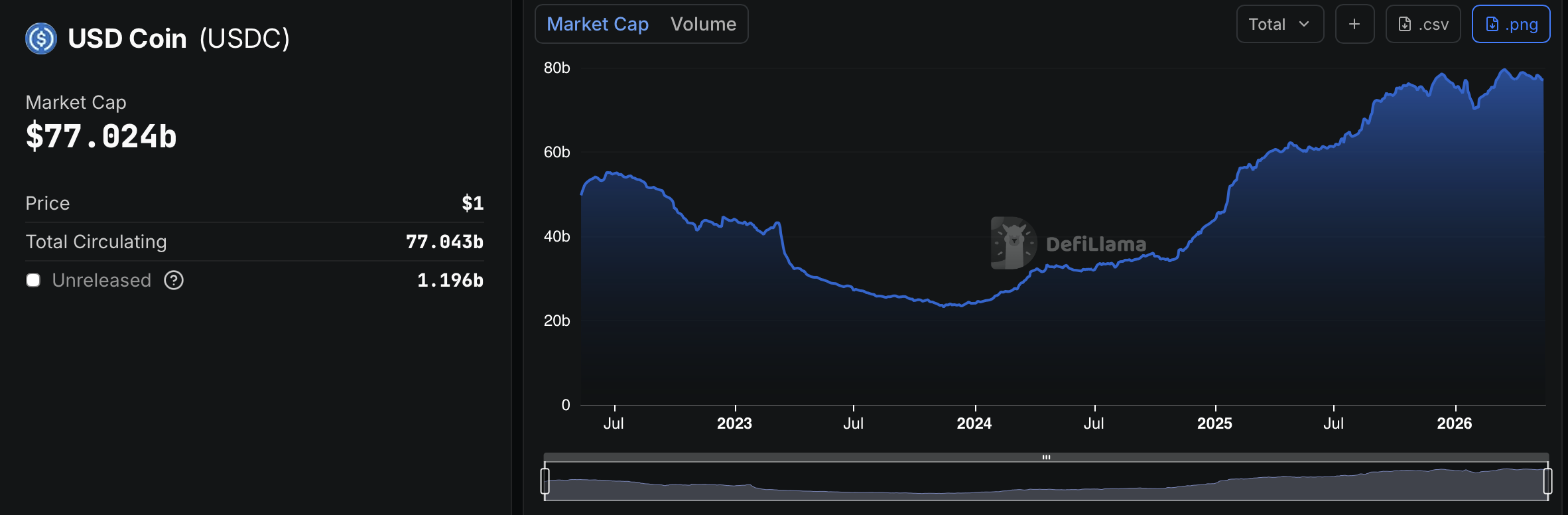
Source: DefiLlama
Related: Trump filing discloses Coinbase, Strategy crypto-linked exposure in Q1
Stablecoin infrastructure providers expand white-label issuance services
The launch comes as stablecoin issuers and crypto infrastructure providers increasingly offer white-label services that allow businesses to launch branded digital dollar products without managing their own blockchain infrastructure or reserves.
In September 2025, Stripe launched Open Issuance, a platform that allows businesses to create and manage their own stablecoins through its Bridge unit. Stripe said the system allows companies to control minting, branding and reserve economics while connecting to shared liquidity infrastructure.
In May, Western Union launched its Solana-based USDPT stablecoin, with issuance handled by Anchorage Digital and wallet and settlement infrastructure provided by Fireblocks. The company said the token would support blockchain-based settlement and cross-border payment services across parts of its remittance network.
Earlier examples include Binance’s BUSD stablecoin, launched in 2019, and PayPal USD, launched in 2023, both of which were issued by Paxos.
Crypto infrastructure companies have also expanded into stablecoin issuance, payments and settlement infrastructure in recent months. Earlier this month, Bakkt completed its acquisition of stablecoin infrastructure firm Distributed Technologies Research as part of its push to build a 24/7 digital settlement layer powered by stablecoin and AI payment technology.
The stablecoin market capitalization has climbed to roughly $323 billion from about $244 billion a year ago, an increase of nearly 32%, according to DefiLlama data.
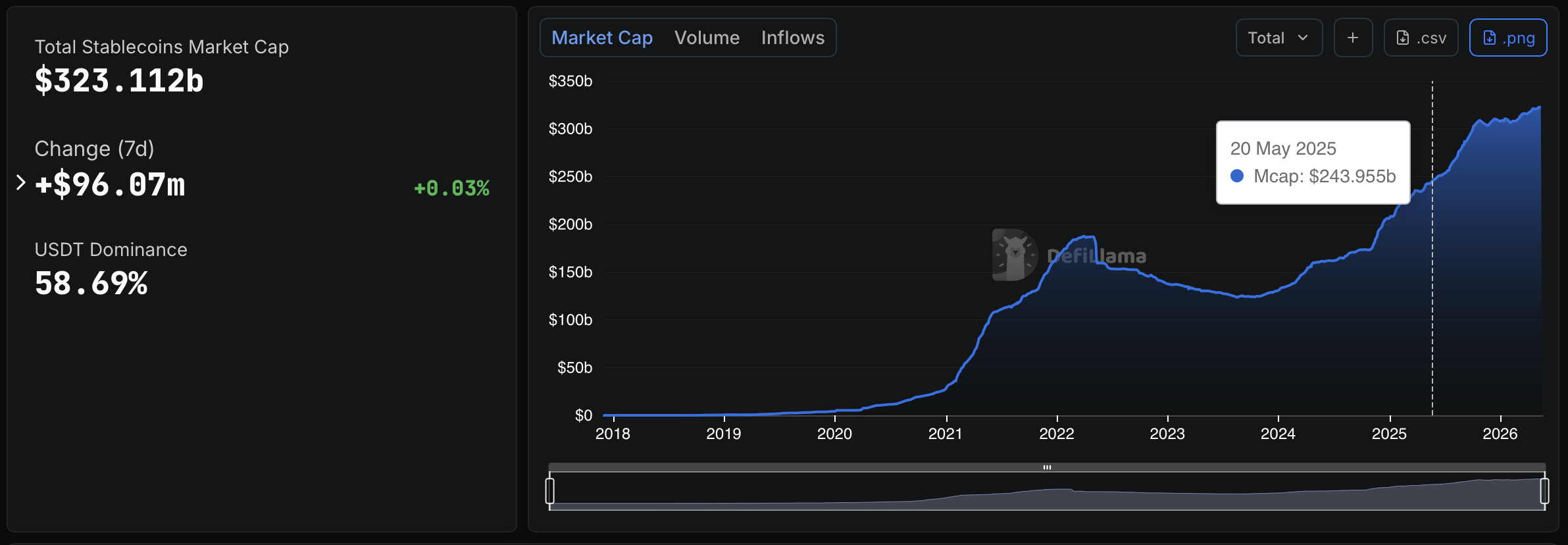
Source: DefiLlama
Magazine: eToro founder timed Bitcoin top perfectly due to belief in 4 year cycles
Crypto World
XRP Exchange Flow Shifts as Bybit Deposit Wave Ends, Binance and Coinbase Turn Negative

TLDR:
- Bybit’s XRP transaction delta returned close to zero around May 16, ending a month-long deposit trend.
- Sustained deposit activity on Bybit from mid-April to mid-May signaled potential sell-side pressure.
- Binance and Coinbase have shifted back to negative delta, meaning withdrawals now outpace deposits.
- The metric tracks transaction count, not token volume, offering a directional but partial market view.
XRP exchange-flow behavior is showing a notable shift across major trading venues. After weeks of persistent deposit activity on Bybit, the platform’s transaction delta returned close to zero around May 16.
Meanwhile, Binance and Coinbase have moved back into negative territory. This change reflects a clear rotation in exchange behavior, suggesting that the broad selling pressure seen during the mid-April to mid-May period has cooled considerably.
Bybit’s Month-Long Deposit Trend Comes to a Halt
XRP deposit activity on Bybit remained consistently elevated from mid-April through mid-May. During that stretch, the exchange recorded strong and persistent positive readings in its transaction delta.
Sustained deposit-side activity is often associated with potential sell-side pressure in crypto markets. Coins moving into exchanges are typically more available for trading or liquidation.
The shift became apparent around May 16, when Bybit’s delta returned near zero. That move marked a clear break from the previous pattern of heavy deposit imbalance.
On a transaction-count basis, the deposit pressure that defined the prior period has now faded. This change removes one of the more visible sources of supply-side activity in recent weeks.
Crypto analyst Amr Taha shared the observation based on the XRP Multi-Exchange Daily Depositing/Withdrawing Transactions Delta. The data tracks transaction counts rather than total token volume.
So it does not confirm exact amounts of XRP moved in or out. However, the directional shift across multiple venues remains a notable development.
The end of Bybit’s deposit wave does not guarantee a price move in either direction. Rather, it removes a layer of exchange-side pressure that was present for roughly a month.
Traders watching supply dynamics will likely monitor whether this neutral reading holds or reverses in the coming sessions.
Binance and Coinbase Withdrawal Activity Points to a Different Flow Structure
As Bybit’s deposit activity cooled, Binance and Coinbase moved back into negative delta territory. Negative readings indicate that withdrawal transactions are now outweighing deposit transactions on those platforms.
This is a different flow structure compared to what was seen during the Bybit-led deposit phase. The shift suggests coins are moving away from those exchanges rather than toward them.
Withdrawal-side behavior on major exchanges like Binance and Coinbase can reflect reduced near-term selling intent. When more tokens leave an exchange than enter, available supply on that platform tends to tighten.
That dynamic, when sustained, can shift the balance between buyers and sellers over time. However, short-term readings should be interpreted carefully without additional context.
The combination of Bybit cooling and Binance and Coinbase turning negative creates a different setup for XRP. The market is no longer showing the same broad exchange-deposit pressure from the prior period.
Instead, a rotation in flow behavior is now visible across major venues. This metric tracks transaction direction, making it a useful but partial view of overall market activity.

TLDR:
- Binance recorded a $1.2 billion stablecoin outflow, with $1 billion of that total consisting solely of USDT.
- The withdrawal follows a recent Bitcoin sell-off, pointing to either short capitulation or spot profit realization.
- Weekend low-liquidity conditions raise the risk of stop-hunts and leveraged liquidations around the $77,600 zone.
- Reduced stablecoin reserves on Binance limit near-term buying pressure, making sustained upward momentum unlikely soon.
Bitcoin is trading around the $77,600 level as a $1.2 billion stablecoin outflow exits Binance. Of that total, $1 billion consists of USDT alone.
The movement follows a recent downward price wave. Stablecoin flows on derivative-heavy exchanges like Binance are closely watched by traders. They often signal what major market participants are planning next.
What the $1 Billion USDT Withdrawal Reveals About Market Sentiment
Stablecoin flows on exchanges act as leading indicators for price movement. When stablecoins leave exchanges, it often means traders are pulling capital rather than preparing to deploy it.
That shift in behavior tells a story about current market confidence. The timing here, coming after a sell-off, makes it worth examining closely.
Two scenarios stand out as the most probable explanations for this outflow. The first is short capitulation, where bearish derivative traders close profitable positions and withdraw proceeds.
The second is spot profit realization, where investors who recently sold Bitcoin are moving their USDT to cold storage or external wallets. Both scenarios point toward reduced near-term buying pressure on Binance.
Analyst BorisD flagged the move noting that stablecoin inflows near resistance zones typically prepare the ground for short positions or profit-taking.
Meanwhile, inflows near market bottoms tend to support upward price action. The current outflow does not fit either of those setups cleanly, which adds to the uncertainty.
This ambiguity is what makes the $1 billion USDT exit particularly notable. Rather than a clear directional bet, it reads more as a withdrawal of capital from the field entirely. That kind of behavior tends to precede consolidation phases rather than sharp moves in either direction.
Weekend Price Action Could Bring Liquidity Sweeps on Both Sides
With the weekend approaching, lower liquidity conditions are expected across crypto markets. Thinner order books make it easier for large players to push price through key levels temporarily.
That environment often produces stop-hunts on both long and short positions. Traders holding leveraged exposure should factor this in.
Consolidation around the $77,600 zone is the most likely short-term outcome. The market needs time to rebuild liquidity pools after the recent wave of selling.
Sideways price action, punctuated by sharp spikes in either direction, fits this pattern well. Neither bulls nor bears currently hold a decisive edge at this level.
Leveraged traders face the highest risk during this kind of environment. A brief wick above or below a key level can trigger cascading liquidations before price returns to range.
Managing position size and stop placement becomes more important than direction calls during consolidation. The data from Binance supports a cautious stance for now.
As Bitcoin holds at $77,600, the market appears to be in a wait-and-see mode. The $1.2 billion stablecoin outflow has removed a layer of potential buying fuel from Binance.
Until fresh capital re-enters the exchange, sustained directional momentum remains unlikely. Traders are advised to monitor stablecoin flow data closely over the coming sessions.


Ripple CLO Stuart Alderoty says the Clarity Act could unlock a multi-trillion dollar US crypto market.
Summary
- The Senate Banking Committee advanced the Clarity Act 15-9 on May 14, with two Senate Democrats voting yes despite Elizabeth Warren’s opposition.
- Ripple CLO Stuart Alderoty called it a “monumental outcome” and cited 67 million American crypto holders as the constituency the bill protects.
- The bill still needs 60 Senate floor votes, two committee reconciliations and Trump’s signature before it becomes law.
The Senate Banking Committee advanced the Clarity Act 15-9 on May 14, a bipartisan result that lifts the Digital Asset Market Clarity Act toward a full Senate floor vote.
“The Clarity Act isn’t about protecting an industry. It’s about protecting everyday Americans who deserve clear rules when they participate in the multi-trillion dollar crypto economy. 67 million Americans already hold crypto. The data is in. It’s time,” Ripple CLO Stuart Alderoty said in a post.
What the Clarity Act would actually do
The bill would establish which regulator — the SEC or the CFTC — has jurisdiction over specific digital assets, ending the enforcement-by-ambiguity approach that has defined US crypto oversight since 2017. Crypto.news explored why the legislation matters more to XRP than to almost any other asset.
The Clarity Act would formally classify named tokens including XRP as digital commodities, removing legal uncertainty that has kept institutional capital on the sidelines. Analysts at Standard Chartered estimate the bill could unlock $4 to $8 billion in additional XRP ETF inflows alone.
Why this bipartisan vote matters
The 15-9 result marks the first time a comprehensive crypto market structure bill has cleared the Senate Banking Committee with cross-party support. Every Republican voted yes, alongside two Senate Democrats despite opposition from Elizabeth Warren.
Despite the momentum, the bill still needs 60 floor votes to clear a filibuster. It then faces reconciliation between the Banking and Agriculture Committee versions before alignment with the House text from July 2025.
What still has to happen before it becomes law
Crypto.news has tracked Ripple CEO Brad Garlinghouse warning the bill’s chances drop sharply if lawmakers fail to act before campaign season. Senators Lummis and Moreno have both warned that failure in 2026 means the next window is 2030.
The XRP price page tracks market reaction against that legislative backdrop in real time.
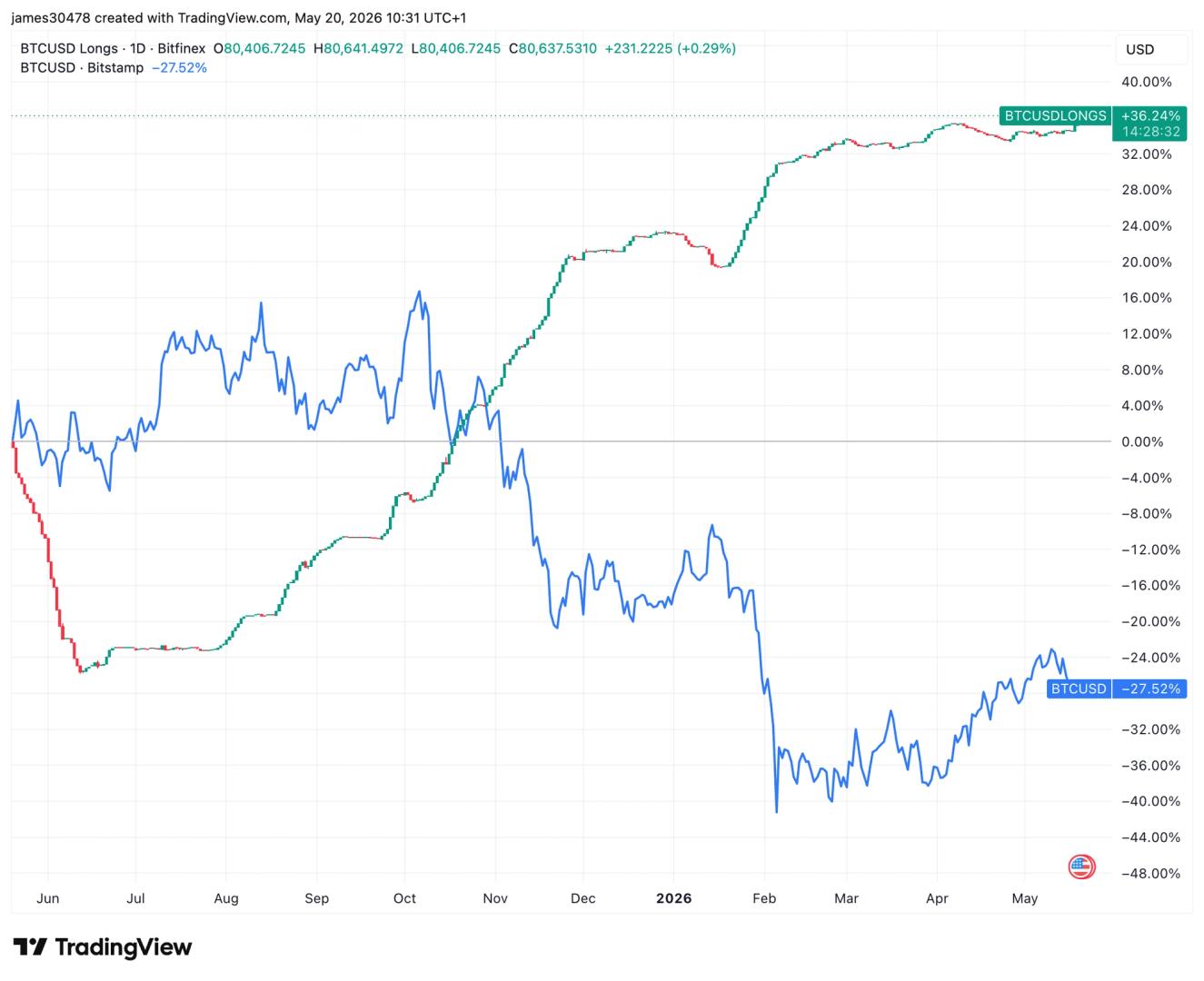
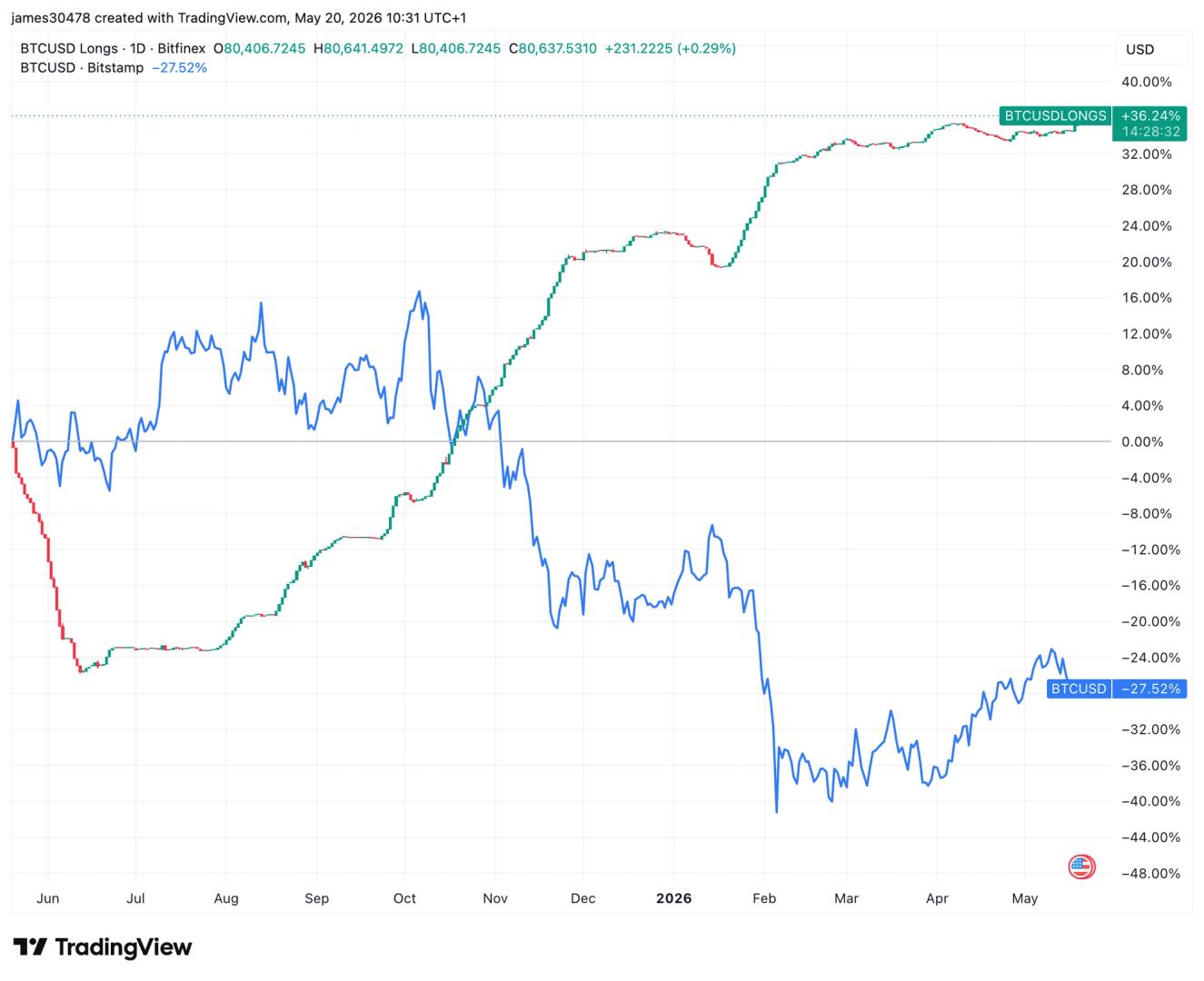
Bitcoin has now declined for five consecutive trading days between May 15 and May 19, marking its second longest losing streak of the year and trying to put in its first daily green candle in six days.
The latest pullback has seen bitcoin slide from above $80,000 to roughly $76,000 in light of broader market weakness.
During the downturn, leveraged traders on Bitfinex continue to add exposure. Data from the TradingView shows bitcoin margin longs, positions opened using borrowed funds, have risen to 80,636 BTC, up roughly 1.5% over the past several days and now sitting at their highest level in two and a half years. The last time longs were this elevated was in December 2023, when bitcoin traded near $43,000.
According to TradingView data, Bitfinex margin longs have climbed around 10% since the start of the year, even as bitcoin itself has fallen 13%. The divergence underscores continued accumulation from large traders despite BTC remaining nearly 35% below its October all-time high of $126,000.
Historically, the so-called “Bitfinex whale” has often acted as a contrarian signal. Over the past five years, large leveraged long positions on the exchange have frequently expanded during periods of market weakness and capitulation, while being reduced closer to local market tops and trend reversals.
Bitcoin is now approaching a key technical zone. The asset is currently testing both the True Market Mean, an onchain valuation metric representing the market’s aggregate cost basis, and the short-term holder realized price, which tracks the average acquisition price of recent buyers over the past 155 days, near $78,000, just above the current spot price. Above that, the 200-day moving average sits just over $81,000, representing another major resistance level for bulls to reclaim.
Crypto World
BTC price tops $77,000. Analysts weigh in on whether the bounce has legs.: Crypto Daily
This is an excerpt from CoinDesk newsletter ‘Daybook.’ Sign up here, if you haven’t already.
Bitcoin has bounced to over $77,000, triggering a broader market recovery that has lifted both the CoinDesk 20 (CD20) and CoinDesk 80 (CD80) indexes by more than 1% since midnight UTC. Some coins, such as privacy-focused Dash and XDC Network’s XDC token, have gained 10% over the past 24 hours.
Some analysts continue to maintain a cautious stance, saying the market is caught between positive regulatory tailwinds and macro headwinds.
“Short-term action is pressured by [ETF] outflows and macro caution, while long-term positioning is supported by regulation, institutional access and reserve-asset narratives,” Naeem Aslam, a former hedge fund trader and the chief investment officer at Zaye Capital Markets, told CoinDesk in an email.
Aslam hailed President Donald Trump’s directive to the government and the Federal Reserve to review payment-system access for fintech and crypto firms as supportive of digital assets.
Alex Kuptsikevich, the chief market analyst at FxPro, said bitcoin’s latest bounce from the 50-day simple moving average is setting the stage for a decisive move in the next couple of days.
“Bitcoin, as of the end of last month, found support on dips to the $76K region,” Kuptsikevich said in an email. “Over the last couple of days, this support has been reinforced by the 50-day MA, as has the market. On the other hand, resistance at the 200-day MA continues to decline, bringing the bulls’ and bears’ red lines closer together and marking the moment when the market will choose its trend for the coming months.”
A market update from the financial technology and digital asset platform 1Konto placed the onus for sustained recovery on ETF inflows.
“ETF flows have become one of the cleanest transmission channels between traditional portfolios and Bitcoin spot demand. If those flows turn negative at the same time the long end sells off, Bitcoin trades more like macro collateral than a standalone scarcity asset,” the firm said in its daily market update.
We think Bitcoin can still stabilize before broader risk assets, but the next durable move higher likely needs either a calmer Treasury market or clear evidence that ETF demand is rebuilding,” the firm said in its daily market update,” it added.
In traditional markets, futures tied to the Nasdaq 100 index rose 0.8%, and oil dropped as the Senate moved to curb Trump’s ability to wage war against Iran. Investors are also looking to Nvidia’s earnings later Wednesday. Stay alert.
Read more: For analysis of today’s activity in altcoins and derivatives, see Crypto Markets Today . For a comprehensive list of events this week, see CoinDesk’s “Crypto Week Ahead.”
What’s trending
Today’s signal

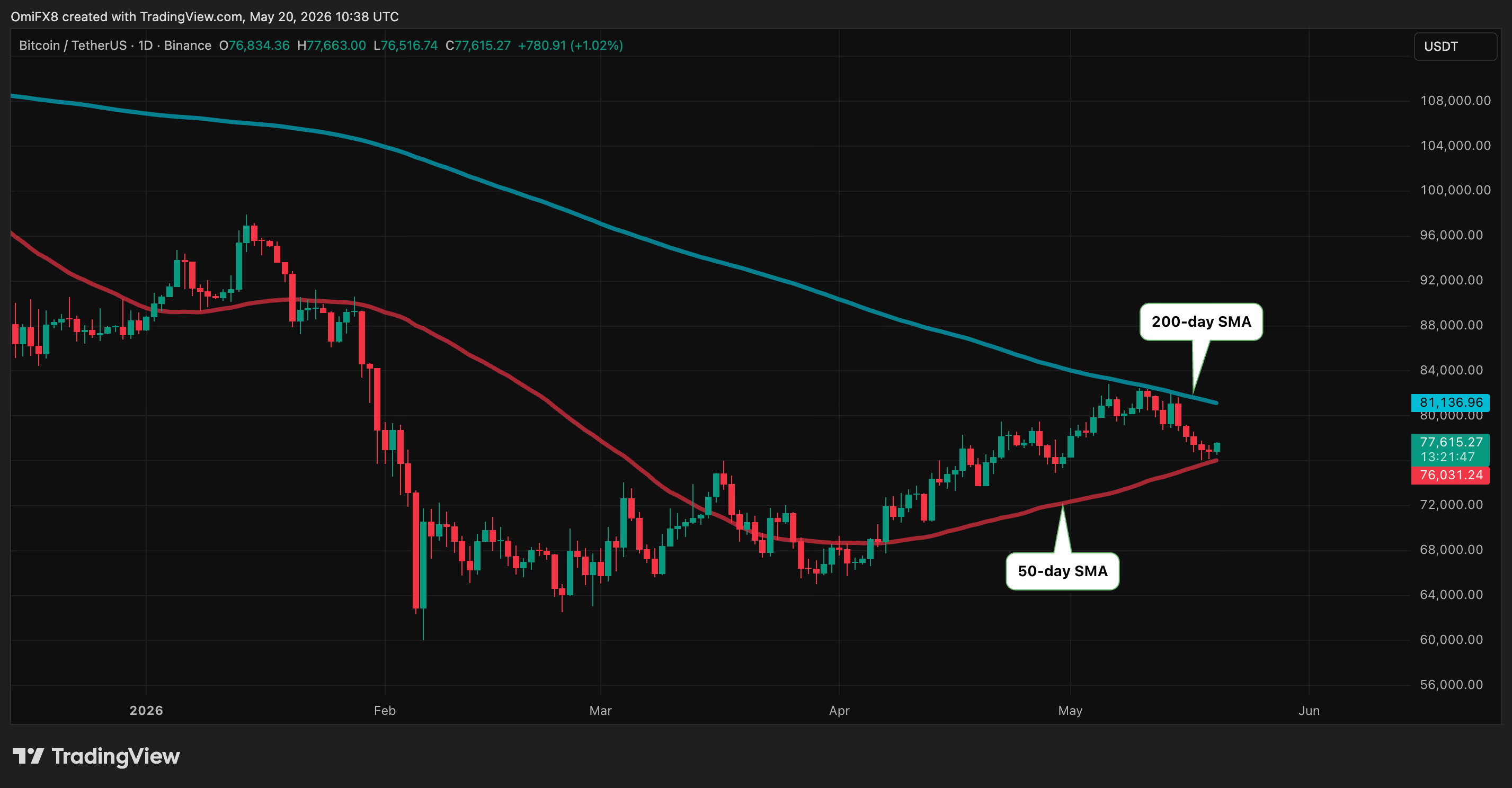
Bitcoin’s five-day losing streak has run out of steam with prices nearly testing the 50-day simple moving average (SMA) late Tuesday.
Since then, BTC has bounced back above $77,000. The setup is pretty simple: Prices are stuck between the 50-day SMA support and the 200-day SMA resistance.
The two averages are converging, with the 200-day SMA declining and the 50-day measure rising, narrowing the range and building pressure for a decisive move in either direction in the days ahead.
A break below the 50-day SMA near $76,000 would likely signal that the bounce has failed and open the door to a retest of the February lows near $73,000. On the other hand, a sustained close above the 200-day SMA near $82,500 would be a meaningful technical development, potentially drawing in sidelined buyers and shifting the broader trend from bearish to neutral at minimum.
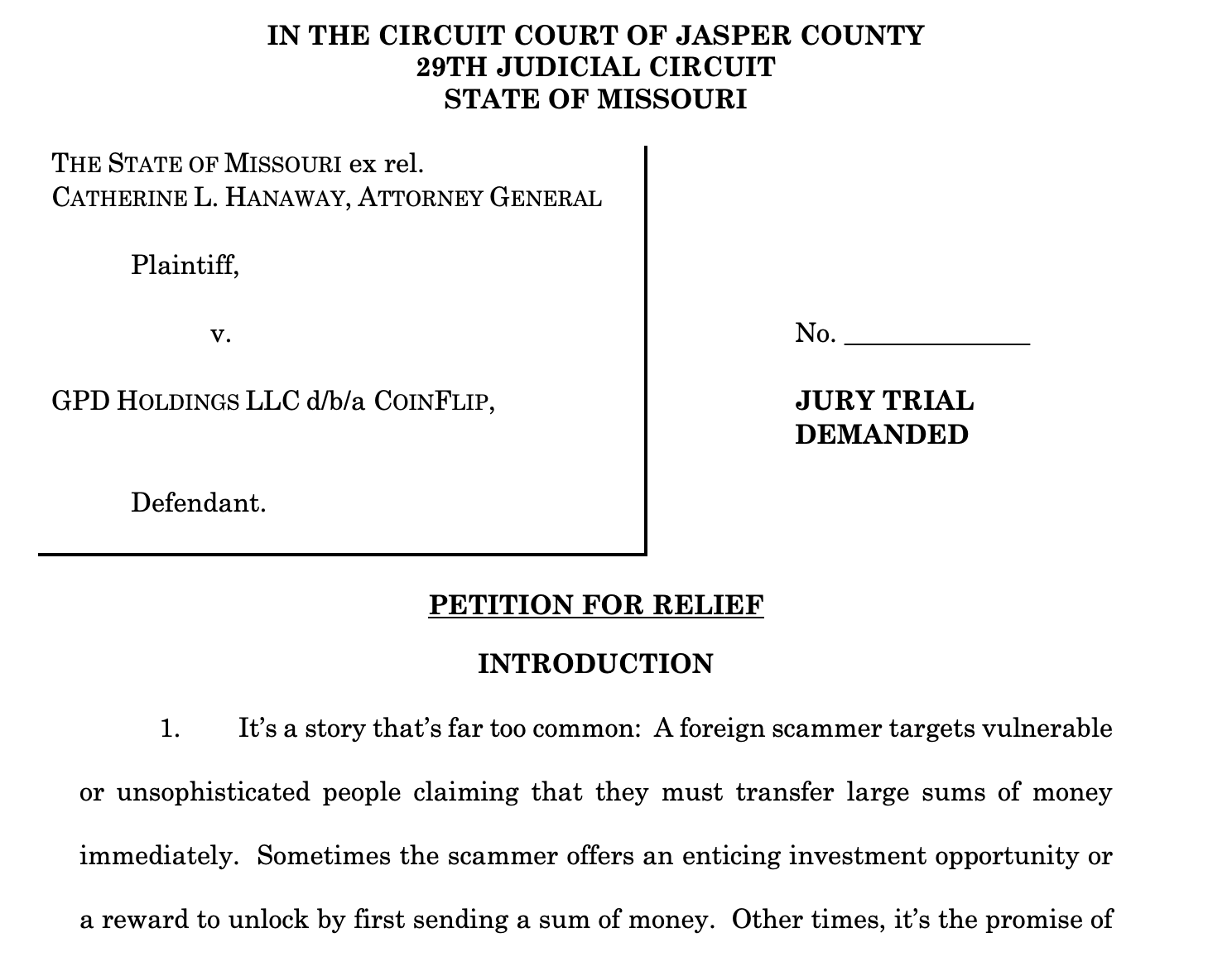
Missouri is suing the company behind cryptocurrency ATM operator CoinFlip for “knowingly facilitating fraudulent transactions and profiting from them,” in the latest move by a US state authority targeting digital currency kiosks and ATMs.
In a Wednesday notice, the office of Missouri Attorney General Catherine Hanaway said the lawsuit against GPD Holdings, doing business as CoinFlip, was in response to incidents of fraud, including against the state’s “seniors and veterans.” The state began a probe in December into several crypto ATM companies, including Bitcoin Depot, which recently filed for bankruptcy.
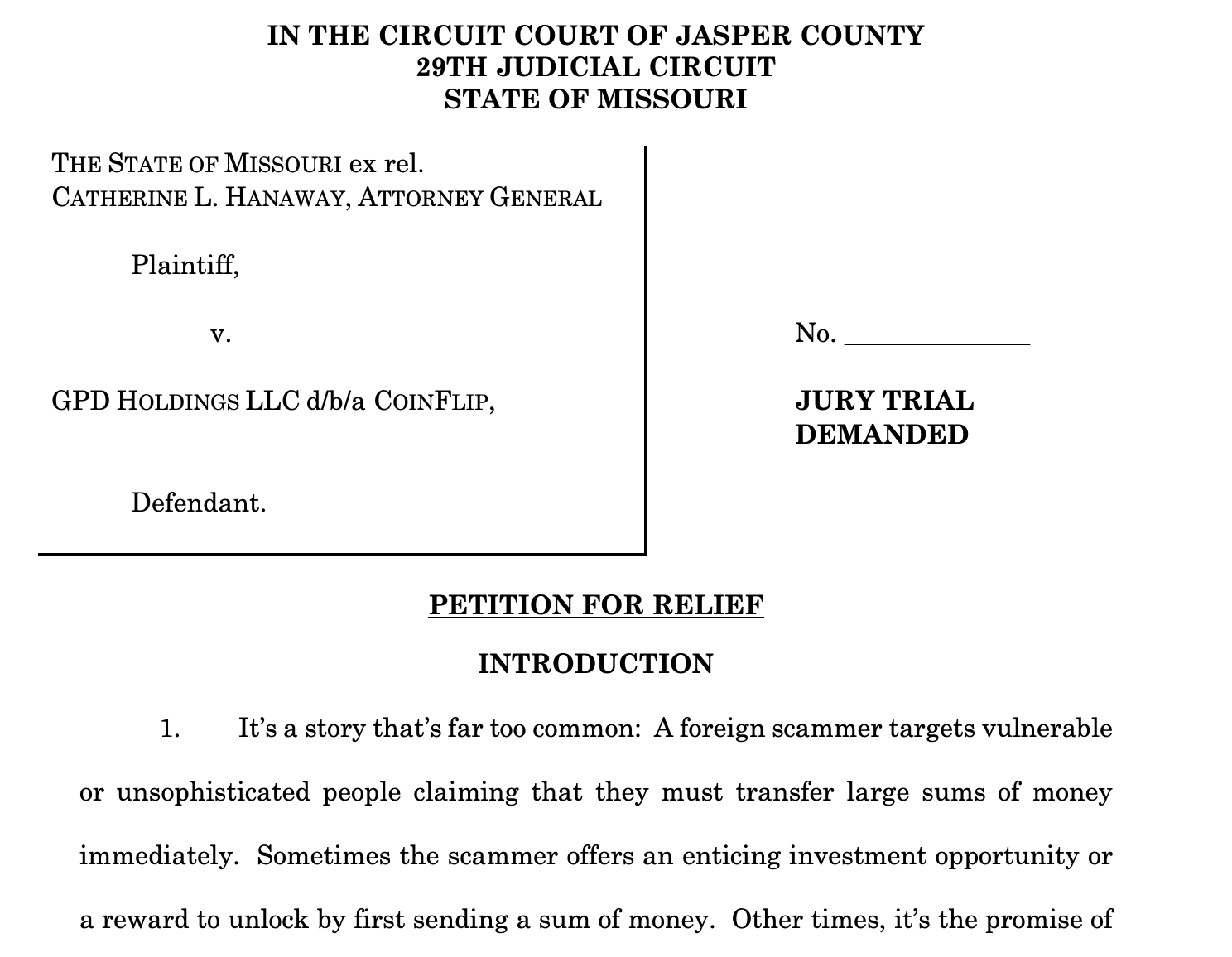
Missouri lawsuit against CoinFlip. Source: Missouri AG
“The Attorney General’s Office is asking the Court to declare that CoinFlip’s practices violate the Missouri Merchandising Practices Act; to enjoin CoinFlip from operating in Missouri; to impose civil penalties of $1,000 per violation over the past five years (up to $1,826,000); and to award restitution to consumers,” said the AG’s office.
According to CoinFlip’s website, the company operates 136 crypto kiosks in Missouri, and 4,229 in the US.
In recent months, ATM operators like Bitcoin Depot, CoinFlip and others have been repeatedly targeted by US state authorities and municipalities which have passed laws and ordinances restricting or outright banning the technology.
Related: Minnesota to weigh ban on crypto kiosks after scam reports

Warning about fraud from May 2025. Source: CoinFlip
Cointelegraph reached out to CoinFlip for comment on the lawsuit but did not receive an immediate response.
Bitcoin Depot warned of lawsuits and regulations before filing for bankruptcy
In a May 12 filing with the US Securities and Exchange Commission, crypto ATM operator Bitcoin Depot said “substantial doubt exists about the Company’s ability to continue as a going concern.” The concerns over paying more than $20 in legal judgments in the fourth quarter of 2025 and “ongoing litigation matters” came just a few days before Bitcoin Depot filed for voluntary Chapter 11 proceedings in Texas.
Bitcoin Depot was one of the largest crypto ATM operators in North America, responsible for more than 9,000 kiosks globally.
Magazine: 5 tech predictions the mainstream media got horribly wrong
Crypto World
NVIDIA Q1 FY2027 Revenue Hits Record $81.6 Billion as AI Infrastructure Demand Accelerates
TLDR:
- NVIDIA Q1 FY2027 revenue reached a record $81.6 billion, rising 85% year-over-year and 20% sequentially.
- Data Center revenue surged 92% annually to $75.2 billion, with networking revenue climbing 199% year-over-year.
- NVIDIA raised its quarterly dividend from $0.01 to $0.25 per share and approved an $80 billion buyback program.
- Q2 FY2027 revenue guidance stands at $91 billion, excluding all Data Center compute revenue sourced from China.
NVIDIA reported record first-quarter fiscal 2027 revenue of $81.6 billion, marking an 85% year-over-year increase. Data Center revenue reached $75.2 billion, up 92% annually.
The company also guided Q2 revenue to $91 billion. Non-GAAP diluted EPS climbed 140% to $1.87. Operating cash flow hit $50.3 billion, while free cash flow totaled $48.6 billion during the quarter.
Record Revenue Driven by AI Infrastructure Demand
NVIDIA’s Q1 FY2027 results reflect growing demand for AI computing infrastructure worldwide. Revenue rose 20% sequentially from $68.1 billion in Q4 FY2026. The company’s GAAP gross margin stood at 74.9%, up 14.4 percentage points year-over-year.
Data Center compute revenue alone reached $60.4 billion, rising 77% from a year ago. Networking revenue within the segment hit $14.8 billion, up 199% annually. These numbers show strong adoption of NVIDIA’s Blackwell GPU platform across hyperscale clients.
Jensen Huang, NVIDIA’s founder and CEO, described the moment as a turning point for global infrastructure. He stated that “the buildout of AI factories — the largest infrastructure expansion in human history — is accelerating at extraordinary speed.” Huang further noted that agentic AI is now doing productive work and generating real value across industries.
NVIDIA returned approximately $20 billion to shareholders through buybacks and dividends during Q1. The Board also approved an additional $80 billion share repurchase authorization on May 18, 2026, with no expiration date.
Huang added that NVIDIA is “uniquely positioned at the center of this transformation” as the only platform running across every major cloud.
Dividend Increase and Shareholder Returns Signal Confidence
NVIDIA raised its quarterly cash dividend from $0.01 per share to $0.25 per share. The dividend will be paid on June 26, 2026, to shareholders of record as of June 4, 2026. This marks a notable shift in NVIDIA’s capital return strategy.
As of Q1’s close, the company had $38.5 billion remaining under its prior share repurchase authorization. The new $80 billion addition further strengthens NVIDIA’s buyback capacity. Together, these moves reflect management’s confidence in sustained earnings growth.
GAAP net income for the quarter came in at $58.3 billion, up 211% year-over-year. Non-GAAP net income reached $45.5 billion, rising 139% from the same period last year. Both figures point to strong profitability alongside revenue growth.
GAAP diluted EPS of $2.39 compares to $0.76 in Q1 FY2026, a 214% increase. Non-GAAP diluted EPS of $1.87 reflects a 140% annual gain.
Huang noted that NVIDIA’s platform “runs in every cloud, powers every frontier and open source model, and scales everywhere AI is produced.”
Q2 Outlook and Structural Reporting Changes
NVIDIA guided Q2 FY2027 revenue at approximately $91 billion, plus or minus 2%. The company stated that this outlook excludes any Data Center compute revenue from China. GAAP and non-GAAP gross margins are expected to remain near 74.9% and 75.0%, respectively.
Operating expenses for Q2 are projected at around $8.5 billion on a GAAP basis and $8.3 billion non-GAAP. For the full fiscal year 2027, NVIDIA expects tax rates of 16% to 18%, excluding discrete items. These projections reflect continued investment in research and operations.
NVIDIA also announced a new reporting framework splitting its business into Data Center and Edge Computing platforms. Within Data Center, it will now report Hyperscale and ACIE sub-markets separately. Edge Computing will cover PCs, game consoles, robotics, and automotive devices.
Edge Computing revenue for Q1 reached $6.4 billion, up 29% year-over-year and 10% sequentially. New partnerships with Hyundai, Kia, BYD, and Uber support growth in autonomous driving. Expanded collaborations with Google Cloud and Marvell also continue to broaden NVIDIA’s ecosystem reach.


The U.K.’s ambitions to become a dominant global digital asset hub is running into a wall of political inertia and regulatory gridlock, Jonny Fry, a blockchain and global banking researcher, founder of Digital Bites and CEO at TeamBlockchain Ltd., told CoinDesk.
Despite outward assurances of progress from the Financial Conduct Authority (FCA), industry insiders suggest that nagging bureaucratic barriers and legislative friction behind closed doors are severely delaying the implementation of a unified crypto framework. The slow progress is creating rising concern that Britain is conceding critical economic ground to regimes in Washington and Brussels.
Fry said the U.K. should worry over other more critical issues. “The real risk is not that firms physically leave Britain,” he said. “The risk is that the next generation of digital asset infrastructure is built somewhere else.”
The concern on the floor of the Digital Money Summit 2026 in London reflects a deep-seated institutional divide. While the private sector demands swift execution to unlock massive market efficiencies, a web of divided remits between HM Treasury, the Bank of England and the FCA has severely fractured the payment and investment perimeters.
“We have a situation at the moment whereby the Treasury is looking to set the law, and then we’re having the FCA looking to have publicly-issued stablecoins and a Bank of England-issued digital pound,” Fry noted.
He warned that this fragmented approach creates deep operational uncertainty, complicating how the jurisdiction handles the “singleness of money” across tokenized deposits and digital assets.
This administrative friction has pushed several high-profile digital asset firms to abandon the U.K. entirely, choosing to relocate to jurisdictions with immediate regulatory clarity. Fry cited the crypto derivatives exchange Deribit as a prime example.
“Had we had the regulatory clarity that staking your crypto was not a collective investment scheme, maybe Deribit would have relocated here in the U.K.,” Fry said, estimating that the missed opportunity cost the U.K. government hundreds of millions in tax revenues following Coinbase’s acquisition of the platform.
Andrew MacKenzie, CEO of sterling stablecoin developer Agant, told CoinDesk in February he believed that regulations were moving in the right direction, but were moving too slowly to support its global digital asset hub ambitions.
The Bank of England’s cautious, slow approach to crypto is heavily frustrating the private sector, a Financial Times article stated last week, It added that while businesses are pushing for fast integration, the central bank’s tight restrictions on stablecoins have created a massive regulatory bottleneck.
The FCA, caught between Downing Street’s political priorities and the Bank of England’s watchfulness on monetary stability, has preferred to emphasize its controlled testing environments rather than publicly vent its operational frustrations.
Matthew Long, Director of Payments and Digital Assets at the FCA, took a more positive approach to the pace at which regulations are being adopted, presenting the timeline as a calculated, modular rollout designed to build a bulletproof regime.
“So I think we’ve delivered a comprehensive regime that’s open for business right now. We’re encouraging firms to apply,” he told CoinDesk. “We’ve got our pre-application support service available, so what I’m saying to firms is it’s open for business.”
However, if U.K. regulators do not move with genuine market agility, liquidity will inevitably default to where capital is most fluid, Fry warned. Without a competitive digital pound alternative, private operators will simply settle transactions using dominant U.S. dollar-backed stablecoins.
“We’ll end up seeing dollarisation,” Fry warned.
U.K. regulations are set to come into effect in October 2027.


Bitcoin quantum exposure covers 1.92 million BTC, or 9.6% of total supply, Glassnode warned in a new report.
Summary
- Glassnode classified 1.92 million BTC as structurally exposed to a quantum breakthrough because their output types reveal public keys by design.
- Satoshi Nakamoto’s coins represent about 1.1 million BTC of the structural risk, with another 620,000 BTC in other early Satoshi-era outputs.
- A broader 4.12 million BTC, or 20.6% of supply, is operationally exposed due to address reuse and key management practices at exchanges.
Blockchain analytics firm Glassnode published a full analysis on May 20 classifying 1.92 million BTC, or 9.6% of total supply, as structurally exposed to a future quantum computing breakthrough.
The structural category covers outputs whose design reveals the public key regardless of address management. The three types at risk are Satoshi-era Pay-to-Public-Key outputs, legacy multisig structures and Pay-to-Taproot outputs.
Glassnode breaks down Bitcoin’s quantum exposure by address type
Glassnode classified 4.12 million BTC, or 20.6% of supply, as operationally exposed due to address reuse and poor key management. This is more than twice the structurally unsafe supply.
Exchange-held Bitcoin accounts for a disproportionate share. About 1.66 million BTC on exchanges, 8.3% of total supply, falls into the exposed category. Binance shows 85% exposed balances while Coinbase’s labeled balances sit at just 5% exposed.
What the structural versus operational split means for holders
Glassnode said the exposure could be reduced through better address standards and user behavior. BIP-360 proposes a quantum-resistant Pay-to-Merkle-Root output type offering a voluntary migration path for affected holders.
Crypto.news has covered the full quantum threat timeline, including the estimated 2,330 logical qubits needed to break Bitcoin’s elliptic curve cryptography.
What exchanges and custodians should do now
Glassnode advised exchanges and custodians to reduce key reuse, improve address hygiene and plan migration to quantum-proof formats before any breakthrough occurs. The firm stressed the risk is structural but not yet active.
Citi’s analysis, as crypto.news reported, found a quantum attack on major financial institutions could put $2 to $3.3 trillion of GDP at risk. The Bitcoin price page tracks how markets are pricing these long-term security concerns alongside current price action.

IPL 2026 Playoffs Scenario After KKR Beat MI: Fight For One Spot Gets More Intense

Fewer Drivers In This State Are Wearing Seatbelts

Bitcoin GOLD About To Breakout? What Charts Reveal Right Now | 20 May | Bitcoin Live Trading


-

 Crypto World5 days ago
BloFin War of Whales 2026 Grand Prix opens registration for $5M trading championship
-

 Fashion5 days ago
Weekend Open Thread: Theory – Corporette.com
-

 Crypto World5 days ago
E-Estate Announces 1 Year Live: Washington DC Summit as Real Estate Tokenization Enters Its Next Phase
-

 Tech6 days ago
Tech Moves: Microsoft AI leader jumps to OpenAI; former AI2 exec joins Meta; and more
-

 Tech5 days ago
Google reimburses Register sources who were victims of API fraud
-
 Crypto World6 days ago
Google’s Gemini AI Predicts Incredible Solana Price by the End of 2026
-

 Business5 days ago
H&R Real Estate Investment Trust (HR.UN:CA) Q1 2026 Earnings Call Transcript
-
 Entertainment6 days ago
Zara Larsson Has Blunt Response To Chris Brown Diss
-

 Sports5 days ago
Napoleonic enters 2026 Doomben 10,000 field via Abounding withdrawal
-

 Crypto World5 days ago
BeInCrypto 100 Institutional Awards Nomination: KAST for Best Digital Assets Neobank and Best Digital Assets Fintech
-
 Crypto World5 days ago
Bitcoin Battles US Bond Nerves With BTC Price Dip Toward New May Lows
-

 Fashion4 days ago
On the Scene at Gucci’s Cruise Show in New York City: Mariah Carey, Kim Kardashian, Lindsay Lohan, Iman, and More!
-
 Crypto World5 days ago
Wall Street’s Boldest Gold Prediction Has Russians Rushing to Buy
-

 Crypto World5 days ago
ICE and CME urge US regulators to curb Hyperliquid energy trading
-

 Fashion5 days ago
Trending Western Style Vests Perfect for Summer
-

 Politics6 days ago
DWP PIP Timms review continues to be an absolute farce
-

 Entertainment5 days ago
David Letterman Returns to Late Show, Blasts Cancellation
-

 Crypto World5 days ago
IREN closes $3 billion convertible notes deal amid AI infrastructure expansion
-
Crypto World6 days ago
Lido Finance Selects Chainlink CCIP as the Official Cross-Chain Infrastructure for wstETH Security
-

 Fashion4 days ago
Amazon Sundays: Memorial Day Hosting
You must be logged in to post a comment Login