

Crypto World
DOG Mode opens a new front in Bitcoin’s governance fight



Bitcoin Ordinals advocate Leonidas has introduced DOG Mode, an alternative open-source Bitcoin client that changes how nodes relay certain valid transactions without altering Bitcoin’s consensus rules.
Summary
- DOG Mode removes default relay limits while keeping Bitcoin’s existing consensus rules completely unchanged today.
- Leonidas says fee-paying users should access block space without Bitcoin Core deciding transaction purposes beforehand.
- BIP 110 takes opposite approach, proposing temporary consensus restrictions on several data-heavy Bitcoin transaction types.
The project adds a new layer to the dispute over Ordinals, Runes and the use of Bitcoin block space.
In his DOG Mode announcement, Leonidas argued that Bitcoin Core and Bitcoin Knots enforce policy restrictions that Bitcoin’s consensus rules do not require. He said a transaction can remain valid under consensus while default nodes still refuse to relay it across the peer-to-peer network.
DOG Mode targets relay policy, not Bitcoin consensus
DOG Mode would raise the maximum individual transaction size allowed under its relay policy to 3.9 million weight units. Bitcoin Core’s default policy currently limits individual standard transactions to 400,000 weight units. The client would also lower the dust threshold to one satoshi for small transaction outputs.
As reported by crypto.news, DOG Mode does not require a Bitcoin fork because it works within existing consensus rules. Nodes can choose to run the software and relay transactions that other clients may treat as non-standard, while miners still decide which valid transactions they include in blocks.
Ordinals and Runes return to the governance debate
The proposal centers on a long-running dispute over whether Bitcoin should treat every valid, fee-paying transaction equally. Leonidas supports a market-based model in which users compete for block space through fees rather than software developers deciding which transaction structures should receive default relay support.
DOG Mode could make it easier to propagate large Ordinals inscriptions and small outputs used by some Bitcoin-native token protocols. However, different relay policies could also leave nodes with different views of unconfirmed transactions before miners add them to blocks. Bitcoin’s consensus rules would remain unchanged even if node mempools differed.
DOG Mode takes a different path from BIP 110
The DOG Mode approach contrasts with BIP 110, which proposes temporary consensus restrictions on several forms of transaction data. As reported by crypto.news, Bitcoin developer Luke Dashjr has continued to support the proposal despite opposition from users who view the restrictions as censorship.
BIP 110 supporters argue that data-heavy transactions raise storage costs and consume scarce block space. Critics argue that changing consensus rules to restrict currently valid transactions could create a broader precedent. Michael Saylor and Adam Back have opposed BIP 110, as reported by crypto.news, while miner signaling remained far below its proposed 55% activation threshold in mid-July.
Bitcoin users decide which policies gain adoption
DOG Mode also raises questions about how Bitcoin governance works outside formal protocol changes. Bitcoin Core developers can set default relay policies, but node operators remain free to run other software. Miners can also receive transactions through direct channels instead of the public peer-to-peer relay network.
That distinction means DOG Mode does not need broad agreement to begin operating. Its influence will depend on whether node operators, miners and Bitcoin users choose to adopt its policies. Leonidas said the longer-term aim is for wider use to push existing Bitcoin clients to reconsider restrictions that he views as unnecessary.
The debate now presents two different approaches to disputed Bitcoin activity. BIP 110 seeks new consensus restrictions, while DOG Mode removes some default policy limits without changing consensus. The outcome will depend on which software users choose to run and which transactions miners choose to process.

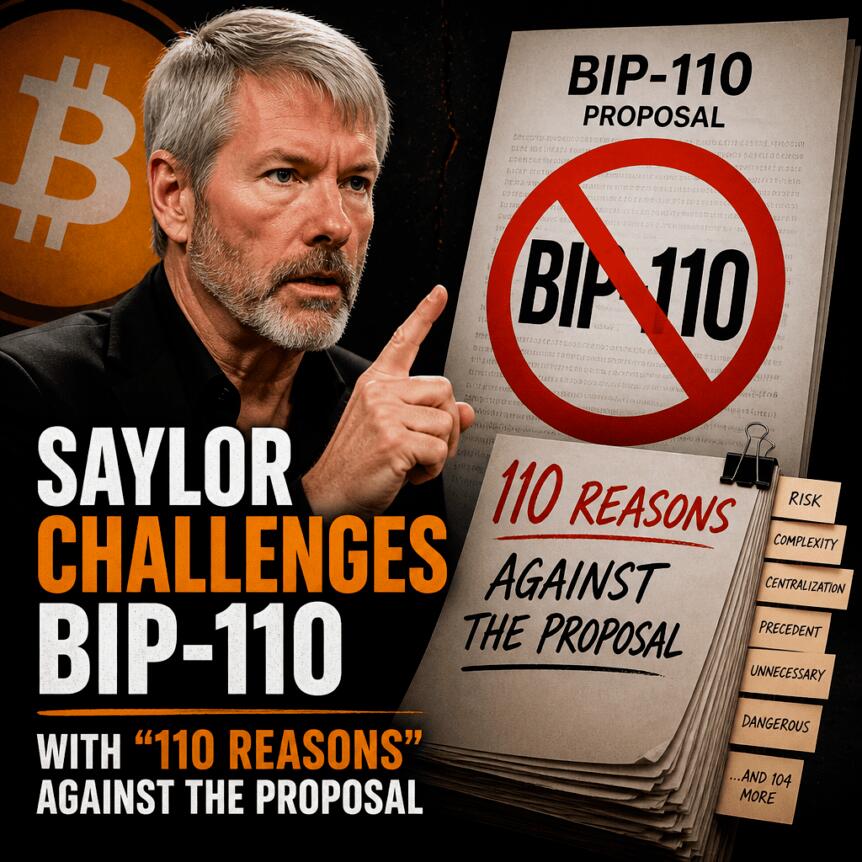
Bitcoin’s internal debate over how to curb network spam and non-monetary data has intensified after Michael Saylor published a detailed critique of Bitcoin Improvement Proposal 110 (BIP-110). In a long post on X.com dated Sunday, Saylor argued that a proposed temporary fork to restrict certain types of data on the Bitcoin network is the wrong solution—despite acknowledging that the underlying concerns raised by supporters are legitimate.
Introduced in December 2025, BIP-110 has become one of the more prominent protocol-level disputes in the Bitcoin development community since the Blocksize Wars of 2015–2017, when scalability questions sparked intense disagreement over whether changes should risk a chain split. Saylor’s intervention comes as Ordinals activity has cooled from its 2023 peak, raising questions about how urgent such a protocol change really is.
Key takeaways
- Saylor supports the goals behind BIP-110—such as protecting validation and affordable payments—but rejects the proposal’s mechanism as a remedy.
- BIP-110 would only move forward if 55% of validating nodes signal support during a Bitcoin “block period,” and recent support levels have been low.
- Ordinals inscriptions have fallen sharply from their August 2023 highs, potentially reducing the immediate pressure driving urgency for protocol-level fixes.
- The debate mirrors past governance tensions, including the Blocksize Wars, where disagreements over enforcement and network rules frequently threatened to split the ecosystem.
Saylor’s critique: shared goals, different fix
According to Saylor’s post on X.com, his argument is aimed at the proposal itself rather than people who support it. He said many Bitcoiners he respects back BIP-110 for reasons including keeping validation accessible, shielding node operators from unwanted costs, preserving low-cost payments, and preventing Bitcoin from drifting into general-purpose data storage.
Saylor emphasized that he agrees with those objectives but disagrees with the proposed remedy. In the same post, he framed his stance as a call to preserve “neutral rules, hard consensus, open markets, and permissionless innovation,” while stressing that vigorous disagreement should not turn into personal factionalism.
As of Sunday at 12 p.m. ET, Saylor’s post had accumulated 879,000 views, along with 692 replies and 852 retweets, highlighting how quickly the discussion has spread beyond core developer circles.
What BIP-110 would change—and why approval is difficult
Protocol changes like BIP-110 are not automatically activated; they depend on broad agreement among validators. BIP-110 cannot be enacted unless 55% of Bitcoin nodes validating blocks signal support for the proposal during a Bitcoin block “period.”
Based on the latest period referenced in reporting, period number 475—covering blocks 955,584 to 957,599—showed only about 1% of blocks in support. That figure suggests that, even if the proposal is technically live for discussion, it currently lacks the signaling momentum required for activation.
This approval threshold matters for investors and operators because it determines whether the change is likely to take effect in practice versus remaining a contested idea within the dev community. A proposal that fails to reach the required support level may still influence future policy debates, but it is less likely to produce immediate network-level consequences.
The spam-bloat dispute meets a cooling Ordinals market
The BIP-110 controversy is tied to concerns about “non-monetary transactions” and data patterns that proponents describe as spamming. BIP-110 was introduced to limit Ordinals-style inscriptions and other arbitrary data that supporters argue can overload the network and distract from Bitcoin’s primary function as peer-to-peer cash.
However, the political and technical urgency of such proposals is harder to gauge when on-chain activity is shifting. The dispute comes while Ordinals activity is reported to be near all-time lows. According to Dune Analytics data cited in the source material, fewer than 10,000 Ordinals are inscribed into the Bitcoin blockchain daily over the last month—down from more than 400,000 per day during its peak in August 2023.
Lower inscription volumes can change the risk calculus for both sides of the debate. Supporters of protocol limits may argue that even reduced activity can still set harmful precedents for how data is used on-chain. Opponents may counter that if demand and congestion pressure have already eased, a fork—especially one that introduces restrictions—becomes harder to justify without more consensus.
Backers, critics, and echoes of earlier Bitcoin governance fights
BIP-110 was introduced by pseudonymous developer “Dathon Ohm,” with backing that includes Ocean protocol founder Luke Dashjr, according to the source. On the opposition side, Blockstream CEO Adam Back is cited as a vocal critic of BIP-110.
Back has previously described the proposal as an attempt to police other people, arguing that Bitcoin’s decentralization should prevent any faction from imposing its preferred rules on the broader community. The objection is framed not only as technical but ideological—rooted in the cypherpunk principle of permissionless, censorship-resistant money.
Meanwhile, supporters of BIP-110 argue that Ordinals-driven bloat represents a serious threat that demands action. They also maintain that BIP-110 would not cause a chain split, a concern raised by those wary of temporary restrictions. Supporters further argue the fork is intended to be limited—described as a one-year constraint—so that it would not invalidate fee-paying transactions over the long run.
These arguments have led to parallels with the Blocksize Wars between 2015 and 2017, when disagreements over how to scale Bitcoin and whether to risk contentious changes sharpened into a broader debate about enforcement and legitimacy. In both cases, the underlying question is the same: how should the network evolve under pressure while preserving decentralized governance?
In this current cycle, the data points being used by each side are not symmetrical. Saylor is not denying that bloat concerns exist; he is questioning whether the governance approach—introducing temporary restrictions through a fork-like mechanism—is compatible with Bitcoin’s broader commitment to neutrality and hard consensus. At the same time, low recent Ordinals activity weakens one common justification for immediate intervention: that the network is actively under severe strain from inscriptions.
As the debate continues, readers should watch two things closely: whether BIP-110’s support signals rise toward the 55% activation threshold in subsequent block periods, and whether Ordinals activity meaningfully returns or stays subdued. Those developments will likely determine whether the proposal remains a theoretical flashpoint—or becomes a real test of how Bitcoin manages conflict over data usage and network rules.
Cardano activated its Van Rossem hard fork on July 18, upgrading the network to Protocol Version 11 with faster, cheaper smart contracts and stronger node security.
The transition was smooth, but the real question is whether ADA can turn the milestone into lasting price gains.
What the Van Rossem Hard Fork Brings to Cardano
A hard fork is a permanent protocol change that updates a blockchain’s core rules for everyone at once. Van Rossem, named after contributor Max van Rossem, went live around 21:45 UTC.
The upgrade caused only a brief ten-minute block gap, with no disruption to users or holdings. It marks the first major upgrade fully approved through Cardano’s Voltaire governance system.
The improvements target smart contracts directly: faster Plutus execution, new built-in functions, updated cost models, and stronger node security.
Those changes aim to make decentralized application development cheaper. Lower costs and stronger scripting could accelerate DeFi, NFT, and real-world asset activity.
Unlike previous era-changing forks, Van Rossem is an intra-era upgrade. It keeps the network inside the Conway governance framework while delivering immediate efficiency gains for developers.
Intersect, coordinating Cardano’s development, framed the event as proof of maturing decentralized governance.
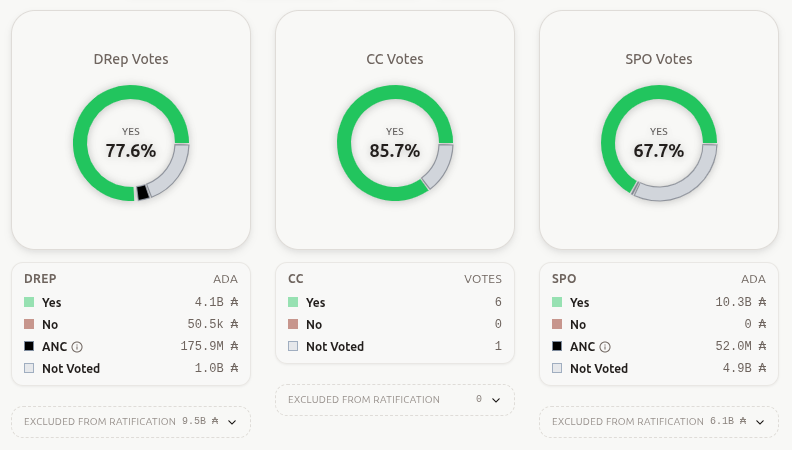
More than 77% of delegated representatives (DReps) and 52% of stake pool operators backed it.
“The best part: it was ratified on-chain by delegated community reps before activation. Upgrades by governance, not decree,” Cardano DRep Jason Appleton said on X.
Follow us on X to get the latest news as it happens.

The upgrade also arrives alongside a broader shift. Input Output will hand over core infrastructure, including the Plutus platform and Daedalus wallet, to external firms from August.
Can Van Rossem Deliver a Sustained ADA Rally
As expected with major upgrades, ADA saw short-term momentum. The token trades near $0.1663, up roughly 1.2% in 24 hours, according to BeInCrypto data. Still, the critical question remains whether Van Rossem can deliver a sustained rally. History urges caution.
Cardano hard forks have often generated initial excitement followed by consolidation, unless paired with real ecosystem growth. The lasting impact depends on several factors.

Rising developer activity, new dApp deployments, and growing total value locked in DeFi all matter. So does integration with upcoming upgrades like Ouroboros Leios, built for higher throughput.
Whale behavior adds another layer. Wallets holding 100,000 to 100 million ADA have accumulated over 25.6 billion tokens, their highest level since February 2023.
Analysts stay cautiously optimistic. The upgrade improves fundamentals, but price gains will ultimately depend on user adoption and capital inflow rather than the technical milestone alone.
Van Rossem represents another step in Cardano’s research-driven roadmap.
Whether ADA competes harder against Solana and newer Layer-1s now hinges on real on-chain growth in daily addresses, volume, and developer activity ahead.
Subscribe to our YouTube channel to watch leaders and journalists provide expert insights.
The post Cardano Activates the Van Rossem Hard Fork: Will It Boost ADA Price? appeared first on BeInCrypto.
The spot exchange-traded funds tracking the performance of Ripple’s cross-border token took their first hit last week in over two months, but net inflows have returned.
However, there’s still an evident investment exodus that we need to discuss, as the financial vehicles had no reportable data for too many days.
XRP ETFs Are Back
For roughly two months, during which the spot Bitcoin and Ethereum ETFs bled heavily, with billions of dollars leaving both, the XRP counterparts enjoyed investors’ attention by gathering fresh capital. In fact, as we repeatedly reported, they set a 9-week green-only streak, in which they attracted almost $200 million.
This all changed during the second week of July when data from SoSoValue showed that investors pulled out just over $7 million from the funds for the first time in over two months.
However, green is back on XRP’s street as the past week almost offset all the losses from the previous one. The net inflows for the five-day trading period stand at $6.78 million. This means that the cumulative total net inflow is back to its ATH levels of almost $1.5 billion.
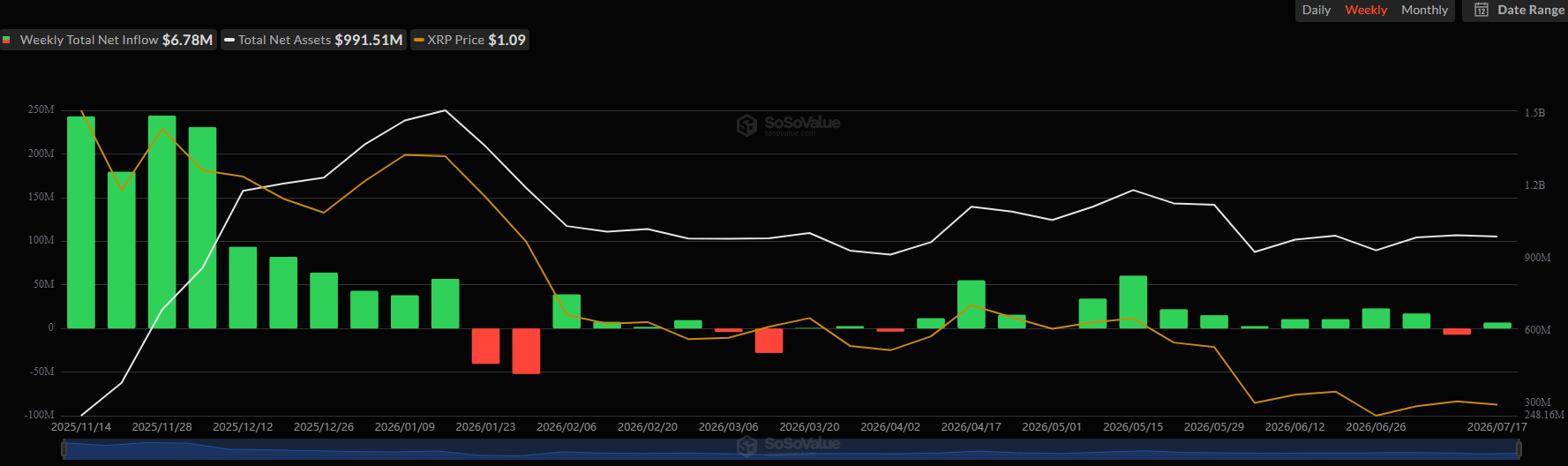
Bitwise’s XRP ETF continues to increase the gap between itself and the first such fund to reach Wall Street – Canary Capital’s XRPC. The former now holds almost $500 million in AUM, while the latter is below $470 million.
The Big Catch
Although the week as a whole was indeed in the green, all $6.78 million in net inflows came in just one day: July 16. The rest (four) trading days saw no reportable action, according to SoSoValue. Although the XRP ETFs have seen many such days in the past, there were never four in the same week.
Moreover, seven of the last 10 business days have seen net flows of $0.00. This is a rather concerning trend, clearly showing that interest and demand for the financial products have declined significantly.
Perhaps a portion of the blame can be put on the overall sluggish summer season, in which trading volumes traditionally drop, as investors wait for better times. XRP’s sluggish price performance might also turn investors away, as the asset has failed to break out above the $1.10 resistance despite a few attempts. It remains down by 3% monthly, with a market cap of well under $70 billion.
The post Ripple (XRP) ETFs Resume Inflow Streak, but There’s an Elephant in the Room appeared first on CryptoPotato.
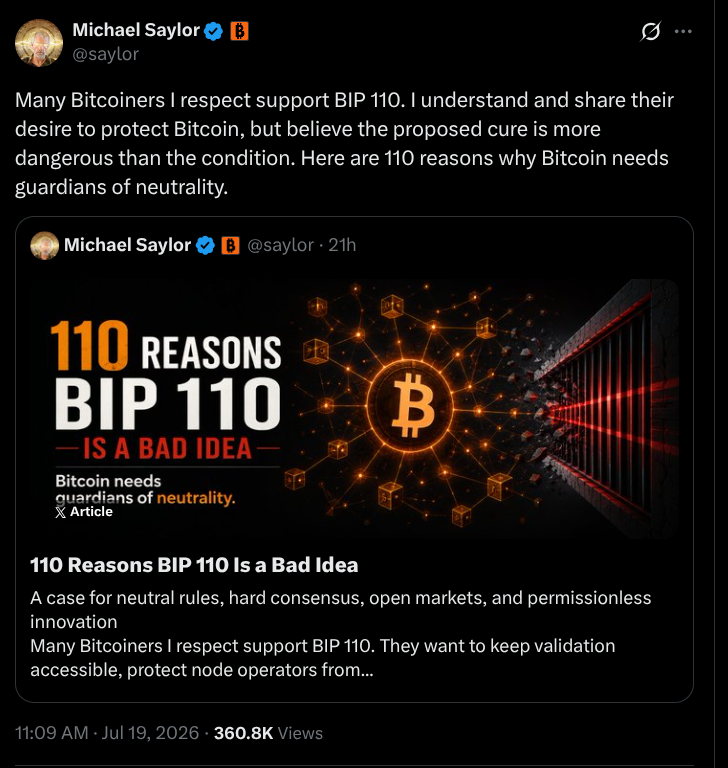
Strategy executive chairman Michael Saylor took to social media on Sunday to detail his “110 reasons” why a proposed temporary fork to limit non-monetary transactions on the Bitcoin network, or BIP-110, is a bad idea.
Bitcoin Improvement Proposal-110 was introduced in December 2025 to stop nonfungible token-like Ordinals inscriptions and other arbitrary data from spamming the network and to preserve BTC’s main use as a peer-to-peer cash system.
In a roughly 3,700 word post on X.com, the man in control of the largest Bitcoin (BTC) corporate treasury made a case for what he said are “neutral rules, hard consensus, open markets, and permissionless innovation.”
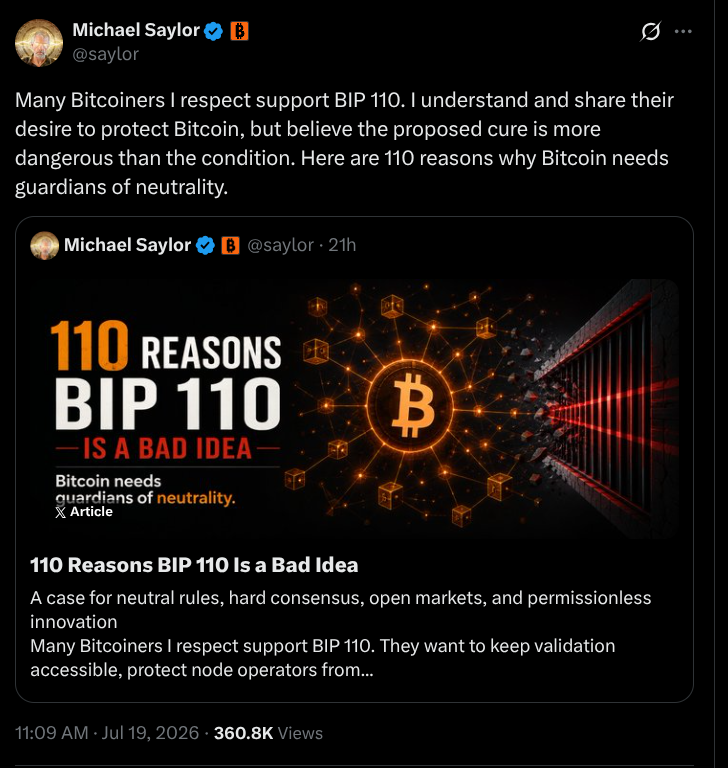
Source: Michael Saylor on X.com
“Many Bitcoiners I respect support BIP 110. They want to keep validation accessible, protect node operators from unwanted costs and content, preserve affordable payments, and keep Bitcoin focused on sound money rather than general-purpose data storage. Those are serious concerns. I share the objectives. I disagree about the remedy,” Saylor said. He added:
“This article critiques the proposal, not the people behind it. I assume good faith. Bitcoin is strongest when we can disagree vigorously without mistaking allies for enemies.”
As of 12 p.m. ET, on Sunday, the post had been viewed 879,000 times, with 692 replies and 852 retweets.
BIP-110 is one of the more notable protocol-level disputes in the Bitcoin development community since the Blocksize Wars between 2015 and 2017, when ecosystem participants debated whether it was worth risking a chain split to raise the block size limit for scalability.
The proposal was introduced by pseudonymous Bitcoin developer “Dathon Ohm” with the support of Ocean protocol founder Luke Dashjr. Opponents include Blockstream CEO Adam Back.
Related: Bitcoin nodes running BIP-110 crosses 2% as spam wars heat up
Little certainty on BHP-110 approval
To be sure, BIP-110 won’t be activated unless 55% of Bitcoin nodes validating blocks are in support of the proposal across a Bitcoin block “period.”
In the last period, period number 475 between block 955,584 and 957,599, only 1% of blocks were in support.
The dispute comes at a time when Ordinals activity is at near all-time lows, with fewer than 10,000 Ordinals inscribed into the Bitcoin blockchain on a daily basis over the last month, down from the more than 400,000 seen during its peak in August 2023.
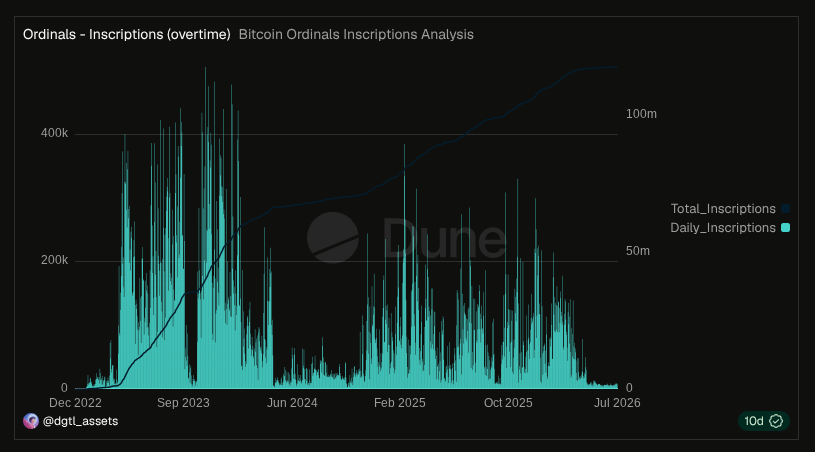
Change in daily Ordinals inscriptions since December 2022.
Source: Dune Analytics
Bock has previously criticized BIP-110, describing it as a “quest to police other people.”
He said Bitcoin’s decentralization should mean “you can’t impose your views on others,” calling it incompatible with BTC’s cypherpunk ethos of permissionless, censorship-resistant money.
Dashjr and other BIP-110 supporters have called Ordinals-driven bloat a “serious threat” to the network, prompting the need for an imminent fix.
They have also argued BIP-110 wouldn’t cause a chain split, as many fear, while adding that the BIP-110 fork imposes a temporary one-year limit and thus wouldn’t invalidate fee-paying transactions over the long term.
Features: From Bitcoin critics to blockchain believers: The 5 biggest crypto backflips


Michael Saylor, executive chairman and co-founder of Strategy, has come out swinging against a new proposal to clean up Bitcoin’s ‘spam,’ arguing that it could fundamentally alter how the world’s largest blockchain operates.
The Bitcoin Improvement Proposal (BIP) 110, aimed at temporarily restricting arbitrary data to focus on the core monetary functions, is a threat to the main principles of the network, Saylor explained in a comprehensive critique published on X, titled “110 reasons BIP-110 is a bad idea.”
“The proposed cure is more dangerous than the condition,” Saylor said in the recent detailed analysis. “BIP 110 would use consensus to narrow valid activity, constrain future options, complicate deployment, and establish a precedent it cannot later erase.”
Saylor’s primary objection is based on the “no-questions-asked” nature of money. “Bitcoin cannot read intent,” Saylor writes. “The network cannot know whether bytes represent an image, a proof, a contract, metadata, an authentication record, or a future application,” argued.
By banning “spam,” the protocol would effectively elevate human judgment into protocol law, effectively turning Bitcoin’s conservatism upside down.
‘Too aggressive’
Saylor is the latest bitcoin executive to weigh in on this highly debated topic among the Bitcoin community.
Pi Network’s native token has stolen the show in the cryptocurrency markets with a massive price surge that drove it to a weekly high of roughly $0.10.
This is rather unexpected given the asset’s latest price performance, which included dumping to several consecutive all-time lows. The question is whether this is a profound recovery or another dead-cat bounce.
PI Pumps Hard on Sunday
CryptoPotato has repeatedly reported over the past week or so the adverse price developments around Pi Network’s PI token. The asset broke below the key $0.10 support last weekend, and the bears took complete control of the market. In the following days, they pushed it below $0.09 and $0.08.
PI rebounded only after it dumped to $0.07, which turned out to be a strong support. The token marked a new all-time low, which meant that it had plunged by over 97% since its ATH over a year ago, but rebounded immediately.
As reported yesterday, it showed some resilience and climbed above $0.08. It remained there for about 24 hours before it went on the aforementioned rally today. It skyrocketed by almost 20% and is now close to $0.10 for the first time in a week. This has become a key resistance level, which has to be reclaimed before the asset has any chance of a bigger rebound.

Recovery or Dead-Cat Bounce?
Although today’s rather unexpected but impressive surge has given some hope to the bulls, PI’s history has repeatedly shown that it’s not that simple, and the hype could come to an end soon.
The asset has posted similar gains on numerous occasions in the past, especially after prolonged downturns. Once it becomes the top performer, though, it crashes and burns to its starting level or even lower within days. The latest such example was in mid-March when it rocketed from $0.20 to $0.30 during the Kraken-listing hype.
It was rejected immediately and slumped below $0.20 within 72 hours. It has been unable to reclaim its former glory since then, and the recent crash to $0.07 only proved that. The Pi Network investors and believers would have to wait and see if this rally now is any different.
The post Pi Network’s PI Suddenly Explodes by 20%: Recovery or Dead-Cat Bounce? appeared first on CryptoPotato.
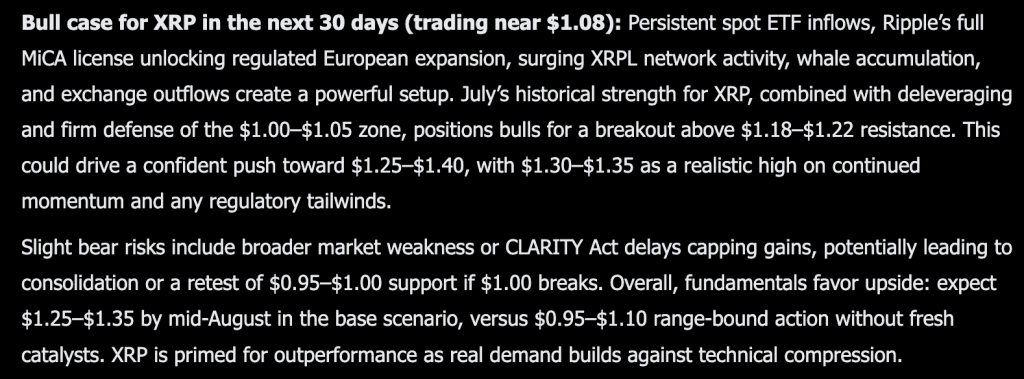
Thirty days is a short window to ask for anything, which makes Grok AI predicts that XRP is almost restrained by comparison to the usual end-of-year moonshots. From $1.08, it wants $1.25 to $1.35 by mid August.
The setup leans on five things happening together rather than one big catalyst. Spot ETF inflows keep showing up. Ripple’s full MiCA license opens the door to regulated European expansion.
XRPL network activity is surging in the background. Whales are accumulating instead of distributing. Exchange balances are dropping as coins move into cold storage.
Grok also points to something almost calendar-based. July has historically been a strong month for XRP, and that seasonal pattern is landing right on top of a market that just deleveraged hard.
The $1.00 to $1.05 zone has held firm through that deleveraging, which Grok reads as buyers defending a line rather than just drifting sideways. Clear resistance at $1.18 to $1.22, and Grok sees a confident push toward $1.25 to $1.40, with $1.30 to $1.35 as the realistic high if momentum and any regulatory tailwind cooperate.
The bear case stays narrow here, too. Broader market weakness or delays to the CLARITY Act could cap gains and force consolidation, with a retest of $0.95 to $1.00 support if the round number breaks.
Grok’s own base scenario without fresh catalysts is a flat $0.95 to $1.10, basically where XRP sits right now. The whole prediction hinges on new news arriving, not on existing momentum carrying itself.

Discover: The Best Token Presales
XRP Price Prediction: Has Traded In A Shrinking Box For Six Months And Grok Wants The Top Broken
The chart tells a quieter story than the prediction does. XRP closed at $1.08468, down 0.14%, in a session ranging between $1.07840 and $1.09495.
Zoom out from February, and this is not a downtrend anymore; it is a fading range. The February crash from above $2.30 down toward $1.20 was the violent part, and everything since has been a series of lower highs inside a slowly compressing box.
April topped near $1.55. May topped near $1.55 again. July’s bounce topped near $1.20 and already rolled over.
That is three failed attempts at reclaiming higher ground, each one weaker than the last. Support sits at $1.00, the level Grok specifically flagged as defended, then $0.95 below that.
Resistance stacks at $1.12, then $1.18, then the stubborn $1.20 ceiling that keeps rejecting every bounce. The RSI panel shows momentum at 44.55 with the signal line at 47.03, a small negative gap that has been narrowing over the past week.
That narrowing gap is the one mildly encouraging detail on this chart. It suggests selling pressure is easing rather than building, even if it has not flipped positive yet.
For Grok’s $1.25 target to happen in 30 days, XRP needs to do something it has failed to do three times since February, actually clear $1.20 and hold above it. Until that happens, this range keeps compressing rather than breaking.
Discover: The best crypto to diversify your portfolio with
Here is what Grok AI Predicts For LiquidChain’s Near Future
Every cycle has a moment where waiting becomes the most expensive decision you can make. That moment is now.
Bitcoin, Ethereum, and XRP are all pinned under the same resistance they have been testing for weeks. The macro unlock is perpetually one data point away. The institutional money keeps arriving next quarter. Large-cap traders waiting for a breakout are queuing for a decision that belongs to someone else entirely.
Grok AI has identified what experienced cycle traders already act on. Capital that registers as statistical background noise at Bitcoin’s market cap can completely reprice a small, undiscovered project.
The asymmetry is not complicated. It lives in the distance between what something is genuinely worth and what the market has currently assigned it. The moment that distance gets noticed, it collapses. Before that moment, it is fully open.
Cross-chain fragmentation has been quietly taxing every DeFi participant since the first bridge went live. Bitcoin, Ethereum, and Solana were engineered independently with zero shared infrastructure and no design intent to communicate. Every transaction crossing those ecosystem boundaries absorbs the cost of that decision in fees, failed execution, and slippage that hits before settlement even begins. The bridge industry did not fix this problem. It built a business model on top of it.
LiquidChain removes the business model entirely. Three networks unified inside a single execution layer. One deployment reaches all of them simultaneously. No cross-chain tax is extracted from any interaction anywhere.
Grok AI predicts it as a worth watching coin. The presale sits at $0.01454 with just over $860,000 raised.
Execution is unproven. Adoption is an open question. Established assets offer a smoother path toward a ceiling that the entire market can already see. LiquidChain is the entry point that stops existing once the market finds it.
Don’t Miss Out on Our $1,000 USDT Airdrop on ByBit
The post Elon Musk Grok AI Predicts XRP Will Do This by Next 30 Days, and Nobody Is Ready appeared first on Cryptonews.

The Electronic Transactions Association (ETA) is signaling a more constructive stance toward Bitcoin, with CEO Jason Oxman saying the group does not oppose the network and is open to partnerships—especially when customer demand and merchant needs point that way. Speaking in an interview with CoinDesk, Oxman framed the ETA’s position as technology-neutral, while pointing to recent activity with BitPay as evidence that Bitcoin-related innovation is on the table.
The shift is also reflected in the ETA’s membership changes: on August 6, the trade group announced BitPay—an Atlanta-based Bitcoin payments provider—as the first virtual currency company to join the ETA. The association represents major players in electronic payments, including Visa, MasterCard, Amazon, and PayPal, and said the addition underscores its intent to engage with emerging technologies as the payments industry evolves.
Key takeaways
- ETA CEO Jason Oxman said the organization does not advocate for Bitcoin and has not taken a position against other technologies; it treats electronic transactions as the common denominator.
- BitPay joining the ETA on August 6 marks the first virtual currency company membership, suggesting traditional payments groups may be willing to cooperate with Bitcoin processors.
- Oxman cited the Bitcoin Foundation’s role in educating ETA members—dating back to an ETA event in 2013—as part of why members began viewing Bitcoin as “an interesting development.”
- In discussing New York’s BitLicense proposal, Oxman argued regulators should avoid reflexive rules for “something new” and instead conduct deeper research into how Bitcoin systems and consumer protections work.
Why the ETA is talking more openly about Bitcoin
Oxman’s comments emphasize that the ETA’s mandate is broader than any single payment network. In the CoinDesk interview, he said the association’s stance is centered on facilitating electronic transactions, which means the transaction format ultimately follows what merchants and customers choose.
That framing matters because it positions Bitcoin less as an “alternative” and more as another option within the payments stack—one that may be integrated if it demonstrates value and operational safety. Oxman specifically pointed to the ETA’s partnership with BitPay as a concrete example of how the group approaches innovation without automatically dismissing new models.
By describing the ETA as “open to work with emerging tech startups, including Bitcoin-related companies,” Oxman also made demand the deciding factor. In other words, the ETA’s engagement appears less like advocacy for a particular technology and more like an attempt to stay relevant as customers and merchants experiment with Bitcoin payments.
BitPay membership and what it signals to traditional payments
The ETA press release introducing BitPay as a member described the decision as part of the group’s commitment to embrace new technology. BitPay’s entrance into an association that includes payment giants is significant, even if it does not automatically translate into endorsement of Bitcoin across the entire membership.
Oxman suggested the ETA’s outlook has changed as members gain more practical context. He referred to an earlier event in 2013 where Bitcoin Foundation general counsel Patrick Murck discussed Bitcoin in business-focused terms. Oxman said Murck’s presentation helped ETA members see Bitcoin as a relevant development for the industry, adding that at least one ETA member proceeded to strike a deal with a Bitcoin processor.
That historical detail points to a wider dynamic: partnerships in payments often come after repeated exposure to regulatory and operational questions. The ETA’s decision to bring BitPay in—and Oxman’s explanation of why—implies that Bitcoin’s perceived legitimacy is improving among mainstream payment stakeholders, at least in the context of how Bitcoin processing can fit into established transaction workflows.
The BitLicense debate: consumer protection vs. innovation
Oxman also addressed New York’s BitLicense proposal and the regulatory scrutiny surrounding it. He acknowledged that regulators’ concerns are understandable, particularly around consumer protection in novel payment systems. In his view, when alternative payment options are not well established and widely deployed, regulators feel more compelled to step in to protect consumers where those protections are not already present.
That stance reflects a tension at the heart of Bitcoin policy discussions: overly strict rules can raise compliance barriers and slow experimentation, while weak oversight can leave users exposed. Oxman argued that the ETA had previously worked through regulatory uncertainty when new payment methods—such as PayPal—arrived, spending significant time ensuring government action did not constrain innovation.
But he said New York should not treat Bitcoin as a special case that must be regulated using reflexive logic. Instead, he urged the NY Department of Financial Services (NYDFS) to conduct a more in-depth examination of Bitcoin’s technical operation and the additional measures that Bitcoin providers—including Bitcoin processors—take to protect both consumers and merchants.
Importantly, Oxman’s position is not a call to ignore regulation; it is a call for regulation built around how Bitcoin works in practice, rather than rules applied because the technology is new.
Regulatory timeline shifts in New York
Meanwhile, New York’s BitLicense review process is still moving. According to earlier coverage from Cointelegraph, the NYDFS superintendent Benjamin Lawsky extended the public comment period on the BitLicense proposal by 45 days, pushing the deadline to October 21. The extension followed a joint letter in which BTC China, Huobi, and OkCoin—referred to by Cointelegraph as the “Big three”—outlined concerns and requested changes to the proposal.
For investors and market participants, these procedural updates can be as important as the policy itself. Longer comment windows often indicate that regulators are weighing industry feedback more deliberately—potentially affecting how strict compliance obligations are ultimately framed. It also means companies preparing for the BitLicense regime may face shifting expectations as regulators refine their approach.
As the ETA continues building relationships with Bitcoin-focused firms like BitPay and New York’s BitLicense review proceeds through an extended comment period, the key question for the market is how regulators will translate concerns about consumer protection into rules that reflect Bitcoin’s actual system design—and whether mainstream payment stakeholders continue to increase engagement as compliance certainty improves.


Japanese logistics group AZ-COM Maruwa Holdings plans to introduce the yen-backed JPYC stablecoin for payments to about 2,300 partner carriers and independent drivers, according to a Nikkei report cited by Crypto Briefing.
Summary
- AZ-COM Maruwa plans JPYC payments for 2,300 logistics partners in Japan’s first large corporate rollout.
- The logistics group will invest ¥1 billion in JPYC while forming a business partnership directly.
- JPYC is gaining wider use through retail trials, lending projects, and emerging payment infrastructure nationwide.
The move is “expected to become Japan’s first large-scale corporate use of JPYC.”The company also plans to invest ¥1 billion in JPYC and form a business partnership with the stablecoin issuer. The rollout would move JPYC beyond retail tests and crypto services into routine business payments across a large logistics network.
AZ-COM Maruwa brings JPYC into logistics payments
AZ-COM Maruwa Holdings operates third-party logistics, transportation, warehousing and delivery services in Japan. Its planned use of JPYC would cover outsourcing and other payments made to a broad network of transport partners, including individual truck drivers.
The reported ¥1 billion investment also ties the logistics group directly to JPYC’s growth. The companies have not yet disclosed a detailed rollout schedule or explained how each partner will receive, hold or convert the tokens. Those operating details will determine how widely drivers and carriers use JPYC instead of immediately redeeming it for yen.
JPYC began issuing its regulated yen-backed stablecoin on October 27, 2025. The token maintains a one-to-one link with the yen and uses bank deposits and Japanese government bonds as reserve assets. It operates on public blockchain networks and can be issued or redeemed through JPYC EX.
The AZ-COM Maruwa plan follows other attempts to move JPYC into daily payments. As reported by crypto.news, Lawson plans to test JPYC payments at a Tokyo convenience store in August through a point-of-sale system. The trial will let customers pay using a smartphone-linked payment system.
Japan’s stablecoin market adds more use cases
JPYC is also expanding into financial products. As reported by crypto.news, Metaplanet and JPYC recently began studying Bitcoin-backed credit products that could use JPYC for lending and settlement. The project is examining how Bitcoin collateral and yen-denominated stablecoin liquidity could work together. Payment infrastructure is developing at the same time.As reported by crypto.news, LINE NEXT plans to support JPYC through Unifi Pay, a stablecoin payment service scheduled for a wider launch in the third quarter. The service is designed to let users in Japan top up local stablecoins from bank accounts after identity checks.
The logistics rollout would differ from smaller consumer pilots because it involves thousands of businesses and independent drivers receiving payments through the same stablecoin system. If implemented at the reported scale, it would test JPYC’s ability to handle regular corporate settlement rather than isolated retail purchases.
Japan is also tightening rules around stablecoin reserves as adoption grows.Japanese regulators have set conditions for government bonds held as reserve assets. JPYC has said it plans to keep most reserve proceeds in Japanese government bonds and the remainder in bank deposits.
AZ-COM Maruwa’s planned rollout therefore arrives as JPYC moves into retail payments, lending experiments and broader payment infrastructure. The ¥1 billion investment adds a direct corporate commitment, while the proposed payments to 2,300 logistics partners would provide one of the clearest tests yet of whether a regulated yen stablecoin can work in everyday business settlement.


The rise of autonomous AI agents necessitates the utilization of zero-knowledge proofs, argues Brian Trunzo, chief growth officer at Succinct Labs.

Will Trump appear at the World Cup final?

Connecting AI agents to outside services explodes the risk radius

The quiet Cambridge nature reserve with crystal clear waters and named after a famous poet


-
 NewsBeat3 days ago
London Mayor Sadiq Khan handed a peerage by Keir Starmer alongside 15 other Labour figures… just days before the PM leaves No10
-

 Fashion2 days ago
Weekend Open Thread – Corporette.com
-

 Politics1 day ago
The House | The City of London can help the new chancellor deliver growth in every postcode
-

 Politics4 days ago
Young campaigners urge incoming PM to act on outdoor junk food ads
-

 Crypto World4 days ago
CFTC blocks Kalshi from unwinding Michigan trades after court order
-

 Business4 days ago
Nvidia Stock Slips After Big Tuesday Rally as Huang Confirms Vera Rubin Chip Is Now in Production Today
-

 Crypto World1 day ago
Ripple Payments Joins MiCA With 14 Firms, Does It Mean Anything For XRP?
-

 Politics4 hours ago
Democrats look to World Cup watch parties to register thousands of voters
-
 Entertainment4 days ago
Disney’s Most Ambitious Failed Star Wars Attraction Is Coming to SDCC
-

 Crypto World2 days ago
Ripple wins EU-wide access as ESMA adds it to MiCA register
-
 Crypto World2 days ago
Two July Windows Left: The CLARITY Act’s Senate Fight and What Failure Means
-

 Business4 days ago
Palantir Shares Rise After Expanded Nvidia Partnership and Fresh Analyst Upgrades Ahead of Earnings Day
-

 Crypto World3 days ago
Injective Submits SEC Transfer-Agent Registration to Onchain Ownership Records
-

 Tech6 days ago
Get Your ESP32 Sunny Side Up With This Solar Dev Board
-

 News Videos5 days ago
XRP BOMBSHELL… XRP OMBOARDED FOR TRANSACTIONS!!!
-

 NewsBeat2 days ago
Registration is now open for March for Men with Kev 2026
-

 Tech5 days ago
Dark Secrets Emerge When Jailbreaking LLMs
-
 Sports4 days ago
New Cornerback Enters Vikings Trade Rumor Mill
-

 News Videos2 days ago
Money | Class 12 Economics | CBSE Board Exam 2026-27
-

 Business3 days ago
Banco Bilbao Vizcaya Argentaria, S.A. (BBVA) Discusses Global Macro Environment and Economic Outlook for Core Markets Transcript
You must be logged in to post a comment Login