

Crypto World
ETH Profit-Taking Hits 3-Week High Despite 5.5% Price Drop

Ethereum’s network recorded its highest realized profits in three weeks on Thursday, with $74.58M booked in a single spike even as the asset’s price fell roughly 5.5% over the past three days.
The data, published by on-chain analytics firm Santiment, points to a specific group of sellers: traders who bought ETH when it was trading below $2,000 during February and March and are now cashing out while they still can.
Who’s Selling and Why It Makes Sense
Santiment’s analysis is worth sitting with for a moment, because the headline number looks strange at first. Prices are down, yet profit-taking is at a three-week high, but the explanation is straightforward once you know what to look for.
ETH spent much of February and March below the $2,000 mark, a period Santiment described as one of “war fears and notably uncertain times in crypto.” Traders who accumulated during that window are still sitting on gains even after this week’s decline, and many have decided to act on them.
Furthermore, separate analysis by CryptoQuant contributor Rei Researcher shows that deposit addresses on Binance spiked to roughly 9,000 ETH, the highest in over a year, with inflow bars confirming selling pressure concentrated around the $2,260 price zone.
The Santiment data also shows that four-hour candles have been compressing near $2,241, a sign of elevated distribution activity. More transactions across a network mean more realized profit-and-loss events, and when volume is elevated, those modest individual gains pile up quickly into large network-level totals.
Santiment’s guidance for traders is to “lean cautious” but stop short of turning outright bearish. The firm is watching for a spike in realized losses as a potential bottoming signal, and advises against aggressive positioning until the distribution phase shows clear signs of ending.
A Technically Fragile Picture
The selling activity is hitting Ethereum at a structurally vulnerable moment, as noted by analyst Keith Alan, who said that the cryptocurrency briefly broke above its macro trend line before being rejected at the 21-week simple moving average and has since slipped below a cluster of technical levels near $2,280.
Should ETH not be able to recapture the 21-week moving average, Alan found a series of support zones to monitor: $2,196, followed by $2,060, with a breach beneath this area possibly clearing the way for $1,892 and beyond.
As per CoinGecko figures, ETH remained trading considerably above the $2,200 mark as of writing but had lost close to 2% from the previous day and 3% over a week. The cryptocurrency is currently roughly 54% off its all-time high of slightly above $4,950 recorded in August 2025.
The post ETH Profit-Taking Hits 3-Week High Despite 5.5% Price Drop appeared first on CryptoPotato.

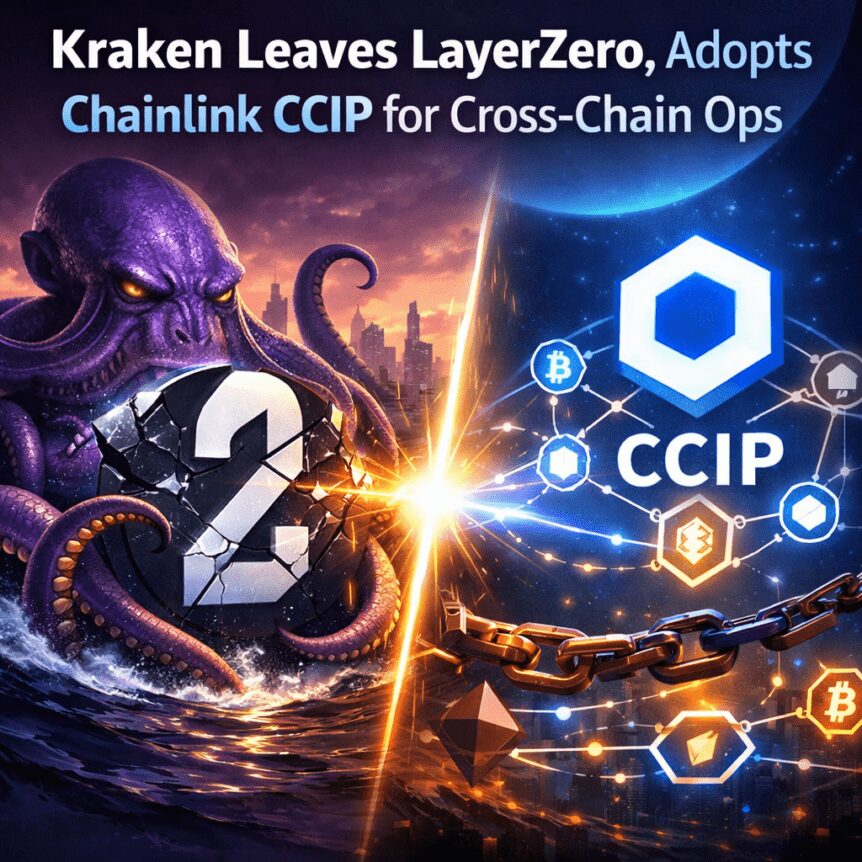
Kraken has decided to migrate its cross-chain infrastructure from LayerZero to Chainlink’s Cross-Chain Interoperability Protocol (CCIP), designating CCIP as the exclusive cross-chain backbone for Kraken Wrapped Bitcoin (kBTC) and all future wrapped assets. The move places Kraken among a growing group of protocols re-evaluating their cross-chain security posture in the wake of a major DeFi incident earlier this spring.
The exchange said the transition to CCIP reflects a preference for what it describes as enterprise-grade security and risk management. Kraken highlighted CCIP’s certifications, secure-by-default design, 16 independent nodes, and native rate limits as core advantages in reducing cross-chain risk for the firm’s wrapped assets.
The shift comes amid heightened scrutiny of LayerZero following the Kelp DAO exploit in April, in which roughly $292 million in liquid restaking tokens were siphoned by actors suspected to be linked to North Korea’s Lazarus Group. LayerZero subsequently issued an “overdue apology” on May 9, acknowledging communication failures in the weeks after the attack. The company attributed the breach to a combination of compromised internal RPCs—described as the “source of truth” being poisoned—and a targeted denial-of-service assault on external RPC providers, while noting that the vulnerability was tied in part to Kelp’s configuration of its single-DVN (decentralized verifier network). LayerZero maintained that the incident did not affect other applications and that more than $9 billion in bridged assets had been moved using the protocol since April 19.
Key takeaways
- Kraken commits to Chainlink CCIP as its exclusive cross-chain infrastructure for kBTC and future wrapped tokens, citing enterprise-grade security features and risk controls.
- The Kelp DAO exploit has accelerated a broader migration away from LayerZero, as multiple protocols reassess cross-chain infrastructure.
- Industry momentum toward CCIP is evident: Kelp DAO, Solv Protocol, and Re.xyz are migrating, with total cross-chain TVL migrating to CCIP rising into the billions of dollars.
- Chainlink CCIP’s adoption is accompanied by a price backdrop where major tokens have shown muted immediate reactions to the cross-chain shift, while LayerZero’s native token has faced notable declines.
LayerZero under pressure after the Kelp DAO incident
The April attack on Kelp DAO set off a wave of reconsiderations across the cross-chain landscape. In addition to the estimated $292 million stolen from liquid restaking tokens, LayerZero’s communications team issued an apology for a communications lag during the crisis, while officials described the breach as a consequence of compromised internal RPCs and a distributed denial-of-service attack on external RPC providers. LayerZero asserted that the problem did not spread beyond the targeted chain and that the rest of its ecosystem remained secure. The protocol has still faced heightened scrutiny as activity on bridges linked to LayerZero continues to be re-evaluated by projects across DeFi.
Despite the setback, LayerZero reported that more than $9 billion in assets had been bridged using its protocol since the April incident, underscoring the continued reliance on cross-chain liquidity even amid security concerns. The episode has prompted several protocols to consider or implement alternative cross-chain infrastructure to diversify risk and reduce single-vendor exposure.
CCIP adoption accelerates across DeFi
Kraken is not alone in shifting away from LayerZero in response to the incident. Kelp DAO has stated it is in the process of migrating to Chainlink CCIP and, as part of its recovery steps, burned 117,132 rsETH issued during the attack. The move to CCIP is part of a broader realignment as DeFi projects reassess cross-chain reliability and risk controls.
Other notable migrations include Solv Protocol, which announced on May 7 that it would move from LayerZero to CCIP as the official cross-chain infrastructure for about $700 million in tokenized Bitcoin. Re.xyz followed suit on May 8, signaling a transfer of its $475 million in total value locked from LayerZero to CCIP. Industry data compiled after the Kelp incident show more than $3 billion in total value locked (TVL) migrating to CCIP, as several protocols suspended bridging using LayerZero while the ecosystem reevaluated its options. In parallel, Lido, the world’s largest Ethereum liquid staking protocol, has publicly endorsed CCIP, praising Chainlink’s defense-in-depth model as a guiding standard for cross-chain interoperability.
The rapid pace of migrations underscores a broader market shift toward multi-layer cross-chain safety, with CCIP emerging as a leading option for secure asset transfers across chains. This trend aligns with a growing emphasis on governance, reliability, and resilience in cross-chain infrastructure, as DeFi projects weigh the costs and benefits of single-vendor dependencies against the potential upside of diversified security models.
Market backdrop and what to watch next
In the wake of these developments, market prices for core cross-chain players painted a cautious picture. Chainlink’s native token, where available, remained around bear-market levels near ten dollars, with no clear, immediate price reaction tied to the CCIP migrations. LayerZero’s ZRO token has faced a pronounced drawdown since the April breach, down more than 30% and well below its 2024 highs, reflecting a broader risk-off sentiment toward cross-chain infrastructure bets during a period of heightened scrutiny.
As CCIP gains traction among major DeFi protocols, observers will be watching for any further migrations, new security measures, and potential regulatory or governance updates that could influence cross-chain interoperability. The coming weeks will likely clarify whether CCIP can sustain rapid adoption while delivering the security guarantees that investors and users increasingly demand.
For readers, the key question is whether this momentum signals a durable reconfiguration of cross-chain trust or if additional incidents could temper the pace of migration. The next steps—more protocol migrations, governance decisions on cross-chain risk, and tangible improvements in cross-chain security—will reveal how the market recalibrates in response to a rapidly evolving multi-chain landscape.


Strategy has recorded a new trading volume high for its STRC perpetual preferred stock, adding fresh attention to the company’s use of structured equity products to finance Bitcoin purchases.
Summary
- Strategy’s STRC preferred stock recorded a new daily trading volume high of $1.53 billion on Thursday.
- The company could theoretically raise enough capital through STRC activity to purchase about 9,066 Bitcoin, according to STRC.live data.
According to a post from Michael Saylor, Strategy’s Variable Rate Series A Perpetual Stretch Preferred Stock, trading under the ticker STRC, reached $1.53 billion in daily liquidity on Thursday, the largest volume recorded for the instrument since launch.
“All-time high volume. $1.53B of liquidity,” Saylor said while referring to the company’s Stretch preferred stock product, which pays investors an 11.5% dividend without diluting Strategy’s common equity.
Data from the STRC.live tracker showed the trading activity could theoretically allow Strategy to raise roughly $735.4 million through its at-the-market issuance structure, enough to acquire about 9,066 Bitcoin at current prices. No announcement confirming a new Bitcoin purchase has been made by the company.
Since March, Strategy has accelerated the pace of its Bitcoin accumulation campaign after a relatively quieter February. Company disclosures show the firm has acquired 101,147 Bitcoin since March, including 56,770 Bitcoin purchased after April alone.
Structured products tied to Bitcoin buying
Over the past few months, perpetual preferred stocks have started gaining traction among corporate Bitcoin treasury firms as traditional fundraising routes become harder to access during the current crypto downturn. Senior convertible notes and at-the-market equity sales have faced weaker investor appetite, pushing several companies toward income-focused instruments linked to Bitcoin exposure.
Earlier in May, during Strategy’s Q1 earnings call, Saylor said the company intends to turn Stretch into the “biggest credit instrument in the world,” while continuing to use proceeds from the product to support Bitcoin acquisitions.
A May 14 report from K33 Research director Vetle Lunde stated that STRC’s structure may already be influencing Bitcoin liquidity cycles around the middle of each month. According to the report, the preferred stock’s dividend schedule and ex-dividend timing create recurring periods where Strategy can issue shares above par value and redirect proceeds into Bitcoin purchases.
K33 data cited in the report showed Strategy-linked purchases through STRC climbed from 4,467 Bitcoin in January to nearly 46,872 Bitcoin in April. Lunde also noted that the pace of STRC returning to its $100 par value had slowed recently, with only around 1 Bitcoin added through the mechanism in the latest observed period, a sign that investor demand for the instrument may be cooling.
Outside Strategy, other Bitcoin treasury firms have also started experimenting with similar financing structures.
On Thursday, Strive announced that investors in its Variable Rate Series A Perpetual Preferred Stock, SATA, would begin receiving daily dividend payments starting June 16. The schedule differs from Strategy’s monthly payout structure tied to Stretch.
Meanwhile, Tokyo-based Metaplanet has raised funds through perpetual preferred stock offerings, including MARS and MERCURY, as part of its Bitcoin acquisition strategy.
Nearly 200 public companies currently hold Bitcoin on their balance sheets. Strategy still controls the largest corporate treasury position, with 818,869 Bitcoin valued at roughly $66.5 billion based on current market prices.
Bitcoin’s recent recovery above $81,000 has also pushed the asset beyond Strategy’s average purchase price of $75,543, leaving the company’s holdings up about 7.2% on paper.
Key Highlights
- HYPE rallied 21% over 24 hours to reach $46.64, with daily trading volumes exceeding $716 million.
- 21Shares launched the THYP ETF on Nasdaq May 12 — marking the first U.S. spot product offering direct HYPE exposure.
- Coinbase was designated as the official USDC treasury deployer on Hyperliquid, phasing out the native USDH stablecoin.
- Circle pledged 500,000 HYPE tokens for validator operations as part of the partnership agreement.
- Technical analyst Crypto Patel warns of possible retracement to $30–$33 range unless HYPE sustains a close above $50.
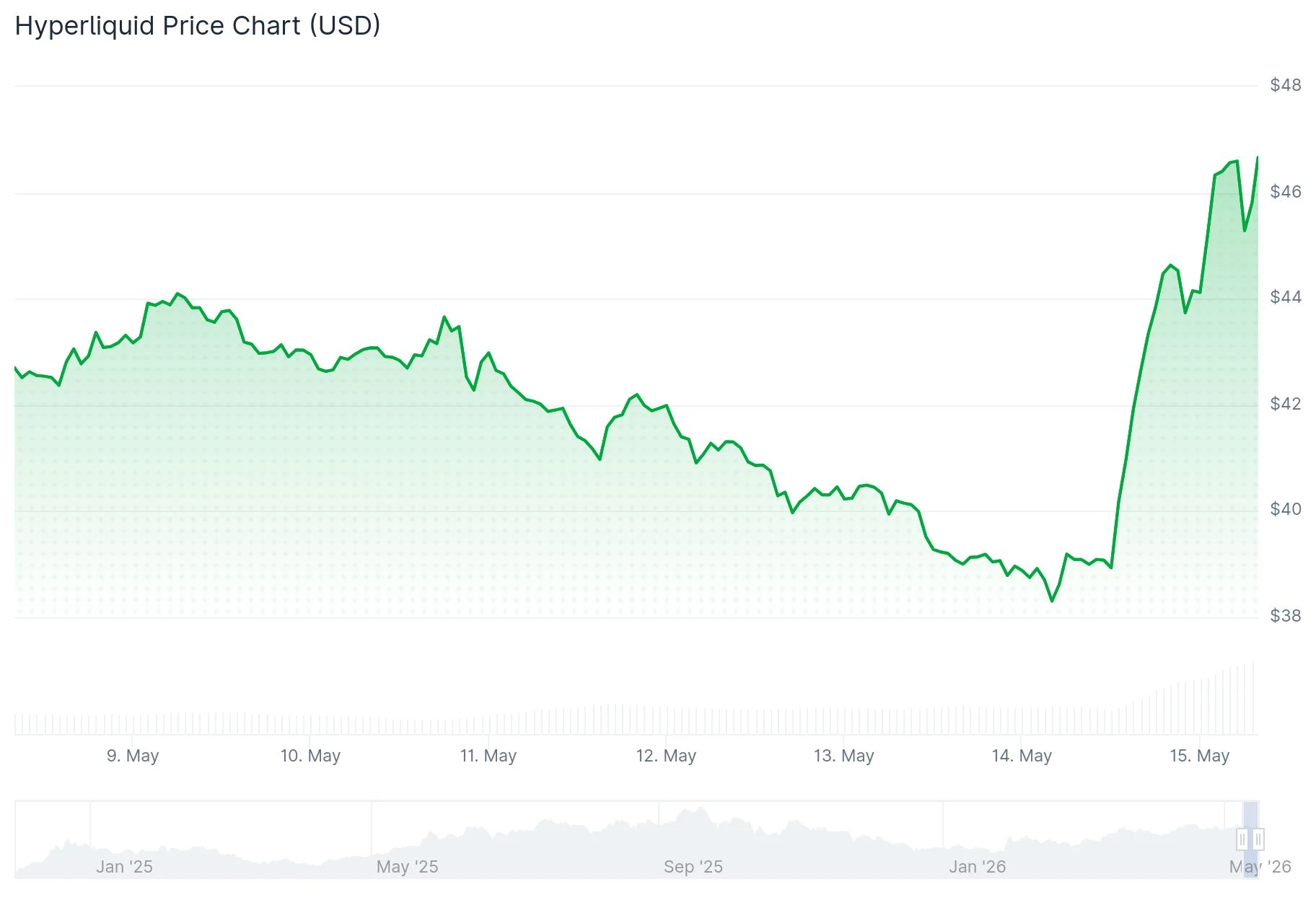
Hyperliquid’s HYPE token experienced a sharp 21% surge over the last 24 hours, climbing to $46.64 by Friday’s close. This upward movement elevated its market capitalization to approximately $11.14 billion, securing its position back among the top 10 largest cryptocurrencies.
The token experienced significant intraday volatility, moving from a low of $38.45 to a peak of $46.93. Daily trading activity surged to $716.7 million — representing more than a twofold increase from the prior session — based on CoinMarketCap statistics.
However, HYPE remains approximately 21% beneath its record high of $59.37, which was recorded in September 2025.
The price explosion came after two significant announcements: the introduction of a regulated investment vehicle and a fundamental transformation in stablecoin operations.
Regulated ETF Provides Institutional Gateway
On May 12, 21Shares introduced the THYP ETF on the Nasdaq exchange. This marks the inaugural U.S. spot exchange-traded fund that provides direct exposure to HYPE tokens. The product maintains physical token holdings, stakes a percentage for rewards, and applies a 0.30% management fee.
First-day trading recorded $1.8 million in volume, accompanied by approximately $1.2 million in net inflows. Pending applications from Bitwise and Grayscale indicate that additional HYPE-focused investment products could emerge soon.
The ETF structure enables conventional investors to gain HYPE exposure without managing cryptocurrency wallets or navigating blockchain protocols.
Coinbase and Circle Forge Strategic Alliance
On May 14, Coinbase revealed its new role as the official treasury deployer for USDC on Hyperliquid through the platform’s Aligned Quote Asset program. USDC will supplant USDH as the dominant settlement and collateral instrument.
Circle will oversee the cross-chain technical operations. This transition aims to minimize liquidity division between the two stablecoin options.
USDC circulating on Hyperliquid currently stands at approximately $5 billion, representing a year-over-year doubling. The bulk of reserve income will be channeled back into Hyperliquid’s ecosystem through its Assistance Fund, which facilitates automatic HYPE token buybacks.
Circle has also allocated 500,000 HYPE tokens to support validator activities.
Technical Analysis and Market Outlook
Analyst Crypto Patel posted a measured assessment on X, noting that the rejection near $46 aligns with a rising wedge breakdown formation. He identified potential support zones at $33, $30, and $27, highlighting his primary interest area between $30–$31. He emphasized that his outlook would shift bullish only with a daily close surpassing $50.
Meanwhile, analyst Ali Charts pointed out that the TD Sequential indicator — which accurately predicted the bounce from $22 to $44 — is currently displaying a sell signal. He suggested this could prompt profit-taking activity targeting $36 or $33.
Hyperliquid presently captures approximately 60% of worldwide perpetual futures trading volume and produces over $2 million in daily protocol fees, with nearly 97% allocated toward HYPE token buybacks and burns.


TLDR
- Kraken transitions kBTC wrapped Bitcoin infrastructure from LayerZero to Chainlink CCIP
- Move triggered by April 2026 Kelp DAO bridge exploit that resulted in $292 million losses
- Industry-wide shift sees more than $3 billion in TVL move from LayerZero to Chainlink platforms
- Kraken becomes fourth major protocol to abandon LayerZero, following Kelp, Solv, and Re
- Coinbase previously adopted Chainlink CCIP for approximately $7 billion in wrapped token assets
Cryptocurrency exchange Kraken has confirmed its decision to transition away from LayerZero as the underlying cross-chain technology for kBTC, its wrapped Bitcoin offering, opting instead for Chainlink’s Cross-Chain Interoperability Protocol (CCIP).
The strategic shift follows a devastating April 2026 security breach at Kelp DAO that resulted in $292 million in stolen funds. Security researchers believe the attack was orchestrated by North Korea’s notorious Lazarus Group, who exploited vulnerabilities in Kelp’s LayerZero-based bridge operating with a single-verifier setup.
According to Kraken’s official statement, the exchange selected Chainlink CCIP due to its “enterprise-grade infrastructure with strict security and risk management requirements.”
Chainlink’s CCIP infrastructure operates with 16 independent node operators that must validate every cross-chain transaction. The protocol features built-in rate limiting mechanisms and maintains both ISO 27001 and SOC 2 Type 2 security certifications.
Launched in 2024, Kraken’s kBTC maintains a 1:1 backing ratio with Bitcoin. Current data from DeFiLlama shows the token commands approximately $260 million in market capitalization with around $333 million in total value locked.
The infrastructure transition encompasses multiple blockchain networks including Ethereum, Ink, Unichain, and Optimism, with additional chains planned. Chainlink will provide infrastructure support for all future wrapped asset products from Kraken.
A Pattern of Departures From LayerZero
Kraken represents the fourth significant protocol to discontinue LayerZero infrastructure following the Kelp security incident. Previous departures include Kelp DAO itself, along with Solv Protocol and Re. Combined, these three protocols account for approximately $2.57 billion in total value locked.
A Chainlink representative verified that more than $3 billion in TVL has transitioned to Chainlink infrastructure in recent weeks, including assets from Tydro, the primary lending protocol operating on Kraken’s Ink blockchain network.
LayerZero initially disputed accountability for the Kelp breach. While the company had previously advised Kelp to implement a more secure multi-signer configuration, LayerZero later acknowledged inadequate communication contributed to the incident.
Post-exploit investigation revealed that 47% of applications utilizing LayerZero infrastructure operated with single-verifier configurations, identical to the setup exploited during the Kelp attack.
LayerZero has subsequently announced it will discontinue support for 1/1 Decentralized Verifier Network configurations and has initiated deployment of enhanced security protocols.
Industry Response
The decentralized finance ecosystem mobilized through the DeFi United initiative, successfully raising over $320 million to restore rsETH backing and provide compensation to impacted users.
Coinbase executed a comparable infrastructure migration last year, designating Chainlink CCIP as the exclusive bridge solution for approximately $7 billion in wrapped token assets.
In related corporate developments, Kraken’s parent entity Payward filed an application this month seeking federal trust charter status to operate as a federally chartered cryptocurrency banking institution.
Key Takeaways
- Senate Banking Committee approved the Digital Asset Market Clarity Act (CLARITY Act) with a 15-9 vote
- Bipartisan support emerged as two Democratic senators sided with all 13 Republican members
- A minimum of 60 votes will be required for passage during the full Senate floor proceedings
- Unresolved ethical questions surrounding Trump’s cryptocurrency ventures continue to pose challenges
- House approval remains necessary before the legislation can reach the president for final signature
During Thursday’s proceedings, the Senate Banking Committee greenlit the Digital Asset Market Clarity Act, commonly referred to as the CLARITY Act, through a bipartisan 15-9 decision. This legislative measure aims to establish a comprehensive regulatory structure for digital asset enterprises and cryptocurrency markets across the United States.
The committee’s entire Republican contingent of 13 senators cast affirmative votes. Two Democratic members—Senators Ruben Gallego and Angela Alsobrooks—broke from their party to endorse the measure. The remaining nine Democrats opposed the bill.
Committee Chairman Tim Scott emphasized that the legislation prioritizes consumer safeguards, encourages technological advancement within American borders, and addresses national security considerations related to digital currencies.
Top-ranking Democrat Elizabeth Warren mounted vigorous opposition to the measure. She characterized the legislation as being “written by the crypto industry for the crypto industry” and suggested Republican colleagues were advancing President Trump’s private cryptocurrency financial interests.
Senator Cynthia Lummis, a prominent Republican advocate for the bill, defended CLARITY as legislation that benefits both law enforcement capabilities and consumer welfare. She countered Warren’s assertions throughout the committee hearing.
Negotiations Shape Final Committee Decision
Private discussions conducted throughout the markup session proved instrumental in securing Democratic support. Chairman Scott committed to entertaining additional amendments, which introduced enhanced investor safeguards and more precise regulatory guidelines for decentralized finance platforms.
Democratic Senator Mark Warner championed strengthening protections specifically for decentralized finance initiatives. His concerns found expression in eleventh-hour amendments that garnered substantial bipartisan backing.
Senator Alsobrooks characterized her affirmative vote as “a vote to keep working in good faith,” emphasizing that further deliberations would be necessary before she commits to supporting the final floor measure. Gallego expressed similar reservations.
The markup session featured debate over more than 100 proposed amendments. The majority were rejected along partisan divisions. These included provisions addressing stablecoin oversight, anti-money laundering measures, cryptocurrency mixer regulations, and prohibitions on federal bailouts for digital asset firms.
Ethical Conflict of Interest Questions Remain Outstanding
Among the most contentious unresolved matters is an ethics clause. Democratic lawmakers seek regulations preventing government officials, including the sitting president, from financially benefiting from cryptocurrency assets under their regulatory purview. Trump’s family operates World Liberty Financial and has launched memecoins.
White House advisor Patrick Witt informed attendees at Consensus Miami 2026 earlier this month that any provision specifically targeting the president would face rejection. He insisted any ethics framework must apply “across the board.”
Digital Chamber’s Cody Carbone informed media representatives that reaching consensus on the ethics provision will probably be necessary before floor consideration. He indicated leadership will only schedule a vote once confident of securing the requisite 60 votes.
The legislation now proceeds toward consolidation with comparable legislation approved by the Senate Agriculture Committee. Following that merger, a unified version will advance to the full Senate for floor consideration, then to the House of Representatives.
Blockchain Association CEO Summer Mersinger described Thursday’s outcome as a “defining moment,” asserting that enduring digital asset policy frameworks require bipartisan foundations.
The Senate’s legislative timeline presents constraints. Industry analysts suggest the vote must likely occur before August, preceding the summer recess and midterm election campaign season.
XRP climbed past $1.50 on Thursday as large holders added to their positions and traders reacted to fresh movement around the US CLARITY Act.
According to data shared by Santiment, the asset’s largest holders are sitting on more of the token than they have in eight years, with wallets holding at least 10 million XRP now controlling a combined 45.83 billion tokens, worth roughly $68.5 billion.
The Numbers Behind the Move
Santiment’s data shows that those whales collectively account for 68.5% of XRP’s circulating supply. That is not a minor data point, since a handful of large holders controlling such a large portion of any asset means their conviction often matters more than retail flow, and right now they appear to be betting on something specific.
That something could most likely be the Digital Asset Market Clarity Act, which was passed on May 14 by the US Senate Banking Committee 15-9 in a bipartisan vote. This cleared it for the next stage in Congress after months of delays.
The market response was immediate, with XRP posting gains of more than 7% on the day, going from around $1.43 to $1.54, a level it last hit in March. One analyst on X, writing under the handle Moon God, argued the move had broken a descending technical pattern that had been forming since February and called $1.52 and $1.60 as the next levels to watch.
Meanwhile, permabull EGRAG Crypto pointed to $1.80 as a more meaningful target, adding that XRP needs to reclaim and hold that level as macro support to confirm structural strength.
On the ETF side, the picture was also moving, with data from SoSoValue showing XRP ETFs pulling in $18.52 million in net inflows for the day, outpacing Ethereum and Solana ETFs, and improving significantly on the $5.31 million from May 12 and the zero showing on May 13.
Bitwise’s XRP product alone accounted for $7 million, while Canary Capital’s XRPC fund added $4.87 million. Cumulative net inflows across all XRP ETF products have now reached $1.37 billion.
XRP Cools After CLARITY Jump
At the time of writing, XRP was trading around $1.46, up more than 5% in the past week and over 7% across 30 days but still some 5% off the high it hit following the CLARITY vote.
There is one note worth flagging, though: leverage on Binance has climbed to its highest level in two months, with the Estimated Leverage Ratio reaching approximately 0.179. That kind of build-up makes the market more sensitive to sudden moves in either direction.
The post Ripple Whales Control Nearly 70% of Supply as XRP Eyes Major Breakout appeared first on CryptoPotato.


Signal has warned that it may leave Canada if the country’s proposed lawful access bill forces the company to weaken its privacy tools.
Summary
- Signal says it may leave Canada rather than weaken its end-to-end encryption promises to users.
- Bill C-22 remains in committee as lawmakers review lawful access powers and metadata rules.
- Meta, Apple and Windscribe have also raised privacy and security concerns over the proposal publicly.
The warning came from Udbhav Tiwari, Signal’s vice president of strategy and global affairs.
Tiwari said Signal “would rather pull out of the country” than break the privacy promises made to users. He also warned that Bill C-22 “could potentially allow hackers” to target weaknesses built into electronic systems.
Canada says the bill supports law enforcement
Bill C-22, also called the Lawful Access Act, 2026, seeks to update Canada’s rules for digital data access. Parliament records show the bill is now under review by the House of Commons Standing Committee on Public Safety and National Security after second reading on April 20.
The Canadian government says the bill would help law enforcement and CSIS respond to crime and national security threats. Public Safety Canada says Part 2 does not create new powers to intercept communications, but would make electronic service providers able to comply with existing legal orders.
Moreover, Apple and Meta have also opposed parts of Bill C-22. Reuters reported that both companies warned the bill may force firms to weaken encryption. Public Safety Canada said the law would not require companies to create a “systemic vulnerability.”
Meta said Part 2 of the bill may require companies to build systems that weaken encryption or allow outside surveillance tools. The company asked Canada to amend the bill and add stronger safeguards around encryption and company challenges to government orders.
Windscribe joins privacy backlash
Signal is not alone in warning about a possible exit. Windscribe, a VPN provider based in Canada, said it may follow Signal if Bill C-22 passes in its current form. The company said the proposal may force VPN services to log identifying user data.
The debate has drawn privacy groups into the fight. The Electronic Frontier Foundation said Bill C-22 may require services to retain metadata for one year and warned that metadata can reveal who users contact, when they communicate and where they go.
Canada’s digital rules remain in focus
The dispute comes as Canada works on other digital policy measures. Crypto.news reported in April that Canadian lawmakers advanced Bill C-25, a proposal that would ban crypto donations in federal elections due to concerns over traceability and campaign finance rules.
Bill C-22 is not yet law. It still needs committee review, further House stages, Senate approval and royal assent before taking effect. Signal’s warning now places encryption at the center of Canada’s lawful access debate.


Crypto majors bid higher Friday after the Digital Asset Market Clarity Act cleared the Senate Banking Committee in a 15-9 bipartisan vote, with XRP and dogecoin leading the cohort even as broader risk assets sold off on Trump’s comments that the US does not need to reopen the Strait of Hormuz.


Wallets holding at least one million ADA now control 25.09 billion tokens, the highest share since July 2020, even as Cardano’s TVL has bled to $137 million from a December 2024 peak of $686 million, per Santiment and DefiLlama data.


Gemini reported $50.3 million in total revenue for the first quarter of 2026, up 42% from a year earlier.
Summary
- Gemini’s credit card revenue jumped nearly 300%, making financial services central to its Q1 growth story.
- Exchange revenue fell 27% as trading volume dropped from $13.5 billion to $6.3 billion year over year.
- Gemini’s CFTC clearing license supports its push into prediction markets, futures, options and broader trading products.
The company said the increase came from services, interest income and over-the-counter activity, while transaction revenue stayed almost flat at $24.1 million.
The results show how Gemini is moving beyond its original crypto exchange model. Exchange revenue fell 27% to $17.2 million as spot trading slowed. Total trading volume dropped to $6.3 billion from $13.5 billion in the same quarter last year.
Credit card revenue leads growth
The largest gain came from Gemini’s credit card business. Credit card revenue rose nearly 300% year over year to $14.7 million. Gemini said the increase came from user growth, with about 13,100 new card sign-ups in Q1 and 123,700 cumulative new cardholders over the past four quarters.
Services revenue and interest income rose 122% to $24.5 million. That segment now accounts for 49% of total revenue, compared with 31% in Q1 2025. The shift shows that credit cards, interest income, custody and advisory services are now a larger part of Gemini’s business mix.
Gemini president Cameron Winklevoss said “the momentum we have built in diversifying our revenue will only accelerate.” The comment came as the company closed a $100 million private placement from Winklevoss Capital, funded in Bitcoin.
Costs remain high despite revenue growth
Gemini’s revenue rose, but costs also increased. Total operating expenses climbed 73% year over year to $144.5 million. The company linked the increase to compensation, marketing and credit card-related costs tied to its wider business expansion.
The company posted a net loss of $109 million, improved from a $149.3 million loss a year earlier. Adjusted EBITDA came in at a loss of $59.9 million, only slightly better than the $61.6 million loss reported in Q1 2025.
Gemini pushes into regulated markets
Gemini also reported progress in regulated market products. Its Olympus unit received a Derivatives Clearing Organization license from the CFTC in April, giving the company in-house clearing infrastructure for futures, options, perpetual contracts and prediction markets.
The license followed a December 2025 Designated Contract Market approval for Gemini Titan. In its latest update, Gemini said its prediction markets product has passed 100 million contracts traded across more than 20,000 traders since launching in December.
Meanwhile, the growth update comes after a difficult period for Gemini’s public-market story. Earlier reporting from crypto.news said shareholders sued Gemini, claiming its IPO filings misled investors about its business strategy and later pivot toward prediction markets.
That case followed layoffs, executive exits and a stock decline after the company’s public listing. Gemini’s Q1 numbers now give investors a clearer picture of the new model: higher revenue from services and credit cards, weaker exchange trading, and continued losses as the company builds a broader financial marketplace.

Inside Dutton Ranch star Kelly Reilly’s life from real first name to surprising dating history

With Aluminum In Short Supply, Regional Price Risks Emerge

Kraken Leaves LayerZero, Adopts Chainlink CCIP for Cross-Chain Ops

Manchester United reach agreement with Casemiro over contract clause amid transfer speculation

US brings back mandatory military draft registration

Steven Gerrard disagrees with Gary Neville over ‘shock’ Chelsea and Arsenal claim | Football


-
 Crypto World7 days ago
HarrisX Poll Found 52% of Registered Voters Support the CLARITY Act
-

 Fashion7 days ago
Weekend Open Thread: Marianne Dress
-

 Fashion4 days ago
Coffee Break: Travel Steam Iron
-

 Fashion4 days ago
What to Know Before Buying a Curling Wand or Curling Iron
-

 Tech5 days ago
Auto Enthusiast Carves Functional Two-Stroke Engine from Solid Metal
-

 Politics3 days ago
What to expect when you’re expecting a budget
-
 Business6 days ago
Ignore market noise, India’s long-term story intact, say D-Street bulls Ramesh Damani and Sunil Singhania
-

 Politics6 days ago
Politics Home Article | Starmer Enters The Danger Zone
-

 Tech4 days ago
GM Agrees To Pay $12.75 Million To Settle California Lawsuit Over Misuse Of Customers’ Driving Data
-

 Crypto World6 days ago
PROS explodes 48% as Upbit and Bithumb listings ignite demand
-

 Crypto World5 days ago
CZ says US crypto rivals tried to block Trump pardon
-

 Tech3 days ago
GM agrees to $12.75M California settlement over sale of drivers’ data
-

 Entertainment7 days ago
YNW Melly Denied Bond Again Ahead Of Double Murder Retrial
-
Tech7 days ago
The Most Exciting Apple Products In The Pipeline For 2026 And Beyond
-

 Crypto World6 days ago
Kraken Parent Seeks OCC Charter, Signaling Regulated Banking Access
-
Crypto World7 days ago
The Hantavirus Danger: Can a Potential Outbreak Spark a New Meme Coin Frenzy?
-

 Sports6 days ago
After Waka Waka, Shakira now drops first teaser for FIFA WC 2026 song | FIFA World Cup 2022
-
 Crypto World6 days ago
Solana UFO Meme Coins Surge After Pentagon Reveals Alien Files
-

 Entertainment6 days ago
Bethenny Frankel Says She Loves ‘Torturing’ Men
-
Crypto World2 days ago
Bitcoin Suisse expands with Digital Asset License and Investment Business Act Registration Approval in Bermuda
You must be logged in to post a comment Login