

Crypto World
Grayscale Calls Hyperliquid the Biggest Breakout Success in Modern Crypto Markets


TLDR:
- Hyperliquid generated nearly $800M revenue in 2025 without raising venture capital funds.
- The HYPE token reached a $13B market cap despite the platform remaining blocked in the U.S.
- Hyperliquid processed $2.9T in perpetual futures volume during 2025 across global markets.
- Grayscale believes HYPE remains undervalued compared with traditional exchange businesses.
Grayscale Research has identified Hyperliquid as the standout success story in modern digital assets. The decentralized exchange generated approximately $800 million in revenue during 2025.
It reached the 8th largest crypto asset by market capitalization. All of this was achieved without a single dollar of venture capital funding.
Notably, the platform remains geoblocked in the United States, yet its growth trajectory has drawn serious institutional attention.
How Hyperliquid Built a $800M Revenue Machine Without VC Backing
Grayscale’s report frames Hyperliquid’s rise as something the digital assets industry rarely produces. The platform launched publicly in August 2023, before Bitcoin ETPs arrived in U.S. markets.
It built its foundation during a relatively quiet period for decentralized finance. That timing proved deliberate rather than coincidental.
Rather than raising venture capital, Hyperliquid distributed approximately 30% of its HYPE token supply directly to early users. That decision shaped who owned and cared about the platform from day one.
The initial holder base consisted of traders, builders, and community participants. They had already used the product before they ever held the token.
This funding model created a different kind of alignment than most crypto projects carry. There were no VC lockup schedules or insider allocations waiting to pressure the market.
Trust, which Grayscale notes is scarce in this category, became a genuine competitive advantage. Users perceived Hyperliquid as a platform building for them rather than extracting value from them.
Grayscale’s report also points to product focus as central to the revenue story. Hyperliquid was engineered specifically around perpetual futures trading. It was not a general-purpose chain that happened to support a trading application.
That narrow focus allowed the team to prioritize exactly what active traders demand: fast order entry, deep liquidity, and reliable execution.
The Platform That Geoblocks America Yet Ranks 8th by Market Cap
Perhaps the most striking detail in Grayscale’s report is what Hyperliquid achieved while locked out of the United States.
U.S. users remain unable to access the platform due to regulatory ambiguity around perpetual futures and decentralized exchanges.
Despite that, HYPE carries a circulating market capitalization of roughly $13 billion. That places it among the eight largest crypto assets globally by market value.
Grayscale processed $2.9 trillion in perpetual futures volume across the platform during 2025. Open interest currently sits at around $7 billion.
That positions Hyperliquid as the third or fourth largest crypto perpetual futures exchange by open interest. All of this activity came exclusively from non-U.S. participants.
The report further notes that Hyperliquid has moved well beyond crypto-native markets. Through its HIP-3 framework, third-party developers can deploy perpetual contracts on traditional assets.
Oil perp volume on the platform surpassed $4 billion in a single 24-hour session on April 9, 2026. During that window, it briefly exceeded Bitcoin perpetual volumes on the same platform.
Bloomberg described Hyperliquid as a round-the-clock venue for leveraged commodity bets. An officially licensed S&P 500 perpetual contract now trades on the platform every day of the week.
Silver perp volume reached over $4 billion daily during the February 2026 price spike. Grayscale frames these data points as evidence that Hyperliquid is evolving into a 24/7 market structure layer for real-world assets.
What Comes Next for Hyperliquid and the HYPE Token
Grayscale’s report identifies U.S. regulatory clarity as the most consequential near-term catalyst for Hyperliquid. The Commodity Futures Trading Commission has recently signaled movement toward frameworks that could accommodate perpetual-like products.
Coinbase, Kraken, Robinhood, and Kalshi are already positioning for compliant perp offerings. That momentum points toward a market structure shift that could directly benefit Hyperliquid.
The HYPE token currently trades at roughly 14 times earnings over the four quarters ending Q1 2026. Grayscale compares this to high-growth public exchange businesses like Robinhood and Interactive Brokers.
Those companies trade at multiples between 35 and 50 times earnings. That gap forms the basis of Grayscale’s view that HYPE offers meaningful upside over time.
Fee mechanics reinforce the token’s value case. Around 99% of platform trading fees flow into an assistance fund that converts fees into HYPE and burns them.
Because burns consistently exceed new token issuance, circulating supply has trended lower. Grayscale draws a direct parallel to share buyback programs in traditional equity markets.
Risks remain part of the picture Grayscale presents. HYPE carries annualized price volatility near 80%, roughly 40 percentage points above Bitcoin.
The platform runs on closed-source software with a more centralized validator set than comparable blockchain networks. U.S. market access remains contingent on regulatory decisions that have not yet reached a final form.




- Stellar and DTCC have partnered to bring tokenized securities on-chain.
- DTCC processed approximately $4.7 quadrillion in securities transactions last year.
- XLM price rose to above $0.16.
Stellar’s native token XLM rose more than 8% after the Depository Trust & Clearing Corporation (DTCC) announced plans to connect its tokenised securities platform to the Stellar blockchain.
The development comes as Bitcoin faces renewed downside pressure, and is being viewed as another sign of growing institutional interest in blockchain infrastructure built for real-world asset tokenisation.
Stellar and DTCC announce tokenization partnership
The DTCC, one of the world’s largest post-trade market infrastructure providers, said it will link its tokenized securities platform to the Stellar network in the first half of 2027.
The partnership targets DTC-custodied assets, including Russell 1000 equities and US Treasuries, bringing large swathes of traditional securities onto-chain.
DTCC processed approximately $4.7 quadrillion in securities transactions last year.
Nadine Chakar, Managing Director and Global Head of DTCC Digital Assets, praised Stellar’s institutional credentials, saying Stellar’s “proven track record with institutional assets onchain is an important factor in our evaluation of blockchain networks. Its emphasis on compliance, transaction throughput, and low-cost operations meets our rigorous standards and will help ensure we’re ready for growth as usage of blockchain networks for real-world asset transactions increases.”
The statement frames the collaboration as a measured step toward scalable, compliant tokenization of mainstream financial instruments.
The arrangement positions Stellar as a candidate for high-volume, regulated token issuance and settlement.
DTCC’s selection criteria, which include compliance features, throughput capacity, and cost-efficiency, mirror the operational demands of institutional markets.
According to market observers, the development could encourage other market infrastructures to explore similar integrations.
“Stellar’s proven compliance-minded architecture, open infrastructure, and risk management capabilities are aligned with market demands and expectations. Our network was built for this moment – we have always believed that blockchain’s utility for finance is to be the rail that institutional-grade markets can depend on,” said Denelle Dixon, CEO and executive director, Stellar Development Foundation
XLM price jumps 8%
Stellar price reacted positively to the announcement, with XLM rising roughly 8% to above $0.16.
Gains in the past week now stand at over 13%.

The intraday rally in Stellar (XLM) appeared to be driven in part by speculative flows as Bitcoin rebounded from intraday lows.
The move also points to renewed investor interest in Stellar’s potential role within the institutional tokenisation market.
From a technical standpoint, XLM has broken above a short-term resistance zone near $0.15, an area that previously acted as a swing high.
Holding above this level would reinforce the view that fresh buying pressure is entering the market.
The token has already retested intraday support following the breakout.
A decisive close above the recent resistance zone could open the way toward higher horizontal supply levels.
On the downside, failure to maintain the breakout may see XLM retreat toward key support areas defined by major moving averages, where buyers have previously emerged.
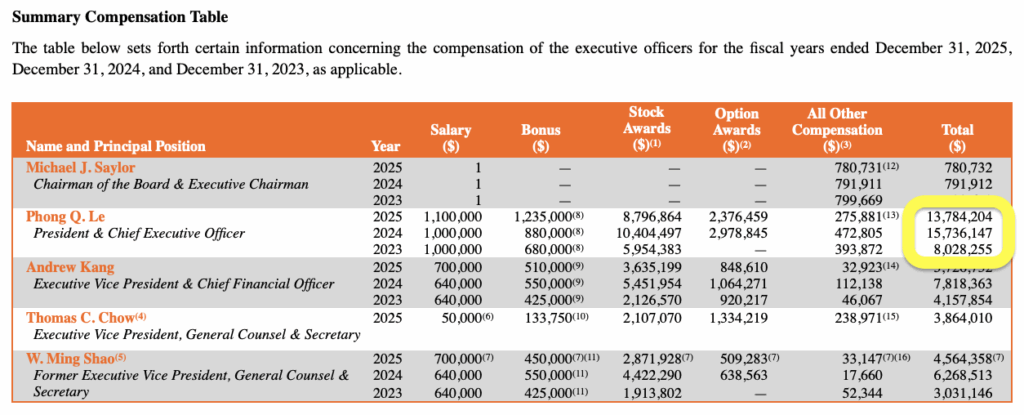
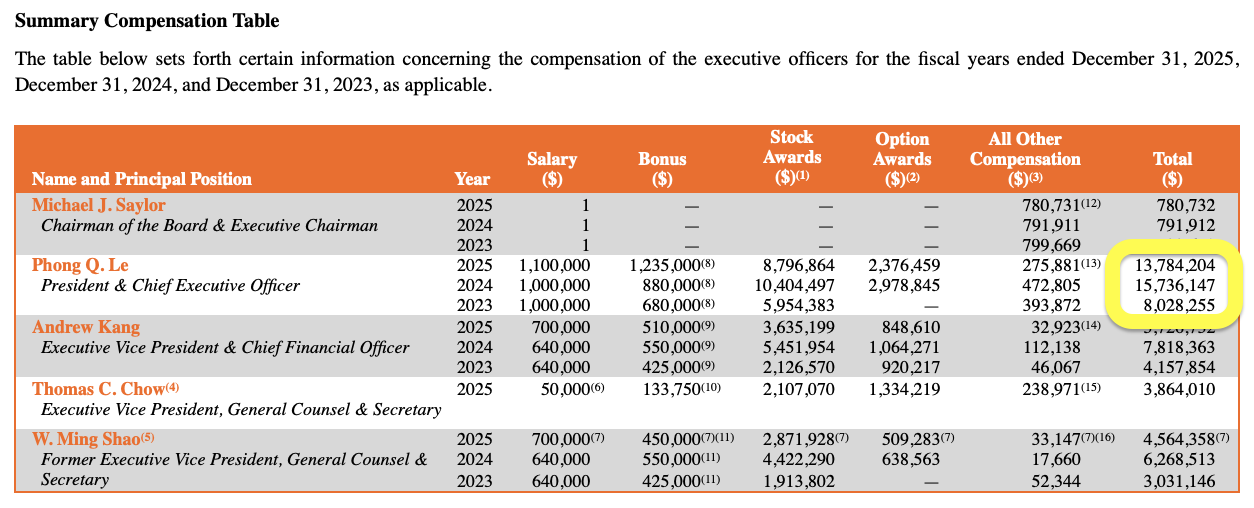
Strategy (formerly MicroStrategy) CEO Phong Le just bought $5,467 of his company’s STRC preferred shares for two of his children. The same man earned over $37 million running the company over the past three years, including $13.7 million in total executive compensation during fiscal 2025 alone.
Not that it makes the figure any better, but all three minor children technically held STRC before May 22. Together, they hold 186 STRC shares, worth $18,600 combined.
Alongside founder Michael Saylor, Le has spent the past year pitching STRC to retail investors as a supposed competitor to high-yield bank accounts and money markets. Le’s 11.5% dividend-paying, variable-rate stock has a market cap of $10.4 billion — about four-fifths of which is owned by non-accredited, retail investors.
Le disclosed his May 22 familial purchases on a SEC Form 4 dated May 26. He bought 50 STRC shares at $99.41 for Minor Child 1, plus 5 shares at $99.37 for Minor Child 3.
BitcoinTreasuries.NET celebrated the filing, “Bitcoiner dad securing the future for his kids.”
Quite the gift from the Strategy CEO who made $37 million
Strategy’s 2025 financials, filed with the SEC on April 28, list Le’s 2025 total compensation at $13,784,204. Specifically, his package breakdown was $1.1 million in salary, $1.235 million in bonus, $8.8 million in stock awards, and $2.38 million in option awards.
In other words, Le’s gift to his children works out to less than one one-hundredth of his 2025 stock awards alone.
His 2024 total was slightly higher, $15.74 million. That was mostly due to the higher closing price of Strategy’s common stock, MSTR, in 2024 versus 2025. In 2023, Le received $8 million.
Read more: Strategy’s BTC binge has cost it $1 billion in expenses
Le has also bought STRC for himself, although not in quantities that would come anywhere close to his level of compensation, let alone net worth. On March 19, he bought 2,509 STRC shares at $99.62, a $250,000 open-market trade.
Trivial relative to his personal fortune, he told podcaster Natalie Brunell that he wanted to “experience” STRC, likening its monthly dividends to a paycheck.
CEO whose common stock lost 58% in 12 months
STRC is a perpetual preferred share that pays a monthly dividend and is quasi-pegged at $100, even though it has traded as low as $90.52 per share on the Nasdaq. In its private debut, Strategy priced its public offering at $90 per share on July 24, 2025.
To encourage bids up to $100 per share, Strategy has hiked the monthly dividend rate seven times since launching STRC, from 9% to 11.5% today.
Le personally owns 8,009 STRC, 6,000 Strife, 4,500 Stride, and 22,923 MSTR common shares.
STRC closed at $99.47 on Tuesday, just below its $100 par. The company’s MSTR common stock has declined 11% over the past six months and 58% over the past 12 months.
The company’s massive stockpile of bitcoin (BTC) were acquired for an average $75,700 cost basis — slightly above the current market — excluding $1 billion of costs while running that acquisition strategy for the past six years.
Got a tip? Send us an email securely via Protos Leaks. For more informed news and investigations, follow us on X, Bluesky, and Google News, or subscribe to our YouTube channel.


Block’s Cash App has begun a phased rollout of USDC support, turning the app into a stablecoin payment rail for tens of millions of U.S. retail users.
Summary
- Cash App is adding USDC deposits, withdrawals and payments for its roughly 60 million users
- About 25% of users have access now, with full coverage targeted by the end of the week
- The feature supports Solana, Ethereum, Polygon and Arbitrum, with on-chain mis-sends remaining irreversible
Block’s Cash App is gradually enabling stablecoin payments for its nearly 60 million users, starting with a restricted launch that currently reaches around a quarter of the customer base and is expected to extend to 100% availability within the week, according to the company’s communications. The new feature allows users to deposit and withdraw USD Coin (USDC), moving value freely between external self-custodial wallets and their Cash App balances, and to use the stablecoin explicitly as a payment and settlement tool rather than a savings or yield product.
At launch, Cash App’s USDC functionality supports four major blockchain networks: Solana, Ethereum, Polygon and Arbitrum, giving users access to both high-throughput, low-fee rails and the more established Ethereum mainnet environment. The company is emphasizing that on-chain payments are irreversible by design, warning that sending USDC to an incorrect address or over an unsupported network will result in permanent loss of funds, a sharp contrast with the reversibility many users associate with card payments or bank transfers.
From bitcoin-first to stablecoin reality
The rollout marks a pragmatic shift for Block, whose co-founder and CEO Jack Dorsey has repeatedly framed bitcoin as the company’s long-term priority and the native money of the internet. In prior public remarks, Dorsey has said the firm’s strategic focus would lean heavily toward bitcoin, from mining hardware to self-custody solutions and Lightning-driven payments. The decision to integrate USDC at scale through Cash App reflects the reality that, in day-to-day commerce, demand for dollar-pegged stablecoins has outpaced consumer interest in spending volatile assets.
By treating USDC as a transactional settlement instrument—rather than dangling yield or speculative upside—Cash App is positioning its stablecoin feature squarely inside a regulatory narrative that views stablecoins as payment tools, not investment contracts. Users can top up USDC from an external wallet on a supported chain, move it into or out of their Cash App dollar balance, and route payments through stablecoin rails without needing to think about FX or crypto price swings.
Consumer payments meet on-chain finality
For Cash App’s user base, the integration opens a direct bridge between mainstream fintech and public blockchains. Someone paid in USDC on Solana, Polygon, Ethereum or Arbitrum can now pull those funds into Cash App and spend in the familiar fiat environment, while merchants or individuals who want to settle in stablecoins can push value out to external addresses on the same networks.
The downside is that users are now exposed to classic on-chain risks. Mis-typing an address, choosing the wrong network, or sending to a contract that does not accept USDC will not trigger a support ticket reversal; the funds are gone. Cash App’s messaging stresses this irreversibility, underscoring that while the company is moving closer to crypto-native infrastructure, it cannot rewrite the fundamental properties of the networks it supports. For Block, the phased rollout allows it to test how a largely retail audience handles those constraints at scale, balancing its long-standing bitcoin maximalist instincts with the market’s clear preference for dollar-stable, programmable money.
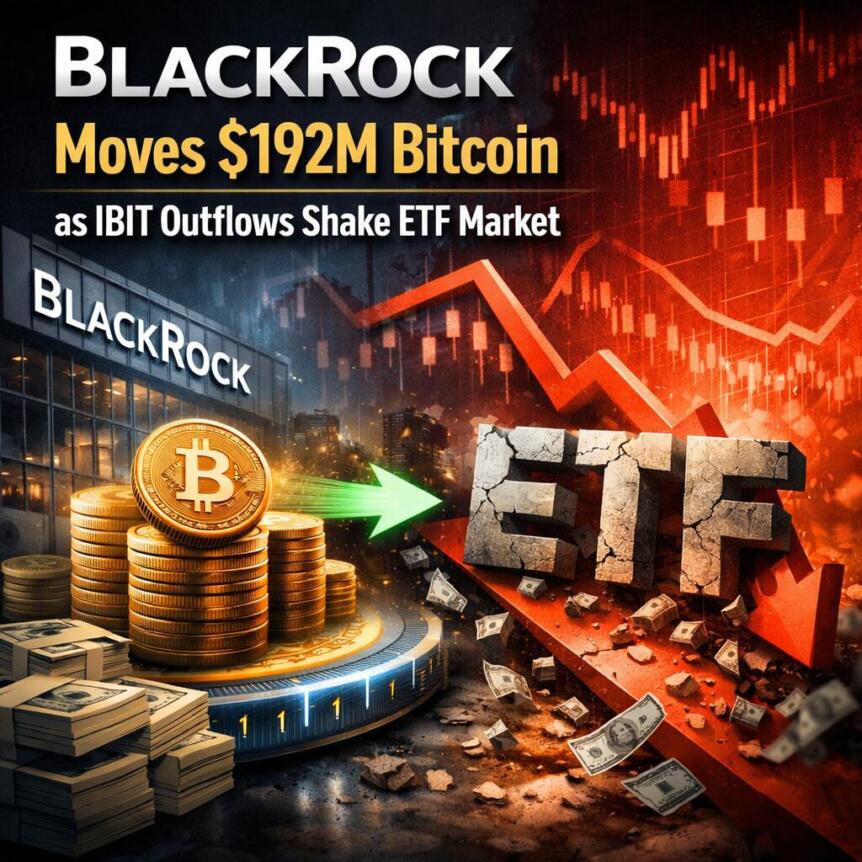
BlackRock’s Bitcoin movements drew fresh market attention after a large Coinbase Prime transfer matched heavy IBIT activity. The asset manager moved 2,538 BTC worth over $192 million on Tuesday. The shift followed a major block trade and fresh outflows from its spot Bitcoin ETF.
BlackRock Transfers Bitcoin after Large IBIT Trade
BlackRock transferred 2,538 Bitcoin between Coinbase Prime-linked wallets, according to data from Arkham Intelligence. The transfer was valued at about $192.53 million. It came during a busy session for BlackRock’s iShares Bitcoin Trust ETF.
The wallet activity followed a large IBIT block transaction on May 26. Trading data showed 29,212,864 IBIT shares changed hands at $43.16 each. The full transaction was valued at nearly $1.26 billion.
The block sale did not create a major price shock for IBIT. The fund only recorded a small decline during the trading session. However, the size of the trade placed BlackRock’s Bitcoin ETF flows back in focus.
Bitcoin ETF Outflows Hit BlackRock and Wider Market
Farside Investors’ data showed that IBIT recorded $192.4 million in outflows on May 26. The figure matched the value range of BlackRock’s related Bitcoin transfer. Therefore, the movement likely reflected fund settlement and portfolio activity.
IBIT also recorded $103.7 million in outflows on May 21. It then posted another $68.9 million in outflows on May 22. These figures marked a weaker stretch for the leading spot Bitcoin ETF.
The wider U.S. spot Bitcoin ETF market also faced redemptions on May 26. Total net outflows reached $333.6 million across the market. Fidelity’s FBTC lost $57.7 million, while Bitwise’s BITB lost $28.8 million.
IBIT Keeps Lead Despite Bitcoin Fund Pullback
Grayscale’s GBTC also reported $41.3 million in outflows during the same session. The numbers showed pressure across several major Bitcoin ETF products. Still, IBIT remained the dominant fund by total historical inflows.
Since launch, BlackRock’s IBIT has attracted $64.58 billion in cumulative inflows. Its average daily inflow stands at $108.7 million. Its highest single-day inflow exceeded $1.11 billion.
The latest outflows came after months of strong demand for U.S. spot Bitcoin ETFs. These funds launched in January 2024 after regulatory approval. They gave traditional market participants direct exposure to Bitcoin through exchange-listed products.
Bitcoin ETFs have since become a major channel for institutional crypto allocation. BlackRock’s IBIT has led that trend through strong liquidity and large inflows. However, recent redemptions show that large holders can still adjust exposure quickly.
The Coinbase Prime transfer does not confirm a direct sale of Bitcoin. It shows movement between custody-linked wallets during a period of ETF redemptions. Still, the timing connected the transfer to broader IBIT activity.
Market reaction stayed measured after the large IBIT block trade. Bitcoin and ETF pricing absorbed the activity without sharp disruption. That response suggested strong secondary market depth around the fund.
BlackRock’s latest Bitcoin movement now adds context to spot ETF flow trends. The transfer showed how ETF redemptions can create large custody movements. Even so, IBIT’s cumulative lead remains intact despite the short-term pullback.


Fold Holdings has started issuing its Fold Bitcoin Credit Card to selected waitlist members, adding a consumer credit product to its growing Bitcoin rewards and workplace payments business.
Summary
- Fold has started issuing its Bitcoin Credit Card to select waitlist members, offering 1.5% back in Bitcoin and up to 4% through rewards and partner offers.
- The card runs on Visa and Stripe Issuing, with physical and virtual cards available through the Fold App for Apple Pay and Google Pay.
- The launch comes after Fold missed Q1 2026 earnings expectations and follows its Bitcoin bonus program for workplace compensation.
According to a modified company release, Fold is rolling out the card in batches over the coming weeks and months. The product runs on the Visa network, uses Stripe Issuing, and gives users bitcoin rewards on everyday card spending.
Fold starts Bitcoin credit card rollout
Fold said the card offers a base rate of 1.5% back in bitcoin on purchases. The company said users can earn up to 4% back through behavior-based rewards and targeted offers from Fold’s partner network.
The release said cardholders who pay their bill in bitcoin receive an extra 0.5% back on that payment. Fold also said the card is accepted at 175 million Visa merchants.
Physical cards have started shipping to active holders, according to Fold. New applicants will receive a physical card after approval, while approved users can access a virtual version through the Fold App for Apple Pay and Google Pay.
Visa, Stripe are issuing a new power card
Fold said the card includes real-time bitcoin reward tracking inside its app. The company also listed lock-and-unlock controls, fraud alerts, and payment options via a Fold Checking account or an external bank.
Fold co-founder and CEO Will Reeves said in the release that the launch was a “pivotal milestone” for the company. Reeves said the card avoids “complicated points systems” and instead gives users a direct way to earn bitcoin on purchases.
The rollout gives Fold another consumer-facing product at a time when the company is trying to connect bitcoin rewards with everyday financial activity.
Meanwhile, Fold Holdings recently reported first-quarter 2026 results that missed analyst expectations. The company reported earnings per share of -$0.59, compared with analyst forecasts of -$0.13.
Fold’s revenue also came in below expectations. The company generated $5.59 million in revenue, while analysts had expected $10.09 million. Those results placed more attention on Fold’s product launches as investors reviewed the company’s ability to grow revenue and narrow losses.
Fold also pushes Bitcoin bonuses
Fold’s Bitcoin credit card launch comes after Fold Holdings previously rolled out a Bitcoin-based bonus program for employees, as covered by crypto.news. Fold said the product expands its effort to bring bitcoin into workplace compensation.
The company said the program was launched through Fold Business, its enterprise arm. Fold said it allows companies to distribute recurring bonuses in bitcoin without managing custody or compliance themselves.
Reeves said employers needed a bonus tool that was simple enough for HR and finance teams to use without requiring them to become Bitcoin experts. Fold said it handles dollar-to-bitcoin conversion and distribution, while employers can set bonus amounts in fiat terms and still offer workers bitcoin exposure.

Key Takeaways
- PDD Holdings shares plummet 10% following disappointing Q1 earnings results.
- Revenue climbed 11% year-over-year while net income declined 15%.
- Rising operational costs and supply chain investments pressure profit margins.
- Transaction services revenue increased 20%, demonstrating platform strength.
- Company maintains robust liquidity position with RMB436.1 billion in cash reserves.
Shares of PDD Holdings (PDD) experienced significant downward pressure following the release of first-quarter financial results that revealed declining profitability despite topline expansion. The e-commerce platform operator saw its stock tumble 10.85% to close at $86.16, retreating from intraday levels near $97. The decline came as investors reacted to earnings that demonstrated revenue momentum but highlighted mounting cost pressures.
First Quarter Earnings Fall Short Despite Topline Beat
PDD Holdings disclosed total quarterly revenue of RMB106.2 billion for the three months ending March 31, 2026. This figure represented an 11% year-over-year improvement compared to RMB95.7 billion recorded in the corresponding period of 2025. Despite this revenue acceleration, profitability metrics disappointed investors and triggered the selloff.
Net income allocated to ordinary shareholders contracted 15% to RMB12.5 billion for the quarter. The company’s non-GAAP net income similarly declined 17% to RMB14.1 billion, down from RMB16.9 billion in the prior-year quarter. This earnings compression overshadowed the positive revenue momentum and drove negative sentiment.
Diluted earnings per American Depositary Share came in at RMB8.48, representing a decline from RMB9.94 posted in Q1 2025. On a non-GAAP basis, diluted EPS per ADS decreased to RMB9.51 from RMB11.41 year-over-year. The earnings shortfall triggered significant selling pressure on PDD Holdings shares throughout the trading session.
Topline Momentum Offset by Escalating Operating Expenses
PDD Holdings demonstrated continued strength in its core revenue streams throughout the reporting period. Transaction services revenue surged 20% to reach RMB56.3 billion, up from RMB47.0 billion in the year-ago quarter. Online marketing services and additional revenue streams contributed RMB49.9 billion to the quarterly total.
However, the company confronted elevated cost pressures across multiple operational areas. Total cost of revenues expanded 15% to RMB46.9 billion compared to RMB40.9 billion in the prior year. These increased expenses stemmed primarily from higher fulfillment costs, expanded server infrastructure, bandwidth requirements, and payment processing charges.
Operating expenses climbed to RMB39.8 billion versus RMB38.6 billion in the comparable quarter. Research and development spending increased notably to RMB4.4 billion from RMB3.6 billion as the company invested in platform capabilities. Sales and marketing expenditures held relatively stable at RMB33.8 billion year-over-year.
Strategic Supply Chain Investments Drive Long-Term Transition
PDD Holdings characterized the quarterly results as marking the beginning of a strategic business transformation. Company leadership indicated intentions to allocate additional capital toward supply chain infrastructure development. The organization also outlined plans to expand its proprietary brand portfolio as part of its long-term growth strategy.
Despite the net income decline, operating profit expanded 22% to RMB19.6 billion during the quarter. Non-GAAP operating profit registered a 15% increase to RMB21.1 billion compared to RMB18.3 billion in the prior year. Nevertheless, the bottom-line earnings weakness maintained downward pressure on the stock following management’s commentary.
The company concluded the quarter with RMB436.1 billion in combined cash, cash equivalents, and short-term investment holdings. This represented an increase from RMB422.3 billion held at year-end 2025. The substantial liquidity position provides PDD Holdings with financial flexibility to execute its supply chain enhancement initiatives and platform evolution strategy.


- Bitcoin price fell to below $75,000 on Wednesday, touching $74,600.
- ETF outflows and broader market headwinds mean downside pressure remains.
- Analysts say the current price outlook includes a “dangerous divergence”.
Bitcoin briefly dipped below the $75,000 mark on Wednesday, extending losses from recent highs.
The decline came as selling pressure persisted and spot ETF outflows continued for a seventh straight session.
BTC could rebound sharply if bulls establish sustainable support near current levels. Otherwise, analysts warn that further downside may follow amid a growing divergence between market optimism and actual capital inflows.
The crypto bellwether traded around $75,175 at the time of writing, down 1.29% over the past 24 hours and nearly 3% lower for the week.
Bitcoin tests support below $75k
The week started poorly for Bitcoin as recent gains toward $78,000 evaporated amid persistent geopolitical and macroeconomic headwinds.
On Wednesday, BTC fell to an intraday low of $74,600 during Asian trading hours, testing a support zone that has intermittently held since the asset’s latest recovery.
The move coincided with continued withdrawals from spot Bitcoin exchange-traded funds.
According to SoSoValue, Bitcoin spot ETFs recorded net outflows of $334 million on May 26.
The figure marked the seventh consecutive day of net redemptions, reinforcing downward pressure on price despite periodic spot-market buying.
Bitcoin price outlook: analysts warn of “dangerous divergence”
Market participants noted that Wednesday’s decline remained relatively orderly, with volatility lower than during previous sell-offs.
Liquidity continued to cluster in the $72,000-$76,000 range, where buyers repeatedly emerged to absorb intraday selling pressure.
Still, persistent ETF outflows and profit-taking from recent highs continue to tilt the near-term outlook to the downside.
Analysts and on-chain researchers have also raised caution flags over weakening demand dynamics.
Crypto investor and analyst Axel Adler Jr. shared concerns on X about what some market watchers describe as a “dangerous divergence” between rising optimism and fading capital inflows.
Bitcoin took 5 weeks to rebuild its structure.
It took 3 weeks to erase it.
Structure Shift: +0.78 -> -0.56 STH flows flipped to loss-taking for the first time in 6 weeks.
Now one level decides the next move:$74.5K.
Floor or trapdoor?
☕️ Morning Brief #178 👇… pic.twitter.com/92i4DG0sZ2
— Axel 💎🙌 Adler Jr (@AxelAdlerJr) May 27, 2026
That view was echoed by a CryptoQuant analyst, who argued that improving bullish sentiment has not been matched by fresh money entering the market.
“This often reflects late-stage speculative behavior: traders become optimistic after a recovery, long positioning increases, but actual capital participation fails to expand,” crypto analyst @MorenoDV wrote.
The analyst added that price strength built on weak inflows may remain vulnerable to sharp reversals.
Meanwhile, analysts at Bitfinex said Bitcoin’s current reaction to ETF outflows differs from earlier market downturns.
“The breakdown that took $BTC to 60k in February is not having the same impact on the market today. ETF outflows are running -$700M a day, close to the February prints that drove price from $100K to $70k. This time, the price is holding. An unidentified bid is absorbing it,” they wrote.
From a technical perspective, Bitcoin now appears caught between the risk of a deeper retracement toward $70,000 and the possibility of renewed bullish momentum.
If buyers regain control, recent highs in the $78,000-$83,000 range could come back into focus.
Crypto World
Elon Musk could become a top 5 corporate bitcoin (BTC) holder if Tesla and SpaceX merge


Elon Musk could soon control one of the largest corporate bitcoin holdings in public markets if Tesla and SpaceX ultimately merge, according to reports surrounding ongoing internal discussions about combining the companies.
CNBC reported Tuesday that Musk has discussed with colleagues the possibility of folding Tesla and SpaceX together, citing people familiar with the talks. A current Tesla employee told CNBC that many workers at the electric vehicle company have long expected such a transaction to eventually happen and that the possibility is openly discussed internally.
Another person close to the company reportedly said growing overlap between the businesses — particularly around power infrastructure and computing constraints tied to artificial intelligence — has increased collaboration between the firms.
The potential merger would also create one of the largest corporate bitcoin treasuries in the world.
Tesla currently holds 11,509 bitcoin, while SpaceX owns 18,712 bitcoin, according to public disclosures and blockchain treasury tracking data. Combined, the companies would control 30,221 bitcoin worth roughly $3.3 billion at current prices.
That total would make the merged company the fifth-largest public corporate holder of bitcoin globally.
The combined holdings would trail only Michael Saylor’s Strategy (MSTR), bitcoin investment firm Twenty One Capital (XXI), Jack Mallers’ bitcoin-focused venture and bitcoin mining companies Metaplanet and Marathon Digital Holdings (MARA.)
SpaceX is also expected to begin trading on the Nasdaq next month after obtaining a private market valuation of roughly $1.25 trillion earlier this year following its merger with Musk’s artificial intelligence company, xAI.
A combination between Tesla and SpaceX would further tighten Musk’s growing network of interconnected technology businesses spanning electric vehicles, aerospace, artificial intelligence, payments and communications infrastructure.
Neither Tesla nor SpaceX has publicly confirmed merger plans.
Tesla first disclosed bitcoin purchases in 2021 and briefly accepted the cryptocurrency for vehicle payments before suspending the option over environmental concerns tied to bitcoin mining. Musk has remained one of the most influential public figures in crypto markets, often moving prices through comments on bitcoin and dogecoin (DOGE.)
Crypto World
Crypto IPOs could create massive $1 trillion market amid tokenization wave, Jefferies says


Jefferies said it expects a new wave of crypto and blockchain-related public listings as institutional adoption of digital asset infrastructure accelerates across Wall Street and the payments industry.
In a report published after its first Digital Assets Investor Conference in New York, Jefferies said it expects a surge of crypto-related public listings over the next two years and believes the sector could grow into a $1 trillion public market within five years.
The conference, which gathered executives from 35 digital asset companies alongside roughly 150 institutional investors, focused less on bitcoin price speculation and more on how blockchain systems are increasingly being integrated into traditional finance.
Jefferies said conversations with clients showed investors are becoming more convinced that blockchain technology is moving beyond experimentation and into core financial infrastructure.
“Client engagement continues to grow as focus shifts to emerging beneficiaries as banks, exchanges, asset managers, fintechs and payments companies integrate blockchain infrastructure,” the report said.
The crypto IPO market has slowed this year after a booming 2025 that saw several digital asset firms successfully go public amid rising bitcoin prices and renewed investor appetite for crypto-related stocks. The recent pullback in listings has largely tracked broader market volatility and macroeconomic uncertainty, but another wave of offerings is expected to come later this year with several crypto companies, including Securitize and Payward, the parent company of Kraken, finalizing IPO plans.
Jeffries also pointed to tokenization — the process of representing financial assets on blockchain networks — as one of the biggest drivers behind that shift. Executives at the conference said tokenized money market funds, private credit products and blockchain-based settlement systems are already moving into production following recent regulatory guidance that reduced legal uncertainty around digital assets.
The trend of Wall Street adopting blockchain technology and not focusing on the crypto prices has been a recurring theme in recent months. Giant financial institutions, such as JPMorgan, Morgan Stanley and other traditional Fintech firms, are going all-in on adopting the technology into their business model, regardless of what the price of bitcoin is doing.
In fact, tokenization and stablecoins were the main topics at Consensus Miami this year, overshadowing all other crypto-related discussions. “We’re moving into a world where essentially the entire economy is going to be tokenized,” said Joseph Lubin, CEO and founder of Consensys in Miami.
Jefferies argued that further regulatory clarity could accelerate adoption even more, particularly among heavily regulated financial institutions. The bank pointed to the proposed CLARITY Act, which would establish a broader market structure framework for digital assets in the U.S., saying that the legislation could become “the missing piece” that drives more institutional investments and pushes blockchain-based finance further into the mainstream.
‘Tech disruption’
The report also highlighted how traditional financial firms are increasingly partnering with crypto-native infrastructure providers rather than competing directly with them.
Panelists at the conference described a growing ecosystem where banks, trading platforms and payments firms use blockchain networks to reduce settlement times, improve capital efficiency and launch new financial products.
Earlier this year, tokenization firm Securitize partnered with transfer agent Computershare to help public companies issue tokenized shares directly within existing shareholder record systems, while crypto platform Bullish (BLSH), the owner of CoinDesk, agreed to acquire transfer agent Equiniti for $4.2 billion to strengthen its blockchain-based settlement infrastructure.
Stablecoins and tokenized payments were repeatedly cited as key areas of near-term growth, especially as payment companies look for ways to lower the cost of cross-border transfers and operate around the clock.
The conference featured executives from firms including Ripple, Kraken, Galaxy (GLXY), Bullish (BLSH) and Consensys.
While institutional adoption was the biggest catalyst when BlackRock first started bitcoin exchange-traded funds, how the adoption would look was among the most talked-about topics back then. Fast forward to today, and it seems these sophisticated investors are viewing the sector as a disruptive technology that can enhance their business model in the long term, rather than short-term speculative trading.
Jefferies said the discussions reflected a broader change in investor attention away from meme coins and speculative trading activity toward blockchain systems generating revenue from trading, payments, lending and tokenized financial products.
“Investors frequently overestimate the magnitude of tech disruption in the near term and underestimate it over the longer term,” the report said.
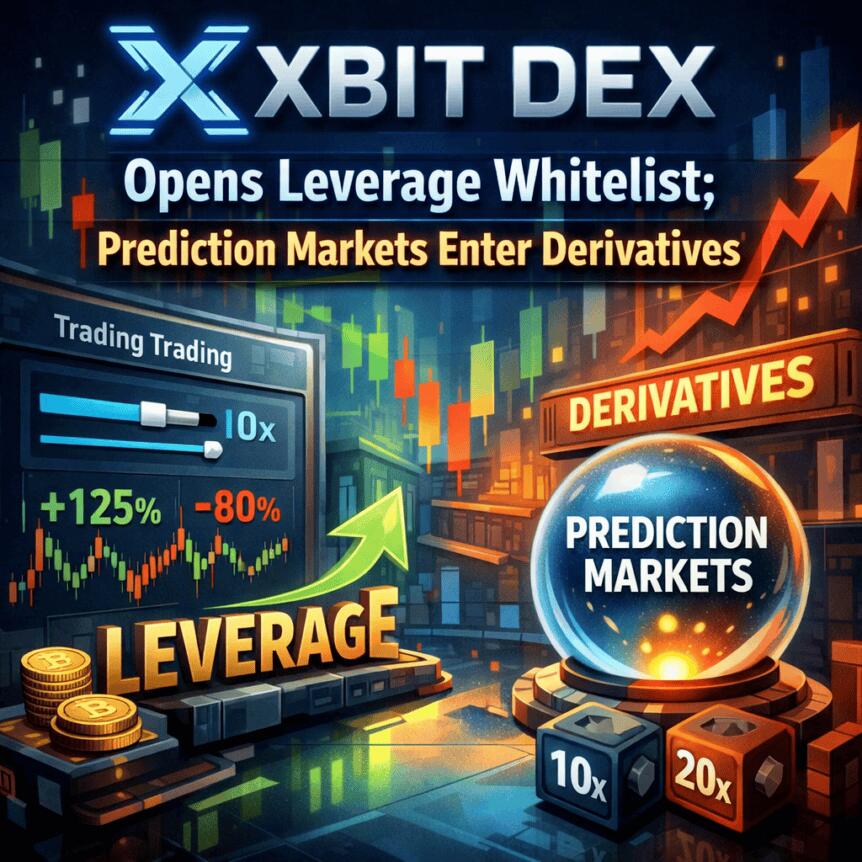
XBIT DEX is expanding the toolkit for on-chain prediction markets by introducing a dedicated leverage layer, with the 2026 FIFA World Cup serving as the initial proving ground. The platform has opened whitelist applications for Prediction Leverage, signaling a shift toward more flexible risk management in on-chain forecasts.
May 27, 2026 — The once-spot-centric world of on-chain predictions is embracing leverage as users seek ways to hedge, scale, and manage exposure across event-driven markets. Industry data show a surge in activity: March 2026 alone saw monthly trading volume north of $25 billion, a stark acceleration from the year prior. In this environment, Polymarket has emerged as the official prediction market partner for XBIT DEX, and Coinbase has broadened prediction contracts across all 50 U.S. states. Yet, even as capital floods in, the underlying product architectures have struggled to keep pace with demand.
Traditional prediction markets have largely operated on a straightforward, all-in, full-amount purchase model with settlement based on binary outcomes. Participants could not easily add to positions, hedge risk, or adjust leverage in real time. This lack of flexibility mirrors an earlier phase seen in crypto derivatives before the arrival of perpetuals in 2016, which catalyzed a surge in derivatives volumes relative to spot trading. XBIT DEX is positioning Prediction Leverage as the next evolution for on-chain predictions, building a bespoke leveraged infrastructure tailored to the unique mechanics of event contracts.
Leverage system built specifically for prediction markets
Event contracts underpin prediction markets by delivering outcomes that settle to 0 or 100. Unlike perpetuals, these contracts do not rely on continuous funding rates, which leaves a misaligned incentive structure for traditional leverage. To bridge this gap, XBIT DEX has devised an independent leveraged lending framework that borrows against authentic order flow from external prediction markets. Instead of funding rates, leverage openings accrue borrowing interest that adjusts dynamically with supply and demand. The design also emphasizes resilient risk controls: extreme-value liquidation mechanics and adaptive leverage management aimed at handling the pronounced volatility as contracts approach settlement.
The result is a system that can accommodate leveraged exposure in a domain where payouts hinge on discrete, binary outcomes, while still preserving the trustless, on-chain nature of the platform. XBIT DEX describes the approach as a necessary evolution to unlock a broader range of trading strategies within event-driven markets, enabling users to hedge, scale, and diversify positions without leaving the on-chain ecosystem.
World Cup as the testing ground for Prediction Leverage
Prediction markets span politics, finance, and sports, but the World Cup offers a combination of settlement certainty, high event density, and concentrated order flow that suits automated, algorithmic trading. Sports events provide clear outcomes and synchronized global viewership, which translates into more robust liquidity for event-based derivatives. The 2026 FIFA World Cup, kicking off on June 11, is the largest edition to date, with 48 teams, 104 matches, and a 39-day schedule. This environment is being used to seed XBIT DEX’s initial Prediction Leverage offerings, featuring 2x to 5x dynamic leverage that adjusts in real time in response to market conditions.
As part of the rollout, XBIT DEX has already begun offering leveraged prediction trading around selected World Cup teams, with the leverage settings designed to respond to shifts in liquidity and risk. The white-label testing phase is specifically designed to validate the mechanics and guardrails before broader platform-wide deployment.
Whitelist rollout and incentives
Access to Prediction Leverage is currently limited to a whitelist, operating on a first-come, first-served basis. Interested traders can apply at app.xbit.com/whitelist, with eligibility unlocked by completing a series of trading milestones. Early engagement appears strong, with more than 1,700 users already on the waitlist, signaling demand for a more sophisticated toolkit in on-chain predictions. The plan is to open platform-wide access in the lead-up to the World Cup kickoff, aligning product readiness with a surge of global interest in event markets.
In conjunction with the whitelist, XBIT DEX launched a two-week trading campaign running from May 26 through June 10. The promotion includes a 35,000 USDC prize pool distributed across three categories: Early Bird Trading, Referrals, and a Leaderboard. Details are published on the whitelist page, offering participants a structured incentive to explore the new leverage features while the platform validates its risk controls and performance in a live environment.
About XBIT DEX
XBIT DEX markets itself as a decentralized aggregated trading platform that brings together multiple on-chain liquidity sources to deliver low-slippage trading across a suite of products. The platform already supports perpetual contracts, prediction markets, and plans to enable a U.S. stock trading avenue for real-world assets (RWA), with more than 150 tokens accessible to traders. By leveraging its established derivatives infrastructure, XBIT DEX positions itself as the first DEX to introduce a dedicated leverage layer for prediction markets, aiming to unlock more nuanced trading strategies for participants who want to hedge, speculate, or arbitrage across event-driven outcomes.
For more information about the platform and its offerings, readers can visit the official site at XBIT DEX Official Website.
As the World Cup shape and global participation evolve, the industry will watch closely to see how the new Prediction Leverage feature performs under real-world liquidity pressures and settlement dynamics. If successful, the model could redefine how traders approach on-chain event markets, moving beyond binary bets toward more sophisticated risk management and strategy design within the predictable cadence of major sporting events.
Readers should keep an eye on the whitelist progress and the platform’s broader rollout timeline, as well as any regulatory developments that could influence leverage-enabled prediction markets and cross-border capital flows. In the near term, the World Cup stands as a critical proving ground for whether prediction markets can scale with financial innovation while maintaining robust risk controls and transparent settlement.

Finolex Industries shares jump 8% after Q4 profit surges 59% YoY; stock rallies 20% in a week

XLM price jumps 8% as Stellar and DTCC partner to bring tokenized securities on-chain

Canelo Alvarez targeted for unification fight if he beats Christian Mbilli in comeback


-

 Crypto World6 days ago
Blockchain.com files with SEC for U.S. IPO
-

 Fashion5 days ago
Holiday Weekend Open Thread – Corporette.com
-

 Crypto World6 days ago
Bitcoin Accumulation Weakens as BTC Realized Losses Hit $600M
-

 Tech2 days ago
Microsoft’s quiet Claude Code retreat and the real cost of enterprise AI
-

 Business5 days ago
Dell Technologies DELL Stock Surges 15% on AI Server Momentum and Analyst Upgrades in 2026
-

 Crypto World4 days ago
Robinhood crypto COO Tanya Denisova exits
-

 Business3 days ago
NYT Strands Answers May 24 2026 Revealed for Puzzle No. 812 Theme Summer Essentials
-

 Politics5 days ago
Makerfield: a tale of two social-media histories
-

 Crypto World5 days ago
Space X IPO Is ‘Bad News’ for Tech Stocks: But What About Bitcoin?
-

 Business6 days ago
Trump Invests $1M-$5M in Kura Sushi USA Chain With 27 California Locations
-

 Crypto World6 days ago
MicroStrategy’s Saylor Says Miners No Longer Set Bitcoin Price, Another Force Has Taken Over
-

 Tech6 days ago
WhatsApp ads could make Irish debut after discussions with DPC
-
 NewsBeat6 days ago
Charity run by Reform leader Malcolm Offord accused of ‘law breaking’ over Scottish registration
-
Tech7 hours ago
The Samsung pay deal is the moment Korean unions changed register
-
 Tech5 days ago
A 0.12% parameter add-on gives AI agents the working memory RAG can’t
-

 Crypto World5 days ago
AI infrastructure race heats up as IREN pitches full-stack strategy, WhiteFiber lands $160M deal
-
 Crypto World2 days ago
Nvidia (NVDA) CEO Calls on Super Micro to Strengthen Export Controls Amid Smuggling Probe
-

 Tech6 days ago
You Can Now Add ChatGPT To PowerPoint
-

 Tech2 days ago
Westone Audio and Etymotic Acquired by Fidelity Collective in Major IEM Market Move
-

 Sports6 days ago
2026 CJ Cup Byron Nelson leaderboard: Brooks Koepka finds putting stroke in Round 1
You must be logged in to post a comment Login