

Crypto World
Grayscale shifts $112m in Bitcoin to Coinbase Prime amid ETF flow churn



Grayscale has transferred roughly $112 million in Bitcoin to Coinbase Prime, adding to a steady drumbeat of institutional-sized flows hitting centralized venues this year.
Summary
- Grayscale sent 1,530.704 BTC to Coinbase Prime worth about $112m in one hour.
- The move follows earlier multi hundred million dollar transfers tied to ETF redemptions.
- On chain data again puts Arkham in the middle as watcher of institutional flows.
Grayscale deposited 1,530.704 Bitcoin into Coinbase Prime worth approximately $112 million in the last hour, according to blockchain tracking from Arkham relayed by ChainCatcher.
The transfer went from wallets attributed to Grayscale to Coinbase’s institutional brokerage platform, underscoring how large asset managers now routinely route size through prime venues rather than retail‑facing exchanges.
Arkham’s dashboard shows the Grayscale entity consolidating and then pushing out a series of large UTXOs that sum to just over 1,530 BTC, with ChainCatcher reporting the tranche moved within a single hour window on May 28. At prevailing prices around the low‑$70,000 range for Bitcoin on major spot venues, that haul comes out near the $112 million mark cited in the ChainCatcher data feed.
Grayscale’s pattern of Coinbase flows
This is hardly the first time Grayscale has funneled substantial Bitcoin to Coinbase-linked infrastructure.
Back in January 2024, the firm shifted about 4,000 BTC, worth roughly $183 million at the time, from the Grayscale Bitcoin Trust to Coinbase Prime deposit addresses as spot ETF products went live and redemptions kicked in, according to a prior crypto.news report that also cited Arkham Intelligence data.
Additional transfers of similar scale have surfaced around ETF rebalancing windows, with on chain data showing roughly $200 million in BTC moving from Grayscale-controlled wallets to Coinbase Prime as new U.S. products began trading in early 2024. In those earlier episodes, Coinbase Prime functioned as the operational bridge between trust‑held coins and the liquidity required to meet creations, redemptions, or secondary market selling as fee pressure intensified in the spot Bitcoin ETF race.
Arkham has effectively become the real‑time tape for these institutional maneuvers. The analytics firm has also flagged large Coinbase Prime movements from other giants, including GameStop’s 4,710 BTC treasury shift worth about $420 million earlier this year, as chronicled in a crypto.news weekly recap.
Institutional flows, ETF mechanics and market pressure
Coinbase Prime now sits at the center of institutional Bitcoin plumbing, handling flows not only from Grayscale but also from BlackRock, SpaceX and other large balance sheet holders documented by on chain sleuths. BlackRock’s ETF wallets, for instance, moved 416.654 BTC and 8,513 ETH worth about $49 million into Coinbase Prime in April, according to Arkham data referenced in a separate crypto.news report.
SpaceX, meanwhile, is sitting on 8,285 BTC worth roughly $637 million in Coinbase Prime custody, making Elon Musk’s rocket company one of the largest identifiable private corporate holders of Bitcoin, as detailed in recent crypto.news coverage. Those positions, and the pipes that custody them, matter for market structure because large transfers into or out of Coinbase Prime tend to coincide with ETF share creation and redemption, OTC block activity, or internal treasury reshuffles that can bleed into spot order books.
The latest 1,530.704 BTC deposit by Grayscale fits squarely into that pattern of quiet but consequential movement. Whether the funds ultimately fuel redemptions, secondary selling, or simply rebalance the firm’s internal accounts, the transaction highlights how a handful of institutional venues and data providers now sit between trillions in notional ETF demand and a finite pool of Bitcoin liquidity.

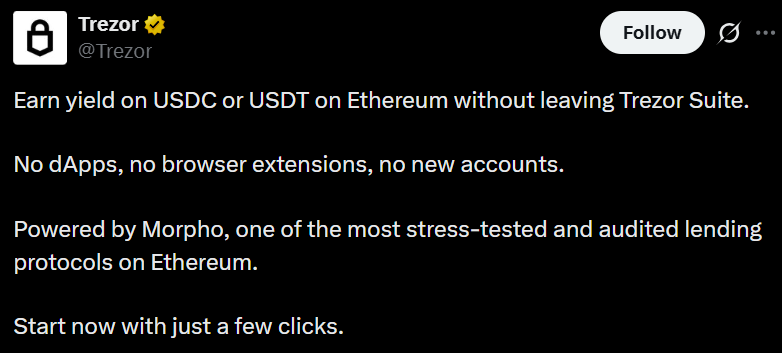
Trezor has integrated native stablecoin yield functionality into Trezor Suite, the hardware wallet provider’s desktop and mobile application, in a move that could make earning yield on stablecoins more accessible to users who have traditionally avoided decentralized finance due to its complexity and security risks.
Announced on Thursday, the feature comes through an integration with Morpho, a decentralized lending protocol built on Ethereum. The integration allows users to deposit USDt (USDT) and USDC (USDC) into pre-selected Morpho vaults directly through Trezor Suite without connecting external wallets or using separate DeFi applications.
According to Trezor, deposits, withdrawals and reward claims are signed directly on users’ hardware wallets through the company’s clear-signing interface, which displays transaction details in human-readable form on the device screen.
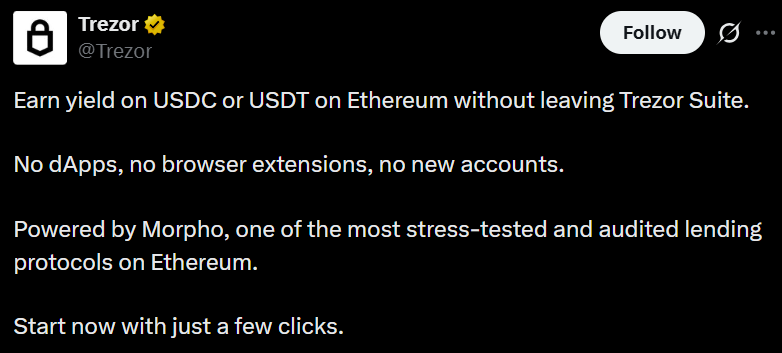
Source: Trezor
At launch, Trezor selected two Morpho vaults curated by Steakhouse Financial — USDC Prime and USDT Prime. The company said yield is generated from borrowing demand on Morpho rather than token incentive programs.
Trezor is one of the largest crypto hardware wallet providers and is widely considered the second-largest player in the market behind Ledger.
Wallet providers have recently been making a broad push to incorporate decentralized finance functionality directly into custody products while reducing the complexity traditionally associated with DeFi protocols.
Ledger already offers native stablecoin yield through Ledger Live using Kiln-powered integrations with protocols including Morpho, Aave and Compound.
Related: ERC-7943 author says institutions can’t play DeFi’s ‘pirate game’
Stablecoin yield draws growing interest — and scrutiny
Stablecoin yield strategies have become one of the fastest-growing use cases in DeFi, allowing users to earn returns on dollar-pegged assets by lending them through onchain protocols.
According to CoinMarketCap data, USDC yields can vary widely across platforms and market conditions, with some protocols offering double-digit annual returns. Supporters say stablecoin yield products offer crypto holders a way to generate passive income.
However, the strategies also carry risks, including smart contract vulnerabilities, liquidity issues and exposure to centralized stablecoin issuers or counterparties.
Ethereum co-founder Vitalik Buterin recently drew a distinction between decentralized finance and many of the yield-focused stablecoin products currently on the market. In a recent post, Buterin said that many “USDC yield” strategies remain heavily dependent on centralized issuers while failing to adequately address counterparty risk.
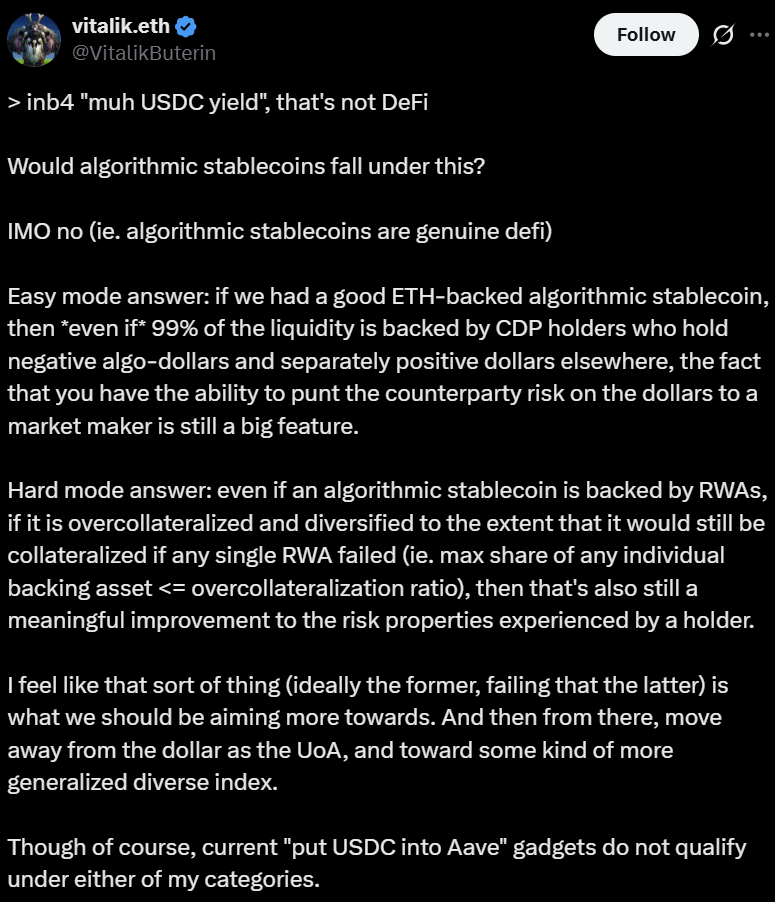
Source: Vitalik Buterin
Buterin proposed two alternative models that he said align more closely with DeFi’s decentralized ethos: Ether-backed algorithmic stablecoins and overcollateralized real-world asset-backed stablecoins.
Related: Crypto Biz: Institutions tighten their grip on Bitcoin, AI and prediction markets

Aave Labs announced on May 28 that its two subsidiaries located in the United Kingdom, Push Labs Ltd. and Push Virtual Assets Ltd., have been granted registration by the Financial Conduct Authority (FCA) to operate as crypto asset exchange providers in the UK.
The approval also gives the firms permission to issue electronic money under the UK’s Electronic Money Regulations 2011.
Aave Pushes Deeper Into Regulated Crypto Services
In a post published on X, Aave said the approvals would allow “regulated cryptoasset activities and payments infrastructure” in the UK, including stablecoin on- and off-ramping services.
The companies were assigned firm reference numbers 1031720 and 1031721, while Push’s electronic money authorization carries reference number 900984.
According to Aave founder Stani Kulechov, the setup will allow users to move fiat currency directly into the Aave ecosystem through what he described as a “vertically integrated zero-fee on-ramp.”
He also linked the FCA registration to Aave’s broader regulatory plans in Europe, referencing the company’s MiCA license through the Central Bank of Ireland for operations across the European Economic Area.
The announcement has come at a particularly busy time for the protocol. Earlier this week, it published a governance “Temp Check” proposal to deploy Aave V4 on Avalanche, including a dedicated liquidity hub for tokenized real-world assets.
Former Ava Labs executive Luigi D’Onorio DeMeo wrote on X that Avalanche had a “huge opportunity” to build on-chain capital markets around the new version of the protocol.
It has also come when the wider DeFi sector is facing renewed scrutiny after several major exploits this year. Things have gotten so bad that yesterday, OpenZeppelin co-founder Manuel Aráoz warned users on X that he now considers “all DeFi unsafe.”
He argued that AI-powered coding tools have tilted the balance too heavily in favor of attackers and named Aave as one of the platforms he no longer thinks is safe.
Aave was indeed heavily affected by an exploit in April on KelpDAO. However, recent community discussion has focused on its response, with analyst Jose Fabrega praising Aave DAO for using roughly $58 million from its treasury to help cover losses tied to rsETH depositors after the incident.
An April 25 report on the recovery effort showed Kulechov personally pledged 5,000 ETH toward the “DeFi United” initiative formed to stabilize markets after the exploit created a deficit of more than 100,000 ETH across connected protocols.
AAVE Price Slips
Despite news of the UK approval, data from CoinGecko showed that at the time of writing, Aave’s native AAVE token had dipped about 5% in 24 hours to trade at around $81.
That figure also represented a nearly 10% drop during the last seven days, as well as a 17% fall over the past month. Still, Aave remains one of the largest DeFi lending protocols, with more than $13.6 billion in total value locked (TVL).
The post Aave Secures FCA Approval for UK Crypto Operations appeared first on CryptoPotato.
Crypto World
Tether’s U.S.-focused stablecoin grows 500% in a month, but still lags Circle, Ripple, Paypal
Stablecoin giant Tether’s U.S.-focused digital dollar token USAT (USAT) expanded more than sixfold month-over-month in April, it still lags far behind its rivals.
According to the latest reserve report signed by Deloitte and published Thursday, the token’s circulating supply hit $140.8 million as of April 30, up from $22 million in March and posting a 540% growth in a month. Reserve assets backing the token rose to $141.2 million from $22.2 million in March, the report showed.
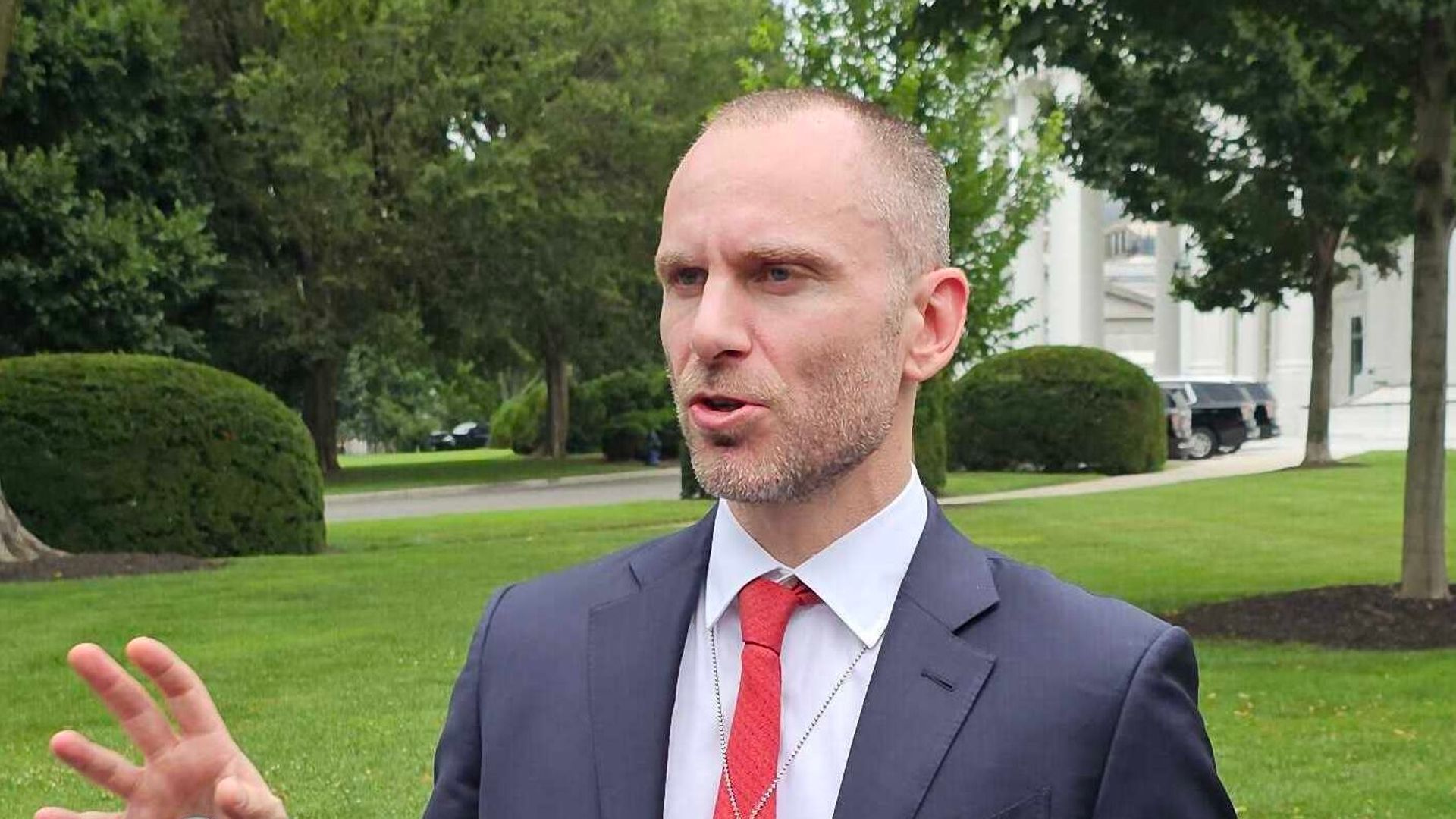
Bo Hines, CEO of Tether USAT, said the growth reflects “increased use across institutional treasury operations, settlement flows, and regulated dollar liquidity management.”
“The broader policy environment is moving in the right direction, and USAT is already operating in the kind of structure that institutions are asking for,” he added.
The stablecoin market has grown past $300 billion in value as the sector is becoming increasingly embedded into global finance and payment rails. The GENIUS Act, which created a federal framework for dollar-backed stablecoins, further boosted that trend, opening the door for banks, fintech firms and crypto companies to offer regulated digital dollars in the U.S.
USAT debuted in January and is issued by Anchorage Digital, the federally chartered crypto bank that Tether partnered with to expand into the U.S. market. Tether’s flagship stablecoin, USDT, remains the largest U.S. dollar-pegged token globally with a market capitalization near $189 billion. USDT is regulated in El Salvador and is widely used in emerging markets for payments, savings and trading.
Despite last month’s spur of growth, USAT still has a lot to catch its main rivals that eye U.S. customers.
Circle’s USDC token has a market capitalization of roughly $76 billion, while , issued by Paxos, stands at about $5.5 billion. , which debuted in 2024 December, has grown to roughly $1.7 billion.
Crypto World
Trump’s Iran Decision Sparks $350 Billion Stock Market Frenzy, But Bitcoin Extends Losses
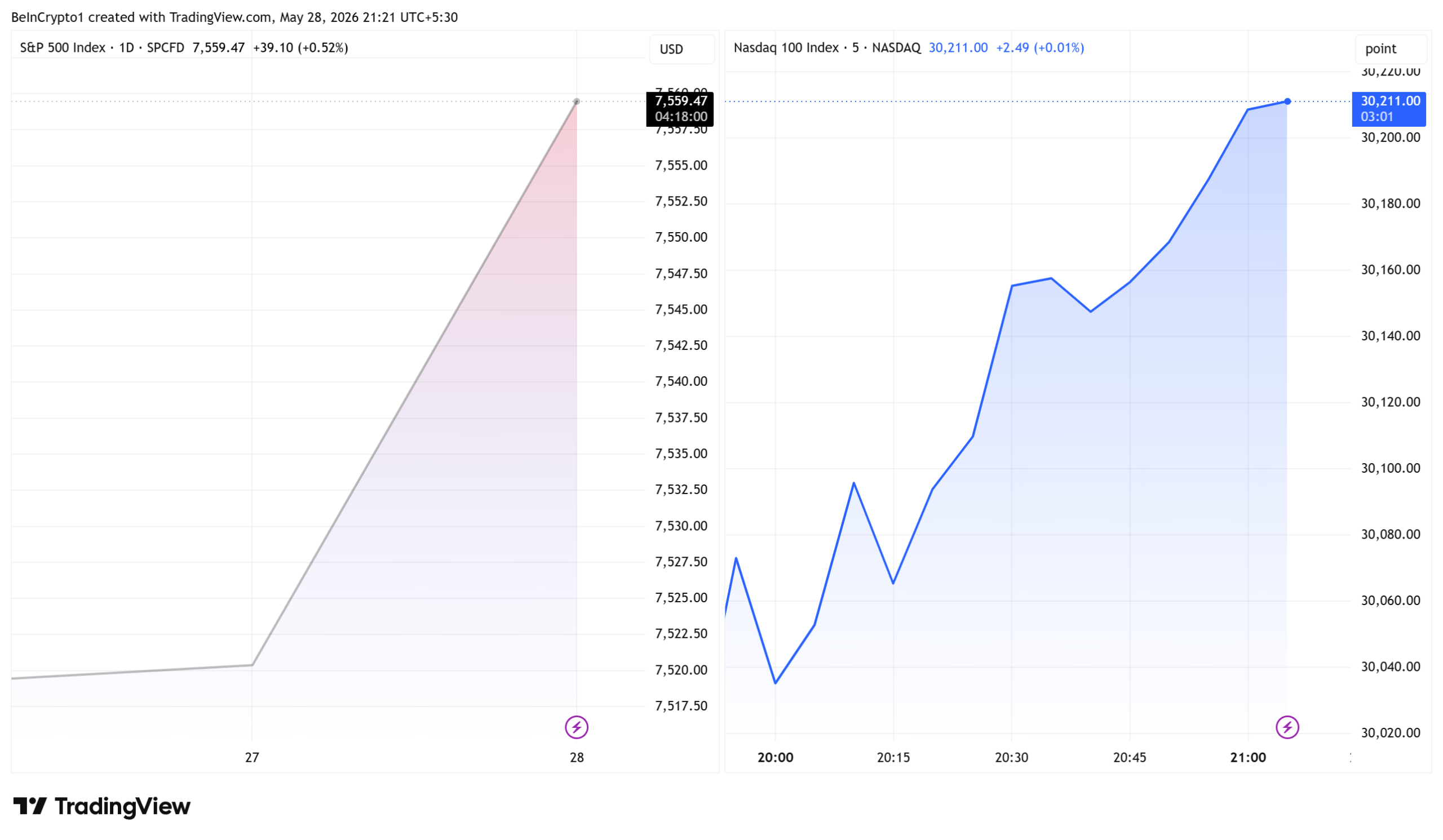
Wall Street added roughly $350 billion in market value within 15 minutes after Axios reported that US and Iranian negotiators had reached a draft ceasefire deal. Bitcoin (BTC) moved the other way, sliding more than 3% on the day.
The proposed 60-day extension still awaits final approval from President Donald Trump and Iran’s senior leadership, leaving the rally exposed to last-minute political resistance on both sides.
Wall Street Jumps on Draft Ceasefire Terms
The Axios report said US negotiators led by Steve Witkoff and Iran’s Abbas Araghchi agreed on a 60-day memorandum of understanding to extend the current truce.
The framework would launch nuclear talks, lift the US naval blockade in proportion to restored commercial shipping, and require Tehran to remove all mines from the Strait of Hormuz within 30 days.
The equity reaction was almost immediate, with the rally lifting stocks to new record highs within minutes of the headline.

“$350 Billion has been added to the US stock market in just 15 minutes after Axios reported the US-Iran deal is done and just pending Trump’s final approval,” analyst Bull Theory highlighted.
The deal also commits Iran not to pursue a nuclear weapon and prioritizes disposal of highly enriched uranium stockpiles during the first 60 days.
In exchange, Washington would discuss sanctions relief and the release of frozen Iranian funds. This is alongside a mechanism to ease humanitarian aid and goods deliveries also written into the memorandum.
However, the Axios ceasefire framework has not been signed, with reports suggesting Trump was briefed and asked for “a few days to think about it.”
“We now await final approval of the deal,” the Kobeissi Letter noted.
Reportedly, Mojtaba Khamenei, son of Iran’s supreme leader, has also withheld approval.
Bitcoin Slides as Stocks Rip
Despite the equity rally, Bitcoin extended the losses below $73,000, and was trading for $72,890 as of this writing, down nearly 5% in the last 24 hours.

The decline came on the same headlines that lifted equities to fresh records.
Sanctions and Naval Blockade Remain Active For Now
Treasury Secretary Scott Bessent said sanctions and the naval blockade remain active until a formal agreement is signed.
He warned that any party facilitating tolls in the Strait of Hormuz would face Treasury action, naming Oman specifically.
“Oman, in particular, should know that the U.S. Treasury will aggressively target any actors involved – directly or indirectly – in facilitating tolls for the Strait and any willing partners will be penalized,” he added.
Follow us on X to get the latest news as it happens
Treasury has also moved to block both Iranian airlines from landing slots and refueling, he said.
The split between stocks and BTC sharpened Mark Cuban’s hedge critique. The billionaire said this month that he sold most of his holdings between roughly $120,000 and $88,000 because the asset stopped behaving like a hedge.
“Under that logic btc should be setting new highs. Instead it now trades as a risk on asset. That’s not what btc was meant to be,” Cuban explained.
Cuban’s argument restates the longer Bitcoin inflation hedge debate that intensified through 2026 as gold rallied to roughly $5,000 while BTC slipped.
Blockstream chief executive Adam Back has countered that BTC still climbed 25% from earlier lows during the Iran escalation period.
The next move may hinge on whether Trump signs and how quickly Tehran lifts shipping restrictions.
- A clean handover could ease oil and reopen risk appetite, possibly lifting Bitcoin’s next move alongside equities.
- A collapse would likely deepen the BTC slide while testing whether stocks give back Thursday’s gain.
The post Trump’s Iran Decision Sparks $350 Billion Stock Market Frenzy, But Bitcoin Extends Losses appeared first on BeInCrypto.
Crypto World
Bitcoin Price Prediction: BTC Eyes $70K Support as ETF Demand Weakens and Bears Stay in Control
Bitcoin continues to trade under pressure after losing the critical $75K-$76K support zone, while broader market sentiment remains cautious amid weakening ETF inflows and deteriorating technical structure.
However, BTC is now approaching an important confluence of technical supports around $70K-$72K, where both trendline support and the 100-day MA could provide temporary relief for the market.
Bitcoin Price Analysis: The Daily Chart
On the daily timeframe, Bitcoin has officially broken below the key $75K-$76K support region, which previously acted as an important decision point for the market. The breakdown confirms bearish continuation after repeated failures to reclaim the descending 200-day MA near $80K-$81K.
Currently, the price is approaching a major support confluence around $70K-$72K. This region aligns with the ascending lower boundary of the broader structure, the 100-day MA around $73K, and a significant historical order block visible on the chart. Such overlapping supports often increase the probability of at least a short-term reaction or relief bounce.
If buyers manage to defend the $70K-$72K range, Bitcoin could attempt a corrective recovery back toward the broken $75K-$76K resistance zone. However, failure to hold this area may open the path toward deeper supports around $65K-$66K and potentially the broader $60K-$63K demand region.
For now, the overall market structure remains bearish unless BTC reclaims the $75K-$76K zone and stabilizes above it.

BTC/USDT 4-Hour Chart
The 4-hour chart reflects accelerating bearish momentum following the recent breakdown below the consolidation structure near $75K-$76K. Sellers remain in control, while lower highs and persistent rejection candles continue to dominate the short-term trend.
Nevertheless, Bitcoin is now entering a critical order block between $70K and $72K. This zone has historically attracted significant demand and currently overlaps with the rising trendline support shown on the chart. The market reaction here will likely determine the next major move.
A short-term bullish pullback remains possible if buyers step in around this support cluster. In that scenario, BTC could revisit the $74K-$76K region as a corrective rebound. However, if the current support fails to hold, bearish momentum could accelerate rapidly toward the $65K-$66K liquidity zone.
Therefore, the $70K-$72K area represents the most important short-term battlefield between buyers and sellers.

Sentiment Analysis
The ETF cumulative flow chart reveals an important divergence developing in the market. Despite Bitcoin attempting multiple recoveries during recent months, cumulative ETF inflows have started flattening and have recently turned weaker alongside the latest correction.
This behavior suggests that institutional demand has cooled considerably compared to previous accumulation phases. The slowdown in spot Bitcoin ETF inflows indicates reduced aggressive buying from large market participants, which partly explains BTC’s inability to sustain rallies above the $80K-$82K region.
More importantly, recent price weakness has occurred while cumulative ETF flows remain relatively stable rather than aggressively expanding higher. This signals a lack of fresh capital entering the market at current levels.
Historically, strong bullish continuation phases in Bitcoin have usually been accompanied by accelerating ETF inflows. The absence of that dynamic increases the likelihood that the current market will remain corrective in the short term.
Still, if Bitcoin stabilizes around the $70K-$72K support region and ETF flows begin strengthening again, the market could regain momentum later. Until then, weakening institutional demand, combined with a bearish technical structure, keeps downside risks elevated despite the possibility of temporary relief rallies.

The post Bitcoin Price Prediction: BTC Eyes $70K Support as ETF Demand Weakens and Bears Stay in Control appeared first on CryptoPotato.


The Ethereum Foundation, the nonprofit organization that has long served as the closest thing Ethereum has to a central steward, has been facing renewed questions about its future after a wave of high-profile departures and mounting criticism from across the crypto industry.
In recent weeks, critics have accused the foundation of becoming insular, slow-moving and disconnected from the increasingly competitive realities of the blockchain industry, reigniting a years-long debate over whether the EF still serves a meaningful role inside Ethereum’s sprawling ecosystem, or whether the network has begun to outgrow the institution that helped create it.
“The EF is completely out of touch,” said Zak Cole, a longtime Ethereum contributor, during a recent appearance on Laura Shin’s Unchained podcast. “They’re funding hippos in Asia and doing a bunch of stuff nobody in the world gives a s*** about other than Vitalik and his little cabal.”
The backlash intensified after several prominent contributors departed the foundation earlier this year, a total of eight since January 2026, fueling speculation about whether the EF was entering a period of decline at a moment when Ethereum itself has become increasingly important to the broader crypto economy.
That question carries weight because the foundation has historically occupied a uniquely influential, and often deliberately ambiguous, position inside the ecosystem.
Founded in 2014 ahead of Ethereum’s launch, the Switzerland-based nonprofit originally functioned as the network’s organizing body. In Ethereum’s earliest years, the foundation funded client teams, coordinated developers, supported research and helped shepherd the network through technical upgrades and existential crises alike.
“The Ethereum Foundation started as the single sole organization around Ethereum,” said Hudson Jameson, a former coordinator at the Ethereum Foundation now serving as head of ecosystem at Certik. “Over time it has tried to minimize itself in order to raise other organizations and coordinating entities up.”
When Ethereum launched in 2015, few other institutions existed around the network. But over the last decade, Ethereum evolved from an experimental blockchain project into the financial backbone for much of crypto, underpinning decentralized finance, stablecoins, tokenized assets and an expanding network of layer-2 chains.
Today, Ethereum secures trillions of dollars in assets across its ecosystem. Yet the institution at its center still operates more like a research nonprofit than a traditional corporate entity, embracing a culture rooted in open-source coordination, decentralization and long-term experimentation rather than aggressive execution or market competition.
As Ethereum expanded into a sprawling ecosystem of companies, developers, layer 2 networks and venture-backed startups, the foundation increasingly attempted to step back from its role as Ethereum’s de facto center of gravity, at least in theory.
“There was still this need for a central coordinator,” Jameson said, particularly around network upgrades and ecosystem-wide technical coordination.
Chris Buolos, president of Dromos Labs, the main developer firm behind decentralized exchange Aerodrome which is on top of Ethereum layer-2 network Base, said the foundation still plays a role few other organizations in the ecosystem can credibly replicate.
“The EF is at its best as a research org, a credibly neutral convener, and a leading voice for advocacy, standards and roadmap,” Buolos said. “Having a neutral party in the room when otherwise-competing teams need to align on best practices is worth more than it sometimes gets credit for.”
That balancing act, remaining influential while trying not to appear controlling, has long defined the Ethereum Foundation. It has also made the organization a recurring lightning rod during periods of market stress, leadership transitions or ideological disagreements about Ethereum’s future.
Some critics argue the foundation has failed to adapt as Ethereum matured into critical financial infrastructure.
“Ethereum is no longer a startup,” Cole said. “It’s a mature and robust ecosystem. There’s billions, trillions of dollars on the line. Livelihoods are dependent on that.”
CoinDesk reached out to a representative at the foundation for comment, and had not heard back at the time of publication.
Others have previously accused the EF of prioritizing ideology over execution and moving too slowly as rival blockchain ecosystems aggressively compete for developers, users and institutional capital.
Buolos said some of the criticism directed at the foundation is justified, particularly around product direction and coordination with Ethereum’s application layer.
“The substantive critique, that direction has been unclear and wasteful and that the app layer has been a secondary concern, is fair,” he said. “The EF has tried to be many things to many constituencies at once, which is not only difficult to execute on but takes focus away from perhaps more product-oriented players.”
Jameson, however, argued that the recurring backlash reflects a deeper identity crisis inside Ethereum itself. “The biggest reason for there to be hoopla every time there is a communication crisis from the Ethereum Foundation is because every cycle we get new people and old people leave,” Jameson said.
Ethereum’s tensions sometimes reflect competing visions for what the network is supposed to become, according to Jameson. Some participants view Ethereum primarily as a financial asset and market platform, while others still see it as a broader social and technical project centered on self-sovereignty, neutrality and censorship resistance.
“People think they know what Ethereum is to them,” Jameson said.
Vitalik Buterin, Ethereum’s co-founder, pushed back last week against many of the recent criticisms in a lengthy post published last week, arguing that critics fundamentally misunderstand what the Ethereum Foundation is trying to become.
“EF is not a ‘center of Ethereum,’” Buterin wrote. “Rather EF is ‘one node, with a defined purpose, alongside other nodes.’”
According to Buterin, the foundation was never intended to function as a permanent executive authority over Ethereum, nor compete with venture-backed crypto companies focused on aggressive expansion or market capture. Instead, he said the EF is intentionally narrowing its scope around what he described as Ethereum’s core values: censorship resistance, openness, privacy and security, internally referred to as “CROPS.”
“The EF is choosing to use its remaining resources to pursue longevity over breadth,” Buterin wrote. “The EF focuses specifically on those activities critical to the success of ethereum as a censorship/capture-resistant, open, private and secure system, that would not happen otherwise.”
Whether the Ethereum Foundation is actually shrinking into irrelevance, or simply evolving into a smaller and more narrowly defined institution, remains an open question.
Still, Buolos said framing the foundation’s current transition as existential likely overstates the situation.
“A smaller org concentrated on the research only it can credibly do, such as post-quantum work, privacy, neutrality and other long-horizon questions that don’t have a commercial sponsor, is probably a healthier shape than the sprawl of the last few years,” he said. “The talent loss is real and the transition will be painful, but a leaner org aimed at hard problems with long timelines is useful to the ecosystem.”
But the debate itself reflects a broader reality: Ethereum today is no longer merely an experimental blockchain project. It is simultaneously an ideological movement, a financial system and a piece of global digital infrastructure. And the institution that helped build it is still struggling to define what role it should play next.
Read more: Ethereum’s identity crisis is deepening after high-profile ‘brain drain’ frustrates the community


Crypto trading firm FalconX has confidentially filed a draft S-1 registration statement with the Securities and Exchange Commission (SEC), the initial step toward a potential public listing, according to a person with knowledge of the matter.
FalconX has hired Wall Street heavyweight Cantor and other bankers to advise on its initial public offering (IPO), the person said, who spoke on condition of anonymity as the matter is private.
The California-based company’s IPO is not expected to happen until the end of the year, given market conditions, the person added. CoinDesk previously reported that Cantor was among the firms pitching FalconX for its potential listing.
Both FalconX and Cantor declined to comment.
FalconX is a brokerage and trading firm that primarily serves institutional clients, including hedge funds, asset managers, and market makers. Founded in 2018, it operates as a digital asset prime broker, providing services such as trade execution, liquidity access, credit, and clearing. In June 2022, the company raised $150 million in a Series D funding round that valued the firm at $8 billion.
Crypto firms entered 2026 expecting a strong year for IPOs after successful listings by companies such as Circle (CRCL) and Bullish (BLSH), CoinDesk’s parent company, helped rekindle investor appetite for digital-asset businesses in 2025.
Since then, however, deteriorating market conditions, weaker trading volumes and lackluster post-listing performances from newly public firms such as BitGo (BTGO) have cooled enthusiasm for additional crypto IPOs.
Several major crypto companies, including Payward, Kraken’s parent company; Ethereum software developer Consensys; hardware wallet maker Ledger, and asset manager Grayscale, have since postponed their IPO plans while waiting for market conditions to improve.
Some firms are still pushing ahead with their plans to go public. Blockchain.com said last week that it had confidentially filed for a U.S. IPO with the SEC.
Meanwhile, Securitize has agreed to merge with Cantor Equity Partners II, a Nasdaq-listed special purpose acquisition company, in a deal that would make it one of the few publicly traded firms primarily focused on tokenized securities and real-world assets.
Read more: Crypto IPOs could create massive $1 trillion market amid tokenization wave, Jefferies says

Bitcoin price prediction is flashing red. BTC is trading near $73,000, down 11% from highs above $82,500 hit earlier this month. To make it even uglier, one prominent fund manager says the worst may not be over.
A $150 billion liquidity drain looming from U.S. Treasury operations could be the catalyst that sends BTC down even lower before any meaningful recovery takes its turn.
Michael Kramer, founder and CEO of Mott Capital Management, issued the warning in his latest market analysis note, flagging Treasury settlements scheduled between May 28 and June 5 as a material risk.
“In my experience, Bitcoin tends to be a better liquidity indicator than most other instruments. If the Treasury settlements are a drain on liquidity, then Bitcoin could be heading much lower,” Kramer wrote.
The mechanism is straightforward. When the Treasury sells new securities, cash flows into the Fed’s account and out of the banking system, starving risk assets of the fuel they need to climb.
The breakdown of key support near $75,000 has already confirmed the tightening trend. Macro forces are driving the tape right now. Several compounding downside factors are converging at once, and a quick recovery may be far away.
Discover: The Best Crypto to Diversify Your Portfolio
Bitcoin Price Prediction: $80,000 Or $72,000?
Bitcoin is currently hovering at $73,000, with data pointing to $74,500 as a near-term anchor. Our near-term window, based on our model, places BTC at $75,800, implying modest upside.
Momentum indicators are not supportive: the loss of the $75,000 level as support is now acting as resistance, and selling pressure has been consistent across multiple sessions.
Technical analyst Michaël van de Poppe identifies $72,000 as the critical floor to hold, with $75,000 as the immediate resistance overhead. Van de Poppe assigns better than 70% odds of BTC topping $80,000 if support holds, but that condition is being tested in real time.

A confirmed bounce through $75,000 on volume could open a run toward $80,000–$85,000. The base case, given the liquidity drain timeline, is a range-bound grind between $72,000 and $76,000 through early June.
The bear case, and Kramer’s implicit warning, put a retest of sub-$70,000 levels on the table if the $150 billion drain hits harder than anticipated.
Galaxy Digital’s Alex Thorn has already cut his year-end target to $120,000 from $185,000, while Standard Chartered, Bitwise, and VanEck maintain $180,000–$200,000 calls.
Discover: The Best Token Presales
Bitcoin Hyper Targets Early-Mover Upside
When BTC stalls at resistance and macro headwinds mount, capital doesn’t disappear; it rotates. The question is where it goes. Waiting for Bitcoin to reclaim $80,000 while a $150 billion liquidity event plays out is a defined-risk bet with limited near-term upside. Some traders are looking earlier in the cycle.
Bitcoin Hyper ($HYPER) is a Bitcoin Layer 2 project currently in presale, positioned as the first-ever Bitcoin Layer 2 with Solana Virtual Machine (SVM) integration, delivering smart contract execution that the is faster than Solana itself.
The pitch addresses Bitcoin’s core structural limitations: slow transactions, high fees, and the absence of programmability, all while preserving Bitcoin’s underlying security.
Hard numbers: the presale has raised $32 million to date at a current price of $0.0136 per $HYPER, with staking available at a high 36% APY for early participants. The project recently passed the $32M raise milestone, signaling sustained presale demand.
The post Bitcoin Price Prediction: “More Pain Ahead,” Warns Fund Manager appeared first on Cryptonews.
Bitcoin News: BTC price broke below $73,000 on Thursday as Iran’s Islamic Revolutionary Guard Corps targeted a US airbase in Kuwait, triggering a broad risk-off wave across global markets.
The geopolítica shock sent the total crypto market cap from $2.54 trillion to $2.45 trillion in a single session.
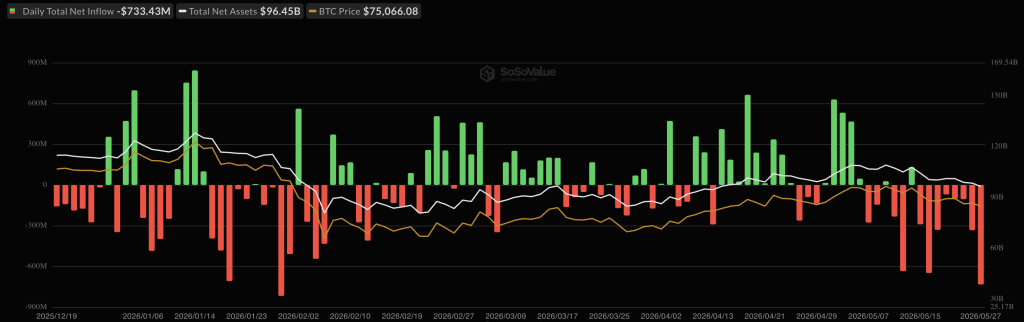
Over $800 million in combined Bitcoin and Ethereum ETF outflows on Thursday marked the largest single-day net redemption in weeks, amplifying spot price pressure well beyond what the geopolitical headline alone would imply.
[crypto-chart coin=”bitcoin”]
That $800 million figure did not arrive in isolation. Wednesday’s session had already logged $737.70 million in Bitcoin ETF outflows and $67.10 million from Ethereum funds, Thursday’s print extended a streak now running eight consecutive days of net trimming.
The institutional inflow narrative that carried BTC from $60,000 to its prior highs is, for now, fully reversed.
Discover: The Best Crypto to Diversify Your Portfolio
Bitcoin News: ETF Outflows Extend Eight-Day Streak as Institutional Demand Collapses
Data confirms the combined two-day Bitcoin and Ethereum ETF outflow figure now exceeds $870 million, with the eight-session streak representing one of the most sustained institutional withdrawal runs since spot Bitcoin ETFs launched in the US.

ETF flows have now turned decisively against Bitcoin and Ether, with capital rotating toward perceived lower-beta crypto assets rather than returning to cash – a distinction that matters for reading the next move in precio BTC.
The Crypto Fear and Greed Index dropped to 31 on Thursday, a reading that sits firmly in “Fear” territory and confirms the sentiment shift is not limited to derivatives positioning.
For the outflow streak to reverse, traders are watching for either a geopolitical de-escalation signal or a macro catalyst, a cooler CPI print or a dovish Fed statement, strong enough to restore appetite for high-risk allocations. Neither is currently on the immediate calendar.
How US-Iran Tensions Are Driving Crypto Risk-Off Behavior
The transmission mechanism here is direct: rising geopolitical risk in the Middle East pushes institutional allocators into defensive positioning, which means selling or reducing exposure to high-volatility assets first.
Bitcoin, despite its gold-narrative framing, behaves as a risk asset in acute stress events – not as a safe haven. Gold rose as oil climbed above $94 globally; Bitcoin fell. That divergence is the data point that explains the ETF redemption cascade.
Iran’s IRGC warned that “any further US attacks would trigger a more decisive response” and stated that “Washington bears responsibility for the consequences.” Asian equity markets, Taiwan, South Korea, and Japan, each dropped roughly 3% on Thursday pricing in the same risk.
Bitcoin’s liquidations amplified that move: over $900 million in total liquidations in 24 hours, with $873 million coming from long positions. Forced selling from leveraged longs accelerates spot price declines beyond what ETF outflows alone would produce.
Can Bitcoin Price Reclaim $74,000, or Does the Structure Now Point Lower?
Precio BTC is currently trading below $74,000, with that level now flipped from psychological support to immediate resistance.
Large-scale Bitcoin ETF movements and bearish price action have reinforced that the $73,000 zone. which analysts had identified as the line separating a bull-cycle correction from a structural breakdown, is now the ceiling to watch, not the floor.
The next meaningful support sits at the $70,500–$71,000 band, where significant buy-side order concentration has been identified in on-chain data.

A sustained break below $70,000 opens a path toward $68,000, where the 200-day EMA currently resides. RSI sits near 38 on the daily, below the signal line, a gap that flags downside momentum without yet reaching oversold territory, meaning there is room for further selling before a mechanical bounce becomes likely.
For a bull case, Bitcoin needs to reclaim and close above $74,000 on meaningful volume, then hold $73,500 as support.
That would signal the $70,500 floor held and that the correction is exhausted. For the bear case, a daily close below $70,000 would confirm a structural shift – not just a geopolitical reaction – and bring $68,000 into play as the next technical target.
Discover: The Best Token Presales
The post Bitcoin News: BTC Price Drops Below $73,000 as US-Iran Tensions Trigger ETF Outflows appeared first on Cryptonews.
Crypto World
Hyperliquid Builder Program Becomes Major Revenue Engine for Wallets and Bots: CoinGecko

Hyperliquid builder program has become a major revenue engine for wallets, bots, and trading apps that route user trades into Hyperliquid’s HyperCore perpetuals exchange through third-party interfaces, according to CoinGecko data.
The program allows developers, including wallets, Telegram bots, and trading frontends, to connect directly to the exchange, set their own fee rates on top of the base protocol fee, and retain 100% of what they charge. There is no gatekeeping or revenue share at the protocol level. As a result, builders compete primarily on product quality, user experience, and pricing, creating a distribution layer where different entry points all access the same order book.
Hyperliquid Builder Rankings
Among builders, CoinGecko found Phantom leads with $20.63 million in terms of cumulative revenue, and represents almost 32% of total earnings among the top 10 since the program began. It also has the largest user base at 137,496 users and averages about $150 revenue per user.
Based ranks second with $15.05 million in revenue from $44 billion in volume compared to Phantom’s $39.4 billion, with its lower 0.025% builder fee versus Phantom’s 0.05% explaining the gap in earnings despite higher throughput. Together, Phantom and Based make up for almost 55% of total top-10 builder revenue.
Meanwhile, MetaMask ranks fourth with $6.51 million in terms of revenue as it charges a 0.1% fee, the highest among the top builders, while still attracting 43,761 users and $7.46 billion in trading volume, with an average revenue per user of $149. Next up is Insilico with $3.30 million in revenue from just 2,962 users, followed by Axiom, which processed $22.1 billion in volume but earned $2.27 million due to a 0.01% fee, resulting in $68 revenue per user.
Drivers Behind Hyperliquid’s Growth
Beyond the builder-driven revenue layer, the broader ecosystem developments are further strengthening Hyperliquid’s position. Traction in HIP-3 permissionless perp markets, including emerging pre-IPO trading venues, is expanding activity and awareness. Additionally, spot HYPE ETF launches appear to have significantly improved distribution and investor access to the token, supported by strong early flows that point to underlying demand.
According to FalconX, the HIP-4 outcome markets, launched on mainnet earlier this month, expand Hyperliquid’s reach into prediction market territory and bring it closer to already established platforms such as Kalshi and Polymarket. At the same time, the introduction of priority fees is expected to add incremental protocol revenue and deepen token utility.
FalconX further estimated that USDC becoming an aligned asset through formal support from Coinbase and Circle could contribute up to $160 million in annualized revenue.
The post Hyperliquid Builder Program Becomes Major Revenue Engine for Wallets and Bots: CoinGecko appeared first on CryptoPotato.

Football gossip: Hincapie, Dias, Diomande, Wharton, Kamada, Scott, Rayan, Junior Kroupi

Microsoft 0-day feud escalates as researcher threatens another Windows exploit dump

Salford football club furious after youths ‘rip down gate and light BBQ on pitch’


-

 Fashion6 days ago
Holiday Weekend Open Thread – Corporette.com
-

 Politics3 days ago
Bridgerton Season 5: Cast, Release Date And Everything We Know So Far
-

 Crypto World7 days ago
Bitcoin Accumulation Weakens as BTC Realized Losses Hit $600M
-

 Crypto World5 days ago
Robinhood crypto COO Tanya Denisova exits
-

 Business7 days ago
Trump Invests $1M-$5M in Kura Sushi USA Chain With 27 California Locations
-

 Tech3 days ago
Microsoft’s quiet Claude Code retreat and the real cost of enterprise AI
-

 Business4 days ago
NYT Strands Answers May 24 2026 Revealed for Puzzle No. 812 Theme Summer Essentials
-

 Business6 days ago
Dell Technologies DELL Stock Surges 15% on AI Server Momentum and Analyst Upgrades in 2026
-

 Business2 days ago
Selena Gomez Reportedly Upset Over Benny Blanco’s Comments on Her ‘Terrible’ Diet
-
 Crypto World2 days ago
Micron Crosses $1 Trillion Market Cap as AI Demand Reshapes Memory Sector
-

 Politics6 days ago
Makerfield: a tale of two social-media histories
-

 Crypto World6 days ago
Space X IPO Is ‘Bad News’ for Tech Stocks: But What About Bitcoin?
-

 Business3 days ago
BTS Sells Out Four Las Vegas Shows at Allegiant Stadium for ARIRANG World Tour
-

 Tech7 days ago
WhatsApp ads could make Irish debut after discussions with DPC
-

 Crypto World7 days ago
MicroStrategy’s Saylor Says Miners No Longer Set Bitcoin Price, Another Force Has Taken Over
-
Tech1 day ago
The Samsung pay deal is the moment Korean unions changed register
-
 Tech6 days ago
A 0.12% parameter add-on gives AI agents the working memory RAG can’t
-

 Crypto World6 days ago
AI infrastructure race heats up as IREN pitches full-stack strategy, WhiteFiber lands $160M deal
-

 Tech3 days ago
Westone Audio and Etymotic Acquired by Fidelity Collective in Major IEM Market Move
-
 Crypto World3 days ago
Nvidia (NVDA) CEO Calls on Super Micro to Strengthen Export Controls Amid Smuggling Probe
You must be logged in to post a comment Login