
Crypto World
Hair Loss Biotechs Emerge As Wall Street's Newest Growth Trade

Hair loss biotechs are racing to deliver the first new baldness treatments in nearly three decades, and investors are positioning for the payoff.
Veradermics, Absci, and Cosmo Pharmaceuticals are advancing a pill, an injection, and a topical drug for pattern hair loss, a condition with no newly approved therapy since the late 1990s.
Hair Loss Biotechs Eye A Market Waiting For A Cure
Pattern hair loss affects an estimated 50 million men and 30 million women in the United States, according to Bloomberg. Current options are limited to decades-old drugs minoxidil and finasteride. Both are tied to side effects that include heart palpitations and reduced sex drive.
Veradermics (NYSE: MANE) is developing an oral pill, VDPHL01, and its stock has climbed nearly 500% since its February IPO. Absci (NASDAQ: ABSI) is testing an injection dosed two to three times over six months, and its shares have more than doubled so far this year.
Cosmo Pharmaceuticals posted positive late-stage trial results for a topical solution but has traded more cautiously against its US rivals.
Investors Chase A GLP-1 Style Trade
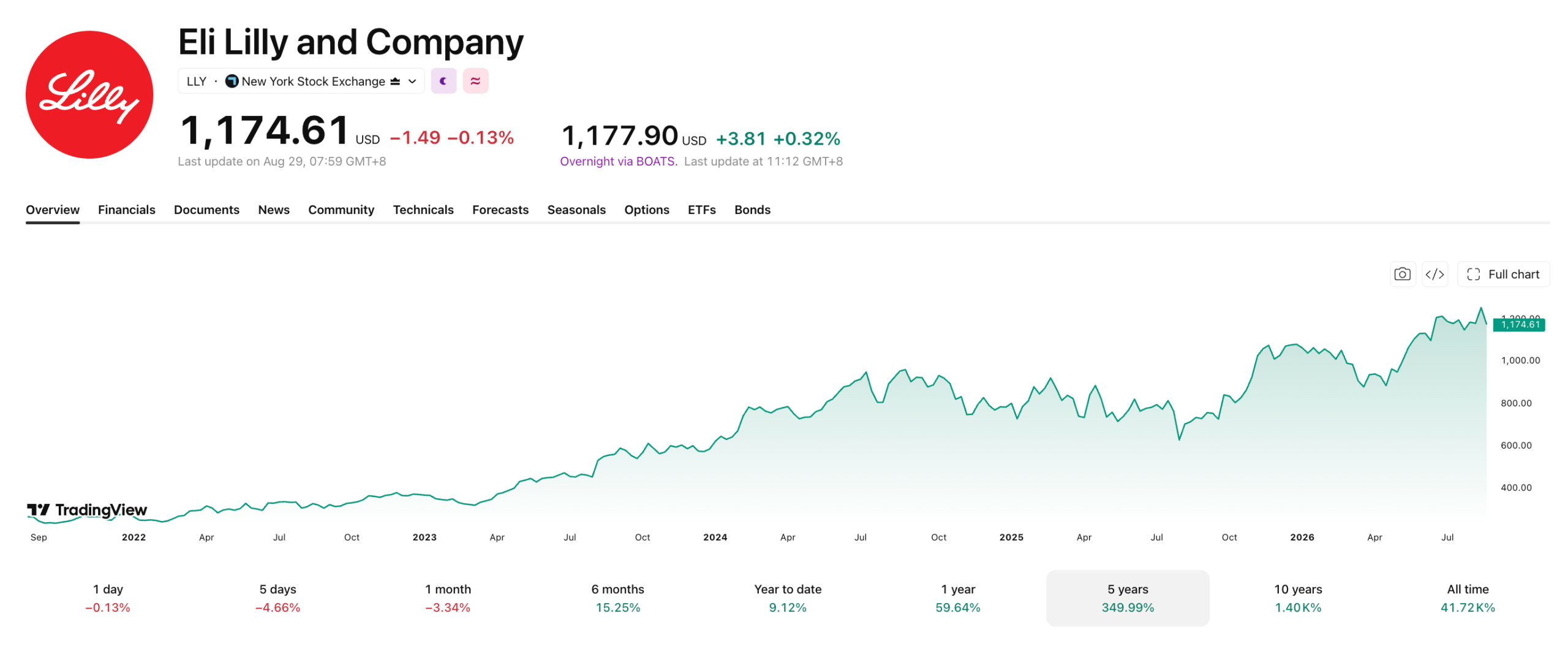
The enthusiasm echoes Eli Lilly’s stock rally, which reshaped investor appetite for consumer health biotech. Its weight loss drugs first drove that shift.

Eli Lilly has since invested $40 million in Absci, betting hair regrowth could follow a similar injectable playbook.
“Both obesity and hair loss are large consumer markets and that’s one reason why both of those categories can offer significant revenue potential.”
Geoff Hsu, portfolio manager at OrbiMed’s Biotech Growth Trust, Fortune
None of the three companies has an approved product yet. The earliest regulatory filings are not expected before 2027. Investors are pricing in demand years before any drug reaches pharmacy shelves.
The post Hair Loss Biotechs Emerge As Wall Street's Newest Growth Trade appeared first on BeInCrypto.

Crypto World
September Fed rate hike fears look overblown as the probability stands at just 58%, not 90%
Odds of a rate hike in September remain below 60% despite Warsh’s hawkish speech on Friday. Observers downplay fears of tightening.


A Solana wallet labeled as Fireblocks Custody transferred another 30 million USD1 to Binance during a 15-hour period, according to an Aug. 31 report from blockchain tracker Onchain Lens.
Summary
- Fireblocks-labeled custody wallet sent 30 million Solana-based USD1 tokens to Binance across fifteen reported hours.
- Onchain records confirm transfers, but they do not identify the beneficial owner or transaction purpose.
- The same wallet previously transferred 66 million USD1 to Binance during the preceding reported week.
- USD1 is issued by World Liberty Financial and operates across multiple networks, including Solana today.
- Neither Fireblocks, Binance nor World Liberty publicly explained whether the deposits supported trading or liquidity.
The tokens had a nominal value of $30 million because USD1 is designed to track the U.S. dollar. The transfer extended a series of large deposits from the same address, but its commercial purpose remains unknown.
Neither Fireblocks, Binance nor USD1 developer World Liberty Financial had publicly identified the beneficial owner or explained the transfers when the latest movement was reported.
USD1 transfer is visible on Solana
Onchain Lens identified the sending address as 9Rycov3U4efJf5HiqZYGjN7qJJHEtMsj4vbmkG4xfCxk. Its activity can be reviewed through the Solscan account page.
The tracker described the address as Fireblocks Custody and the receiving destination as Binance. Those labels are blockchain-analytics attributions rather than identities recorded directly inside Solana transactions.
Onchain data verifies that tokens moved between addresses. It cannot, by itself, establish who beneficially owned the assets or whether the transfer represented a sale, market-making activity, customer withdrawal, treasury operation or internal exchange movement.
Accordingly, the Onchain Lens report should not be interpreted as proof that Fireblocks, World Liberty or another party sold $30 million of USD1.
Fireblocks-labeled wallet previously moved $66M
The same address previously transferred 28 million USD1 to Binance through three transactions over 21 hours, according to an earlier Onchain Lens update.
A subsequent report said the wallet had deposited 66 million USD1 into Binance over one week after sending another 10 million tokens. The latest 30 million transfer appears to follow that reported sequence.
If the periods do not overlap, the cited movements would represent approximately 96 million USD1 sent to Binance. However, Onchain Lens did not provide a complete transaction inventory in its latest post, so the combined figure should be treated cautiously.
Fireblocks provides wallet and transaction infrastructure for institutions. A wallet using its custody technology can hold assets for a customer without Fireblocks owning those assets economically.
World Liberty’s USD1 already has close Binance ties
USD1 is a dollar-pegged stablecoin associated with World Liberty Financial, the crypto business linked to U.S. President Donald Trump and members of his family.
World Liberty’s official documentation lists USD1 deployments across several blockchains. The Solana token address begins with USD1ttGY1N17, matching the asset identified in the transfer report.
USD1 already has substantial links to Binance. Abu Dhabi-backed investment company MGX used $2 billion of the stablecoin to settle an investment in the exchange during 2025.
As crypto.news previously reported, the MGX transaction gave USD1 an early institutional use shortly after its launch.
Binance-controlled wallets and customer accounts held nearly 87% of USD1’s supply at one stage. Such concentration can reflect exchange customer holdings, institutional settlement balances and Binance’s own operational wallets.
Binance deposits do not establish selling pressure
Sending a volatile cryptocurrency to an exchange can indicate possible selling. That interpretation is less direct for a stablecoin because dollar-pegged assets commonly move to exchanges as trading collateral, settlement funds or quote-currency liquidity.
Binance offers USD1 trading pairs, including a SOL/USD1 market. Deposits could therefore support customer trading, market-making or liquidity management.
World Liberty says USD1 circulation has exceeded $4 billion. As crypto.news reported, company CEO Zach Witkoff attributed its expansion to institutional demand. That remains a company explanation rather than proof of the purpose behind these transfers.
World Liberty also received preliminary conditional approval to establish a national trust bank that could eventually issue and redeem USD1. The institution cannot open until it satisfies the OCC’s conditions.
Further wallet movements, changes in Binance balances or statements from the involved companies could clarify the deposits. No verified price movement in USD1, WLFI or another asset was directly attributable to the reported transfer.


A wallet attributed to HyperLabs, the development organization behind Hyperliquid, requested the unstaking of 433,000 HYPE tokens on Aug. 30, according to blockchain analyst Ember.
Summary
- HyperLabs requested unstaking of 433,000 HYPE tokens, valued near $36.14 million when Ember reported it publicly.
- Hyperliquid’s protocol places staking withdrawals into a seven-day queue before tokens return to spot balances.
- The pending withdrawal should complete September 6, provided the protocol processes it according to schedule.
- Previous HyperLabs withdrawals were routed through Flowdesk, but that history does not confirm another sale.
- No official Hyperliquid statement explained whether the unstaking supports liquidity, operations, or token distribution plans.
The position was valued at approximately $36.14 million when Ember reported the transaction. That valuation implies an average HYPE price near $83.46, but the dollar value will change with the token’s market price.
The withdrawal is expected to clear the protocol’s seven-day unstaking queue on Sept. 6. HyperLabs has not publicly explained its purpose.
HyperLabs placed 433,000 HYPE into the exit queue
The wallet’s staking activity is visible through its HypurrScan profile. The explorer records staking and balance activity associated with the address.
Hyperliquid’s staking documentation says transfers from staking accounts to spot accounts enter a seven-day unstaking queue. Tokens cannot be freely transferred until that period finishes.
An unstaking request does not itself place tokens into market circulation. It changes their status from staked and locked to pending withdrawal.
Once released, HyperLabs could transfer the HYPE, restake it, use it as collateral, provide liquidity or hold it in a spot account. No verified transaction has yet established which option it will choose.
September 6 marks the next onchain deadline
Ember expects the 433,000 HYPE to complete its staking exit on Sept. 6. The final time will depend on when Hyperliquid processes the pending withdrawal.
The tokens would then become transferable from the staking account. Wallet movements after that point should show whether they remain under HyperLabs’ control or move toward another address.
The scheduled amount is small relative to HYPE’s total supply, but its approximate $36 million value makes the transaction relevant to short-term liquidity monitoring.
No official statement from Hyperliquid or HyperLabs connected the transaction to operational expenses, employee distributions, market-making arrangements or sales.
Previous HYPE withdrawals went through Flowdesk
The same HyperLabs wallet previously withdrew a similar batch of approximately 433,000 HYPE. In August, parts of that earlier distribution were routed through market maker Flowdesk and addresses associated with centralized exchanges.
HyperLabs unlocked 433,025 HYPE worth approximately $23.46 million during the earlier cycle.
Onchain analysis found that 165,000 HYPE moved to Flowdesk. Of that amount, 75,000 HYPE was reportedly exchanged for USDC on Hyperliquid, while another 90,000 tokens moved toward OKX and Bybit deposit addresses.
That history supports monitoring Flowdesk after Sept. 6, but it does not prove the latest batch will follow the same route. Market makers can facilitate sales, over-the-counter transactions, liquidity provision or treasury execution.
HYPE unstaking does not confirm immediate selling
Large unstaking requests often attract attention because they make previously locked tokens transferable. However, unstaking should not automatically be described as selling pressure.
A confirmed sale would require additional evidence, such as swaps into stablecoins, transfers to identified exchange deposit addresses or statements from the wallet owner.
The distinction is particularly relevant because Hyperliquid also operates an Assistance Fund that uses protocol revenue to purchase HYPE. As previously reported, Hyperliquid’s buyback structure creates recurring demand that can offset part of the token supply entering circulation.
Team and contributor distributions nevertheless remain an important part of HYPE’s token economics. Crypto.news provides a broader explanation of how vesting schedules and token unlocks can affect liquid supply.
The next confirmed development should arrive when the withdrawal clears on Sept. 6. Traders can then monitor the HyperLabs wallet, Flowdesk-linked addresses and centralized exchange deposits.
Crypto World
Ternus Takes Over as Apple CEO With AAPL Near $320: History Shows Wild First-Year Swings
John Ternus officially becomes Apple’s chief executive on Tuesday, September 1, replacing Tim Cook, who moves into the role of executive chairman.
Apple’s board approved the succession unanimously in April, capping months of internal planning ahead of the changeover.
What History Says About Year One
Four prior planned tech CEO handoffs have a complete first year to judge, with returns ranging from a 38% decline to a 76% gain, a Motley Fool analysis found. The same analysis found no prior handoff triggered a rush to sell shares beforehand.

Bank of America reiterated its Buy rating on Apple ahead of the switch. Analyst Wamsi Mohan expects Apple’s core business to stay steady while Ternus considers a bigger AI budget.
Options activity in AAPL has stayed elevated heading into the handoff, with sentiment described as mixed rather than clearly one-sided.
A Hardware Veteran Takes Charge
Ternus spent 25 years at Apple, most recently leading hardware engineering across the iPhone, Mac, and Apple Watch lines. His product portfolio also included the iPad, AirPods, and Vision Pro headset.
Cook will focus on government relations in his new post, and Arthur Levinson becomes lead independent director.
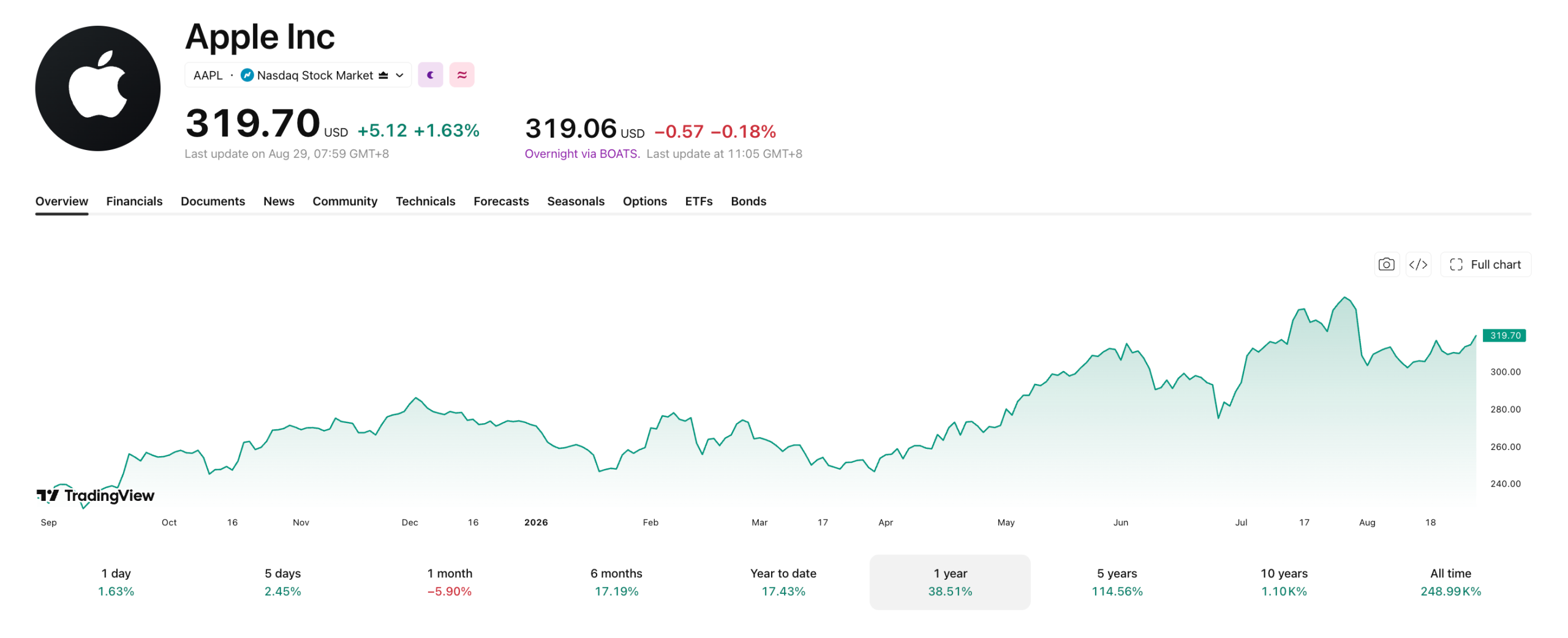
AAPL closed Friday at $319.70, up 1.63% on the day. Shares sit about 6% below the record close after Apple’s brief climb to a $5 trillion market cap in July.
The AI Question Ternus Inherits
The bigger test is not the handoff itself, but whether Ternus, a hardware veteran, can deliver Apple’s AI ambitions. Cook addressed the AI compute question directly on his final earnings call, noting demand could outstrip capacity.
“This probably would be a good problem to have.”
Tim Cook, CNBC
Apple’s next Mac software, macOS Golden Gate, is confirmed to arrive by September 22, alongside iOS 27’s Siri AI rollout. Ternus faces his first public test at Apple’s September 9 event, where a foldable iPhone is widely expected. That test will show whether hardware discipline can translate into an AI turnaround.
The post Ternus Takes Over as Apple CEO With AAPL Near $320: History Shows Wild First-Year Swings appeared first on BeInCrypto.
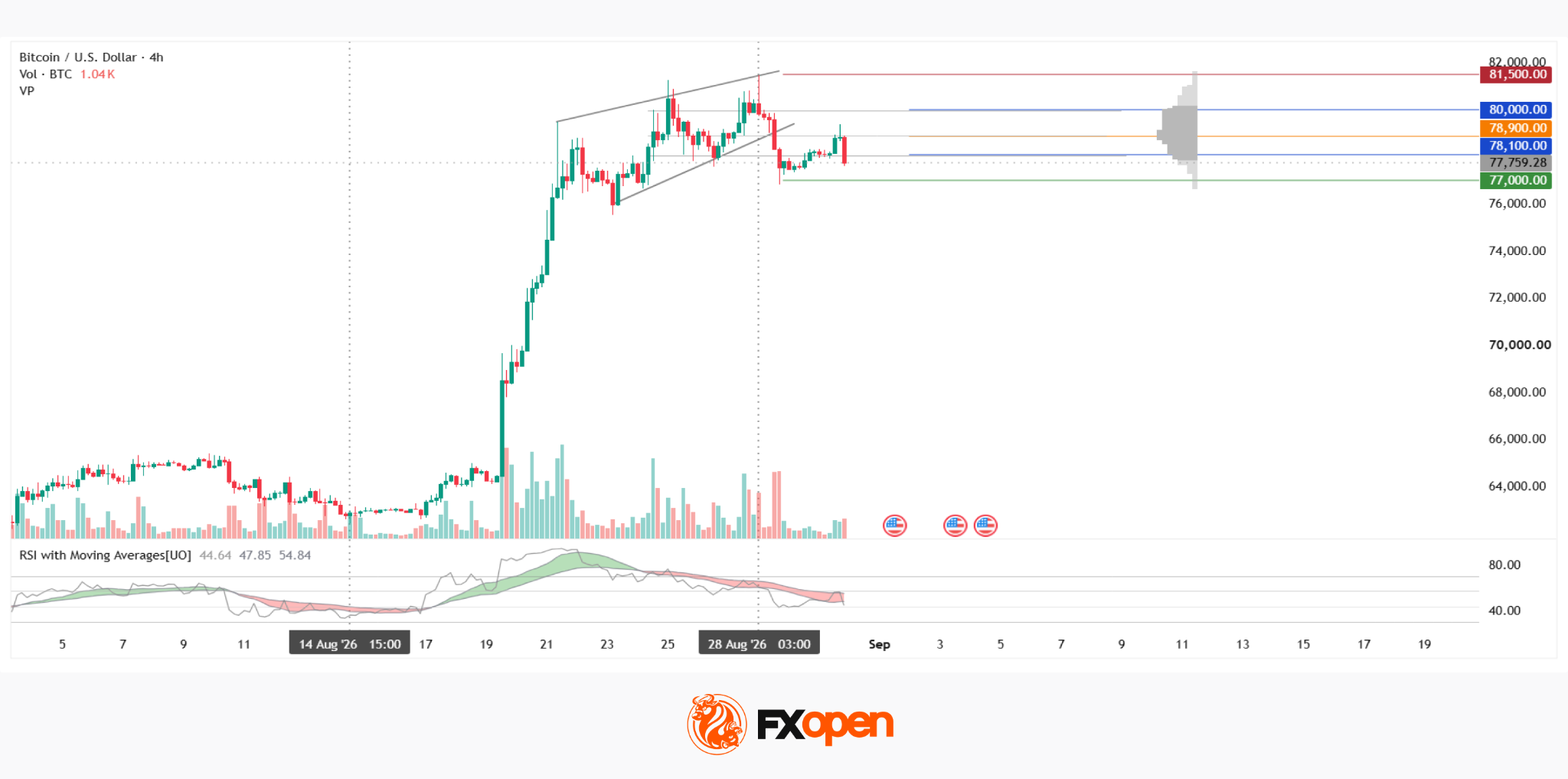
On 28 August, Fed Chair Kevin Warsh delivered a more hawkish assessment of inflation at the Jackson Hole symposium than he had following the July meeting. He reaffirmed the Federal Reserve’s 2% target for core PCE inflation and described tackling price pressures as the central priority for policymakers.
Following his remarks, expectations for a rate hike at the September meeting increased noticeably, with the market apparently pricing in a higher probability of such a scenario. Against this backdrop, Bitcoin pulled back, giving up part of its August gains.
Technical Analysis of Bitcoin
The four-hour BTC/USD chart shows a pronounced uptrend, with the move from 14 to 28 August taking the price from around $63,000 to a peak near the current red resistance at $81,500.
An ascending wedge formed near the top of this advance, and on 28 August the price broke below its lower boundary on elevated volume. However, the decline has yet to develop into a sustained move. Momentum has slowed, and Bitcoin is currently trading within the density of the market profile, between the Point of Control (POC) at $78,900 and the lower profile boundary at $78,100.
If the decline resumes and the price establishes itself below the lower profile boundary, the round-number level at $77,000 could provide the next area of support.
Conversely, if sellers fail to push the price lower and the wedge breakout proves to be false, Bitcoin would first need to overcome the market-profile density on the way up. A break above the upper profile boundary at $80,000 would reopen the path towards the trend high around $81,500.
The RSI + MAs indicator currently shows readings of 50, 48 and 55, with all three measures remaining within the neutral zone.
Key Takeaways
The wedge breakout has yet to generate confirmation of a sustained decline, while the market remains within the current profile range. Neutral RSI + MAs readings offer no clear advantage to either buyers or sellers.
A more decisive move in Bitcoin could emerge as market expectations surrounding the Federal Reserve’s September decision continue to evolve.
FXOpen offers the world’s most popular cryptocurrency CFDs*, including Bitcoin and Ethereum. Floating spreads, 1:2 leverage — at your service (additional fees may apply). Open your trading account now or learn more about crypto CFD trading with FXOpen.
*Important: At FXOpen UK, Cryptocurrency trading via CFDs is only available to our Professional clients. They are not available for trading by Retail clients. To find out more information about how this may affect you, please get in touch with our team.
This article represents the opinion of the Companies operating under the FXOpen brand only. It is not to be construed as an offer, solicitation, or recommendation with respect to products and services provided by the Companies operating under the FXOpen brand, nor is it to be considered financial advice.


Alderoty argues the CLARITY Act could support employment, but his statement remains an industry claim.
Summary
- Alderoty argues the CLARITY Act could support employment, but his statement remains an industry claim.
- An NCA-commissioned study estimates crypto directly employs 34,000 workers and supports 232,000 jobs nationwide today.
- The modeled employment total includes supplier positions and jobs supported indirectly through household worker spending.
- Senate records schedule a September 15 cloture vote determining whether lawmakers begin formally considering CLARITY.
- CLARITY passed the House 294-134, while Senate Banking advanced amended legislation by 15-9 in May.
An NCA-commissioned study estimates crypto directly employs 34,000 workers and supports 232,000 jobs nationwide today.
Senate records schedule a September 15 cloture vote determining whether lawmakers begin formally considering CLARITY.
Ripple Chief Legal Officer Stuart Alderoty urged U.S. senators to support the Digital Asset Market Clarity Act ahead of its next procedural vote, arguing that the legislation could promote employment and economic growth.
“A vote for Clarity is a vote for jobs and economic growth,” Alderoty wrote on Aug. 30. His statement is a policy argument rather than a finding that passing the bill would create a specific number of jobs.
Alderoty is also president of the National Cryptocurrency Association, which commissioned the employment research underpinning his argument
CLARITY Act job figures rely on economic modeling
The NCA’s Crypto at Work report, produced by Pragmatic Policy Group, estimates that crypto companies directly support about 34,000 full-time-equivalent U.S. positions in 2026.
The study places the industry’s broader employment footprint at 232,000 jobs. That total includes approximately 75,000 supplier positions and 123,000 jobs connected to spending by workers whose employment is directly or indirectly linked to crypto.
The 232,000 figure does not mean cryptocurrency businesses employ that many people directly. It is an economic-impact estimate built using multiplier effects across cloud computing, legal services, accounting, housing, transportation and other sectors.
As crypto.news reported, the model uses 2024 Bureau of Economic Analysis input-output tables, Bureau of Labor Statistics data and a $23.22 billion industry revenue estimate sourced from Statista.
NCA estimates $55B economic contribution
The report estimates that crypto-related activity will contribute more than $55 billion to U.S. gross domestic product during 2026. It also projects approximately $31 billion in worker income.
Average wages across the jobs included in the model were estimated at about $133,000. The NCA compared that figure with a national median wage of roughly $64,000.
California represented an estimated 57,649 supported jobs, followed by New York with 53,766 and Texas with 26,536. Washington and North Carolina accounted for about 15,097 and 9,524 jobs, respectively.
These are modeled estimates rather than a live payroll census. The report was commissioned by an industry association led by Alderoty, so its findings should not be presented as independent government employment statistics.
CLARITY Act faces September 15 Senate test
Official Senate records schedule a cloture motion on H.R. 3633 for Sept. 15 at 2:15 p.m. Eastern. The vote will determine whether senators formally begin considering the legislation.
It will not be a final vote on passing the CLARITY Act. The motion to proceed requires 60 votes, meaning Republican senators will need Democratic support to advance the bill.
The House passed the legislation by 294-134 on July 17, 2025, according to the official roll-call record. Seventy-eight Democrats joined Republicans in supporting the measure.
The Senate Banking Committee advanced an amended version by 15-9 in May 2026. Democratic Sens. Ruben Gallego and Angela Alsobrooks joined committee Republicans, according to the committee’s announcement.
Passage would require several additional steps
The CLARITY Act would establish federal definitions and registration rules for digital assets, exchanges, brokers and dealers. It would divide oversight between the Securities and Exchange Commission and Commodity Futures Trading Commission based on the asset and transaction involved.
Clearing cloture would only open Senate consideration. Senators could then debate and amend the legislation before holding a separate passage vote.
Because the Senate committee changed the House-approved measure, both chambers would need to approve identical language before the bill could reach the president.
As previously reported, ethics rules and stablecoin provisions remain disputed. The debate includes proposed restrictions involving public officials’ crypto interests, consumer protections and stablecoin rewards.
Alderoty’s claim that CLARITY would support future employment cannot be tested unless the legislation becomes law. The NCA report estimates the industry’s current economic footprint but does not quantify how many additional jobs the bill itself would create.

Bitcoin ends August and enters September under renewed pressure, but geopolitics won’t be the only factor traders need to watch this week.
Several important US economic reports are due between Tuesday and Friday, culminating with the August jobs report, which could significantly shift expectations for the Fed’s September meeting.
First Tests Arrive Tuesday
Monday is likely to be a quiet day on the economic front, but it saw military action between the US and Iran as both countries resumed attacks against each other. The impact on BTC was felt immediately, with the asset slipping by over two grand to just under $77,000.
Tuesday brings two reports capable of moving markets: the July JOLTS Job Openings and August ISM Manufacturing PIM, both scheduled for 10:00 ET. Economists expect job openings to decline slightly to around 7.27 million, from 7.36 million previously.
A stronger labor market could reinforce expectations that the Fed has room to raise rates again, potentially supporting Treasury yields and the greenback. Such environments are typically not favorable for risk assets like bitcoin.
The ADP Private Employment Report will go live on Wednesday, which offers another indication of labor-market strength. Thursday delivers weekly jobless claims and the ISM Services PMI.
Key Events This Week:
1. August Chicago PMI data – Monday
2. August ISM Manufacturing PMI and Prices data – Tuesday
3. July JOLTS Job Openings data – Tuesday
4. August ADP Nonfarm Employment data – Wednesday
5. August ISM Non-Manufacturing PMI and Prices data – Thursday
6.…
— The Kobeissi Letter (@KobeissiLetter) August 30, 2026
All Eyes on Friday
The most important macro event on US soil arrives on Friday at 8:30 ET: The August employment report. General expectations suggest that the world’s largest economy has added approximately 58,000 jobs in August, while unemployment is anticipated to remain at 4.1%. The July report showed that the US actually lost 23,000 jobs, adding to existing concerns that the labor market is losing momentum.
Friday’s numbers could therefore significantly reshape the debate surrounding the Fed’s September 15-16 meeting. A stronger-than-expected report could suggest employment remains resilient despite restrictive monetary policy. This could be bearish for risk assets, as if it’s combined with stubborn inflation, it could strengthen the case for a rate hike.
In contrast, a weaker report could reduce those expectations and provide some relief for the crypto market, although an unexpectedly sharp deterioration could instead raise recession concerns and trigger another risk-off reaction.
The post Will Bitcoin Bounce or Dump? All Eyes Are on This Week’s Major Economic Events appeared first on CryptoPotato.
Cronos halted block production on Aug. 30 after detecting an exploit involving Tectonic, a decentralized lending protocol operating on the blockchain.
Summary
- Cronos validators halted block production after Tectonic disclosed an exploit affecting its decentralized lending protocol.
- Researchers estimate roughly $75 million was affected, but Tectonic has not confirmed total losses publicly yet.
- Approximately $6 million reached Ethereum before the halt, according to researcher Weilin Li’s address analysis online.
- Crypto.com said its centralized app and exchange remained operational, with customer funds there unaffected throughout.
- Cronos and Tectonic have not announced a restart timetable, recovery plan, or user compensation framework.
Independent researcher Weilin Li estimated that approximately $75 million was affected. However, neither Cronos nor Tectonic had confirmed the cause or total loss as of Aug. 31.
Most of the identified assets appeared to remain on Cronos after validators stopped the network. No restart time, recovery plan or compensation framework had been announced.
Tectonic exploit reportedly used inflated TONIC collateral
Li attributed the incident to the treatment of TONIC, Tectonic’s governance token, as collateral. TONIC reportedly had a 20% collateral factor despite limited market liquidity.
According to his initial analysis, the attacker increased TONIC’s market price roughly 100-fold over about 20 minutes. The attacker then supplied the inflated tokens as collateral and borrowed other assets from Tectonic.
Li described the incident as a “Mango-market style” pump-and-borrow attack. The characterization remains an independent assessment because Tectonic has not published its own technical post-mortem.
The reported pattern resembles earlier attacks in which thinly traded collateral was assigned an inflated valuation. As crypto.news reported, a similar collateral-price attack drained Moonwell of an estimated $8.7 million shortly before the Tectonic incident.
Cronos halt kept most identified funds onchain
Li initially placed the affected assets at approximately $66 million. He said around $6 million crossed to Ethereum before Cronos validators halted block production, while roughly $60 million remained at a Cronos address.
The researcher later identified another address holding approximately $8 million, raising his combined estimate to around $75 million. Those figures remain estimates based on address attribution and token valuations.
The fact that assets remain on Cronos does not mean they have been recovered. A network restart could allow the attacker to resume moving funds unless validators, protocol developers or other participants introduce restrictions.
Cronos and Tectonic have not said whether they intend to freeze the identified addresses, reverse transactions or negotiate with the attacker. Any intervention could also raise questions about network governance and transaction finality.
Crypto.com says its exchange was unaffected
Crypto.com CEO Kris Marszalek said the company’s app and centralized exchange continued operating normally. “All funds are safe,” he wrote, referring to assets held through those Crypto.com services.
That statement does not cover funds deposited directly into Tectonic. Crypto.com and Cronos are closely associated, but Tectonic operates as a separate decentralized lending application on the network.
Marszalek said Crypto.com’s security team was assisting with the investigation. He also promised a full post-mortem, although no publication date was provided.
The incident illustrates the difference between centralized exchange balances, blockchain-held assets and funds deposited into DeFi contracts. A failure affecting one layer does not necessarily compromise every service connected to the same ecosystem.
Cronos restart depends on containment and accounting
Cronos must determine whether the identified addresses can move funds safely before restoring block production. Validators will also need to assess whether the attacker left bad debt inside Tectonic’s lending markets.
Tectonic separately warned users not to interact with the protocol until it confirms that doing so is safe. Deposits, repayments, liquidations and withdrawals remain affected while the blockchain is halted.
A technical review must establish how Tectonic valued TONIC collateral and whether its price source included sufficient protections against manipulation. Crypto.news has previously explained how weak oracles can expose lending protocols to manipulated collateral prices.
The incident also resembles the Mango Markets manipulation, where inflated governance-token collateral supported loans against more liquid assets.
The next confirmed updates should address the network restart, the final asset total, Tectonic’s outstanding bad debt and possible treatment of affected depositors. No verified market movement in CRO or TONIC was included because a reliable event-specific price reaction had not been established.


Zakura says a new cryptography stack makes mobile proof generation more than 14 times faster, removing one of the biggest delays users face when sending private ZEC.


U.S. users looking for Lake Ontario on Google Maps will now find “Lake America” in its place, after President Donald Trump’s executive order to rename the lake amid an escalating trade stoush.
Google announced on Saturday that the lake, which borders the Canadian province of Ontario and the U.S. state of New York, will appear as “Lake America” in the U.S., “Lake Ontario” in Canada, and “Lake Ontario (Lake America)” for users in the rest of the world.
The company said it changed the maps following the formal renaming by the U.S. Geographic Names Information System (GNIS), and that the update is in line with its “long-standing policy for bodies of water with names that vary from country to country.”
Read More: The Trouble With Trump’s Attempt to Rename Lake Ontario
The change has divided tech companies.
MapQuest, the first commercial web mapping service, said in a Thursday post, “We’re not changing the name of Lake Ontario. Name it whatever you want at your leisure.” The post included a link to a satirical tool allowing users to give the lake a name of their choosing and an image of a parody map labeling the body of water, “Lake Are We Doing This Again?”
As of Sunday, Apple had not changed the name on Apple Maps.
Lake Ontario/America
The change comes after Trump signed an executive order on Thursday to officially rename the body of water—the latest salvo in an escalating trade war with Canada. After trade talks abruptly collapsed earlier this month, the U.S. and Canada announced tit-for-tat tariffs of up to 50% on some goods. Canadian officials also called for Canadians to boycott U.S. travel and products, while Trump revived rhetoric of Canada being the “51st state” of the U.S., claiming that Canada wanted “the benefits of being a State, without being one.”
The name change has faced significant opposition from Democrats. Rep. Debbie Dingell (D, Mich.) announced plans to introduce the “Hands Off Our Great Lakes Act,” a bill that would reverse Trump’s order renaming the lake. Other Democratic lawmakers reportedly said they were preparing legislation to counter the name change.
Canadian officials also derided the name change. Prime Minister Mark Carney rejected the renaming on Thursday, noting that Canadians will continue “calling it Lake Ontario—then, now and always.”
On Saturday, Ontario Premier Doug Ford unveiled a newly erected 24-by-12-foot sign overlooking the lake in Winona, Ontario, that read “Lake Ontario Now and Always” in English and French.
Ford told ABC on Sunday that the name change is “like something out of ‘Saturday Night Live.’”
“No one’s going to call it Lake of America. It’s been Lake Ontario for hundreds of years. It’s going to continue being Lake Ontario. It’s just so disappointing,” he said.
Some Ontario government and business websites that use data from Google Maps showed “Lake America” after the change. A Google spokesperson told Axios that website developers embedding Google Maps can select a region to localize their maps.
“Following recent changes by Google, we’re actively reviewing our websites to make sure they all identify Lake Ontario by its correct name: Lake Ontario,” Stephen Crawford, Ontario’s minister of public and business service delivery and procurement, posted. “As Ontarians, we will always stand up for our province, our identity and the places that define it.”
Previous name changes
Google made a similar change in February 2025 after Trump issued an executive order renaming the Gulf of Mexico the “Gulf of America.” Google began displaying “Gulf of America” to Google Maps users in the U.S. after the name change was made in the U.S. federal geographic database. Users in Mexico continued to see “Gulf of Mexico” and users elsewhere saw both names.
Soon after, Apple Maps adopted the new name for U.S. users.
Mexico filed a lawsuit against Google in May 2025, arguing that the U.S. did not have the authority to rename the entire gulf, including waters under Mexican jurisdiction. The suit followed Google’s refusal to limit the “Gulf of America” label to the portion of the gulf under U.S. jurisdiction, as Mexican President Claudia Sheinbaum had requested. The lawsuit remains pending before the Superior Court of Justice of Mexico City.
Both Google and Apple also changed their U.S. map labels for North America’s highest peak from Denali to Mount McKinley last February. Trump had directed the name change in the same executive order, reversing a 2015 decision that had restored Denali, the mountain’s Alaska Native name, as its federal designation.
MapQuest retained the names of Denali and the Gulf of Mexico, and also offered users the option to rename the gulf as they pleased.

September Fed rate hike fears look overblown as the probability stands at just 58%, not 90%
Main story and 100% completion time

Amazon's HR Lead Uses AI Tool to Write 100,000 Lines of Code – 25 Years After She Last Coded





-

 Crypto World5 days ago
SpaceX stock could rise 75% to $240, JPMorgan says
-

 Fashion3 days ago
Weekend Open Thread: Maeve – Corporette.com
-

 Crypto World3 days ago
Bitcoin’s 22% rally now needs real demand to outlast Treasury liquidity boost
-

 Crypto World5 days ago
Warsh Jackson Hole keynote puts financial innovation first
-

 Crypto World6 days ago
A $30 Billion AI Fund Implodes, Now the SEC Is Investigating Wall Street’s Role
-

 Business3 days ago
Salesforce Stock Soars 19% as Blowout Earnings and Agentforce AI Growth Silence Software Skeptics
-

 Crypto World5 days ago
Did Trump Just Move SpaceX Stock With One Truth Social Post?
-

 Crypto World4 days ago
Elon Musk Grok Bot Promise: We Will Make You Whole if AI Loses Your Money
-

 Business5 days ago
Walmart takes aim at younger shoppers with new fashion brand
-

 Business3 days ago
Apple Confirms September 9 Keynote and Reveals Its Full Pre-Order Schedule
-
 NewsBeat4 days ago
Lindsay Clancy jury braces for closing arguments as judge tells court: ‘You’ve heard all the evidence’ – Live updates
-

 Business5 days ago
Thailand’s Eastern Economic Corridor Capital City (EECiti): Key Developments and Investment Opportunities
-

 Crypto World2 days ago
Bitcoin price tests $82K resistance as Brandt stays long
-

 Crypto World4 days ago
NVIDIA revenue hits $96.2B as AI demand doubles
-

 Business2 days ago
Onto Innovation Stock: AI’s Next Bottleneck Is Yield (NYSE:ONTO)
-

 Business7 days ago
Moderna CEO warns China is pouring state money into mRNA technology
-

 Business6 days ago
NVIDIA Stock Drops Nearly 2 Percent to $210 on Seventh Losing Day Ahead of Critical AI Earnings
-

 Business3 days ago
iPhone 18 Pro Pre-Orders Could Shift to Saturday as Apple Reportedly Avoids September 11 Anniversary
-

 NewsBeat5 days ago
Trump’s trade truce with China faces test with Iran effort
-
 Crypto World4 days ago
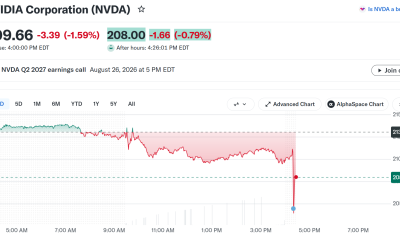
Nvidia Q2 Earnings Reveal $96.2 Billion Beat, So Why Is NVDA Falling?
You must be logged in to post a comment Login