

Crypto World
Hyperliquid price reenters bullish wedge pattern, will it break out?

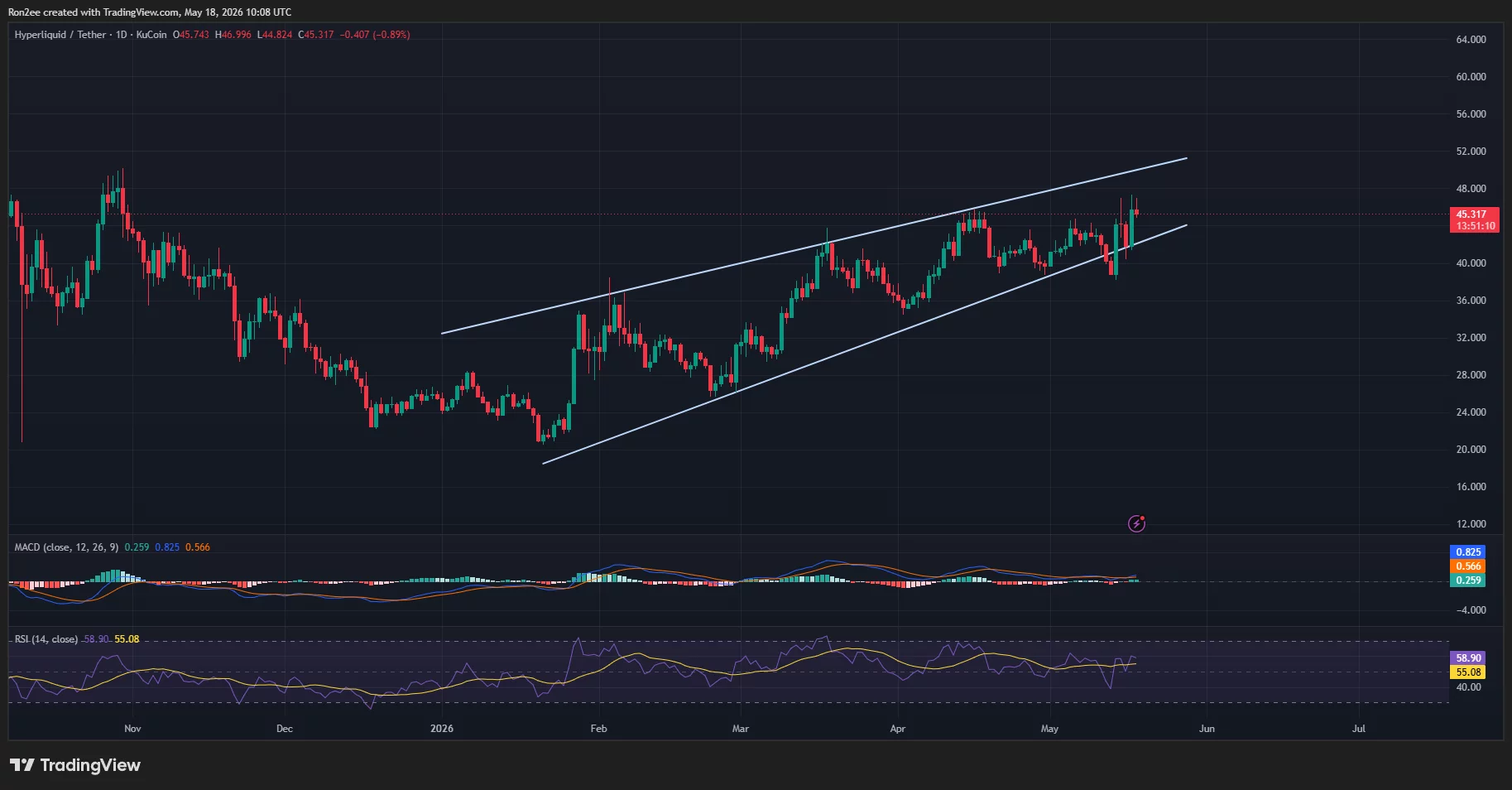
Hyperliquid price stabilized over the weekend after reclaiming a key bullish chart structure, while growing institutional adoption narratives continued supporting investor sentiment around the decentralized derivatives protocol.
Summary
- Hyperliquid price rebounded above $45 after reentering a bullish ascending wedge pattern following a recent pullback toward the $38 support zone.
- CME Group and ICE reportedly urged U.S. regulators to scrutinize Hyperliquid over potential manipulation and sanctions risks, contributing to recent volatility in HYPE price.
- Institutional interest in Hyperliquid continued rising as Bitwise and 21Shares expanded spot and leveraged HYPE ETF offerings in the U.S.
According to data from crypto.news, Hyperliquid (HYPE) price was trading around $45 at press time on May 18 after briefly rallying above the $46 level earlier in the session. The token has now recovered more than 100% from its January lows near $22 as demand surrounding decentralized perpetual trading infrastructure continued strengthening.
Despite the recent recovery, Hyperliquid faced heightened volatility over the past two weeks following reports that CME Group and Intercontinental Exchange urged U.S. regulators to scrutinize the protocol over potential market manipulation and sanctions compliance risks.
The concerns reportedly centered around the growing influence of decentralized offshore trading platforms within the perpetual futures market and whether existing compliance frameworks remain sufficient as trading volumes continue expanding rapidly.
The regulatory scrutiny narrative contributed to a sharp correction in Hyperliquid price earlier this month as some traders reduced exposure amid fears that increased oversight could temporarily weigh on sentiment surrounding decentralized derivatives platforms.
However, bulls have since regained control as institutional demand for Hyperliquid-linked investment products continued to accelerate.
One of the biggest catalysts supporting sentiment remains the recent launch of multiple Hyperliquid-related exchange-traded products in the United States.
Earlier this month, Bitwise launched its spot Hyperliquid ETF product, while 21Shares introduced both a spot-focused HYPE ETF and a leveraged 2x Long HYPE ETF. The launches reinforced expectations that institutional appetite for decentralized finance infrastructure continues expanding beyond Bitcoin and Ethereum.
Hyperliquid has also continued benefiting from broader ecosystem integration narratives involving Coinbase and Circle, particularly as institutional stablecoin infrastructure and trading connectivity tied to the protocol keep improving.
At the same time, derivatives activity surrounding Hyperliquid has remained elevated as traders continue positioning for a potential continuation of the broader uptrend.
Hyperliquid price analysis
On the daily chart, Hyperliquid price appears to have reentered a bullish ascending wedge pattern after successfully rebounding from the lower support trendline near the $38–$40 region.
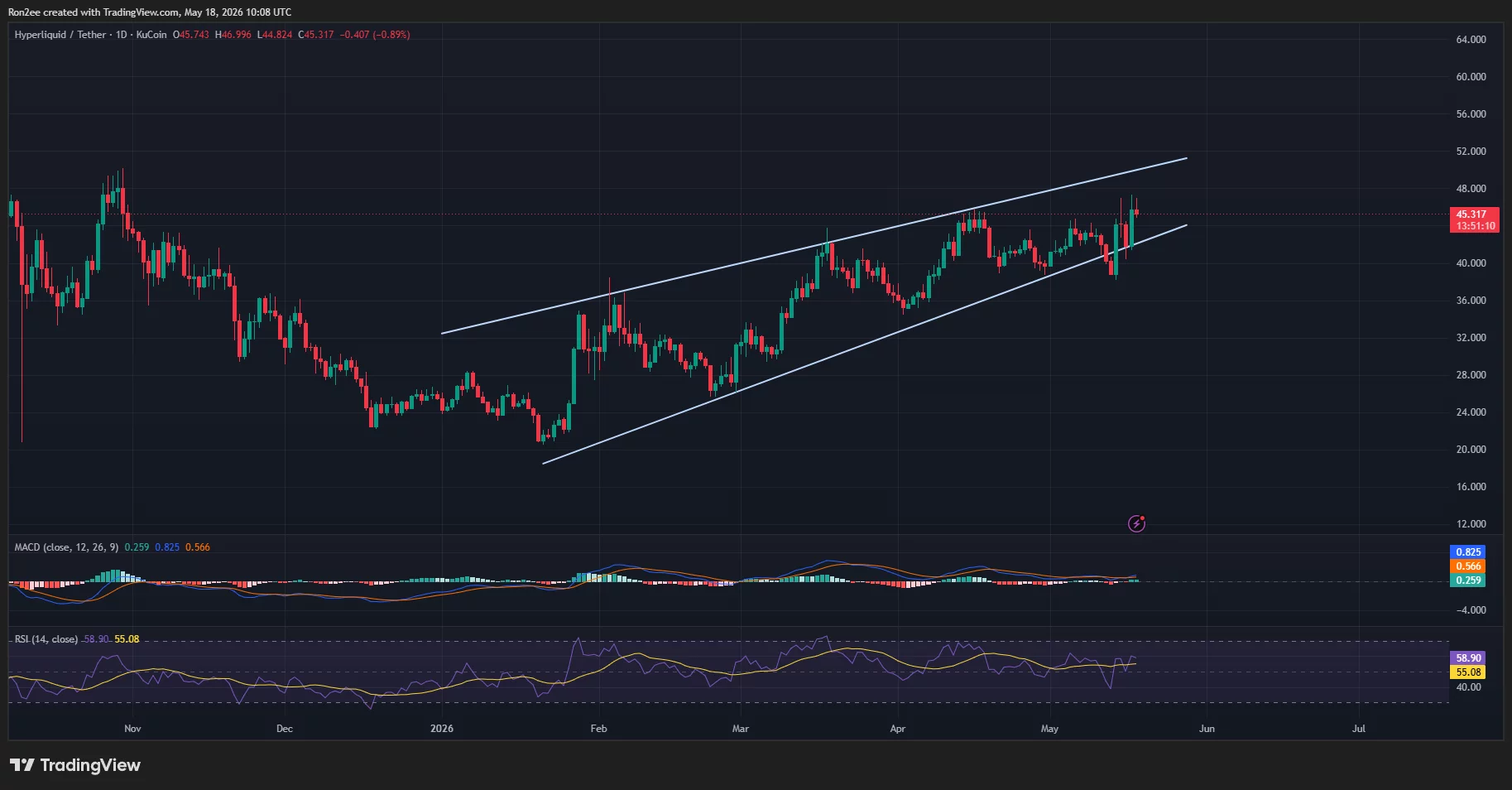
The recovery back toward the upper half of the structure suggests buyers continue defending the broader bullish trend despite recent regulatory-driven volatility.
Unlike the previously invalidated bearish double top structure near the $45–$46 resistance zone, the current setup increasingly resembles a bullish continuation pattern following Hyperliquid’s explosive rally earlier this year.
The MACD indicator has also started turning higher again after a brief cooldown phase, with the histogram gradually flipping back into positive territory. This often signals strengthening bullish momentum as buyers regain short-term control.
Meanwhile, the RSI currently remains near the 58 level, indicating momentum has improved without yet entering overbought territory. That leaves room for another potential leg higher if bullish momentum continues building.
As long as HYPE continues holding above the ascending wedge support near the $40 region, bulls may attempt another breakout above the key $46 resistance zone.
A successful breakout above that level could open the door for a rally toward the psychological $50 mark, with the upper wedge resistance near the $52 region acting as the next major upside target.
On the downside, failure to hold above the wedge support structure could weaken bullish momentum and potentially expose Hyperliquid to another correction toward the $38 support zone. A deeper breakdown below that level could invalidate the broader bullish continuation setup and shift momentum back in favor of sellers.
Disclosure: This article does not represent investment advice. The content and materials featured on this page are for educational purposes only.



- Real Finance launches REAL Competition for the $ASSET ecosystem.
- Users can earn points by trading, staking and holding $ASSET.
- A $3400 raffle pool gives more community members a chance to win.
Real Finance has launched the REAL Competition, a community rewards campaign aimed at increasing participation across the $ASSET ecosystem.
The Sofia-based company said the campaign will allow users to earn points through trading, staking and holding $ASSET, with top participants eligible for up to $20,000 in USDC rewards.
The competition also includes an additional raffle prize pool, broadening the reward structure beyond the highest-ranked users.
Real Finance said the campaign is designed to recognise sustained on-chain engagement rather than simply rewarding short-term trading volume.
Points system targets wider ecosystem activity
The REAL Competition introduces a points-based model that tracks qualifying activity involving $ASSET.
Participants can earn points by trading, staking and holding the token, with all activity monitored on-chain through the competition dashboard.
The structure is designed to give users multiple ways to participate.
Active traders can build points through qualifying transactions, while long-term holders and stakers can also improve their standing through sustained participation.
Real Finance said participants will move through a 13-level rewards structure during the campaign.
This approach marks a shift from conventional trading competitions, which often focus mainly on volume.
By including staking and holding activity, the REAL Competition is intended to reward broader involvement across the $ASSET ecosystem.
Leaderboard rewards backed by raffle prizes
The campaign’s main prize structure includes fixed rewards for the top-ranked participants, with total rewards of up to $20,000 in USDC available through the competition.
Real Finance will also distribute rewards through a broader pool based on final point totals.
This means participants outside the highest leaderboard positions may still be eligible for rewards, depending on their accumulated score.
In addition, the company said it will offer a separate raffle reward pool worth $3,400.
The raffle is designed to give more community members a chance to win prizes, even if they do not finish among the top-ranked participants.
“The REAL Competition is designed to reward meaningful participation across our ecosystem,” said Ivo Georgiev, CEO of Real Finance.
Whether users are actively trading, staking for the long term, or steadily building their position in $ASSET, we want to recognize the community members helping drive the growth of the network. By combining leaderboard rewards with raffle prizes, we’re creating opportunities for a broader range of participants to benefit from the campaign.
Campaign to run over coming months
Participants can join the REAL Competition by connecting a supported wallet and completing qualifying $ASSET transactions or staking activities.
Real Finance said users will be able to track their points, leaderboard ranking and unlocked multipliers through the campaign dashboard.
The company said the competition is now live and will run through the coming months, with rewards to be distributed after the campaign concludes.
The REAL Competition is scheduled to go live at 11 AM UTC.
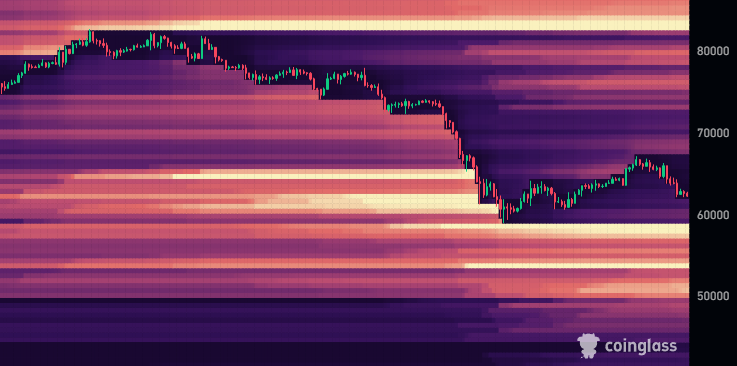
Bitcoin (BTC) could reach its new “macro bottom” by September, as price action continues to surprise traders.
Key points:
- Bitcoin may “front run” exchange order-book liquidity to produce a bear-market low between $50,000 and $60,000.
- A trader sees “complete disbelief” if price reverses with only a partial liquidity grab.
- “Aggressive” shorting from Binance traders returns on low time frames.
BTC price bottom could spark “complete disbelief”
New analysis from pseudonymous trader Killa on Friday focuses on a sub-$60,000 liquidity grab next quarter.
Crypto exchange order-book liquidity is key to short-term price moves, as large-volume traders coerce the market into wiping nearby positions, causing volatility.
Killa, however, is looking at the longer-term picture — many expect BTC/USD to drop as low as $50,000 to take liquidity before bouncing, data shows.
“At some point, $BTC is going to front run major HTF liquidity,” he told followers in a post on X.
“Just like the market front ran the 140K liquidity above, it can do the exact same thing on the downside, leaving many in complete disbelief.”
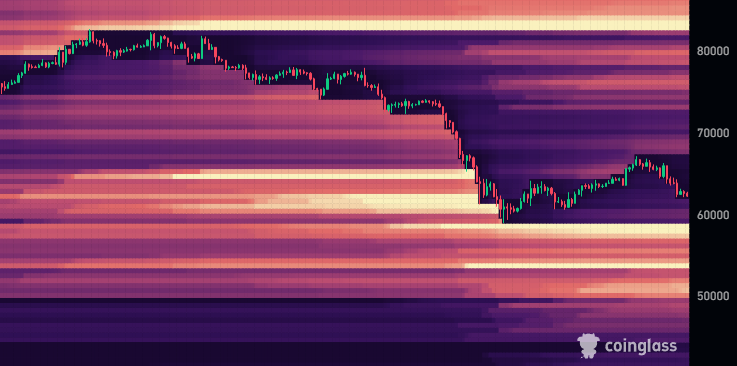
Bitcoin order-book liquidity data. Source: Killa/X
An accompanying chart from CoinGlass shows the main area of interest between $50,000 and $60,000. If it gets taken, Killa argues, it would lay the foundation for the end of the bear market.
“I’m not saying we won’t sweep below 60K, but it’s something worth considering. Markets have a habit of front running the levels everyone is focused on,” they continued.
“Because if this particular liquidity below 60K gets grabbed, there’s a very good chance the next major pool that forms between July and September never gets filled, marking the macro bottom.”
Binance BTC shorts become “aggressive”
As Cointelegraph reported, others have questioned the staying power of current support around the $60,000 mark.
Related: Bitcoin market cap rebound to take ‘5-10 years’ after dropping 10 places since mid-2025
Traders are poised for a snap collapse, with Daan Crypto Trades warning that the situation could “get ugly” if nearby trend lines fail to hold.
“Bulls need to hold that $61K-$62K region otherwise things get ugly real quick I think. But for now, still at support,” he summarized on X.
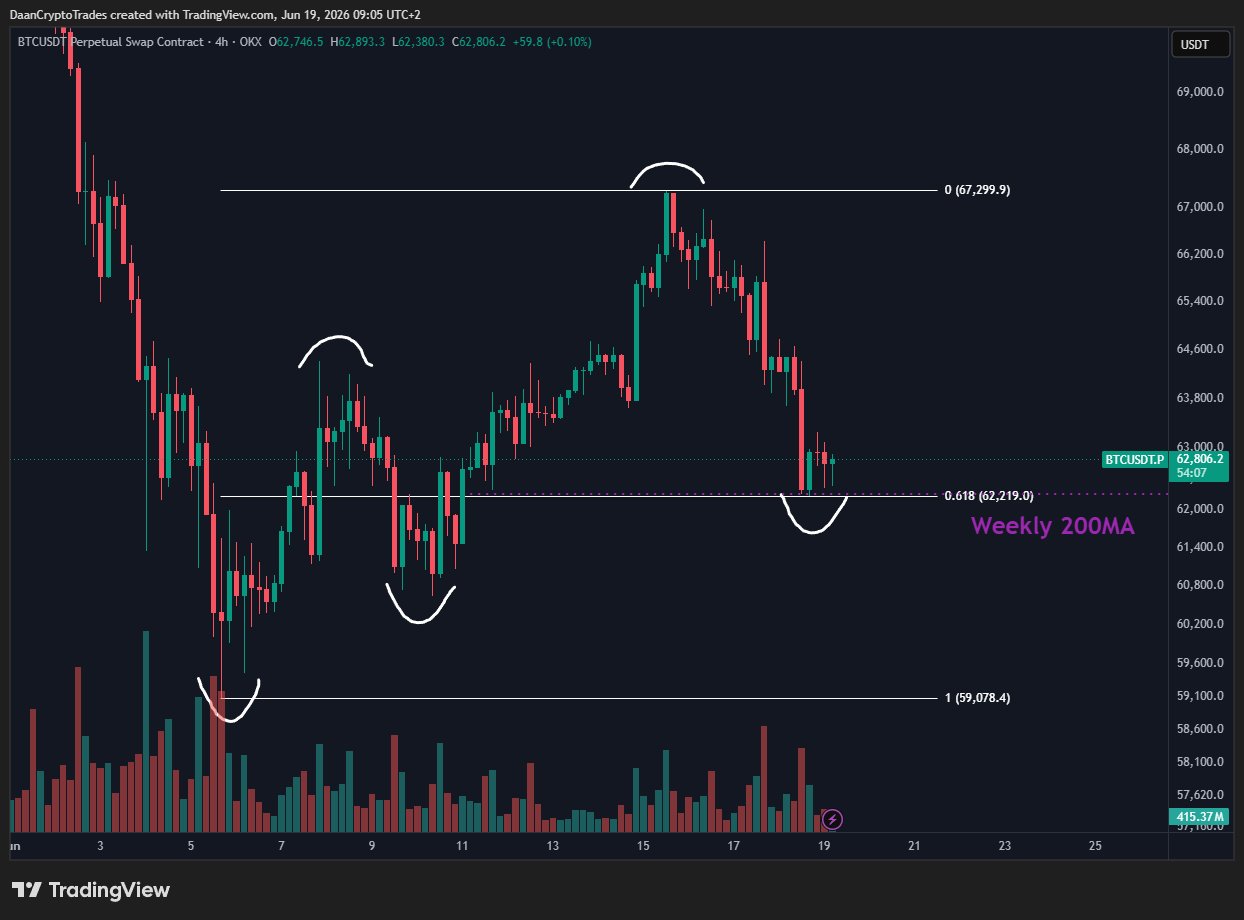
BTC/USD perpetual swap contract four-hour chart. Source: Daan Crypto Trades/X
On Thursday, commentator Exitpump flagged “aggressive” short positioning by traders on Binance, saying that the short-term price outlooks “looks bearish” as a result.
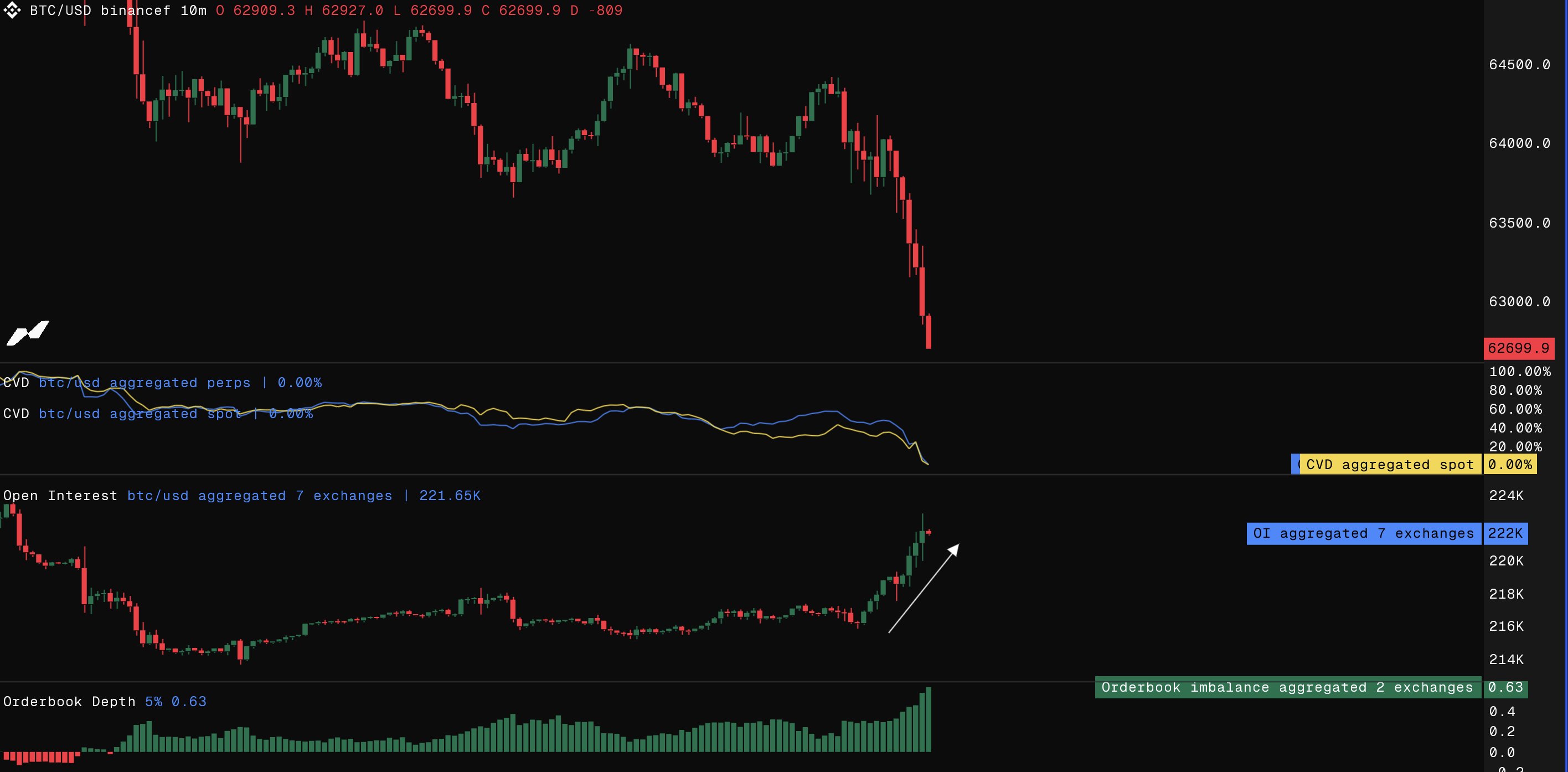
BTC/USD 10-minute chart with order-book data (Binance). Source: Exitpump/X


The largest cryptocurrencies remained under pressure for a fourth straight day, with bitcoin falling 2.5% in 24 hours to just below $62,400.
It’s not alone. The CoinDesk 20 Index (CD20) has dropped 3.3%, with ether (ETH), XRP (XRP) and solana (SOL) all weaker. The CoinDesk Smart Contract Platform Select Capped Index fell 4%, and the CoinDesk 80 and CoinDesk DeFi Select Index are following close behind.
Concerns about Strategy (MSTR), the Michael Saylor-led bitcoin treasury company, continue to dominate market sentiment, with particular focus on its dividend-paying preferred stock, STRC.
“Strategy, the largest listed BTC holder, has watched its STRC preferred collapse below par, and the market is now openly pricing the tail that it has to sell coins to defend the structure,” analysts at Marex said.
“Add five straight months of BTC trading under its estimated $78k production cost, quietly forcing the weakest miners to capitulate, and you have two real sellers that were not in the frame a week ago,” they added.
Derivatives Positioning
- Bulls continue to bleed as the market wilts in the wake of Wednesday’s hawkish Fed meeting. In the past 24 hours, more than $450 million in leveraged bets has been liquidated. As has been the case since the meeting, most are longs.
- Open interest (OI) in bitcoin and ether futures is largely unchanged over the past 24 hours. SOL futures OI increased to over 70 million tokens, just shy of the June 5 record 71.57 million. In other words, demand for leverage remains near all-time highs, pointing to potential for outsized volatility.
- The same is true of XRP, where futures OI is hovering at its highest since October last year.
- As for cumulative volume delta, most of the biggest 25 tokens, except TRX and LAB, show negative OI-adjusted CVD for the past 24 hours. That’s a sign sellers are trading at market orders, leading the price action, as opposed to passive limit orders. It’s been the same playbook since at least Wednesday.
- Funding rates for most tokens remain flat to negative, pointing to bearish sentiment. ADA, XLM, and BCH funding rates are down to between minus 20% and minus 30%.
- In the bitcoin options market, traders are lifting put options in size, prepping for a potential slide down to $52,000 or lower in the coming weeks.
- The bearish sentiment is also evident from 25-delta skews, which show one-week puts trading at a volatility premium of 10% or more.
Token Talk
- Need evidence of how frenzied sentiment about AI is? Check out the LAB token, the cryptocurrency native to the LAB Terminal, which is a browser-based and extension-accessible platform for high-performance trade execution. Its key feature: AI-powered research and trade routing to minimize slippage.
- LAB has gained 57% in seven days, a staggering rise compared with the malaise in the broader market.
- The outperformance doesn’t end there: The token has surged 92% this month, following gains of 900% in May, 250% in April and 78% in March. Talk about a bull market.
- Over the same period, bitcoin has ricocheted from $68,000 to $82,000 and back to $63,000.
- While LAB’s performance is impressive, their’s not apparent reason for it. And it’s not without controversy.
- Blockchain investigation expert ZachXBT recently highlighted that insiders supposedly own 95% of the token’s supply. He said they have used four methods concurrently to attract retailer investors. These include high-interest over-the-counter loans with promotional conditions, unilateral vesting period extensions, delayed or withheld market rewards and undisclosed market-making deals.
- As the old saying goes: All that glitters is not gold.

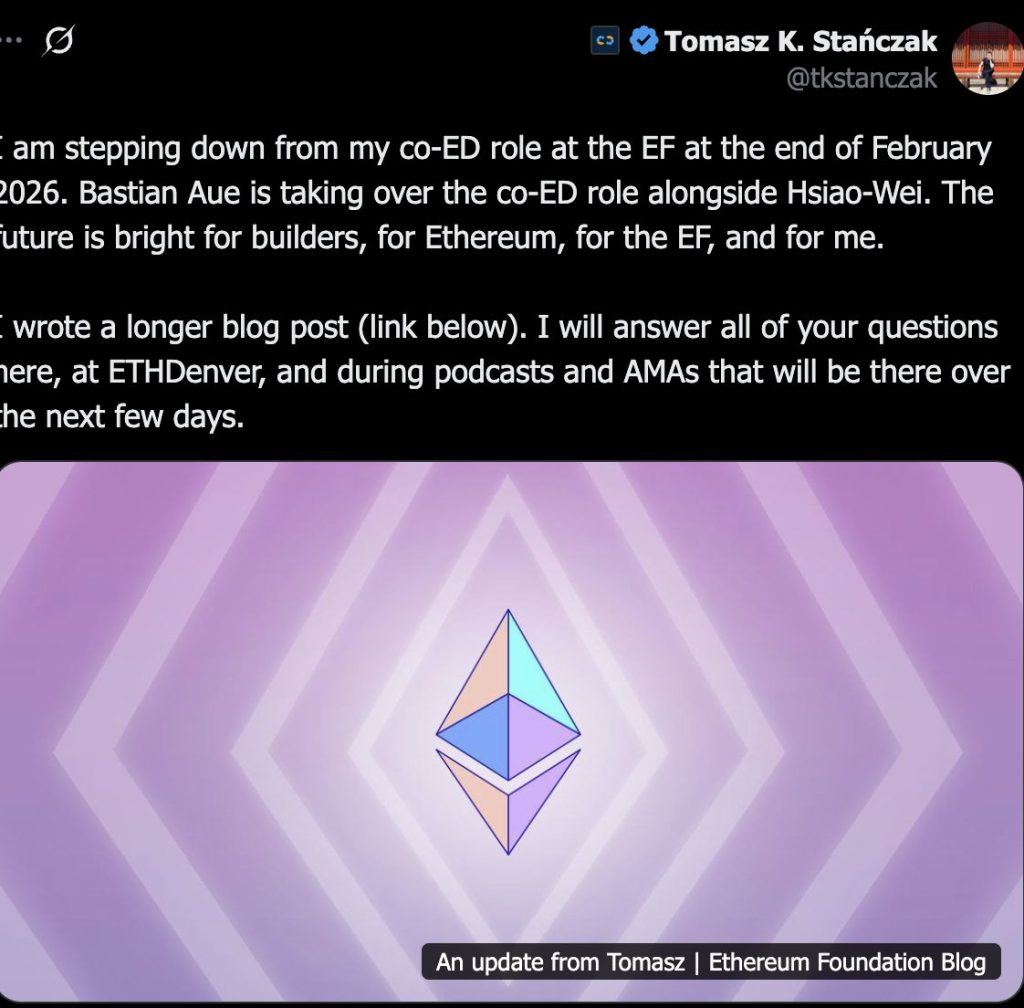
Hsiao-Wei Wang resigned as co-executive director and board member of the Ethereum Foundation on June 18, effective immediately, the second co-ED departure in roughly four months and the latest news signal that EF leadership is structurally unsettled heading into a critical upgrade cycle.
The exit lands the same day former EF contributor Trent Van Epps published a detailed warning that Ethereum’s core development ecosystem faces a slow-burning funding crisis within three to nine months, with an estimated $30 million annual gap that has no replacement mechanism in place.
Wang thanked Bastian Aue for guiding the transition during her prior sabbatical. Aue, who served as interim co-ED after Tomasz Stańczak stepped down in February, is now effectively the sole executive director of the Foundation. No successor structure has been announced.
ETH was trading near $1,690 at the time of publication, down roughly 3.3% on the day, broadly in line with market-wide pressure rather than any Wang-specific repricing. The structural story here is not the price tick. It is whether the EF can stabilize its leadership and funding architecture before both gaps compound.

Discover: The Best Crypto to Diversify Your Portfolio
Ethereum Core Dev Funding: What the $30M Gap Actually Means
Van Epps, who spent five years at the Ethereum Foundation from May 2021 to April 2026, focusing on core development coordination and Protocol Guild funding, is not an outside commentator raising theoretical concerns.
He was embedded in the mechanism he is now warning about, which makes the three-to-nine-month window he names worth taking seriously.
The $30 million annual figure Van Epps cites covers client teams, researchers, and coordination groups responsible for shipping protocol upgrades and maintaining network reliability. That baseline is currently under pressure from two converging sources.
First, the Client Incentive Program expired in April 2026 with no replacement announced. The CIP launched in 2021 to provide validator-based rewards to teams maintaining key Ethereum execution and consensus clients, Geth, Erigon, Lighthouse, and others, with payouts that unlocked over time contingent on continued network contribution.
Its expiration removes one of the few recurring, structured funding streams outside direct EF grants.
ETHEREUM FOUNDATION IS RUNNING OUT OF MONEY! CRISIS COMING IN 3-9 MONTHS
A former Ethereum Foundation core developer just dropped a serious warning.
Trent Van Epps, who worked at EF for 5 years coordinating core development, says the foundation’s funding is drying up fast.… pic.twitter.com/PLv3d5IvWA— Andrew Leverage (@Mr_LeverageX) June 19, 2026
Second, the EF leadership is running a deliberate treasury drawdown policy, targeting a reduction in annual spending from 15% of its treasury to a 5% baseline by 2030.
That is a defensible long-term posture for an institution managing billions in ETH, but the transition creates a near-term gap that no alternative mechanism has yet filled.
EF Q1 2026 grants covered Geth, Erigon, Lighthouse, validator security tooling, cryptography research, and core infrastructure. Funding continues, but Van Epps’s argument is that episodic grants do not substitute for the structural continuity the CIP provided.
If a replacement for the Client Incentive Program is not announced within the next few months, the most exposed teams are those maintaining execution and consensus clients on a thinner runway, precisely the engineers whose continued output is required for the Glamsterdam upgrade roadmap to stay on schedule.
Van Epps also flags quantum-security research and Layer 1 scaling work as long-horizon projects that erode first when funding visibility shortens.
Discover: The Best Token Presales
Two Co-EDs Out in Four Months: What the Ethereum Leadership Exits News Signal
Wang and Stańczak were named co-executive directors in March 2025 as part of a governance reset following Aya Miyaguchi’s move to a president role.
Both are now gone within fifteen months. Broader reporting places the total number of EF departures in 2026 at approximately 19, with at least eight senior figures exiting in the past five months, including figures tied to the Protocol Cluster transition, such as Barnabé Monnot, Tim Beiko, and Alex Stokes.
Treating each exit as an individual decision misses the pattern. A foundation managing a multi-billion-dollar ETH treasury, overseeing core developer funding for the world’s largest smart contract platform, and navigating a major upgrade cycle does not shed two co-EDs in four months without structural tension of some kind, whether over mandate, resource allocation, or governance direction.
Vitalik Buterin publicly responded to Wang’s departure, calling her a steadfast contributor for a decade and crediting her with organizing Ethereum research, consensus work, and community building in Taipei. That is a genuine acknowledgment.
It does not resolve the question of what the EF’s executive structure looks like going forward, particularly as Bastian Aue holds the ED role without a co-lead, and no succession timeline has been made public.
The post Ethereum Foundation Lost 2nd Co-Director in 4 Months As $30M Funding Crisis Looms appeared first on Cryptonews.

Key Highlights
- Bernstein SocGen launched coverage of GEV with an Outperform rating and set a $1,206 price objective
- Analyst Sunaina Ocalan highlighted three major tailwinds: decarbonization efforts, energy security needs, and surging AI power requirements
- First quarter orders surged to $18.3 billion, representing a 71% year-over-year increase, while backlog climbed to $163 billion
- Q1 free cash flow reached $4.8 billion — exceeding the entire fiscal 2025 total
- Shares have climbed 62.3% year-to-date, currently trading at $1,103, approaching the 52-week peak of $1,150
GE Vernova (GEV) saw its shares climb 5.2% Wednesday following Bernstein SocGen analyst Sunaina Ocalan’s initiation of coverage with an Outperform rating alongside a $1,206 price objective. At the time of the upgrade, shares were changing hands at $1,103, hovering near the 52-week high of $1,150 reached in April 2026.
Ocalan characterized GEV as the “right time, right business” — positioning the company at the convergence point of three significant structural trends currently fueling electricity demand.
These three catalysts include the push toward decarbonization, heightened energy security concerns, and the explosive growth in AI infrastructure. Each trend is amplifying demand for gas turbines and grid infrastructure. GEV’s order pipeline is experiencing unprecedented growth.
First quarter bookings totaled $18.3 billion, reflecting 71% organic growth compared to the prior year period. The total backlog now stands at $163 billion. Gas turbine capacity reservations reached 100 gigawatts during the quarter, with company leadership aiming for 110 GW by the close of the year.
First quarter free cash flow hit $4.8 billion. This figure surpasses what GEV produced throughout the entirety of fiscal 2025. The magnitude of this performance is noteworthy.
Small Modular Reactor Initiative Strengthens Growth Thesis
GE Vernova Hitachi Nuclear Energy revealed plans for a partnership focused on constructing a new production facility designed to support small modular reactor (SMR) rollouts throughout Europe. Additionally, the company continues advancing its SMR initiative in Ontario, Canada.
The recent Iran peace agreement contributed favorably to market sentiment. Reduced oil prices lower operational expenses for data centers and industrial operations that represent GEV’s primary customer base, supporting the financial viability of the AI expansion fueling its order growth.
GEV shares have appreciated 62.3% from the beginning of the year. Early investors who allocated $1,000 to GEV at its March 2024 initial public offering now hold positions valued at $8,401.
Market Context: Price Swings Are Common
GEV has experienced 19 single-day movements exceeding 5% throughout the past year, indicating today’s advance aligns with the stock’s established volatility pattern.
Just eight trading sessions ago, shares declined 6.6% following CPI data revealing 4.2% annualized inflation — the steepest level in three years — prompting markets to anticipate a December Federal Reserve rate increase. Elevated interest rates create challenges for capital-intensive industrial companies like GEV.
Previously, the Iran conflict weighed on investor sentiment, as Tehran directed attacks toward Bahrain, Kuwait, and Jordan, introducing supply chain disruptions and complications to international logistics operations.
Gas turbine capacity reservations totaled 100 gigawatts at first quarter end, with leadership establishing a 110 GW target for year-end.

Franklin Templeton has filed to launch two exchange-traded funds that would automatically direct stock dividend income into Bitcoin exposure.
Summary
- Franklin Templeton has filed for two ETFs that would reinvest stock dividends into Bitcoin exposure through a rules based allocation strategy.
- The proposed funds would start with a 95% allocation to U.S. large cap equities and a 5% allocation to Bitcoin linked investments.
- The filing extends Franklin Templeton’s digital asset expansion after recent tokenization partnerships with Kraken, MoonPay, and Ondo Finance.
A registration filing submitted on Thursday shows the asset manager has proposed the Franklin US Equity Bitcoin DRIP Index ETF and the Franklin US Innovation Bitcoin DRIP Index ETF, with an anticipated effective date of Sept. 1, 2026.
The products would track the VettaFi US Large-Cap 500 Bitcoin DRIP Index and a related innovation-focused version. Under the index methodology, dividends generated by the underlying stock portfolios would be reinvested into Bitcoin-linked investments rather than remaining in cash or being distributed to investors.
The filing states that Bitcoin exposure could come through spot Bitcoin exchange-traded products, futures contracts, options, or other investment instruments. The strategy is scheduled to begin with a portfolio allocation of 95% U.S. large-cap equities and 5% Bitcoin exposure.
Quarterly rebalancing rules would reduce Bitcoin allocations above 5% back to 4.5%, while a separate cap would limit Bitcoin exposure to 20% between rebalancing periods, the filing states.
As of April 30, the equity index included approximately 498 securities. The filing states that constituent companies ranged in market capitalization from roughly $7.5 billion to $4.9 trillion.
Franklin expands crypto-linked investment offerings
The proposed ETFs add another product category to Franklin Templeton’s digital asset business, which already includes spot cryptocurrency ETFs, tokenized funds, and blockchain-based investment products.
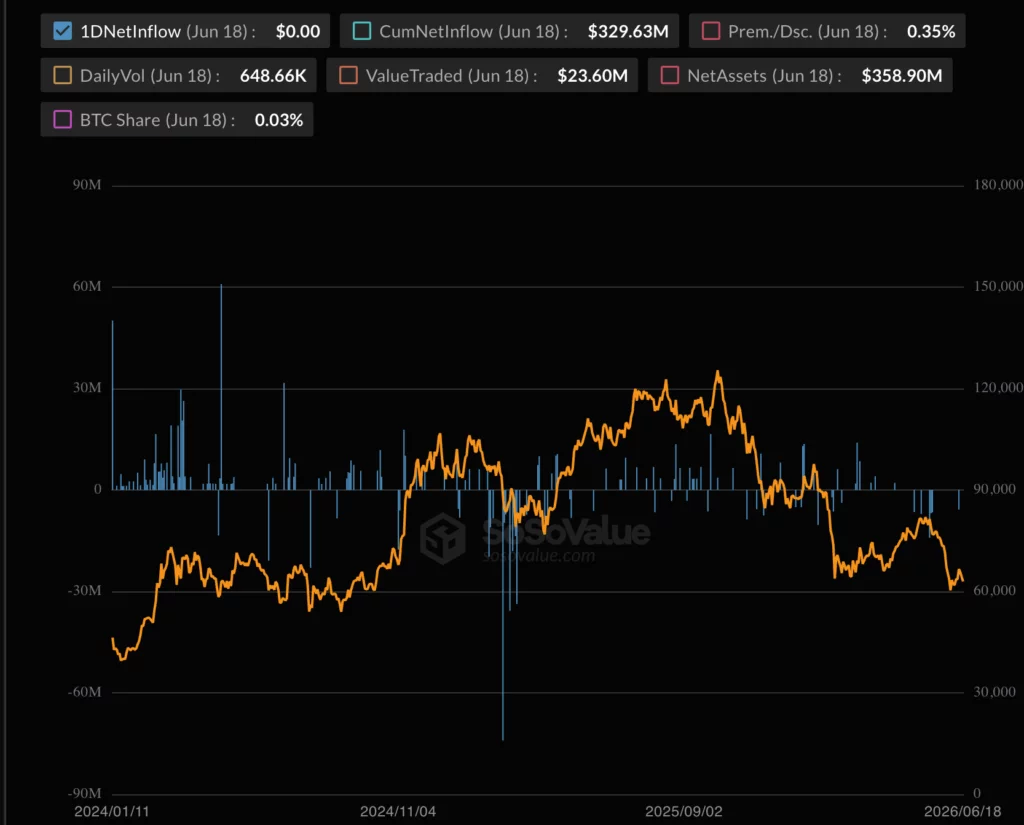
Data from SoSoValue showed Franklin Templeton’s spot Bitcoin ETF, EZBC, held $358.9 million in net assets and had attracted $329.6 million in cumulative net inflows as of Thursday.
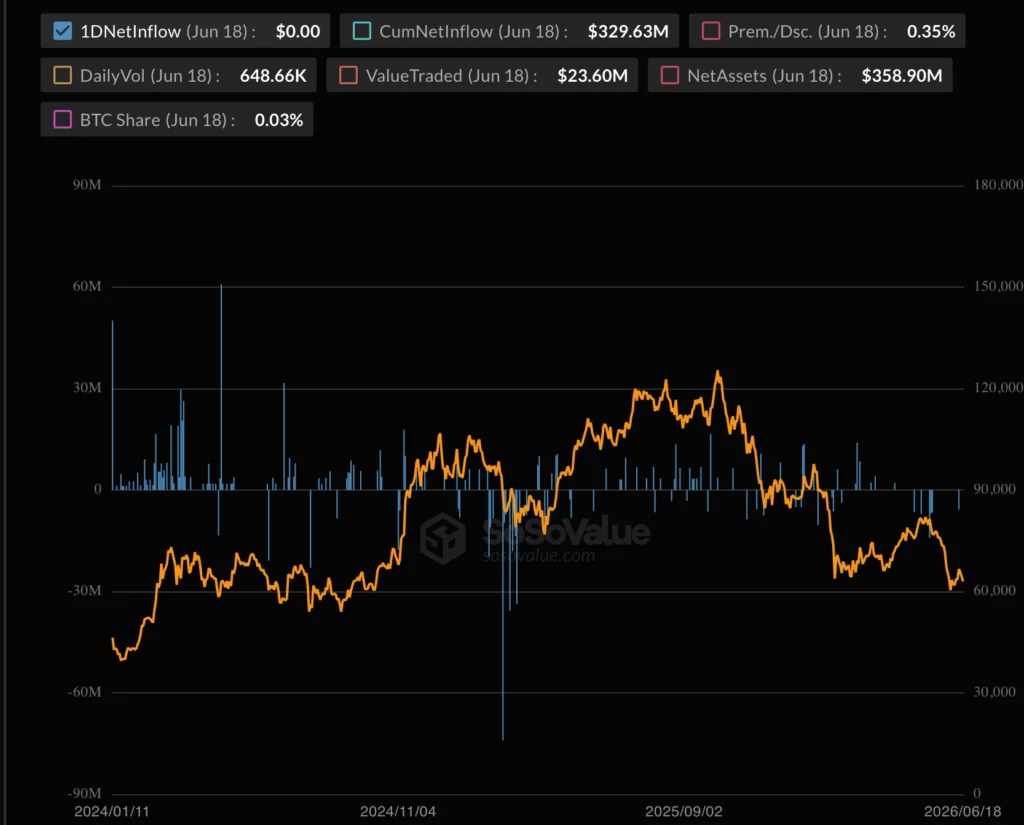
Source: SoSoValue.
The filing follows several digital asset initiatives announced by the firm in recent months. On June 15, Franklin Templeton said it would work with Ondo Finance to offer tokenized versions of its ETFs that can trade directly from crypto wallets on a 24/7 basis. The products target investors outside the United States and include exposure to U.S. equities, fixed income assets, and gold.
Earlier in June, Franklin Templeton integrated its BENJI tokenized money market fund into MoonPay Trade. The partnership allows institutional clients to exchange stablecoins such as USDC and USDT for BENJI through MoonPay’s on-chain trading infrastructure.
In May, Franklin Templeton announced a separate partnership with Payward, the parent company of crypto exchange Kraken. The companies said BENJI would be available on Kraken’s platform as a collateral and cash management product for institutional users. They also disclosed plans to develop additional tokenized investment products through Payward’s xStocks infrastructure.
Crypto World
Crypto News, June 19: Bitcoin at Risk as Strategy STRC Cracks its Peg, Microsoft Warns Windows Crypto Users, Iran Suspends Peace Talks

Bitcoin is not having a good time as Strategy STRC peg finally snapped, Iran peace talks stalled before they even started, and Microsoft just told every Windows user touching crypto to wake up.
Strategy chairman, Saylor, dropped a tweet this morning that felt way too calm for him. There is fire, no shill energy in his tweet, it’s worrying to some degree. At the same time, an old video of him saying he built parts of the Bitcoin Strategy mechanism with ChatGPT is getting another round of attention.
In reality, the STRC peg has been broken since May, and it’s getting ugly because of the Bitcoin current chart. STRC was aggressively buying Bitcoin when it was above par, but now it’s below $100, and the buying pressure is somehow gone. If STRC stops acting like an accumulator, Bitcoin could lose one of its more aggressive buyers. Some analysts even think that we could see forced selling next.
It could be just temporary, and the peg may be back when Bitcoin starts going back up again. But either way, Saylor with his STRC Strategy and Bitcoin is not in a good position. Critics say this is the same movie as the dot-com days. We can feel that STRC fud isn’t going away anytime soon, not before Bitcoin goes up.

Discover: The Best Crypto to Diversify Your Portfolio
Iran Peace Talks Postponed Just 24 Hours After Memorandum Signed: Bitcoin, STRC, and Saylor Are in Danger
Switzerland said today that Friday’s US-Iran meeting will be postponed. Iran reportedly suspended the whole 60-day process less than a day after the initial deal, blaming strikes on Lebanon. JD Vance’s trip has also been quietly canceled. Iran peace deal looks dead in the water right now.
Simultaneously, the Pentagon is now asking for $80 billion to cover Iran war costs after already spending way more than the $29 billion they admitted back in May. But this is also on top of their trillion-dollar budget.
JUST IN: — Watcher.Guru (@WatcherGuru) June 19, 2026

 US Department of War requests $80,000,000,000 to cover Iran war and other costs.
More geopolitical tension means more short-term pain for risk assets and anyone running a leveraged Bitcoin-like strategy.
Discover: The Best Token Presales
Microsoft Warns Windows Users of Crypto Attack
Microsoft Threat Intelligence posted about a crypto clipper that’s been running since February. It swaps wallet addresses in your clipboard, spreads through malicious .lnk files on USB drives, and even runs Tor in the background.
How does it work? Once your computer is infected, there are some backdoors to it, and this is actually bad for Windows users. When you copy an address, the malware changes it and tricks you into transferring funds to the wrong address.
As of now, Microsoft tags it as Trojan:Win32/CryptoBandits.A. If you’re trading crypto, or even just doing stablecoin transactions on Windows, it might be the right time to take precautionary measures. Double-check every address, use a hardware wallet, and stop clicking random shortcuts. It could be an expensive lesson.
Discover: The Best Crypto to Diversify Your Portfolio
Bitcoin and Other Market Updates
Morgan Stanley updated their spot Ethereum and Solana ETF filings with a 0.14% fee, making their offer the cheapest on the table so far. At the same time, Franklin Templeton filed two new products that convert stock dividends and automatically turn them into Bitcoin up to 20% exposure, targeting a September launch.
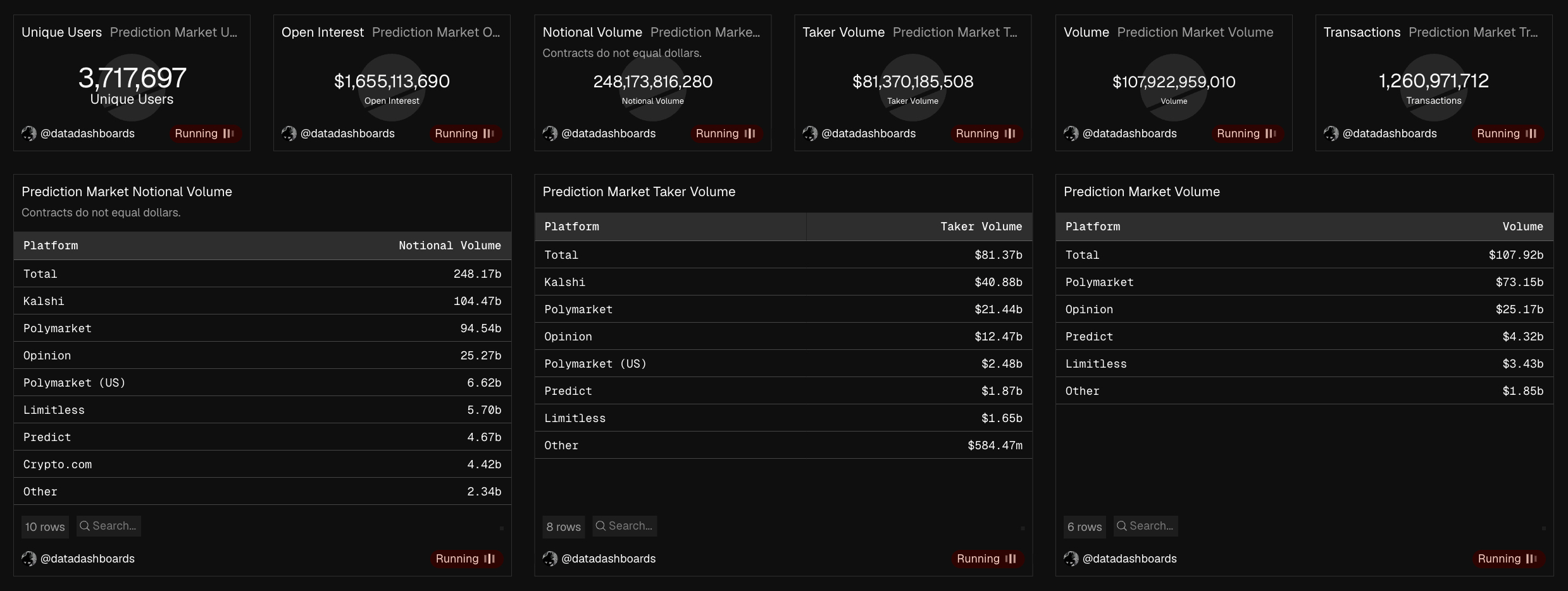
On the prediction market, Polymarket’s rival, Kalshi, is now preparing to go public at a $22 billion valuation with over $2 billion in yearly revenue. The prediction markets platform raised $1B in a Series F round in May, bringing its valuation to $22B. The round was led by Coatue, with participation from Sequoia Capital, Andreessen Horowitz, IVP, Paradigm, Morgan Stanley (MS), and ARK Invest.
For now, it’s true that Bitcoin is not helping STRC, and Iran peace looks like it’s falling apart. Microsoft warnings questions the safety of crypto, too. But the big money isn’t waiting around for perfect conditions. They’re still filing ETFs, raising capital, and building infrastructure. Bitcoin cycle survivors already know how this works.
Discover: The Best Token Presales
The post Crypto News, June 19: Bitcoin at Risk as Strategy STRC Cracks its Peg, Microsoft Warns Windows Crypto Users, Iran Suspends Peace Talks appeared first on Cryptonews.
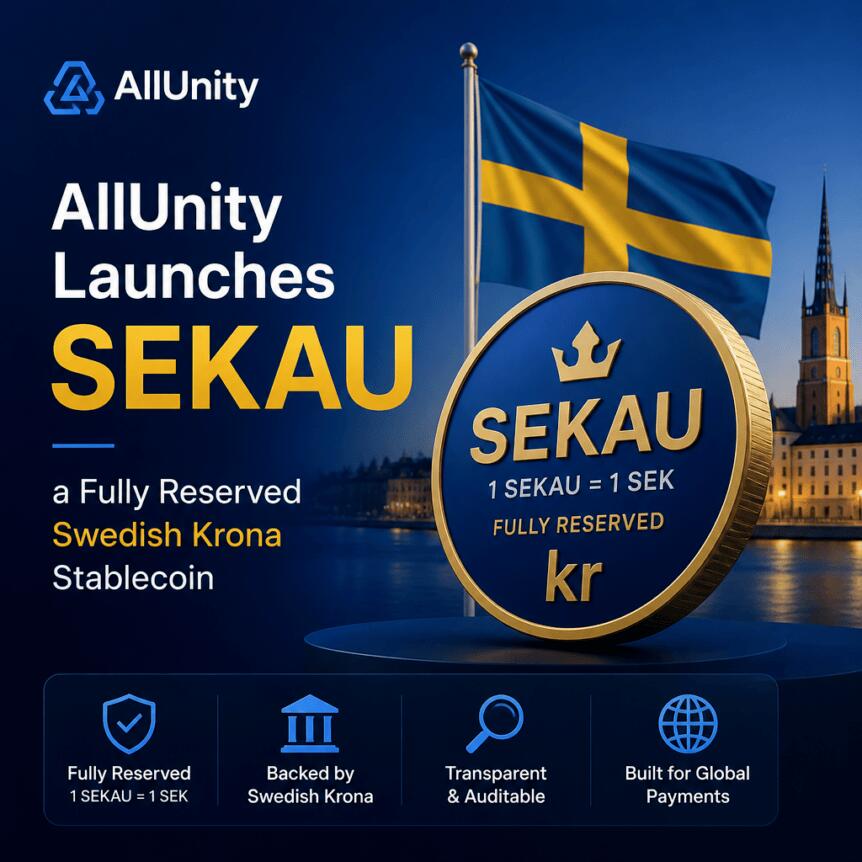
AllUnity is extending its MiCA-regulated stablecoin lineup with SEKAU, a Swedish krona-backed token designed for institutional settlement and cross-border payments. The company said the new stablecoin is issued under the EU’s Markets in Crypto-Assets Regulation (MiCA) as an e-money token, with reserves held in segregated Swedish krona accounts.
The release also highlights how issuers are adapting to MiCA’s framework by moving beyond “early-stage” token concepts and toward bank- and infrastructure-style custody and settlement. AllUnity’s SEKAU follows its earlier Swiss franc stablecoin rollout, reinforcing a multi-currency strategy built for different blockchain ecosystems.
Key takeaways
- SEKAU is a Swedish krona stablecoin issued under MiCA as an e-money token, backed 1:1 by segregated SEK reserves.
- Banking Circle will hold and manage the reserves, with Marginalen Bank supporting the rollout as a banking partner.
- SEKAU launches on five networks—Ethereum, Solana, Base, Tempo, and Polygon—with plans to add more chains later in 2026.
- AllUnity frames SEKAU as the first fully reserved Swedish krona-denominated MiCA-aligned stablecoin, contrasting it with non-public tokenized experiments.
MiCA compliance becomes the product, not just the legal wrapper
In a statement shared with Cointelegraph, AllUnity described SEKAU as the first fully reserved Swedish krona stablecoin aligned with MiCA, issued as a regulated e-money token (“EMT”). The token’s backing is described as 1:1 by Swedish krona reserves held in segregated accounts, an approach intended to distinguish it from fiat-referenced crypto concepts that may not be designed for regulated redemption and governance.
AllUnity also emphasized that “SEK exposure has previously existed mainly through early-stage concepts,” which it said were not confirmed as MiCA-authorized, fully regulated EMTs. That distinction matters for market participants who care less about token branding and more about how fiat reserves are managed, what oversight applies, and whether the stablecoin is designed to operate as regulated private money under EU rules.
Who will hold the reserves and connect the infrastructure
SEKAU’s structure leans heavily on regulated financial infrastructure and integration partners. Banking Circle, a Luxembourg-based business-to-business bank and financial infrastructure firm, will hold and manage the reserves backing the token. Swedish Marginalen Bank is listed as a banking partner supporting the rollout.
For broader ecosystem access, Trust Anchor Group is named as the infrastructure integration provider for SEKAU. Together, these relationships suggest AllUnity is treating stablecoin deployment as a coordinated effort across custody, banking relationships, and technical connectivity—rather than a standalone token launch.
A multi-chain rollout aimed at liquidity across ecosystems
SEKAU is launching on five blockchain networks: Ethereum, Solana, Base, Tempo, and Polygon. AllUnity said the multi-chain approach is intended to improve access, interoperability, and liquidity across major ecosystems.
The company also signaled it does not intend to stop at the initial set of networks, stating it plans to expand SEKAU to additional blockchain networks later in 2026. The contrast with AllUnity’s previous stablecoin deployment is notable: its Swiss franc stablecoin CHFAU initially launched exclusively on Ethereum in February before expanding to Tempo, implying a more staggered chain rollout for the earlier product.
AllUnity also operates EURAU, a euro-backed stablecoin launched in 2025. According to CoinGecko data cited by Cointelegraph, EURAU has reached a market capitalization of $1.4 million and ranks as the 16th largest euro stablecoin among 23 tracked tokens. CoinGecko also shows the euro stablecoin market totals about $883 million in combined value at the time of writing.
SEK stablecoins in Sweden: public tokens vs closed pilots
AllUnity’s messaging around SEKAU also speaks to the broader question of whether Sweden has stablecoin activity beyond regulated, publicly redeemable products. The company pointed to Sweden’s e-krona project run by the Riksbank as a relevant initiative for tokenized payments infrastructure—but stressed it is fundamentally different from a stablecoin.
AllUnity noted that Swedish banking and fintech pilots have explored tokenized deposit money and settlement systems. However, the company characterized these as “closed, experimental infrastructures” rather than publicly redeemable stablecoins.
The company further referenced communication from the Riksbank earlier in 2026 indicating there were no stablecoins in Swedish kronor. While that does not preclude tokenized pilots or related experiments, it frames SEKAU as a distinct category: a regulated, publicly available krona token built under MiCA’s e-money rules.
What investors and users should watch next
With SEKAU now live across multiple chains, the immediate question is how liquidity and usage develop across Ethereum, Solana, Base, Tempo, and Polygon—especially as AllUnity plans additional network expansion later in 2026. Market participants will also want to monitor how reserve management and EMT compliance are handled in practice over time, and whether the SEK stablecoin narrative gains traction alongside other MiCA-regulated fiat tokens.


Representative Bryan Steil introduced the Stop Lawmakers from Predicting Act on June 18. The bill bars members of Congress, their spouses, and dependent children from wagering on government policy and political outcomes through prediction markets.
The Wisconsin Republican chairs the House Administration Committee. His bill responds to mounting concerns surrounding reported insider trading on these platforms.
Steil Seeks to Bar Lawmakers From Betting on US Policy Outcomes
The legislation builds on the Stop Insider Trading Act, which the committee advanced on January 14. Steil framed the new measure as a way to rebuild confidence in elected officials.
“The American people deserve to know their Member of Congress is not profiting off insider information,” Steil said. “Lawmakers should be writing policy, not wagering on its outcome.”
Follow us on X to get the latest news as it happens
The bill bans members, spouses, and dependent children from betting on specific government policies, actions, or political results. Violators must pay $2,000 or 10% of the transaction value, whichever is greater. They also forfeit any net gain.
In addition, the bill proposes that members cannot use their official allowances, Senate expense accounts, or political donations to pay the fine. Those who resign or retire without paying can be referred to the Department of Justice for civil enforcement.
The proposal joins a wider push. In March, Senators Todd Young, Elissa Slotkin, John Curtis, and Adam Schiff introduced the Public Integrity in Financial Prediction Markets Act, targeting nonpublic information trades across any platform. A House companion, the PREDICT Act, extends similar limits to officials’ families.
Whether the measure advances may hinge on bipartisan appetite, given parallel Senate and House efforts already in motion. Meanwhile, prediction market platforms have responded too.
In June, Kalshi rolled out risk scoring, employment checks, and whistleblower channels to deter insiders from acting on privileged information. Polymarket brought in Chainalysis to build an on-chain surveillance system.
Subscribe to our YouTube channel to watch leaders and journalists provide expert insights
The post US Lawmakers May Be Banned From Betting on Kalshi and Polymarket appeared first on BeInCrypto.
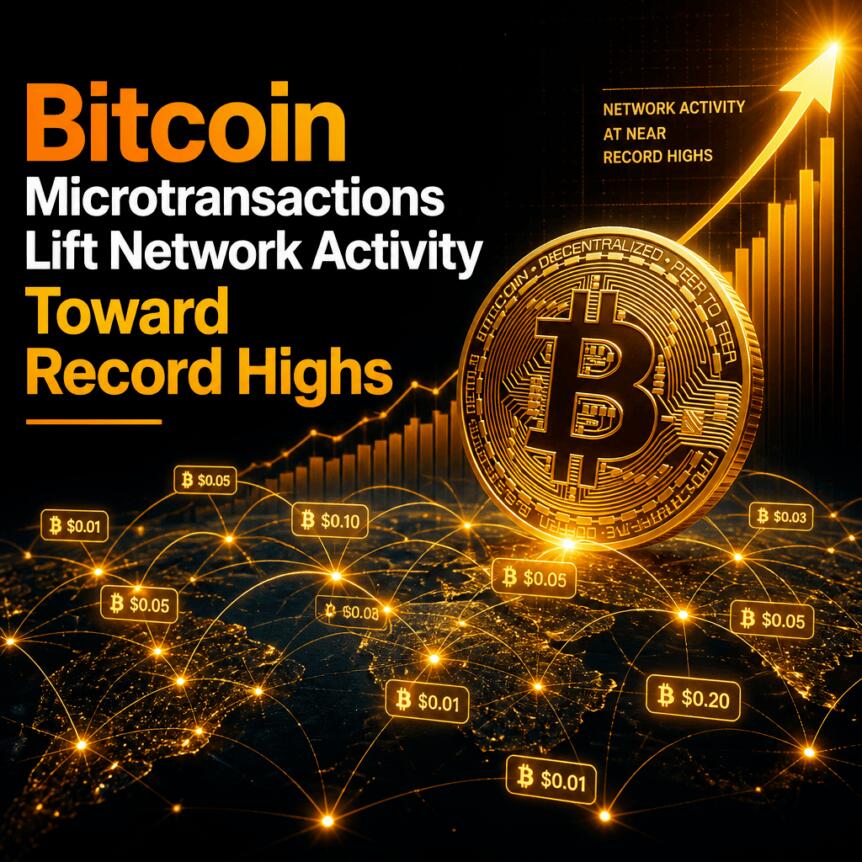
Bitcoin’s day-to-day activity is accelerating again, even as the asset’s price action remains relatively unimpressive. According to CryptoQuant, transactions smaller than 0.01 BTC—often associated with “dust” or data-driven on-chain activity—now make up about 80% of all daily transfers on the network, taking overall network activity close to record levels.
In a report released Thursday, CryptoQuant said its Bitcoin “Network Activity Index” has turned positive for the first time since 2024. The change matters because it signals that block space demand is increasingly being driven by non-financial usage—an environment that can translate into more competition for space and higher fees for users who rely on standard economic transactions.
Key takeaways
- CryptoQuant reports that sub-0.01 BTC transactions represent roughly 80% of daily Bitcoin activity, up sharply from earlier years.
- CryptoQuant’s Network Activity Index has moved into positive territory for the first time since 2024, despite weaker price performance.
- Data-inscription and related protocols—especially Ordinals, Runes, BRC-20 activity, and timestamping services—are cited as major contributors.
- Growing micro-transaction volumes can increase block space competition, potentially pushing up fees for “economic” transactions.
- Bitcoin’s mempool is reported at around 128,000 transactions, the highest level since February 2025.
Microtransactions rebound as share of daily volume grows
The most striking development is the shift in the composition of transactions. CryptoQuant notes that transactions below 0.01 BTC accounted for about 44% of daily transactions in 2023, but their share has nearly doubled since then.
CryptoQuant attributes this acceleration largely to inscription-centric demand and other data-writing approaches. In particular, the report highlights Ordinals and Runes—along with BRC-20 activity and data-timestamping protocols—as major drivers of low-value, high-count transactions. This helps explain why overall network activity can rise even when traders are not broadly chasing price momentum.
Research lead Julio Moreno wrote that sustained growth in non-financial activity could “increase block space competition and raise fees for economic transactions.” He also cautioned that the economic value of these transactions is “disproportionately small,” underscoring a key tension: the network can appear busier while the value per transaction remains low.
From earlier inscription booms to today’s renewed congestion
CryptoQuant’s report places the current wave in context by comparing it to past periods when inscription activity pushed Bitcoin toward congestion. The company says congestion levels today remain below the peaks associated with earlier inscription booms, when users embedded data such as images, text, and token-like information directly in blocks.
According to the report, transaction backlogs surged in 2023 as Ordinals and BRC-20 competed with routine transfers for limited block space. It then points to another spike emerging in late 2024 following the launch of the Runes protocol. The latest increase appears to follow that same pattern: bursts of on-chain data activity generate large numbers of transactions, which can swell network queues and raise the likelihood of fee pressure.
Importantly for readers, congestion is not just an abstract metric. When block space demand concentrates in low-value transactions, it can still alter fee dynamics for everyone—particularly those sending standard payments that depend on timely confirmation.
OP_RETURN usage and the mechanics behind higher transaction counts
Beyond the headline micro-transaction shares, CryptoQuant’s research also points to the specific transaction design choices fueling the trend. The report says Runes, Ordinals, BRC-20 tokens, and data-timestamping services produce large volumes of low-value transactions, helping drive the rise in the smallest cohort.
A central element in this mechanism is OP_RETURN, an opcode that allows users to embed data on-chain without creating spendable outputs. CryptoQuant reports that OP_RETURN usage has climbed to near-record levels in 2026.
That increase ties back to a contentious development within Bitcoin’s infrastructure: in 2025, Bitcoin Core developers removed a long-standing 80-byte relay limit. Critics argued the change would make it easier to use Bitcoin for non-financial data storage, effectively lowering friction for larger data embeddings. CryptoQuant frames OP_RETURN as the standard approach for many Bitcoin data-layer protocols, meaning changes in relay behavior can influence how much data activity the network can absorb.
These protocols generate high volumes of dust-value transactions (as low as 546 satoshis), directly explaining the low-value cohort surge.
Put differently, the “how” of transactions matters as much as the “how many.” Even when users are not transferring large amounts of value, on-chain data operations can still consume block resources—resulting in a higher count of transactions competing for inclusion.
Mempool pressure rises alongside the micro-transaction wave
CryptoQuant’s report also connects micro-transaction growth to observable network conditions. It says Bitcoin’s mempool—where unconfirmed transactions wait—has risen to roughly 128,000 transactions. That figure is described as the highest transaction count since February 2025.
For market participants and users, mempool size is often treated as a practical proxy for near-term congestion. While the report notes that current conditions are still below earlier inscription peaks, the combination of a high share of sub-0.01 BTC transactions and a swollen mempool suggests that fee markets may remain sensitive, especially for transactions that need confirmation during busy periods.
Another important implication is that the network’s “busy” signal may increasingly reflect data-layer usage rather than straightforward economic demand. That distinction can affect how participants interpret on-chain metrics: rising activity may not correspond to higher on-chain settlement value, even if it does correspond to greater resource competition.
Looking ahead, readers should watch whether this micro-transaction-driven activity persists and whether mempool levels remain elevated long enough to translate into sustained fee pressure for standard payments. CryptoQuant’s index turning positive after a multi-year stretch is a meaningful early sign—but the key question is whether non-financial activity continues to outpace demand for economic transactions, reshaping fee dynamics as the cycle progresses.

Bob Iger on Shanghai Disneyland as it defies the Chinese pullback

Real Finance puts $20,000 up for grabs in new $ASSET rewards campaign

Nicky Hilton’s Leopard Print Dress Style Is on Amazon for $30


-

 Business5 days ago
No Jackpot Winner as $257 Million Prize Rolls Over to $269 Million Monday Draw
-

 Fashion7 days ago
Weekend Open Thread: Tuckernuck – Corporette.com
-
 Crypto World4 days ago
Zimbabwe Requires Crypto Businesses to Register Annually Under New FIU Regulations
-

 Crypto World6 days ago
Bitget enters Argentina’s regulated crypto market through PSAV registration
-

 Tech6 days ago
NanoClaw integrates JFrog registries to secure AI agent downloads
-

 Tech7 days ago
This Week In Security: Microsoft On Microsoft, Register Your Domains, Linux On ARM, And FreeBSD Joins The File Cache Club
-

 NewsBeat7 days ago
FBI searches office of Ohio voter registration group
-
 Entertainment5 days ago
Matt Damon’s Viral Sci-Fi Thriller Has Taken Over HBO Max
-

 Business5 days ago
Anthropic staff to meet White House officials next week, Axios reports
-

 Tech5 days ago
As AI companies race to go public, who else is along for the ride?
-
 Crypto World5 days ago
Bitcoin could crash to $48,000, if this historical pattern is triggered
-

 Politics5 days ago
“Israel’s” ban on ICRC visits ruled illegal, but Knesset moves to stop them permanently
-
 NewsBeat5 days ago
Warning of disruption as Cardiff Crossrail works to start
-

 News Videos5 days ago
Financial Accounting | Last Day Revision Strategy and Booster | CMA Inter – June 2026
-
 NewsBeat5 days ago
Tributes to former deputy head teacher at Cambridge school among death and funeral notices
-

 Entertainment5 days ago
Deion Sanders Shares Powerful Post After Viral Advice To Deiondra
-
 Crypto World5 days ago
Market Preview: SpaceX (SPCX) IPO Record, Federal Reserve Meeting, and Iran Nuclear Agreement
-
 NewsBeat5 days ago
what doctors are seeing in ebike crashes
-

 Crypto World5 days ago
XRP ETFs Outperform As Bitcoin And Ethereum Funds Extend Outflow Trend
-
 Entertainment5 days ago
Kate Middleton Glare Goes Viral After Kids Booed At Royal Event
You must be logged in to post a comment Login