

Crypto World
Inside the Strategic Bitcoin Reserve: promise vs reality



President Trump signed the executive order establishing the Strategic Bitcoin Reserve on March 6, 2025.
Summary
- Trump’s Strategic Bitcoin Reserve exists as a no-sell directive, not an active acquisition program yet.
- The U.S. government reportedly holds about 328,372 BTC, but custody and legal questions remain unresolved.
- Lummis’s BITCOIN Act targets 1 million BTC, while ARMA offers a more conservative legislative path.
- The next announcement may formalize custody and legal frameworks, not authorize direct Bitcoin purchases.
Fourteen months later, in May 2026, White House digital asset advisor Patrick Witt told the audience at Consensus Miami that a “major announcement” on the reserve is coming “in the next few weeks.” Witt characterized the underlying legal and custody work as a “breakthrough” and disclosed for the first time the government holds approximately 328,372 BTC worth roughly $25.4 billion.
Meanwhile, the gap between what has been promised and what has been operationally delivered is the structural story of the SBR. Trump’s order halted sales of seized Bitcoin and mandated centralized custody. The administration has conducted an audit revealing cold wallets stored in desk drawers across federal agencies and a $60+ million exploit of US Marshals Service holdings in late 2025.
Treasury Secretary Scott Bessent confirmed in August 2025 the US “won’t be buying” additional Bitcoin, contradicting the “Bitcoin superpower” rhetoric of former White House crypto advisor Bo Hines, who stepped down that same month amid SBR scrutiny. Senator Cynthia Lummis’s BITCOIN Act would mandate purchases of 1 million BTC over five years funded by gold revaluation. The bipartisan ARMA bill introduced May 2026 (Begich-R/Golden-D) dropped the specific 1M target and added a 20-year lockup.
Senate Banking Committee markup of competing bills is expected by May 31. The honest read is the SBR exists as legal directive but does not yet exist as operational acquisition program. The next several weeks will determine whether it becomes the latter or stays primarily the former. This is what the documented record shows, what the structural questions are, and what the imminent announcement might actually contain.
What the executive order actually established
The executive order signed on March 6, 2025 deserves careful unpacking because the gap between what it formally established and what most coverage characterized it as creating is structurally significant.
The order created two separate entities. The Strategic Bitcoin Reserve (SBR) is the entity holding Bitcoin specifically. The US Digital Asset Stockpile is a separate entity holding non-Bitcoin cryptocurrencies (Ethereum, XRP, Solana, Cardano, and other forfeited digital assets). The two entities have different operational mandates: the SBR cannot sell its Bitcoin holdings under the order’s terms, while the Digital Asset Stockpile lets the Treasury Department liquidate non-Bitcoin assets at its discretion.
The funding mechanism is the most consequential structural element. The reserve is “capitalized with all BTC held by the Department of the Treasury that was finally forfeited as part of criminal or civil asset forfeiture proceedings or in satisfaction of any civil money penalty imposed by any executive department or agency.” In plain English: the reserve consists of Bitcoin the government already had from law enforcement seizures. The executive order did not authorize and did not fund any active acquisition of additional Bitcoin.
The order does direct the Secretaries of Treasury and Commerce to “develop strategies for acquiring additional Government BTC, provided that such strategies are budget-neutral and do not impose incremental costs on United States taxpayers.” This is permissive language inviting policy development, not mandatory language requiring action. The Treasury and Commerce departments were tasked with studying whether budget-neutral acquisition mechanisms exist, not with implementing them.
The audit mandate is what produced the first concrete operational deliverable. The order required each federal agency to “provide the Secretary of the Treasury and the President’s Working Group on Digital Asset Markets with a full accounting of all Bitcoin and other digital assets in the agency’s possession” within 30 days. The audit deadline was April 5, 2025. The audit was completed but the detailed findings were not made public until the White House report released on July 30, 2025.
The structural questions the executive order left unresolved are the ones now being addressed through the May 2026 Witt announcement and the pending congressional legislation. Which specific legal authorities permit federal agencies to hold Bitcoin long-term rather than liquidating it through standard forfeiture procedures? Can Congress reclaim the assets through appropriations or other legislative action? What custody framework will protect the holdings from operational risks? How is “budget-neutral acquisition” actually defined and implemented?
These questions are not trivial. The executive order can set a policy direction, but it cannot by itself create the legal and operational infrastructure required to make a strategic Bitcoin reserve function comparably to other strategic reserves like the Strategic Petroleum Reserve or the gold holdings at Fort Knox. The infrastructure work is what Witt was referring to when he characterized the May 2026 announcement as a “breakthrough.”
What the executive order did establish, clearly and definitively, is the federal government’s policy of not selling its Bitcoin holdings. The Treasury Secretary’s August 2025 confirmation that the US “won’t be buying” additional Bitcoin reinforced the operational reality: the SBR is a directive to hold, not a directive to accumulate. The “digital Fort Knox” rhetoric from White House crypto czar David Sacks describes the aspirational endpoint. The current operational state is more accurately characterized as “do not sell what we already have.”
What the audit actually revealed
The audit conducted between March and July 2025 produced findings more revealing than the formal report acknowledged, and the documented operational realities deserve attention because they shape what the imminent SBR announcement can realistically deliver.
The headline number is the government holds approximately 328,372 BTC worth roughly $25.4 billion as of February 2026, according to Witt’s Consensus Miami disclosure on May 6, 2026. This is the first time the White House has confirmed a specific holdings figure since the executive order was signed. Previous third-party estimates from Arkham Intelligence and Bitcoin Treasuries had ranged from 198,012 to 328,000 BTC, with the variance reflecting confusion between officially forfeited assets and merely seized assets that might be returned to victims.
The composition of the holdings comes primarily from three major law enforcement actions. The Silk Road marketplace takedown produced the original anchor of government Bitcoin holdings starting in 2013. The Bitfinex hack recovery in 2022 added 94,636 BTC seized by the DOJ. Various smaller criminal forfeitures over the past decade contributed the remaining holdings. The composition has implications for the legal status of individual coins: some are fully forfeited (legally owned by the US government) while others are technically seized but still subject to potential restitution to crime victims.
The operational state of the holdings was more chaotic than the public might have expected. Witt acknowledged at Consensus the audit process revealed agency-level custody practices were “messy” in his characterization. “We’ve heard stories and confirmed some of them of cold wallets that were being stored in drawers of desks in various agencies,” Witt said publicly. This is not a routine custody finding. It indicates for years, federal agencies were holding crypto assets worth potentially billions of dollars without the kind of institutional custody framework required for any other government-held strategic asset.
The January 2026 US Marshals Service incident reinforced the custody concerns. Bloomberg reported the Marshals Service was investigating a possible hack of government digital-asset accounts following allegations from on-chain investigator ZachXBT that a hacker had stolen more than $60 million from government seizure wallets in late 2025. The incident is part of the public record now and is one of the specific operational events Witt cited as motivation for centralized custody architecture.
David Sacks revealed in early 2025 the government had previously held approximately 400,000 BTC through cumulative civil and criminal asset forfeitures over the past decade. The current holdings (approximately 328,372 BTC) reflect both ongoing seizures and the substantial liquidations conducted under the prior administration. Sacks characterized the prior administration’s auctions as “fire sale” liquidations wasting significant taxpayer value. At current prices, the difference between holding all 400,000 BTC and the current 328,372 BTC represents approximately $5.5 billion in foregone value if the auctioned coins had been retained. The political framing of “fire sale” liquidations has been a recurring theme in administration rhetoric about why the no-sell policy is fiscally important.
The audit findings establish two structural realities. First, the government’s actual Bitcoin holdings are substantial (over $25 billion at current prices) but smaller than they would have been absent prior auctions. Second, the operational infrastructure required to hold these assets safely has been inadequate, and the centralization and custody work the Witt team has been conducting addresses real operational gaps rather than just political theater. The combination matters for evaluating what the imminent announcement can credibly deliver.
The Bo Hines pivot and what it revealed
The transition from Bo Hines to Patrick Witt as the operational lead on the SBR happened in August 2025 and tells a structural story about how the SBR rhetoric evolved into operational reality. The story deserves attention because it clarifies what the administration’s actual capabilities and intentions are.
Bo Hines was the executive director of the President’s Council of Advisors for Digital Assets through the first half of 2025. He was a central voice in the early SBR rhetoric, characterizing the United States as needing to become “the Bitcoin superpower of the world” and describing a “space race” for Bitcoin accumulation. In April 2025 remarks, Hines outlined acquisition methods focused on rapid scaling and budget-neutral mechanisms, framing the SBR as an active acquisition program rather than just a holding directive.
The Hines rhetoric clashed with the executive order’s actual provisions. The order did not authorize Bitcoin purchases. It directed Treasury and Commerce to study budget-neutral mechanisms. The gap between Hines’s “Bitcoin superpower” framing and the executive order’s “explore strategies” language created public expectations the administration could not deliver on without congressional action.
Treasury Secretary Scott Bessent’s August 14, 2025 Fox Business interview was the moment the gap became unsustainable. When asked about the Bitcoin reserve, Bessent said directly: “We’re not going to be buying that [bitcoin] but are going to use confiscated assets and continue to build that up, we’re going to stop selling that.” He estimated the reserve was “somewhere between $15 and $20 billion” at the time. This was a direct contradiction of the Hines framing. The Treasury Secretary, the senior administration official responsible for the actual financial operations, was clarifying the US would not be actively buying Bitcoin.
Bo Hines stepped down from his White House role within days of the Bessent comments, in August 2025. The stated reason was the standard “pursue other opportunities” framing used in such departures. The actual context was the SBR scrutiny intensifying around the gap between the rhetoric and the operational reality. Hines subsequently joined Tether’s US operations and eventually became CEO of USAT (the Anchorage Digital-issued GENIUS-compliant stablecoin from Tether) when it launched in January 2026.
Patrick Witt took over as executive director of the President’s Council of Advisors for Digital Assets following Hines’s departure. The transition shifted the SBR’s operational character significantly. Witt’s public framing has been substantially more measured than Hines’s. Where Hines stressed acquisition and scale, Witt stresses “getting our house in order” through custody centralization, legal framework development, and operational infrastructure. The shift reflects a more accurate accounting of what the executive order actually enabled and what congressional action would be required to expand.
Witt’s deputy Harry John conducted the legal framework development producing the May 2026 “breakthrough.” The framework addresses specific legal questions the executive order did not resolve: which authorities permit federal agencies to hold Bitcoin long-term, for how long, and whether Congress could reclaim the assets through legislative action. The legal work is the kind of detailed administrative state work not producing headlines but determining whether the SBR can function as a credible strategic reserve over time.
The structural lesson from the Hines-Witt transition is the SBR moved from rhetoric to operational reality through personnel change. The “Bitcoin superpower” framing required legislative action not forthcoming. The more measured “centralize custody, develop legal framework, prepare for future congressional action” framing reflects what the executive branch can actually deliver. The May 2026 “breakthrough” announcement will likely formalize this more measured framing rather than restore the maximalist accumulation rhetoric.
For market observers, the structural implication is the SBR’s near-term impact is likely smaller than the early Hines rhetoric suggested but more durable than the maximalist framing would have produced. A formal centralized custody architecture for 328,372 BTC, combined with a legally robust no-sell policy and a clear pathway for future congressional acquisition authorization, is a real structural shift in the US government’s relationship with Bitcoin. It just runs on a slower timeline than the Bitcoin maximalist community had hoped.
The legislative pathway: BITCOIN Act and ARMA
The executive order can establish policy direction but cannot create permanent legal infrastructure or fund active acquisition. Both functions require congressional action. The two competing bills currently in play deserve careful examination because they will determine whether the SBR becomes an active acquisition program or stays primarily a passive holding directive.
Senator Cynthia Lummis (R-WY) reintroduced the BITCOIN Act (S.954) in March 2025, formalizing legislation she had introduced in the prior Congress. The bill’s full title is the Boosting Innovation, Technology, and Competitiveness through Optimized Investment Nationwide Act. The core provisions are substantive. The Treasury would be required to buy one million Bitcoin over a five-year period and hold the assets in trust for the United States. At March 2025 prices, the one million BTC target represented approximately $80 billion in acquisition cost. At current prices, the cost would be roughly $80 billion (Bitcoin price has fluctuated but the order of magnitude is similar).
The funding mechanism in the BITCOIN Act is the structural innovation. The bill proposes funding the purchases through the net earnings of the Federal Reserve, which historically transfers surplus revenues to the Treasury, and through Treasury issuance of new gold certificates reflecting current market prices for the Federal Reserve’s gold holdings. The gold revaluation mechanism is technically interesting. The Federal Reserve’s gold holdings are currently valued on Treasury books at the statutory rate of $42.22 per ounce, which dramatically understates current market value (approximately $3,000+ per ounce). Revaluing the gold holdings would produce a paper accounting gain the Treasury could theoretically use to fund Bitcoin purchases without new appropriations.
The 20-year holding period is the second structural provision. All Bitcoin acquired by the United States and placed into the Strategic Bitcoin Reserve must be held for at least 20 years under the bill’s terms. After the holding period expires and upon Treasury recommendation, up to 10 percent of the holdings could be sold to reduce the national debt in any two-year period. The 20-year lockup turns the SBR from a flexible reserve asset into a long-term strategic position similar to the gold reserves.
The American Reserve Modernization Act of 2026 (ARMA) was introduced in May 2026 by Representative Nick Begich (R-AK) and Representative Jared Golden (D-ME) as a bipartisan alternative to the Lummis bill. ARMA is structurally similar to the BITCOIN Act in core mandates (Strategic Bitcoin Reserve, Digital Asset Stockpile, 20-year lockup, budget-neutral acquisition) but has important differences in scope and approach.
The most significant ARMA difference is the bill dropped the specific 1 million BTC target. Rather than mandating purchase volumes, ARMA directs Treasury and Commerce to “study whether additional acquisitions could be carried out through budget-neutral mechanisms” without specifying outcomes. This is a substantially more conservative legislative posture that may make the bill more politically viable but provides less certainty about actual acquisition levels.
ARMA also strengthens custody standards explicitly. The bill includes specific provisions about secure storage requirements, custody protocols, and operational safeguards meant to prevent incidents like the US Marshals Service exploit. The custody focus reflects the operational reality the Witt audit revealed and aligns the legislative work with the operational concerns the administration has been addressing.
The Senate Banking Committee markup of the BITCOIN Act is expected by May 31, 2026, per Witt’s Consensus statements and other administration signals. The markup is the first substantive legislative step. If the bill passes committee with reasonable bipartisan support, the path to floor consideration becomes plausible. If the bill stalls in committee, the legislative pathway becomes more difficult and the executive branch’s incremental approach (centralized custody, no-sell directive, audited holdings) becomes the de facto SBR for the foreseeable future.
The political dynamics around the legislation are complicated. The BITCOIN Act has primarily Republican backing despite the strong fiscal conservative argument for the bill (acquisition through gold revaluation rather than new debt issuance, long-term store of value, no taxpayer impact). Democrats have generally been skeptical of the executive order and the broader crypto-friendly policy direction, though the ARMA bill’s bipartisan structure (Golden as Democratic co-sponsor) suggests some Democratic support is achievable for a more modest version of the SBR concept.
For market observers, the key question is whether legislative action produces the active acquisition program the Bitcoin maximalist community has hoped for, or whether the legislative window closes with the SBR remaining primarily a passive holding directive. The May 31 markup and the subsequent legislative trajectory will likely answer this question over the next few months.
What the “breakthrough” announcement might actually contain
Witt’s May 2026 “breakthrough” characterization at Consensus Miami signals an imminent announcement, but the specific content the announcement will contain has not been publicly confirmed. Based on the documented public statements and the structural work the administration has been conducting, several likely components can be inferred.
The most likely component is formalization of centralized custody architecture for the 328,372 BTC currently held across various federal agencies. The audit revealed cold wallets in desk drawers and the Marshals Service exploit showed the operational risks of decentralized custody. A formal architecture would consolidate the holdings into purpose-built institutional custody (likely involving regulated custodians like BitGo, Anchorage, or Coinbase Custody) with multi-signature controls, geographic distribution of custody locations, and standardized operational procedures.
The legal framework Harry John’s team developed is the second likely component. The framework addresses the executive branch’s authority to hold the Bitcoin long-term without congressional appropriations, the legal status of seized versus forfeited assets, the procedural requirements for transferring assets between agencies, and the protections against legislative claw-back of the holdings. The framework’s specific provisions will be technically detailed but politically significant, as they determine what the executive branch can do without congressional action.
The no-sell policy formalization is the third likely component. The executive order set the policy direction, but the operational implementation requires specific regulatory and procedural changes at the agency level. The announcement may include formal regulations or memoranda specifying how individual agencies must handle Bitcoin holdings, the requirements for transferring assets to centralized SBR custody, and the prohibitions on auction or sale without specific Treasury authorization.
The integration with congressional legislation is the fourth likely component. The announcement will probably express administration support for either the BITCOIN Act or the ARMA bill (or both, with the ARMA bill positioned as a fallback if the more ambitious BITCOIN Act stalls). The timing of the announcement around the May 31 Senate Banking Committee markup is probably not coincidental. The administration may be coordinating with congressional sponsors to maximize legislative momentum.
What the announcement is unlikely to contain is authorization for active Bitcoin purchases. The executive branch does not have the legal authority to use appropriated funds for Bitcoin acquisition without congressional action. Treasury Secretary Bessent’s August 2025 confirmation the US “won’t be buying” is still the operational reality until Congress acts. The announcement will likely stress what the executive branch has done (custody centralization, legal framework, no-sell directive) and what congressional action could enable in the future.
The market response to the announcement will likely depend on whether it contains specific operational milestones or just process commitments. Specific operational milestones (custody contracts signed, holdings transferred, audit results published) would be substantively meaningful. Process commitments (committee markups expected, frameworks under development, announcements coming) would be incremental. The “breakthrough” characterization suggests the former, but the actual content remains to be seen.
For Bitcoin price specifically, the structural impact of the formalized no-sell policy is positive but limited. Removing seized-coin auctions as a recurring supply event (the prior administration sold approximately 70,000 BTC across multiple auctions) eliminates one form of structural selling pressure. But the no-sell policy was already operational in practice since the executive order, so formalizing it has limited additional impact. The more significant price catalyst would be congressional authorization of active acquisition, which the announcement will not contain.
For the broader policy trajectory, the announcement’s most significant content may be establishing a clear path from the current passive holding state to a potential future active acquisition program. If the announcement positions the executive branch as having completed its custody and legal foundation work, it puts the responsibility for the next stage squarely on Congress. The political dynamics of the Senate Banking Committee markup and subsequent legislative work become the determinative variables.
The structural questions still unresolved
Several substantive questions about the SBR remain unresolved regardless of what the imminent announcement contains, and the questions deserve attention because they shape the long-term viability of the reserve concept.
The first unresolved question is what “budget-neutral acquisition” actually means in practice. The executive order, the BITCOIN Act, and ARMA all invoke budget-neutral mechanisms, but the specific operational definition varies. Gold revaluation (the BITCOIN Act mechanism) is technically budget-neutral in accounting terms but creates real economic effects. Federal Reserve net earnings (also in the BITCOIN Act) would redirect funds otherwise flowing to general Treasury revenue. Other proposed mechanisms (tariff revenue allocation, asset sales of other federal holdings) have different implications. The definitional question matters because different definitions enable different acquisition scales.
The second unresolved question is whether sovereign Bitcoin holdings create market manipulation concerns. If the United States accumulates 1 million BTC (the BITCOIN Act target), it would hold approximately 5 percent of the total Bitcoin supply. The concentrated holdings could create market manipulation incentives where US policy decisions about Bitcoin (custody, accounting treatment, regulatory framework) affect the asset’s price in ways benefiting US holdings. This is the same concern applying to government gold holdings and other strategic reserves, but the relatively smaller size of the Bitcoin market makes the concentration effects more pronounced.
The third unresolved question is how other sovereign nations will respond to US accumulation. If the United States becomes the largest sovereign Bitcoin holder, other major economies will likely consider similar reserves. El Salvador has held Bitcoin reserves since 2021. The UAE through Abu Dhabi has been accumulating crypto exposure through various channels. China has historically been opposed to crypto but has shown signs of softening on Bitcoin specifically through Hong Kong-based vehicles. The “Bitcoin space race” Hines invoked may actually be a real geopolitical dynamic if US accumulation prompts competitive sovereign accumulation by other major economies.
The fourth unresolved question is the relationship between the SBR and the broader US dollar position. Treasury Secretary Bessent has framed Bitcoin as complementary to gold as a strategic asset rather than as competition for the dollar. Larry Fink and other major financial figures have argued tokenization broadly strengthens dollar dominance rather than weakening it. But Bitcoin accumulation does represent a partial diversification away from pure dollar-denominated reserve assets. The structural implications for dollar hegemony are debated and depend on accumulation scale, parallel actions by other reserve holders, and the broader evolution of the international monetary system.
The fifth unresolved question is the political durability of the SBR across administrations. The executive order can be reversed by a future administration. The no-sell policy could be reversed. The custody arrangements could be unwound. Codification through congressional legislation (the BITCOIN Act or ARMA) would provide more political durability, but even legislation can be amended or repealed. The structural question is whether the SBR can develop the kind of bipartisan support making it durable across political transitions, or whether it stays a partisan policy future administrations could dismantle.
These questions do not have clean answers in 2026. The next several years of operational implementation, legislative action, and broader policy evolution will determine how the questions get resolved. The Witt announcement will address some of them (custody, legal framework) but cannot resolve others (international response, political durability, dollar implications). The questions are worth keeping in mind as the SBR story develops, regardless of how the imminent announcement is received.
What the SBR means for Bitcoin specifically
The market implications of the SBR for Bitcoin price, adoption, and structural positioning deserve direct engagement because they shape how investors and observers should interpret the imminent announcement and the broader policy trajectory.
The supply impact is the most concrete dimension. The no-sell policy removes approximately 328,372 BTC from potential auction supply, representing approximately 1.6 percent of total Bitcoin supply (which is approximately 19.9 million coins as of May 2026). The supply removal is not new to the market (the executive order has been in effect for 14 months and prior administration auctions were already disclosed in advance), but the formal policy codification removes the residual uncertainty about whether seized coins might be auctioned in the future.
If the BITCOIN Act passes and the 1 million BTC acquisition target is implemented over five years, the cumulative supply impact would be much larger. The 1 million BTC target represents approximately 5 percent of total supply. Acquiring this amount over five years would require approximately 200,000 BTC per year of accumulation, which represents substantial structural demand. For comparison, Bitcoin spot ETFs accumulated approximately 1.1 million BTC across their first 18 months of trading, so US government acquisition at the BITCOIN Act target would be roughly equivalent in scale to the ETF accumulation having driven much of Bitcoin’s institutional adoption.
The demand catalyst would be significant but not transformative for Bitcoin price. At current trading volumes of approximately $50-80 billion per day in spot Bitcoin markets, government acquisition of 200,000 BTC per year (averaging perhaps $40-50 billion in annual value) would represent meaningful but not overwhelming demand. The price impact depends substantially on how the acquisition is structured (announced auctions versus quiet accumulation, OTC versus exchange-based purchases) and how other market participants respond to the government activity.
The structural signaling effect may matter more than the direct supply or demand impact. US government accumulation of Bitcoin as a strategic reserve signals to other sovereign actors, institutional investors, and the broader market that Bitcoin has achieved a level of legitimacy comparable to other strategic assets. The signaling effect could catalyze additional institutional adoption beyond what the direct US government purchases would produce.
The regulatory and policy implications extend beyond just the SBR. The administration’s broader crypto-friendly direction (the GENIUS Act, the Bitcoin reserve, the CLARITY Act work, the SEC enforcement shift under Chair Atkins) creates a policy environment supporting Bitcoin adoption across multiple channels simultaneously. The SBR is one component of this broader policy framework, not a standalone driver.
The risks to Bitcoin from SBR developments deserve equal attention. If the BITCOIN Act stalls in Congress and the legislative pathway closes, the SBR stays primarily a passive holding directive without the active acquisition dynamics. If a future administration reverses the executive order, the no-sell policy and centralized custody could be unwound. If the budget-neutral acquisition mechanisms (gold revaluation, Federal Reserve net earnings) face legal or political challenges, the funding pathway for active acquisition becomes uncertain.
The honest read is the SBR provides Bitcoin with structural support not existing before the March 2025 executive order, but the scale of the support is more modest than the maximalist rhetoric suggested. The imminent Witt announcement will likely formalize the existing support without dramatically expanding it. Significant additional support depends on congressional action having not yet happened and may or may not happen in the current legislative window.
For Bitcoin investors specifically, the practical implication is the SBR is a positive structural development should be factored into long-term thesis but should not be treated as a near-term price catalyst with specific magnitude. The structural story develops over years through operational implementation and legislative action rather than through any single announcement.
The bottom line
The Strategic Bitcoin Reserve as it actually exists in May 2026 is a legal directive setting a government policy of not selling approximately 328,372 BTC currently held across various federal agencies, with a centralized custody framework under active development and a legal framework recently completed addressing the questions left unresolved by the original executive order.
The Strategic Bitcoin Reserve as it has been rhetorically characterized (the “digital Fort Knox,” the “Bitcoin superpower” framing, the active accumulation program targeting 1 million BTC) is an aspirational endpoint requiring congressional action not yet happened.
The gap between these two characterizations is the structural story of the SBR over the past 14 months. The Bo Hines maximalist framing collided with the executive order’s actual provisions and the Treasury Secretary’s operational reality. The Patrick Witt measured framing reflects what the executive branch can actually deliver. The imminent announcement will formalize what Witt and his team have built rather than restore the more ambitious Hines vision.
The documented facts are clear. Executive order signed March 6, 2025. Audit completed by April 2025, findings detailed in the July 30, 2025 White House report. Approximately 328,372 BTC currently held worth roughly $25.4 billion. Cold wallets stored in desk drawers across federal agencies. A $60+ million exploit of US Marshals Service holdings in late 2025. Treasury Secretary Bessent’s August 2025 confirmation of no purchases. Bo Hines departure in August 2025. Patrick Witt’s Consensus Miami breakthrough announcement May 6, 2026. Senate Banking Committee markup of the BITCOIN Act expected by May 31, 2026. The bipartisan ARMA bill introduced May 2026 as alternative to the Lummis BITCOIN Act.
The structural questions stay open. Will Congress codify the SBR through legislation? Will budget-neutral acquisition mechanisms (gold revaluation, Federal Reserve net earnings) be authorized? Will future administrations keep or reverse the policy? How will other sovereign actors respond? What does sovereign Bitcoin accumulation mean for the broader dollar position?
For Bitcoin holders, the practical implication is the SBR provides modest structural support that should be factored into long-term thesis without being treated as a near-term price catalyst. The supply removal (328,372 BTC effectively off the market under the no-sell policy) is real but not transformative. The potential demand catalyst (1 million BTC acquisition if BITCOIN Act passes) would be significant but depends on legislative outcomes not yet materialized.
For policy observers, the SBR is one of the clearest examples of how crypto policy actually evolves under administrative implementation versus political rhetoric. The executive order set direction. The audit revealed operational realities. The personnel transitions reflected mismatch between rhetoric and capability. The measured operational approach Witt and his team have taken is producing real but incremental progress. The legislative work runs in parallel with uncertain outcomes.
For market observers, the imminent Witt announcement is unlikely to produce dramatic price movement in either direction. It will probably formalize the centralized custody architecture, the legal framework, and the no-sell directive. It will probably express administration support for congressional legislation. It will probably stress the operational progress over the past 14 months. It will probably not contain authorization for active acquisition because that requires congressional action.
The honest assessment is the SBR is real but smaller than promised, operational but incomplete, structurally important but not yet transformative. The next several months will determine whether congressional action expands it into the active accumulation program the maximalist rhetoric described, or whether it stays primarily a passive holding directive with formal custody and legal infrastructure.
For now, what is established is the United States government holds approximately 328,372 BTC worth roughly $25.4 billion under a no-sell policy with developing centralized custody and a recently completed legal framework. The reserve exists. The promise of active accumulation has not yet been delivered. The reality of operational implementation keeps unfolding.
The Witt announcement will provide the next data point. The Senate Banking Committee markup will provide the next legislative signal. The eventual outcome will be determined over the coming months and years through specific operational milestones and political developments rather than through any single defining event.
The Strategic Bitcoin Reserve is real. It is also incomplete. Both can be true simultaneously, and the honest reading of the documented record requires holding both characterizations at once.
What happens next is being decided now, in legal memos prepared by Harry John’s team, in Senate Banking Committee hearings yet to take place, in operational decisions about custody contracts not yet signed, and in the broader political dynamics determining whether US Bitcoin policy stays its current course or evolves further. The story is consequential, ongoing, and worth following carefully through the specific structural milestones rather than through the rhetorical framing on either side.
The promise versus reality gap will narrow over time. Which side it narrows toward is the question the next several months will answer.
This article is for informational purposes and does not constitute financial or investment advice. The Strategic Bitcoin Reserve’s policy framework, congressional legislation, and operational implementation continue to evolve; the figures and milestones described reflect reporting available as of late May 2026. Always do your own research.

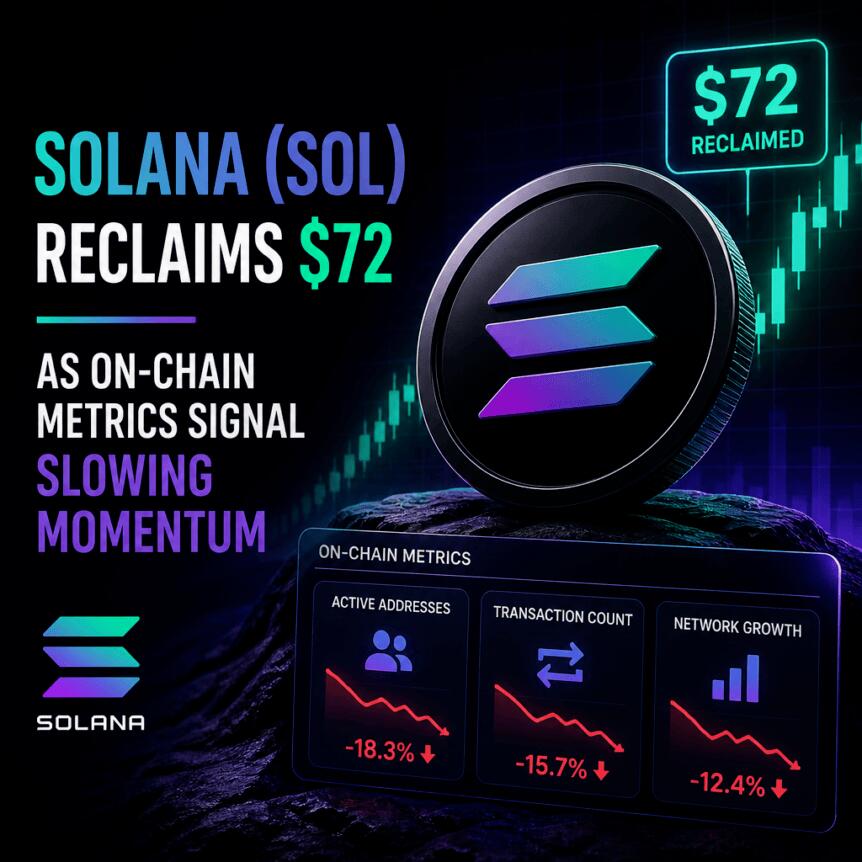
Solana’s native token SOL rebounded sharply this week, climbing to around $72 on Friday after falling to about $64 the day before. Traders pointed to renewed optimism around tokenized assets on the network—particularly tokenized stock products—while market data also highlighted a more fragile foundation for sustained momentum: Solana’s onchain liquidity and DEX activity have been cooling.
The result is a mixed near-term picture for investors. Futures positioning has turned more bullish, but DeFi metrics—especially Total Value Locked (TVL) and decentralized exchange volumes—show that demand for SOL-linked onchain activity remains uneven.
Key takeaways
- SOL’s move back to ~$72 comes as tokenized stocks on Solana posted more than $113 million in 24-hour volume, per Jupiter Aggregator data.
- Still, Solana TVL fell 11% over the past month, including declines across major protocols such as Kamino, Raydium, and Binance Staked SOL.
- DEX volumes on Solana have dropped to about $10 billion per week from roughly $30 billion in early February, alongside weaker decentralized application revenues.
- Solana’s DApp economy appears concentrated: Cointelegraph cited that Pump.fun accounts for about 30% of Solana DApp revenue, tying activity to memecoin dynamics.
- While SOL futures funding rose to around 10% (highest in June), the level remains within a range often described as closer to neutral than “overheated.”
Tokenized stocks lift activity, but liquidity remains a question
One of the clearest drivers behind SOL’s optimism is activity tied to tokenized equities trading on Solana. According to Jupiter Aggregator, tokenized stock instruments traded for more than $113 million over 24 hours. For traders watching for catalysts to sustain an “altcoin season” narrative on Solana, these volumes offer a tangible signal that new demand is showing up where it matters: in spot liquidity and swap flow on Solana’s venues.
However, the story isn’t uniformly bullish. The same data segment raised concerns about liquidity depth inside automated market-maker pools, especially as multiple issuers compete for similar exposure. Thin liquidity can make price discovery more volatile and can reduce the stickiness of trading demand if users find spreads widen or exits become harder during fast moves.
There’s also a timing wrinkle: many tokenized instruments launched recently, which can correspond with low holder counts. That doesn’t automatically invalidate the trend, but it does mean investors should watch whether participation broadens beyond the initial launch cycle.
TVL and DEX volumes point to softer baseline demand
Outside of the tokenized equities narrative, broader Solana DeFi conditions have weakened. DefiLlama data referenced in the report shows Solana’s TVL declined 11% over the past month. At the same time, Ethereum’s layer-2 network Base has reduced the gap between the two ecosystems, putting more competitive pressure on Solana’s standing as a high-throughput DeFi hub.
Looking at protocol-level declines, the report cited a 19% TVL drop in Kamino, a 20% trim by Binance Staked SOL, and a 17% decline by Raydium. Not every protocol moved in the same direction: xStocks reportedly grew TVL by 31%, aligning with the upbeat headlines around tokenized products.
Still, the DEX picture is the part that may temper expectations. Solana decentralized exchange volumes fell to around $10 billion per week from $30 billion in early February, and the downtrend coincided with declining DApp revenues. In practical terms, tokenization can create bursts of activity, but if overall exchange throughput remains muted, SOL demand tied to transaction processing may struggle to sustain a strong rally on its own.
Pump.fun concentration and leverage positioning add volatility
The next issue for readers is concentration risk in Solana’s DApp revenue. Cointelegraph cited that Pump.fun accounts for roughly 30% of Solana DApp revenue. That matters because Pump.fun’s output is closely tied to memecoin cycles, which can be intense but also short-lived.
CoinGecko’s research, referenced in the report, indicated that 80% of tokens launched on Pump.fun within less than 48 hours, based on a sample of 18.7 million tokens. Dune data cited alongside it suggested that 55% of involved addresses lost up to $1,000. The combination of rapid launches and high loss rates is not necessarily a direct bearish signal for SOL—but it does underline that a large share of onchain revenue may be driven by speculative dynamics rather than steady, utility-driven retention.
Meanwhile, derivatives markets have shifted more optimistic. The report referenced a funding-rate gauge from Laevitas, noting that bullish leverage demand increased on Friday and that the funding rate reached its highest level in June. The current funding rate of about 10% was described as not “excessive,” since a 6% to 12% band is often treated as neutral. Still, the report highlighted that SOL’s recovery—up roughly 14% from the $64 low—helped reverse earlier bearishness reflected in negative funding rates.
For traders, this implies a more supportive short-term backdrop: funding turning positive can reflect demand to stay long. But when tokenization narratives are active while baseline DeFi usage cools, leverage can also amplify drawdowns if liquidity thins again or if tokenized trading interest fades.
Airdrop hopes and new tokenized infrastructure may matter—competition is real
Some of SOL’s momentum is linked to expectations around potential network airdrops, though the timing and specific launch schedule remain uncertain. The report pointed to various projects and metrics that traders may associate with an “ecosystem runway,” including OnRe reinsurance (with $200 million in TVL), Bulk perpetual DEX (aggregate open interest of $325 million), and Loopscale lending platform (TVL of $79 million).
Even so, the report urged caution about assuming SOL must reclaim the $80 level seen on June 1. The reason is competition—not just from within Solana’s own tokenization ecosystem, but also from other venues and centralized platforms. The report specifically noted increased competition in tokenized stock trading from Hyperliquid and from centralized exchanges on competing chains.
One example cited was a strategic partnership between OKX and the NYSE parent company, reportedly using Ethereum-based systems. For investors, this is a reminder that the “tokenized equities” narrative isn’t exclusive to Solana. If liquidity and user attention fragment across networks and regulated rails, SOL’s tokenization volumes could remain high at times while still failing to translate into durable onchain strength.
What to watch next is whether Solana can convert tokenized-equities volume into broader, repeatable onchain activity—measured through sustained TVL and DEX throughput—while futures funding stays positive without turning extreme. If SOL’s rally holds alongside improving liquidity depth in tokenized pools, the current optimism may solidify; if DEX volumes and revenues keep slipping, the market may treat tokenized stock flows as temporary.
Bitcoin options traders remain heavily positioned for downside protection, with both crypto-native and exchange-traded fund investors showing elevated demand for downside hedges, according to new research by Anchorage Digital’s head of research, David Lawant.
The report analyzed options activity across Deribit, BlackRock’s iShares Bitcoin Trust (IBIT) and Strategy (MSTR), saying the three markets together provide a broader view of crypto-native, institutional and retail investor sentiment than any single options market alone.
Both Deribit and IBIT options markets showed elevated put skew, indicating traders are paying a premium for downside protection rather than positioning for further gains. The report found defensive positioning ranked in the 82nd percentile of IBIT’s history and the 84th percentile of Deribit’s five-year history.
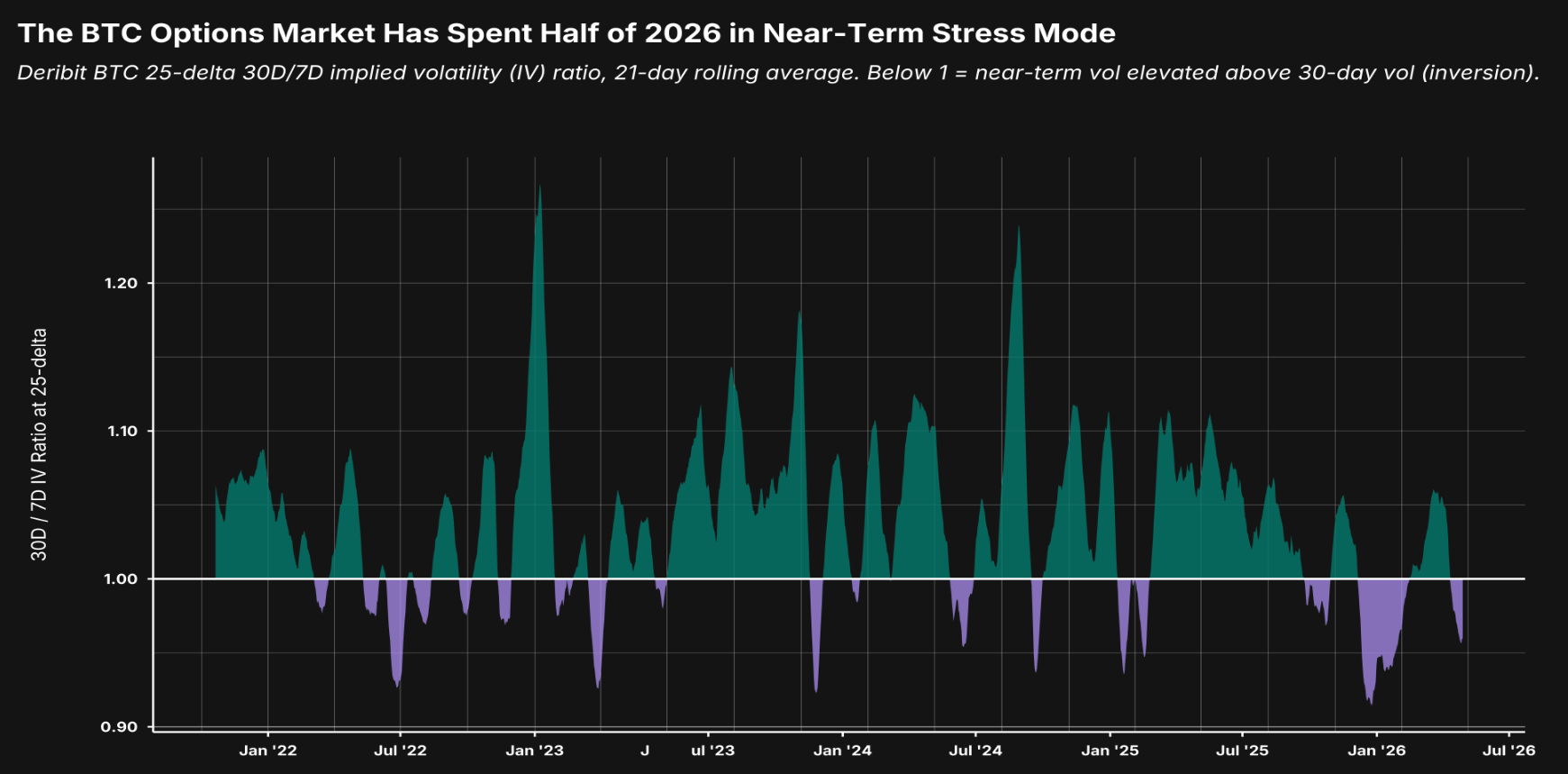
Anchorage also found that Bitcoin (BTC) options markets have spent nearly half of 2026 pricing higher implied volatility over the next week than over the next month, an unusual inversion that has historically been episodic and short-lived. The report attributed the pattern to a succession of macroeconomic, geopolitical and crypto-specific catalysts that have kept traders focused on near-term risks.
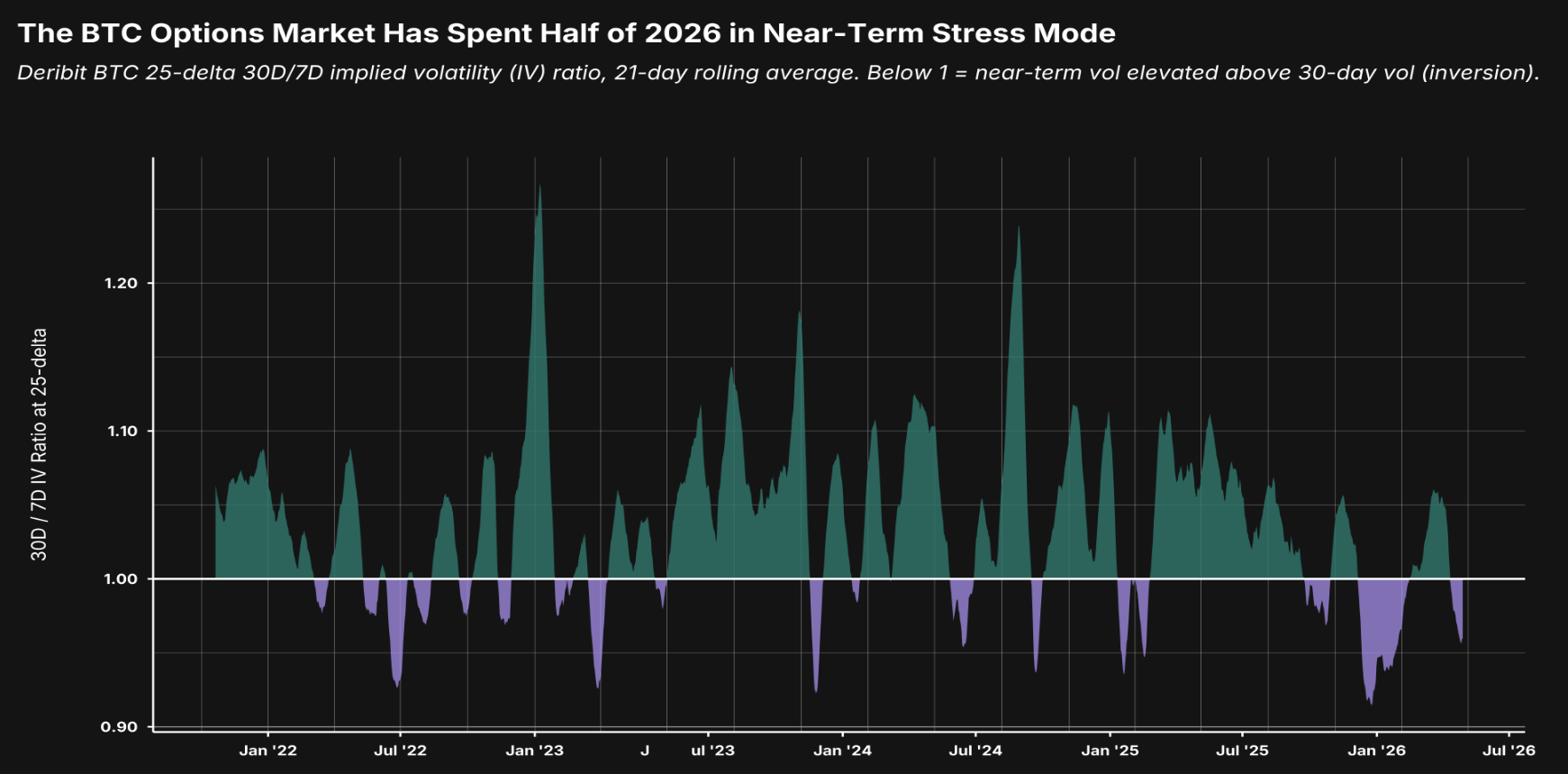
Bitcoin options 30-day/7-day implied volatility ratio. Source: Anchorage Digital report
Taken together, the findings suggest options traders remain focused on managing near-term risks rather than positioning for a clear directional move. Lawant said he is watching for one-month implied volatility to once again exceed one-week implied volatility, a shift he said would indicate markets are becoming more comfortable looking beyond immediate risks.
Related: Bitcoin price is down over 40% since STRC launched: Is Strategy ‘fine’?
Options market not signaling Strategy crisis
The analysis from Anchorage Digital also suggests investors remain cautious but are not pricing a severe downside scenario for Strategy despite recent weakness in the company’s preferred and common shares.
Strategy’s perpetual preferred stock, STRC, fell as low as $82.53 on June 22, or about 17% below its $100 par value, before partially recovering after the company disclosed it had increased its fiat reserves to $1.3 billion. As of Thursday, it was trading around $77, roughly 23% below par.
The weakness has extended beyond STRC. Strategy’s common shares (MSTR) were down about 78% over the past year and traded around $87 on Thursday, according to Yahoo Finance data.
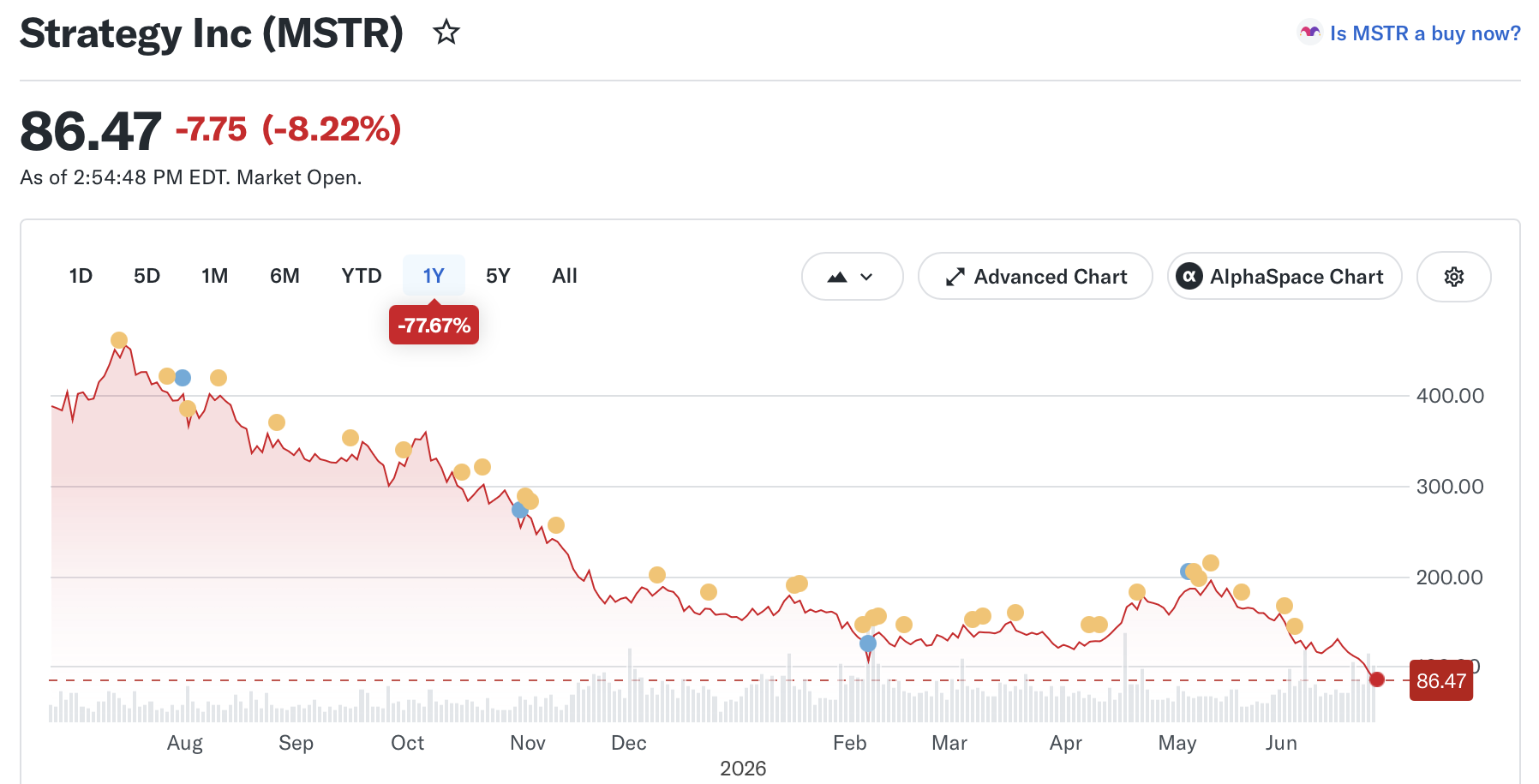
Strategy stock. Source: Yahoo Finance
Despite the sell-off, Anchorage found that Strategy’s options market remains well below stress levels seen during previous market corrections. While traders continue to hedge against downside risk, put skew has not reached levels typically associated with fears of forced deleveraging or a broader crisis, according to the report.
Strategy, led by Executive Chairman Michael Saylor, pioneered the corporate Bitcoin treasury model in 2020 and remains the world’s largest corporate holder of Bitcoin, with 847,363 BTC on its balance sheet.
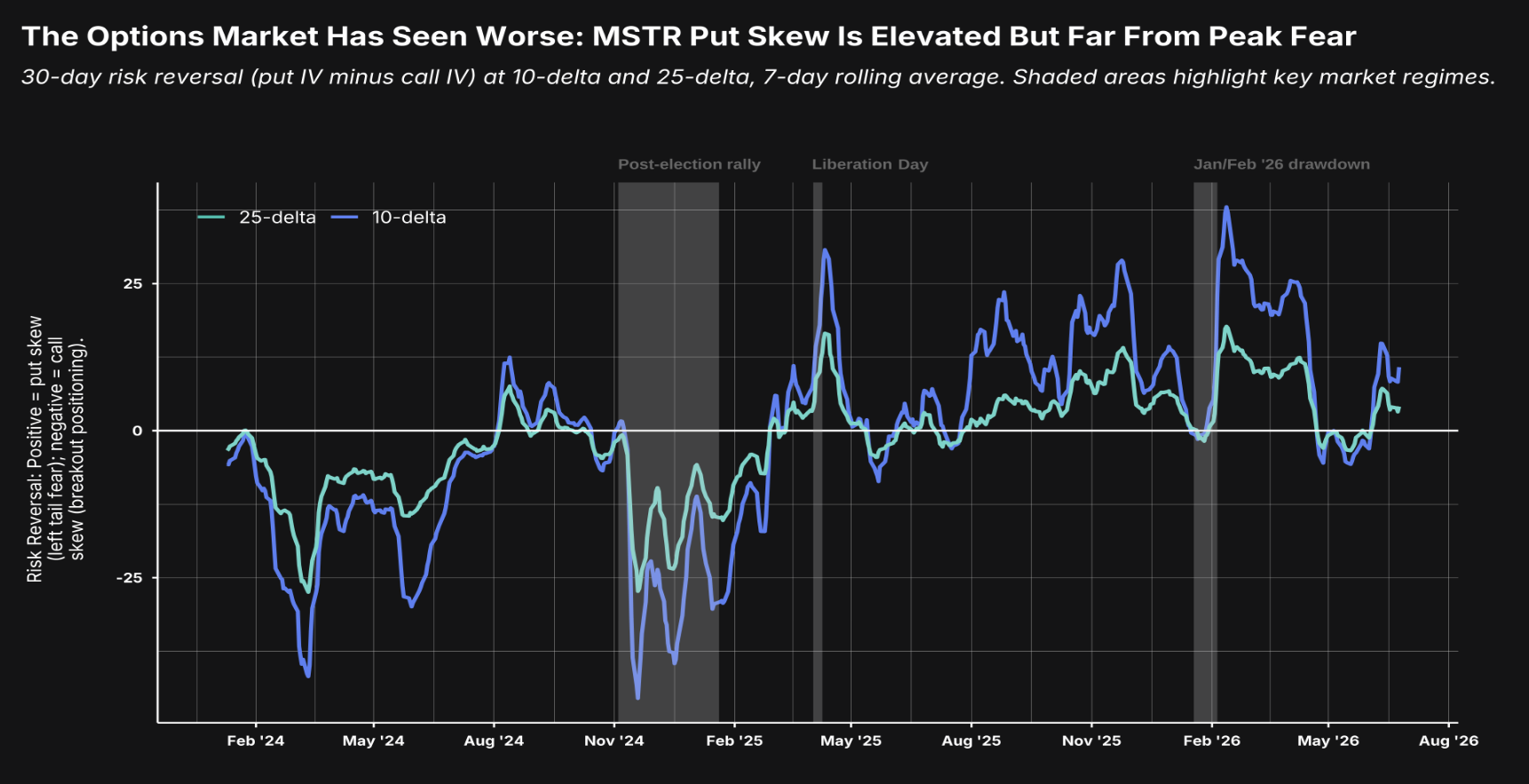
30-day risk reversals in Strategy (MSTR) options markets. Source: Anchorage Digital report
Magazine: Bitcoin decouples from tech stocks, Ether eyes ‘selling wave’: Market Moves
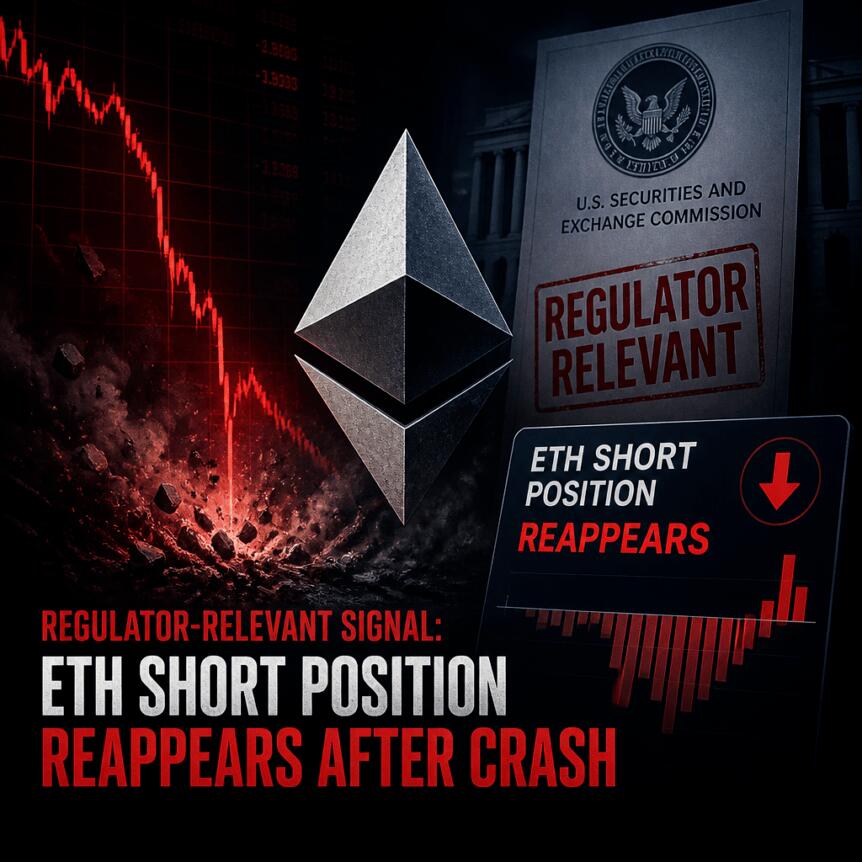
An Ethereum-linked wallet that previously took leveraged downside exposure during the October 2025 market turmoil has re-entered after an eight-month pause, opening a new 20x short position near a widely watched ETH support area. The activity underscores how some large, on-chain participants may respond to macro-driven drawdowns and internal ecosystem developments—both of which can shape liquidity and risk appetite for digital assets.
Key takeaways
- A wallet labeled 0xf83f…6728 opened a 20x leveraged ETH short with a notional value of about $19.72 million near the $1,500 support region.
- The short was reportedly entered at an average price around $1,565, with unrealized gains shown near $106,500 at the time of reporting.
- On-chain data indicates the same wallet last traded on Oct. 27, 2025, when it opened a short near $4,172 and later closed it near $4,133.
- While the new position is positioned for downside, the near-term chart setup includes a potential double-bottom scenario that could limit losses—or create liquidation risk if the market reverses sharply.
Large leveraged short returns near $1,500 support
On Friday, wallet 0xf83f…6728 initiated a 20x leveraged ETH short with an estimated notional size of $19.72 million, coinciding with Ether trading near the $1,500 support zone. ETH had reportedly fallen 18.25% over the prior two weeks, reflecting broader pressure on risk assets.
According to data compiled by Hyperbot, the position was opened at an average price around $1,565. At the time of publication, the wallet reportedly held nearly $106,500 in unrealized profit as ETH traded around the $1,550 area.
The decision to re-enter with high leverage is notable for institutional risk monitoring because leveraged derivatives positions can amplify market moves, increase systemic fragility around support levels, and accelerate forced deleveraging if price action moves against the trade. For compliance and risk teams, the key point is less about directional views and more about the risk mechanics: notional size, leverage, and collateral management determine exposure and potential cascading effects.
Ether’s bearish positioning was also linked in reporting to wider market conditions, described as a tech-led risk selloff that pressured Nasdaq and chip-linked equities. That broader backdrop can translate into reduced liquidity and higher volatility across crypto venues, particularly in periods where investors rebalance away from speculative assets.
Ecosystem and governance scrutiny adds another compliance lens
Alongside macro pressure, Ethereum-specific sentiment appeared to deteriorate in connection with renewed scrutiny of the Ethereum Foundation. Cointelegraph previously reported on issues including budget cuts, staff reductions, and a series of senior departures, each of which has the potential to affect stakeholder confidence in governance continuity and long-term development capacity.
While the wallet’s trade itself does not establish a direct causal link to those governance developments, the broader institutional context matters. Changes in organizational capacity and leadership can influence expectations about protocol development timelines, grant structures, and coordination across ecosystem actors—factors that may feed into risk premia and hedging behavior among sophisticated market participants.
For financial institutions assessing crypto exposure under internal risk frameworks, the key compliance-relevant point is that ecosystem governance developments can increase operational and reputational uncertainty. That uncertainty can affect counterparties, investment committee decisions, and the quality of risk disclosures—especially where holdings intersect with regulated markets, custody arrangements, or derivatives documentation.
Prior trade history: short near October 2025 crash top
The wallet’s current activity stands out due to its trading history. Transaction logs indicate that 0xf83f…6728 last became active on Oct. 27, 2025, when it opened an ETH short near $4,172 as volatility tied to the October crypto crash began to ease.
Hyperbot data cited in the report suggests the trader later exited near $4,133, realizing net profit of about $41,693 after roughly $5,263 in exchange fees. The earlier position provides a useful benchmark for pattern recognition: the wallet appears to have favored shorting into weakness using leverage, aligning with a consistent downside execution style.
However, the current trade differs in scale. The new position’s notional exposure is nearly $20 million, substantially larger than the notional size reported for the earlier trade, which would likely raise the stakes for risk management, margin requirements, and potential impact on liquidity during fast market moves.
Downside call faces potential reversal and liquidation risk
Despite the bearish rationale for the new short, the risk profile is not one-sided. As of Friday, technical structure described in the reporting included a potential double bottom forming in the $1,500–$1,512 area, where buyers reportedly stepped in twice during June. The pattern remained unconfirmed, but a strong rebound from that zone could shift short-term momentum.
The key technical level referenced was a neckline near $1,850. A decisive daily close above that level would, in the scenario presented, confirm the double-bottom structure and support a measured rebound toward roughly $2,190, based on the distance between the reported bottom and neckline.
From an institutional risk perspective, the most critical element is the potential interaction between technical reversal scenarios and the wallet’s leverage constraints. The report notes liquidation-related proximity near $2,150. If a bullish confirmation occurs without corresponding collateral top-ups or position reduction, the trader could face heightened liquidation risk—particularly in environments where volatility widens and spreads increase.
For compliance and monitoring teams, this highlights a broader theme relevant to derivatives markets: large leveraged positions can produce abrupt outcomes unrelated to fundamental valuation. Under risk governance frameworks—whether internal model risk controls or external regulatory expectations around market integrity—monitoring should prioritize position size relative to liquidity, margin dynamics, and how quickly liquidation thresholds could be reached under adverse price moves.
Closing perspective
The return of a high-leverage ETH short after an eight-month gap will likely keep attention on near-term support and any confirmation of potential reversal patterns. What to watch next is whether market structure stabilizes around the cited support region, and how derivatives margin conditions evolve if price moves accelerate—developments that can carry compliance, liquidity, and risk-management implications across regulated and institutional participation in crypto markets.


On-Demand Liquidity is Ripple’s flagship use of XRP, a way to settle cross-border payments in seconds without banks pre-funding accounts around the world. This guide explains how it works, the trapped capital it frees, and why its own stablecoin now competes for the job.
Summary
- On-Demand Liquidity (ODL) is Ripple’s service that uses XRP as a bridge asset to settle cross-border payments in seconds, without banks pre-funding accounts in foreign currencies.
- It targets the biggest inefficiency in traditional cross-border payments: the trillions of dollars banks park in pre-funded accounts around the world to enable international transfers.
- A payment converts the source currency into XRP, moves the XRP across the world in seconds, and converts it into the destination currency, freeing that trapped capital.
- ODL, now folded into Ripple Payments, found real adoption in specific remittance corridors, though Ripple increasingly also uses its stablecoin for the settlement role.
- ODL is the clearest real-world use of XRP as a bridge asset, but its growth is corridor-specific and now competes with stablecoin-based settlement inside Ripple’s own products.
On-Demand Liquidity, usually shortened to ODL, is Ripple’s service that uses the XRP token as a bridge asset to settle cross-border payments almost instantly, eliminating the need for banks and payment providers to hold pre-funded accounts in foreign currencies around the world. That description captures both what it does and why it matters: it attacks one of the largest and most expensive inefficiencies in global finance, the vast sums of money that institutions must park in advance in distant accounts simply to be able to send international payments.
ODL replaces that pre-funded capital with a real-time conversion through XRP, turning a slow, capital-heavy process into a fast, capital-light one. It is also, importantly, the clearest and most concrete real-world use case for XRP, the answer to the question of what the token is actually for. This guide explains the problem ODL solves, how the mechanism works step by step, why XRP is used as the bridge, what the approach unlocks, how it fits into Ripple’s broader products, and the honest limits of its adoption, including the way Ripple’s own stablecoin now competes for the very role ODL was built to play.
Understanding ODL is valuable because it sits at the heart of the entire XRP investment thesis, and because it is one of the few places in crypto where a token has a clearly defined utility tied to a real financial problem. For years, the bullish case for XRP rested largely on the promise of ODL: that as more institutions used it to move money, demand for XRP as the bridge asset would grow. Whether that promise has been fulfilled, and whether it can be, depends on understanding exactly how ODL works and where its limits lie.
This guide covers the trapped-capital problem at the root, the mechanics of an ODL payment, why a volatile token can serve as the bridge, the capital efficiency it delivers, its place within Ripple’s evolving product lineup, the growing competition from stablecoins, and a clear-eyed assessment of how much ODL has actually achieved.
The problem ODL was built to solve
To understand ODL, you first have to understand how broken cross-border payments are under the traditional system, because the inefficiency is genuinely staggering.
When money moves between countries, it does not actually travel; instead, banks rely on a web of relationships called correspondent banking, in which each bank holds accounts at banks in other countries to enable payments in those countries’ currencies. To send money to, say, Mexico, a bank needs access to Mexican pesos, which it typically arranges by keeping a pre-funded account full of pesos at a bank in Mexico, ready to draw on. Multiply this across every currency and every corridor a bank serves, and the institution must keep accounts pre-funded with many currencies at many banks all over the world, with money sitting idle in each one waiting to be used.
The cost of this arrangement is enormous and largely invisible to the public. An estimated several trillion dollars sits trapped in these pre-funded accounts globally, capital that earns little and cannot be deployed for anything productive because it has to be available on demand for payments. Beyond the trapped capital, the system is slow, because a cross-border payment may hop through several correspondent banks, each adding delay, so transfers that should be instant can take days.
And it is expensive, with fees accumulating at each step. For banks, payment providers, and ultimately the people and businesses sending money, the correspondent-banking model is costly, sluggish, and capital-intensive. This is the problem ODL was designed to solve: not to make payments slightly better, but to remove the need for pre-funded accounts altogether, freeing the trapped capital and collapsing the settlement time from days to seconds.
What On-Demand Liquidity actually is
ODL’s solution is to replace the pre-funded foreign account with a real-time conversion through a bridge asset, and that bridge asset is XRP. Instead of keeping pesos sitting in a Mexican bank account in advance, an institution using ODL converts its money into XRP at the moment a payment is needed, sends the XRP across the world in seconds, and converts it into the destination currency on arrival.
The pre-funding disappears, because the liquidity is sourced on demand, in real time, exactly when the payment happens, which is what the name describes. There is no need to lock up capital in advance, because XRP serves as a temporary, fast-moving bridge between the two currencies rather than a parked reserve.
The elegance of the design is that XRP exists only fleetingly in the transaction, as a momentary intermediary between the source and destination currencies. The institution does not need to hold XRP as a long-term reserve; it acquires the XRP it needs at the instant of the payment, uses it to bridge the value across, and the recipient ends up with their local currency, not with XRP. This is what distinguishes a bridge asset from a held asset.
The whole point is that the value passes through XRP in seconds, so the parties are exposed to the token only for the brief moment the bridge is in use. ODL, in other words, is a mechanism for sourcing liquidity at the moment of need rather than parking it in advance, with XRP as the connective tissue that makes the instant currency-to-currency conversion possible. That is the core idea, and everything else about ODL follows from it.
A worked example: a payment through ODL
To make the mechanism concrete, follow a single payment from the United States to Mexico, which is one of the corridors where ODL has seen real use. Imagine a remittance company needs to send the equivalent of one thousand dollars to a recipient in Mexico, who should receive Mexican pesos. Under the traditional system, the company would rely on a pre-funded account of pesos sitting at a Mexican bank, drawing down that reserve to pay the recipient and later replenishing it, with all the trapped capital and delay that implies. Under ODL, the process is entirely different and happens in seconds.
The company’s dollars are converted into XRP on an exchange in the United States. That XRP is sent across the XRP Ledger to an exchange in Mexico, a transfer that settles in a few seconds for a tiny fee. On arrival, the XRP is immediately converted into Mexican pesos on the Mexican exchange, and those pesos are paid out to the recipient. From start to finish, the value has moved from dollars to pesos in seconds, with XRP serving as the bridge in the middle, and at no point did the company need a pre-funded peso account.
The capital that would have been trapped in that account is freed for other uses, the settlement that might have taken days happened almost instantly, and the cost is a fraction of the traditional fees. The recipient simply receives pesos, never touching or even knowing about the XRP that briefly carried the value across the border. That round trip, dollars to XRP to pesos in seconds with no pre-funding, is ODL in action, and it shows precisely what the service is built to do.
Why XRP is used as the bridge
A natural question is why a volatile cryptocurrency would be trusted to bridge real money, and the answer lies in the specific properties XRP brings and the very short window it is actually exposed. XRP settles transactions on its ledger in a few seconds, with very low fees, which is exactly what a bridge asset needs, because the entire value of the approach depends on moving value across quickly and cheaply.
The token also has reasonably deep liquidity on exchanges in many markets, meaning there is usually enough trading volume to convert into and out of XRP without moving its price too much, which is essential for a bridge that has to handle real payment volumes. And as a neutral asset not tied to any single country’s currency, XRP can serve as a common intermediary between many different currency pairs.
The volatility concern, which sounds disqualifying, is actually limited by the design. Because XRP is used purely as a fleeting bridge, the value passes through it in seconds, so the exposure to its price movements lasts only for that brief window. A payment is converted into XRP and out of XRP almost instantly, so even a volatile token poses little risk over a few seconds, especially when the amounts are hedged or the conversions are near-simultaneous.
This is the key insight that makes a volatile asset usable for settlement: the goal is not to hold XRP and bear its price swings, but to pass through it so quickly that the swings barely matter. The token’s speed, low cost, liquidity, and neutrality make it well suited to the bridging role, and its volatility, the obvious objection, is neutralized by the fact that no one holds it for more than moments. This is why XRP, despite being a volatile cryptocurrency, can function as the settlement bridge at the center of ODL.
What ODL unlocks: freeing trapped capital
The payoff of ODL, the reason institutions would adopt it, is the liberation of the enormous capital trapped in pre-funded accounts, and the significance of that is hard to overstate. When an institution no longer needs to keep money parked in foreign accounts around the world, all of that capital becomes available for productive use.
For a large payment provider or bank operating across many corridors, the sums involved can be substantial, and freeing them improves the efficiency of the entire operation. Capital that sat idle as a precondition for sending payments can instead be deployed, lent, or invested, which is a direct and meaningful financial benefit. This capital-efficiency gain is the core business case for ODL, the concrete reason a rational institution would consider it over the traditional model.
Beyond the capital efficiency, ODL delivers speed and cost benefits that matter especially in certain use cases. Remittances, the money that workers send home to families in other countries, are a natural fit, because they are often small, frequent, time-sensitive, and currently burdened by high fees and delays, exactly the pain points ODL addresses. Payment corridors between countries with less developed banking links, where maintaining pre-funded accounts is especially costly or difficult, also benefit disproportionately.
Ripple has reported significant volume milestones through partners using its liquidity service in such corridors, including large remittance flows in certain markets, which shows the model working in practice where the traditional system is weakest. The combination of freed capital, faster settlement, and lower cost is what ODL offers, and in the corridors where those benefits are sharpest, the value proposition is real and demonstrable. The question, which the honest assessment later addresses, is how broadly those conditions apply.
ODL, RippleNet, and Ripple Payments
It helps to place ODL within Ripple’s broader product history, because the branding has evolved and the names can confuse. ODL began as a specific service within RippleNet, the company’s network of financial institutions, distinguishing the XRP-powered liquidity offering from the basic messaging and payment-coordination features that did not require the token.
Over time, as Ripple consolidated and rebranded its offerings, the XRP-based liquidity capability was folded into a broader product now generally called Ripple Payments, the company’s end-to-end cross-border payments solution for institutions. The underlying mechanism, using XRP as a bridge to source liquidity on demand, remained, even as the packaging and naming changed.
This evolution reflects Ripple’s maturation from a company selling a specific token-powered feature to one offering a comprehensive payments platform that institutions can adopt. Ripple Payments bundles the connectivity, compliance, and settlement features an institution needs to move money across borders, with on-demand liquidity through XRP available as the settlement mechanism for corridors where it makes sense. Hundreds of financial institutions have relationships with Ripple’s network in some form, though it is important to understand that not all of them use XRP-powered liquidity; many use Ripple’s technology for messaging and coordination while settling through traditional means.
The distinction matters, because the headline figure of how many institutions work with Ripple is much larger than the number actually using XRP as a bridge. ODL, now living inside Ripple Payments, is the part of the offering that genuinely uses the token, and it is one component of a wider platform rather than the whole of it.
The stablecoin question
The most important recent development in the ODL story is that Ripple’s own stablecoin has begun competing with XRP for the settlement role, which complicates the token thesis significantly. Ripple launched a dollar-pegged stablecoin, and across its institutional business that stablecoin has increasingly been used as the settlement asset for cross-border payments, the very job ODL was designed to give XRP.
The reason is straightforward: institutions often prefer a stable, dollar-denominated instrument for settlement because it does not move in price at all, removing even the brief exposure that bridging through a volatile token involves. For many institutional use cases, a stablecoin is simply an easier sell, because treasurers and compliance teams are more comfortable with an asset pegged to a familiar currency than with a volatile cryptocurrency, however fleeting the exposure.
This creates a genuine tension at the heart of Ripple’s strategy and the XRP thesis. ODL was the flagship use case that justified demand for XRP, the concrete answer to what the token is for. But Ripple now offers a stablecoin that can perform the same settlement function, and in many cases is being chosen for it, which means the company’s own product can substitute for its own token. This does not eliminate XRP’s role, because there remain situations where bridging through a neutral asset is more efficient than holding many different stablecoins, particularly across exotic currency pairs.
But it does mean that the simple thesis, that ODL adoption automatically drives XRP demand, is weaker than it once was, because some of that settlement is now flowing through the stablecoin instead. The stablecoin question is the single biggest complication to the ODL story, and any honest account of what ODL means for XRP has to reckon with the fact that Ripple built an alternative to its own bridge asset.
Risks and limits to understand
ODL is a real and clever mechanism, but anyone evaluating it, particularly as a basis for an XRP investment thesis, should understand its genuine limits and risks instead of the idealized version. The most important limit is that ODL adoption is corridor-specific, not universal. The benefits are sharpest in particular remittance and payment corridors, often between markets with less developed banking links, and far less compelling in major, highly liquid corridors where traditional settlement is already cheap and fast. So ODL is not a wholesale replacement for global payments but a targeted tool that wins in specific situations, which means its growth is bounded by how many such situations exist and how quickly Ripple can win them.
Several other risks deserve attention. The bridge mechanism depends on sufficient XRP liquidity on exchanges at both ends of a corridor; in thin markets, converting in and out of XRP at scale can move the price or incur slippage, limiting how much volume the corridor can handle. The model also depends on the regulatory acceptance of using a cryptocurrency in payment flows, which varies by jurisdiction and can change.
Most significantly for an investor, the link between ODL adoption and XRP price is far less direct than the hype suggests: because XRP is used only as a fleeting bridge and is not held as a reserve, even substantial payment volume translates into only momentary demand for the token, and the rise of Ripple’s stablecoin as a settlement alternative further weakens that link. ODL is a genuine, working use of XRP, but it is a targeted tool with real constraints, not the universal engine of token demand it is sometimes portrayed as.
Anyone using ODL as the foundation of an investment case should weigh how corridor-specific the adoption is, how brief the token exposure is, and how much of the settlement role the stablecoin is taking, and should never invest money they cannot afford to lose on a thesis that depends on adoption outrunning those limits.
Frequently Asked Questions
What is On-Demand Liquidity in simple terms?
On-Demand Liquidity, or ODL, is Ripple’s service that uses the XRP token as a bridge to settle cross-border payments in seconds, without banks pre-funding accounts in foreign currencies. Instead of keeping money parked in foreign accounts in advance, an institution converts its currency into XRP at the moment of payment, sends the XRP across the world in seconds, and converts it into the destination currency on arrival. This frees the capital that would otherwise sit trapped in pre-funded accounts and collapses settlement time from days to seconds.
How does ODL actually work?
It replaces a pre-funded foreign account with a real-time conversion through XRP. In a payment from one country to another, the sender’s currency is converted into XRP on an exchange, the XRP is sent across the XRP Ledger in a few seconds for a tiny fee, and on arrival it is immediately converted into the destination currency and paid to the recipient. The recipient receives their local currency and never holds XRP. The token exists in the transaction only fleetingly, as a momentary bridge between the two currencies, which is what makes the instant, capital-light settlement possible.
Why use a volatile token like XRP for settlement?
Because XRP is used only as a fleeting bridge, exposure to its price lasts just the few seconds the value passes through it, so its volatility barely matters. XRP also settles in seconds with very low fees, has reasonably deep liquidity in many markets, and is neutral, not tied to any one country’s currency, all of which suit a bridge asset. The goal is not to hold XRP and bear its swings but to pass through it so quickly that the swings are negligible, which is what makes a volatile asset usable for settlement.
What problem does ODL solve?
The enormous inefficiency of traditional cross-border payments. Under correspondent banking, institutions must keep money pre-funded in foreign accounts around the world to send payments in those currencies, trapping an estimated several trillion dollars globally in idle capital, while payments hop through multiple banks over days and accumulate fees. ODL removes the need for pre-funding by sourcing liquidity on demand through XRP, freeing that trapped capital, collapsing settlement to seconds, and cutting costs. The benefits are sharpest in remittances and corridors with less developed banking links.
Does ODL adoption drive XRP’s price up?
Less directly than the hype suggests. Because XRP is used only as a momentary bridge and is not held as a reserve, even substantial payment volume creates only brief, fleeting demand for the token instead of sustained holding. Adoption is also corridor-specific instead of universal, and Ripple’s own stablecoin is increasingly used for the same settlement role, which further weakens the link. ODL is a genuine, working use of XRP, but the simple thesis that adoption automatically and substantially lifts the price overstates how the mechanism actually affects token demand.
Why does Ripple’s stablecoin compete with ODL?
Ripple launched a dollar-pegged stablecoin, and across its institutional business that stablecoin is increasingly used as the settlement asset for cross-border payments, the same role ODL gives XRP. Institutions often prefer a stable, dollar-denominated instrument because it does not move in price at all, removing even the brief exposure that bridging through XRP involves, and treasurers and compliance teams tend to be more comfortable with it. So Ripple’s own product can substitute for its own token, which complicates the thesis that ODL adoption drives XRP demand, though XRP retains an edge in some cross-currency situations.
This article is educational information, not investment advice. Cryptocurrency is volatile, and details about Ripple’s products and adoption reflect reporting available as of June 26, 2026, which can change quickly. Verify current information from primary sources and assess the risks carefully before making any decision.
Almost every major altcoin has taken a beating in recent months, and Ethereum is no exception, with its price plunging to a 14-month bottom.
Analysts now warn that it could be on the verge of a further slump, with some floating the idea of a crash to a multi-year low of around $1,000.
The Red Days Aren’t Over?
The prolonged bear market hasn’t been the only thing suppressing ETH’s valuation lately. As CryptoPotato reported, Hsiao-Wei Wang stepped down as the Ethereum Foundation’s co-executive director and board member, while shortly after, the entity reduced its workforce by 20%.
Following the combination of the numerous negative developments, ETH’s price nosedived to just north of $1,500, while its market capitalization briefly tumbled below $183 billion. This means that for a moment, Tether’s USDT flipped Ethereum to become the second-largest cryptocurrency. ETH has reclaimed its prestigious spot, albeit leading by a slim margin.
According to Ali Martinez, the asset has been trading inside a crucial volume block between $1,584 and $1,683, where nearly 4 million coins have changed hands. He claimed that securing this “specific area” as support can open the door to the next major supply clusters at $1,980 and $2,079.
At the same time, the analyst warned that losing this baseline (as it happened just hours ago) might result in a deeper plunge to $1,237 and even $1,089.
X user Ryker also shared their outlook, predicting a drop to $1,260 before a potential rally above $3K. Merlijn The Trader highlighted the forecast, noting that Ryker is the only trader followed by Changpeng Zhao (CZ) on X.
Previous Predictions
Earlier this month, X user Ted opined that ETH is more likely to reach its cycle bottom before Bitcoin (BTC). Back then, he claimed that most of the downside liquidity has been taken out, projecting a downfall to $1,300-$1,400. For their part, Niels envisioned a drop to $1,200 sometime this year.
Recent whale activity reinforces the bearish outlook. X user Max Crypto revealed that one large investor opened a $68 million short position on ETH with 23x leverage, while Justin Wu outlined that four OG wallets have started dumping their holdings.
Whales are known as experienced market participants who may have inside information about upcoming events that could influence the price. That’s why their efforts are closely monitored by retail investors who could panic and cash out as well.
The post Ethereum (ETH) Suffers a Major Blow: Is a Crash to $1,000 Coming Next? appeared first on CryptoPotato.
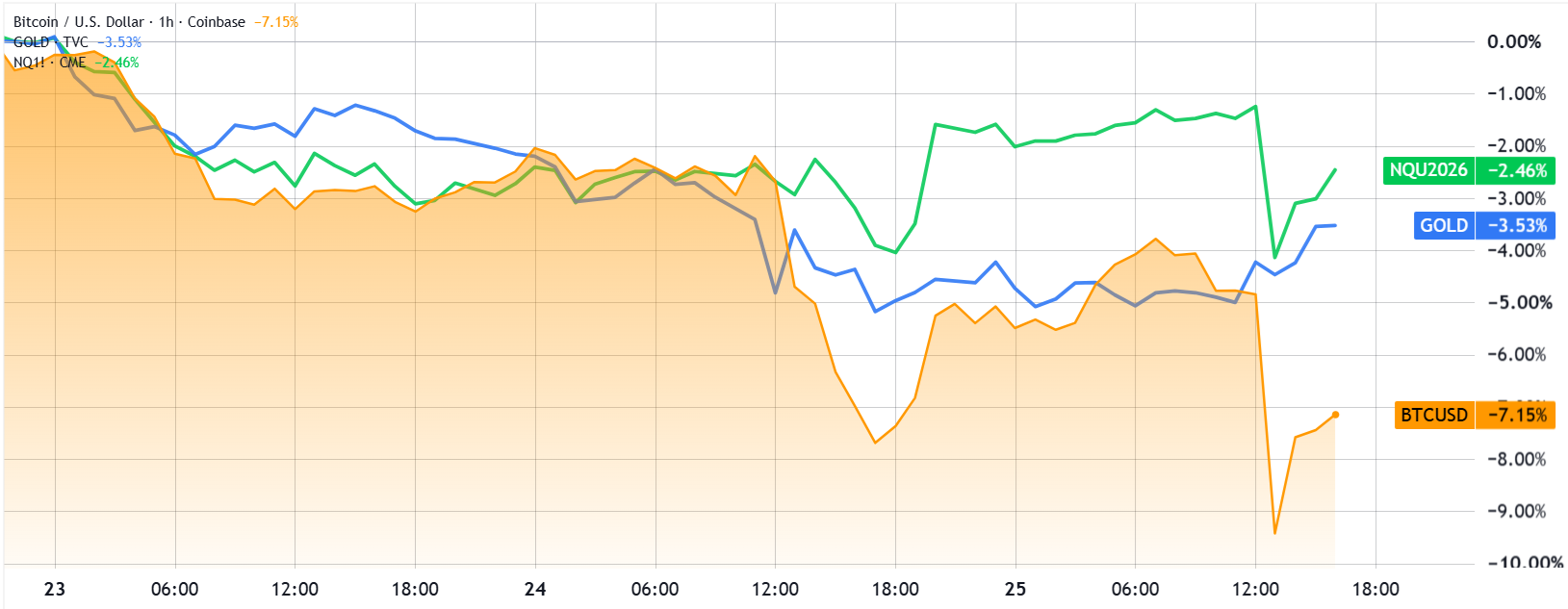
Key takeaways:
- Surging spot Bitcoin ETF outflows and a put-heavy options expiry point to fading institutional demand.
- Risk-reward shifts toward tech stocks, leaving crypto traders to seek catalysts beyond macroeconomic tailwinds.
Bitcoin (BTC) traded down 9% in three days, hitting its lowest level since September 2024. The $58,000 retest triggered over $1 billion in liquidations across bullish BTC leveraged positions. Despite a modest recovery to $59,500, Bitcoin traders remain uneasy as the S&P 500 index and gold prices fully erased their intraday losses.
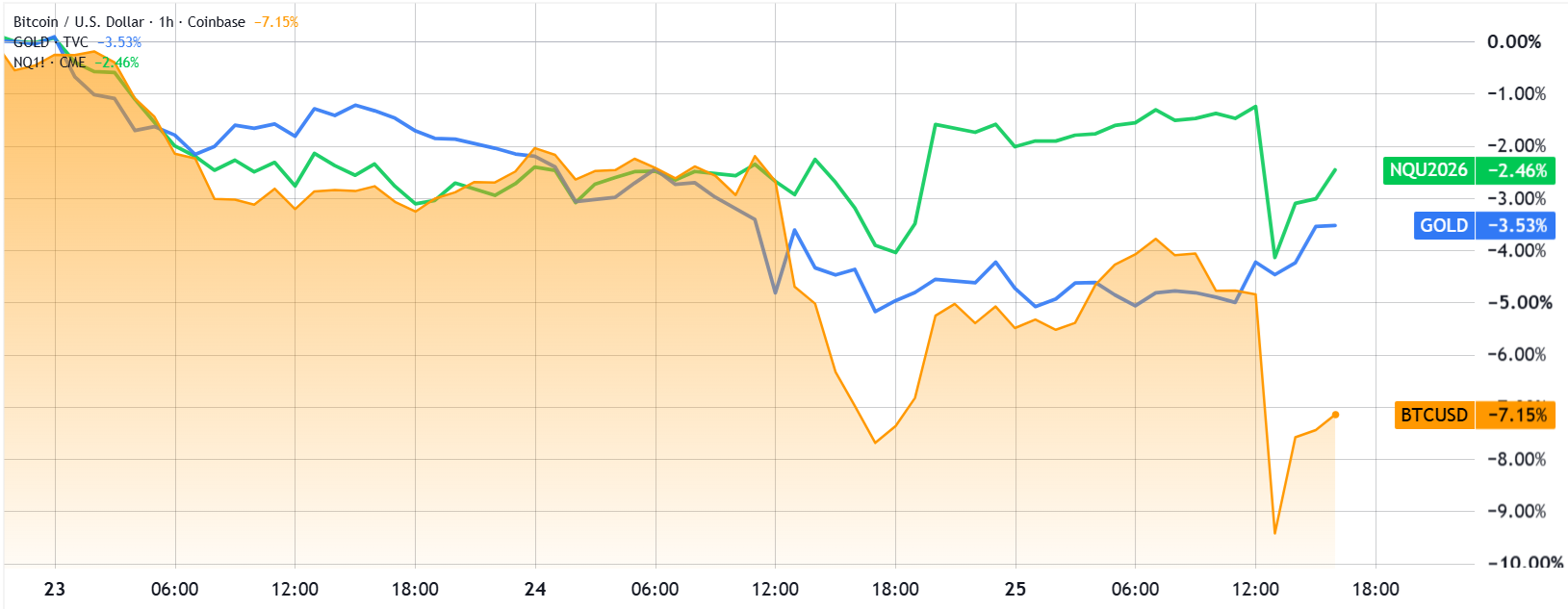
Bitcoin/USD (orange) vs. gold/USD & Nasdaq 100 futures (green). Source: TradingView
The market downturn on Thursday lined up with the release of the US Personal Consumption Expenditures index, which showed a 4.1% increase in May from the prior year. Yet as Crude Brent oil prices pulled back to $75 from $95 just one month earlier, investors grew more confident that inflation had peaked. As a result, the cash freed up by lower energy costs is boosting the stock market.
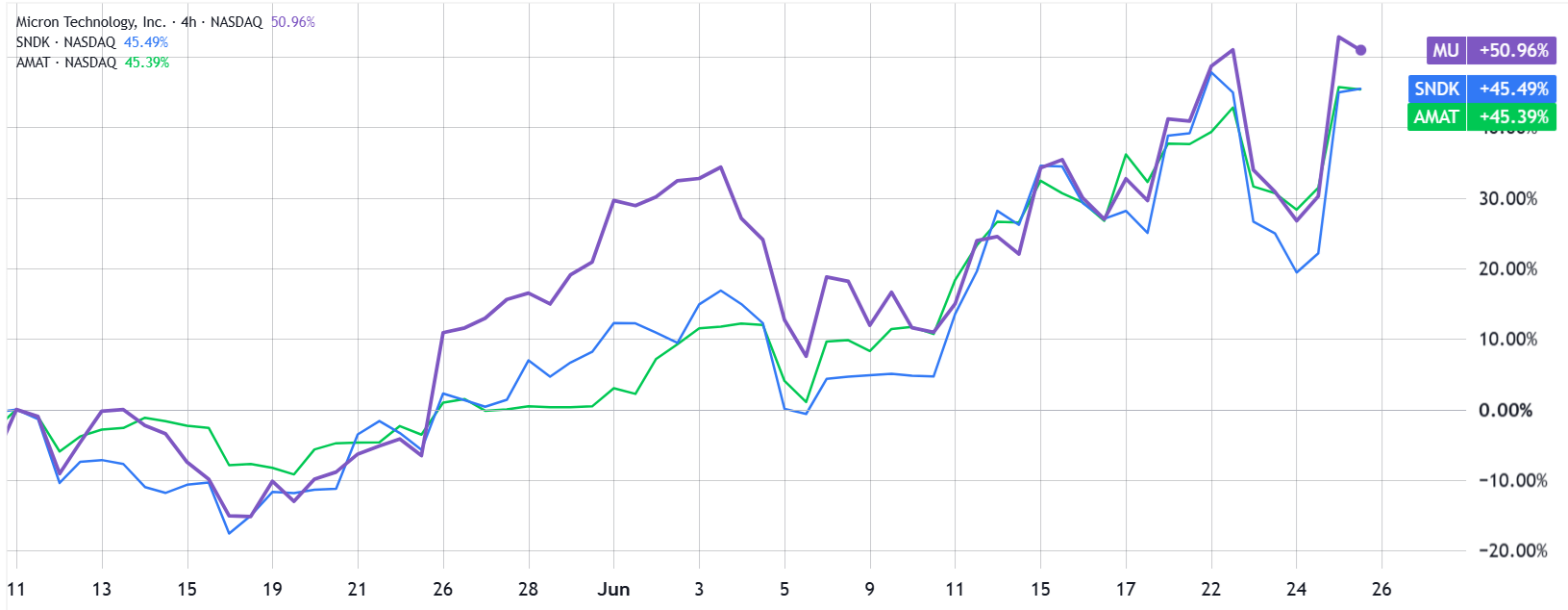
Shares of Micron, Sandisk, Applied Materials. Source: TradingView
The tech sector kept delivering strong surprises, with Micron Technology (MU) jumping 16% after solid quarterly earnings and Sandisk (SNDK) riding along with an 18% gain. Applied Materials (AMAT) rose 10% thanks to its new chipmaking tools. Investors’ renewed faith in the sector also mirrors the US government administration’s recent emphasis.
Fixed income offers a more compelling hedge alternative
Even if Bitcoin does not directly compete with the artificial intelligence sector, traders’ risk-reward views have likely tilted toward stocks. This shift followed the US government taking a 9.9% stake in Intel, proposing $2 billion for quantum computing firms, opening federal lands for data center projects, and setting a framework for “frontier models” releases.
Investors worried about inflated AI valuations after Elon Musk’s SpaceX (SPCX) shares fell 32% from their peak can find comfort in 5-year US Treasuries yielding 4.15%. Demand for non-yielding assets like Bitcoin faded as traders now see an 80% chance of US interest rate hikes by December, up from 68% a month ago, according to the CME FedWatch Tool.
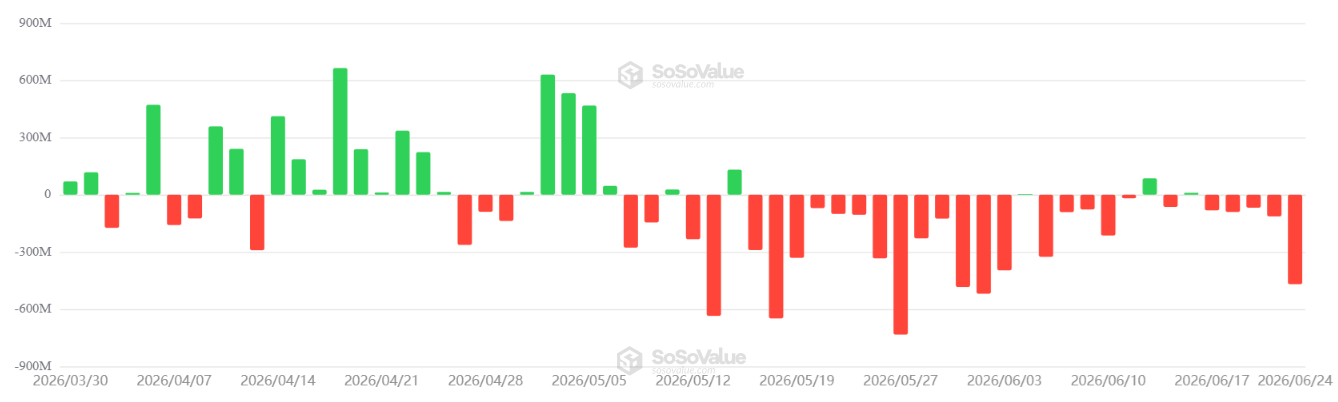
US-listed spot Bitcoin ETFs daily net flows, USD. Source: SoSoValue
Bitcoin’s appeal also took a hit from the massive $469 million net outflows in spot BTC exchange-traded funds (ETFs) on Wednesday. The metric serves as a key proxy for institutional demand. Sentiment worsened further as Strategy (MSTR) now sits on a huge unrealized loss after buying $64.1 billion worth of Bitcoin since 2020.
Related: 21shares trims 2026 crypto forecasts despite institutional adoption gains
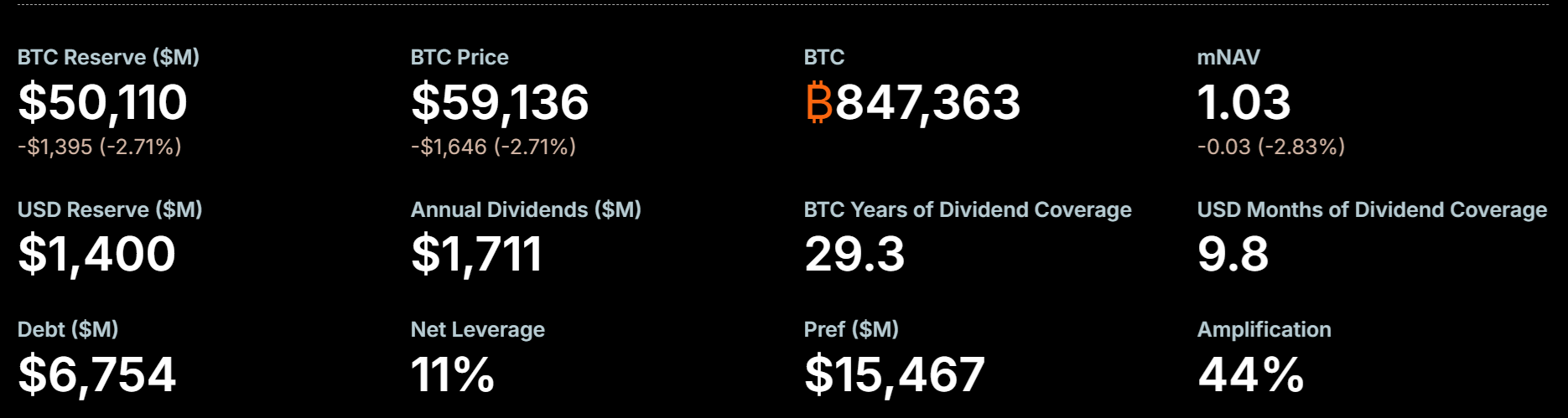
Strategy (MSTR) Bitcoin reserves and cash position, USD. Source: Strategy
The upcoming $13 billion Bitcoin options expiry on Friday heavily favors put (sell) instruments. Most neutral-to-bullish strategies will likely expire worthless, since 78% of call (buy) options are priced at $72,000 or above. Put options open interest on Deribit will exceed call options by $3.4 billion.
Bitcoin’s price momentum shows little tie to stocks due to heavy ETF outflows, a bearish options expiry skew and Strategy’s mounting unrealized losses. Bitcoin traders must now hunt for unique catalysts beyond equity market tailwinds to spark a turnaround.
Pi trades near $0.12, sitting on its all-time low, down roughly 95% from its peak. Getting back to $0.20 would take a 60% gain. This guide weighs the unlocks and thin liquidity dragging it down against the upgrades and the Pi2Day catalyst that bulls are counting on.
Summary
- Pi trades near $0.12-$0.13, sitting on or just below its all-time low near $0.13, down roughly 95% from its post-listing peak above $2.90.
- Reclaiming $0.20 would require a gain of roughly 60% from current levels, a large move against a year-long downtrend, and persistent selling pressure.
- The core drag is supply meeting weak demand: ongoing token unlocks add millions of coins while 24-hour volume sits below $10 to 26 million against a market cap over $1.3 billion, a sign of thin liquidity.
- The bull case rests on catalysts: the annual Pi2Day event, newly launched smart contracts, a growing app ecosystem, and the long-awaited possibility of a major exchange listing.
- Reclaiming $0.20 before year-end is possible but demanding, requiring real demand to finally outpace the unlocks, with the more likely path a continued grind unless a genuine catalyst lands.
Pi Network’s token trades near $0.12, sitting on or just below its all-time low, and the question for the rest of 2026 is whether it can claw its way back to $0.20, a level that would require a gain of roughly 60% from where it stands now. That framing matters because $0.20 is not an arbitrary target; it is the level Pi traded around as recently as late 2025 before its latest decline, a psychological and technical zone that, if reclaimed, would signal that the relentless downtrend has finally broken.
Getting there, though, means overcoming the forces that have driven Pi down roughly 95% from its post-listing peak above $2 and $0.90: a steady stream of token unlocks that keep adding supply, thin trading liquidity that makes the token fragile, weak real-world utility, and the conspicuous absence of a listing on a major tier-one exchange.
Against those headwinds stand a set of genuine catalysts that Pi’s large community is counting on, including the network’s annual flagship event, the recent arrival of smart contracts, a growing roster of ecosystem apps, and the ever-present possibility of a major listing. This piece weighs the two sides honestly to assess whether a move back to $0.20 is realistic before the year ends.
The reason to frame Pi’s prediction around the twenty-cent question, rather than the wildly divergent multi-year targets that fill most prediction pages, is that Pi’s situation is fundamentally a near-term contest between supply and demand, and $0.20 is the concrete level at which that contest would be visibly resolved in the bulls’ favor.
The wildly optimistic long-term forecasts that some sites publish, and the community calls for prices many multiples higher, are largely disconnected from the mechanics actually driving Pi’s price right now, which are the unlock schedule, the thin liquidity, and the search for real demand.
What follows traces how Pi reached its all-time low, maps the levels that matter, examines the supply problem that defines the token, weighs the catalysts that could spark a recovery against the forces holding it down, and lays out concrete bull, base, and bear scenarios for whether $0.20 is reachable before year-end.
A long way back to $0.20
Start with the distance Pi has to travel, because it frames everything. At roughly $0.20, Pi sits on or just beneath its all-time low near $0.13, having fallen relentlessly from a peak above $2 and $0.90 recorded shortly after its broader market availability. That is a decline of roughly 95%, the kind of drawdown that leaves a token searching for any sign of a floor.
To reclaim $0.20 from $0.12 requires a gain of around 60%, which in the context of crypto is far from impossible over a year, but which represents a major reversal for an asset that has done little but fall and that faces continuous selling pressure from new supply.
The $0.20 level is meaningful precisely because Pi traded around it as recently as the fourth quarter of 2025, before sliding below it and then below subsequent support levels through the first half of 2026, so reclaiming it would mark a genuine break from the established downtrend.
The path to $0.20 was a steady erosion rather than a single collapse. Pi traded in a higher range through much of 2025, with periods in the $0.30-$0.40, before momentum faded in the second half of the year and the price slipped into the twenties and then below.
In early 2026, it broke beneath the twenty-cent area that had served as support, and subsequent attempts to rally, often fueled by ecosystem announcements, failed to hold, with the price repeatedly rejected at higher levels before resuming its decline toward the all-time low.
The token now trades below all of its major moving averages with momentum indicators in or near oversold territory, the technical signature of a sustained downtrend that has not yet found its bottom. The 60% climb back to $0.20, in other words, would have to overcome both the weight of a year-long decline and the specific forces that have driven it, which is why the question is genuinely open rather than a foregone conclusion in either direction.
The levels: $0.097 below, $0.20 above
The technical map around Pi is worth laying out, because it defines how much room there is on each side. Immediately around the current price, support sits in the area of $0.130-$0.135, the zone of the all-time low, with a break below it pointing toward lower levels that some analysts identify near $0.10, and a deeper “ultimate support” flagged around $0.09-$0.10.
These are the downside markers: losing the all-time low would open the door to single-digit-cent territory, a prospect that underscores how fragile the current level is. The fact that Pi is testing its all-time low at all means there is little historical price structure beneath it to provide support, which is part of what makes the downside risk real.
On the upside, the resistance levels are stacked and meaningful, which is what makes the climb to $0.20 demanding. The first hurdle sits near $0.14, with a more significant barrier around $0.16, the level that has recently capped rallies. Above that, the seventeen-to-nineteen-cent zone represents further resistance, and then $0.20 itself, the target, sits at the top of this band as both a psychological round number and a former support-turned-resistance level.
For Pi to reclaim $0.20, it would have to break through this entire stack of resistance in succession, each level representing a point where sellers, including holders looking to exit losing positions and recipients of newly unlocked tokens, are likely to apply pressure.
The structure is therefore asymmetric in a worrying way for bulls: relatively little support beneath the all-time low, and multiple layers of resistance between the current price and the twenty-cent target. Climbing that wall requires sustained buying pressure that has been conspicuously absent, which brings the analysis to the core problem.
The supply problem nobody can ignore
The single most important factor weighing on Pi’s price is the imbalance between supply and demand, and it is worth understanding in detail because it defines the token’s predicament. Pi has a very large maximum supply, and a substantial portion of the total has yet to enter circulation, held back by lock-up mechanisms that release tokens on a schedule. As those unlocks occur, new supply enters the market, and in June alone, the network was set to unlock well over 170 million tokens worth tens of millions of dollars.
This is the crux of the problem: every unlock adds coins that can be sold, and unless demand grows fast enough to absorb them, the additional supply pushes the price down. For a token already in a downtrend, a steady stream of unlocks acts as a persistent headwind, continually replenishing the supply available to sell into any rally.
Compounding the supply pressure is the thinness of Pi’s trading liquidity, which is striking given its size. Despite a market capitalization above $1 billion, Pi’s 24-hour trading volume has at times fallen below $10 million and generally sits in the low tens of millions, an unusually small amount of trading for a token of that nominal value. Thin liquidity makes a token fragile in both directions, but especially on the downside, because relatively small amounts of selling can move the price significantly when there are few buyers, and the steady supply from unlocks meets a market without deep enough demand to absorb it.
This combination, ongoing unlocks adding supply into a thinly traded market with weak organic demand, is the fundamental reason Pi has ground lower, and it is the central obstacle to any recovery toward $0.20. Until demand grows enough to outpace the unlocks and deepen the liquidity, the supply problem will keep exerting downward pressure, which is why the bull case has to rest on catalysts large enough to change the demand side of the equation.
The bull case: catalysts that could spark a move
For Pi to reclaim $0.20, demand has to finally outpace the unlocks, and the bull case rests on a set of catalysts that could, in principle, drive that demand, several of which are concrete and near-term.
The most immediate is the network’s annual flagship event, held in late June, which has historically served as a moment for major ecosystem announcements, including new applications, developer initiatives, and feature launches. Because the community anticipates this event as a catalyst, it can drive a surge of engagement and speculative buying around the date, and a slate of well-received announcements could refresh the narrative around Pi and spark the kind of demand the price needs.
The event functions as a recurring opportunity for a positive surprise, and with it falling just days away from the current moment, it is the most time-sensitive catalyst on the horizon.
The deeper bull case rests on the network’s technical progress and ecosystem growth. Pi recently introduced smart contracts through a series of protocol upgrades, a significant capability that opens the door to decentralized finance, real-world asset tokenization, and more complex applications, potentially giving the token the genuine utility it has lacked.
The ecosystem has shown early signs of life, with new applications and games attracting tens of thousands of users in short periods, developer tools expanding, and initiatives to make it easier for builders to launch apps and reach Pi’s large user base.
If this ecosystem activity translates into real, sustained usage that creates organic demand for the token, it could begin to absorb the unlock supply and shift the supply-demand balance. And hanging over everything is the possibility, long rumored and long awaited, of a listing on a major tier-one exchange, which would dramatically expand access, liquidity, and visibility, and which many in the community view as the single catalyst most capable of driving a substantial repricing.
Each of these, the event, the smart contracts, the ecosystem, and a potential major listing, is a plausible source of the demand a recovery would require, which is what keeps the bull case alive despite the bearish chart.
The bear case: why $0.20 may stay out of reach
Honesty requires giving equal weight to the case that $0.20 stays out of reach, because the bearish argument is grounded in the same structural realities that have driven Pi to its all-time low.
The foundation is the supply problem: the unlocks are scheduled and will continue regardless of sentiment, so unless demand grows substantially and consistently, the steady addition of new supply will keep capping rallies and pressuring the price, making a 60% climb against that headwind genuinely difficult.
The thin liquidity reinforces this, because even if demand picks up, the shallow market can be overwhelmed by unlock-driven selling, and the absence of deep order books makes sustained rallies hard to hold.
The bearish case is reinforced by the demand side’s persistent weakness. Despite a large user base, Pi has struggled to translate that into real economic activity that creates organic token demand, with utility remaining limited and much of the trading driven by speculation instead of usage.
The much-anticipated catalysts have, in the past, repeatedly failed to produce sustained demand: ecosystem announcements have sparked brief rallies that faded, and the major exchange listing that the community counts on has not materialized despite years of anticipation, with no guarantee it ever will.
The risk around the annual event is that announcements fail to meet the community’s high expectations, which could trigger sell pressure instead of a rally. And Pi remains exposed to the broader crypto market, where a weak environment for altcoins provides little tailwind.
The bearish synthesis is that Pi’s problems are structural and have repeatedly defeated the same catalysts the bulls are counting on, so the most likely path is a continued grind near or below the all-time low, with $0.20 remaining out of reach unless something truly changes the demand side in a durable way.
One widely cited analysis has flagged a path toward $0.10 as a real possibility if unlocks keep outrunning demand.
The bull, base, and bear cases for year-end
Tying the scenarios to the supply-demand contest and the catalysts makes them concrete. These are conditional ranges, not predictions, and each depends on whether demand can outpace the unlocks.
- Bull case: a genuine catalyst lands, whether a strong slate of announcements at the annual event, real adoption of the new smart-contract capabilities, breakout ecosystem usage, or a long-awaited major exchange listing, and demand finally outpaces the unlock supply. Pi breaks through the stack of resistance from fourteen to $0.19 and reclaims $0.20 before year-end, with the upper end of optimistic ranges pointing toward the high $0.20-$0.40 if a major listing in particular materializes.
- Base case: Pi continues to grind in a low range near its all-time low, roughly $0.12-$0.18, as the unlocks and thin liquidity cap rallies while the ecosystem develops too slowly to generate the demand needed for a decisive breakout. In this scenario, the catalysts produce brief rallies that fade, $0.20 is approached at best but not reclaimed durably, and the token ends the year near where it began the second half.
- Bear case: the unlocks continue to outpace weak demand, the anticipated catalysts disappoint, no major listing arrives, and a soft broader market provides no support. Pi loses its all-time low and slides into single-digit-cent territory toward $0.10 or below, with $0.20 firmly out of reach and the structural supply problem dominating.
What to watch
For anyone tracking whether Pi can reclaim $0.20, the analysis points to a clear watchlist, and the first item is the annual event and its immediate aftermath. Because the late-June event is the most time-sensitive catalyst, the substance of its announcements and the market’s reaction will be an early and telling signal: a strong, well-received slate that drives sustained buying would support the bull case, while announcements that disappoint and a rally that fades would reinforce the bearish pattern of catalysts failing to produce lasting demand. Watching how Pi trades around and after the event is the most immediate test.
The second item is the perennial question of a major exchange listing, which remains the single catalyst most capable of a substantial repricing; any credible news of a tier-one listing would be a powerful bullish signal, while continued absence keeps a key source of liquidity and demand off the table.
The third item is the relationship between the unlocks and demand, which is the structural heart of the matter: watching whether trading volume and on-chain usage grow enough to absorb the scheduled unlock supply, or whether the unlocks continue to outpace demand, will indicate which direction the supply-demand balance is tipping. The fourth item is the adoption of the new smart-contract capabilities, and the ecosystem’s growth, since real, sustained usage is what would create the organic demand a durable recovery requires, as opposed to the speculative rallies that have repeatedly faded.
The honest synthesis is that reclaiming $0.20 is possible but demanding, requiring demand to finally and durably outpace the persistent unlock supply, and that, absent a genuine catalyst of sufficient size, the more likely path is a continued grind near the all-time low. The catalysts that could change this are real, and some are near-term, but Pi’s history is a string of catalysts that sparked brief hope and faded, so the burden of proof rests firmly on demand actually showing up this time.
Frequently Asked Questions
Why is Pi trading near its all-time low?
Because of a persistent imbalance between supply and demand. Pi has a very large maximum supply, much of it released gradually through scheduled unlocks, and in some months, well over 100 million tokens enter circulation. That steady new supply meets weak organic demand and unusually thin trading liquidity, with twenty-four-hour volume sometimes below $10 million despite a market cap of over 1 billion. The result is continuous downward pressure: new supply gets sold into a shallow market without enough buyers to absorb it, driving Pi down roughly 95% from its post-listing peak to its current all-time low area near $0.12-$0.13.
What would it take for Pi to reach $0.20?
Demand would have to finally and durably outpace the unlock supply, which requires a genuine catalyst. The most immediate is the network’s annual late-June event, which can drive engagement if its announcements are strong. The deeper drivers would be real adoption of Pi’s new smart-contract capabilities, breakout ecosystem usage that creates organic token demand, and, most powerfully, a listing on a major tier-one exchange, which would expand access and liquidity. Reclaiming $0.20 from $0.12 is a roughly 60% gain, achievable in crypto over a year but demanding against the unlock headwind, so it depends on demand truly showing up.
What is the supply problem with Pi?
Pi has a large maximum supply, and a substantial portion has not yet entered circulation, held back by lock-up mechanisms that release tokens on a schedule. As these unlocks occur, new coins enter the market and can be sold, and unless demand grows fast enough to absorb them, the added supply pushes the price down. For a token already in a downtrend with thin liquidity, this acts as a persistent headwind, continually replenishing the supply available to sell into rallies. The supply problem is the central obstacle to any recovery, because it must be outpaced by demand for the price to rise durably.
Why does Pi’s thin liquidity matter?
Because it makes the token fragile and amplifies the supply problem. Despite a market cap over $1 billion, Pi’s daily trading volume often sits in the low tens of millions or below, unusually small for a token of that size. Thin liquidity means relatively small amounts of selling can move the price significantly when buyers are scarce, so the steady supply from unlocks meets a market without the depth to absorb it smoothly. It also makes rallies hard to sustain, because shallow order books can be overwhelmed. Deepening liquidity, which a major exchange listing would help with, is part of what a durable recovery would require.
Could Pi fall below its all-time low?
Yes, that is the bear scenario, and it is a real risk. Because Pi is testing its all-time low, there is little historical price structure beneath it to provide support, so a decisive break lower could open the door to single-digit-cent territory, with analysts identifying levels near $0.10 and a deeper floor below that. This would happen if the unlocks continue to outpace weak demand, the anticipated catalysts disappoint, no major listing arrives, and the broader market stays soft. One widely cited analysis has flagged a path toward $0.10 as a genuine possibility if supply keeps overwhelming demand.
Are the bullish long-term Pi price predictions realistic?
Most of the very high long-term targets that circulate, including community calls for prices many multiples above current levels, are largely disconnected from the mechanics actually driving Pi’s price, which are the unlock schedule, thin liquidity, and weak demand. Reaching even $1, let alone the far higher figures some promote, would require a combination of full ecosystem adoption, sustained real usage, and much broader exchange access than exists today, and figures in the hundreds or thousands of dollars are not grounded in any realistic near or medium-term scenario. A disciplined view focuses on the near-term supply-demand contest instead of speculative long-range targets.
This article is information, not investment advice. The scenarios described are conditional ranges that depend on unresolved questions, not predictions, and Pi is highly volatile with thin liquidity. Prices, unlock schedules, and ecosystem developments reflect reporting available as of June 26, 2026, and can change quickly. Nothing here is a recommendation to buy or sell. Verify current data from primary sources and consider your own circumstances before making any decision.

TLDR:
- Aave V4 will enable onchain securities lending for tokenized stocks, removing broker intermediaries entirely.
- The global securities lending market holds $4.6 trillion in loans and generates $35 billion annually.
- Brokers currently retain 50–85% of borrow fees, leaving asset holders with only a minimal revenue share.
- Aave founder Stani Kulechov confirmed the protocol is expanding its TAM beyond crypto to all asset classes.
Aave is positioning itself to capture a share of the global securities lending market through its upcoming V4 upgrade.
The protocol plans to bring tokenized stocks onchain, enabling users to earn borrowing fees without brokers taking the majority of revenue.
Aave executive Luigi D’Onorio DeMeo outlined the move on X, noting a market with roughly $4.6 trillion in securities on loan annually. The protocol aims to remove intermediaries and offer full borrowing rates directly to users.
Aave V4 Opens the Door to Tokenized Equity Lending
Prime brokers and retail platforms currently dominate the securities lending business. Firms like Robinhood and Schwab lend out client-held stocks to earn revenue.
DeMeo laid out the imbalance clearly on X, stating that these platforms “typically keep 50–85% of the borrow fees, passing only a small share back to you.” Only a fraction of that revenue flows back to the actual holders of those securities.
Aave V4 is designed to change that arrangement entirely. The upgrade will allow users to supply tokenized stocks directly onchain.
From there, users can earn the full borrow rate without a middleman capturing most of the return. DeMeo described the model as one that offers “real-time transparency, dynamic pricing, no rehypothecation and no middlemen taking the lion’s share.”
The protocol also plans to eliminate rehypothecation, meaning collateral cannot be reused in layered transactions. That removes a major risk factor commonly associated with traditional securities lending operations.
Users retain direct exposure to their assets without hidden leverage from intermediaries. The structure is intended to give holders meaningful control over how their securities generate returns.
Aave founder Stani Kulechov reinforced this direction publicly on X. He wrote that “Aave is expanding its TAM from crypto assets to all assets with securities-backed loans and securities lending.”
The post came in direct response to DeMeo’s outline of the V4 roadmap. Together, both statements confirm the protocol is moving deliberately into traditional financial market territory.
A $35 Billion Annual Revenue Pool Now Within Reach
The global securities lending market generates approximately $35 billion in annual revenue. DeMeo noted that “the securities lending market sees roughly $4.6 trillion in securities on loan globally,” with brokers capturing the majority of that revenue pool.
Asset holders receive only a minor cut of what their securities generate. Aave’s V4 launch is positioned as a direct response to that structural gap.
The go-to-market strategy for tokenized equities will be built around utility within Aave V4. Rather than tokenizing stocks purely for speculative trading, the focus is on enabling productive use through lending.
DeMeo stated that “the GTM for tokenizing equities will be providing utility with Aave V4.” Securities lending is a proven revenue-generating mechanism in traditional finance, and Aave is bringing it onchain from day one.
The protocol’s approach also addresses transparency concerns common in traditional lending markets. Onchain infrastructure allows open verification of which assets are on loan and at what rates.
That level of visibility does not exist in most broker-operated lending programs. Users can track their returns in real time without relying on periodic statements from intermediaries.
Aave’s push into securities lending marks a meaningful shift in how the protocol defines its market. Previously, the focus was on crypto-native collateral and borrowing.
Now the protocol is actively targeting traditional financial markets through tokenized asset infrastructure. The $4.6 trillion securities lending pool represents a target that extends well beyond anything Aave has previously addressed.

For the past two cycles, Bitcoin DeFi has lived more as a promise than a category.
Programmable Bitcoin has remained a vision held by a certain breed of Bitcoin maxi who believes that the world’s largest cryptocurrency can become productive without losing its security or sound money qualities.
Yet the closure of Bitcoin scaling platform Botanix earlier this month has called that vision into question.
If a well-funded, technically ambitious Bitcoin layer-2 with live apps, integrations and competitive yields can’t attract enough usage to survive, does that mean Bitcoiners simply don’t care about decentralized finance?
Bitcoin DeFi remains a niche proposition in 2026, despite years of being touted as the next big thing.
DefiLlama’s dashboard shows just $4.12 billion of total value locked (TVL) across all of the Bitcoin DeFi protocols. That’s a rounding error next to Bitcoin’s $1.2 trillion market cap, and the hundreds of billions held via spot exchange-traded funds, corporate treasuries and custodial accounts.
Andre Dragosch, head of research Europe at Bitwise, told Cointelegraph, “Bitcoin is winning decisively as a monetary asset and as pristine collateral, but the case for Bitcoin as a standalone DeFi execution layer was always structurally weaker than the narrative suggested.”
Botanix closes after four years
When Botanix announced it was winding down after nearly four years of work and a year of mainnet uptime, the team didn’t blame a hack or a regulatory shock; they blamed demand.
Botanix described a chain that “worked” in every technical sense: 25 million transactions, 200,000 wallets, and tens of millions of dollars in bridged funds, yet it never generated the fee volume needed to cover its infrastructure costs.
Users came for the yield, treated BTC as store-of-value collateral, and then largely stuck to passive, buy-and-hold strategies, rather than actively borrowing, trading, or moving funds often enough to generate meaningful fee volume.
Related: Fireblocks to integrate Stacks for institutional-grade Bitcoin DeFi
Like most BTCFi stacks today, Botanix still requires users to bridge their Bitcoin into a tokenized version on a separate Ethereum Virtual Machine (EVM)-based chain before they can access DeFi. That introduces additional bridge and smart contract assumptions that worry many Bitcoiners.
Botanix’s shutdown notice. Source: Botanix
Even so, Botanix co-founder Willem Schroé told Cointelegraph that he wouldn’t have changed the core design. Despite Botanix offering what he described as “the best rates in the industry” and a more Bitcoin-aligned security model than typical wrapped BTC bridges, wrapped BTC on Ethereum still out-competed Botanix.
He attributed that to Ethereum’s “huge infrastructure network and Lindy effect,” as well as a mix of liquidity depth, user experience and regulatory comfort.
What Botanix learned about Bitcoin DeFi
The team concluded that Bitcoin is still viewed as a reserve asset rather than something that has programmable utility.
For most existing use cases like lending, leveraged exposure, or yield, a wrapped BTC position on a large, mature EVM ecosystem such as Ethereum is “genuinely sufficient” for most users. Rather than bridge into a Bitcoin-aligned EVM chain like Botanix, users preferred to stick with wBTC on venues where the liquidity, apps and integrations already exist.
Related: Mercado Bitcoin expands LatAm RWA push with $20M in Rootstock private credit
Botanix also pointed to onchain activity consolidating around venues like Hyperliquid, and major centralized exchanges and retail-facing fintechs that “own the user relationship,” leaving independent infrastructure “rowing upstream” against convenience and branding.
Wilhelm said he hopes Botanix’s wind-down “will definitely be looked at by others,” and framed the process as a professionally managed experiment whose lessons other BTCFi builders should take seriously.
Bitcoiners, DeFi and wrapped BTC
While estimates vary, only a small fraction of Bitcoin’s supply is currently productive in DeFi, and most of that sits in wrapped BTC products on Ethereum and its L2s like Base and Arbitrum, as well as Polygon, Solana and BNB Smart Chain. A smaller percentage is on “Bitcoin L2” chains, with Bitcoin-aligned L2s and sidechains accounting for a modest share of that activity by value.
Tokenized BTC products themselves represent just a sliver of the asset: A May 2026 analysis estimated that roughly $20 billion worth of BTC — less than 2% of the total Bitcoin supply — is circulating on EVM chains in wrapped form.
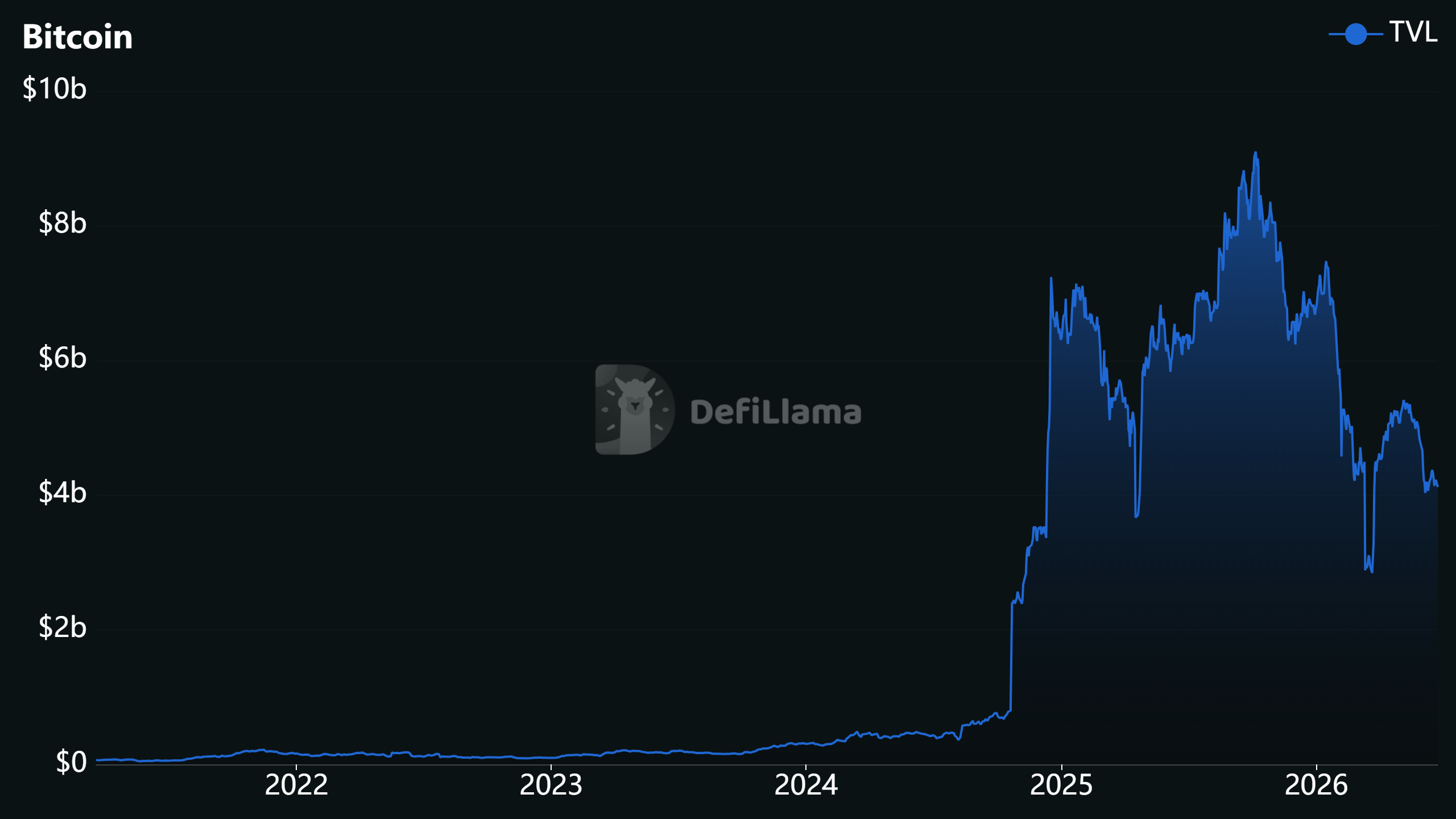
Total Value Locked (TVL) in Bitcoin DeFi. Source: DeFiLlama
An October 2025 GoMining survey of 730 Bitcoin holders found that 77% of respondents had never used a BTCFi platform, and only 3% integrated BTCFi into their overall Bitcoin strategy.
Even allowing for sample bias (these respondents were plugged-in, survey-answering BTC holders), the numbers show that BTCFi platforms that keep users in Bitcoin-aligned stacks remain a niche activity rather than a mass behavior.
Justin d’Anethan, head of research at crypto private markets advisory firm Arctic Digital, told Cointelegraph, “There is more liquidity and better yields on EVM or SVM [Solana Virtual Machine] native solutions than on BTC solutions, period.”
When clients ask about “putting their Bitcoin to work,” the practical routes, he said, are still centralized desks, exchanges lending out BTC at 2% to 4%, basis trade structures “à la Ethena,” or institutional credit pools like Maple.
Related: Bitcoin recovery meets DeFi tensions as Aave rift deepens: Finance Redefined
He said the big obstacle for most Bitcoiners was the risk of bridging to a less secure Bitcoin L2. For “hardcore BTC maxis,” the default remains cold storage, HODLing and riding price appreciation, rather than trying to “eke out 2-3% with counterparty risk.”
Native BTCFi as a structural mismatch
Dragosch said Botanix’s failure suggested that demand for standalone Bitcoin DeFi execution layers was much weaker than their backers expected.
He argued that capital that “genuinely wants yield has migrated to wrapped BTC on mature, liquid venues rather than bridging into bespoke federations.”
In this view, the problem isn’t just that Bitcoiners haven’t “discovered” native DeFi yet; it’s that the architecture and user base are misaligned. Bitcoin’s base layer is slow, conservative and firmly anchored in the store-of-value narrative.
“Bitcoin as reserve collateral is the durable trade,” Dr. Dragosch said, “the next leg of adoption runs through institutions and balance sheets, not necessarily through onchain execution layers.”
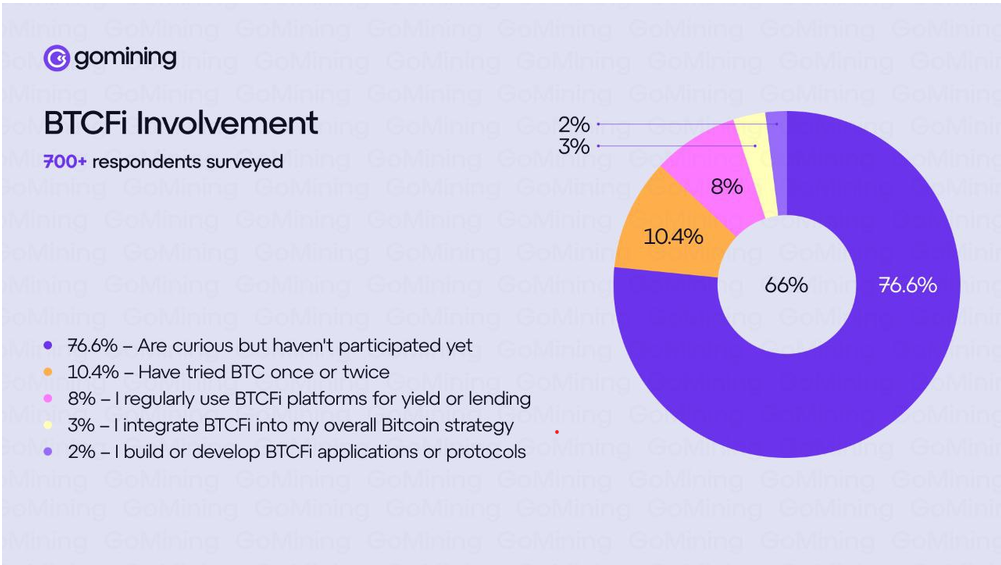
77% of respondents have never used a BTCFi platform. Source: GoMining
Who is still building BTCFi, and for whom?
Diego Gutierrez Zaldivar, chief executive of RootstockLabs, a Bitcoin-secured, EVM-compatible sidechain, doesn’t buy the idea that there’s “no demand” for Bitcoin-backed lending, yield products or broader BTCFi services.
He said the main constraint is trust: putting in place the operational, legal and risk management frameworks that institutions need.
More than 40% of all Bitcoin DeFi activity now runs through Rootstock, he said, including real-world asset settlements and institutional vaults. Over the past year, he said, funds have started asking to deposit hundreds or even thousands of BTC at a time into Rootstock-based products; flows that were almost unheard of two or three years ago.
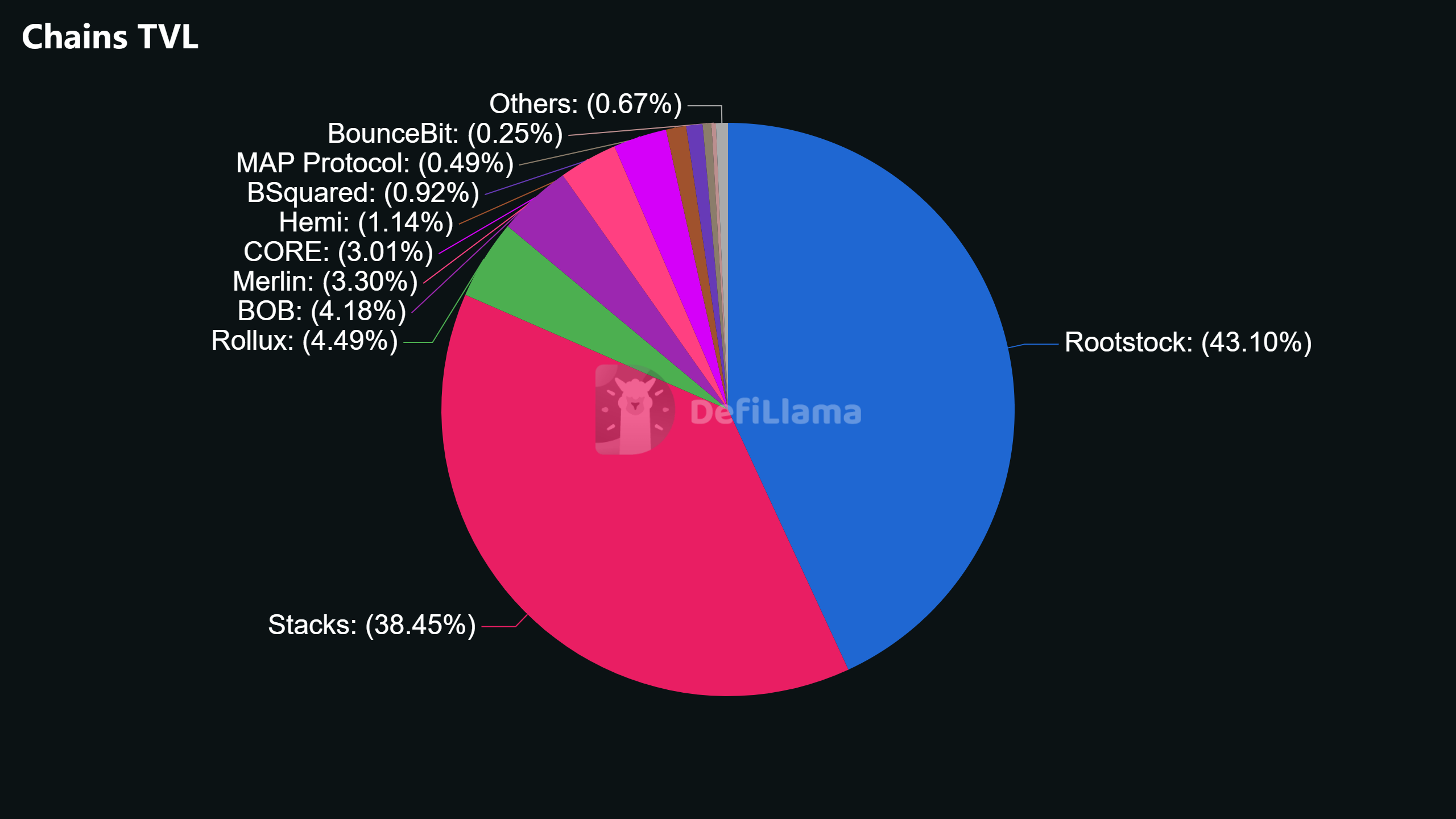
Chains TVL. Source: DeFiLlama
Orkun Mahir Kılıç is co-founder of Chainway Labs, behind Citrea, a Bitcoin-anchored rollup that keeps user assets inside Bitcoin’s security perimeter and proves its state with zero-knowledge proofs. He argued that cloning EVM DeFi primitives onto Bitcoin is a dead end, and said that Botanix’s experience is a verdict on that model, rather than BTCFi itself.
He told Cointelegraph that “more secure” doesn’t change most people’s behavior.
“People don’t price counterparty risk until something breaks,” he said. ”Where it matters” is for institutions and large holders that need trust-minimized transactions with no custodian to fail.
“For everyone else, the reason to be here isn’t the security guarantee in the abstract; it’s the applications that don’t exist elsewhere.”
Magazine: Bitcoin will not hit $1M by 2030, says veteran trader Peter Brandt
TLDR:
- Bitcoin’s apparent demand has stayed negative for 208 consecutive days, dropping to a record low of -273,000 BTC.
- Old Bitcoin supply is re-entering circulation faster than the spot market can absorb the incoming coins.
- BTC price was rejected at both $82,000 and $61,000 resistance levels, extending the pattern of lower highs.
- Analyst Kabuki projects Bitcoin could drop to $53,000 shortly and reach $42,000 by the end of July 2026.
Bitcoin’s apparent demand has remained in negative territory for 208 consecutive days, reaching a new low of -273,000 BTC.
The metric measures real spot market demand by comparing new Bitcoin supply from miner block rewards against existing inventory movement.
Old supply is now entering circulation faster than the market can absorb it. This mismatch between inflows and outflows is creating heavy overhead resistance across Bitcoin’s price structure.
Seven Months of Sustained Distribution Signal Structural Weakness
From November 9, 2025, to May 31, 2026, Bitcoin’s apparent demand hovered quietly between 0 and -150,000 BTC. That range pointed to mild but steady distribution rather than sharp selling.
The market absorbed the pressure without dramatic price moves during that stretch. However, the pattern set the stage for the sharper deterioration that followed.
On-chain analyst Ali Charts flagged the shift in a recent post, noting that apparent demand had dropped to a new low of -273,000 BTC.
The metric has since flatlined around that level, showing no signs of recovery. When apparent demand is persistently negative, it reflects a structural imbalance in supply and demand.
New capital entering the spot market is simply not enough to offset the volume of older coins moving back into circulation.
The metric is considered a reliable gauge of genuine demand because it strips out derivative activity. It focuses entirely on spot-side flows, making it harder to manipulate or misread.
A sustained negative reading over seven months carries more weight than a short-term dip. Traders and analysts watching this data now face a market where selling pressure appears to be the dominant force.
This kind of prolonged distribution cycle has historically preceded extended price corrections. Bitcoin trading at $59,855 at the time of the data release reflects the pressure building on price.
Without a clear reversal in apparent demand, recovery rallies may face sustained resistance. The current on-chain picture supports caution rather than confidence.
Price Rejections at Key Levels Fuel Bearish Projections
Bitcoin’s price action has reinforced the bearish on-chain signals with two clear rejections at technical resistance. Analyst Kabuki, writing on X, pointed out that resistance at $82,000 was rejected before the market dropped sharply. A subsequent attempt at $61,000 was also turned away, continuing the sequence of lower highs.
Kabuki, who claimed to have called the $126,000 top in October 2025 and the $15,000 bottom in November 2022, outlined a bearish price path.
The projection targets $53,000 in the near term, followed by a drop to $42,000 by July. That roadmap follows two prior rejections and aligns with a broader pattern of declining support levels.
Each failed attempt to hold above resistance adds to the case for continued downside. The combination of negative apparent demand and repeated price rejections at key levels creates a compounding bearish setup.
Buyers stepping in at current prices are absorbing supply without successfully defending any meaningful level. That dynamic tends to exhaust demand further rather than restore confidence.
Whether Bitcoin follows the projected path to $42,000 remains to be seen. However, the on-chain data and technical structure both point to a market where sellers are in control.
A meaningful shift would require apparent demand to turn positive and price to break cleanly above near-term resistance. Until that happens, the weight of evidence tilts toward continued pressure on Bitcoin’s price.

Didier Deschamps rejoining France after attending mother’s funeral

Cleer Arc 5 review: feature-packed open earbuds with issues

Astley Bridge arrest after Bolton drug activity is reported to police


-

 Entertainment6 days ago
Renter of Home in Anne Heche Crash Denies Settlement With Son
-
 Sports3 days ago
Two goals and an assist by sheer aura: Cristiano Ronaldo just entered the World Cup chat
-

 Tech5 days ago
Microsoft accidentally kills epic Outlook email threads
-

 Fashion11 hours ago
Weekend Open Thread: Staud – Corporette.com
-

 Business6 days ago
Soccer-U.S. defends Iran World Cup travel restrictions, says discussions ongoing
-

 Politics23 hours ago
The House | Manchesterism won’t survive the painful trade-offs unless it gets citizens on board
-

 Politics7 days ago
Andy Burnham and the meaning of Makerfield
-

 Politics1 day ago
Potential 2028er World Cup attendee leaderboard
-

 Business21 hours ago
Asia stock markets slide as tech shares slump
-

 Tech1 day ago
A Look At A Gaggle Of Transputer Boards
-
Crypto World3 days ago
Bitcoin (BTC) Dips Below $62K, Ethereum (ETH) Plunges 6% Daily: Market Watch
-

 Crypto World3 days ago
Securitize Wraps Roubini's SEC-Registered ETF as Dubai VARA Digital Security
-
 Crypto World1 day ago
Dell (DELL) Shares Tumble Over 5% Following Analyst Downgrade to Hold
-
Business3 days ago
Entergy settles forward sale agreements, raises $672 million in cash proceeds
-
 Crypto World7 days ago
Can Charles Hoskinson Really Rescue Cardano?
-

 Sports8 hours ago
FIH Pro League: India defeat Pakistan 7-1, register biggest win of campaign | Other Sports News
-

 Crypto World12 hours ago
RTX holders must register wallets before token distribution begins
-
Crypto World15 hours ago
Hyperliquid Named on Singapore MAS Investor Alert Register
-

 Crypto World7 days ago
Jake Chervinsky accuses CME of protecting derivatives monopoly
-

 Sports2 days ago
India vs Bangladesh LIVE Score, Women’s T20 World Cup: Bangladesh Opt To Bat; India Enter ‘Do-Or-Die’ Stage As Semi-Final Race Heats Up
You must be logged in to post a comment Login