
Crypto World
New York sued, who is next



New York filed the most aggressive state action against the prediction market industry two days after the Second Circuit denied Kalshi emergency relief on July 29. The suit arrived with a coordinated announcement from the AG and the Governor, counts spanning multiple bodies of state law, a $36 billion damages demand, and a motion to shut down operations in the state immediately.
Summary
- New York Attorney General Letitia James and Governor Kathy Hochul sued KalshiEX on July 31, 2026, in Manhattan Supreme Court, seeking at least $36 billion in compensatory damages, triple-gains penalties, and $100,000 per unauthorized sports wagering offer.
- The state filed simultaneously for a temporary restraining order to halt all Kalshi event contracts in New York immediately, citing evidence that investigators placed real wagers from New York accounts without obstruction.
- Kalshi, valued at roughly $22 billion with annualized volume of approximately $178 billion, calls the suit “political theater” and argues that its CFTC registration as a designated contract market means exclusive federal oversight.
- A bipartisan coalition of 38 state attorneys general has already filed an amicus brief supporting Massachusetts in a parallel case, signaling that the enforcement wave extends far beyond the 13 states with active litigation.
- A bipartisan Senate proposal to ban sports event contracts would eliminate roughly 90 percent of Kalshi’s volume, making the legislative and litigation tracks existential for the same company at the same time.
The damages figure is roughly 1.6 times Kalshi’s reported valuation. It is the number every major outlet led with, and it tells you what New York thinks this case is about. This is not a cease-and-desist. It is a revenue-extraction action against a company the state believes processed billions in unlicensed wagers over multiple years without paying a dollar in gaming taxes.
The question the case forces is whether a federal derivatives license protects a platform from state gambling enforcement. Kalshi says yes. New York says the answer has always been no. The 37 other attorneys general lining up behind Massachusetts suggest New York will not be the last to file.
What the complaint actually alleges
The core claim is that Kalshi is running an unlicensed gambling business in New York. The AG says the platform lets users place wagers on uncertain future events, from Super Bowl outcomes to reality TV winners to election results, without a Gaming Commission license and without paying state gaming taxes. New York treats these as bets, not derivatives, regardless of CFTC registration.
The complaint goes further. It alleges Kalshi allows users aged 18 to 20 to place bets, violating New York’s 21-and-older minimum for mobile sports betting. It alleges the platform offered wagers on games involving New York college teams, a separate violation under state law.
The AG’s investigators placed test wagers from New York accounts as evidence. Four “Yes” contracts on a UConn-Michigan basketball game at $1.14 in April 2026. Ten contracts on the winner of “Big Brother” in July 2026. Both transactions completed without any obstruction.
The filing introduces a count under the federal Interstate Wire Act, alleging Kalshi used wire communications to transmit bets across state lines. This is significant because it widens the legal exposure beyond state gambling statutes into federal criminal law. Even if Kalshi’s CFTC registration were found to preempt state gambling law, the Wire Act is a federal statute. The state is arguing that Kalshi violates it regardless of preemption.
The $36 billion and the restraining order
The headline remedies include a permanent injunction, a TRO, a full accounting of every customer bet and loss, forfeiture and disgorgement of all gains deemed illegal, restitution, penalties of three times Kalshi’s gains under Penal Law Section 80.10, and fines of $100,000 per unauthorized sports wagering offer under the Racing Law.
The per-offer fine structure matters on its own. Kalshi users bet over $1 billion monthly in 2025, with 90 percent of that volume on sports according to figures cited in the AG’s own release. Each unauthorized sports offering carries the $100,000 fine. At that volume, per-offer penalties alone could run into the hundreds of millions.
The TRO is the near-term threat. If granted, Kalshi would need to suspend operations in New York while the case proceeds, potentially for years. A TRO hearing can happen within days or weeks. The underlying lawsuit could take years. That asymmetry is the point. New York does not need to win the case to hurt Kalshi. It needs to win the restraining order.
The preemption argument and why it is weaker than Kalshi says
Kalshi’s defense rests on a single proposition: the CFTC registered it as a designated contract market, and that registration preempts state gambling law. The Commodity Exchange Act does contain a preemption clause. It bars states from imposing requirements on CFTC-registered exchanges that conflict with federal law.
The problem for Kalshi is that the preemption clause has limits. States retain their general police powers, including the power to enforce criminal gambling statutes. The CEA preempts state laws that regulate the same activity the CFTC regulates, meaning the trading of futures and options on designated contract markets. It does not automatically immunize a platform against state criminal law when the state claims the activity is not a derivative at all but an illegal wager.
New York is making exactly that argument. The AG is not saying Kalshi’s CFTC registration is invalid. The AG is saying it is irrelevant. The state treats event contracts as gambling contracts, full stop, and no federal derivatives license converts gambling into commodity trading under New York law.
The Second Circuit’s July 29 denial of emergency relief, while procedural, suggests the appellate court was not persuaded that Kalshi would suffer irreparable harm in the absence of a stay. That is not a ruling on the merits. But it is a signal that the courts are not treating federal registration as an automatic shield.
The 38-state coalition and what comes next
New York is not operating alone. Thirty-eight state attorneys general have filed an amicus brief in the parallel Massachusetts case supporting the argument that state gambling laws apply to prediction markets regardless of federal registration.
That coalition includes states with active sports betting markets and states without them, Republican attorneys general and Democratic ones. The breadth matters because it signals that the enforcement wave is not a partisan project. It is a states’ rights argument about gambling regulation, and it has bipartisan support among the officials who would bring the next round of suits.
The 13 states with active litigation represent the first wave. If New York prevails on the TRO or on the merits, the remaining 25 coalition members have a template. Each state has its own gambling statutes, its own damages provisions, and its own political incentives. A state with a regulated sports betting market, collecting licensing fees and tax revenue, has a direct financial interest in shutting down an unlicensed competitor.
Kalshi’s response has been consistent. It calls the suits political theater, points to its CFTC registration, and argues that only federal courts can decide whether event contracts are derivatives or gambling. The company has not announced any plan to geoblock New York users or restrict sports contracts. That decision will be forced if the TRO is granted.
Congress is moving on the same question
The litigation exists alongside a separate legislative track that could eliminate the product entirely. A bipartisan Senate proposal would ban sports event contracts on CFTC-registered exchanges. If enacted, the ban would remove roughly 90 percent of Kalshi’s volume based on the AG’s own figures.
The proposal has support from senators who otherwise favor crypto market-structure legislation, creating an unusual dynamic in which Kalshi’s allies on general derivatives regulation are the same lawmakers seeking to ban its largest product. The CLARITY Act negotiations have run parallel to the sports-contract debate, and several senators have indicated they would support CLARITY only if the sports ban is included.
For Kalshi, the litigation and legislative tracks threaten the business from opposite directions. The state suits attack the legality of the current product. The Senate proposal would ban the product even if the courts find it legal. The company needs to win both fronts to survive in its current form.
The gambling tax problem nobody is discussing
Buried in the New York complaint is an argument that prediction market platforms owe state gaming taxes on every transaction processed within the state’s borders. New York collects a 51 percent tax rate on mobile sports betting revenue. If event contracts are gambling, that rate applies.
The revenue implications are not trivial. Kalshi processed over $12 billion in New York wagers in 2025, according to the state’s estimates. At a 51 percent tax rate on platform revenue (the operator’s cut, not the full volume), the back taxes alone could run into hundreds of millions before the treble-damages multiplier.
Other states with legal sports betting collect their own tax rates, ranging from 10 percent in some jurisdictions to over 50 percent in others. If the gambling classification holds, every state with a gaming tax has a claim against every prediction market that accepted bets from its residents. The tax liability is not hypothetical. It is the mathematical consequence of the classification argument.
The CFTC’s silence
The CFTC has not intervened in any of the state lawsuits. The agency registered Kalshi, approved its event contracts over internal dissent, and has said nothing publicly about whether it believes state gambling laws are preempted by that registration.
The silence is notable because the CFTC could file amicus briefs in the state cases arguing for federal preemption. The agency has the legal authority and the institutional interest. A ruling that state gambling laws override CFTC registration would undermine the agency’s authority over a product category it explicitly approved.
The most likely explanation for the silence is political. The current commission has one confirmed commissioner and four vacancies. Taking a public position in a politically charged case about sports gambling while operating at minimal capacity carries risk with no obvious institutional reward. The commission may also be waiting for Congress to resolve the question legislatively through the sports-contract ban, which would make the preemption question moot.
What to watch
- TRO hearing date. If New York secures the restraining order, Kalshi must decide within days whether to geoblock New York or appeal. The hearing could come within weeks.
- Second Circuit briefing schedule. The denial of emergency relief was procedural. The underlying appeal on preemption will produce the first circuit-level ruling on whether CFTC registration shields platforms from state gambling enforcement.
- Senate sports-contract ban markup. If the ban advances alongside or as part of CLARITY, 90 percent of Kalshi’s volume becomes illegal regardless of how the courts rule.
- State AG filing cadence. Watch for the next state to file after New York. The 38-state coalition has the template. Each new filing multiplies the damages exposure and the compliance cost.
- Kalshi’s geoblocking decisions. If the company begins restricting access in specific states, it is conceding ground on the preemption argument in practice even while contesting it in court.
Frequently asked questions
Can Kalshi continue operating in New York while the lawsuit proceeds?
Only if the court denies the TRO. If the restraining order is granted, Kalshi must suspend New York operations immediately. The TRO hearing could happen within weeks of filing.
Does CFTC registration protect Kalshi from state gambling laws?
Kalshi argues yes. New York and 38 state attorneys general argue no. No appellate court has ruled on the merits. The preemption question is the central legal issue in every pending state case.
Why is the damages figure $36 billion?
The number reflects the total volume of wagers New York alleges were placed by state residents, multiplied by the treble-damages provision under state penal law. The final amount depends on a full accounting of Kalshi’s New York operations.
How many states are suing prediction markets?
Thirteen states have active litigation. Thirty-eight attorneys general have filed an amicus brief supporting the gambling classification in the Massachusetts case.
What happens to open positions if Kalshi is blocked in New York?
Kalshi would need to settle or transfer open positions for New York users. The mechanics depend on the terms of the restraining order and Kalshi’s own procedures for restricted jurisdictions.
Could Congress resolve this before the courts do?
Yes. The bipartisan Senate proposal to ban sports event contracts would remove 90 percent of Kalshi’s volume legislatively, making the state court cases partially moot on the sports contracts while leaving non-sports contracts unaffected.
Are other prediction market platforms at risk?
Any platform offering event contracts to US users faces the same state-law exposure. Polymarket, which operates offshore, faces different jurisdictional questions but the same underlying classification debate.
What is the Interstate Wire Act argument?
New York alleges Kalshi used wire communications to transmit bets across state lines, invoking a federal criminal statute that operates independently of the preemption question. This count survives even if CFTC registration preempts state gambling law.
Disclaimer: This article is for informational purposes only and does not constitute legal, financial, or investment advice. The legal proceedings described are ongoing. Outcomes remain uncertain. Published August 3, 2026.

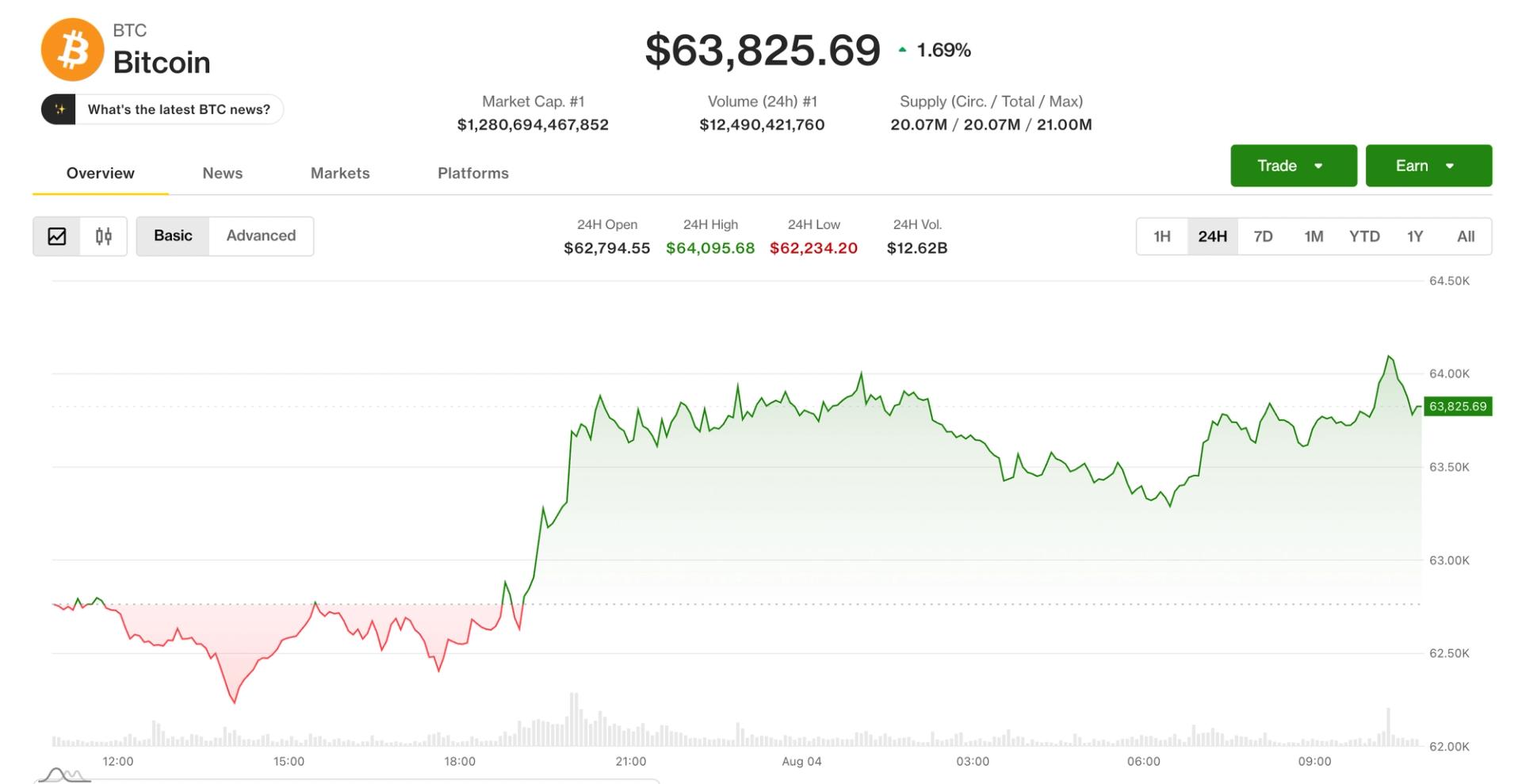
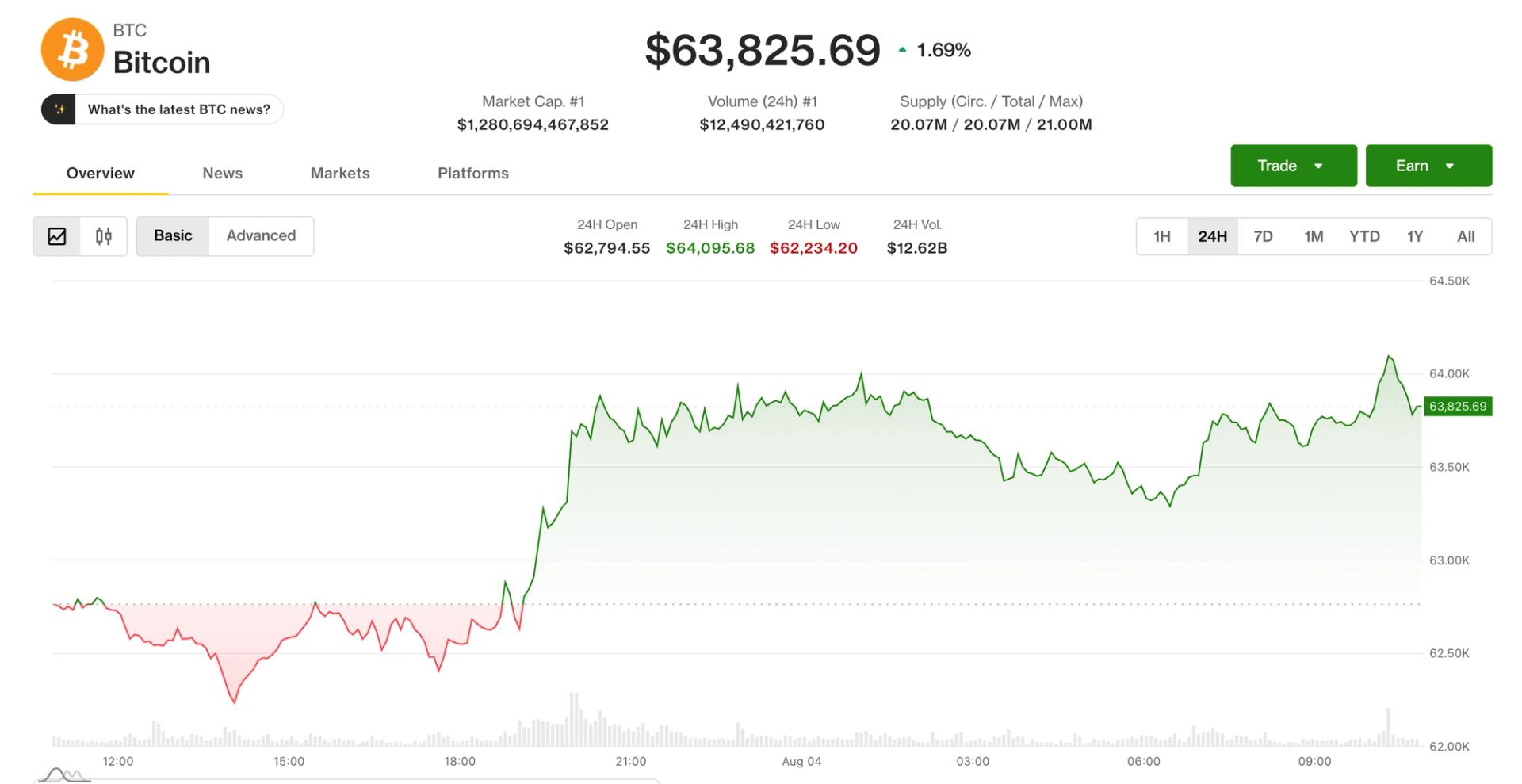
Bitcoin neared $64,000 in Asian morning hours Tuesday, up 2% over 24 hours and 1% on the week, recovering the $63,000 level it lost during Monday’s session. The low came near $62,250 before a steady bid carried it to just above $64,100 overnight.
Ether lagged near $1,865, up marginally on the day but still down 1% over seven days, the only major in the red on the weekly view. XRP rose almost 1% to $1.08 and is up 2% on the week. BNB added 1.5% to nearly $591 and leads the majors over seven days at almost 5%.
Solana gained over 1% to nearly $74, tron 1% to 33 cents and dogecoin the same to 7 cents. Hyperliquid’s HYPE bounced over 4% to $54 after last week’s slide, though it remains down 3% over seven days.
The recovery came without any resolution to the Coldcard situation. A fourth wave of sweeps against addresses generated by the affected firmware ran through Monday, taking roughly 449 bitcoin from 709 addresses on the revised count, and Galaxy Research has not confirmed whether the same operator is behind it.

Ripple said it has made two strategic investments aimed at expanding the infrastructure behind tokenized financial assets on its XRP Ledger (XRPL). In an announcement released Monday, the company disclosed funding into Zilo, a global transfer agency provider for wealth managers, and Licuido, a tokenization solutions firm regulated by the UK’s Financial Conduct Authority.
While Ripple did not provide deal sizes or investment terms, the move signals a continued effort to reduce friction in tokenized markets—particularly around how collateral can move and be reused across issuance and settlement.
Key takeaways
- Ripple announced strategic investments in Zilo and Licuido to support tokenized asset workflows on XRPL.
- The company expects the partnerships to improve regulated transfer agency, issuance, and collateral mobility on its ledger.
- Ripple’s stated focus is addressing “idle collateral” by enabling tokenized funds to be used as collateral from issuance.
- The announcements follow recent XRPL-related product and adoption milestones, including Aviva Investors’ tokenized fund launch and Ripple Mint for RLUSD.
Why Ripple is tying tokenization to regulated market plumbing
For institutional tokenization to scale, networks need more than smart-contract functionality—they require operational layers such as issuance controls, transfer agency services, and mechanisms that support compliance and collateral management. Ripple framed its investments as part of that broader stack.
According to the company’s announcement, Ripple expects the Zilo and Licuido investments to bring “regulated transfer agency, issuance, and collateral mobility” to XRPL infrastructure. That positioning matters because the capital markets bottlenecks that slow adoption are often less about token mechanics and more about how assets move through regulated processes.
Zilo and Licuido: transfer agency and FCA-regulated tokenization
Ripple said it invested in Zilo, which provides global transfer agency asset solutions for wealth managers. The UK-based company has reportedly raised $58.7 million in total equity funding, based on data compiled by Traxcn.
Ripple also announced an investment in Licuido, a tokenization solutions provider based in the UK and regulated by the Financial Conduct Authority. The combination of Zilo’s transfer agency orientation and Licuido’s regulated tokenization role suggests Ripple is targeting multiple stages of a tokenized asset’s lifecycle—from issuance through custody-related and operational handling.
Collateral mobility and the “idle collateral” problem
Ripple’s announcement tied the investments to a specific market issue: collateral that sits unused. The company said that by combining the investments, it aims to help address problems related to idle collateral by enabling tokenized funds to be used as collateral from the point of issuance.
In practical terms, this is the type of improvement that could reduce inefficiencies in leveraged trading, structured financing, or other institutional strategies where capital availability matters. If tokenized instruments can be deployed as collateral more directly, it may reduce the need to lock value in separate pools for different steps of the workflow.
However, the company did not provide implementation timelines or technical details in the announcement, leaving open questions about exactly how quickly these partnerships translate into new product capabilities on XRPL. Investors and ecosystem participants will likely want to watch for concrete rollout plans or integrations that demonstrate the promised shift from token issuance to usable collateral.
XRPL adoption momentum: RLUSD tooling and tokenized fund activity
Ripple’s investment news arrives shortly after other XRPL-related developments highlighted momentum in institutional tokenization.
One week prior to the announcement, London-based asset manager Aviva Investors launched a tokenized share class of its US Dollar Liquidity Fund on XRPL after receiving approval from the Central Bank of Ireland, according to earlier coverage from Cointelegraph. That example illustrates how regulatory clearance and asset-manager participation are becoming central to XRPL’s institutional narrative.
In addition, Ripple last month introduced Ripple Mint, a platform designed to give institutions new ways to access, mint, redeem, and manage its US dollar-pegged stablecoin, Ripple USD (RLUSD). By building tools around stablecoin operations and management, Ripple has been advancing the practical infrastructure institutions need for on-chain settlement and token issuance workflows.
Taken together, these efforts point to a broader strategy: pair ledger-level capabilities with real-world finance counterparts—asset managers, transfer agency providers, and regulated tokenization services—so that tokenized assets can be issued, moved, and operationally managed under compliance expectations.
Tokenized assets onchain: growth, concentration, and what to watch
The broader tokenized real-world assets (RWA) market has continued to expand, reinforcing why firms are investing in infrastructure. According to data compiled by RWA.xyz, XRPL is the 11th-largest blockchain network with $368 million in tokenized RWAs. Ethereum ranks first with $17.1 billion in tokenized RWAs.
RWA.xyz data also showed that total RWA holders increased by 50% to 1.57 million over the past 30 days, while the total value of tokenized assets rose by 1.5% to $37.3 billion. Those figures suggest that, despite concentration at the top, the sector is not standing still—participation and capital have both been trending upward.
For XRPL participants, the key takeaway is that growth in tokenization demand may increasingly depend on the maturity of the operational layer. Ripple’s stated goal—improving collateral mobility and transfer agency and issuance capabilities—directly targets a set of constraints that can limit institutional use even when tokenization technology exists.
Next, market observers will likely focus on whether Ripple can translate these investments into measurable product outcomes on XRPL—especially around regulated issuance workflows and the ability for tokenized funds to function as collateral from issuance, as Ripple described. Concrete integrations, pilot deployments, and partner announcements will be the clearest indicators of how quickly the strategy moves from concept to capability.


Kalshi CEO Tarek Mansour defended the prediction market operator on Aug. 3 after New York filed a lawsuit seeking at least $36 billion in damages, penalties and related relief.
Summary
- New York seeks at least $36 billion while alleging Kalshi operates an unlicensed gambling platform.
- Kalshi removed the case to federal court, temporarily sidelining New York’s immediate preliminary injunction request.
- Tarek Mansour compared Kalshi with Nasdaq, saying the exchange matches traders and charges transaction fees.
- Federal courts previously refused Kalshi’s bid to block New York from enforcing gambling laws locally.
- The next court fight concerns federal jurisdiction, remand, and whether state gambling rules can coexist.
During a CNBC interview, Mansour compared Kalshi’s structure to Nasdaq and argued that the state’s allegations threaten the wider event contract business.
The legal case also moved away from New York state court. The prediction market platform removed the proceeding to the U.S. District Court for the Southern District of New York shortly after Attorney General Letitia James filed it on July 31.
New York Supreme Court Justice Melissa A. Crane then treated the state’s preliminary injunction request as moot because the case was no longer before her court, according to court records shared by gaming law attorney Daniel Wallach. The decision was procedural and did not reject New York’s allegations.
Kalshi lawsuit moves into federal court
New York’s verified petition accuses the firm of repeatedly violating state gambling laws by offering event contracts without a New York State Gaming Commission license. The state wants a permanent injunction, an accounting of customer activity, restitution, disgorgement and civil penalties. It also seeks $100,000 for each alleged unauthorized sports wagering offer. Those requests remain allegations and have not resulted in a final judgment.
The company transferred the case to federal court about eight hours after the state filing, arguing that New York was attempting to regulate a derivatives exchange overseen by the Commodity Futures Trading Commission. As crypto.news reported, the state had initially asked for immediate restrictions while the wider case proceeded.
Justice Crane’s order temporarily removes that state court request from consideration. Wallach said New York could file the motion again if a federal judge sends the case back to state court. A remand decision would determine the forum, not whether Kalshi’s products are lawful.
Mansour says Kalshi resembles Nasdaq
Mansour rejected New York’s description of Kalshi as an unlicensed sportsbook. He said users trade with other participants while the prediction market platform matches positions and earns transaction fees. He added that officials could “copy and paste that lawsuit and file it against Nasdaq,” extending his defense beyond sports markets.
The comparison reflects Kalshi’s central argument that event contracts are financial instruments rather than conventional wagers. The firm is registered with the CFTC as a designated contract market, and its contracts generally allow customers to take opposing positions on whether an event will occur. New York argues that this structure does not change the products’ gambling character under state law.
Mansour also compared Kalshi’s regulatory battles with earlier disputes involving Uber and Airbnb. He portrayed the state action as resistance from established gaming businesses facing a new competitor. That remains Kalshi’s interpretation. New York has said its case concerns licensing, consumer safeguards, tax obligations and access by users below the state’s minimum sports betting age.
The CEO claimed New Yorkers had collectively earned more than $200 million on Kalshi during 2026. He also said the company proposed a system that could produce almost $10 billion in state tax revenue over five years. Mansour did not publish supporting calculations during the interview, so those figures should be treated as company claims rather than verified totals.
New York says event contracts are illegal gambling
The attorney general’s office alleges that the company allows customers to risk money on future events outside their control, meeting New York’s definition of gambling. The petition cites contracts covering professional sports, college games, elections and entertainment programs. It also alleges that Kalshi charges customers fees for entering those positions.
New York further claims that people aged 18 to 20 can use the platform even though state law sets the minimum age for mobile sports betting at 21. The state says licensed operators must follow local consumer protection requirements and contribute gaming taxes. The prediction market operator disputes the state’s authority to apply those rules to a federally registered exchange.
The petition refers to a reported $22 billion company valuation and annualized transaction volume of $178 billion. Those figures appear as the firm reported numbers in the state filing. They are not findings by the court, and the final monetary exposure cannot be known before an accounting and judgment.
Federal and state regulators remain divided
The new removal follows an earlier setback for the prediction market operator. On July 7, U.S. District Judge Analisa Torres refused to block the New York State Gaming Commission from applying state gambling laws to Kalshi’s sports contracts. She found that Kalshi had not shown at the preliminary stage that the Commodity Exchange Act displaced New York’s rules. Kalshi appealed, but its requests for emergency protection were also rejected.
The CFTC takes the opposite position. In an April federal complaint, the regulator argued that Congress gave it exclusive authority over swaps and other contracts traded on registered derivatives exchanges. New York maintains that states retain their traditional power to police gambling within their borders.
Courts have not applied one consistent approach nationwide. In related coverage, a Washington judge blocked Kalshi sports contracts after finding that state gambling laws could apply. A Minnesota federal judge reached a different early conclusion and temporarily blocked that state’s prediction market ban.
The federal judge assigned to New York’s newly removed case must now consider whether federal jurisdiction exists and whether the proceeding should remain in federal court. A remand would allow New York to renew its injunction request in state court. Keeping the case in federal court would move the immediate dispute into the same court system already handling related questions about CFTC authority and federal preemption.
Since July 30, attackers have drained thousands of BTC from Coldcard-generated wallets, exploiting a flaw dating back to March 2021. According to researchers at Galaxy, total damage so far is about $130 million in BTC.
Over the weekend, some analysts pointed to increased inflows of BTC onto exchanges as the hack dented confidence in self-custody safety.
The 500 BTC isn’t an isolated case
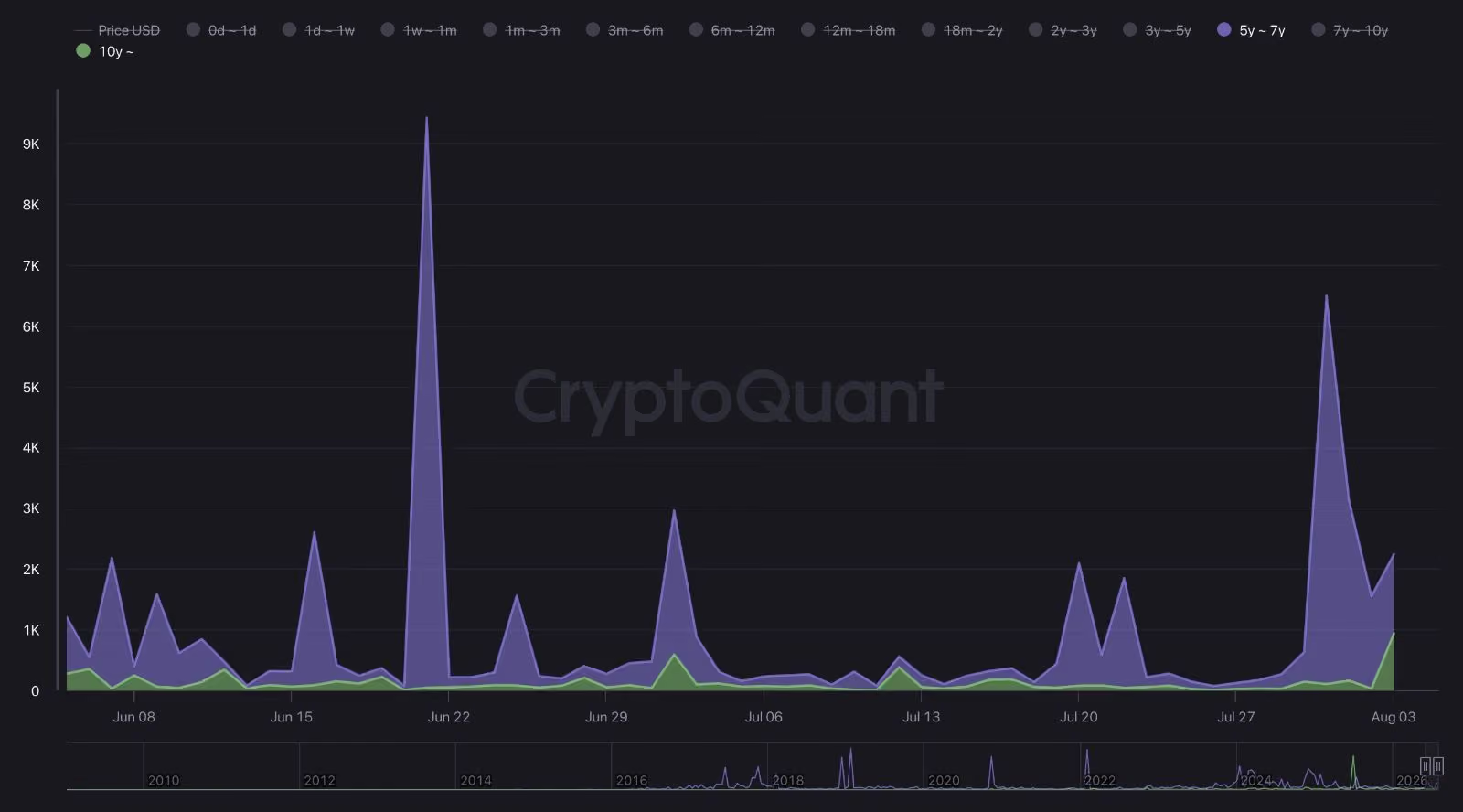
On-chain data from CryptoQuant tracking the so-called spent output age bands, an indicator which groups all bitcoin moved on a given day by how long each coin had sat dormant before being spent, reveals a clear spike in old-coin movement around the same window.

Coins that had been dormant for 10 years or longer saw roughly 935 BTC move on Aug. 3, the largest single-day total since March 20. Separately, coins dormant for five to seven years saw a much larger spike, with roughly 6,388 BTC moving on July 31.
Old coins move for all kinds of reasons, such as estate transfers, exchange consolidations, custodial migrations that have nothing to do with any single hack.
But the clustering of large, long-dormant movements in the days immediately following the Coldcard incident gives the impression of holders proactively migrating funds for security reasons.


Cointelegraph is committed to providing independent, high-quality journalism across the crypto, blockchain, AI, and fintech industries.
All news, reviews, and analyses are produced with full journalistic independence and integrity. For more details on our standards and processes, please read our Editorial Policy.


Tom Lee’s BitMine Immersion Technologies staked another 150,120 Ethereum (ETH) tokens, worth roughly $278 million. The move deepens one of the largest corporate bets on Ethereum’s proof-of-stake network.
Blockchain analytics account Lookonchain flagged the transaction hours after it happened on August 4. It lifts BitMine’s total staked ETH to 5,067,309 tokens, worth about $9.38 billion. That figure equals 87.4% of the company’s entire ether stack.
Why Staking This Much Signals Conviction
Staking locks tokens into Ethereum’s validator network instead of leaving them idle in a wallet. Validators earn rewards for helping secure the chain. In exchange, they accept withdrawal queues and full price exposure for as long as the tokens stay locked.
A company that stakes nearly nine-tenths of its holdings is not hedging. It is committing to hold the position for years rather than trade around short-term price swings.
BitMine runs its staking through the Made in America Validator Network (MAVAN), an institutional platform the company built to generate yield on its own Ethereum treasury. It eventually plans to open MAVAN to outside clients too.
An Ethereum ‘Supercycle’
Chairman Tom Lee, who also co-founded research firm Fundstrat, has repeatedly framed the buildup as a wager on a multiyear “supercycle” for Ethereum.
The timing fits a broader institutional tilt toward ether. Ethereum ETFs recently posted their best month since October 2025, even as Bitcoin funds kept bleeding assets. BitMine’s own stock has rallied on the strategy, as investors reward the treasury bet.
Staking nearly 90% of a multibillion-dollar position leaves little room to reverse course quickly if sentiment turns. Ethereum needs to keep attracting institutional demand for that bet to pay off. BitMine has staked its balance sheet on exactly that outcome.
The post BitMine Stakes 87% of Its Ethereum Holdings in Fresh Conviction Bet appeared first on BeInCrypto.


Blockchain Association sent Senate Majority Leader John Thune and Minority Leader Chuck Schumer an eight page response on Aug. 3, disputing the National Sheriffs’ Association’s objections to the latest CLARITY Act draft.
Summary
- Blockchain Association says the CLARITY Act regulates intermediaries while protecting developers who lack asset control.
- The group says registered crypto brokers, dealers and exchanges would face Bank Secrecy Act duties.
- Section 10604 protects noncontrolling developers but leaves criminal money laundering and sanctions laws fully intact.
- The bill authorizes $600 million yearly for digital asset investigations from fiscal 2027 through 2031.
- Senate leaders ended Monday without scheduling CLARITY, while continuing resolution business occupied the floor instead.
The trade group argued that the July 22 Senate text does not give decentralized finance platforms, software developers, mixers or bridges a “blanket exemption” from anti money laundering and sanctions laws. It said the bill separates financial intermediaries that control assets or transactions from developers who only create neutral software.
The exchange arrived during a narrowing legislative window. The Senate ended Monday without acting on H.R. 3633. It invoked cloture on a continuing resolution vehicle and scheduled further work on that measure for Tuesday, leaving the market structure bill without a publicly announced vote.
CLARITY Act dispute turns on who controls transactions
The sheriffs’ group told Senate leaders on July 31 that the bill’s developer protections were too broad and could make financial crime investigations harder. Its attachment argued that Congress should regulate “everyone who receives revenue” from the digital asset marketplace and asked lawmakers to remove or narrow Section 10604.
Blockchain Association rejected that approach. It said revenue alone does not determine whether a person is a financial institution under the Bank Secrecy Act. FinCEN’s 2019 guidance says money transmitter status depends on a business model’s facts and circumstances. FATF guidance also focuses on whether a person performs covered financial functions for another party.
According to the association, brokers, dealers and exchanges registered or required to register under the bill would face anti money laundering programs, customer identification, suspicious activity reporting, recordkeeping and sanctions compliance. The sheriffs’ group disputes whether the framework reaches enough participants.
Developer protections leave criminal laws in place
Section 10604 would protect a noncontrolling developer from being treated as a money transmitting business merely for creating software, offering self custody tools or supplying infrastructure. To qualify, the person must lack the legal right and unilateral ability to control transactions involving users’ assets.
The Blockchain Association said the provision leaves laws covering money laundering, wire fraud, sanctions violations, terrorism financing, conspiracy, theft and aiding and abetting intact. A developer who knowingly handles criminal proceeds, controls customer funds or assists an offense could still face prosecution, according to the letter.
The draft also directs the SEC, working with Treasury, to write rules for people controlling protocols that are decentralized in name but perform intermediary functions. The association said this answers claims that controlled platforms could avoid oversight by calling themselves DeFi.
Law enforcement groups remain divided
The dispute does not represent one law enforcement position. Blockchain Association cited support from the Fraternal Order of Police, the National Organization of Black Law Enforcement Executives, the Major Cities Chiefs Association and the Federal Law Enforcement Officers Association. Major County Sheriffs of America is neutral, while 160 former law enforcement, intelligence and national security officials previously urged Senate action.
In related coverage, crypto.news examined how the law enforcement divide centers on developer protections and investigative authority. Supporters view a control based standard as necessary to avoid treating software writers like banks. Critics argue broad language could make responsible parties harder to identify when illicit funds move through decentralized systems.
The July 22 draft proposes $600 million annually from fiscal 2027 through 2031 for state and local digital asset investigations and prosecutions. It would fund training, blockchain analytics and a Digital Asset Cyber Innovation Center. FinCEN would receive another $30 million annually for five years.
Senate calendar leaves no CLARITY vote scheduled
The latest verified Senate floor update shows the chamber adjourned Monday after invoking cloture on H.R. 6500 by an 89 to 4 vote. Senators were due to resume that continuing resolution vehicle Tuesday. The official update did not list H.R. 3633 or announce a CLARITY Act cloture filing.
As crypto.news previously reported, an ordinary cloture filing by Wednesday, Aug. 5 could preserve a possible Friday procedural vote. This timing follows Senate Rule XXII rather than a leadership commitment. A petition requires at least 16 signatures, while ending debate on legislation normally requires three fifths of senators duly chosen and sworn.
Even a successful motion to proceed would not pass the bill. Senators would still need to debate the text, consider amendments and approve final passage. Any Senate changes would also require House approval before the measure could reach the president.
The Senate calendar places its state work period from Aug. 10 through Sept. 11. Leaders could still negotiate faster action or extend floor time, but no arrangement had been announced by Monday’s adjournment. The next confirmed signal would be a cloture filing, leadership notice or formal scheduling agreement.
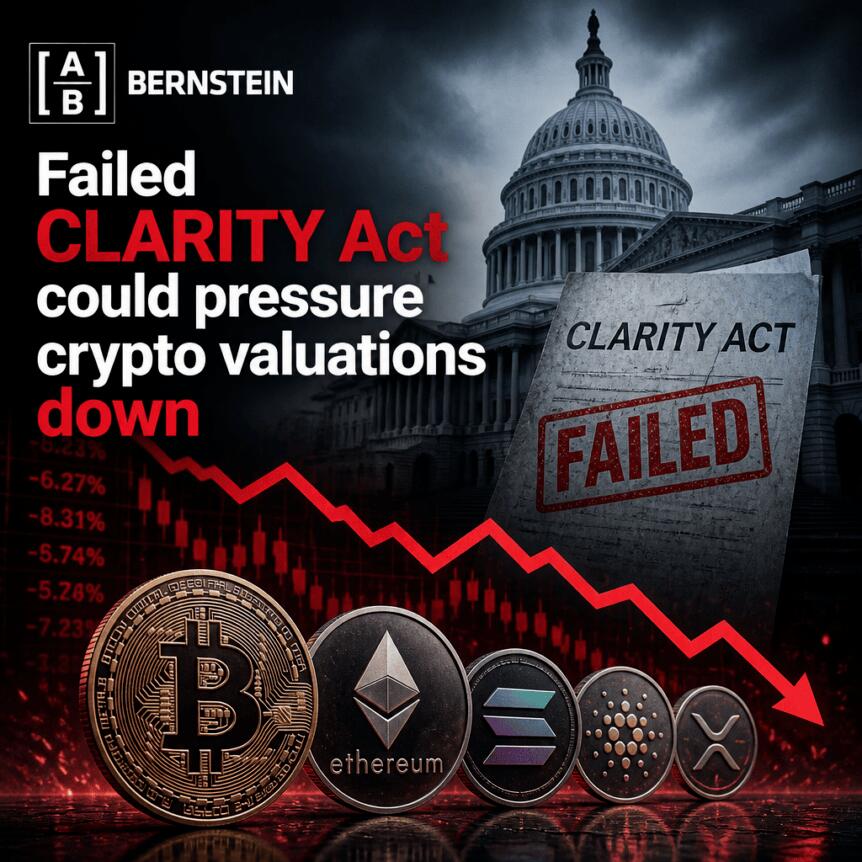
The US Senate’s schedule is becoming a key variable for the crypto industry as lawmakers prepare to enter summer recess at the end of this week, according to Bernstein, a wealth manager. Bernstein says that the odds of the Digital Asset Market Clarity Act (CLARITY) advancing are falling, raising the risk of another short-term downturn in crypto valuations—particularly for Bitcoin.
In a Monday report shared with Cointelegraph, Bernstein also warned that a missed legislative push could spark a “knee-jerk” reaction from market participants. Still, the firm points to a counterbalance: if Congress stalls, regulators may intensify efforts already underway under existing authorities, including the SEC and CFTC’s Project Crypto.
Key takeaways
- Bernstein says CLARITY momentum is weakening as the Senate approaches its summer recess, increasing the risk of additional downside for the market.
- The firm expects the crypto market to bottom and regain momentum toward late Q3 or early Q4 ahead of the mid-term period, if timing pressures persist.
- Prediction market activity on Polymarket puts CLARITY passage before the end of 2026 at 31%, down from 38% week-to-date.
- Bernstein argues that legislative delays could lead to more proactive SEC and CFTC policy releases tied to token classification and DeFi rules under Project Crypto.
Recess risk and the “knee-jerk” market reaction
Bernstein’s central concern is timing. With the Senate preparing to start summer recess, the window for passing CLARITY appears to narrow. The wealth manager said that if the legislation does not advance, the market could interpret the outcome as a near-term delay in US crypto market structure reform.
In Bernstein’s view, that could trigger an immediate negative “industry knee-jerk reaction,” potentially translating into another leg down for Bitcoin and the broader crypto market. The firm’s outlook is not purely bearish, however: it also anticipates that—tactically—the market could find a bottom and begin building momentum toward late Q3 and early Q4 before the mid-terms.
What Project Crypto could do if CLARITY stalls
Bernstein’s report highlights an important asymmetry. While markets may react negatively to legislative delays, the same outcome could push regulators to move faster within their current legal frameworks.
Project Crypto is a joint initiative intended to use existing agency authority to develop a workable regulatory approach for digital assets while Congress finalizes broader legislation under CLARITY. The SEC first announced Project Crypto under Chairman Paul Atkins in July 2025, and it was later expanded into a joint staff effort between the SEC and the CFTC in September 2025. (SEC announcement: https://www.sec.gov/about/sec-launches-project-crypto; CFTC/SEC expansion referenced by Cointelegraph: https://www.cftc.gov/LawRegulation/FederalRegister/finalrules/2026-05635.html.)
According to Bernstein, the SEC and CFTC could respond to Congress’s slowdown with additional interpretive releases and clearer guidance. The firm specifically points to potential developments involving:
- Token “taxonomy” and interpretive guidance tied to how different types of tokens should be treated.
- Clearer rules related to decentralized finance (DeFi).
- Acceleration of an “innovation exemption” concept for issuing tokens that would be exempted from securities status during a finite period.
For investors and builders, the practical takeaway is that regulatory clarity might not arrive only through CLARITY. If Congress can’t deliver in the near term, markets may increasingly price regulatory outputs—such as guidance, interpretive releases, and rulemaking momentum—emanating from the SEC and CFTC.
Polymarket odds slip to 31% for passage by end-2026
Bernstein’s concern about dwindling prospects for CLARITY is echoed by market-implied probabilities. Polymarket data shows the odds of the act being signed into law before the end of 2026 at 31%, down 7% over the past week and down 9% over the past month. The market reports roughly $3.7 million has been wagered on the outcome. (Source: Polymarket.)
The drop matters because prediction markets often reflect shifting expectations around legislative scheduling and political willingness—especially when credible procedural deadlines approach. In this case, the timing implied by summer recess is a direct catalyst for priceable uncertainty.
Earlier coverage also indicates that expectations have moved in recent months: on June 26, Galaxy Digital cut its odds of CLARITY becoming law in 2026 to 50%, warning that the US Senate was running out of time to pass the market-structure bill before its August recess (as noted in Cointelegraph’s reporting: https://cointelegraph.com/news/galaxy-cuts-2026-clarity-act-odds-50).
Political and industry friction around the bill
Beyond Senate calendar risk, CLARITY is navigating political and institutional scrutiny. Cointelegraph reported that White House officials are reportedly weighing a bipartisan ethics counterproposal received on Thursday after weeks of negotiations between Republican Senator Thom Tillis and Arizona Democrat Ruben Gallego.
Per sources familiar with the matter who spoke to crypto journalist Eleanor Terrett, the proposal would allow state attorneys general to sue the Department of Justice if it fails to enforce ethics laws against federal officials. (As reported by: https://www.cryptoinamerica.com/p/president-trump-weighs-bipartisan.) The relevance for crypto stakeholders is indirect, but it underscores how broader political processes can consume attention and time that might otherwise be directed toward stalled legislation.
CLARITY’s substance has also faced resistance. The banking industry has pushed back, arguing that the draft could let crypto firms offer yields on stablecoins without meeting requirements they say apply to traditional financial institutions. Cointelegraph also flagged that the act’s stablecoin yield provisions have drawn concern from banking groups (related link referenced in the source material: https://cointelegraph.com/news/aba-banking-associations-clarity-act-yield).
As those tensions persist, the bill’s path becomes less predictable—one reason prediction market odds and institutional forecasts can move quickly as legislators approach procedural inflection points like recess.
With the Senate headed into recess, traders and long-term participants should watch two things in parallel: whether CLARITY gains any late-stage momentum before lawmakers leave, and whether the SEC and CFTC accelerate practical guidance under Project Crypto—especially around token classification and DeFi—if Congress fails to deliver the legislative clarity the market is pricing.

Crypto analyst ChartNerd said on August 3 that XRP’s prolonged weakness could be setting the stage for a major market repricing.
With the token testing long-term support near $1.06 after months of negative sentiment, the market watcher argued that the current decline is part of a wider crypto correction rather than a sign of weakness in Ripple’s fundamentals.
Watching for Larger Moves as XRP Tests Support
ChartNerd wrote that being a macro XRP bull during the current downturn has been difficult, especially as altcoins have underperformed Bitcoin (BTC) for much of the cycle.
He stressed that nothing is inherently wrong with the asset and described the current period as a normal correction within a larger trend.
‘The next few months are setting the stage for the next market repricing. Maybe the biggest yet,” he stated.
His focus is on XRP’s technical structure, with the token again testing the $1.06 support area after failing to break above its daily 20 EMA near $1.08. The 50 EMA near $1.12 is another resistance level, as is $1.16 if buyers regain control.
According to ChartNerd, XRP’s current price action is taking place inside a falling wedge pattern while approaching a six-year support zone that in the past came right before a big upward movement. However, the analyst also warned that a move below the $1 support would not be unexpected, considering the prevailing market structure, but painted it as a “golden ticket” entry point.
“The lower it goes, the better the long-term opportunity becomes,” he said. “It’s all about perspective.”
Analyst EGRAG CRYPTO had earlier identified the $1.05 area as a “battlefield” for the asset, with a successful defense potentially taking it back toward $1.10 and higher, while a breakdown below that zone could expose XRP to the $1 region ChartNerd spoke about.
Long-Term Thesis Facing Short-Term Pressure
The #6 biggest cryptocurrency was trading around $1.07 at the time of writing, down 1% in 24 hours and nearly 3% over seven days. It has also lost about 24% of its value in the past three months, keeping it more than 70% below its July 2025 all-time high near $3.65.
And that weakness is present despite developments around the Ripple ecosystem, including an announcement by the blockchain payments firm that it has invested in Zilo and Licuido, two companies focusing on tokenized funds and institutional asset infrastructure.
Institutional interest has also been positive, with spot XRP ETFs recording $27 million in net inflows in July, although that figure was markedly lower than June’s $60 million and May’s $132 million, highlighting XRP’s struggle to hold higher levels after its mid-July rally.
The post Major XRP Repricing Could Begin in the Next Few Months: Analyst appeared first on CryptoPotato.


Bitmine said it now holds about 4.8% of Ether’s circulating supply as it pursues its 5% acquisition target.

Hannah Waddingham says Ted Lasso stars had one question when fourth season was announced

Rise in small business ‘whisk takers’ prompts review of bake sheds

Bitcoin nears $64,000 as traders look past Coldcard sweeps


-

 Business5 days ago
Why Trees Belong on the Risk Register
-

 Fashion3 days ago
Weekend Open Thread: Wit & Wisdom
-

 Politics3 days ago
Meta enters AI-training agreement with far-right ‘propaganda rag’ Newsmax
-
 Entertainment6 days ago
‘Stargate’ Creator’s New Sci-Fi Series Returns for Season 3 Tomorrow
-

 Crypto World3 days ago
MicroStrategy Post-Earnings CLARITY Act Push Could Add New Catalyst for Its Stock
-

 Politics7 days ago
The Part of the Electric Transition Nobody Wants to Discuss
-

 Business6 days ago
Major shareholder moves on Canyon
-

 Crypto World3 days ago
XRP Ledger v3.3.0 brings five institutional features
-

 News Videos5 days ago
Bitcoin Enters the 3rd Stage of the Bear Market
-

 Crypto World6 days ago
Kraken Enables Retail Access to Jersey Mike’s IPO via Tokenized Shares
-

 Politics6 days ago
Reform UK betrays West Mids residents by running from party pledges
-

 Politics5 days ago
Luke Littler’s dominance sparks GOAT debate
-

 News Videos6 days ago
Claude: Build Financial Dashboards in Minutes (2026)
-

 Sports4 days ago
Seema Kaliramna Wins Discus Throw Bronze, Takes India’s CWG Medals Tally To 17
-

 Crypto World3 days ago
New York sues Kalshi over prediction market gambling
-

 Business6 days ago
Johnson & Johnson agrees to $5.5B settlement over talc cancer claims
-

 Crypto World2 days ago
Crypto PAC spending tops $2M in Michigan House race
-

 Business4 days ago
Trump Announces Hamas Disarmament Agreement as Iran Strikes Kuwait Air Base and US Attacks Pause Overnight
-

 Tech6 days ago
Gemini can now summarize the messiest comment threads in Google Docs
-

 Tech2 days ago
ESET tracks rise in malicious AI skills and adaptable malware
You must be logged in to post a comment Login