

Crypto World
Nvidia (NVDA) Stock Surges Ahead with Massive $80B Buyback and Dividend Boost


Key Highlights
- Nvidia unveiled an $80 billion share repurchase authorization, supplementing an existing $39 billion plan.
- Quarterly dividend increased 2,500%, jumping from $0.01 to $0.25 per share.
- First quarter FY2027 revenue reached $81.6 billion, representing 85% year-over-year growth.
- Evercore ISI draws parallels between Nvidia’s shareholder return strategy and Apple’s historical P/E expansion.
- Consensus rating stands at Strong Buy, with analysts targeting $283.26 per share.
In what represents one of the most significant capital allocation announcements in technology sector history, Nvidia has rolled out an additional $80 billion share repurchase authorization without an expiration timeline, while simultaneously increasing its quarterly dividend payment by 2,500% — from $0.01 to $0.25 per share.
Shareholders on record as of June 4 will receive the enhanced dividend payment on June 26, 2026.
These shareholder-friendly initiatives accompanied the company’s first quarter fiscal 2027 financial results. Total revenue registered $81.6 billion, marking an 85% increase compared to the prior year period. The data center segment delivered particularly robust performance, climbing 92% to establish a new record at $75.2 billion.
Throughout the first quarter, Nvidia distributed approximately $20 billion to investors via share repurchases and dividend payments. The company maintained $38.5 billion in remaining authorization under its previous buyback framework before announcing the additional $80 billion program.
For perspective: this newly authorized repurchase program exceeds the entire market capitalization of numerous S&P 500 constituent companies.
Despite these shareholder-favorable developments, NVDA stock declined approximately 1% during trading. Market participants appeared more concerned with potential growth trajectory deceleration than the substantial capital return announcement.
The Apple Parallel Explained
Evercore ISI’s Mark Lipacis established a clear correlation between Nvidia’s present circumstances and Apple’s historical trajectory. Following an extended period of price-to-earnings multiple contraction, Apple experienced valuation expansion once the company accelerated its buyback and dividend programs. Lipacis anticipates Nvidia will follow a similar pattern.
He further suggested that Nvidia’s capital return generosity could intensify throughout 2027.
Bank of America’s Vivek Arya provided additional perspective. Between 2022 and 2025, merely 47% of Nvidia’s free cash flow was allocated to dividends and repurchases. Industry competitors typically distribute approximately 80%.
Instead, Nvidia has been channeling capital into AI ecosystem development — taking positions in entities such as OpenAI and Anthropic. Arya argued that this strategy has been “unfairly” labeled as questionable circular financing.
“Enhancing shareholder returns could broaden the ownership base, narrow Nvidia’s valuation discount and address circularity concerns,” Arya stated.
Nvidia’s Strategic Transformation
CEO Jensen Huang characterized the AI infrastructure deployment as representing the “largest infrastructure expansion in human history.” This fundamental thesis remains unchanged.
What has transformed is Nvidia’s approach to cash management. For an extended period, the company embodied a pure growth narrative. Currently, it’s producing sufficient cash flow to simultaneously fund AI investments and return billions to shareholders.
Nvidia has committed to distributing 50% of its free cash flow to investors during calendar year 2026.
Wall Street maintains overwhelming support for the equity. During the past three months, the analyst community has issued 40 Buy recommendations, one Hold rating, and one Sell rating. The mean 12-month price objective stands at $283.26, suggesting approximately 26.75% appreciation potential from present levels.
The $80 billion repurchase authorization ranks among the largest buyback programs within the technology sector. Share repurchases decrease outstanding share count, which typically provides earnings per share support over time.




In today’s newsletter, Sarah Cummings from Morgan Stanley Investment Management provides insights and considerations when assessing crypto exchange-traded funds.
Then, in “Ask an Expert,” Ryan Tannahill from iA Private Wealth USA, answers questions about borrowing against bitcoin assets.
Assessing Crypto ETPs in an Evolving Market
When evaluating exchange‑traded funds (ETFs), investors typically focus on factors such as fees, liquidity and tracking. Spot bitcoin exchange‑traded products (ETPs) introduce additional dimensions of due diligence that investors may be less accustomed to assessing. First launched in January 2024, these vehicles — structured as grantor trusts under the 1933 Act — seek to track bitcoin performance using a designated pricing benchmark. Understanding how their structure, custody arrangements and benchmarks operate is central to evaluating these products.
Core ETF considerations
As with any ETF, headline costs and trading characteristics matter.
Fees and waivers. While fee compression has occurred since the first spot bitcoin ETPs entered the market, expense ratios still vary meaningfully across products. Investors may wish to distinguish between gross and net expense ratios, particularly where fee waivers are in place. Such waivers may be subject to asset thresholds or expiration dates that could affect costs over time.
Liquidity and execution. Trading volume, bid/ask spreads, and overall fund liquidity remain important inputs when assessing the total cost of ownership. However, because bitcoin itself is a highly liquid underlying asset, onscreen fund liquidity may not fully reflect execution quality. In practice, similarly priced execution may be achievable across products despite differences in visible trading activity. Engaging with a trust sponsor or liquidity provider ahead of a trade may help manage execution costs.
Tracking and fund design. Given their single‑asset, passive structure, spot bitcoin ETPs tend to exhibit limited sources of tracking error. Expense ratios are typically the primary driver, with lower‑fee products generally expected to track more closely over time. In‑kind creation and redemption mechanisms may also support tighter tracking by reducing frictional costs.
Considerations specific to crypto ETPs
Beyond traditional ETF metrics, several factors are more specific to crypto‑based products.
Digital asset custody. Holding bitcoin requires specialized custody arrangements, a relatively new function within asset servicing. While early infrastructure was largely developed by crypto‑native firms, traditional custodians have increasingly entered the space. Custody practices, regulatory status and bankruptcy protections can differ across providers, making it prudent to understand how and where digital assets are held.
Sponsor profile. The issuer’s background may also warrant consideration. Crypto‑native sponsors and traditional financial institutions may operate under different regulatory frameworks and governance standards, which can influence risk management, operations and investor protections.
Benchmark methodology. The growth of digital asset products has led to the emergence of new benchmark providers. Evaluating a benchmark’s construction—such as exchange inclusion criteria, pricing methodologies and review processes—can be important. A poorly designed benchmark may diverge from broader bitcoin pricing, potentially affecting tracking outcomes.
Bringing it together
In a developing asset class, the structure and design of an ETP can be as consequential as the exposure it seeks to provide. Beyond headline fees, evaluating custody frameworks, sponsor profiles, benchmark methodologies and execution characteristics may help investors better understand potential costs and risks. As the market for crypto ETPs continues to evolve, a disciplined and holistic due diligence process remains essential.
– Sarah Cummings, executive director, ETF Strategist, Morgan Stanley Investment Management
Important risks and disclosures.
Ask an Expert
Q: Do I need to move my bitcoin to get a loan against it?
In many cases, yes — centralized lenders typically require custody of your bitcoin for the loan’s duration. However, structures vary across platforms, so it’s worth understanding who holds your assets and how they’re protected before committing.
Q: What’s the main risk advisors should flag?
Margin calls. If bitcoin drops sharply, clients may be forced to post additional collateral or face liquidation — often at the worst time. That forced sale can also trigger a taxable event, compounding the loss.
Q: Should I do this instead of selling some of my position?
It depends on conviction. If you believe bitcoin appreciates, borrowing preserves that upside while meeting liquidity needs. But if you’re uncertain about the position, adding leverage isn’t the answer — sometimes a clean sale is the simpler move.
– Ryan Tannahill, Investment Advisor Representative, iA Privabecoming
Keep Reading
- The U.S. Senate Banking Committee advanced its crypto market structure bill, the Clarity Act, to the Senate floor on Thursday, bringing it a step closer to passing it into law.
- Japan’s Financial Services Agency recognizes foreign-issued stablecoins as electronic p.yment methods under domestic law, effective June 1.
- Bank of England Deputy Governor Sarah Breeden says the BoE will publish draft stablecoin rules next month and finalize them by year-end.

Kraken’s operator Payward has moved closer to a formal UAE launch after receiving preliminary authorization from Dubai’s Virtual Assets Regulatory Authority (VARA). The company announced that the preliminary VARA nod came alongside a broker-dealer, investment and management licence from the regulator, signaling an expanding footprint in the Gulf region.
Kraken said the preliminary approval was granted on Thursday, with the full launch date yet to be confirmed. At market introduction, the exchange plans to offer AED funding, a full slate of trading services including margin and over-the-counter (OTC) capabilities, and access to Kraken Prime for institutional clients. This aligns with the firm’s stated objective of serving both retail and professional participants in the UAE.
“Kraken’s UAE expansion aligns with our prior regulatory footprint in the region and reinforces the UAE’s position as a regional hub for digital-asset activities,” Kraken’s spokesperson noted. The company also referenced earlier regulatory progress in the UAE, including its 2022 approval to operate within Abu Dhabi’s financial free zone framework under ADGM.
According to Kraken, the development fits a longer strategy to create a robust and compliant presence in the Middle East, leveraging a UAE licensing regime that is widely viewed by market participants as among the most mature in the region. The firm’s public messaging about the UAE expansion was shared in its official blog post linking the VARA authorization with its broader UAE ambitions.
Dubai’s VARA register has grown to include 49 active crypto firms across exchange, broker-dealer, custody and lending activities, illustrating the city’s push to establish a regional digital-asset services ecosystem. Notable names on the public register include Binance, Crypto.com, OKX, Deribit and HashKey, a reflection of Dubai’s strategy to attract global operators under a centralized regulatory framework. Kraken and its parent Payward do not yet appear on the regulator’s public list. The most recent update to the register shows CoinCorner obtaining approval to offer virtual-asset broker-dealer services on May 5.
Dubai’s regulatory posture continues to attract crypto firms despite geopolitical frictions in the region. Industry executives frequently point to regulatory clarity as a key differentiator when choosing where to establish or expand operations, especially versus jurisdictions that are perceived as more fragmented or uncertain. The UAE’s approach to licensing, oversight and risk management stands as a core reason why major institutions are weighing Dubai as a base for regional activity.
In the framing of the expansion, Kraken co-CEO Arjun Sethi was quoted as saying, “Dubai wrote a rulebook for crypto before most jurisdictions even acknowledged the asset class. That clarity is why real liquidity and institutional capital now sit in the UAE.” This sentiment underscores the broader narrative that regulatory certainty can translate into measurable access to liquidity and client demand for compliant operators.
Related coverage notes that the UAE’s licensing environment for crypto and government-related payments has been evolving, reflecting a broader policy push to integrate digital assets into a regulated financial ecosystem. For context, Crypto.com has previously secured a UAE license tied to government crypto-payments initiatives, illustrating a wider corporate migration toward Dubai’s structured regime for digital assets.
Key takeaways
- Kraken receives preliminary VARA authorization to operate in the UAE, paired with a broker-dealer, investment and management licence, signaling imminent market entry.
- The launch plan includes UAE dirham funding, margin trading, OTC services and access to Kraken Prime for institutional clients.
- Dubai’s VARA public register comprises 49 active crypto entities, with several major global platforms already listed; Kraken/Payward are not yet on the public register.
- The UAE’s regulatory framework is cited by industry participants as a key driver of liquidity and institutional participation in the region.
- Regulatory clarity in Dubai is positioned as a differentiator from jurisdictions perceived as more fragmented or uncertain, especially in the context of cross-border crypto operations.
Kraken’s UAE regulatory footprint and market entrance
The preliminarily cleared status from VARA, complemented by a broker-dealer, investment and management licence, marks a tangible milestone for Kraken’s regional strategy. The UAE has pursued a centralized, rule-based approach to digital assets, seeking to align exchange operations, custody, and ancillary services under a single regulatory umbrella. Kraken’s stated plan to offer AED-denominated funding and a full suite of trading services—including limited leverage through margin facilities and OTC desks—is aimed at meeting the demands of both sophisticated traders and institutional clients seeking compliant access to the region’s liquidity pools.
While the company’s announcement confirms the regulatory green light for a UAE-based operation, it also signals a transition phase for the broader market: operators are navigating a dual objective of rapid onboarding and rigorous risk controls. The 2022 ADGM license previously granted to Kraken under Abu Dhabi’s Global Market framework remains a foundational element of the firm’s regional compliance architecture, illustrating a layered regulatory engagement that some market participants view as a blueprint for cross-jurisdictional operations within the UAE.
From a compliance perspective, the combination of VARA’s licensing and ADGM’s established framework could facilitate a more predictable operating environment for foreign crypto firms. For banks and institutional clients, the UAE’s approach may translate to clearer AML/KYC processes, standardized onboarding, and defined capital and reporting regimes—elements that are increasingly essential for regulated market participation in digital assets. Observers note that such clarity can reduce counterparty risk and enable more robust risk governance structures for institutional participants looking to engage with UAE-based venues and counterparties.
Dubai’s regulatory landscape: a growing registry and policy implications
Dubai’s VARA registry’s expansion to 49 active firms demonstrates a sustained regulatory effort to formalize digital-asset activities across exchange, broker-dealer, custody and lending services. The selection of prominent global operators—such as Binance, Crypto.com, OKX, Deribit and HashKey—illustrates a deliberate strategy to attract marquee players while maintaining oversight through a centralized licensing framework. Kraken’s current absence from the public register highlights the ongoing process of formal listing and public disclosure, even as the regulatory apparatus enables market access through provisional approvals.
The UAE’s regulatory stance interacts with global policy trends in meaningful ways. As global markets grapple with the harmonization of crypto regulation, Dubai has pursued a dual strategy: enabling regulated market access for established operators while imposing stringent compliance requirements that align with international norms on AML/KYC, customer protection and financial stability. This approach has implications for licensing pathways, cross-border service provisioning, and the management of systemic risk within digital-asset ecosystems. In practice, firms seeking to operate in Dubai must navigate a layered regime that includes VARA licensing, potential cross-licensing with other UAE authorities, and ongoing supervisory reporting obligations.
Industry participants have emphasized that such regulatory clarity can facilitate legitimate liquidity flows and institutional capital retention within the UAE. The emphasis on a formal rulebook and predictable oversight may influence where firms choose to base regional operations, how they structure product offerings, and how they coordinate with local banks and custodians to support regulated digital-asset activities. For regulators, the UAE model raises considerations about enforcement, cross-border cooperation with other jurisdictions, and the balance between innovation incentives and financial integrity safeguards.
Dubai’s position in the broader policy and market structure
Even as regional tensions in the wider Gulf arena have unsettled some investors and events, Dubai’s ongoing development of a regulated digital-asset ecosystem continues to attract firms seeking greater regulatory certainty. The UAE’s approach to licensing and oversight is often contrasted with jurisdictions where rules are perceived as less transparent or rapidly changing. In this context, the maturation of VARA and the broader UAE regulatory architecture could influence international discussions on crypto policy and influence how other jurisdictions design licensing regimes to attract legitimate activity while addressing financial crime risks.
Looking ahead, observers will be watching for the timing of Kraken’s full launch in the UAE and whether the firm’s public registration status will align with its regulatory approvals. The degree to which VARA’s supervision will integrate with other UAE financial authorities, and how cross-border service provision will be governed, remains an area of interest for compliance teams, legal professionals and institutional desks monitoring evolving regulatory risk in the region.
Crypto market participants and policymakers alike may continue to assess how Dubai’s regulatory architecture helps reconcile the pace of product innovation with the need for robust governance. As Dubai consolidates its status as a regional crypto hub, the coming quarters will test the durability of a framework designed to attract global operators while maintaining a high standard of regulatory oversight.
Closing perspective: The UAE’s regulatory path for digital assets remains a defining factor for industry entrants. Kraken’s preliminary VARA authorization illustrates how a structured licensing environment can enable a measured market entry, with ongoing developments likely to shape cross-border collaboration, compliance practices and institutional access in the Middle East’s expanding crypto ecosystem.
In the midst of its playoffs surge, the top professional hockey league has agreed to coordinate oversight of betting on popular prediction markets with the U.S. Commodity Futures Trading Commission, securing a new memorandum of understanding similar to the one recently struck with Major League Baseball.
The National Hockey League, which had officially linked itself last year with both Kalshi and Polymarket as the league’s official prediction market partners, has agreed to share information with the regulator on event contracts tied to its games, according to a Thursday statement from the agency. The CFTC has been pursuing similar arrangements with all of the professional sports leagues, Chairman Mike Selig said at an event last week.
“This agreement is another step toward safeguarding the integrity of sports and protecting market participants in prediction markets from insider trading, fraud, and other abuses,” he said of the NHL arrangement in a statement.
Selig has made it a point to foster the industry and to defend his agency’s role as its sole regulator.
Prediction market betting has seen explosive growth in recent years, and along with its popularity has come concerns that the wagering is being abused and is encouraging cheating. In a Senate Commerce Committee hearing this week, lawmakers criticized the dark side of the industry. Bad actors — including among the athletes themselves — threaten to “sow doubt in the minds of fans,” said committee Chairman Ted Cruz.
“Integrity has always been and remains paramount to the NHL and fundamental to the trust our fans and partners place in our game,” said NHL Commissioner Gary Bettman, in a statement released by the CFTC. “Our agreement with the CFTC enhances the comprehensive integrity monitoring systems already in place and strengthens our ability to identify, deter, and address potential risks.”
According to the new MOU, the league and regulator will “endeavor to share information, upon request, regarding the integrity of professional hockey and the event contract markets related thereto or other matters deemed appropriate.”
Read More: Prediction markets firms take heat in Senate Commerce hearing scrutinizing surge
Crypto World
Nakamoto Ltd Enacts 1-for-40 Split to Secure Nasdaq Listing, Tilts Toward Bitcoin Treasury

Nakamoto Ltd is executing a 1-for-40 reverse stock split Friday, a compliance-driven consolidation that collapses 696.1 million outstanding shares down to approximately 17.4 million and targets the one threshold that determines exchange survival: Nasdaq’s $1.00 minimum bid requirement.
The company’s shares had fallen to $0.22 as of April 6, 2026, triggering a Nasdaq deficiency notice under Listing Rule 5450(a)(1) with an initial compliance deadline of June 8, 2026.
This is not purely a defensive maneuver. Paired with the reverse stock split is a deliberate pivot toward a Bitcoin Treasury model, positioning Nakamoto alongside the growing category of crypto equities designed to offer institutional investors regulated, exchange-listed exposure to BTC price performance without holding spot Bitcoin directly.
Discover: The best crypto to diversify your portfolio with
How the 1-for-40 Nakamoto Split Restores Nasdaq Compliance, and What It Costs Existing Shareholders
A 1-for-40 reverse stock split means every 40 shares of existing common stock are consolidated into a single new share.
At a pre-split price of $0.22, the theoretical post-split opening price lands near $8.80, well above Nasdaq’s $1.00 floor and within the range needed to satisfy the exchange’s minimum bid requirement under Listing Rule 5450(a)(1).
Shareholders approved the action at a Special Meeting on May 8, 2026, granting the board discretion to set the final ratio anywhere within a 1-for-20 to 1-for-50 range.

The board elected 1-for-40. Authorized shares and par value remain unchanged by the consolidation, which is structurally significant: Nakamoto retains substantial headroom for future equity issuances, ATM offerings, convertible notes, or share-based acquisitions – without requiring an additional shareholder vote to expand authorized capital.
One cost falls on smaller holders. Shareholders whose positions do not divide evenly into 40-share lots will receive cash in lieu of fractional shares, not additional stock.
Discover: The best pre-launch token sales
The post Nakamoto Ltd Enacts 1-for-40 Split to Secure Nasdaq Listing, Tilts Toward Bitcoin Treasury appeared first on Cryptonews.
Ethereum is trading at $2.1k, and the chart tells a story that three months of cautious optimism can no longer paper over. The ascending channel that has provided the structural backbone for every bullish argument since the February bottom is getting broken to the downside.
Moreover, the US institutional bid that supported the recovery through March and April has quietly retreated to its most negative reading since the capitulation lows. Therefore, ETH is seemingly not pulling back. It is breaking down.
Ethereum Price Analysis: The Daily Chart
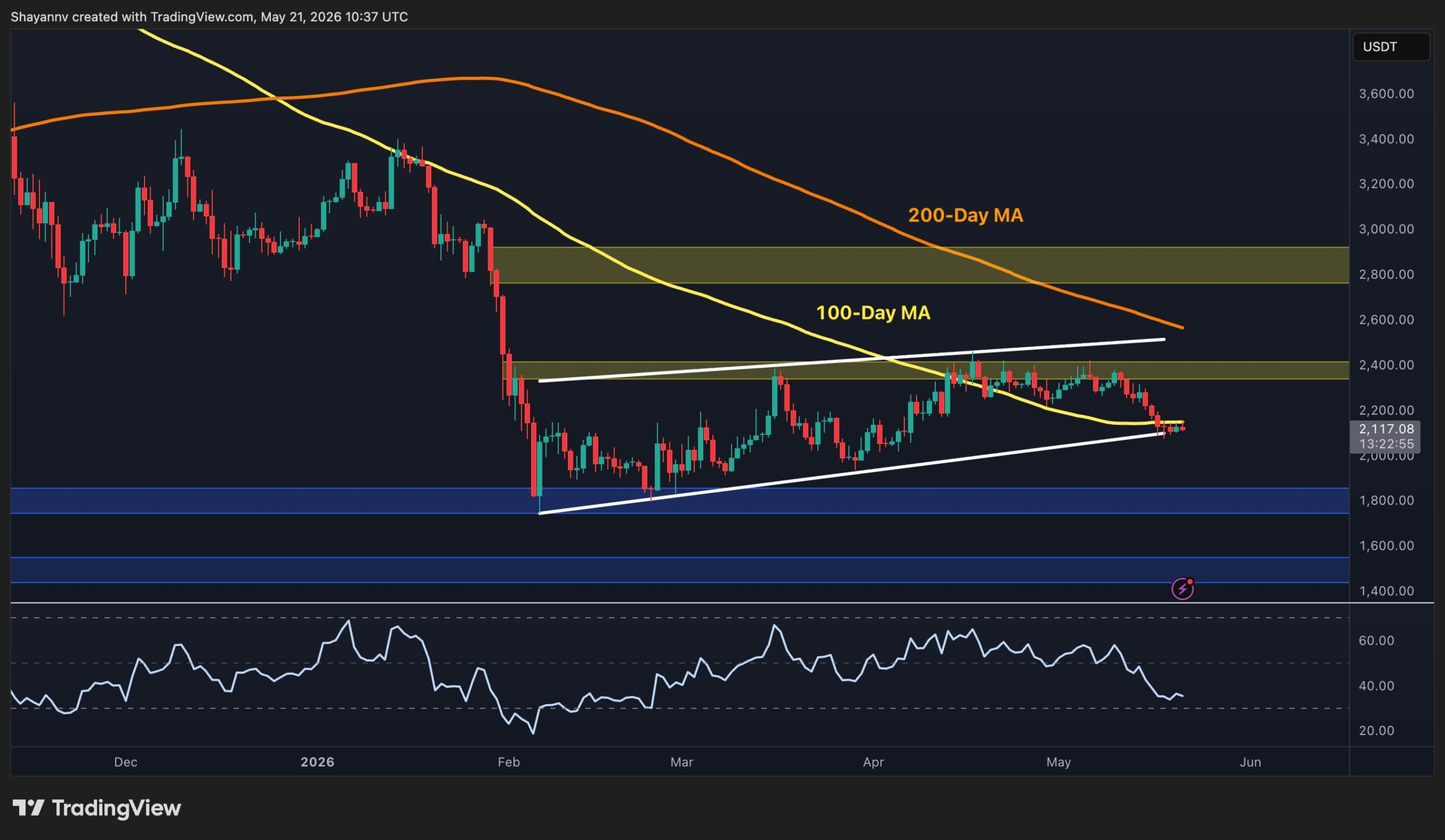
The ascending daily channel from the February low is failing. The asset is breaking below its lower boundary for the first time since the recovery began, and the 100-day moving average, which sat at approximately $2.2k and is still nearby, has been lost on a daily closing basis. The RSI has also declined below 40. This is its weakest daily reading since February’s capitulation, with no sign of a momentum floor forming yet.
The $1.8k demand zone is now the primary downside reference, having held as the absolute floor during February’s sell-off. Above, the lost 100-day moving average at the $2.2k zone now acts as immediate resistance. Reclaiming the $2.2k area on a sustained daily close is the minimum requirement to suggest this breakdown is a fakeout rather than a real structural shift.
ETH/USDT 4-Hour Chart
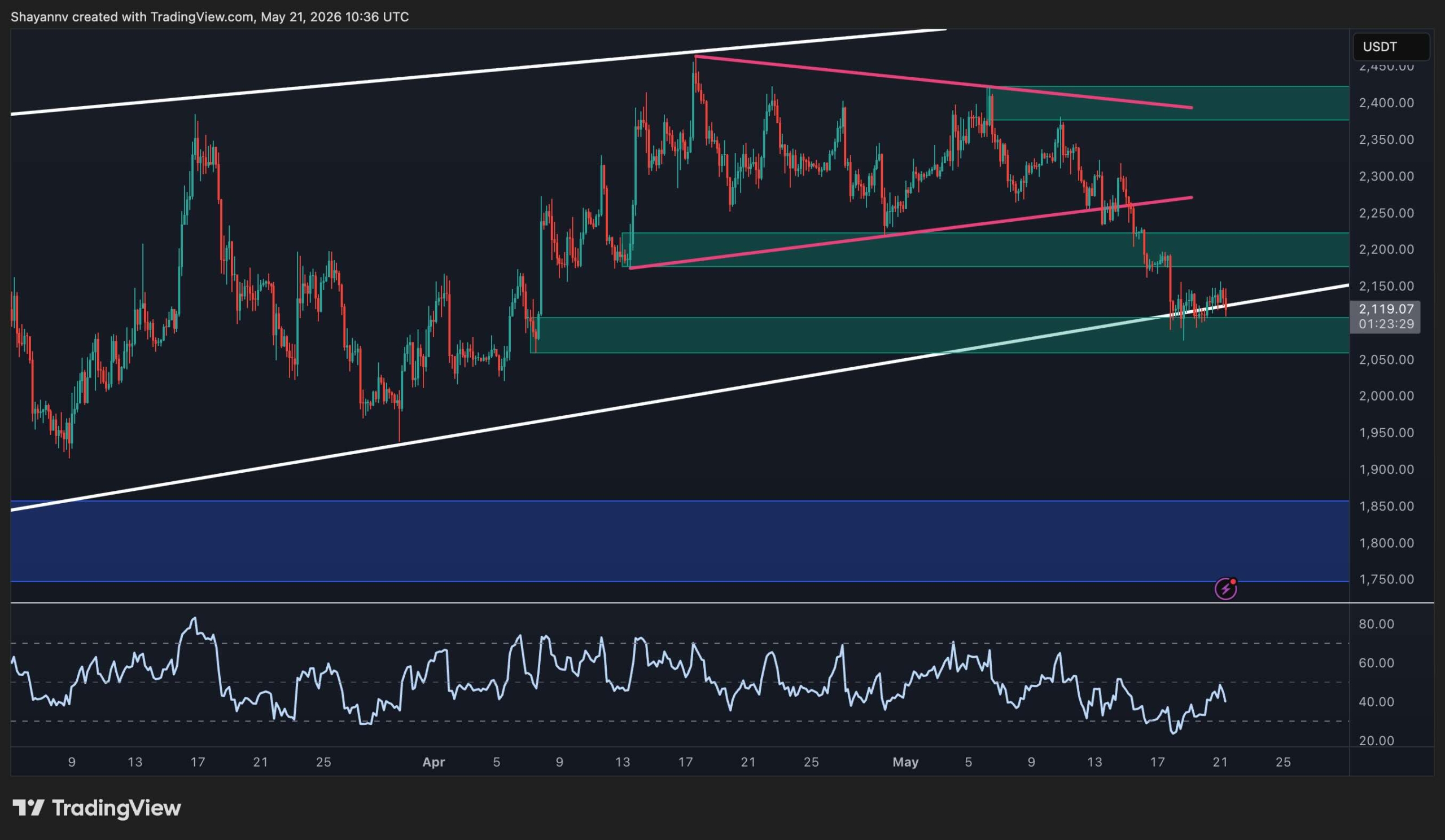
On the 4-hour timeframe, the inner symmetrical triangle has resolved fully to the downside, taking the $2.2k support zone with it, which was a level that held on two prior occasions. The price is now sitting directly on the lower zone at $2.05k–$2.1k, which aligns almost precisely with the daily ascending channel’s lower boundary.
The 4-hour RSI has bounced modestly from the oversold low reached during the sharpest leg of the recent sell-off, and is recovering to the 40s. This should be viewed as a dead cat bounce until proven otherwise.
The current area at $2k-$2.1k is the last meaningful support before $1.8k. A 4-hour close below this area removes the final technical argument for the ascending channel structure and opens a direct path to the $1.8k demand zone below.
On the other hand, a sustained hold and recovery back above $2.2k would be the first sign that the breakdown is being absorbed. However, given the momentum behind this move, that recovery needs to happen quickly.
Sentiment Analysis
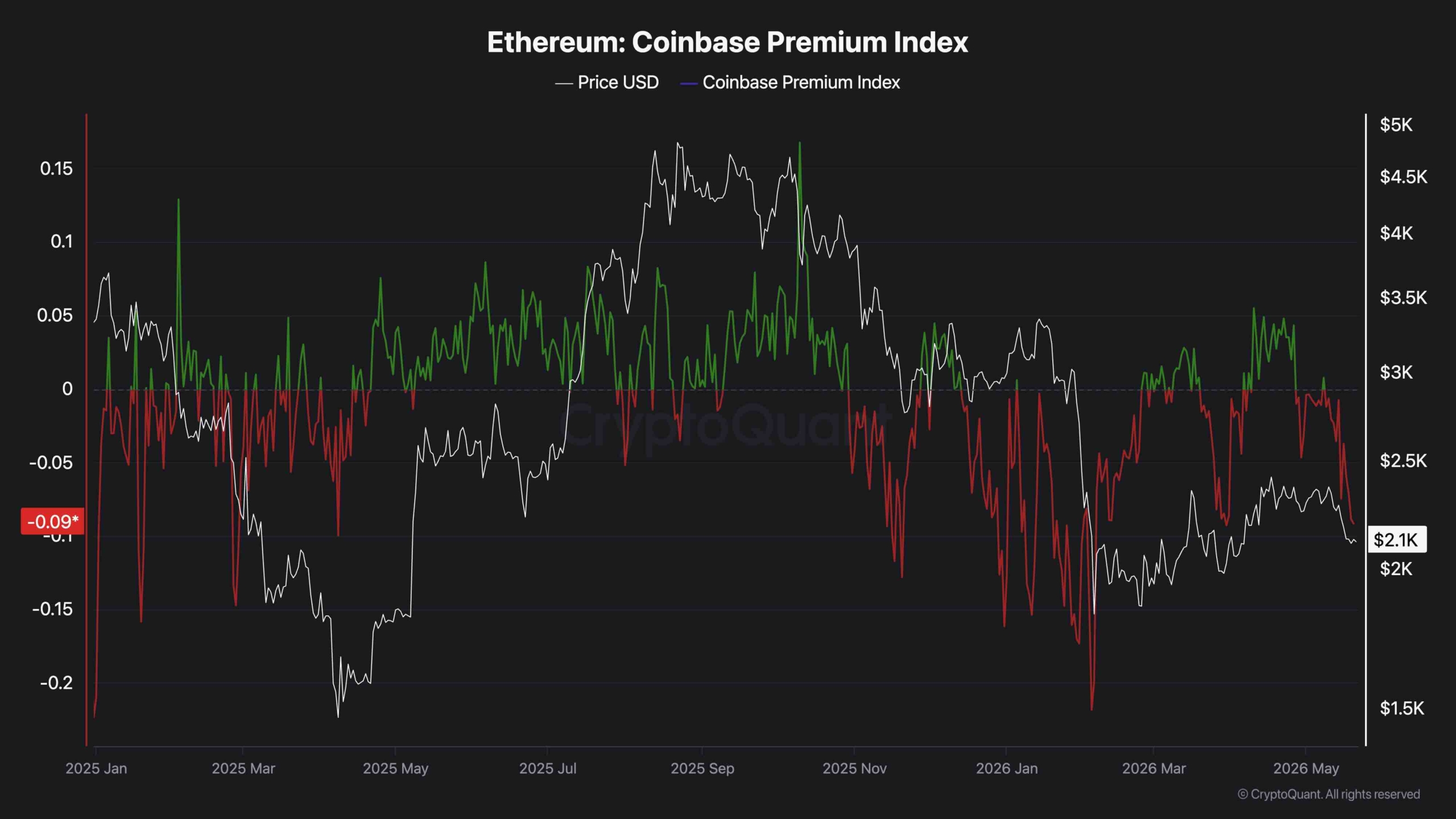
The Coinbase Premium Index has fallen to -0.09, which is the deepest negative reading since February’s capitulation low, and a sharp reversal from the slightly positive territory that characterized the March and April recovery. US buyers returned during the recovery (+0.02 to +0.08), stepped back at $2.4k resistance (premium faded to zero in early May), and have now actively retreated as the breakdown accelerated (-0.09).
The -0.09 reading is not yet at the -0.20 extreme seen at the February bottom, which means there is further room for US institutional selling to intensify if the price continues lower. What it confirms is that the cohort of buyers who provided the demand floor through the recovery is not stepping in to defend current levels. They are absent or net selling.
Without the Coinbase premium returning to sustained positive territory, any bounce from the $2.05k–2.1k support is likely to be sold rather than built upon, and the structural requirement for a genuine recovery is a reclaim of $2.2k with a positive Coinbase premium. Unless this happens, the bullish case has no credibility to stand on.
The post Ethereum Price Analysis: ETH Is Not Simply Pulling Back, It’s Breaking Down appeared first on CryptoPotato.
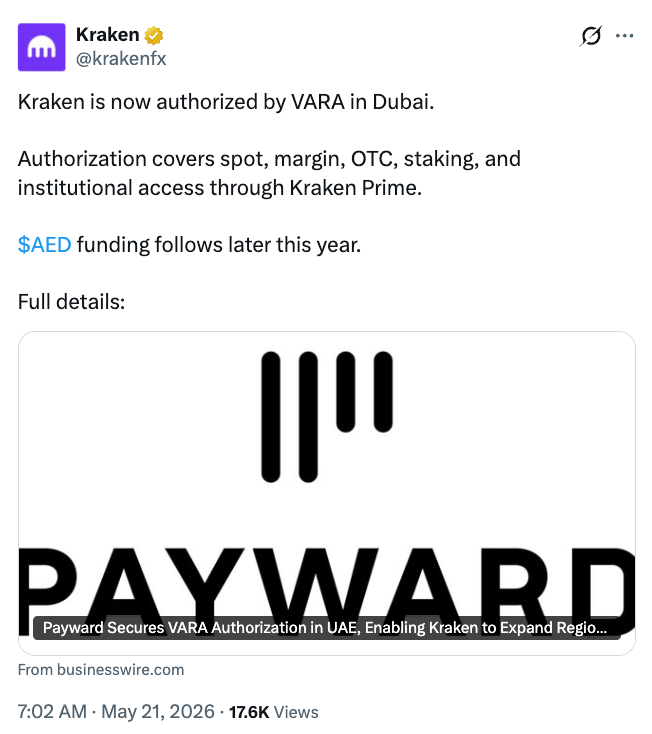
Cryptocurrency exchange Kraken moved closer to a launch in the United Arab Emirates after its operator, Payward, received preliminary approval from Dubai’s Virtual Assets Regulatory Authority (VARA), according to the company.
Payward on Thursday announced its UAE expansion alongside receiving preliminary approval for a broker-dealer, investment and management licence from VARA.
A spokesperson for Kraken told Cointelegraph the preliminary approval was granted on Thursday, with a full launch date to be confirmed.
At launch, Kraken plans to offer UAE dirham (AED) funding, along with a full suite of services including margin and over-the-counter trading, as well as access to Kraken Prime for institutional clients, the representative added.
The move builds on Kraken’s earlier regulatory footprint in the region, including its 2022 approval to operate in the UAE under Abu Dhabi’s financial free zone framework.
Dubai’s VARA register now includes 49 active crypto firms
Dubai’s public VARA register currently includes 49 active companies spanning exchange, broker-dealer, custody and lending businesses.
The list includes major global crypto players such as Binance, Crypto.com, OKX, Deribit and HashKey, reflecting Dubai’s push to position itself as a regional hub for companies in the digital asset industry.
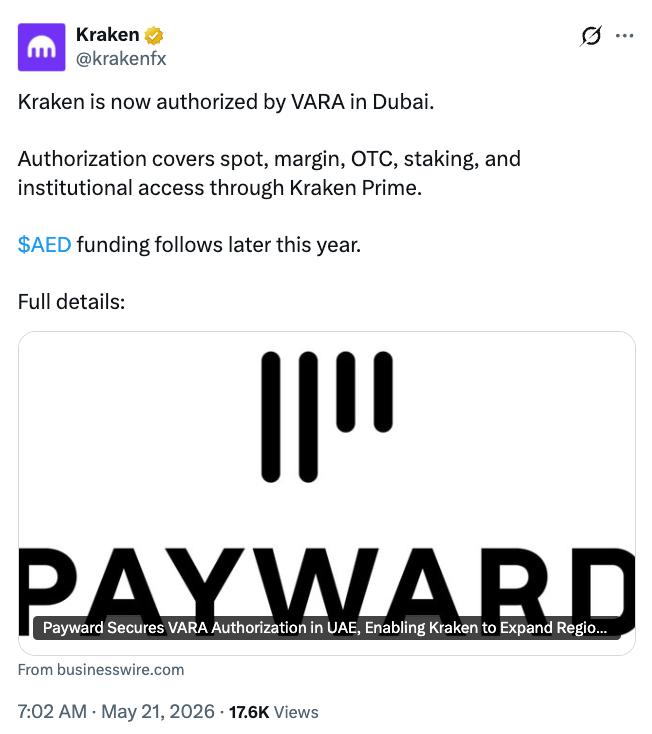
Source: Kraken
Kraken and parent company Payward do not yet appear on the regulator’s public register. The latest company recorded on the list was centralized crypto exchange CoinCorner, which received approval to operate virtual asset broker-dealer services on May 5.
Related: Crypto.com receives UAE license for Dubai government crypto payments
Dubai remains a major crypto hub despite recent Iran-linked tensions
Kraken’s expansion in Dubai adds to signs that the UAE continues to emerge as a major global crypto hub, even as recent Iran-linked regional tensions have unsettled some investors and disrupted major events across the Gulf.
Industry executives have increasingly pointed to regulatory clarity as a key reason crypto firms are choosing the UAE over jurisdictions with more fragmented or uncertain rules.
“Dubai wrote a rulebook for crypto before most jurisdictions even acknowledged the asset class,” Payward and Kraken co-CEO Arjun Sethi said in the announcement. “That clarity is why real liquidity and institutional capital now sit in the UAE,” he added.
Magazine: Crypto scammers face death, Aussie CGT makes Asian hubs attractive: Asia Express
A Hyperliquid (HYPE) whale is refusing to close a massive short position even as the token’s rally leaves the trader sitting on more than $22 million in unrealized losses.
Key takeaways:
- HYPE’s 134% year-to-date rally, rising ETF inflows and fresh whale accumulation may deepen squeeze pressure on the short seller.
- Technical setups suggest a potential 20% pullback toward $51.5–$45.
HYPE whale increases short exposure to over $100 million
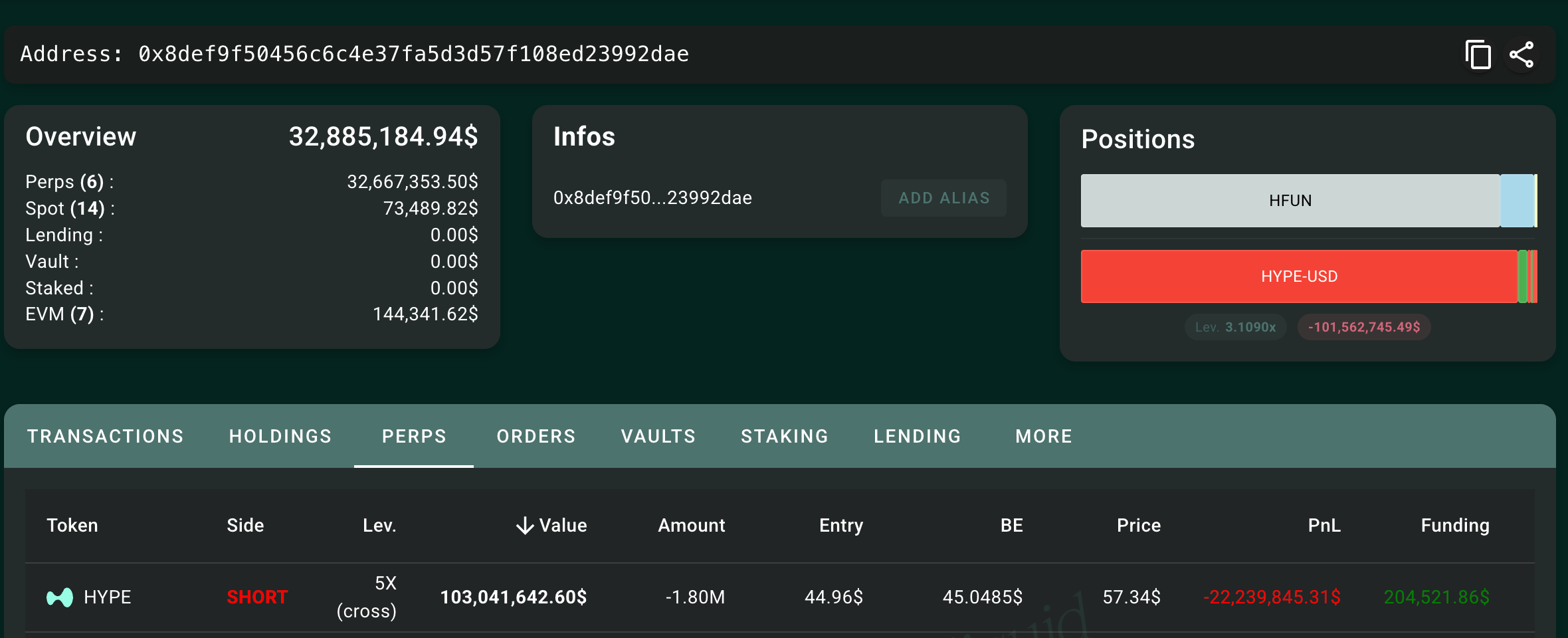
As of Thursday, the wallet ‘0x8ef…’ held a 5x cross-margin short on 1.80 million HYPE, worth about $102.98 million, with an entry price near $44.96, according to HypurrScan data.
With HYPE trading around $57.30, the position was down roughly $22.18 million. The trader had earned about $204,522 in funding, but that barely offset the growing losses as HYPE rallied nearly 8% intraday.
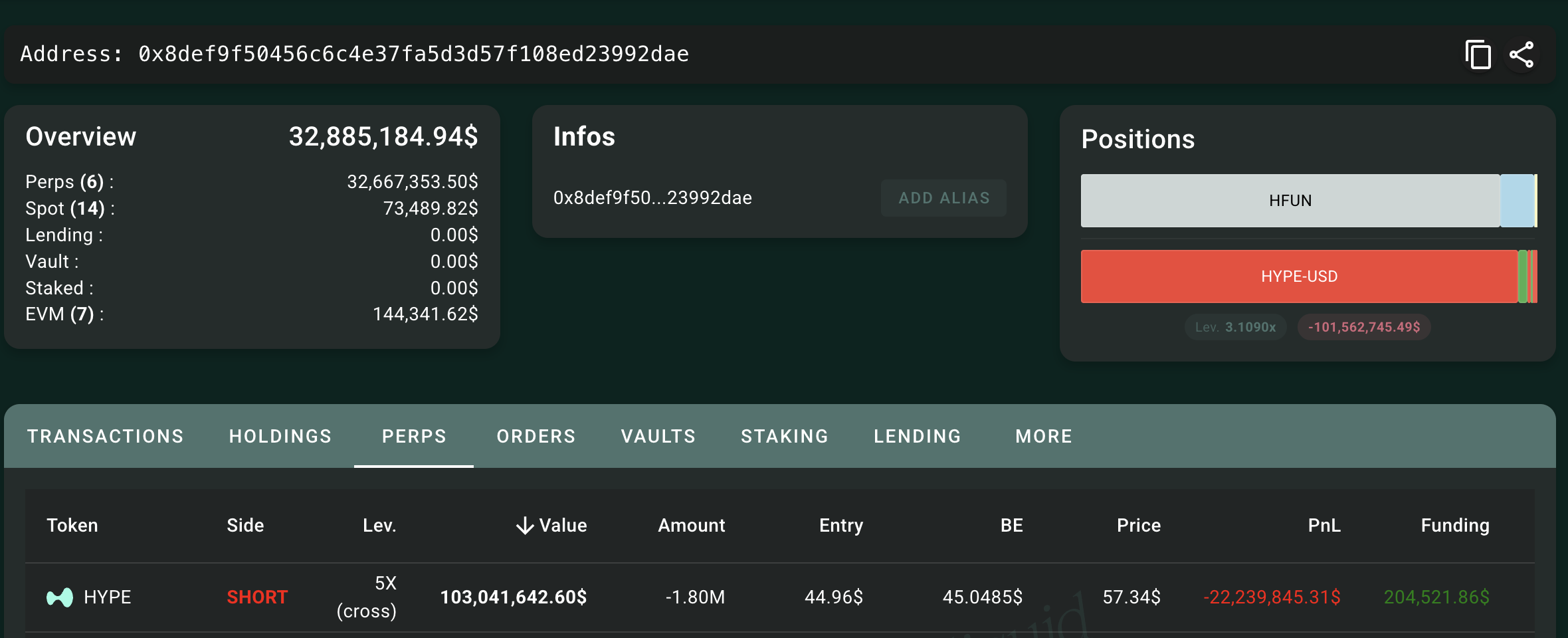
HYPE whale’s perpetual positions dashboard. Source: HypurrScan
The short exposure was worth about $95 million earlier on Thursday, suggesting the whale has increased its exposure despite mounting losses. It risks liquidation if the HYPE price rises to around $69.
Strong HYPE accumulation may deepen whale’s losses
HYPE has emerged as one of the best-performing cryptocurrencies so far in 2026, up about 134% compared to the crypto market’s 16% drop.
A huge chunk of those gains surfaced in May as market attention turned to newly launched US spot HYPE ETFs and Coinbase’s role as the official treasury deployer for USDC on Hyperliquid.
Since the May 12 launch, these ETFs have attracted $58.73 million amid a steady increase in daily inflows, according to data resource SoSoValue.
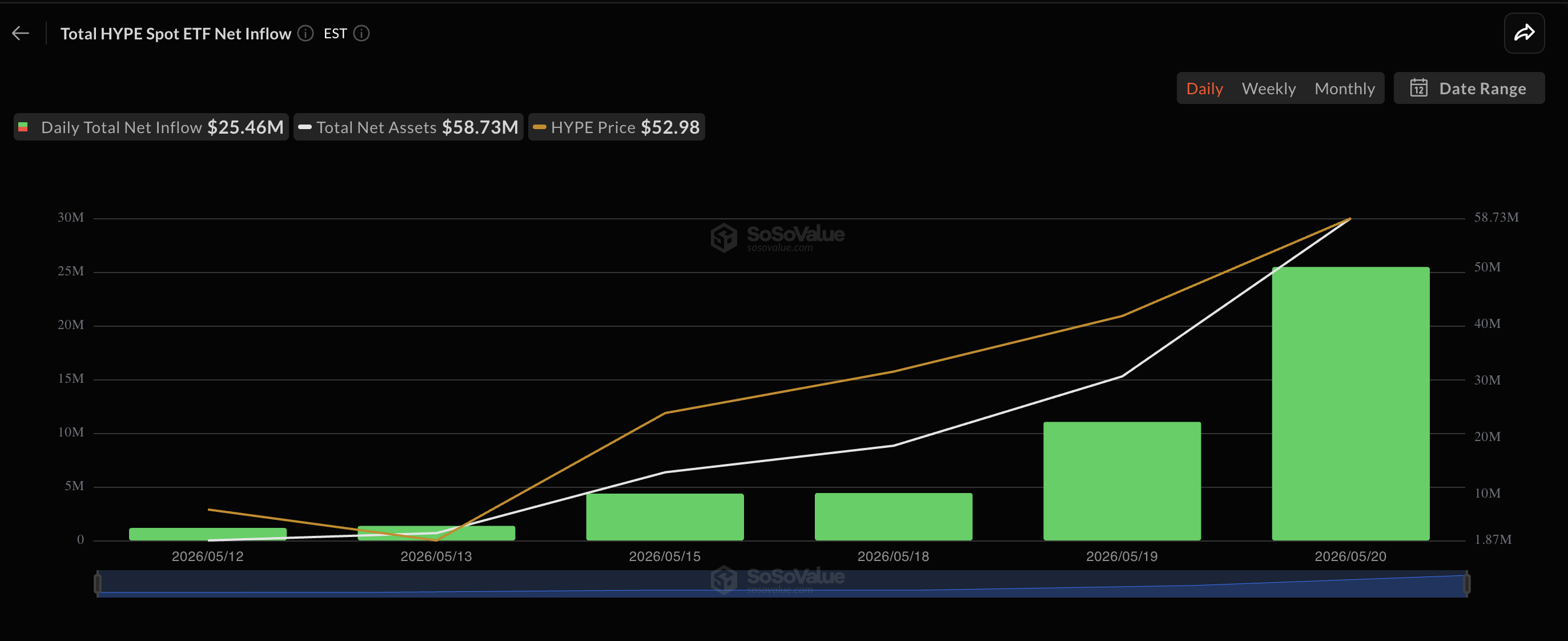
US spot HYPE ETFs net inflows. Source: SoSoValue
A wallet linked to Galaxy Digital bought 158,100 HYPE worth $8.8 million in two hours, while a new wallet withdrew 536,247 HYPE worth $29.87 million from Coinbase over two days, according to data resource Arkham Intelligence.
Together, they accumulated or withdrew around 694,500 HYPE, valued at nearly $38.67 million. Such moves may deepen losses for the already underwater short seller.
Related: Hyperliquid eyes 55% price rise after Silicon Valley investor’s ‘massive HYPE buy’
As of Thursday, Hyperliquid had witnessed $36.33 million in liquidations on a 24-hour rolling basis, according to CoinGlass. Shorts accounted for $34.29 million, or about 94% of the total, while long liquidations were only $2.03 million.
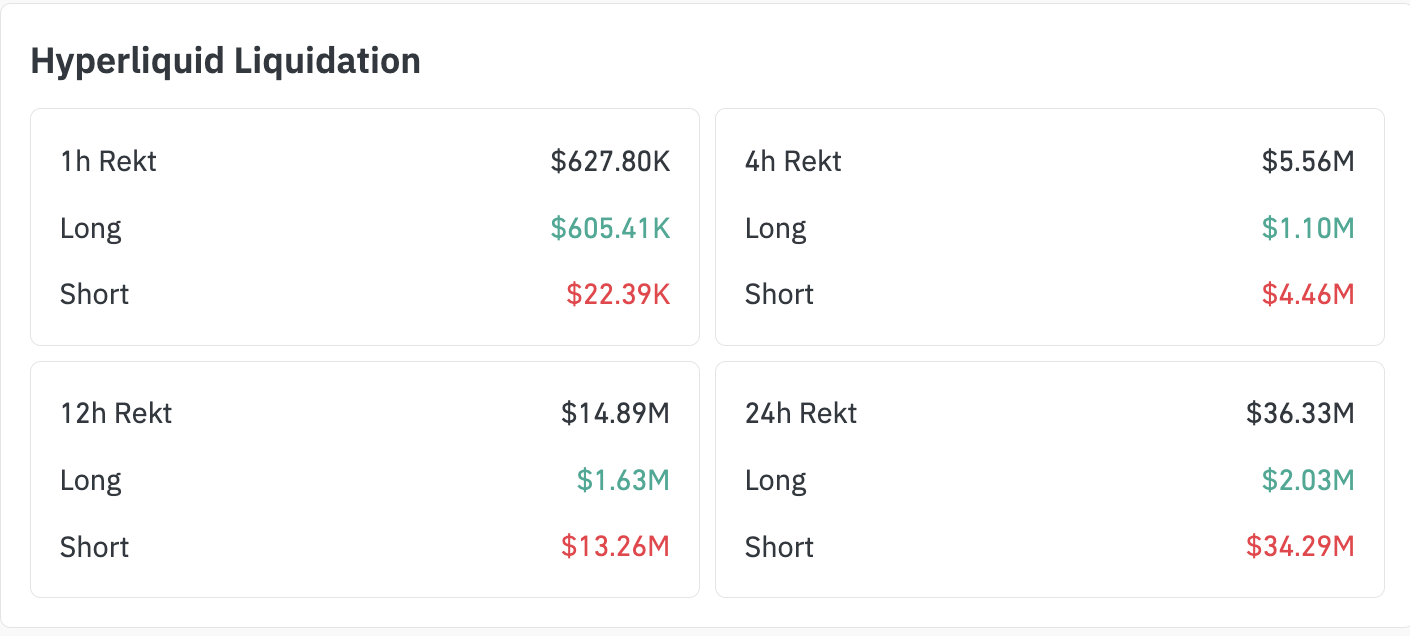
Hyperliquid liquidation data. Source: CoinGlass
That shows HYPE’s rally is heavily driven by forced short covering, increasing squeeze risk for the underwater whale if prices keep rising.
HYPE technicals hint at a 20% correction
HYPE’s rally is showing signs of upside exhaustion as the price tests the upper boundary of its ascending channel.
That resistance zone sits near $59–$60, the same area that marked HYPE’s September 2025 record high before plunging by over 65%.
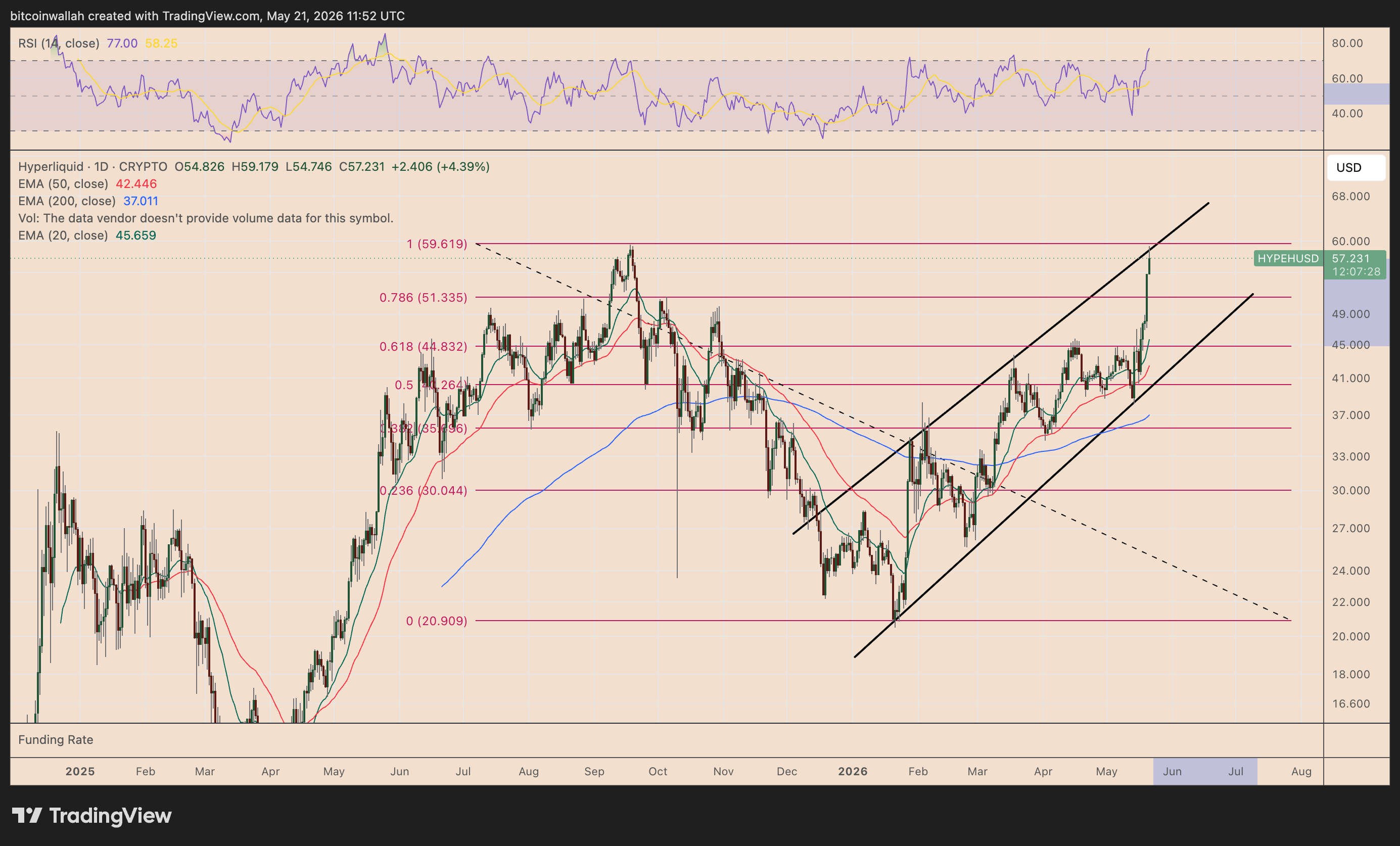
HYPE/USD daily chart. Source: TradingView
Its daily relative strength index (RSI) has also climbed to around 77, the highest level since May 2025, putting HYPE firmly in overbought territory.
A pullback from this resistance confluence could send HYPE toward the 0.786–0.618 Fibonacci retracement range, near $51.5–$45. This range aligns with the channel’s lower trend line.
In other words, HYPE price risks a decline of up to 20% from current levels if traders start taking profits near the channel top.
The short seller would recover roughly $10.4 million–$22.1 million from current levels, though the trade would only turn profitable below the $44.96 entry price, excluding funding and fees.
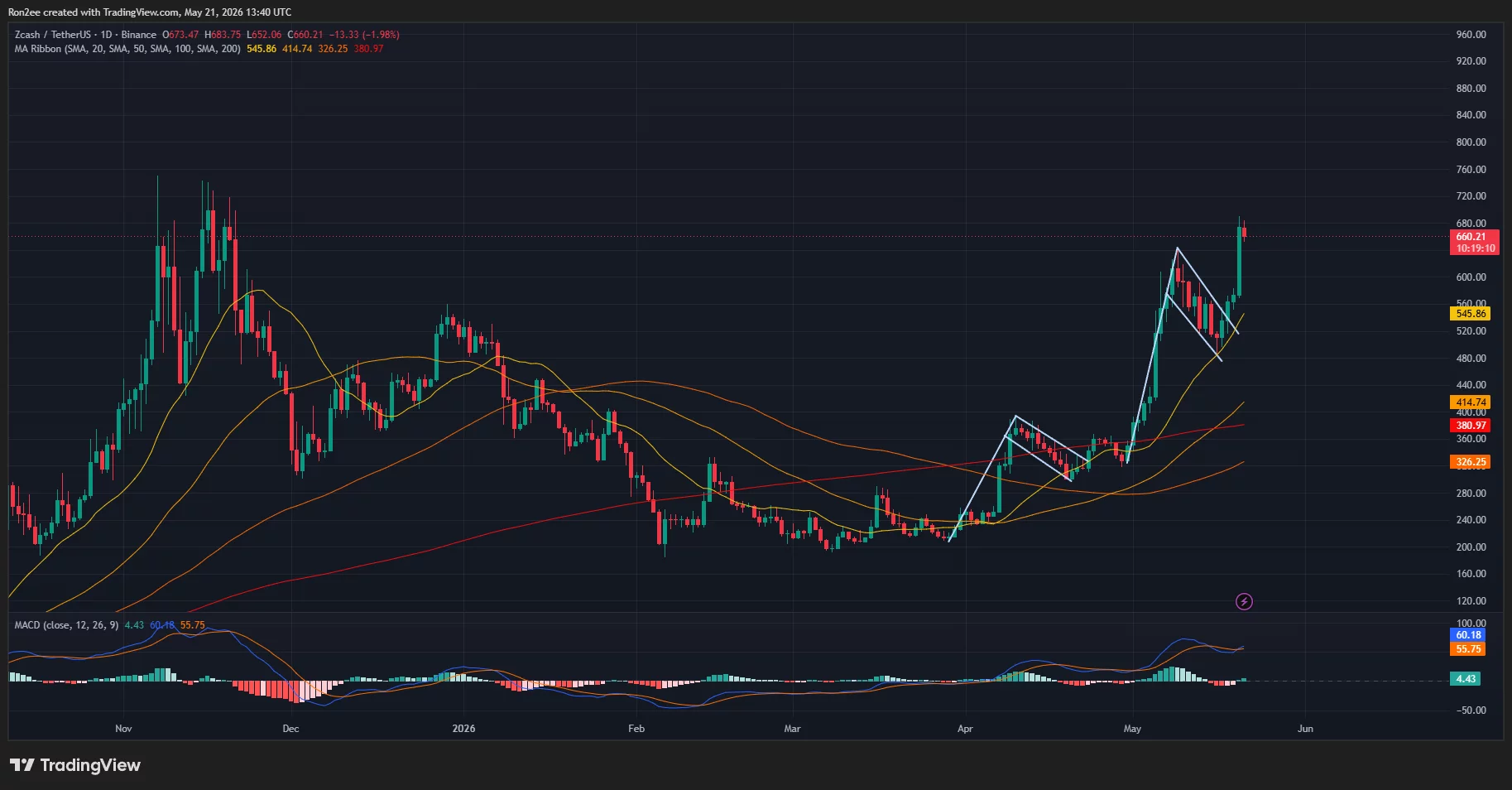
Zcash has emerged as the market’s primary breakout performer, logging a 15% single-day advance to trade at $660.21.
Summary
- Zcash price surged 15% to $660 after the SEC officially closed its multi-year probe into the Zcash Foundation without penalties or enforcement action.
- Institutional accumulation accelerated as Multicoin Capital disclosed a long-term ZEC position, while Cypherpunk Technologies expanded holdings to 314,185 ZEC.
- ZEC confirmed a bullish flag breakout on rising volume, with CoinGlass data showing a 38% jump in open interest and over $14.2 million in short liquidations.
Investor sentiment has rapidly pivoted from cautious accumulation to aggressive risk-on expansion, fueled by a perfect convergence of long-term structural chart breakouts and an abrupt vacuum of regulatory downside risk.
This localized rally comes at a time when aggregate digital asset volumes are shifting toward utility and sovereign privacy preservation. As institutional market makers recalibrate their portfolios ahead of upcoming macroeconomic policy decisions, Zcash (ZEC) has decoupled from legacy layer-1 assets. The sudden spike in spot purchasing volume indicates that market participants are aggressively positioning for an extended multi-week extension vector.
What catalysts are driving institutional accumulation into Zcash?
The foundational spark for the immediate price expansion is the official and unconditional closure of the U.S. Securities and Exchange Commission’s multi-year investigation into the Zcash Foundation.
Originally initiated in August 2023 to evaluate the compliance parameters of private decentralized protocols, the regulatory agency concluded its probe with zero penalties, enforcement mandates, or restrictive settlement conditions. This development removes a multi-year institutional discount factor, effectively greenlighting compliant capital deployment into the asset from risk-averse American entities.
Following the regulatory clearance, corporate and venture-scale accumulation has accelerated rapidly, drastically altering the token’s supply-side dynamics. Web3-focused investment titan Multicoin Capital publicly disclosed a substantial long-term spot position in ZEC, describing it as an essential, un-seizable, and cryptographically private alternative store of value against mounting sovereign wealth taxes and global capital controls.
Concurrently, Nasdaq-listed digital asset deployment firm Cypherpunk Technologies revealed it has expanded its balance sheet holdings to 314,185 ZEC—accounting for roughly 1.88% of the total circulating supply—while committing an additional $5 million to the Zcash Open Development Labs (ZODL) alongside Andreessen Horowitz (a16z) and Coinbase Ventures.
Institutional infrastructure expectations are further amplified by structural movements surrounding Grayscale Investments’ digital asset vehicles.
Market intelligence trackers indicate that Grayscale is actively advancing internal operations to convert its existing $150 million Zcash Trust (ZCSH) into a fully regulated U.S. Spot Zcash Exchange-Traded Fund (ETF) on NYSE Arca. The realization of an institutional bridge of this scale would establish the world’s first programmatic vehicle for shielded transactional exposure, introducing a permanent source of baseline structural buying pressure that traditional digital asset exchanges cannot replicate.
On-chain transactional velocity highlights that this price movement is heavily backed by real network utilization rather than superficial retail speculation.
Data from Glassnode verifies that the volume of transactions interacting with shielded addresses—utilizing Zcash’s core zk-SNARKs technology—hit an all-time high this week. This migration toward maximum privacy architecture is being systematically driven by global high-net-worth market participants attempting to shield their transaction trails from tracking algorithms amid escalating international financial monitoring.
How high can the confirmed technical breakout push ZEC?
From a structural perspective, the daily chart confirms a textbook continuation pattern that points toward aggressive near-term upside. After an initial parabolic impulse leg that extended from the $240 localized floor up to an interim high near $640, the price entered a brief, descending consolidation channel.
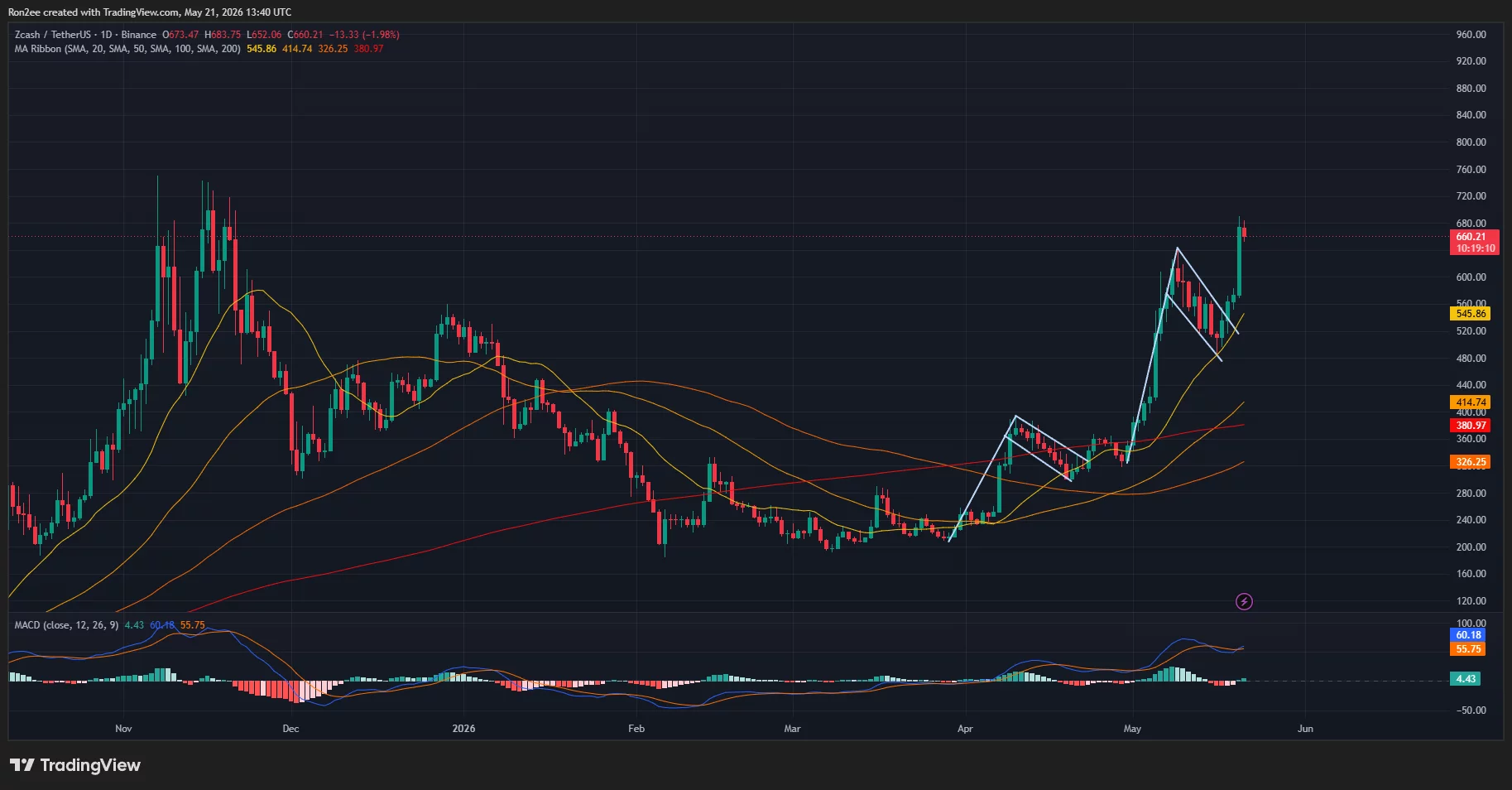
This temporary cooling period successfully formed a structural “bull flag” pattern, which has now been decisively broken to the upside on expanding buying volume, signaling the commencement of a secondary macroscopic expansion wave.
The underlying momentum is strongly supported by a bullish alignment across the asset’s primary moving average ribbon. Zcash is trading safely above its 20-day, 50-day, 100-day, and 200-day Simple Moving Averages (SMAs), with the 20-day SMA ($545.86) acting as dynamic trailing insulation.
The wider geometry of the moving averages displays a widening parallel separation, confirming that the long-term trend has completely shifted from historical accumulation into structural distribution and price discovery.
Secondary momentum oscillators corroborate this structural strength, demonstrating that buyers maintain clear control over price delivery. The Moving Average Convergence Divergence (MACD) indicator reveals the MACD line sitting at 4.43, positioned well above the signal line (55.75) following a clean bullish divergence crossover at the zero-bound axis.
While the histogram shows expanding positive green bars, the daily Relative Strength Index (RSI) is holding steady in the low 70s, indicating that despite the rapid price expansion, the asset has not yet exhausted its buying power and retains technical clearance to extend toward its primary resistance target at $745.
Derivatives data obtained from CoinGlass indicates that the current spot extension is being amplified by a structural short squeeze in the perpetual futures market.
Open Interest (OI) for Zcash contracts surged by 38% within a 48-hour window, while funding rates flipped deeply positive, demonstrating that leveraged traders are aggressively chasing the breakout velocity. This intense buying velocity forced the liquidation of over $14.2 million in legacy short positions, creating a mechanical feedback loop where forced buy-backs continuously strip liquidity away from sellers, leaving a clear path to the psychological $700 ceiling.
What downside risks could invalidate the bullish thesis?
Despite the overwhelmingly bullish technical framework, a series of acute macroeconomic and systemic risks could invalidate the current expansion model. The global bond market is exerting significant pressure on speculative risk assets, with the U.S. 10-year Treasury yield climbing to a multi-month high of 4.58% following consecutive hot core consumer price inflation prints.
If the Federal Reserve maintains a restrictive interest rate stance longer than the equity markets currently project, macro liquidity will likely pull back into risk-free yields, severely stalling the capital inflows necessary to sustain Zcash’s upward momentum.
Geopolitical developments across the energy sector present an additional layer of capital distribution risk. Recent complications in global trade negotiations have sent crude oil prices higher, driving fears of a secondary supply-side inflation shock.
Historically, sharp escalations in geopolitical tension trigger immediate de-risking cycles across the tech and digital asset ecosystems, forcing mechanical fund liquidations that ignore underlying project fundamentals.
From a localized technical perspective, the primary invalidation trigger sits at the lower boundary of the recent breakout flag. If a sudden market-wide selloff forces Zcash to collapse back inside the consolidation channel and break beneath the critical 20-day SMA at $545.86, the immediate bullish continuation model will be entirely neutralized.
A daily candlestick close below the $480 structural support line would confirm a macro-scale fakeout, exposing the asset to a deeper corrective phase back toward the 50-day SMA at $414.74.
Disclosure: This article does not represent investment advice. The content and materials featured on this page are for educational purposes only.
Crypto World
A crypto betting platform may have leaked U.S. military secrets before a surprise attack on Iran, experts warn
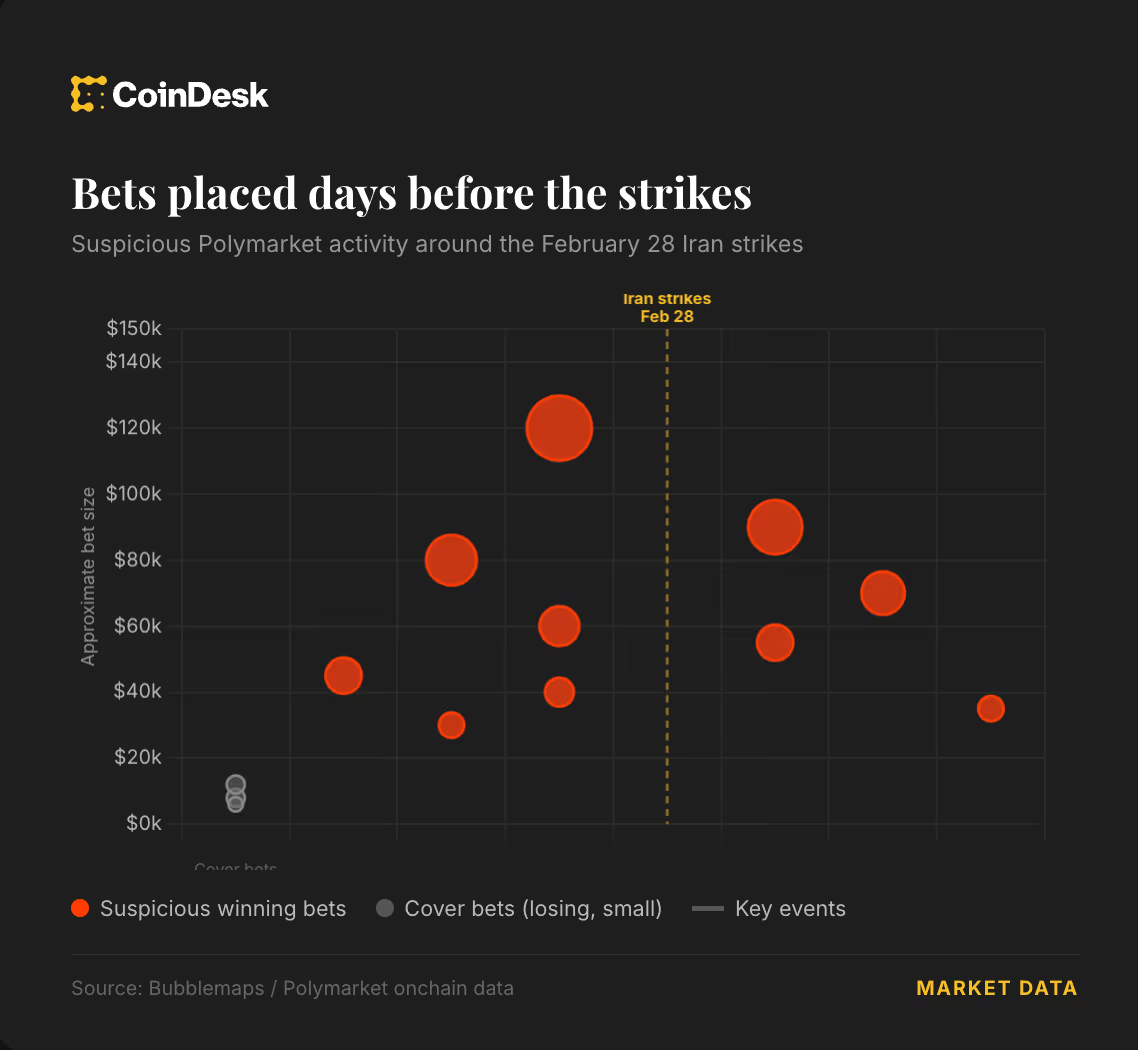
An in-depth investigation into insider trading by Bubblemaps analysts reveal how accurate bets on U.S. attacks on Iran were, exposing a trend that experts fear poses immense risks to the United States’ national security.
In an interview with CoinDesk, Nicolas Vaiman, Bubblemaps co-founder and CEO, expressed deep concern over the national security implications of this new alleged wave of insider trading. He warned that if those observing the predictions markets can spot irregular trades, so can enemies of the United States.
“The issue here is they can make war plans accordingly,” Vaiman said. “Just to put it bluntly, this could potentially expose the lives of many people.”
Vaiman said U.S. adversaries could easily spot the insider trading patterns and use that information to plan their own military strategies.
Luck alone cannot explain the accuracy
The warnings come as he and his team uncovered 80 bets on Polymarket that were so accurate that “luck alone cannot explain” the numbers.
Driven by geopolitical tensions, bets on military plans and outcomes have skyrocketed, with more than $1 billion alone this year. The ability to wager on global conflict creates an entirely new category of insider trading.
Onchain data showed that several major, high-conviction bets were placed days before the Feb. 28 surprise attacks on Iran, the removal of its supreme leader and the announcement of a ceasefire.
According to Bubblemaps, nine accounts connected to Polymarket made more $2.4 million betting almost exclusively on U.S. military operations.
“They just didn’t bet on U.S. strikes days before they took place, but across multiplate later dates to maximize profit,” Vaiman said. They also placed smaller losing bets on Feb. 20, likely attempting to avoid attention.

A 98% win-rate is hard to miss
However, executing dozens of bets with a 98% win rate is hard to miss. “During the Iran strikes, civilians were reportedly checking Polymarket to decide whether they should sleep in bunkers or not,” Vaiman added. “So yes, governments and potential enemies are probably watching that closely.”
When asked if he had any indication those insider traders were connected to the U.S. government, Vaiman responded “we have no proof these are military insiders or even Americans.” He said, “the data is suspicious and may indicate someone with an unfair informational advantage.”
Rep. Mike Levin recently said on X that the “insider trading problem with prediction markets is bigger than any of us could have known,” which is why he and Senator Adam Schiff introduced the DEATH BETS act to ban contracts on war.
One insider trading arrest has been made. A U.S. army green beret, Master Sergeant Gannon Ken Van Dyke, made $400,000 on Polymarket bets he placed on the Venezuela raid to extract President Nicolas Maduro in which he participated. Later that month, a study found that only 3% of “informed” traders drove accuracy, while 97% did not.
Bubblemaps first made their investigation public on May 18 via a series of X posts, in which they share graphics and images as evidence that confirms the statistically impossible accuracy of the timing on each of the bets.
Two weeks prior to its findings, Polymarket announced a partnership with Chainalysis to bring Wall Street-grade supervision to its platform, in a clear signal by the prediction markets provider that it is serious about clamping down on insider trading and market manipulation.

Potential for manipulation
According to Vaiman, all this brings up other questions and concerns, such as the potential for prediction markets to be manipulated.
“A government could intentionally place bets to create a false signal and mislead adversaries into thinking something is about to happen,” he said. “Prediction markets are intelligence and information warfare tools.”
He also noted prediction markets do not just predict the future, “they can change it.” He mentioned cases where journalists faced extortion threats from bettors trying to protect their financial positions.
On the other hand, Vaiman defended Polymarket’s structural design and the transparency it provides, while refusing to blame the platform for the compliance failures.
“I don’t want to dunk on Polymarket,” Vaiman stated. “Realistically, anybody can use a cheap VPN or buy a KYC’d account. That is not just a Polymarket problem. It is an internet-wide problem.”
Polymarket did not immediately respond to CoinDesk’s request to comment. However, has hit back at insider trading claims in the past, saying that it has strict insider trading rules, AI-powered surveillance and blockchain forensics to identify suspicious activity and report it to relevant authorities. ”Insider trading is not welcome on Polymarket, and those who attempt it will be identified,” the platform has said.
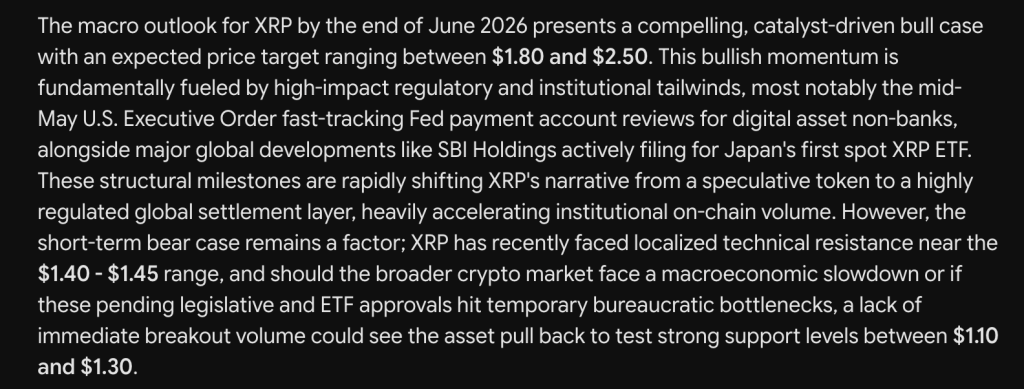
XRP has been stuck at $1.37 while the news around it has been anything but stuck. Google Gemini AI just connected those 2 things and predicts the divergence a 6-week deadline.
$1.80 to $2.50 by end of June 2026. And the catalyst stack behind it is more specific than anything this series has produced so far.
Gemini is not building this call on general bull market vibes. It is pointing at 2 specific events that landed in mid-May and have not been priced in yet.
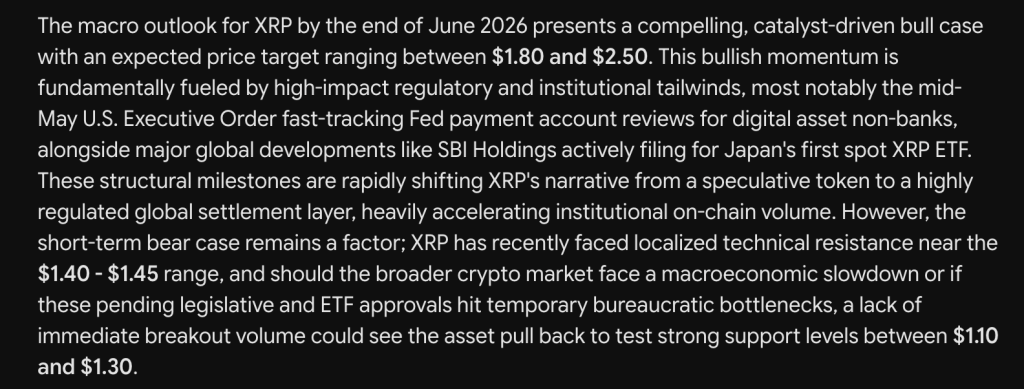
The first is a US Executive Order fast-tracking Fed payment account reviews for digital asset non-banks, which directly accelerates the regulatory pathway for Ripple’s institutional partners.
The second is SBI Holdings actively filing for Japan’s first spot XRP ETF, which opens an entirely new institutional demand channel from the world’s third-largest economy.
Gemini’s argument is that these are not future catalysts waiting to arrive, they are present-tense structural milestones that are actively shifting XRP’s narrative from speculative token to regulated global settlement layer.
Institutional on-chain volume is accelerating as a direct result, and the price has not caught up yet. That gap between fundamental development and market price is exactly what Gemini sees closing between now and June 30.

The bear case is precise and close. XRP has been facing technical resistance at $1.40 to $1.45 repeatedly, and if the broader crypto market hits a macroeconomic slowdown or the pending legislative and ETF approvals hit bureaucratic bottlenecks, the lack of immediate breakout volume pulls price back to test support between $1.10 and $1.30.
The bear case floor is not far from current price, which is what makes the risk-reward conversation interesting here.
XRP Price Prediction: XRP’s Chart Is Running Out of Excuses to Stay at $1.37 and Gemini AI Predicts Might Be Correct
XRP price is trading at $1.3718 on the daily, and the chart captures 10 months of sustained selling pressure that has brought price from $3.70 all the way to current levels.
The recovery since the February crash to $1.20 has been real but unconvincing, with higher lows forming quietly while the ceiling at $1.50 to $1.55 refuses to give way. The result is a chart that looks stuck but is actually coiling tighter with each failed test of the resistance zone.
Gemini’s $1.80 to $2.50 June target requires 2 things to happen fast. First, the $1.50 to $1.55 resistance needs to break on volume.
That level has rejected price 4 times across March, April, and May and has not shown any signs of weakening yet.
A clean daily close above $1.55 is the trigger that opens the path toward $1.80, which is the lower end of Gemini’s target and also a major horizontal level from the late January selloff.
Above $1.80 the next meaningful supply sits at $2.00, the psychological ceiling, and $2.40 to $2.50 is where the February bounce high clustered before the second leg down.
Support is $1.20 to $1.30, the range Gemini flagged as the pullback zone and where the February crash found its floor. At $1.37 current price is sitting uncomfortably close to the lower end of that support band, which means the downside scenario is structurally closer than the upside target right now.
Gemini put a date on this trade. June 30 either validates the prediction or exposes it.
Google Gemini Says Liquidchain Could Be The Next Big Thing
This is not a new pattern. Every cycle has a moment where the obvious plays stop working, and capital starts hunting for the next thing. That moment is now.
The next thing rarely looks obvious when it starts. It looks like an early presale, an unproven team, and a problem that everyone in the space knows exists but nobody has cleanly solved yet.
LiquidChain is building the bridge layer that makes the fragmentation irrelevant. A single execution environment that connects all 3 ecosystems simultaneously. Deploy once, reach everywhere, pay nothing extra to cross the gap.
The presale is at $0.01454. Just over $700,000 raised. For context, that means the market has barely looked at this yet.
The risk profile is what you would expect at this stage. Nothing is proven. Adoption, liquidity, and execution are all still unknowns. That is not a disclaimer. That is the nature of the bet.
The projects that return 10x or 100x are not the ones that looked safe at entry. They are the ones who solved a real problem before the rest of the market understood it.
LiquidChain is still in that window.
The post Google’s Gemini AI Predicts Incredible XRP Price by End of June 2026 appeared first on Cryptonews.

The House Article | “The perfect short novel”: Lord Black reviews ‘Operation Heartbreak’
Vikings’ GM Search Has 5 Finalists

Building A Better Automotive Rotary Controller


-
 Crypto World6 days ago
BloFin War of Whales 2026 Grand Prix opens registration for $5M trading championship
-

 Fashion6 days ago
Weekend Open Thread: Theory – Corporette.com
-

 Crypto World6 days ago
E-Estate Announces 1 Year Live: Washington DC Summit as Real Estate Tokenization Enters Its Next Phase
-

 Tech6 days ago
Tech Moves: Microsoft AI leader jumps to OpenAI; former AI2 exec joins Meta; and more
-

 Tech6 days ago
Google reimburses Register sources who were victims of API fraud
-

 Business6 days ago
H&R Real Estate Investment Trust (HR.UN:CA) Q1 2026 Earnings Call Transcript
-
 Entertainment7 days ago
Zara Larsson Has Blunt Response To Chris Brown Diss
-

 Sports6 days ago
Napoleonic enters 2026 Doomben 10,000 field via Abounding withdrawal
-

 Crypto World6 days ago
BeInCrypto 100 Institutional Awards Nomination: KAST for Best Digital Assets Neobank and Best Digital Assets Fintech
-
 Crypto World6 days ago
Bitcoin Battles US Bond Nerves With BTC Price Dip Toward New May Lows
-

 Crypto World6 days ago
ICE and CME urge US regulators to curb Hyperliquid energy trading
-
 Crypto World6 days ago
Wall Street’s Boldest Gold Prediction Has Russians Rushing to Buy
-

 Fashion5 days ago
On the Scene at Gucci’s Cruise Show in New York City: Mariah Carey, Kim Kardashian, Lindsay Lohan, Iman, and More!
-

 Politics7 days ago
DWP PIP Timms review continues to be an absolute farce
-

 Crypto World6 days ago
IREN closes $3 billion convertible notes deal amid AI infrastructure expansion
-

 Fashion5 days ago
Trending Western Style Vests Perfect for Summer
-

 Entertainment6 days ago
David Letterman Returns to Late Show, Blasts Cancellation
-
 Crypto World7 days ago
Lido Finance Selects Chainlink CCIP as the Official Cross-Chain Infrastructure for wstETH Security
-

 Fashion5 days ago
Amazon Sundays: Memorial Day Hosting
-

 Fashion6 days ago
Creative Ideas for Custom T-Shirts
You must be logged in to post a comment Login