

Crypto World
Zcash price prediction 2026-2030: the privacy renaissance test

Zcash (ZEC) hit $642.18 on May 9, 2026, marking the peak of a 650-1,000% rally from 2024 lows that crowned it the largest privacy coin by market cap, overtaking Monero. The catalysts driving this performance are different in kind from previous Zcash cycles. Grayscale filed Form S-3 to convert its Zcash Trust into the first US spot privacy coin ETF (ticker ZCSH) on NYSE Arca on May 12, 2026. The SEC closed its nearly two-year investigation into the Zcash Foundation on January 15, 2026, without enforcement action, removing the regulatory overhang that suppressed institutional participation for years.
Summary
- Zcash’s May 2026 rally to $642 was tied to Grayscale’s ETF filing, SEC clearance, Multicoin Capital’s position, and shielded pool growth.
- The bull case sees ZEC reaching $800 to $1,800 by 2030 if ETF approval, institutional demand, and FCMP++ deployment align.
- The bear case puts ZEC at $180 to $350 by 2030 if ETF rejection, regulatory pressure, or privacy coin competition weighs on adoption.
Multicoin Capital disclosed a “significant position” in (ZEC) on May 5, accumulated quietly since February 2024. Approximately 30% of the ZEC supply is now locked in shielded pools, up from 8% in 2024. The November 2024 halving cut inflation from 4% to 2% annually. The FCMP++ upgrade, promising 300% throughput improvement, is targeted for 2026 deployment. The “Privacy is Normal” narrative has shifted institutional perception from privacy coins as evasion tools to privacy coins as essential infrastructure for compliant commercial confidentiality. ZEC is currently trading around $522 after cooling from the May peak.
The honest read is Zcash is one of the more interesting setups in crypto for 2026-2030: real structural catalysts (ETF filing, shielded pool growth, FCMP++ upgrade, SEC clearance), real institutional interest (Grayscale, Multicoin Capital, growing whale accumulation), real risks (ETF approval uncertainty, governance disputes, competitive pressure from Monero and Railgun). This piece walks through actual mechanics, the bull case ($800-$1,800 by 2030), the base case ($400-$700), and the bear case ($180-$350), with the specific variables determining outcome.
Why Zcash is at $522 right now
The current Zcash price reflects a narrative shift that competitors keep missing. Most price prediction articles treat ZEC as just another privacy coin with generic supply-and-demand dynamics. The actual story is more specific and analytically important.
The starting point: ZEC traded around $20 in early 2024, having declined steadily from 2021 highs as the broader crypto market shifted away from privacy coins amid regulatory pressure. Multiple major exchanges delisted privacy coins through 2023-2024 in response to MiCA’s pending deployment in the EU and broader regulatory caution. The Zcash narrative was widely considered structurally damaged.
The rally that produced the current $522 price (and the May peak of $642) wasn’t speculation. It was driven by five specific catalysts arriving in sequence:
The November 2024 halving cut block rewards in half, reducing ZEC inflation from approximately 4% annually to approximately 2%. This is a big deal for a 21-million-supply asset where shielded pool accumulation removes supply from liquid markets. The halving plus shielded growth created the supply dynamics for the subsequent rally.
The shielded pool grew from approximately 8% of total supply in 2024 to approximately 30% of total supply by mid-2026. This is approximately 4.5 million ZEC moved from transparent (liquid) to shielded (illiquid for trading purposes) pools. The shielded pool growth represents both ideological commitment to privacy use and supply reduction in liquid markets. Most analyses treat shielded pool growth as a usage metric. It’s also a supply absorption mechanism comparable in effect to corporate Bitcoin treasury accumulation.
The SEC closed its nearly two-year investigation into the Zcash Foundation on January 15, 2026 without recommending enforcement action. The foundation had received a subpoena in August 2023 related to crypto asset offerings inquiries. The investigation closure removed a regulatory overhang that had suppressed institutional participation for years.
The immediate market response was a 3+ percent rally with ZEC briefly exceeding $427. The longer-term impact was institutional investors gaining confidence that Zcash specifically would not face SEC enforcement.
Multicoin Capital’s position disclosure on May 5, 2026 was the catalyst that triggered the May rally to $642. Co-founder and Managing Partner Tushar Jain disclosed via X that the firm had built a “significant position” in ZEC, accumulated quietly since February 2024. Jain framed the thesis as “a return to the cypherpunk ideals crypto was founded on” and argued that growing government scrutiny of visible crypto holdings makes Bitcoin’s transparent balances increasingly problematic for sophisticated holders. The Multicoin disclosure gave institutional validation that compounded the broader privacy narrative.
Grayscale’s Form S-3 filing on May 12, 2026 to convert its Zcash Trust into a spot ETF (ticker ZCSH) on NYSE Arca represents the first US spot privacy coin ETF filing in history. The trust currently holds approximately 391,103 ZEC ($99.4 million as of March 31, 2026 quarter-end). If approved, the ETF would provide regulated institutional access to ZEC similar to how spot Bitcoin and Ethereum ETFs changed those assets’ accessibility. The filing alone validated the institutional thesis even before approval is decided.
The combined effect of these five catalysts arriving in sequence produced the rally from approximately $20 in early 2024 to the May 2026 peak of $642 (a 30x+ move). The post-peak consolidation to current $522 levels reflects normal post-rally profit-taking and futures market unwinding (futures open interest fell 30% from peak to approximately $1.05 billion) rather than a fundamental thesis breakdown.
What the rally is fundamentally signaling: the “Privacy is Normal” narrative has gained genuine institutional traction. The same regulatory environment that pressured privacy coins in 2023-2024 (MiCA deployment, SEC enforcement concerns) has evolved through 2025-2026 (SEC enforcement pullback under Atkins, CLARITY Act framework, institutional adoption of crypto generally). Privacy infrastructure that was institutionally radioactive 18 months ago is becoming institutionally palatable for specific use cases (corporate confidentiality, regulatory compliance with selective disclosure, protected commercial transactions).
The bull case: $800-$1,800 by 2030
The bull case for Zcash requires specific catalyst conditions and represents the scenario where the “Privacy is Normal” narrative achieves full institutional acceptance.
The ETF approval catalyst: Grayscale’s ZCSH ETF approval is the single most important bull case variable. The pathway: SEC review completes by Q3 2026, exchange listing approval secured, ETF begins trading with $500M-$2B in initial inflows over the first 12 months. The precedent from Bitcoin and Ethereum ETF launches suggests this level of institutional capital flowing into a smaller asset like ZEC could produce a significant price impact. With a circulating supply of approximately 16 million ZEC and 30% already in shielded pools (effectively illiquid), the liquid float available for ETF accumulation is constrained.
The shielded pool supply absorption: continued growth from 30% to 40-50% of total supply removes another 1.5-3 million ZEC from liquid markets over the bull scenario timeframe. Plus ETF accumulation, the supply reduction would be significant. The bull case assumes shielded pool growth accelerates as FCMP++ deployment improves throughput and reduces the costs of shielded transactions.
The FCMP++ deployment: the upgrade targeting 300% throughput improvement for shielded transactions, planned for 2026 deployment, would address one of Zcash’s persistent technical limitations. Reduced shielded transaction costs would enable broader use cases (institutional settlements, commercial transactions, DeFi integrations) currently constrained by performance. A successful FCMP++ deployment would unlock the institutional use cases the privacy narrative requires.
The privacy narrative expansion: the bull case assumes the broader “Privacy is Normal” narrative gains traction beyond just crypto-native investors. Specific developments that would support this: major corporations adopting privacy infrastructure for commercial transactions, traditional finance integrating privacy-preserving technologies, regulators developing frameworks distinguishing compliant privacy from illicit use, and growing public awareness of financial surveillance concerns driving demand for privacy options.
The competitive positioning: Zcash bull case assumes it holds its position as the institutionally-preferred privacy coin, while Monero and Railgun serve different (less institutional) use cases. The differentiation: Zcash offers selective disclosure (institutions can prove compliance while keeping commercial details private), Monero offers mandatory privacy (which institutional investors find harder to navigate), and Railgun offers DeFi-native privacy (which serves different use cases). Zcash’s institutional positioning would be reinforced by ETF approval and Grayscale’s institutional distribution.
The Midnight integration: the Midnight Cardano privacy companion chain (covered in the Midnight long read) creates additional institutional infrastructure leveraging privacy primitives. While Midnight is technically separate from Zcash, the broader privacy ecosystem maturation benefits all institutional privacy infrastructure, including Zcash. Successful Midnight deployment with major partners (Google Cloud, MoneyGram) validates the broader privacy infrastructure investment thesis.
If all bull case conditions materialize, the price targets are:
2026 year-end: $700-1,000
2027 year-end: $850-1,300
2028 year-end: $1,000-1,500
2029 year-end: $1,200-1,700
2030 year-end: $800-1,800
The wide range at 2030 reflects uncertainty about how aggressively institutional adoption scales and whether broader market dynamics support sustained altcoin appreciation. The lower end of the bull range ($800) represents successful ETF launch with moderate institutional adoption. The upper end ($1,800) requires the privacy narrative achieving mainstream institutional acceptance comparable to how Bitcoin achieved mainstream institutional acceptance over 2024-2025.
The base case: $400-$700 by 2030
The base case assumes mixed outcomes across the catalyst variables, with Zcash maintaining institutional relevance but not achieving big adoption.
The ETF approval scenario: in the base case, Grayscale’s ZCSH ETF is eventually approved but the approval is delayed beyond initial Q3 2026 expectations. The SEC review process extends into 2027 or 2028. When approved, initial inflows are more modest ($200-500M rather than the bull case $500M-2B). The institutional adoption pathway opens but the impact is gradual rather than big.
The shielded pool growth scenario: continued moderate growth from 30% to 35-40% of total supply. The growth provides ongoing supply absorption but not the dramatic supply shock the bull case envisions. The shielded pool serves both privacy users and structural HODLers without achieving the broader commercial adoption the bull case requires.
The FCMP++ deployment outcome: the upgrade deploys successfully but the throughput improvement is more modest than projected, or deployment is delayed. The technical capability improvement happens but doesn’t unlock the dramatic institutional use case expansion the bull case requires.
The competitive landscape: Zcash holds its position as the largest institutional-grade privacy coin but faces growing competition from Monero (for non-institutional privacy users), Railgun (for DeFi-native privacy), and emerging privacy infrastructure (Midnight, Aztec, others). The competitive pressure limits Zcash’s pricing power without fundamentally undermining its position.
The regulatory environment: the broader crypto regulatory environment continues evolving under CLARITY Act deployment, but specific regulatory clarity for privacy coins stays ambiguous. Exchange delistings continue in some jurisdictions while listings expand in others. The mixed regulatory picture limits institutional adoption acceleration without forcing a Zcash-specific crackdown.
The “Privacy is Normal” narrative: the narrative continues developing but doesn’t achieve the mainstream institutional acceptance the bull case requires. Specific use cases (compliant corporate confidentiality, regulatory selective disclosure) gain traction in niche applications without becoming default institutional infrastructure. The narrative supports continued ZEC relevance without driving big growth.
Base case targets:
2026 year-end: $500-700
2027 year-end: $450-650
2028 year-end: $400-600
2029 year-end: $400-650
2030 year-end: $400-700
The base case represents moderate price appreciation from current levels plus periodic volatility around specific catalyst developments. The structural floor is meaningfully higher than pre-2026 levels because the SEC investigation closure and institutional accumulation have shifted the asset’s investor base toward longer-term holders.
The bear case: $180-$350 by 2030
The bear case requires either specific Zcash setbacks or broader privacy coin headwinds disrupting the thesis.
The ETF rejection scenario: the SEC rejects Grayscale’s ZCSH application, citing concerns about privacy coin oversight, market manipulation potential, or insufficient surveillance-sharing agreements. The rejection would close the institutional pathway that the bull case requires. Without ETF access, institutional accumulation would be limited to direct purchases through more cumbersome processes, reducing the capital pool available for ZEC investment.
The regulatory crackdown scenario: privacy coins broadly face renewed regulatory pressure as governments respond to growing crypto adoption. Specific risks: CLARITY Act deployment includes explicit privacy coin restrictions, EU MiCA enforcement targeting Zcash beyond current scope, US regulatory action restricting exchange listings, or major jurisdictions deploying privacy coin bans. Any of these would directly impact ZEC accessibility and adoption.
The exchange delisting cascade: in 2023-2024, multiple major exchanges delisted privacy coins amid regulatory uncertainty. A renewed cascade triggered by new regulatory pressure or specific privacy coin incidents could reduce ZEC trading liquidity and accessibility. The bear case assumes this dynamic returns and intensifies, with exchanges including some currently listing ZEC choosing to delist.
The competitive disruption: Monero, Railgun, or emerging privacy infrastructure captures the use cases Zcash currently serves. Monero retains hardcore privacy users who view selective disclosure as a compromise. Railgun captures DeFi-native privacy demand. New entrants (potentially Midnight, Aztec, others) capture institutional use cases through different technical approaches. Zcash’s positioning between institutional and crypto-native privacy could fail to capture either segment effectively.
The shielded pool stagnation: shielded pool growth slows or reverses as users find shielded transaction costs prohibitive or move to alternative privacy infrastructure. Without continued shielded pool expansion, the supply absorption mechanism weakens. ZEC becomes more liquid in markets, removing one of the key supply-side supports for current price levels.
The FCMP++ failure: the upgrade encounters technical problems, is significantly delayed, or fails to deliver projected throughput improvements. The technical limitations that have constrained Zcash’s broader adoption would persist, limiting institutional use case expansion.
The governance and foundation issues: Zcash has faced periodic governance disputes between the foundation and broader community. A major governance crisis or foundation funding shortfall could disrupt development momentum and institutional confidence. The Q1 2026 operating expenses of approximately $817K and treasury of $36.7M provide near-term stability but represent ongoing burn rates requiring sustainable funding mechanisms.
Bear case targets:
2026 year-end: $250-400
2027 year-end: $200-350
2028 year-end: $180-320
2029 year-end: $180-340
2030 year-end: $180-350
The bear case represents significant downside from current levels but assumes ZEC retains some institutional and crypto-native investor base. Complete failure scenarios (price below $100) would require more severe disruption than even the bear case envisions.
The five variables that determine outcome
Five specific variables determine which scenario materializes. Readers can monitor these directly rather than relying on price action alone.
Variable 1: Grayscale ZCSH ETF approval status.
The single most important variable. Approval timeline expectations: Q3 2026 (bull case), late 2026-2027 (base case), 2028+ or rejection (bear case).
Monitor: SEC docket updates for ZCSH filing, Grayscale public statements on approval expectations, related crypto ETF approval patterns (Solana ETF dynamics provide useful precedent), and CFTC-SEC coordination on privacy coin oversight.
Variable 2: Shielded pool supply percentage.
Currently 30% of total ZEC supply. Bull case requires growth to 40-50%. Base case assumes 35-40%. Bear case assumes stagnation or decline.
Monitor: Zcash shielded pool dashboard, FCMP++ deployment status (which would reduce shielded transaction costs and likely accelerate growth), and institutional accumulation patterns (institutions may shield holdings for both privacy and supply absorption purposes).
Variable 3: FCMP++ deployment timeline and success.
Targeted for 2026 deployment, promising 300% throughput improvement. Successful deployment unlocks institutional use cases requiring better performance.
Monitor: Zcash development updates, testnet performance data, deployment timeline announcements, and post-deployment shielded transaction volume metrics.
Variable 4: Privacy coin regulatory environment.
The broader regulatory framework for privacy coins continues evolving.
Specific developments to monitor: CLARITY Act deployment details affecting privacy coins, MiCA enforcement actions in EU, US Treasury or SEC privacy coin guidance, exchange listing/delisting patterns, and major jurisdictional decisions (UK, Singapore, Japan privacy coin policies).
Variable 5: Competitive positioning vs Monero, Railgun, and emerging privacy infrastructure.
ZEC’s bull case assumes it captures institutional use cases, while Monero serves hardcore privacy users and Railgun serves DeFi-native applications.
Monitor: Monero adoption metrics, Railgun TVL and transaction volume, emerging privacy projects (Midnight, Aztec) development progress, and institutional preference signals (which privacy infrastructure major institutions choose for specific use cases).
The five variables interact in important ways. ETF approval would likely accelerate shielded pool growth as institutions accumulate. FCMP++ deployment success would strengthen competitive positioning vs Monero. Regulatory clarity favoring compliant privacy would benefit ZEC specifically. Successful competitive positioning would justify higher institutional valuations. Readers monitoring all five variables get a more complete picture than focusing on price action alone.
What this means for Zcash holders and traders
For current ZEC holders, the practical implication is the thesis has shifted from speculative to fundamentally supported. The May 2026 rally to $642 wasn’t driven primarily by speculation. It was driven by specific institutional catalysts (Grayscale filing, Multicoin Capital position, and SEC investigation closure). The current $522 level reflects post-rally consolidation rather than thesis breakdown. The five variables framework provides a way to evaluate whether holding makes sense based on which scenario is materializing.
For potential ZEC buyers, the practical implication is current entry levels are significantly higher than pre-2026 levels, but the institutional thesis is more developed than at any previous point. The risk-reward calculation depends on the assessment of whether ETF approval and continued institutional adoption will materialize. The five variables provide objective signals to monitor rather than relying on price-based timing decisions.
For traders specifically, the practical implication is ZEC’s volatility profile combines structural support (institutional accumulation, shielded pool growth) with catalyst-driven moves (ETF approval news, regulatory developments, competitor dynamics). The support provides a downside cushion that purely speculative privacy coins lack. The catalyst-driven moves create asymmetric upside opportunities around specific events.
For institutional investors evaluating privacy coin allocation, the practical implication is that ZEC offers a more conventional risk-reward profile than alternative privacy coins. Selective disclosure capability addresses regulatory compliance concerns that mandatory privacy (Monero) makes difficult to navigate. Institutional infrastructure (Grayscale Trust, eventual ETF) provides accessibility that DeFi-native privacy (Railgun) lacks. The institutional positioning is the structural differentiation.
For the broader privacy coin ecosystem, the practical implication is that Zcash’s success or failure influences institutional perception of privacy infrastructure generally. ETF approval would validate institutional privacy investment broadly. ETF rejection would reinforce institutional caution. The outcome affects not just ZEC price but also Monero, Railgun, Midnight, and other privacy infrastructure development trajectories.
Connection to broader market dynamics
Zcash’s price story connects to several broader narratives we have previous covered on crypto.news.
The institutional-driven crypto dynamics explain why ZEC has performed strongly during a period of broad retail capitulation. Multicoin Capital’s institutional accumulation, Grayscale’s ETF filing, and the SEC investigation closure are all institutional dynamics that drive price action independently of retail attention.
The CLARITY Act framework provides regulatory clarity that distinguishes compliant privacy infrastructure from illicit use. Zcash’s selective disclosure capability fits this framework better than mandatory privacy alternatives. The framework’s deployment timeline (2027-2028 compliance deadlines) creates ongoing regulatory development that benefits ZEC’s positioning.
The Midnight Cardano privacy companion chain represents a broader institutional infrastructure for privacy primitives. While technically separate, Midnight’s success with Google Cloud and MoneyGram partnerships validates the institutional thesis for privacy infrastructure generally, which benefits ZEC by extension.
The Zcash shielded pool growth is one of the structural variables on which this prediction depends. The continued shielded pool expansion is both a usage metric and a supply absorption mechanism that supports ZEC price levels.
The Grayscale Zcash ETF dynamics represent the institutional pathway that determines whether the bull case materializes. The ETF approval pathway, fee structures, distribution mechanisms, and competitive dynamics all affect ZEC’s institutional adoption trajectory.
The honest bottom line
Zcash spent five years as a structurally damaged privacy coin. Then four things happened in twelve months: the SEC closed its Foundation probe with no enforcement, Multicoin Capital disclosed a quiet 15-month accumulation, Grayscale filed the first US privacy-coin ETF, and the shielded pool quietly grew from 8% to 30% of supply. The May rally to $642 wasn’t speculation. It was the market pricing in a thesis that no longer requires hand-waving.
The catalysts that drove the May 2026 rally are real: Grayscale’s ZCSH ETF filing, Multicoin Capital’s accumulated position disclosure, the SEC investigation closure, shielded pool growth to 30% of supply, the November 2024 halving’s inflation reduction, and the broader “Privacy is Normal” institutional narrative shift.
The main risks are real and material: ETF approval uncertainty, broader privacy coin regulatory pressure, exchange delisting risks, competitive pressure from Monero and Railgun, governance and foundation funding sustainability, and FCMP++ deployment execution risk.
The 2030 price range across scenarios is wide: $180-1,800, depending on how the structural variables resolve. The base case ($400-700) represents the most probable outcome assuming mixed catalyst outcomes. The bull case ($800-1,800) requires sustained institutional adoption plus ETF approval. The bear case ($180-350) assumes adverse regulatory or competitive developments.
ZEC holders own a different asset than they owned 18 months ago, and that’s the part that matters. Pre-2026 ZEC was a speculative privacy coin with limited institutional access. Post-Grayscale filing ZEC is an institutional privacy coin candidate with a clear regulatory pathway. The shift is significant even if specific outcomes (ETF approval, adoption magnitude) remain uncertain.
The ETF approval question is the most important catalyst variable. Approval would likely produce significant price appreciation through institutional capital flows colliding with constrained liquid supply (70% of ZEC is not in shielded pools, but a substantial portion of that is held by long-term holders rather than actively traded). Rejection would limit but not remove the institutional thesis.
The competitive positioning vs Monero and Railgun is the most important strategic variable. Zcash’s selective disclosure capability is fundamentally differentiated for institutional use cases. The competitive dynamics determine whether ZEC captures the institutional privacy market or whether different infrastructure (potentially Midnight, potentially Aztec, potentially others) becomes the institutional standard.
The shielded pool growth is the most important supply variable. Continued growth removes ZEC from liquid markets, supporting price levels. The pool’s growth from 8% to 30% over 2024-2026 represents supply absorption. Future growth depends on FCMP++ deployment, improving transaction economics.
For 2026 specifically, expect ZEC to continue trading in elevated ranges relative to historical levels, with significant volatility around ETF approval news, regulatory developments, and broader privacy coin dynamics. The $400-700 range represents the support given current institutional positioning. The upside ($700-1,000) depends on ETF approval timing. The downside ($300-450) depends on adverse regulatory or competitive developments.
For 2027-2030, the structural variables compound. Sustained execution across ETF launch, shielded pool growth, FCMP++ deployment, and competitive positioning produces the bull case trajectory. Deterioration across these variables produces the bear case. The base case assumes mixed outcomes producing moderate price appreciation.
The Zcash story is ultimately about whether privacy infrastructure can be institutionally palatable in 2026 and beyond. The early evidence is strongly positive. The structural catalysts are real. The institutional capital is positioning. The remaining variables are largely external (regulatory developments, competitive dynamics) and partially within Zcash’s control (development execution, governance stability, ecosystem development).
The “Privacy is Normal” narrative is being tested in real-time. Zcash is the asset whose price action provides the clearest signal of whether the narrative succeeds. The next 18-24 months will likely determine whether privacy infrastructure achieves institutional acceptance or remains a specialized crypto-native use case.
Frequently asked questions
- What is driving Zcash’s 2026 rally?
Five specific catalysts: the SEC closing its investigation of the Zcash Foundation on January 15, 2026 without enforcement action; Grayscale filing Form S-3 on May 12, 2026 for the first US spot privacy coin ETF (ZCSH); Multicoin Capital’s May 5 disclosure of a “significant position” accumulated since February 2024; shielded pool growth to 30% of total supply; and the November 2024 halving cutting inflation from 4 to 2%.
- Will Grayscale’s Zcash ETF actually get approved?
The approval is uncertain but the filing itself is a big deal. Form S-3 filings for crypto ETFs have a track record of approval over time (Bitcoin and Ethereum ETFs followed similar pathways). The SEC’s January 2026 closure of the Zcash Foundation investigation suggests reduced regulatory friction. Potential approval timeline: Q3 2026 (bull case) to 2028+ (bear case). Approval would likely produce $500M-$2B in initial institutional inflows.
- Can Zcash reach $1,000 by 2030?
$1,000 is within the bull case range ($800-$1,800 by 2030). Required conditions: ETF approval with substantial institutional adoption, FCMP++ successful deployment, shielded pool growth to 40-50% of supply, sustained “Privacy is Normal” narrative driving institutional acceptance, and Zcash keeping position as the largest institutional-grade privacy coin. The base case for 2030 is $400-$700.
- What is the FCMP++ upgrade and why does it matter?
FCMP++ is a planned Zcash upgrade targeting 300% throughput improvement for shielded transactions. The upgrade matters because shielded transaction performance has been a persistent limitation that has constrained Zcash’s broader institutional adoption. Successful deployment would reduce shielded transaction costs and enable broader use cases (institutional settlements, commercial transactions, DeFi integrations). Deployment is targeted for 2026.
- How does Zcash compare to Monero in 2026?
Zcash has overtaken Monero as the largest privacy coin by market cap, having risen 650-1,000% from 2024 lows. The differentiation: Zcash offers selective disclosure (institutions can prove compliance while keeping commercial details private), Monero offers mandatory privacy (which institutional investors find harder to navigate). Zcash is positioned for institutional adoption (ETF filing, Grayscale Trust), Monero stays positioned for crypto-native privacy users. Different use cases, different investor bases.
- What are the main risks to the Zcash thesis?
Five primary risks: (1) Grayscale ZCSH ETF rejection or extended delay, (2) broader privacy coin regulatory crackdown under CLARITY Act or MiCA, (3) exchange delisting cascade similar to 2023-2024, (4) competitive disruption from Monero, Railgun, or emerging privacy infrastructure (Midnight, Aztec), (5) FCMP++ deployment failure or significant delay, (6) Zcash governance or foundation funding sustainability issues.
- Should I buy Zcash now or wait for a pullback?
This piece does not provide investment advice. The structural analysis suggests ZEC’s current price reflects substantial institutional thesis development, but the asset carries specific risks that buyers should evaluate against their risk tolerance. The five variables framework provides objective signals to monitor. Current $522 level reflects post-rally consolidation from $642 May peak rather than thesis breakdown. ETF approval timing is the most important near-term catalyst variable.
- How does the CLARITY Act affect Zcash?
The CLARITY Act framework distinguishes compliant privacy infrastructure from illicit use, which structurally favors Zcash’s selective disclosure capability over mandatory privacy alternatives. The Act’s deployment through 2027-2028 will determine specific regulatory clarity for privacy coins. Zcash’s positioning between institutional adoption and crypto-native privacy use makes CLARITY deployment generally favorable, though specific provisions targeting privacy coins could create either bullish or bearish dynamics depending on how the framework develops.
This article is for informational purposes and does not constitute financial or investment advice. Cryptocurrency markets are highly volatile, and price predictions are inherently speculative. The figures and analysis described reflect data available as of late May 2026. Always do your own research and consult with qualified financial professionals before making investment decisions.



Base announced the launch of Base MCP, a new gateway enabling AI agents to connect directly to user Base accounts and execute onchain transactions. The protocol allows agents to swap, trade, and manage digital asset portfolios while integrating plugins from major DeFi applications on the Base… Read the full story at The Defiant
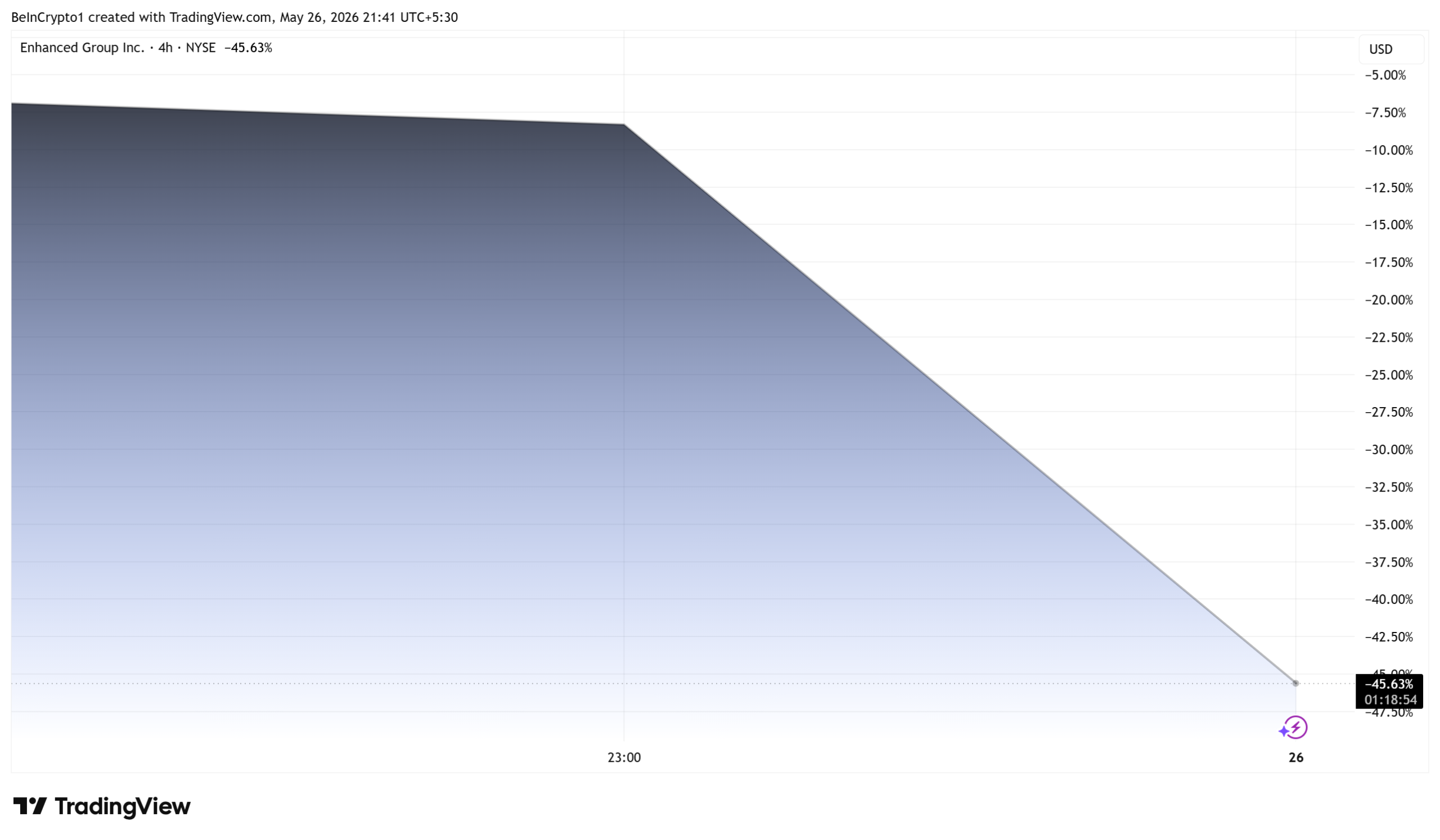
Shares of Enhanced Group (ENHA), the company behind the Peter Thiel-backed Enhanced Games, fell by as much as half on Tuesday after a six-hour Las Vegas debut produced only one unofficial world record.
The startup went public this month at a $1.2 billion valuation and has now shed hundreds of millions in market value over the past three weeks.

Vegas Debut Delivers One Record
The Enhanced Games held a single-night competition on May 24 at Resorts World Las Vegas, paying out a $25 million purse.
Roughly 42 athletes competed, with the company’s own monitoring data showing 91% used testosterone, 79% used human growth hormone, and 62% used stimulants like Adderall & modafinil ahead of the event.
“Peter Thiel and Donald Trump Jr. spent millions to create a steroid Olympics. They promised to “redefine human limits” and put up $25M in prize money…the whole pitch was that drugs would shatter the limits of clean sport. Instead, they proved the gap between juiced and clean…the only thing they actually proved was how good the clean athletes already are. You think the Enhanced Games exposed anything or just embarrassed themselves?” one researcher posed.
Only one unofficial world record fell. Greek swimmer Kristian Gkolomeev clocked 20.81 seconds in the men’s 50-meter freestyle, beating Cameron McEvoy’s 20.88-second mark and earning a $1 million bonus.
Sprinter Fred Kerley, who had predicted Usain Bolt’s 9.58-second 100-meter mark would be “destroyed,” won in 9.97 seconds, a time that would not have qualified for the Paris Olympics final.
Clean athletes, including Olympic gold medalist Hunter Armstrong, took three events outright.
Silicon Valley Loses to Biology
After closing at $5.36 on Friday, ENHA opened near $2.67 on Tuesday, a roughly 50% intraday slide that wiped out close to $800 million in market value.
Market cap has fallen from $981 million on May 7 to roughly $655 million.
Follow us on X to get the latest news as it happens
The setup echoes another recent venture-backed spectacle. A week earlier, Figure AI staged a 10-hour “Man vs. Machine” contest in which a human intern beat its F.03 humanoid robot 12,924 packages to 12,732.
When a single live-streamed proof point misses, the equity story tends to unravel in hours, not quarters.
With backers like tech investor Peter Thiel historically quick to rotate out of stalling bets, ENHA’s path to a second event now depends on public-market patience.
The post Peter Thiel-Backed Stock Crashes 50% After ‘Superhuman Sports’ Dream Collapsed appeared first on BeInCrypto.

Five transactions broadcast on May 26 sent a combined 107 Bitcoin (BTC) to Bitcoin’s well-known burn address, permanently removing the funds from circulation. Blockstream CEO Adam Back called the incident an “accidental quantum bounty” on X, drawing immediate attention across the crypto community.
The burn address, 1111111111111111111114oLvT2, has no corresponding private key, making any BTC sent there irrecoverable under current cryptographic assumptions. The 107 BTC adds to over 403 BTC already locked at the address across more than 146,000 prior transactions, all permanently withdrawn from the circulating supply.
Back’s Remark Revives a Long-Running Debate
Back’s comment pointed to one of the more unusual theoretical scenarios in Bitcoin’s quantum security debate. The address’s public key is mathematically derivable from its structure. A sufficiently powerful quantum computer could, in theory, compute the corresponding private key and claim those funds.
Back has been active in discussions about quantum preparedness throughout 2026. In April, he pushed for optional quantum-resistant upgrades to Bitcoin over forced wallet freezes. His framing of the burn event as a bounty illustrates why that debate carries real stakes, even if the technology to collect such a prize remains distant.
Quantum Risk to BTC Has Grown More Concrete
ARK Invest has outlined five quantum risk stages for Bitcoin, with early stages already influencing how large investors manage BTC exposure. Separately, Caltech researchers found that Bitcoin may need far fewer qubits to crack than earlier models assumed. That finding has compressed the theoretical threat window considerably.
Research confirms that quantum computing is reshaping Bitcoin allocations among institutional investors well before any machine poses a direct threat. ARK’s broader estimates put roughly $480 billion in BTC at long-term risk due to publicly visible keys. That category includes funds sitting at all known burn addresses.
Whether those 107 BTC remain permanently lost or become an early benchmark for quantum progress is an open question. The answer depends on how quickly hardware development narrows the gap between theoretical capability and practical key derivation.
The post Adam Back Calls 107 BTC Burn an “Accidental Quantum Bounty appeared first on BeInCrypto.

Pope Leo XIV holds his weekly general audience at St. Peter’s Square in Vatican City, Vatican, on June 11, 2025.
Massimo Valicchia | Nurphoto | Getty Images
Pope Leo warned over the weekend about a “social calamity” that could come from mass unemployment due to the adoption of artificial intelligence technologies. Prediction market traders appear to think that worry isn’t misplaced.
In his first encyclical, a document that is a form of teaching by the leader of the Catholic Church, Pope Leo urged the world to regulate AI. He also warned about the effects it may have on the labor market.
“The pursuit of greater profits cannot justify choices that systematically sacrifice jobs, because the human person is an end, not a means, and the economic order must remain subordinate to human dignity and the common good,” he wrote.
Traders on Kalshi place 60% odds that U.S. unemployment will cross 8% at some point before 2030. They also give a 47% chance it will cross 9% in the same period.
A 9% unemployment rate would likely stem from a severe recession or displacement of workers. Not including the Covid-19 recession in 2020, there have only been three economic contractions that have pushed the unemployment rate in the U.S. above 9% since World War II.
Kalshi traders think there’s a low chance of a recession in 2026, with odds just at 16%. However, in 2027, they see those odds climbing to 45%. There are no contracts about potential recessions in 2028 or 2029.
At the same time, traders think AI is driving layoffs right now. Traders place a 78% chance that AI is the number one reason for job cuts in May, which will be confirmed or denied by data from Challenger, Gray & Christmas.
In his first encyclical, Pope Leo wrote that “unemployment is a grave evil.” He acknowledged that any new technology leads to temporary labor displacements — a view supporters of the AI buildout have acknowledged too even while reassuring workers that they project there won’t be a mass labor disruption by automation.

But the pope still worries about what the consequences of any disruption may be.
“Work remains a fundamental dimension of the human experience, for not only is it a means of sustenance, but it is also a context for expression, relationships and contributing to the community,” Leo wrote. “A society that guarantees employment to only a small fraction of the population, despite having a high level of technical development, risks exposing many to forced inactivity, a lack of responsibility and the absence of daily tasks and stimuli, resulting in human and cultural impoverishment.”
Disclosure: CNBC and Kalshi have a commercial relationship that includes customer acquisition and a minority investment.
Crypto World
Ethereum Price Stuck Sideways as Tom Lee Hints at Russell 1000 Inclusion: Passive ETF Flows Could Boost ETH USD

Ethereum price is grinding sideways while an indirect institutional catalyst might be building in the background. Onchain data shows that BitMine Immersion Technologies, the biggest Ether treasury company chaired by Tom Lee, has added another 60,000 ETH to its holdings, withdrawing those funds from Kraken. Although it is not yet confirmed by either Bitmine or Tom Lee officially.
FTSE Russell simultaneously placed BitMine on its preliminary Russell 3000 inclusion list, and Lee is publicly flagging that the company’s $10.15 billion market cap clears the $5.7 billion threshold required for Russell 1000 eligibility.
It is not baseless as BitMine’s market cap comfortably exceeds the Russell 1000 minimum, and Lee posted on X that “many active managers only buy equities on the Russell 1000.” His estimate: passive index funds and ETFs typically hold 20% to 25% of any included stock’s market cap.
FTSE Russell will publish updated lists on June 5, June 12, and June 18, with reconstituted indexes taking effect after market close on June 26. Every one of those dates is a potential volatility event for BMNR, and indirectly, for ETH.
Meanwhile, Ethereum ETF flows, regulatory overhang from the SEC’s delayed tokenized-stocks proposal, and Ethereum Foundation governance shifts are all unresolved. This backdrop has been keeping ETH pinned.
Discover: The Best Crypto to Diversify Your Portfolio
Ethereum Price Outlook: Russell 1000 Tailwinds vs. Sideways Grind
ETH volume has been uninspiring during this sideways phase, and Tom Lee’s framework provides the longer-range scaffolding. Lee has publicly outlined Ethereum price targets of $12,000, $22,000, and even $62,000 depending on Bitcoin’s trajectory, historical ETH/BTC ratios, and Ethereum’s expanding role in tokenization and payments.
BILLIONAIRE TOM LEE PREDICTS $ETH WILL REACH $62,000 — Cup (@cryptocupra) May 25, 2026
YOU ARE NOT BULLISH ENOUGH
BUYING ETH NOW IS LIKE BUYING BTC IN 2014
BE PREPARED ETHEREUM WILL MELT FACES pic.twitter.com/yQcN7Q2U5Q
These figures are long-cycle projections, not near-term calls, but they establish the directional bias held by one of Wall Street’s most visible crypto advocates.
For ETH, FTSE Russell confirmation on BitMine’s Russell 1000 inclusion would trigger forced buying from passive ETFs. The 20–25% passive ownership estimate translates to billions in mandated exposure, some of which flows through to ETH’s price indirectly as BitMine accumulates further.

At the moment, the ETF flow dynamic remains the most underappreciated variable in Ethereum’s near-term setup. The index calendar is the clock now.
Discover: The Best Token Presales
LiquidChain Targets Early-Mover Upside as Ethereum Tests Key Levels
Ethereum’s consolidation is a familiar pattern for cycle-aware investors, and history suggests the sharpest gains in a bull phase often accrue not at the large-cap level, but one layer deeper in the infrastructure stack. That’s the window LiquidChain ($LIQUID) is positioning to exploit.
LiquidChain is a Layer 3 infrastructure project with a specific, technically grounded thesis: fuse Bitcoin, Ethereum, and Solana liquidity into a single execution environment. One deployment, all three ecosystems. That’s not a vague cross-chain promise.
What happens when three great chains are meticulously unified? — LiquidChain (@getliquidchain) May 25, 2026
The LiquidChain L3.  ⟁https://t.co/vqvBcdSQYC pic.twitter.com/I6itOtiDP4
The architecture centers on a Unified Liquidity Layer, Single-Step Execution, Verifiable Settlement, and Deploy-Once Architecture. These are components designed to eliminate the fragmentation that currently forces developers to choose chains rather than combine them.
Capital rotation into on-chain infrastructure has been accelerating as ETH-adjacent narratives heat up — and LiquidChain’s presale reflects that momentum. The numbers speak for themself. Currently priced at $0.01463, Liquid has managed to grow its IPO with more than $800K raised to date, approaching the $1 million milestone.
Research LiquidChain’s presale terms before the next pricing tier moves.
The post Ethereum Price Stuck Sideways as Tom Lee Hints at Russell 1000 Inclusion: Passive ETF Flows Could Boost ETH USD appeared first on Cryptonews.


On Monday at 10am New York time, five old Bitcoin addresses each sent their entire balance to the network’s best-known burn address, 1111111111111111111114oLvT2.
The combined total was over 107 BTC, worth about $8.2 million at the time.
Because the bizarrely selfless transactions occurred at the same time, the action is likely the work of a single person or group acting in synchrony.
Adam Back joked that it increased the accidental quantum bounty pool alongside other burned BTC for whoever cracks elliptic curve cryptography.
The recipient address has no private key. Sends to its public key is the cryptographic equivalent of dropping cash into an incinerator.
Across more than 256,000 confirmed transactions stretching back to 2010, the address has received 385,811 outputs and spent exactly zero.
Most Bitcoin public keys derive from a private key. In contrast, 111111111111111111114oLvT2 is a syntactically valid address that was handcrafted directly as a Base58Check string.
Because this null address was made first as a public address, attempting to derive backwards from its public key to a private key is computationally infeasible, until someone invents a cryptographically relevant quantum computer in the distant future.
‘Looks like Maximus Retardimus’
The wallet 111111111111111111114oLvT2 has no known or expected private key until the dawn of quantum, so coins sent to this address are effectively burned.
Timechain Index founder Sani flagged the burn. The post collected hundreds of thousands of views within hours.
Protos has previously reported on draft Bitcoin improvement proposals that actually propose burning legacy outputs if their owners don’t migrate coins to quantum-resistant addresses.
Voluntarily piling more coins onto quantum-vulnerable addresses certainly inverts that effort.
Sani replied to Back’s joke in his own thread, “Looks like Maximus Retardimus,” he wrote.
Read more: Cloudflare’s 2029 quantum sprint raises Bitcoin alarm bells
Five wallets, one signature pattern
The five source addresses were:
- 16g5hMoREWqMcaQGvnCHCWPheotD99bVQt
- 1PkWqW1P7KsxYXsAnWMPru6NNTfBeiRT6V
- 1LieqLD1qNadbQrSGjYAUT3tVL2w4cxXQu
- 14UNkCVPDQFCZAvq3j4vUQ6h6pHwBtegMa
- 1JtpAuksysZdwzkCjwQpTG5mzE8BRq7qmh
All five share the same first-seen date on the chain: April 10, 2014. This reinforces the conclusion that today’s burn was likely one person or synchronized group.
Each transaction used an identical locktime of 950,958, identical RBF preferences, and a fee rate of 1.81 satoshis per vByte. Each consolidated multiple UTXOs into a single output.
Transaction execution lined up to the second across all five wallets.
That pattern points to a single controller running an action in parallel, not five strangers coincidentally arriving at the same, bizarre conclusion.
After the burn, all five source addresses hold exactly zero satoshis. The largest of the five, 1PkWqW1P7Ks…, moved 551.86 BTC through 71 transactions over a decade.
Its final transaction sent 1.42 BTC to the null address.
A growing pile of burned bitcoin
The May 25 burn pushed the null address from roughly 700 BTC to 807.24 BTC, a 15.3% jump in a single block.
That number has been climbing for years. A Bitcoin community post in February 2025 measured the address at 669 BTC. Holdings were closer to 555 BTC roughly two years earlier.
At today’s BTC price, the wallet contains over $62 million of permanently destroyed coins.
Unlike Ethereum, where EIP-1559 burns base fees automatically with every transaction, Bitcoin has no protocol-level destruction mechanism. Every satoshi at 1111111111111111111114oLvT2 had to be deliberately sent there by someone holding a working private key.
Got a tip? Send us an email securely via Protos Leaks. For more informed news and investigations, follow us on X, Bluesky, and Google News, or subscribe to our YouTube channel.
Crypto World
XRP Price is yet to Recover as RLUSD Breached $1.7 Billion Market Cap: Will XRP Follow?

Ripple’s RLUSD stablecoin just blew past a $1.7 billion market cap milestone, one of the fastest stablecoin ascents since its December 2024 launch, yet the XRP price stalls.
RLUSD’s expanding share of settlement activity on the XRP Ledger signals genuine adoption beyond early users. Yet analysts confirm that almost none of RLUSD’s growth is translating into buy pressure on XRP. The stablecoin’s rise and XRP’s sideways grind are, for now, two separate stories.

With compressed volatility, a symmetrical triangle tightening on the daily chart, and a critical resistance band dead ahead, XRP is approaching a true decision point.
Discover: The Best Crypto to Diversify Your Portfolio
Can XRP Price Break $1.45 This Week?
XRP price is wedged inside a multi-week consolidation corridor that has compressed price action into an increasingly tight range. The symmetrical triangle forming on the daily timeframe reflects a near-perfect equilibrium between buyers and sellers.
Immediate resistance clusters between $1.38–$1.42, with a stronger ceiling at $1.45 where the 100-day moving average converges with the upper boundary of a long-term descending channel. That confluence makes the $1.40–$1.45 zone the most consequential technical level on XRP’s chart right now.

Support is equally defined. The $1.30–$1.32 band has held as a floor through multiple tests, but a clean break below opens a direct path to $1.20, a level that would reset the structure bearishly.
Analysts tracking the consolidation note that low volatility environments like this historically precede sharp directional moves.
Discover: The Best Token Presales
Maxi Doge Targets Early Mover Upside as XRP Tests Key Levels
XRP’s stall at current levels raises an uncomfortable question for holders: how much upside remains in an asset with a $80 billion+ market cap that still can’t clear $1.45? Waiting for a breakout that may not arrive for weeks has a real opportunity cost, especially when early-stage assets are raising capital fast.
Maxi Doge ($MAXI) is one presale capturing attention in the current cycle. Built on Ethereum (ERC-20), it positions itself as the meme token for the 1000x leverage trading mindset, a 240-lb canine juggernaut embodying the relentless grind of bull market culture. The tagline says it bluntly: never skip leg day, never skip a pump.
The numbers are concrete. $MAXI is priced at $0.000282, with more than $4.7 million raised to date. The project also offers 65% APY staking, holder-only trading competitions with leaderboard rewards, and a Maxi Fund treasury earmarked for liquidity and partnerships.
Meme-first marketing with gym-bro viral energy rounds out the community engine.
Research Maxi Doge at the official presale.
The post XRP Price is yet to Recover as RLUSD Breached $1.7 Billion Market Cap: Will XRP Follow? appeared first on Cryptonews.


The United Kingdom has imposed sanctions on a group of cryptocurrency exchanges, payment firms and individuals accused of helping Russia evade Western restrictions and finance its war in Ukraine, including crypto exchange Huobi.
The sanctions package from the U.K. Foreign, Commonwealth & Development Office targets 18 entities and individuals linked to what officials described as Russia’s “illicit financial infrastructure used to move funds, procure goods, and sustain its war.”
Among them are Huobi Global S.A., operator of the HTX exchange, Rapira Group LLC, Aifory LLC, Arvix LLC and Bitpapa IC FZC LLC.
HTX is one of the world’s largest crypto exchanges, with roughly $3.3 trillion in trading volume last year, according to a blog post from blockchain analytics firm Elliptic.
Elliptic said the platform is suspected of providing services to both the A7 payments network and Garantex, a Russian crypto exchange previously sanctioned by Western authorities. Garantex rebranded to Grinex earlier in the year and last month halted its operations after a $13 million “state-backed” hack.
Britain also sanctioned Open Joint Stock Company “Virtual Asset Issuer,” a Kyrgyzstan-linked company behind the USDKG gold-backed stablecoin, along with several people accused of sanctions-evasion activity, including Sergey Mendeleev, Igor Gorin, Irina Akopyan and Israeli national Liran Cohen.
The measures mark one of the country’s strongest moves yet against Russia’s use of cryptocurrencies and alternative payment systems. For the first time, the U.K. applied Regulation 17A of its Russia sanctions regime to crypto exchanges, a tool previously used against sanctioned banks.
Under the rules, U.K. financial firms and crypto service providers cannot maintain correspondent relationships with the designated entities or process payments tied to them. Companies may also need to freeze funds and trace blockchain transactions linked to sanctioned platforms.
Elliptic said the rules could require firms to trace transactions across multiple blockchain “hops,” meaning compliance checks would extend beyond direct counterparties to wallets and exchanges appearing anywhere in a transaction chain.
A major focus of the sanctions package is the Kremlin-backed A7 payments network, which British officials say helped process proceeds from Russian oil sales and supported military procurement. The U.K. says the network moved more than $90 billion last year.
Elliptic said other regulators are likely to watch closely as Britain tests a new model for applying traditional financial sanctions rules to digital asset markets.
The sanctions took effect immediately. CoinDesk has reached out to Huobi for comment but did not hear back by press time.


A growing number of people see the Clarity Act, which intends to establish clear and enforceable guardrails for the U.S. crypto industry, as a sign that Washington has firmly closed the door on the “regulation-by-enforcement” approach seen under the Biden administration to a more structured framework for the crypto industry.
And look, on paper, it’s a major step forward. There is no doubt the Clarity Act offers clearer definitions and a more coherent regulatory perimeter for the industry.
But regulatory clarity does not automatically lead to adoption. Because even if Congress gets the market structure right, the U.S. crypto tax framework, in its current form, is still a bit messy and complicated.
Form 1099-DA is confusing for crypto investors
On paper, Form 1099-DA, which any business defined as a crypto broker must issue, is about transparency, standardized reporting and improved compliance.
The Form 1099-DA asks crypto users for the number of assets, acquisition date, sale and disposal date, as well as specific sections for aggregated transactions for stablecoins and NFTs.
However, it is becoming more counterproductive than intended. Crypto users are now receiving tax forms that often report proceeds without a reliable cost basis, fail to properly capture holding periods and excludes non-custodial activity entirely. The result is a fragmented and incomplete picture of a user’s actual tax position.
For retail investors, that means manually reconciling thousands of transactions across exchanges, wallets, bridges and DeFi protocols, often with conflicting data that does not align with what the IRS receives.
Even within the industry, the problem has become immense. When assets are moved between platforms, the cost basis often disappears. The receiving exchange has no reliable way to reconstruct historical purchase data. Yet, the system is designed as if crypto can be reported with the same precision as traditional securities held within a single brokerage account.
It cannot. So the burden falls back to the individual taxpayer. They are now expected to override, reconcile and reconstruct their entire transaction history, or risk audit exposure if they get it wrong.
The audit trail and record-keeping requirements in the Clarity Act represent a necessary trade-off for regulatory certainty under the CFTC, but the operational hurdles they impose can’t be ignored.
To the bill’s credit, the underlying intent of these strict mandates is a massive win for the industry. Forcing audit trails to definitively prove the absolute segregation of customer assets injects a level of trust and security that will protect retail users and prevent the catastrophic commingling of funds that defined early crypto collapses.
However, the technical challenges of implementing these systems remain daunting. While the bill wisely acknowledges that tailored, onchain tracking solutions are required rather than outdated legacy reporting stacks, the operational demands are steep. Because digital asset markets run 24/7, firms must build and maintain continuous audit trails capable of instantly matching real-time blockchain ledger data with off-chain communications.
Contradiction in U.S. policy becomes impossible to ignore
For small and mid-sized investors, especially, the compliance burden can exceed the economic benefit. And if the future of crypto depends on broad participation, that is a serious structural problem.
This is where the contradiction in U.S. policy becomes impossible to ignore.
On the one hand, the government is supporting innovation, market growth and domestic leadership in digital assets. On the other hand, it is implementing a tax reporting regime that treats decentralized networks as if they were traditional brokerage accounts with perfect data continuity.
Those two positions cannot both scale. We’ve already seen partial backtracking, particularly around how the regime applies to non-custodial or DeFi activity. That’s a start, but it only scratches the surface.
The deeper issue is yet to be solved. The IRS does not need to turn crypto exchanges into perfect, all-seeing record keepers to improve compliance. It needs a framework that acknowledges the reality of fragmented ownership and cross-platform asset movement.
Other jurisdictions are moving in that direction. The Organisation for Economic Co-operation and Development’s (OECD) Crypto-Asset Reporting Framework (commonly referred to as CARF), for example, leans toward standardized data collection across platforms without pretending that intermediaries can reconstruct a perfect cost basis history for every user.
Exchange reporting should not function as a definitive ledger. Its purpose should be to flag unreported activity, not to force millions of users into impossible reconciliation exercises based on incomplete institutional data.
Even within the U.S., there are early signs of recognition that the current approach is too blunt. Discussions around de minimis exemptions and targeted relief for small transactions suggest policymakers understand that friction matters.
While the act does provide a de minimis exemption to shield low-volume brokers and dealers from registering or maintaining these heavy systems, which will protect the smallest startups, it simultaneously creates a steep compliance cliff for the middle market.
While established industry giants can treat these real-time surveillance pipelines as an expensive upgrade, growing businesses caught just above the de minimis threshold face sheer engineering complexity and costs that could prove a massive barrier to entry.
Reform is still lagging behind rhetoric
But at the federal level, reform is still lagging behind rhetoric, and that gap is becoming harder to ignore.
Because if the U.S. continues to define “crypto-friendly” as regulatory clarity alone while ignoring the existing tax burden, adoption will not accelerate significantly.
It will stall at the edges. High-net-worth participants and sophisticated funds will continue operating. Builders will continue building. But mainstream retail participation, the layer that many argue is needed for true scale, will quietly opt out under the weight of compliance complexity.
The U.S. won’t need to ban crypto to slow its growth, but it may tax it into friction, while other jurisdictions design systems that make participation materially easier.
One of the XRP Ledger’s biggest weaknesses as a DeFi venue might be on its way out.
A draft amendment titled “AMM Swappable Curves” was filed on the XRPL standards repository Tuesday, proposing to extend the network’s existing automated market maker with three pluggable curve types — constant product, concentrated liquidity, and StableSwap.
A fourth, fully programmable curve type called Smart AMM is reserved for a follow-up specification. AMMs refer to automated market makers, a type of decentralized exchange where trades happen against a pool of deposited tokens rather than between buyers and sellers.
The proposal was authored by XRL core developers Denis Angell and Roman Thpt and would require a separate amendment vote before activation. For now it is still in draft.
What it would do is let liquidity providers on the XRPL choose how their pool prices assets. The current setup spreads liquidity uniformly across every possible price, which is fine for volatile pairs but burns capital for stablecoin pairs and correlated assets.
Concentrated liquidity lets liquidity providers (or users that supply their tokens to a protocol in exchange of capturing a share of fees) target a narrow band where most trades actually happen, which produces far more usable depth per dollar deposited. StableSwap is built for assets that trade near 1:1, like dollar-pegged stablecoins or wrapped representations of the same asset.
The XRPL has been quietly building institutional tokenization volume — over $3 billion in tokenized real-world assets currently sit onchain, including a Ripple-JPMorgan pilot earlier this month processing a tokenized U.S. Treasury redemption in under five seconds.
But moving institutional capital onchain is one leg of any financial strategy. Letting that capital earn yield, get borrowed against, or trade efficiently against other tokenized assets requires DeFi rails that actually work for the task.
Concentrated liquidity in particular has become the standard for capital-efficient AMMs across major DeFi ecosystems, with around 60% of AMM volume now running through some version of it, per the proposal’s own data citations. XRPL’s current AMM has been missing that since launch in 2024.
The amendment also keeps existing pools untouched. Pools created before the new curves activate stay on the constant product model with no migration required. Pool creators picking from the new menu would do so at creation time, with the curve type locked in for the life of the pool.
XRP traded at $1.34 in U.S. morning hours Tuesday. Whether the AMM upgrade lands in time to compound the institutional narrative depends on the amendment process, which can stretch for months and is not guaranteed to pass.

Palestine Action Global targets logistics firm DSV over Elbit link

Evgeni Malkin returning to Penguins on 1-year deal

Today’s NYT Connections Hints, Answers for May 26 #1080


-

 Crypto World5 days ago
Blockchain.com files with SEC for U.S. IPO
-

 Fashion4 days ago
Holiday Weekend Open Thread – Corporette.com
-

 Business4 days ago
Dell Technologies DELL Stock Surges 15% on AI Server Momentum and Analyst Upgrades in 2026
-

 Crypto World4 days ago
Bitcoin Accumulation Weakens as BTC Realized Losses Hit $600M
-

 Crypto World3 days ago
Robinhood crypto COO Tanya Denisova exits
-

 Crypto World4 days ago
Space X IPO Is ‘Bad News’ for Tech Stocks: But What About Bitcoin?
-

 Politics4 days ago
Makerfield: a tale of two social-media histories
-

 Business2 days ago
NYT Strands Answers May 24 2026 Revealed for Puzzle No. 812 Theme Summer Essentials
-

 Crypto World5 days ago
MicroStrategy’s Saylor Says Miners No Longer Set Bitcoin Price, Another Force Has Taken Over
-

 Tech5 days ago
WhatsApp ads could make Irish debut after discussions with DPC
-

 Crypto World4 days ago
AI infrastructure race heats up as IREN pitches full-stack strategy, WhiteFiber lands $160M deal
-
 Tech4 days ago
A 0.12% parameter add-on gives AI agents the working memory RAG can’t
-

 Tech5 days ago
You Can Now Add ChatGPT To PowerPoint
-
 NewsBeat5 days ago
Charity run by Reform leader Malcolm Offord accused of ‘law breaking’ over Scottish registration
-

 Business4 days ago
Trump Invests $1M-$5M in Kura Sushi USA Chain With 27 California Locations
-

 Tech1 day ago
Microsoft’s quiet Claude Code retreat and the real cost of enterprise AI
-

 Sports5 days ago
2026 CJ Cup Byron Nelson leaderboard: Brooks Koepka finds putting stroke in Round 1
-

 Crypto World6 days ago
Exa Labs raises $250 million in funding led by a16z
-
Business4 days ago
Goldman Sachs reinstates Ageas stock coverage with neutral rating
-
 Crypto World4 days ago
Verus Bridge Hacker Returns $8.5M ETH, Keeps $2.8M as Bounty
You must be logged in to post a comment Login