
Crypto World
Zoomex Deepens Its Real-World Asset Strategy

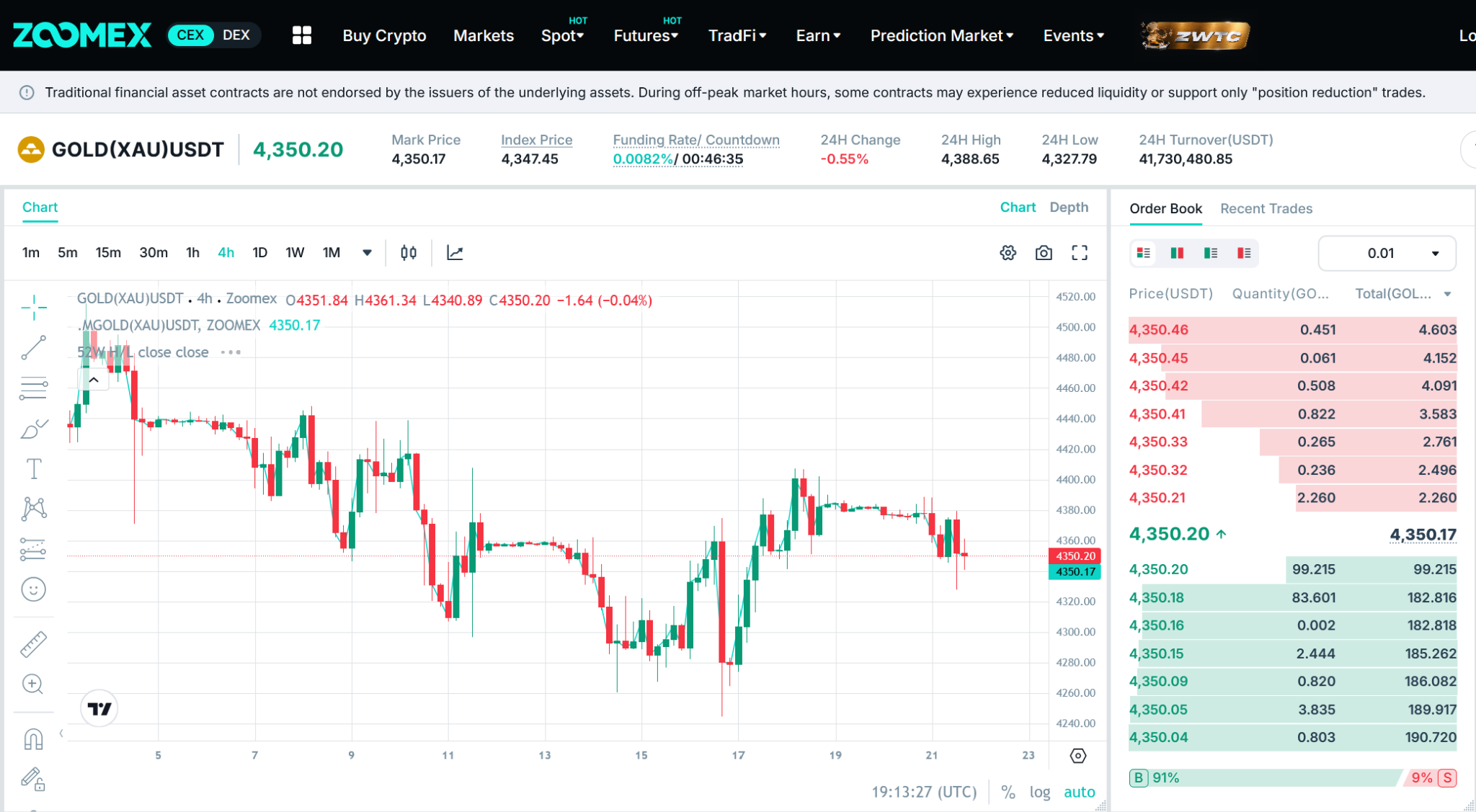
Global cryptocurrency derivatives platform Zoomex reinforces its commitment to Real-World Assets (RWA), positioning the sector not as a peripheral listing category but as a core pillar of its product roadmap.
The announcement builds on a year in which tokenized RWA markets have moved from experimental territory into mainstream institutional adoption, with on-chain RWA value (excluding stablecoins) climbing past $27 billion by April 2026, driven primarily by tokenized U.S.
Treasuries, private credit and commodity-backed tokens. For Zoomex, this shift is not simply a market trend to track, but a philosophy to build around, expressed through five defining pillars: Easy to Use, Transparent by Design, Fair Access & Rule-Based Execution, Focused on Derivatives, and Refined Brand & Trading Experience.
RWA as a Bridge, Not a Buzzword
Commenting on the expansion, Fernando Aranda said: “One of the most important moments is our expansion into Real-World Assets (RWA). We see RWA as an essential bridge between blockchain technology and everyday life. Tokenizing assets such as treasury bonds, commodities, or real estate allows blockchain to go beyond speculation to increase its real economic utility. However, for us, RWA is not limited to the listing of tokenized assets, it is about making this value accessible and spendable in real life. It is in this context that the Zoomex Card, launched in partnership with the Swiss financial institution UR, significantly changes the game.”
That statement frames Zoomex’s broader thesis, tokenization only delivers on its promise when the value it creates can move as freely as the assets it represents, flowing from a blockchain ledger into a user’s daily financial life without friction, delay, or hidden cost.
Easy to Use: Removing the Barrier Between Complexity and Access
Historically, exposure to tokenized real-world assets and the derivatives built around them has been the domain of institutions and highly experienced traders, gated by dense interfaces and opaque execution logic. Zoomex has engineered its platform to collapse that barrier, giving both first-time users and professional traders a clear, immediate read on position status, risk exposure, and potential outcomes. As RWA products draw in a broader, less specialized user base, this emphasis on usability becomes a structural advantage rather than a cosmetic one.
Transparent by Design: Rebuilding the Trust Contract
Trust has long been the central obstacle in real-world asset tokenization, users need confidence that the underlying asset genuinely exists, that valuation is fair, and that they can verify both independently. Zoomex treats transparency as an engineering requirement rather than a compliance afterthought, with balance mechanisms and trading rules built to be visible and verifiable. This philosophy extends directly into the Zoomex Card, developed alongside the Swiss-regulated financial platform UR.
According to details shared at launch, the card was built around zero card issuance fees, zero annual fees, and zero withdrawal fees for fiat returns, with cross-currency transactions anchored to real-time market exchange rates rather than hidden markups. Every layer of the asset journey, from transfer to exchange to consumption, is designed to remain traceable, reducing the risk of asset misappropriation and giving users direct control over their funds.
Fair Access & Rule-Based Execution
As institutional capital increasingly dominates the RWA landscape, the gap in infrastructure and information access between large players and individual traders has widened. Zoomex’s answer is a consistent, rule-based execution model applied equally to every participant, regardless of position size or account tier. There are no privileged lanes or preferential routing; the rules that govern order execution are fixed in advance and applied uniformly. In a market where institutional RWA issuance increasingly sets the pace, this consistency gives individual traders a rare guarantee: the same rules apply to everyone at the table.
Focused on Derivatives: Giving RWA Exposure Somewhere to Go
As tokenization extends into bonds, real estate, private credit and commodities, the market still lacks the sophisticated instruments needed to structure, hedge, or amplify that exposure. As a platform built primarily around derivatives trading, Zoomex is positioned to fill exactly that gap.

Its derivatives focus allows users to engage with RWA-driven trends actively rather than passively, managing risk, hedging exposure, and building strategies suited to a still-volatile broader crypto market. With analysts projecting the tokenized asset market could reach into the trillions by the end of the decade, the demand for mature derivatives infrastructure around RWA exposure is only expected to grow, and Zoomex intends to meet it directly.
Refined Brand & Trading Experience
Zoomex does not treat product engineering and brand identity as separate workstreams. A polished user experience, consistent visual communication, and carefully considered product flows sit alongside the platform’s security architecture as part of a single promise to users. Founded in 2021, Zoomex now serves over 3 million users across more than 35 regions and has passed comprehensive security audits from Hacken, while holding multiple regulatory licenses including U.S. and Canada MSB, U.S. NFA, and Australia AUSTRAC registrations.
As an official partner of the TGR Haas F1 Team, with goalkeeper Emiliano Martínez serving as global ambassador, the brand draws a direct line between precision on the racetrack and discipline in the trading environment.
About Zoomex
Founded in 2021, Zoomex is a global cryptocurrency trading platform focused on derivatives trading. The platform serves over 3 million users across 35+ countries and regions, offering access to 700+ trading pairs. Built around easy to use, transparency, fairness, and speed, Zoomex provides a clear and efficient trading experience for users worldwide.
Through its high-performance matching engine, clear asset and order displays, and transparent fee and rule mechanisms, Zoomex helps users better understand their account status, order execution, trading costs, and results. Zoomex maintains registrations, licenses, and regulatory statuses across multiple jurisdictions, including the U.S. MSB, Canada MSB, U.S. NFA, and Australia AUSTRAC, and has completed security audits conducted by blockchain security firm Hacken. The platform also continues to strengthen its trust framework through Proof of Reserves, Security & Transparency, Compliance Information, and Fees / Rules Transparency initiatives.
Beyond trading, Zoomex builds a refined brand experience through elite sports partnerships, including the TGR Haas F1 Team, World Cup-winning goalkeeper Emiliano Martínez, and world-class tennis events such as Wimbledon. The values of speed, precision, discipline, fair play, and rule-based execution are closely aligned with Zoomex’s approach to derivatives trading.
At Zoomex: Easy to Use. Transparent balance. Fair access to your earnings.
Frequently Asked Questions
- What is Zoomex? Zoomex is a global crypto derivatives platform founded in 2021, serving over 3 million users across more than 35 countries and regions with 700+ trading pairs.
- How does Zoomex work? Zoomex operates through a high-performance matching engine with transparent asset and order displays, allowing users to execute trades and track outcomes with full visibility into their balances and results.
- What can you trade on Zoomex? Zoomex offers 700+ trading pairs spanning cryptocurrencies such as BTC, ETH, and SOL, as well as stock-linked contracts like NVDA and AAPL and gold exposure through XAUT.
- Where is Zoomex headquartered? Zoomex operates as a global cryptocurrency exchange with regulatory registrations including Canada MSB, U.S. MSB, U.S. NFA, and Australia AUSTRAC, reflecting its multi-jurisdictional compliance approach.
- Is Zoomex available in my country? Zoomex serves users across more than 35 countries and regions. Availability can vary by local regulation, so traders should check the official Zoomex website for country-specific access and requirements.
The post Zoomex Deepens Its Real-World Asset Strategy appeared first on BeInCrypto.

Traders placed record bets against oil on Tuesday. Volume in Brent put options topped 764,000 contracts, according to preliminary ICE Futures Europe data cited by Bloomberg.
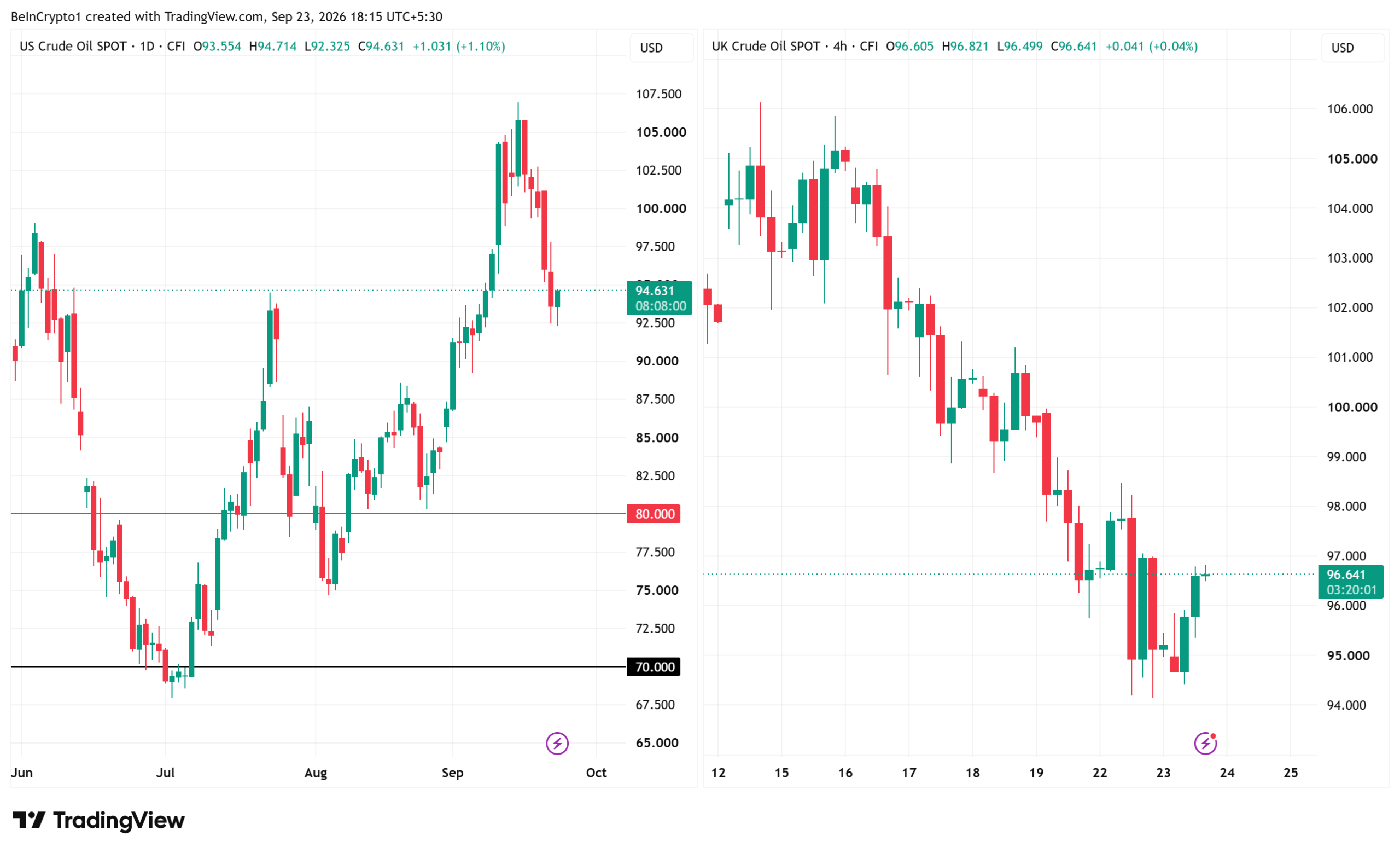
A put option pays off when prices fall below a set level. Some of Tuesday’s biggest trades pay only if oil drops to about $70 by December, from roughly $96 now.
Record Bets Against Oil Target $70 by December
December $70/$69 put spreads alone topped 110,000 contracts. A spread pairs two options a dollar apart, capping both the cost and the payout. These positions profit only if Brent, the global oil benchmark, sinks below $70.
However, the record overstates pure bearish conviction. Narrow spreads made up more than half of Tuesday’s volume, per the same ICE data. Traders often use them to hedge existing positions rather than bet outright.
Why Oil Fell More Than 10% in Eight Days
Brent traded near $106 on September 14. By Tuesday, it briefly slipped below $98, its sixth straight daily loss and the longest run since August 2025. The slide reversed a war-driven rally as the Strait of Hormuz stayed largely shut.
Two developments drove the selling. First, U.S. envoys Steve Witkoff and Jared Kushner met Iranian Foreign Minister Abbas Araghchi at the UN General Assembly. President Donald Trump praised the three-hour session.
“They had a very good meeting, a very productive meeting,” Al Jazeera reported, citing Trump.
Iran said it could reopen Hormuz within seven days if Washington eased military pressure. Its terms also include lifting the U.S. naval blockade of Iranian ports and releasing frozen assets.
Second, Saudi Aramco restarted its East-West pipeline on Tuesday, Hydrocarbon Processing reported. The line carries crude to the Red Sea port of Yanbu, avoiding Hormuz. Drones knocked it offline on September 13.
What Stands Between Oil and $70
Oil steadied on Wednesday. Brent spot traded near $96.64, while U.S. crude rose 1.1% to about $94.63, TradingView data showed. Reaching $70 would require a further fall of roughly 28%.

No U.S.-Iran agreement has been announced. The Saudi pipeline also restarted at a low rate, and a security source said restoring about 4 million barrels a day could take weeks.
Earlier this month, JPMorgan dropped its forecast baseline, saying it could no longer model the war’s endgame.
The post Traders Place Record Bets Against Oil: Could Prices Fall to $70? appeared first on BeInCrypto.

Cryptocurrency payments company MoonPay is set to acquire private-markets investment platform North Capital to support its tokenization efforts, according to an emailed announcement Wednesday.
Salt Lake City, Utah-based North Capital, whose platform boasts around $9 billion in primary and secondary transaction volume, will become a wholly owned subsidiary of MoonPay after the transaction closes, subject to regulatory approval.
The all-stock deal is worth over $60 million, sources familiar with the matter told CoinDesk.
The acquisition will support MoonPay’s aim of “building the regulatory foundation to support mass adoption of tokenized real-world assets,” according to CEO and founder Ivan Soto-Wright.
“We believe bringing those capabilities into the MoonPay ecosystem can help connect different parts of the financial system through modern, programmable infrastructure,” Soto-Wright added.
North Capital provides the tech infrastructure for tokenizing securities for private securities issuers and fund managers, supporting capital raising, asset management, clearing, custody, and secondary trading.
North Capital’s affiliates hold relevant broker-dealer, trading, transfer and investment advisory registrations with the U.S. Securities and Exchange Commission (SEC).
MoonPay has expanded beyond its core business of crypto payments in recent months, establishing its Trade platform to connect banks and fintechs to tokenized assets, DeFi protocols and stablecoin liquidity.
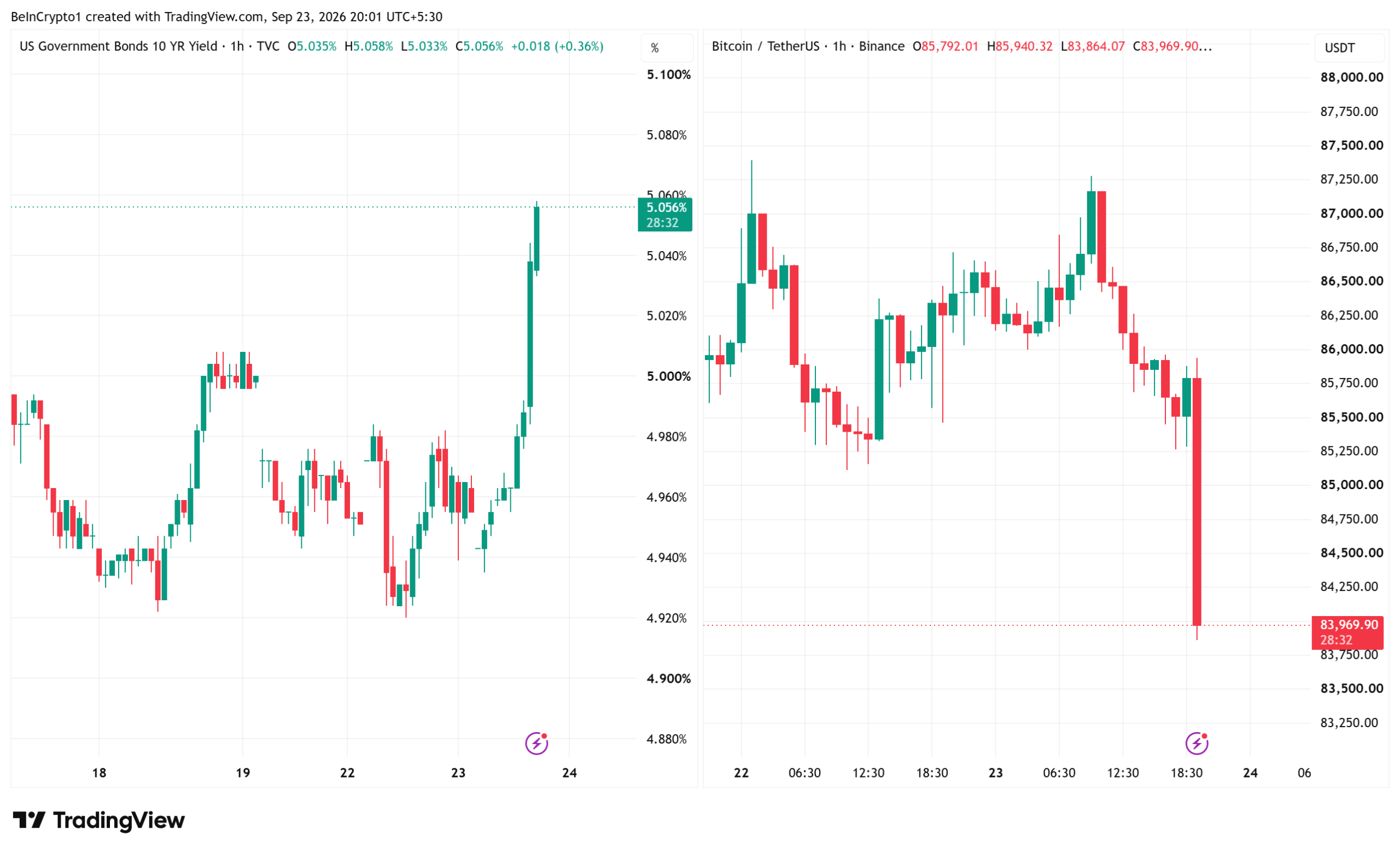
Bitcoin (BTC) fell below $84,000 on Wednesday after a surprise jump in US business activity sent Treasury yields higher.
The drop came within about an hour of the data release. It reversed a morning rally that had carried Bitcoin above $87,000 on Binance.

What the US Business Survey Showed
The S&P Global flash Purchasing Managers’ Index (PMI) is an early monthly survey of about 1,150 US companies. A reading above 50 means business activity is growing.
September’s composite reading rose to 58.4 from 56.0 in August. That is the fastest growth since July 2021. The manufacturing gauge jumped to 57.0 from 53.9, its strongest since May 2022.
However, the report also flagged rising costs. Input prices climbed at the fastest rate since October 2022 as oil pushed fuel and transport bills higher. Meanwhile, hiring hit its quickest pace since June 2022.
Chris Williamson, chief business economist at S&P Global Market Intelligence, warned about what comes next.
“Firms’ input costs have meanwhile jumped in September at the steepest rate for four years, with fuel and transport costs spiking higher thanks to the rise in oil prices seen during the month, which will add further to the upward pressure on selling prices and inflation in the coming months,” said Chris Williamson.
Why Higher Yields Pushed Bitcoin Below $84,000
Treasury yields show the return investors demand to lend to the US government. They tend to rise when markets expect higher interest rates.
The 10-year yield climbed to 5.058% after the release, TradingView data shows. It had closed at 4.96% on Tuesday, according to the Treasury.
The Federal Reserve (Fed) raised its benchmark rate to a range of 3.75% to 4% on September 16. Its statement said the hike would speed a return to 2% inflation.
Higher yields make assets that pay no interest, such as Bitcoin, less attractive. BeInCrypto flagged that exact risk on September 15, when the 10-year first touched 5%.
The slide came hours after BeInCrypto reported Bitcoin up 13% since the Fed hike. A day earlier, Tom Lee and iTrustCapital’s chief executive said the worst is over.
Final September PMI readings arrive on October 1 for manufacturing and October 5 for services.
The post Bitcoin Falls Below $84,000 as Hot US Data Sends Yields Higher appeared first on BeInCrypto.
Tron uses a delegated proof-of-stake (DPoS) consensus mechanism. Under this system, TRX holders stake their tokens to gain voting power and use that power to elect 27 Super Representatives, the validators responsible for producing blocks and maintaining the network. Because block production is concentrated among a limited, elected set of validators rather than distributed across a broad network of participants, Tron can achieve fast confirmation times and low computational overhead.
Stablecoins and the payments use case
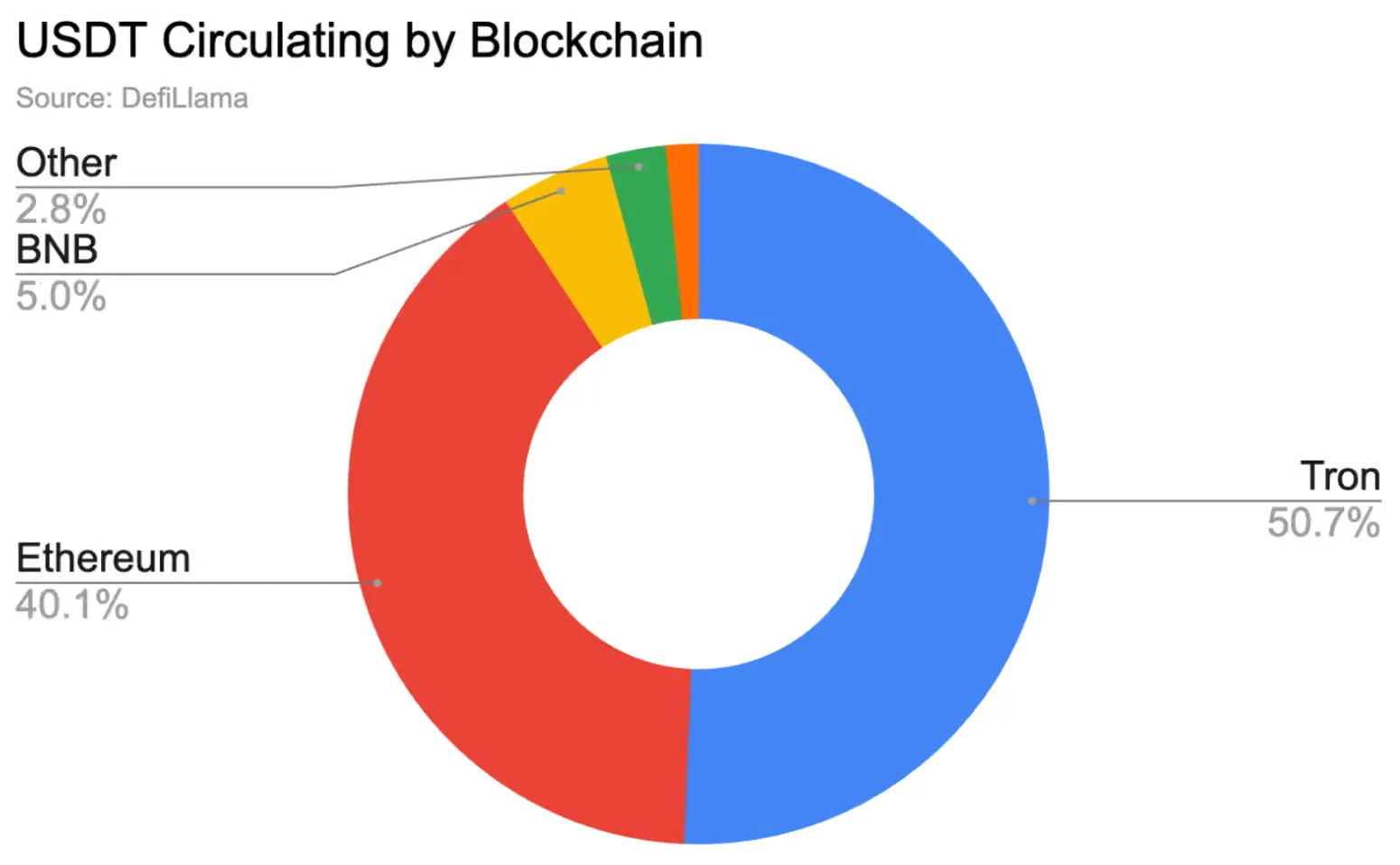
The single most important development in Tron’s evolution has been its emergence as the leading settlement network for stablecoins. A substantial share of global USDT circulation now resides on Tron, and this characteristic separates Tron from many of its layer-1 peers: rather than competing primarily on DeFi innovation or consumer applications, Tron has positioned itself as digital payment rails for dollars.

That positioning shows up clearly in the network’s usage data. According to Tron’s blockchain explorer, weekly transaction counts on Tron have climbed to record highs, recently approaching 100 million transactions per week, even as the average onchain transaction fee has fallen to around seven cents, a multiyear low.


Weekly active addresses, a measure of unique wallets transacting on the network over a seven-day period, have also been climbing toward record levels, reflecting broad and sustained usage rather than a narrow base of activity. Stablecoin transfer volume on Tron has grown alongside this activity, recently running at roughly $150 billion to $190 billion per week.

“Boy, did I have impostor syndrome,” she says. “Here I was in this room full of eminences, and I had been reading their work, I’d been citing them, I’d been learning from them.” She also had some hard lessons to learn as a northeastern hippie in a majority-Black school district. “I just couldn’t believe the state of affairs in these schools,” says Moats. “Libraries with no books, no doors on the lavatory, no running water in the sinks.” She labored to get the teachers to trust her. Eventually, one of her assistants took her aside. “She said, ‘You’re the director, you’ve got to look like the director,’” recalls Moats, who favors denim and heavy glasses. “I said, ‘You have any advice?’ She said, ‘Go to Ann Taylor.’” The project was a success, her nine schools’ reading rates soared, and local politicians started to drop by for photo opportunities.
Then national politicians took notice too. The No Child Left Behind Act that President George W. Bush signed in 2002 enshrined the work of Lyon’s team and the National Reading Panel. Moats was tapped to write the teacher-training component of the act’s Reading First initiative, which became LETRS.

Michael Burry continues to have a bearish view of the semiconductor industry. On Tuesday, Burry added to his short positions of Micron Technology (MU), Nebius (NBIS), Palantir (PLTR) and the iShares Semiconductor ETF (SOXX), according to an update published on his Substack Cassandra Unchained. Since the end of last year, Burry has been shorting semiconductor stocks on the view that…
Copyright ©2026 Investor’s Business Daily, LLC. All rights reserved. 87990cbe856818d5eddac44c7b1cdeb8

The world’s largest private debt offering, a bond series for one of Meta’s AI data centers, has slumped to its worst level since the deal priced at par last October.
As the Nasdaq composite closed at an all-time high on Tuesday in an AI-led rally, unease rose in the credit market for the industry.
The $27.3 billion bond financing Meta’s Hyperion AI data center traded down to a disconcerting 94.4 cents on the dollar, a record low. Worse, the loss coincided with Meta’s largest intraday stock rally in a year: 9%.
The bond series was the largest private debt offering ever sold. Corporate notes, backed by Mark Zuckerberg’s massive AI division at Meta, boasted a 6.581% coupon and a long-dated 2049 maturity.
PIMCO, the world’s largest bond manager, anchored the deal with about $18 billion. Funds by the world’s largest asset manager, Blackrock, bought upward of $3 billion.
Read more: Viral report alleges Anthropic’s AI safety watchdog conflicted
Technically, the debt sits on the books of Beignet Investor LLC, a special-purpose vehicle. A search for pricing of Beignet Investor LLC show latest pricing at 94.61 to 94.4, far below its 100 par.
In October 2025, S&P blessed Beignet Investor LLC’s AI bond with an A+ rating. It was within one rating level of regular Meta corporate bonds backed by Facebook, Instagram, and WhatsApp, and other divisions of Zuckerberg’s company.
Within days of its initial pricing, Beignet Investor LLC’s AI bond traded above par to as high as 110. By late July, it had fallen to about 96 cents. Today, it has retraced 14% of its peak gain.
PIMCO’s own GIS funds now mark it at 94.5, despite anchoring the initial offering.
An $18 billion position bought at par would now show a paper loss of roughly $1 billion.
The losses for bond investors contrast with Meta’s otherwise positive developments and stock performance. It launched Muse on September 8, a personal AI agent with free, $20, and $100 tiers.
Initial success was resounding, with Muse quickly topping Apple’s US App Store chart.
Goldman Sachs spent the session listing everyone the agent might disrupt. Businesses built on recurring bills — Goldman’s so-called “consumer inertia” basket like AT&T, Allstate, Netflix, or Booking.com — fell 2.6% on the day in the basket’s worst day since February.
Protos reported in July that credit default swaps on mega-cap AI names were blowing out.
Moody’s warned that the AI’s capital expenditures binge could dent the credit quality of even the largest AI companies.
Got a tip? Send us an email securely via Protos Leaks. For more informed news and investigations, follow us on X, Bluesky, and Google News, or subscribe to our YouTube channel.
Although the symposium is not secret, it has received little media attention. Its public footprint consists largely of occasional posts from attendees rather than prominent FBI announcements or the publicity campaigns typical of commercial crypto conferences.
A LinkedIn post published by Token Recovery executive Roman Bieda confirms that the 2024 symposium took place in Austin.
Bieda, attending for a third time, said it convened an international group of public and private-sector specialists to discuss threats including money laundering, ransomware, human trafficking and crypto-related scams. He did not respond to a request for comment by publication time.
From government gathering to industry forum
The gathering was once weighted more heavily toward government agencies and public sector officials, according to one of the people who spoke to CoinDesk.
It has since expanded to include more representatives from the crypto industry, they added.
The focus is practical, aimed at informing attendees about emerging attack methods, what techniques are proving effective, and how North Korean operatives are targeting crypto companies.
A detailed presentation covered the Drift exploit, in which hackers gained administrative control and used a manipulated token as collateral to steal more than $270 million from the Solana-based decentralized exchange in April, the person added.
Sharing intelligence on crypto threats
Unlike the polished venues and promotional atmosphere of major crypto gatherings, the FBI symposium is deliberately low-key, one of the attendees said. Its growing industry presence, however, reflects how closely law enforcement now depends on crypto companies, blockchain analysts and security researchers to identify attackers and trace stolen funds.
Crypto World
Southern Company or Duke Energy: Only One Offers the Combination of Yield, Growth, and Safety You Need

Quick Read
-
Duke Energy (DUK) beats Southern Company (SO) on yield (3.62% vs. 3.49%), dividend coverage, and 20-plus consecutive years of annual raises.
-
Duke’s $103 billion capital plan and 7.8 GW of data center contracts give its dividend a cleaner, faster-growing funding engine than Southern’s.
-
Southern’s wind repowering charges and Nicor disallowances drain roughly $325 million in cash through 2027, actively competing with its dividend.
-
Just released. Our analysts combed the entire stock market and named the ten best stocks to buy right now, and Southern Company didn’t make the cut. Enter your email to see the names that beat SO. The report is free. Enter your email and see if any of your stocks made the cut.
For a retirement investor building an income sleeve from regulated utilities, the choice between Duke Energy (NYSE:DUK) and Southern Company (NYSE:SO) matters for income construction. Here is how they compare. Both benefit from data center load growth in the SERC region, but their dividends, balance sheets, and growth engines move at different speeds. Here is the head-to-head across the three dimensions that matter for income holders.

Dividend Yield, Coverage, and Raise History
Start with the check-writing math. Duke pays a $4.34 annualized forward dividend against a share price of $115.20, for a trailing yield of 3.62%. Southern pays a $3.04 annualized forward dividend at $84.40, yielding 3.49%. Duke also covers its payout more comfortably: TTM EPS of $6.64 against a $4.26 per-share payout, versus Southern’s $4.15 EPS against $2.98.
Both are long-tenured raisers, but Duke has been more generous. CFO Brian Savoy noted on the Q2 call that the July hike marked “over 20 years of consecutive annual dividend increases”. Duke’s quarterly went from 1.065 to 1.085 at the August 14, 2026 ex-date. Southern’s most recent bump took the payout from $0.74 to $0.76 at the May 18, 2026 ex-date, in line with its once-a-year cadence. Winner: DUK. Higher yield, better coverage, faster recent raise.
Free Report, Just Released
Why Didn’t SO Make The Top 10 List?
24/7 Wall St has helped investors make money for over two decades, and our top analysts just finished ranking the definitive Top 10 Stocks To Buy Now. Not the ten biggest companies. Not the ten everyone is arguing about. The ten best stocks to buy right now.
And SO didn’t make the cut!
The report is free, and you can see why we think each stock is a top investment today.
Enter Your Email and See the Ten →


What Actually Funds the Dividend


Bitcoin’s latest leg up has carried the price directly into a major overhead supply region, putting the rally at an important test. Momentum remains constructive, but the reaction around the $86K-$89K area could determine whether the move develops into another bullish leg or pauses for a deeper retest.
Bitcoin Price Analysis: The Daily Chart
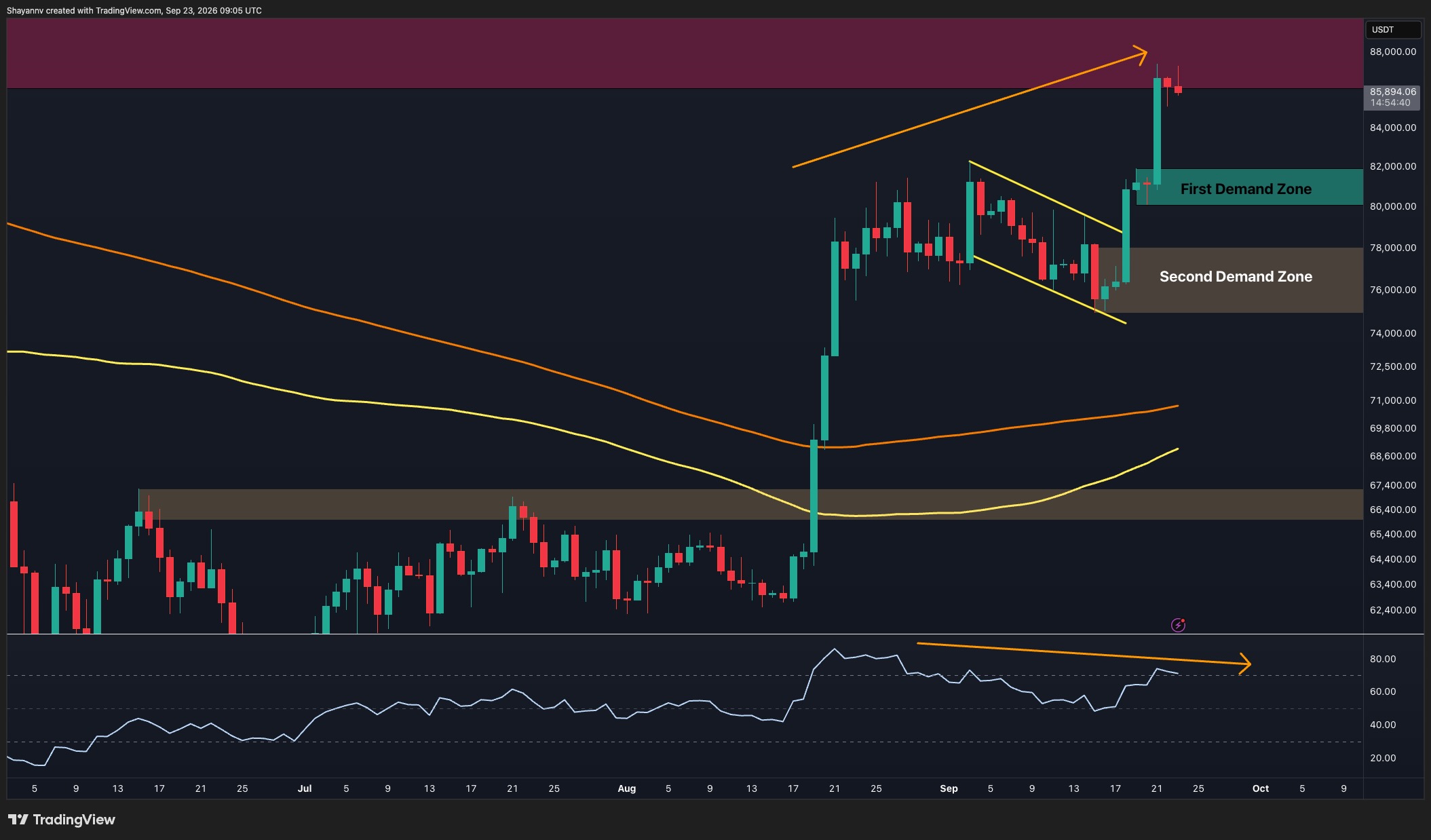
On the daily timeframe, Bitcoin has extended its recovery significantly after breaking out of the previous corrective structure. The asset is now trading around $86K and has entered the major $86K-$89K resistance zone highlighted on the chart.
The broader structure remains bullish. BTC is comfortably above both moving averages, while the sharp recovery from the $75K area has established a clear sequence of higher prices. However, the current resistance zone is substantial, and the latest candles show some hesitation after reaching it.
There is also a notable momentum divergence developing. While the price has pushed to a higher high, the RSI has failed to confirm that strength and remains below its previous peak. This bearish divergence does not necessarily signal an immediate reversal, but it suggests that upside momentum is not expanding at the same rate as price.
As a result, a rejection from the $86K-$89K resistance could trigger a corrective move toward the first demand zone around $80K-$82K. Below that, the $75K-$78K area represents the next major support. Conversely, a decisive daily breakout above $89K would invalidate the immediate bearish divergence concern and strengthen the case for continuation.
BTC/USDT 4-Hour Chart
The 4-hour chart emphasizes just how aggressive the latest move has been. After consolidating around the $80K-$82K demand zone, Bitcoin broke higher with a large impulsive candle and quickly reached the $86K region.
The price is now consolidating just inside the $86K-$89K supply zone rather than immediately reversing, which suggests buyers are still attempting to absorb the available selling pressure. The rising trendline from the $75K low also remains intact, supporting the short-term bullish structure.
Nevertheless, BTC is extended from its nearest demand area. If sellers gain control at the current resistance, the $80K-$82K zone would be the most important initial area to monitor for a pullback. Holding that region would preserve the breakout structure and could provide the foundation for another attempt at $89K.
A breakdown below $80K would weaken the short-term setup and increase the probability of a deeper correction toward the $75K-$78K demand zone.

Sentiment Analysis
The Realized Price UTXO Age Bands chart provides additional context for Bitcoin’s current position by showing the average acquisition prices of different holder cohorts.
BTC, currently around the mid-$80K region on this chart, has moved above the realized prices of several younger and intermediate cohorts. Most notably, price is approaching the 18-month-to-2-year cohort’s realized price, which sits around $88K. The 6-to-12-month cohort is also positioned near $90K.
These levels closely overlap with the $86K-$89K technical resistance identified on the price charts, creating an important confluence. Investors belonging to these cohorts may be approaching their aggregate cost basis, potentially increasing selling or breakeven supply as BTC moves higher.
At the same time, Bitcoin trading above the realized prices of several other active cohorts indicates that a larger portion of those holders has returned to unrealized profit. Therefore, the $88K-$90K region appears particularly important. A sustained move through it would place Bitcoin above another significant cluster of holder cost bases and could reinforce the bullish continuation scenario, while rejection would leave the current resistance confluence intact.

The post Bitcoin Price Analysis: BTC Faces First Major Test After 13% Weekly Rally appeared first on CryptoPotato.

Digger Reviews: Tom Cruise’s ‘Outrageous’ Film Divides Early Critics

Jaxson Dart expected to undergo knee surgery, ending Giants QB’s 2026 season

Craftsman Chris Transforms a Dumpster Window Air Conditioner Into a DIY Geothermal Heat Pump


![IT'S HAPPENING! Bitcoin Bearish Divergence Playing Out! [My Targets!]](https://wordupnews.com/wp-content/uploads/2026/09/1790181021_maxresdefault-80x80.jpg)


-

 Fashion5 days ago
Weekend Open Thread: Talbots – Corporette.com
-

 Tech3 days ago
Researchers escape OpenAI Codex sandbox to run commands on host
-

 Crypto World5 days ago
Circle launches Arc Studio AI agent for building onchain apps
-
 NewsBeat5 days ago
Trump says US has reached an agreement to take permanent control of Greenland’s security
-

 Crypto World3 days ago
Who Needs CLARITY Anyway? ARB Could See 70X Increase: Hodler’s Digest
-

 Crypto World5 days ago
Trading Bitcoin on Robinhood? Why 2% Spread Has Traders Worried
-

 Crypto World6 days ago
Mortgage and refinance interest rates today, Thursday, September 17, 2026
-

 Crypto World5 days ago
Bitcoin price breaks channel as RSI climbs to 63
-

 Crypto World7 days ago
US Charges Robinhood Engineers Over Crypto Listing Trades
-

 Tech2 days ago
Google’s $899 Googlebook is a bet that you’ll buy a new laptop for Gemini
-

 Crypto World17 hours ago
Goldman Sachs and Deutsche Bank Agree: The S&P 500 Rally Isn't Over
-

 Business3 days ago
Analog Devices (ADI) Bets $1.35 Billion on Chips that Let Machines Think for Themselves
-

 Crypto World5 days ago
World Money launches in 150+ countries with Stripe
-

 Crypto World3 days ago
Coinbase, Robinhood, Circle Seen as Tokenized-Stock Winners
-

 Crypto World5 days ago
Silver prices recover quickly, hitting weekly high today
-

 Tech6 days ago
GPT-6 Astra Reached the Nether in Minecraft, Lost Its Stash to a Creeper, and Farmed Potatoes for Hours
-

 Tech4 days ago
Trump suggests rebranding AI with a new name, says he’s also creating an AI Force
-
 NewsBeat5 days ago
US was ‘on brink of war’ with China over false AI report of nukes moving in Middle East
-

 Entertainment7 days ago
Grey’s Anatomy Showrunner Teases Changes After Cast Exits
-

 Crypto World2 days ago
Bitcoin price holds above $81K as key catalysts line up
You must be logged in to post a comment Login