Connect with us
DAPA Banner
DAPA Coin
DAPA
COIN PAYMENT ASSET
PRIVACY · BLOCKDAG · HOMOMORPHIC ENCRYPTION · RUST
ElGamal Encrypted MINE DAPA
🚫 GENESIS SOLD OUT
DAPAPAY COMING

NewsBeat

Tear down this wall! Property developer faces council probe after erecting section of the Berlin Wall in his garden without planning permission

Published

on

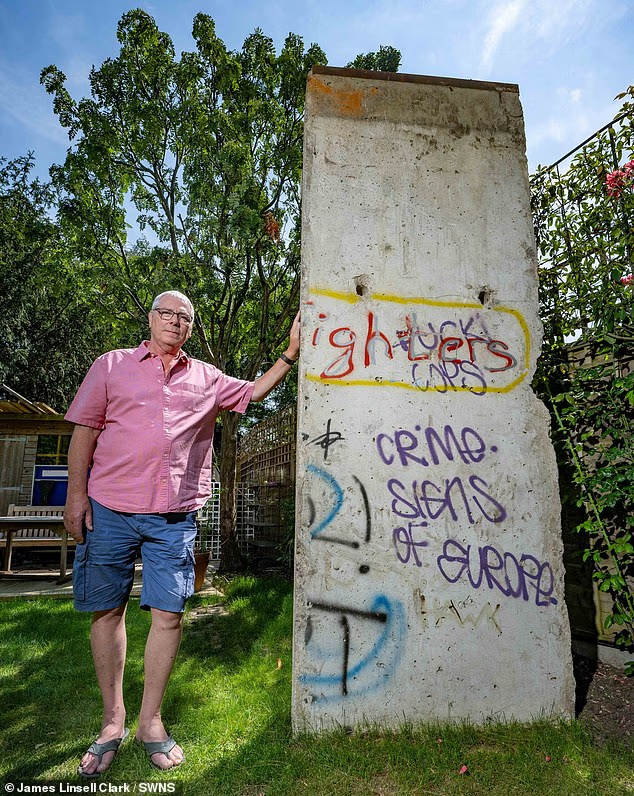
Property developer Steve Thorpe, 65, bought a piece of the Berlin Wall to bring home to the UK

A property developer snapping up part of the Berlin Wall has triggered a new Cold War after a neighbour’s complaint – this time not in Germany’s but in England’s capital.

Steve Thorpe, 65, bought a piece of the historic structure and brought it more than 650 miles back to his home in Dulwich, south-east London.

He installed the 3.1m slab at the back of his garden but a neighbour has since complained to Southwark Council about the piece of concrete that used to separate East and West Germany – saying it lacks planning permission.

And the local authority has now launched an investigation into whether the wall, which can be seen from the front door, can stay. 

Advertisement

Mr Thorpe tracked the towering wall chunk down after learning a grain farmer had been using hundreds of sections of it to line his sheds.

Along with a friend, Mr Thorpe flew out to Germany to go Berlin Wall shopping and decided to buy a piece of history.

He said: ‘The original piece I wanted, they wouldn’t sell me as it is going to go to an exhibition at Brandenburg Gate.’

Mr Thorpe instead found another piece of graffiti-daubed wall catching his eye and settled on that.

Advertisement

Property developer Steve Thorpe, 65, bought a piece of the Berlin Wall to bring home to the UK

Mr Thorpe, pictured with his section of the wall, may have to remove it if retrospective planning permission is not granted

Mr Thorpe, pictured with his section of the wall, may have to remove it if retrospective planning permission is not granted

He had the segment transported to his home in Dulwich, south-east London

He had the segment transported to his home in Dulwich, south-east London

Advertisement

The shopping was the easy task as he then had to transport the heavy wall back to the UK and get it installed in his garden.

He said: ‘It took an awful lot of wrangling to get it here. We had to get export licences and import licences, but we got it.

‘And because it weighs so much, we had to make a dolly to get it down and use lots and lots of machines and winches to get it through the garden.’

After battling the ‘awful’ January weather, the wall was successfully installed at his home.

Advertisement

But for Mr Thorpe it is far more than a garden decoration, it is a ‘really significant part of history’, adding: ‘It’s probably the biggest thing that’s happened in my lifetime.’

Mr Thorpe feels his connections to the wall stretch back to the Cold War when he visited Germany with the club Clifton Rugby and played against the British Army. 

However, the segment has not gone down well with everybody nearby – with one neighbour having formally complained to Southwark Council that Mr Thorpe needed planning permission to install the wall.

Mr Thorpe told the Daily Mail: ‘Just as we finished putting it up, a neighbour asked “what is that?”.

Advertisement
The section is now at the centre of a planning dispute involving Southwark Council

The section is now at the centre of a planning dispute involving Southwark Council

Mr Thorpe said of the structure: 'Because it weighs so much, we had to make a dolly to get it down and use lots and lots of machines and winches to get it through the garden'

Mr Thorpe said of the structure: ‘Because it weighs so much, we had to make a dolly to get it down and use lots and lots of machines and winches to get it through the garden’

Mr Thorpe feels his connections to the wall stretch back to the Cold War when he visited Germany with the club Clifton Rugby and played against the British Army

Mr Thorpe feels his connections to the wall stretch back to the Cold War when he visited Germany with the club Clifton Rugby and played against the British Army

The Berlin Wall near the Brandenburg gate which was built in August 1961

The Berlin Wall near the Brandenburg gate which was built in August 1961

Advertisement

‘I explained that it was a piece of the Berlin Wall and he said, “You needed to ask my permission for that”. I didn’t think I needed to.’

He has now applied for retrospective planning permission through Dulwich Estates in the hopes they will allow for the wall to remain and not be torn down for a second time.

He said: ‘They either give me permission or they don’t and I’m not sure what I’ll do if they don’t.’

‘It would be a crime to demolish it. It would cost an awful lot to move it – it cost a fortune to get it in.’

Advertisement

Mr Thorpe says children from the south London neighbourhood come over to view the wall and he has even printed a pamphlet with information on the wall.

Steve said: “Most of my neighbours seem to be very supportive of it. The most historically significant event in my life, in our lives, is the fall of the wall. It’s massive.’

A Southwark Council spokesperson said: ‘We have received a planning complaint about a section of wall installed in Dulwich

‘We will investigate the complaint and take any appropriate action in line with the national planning processes.’

Advertisement

The Berlin Wall – also known as the Iron Curtain – was a 155km (96-mile) barrier built by East Germany in August 1961 to prevent its citizens from fleeing to the West.

It stood until November 1989 when a new travel law was mistakenly announced, which saw crowds rush to the border.

The wall was opened under the onslaught of so many people and ultimately torn down, paving the way for Germany’s reunification the following year.

Mr Thorpe’s neighbour, who is making the complaint, has been approached for comment. 

Advertisement

Source link

Continue Reading
Click to comment

You must be logged in to post a comment Login

Leave a Reply

NewsBeat

Costa drops new reusable cups fans say are Stanley dupes

Published

on

Costa drops new reusable cups fans say are Stanley dupes

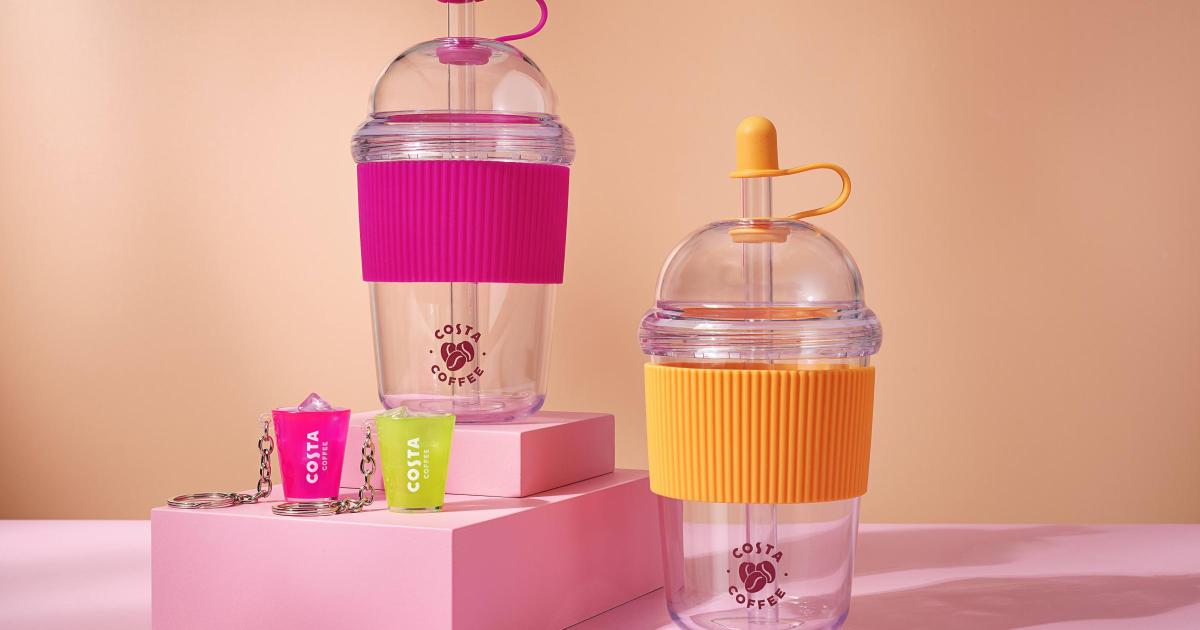
The new insulated-style tumblers arrive in eye-catching Mango orange and Dragon Fruit pink, complete with a reusable straw, straw cover and ribbed sleeve, giving shoppers a budget-friendly alternative to the premium reusable cups dominating TikTok and Instagram.

With reusable drinkware continuing to fly off shelves, Costa’s latest merchandise could prove just as popular as previous limited-edition collections.

The new reusable cups go on sale in Costa stores from today, Thursday, July 2, alongside the chain’s refreshed summer menu.

They are available while stocks last, meaning shoppers hoping to grab one may need to move quickly.

Advertisement

Costa is also releasing matching refresher-inspired keyrings in bright pink and lime green

There’s a new high-protein coffee too

Alongside the new merchandise, Costa is trialling its first-ever High Protein Latte and High Protein Iced Latte in selected stores.

Made using Costa’s signature Mocha Italia coffee and semi-skimmed milk, each drink contains 23g of protein and can be ordered hot or iced.

Customers can also personalise the drinks with flavoured syrups.

Costa Coffee cream tea bundle (Image: Costa Coffee)


Recommended reading:

Advertisement

New cream tea-style deal joins the summer menu

Costa is also introducing a new scone bundle, available between 11am and 5pm in selected stores.

The offer includes an All Butter Sultana Scone, Bonne Maman strawberry conserve, Cornish clotted cream and a handcrafted small or medium drink.

Costa is also giving away free samples of its new Smooth Medium Blend At Home Instant Coffee in stores nationwide while stocks last.

The new reusable cups, keyrings and seasonal menu are available from Thursday, July 2, with merchandise expected to be available only while supplies last.

Advertisement

Source link

Continue Reading

NewsBeat

New research challenges the idea that memories of childhood maltreatment can’t be trusted

Published

on

New research challenges the idea that memories of childhood maltreatment can’t be trusted

People are often treated as unreliable narrators of their own past, and this scepticism runs especially deep around emotionally charged early experiences.

Researchers have long worried that memories of abuse and neglect might shift depending on someone’s mood, mental health or current circumstances, meaning what someone tells a researcher, doctor or social worker one year might not match what they’d say the next.

Our new research, published in Nature Mental Health, suggests that these fears may be overstated. We found that reports of childhood maltreatment remain highly stable over time – at least over a period of a few years.

Childhood maltreatment covers experiences of physical, sexual or emotional abuse or neglect. Most research into how these experiences affect mental and physical health relies on retrospective self-reports. Essentially, it involves asking people to describe what happened to them based on memory.

Advertisement

These reports show consistently stronger links with mental health outcomes than reports from outside observers. But this has raised an uncomfortable question: are these stronger links genuine, or are they artefacts of people’s current mood, colouring how they remember their past?

Whether memories of maltreatment are stable isn’t just an academic curiosity; it has serious practical consequences. If people’s accounts of what happened to them shift over time, a single snapshot survey could misclassify who did and didn’t experience maltreatment, muddying research findings and making it harder to identify what’s actually driving poor outcomes.

The stakes are just as high outside the lab. Clinical, legal and social care decisions can hinge on someone’s account of childhood experiences, often given only once.

To test this, researchers have asked the same people about their childhood experiences at two or more points in time, then compared their answers. We pulled together 49 such studies, spanning almost 40,000 people, to see how consistent people’s memories really were.

Advertisement

We found they were remarkably consistent. Over an average gap of two and a half years, people’s memories of maltreatment barely budged, supporting the case for using a single time-point assessment in both research and clinical practice. That said, we still don’t know whether this stability holds over longer stretches of time, so more research is needed.

That’s not to say memory is perfect. About one in five people did change their response over time. This shouldn’t be read as evidence that someone was lying, though.

Memories can shift for all sorts of reasons, such as how someone comes to interpret what happened to them, ordinary quirks of memory, how comfortable someone feels disclosing sensitive information in a given setting, or simple human error.

This is why any record of maltreatment disclosure, whether in research or in clinical practice, should also capture the context in which it was made. This may well shape how consistently that account holds up later.

Advertisement
Ordinary quirks of memory can cause people to forget.
Bits and Splits/Shutterstock.com

Memory also depends on the type of maltreatment

Some experiences also proved harder to remember consistently than others. Reports of neglect changed more often than reports of abuse, perhaps because abuse tends to involve specific, tangible events that anchor themselves in memory, whereas neglect is often about the absence of something – care, attention or resources that simply weren’t there. It’s harder to consistently recall something that didn’t happen than something that did.

Memories were also less stable in large, population-representative studies than among people who volunteered for research or who had been recruited through clinical services. One explanation is that people who sign up for studies on this topic may already have spent time reflecting on their past, and grown practised at answering these types of questions consistently.

People with poor mental health may also think about negative childhood experiences more often, and reflect on them more in treatment, making those memories more accessible and likely to be reported consistently.

Finally, we found that while adults’ memories of childhood maltreatment were very stable over time, young people’s memories of maltreatment were less stable and decreased over longer gaps between assessments.

Advertisement

This probably reflects the fact that children’s memory systems are still developing. Early memories may be laid down less firmly, leaving them more open to reinterpretation as children mature and come to understand their experiences differently.

Our findings carry a hopeful implication. Childhood and adolescence may be a particularly valuable window for offering support after trauma. Treatments such as trauma-focused cognitive behavioural therapy work by helping people to reinterpret traumatic memories and weave them into their broader life story in ways that ease long-term distress.

If young people’s memories are genuinely more malleable, that suggests adolescence could be an especially powerful moment to help them process traumatic memories, before those memories settle into a more fixed shape.

Advertisement

Source link

Continue Reading

NewsBeat

‘Cool’ Andy Burnham won’t let Trump get under his skin, Neil Kinnock says

Published

on

‘Cool’ Andy Burnham won’t let Trump get under his skin, Neil Kinnock says

Andy Burnham will keep his cool with Donald Trump and quickly win over other European leaders after he becomes prime minister, Neil Kinnock has insisted.

The former Labour leader admitted pressure would be piled on to the incoming PM, but backed Mr Burnham to deliver in office and succeed on the world stage – including handling the prickly US President.

However, he signalled a potential foreign policy headache ahead for Mr Burnham as he hit out at Labour’s “counterproductive” international aid cuts.

He said his late wife Glenys, a minister under Gordon Brown, would never have stopped fighting the party over the policy.

Advertisement

“Andy’s got to deal with Trump like hedgehogs make love – carefully,” Lord Kinnock, who met Ronald Reagan in the White House in 1984, said in an interview with The Independent.

“That’s just basic, but nobody’s got to tell him that. That’s what he’ll do.”

He added: “The good thing about Andy, he is a very cool guy. He doesn’t burst into flames.

U.S. President Donald Trump waves ahead of boarding Air Force One, en route to Joint Base Andrews, at Ellsworth Air Force Base in Belle Fourche-Cheyenne Valleys, South Dakota, U.S., July 3, 2026. REUTERS/Kylie Cooper
U.S. President Donald Trump waves ahead of boarding Air Force One, en route to Joint Base Andrews, at Ellsworth Air Force Base in Belle Fourche-Cheyenne Valleys, South Dakota, U.S., July 3, 2026. REUTERS/Kylie Cooper (Reuters)

“I’d have had difficulty with Trump because my irritation level is very, very low.

“And Andy’s isn’t, which is a real plus. So he’ll keep his temper, and if he doesn’t actually bite his tongue, he’ll discipline it, so it’ll be okay.”

Advertisement

For exclusive analysis on how Britain can rebuild its relationship with Europe, sign up for our weekly Europe: The Way Back newsletter here

When it comes to European leaders, however, they would be “quickly reassured by Andy” after Sir Keir Starmer built “real trust and admiration” across the bloc, he said.

Lord Kinnock, who was speaking to The Independent as part of its Europe: The Way Back campaign, which is calling for the UK to rebuild its relationship with Europe, said Mr Burnham’s passion for devolution, which he talked of in his first major policy speech on Monday, means that “quite a lot of what he’s proposing is conventional politics in much of the rest of Europe… they know what Andy is talking about when he’s talking about devolved empowerment”.

“I think it’ll be a relatively short bridge from trusting Keir to having trust in Andy,” he said.

Advertisement

Lord Kinnock also dismissed criticism from Sir John Major, in this publication last week, who suggested it was a leap to go from being in charge of buses in Manchester to mastering international relations.

Lord Kinnock said it was a “candid appraisal” and “the man on the whole planet who knows that best is called Andy Burnham”.

Andy Burnham arriving ahead of an appearance on the Tonight with Andrew Marr show on LBC radio, from the Global studios at Millbank, central London (Stefan Rousseau/PA)
Andy Burnham arriving ahead of an appearance on the Tonight with Andrew Marr show on LBC radio, from the Global studios at Millbank, central London (Stefan Rousseau/PA) (PA Wire)

“He mustn’t be daunted by it, because of course John Major would be the first to recognise that there are some common requirements.”

These included a strong sense of purpose, confidence, the ability to persuade people to work together, to stop them being ideological or dogmatic and to negotiate, he said.

“Both in terms of the clarity of his direction and purpose, which is invaluable – and the fact that he’s a normal guy who can get on with just about anybody – Andy will be fine,” he said.

Advertisement

Lord Kinnock also criticised the government’s decision to fund higher defence spending through cuts to development aid, one of the key passions of Glenys, arguing the policy risked being self-defeating.

He warned that, in conflict situations such as the Democratic Republic of Congo, aid could mean the difference between a young person going to university or getting embroiled in a life of violence.

He said a “reordering of priorities is very much needed, and Glenys would have been arguing for that, ferociously.”

“I don’t think there’s anybody in the (Labour) movement who thinks that she wouldn’t have been disappointed, but she was never silently disappointed. Glenys could be lethally disappointed,” he said.

Advertisement

“She never stopped campaigning.”

He recalled one of her key slogans, which guided her politics: “It’s the duty of those with freedom to expand the liberty of others”.

Join the community

Sign up for our free Europe: The Way Back newsletter here or by using the form below:

Advertisement

What you will get by joining:

  • A dedicated community: We are fully committed to the long haul, consistently campaigning to secure the absolute best deal for Britain within Europe.
  • Free weekly newsletter: Every Wednesday, political editor David Maddox and political correspondent Millie Cooke will be in your inbox with exclusive reporting, analysis and insight on the biggest developments shaping relations between Britain and Europe. Each week, they will explain what’s happened, what it means, and what the key political figures, experts and decision-makers are saying about it.
  • Essential continental updates: Stay informed with regular briefings on the biggest developments in European politics and the specific policies that could pave the way for closer EU relations.

There are even more benefits if you subscribe for just £1 for seven months:

  • Exclusive content: Get the highest quality analysis, opinion and debate from political experts across the UK and Europe by subscribing to our premium service.
  • The Brexit Effect: You’ll get exclusive access to extracts from Anthony Seldon’s major new book, The Brexit Effect, offering an unparalleled analysis of the 10 years since the referendum.
  • Inform the debate: Receive exclusive invitations to live events, webinars, expert Q&As and podcast recordings.

Source link

Continue Reading

NewsBeat

The special ‘gay time disco’ that nobody else had the b**** to do

Published

on

Manchester Evening News

For prolific nightlife operator Steph Kay, the only way for her to enjoy the type of daytime event that she wanted to attend in the Gay Village was to host it and arrange it herself. So she did.

Almost exactly a year ago, the former manager of legendary 90s LGBTQ+ venue Manto and owner of Vanilla, held her first ever Afternoon Delights event at New York New York.

Billed as a ‘gay time disco’, Steph said at the time of its inception that she wanted the event to ‘capture the spirit’ of venues like Vanilla, which was the first lesbian venue in the area and had been ‘all about the music, the vibe, and the freedom’ on the dancefloor.

Click here for the latest on Manchester’s food & drink scene, gigs and more in our CityLife newsletter

Advertisement

Since its launch last July, Afternoon Delights has gone from strength to strength and now often sells out. The party will return to New York New York on Saturday (July 11) from 3pm to 8pm. Whilst online tickets have sold out, Steph said she is making a number of tickets available on the door.

“I’m a bit overwhelmed by the success of it all, to be honest,” Steph tells the Manchester Evening News. “I sold Vanilla eight years ago and ever since then, I’ve had people coming up to me telling me the Village is not the same. When I came up with this idea, I was like, well ‘put your money where your mouth is’ – and, I’m glad to say, they have.”

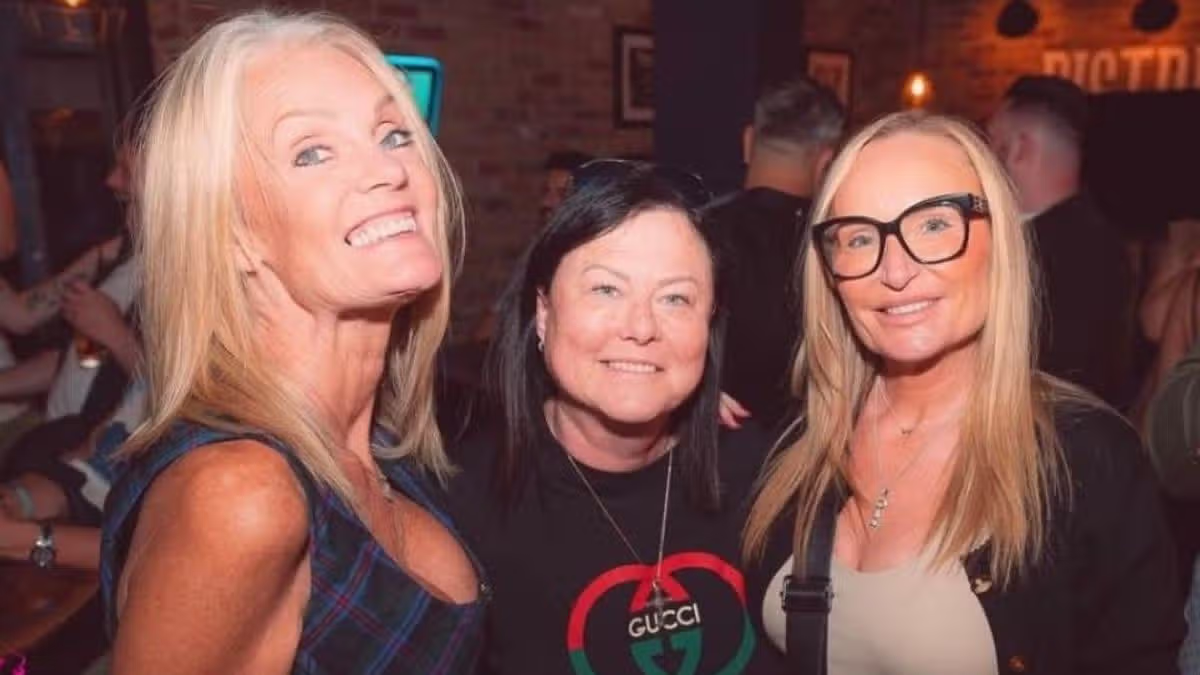
Steph said the concept of a daytime party came about after she and two friends went out in the Village and realised the concept of clubbing on Canal Street had become more expensive and revolved mostly around the evening.

“We’re older now and we prefer to get home by the time some people are just going out,” she laughs. “One of the best things about Afternoon Delights is that it finishes at 8pm and, for us, it feels like it’s midnight already by that point.”

Whilst it has become big with those looking for a club experience that comes with an appropriate bedtime, the event has also been popular with those who no longer live in Manchester and are looking to reminisce on their time clubbing out in the Village.

“A lot of the people who used to come to Vanilla now have grown up or moved out of Manchester,” Steph explains. “Not everybody can come here for a night out every weekend, but they still want the experience. That’s why we decided to do Afternoon Delights every three months – it becomes a special event and a moment for people, and they can get the train home afterwards.

Advertisement

“We have people who travel from Blackpool just for this event. We’ve even had people come up from Amsterdam as they’ve said there’s nothing like this there. There’s clearly a big interest in it!

“A member of my team recently got proposed to someone who she met at an Afternoon Delights event so we now have our very own wedding on the cards too.”

Steph said that once she had left Vanilla, she had considered herself a retiree of Manchester’s nightlife scene. But when she became frustrated with the lack of offerings in terms of what she was looking from the Village, she realised it was up to her to get an event running.

Advertisement

“I had to come out of retirement,” she says. “If I’m going to do something, I’m going to do it properly. I demand the best and that’s how we get the best. I’ve been doing this for 30 years now, so I like to think I know what I’m doing.”

Whilst the event is not directly aimed towards lesbians and queer women, it has attracted such an audience due to Steph’s links to Vanilla. But, she says that it has been great to see the event bring in audiences who are often not always represented within the village – and she hopes it will make other venues see the potential.

“It’s what the Village has been missing,” she says. “There’s not really been anything that has properly taken the space that Vanilla had, sadly. Quite frankly, I don’t think anybody has the balls to do it. Love me or hate me, Vanilla happened because I was confident enough and I had the funds to do it.”

Advertisement

Asked why the village doesn’t really have many lesbian bars or club nights right now, she adds: “I think there is generally a bit of a different approach to clubbing with women. I don’t think people think women want to go out clubbing every night, but somebody’s got to be the first do it, haven’t they?

“With Vanilla, we did loads of events which were hailed as the first one of its kind for the Village. We were the first bar that hosted Black Angel, which was an R&B and Urban night. We also did events tied into Asian music. People followed us at the time, but when we left, nobody really filled that gap.

“But I do also think the approach to the Village is different today. I feel like Manchester is, as a whole, so cool that being gay is not an issue anymore. Most people do not care. With the internet and social media, it’s changed how people go out now.

Advertisement

“That being said, you will always know when Afternoon Delights has taken place because you will see loads of women in one place in the village – something which is still quite a rarity!”

Afternoon Delights will be held at New York New York on Saturday (July 11), tickets will be £10 on the door, and from £7.75 online.

Source link

Advertisement
Continue Reading

NewsBeat

East of England Ambulance Service celebrates 20th anniversary

Published

on

Cambridgeshire Live

The East of England Ambulance Service NHS Trust formed in 2006

The East of England Ambulance Service NHS Trust (EEAST) has celebrated two decades since its formation.

Advertisement

On Wednesday, July 1, the Trust marked 20 years since it was first established through the merger of three services: Bedfordshire and Hertfordshire Ambulance and Paramedic Service NHS Trust, East Anglian Ambulance NHS Trust, and Essex Ambulance Service NHS Trust.

Simon Chase, Chief Paramedic and Director of Quality at EEAST – who witnessed the 2006 merger first-hand – has worked for the ambulance service for more than 30 years.

He said: “The ambulance service has changed significantly over the past 20 years and continues to evolve, adapt and improve. What has remained constant is the dedication of our staff in serving their communities, many of whom… have devoted decades to the ambulance service and experienced its transformation first-hand.”

One person who has been part of that journey from the very beginning is paramedic Brent Sylvester. Now a Hospital Ambulance Liaison Officer (HALO), Brent transferred from Essex Ambulance Service at the time of the merger.

Advertisement

He said: “I love the job today as much as I did when I first started with the Essex Ambulance Service in 1986. You experience both wonderful and difficult moments, but that is all part of the role. Making a difference to patients’ lives, at some of the best and worst times, is incredibly rewarding.”

Brent admitted he had seen much change over the course of his working life: “The ambulance service has changed so much during my career, and the care we provide today is more advanced than ever and continues to improve.”

Since 2006, EEAST has worked in close partnership with the region’s three air ambulance charities: East Anglian Air Ambulance, Magpas Air Ambulance and Essex & Herts Air Ambulance:

Dr Simon Lewis MBE, Executive Medical Director of Magpas said: “EEAST isn’t simply a partner to Magpas Air Ambulance, they’re part of the foundation on which everything we do is built. Operating alongside EEAST crews every single day, our partnership runs far deeper than shared geography; at every level of our organisations, we share a common goal of improving outcomes for patients by providing outstanding pre-hospital care 24/7.

Advertisement

“As EEAST marks this milestone, Magpas Air Ambulance is proud to be part of its story.”

Source link

Continue Reading

NewsBeat

World Cup thrown into chaos as FIFA told to postpone match and statement issued

Published

on

Wales Online

The tournament organisers have issued a statement ahead of the final batch of last-16 fixtures

FIFA has been told it should postpone the World Cup last-16 match between France and Paraguay on Saturday, with the game set to be played in sweltering conditions that could pose a threat to life.

Advertisement

A heatwave has hit eastern and central areas of the United States and is expected to continue over the weekend, with the tournament organisers already forced into making changes to its Fan Festival event in Philadelphia due to the dangerous and potentially record-breaking temperatures expected.

France and Paraguay will face each other in the city at 5pm on Saturday, with the head index – which includes humidity – expected to be between 37C and 46C at the uncovered Philadelphia Stadium.

Under FIFA’s current heat guidelines, any match could be postponed if the wet bulb temperature – accounting for heat and humidity – reaches 32C.

Get the latest World Cup news straight to your inbox by signing up to our Make Football Great Again newsletter now!

Advertisement

With rising concerns for the safety of players, officials and fans, the governing body has been urged to postpone the match and delay kick-off until the evening, when temperatures will be slightly cooler.

One critic added that playing the fixture as it stands puts those involved at “unnecessary risk”, with a postponement of just a few hours making conditions “considerably more playable”.

Director of the Heat Lab at the University of California, Bahart Venkat, told the Associated Press: “When you’re exerting yourself on a particularly hot day, the likelihood of experiencing heat related illness or even death is much higher.”

He added that players’ decision-making could also be negatively impacted by the sweltering temperatures.

Advertisement

This year’s World Cup matches have featured mandatory three-minute hydration breaks midway through each half.

While they have been criticised for disrupting the flow of games, they have remained in force to protect players from extreme heat illness.

In a statement, FIFA said it was taking proactive steps to protect fans heading to Saturday’s match in Philadelphia, such as setting up cooling tents and making water readily available.

“FIFA is committed to protecting the health and safety of all players, referees, fans, volunteers and staff through a tiered heat mitigation model,” a spokesperson told The Philadelphia Inquirer.

Advertisement

“Through close collaboration with the City of Philadelphia, medical experts and emergency authorities, FIFA remains committed to delivering a safe, resilient and memorable tournament experience for everyone involved.”

It comes as England’s match against Mexico on Sunday was almost brought forward by six hours amid concerns over storms and fan safety.

Source link

Advertisement
Continue Reading

NewsBeat

Our song of the summer predictions for 2026

Published

on

Our song of the summer predictions for 2026

What is 2026’s song of the summer?

There’s no easy answer. Algorithmic division is certainly a factor in why there isn’t an obvious pick this year. Where have the songs like “Despacito” in 2017 or “Old Town Road” in 2019 gone? Last year, some even wondered if Alex Warren’s “Ordinary” — a ballad, not a banger — qualified, a departure from the usual up-tempo, feel-good hits.

Whatever your summer mood or flavor, The Associated Press has found a song to soundtrack the season, collected in a Spotify playlist.

Biggest song of the year and therefore the default song of the summer: “Choosin’ Texas,” Ella Langley

Advertisement


Ella Langley broke out just last year with the throwback, spoken-word track “You Look Like You Love Me,” featuring Riley Green, but it’s her breakup banger “Choosin’ Texas” that has made her a crossover country star. Not only has it spent more time at No. 1 on the Billboard Hot 100 than any other song this year, it also has some of the most distinctive lyrics of the year. “He always loved ‘Amarillo By Morning,’” she sings in a particularly melancholic verse, referencing the George Strait classic. “I should’ve taken that as a warnin’.” Indeed.

Advertisement

Past champion: “Luther,” Kendrick Lamar and SZA (2025)

Song of the summer for when you lose the beef but still have fight left in ya: “Janice STFU,” Drake


Advertisement

For the better part of 2025, Drake mostly made headlines for his feud with Kendrick Lamar. It’s safe to say he lost that war, but he’s clearly not going anywhere; he’s still one of the most streamed artists of all time. “Janice STFU” is the undeniable hit off May’s “Iceman,” with its familiar Lykke Li interpolation and moody production.

Past champion: “Nokia,” Drake (2025)

Song of the summer that shares a title with a film: “Midnight Sun (Girls Trip),” Zara Larsson and PinkPantheress

Advertisement


It’s the title of a 2018 romantic drama starring Bella Thorne and a term used to describe regions around the Arctic Circle. But in 2026, the phrase “Midnight Sun” belongs to Swedish pop star Zara Larsson. It’s the title of her last album and lead single, the inescapable Eurodance-pop “Midnight Sun,” with an elastic vocal performance. Last month, she released “Midnight Sun: Girls Trip,” a collection of remixes featuring everyone from Shakira and Robyn to Kehlani and rapper JT and, of course, PinkPantheress.

Advertisement

Past champion: “Breakfast at Tiffany’s,” Deep Blue Something (1995)

Song of the summer for high-energy It Girls: “DANCE…,” Slayyyter


Advertisement

She’s the “Wor$t Girl in America,” if her cheeky album title is to be believed, but also one of pop’s great new provocateurs. At the album’s center is her buzzy electro-pop opus “DANCE…,” perfect for those who’ve been patiently awaiting her mainstream rise — and those who need a good excuse to hit the dance floor.

Past champion: “Bad Girls,” Donna Summer (1979)

Song of the summer for the throwback crowd: “I Just Might,” Bruno Mars

Advertisement


Earlier this year, hitmaker Bruno Mars returned with his first new album in 10 years, anchored by the feel-good, disco-pop-soul single “I Just Might.” The throwback tune is a funky reprieve from slow or boring days — and one that will be heard on wedding dance floors for the foreseeable future.

Advertisement

Past champion: “Red Red Wine,” UB40 (1983)

Song of the summer that arrived at the beginning of the year: “Dracula (Jennie Remix)”, Tame Impala and Jennie


Advertisement

There’s a long tradition of the song of the summer arriving at the top of the year — looking at you, “drivers license” and “Boy’s a Liar PT. 2.” This year, the title goes to Tame Impala’s “Dracula” — particularly the remix with Blackpink’s Jennie. “Run from the sunlight, Dracula,” they harmonize, in a vocal melody inescapable on TikTok and in the real world.

Past champion: “NUEVAYoL,” Bad Bunny (2025)

Song of the summer for those looking for a club classic: “Chévere (premium_remix),” by Aria Vega and Ryan Castro

Advertisement


A club-ready contender for song of the summer should be easy, breezy and amorous. Such is the case of Aria Vega and Ryan Castro’s “Chévere (premium_remix),” where reimagined, romantic reggaeton is perfect for a house party or finding the love of your life. Ideally both.

Advertisement

Past champion: “Break My Soul,” Beyoncé (2022)

Song of the summer for people who know the power of a good bridge: “The Cure,” Olivia Rodrigo


Advertisement

In the lead up to her career-best album, “You seem pretty sad for a girl so in love,” Olivia Rodrigo released “The Cure.” It marked a giant step forward for the young songwriter, with dreamy guitars, orchestral strings and most impactful of all: its explosive bridge.

Past champion: “Hollaback Girl,” Gwen Stefani (2005)

Song of the summer for people who love music, fashion and film in equal measure: “SS26,” Charli xcx

Advertisement


So long, “BRAT.” The contemporary pop landscape’s preeminent party girl is in for a bummer of a summer. “SS26,” one of the first tracks released from Charli xcx’s forthcoming “Music, Fashion, Film,” is shockingly minimalistic, with little more than distorted guitar riffs and production that sounds like a simple Casio keyboard preset. It’s rock music, as she’s promised — but done her own way.

Advertisement

Past champion: “Rhinestone Cowboy,” Glen Campbell (1975)

Song for people who live like it’s summer year-round: “E85,” Don Toliver


Advertisement

“On the highway with my significant lover (I love),” the singer-songwriter-rapper Don Toliver declares with ease in the chorus of “E85.” “High octane, more fuel for your consumption.” If there is an image more primed for the hot summer months than rolling down the freeway on a trip with a loved one, we have yet to see it.

Past champion: “Mi Gente,” J Balvin and Willy William (2017)

Song of the summer for seaside dreamers: “Swim,” BTS

Advertisement


The game-changing K-pop boy band BTS returned after a nearly four-year musical hiatus with “ARIRANG.” The comeback was led by “Swim,” a reserved, alt-pop track that brings a kind of intimacy to their stadium-sized output. The “Swim” here is metaphorical — as is the “dive” in its chorus — of having a crush, but the aquatic language works in conjuring dreamy, poolside imagery, too.

Advertisement

Past champion: “Waterfalls,” TLC (1995)

Song of the summer for the yearners: “Raindance,” Dave ft. Tems


Advertisement

British rapper Dave and Nigerian singer Tems team up for the Afroswing single “Raindance,” a sweet, sexy song about wanting to lock things down. “Hold me close, don’t tell me goodnight / Are you down to get me?” the pair dreamily duet on the second verse. “Tell me when you’re ready, I’m ready.”

Past champion: “Nineteen,” Tegan and Sara (2007)

Song of the summer for the sports crowd: “Dai Dai,” Shakira and Burna Boy

Advertisement


This summer is all about soccer, so, of course, we had to include one of the official songs for the 2026 FIFA World Cup: “Dai Dai.” The Colombian superstar Shakira and Afrobeats icon Burna Boy team up on an energetic, undeniably global pop track. It exists at the intersection of all their strengths: Afrobeats and Latin rhythms, separate, complementary verses and a strong chorus about unity.

Advertisement

Past champion: “The Final Countdown,” Europe (1986)

Song of the summer for those ready to stop feuding and enjoy life again: “Horses & Divorces,” Kacey Musgraves and Miranda Lambert


Advertisement

Look, there’s no shortage of great songs from Kacey Musgraves’ latest album, “Middle of Nowhere.” A case could be made to include “Mexico Honey” or “Dry Spell” here, but what about a song with norteño accordions and slide guitar that doubles as a cheeky punchline to a fight? The capital-c country “Horses & Divorces” brings musicians’ feud to an end over a shared love of drinking and Willie Nelson. What could be sweeter?

Past champion: “Girl, so confusing,” Charli xcx and Lorde (2024)

Advertisement

Source link

Continue Reading

NewsBeat

Plans to turn former chapel into ‘vibrant community space’ given go-ahead

Published

on

Cambridgeshire Live

The space will feature a café and wellness space

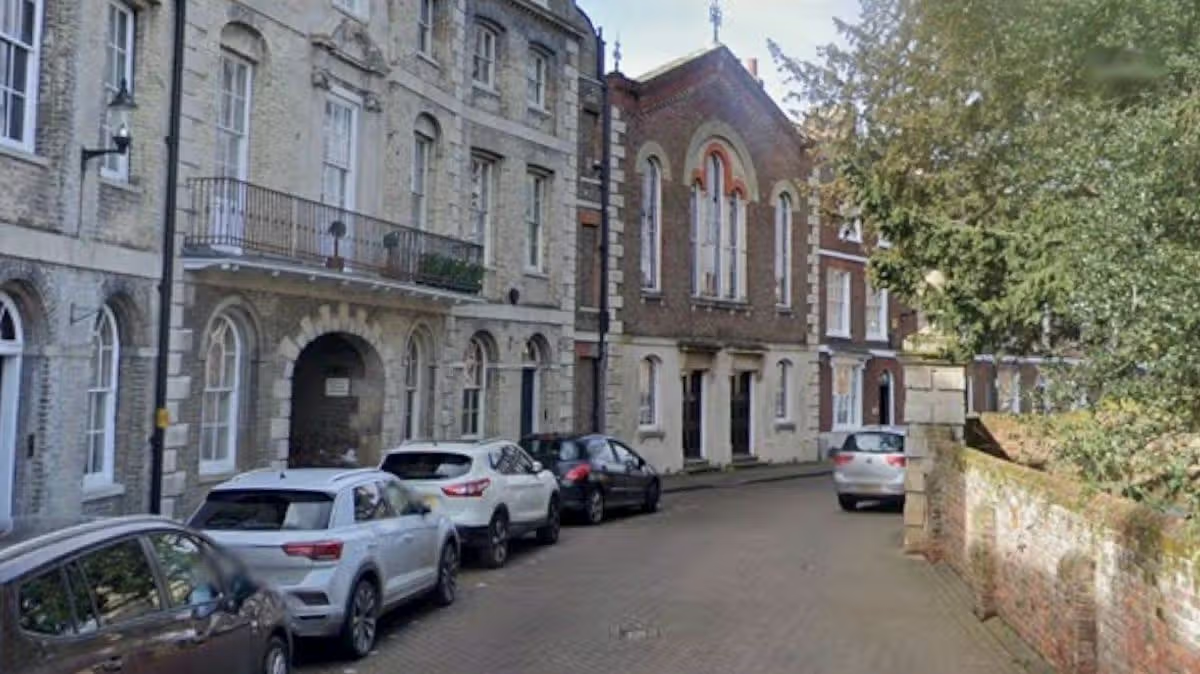
Plans have been approved for a former chapel to become a “vibrant community hub”. Back in May, Mr D Daly submitted plans to turn the former Masonic Hall in The Crescent, Wisbech into a community space.

Advertisement

The plans proposed that the building would include a health and wellbeing centre and a café, and it would also be used as a community space and for events. The applicant said the Crescent Wellness Club would bring a “historic building back into use”.

They also said the space would provide a “welcoming and inclusive environment supporting physical, mental and emotional wellbeing, alongside community and creative use”. The wellness space will offer mental health and wellbeing workshops, therapy and group support sessions.

The basement area will also be used for yoga, Pilates, reformer Pilates and sound healing. Fenland District Council has now approved the plans.

Before approval, there was a mix of objections and support for the application. A resident in Lerowe Road objected to the plans as they said there was “no provisions made for wheelchair access”.

Advertisement

The Wisbech Society said they “welcomed” the plans, but they did raise some concerns. One of these concern was about a potential “nuisance” to neighbours.

A spokesperson for the society said: “The design and access statement notes long operational hours of 7am to 9pm with a café in operation from 8am to 5pm with a capacity for 50.

“Also, an estimate of a possible 208 users at one time. We wish the enterprise well, but this will have a significant impact on neighbouring residents in this prime location in Wisbech.

“We wish to have assurance that all measures will be taken to alleviate any disturbance; including use of on street parking and noise.”

Advertisement

Another resident in Union Place was in support of the plans. They said: “It is refreshing to see a large public building and period property being restored and put to use in the community when so many others in town are derelict and slowly going to ruin.”

Source link

Continue Reading

NewsBeat

Wales breaking news plus weather and traffic updates (Saturday, July 4)

Published

on

Wales Online

Hello, and welcome to WalesOnline’s live blog for Saturday, July 4. We’ll be bringing you all of the latest news from across Wales – whether you’re on the move, at home or at work – as well as the latest traffic and travel.

We’ll also be keeping you informed of major news stories from the UK and overseas.

Contribute to the live blog by posting your comments below, or tweet us @WalesOnline to share the news that’s breaking in your area. Read the biggest stories in Wales first by signing up to our daily newsletter here.

Advertisement

Source link

Continue Reading

NewsBeat

LGBTQ+ Londoners share tributes on what Pride means to them

Published

on

LGBTQ+ Londoners share tributes on what Pride means to them

Peter Tatchell, LGBTQ+ and human rights campaigner

‘We saw Pride as the LGBT+ equivalent of the black civil rights marches in America’

Peter Tatchell

Getty

Advertisement

Way back in the early 1970s, I was a member of the newly formed Gay Liberation Front (GLF). It was Britain’s first freedom movement of openly LGBT+ people. In those days, nearly everyone was closeted and many felt ashamed.

Indeed, homosexuality was condemned as shameful by every social institution: government, police, media, church and the medical profession.

The opposite of shame is pride. So, on 1 July 1972, in London, GLF held the UK’s first-ever “Gay Pride” march. Our aim was to show that we were proud, not ashamed. Only 700 people turned up. Most of my friends were too scared to march. They feared that if they were seen at Pride they might be sacked from their job or evicted. That was lawful in those days. Many worried that we’d be attacked by queer-bashers or arrested. That didn’t happen, but we were swamped by a sometimes aggressive police presence. They treated us like criminals. It was scary.

But we were determined to have fun and make our point. Our carnival-style parade went from Trafalgar Square to Hyde Park. There were lots of extravagant costumes and banners poking fun at homophobes like Mary Whitehouse.

Advertisement

Back then, Pride was very political. In 1972 homosexuality was still classified as an illness, lesbian mothers had their kids taken off them by the courts, and the police were at war with the LGBT+ community — with thousands of gay and bisexual men arrested for consensual behaviour, including for having sex before the age of 21, the discriminatory age of consent for gay men at the time. Many of us saw the Pride parade as the LGBT+ equivalent of the black civil rights marches in America. Our slogan was “Gay Is Good”.

We got mixed reactions from the public. Some were hostile. Many were curious or bewildered. Most had never knowingly seen a gay person, let alone hundreds of queers demanding freedom. But some were supportive, which encouraged us.

Unlike nowadays, there was no commercial sponsorship. No business wanted to be associated with queers. London councils spurned the event. MPs refused to attend.

There were no floats or marching bands, and no entertainment after the march. Instead, we held a DIY party in Hyde Park. We played camped-up versions of party games like spin the bottle and drop the hanky. I won a game and my prize was a kiss with a handsome French activist who had come over to London for our march.

Advertisement

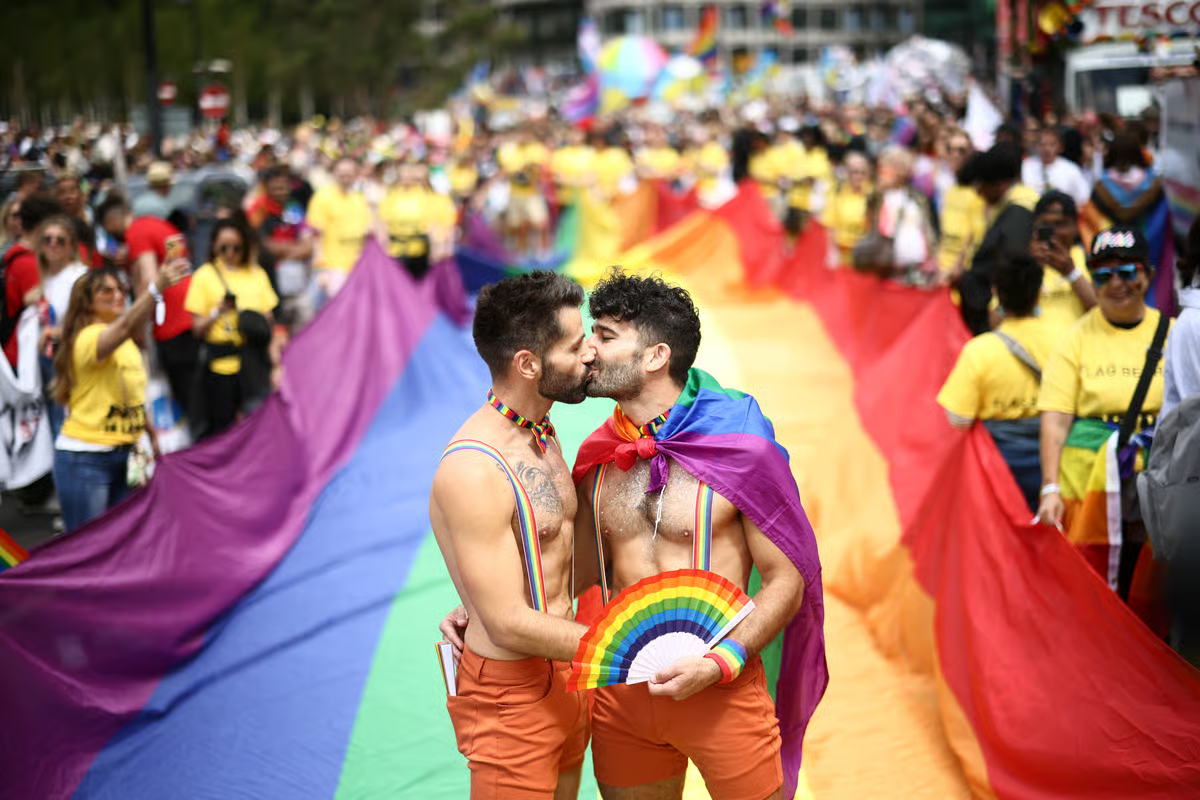
Kissing him was more than good fun. In those days, same-sex kissing in public could get you arrested. Our games were a gesture of defiance. But the police didn’t make arrests — I guess there were just too many uppity queers for them to handle.

Five decades on, London Pride is now a rally attended by more than a million revellers. Since 1999, we’ve won many LGBT+ law reforms, such as equalising the age of consent to 16, repealing Section 28 and legalising same-sex marriage.

But nearly half of all LGBT+ pupils are bullied at school, there are thousands of homophobic hate crimes every year and about 12 per cent of the public still believe that homosexuality is “always or mostly wrong”. Trans people are demonised and subject to new social exclusions following the Supreme Court ruling.

This is why the campaign for our rights must continue. Let’s have a fun Pride but also send out a message: the battle for acceptance and rights ain’t over yet.

Advertisement

Peter Tatchell is the director of the Peter Tatchell Foundation; petertatchellfoundation.org

‘I’m overwhelmed with gratitude that schools like my daughter’s celebrate Pride’

Author and writer Lotte Jeffs attends the Elle Style Awards 2017 on February 13, 2017 in London,

Lotte Jeffs

Getty Images

I was up a ladder, hanging up rainbow bunting so that it stretched from the school gates to the branch of an apple tree in the playground, when the emotion hit me. My daughter’s state primary in south-east London celebrates Pride every July. There’s a big Pride playtime with music and dancing. In the classroom there are lessons about diversity; sometimes an LGBT speaker will share their experiences and I’ll read the picture book I wrote, My Magic Family (published by Puffin) to the Reception and Year One children. We’ll talk about the fact that the girl in my story, right, has two mums and goes on a fantastical adventure to discover all the different kinds of families her friends are part of, too.

Advertisement

I love answering the four and five-year-old’s questions. I’ve been asked if I live in a shoe, why dragons breathe fire and if it’s possible to hate Frozen if you love princesses. But I’ve never once, in the four years I’ve been doing this, had my queer family questioned or challenged — the kids just get it.

I’ve heard from other LGBT families who say that their children’s schools either don’t acknowledge Pride Month at all or do so in a way that involves rainbows and kindness but avoids ever having to mention the words “gay” or “lesbian” — as if the terms are somehow inappropriate.

But what about the kids with gay parents or other family members? What about the Year Six children who are starting to wonder if they might be queer or trans themselves? How damaging it is to be told, even subtly, that this is not OK. To normalise talking about the LGBT community, and all the ways we can be ourselves and love who we want to love, is powerful and affirmative. It could make the difference between a child growing up feeling shame about themselves or having a deep sense of pride.

I was a child during the era of Section 28, when it was illegal to talk about homosexuality in schools, so I’m overwhelmed with relief and gratitude that schools like my daughter’s celebrate LGBT Pride. Watching the kids run out into the playground to a soundtrack of gay anthems, waving Progress flags and queuing up for glitter facepaint fills my heart with joy every year.

Advertisement

Jack Guinness, Presenter and author of The Queer Bible

‘I dropped Madonna’s Vogue as we turned onto Oxford Street and the crowd erupted as one’

Getty

My favourite London Pride memory? It’s a surreal one. Years ago I was the face of Levi’s for its Pride campaign. I arrived to the float early in the morning to join the procession. As soon as the parade got moving, whistles, cheers and music created a cacophony of queer joy. We moved past families with small children, allies and parents holding placards celebrating their LGBTQ+ kids. Seeing an older gay couple holding hands and watching the march, I imagined all they have endured: surviving the Aids epidemic, repressive laws under the Conservatives and living in such a hostile world. I cried… with joy for all we’ve achieved, but with sadness for all they had to fight against.

Queer people so often move through the world in a state of high alert, constantly checking ourselves. Even as a very privileged, white, cisgender, gay man, I constantly ask myself: am I being too visible? Is it safe to hold my partner’s hand? Dare I steal a kiss and risk attack? But at Pride, en masse, we are offered a level of temporary security.

Advertisement

For just a day, we can be impulsive, freeing ourselves from the checks that society puts on us. We can be unapologetic, reject shame and be truly proud.

On that sunny day in London, I clambered (gracefully, of course) onto the top of the float. I plugged my USB sticks into the decks and dropped Madonna’s song Vogue just as we turned onto Oxford Street. The crowd erupted. As one, connected through music, through shared history and, most importantly, through love… we danced.

‘Pride was born out of protest, designed to be a disruption to the status quo’

  CRYSTAL

Crystal

Crystal

Advertisement

São Paulo. Madrid. Brighton. Manchester. The Pride that changed my life wasn’t at any of these grand or well-known locations. It happened in 2023, in Southend-on-Sea.

I was booked to perform at Adventure Island amusement park in Southend as part of the area’s Pride celebrations, right. It was the third year in a row that I had brought a family-friendly show to the park. There was a warm atmosphere, with lots of families and teens.

Sadly, someone who hadn’t attended the event clipped a few seconds of video, Right-wing outrage accounts (like Libs of TikTok) amplified it, and the Daily Mail did a hit piece on me, saying parents were “horrified”. Suddenly I was receiving hundreds of comments describing me as a paedophile, and MP Lee Anderson was on GB News calling me an “it”.

Adventure Island issued a statement claiming it had no idea about the nature of my performance and cancelled all future Pride events at the park. It said “Pride isn’t for us”, and that its attempt at inclusivity had “backfired”. Of course, I had done the same act there for three years with no issue, so the problem wasn’t me or my performance, it was the manufactured outrage. It was a stark reminder of the nature of pinkwashing. Companies are very happy to use queer people when convenient, either to sell things or to polish their image. But we can’t count on them when the chips are down.

Advertisement

This is true of governments and public bodies as well, as we’ve seen Reform-led councils around the country axe Pride funding this year.

The thing is, Pride was never meant to be free from controversy. It was born out of protest, designed to disrupt the status quo. So, the following year I returned to Southend-on-Sea to volunteer my services for the grassroots local Pride. While the corporate version of Pride folded under pressure, the real one didn’t. The event was joyful and couldn’t be cancelled on a panicked CEO’s whim.

As the anti-trans panic intensifies, more and more companies and councils will pull back their support, so we need to remember the lesson I learned from Southend. If we are united, no one can stop us. See you on the streets!

Lady Phyll, Political activist

Advertisement

‘As long as our rights can be denied, Pride remains both a celebration and a call to action’

Lady Phyll

Getty

Pride feels as though, for just a few precious hours, we have given each other permission to exist fully. Today, when I stand at UK Black Pride and look out at tens of thousands of people, I don’t see a crowd. I see generations. I see elders who fought battles many of us will never fully understand. I see young people discovering that they are not alone.

I see families, chosen and biological, celebrating together. I see joy sitting alongside protest, because our liberation has always demanded both.

Advertisement

People sometimes ask whether Pride is still needed. My answer is always the same: as long as there is a young queer person wondering if there is a place for them, Pride matters; as long as Black, trans, disabled, migrant and other marginalised LGBTQIA+ communities are still fighting to be seen, Pride matters; and as long as our rights can be debated, rolled back or denied, Pride remains both a celebration and a call to action.

Miss Jason, DJ and presenter

‘I saw strangers looking out for one another, caring for each other like family’

Miss Jason attends the Another Man x Jil Sander Launch at Jil Sander on April 30, 2026 in London

Miss Jason

Jed Cullen/Dave Benett/Getty Ima

Advertisement

I remember my first Pride parade. I was 24, newly out and still learning how to feel comfortable in my own skin. My friends and I decided it would be fun to get the coach to Brighton and have a few drinks on the way.

A few drinks quickly turned into far too many, and we arrived absolutely smashed. But what I remember most has nothing to do with that.

I just recall feeling an overwhelming sense of safety. I saw people of every age living unapologetically, celebrating who they were. I saw strangers looking out for one another, caring for each other like family. It was something I wasn’t used to, but I instantly loved it. I’ll never forget this one Pride in Soho where artist Liz Johnson Artur steered us through this crowd of tall muscle gays, like she knew exactly where to go. She is only about 5ft 2in, but she had this total authority in the middle of all that chaos.

My friend was newly transitioning at the time, and a woman came over with her child. She wanted her child to meet my friend, and to say “Happy Pride” and give her a hug — to really see her and make it clear she was supported.

Advertisement

It really got to me. Knowing how much it meant to my friend, who was going through this new journey, was so beautiful and poetic.

For me Pride is safety. Pride is home. Pride is kindness. Pride is about being seen and seeing others.

Source link

Advertisement
Continue Reading

Trending

Copyright © 2025